Digital Green Hospitality: How Green Marketing and Digitalization Shape Tourist Perceptions and Eco-Friendly Hotel Booking Decisions


Abstract
1. Introduction
2. Theory-Informed Conceptual Framework
2.1. Stimulus-Organism-Response (S-O-R) Framework
2.2. Perceived Green Marketing Practices
2.3. Perceived Digitalization
2.4. Tourist Perception
2.5. Eco-Friendly Accommodation Booking Intention
2.6. Purchase Decision and Behavioral Intention
2.7. Hypothesis Development
2.7.1. Green Marketing Strategies and Digitalization
2.7.2. Green Marketing Strategies and Tourist Perception
2.7.3. Green Marketing Strategies and Purchase Decision for Eco-Friendly Accommodation
2.7.4. Digitalization and Purchase Decision for Eco-Friendly Accommodation
2.7.5. Tourist Perception and Purchase Decision for Eco-Friendly Accommodation
2.7.6. Digitalization and Tourist Perception
2.7.7. Digitalization as an Intervening Mechanism Linking Green Marketing Strategies and Eco-Friendly Accommodation Purchase Decisions
2.7.8. Tourist Perception as an Intervening Mechanism Linking Green Marketing Strategies and Eco-Friendly Accommodation Purchase Decisions
3. Materials and Methods
3.1. Research Design
3.2. Research Instrument
3.3. Sampling and Data Collection
3.4. Sample Characteristics
3.5. Data Analysis
4. Results
5. Discussion
6. Conclusions
7. Research Limitations and Directions for Future Research
Author Contributions
Funding
Institutional Review Board Statement
Informed Consent Statement
Data Availability Statement
Acknowledgments
Conflicts of Interest
Appendix A

| Construct | Dimension | Item | Sources |
|---|---|---|---|
| Green Marketing Strategies | Environmental Communication | 1. The hotel clearly provides information about environmental conservation activities or projects, such as through its website or social media. | Developed based on Acampora et al. (2022); Alyahia et al. (2024); Brañes et al. (2025) |
| 2. I can easily access information about the hotel’s environmental policies, such as reducing plastic use and saving energy. | |||
| 3. The hotel regularly communicates the importance of environmental conservation to customers, such as through its website or social media. | |||
| 4. I feel that the hotel is sincere in communicating environmental issues, rather than doing so merely for marketing purposes. | |||
| Eco-Friendly Certifications | 1. The hotel has environmental certifications or standards from a credible organization. | Developed based on Težak Damijanić et al. (2023); Velaoras et al. (2025) | |
| 2. The hotel’s environmental certification affects my confidence in choosing its services. | |||
| 3. The hotel clearly displays information or symbols of its environmental certification through its communication channels. | |||
| 4. The environmental certification received by the hotel reflects its genuine commitment to environmental protection. | |||
| Green Product and Service Offerings | 1. The hotel uses environmentally friendly products, such as biodegradable soap, shampoo, or packaging. | Developed based on Majeed et al. (2022); Seo et al. (2024); Yu et al. (2021) | |
| 2. The hotel provides services that help reduce resource consumption, such as water- or energy-saving systems in guest rooms. | |||
| 3. The hotel organizes activities or provides services that promote environmental conservation, such as recycling or tree-planting activities. | |||
| 4. The hotel places serious importance on offering environmentally friendly products and services. | |||
| Customer Engagement in Sustainability | 1. The hotel encourages customers to participate in activities that promote sustainability, such as tree planting or waste recycling. | Developed based on Acampora et al. (2022); Seo et al. (2024); Han (2021) | |
| 2. I feel motivated to participate in environmental activities organized by the hotel. | |||
| 3. The hotel provides information or recommendations on how customers can help reduce environmental impacts during their stay. | |||
| 4. Participating in the hotel’s sustainability activities enhances the value of my accommodation experience. | |||
| Digitalization | Digital Culture | 1. The hotel continuously promotes the use of digital technology in service delivery, such as online booking, mobile check-in, or applications. | Developed based on Farías and Cancino (2021); Amirulloh Anwar et al. (2024) |
| 2. I feel that the hotel is modern and receptive to digital innovations in its operations. | |||
| 3. The hotel uses digital channels to communicate with customers effectively, such as responding through social media or automated chat systems. | |||
| 4. The hotel’s use of digital technology increases convenience and provides a better accommodation experience for me. | |||
| Digital Organization | 1. The hotel uses digital systems for internal management, such as customer data management, room reservations, and customer service. | Developed based on Farías and Cancino (2021); Amirulloh Anwar et al. (2024) | |
| 2. Hotel employees are capable of using digital technology to serve customers effectively. | |||
| 3. The hotel continuously improves its digital systems to increase operational efficiency. | |||
| 4. The hotel’s internal management through digital systems enables me to receive fast and high-quality services. | |||
| Digital Technology | 1. The hotel uses digital technology in services during my stay, such as automated check-in systems or controlling room equipment through an application. | Developed based on Farías and Cancino (2021); Amirulloh Anwar et al. (2024); Nguyen et al. (2022) | |
| 2. The hotel uses technology to communicate effectively with customers, such as mobile notifications or online chat systems. | |||
| 3. I feel that the digital technology used by the hotel increases convenience and my satisfaction during my stay. | |||
| Digital Insights | 1. The hotel collects and analyzes data from digital systems to improve services, such as online booking data, customer satisfaction, or stay behavior. | Developed based on Amirulloh Anwar et al. (2024); Rodrigues et al. (2023); Zeqiri et al. (2025) | |
| 2. I feel that the hotel understands customers’ needs well through the use of digital data. | |||
| 3. The hotel offers promotions or services that match my interests through digital channels. | |||
| 4. The use of data from digital systems enables the hotel to respond to customers’ needs quickly and accurately. | |||
| Tourist Perception | Perceived Environmental Responsibility | 1. The hotel is genuinely committed to activities that help conserve the environment. | Developed based on Hou and Wu (2021); Araújo et al. (2025); Patwary et al. (2022b) |
| 2. The hotel has clear policies to reduce environmental impacts, such as reducing energy use or managing waste. | |||
| 3. The hotel plays a role in promoting sustainability in the tourism industry. | |||
| 4. My perception of the hotel’s environmental responsibility affects my confidence in choosing its services. | |||
| Perceived Value | 1. I feel that choosing to stay at an eco-friendly hotel provides good value for the price paid. | Developed based on Kokkhangplu et al. (2023); Chang et al. (2024) | |
| 2. Using the services of an environmentally conscious hotel makes me feel good and more satisfied. | |||
| 3. I believe that supporting eco-friendly hotels is a valuable investment in society and the environment. | |||
| 4. Overall, I feel that the experience received from an eco-friendly hotel is more valuable than that of a conventional accommodation. | |||
| Perceived Trust | 1. I trust that the hotel is sincere in carrying out environmentally friendly activities. | Developed based on Alyahia et al. (2024); Težak Damijanić et al. (2023) | |
| 2. The environmental information published by the hotel is reliable and verifiable. | |||
| 3. I trust that the hotel follows the environmental policies it has announced. | |||
| 4. The hotel’s environmental credibility affects my decision to choose the accommodation. | |||
| Perceived Image | 1. The hotel has a good image in terms of environmental care. | Developed based on Seyfi et al. (2025); Yu et al. (2021); Majeed et al. (2022) | |
| 2. The hotel has a modern image and is concerned about sustainability. | |||
| 3. The hotel’s environmental image affects my pride in choosing its services. | |||
| 4. I believe that the image of an eco-friendly hotel helps differentiate it from conventional hotels. | |||
| Purchase Decision | Intention | 1. I intend to choose an eco-friendly accommodation for my next trip. | Developed based on Patwary et al. (2022a); Van Huy et al. (2024); Dong et al. (2024) |
| 2. I give importance to choosing accommodations with environmental policies when planning a trip. | |||
| 3. I am inclined to avoid booking accommodations without clear environmental measures. | |||
| 4. I intend to support hotels that operate sustainably and are environmentally friendly. | |||
| Likelihood | 1. I am highly likely to choose an eco-friendly accommodation when there are options to choose from. | Developed based on Kokkhangplu et al. (2023); Chang et al. (2024); Velaoras et al. (2025) | |
| 2. If there is an eco-friendly accommodation in the area I wish to visit, I am more likely to book it than a conventional accommodation. | |||
| 3. I am likely to recommend an eco-friendly accommodation to friends or family. | |||
| 4. I am likely to book an eco-friendly accommodation even if its price is slightly higher than that of a conventional accommodation. | |||
| Effort | 1. I am willing to spend time searching for information about eco-friendly accommodations before making a booking. | Developed based on Fuchs et al. (2025); Araújo et al. (2025) | |
| 2. I am willing to compare several accommodation options to choose the one with the best environmental policies. | |||
| 3. I am willing to adjust my travel plans so that I can stay at an eco-friendly accommodation. | |||
| 4. I am willing to make additional efforts to book an eco-friendly accommodation even if it is not the most convenient option. | |||
| Prioritization | 1. I prioritize choosing an eco-friendly accommodation over other factors, such as price or location. | Developed based on Fuchs et al. (2025); Seo et al. (2024); Majeed et al. (2022) | |
| 2. When comparing several accommodations, I usually choose first the one with clear environmental policies. | |||
| 3. I consider the environmental friendliness of an accommodation a major factor in my booking decision. | |||
| 4. Even if there are other options that are more convenient or less expensive, I still prioritize choosing an eco-friendly accommodation. |
| Variables | Factor Loading | Cronbach’s Alpha |
|---|---|---|
| 1. Green Marketing Strategies | ||
| 1.1 Environmental Communication | 0.719–0.798 | 0.893 |
| The hotel clearly provides information about environmental conservation activities or projects, such as through its website or social media. | 0.766 | |
| I can easily access information about the hotel’s environmental policies, such as reducing plastic use and saving energy. | 0.756 | |
| The hotel regularly communicates the importance of environmental conservation to customers, such as through its website or social media. | 0.798 | |
| I feel that the hotel is sincere in communicating environmental issues, rather than doing so merely for marketing purposes. | 0.719 | |
| 1.2 Eco-Friendly Certifications | 0.719–0.764 | 0.884 |
| The hotel has environmental certifications or standards from a credible organization. | 0.719 | |
| The hotel’s environmental certification affects my confidence in choosing its services. | 0.746 | |
| The hotel clearly displays information or symbols of its environmental certification through its communication channels. | 0.764 | |
| The environmental certification received by the hotel reflects its genuine commitment to environmental protection. | 0.742 | |
| 1.3 Green Product and Service Offerings | 0.590–0.759 | 0.851 |
| The hotel uses environmentally friendly products, such as biodegradable soap, shampoo, or packaging. | 0.718 | |
| The hotel provides services that help reduce resource consumption, such as water- or energy-saving systems in guest rooms. | 0.590 | |
| The hotel organizes activities or provides services that promote environmental conservation, such as recycling or tree-planting activities. | 0.700 | |
| The hotel places serious importance on offering environmentally friendly products and services. | 0.759 | |
| 1.4 Customer Engagement in Sustainability | 0.707–0.803 | 0.895 |
| The hotel encourages customers to participate in activities that promote sustainability, such as tree planting or waste recycling. | 0.768 | |
| I feel motivated to participate in environmental activities organized by the hotel. | 0.763 | |
| The hotel provides information or recommendations on how customers can help reduce environmental impacts during their stay. | 0.803 | |
| Participating in the hotel’s sustainability activities enhances the value of my accommodation experience. | 0.707 | |
| 2. Digitalization | ||
| 2.1 Digital Culture | 0.729–0.766 | 0.886 |
| The hotel continuously promotes the use of digital technology in service delivery, such as online booking, mobile check-in, or applications. | 0.729 | |
| I feel that the hotel is modern and receptive to digital innovations in its operations. | 0.766 | |
| The hotel uses digital channels to communicate with customers effectively, such as responding through social media or automated chat systems. | 0.731 | |
| The hotel’s use of digital technology increases convenience and provides a better accommodation experience for me. | 0.759 | |
| 2.2 Digital Organization | 0.689–0.762 | 0.876 |
| The hotel uses digital systems for internal management, such as customer data management, room reservations, and customer service. | 0.689 | |
| Hotel employees are capable of using digital technology to serve customers effectively. | 0.762 | |
| The hotel continuously improves its digital systems to increase operational efficiency. | 0.749 | |
| The hotel’s internal management through digital systems enables me to receive fast and high-quality services. | 0.720 | |
| 2.3 Digital Technology | 0.767–0.807 | 0.859 |
| The hotel uses digital technology in services during my stay, such as automated check-in systems or controlling room equipment through an application. | 0.767 | |
| The hotel uses technology to communicate effectively with customers, such as mobile notifications or online chat systems. | 0.807 | |
| I feel that the digital technology used by the hotel increases convenience and my satisfaction during my stay. | 0.769 | |
| 2.4 Digital Insights | 0.683–0.745 | 0.872 |
| The hotel collects and analyzes data from digital systems to improve services, such as online booking data, customer satisfaction, or stay behavior. | 0.683 | |
| I feel that the hotel understands customers’ needs well through the use of digital data. | 0.745 | |
| The hotel offers promotions or services that match my interests through digital channels. | 0.728 | |
| The use of data from digital systems enables the hotel to respond to customers’ needs quickly and accurately. | 0.738 | |
| 3. Tourist Perception | ||
| 3.1 Perceived Environmental Responsibility | 0.658–0.764 | 0.869 |
| The hotel is genuinely committed to activities that help conserve the environment. | 0.705 | |
| The hotel has clear policies to reduce environmental impacts, such as reducing energy use or managing waste. | 0.764 | |
| The hotel plays a role in promoting sustainability in the tourism industry. | 0.746 | |
| My perception of the hotel’s environmental responsibility affects my confidence in choosing its services. | 0.658 | |
| 3.2 Perceived Value | 0.702–0.732 | 0.870 |
| I feel that choosing to stay at an eco-friendly hotel provides good value for the price paid. | 0.702 | |
| Using the services of an environmentally conscious hotel makes me feel good and more satisfied. | 0.718 | |
| I believe that supporting eco-friendly hotels is a valuable investment in society and the environment. | 0.724 | |
| Overall, I feel that the experience received from an eco-friendly hotel is more valuable than that of a conventional accommodation. | 0.732 | |
| 3.3 Perceived Trust | 0.674–0.761 | 0.878 |
| I trust that the hotel is sincere in carrying out environmentally friendly activities. | 0.761 | |
| The environmental information published by the hotel is reliable and verifiable. | 0.749 | |
| I trust that the hotel follows the environmental policies it has announced. | 0.746 | |
| The hotel’s environmental credibility affects my decision to choose the accommodation. | 0.674 | |
| 3.4 Perceived Image | 0.667–0.763 | 0.876 |
| The hotel has a good image in terms of environmental care. | 0.727 | |
| The hotel has a modern image and is concerned about sustainability. | 0.762 | |
| The hotel’s environmental image affects my pride in choosing its services. | 0.763 | |
| I believe that the image of an eco-friendly hotel helps differentiate it from conventional hotels. | 0.667 | |
| 4. Purchase Decision for an Eco-Friendly Accommodation | ||
| 4.1 Intention | 0.597–0.754 | 0.839 |
| I intend to choose an eco-friendly accommodation for my next trip. | 0.738 | |
| I give importance to choosing accommodations with environmental policies when planning a trip. | 0.754 | |
| I am inclined to avoid booking accommodations without clear environmental measures. | 0.628 | |
| I intend to support hotels that operate sustainably and are environmentally friendly. | 0.597 | |
| 4.2 Likelihood | 0.677–0.771 | 0.871 |
| I am highly likely to choose an eco-friendly accommodation when there are options to choose from. | 0.771 | |
| If there is an eco-friendly accommodation in the area I wish to visit, I am more likely to book it than a conventional accommodation. | 0.747 | |
| I am likely to recommend an eco-friendly accommodation to friends or family. | 0.677 | |
| I am likely to book an eco-friendly accommodation even if its price is slightly higher than that of a conventional accommodation. | 0.697 | |
| 4.3 Effort | 0.735–0.756 | 0.886 |
| I am willing to spend time searching for information about eco-friendly accommodations before making a booking. | 0.756 | |
| I am willing to compare several accommodation options to choose the one with the best environmental policies. | 0.740 | |
| I am willing to adjust my travel plans so that I can stay at an eco-friendly accommodation. | 0.753 | |
| I am willing to make additional efforts to book an eco-friendly accommodation even if it is not the most convenient option. | 0.735 | |
| 4.4 Prioritization | 0.651–0.792 | 0.887 |
| I prioritize choosing an eco-friendly accommodation over other factors, such as price or location. | 0.651 | |
| When comparing several accommodations, I usually choose first the one with clear environmental policies. | 0.779 | |
| I consider the environmental friendliness of an accommodation a major factor in my booking decision. | 0.778 | |
| Even if there are other options that are more convenient or less expensive, I still prioritize choosing an eco-friendly accommodation. | 0.792 | |
| Variables | Factor Loading | Cronbach’s Alpha |
|---|---|---|
| 1. Green Marketing Strategies | 0.772–0.803 | 0.910 |
| 1.1 Environmental Communication | 0.792 | |
| 1.2 Eco-Friendly Certifications | 0.772 | |
| 1.3 Green Product and Service Offerings | 0.783 | |
| 1.4 Customer Engagement in Sustainability | 0.803 | |
| 2. Digitalization | 0.748–0.839 | 0.911 |
| 2.1 Digital Culture | 0.748 | |
| 2.2 Digital Organization | 0.839 | |
| 2.3 Digital Technology | 0.775 | |
| 2.4 Digital Insights | 0.814 | |
| 3. Tourist Perception | 0.740–0.836 | 0.914 |
| 3.1 Perceived Environmental Responsibility | 0.740 | |
| 3.2 Perceived Value | 0.836 | |
| 3.3 Perceived Trust | 0.836 | |
| 3.4 Perceived Image | 0.771 | |
| 4. Purchase Decision for an Eco-Friendly Accommodation | 0.776–0.845 | 0.919 |
| 4.1 Intention | 0.806 | |
| 4.2 Likelihood | 0.812 | |
| 4.3 Effort | 0.845 | |
| 4.4 Prioritization | 0.776 |
| Dependent Variable | Digitalization | Tourist Perception | Purchase Decision for an Eco-Friendly Accommodation | |||||||
|---|---|---|---|---|---|---|---|---|---|---|
| Predictor Variable | DE | IE | TE | DE | IE | TE | DE | IE | TE | |
| Green Marketing Strategies | 0.634 | - | 0.634 | 0.316 | 0.381 | 0.697 | 0.061 | 0.557 | 0.618 | |
| Digitalization | - | - | - | 0.602 | - | 0.602 | 0.120 | 0.415 | 0.535 | |
| Tourist Perception | - | - | - | - | - | - | 0.690 | - | 0.690 | |
| R-square (R2) | 0.402 | 0.703 | 0.694 | |||||||
| Chi-Square = 94.599, df = 76, Relative chi-square = 1.245, p-value = 0.073, RMSEA = 0.024, RMR = 0.014, GFI = 0.972, NFI = 0.984, TLI = 0.995, CFI = 0.997 | ||||||||||
References
- Abdou, A. H., Hassan, T. H., & El Dief, M. M. (2020). A Description of green hotel practices and their role in achieving sustainable development. Sustainability, 12(22), 9624. [Google Scholar] [CrossRef] [Scilit]
- Abdou, A. H., Shehata, H. S., Mahmoud, H. M. E., Albakhit, A. I., & Almakhayitah, M. Y. (2022). The effect of environmentally sustainable practices on customer citizenship behavior in eco-friendly hotels: Does the green perceived value matter? Sustainability, 14(12), 7167. [Google Scholar] [CrossRef] [Scilit]
- Acampora, A., Preziosi, M., Lucchetti, M. C., & Merli, R. (2022). The role of hotel environmental communication and guests’ environmental concern in determining guests’ behavioral intentions. Sustainability, 14(18), 11638. [Google Scholar] [CrossRef] [Scilit]
- Adhikari, U. (2024). Greenwashing practices and its consequences in hospitality industry: A systematic literature review. Janaprakash Journal of Multidisciplinary Research, 2, 120–141. [Google Scholar] [CrossRef] [Scilit]
- Alyahia, M., Azazz, A. M. S., Fayyad, S., Elshaer, I. A., & Mohammad, A. A. A. (2024). Greenwashing behavior in hotels industry: The role of green transparency and green authenticity. Sustainability, 16(3), 1050. [Google Scholar] [CrossRef] [Scilit]
- Amirulloh Anwar, F., Deliana, D., & Suyamto, S. (2024). Digital transformation in the hospitality industry: Improving efficiency and guest experience. International Journal of Management Science and Information Technology, 4(2), 428–437. [Google Scholar] [CrossRef] [Scilit]
- Araújo, A., Marques, I. A., Moreno, L. L., & García, P. C. (2025). Bridging the attitude–behavior gap in sustainable tourism: An extended TPB model of green hotel purchase intentions. Tourism and Hospitality, 6(4), 215. [Google Scholar] [CrossRef] [Scilit]
- Assaker, G., & O’Connor, P. (2023). The importance of green certification labels/badges in online hotel booking choice: A conjoint investigation of consumers’ preferences pre- and post-COVID-19. Cornell Hospitality Quarterly, 64(4), 401–414. [Google Scholar] [CrossRef] [Scilit]
- Bhinder, H., & Singh, A. (2025). Evaluating the effectiveness of sustainable management practices in promoting eco-friendly initiatives in the hospitality industry. International Journal for Multidisciplinary Research, 7(3), 46057. [Google Scholar] [CrossRef]
- Brañes, L., Gamarra, M. F., Guillen, N. K., & Regalado, M. (2025). Avoiding greenwashing through the application of effective green marketing: The case of hospitality industry in Lima City—Peru. Sustainability, 17(17), 7605. [Google Scholar] [CrossRef] [Scilit]
- Chang, R., Chanda, R. C., Vafaei-Zadeh, A., Hanifah, H., & Gui, A. (2024). Assessing green practices on eco-friendly hotel customer loyalty: A partial least squares structural equation modeling and fuzzy-set qualitative comparative analysis hybrid approach. Sustainability, 16(9), 3834. [Google Scholar] [CrossRef] [Scilit]
- Chaudhary, H. K., Singh, M., & Ghosh, P. (2025). Influence of corporate digital responsibility, responsible marketing, green technology and responsible practices on green brand equity in star-rated hotels. International Journal of Contemporary Hospitality Management, 37(11), 3632–3656. [Google Scholar] [CrossRef] [Scilit]
- Chen, T., Liu, G., Sui, X., & Solangi, Y. A. (2025). Influencing consumer perceptions in green tourism: Criteria and strategies for effective destination branding. PLoS ONE, 20(2), e0319254. [Google Scholar] [CrossRef] [Scilit] [PubMed]
- Chi, N. T. K. (2021). Understanding the effects of eco-label, eco-brand, and social media on green consumption intention in ecotourism destinations. Journal of Cleaner Production, 321, 128995. [Google Scholar] [CrossRef] [Scilit]
- Chorna, N., Korzh, N., Kiziun, A., Onyshchuk, N., & Antoniuk, K. (2024). The role of digital technologies in the transformation of the tourism business: Prospects for development and impact on the country’s economy. Ad Alta: Journal of Interdisciplinary Research, 14(1), 136–140. [Google Scholar] [CrossRef] [Scilit]
- Dong, Z., He, C., Hu, T., & Jiang, T. (2024). Integrating values, ascribed responsibility and environmental concern to predict customers’ intention to visit green hotels: The mediating role of personal norm. Frontiers in Psychology, 14, 1340491. [Google Scholar] [CrossRef] [Scilit] [PubMed]
- Fang, L., & Zaman, U. (2025). Sustainable consumer-brand relationship: The role of sustainable marketing in shaping room booking intentions in green hospitality services. Acta Psychologica, 258, 105197. [Google Scholar] [CrossRef] [Scilit] [PubMed]
- Farías, A., & Cancino, C. A. (2021). Digital Transformation in the Chilean lodging sector: Opportunities for sustainable businesses. Sustainability, 13(14), 8097. [Google Scholar] [CrossRef] [Scilit]
- Fauzi, M. A., Hanafiah, M. H., & Kunjuraman, V. (2024). Tourists’ intention to visit green hotels: Building on the theory of planned behaviour and the value-belief-norm theory. Journal of Tourism Futures, 10(2), 255–276. [Google Scholar] [CrossRef] [Scilit]
- Fuchs, K., Prideaux, B., & Konar, R. (2025). An exploratory study on tourist perception of green hotels: Empirical evidence from Thailand. Journal of Vacation Marketing, 31(3), 683–697. [Google Scholar] [CrossRef] [Scilit]
- Galati, A., Thrassou, A., Christofi, M., Vrontis, D., & Migliore, G. (2023). Exploring travelers’ willingness to pay for green hotels in the digital era. Journal of Sustainable Tourism, 31(11), 2546–2563. [Google Scholar] [CrossRef] [Scilit]
- Han, H. (2021). Consumer behavior and environmental sustainability in tourism and hospitality: A review of theories, concepts, and latest research. Journal of Sustainable Tourism, 29(7), 1021–1042. [Google Scholar] [CrossRef] [Scilit]
- Hashish, M. E.-S., Abdou, A. H., Mohamed, S. A. K., Elenain, A. S. A., & Salama, W. (2022). The nexus between green perceived quality, green satisfaction, green trust, and customers’ green behavioral intentions in eco-friendly hotels: A structural equation modeling approach. International Journal of Environmental Research and Public Health, 19(23), 16195. [Google Scholar] [CrossRef] [Scilit]
- Hou, H. (Cynthia), & Wu, H. (2021). Tourists’ perceptions of green building design and their intention of staying in green hotel. Tourism and Hospitality Research, 21(1), 115–128. [Google Scholar] [CrossRef] [Scilit]
- Hsiao, T. Y., Sung, P. L., & Yeh, Y.-C. (2026). Resetting sustainable tourism policy amid climate change: The role of green perceived value, trust, satisfaction, and purchase intention from civil servants’ perspective. Journal of Policy Research in Tourism, Leisure and Events, 18(2), 458–475. [Google Scholar] [CrossRef] [Scilit]
- Hussein, H., Albadry, O. M., Mathew, V., Al-Romeedy, B. S., Alsetoohy, O., Abou Kamar, M., & Khairy, H. A. (2024). Digital leadership and sustainable competitive advantage: Leveraging green absorptive capability and eco-innovation in tourism and hospitality businesses. Sustainability, 16(13), 5371. [Google Scholar] [CrossRef] [Scilit]
- Jia, T., Iqbal, S., Ayub, A., Fatima, T., & Rasool, Z. (2023). Promoting responsible sustainable consumer behavior through sustainability marketing: The boundary effects of corporate social responsibility and brand image. Sustainability, 15(7), 6092. [Google Scholar] [CrossRef] [Scilit]
- Kapoor, P. S., Balaji, M. S., Jiang, Y., & Jebarajakirthy, C. (2022). Effectiveness of travel social media influencers: A case of eco-friendly hotels. Journal of Travel Research, 61(5), 1138–1155. [Google Scholar] [CrossRef] [Scilit]
- Karunaratna, D., Senevirathne, C., Jayasinghe, P. S. K., Samarakkody, T., Peksha, P., & Fernando, K. (2026). Unveiling the digital pathways: Exploring the key drivers behind travelers’ decision-making in smart tourism—A systematic literature review. Journal of Hospitality and Tourism Insights, 9(2), 648–667. [Google Scholar] [CrossRef] [Scilit]
- Khan, U., Ali, F., Ali, L., Parvez, M. O., & Alotaibi, S. (2025). The effectiveness of sustainability badges in hospitality: Examining credibility and its impact on booking intentions. International Journal of Tourism Research, 27(6), e70142. [Google Scholar] [CrossRef] [Scilit]
- Kholijah, S. (2024). Analysis of economic and environmental benefits of green business practices in the hospitality and tourism sector. Involvement International Journal of Business, 1(1), 60–74. [Google Scholar] [CrossRef] [Scilit]
- Kokkhangplu, A., Onlamai, W., Chokpreedapanich, T., & Phikul, K. (2023). What predicts behavioral intention in eco-friendly hotels? The roles of tourist’s perceived value and satisfaction: A case study of Thailand. Sustainability, 15(4), 3219. [Google Scholar] [CrossRef] [Scilit]
- Langgat, J., Ramdani, B., Pavic, S., & Tok, E. (2023). Environmentally sustainable practices and hotel performance: Evidence from Malaysia. Sustainability, 15(6), 5289. [Google Scholar] [CrossRef] [Scilit]
- Lee, M., Lee, S. A., Shin, H. H., & Jeong, M. (2025). Revisiting and exploring trust in the digital era: Conceptualization and scale development of digital trust in hospitality and tourism. Information Technology & Tourism, 27(1), 125–155. [Google Scholar] [CrossRef] [Scilit]
- Li, F. (Sam), Zhu, D., Lin, M.-T. (Brian), & Kim, P. B. (2024). The technology acceptance model and hospitality and tourism consumers’ intention to use mobile technologies: Meta-analysis and structural equation modeling. Cornell Hospitality Quarterly, 65(4), 461–477. [Google Scholar] [CrossRef] [Scilit]
- Liu, J., Zhu, Y., Liu, J., & Wang, P. (2025). Unraveling tourist behavioral intentions in historic urban built environment: The mediating role of perceived value via SOR model in Macau’s heritage sites. Buildings, 15(13), 2316. [Google Scholar] [CrossRef] [Scilit]
- Majeed, M. U., Aslam, S., Murtaza, S. A., Attila, S., & Molnár, E. (2022). Green marketing approaches and their impact on green purchase intentions: Mediating role of green brand image and consumer beliefs towards the environment. Sustainability, 14(18), 11703. [Google Scholar] [CrossRef] [Scilit]
- Mariani, M., & Borghi, M. (2023). Exploring environmental concerns on digital platforms through big data: The effect of online consumers’ environmental discourse on online review ratings. Journal of Sustainable Tourism, 31(11), 2592–2611. [Google Scholar] [CrossRef] [Scilit]
- Mehrabian, A., & Russell, J. A. (1974). An approach to environmental psychology. The MIT Press. [Google Scholar]
- Nelson, K. M., Partelow, S., Stäbler, M., Graci, S., & Fujitani, M. (2021). Tourist willingness to pay for local green hotel certification. PLoS ONE, 16(2), e0245953. [Google Scholar] [CrossRef] [Scilit]
- Nguyen, T., Quach, S., & Thaichon, P. (2022). The effect of AI quality on customer experience and brand relationship. Journal of Consumer Behaviour, 21(3), 481–493. [Google Scholar] [CrossRef] [Scilit]
- Nieves-Pavón, S., López-Mosquera, N., & Jiménez-Naranjo, H. (2023). The factors influencing STD through SOR theory. Journal of Retailing and Consumer Services, 75, 103533. [Google Scholar] [CrossRef] [Scilit]
- Nosrati, S., Rabbani, M., Sharifipur Shirazi, R., Yorganci, I., Talebzadeh, N., & Bassirat, N. (2026). Can environmentally friendly hotels lead customers to green behaviors? Evidence from the stimulus–organism–response model and social cognitive theory. Consumer Behavior in Tourism and Hospitality, 21(2), 197–214. [Google Scholar] [CrossRef] [Scilit]
- Orús, C., Ibáñez-Sánchez, S., & Flavián, C. (2021). Enhancing the customer experience with virtual and augmented reality: The impact of content and device type. International Journal of Hospitality Management, 98, 103019. [Google Scholar] [CrossRef] [Scilit]
- Pan, J., Teng, Y.-M., Wu, K.-S., & Wen, T.-C. (2022). Anticipating Z-generation tourists’ green hotel visit intention utilizing an extended theory of planned behavior. Frontiers in Psychology, 13, 1008705. [Google Scholar] [CrossRef] [Scilit]
- Patwary, A. K., Mohamed, M., Rabiul, M. K., Mehmood, W., Ashraf, M. U., & Adamu, A. A. (2022a). Green purchasing behaviour of international tourists in Malaysia using green marketing tools: Theory of planned behaviour perspective. Nankai Business Review International, 13(2), 246–265. [Google Scholar] [CrossRef] [Scilit]
- Patwary, A. K., Rasoolimanesh, S. M., Rabiul, M. K., Aziz, R. C., & Hanafiah, M. H. (2022b). Linking environmental knowledge, environmental responsibility, altruism, and intention toward green hotels through ecocentric and anthropocentric attitudes. International Journal of Contemporary Hospitality Management, 34(12), 4653–4673. [Google Scholar] [CrossRef] [Scilit]
- Preziosi, M., Acampora, A., Lucchetti, M. C., & Merli, R. (2022). Delighting hotel guests with sustainability: Revamping importance-performance analysis in the light of the three-factor theory of customer satisfaction. Sustainability, 14(6), 3575. [Google Scholar] [CrossRef] [Scilit]
- Qubbaj, A. I., Peiró-Signes, A., & Najjar, M. (2023). The Effect of green certificates on the purchasing decisions of online customers in green hotels: A case study from Saudi Arabia. Sustainability, 15(7), 5892. [Google Scholar] [CrossRef] [Scilit]
- Rodrigues, V., Eusébio, C., & Breda, Z. (2023). Enhancing sustainable development through tourism digitalisation: A systematic literature review. Information Technology & Tourism, 25(1), 13–45. [Google Scholar] [CrossRef] [Scilit]
- Sadiq, M., Adil, M., & Paul, J. (2022). Eco-friendly hotel stay and environmental attitude: A value-attitude-behaviour perspective. International Journal of Hospitality Management, 100, 103094. [Google Scholar] [CrossRef] [Scilit]
- Seo, J., Kim, C.-S., Kim, B.-S., & Park, S. (2024). Customers’ behavioral intentions in relation to sustainable green marketing activities in hotels. Sage Open, 14(2), 21582440241247655. [Google Scholar] [CrossRef] [Scilit]
- Seyfi, S., Elhoushy, S., Kuhzady, S., Vo-Thanh, T., & Zaman, M. (2025). Bridging the green marketing communication gap: Assessing image coherence in green hotels. International Journal of Tourism Research, 27(2), e70027. [Google Scholar] [CrossRef] [Scilit]
- Sharma, A. P. (2021). Consumers’ purchase behaviour and green marketing: A synthesis, review and agenda. International Journal of Consumer Studies, 45(6), 1217–1238. [Google Scholar] [CrossRef] [Scilit]
- Težak Damijanić, A., Pičuljan, M., & Goreta Ban, S. (2023). The role of pro-environmental behavior, environmental knowledge, and eco-labeling perception in relation to travel intention in the hotel industry. Sustainability, 15(13), 10103. [Google Scholar] [CrossRef] [Scilit]
- Tran, A. V., & Khoa, B. T. (2025). Generation Z customers’ online outbound tourism booking intention in Vietnam: Extending the technology acceptance model with intercultural competence. Geojournal of Tourism and Geosites, 60(Suppl. S2), 1119–1127. [Google Scholar] [CrossRef] [Scilit]
- Uludag, O., Andrlić, B., & Omoruyi, D. (2024). The role of green consumer brand engagement in shaping brand loyalty through digital marketing in the hotel industry. Sustainability, 16(23), 10410. [Google Scholar] [CrossRef] [Scilit]
- Van Huy, L., Nguyen, H. T. T., Hoang Long, P., Quyen Phu Thi, P., & Pham, N. T. (2024). Going green: Predicting tourists’ intentions to stay at eco-friendly hotels—The roles of green attitude and environmental concern. Journal of Hospitality and Tourism Insights, 7(5), 2723–2741. [Google Scholar] [CrossRef] [Scilit]
- Velaoras, K., Menegaki, A. N., Polyzos, S., & Gotzamani, K. (2025). The role of environmental certification in the hospitality industry: Assessing sustainability, consumer preferences, and the economic impact. Sustainability, 17(2), 650. [Google Scholar] [CrossRef] [Scilit]
- Veseli, A., Bytyqi, L., Hasanaj, P., & Bajraktari, A. (2025). The impact of digital marketing on promotion and sustainable tourism development. Tourism and Hospitality, 6(2), 56. [Google Scholar] [CrossRef] [Scilit]
- Vilkaite-Vaitone, N., & Skackauskiene, I. (2026). Going green: The key to winning over the next generation of travellers. Sage Open, 16(1), 21582440251414859. [Google Scholar] [CrossRef] [Scilit]
- Vu, H. G. (2025). The impact of tourists’ awareness of greenwashing on their intention of booking green accommodation services: The mediating roles of green skepticism and tourists’ trust. Journal of Sustainable Marketing, 6(2), 323–340. [Google Scholar] [CrossRef] [Scilit]
- Wang, L. (2022). Determinants of consumers purchase attitude and intention toward green hotel selection. Journal of China Tourism Research, 18(1), 203–222. [Google Scholar] [CrossRef] [Scilit]
- Yang, X., Zhang, L., & Feng, Z. (2024). Personalized tourism recommendations and the E-tourism user experience. Journal of Travel Research, 63(5), 1183–1200. [Google Scholar] [CrossRef] [Scilit]
- Yu, J., Park, J., Lee, K., & Han, H. (2021). Can environmentally sustainable development and green innovation of hotels trigger the formation of a positive brand and price premium? International Journal of Environmental Research and Public Health, 18(6), 3275. [Google Scholar] [CrossRef] [Scilit]
- Zada, M., Erkol Bayram, G., Contreras-Barraza, N., Kaptangil, K., & Aylan, S. (2025). Integrating social media-driven service innovation and sustainable leadership: Advancing sustainable practices in tourism and hospitality. Sustainability, 17(2), 399. [Google Scholar] [CrossRef] [Scilit]
- Zeqiri, A., Ben Youssef, A., & Maherzi Zahar, T. (2025). The role of digital tourism platforms in advancing sustainable development goals in the industry 4.0 era. Sustainability, 17(8), 3482. [Google Scholar] [CrossRef] [Scilit]
- Zhang, Y., Sotiriadis, M., & Shen, S. (2022). Investigating the impact of smart tourism technologies on tourists’ experiences. Sustainability, 14(5), 3048. [Google Scholar] [CrossRef] [Scilit]
- Zheng, S., Han, J., Gandolfi, F., Alturise, F., & Alkhalaf, S. (2025). Fostering eco-conscious tourists: How sustainable marketing drives green consumption behaviors. Acta Psychologica, 255, 104900. [Google Scholar] [CrossRef] [Scilit]


| Items | Details | Number of Responses | Percentage |
|---|---|---|---|
| Sex | Male | 181 | 44.15 |
| Female | 215 | 52.44 | |
| Not identify | 14 | 3.41 | |
| Total | 410 | 100.00 | |
| Age | 20–28 Years | 226 | 55.12 |
| 29–44 Years | 103 | 25.12 | |
| 45–59 Years | 78 | 19.02 | |
| Higher than 60 Years | 3 | 0.73 | |
| Total | 410 | 100.00 | |
| Education | <Bachelor degree | 123 | 30.00 |
| Bachelor degree | 259 | 63.17 | |
| >Bachelor degree | 28 | 6.83 | |
| Total | 410 | 100.00 | |
| Occupation | Students | 158 | 38.54 |
| Government service | 68 | 16.59 | |
| Private employee | 112 | 27.32 | |
| Business owner | 70 | 17.07 | |
| Others | 2 | 0.49 | |
| Total | 410 | 100.00 | |
| Monthly incomes | Less than 454 USD | 165 | 40.24 |
| 454–909 USD | 139 | 33.90 | |
| 910–1363 USD | 62 | 15.12 | |
| 1364–1818 USD | 19 | 4.63 | |
| 1819–2272 USD | 9 | 2.20 | |
| More than 2273 USD | 16 | 3.90 | |
| Total | 410 | 100.00 | |
| Purpose of travel (You can answer more than one question) | For recreation | 367 | 86.76 |
| To participate in a festival/cultural event | 21 | 4.96 | |
| For work/meetings/seminars | 35 | 8.27 | |
| Total | 423 | 100.00 | |
| What is your typical travel style? (You can answer more than one question) | Traveling alone | 52 | 12.41 |
| Traveling with a partner/boyfriend/girlfriend | 98 | 23.39 | |
| Travel with friends | 148 | 35.32 | |
| Traveling with families including young children/youth | 56 | 13.37 | |
| Traveling with a family that doesn’t have young children | 65 | 15.51 | |
| Total | 419 | 100.00 | |
| Have you ever stayed at a hotel that you “perceive or believe” is environmentally friendly? | Ever | 206 | 50.24 |
| Never | 83 | 20.24 | |
| Unsure/No information available. | 121 | 29.51 | |
| Total | 410 | 100.00 |
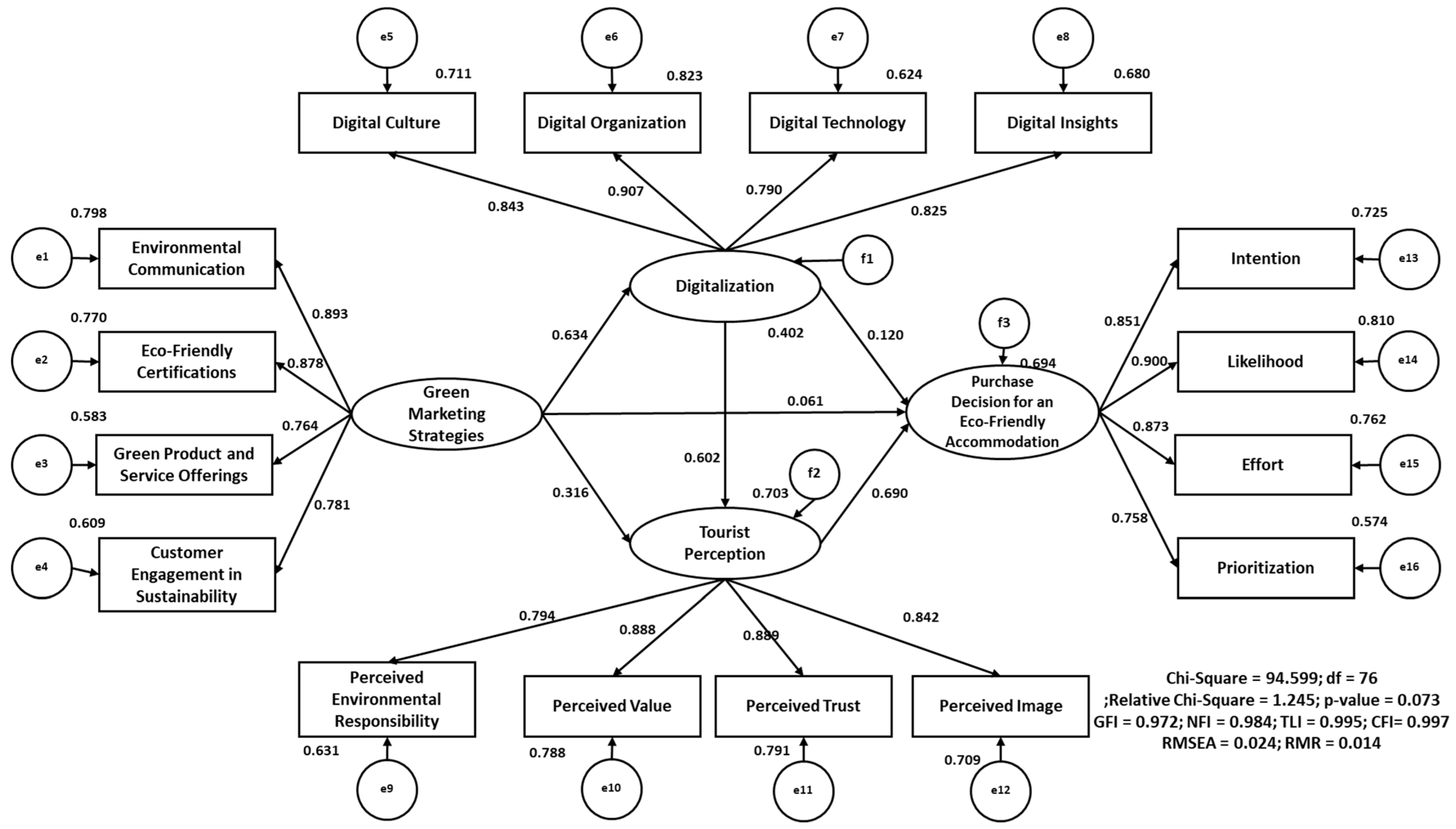
| Constructs | Items | Factor Loading | CR | Cronbach’s Alpha | AVE | MSV | ASV |
|---|---|---|---|---|---|---|---|
| Green Marketing Strategies | Environmental Communication | 0.893 | 0.899 | 0.910 | 0.691 | 0.687 | 0.520 |
| Eco-Friendly Certifications | 0.878 | ||||||
| Green Product and Service Offerings | 0.764 | ||||||
| Customer Engagement in Sustainability | 0.781 | ||||||
| Digitalization | Digital Culture | 0.843 | 0.907 | 0.911 | 0.710 | ||
| Digital Organization | 0.907 | ||||||
| Digital Technology | 0.790 | ||||||
| Digital Insights | 0.825 | ||||||
| Tourist Perception | Perceived Environmental Responsibility | 0.794 | 0.915 | 0.914 | 0.730 | ||
| Perceived Value | 0.888 | ||||||
| Perceived Trust | 0.889 | ||||||
| Perceived Image | 0.842 | ||||||
| Purchase Decision for an Eco-Friendly Accommodation | Intention | 0.851 | 0.910 | 0.919 | 0.718 | ||
| Likelihood | 0.900 | ||||||
| Effort | 0.873 | ||||||
| Prioritization | 0.758 |
| Hypothesis | Paths | Path Coefficient | p-Value | Relationship |
|---|---|---|---|---|
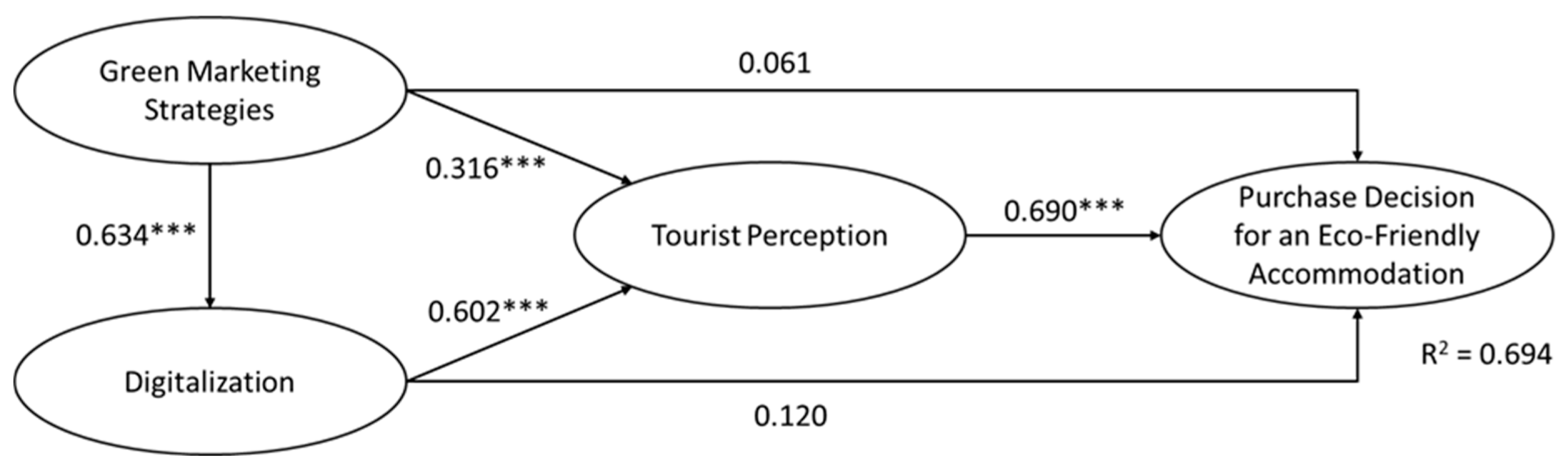
| H1 | Green Marketing Strategies → Digitalization | 0.634 *** | <0.001 | Supported |
| H2 | Green Marketing Strategies → Tourist Perception | 0.316 *** | <0.001 | Supported |
| H3 | Green Marketing Strategies → Purchase Decision for an Eco-Friendly Accommodation | 0.061 | 0.196 | Not Supported |
| H4 | Digitalization → Purchase Decision for an Eco-Friendly Accommodation | 0.120 | 0.078 | Not Supported |
| H5 | Tourist Perception → Purchase Decision for an Eco-Friendly Accommodation | 0.690 *** | <0.001 | Supported |
| H6 | Digitalization → Tourist Perception | 0.602 *** | <0.001 | Supported |
| Hypothesis | Paths | Direct Effect | Indirect Effect | p-Value | Mediation | Relationship |
|---|---|---|---|---|---|---|
| Green Marketing Strategies →Purchase Decision for an Eco-Friendly Accommodation | 0.061 | 0.196 | Not Supported | |||
| H7 | Green Marketing Strategies → Digitalization → Purchase Decision for an Eco-Friendly Accommodation | 0.070 | 0.146 | No | Not Supported | |
| H8 | Green Marketing Strategies → Tourist Perception → Purchase Decision for an Eco-Friendly Accommodation | 0.202 *** | 0.000 | Full | Supported |
Disclaimer/Publisher’s Note: The statements, opinions and data contained in all publications are solely those of the individual author(s) and contributor(s) and not of MDPI and/or the editor(s). MDPI and/or the editor(s) disclaim responsibility for any injury to people or property resulting from any ideas, methods, instructions or products referred to in the content. |
© 2026 by the authors. Licensee MDPI, Basel, Switzerland. This article is an open access article distributed under the terms and conditions of the Creative Commons Attribution (CC BY) license.
Share and Cite
Suvittawat, A.; Janchai, N. Digital Green Hospitality: How Green Marketing and Digitalization Shape Tourist Perceptions and Eco-Friendly Hotel Booking Decisions. Adm. Sci. 2026, 16, 442. https://doi.org/10.3390/admsci16090442
Suvittawat A, Janchai N. Digital Green Hospitality: How Green Marketing and Digitalization Shape Tourist Perceptions and Eco-Friendly Hotel Booking Decisions. Administrative Sciences. 2026; 16(9):442. https://doi.org/10.3390/admsci16090442
Chicago/Turabian StyleSuvittawat, Adisak, and Napaporn Janchai. 2026. "Digital Green Hospitality: How Green Marketing and Digitalization Shape Tourist Perceptions and Eco-Friendly Hotel Booking Decisions" Administrative Sciences 16, no. 9: 442. https://doi.org/10.3390/admsci16090442
APA StyleSuvittawat, A., & Janchai, N. (2026). Digital Green Hospitality: How Green Marketing and Digitalization Shape Tourist Perceptions and Eco-Friendly Hotel Booking Decisions. Administrative Sciences, 16(9), 442. https://doi.org/10.3390/admsci16090442