

Development and Initial Validation of the Multidimensional Employee Engagement Instrument (MEEI): A Mixed-Methods Scale Development Study


 ,
,  ,
, 
Abstract
1. Introduction
Shaped by events or circumstances according to which phase of life its members occupy. As each generation ages into the next phase—from youth to young adulthood to midlife to elderhood—its attitudes and behaviors mature, producing new currents in the public mood.(p. 42)
2. Literature Review
2.1. Employee Engagement
- How meaningful is it to me to bring myself into this performance? (p. 703)
- How safe is it to do so? (p. 703).
- How available am I to do so? (p. 703).
2.2. Operationalized Definition of Employee Engagement
Employee engagement is a multidimensional psychological state in which employees are intrinsically motivated to invest cognitive, emotional, and behavioral energy into their work. Engaged employees find their work meaningful, perceive alignment between their personal values and their work, and experience supportive relationships with their supervisors, colleagues, organizations, and communities. They feel competent, valued, empowered, and connected to their work environment, which encourages them to contribute beyond formal job requirements. Employee engagement is strengthened when employees receive organizational support, autonomy, adequate resources, and positive interpersonal relationships that foster trust, purpose, and well-being. This operationalized definition is informed by the employee engagement literature reviewed above. It is consistent with B. Winston and Gilbert’s (2024) finding that employees are more engaged when they perceive their supervisors as demonstrating ethical behavior.(Reworded by Co-pilot AI Chatbot)
- IQ1—Describe a work situation in which you felt happy and motivated to work on a project to the extent that you were excited to start work and looked forward to resuming work on the task. Please state why you felt happy and motivated to work on this task.
- IQ2—Describe a work situation in which you willingly, without being asked, went beyond expected work behaviors such as working late without compensation, expending your own funds to purchase tools or supplies, etc., so that you could willingly commit your time and resources to completing a task.
- IQ3—Describe a work situation in which you engaged in a work task because you wanted to support your coworkers, supervisor, or organization. Describe why you wanted to support your coworkers, supervisors, or organization.
- IQ4—Describe a work situation in which you wholeheartedly engaged in the work because your supervisor or organization gave you autonomy to plan and carry out your work, and empowered you with the authority and the resources to do your work. Describe why you felt so committed to completing the task.
- IQ5—Describe a work situation in which you wholeheartedly engaged in the work because you wanted to reciprocate to the organization and your supervisor for all the care that they gave you.
2.3. Generation Z
- IQ6—Tell me how important the following are to your engagement in the workplace: (a) diversity, (b) inclusion, (c) work–life balance, and (d) opportunity to be creative.
2.4. Generation Y
2.5. Generation X
3. Qualitative Study Method
3.1. In-Depth Interviews and In Vivo Coding Results
3.2. Results of the Qualitative Study
- What motivates employees to be highly engaged in their work?
3.3. Themes
4. Scale Development
4.1. Scale Development Item Pool
- 4.
- My organization creates an environment where employees feel supported.
- 5.
- I feel encouraged by my leaders to do my best work.
- 6.
- I feel encouraged by my colleagues to do my best work.
- I feel trusted by my supervisor to manage the work responsibilities delegated to me.
- I feel empowered by my supervisor’s leadership.
- I believe my supervisor recognizes me for the contributions I make at work.
- What I do in my work comes naturally, as if I am meant to do this type of work.
- I feel joyful when I am engaged in my work.
- I believe that my work adds value to the final product/service.
- I feel that my communication style aligns well with that of my colleagues.
- I share similar values and goals with my colleagues.
- I am comfortable collaborating with my colleagues on projects and tasks.
- I feel a sense of connection to my community.
- I would recommend my community to family members and friends as a great place to live.
- The people in my community share values similar to my values.
- I feel a sense of purpose for the work I do, which motivates me to consistently give my best effort.
- My work provides me with meaningful opportunities to fully leverage my talents and skills.
- My work environment allows me to thrive both professionally and personally.
4.2. Jury of Expert Evaluation
4.3. Validation Items
- A minimum of 125 people aged 21–30 at the time of data collection (Generation Z) living in the United States of America who have at least one year of work experience.
- A minimum of 125 people aged 31–43 at the time of data collection (Generation Y) living in the United States of America who have at least one year of work experience.
- A minimum of 125 people aged 44–64 at the time of data collection (Generation X) living in the United States of America who have at least one year of work experience.
- A minimum of 125 people aged 65–90 at the time of data collection (Baby Boomer Generation) living in the United States of America who have at least one year of work experience.
4.4. Demographics
5. Analysis
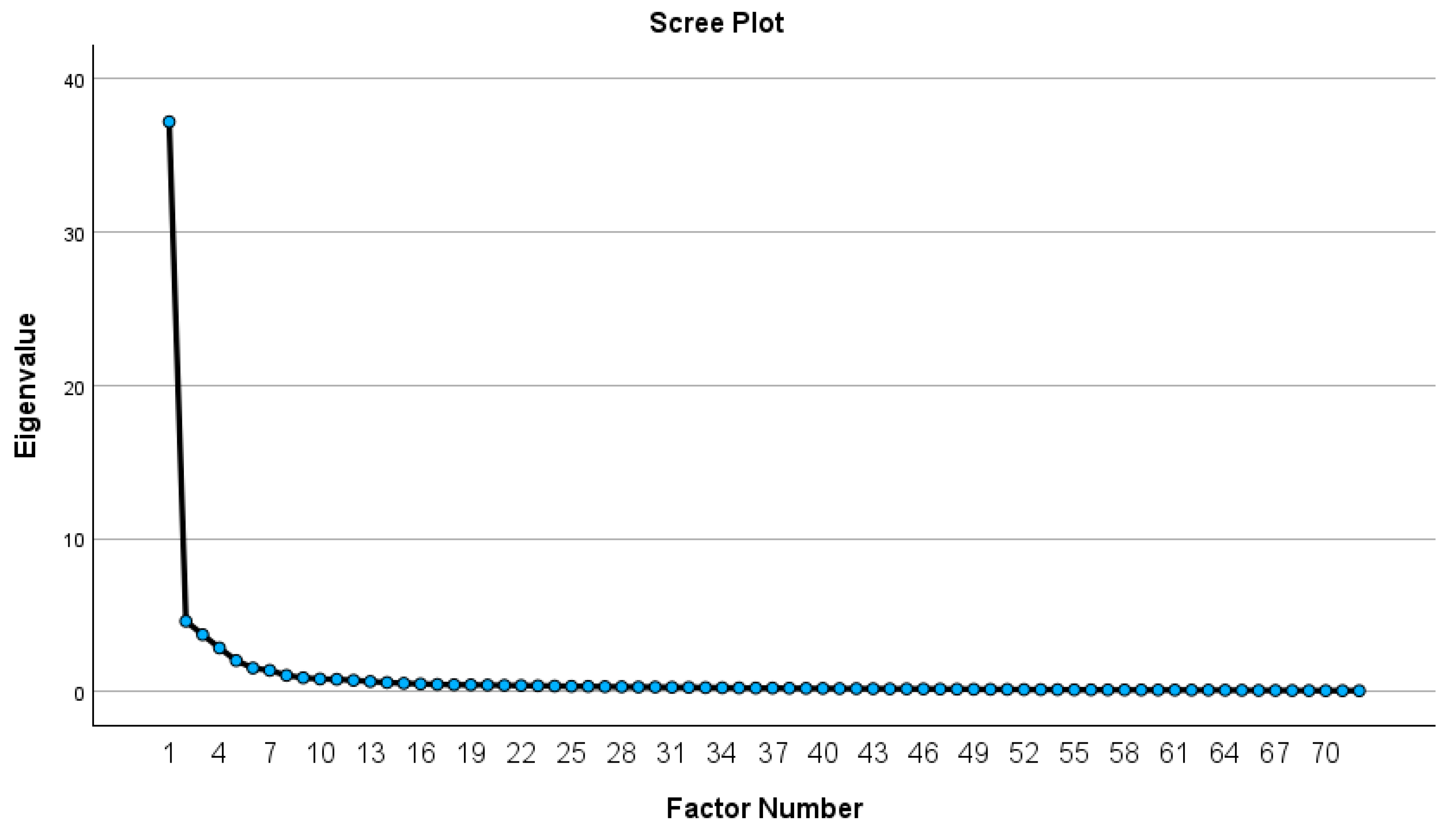
- Factor 1 had an eigenvalue of 37.2 and consisted of 17 items that explained 51.3% of the variance. The factor primarily consisted of items representing personal values, purpose, meaningful work, and alignment between employees’ values and their work. They focused on employees’ passion for and purpose of the work, as well as the alignment of the work’s values with employees’ values. We labeled this factor: “person-job values/passion/purpose fit”.
- ○
- The focus on values/passion/purpose-for Generation-Z and Generation-Y is substantiated in the work by Lynn (2023), Roy et al. (2025), Dehghan Nayeri et al. (2026)
- Factor 2 had an eigenvalue of 4.6 and consisted of 12 items that explained 6.0% of the variance. The items were from the person-colleague fit list. We labeled this factor “person-colleague fit.”
- Factor 3 had an eigenvalue of 3.7 and consisted of 11 items that explained 4.8% of the variance. The items were from the person-supervisor fit list. We labeled this factor “person-supervisor fit.”
- Factor 4 had an eigenvalue of 2.9 and consisted of 10 items that explained 3.6% of the variance. The items were from the person-community fit list. We labeled this factor “person-community fit.”
- Factor 5 had an eigenvalue of 2.0 and consisted of 5 items that explained 2.5% of the variance. The items were from the employee well-being, person-organization fit, and supervisor fit lists of items. The items focused on job flexibility to accommodate employees’ needs and wants. We labeled this factor “person-job flexibility fit.”
- ○
- The focus on flexibility is substantiated in the work of Gabrielova and Buchko (2021), Yadav et al. (2025), Syafani et al. (2025), and Goessling (2017).
- Factor 6 had an eigenvalue of 1.5 and consisted of 11 items that explained 1.7% of the variance. The items came from the person-organization fit list. We labeled this factor “person-organization fit.”
5.1. Descriptives
5.2. Concurrent and Discriminant Validity Testing
5.3. t-Test and ANOVA Analysis
- A one-way ANOVA revealed a significant effect of group for PVF_Avg, F(3, 507) = 10.33, p < 0.001.
- A one-way ANOVA revealed a significant group effect for COL_Avg, F(3, 507) = 4.47, p = 0.004.
- A one-way ANOVA revealed a significant effect of group for SUP_Avg, F(3, 505) = 3.47, p = 0.016.
- A one-way ANOVA revealed a significant group effect for COM_Avg, F(3, 507) = 4.15, p = 0.006.
- A one-way ANOVA revealed a significant group effect for PFF_Avg, F(3, 507) = 2.78, p = 0.040.
- A one-way ANOVA revealed a significant group effect for ORG_Avg, F(3, 507) = 9.81, p < 0.001.
5.4. Confirmatory Factor Analysis
6. Discussion
6.1. Value of the Study to Researchers
6.2. Future Research
6.3. Limitations
6.4. Conclusions
Author Contributions
Funding
Institutional Review Board Statement
Informed Consent Statement
Data Availability Statement
Conflicts of Interest
Appendix A. Statement of Informed Consent for the Qualitative Study
- Generation Z—born 1995–2009
- Generation Y—born 1982–1995
- Generation X—born 1961–1981
- IQ1—Describe a work situation in which you felt happy and motivated to work on a project to the extent that you were excited to start work and looked forward to resuming work on the task. Please state why you felt happy and motivated to work on this task.
- IQ2—Describe a work situation in which you willingly, without being asked, went beyond expected work behaviors such as working late without compensation, expending your own funds to purchase tools or supplies, etc., so that you could willingly commit your time and resources to completing a task.
- IQ3—Describe a work situation in which you engaged in a work task because you wanted to support your coworkers, supervisor, or organization. Describe why you wanted to support your coworkers, supervisors, or organization.
- IQ4—Describe a work situation in which you wholeheartedly engaged in the work because your supervisor or organization gave you autonomy to plan and carry out your work, and empowered you with the authority and the resources to do your work. Describe why you felt so committed to completing the task.
- IQ5—Describe a work situation in which you wholeheartedly engaged in the work because you wanted to reciprocate to the organization and your supervisor for all the care that they gave you.
- IQ6—Tell me how important the following are to your engagement in the workplace: (a) diversity, (b) inclusion, (c) work–life balance, and (d) opportunity to be creative.
Appendix B. Statement of Consent for the Quantitative Study
- be 21 years old or older.
- have worked for at least 3 years.
References
- Ahmed, I., Nawaz, M. M., Ali, G., & Islam, T. (2015). Perceived organizational support and its outcomes: A meta-analysis of latest available literature. Management Research Review, 38(6), 627–639. [Google Scholar] [CrossRef] [Scilit]
- Alves, B. (2024). Gen Z in the workplace: Statistics and 2024 trends. Job Today. Available online: https://jobtoday.com/us/blog/gen-z-in-the-workplace-statistics-and-2024-trends/ (accessed on 5 July 2026).
- Arshad, M., Qasim, N., Farooq, O., & Rice, J. (2022). Empowering leadership and employees’ work engagement: A social identity theory perspective. Management Decision, 60(5), 1218–1236. [Google Scholar] [CrossRef] [Scilit]
- Baumeister, R. F., & Leary, M. R. (1995). The need to belong: Desire for interpersonal attachments as a fundamental human motivation. Psychological Bulletin, 117(3), 497–529. [Google Scholar] [CrossRef] [Scilit]
- Cartwright, S., & Holmes, N. (2006). The meaning of work: The challenge of regaining employee engagement and reducing cynicism. Human Resource Management Review, 16(2), 199–208. [Google Scholar] [CrossRef] [Scilit]
- Chass, M. S., & Balu, L. (2018). Impact of perceived organizational support on employee engagement at Tas Impex Private Limited, Hyderabad. International Journal of Engineering Technology Science and Research, 5(3), 334–339. [Google Scholar]
- Chaudhary, R., Rangnekar, S., & Barua, M. (2011). Relation between human resource development climate and employee engagement: Results from India. Europe’s Journal of Psychology, 7(4), 664–685. [Google Scholar] [CrossRef] [Scilit]
- Chuang, A., Shen, C., & Judge, T. A. (2016). Development of a multidimensional instrument of person-environment fit: The perceived person-environment fit scale (PPEFS). Applied Psychology, 65(1), 66–98. [Google Scholar] [CrossRef] [Scilit]
- Dai, K., & Qin, X. (2016). Perceived organizational support and employee engagement: Based on the research of organizational identification and organizational justice. Open Journal of Social Sciences, 4(12), 46–57. [Google Scholar] [CrossRef]
- Deci, E. L., Connell, J. P., & Ryan, R. M. (1989). Self-determination in a work organization. Journal of Applied Psychology, 74(4), 580–590. [Google Scholar] [CrossRef] [Scilit]
- Deci, E. L., & Ryan, R. M. (2014). The importance of universal psychological needs for understanding motivation in the workplace. In M. Gagné (Ed.), The Oxford handbook of work engagement, motivation, and self-determination theory (pp. 13–32). Oxford University Press. [Google Scholar]
- Dehghan Nayeri, M., Sadeghpour Firouzabad, A., & Safari, S. (2026). Comparison across X, Y and Z generation employees’ attraction and retention factors: Multigroup analysis (MGA). International Journal of Organizational Analysis, 34(2), 385–414. [Google Scholar] [CrossRef] [Scilit]
- DeVellis, R. F., & Thorpe, C. T. (2022). Scale development (5th edition) (applied social research methods) (Kindle ed.). SAGE Publications. [Google Scholar]
- Dobrowolski, Z., Drozdowski, G., & Panait, M. (2022). Understanding the impact of Generation Z on risk management—A preliminary views on values, competencies, and ethics of the Generation Z in public administration. International Journal of Environmental Research and Public Health, 19(7), 3868. [Google Scholar] [CrossRef] [Scilit]
- Farzana, S., & Charoensukmongkol, P. (2024). Effects of transformational leadership on psychological empowerment and employee engagement: A comparative study of Bangladesh and Thailand. Journal of Asia Business Studies, 18(4), 1094–1113. [Google Scholar] [CrossRef] [Scilit]
- Gabrielova, K., & Buchko, A. A. (2021). Here comes Generation Z: Millennials as managers. Business Horizons, 64(4), 489–499. [Google Scholar] [CrossRef] [Scilit]
- Gagné, M., & Deci, D. L. (2014). The history of self-determination theory in psychology and management. In M. Gagné (Ed.), The Oxford handbook of work engagement, motivation, and self-determination theory (pp. 1–9). Oxford University Press. [Google Scholar]
- Goessling, M. (2017). Attraction and retention of Generations X, Y and Z in the workplace [Bachelor’s thesis, Murray State University]. Available online: https://digitalcommons.murraystate.edu/bis437/66 (accessed on 25 November 2024).
- Goh, E., & Lee, C. (2018). A workforce to be reckoned with: The emerging pivotal Generation Z hospitality workforce. International Journal of Hospitality Management, 73, 20–28. [Google Scholar] [CrossRef] [Scilit]
- Hair, J. F., Black, W. C., Babin, B. J., & Anderson, R. E. (2013). Multivariate data analysis: [Global edition] (7th ed., Pearson New International ed.). Pearson Prentice Hall. [Google Scholar]
- Hassan, A., & Ahmed, F. (2011). Authentic leadership, trust, and work engagement. World Academy of Science, Engineering, and Technology, 80, 750–756. [Google Scholar]
- Hassan, R. S., Amin, H. M. G., & Ghoneim, H. (2024). Decent work and innovative work behavior of academic staff in higher education institutions: The mediating role of work engagement and job self-efficacy. Humanities & Social Sciences Communications, 11(1), 702–719. [Google Scholar] [CrossRef] [Scilit]
- Headley, J. (2024). The effect of employees’ perceived organizational support on the level of employee engagement in a virtual work environment (Order No. 31141591) [Ph.D. thesis, Regent University]. Dissertations & Theses @ Regent University. [Google Scholar]
- Hooper, D., Coughlan, J., & Mullen, M. (2008). Structural equation modelling: Guidelines for determining model fit. Electronic Journal of Business Research Methods, 6(1), 53–60. [Google Scholar]
- Howe, N., & Strauss, W. (2007). The next 20 years: How customer and workforce attitudes will evolve. Harvard Business Review, 85(7–8), 41–52. [Google Scholar]
- Howe, N., & Strauss, W. (2009). Millennials rising: The next great generation (1st ed.). Knopf Doubleday Publishing Group. [Google Scholar]
- Intellectus Statistics. (2023). Intellectus statistics [Online computer software]. Available online: https://statistics.intellectus360.com (accessed on 9 June 2026).
- Intellectus Statistics. (2024). Intellectus qualitative [Online computer software]. Available online: https://statistics.intellectus360.com (accessed on 9 June 2026).
- Jin, J., & Rounds, J. (2012). Stability and change in work values: A meta-analysis of longitudinal studies. Journal of Vocational Behavior, 80(2), 326–339. [Google Scholar] [CrossRef] [Scilit]
- Johnson, S. (2013). Leadership skills, job satisfaction, and motivation in the workplace: A phenomenological research study [Doctoral dissertation, University of Phoenix]. ProQuest Dissertations & Theses Global. [Google Scholar]
- Kahn, W. A. (1990). Psychological conditions of personal engagement and disengagement at work. Academy of Management Journal, 33(4), 692–724. [Google Scholar] [CrossRef] [Scilit]
- Kim, H.-Y. (2013). Statistical notes for clinical researchers: Assessing normal distribution (2) using skewness and kurtosis. Restorative dentistry & endodontics, 38(1), 52–54. [Google Scholar] [CrossRef] [Scilit]
- Krahn, H. J., & Galambos, N. L. (2014). Work values and beliefs of “Generation X” and “Generation Y”. Journal of Youth Studies, 17(1), 92–112. [Google Scholar] [CrossRef] [Scilit]
- Kumar, H., & Raghavendran, S. (2013). Not by money alone: The emotional wallet and talent management. Journal of Business Strategy, 34(3), 16–23. [Google Scholar] [CrossRef] [Scilit]
- Kumar, P., & Padhi, N. (2022). Development and validation of multi-factor employee engagement measuring instrument: A formative measurement model. Personnel Review, 51(9), 2261–2276. [Google Scholar] [CrossRef] [Scilit]
- Leslie, B., Anderson, C., Bickham, C., Horman, J., Overly, A., Gentry, C., Callahan, C., & King, J. (2021). Generation Z perceptions of a positive workplace environment. Employee Responsibilities and Rights Journal, 33(3), 171–187. [Google Scholar] [CrossRef] [Scilit]
- Lynn, S. A. (2023). Elevating followers: Confirmatory factor analysis on the revised Kelley followership questionnaire [Doctoral dissertation, Southeastern University]. FireScholars. Available online: https://firescholars.seu.edu/org-lead/23 (accessed on 9 June 2026).
- May, D. R., Gilson, R. L., & Harter, L. M. (2004). The psychological conditions of meaningfulness, safety, and availability, and the engagement of the human spirit at work. Journal of Occupational and Organizational Psychology, 77(1), 11–37. [Google Scholar] [CrossRef] [Scilit]
- McGaha, K. K. (2018). An interpretive phenomenological study of America’s emerging workforce: Exploring Generation Z’s leadership preferences [Ph.D. thesis, Regent University]. ProQuest Dissertations & Theses. [Google Scholar]
- Naveed, M., & Zia, M. Q. (2024). Exploring the interplay between job resources, employee engagement, and adaptive job performance with a focus on psychological contract fulfillment. Journal of Asia Business Studies, 18(3), 767–783. [Google Scholar] [CrossRef] [Scilit]
- Ng, E. S. W., Schweitzer, L., & Lyons, S. T. (2010). New generation, great expectations: A field study of the millennial generation. Journal of Business and Psychology, 25(2), 281–292. [Google Scholar] [CrossRef] [Scilit]
- Nguyen, N. T. H. (2023). Are millennials different? A time-lag study of federal millennial and Generation X employees’ affective commitment. Public Personnel Management, 52(2), 143–169. [Google Scholar] [CrossRef] [Scilit]
- Peterson, R. A. (2000). A meta-analysis of variance accounted for and factor loadings in exploratory factor analysis. Marketing Letters, 11(3), 261–275. [Google Scholar] [CrossRef] [Scilit]
- Pyöriä, P., Ojala, S., Saari, T., & Järvinen, K.-M. (2017). The millennial generation: A new breed of labour? SAGE Open, 7(1). [Google Scholar] [CrossRef] [Scilit]
- Resick, C. J., Baltes, B. B., & Shantz, C. W. (2007). Person-organization fit and work-related attitudes and decisions: Examining interactive effects with job fit and conscientiousness. Journal of Applied Psychology, 92(5), 1446–1455. [Google Scholar] [CrossRef] [Scilit]
- Robinson, D., Perryman, S., & Hayday, S. (2004). The drivers of employee engagement. Institute for Employment Studies. [Google Scholar]
- Roy, M., Das, S., Majumder, T., & Ray, N. (2025). Evolving workplace priorities: A study on GEN Z’S Core values. International Journal of Advances in Business and Management Research, 3(1), 1–11. [Google Scholar] [CrossRef] [Scilit]
- Rubiano-Moreno, J., Alonso-Malaver, C., Nucamendi-Guillén, S., López-Hernández, C., & Ramírez-Rojas, C. (2023). Work motivation profiles of the millennial generation. Revista CEA, 9(21), e2603. [Google Scholar] [CrossRef] [Scilit]
- Ryan, R. M., & Deci, E. L. (2000). Self-determination theory and the facilitation of intrinsic motivation, social development, and wellbeing. American Psychologist, 55(1), 68–78. [Google Scholar] [CrossRef] [Scilit]
- Saks, A. M. (2006). Antecedents and consequences of employee engagement. Journal of Managerial Psychology, 21(7), 600–619. [Google Scholar] [CrossRef] [Scilit]
- Salcedo, J. F. (2016). Authentic leadership: A quantitative study of the effect of authentic leadership on group cohesion and work engagement in student organizations in Mexico [Ph.D. thesis, Regent University]. Dissertations & Theses @ Regent University; ProQuest Dissertations & Theses Global; ProQuest One Academic. [Google Scholar]
- Schaufeli, W. B., Salanova, M., González-romá, V., & Bakker, A. B. (2002). The measurement of engagement and burnout: A two sample confirmatory factor analytic approach. Journal of Happiness Studies, 3(1), 71–92. [Google Scholar] [CrossRef] [Scilit]
- Schreiber, J. B., Nora, A., Stage, F. K., Barlow, E. A., & King, J. (2006). Reporting structural equation modeling and confirmatory factor analysis results: A review. The Journal of Educational Research, 99(6), 323–338. [Google Scholar] [CrossRef] [Scilit]
- Shuck, B., Adelson, J. L., & Reio, T. G. (2017). The employee engagement scale: Initial evidence for construct validity and implications for theory and practice. Human Resource Management, 56(6), 953–977. [Google Scholar] [CrossRef] [Scilit]
- Spreitzer, G. M. (1995). Psychological empowerment in the workplace: Dimensions, measurement, and validation. Academy of Management Journal, 38(5), 1442–1465. [Google Scholar] [CrossRef] [Scilit]
- Syafani, R. S., Hasya, N. N., & Chaniago, H. (2025). Mapping Generation Z work priorities: Comprehensive study and strategic implications for office management in the age of AI. International Journal Administration, Business & Organization, 6(2), 123–135. [Google Scholar] [CrossRef] [Scilit]
- Winston, B., Bocarnea, M., & Dean, D. (2024). New testament-based culture and climate as antecedents to employee engagement and psychological safety. Journal of Biblical Integration in Business, 27(1), 22–36. [Google Scholar] [CrossRef] [Scilit]
- Winston, B., & Gilbert, M. (2024, November 14–15). Sixteen new testament-based terminal values (virtues) as antecedents to virtue-ethical behaviors. 2024 Regent University Research Roundtables, Online. Available online: https://www.regent.edu/school-of-business-and-leadership/news/annual-research-roundtables/ (accessed on 9 June 2026).
- Winston, B. E. (2023). Biblical organizational spirituality: (Qualitative case studies of leaders and organizations) (Vol. 2). Palgrave Macmillan. [Google Scholar]
- Wong, C.-S., & Law, K. S. (2002). The effects of leader and follower emotional intelligence on performance and attitude: An exploratory study. The Leadership Quarterly, 13(3), 243–274. [Google Scholar] [CrossRef] [Scilit]
- Yadav, M., Pandey, A., & Huzooree, G. (2025). Transformational HR for Generation Z: Gig economy efficiency and adaptability. In Global work arrangements and outsourcing in the age of AI (pp. 399–420). IGI Global Scientific Publishing. [Google Scholar] [CrossRef] [Scilit]

| Generation | Transcript Excerpts |
|---|---|
| Generation X | Well, enjoyment of a work project and to continue working on that in part has to do with simply enjoying the nature of the work. I believe that some of this satisfaction may come from the work being well suited to the person’s temperament and giftings. That’s a big part of it. |
| Generation Y | I’m a people person. I enjoy being around other people and enjoy a collaborative work environment. I enjoy taking a leadership role in the project, but also doing it in a way that makes other people feel valued and heard, and where I can delegate both tasks and responsibility depending on the scope of the project and the abilities and training of the people I’m working with. So, with all that in mind, I think a situation where I feel happy and motivated to work on a project. Starting and resuming it would be where I am working with people instead of in isolation; where I have significant input into the direction of the project; and where I can make sure that everybody on it feels included and valued. |
| Generation Z | In my work, I do mechanical things, and I often get excited when we’re doing a part of the engine or vehicle that I have not done before, and I get to learn how to do that or something we don’t do very often, things like that. Some of the work I’m doing is exciting, and I’m excited to go to work and knock it out. |
| Theme | Codes | Frequency |
|---|---|---|
| Person-Supervisor Fit | AI: Recognition And Respect | 4 |
| AI: Reciprocity | 3 | |
| AI: Empowerment Through Leadership | 3 | |
| Person-Organization Fit | AI: Mission Alignment | 4 |
| AI: Organizational Commitment | 4 | |
| AI: Belief In The Mission | 3 | |
| AI: Resource Availability | 3 | |
| AI: Sense Of Purpose | 1 | |
| AI: Resource Provision | 4 | |
| AI: Organizational Loyalty | 2 | |
| AI: Supportive Work Environment | 5 | |
| Person-Job Fit | AI: Going Above And Beyond | 10 |
| AI: Autonomy | 14 | |
| AI: Service And Dedication | 3 | |
| AI: Work Engagement | 3 | |
| AI: Creativity And Innovation | 5 | |
| AI: Adding Value | 8 | |
| Person-Group/Colleague Fit | AI: Workplace Relationships | 3 |
| AI: Teamwork And Support | 3 | |
| AI: Gratitude | 3 | |
| AI: Reciprocity And Giving Back | 3 | |
| AI: Trust And Empowerment | 5 | |
| AI: Collaborative Work Environment | 3 | |
| Person-Community Fit | AI: Community Impact | 6 |
| AI: Community Service | 5 | |
| Personal Wellbeing | AI: Personal Care And Support | 3 |
| AI: Purpose And Impact | 2 | |
| AI: Intrinsic Motivation | 2 | |
| AI: Personal Growth | 3 | |
| AI: Personal Connection To Mission | 10 | |
| AI: Job Satisfaction | 3 | |
| AI: Personal Resources | 4 | |
| AI: Personal Investment | 4 | |
| AI: Meaningful Work | 4 | |
| AI: Personal Fulfillment | 4 | |
| AI: Personal Values Alignment | 2 | |
| AI: Willingness To Help | 4 |
| Generation | Gender | Years of Work Experience | |||||||
|---|---|---|---|---|---|---|---|---|---|
| Female | Male | Less Than 5 | 5–10 | 11–15 | 16–20 | 21–25 | 26–30 | 31 or More | |
| Gen Z | 48 | 68 | 47 | 59 | 7 | 1 | 0 | 0 | 0 |
| Gen Y | 67 | 68 | 3 | 37 | 33 | 36 | 22 | 3 | 1 |
| Gen X | 71 | 56 | 0 | 4 | 7 | 10 | 33 | 26 | 48 |
| Boomer | 80 | 50 | 0 | 0 | 3 | 2 | 2 | 4 | 119 |
| Total | 266 | 242 | 50 | 100 | 50 | 49 | 57 | 33 | 168 |
| Scale Item | Factor 1 Person-Job Values/Passion Fit | Factor 2 Person-Colleague Fit | Factor 3 Person-Supervisor Fit | Factor 4 Person-Community Fit | Factor 5 Person-Job Flexibility Fit | Factor 6 Person-Organization Fit |
|---|---|---|---|---|---|---|
| PVF 1 I feel a sense of purpose for the work I do, which motivates me to consistently give my best effort. | 0.995 | |||||
| PVF 2 I believe that my work is meaningful. | 0.921 | |||||
| PVF 3 My work provides me with meaningful opportunities to fully leverage my talents and skills. | 0.921 | |||||
| PVF 4 What I do in my work comes naturally, as if I am meant to do this type of work. | 0.870 | |||||
| PVF 5 My work values are aligned with my personal mission or purpose. | 0.819 | |||||
| PVF 6 I feel joyful when I am engaged in my work. | 0.742 | |||||
| PVF 7 My work environment allows me to thrive both professionally and personally. | 0.715 | |||||
| COL 1 I feel comfortable giving and receiving feedback from my colleagues. | 0.849 | |||||
| COL 2 My colleagues respect and value my ideas and input. | 0.837 | |||||
| COL 3 I feel supported by my colleagues in professional matters. | 0.836 | |||||
| COL 4 I trust my colleagues to deliver on their responsibilities and commitments. | 0.829 | |||||
| COL 5 I share similar goals with my colleagues. | 0.812 | |||||
| COL 6 My approach to work aligns well with the work habits of my colleagues. | 0.799 | |||||
| COL 7 I share similar values with my colleagues. | 0.785 | |||||
| SUP 1 My supervisor trusts me to manage my work responsibilities. | 0.950 | |||||
| SUP 2 My supervisor trusts my decision-making ability at work. | 0.881 | |||||
| SUP 3 My supervisor gives me autonomy over my work. | 0.867 | |||||
| SUP 4 My supervisor recognizes me for the contributions I make at work. | 0.826 | |||||
| SUP 5 My supervisor and I mutually respect one another. | 0.811 | |||||
| SUP 6 I am empowered by my supervisor’s leadership. | 0.803 | |||||
| SUP 7 My supervisor motivates me to do my best work. | 0.701 | |||||
| COM 1 Given the opportunity, I would choose this community again. | 0.947 | |||||
| COM 2 I am proud to say I live in my community. | 0.896 | |||||
| COM 3 I believe living in my community supports my wellbeing. | 0.893 | |||||
| COM 4 I would recommend my community to family members and friends as a great place to live. | 0.875 | |||||
| COM 5 In general, I believe my community is friendly toward individuals or families who move here for their jobs. | 0.853 | |||||
| COM 6 In general, I believe others in my community respect differences in nationality, beliefs, and traditions. | 0.770 | |||||
| COM 7 The people in my community share values similar to my values. | 0.761 | |||||
| PFF 1 My job provides me with the flexibility needed to care for my physical and emotional health. | 0.838 | |||||
| PFF 2 My work schedule provides me with the flexibility to maintain healthy habits and adequate rest. | 0.799 | |||||
| PFF 3 My organization offers flexibility that allows me to balance my professional and personal life. | 0.779 | |||||
| PFF 4 My work environment supports a healthy work–life balance (professional duties and personal self-care practices). | 0.706 | |||||
| PFF 5 My supervisor gives me flexibility to adjust my work hours. | 0.681 | |||||
| ORG 1 I believe in my organization’s mission and goals. | 0.757 | |||||
| ORG 2 My organization creates an environment where employees feel supported. | 0.731 | |||||
| ORG 3 I feel a sense of loyalty to my organization. | 0.710 | |||||
| ORG 4 I am willing to go above and beyond to ensure my organization’s success. | 0.664 | |||||
| ORG 5 My organization provides the tools and resources I need to succeed. | 0.644 | |||||
| ORG 6 I feel proud to tell others that I work for my organization. | 0.643 | |||||
| ORG 7 I would recommend my organization to others as a great place to work. | 0.606 |
| Scale | Mean | SD | Skewness | SE | Kurtosis | SE | Cronbach α |
|---|---|---|---|---|---|---|---|
| POF_Avg | 5.12 | 1.48 | −0.922 | 0.108 | 0.382 | 0.216 | 0.97 |
| PSF_Avg | 5.0 | 1.52 | −0.947 | 0.108 | 0.365 | 0.216 | 0.96 |
| EFB_Avg | 5.5 | 1.11 | 1.078 | 0.108 | 1.709 | 0.216 | 0.92 |
| PVF_AVG | 5.3 | 1.40 | −1.113 | 0.108 | 0.73 | 0.216 | 0.96 |
| COL_AVG | 5.5 | 1.15 | −1.153 | 0.108 | 1.634 | 0.216 | 0.95 |
| SUP_AVG | 5.7 | 1.30 | −1.413 | 0.108 | 1.960 | 0.216 | 0.95 |
| COM_AVG | 5.2 | 1.29 | −0.952 | 0.108 | 0.771 | 0.216 | 0.95 |
| PFF_AVG | 5.4 | 1.37 | −1.059 | 0.108 | 0.0759 | 0.216 | 0.92 |
| ORG_AVG | 5.3 | 1.42 | −0.881 | 0.108 | 0.111 | 0.216 | 0.96 |
| 1 | 2 | 3 | 4 | 5 | 6 | 7 | 8 | 9 | |
|---|---|---|---|---|---|---|---|---|---|
| 1. POF | - | ||||||||
| 2. PSF | 0.77 | - | |||||||
| 3. EFB | 0.40 | 0.30 | - | ||||||
| 4. PVF_Avg | 0.82 | 0.66 | 0.43 | - | |||||
| 5. COL_Avg | 0.74 | 0.63 | 0.39 | 0.68 | - | ||||
| 6. SUP_Avg | 0.68 | 0.85 | 0.28 | 0.65 | 0.64 | - | |||
| 7. COM_Avg | 0.57 | 0.48 | 0.35 | 0.56 | 0.59 | 0.44 | - | ||
| 8. PFF_Avg | 0.67 | 0.66 | 0.28 | 0.64 | 0.58 | 0.66 | 0.45 | - | |
| 9. ORG_Avg | 0.86 | 0.75 | 0.32 | 0.82 | 0.68 | 0.76 | 0.52 | 0.69 | - |
| Gender | N | Mean | Std. Deviation | Std. Error Mean | |
|---|---|---|---|---|---|
| PVF_Avg | Female | 266 | 5.5 | 1.32 | 0.081 |
| Male | 242 | 5.2 | 1.43 | 0.092 | |
| COL_Avg | Female | 266 | 5.6 | 1.10 | 0.067 |
| Male | 242 | 5.4 | 1.17 | 0.075 | |
| SUP_Avg | Female | 265 | 5.8 | 1.23 | 0.075 |
| Male | 242 | 5.5 | 1.30 | 0.084 | |
| COM_Avg | Female | 266 | 5.3 | 1.24 | 0.076 |
| Male | 242 | 5.0 | 1.33 | 0.086 | |
| PFF_Avg | Female | 266 | 5.5 | 1.34 | 0.082 |
| Male | 242 | 5.3 | 1.41 | 0.091 | |
| EFB_Avg | Female | 266 | 5.7 | 0.97 | 0.060 |
| Male | 242 | 5.3 | 1.19 | 0.077 | |
| t-Test for Equality of Means | |||||||||
|---|---|---|---|---|---|---|---|---|---|
| t | df | Significance | Mean Difference | Std. Error Difference | 95% Confidence Interval of the Difference | ||||
| One-Sided p | Two-Sided p | Lower | Upper | ||||||
| PVF_Avg | Equal variances assumed | 3.126 | 506 | 0.001 | 0.002 | 0.38 | 0.122 | 0.14167 | 0.62097 |
| Equal variances not assumed | 3.114 | 490.463 | 0.001 | 0.002 | 0.38 | 0.122 | 0.14070 | 0.62193 | |
| COL_Avg | Equal variances assumed | 1.815 | 506 | 0.035 | 0.070 | 0.18 | 0.101 | −0.01506 | 0.38008 |
| Equal variances not assumed | 1.809 | 493.390 | 0.036 | 0.071 | 0.18 | 0.101 | −0.01569 | 0.38070 | |
| SUP_Avg | Equal variances assumed | 2.414 | 505 | 0.008 | 0.016 | 0.27 | 0.112 | 0.05042 | 0.49178 |
| Equal variances not assumed | 2.407 | 494.120 | 0.008 | 0.016 | 0.27 | 0.113 | 0.04983 | 0.49237 | |
| COM_Avg | Equal variances assumed | 2.457 | 506 | 0.007 | 0.014 | 0.28 | 0.114 | 0.05622 | 0.50517 |
| Equal variances not assumed | 2.449 | 492.614 | 0.007 | 0.015 | 0.28 | 0.115 | 0.05546 | 0.50593 | |
| PFF_Avg | Equal variances assumed | 1.758 | 506 | 0.040 | 0.079 | 0.21 | 0.122 | −0.02517 | 0.45370 |
| Equal variances not assumed | 1.754 | 494.884 | 0.040 | 0.080 | 0.21 | 0.122 | −0.02581 | 0.45434 | |
| EFB_Avg | Equal variances assumed | 3.839 | 506 | 0.000 | 0.000 | 0.37 | 0.096 | 0.18044 | 0.55879 |
| Equal variances not assumed | 3.802 | 465.981 | 0.000 | 0.000 | 0.37 | 0.097 | 0.17860 | 0.56063 | |
| Sum of Squares | df | Mean Square | F | Sig. | ||
|---|---|---|---|---|---|---|
| PVF_Avg | Between Groups | 57.321 | 3 | 19.107 | 10.327 | 0.001 |
| Within Groups | 938.088 | 507 | 1.850 | |||
| Total | 995.409 | 510 | ||||
| COL_Avg | Between Groups | 17.418 | 3 | 5.806 | 4.474 | 0.004 |
| Within Groups | 657.963 | 507 | 1.298 | |||
| Total | 675.380 | 510 | ||||
| SUP_Avg | Between Groups | 17.327 | 3 | 5.776 | 3.466 | 0.016 |
| Within Groups | 841.478 | 505 | 1.666 | |||
| Total | 858.804 | 508 | ||||
| COM_Avg | Between Groups | 20.416 | 3 | 6.805 | 4.154 | 0.006 |
| Within Groups | 830.572 | 507 | 1.638 | |||
| Total | 850.987 | 510 | ||||
| PFF_Avg | Between Groups | 15.594 | 3 | 5.198 | 2.781 | 0.040 |
| Within Groups | 947.564 | 507 | 1.869 | |||
| Total | 963.158 | 510 | ||||
| ORG_Avg | Between Groups | 56.266 | 3 | 18.755 | 9.812 | 0.001 |
| Within Groups | 969.116 | 507 | 1.911 | |||
| Total | 1025.382 | 510 | ||||
| Scale | Generations That Differed |
|---|---|
| Person-Values Fit | Gen Z—Gen X Gen Z—Baby Boomer Gen Y—Baby Boomer |
| Person-Colleague Fit | Gen Z—Baby Boomer |
| Person-Supervisor Fit | Gen Z—Baby Boomer |
| Person-Community Fit | Gen Z—Baby Boomer |
| Person-Flexibility Fit | No differences |
| Person-Organization Fit. | Gen Z—Gen X Gen Z—Baby Boomer Gen Y—Baby Boomer |
| Model | NFI | TLI | CFI | RMSEA | SRMR |
|---|---|---|---|---|---|
| PVF, COL, SUP, COM, PFF, and ORG | 0.89 | 0.91 | 0.92 | 0.07 | 0.05 |
| PVF, COL, SUP | 0.92 | 0.93 | 0.94 | 0.09 | 0.04 |
Disclaimer/Publisher’s Note: The statements, opinions and data contained in all publications are solely those of the individual author(s) and contributor(s) and not of MDPI and/or the editor(s). MDPI and/or the editor(s) disclaim responsibility for any injury to people or property resulting from any ideas, methods, instructions or products referred to in the content. |
© 2026 by the authors. Licensee MDPI, Basel, Switzerland. This article is an open access article distributed under the terms and conditions of the Creative Commons Attribution (CC BY) license.
Share and Cite
Winston, B.; Dean, D.; Foster, L.; Headley, J.; Salcedo, J.; Lynn, S. Development and Initial Validation of the Multidimensional Employee Engagement Instrument (MEEI): A Mixed-Methods Scale Development Study. Adm. Sci. 2026, 16, 421. https://doi.org/10.3390/admsci16090421
Winston B, Dean D, Foster L, Headley J, Salcedo J, Lynn S. Development and Initial Validation of the Multidimensional Employee Engagement Instrument (MEEI): A Mixed-Methods Scale Development Study. Administrative Sciences. 2026; 16(9):421. https://doi.org/10.3390/admsci16090421
Chicago/Turabian StyleWinston, Bruce, Debra Dean, Lisa Foster, Julie Headley, Jorge Salcedo, and Sherrie Lynn. 2026. "Development and Initial Validation of the Multidimensional Employee Engagement Instrument (MEEI): A Mixed-Methods Scale Development Study" Administrative Sciences 16, no. 9: 421. https://doi.org/10.3390/admsci16090421
APA StyleWinston, B., Dean, D., Foster, L., Headley, J., Salcedo, J., & Lynn, S. (2026). Development and Initial Validation of the Multidimensional Employee Engagement Instrument (MEEI): A Mixed-Methods Scale Development Study. Administrative Sciences, 16(9), 421. https://doi.org/10.3390/admsci16090421

