


Abstract
This study examined employer-perceived competency discrepancies, anticipated competency requirements, hiring barriers, and valued educational experiences in Utah. Survey data were collected between September and October 2025 from 226 individuals with hiring responsibility in Utah-based organizations. The Ranked Discrepancy Model (RDM) quantified discrepancies between respondents’ ratings of competency importance and their satisfaction with demonstrated employee proficiency. Respondents reported the largest discrepancies for time management, critical thinking, conflict resolution, ethical judgment, and verbal communication of ideas. Respondents rated communication, collaboration, analytical thinking, and lifelong learning highest among competencies anticipated to matter most over the next five to ten years. Most employers identified AI and machine learning as the most disruptive emerging technology. Our study provides timely evidence to inform organizational recruitment strategies, education administration, and workforce development policies.
1. Introduction
Labor markets rarely achieve an equilibrium between the skills workers supply and the skills employers demand (Brunello & Wruuck, 2021). This ‘skill mismatch’ includes both shortages (i.e., insufficient supply of specific skills) and surpluses (i.e., skills exceeding what jobs demand) caused by economic shifts, hiring and screening practices, and lagging education or training programs (Brunello & Wruuck, 2021; Brun-Schammé & Rey, 2021; Cappelli, 2015; Desjardins & Rubenson, 2011; Handel, 2003). An education mismatch, or misalignment between workers’ credentials and job requirements, differs from a skill mismatch, in which credentials do not accurately reflect workers’ true abilities or indicate whether their skills are being fully used or underused (Desjardins & Rubenson, 2011; Horowitz, 2018). Ultimately, mismatches are the suboptimal use of skills within jobs (Brun-Schammé & Rey, 2021). In this study, we use “skill mismatch” as the umbrella term for misalignment between the skills employers need and the skills workers demonstrate. We use “competency gap” (or “gap”) in a narrower, operational sense, as an employer-perceived discrepancy between the importance of a competency and employers’ satisfaction with employees’ demonstrated proficiency in that competency, as quantified by the Ranked Discrepancy Model described below.
Technological change helps explain why skill mismatches persist despite rising educational attainment, as it can alter tasks that jobs require rather than increasing demand for certain skills. Because technology often replaces labor in routine tasks while complementing workers in non-routine tasks, it changes job requirements and employer expectations (Acemoglu & Autor, 2011). Therefore, as tasks change, the value of skills depends on how well worker capabilities align with evolving business processes, rather than solely on credentials (Acemoglu & Autor, 2012). Today, AI- and data-intensive work is increasing the value of human expertise, particularly judgment, interpretation, and communication, because workers must evaluate system outputs and manage exceptions in complex circumstances (D. Autor & Thompson, 2025). As technological change alters the tasks people perform at work, higher education and workforce training programs must routinely update curricula, credentials, pedagogy, assessment practices, and work-based learning design so that learning outcomes stay aligned with evolving occupational requirements and employer expectations (Acemoglu & Autor, 2011; Brunello & Wruuck, 2021; Brun-Schammé & Rey, 2021).
Verifying skill mismatches relies on rough estimates, subjective judgments, and limited standardized data on job skill content (Brun-Schammé & Rey, 2021; Brunello & Wruuck, 2021; Cappelli, 2015; Handel, 2003). Employer evidence offers one perspective on this problem. Employers observe the tasks their organizations require and the capabilities their workforces demonstrate, which positions them to report perceived discrepancies that aggregate labor-market indicators do not capture. Employer reports are partial; they reflect organizational expectations, recruitment practices, and workforce capability (Brunello & Wruuck, 2021; Cappelli, 2015). A regional needs assessment provides a structured way to identify “who needs what according to whom” (Conner et al., 2018).
Understanding skill mismatch also requires attention to how employers judge the capabilities of the people they hire. Because employers cannot observe skills directly, they rely on signals such as degrees, certifications, work experience, and demonstrated performance; these signals inform hiring decisions, screening practices, and perceptions of talent shortages (Cappelli, 2015; Horowitz, 2018; Bone et al., 2025). Examining which educational experiences, credentials, and hiring barriers matter most to employers therefore complements discrepancy-based measures of skill gaps, because both reflect how organizations translate skill needs into recruitment and selection practices.
Persistent skill mismatch, technology-driven change in job tasks, and measurement difficulty are salient in Utah, where employers operate in a fast-growing, regionally diverse economy (Utah Economic Council, 2026). Utah’s population exceeded 3.55 million in 2025, and the state remains the youngest in the nation with a median age of 32 in 2024. Its labor market spans six economic regions, with the Greater Salt Lake region accounting for most statewide employment and more rural regions showing greater industrial specialization. Unemployment stood at 3.3% in 2025, indicating sustained employer demand for talent. In this context, Utah’s 2025 Higher Education Strategic Reinvestment (H.B. 265) requires public institutions to reallocate instructional resources based on evidence of current and future workforce demand (Higher Education Strategic Reinvestment, 2025).
Research on skill mismatches often faces measurement difficulty. Mismatches are often examined as either a shortage or a surplus of skills, and rarely as both. However, a needs assessment captures both those conditions as they exist at the time of measurement. In addition, a mismatch is one component of a broader set of factors affecting workforce capacity that employers consider in hiring. Their selection criteria reveal how they weigh demonstrated capability against credentials (Bone et al., 2025). Their evaluations of educational experiences indicate which forms of preparation they regard as producing capability that transfers to work. These judgments affect which competencies employers perceive as underdeveloped and how they assess, verify, and develop them.
Purpose of the Study
This study examined employer-perceived competency discrepancies, anticipated competency requirements, hiring barriers, and valued educational experiences and credentials among individuals with hiring responsibility in Utah organizations. Our study addresses the following Research Questions (RQs):
- Which competencies do employers identify as showing the greatest perceived discrepancies in workforce capacity?
- Which competencies do employers anticipate will be most important over the next five to ten years?
- Which educational experiences do employers believe best prepare graduates for success?
- How do employers compare the importance of a college degree versus demonstrated skills or certifications in hiring decisions?
- What types of credentials and certificates are most valued?
- What barriers do employers face when hiring new employees?
- What emerging technological and regulatory developments are expected to have the greatest impact on workforce needs?
This study contributes evidence of employer-perceived competency discrepancy. Mismatch is difficult to objectively verify. Therefore, this study measures perceptions rather than observed competency. The findings identify priorities as employers perceive them and do not establish causes of the discrepancies (Brun-Schammé & Rey, 2021; Cappelli, 2015; Handel, 2003).
2. Literature Review
2.1. Skill Mismatch
Brun-Schammé and Rey (2021) define skill mismatch as the inefficient use of an individual’s skills in their job, which includes both underskilling and overskilling. Their work explains how underskilling (i.e., a skill deficit) occurs when a worker’s skill level falls short of the requirements for their job tasks, while overskilling (i.e., a skill surplus) arises when a worker’s existing skills are not fully utilized at work (Brun-Schammé & Rey, 2021). Desjardins and Rubenson (2011) emphasize the need to differentiate between skill mismatch and education mismatch, as the latter relies on educational credentials as indicators of human capital.
An educational mismatch is easy to quantify, but it is often inaccurate, as qualifications do not always reflect foundational skills, particularly for workers who left formal schooling years earlier (Desjardins & Rubenson, 2011). Brunello and Wruuck (2021) further clarify the distinctions among skill shortages, skill gaps, and skill mismatches, describing how skill shortages arise when employers cannot recruit employees with the required skills at the prevailing wage rate, typically resulting in vacant positions.
In contrast, Cappelli (2015) explains that skill mismatch arises when the existing workforce lacks the competencies employers require. Nevertheless, Brunello and Wruuck (2021) describe claims of skill shortages as frequently ambiguous, as they may also reflect a lack of qualified candidates or merely an employer’s unwillingness to offer competitive wages and suitable working conditions. These conceptual differences establish the groundwork for investigating the fundamental forces behind these imbalances.
Brunello and Wruuck (2021) explored how skill gaps fluctuate within an economy and can change over time due to larger structural forces, such as globalization, changing workplace practices, population shifts, and new digital technologies, including automation. As such, they found that skill shortages tend to grow through economic expansions as organizations compete for a limited talent pool and shrink during recessions (Brunello & Wruuck, 2021). However, they also argue that downturns may disrupt low-quality matches by pressuring job seekers to accept fewer desirable positions, potentially leading to overskilling (Brunello & Wruuck, 2021). Both Brunello and Wruuck (2021) and Desjardins and Rubenson (2011) suggest that skill mismatch may be procyclical, driven by the rapid decline in low-quality jobs.
D. H. Autor et al. (2003) explain that structural forces influence the demand for skills regardless of cyclical changes, as employer practices and job design decisions create skill mismatches. For instance, Cappelli (2015) found that reduced opportunities for upward mobility and lower investment in worker training can make shortages appear larger by constraining companies to draw on the external labor market to fill necessary skill gaps. Additionally, skill underutilization can lead to the loss of human capital, as basic skills tend to decline when not regularly practiced on the job (Brunello & Wruuck, 2021; Desjardins & Rubenson, 2011). Desjardins and Rubenson (2011) emphasize that such institutional factors influence how changes in work requirements affect labor market outcomes.
2.2. Technological Change, Job Tasks, and Shifting Job Requirements
In their analysis of labor-market demand, Acemoglu and Autor (2011) utilized a task-based framework to explain how technological change alters work tasks. This framework distinguishes between a worker’s skills and the actual tasks they perform. Acemoglu and Johnson (2024) describe how traditional human capital models assumed technology was naturally skill-biased and raised real wages for all. However, Acemoglu and Autor’s (2011) task-based model shows that technology can directly substitute for human labor in specific activities. In particular, they demonstrate how machines and computer capital act as direct substitutes for routine tasks, which are codifiable, rule-based activities prevalent in middle-skill occupations (Acemoglu & Autor, 2011, 2012).
Extending the task-based framework to AI, Acemoglu et al. (2026) found that AI can either devalue human expertise through automation or increase its value through collaboration, skill acquisition, and new task creation. Acemoglu and Autor (2011) found that technological change complements non-routine tasks, noting that computers support abstract activities such as problem-solving, intuition, and persuasion, which depend heavily on information as input. The divergence they have uncovered is consistent with Brunello and Wruuck’s (2021) research and has led to a polarization of the labor market, depicted by growth in high-wage professional roles and low-wage service jobs, with a hollowing out of middle-skilled jobs (Acemoglu & Autor, 2011, 2012). D. H. Autor et al. (2003), Cappelli (2015), and Desjardins and Rubenson (2011) infer that because technological change affects the nature of work, educational credentials alone cannot guarantee productivity or alignment with current job tasks.
The Utah Economic Council (2026) notes the widespread use of AI technologies as a potential threat to certain occupations. Moreover, D. Autor and Thompson (2025) suggest that integrating AI- and data-intensive systems could usher in a new era of task-based automation, thereby increasing the scarcity of certain types of expertise. Unlike earlier waves of mechanization, D. Autor and Thompson (2025) describe AI’s potential to substitute for some non-routine tasks, with evidence suggesting it primarily leads to task-based augmentation rather than a net job loss (Acemoglu & Johnson, 2024). D. Autor and Thompson (2025) report that AI systems empower workers by handling routine tasks at lower costs, freeing them to focus on duties that require more human-centric qualities. As a result, the value of expertise rises for tasks that involve human judgment, interpretation, and communication, which research has shown are more difficult to automate (D. Autor & Thompson, 2025; D. H. Autor et al., 2003; Acemoglu & Autor, 2011; Utah Economic Council, 2026).
2.3. Skill Mismatch Measurement Challenges
Accurately measuring mismatch remains difficult. Brun-Schammé and Rey (2021) and Brunello and Wruuck (2021) observe that subjective measures depend on how individuals assess their own skills and job requirements, which can be distorted by overconfidence or imposter syndrome. Desjardins and Rubenson (2011) clarify that statistical measures can reflect differences in worker performance rather than actual patterns of skill mismatch. Handel (2003) reports a persistent deficiency of standardized, up-to-date data on the actual skill requirements of jobs. Bischof (2024), comparing five test-based approaches in a German adult cohort, finds significantly different skill mismatch categories depending on the methodological approach applied. Perceptual measures, such as those used in this study, raise similar concerns.
Evidence from employers offers one perspective on current skill requirements, as they have insights into the specific tasks and competencies needed for organizational productivity. However, Brunello and Wruuck (2021) warn that such evidence should be interpreted carefully, and Cappelli (2015) points out that reported “hiring difficulties” can be misleading if low wages, poor recruitment practices, or a lack of internal training are to blame. Therefore, these measurement challenges call for a structured approach to identifying regional workforce development needs.
Witkin and Altschuld (1995) define a needs assessment as a core process in applied education for identifying gaps between current and desired conditions. In non-formal education, Garst and McCawley (2015) explain how it supports program relevance, planning, and resource allocation, all of which have become increasingly important in formal education (Higher Education Strategic Reinvestment, 2025). As workforce needs differ across places and time, Narine et al. (2021) discussed the usefulness of region-specific assessments for context-relevant decision-making. Within workforce development contexts, employer participation in the needs assessment process can help identify competency gaps most relevant to regional industry needs (Garst & McCawley, 2015).
2.4. Defining Durable Skills and Credentials
The competencies examined in this study are described as soft, transferable, non-technical, or twenty-first-century skills. Teyssier-Roberge et al. (2025) analyzed 40 competencies labeled twenty-first-century skills and found high semantic and psychometric overlap. Lamri and Lubart (2023) argued that the hard-soft skill distinction is analytically unstable, and Ramirez-Ramirez et al. (2025) document terminological drift across this literature. We use durable skills, a term introduced by America Succeeds (2021) to describe competencies that retain value as job tasks change. The term originates in the education-advocacy sector; we adopt it for its emphasis on durability under task change, which corresponds to the task-based framework of this study.
In this study, durable skills are defined as cross-cutting competencies applied across occupations and industries, and therefore comparatively stable as job tasks change. This distinguishes them from occupation-specific technical skills by scope and stability. However, several competencies examined, including critical thinking and evaluating data in decision-making, are analytically demanding. Consistent with Teyssier-Roberge et al. (2025), we make no claim that the competencies assessed are psychometrically distinct and interpret them as a domain rather than as discrete constructs.
Desjardins and Rubenson (2011) note that educational qualifications may not reflect foundational skills. Recent evidence indicates movement toward skill-based selection in some industries. Analyzing approximately 11 million United Kingdom vacancy postings between 2018 and 2024, Bone et al. (2025) find that as demand for artificial intelligence roles grew, university education credentials in those roles declined. As such, specific AI skills carried wage premiums exceeding those associated with degrees below the doctoral level. Aside from university credentials, Varadarajan et al. (2023) report that employers’ principal concern with micro-credentials is interpretability; employers seek clarity about what competencies a credential certifies.
The management and organizational behavior literature argues that reported skill deficiencies are partly produced by organizational practice. Hurrell (2016) indicated that organizations can generate soft-skill gaps when onboarding and organizational training practices are insufficient. Meanwhile, Filippucci et al. (2026) found that lower-productivity firms associated with lower wages and poorer working conditions tend to report chronic skill shortages. Meanwhile, higher-productivity firms respond to skill gaps by automating, reorganizing, and investing in training. Weber and Adascalitei (2024) noted that skill discrepancies result from both workforce competencies and the practices through which an organization recruits, develops, and retains employees.
3. Conceptual Framework
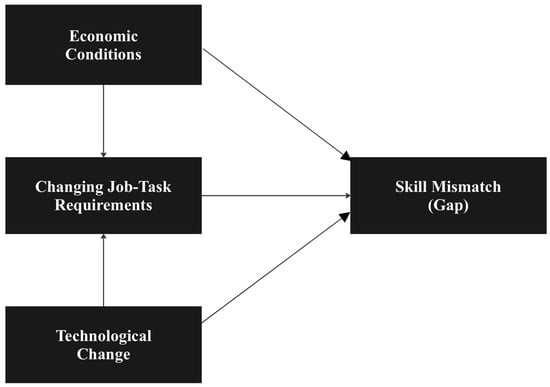
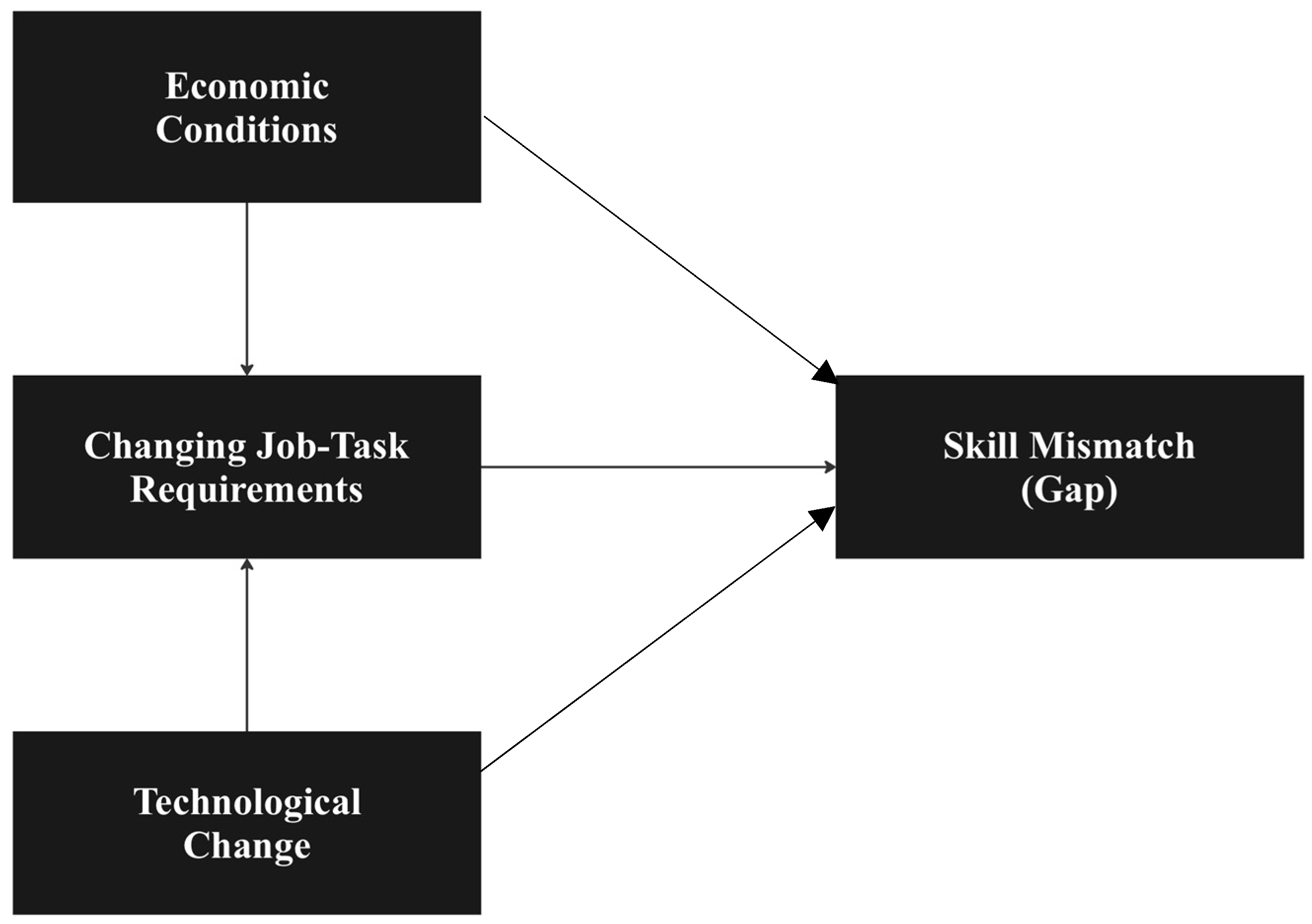
Economic conditions, technological change, and organizational practices together shape the discrepancies employers perceive between the competencies their work requires and those their workforces demonstrate. Technological change alters job tasks as automation, digitalization, and AI reduce routine task content (Acemoglu & Autor, 2011; D. Autor & Thompson, 2025). Changes in job-task requirements are therefore central to Figure 1. Economic conditions influence how salient a discrepancy becomes; tight labor markets increase competition for available capability without necessarily altering the tasks themselves (Brunello & Wruuck, 2021). Organizational practices, including wage-setting, recruitment and screening, investment in internal training, and job design, shape both the capability available to an organization and the extent to which employers attribute shortfalls to the external labor market (Cappelli, 2015; Desjardins & Rubenson, 2011). The outcome in Figure 1 is an employer-perceived competency discrepancy or skill mismatch; the difference between the importance of competency and employers’ satisfaction with its demonstration. Figure 1 primarily relates to RQ1 and RQ2; the remaining RQs are addressed descriptively as complementary findings.
Figure 1.
Conditions Influencing Employer-Perceived Competency Discrepancy.
The Ranked Discrepancy Model (RDM) was used to quantify employer-perceived competency discrepancies (Narine & Harder, 2021, 2024). The needs assessment literature defines a need as the difference between a current state (i.e., what is?) and a desired state (i.e., what should be?) (Borich, 1980; Boyle, 1981; Witkin & Altschuld, 1995), and the RDM provides a rank-based procedure for estimating that difference. In this study, the desired and current states were indicated by rated importance and rated satisfaction with proficiency, respectively. These are proxy indicators rather than direct measures, and the Methodology details the operationalization and its limits. The RDM has been applied to professional development needs (e.g., Choi & Park, 2023; Flanagan et al., 2023) and community-based needs (e.g., Zickafoose et al., 2023).
Needs assessment approaches in education are conceptually consistent with Lewin’s (1939) field theory. The needs assessment literature (Borich, 1980; Boyle, 1981; Witkin & Altschuld, 1995) defines a “need” as the difference between two conditions: a current state (i.e., what is?) and a desired state (i.e., what should be?). Lewin (1939) provided the seminal work that unintentionally set the stage for needs assessments in his conceptualization of field theory. Lewin posited that a system experiencing tension or divergence from its optimal state of functioning will naturally seek to restore equilibrium. Lewin (1939) also noted that tension arises from dynamic forces, such as technological change, that cause divergence from an equilibrium state. While the tension itself disrupts equilibrium, the system’s initial resting point is quasi-stationary, suggesting that a return to equilibrium may occur at a different point within the system. Needs assessment approaches are conceptually consistent with Lewin’s (1939) field theory, particularly its treatment of tension arising from discrepancies between existing and desired conditions. We use the term “equilibrium” only as a conceptual analogy and not as an empirically observed labor-market state.
Witkin and Altschuld (1995) operationalized Lewin’s (1939) force field theory for needs assessment in education. Complementing Boyle’s (1981) work on planning better programs, Witkin and Altschuld (1995) conceptualized a need as the discrepancy between a known condition and its desired state. They outlined a three-phased process to examine such discrepancies and the forces (or causes) behind them, noting that the magnitude and causes of these discrepancies are pivotal to choosing the intervention necessary to close the gap and return to equilibrium, as Lewin (1939) described in field theory. However, the discrepancies, or divergence, from equilibrium in social conditions, such as skill mismatches in the labor market, are unstandardized and difficult to quantify. For example, what is the minimum level of leadership skills necessary for organizational effectiveness, and if there is a deviation, what intervention restores equilibrium? This concept applies to the broader field of soft or durable skills and human competency. While standardized tests estimate ability, these scores are only proxies for actual competency, since there is always an unknown deviation from the “true” value.
Workforce development and career capacity-building interventions (e.g., degrees, technical certificates, diplomas) continually address the same problem: how to prepare students for a workplace that is constantly evolving amid dynamic forces. Given the difficulty of measuring actual skills, the RDM was applied to quantify employer-perceived discrepancies between the importance of competencies and satisfaction with their demonstration. While the conceptual framework identifies the conditions bearing on perceived discrepancy, the RDM provides the methodological approach for quantifying it.
4. Methodology
4.1. Study Design
This applied study used a cross-sectional descriptive survey design to identify and describe employer-perceived competency discrepancies in Utah. The target population was individuals with hiring responsibility in Utah-based organizations. Data were collected from 226 respondents between 17 September and 20 October 2025 using an online questionnaire administered via Qualtrics. A nonprobability sampling approach was used because available time, funding, and administrative capacity did not permit a probability-based design. Findings are exploratory and should be interpreted as indications of perceived workforce discrepancies rather than population estimates.
4.2. Sampling and Recruitment
Respondents were recruited through two channels using identical screening criteria and an identical instrument: (a) respondents were employed in a Utah-based organization, and (b) respondents were directly involved in hiring decisions. Centiment, a research panel provider, was contracted to recruit respondents meeting these criteria, yielding 187 respondents. The research team recruited an additional 39 respondents through professional networks at Utah State University. Centiment initiated data collection with a pilot launch of 50 responses. We examined the pilot data to confirm screening effectiveness and to assess completeness, missing values, and automated responses following Harder et al.’s (2025) guidelines for panel data. Because the review found no need to modify the instrument, we retained the pilot responses in the final dataset.
The instrument contained an embedded attention check; all cases in the final dataset passed it. There were no missing data. Limitations of this design are unknown selection bias and limited external validity. The sampling frame did not verify organizational uniqueness, so the study comprises 226 individual respondents and more than one respondent may have been employed by the same organization. Geographic region was not collected, so the sample cannot be characterized by Utah’s economic regions.
Because the two recruitment channels represent different selection mechanisms, we compared them before pooling. Network-recruited respondents (n = 39) reported larger discrepancies than panel respondents (n = 187) on 14 of 16 competencies. However, the rank ordering of competencies based on the RDM was substantially unaffected between the full sample and the panel-only subsample. Therefore, we report full-sample results (n = 226).
4.3. Instrument Design
The questionnaire was developed from existing employer-survey instruments and the workforce-skills literature, guided by the Tailored Design Method (Dillman et al., 2014). Competency items were adapted from established instruments assessing employer perceptions of workforce preparedness, principally the paired importance-and-performance measures used in national employer surveys of graduate competency (Association of American Colleges and Universities, 2021). Items were edited for relevance to Utah employers and to a general employed workforce rather than to recent graduates. We added competencies based on Utah-specific evidence and the broader literature (i.e., time management and conflict resolution, leadership, lifelong learning, and global awareness). We then identified persistent and emerging issues affecting workforce development, drawing on Bone et al. (2025), Rikala et al. (2024), and OECD (2025), and examined the literature on gaps between workforce preparation and educational attainment to inform career-readiness items. The instrument assesses cross-cutting competencies applicable across industries and does not include occupation-specific technical skills. A limitation of our study is that discrepancy results can only reflect competencies included in the instrument.
The research team reviewed the draft instrument for content validity; its members have combined expertise in workforce development, survey design and methodology, and higher education administration. This review was internal and did not involve an external expert panel. The absence of external validation is a limitation, which is somewhat mitigated by the use of existing competency items from an established national instrument.
The questionnaire comprised four sections. In Section 1, respondents rated 16 competencies twice: how important each is for success in their industry today, on a 5-point scale (1 = Not at all important, 2 = Slightly important, 3 = Moderately important, 4 = Very important, 5 = Extremely important); and how satisfied they were with the level of proficiency employees demonstrated in each, on a 5-point scale (1 = Extremely dissatisfied, 2 = Somewhat dissatisfied, 3 = Neither satisfied nor dissatisfied, 4 = Somewhat satisfied, 5 = Extremely satisfied). In Section 2, respondents rated the importance of eight competencies for employee success over the next five to ten years on the same importance scale, and selected from a provided list the emerging technological and regulatory developments expected to have the greatest impact on their workforce needs (i.e., select all that apply). In Section 3, respondents selected from two provided lists the barriers their organization faces when hiring and the areas in which employees tend to underperform (i.e., select all that apply). In Section 4, respondents rated the importance of nine academic experiences on the same importance scale, selected the credentials they considered most valuable (i.e., select all that apply), rated the importance of a college degree relative to demonstrated skills on a 5-point scale (1 = Much more important to have a degree to 5 = Much more important to have demonstrated skills), and ranked four hiring factors from 1 (most important) to 4 (least important).
4.4. Operationalization of the Current and Desired States
The RDM requires paired measures of a current and a desired condition. Rated importance served as the indicator of the desired state, and rated satisfaction with demonstrated proficiency as the indicator of the current state. These are proxy indicators. Importance is not a direct measure of the desired proficiency. Satisfaction with demonstrated proficiency is not a direct measure of actual proficiency: it is an evaluative judgment reflecting the respondent’s standards as well as observed performance. The RDM does not require the two conditions to be measured on a common metric because it uses only ordinal comparisons between a respondent’s paired ratings; a discrepancy exists when a respondent regards a competency as more important than they are satisfied with its demonstration in the workplace. This is consistent with applied competency assessment using proxy indicators (e.g., Eze & Siegmund, 2024; Hernandez, 2025; Seitz et al., 2022). Results are accordingly described as employer-perceived competency discrepancies; they are not direct measurements of employee proficiency.
4.5. Data Analysis
The RDM (Narine & Harder, 2021, 2024) was used to quantify the magnitude of discrepancy between the current and desired conditions for each competency. We selected the RDM over alternative analytical approaches for two reasons. First, mean-difference and weighted-discrepancy approaches such as the Borich (1980) model treat Likert ratings as interval data, whereas the RDM requires only ordinal assumptions, which is appropriate for single-item perceptual ratings. Second, the RDM preserves the paired, within-respondent structure of the comparison. Choi and Park (2023) directly compare the RDM with the Borich model and a Weighted Total Index (WTI) approach.
The RDM is a nonparametric, rank-based procedure (Narine & Harder, 2021). For each respondent (n) and each competency, the desired-state rating was compared with the current-state rating and assigned a rank: −100 where the desired state exceeded the current state (i.e., importance rated higher than satisfaction), 0 where the two were equal, and +100 where the current state exceeded the desired state. The RDS ranges from −100 to +100. Negative values indicate that importance exceeded satisfaction, reflecting a perceived discrepancy, with larger negative values indicating greater magnitude. Values at or near zero indicate that the two conditions were balanced. Positive values indicate that satisfaction exceeded importance, a condition conceptually adjacent to skill surplus or underutilization (Brun-Schammé & Rey, 2021; Brunello & Wruuck, 2021; Desjardins & Rubenson, 2011).
As an example, consider 10 respondents rating a competency. Six rated importance higher than satisfaction (6 × −100), two gave equal ratings (2 × 0), and two rated satisfaction higher than importance (2 × +100). The resulting RDS is [(−600) + (0) + (200)]/10 = −40.00. An RDS of −40.00 indicates an employer-perceived competency discrepancy. This negative discrepancy represents tension between the desired and current conditions, indicating a priority area where intervention may help move the system toward greater equilibrium.
4.6. Sample Characteristics
Respondents worked across five industry groupings: Business, Information, and Finance (27.4%); Manufacturing and Trade (23.0%); Education and Health Services (19.5%); Leisure and Other Services (19.5%); and Natural Resources and Construction (10.6%). All respondents were involved in hiring within their organization; 60.2% were mid-level managers and 39.8% were general managers or executives. Organization size varied: 22.1% employed 1–9 individuals, 23.0% employed 10–49, 22.1% employed 50–249, 19.5% employed 250–999, and 13.3% employed 1000 or more. Most respondents (43.8%) reported hiring fewer than five employees annually, while 30.1% reported hiring more than 20. Management level and organization size were strongly associated: 45.6% of general managers were in organizations of 1–9 employees, compared with 6.6% of mid-level managers.
5. Results
Results are reported by research question (RQ). Throughout, findings describe respondents’ perceptions and are not measurements of employee proficiency or applicant capability. Because respondents were recruited through a nonprobability design, percentages describe this sample and are not estimates of the population of Utah employers.
- RQ1: Which competencies do employers identify as showing the greatest perceived discrepancies in workforce capacity?
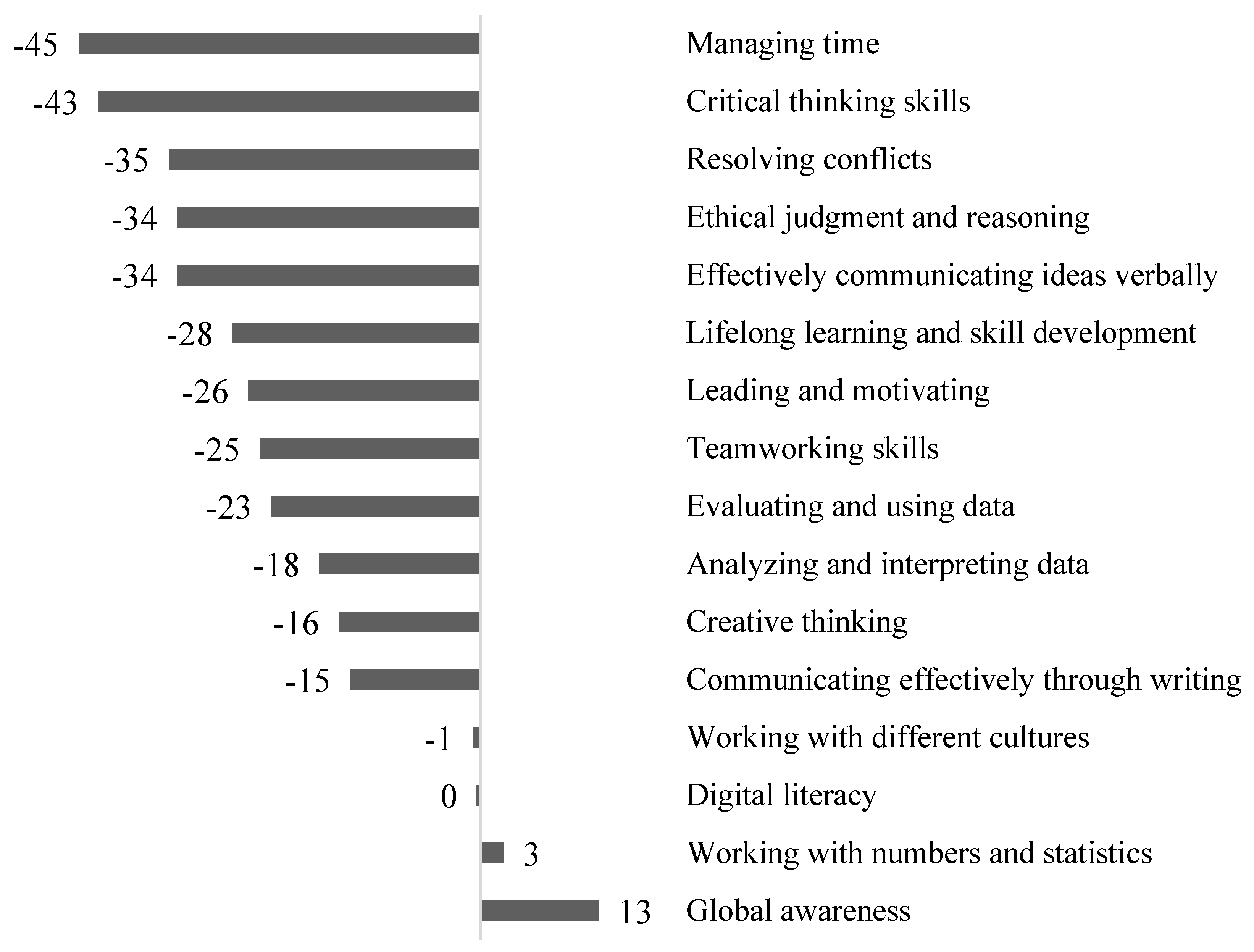
Figure 2 illustrates the Ranked Discrepancy Scores for the 16 competencies assessed, ordered from largest to smallest discrepancy. The largest discrepancies were observed for managing time (RDS = −45.13), using critical thinking skills (RDS = −42.92), resolving conflicts effectively (RDS = −34.96), communicating ideas verbally (RDS = −34.07), and exercising ethical judgment and reasoning (RDS = −34.07). Discrepancies were observed across most competencies, including leading and motivating others (RDS = −26.11), working effectively in teams (RDS = −24.78), and evaluating and using data in decision-making (RDS = −23.45). Three competencies did not show a negative discrepancy.
Figure 2.
Perceived Competency Discrepancies among Utah Employers, Ranked by RDS. Note. n = 226. Scores were calculated using the Ranked Discrepancy Model (Narine & Harder, 2024). The RDS ranges from −100 to +100. Negative values indicate that rated importance exceeded rated satisfaction, with larger negative values indicating greater perceived discrepancy. Values near zero indicate balance between the two conditions. Positive values indicate that rated satisfaction exceeded rated importance.
Digital literacy (RDS = −0.44) and working with people from different cultural backgrounds (RDS = −0.88) were effectively balanced. Working with numbers and statistics (RDS = +2.65) and demonstrating global awareness (RDS = +13.27) produced positive scores, indicating that more respondents were satisfied with demonstrated proficiency than regarded the competency as important to current success in their industry. A positive score indicates that perceived proficiency currently exceeds perceived importance, a condition conceptually related to skill surplus or underutilization (Brun-Schammé & Rey, 2021; Brunello & Wruuck, 2021; Desjardins & Rubenson, 2011).
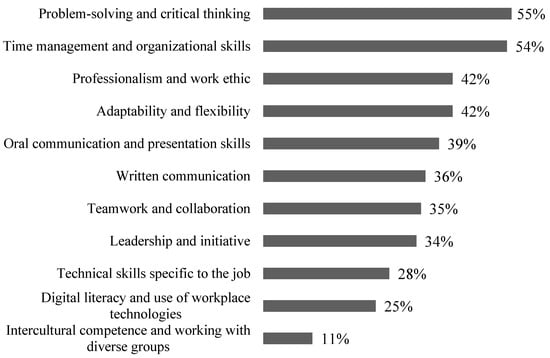
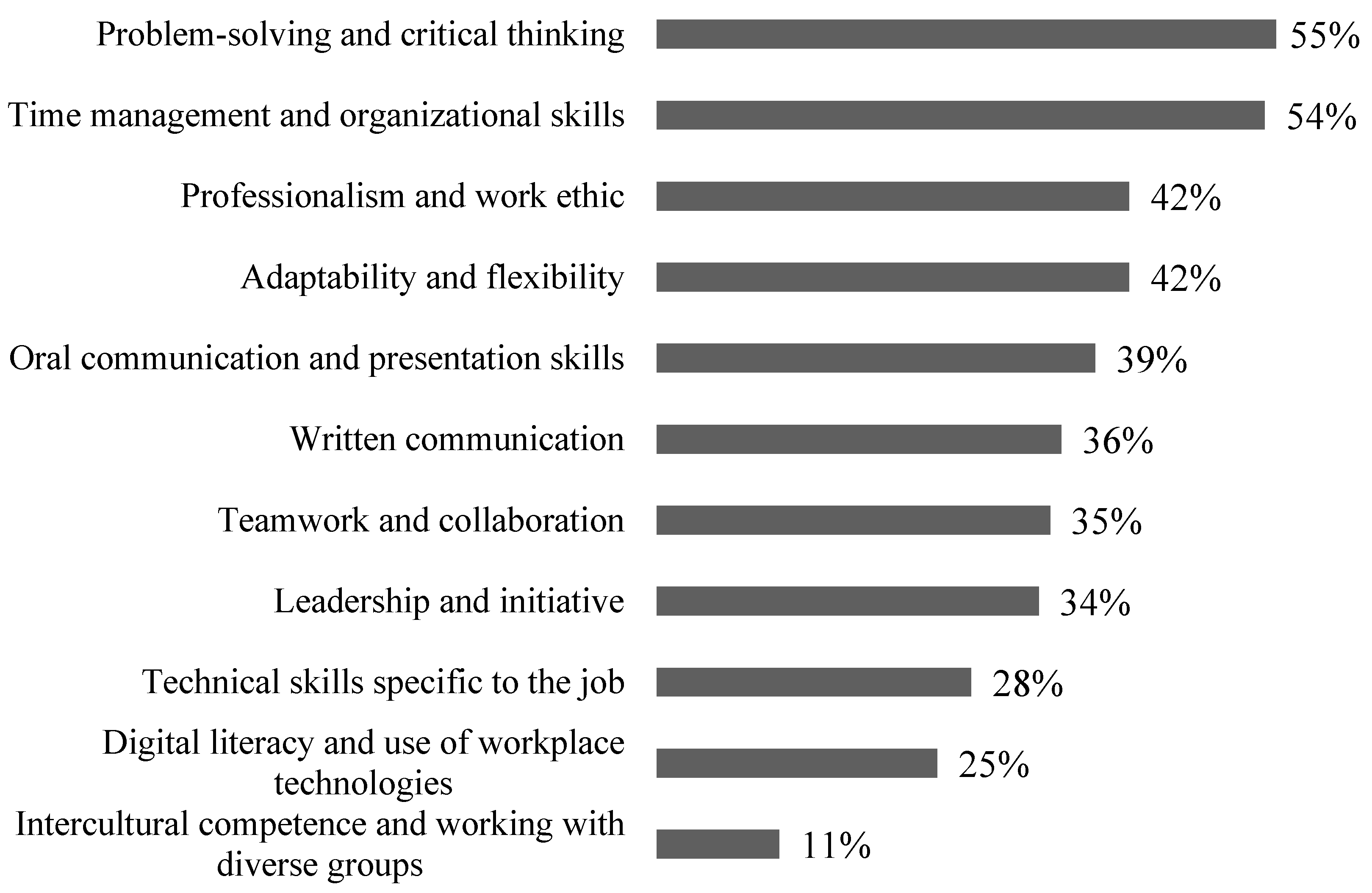
Figure 3 illustrates the areas in which respondents reported that employees most often underperform. These results are broadly consistent with the discrepancy findings in Figure 2. Respondents most frequently identified problem-solving and critical thinking (55.3%) and time management and organizational skills (54.0%). Adaptability and flexibility and professionalism and work ethic were each selected by 42.9%. Fewer respondents identified digital literacy and use of workplace technologies (24.8%) or intercultural competence and working with diverse groups (11.1%).
Figure 3.
Areas of Reported Employee Underperformance. Note. n = 226. Respondents could select more than one option; percentages represent the proportion of all respondents selecting each option and sum to more than 100%. Respondents selected an average of 4.04 options.
- RQ2: Which competencies do employers anticipate will be most important over the next five to ten years?
Table 1 shows respondents’ ratings of the anticipated importance of eight competencies over the next five to ten years, ordered by mean score. The highest-rated were communication (M = 4.54, SD = 0.66), collaboration and teamwork (M = 4.37, SD = 0.84), analytical thinking and problem-solving (M = 4.36, SD = 0.77), and lifelong learning and adaptability (M = 4.31, SD = 0.80). Digital and AI literacy was rated fifth (M = 4.16, SD = 0.95). Cultural and global awareness received the lowest rating and the widest dispersion (M = 3.51, SD = 1.24). Ratings for the top four items fell within 0.23 scale points of one another with overlapping dispersion and should be interpreted as comparably rated competencies. These ratings describe anticipated importance at a single point in time and cannot establish whether their importance is increasing.
Table 1.
Anticipated Importance of Competencies over the Next Five to Ten Years.
- RQ3: Which educational experiences do employers believe best prepare graduates for success?
Table 2 shows respondents’ ratings of nine academic experiences. Participation in work-based learning projects received the highest rating (M = 4.18, SD = 0.84), followed by internships or apprenticeships (M = 3.92, SD = 1.02) and mentorship and advising experiences (M = 3.90, SD = 0.94). The lowest-rated were capstone or senior projects (M = 3.36, SD = 1.20) and global learning opportunities (M = 3.20, SD = 1.23). All nine were rated above the scale midpoint, spanning 0.98 scale points with overlapping dispersion. These ratings indicate relative preference among the experiences presented rather than a judgment that lower-rated experiences lack value.
Table 2.
Employers’ Ratings of Academic Experiences in Preparing Students for Success.
- RQ4: How do employers compare the importance of a college degree with demonstrated skills or certifications in hiring decisions?
Respondents ranked the importance of a college degree relative to demonstrated skills. Most (58.4%) indicated demonstrated skills were more important, 13.8% indicated a degree was more important, and 27.9% rated the two as equally important. As shown in Table 3, demonstrated skills or competencies received the most favorable mean rank (M = 1.62, SD = 0.80) and were ranked first by 54.9% of respondents, followed by relevant work experience (M = 2.16, SD = 0.94). A college degree (M = 3.10, SD = 1.10) and industry-recognized certifications (M = 3.12, SD = 0.81) received nearly identical mean ranks.
Table 3.
Mean Ranked Importance of Factors in Hiring Decisions.
- RQ5: What types of credentials and certificates are most valued?
Table 4 shows the credentials respondents identified as most valuable. Industry-specific certifications were selected most frequently (56.6%), followed by soft-skill-focused micro-credentials (54.0%) and workplace safety and compliance certifications (50.0%). Language proficiency certifications were selected least frequently (26.5%).
Table 4.
Credentials and Certificates Identified as Most Valuable.
- RQ6: What barriers do employers face when hiring new employees?
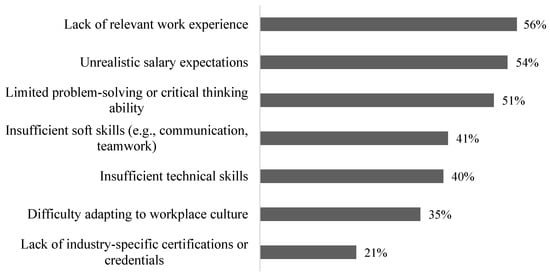
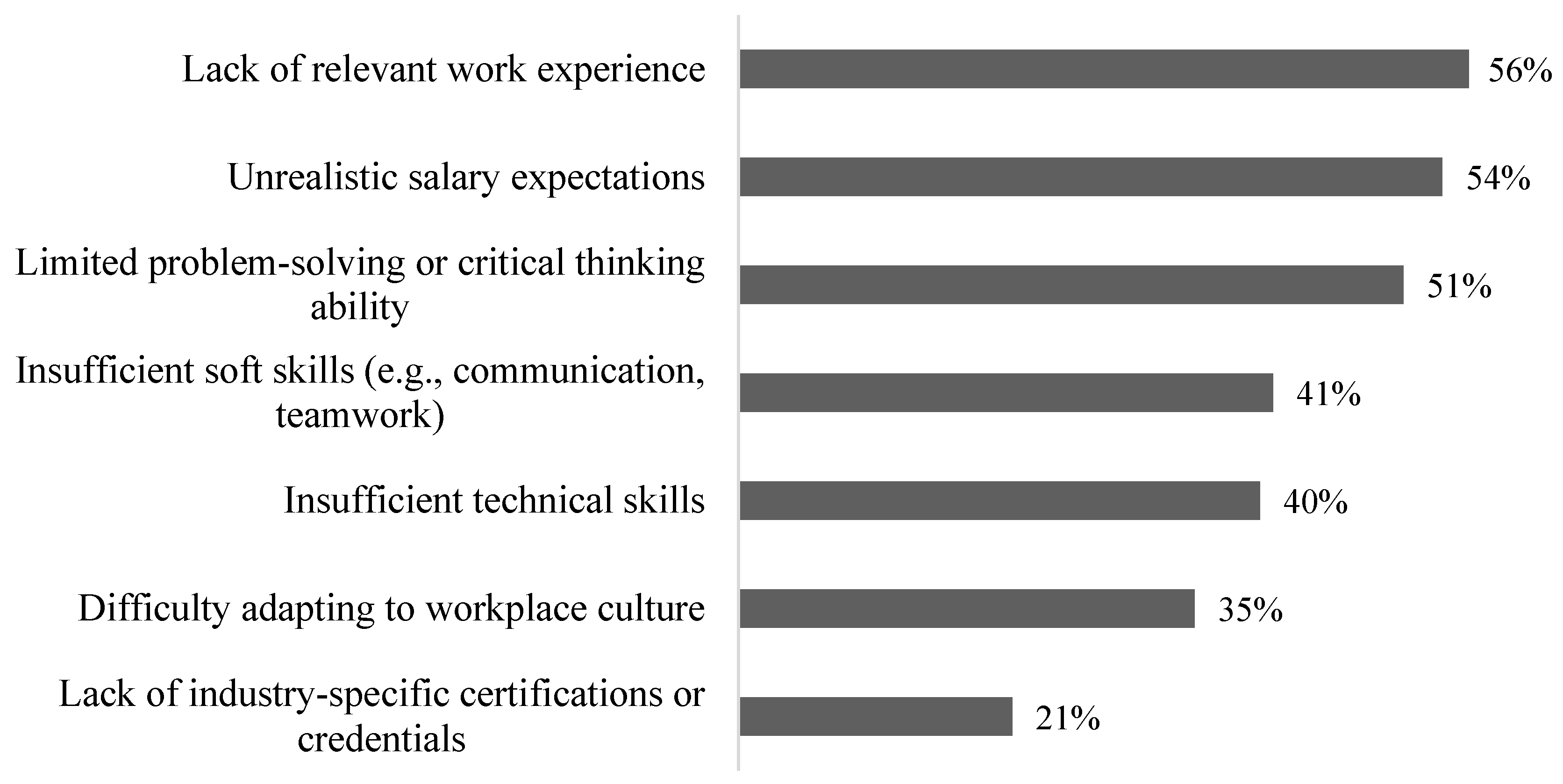
Figure 4 illustrates hiring barriers. The most frequently selected were a lack of relevant work experience (55.8%), unrealistic salary expectations (54.4%), and limited problem-solving or critical-thinking ability (50.9%). Insufficient soft skills (40.7%) and insufficient technical skills (40.3%) were selected at comparable rates, and a lack of industry-specific certifications or credentials was selected least frequently (20.8%). These items relate to employers’ perceptions regarding the causes of hiring difficulty. For unrealistic salary expectations, the data do not identify which party’s expectations are unrealistic based on prevailing market conditions. Cappelli (2015) argues that hiring difficulties may reflect employers’ wage-setting and recruitment practices and not deficits in labor supply.
Figure 4.
Reported Barriers to Hiring New Employees. Note. n = 226. Respondents could select more than one option; percentages represent the proportion of all respondents selecting each option. Respondents selected an average of 3.06 options, and eight respondents (3.5%) selected no barrier.
- RQ7: What emerging technological and regulatory developments are expected to have the greatest impact on workforce needs?
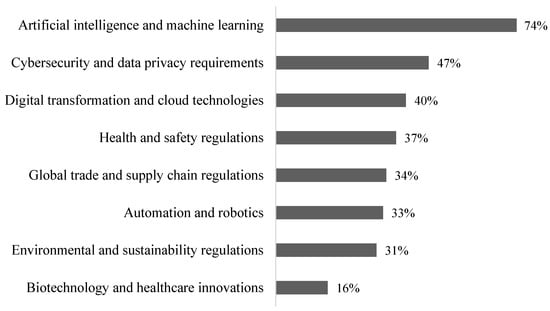
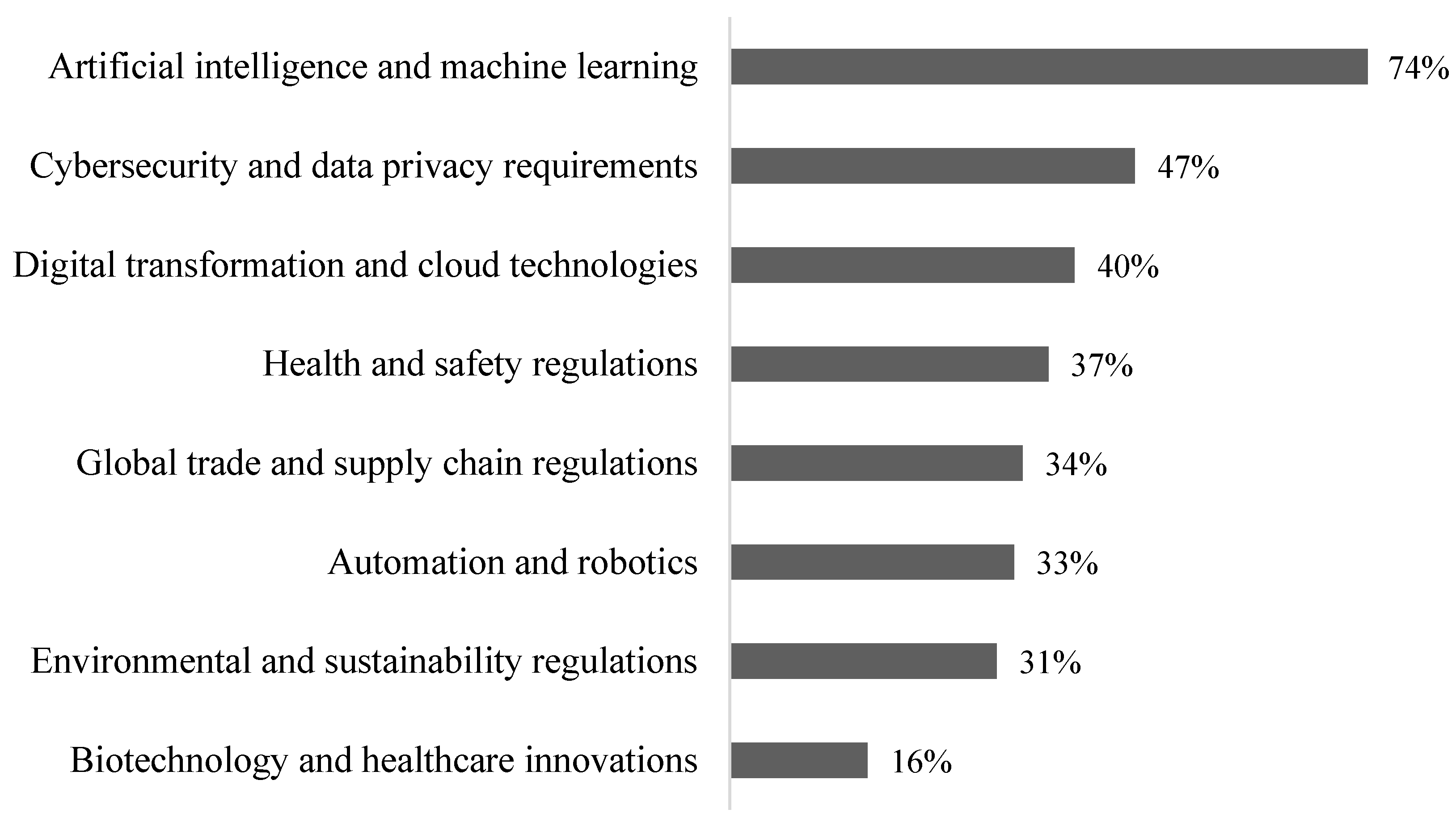
Figure 5 presents the developments respondents expected to most affect their workforce needs over the next five to ten years. Artificial intelligence and machine learning were selected by 73.5% of respondents, substantially more than any other option. Cybersecurity and data privacy requirements (46.5%) and digital transformation and cloud technologies (40.3%) followed. The question presented both technological developments and regulatory changes; health and safety regulations (36.7%), global trade and supply chain regulations (34.1%), and environmental and sustainability regulations (30.5%) were each selected by roughly a third of respondents.
Figure 5.
Emerging Technological and Regulatory Developments Expected to Affect Workforce Needs. Note. n = 226. Respondents could select more than one option; percentages represent the proportion of all respondents selecting each option. Respondents selected an average of 3.13 options.
Subgroup Comparison
We examined perceived skill mismatches by respondents’ managerial level. Comparing general managers (n = 90) with mid-level managers (n = 136) across all 16 competencies, there was no descriptive difference in ranking. In addition, ratings of anticipated importance, hiring barriers, underperformance areas, and the degree-versus-skills comparison were likewise descriptively indistinguishable. However, mid-level managers selected artificial intelligence and machine learning more frequently than general managers (80.9% vs. 62.2%).
6. Discussion
This study explored employer-perceived competency discrepancies in Utah, anticipated competency requirements, hiring barriers, and the educational experiences and credentials employers value. The study was designed as an applied regional needs assessment, and its findings are interpreted through a task-based needs assessment framework. Findings describe employers’ perceptions at a single point in time; they do not measure employee proficiency, applicant capability, graduate preparedness, or change in job tasks.
The largest employer-perceived discrepancies, as illustrated by the RDM and reported areas of underperformance, involved cross-cutting durable skills, particularly time management, critical thinking, and conflict resolution. This pattern was consistent throughout the findings, appearing in both the RDM rankings and the areas of underperformance. This finding is consistent with Brunello and Wruuck (2021) and Cappelli (2015), who report employer-identified deficiencies in non-technical competencies, and with Utah-specific evidence (Cicero Group, 2024), which identified time management and conflict management as areas where graduates were least prepared. The instrument did not include occupation-specific technical skills. Therefore, we cannot determine whether durable competencies show larger discrepancies than technical competencies.
Not all competencies showed unmet need. Global awareness produced a positive Ranked Discrepancy Score, and working with numbers and statistics was marginally positive, indicating that most respondents were satisfied with demonstrated proficiency. Digital literacy and cross-cultural working were effectively balanced. The mismatch literature distinguishes underskilling from overskilling and treats skill underutilization as a distinct condition with its own consequences, including the depreciation of unused skills (Brun-Schammé & Rey, 2021; Brunello & Wruuck, 2021; Desjardins & Rubenson, 2011), but these conditions are typically examined separately and often in different populations. A surplus condition calls for different action, such as job redesign or reallocation of instructional emphasis. This interpretation should be advanced cautiously; a positive score reflects relative ratings rather than a measured excess of capability.
Respondents rated communication, collaboration, analytical thinking, and lifelong learning highest among competencies anticipated to matter over the next five to ten years, while also identifying artificial intelligence and machine learning as the development most likely to affect their workforce needs. This is consistent with the task-based account in which technology substitutes for routine tasks while raising the value of judgment, interpretation, and communication in non-routine work (Acemoglu & Autor, 2011; D. Autor & Thompson, 2025; Acemoglu et al., 2026). However, results indicated no meaningful discrepancy in digital literacy (RDS = −0.44; importance M = 4.01, satisfaction M = 3.90), yet digital and AI literacy were rated 4.16 in anticipated importance, and AI was identified as the most consequential emerging development. Respondents thus reported present adequacy alongside expected future demand for closely related capabilities. While the needs assessment identifies gaps between a current and a desired condition as they exist at the time of measurement, it cannot detect a need whose importance has not yet risen. Needs assessments intended to inform decisions with multi-year lead times may systematically under-identify anticipatory needs unless they incorporate a prospective component.
Respondents ranked demonstrated skills and relevant work experience above a college degree and industry-recognized certifications, and rated work-based learning, internships, and mentorship above classroom-based academic experiences. These findings are consistent with evidence of movement toward skills-based hiring (Bone et al., 2025) and with arguments that educational credentials are imperfect indicators of job-relevant capability (Cappelli, 2015; Desjardins & Rubenson, 2011). However, a stated preference for demonstrated skills over degrees does not itself demonstrate that degrees are unreliable predictors of job performance; it indicates what these respondents reported valuing in hiring decisions.
The most frequently reported hiring barriers were a lack of relevant work experience (55.8%), unrealistic salary expectations (54.4%), and limited problem-solving or critical-thinking ability (50.9%). The first and third are attributions about candidates; the second describes a divergence between employer and candidate wage expectations without identifying which departs from market conditions. The literature indicates that reported hiring difficulties may reflect wage-setting, recruitment practice, limited internal training, and job design rather than actual deficits in labor supply (Brunello & Wruuck, 2021; Cappelli, 2015; Hurrell, 2016; Filippucci et al., 2026). This suggests employer-perceived discrepancies are partly produced within organizations. Respondents who reported both an inability to find candidates with relevant experience and dissatisfaction with employees’ durable competencies were, in effect, describing conditions that internal development practices—onboarding, coaching, structured training, and job design—are ordinarily intended to address. This implies that perceived workforce discrepancies are not solely an educational responsibility. However, our study cannot determine the relative contribution of external supply and internal practice to workforce capacity since we did not examine wage-setting, recruitment practice, or professional learning.
7. Conclusions and Recommendations
Employers in this study perceived the largest workforce discrepancies in durable, cross-cutting competencies. They rated communication, collaboration, analytical thinking, lifelong learning, and digital and AI literacy as most important over the next five to ten years and identified artificial intelligence and machine learning as the development most likely to affect their workforce needs. They ranked demonstrated skills and relevant work experience above degrees and certifications in hiring, and rated work-based learning and internships above classroom-based academic experiences.
First, higher education and workforce training programs can seek alignment with employer-reported priorities in Utah, particularly time management, critical thinking and problem-solving, conflict resolution, ethical judgment, and communication. Second, respondents rated work-based learning, internships, and mentorship above the academic experiences presented, and ranked demonstrated skills above credentials. Potential options for professional learning are expanding employer-sponsored projects, internships, and apprenticeships, and structured mentorship.
Competency-focused instruction may be more effective when reinforced across a curriculum and assessed with performance-based methods than when confined to a single professional-skills module. Where work-based learning cannot be scaled, shorter applied projects, simulated deliverables, and employer-developed competency checklists may offer partial substitutes. Skill-verification mechanisms such as portfolios, demonstrations, and micro-credentials may address the preference for demonstrated capability. Applied digital and AI literacy may warrant curricular attention given the anticipated demand. Within organizations, investment in onboarding, coaching, ongoing professional learning, and review of screening and hiring practices may address conditions employers attributed to the external labor market.
These recommendations should be interpreted in light of the study’s limitations. Findings reflect the perceptions of 226 individuals with hiring responsibility recruited through a nonprobability design and are exploratory; they are not estimates of the population of Utah employers, and organizational uniqueness was not verified. Rated importance and rated satisfaction are proxy indicators of the desired and current conditions rather than direct measures of proficiency, and no direct or work-sample measure of competency was obtained. Reported hiring difficulties may reflect organizational practices and labor-market conditions as well as candidate characteristics, and the study cannot distinguish the source or cause of workforce capacity. Discrepancy scores are bounded by the competencies included in the instrument.
Future research could replicate this assessment using probability-based sampling stratified by region and industry; incorporate direct or work-sample measures of competency; collect organizational measures of wage-setting, recruitment practice, and training investment to distinguish external supply constraints from internal practice.
Author Contributions
Conceptualization, L.K.N.; methodology, L.K.N.; software, L.K.N.; validation, L.K.N.; formal analysis, L.K.N.; investigation, L.K.N.; resources, P.A.H.; data curation, L.K.N.; writing—original draft preparation, L.K.N., P.A.H. and A.W.-B.; writing—review and editing, L.K.N., P.A.H. and A.W.-B.; visualization, P.A.H.; supervision, P.A.H.; project administration, P.A.H.; funding acquisi-tion, P.A.H. All authors have read and agreed to the published version of the manuscript.
Funding
This research was funded by an ongoing appropriation from the Utah Legislature. Rural Online Initiative Sunset Amendments, S.B. 55, Utah Legislature. (2021).
Institutional Review Board Statement
This study was conducted in accordance with the Declaration of Helsinki and received approval from the Institutional Review Board of Utah State University (protocol code #15463, approved 28 August 2025).
Informed Consent Statement
Informed consent was obtained from all subjects involved in the study.
Data Availability Statement
The data presented in this study are available upon request from the corresponding author. The data are not publicly available due to ethical protocols established by the Institutional Review Board.
Acknowledgments
The authors used OpenAI’s ChatGPT to copy-edit author-drafted text in the abstract, introduction, literature review, and conclusion sections of the manuscript for grammar, structure, and clarity. ChatGPT was not used to generate content, outlines, citations, or data, nor to evaluate the referenced literature. The authors verified every AI-suggested edit and take full responsibility for the manuscript’s accuracy and originality.
Conflicts of Interest
The authors state no conflicts of interest. The funders did not influence the study design, data collection, analysis, interpretation, manuscript preparation, or the decision to publish.
Abbreviations
The following abbreviations are used in this manuscript:
| ACTFL | American Council on the Teaching of Foreign Languages |
| AI | Artificial Intelligence |
| CPA | Certified Public Accountant |
| HIPAA | Health Insurance Portability and Accountability Act |
| OECD | Organization for Economic Cooperation and Development |
| OSHA | Occupational Safety and Health Administration |
| PMP | Project Management Professional |
| RDM | Ranked Discrepancy Model |
| RDS | Ranked Discrepancy Score |
| RQ | Research Question |
| STEM | Science, Technology, Engineering, and Mathematics |
| TOEFL | Test of English as a Foreign Language |
| UNESCO | United Nations Educational, Scientific and Cultural Organization |
References
- Acemoglu, D., & Autor, D. (2011). Skills, tasks, and technologies: Implications for employment and earnings. In Handbook of labor economics (Vol. 4, pp. 1043–1171). Elsevier. [Google Scholar] [CrossRef] [Scilit]
- Acemoglu, D., & Autor, D. (2012). What does human capital do? A review of Goldin and Katz’s The race between education and technology. Journal of Economic Literature, 50(2), 426–463. [Google Scholar] [CrossRef] [Scilit]
- Acemoglu, D., Autor, D., & Johnson, S. (2026). Building pro-worker artificial intelligence (No. w34854). National Bureau of Economic Research. Available online: https://www.nber.org/papers/w34854 (accessed on 29 April 2026).
- Acemoglu, D., & Johnson, S. (2024). Learning from Ricardo and Thompson: Machinery and labor in the early industrial revolution and in the age of artificial intelligence. Annual Review of Economics, 16(1), 597–621. [Google Scholar] [CrossRef] [Scilit]
- America Succeeds. (2021). Defining durable skills. Available online: https://americasucceeds.org/defining-durable-skills (accessed on 3 April 2026).
- Association of American Colleges and Universities. (2021). How college contributes to workforce success: Employer views on what matters most. Available online: https://www.aacu.org/research/how-college-contributes-to-workforce-success (accessed on 17 March 2026).
- Autor, D., & Thompson, N. (2025). Expertise (No. w33941). National Bureau of Economic Research. Available online: https://www.nber.org/papers/w33941 (accessed on 10 April 2026).
- Autor, D. H., Levy, F., & Murnane, R. J. (2003). The skill content of recent technological change: An empirical exploration. The Quarterly Journal of Economics, 118(4), 1279–1333. [Google Scholar] [CrossRef] [Scilit]
- Bischof, S. (2024). Test-based measurement of skill mismatch: A validation of five different measurement approaches using the NEPS. Journal for Labour Market Research, 58(1), 11. [Google Scholar] [CrossRef] [Scilit]
- Bone, M., Gonzalez Ehlinger, E., & Stephany, F. (2025). Skills or degree? The rise of skill-based hiring for AI and green jobs. Technological Forecasting and Social Change, 214, 124042. [Google Scholar] [CrossRef] [Scilit]
- Borich, G. D. (1980). A needs assessment model for conducting follow-up studies. Journal of Teacher Education, 31(3), 39–42. [Google Scholar] [CrossRef] [Scilit]
- Boyle, P. G. (1981). Planning better programs. McGraw-Hill. [Google Scholar]
- Brunello, G., & Wruuck, P. (2021). Skill shortages and skill mismatch: A review of the literature. Journal of Economic Surveys, 35(4), 1145–1167. [Google Scholar] [CrossRef] [Scilit]
- Brun-Schammé, A., & Rey, M. (2021). A new approach to skills mismatch (OECD productivity working papers No. 24). OECD Publishing. [Google Scholar] [CrossRef]
- Cappelli, P. H. (2015). Skill gaps, skill shortages, and skill mismatches: Evidence and arguments for the United States. ILR Review, 68(2), 251–290. [Google Scholar] [CrossRef] [Scilit]
- Choi, H.-J., & Park, J.-H. (2023). Exploring the viability of the ranked discrepancy model by comparing the weighted total index approach and the Borich model: A case of learning needs assessment of career guidance teachers. Education Sciences, 13(4), 414. [Google Scholar] [CrossRef] [Scilit]
- Cicero Group. (2024, December 3). Utah workforce alignment study. Utah System of Higher Education and Talent Ready Utah. Available online: https://ushe.edu/wp-content/uploads/pdf/reports/2024/2024_USHE_State_Workforce_Alignment_Study_Report.pdf (accessed on 6 March 2026).
- Conner, N. W., Dev, D., & Krause, K. (2018). Needs assessment for informing extension professional development trainings on teaching adult learners. Journal of Extension, 56(3), 25. [Google Scholar] [CrossRef] [Scilit]
- Desjardins, R., & Rubenson, K. (2011). An analysis of skill mismatch using direct measures of skills. In OECD education working papers (No. 63). OECD Publishing. [Google Scholar] [CrossRef]
- Dillman, D. A., Smyth, J. D., & Christian, L. M. (2014). Internet, phone, mail, and mixed-mode surveys: The tailored design method (4th ed.). Wiley. [Google Scholar]
- Eze, E., & Siegmund, A. (2024). Appraising competency gaps among UNESCO-designated heritage site actors in disaster risk reduction innovations. Progress in Disaster Science, 22, 100321. [Google Scholar] [CrossRef] [Scilit]
- Filippucci, F., Langle, K., & Marcolin, L. (2026). The firm side of labour shortages: Five new facts from the OECD-GFP employer survey. Labour Economics, 100, 102894. [Google Scholar] [CrossRef] [Scilit]
- Flanagan, B., Boren-Alpizar, A., Wingenbach, G., Lawver, D., & Strong, R. (2023). Evaluating agroforestry extension workers’ technical and human relation competencies: A ranked discrepancy model needs assessment. Sustainability, 15(19), 14100. [Google Scholar] [CrossRef] [Scilit]
- Garst, B. A., & McCawley, P. F. (2015). Solving problems, ensuring relevance, and facilitating change: The evolution of needs assessment within Cooperative Extension. Journal of Human Sciences and Extension, 3(2), 4. [Google Scholar] [CrossRef] [Scilit]
- Handel, M. J. (2003). Skills mismatch in the labor market. Annual Review of Sociology, 29(1), 135–165. [Google Scholar] [CrossRef] [Scilit]
- Harder, A., Narine, L. K., & Stearns, S. (2025). Decision-making and data quality: Applying fraud response strategies to clean survey panel data. Advancements in Agricultural Development, 6(1), 97–108. [Google Scholar] [CrossRef] [Scilit]
- Hernandez, F. J. (2025). Assessment of the evaluation competencies needed for extension professionals at the University of Connecticut: Implications for designing professional development curriculum in program evaluation. Journal of Agricultural Education, 66(4), 9. [Google Scholar] [CrossRef] [Scilit]
- Higher Education Strategic Reinvestment. (2025). H.B. 265. 2025 Gen. Sess. (Utah 2025). Available online: https://le.utah.gov/~2025/bills/static/HB0265.html (accessed on 19 April 2026).
- Horowitz, J. (2018). Relative education and the advantage of a college degree. American Sociological Review, 83(4), 771–801. [Google Scholar] [CrossRef] [Scilit]
- Hurrell, S. A. (2016). Rethinking the soft skills deficit blame game: Employers, skills withdrawal and the reporting of soft skills gaps. Human Relations, 69(3), 605–628. [Google Scholar] [CrossRef] [Scilit]
- Lamri, J., & Lubart, T. (2023). Reconciling hard skills and soft skills in a common framework: The generic skills component approach. Journal of Intelligence, 11(6), 107. [Google Scholar] [CrossRef] [Scilit]
- Lewin, K. (1939). Field theory and experiment in social psychology: Concepts and methods. American Journal of Sociology, 44(6), 868–896. [Google Scholar] [CrossRef] [Scilit]
- Narine, L. K., Ali, A. D., & Hill, P. A. (2021). Assessing rural and urban community assets and needs to inform Extension program planning. Journal of Human Sciences and Extension, 9(1), 8. [Google Scholar] [CrossRef] [Scilit]
- Narine, L. K., & Harder, A. (2021). Comparing the borich model with the ranked discrepancy model for competency assessment: A novel approach. Advancements in Agricultural Development, 2(3), 96–111. [Google Scholar] [CrossRef] [Scilit]
- Narine, L. K., & Harder, A. (2024). Analyzing and visualizing repeated-measures needs assessment data using the ranked discrepancy model. Advancements in Agricultural Development, 5(2), 105–118. [Google Scholar] [CrossRef] [Scilit]
- Organization for Economic Cooperation and Development (OECD). (2025). Empowering the workforce in the context of a skills-first approach. Available online: https://www.oecd.org/content/dam/oecd/en/publications/reports/2025/06/empowering-the-workforce-in-the-context-of-a-skills-first-approach_0e3be363/345b6528-en.pdf (accessed on 8 March 2026).
- Ramirez-Ramirez, D. M., Agudelo-Ceballos, E., Jimenez Garcia, J. A., Valencia-Arias, A., Cardona-Acevedo, S., Valencia, J., & Ynoquio, E. (2025). Research trends in the development of generic skills. Frontiers in Education, 10, 1629392. [Google Scholar] [CrossRef] [Scilit]
- Rikala, P., Braun, G., Jarvinen, M., Stahre, J., & Hamalainen, R. (2024). Understanding and measuring skill gaps in Industry 4.0—A review. Technological Forecasting and Social Change, 201, 123206. [Google Scholar] [CrossRef] [Scilit]
- Seitz, P., Strong, R., Hague, S., & Murphrey, T. P. (2022). Evaluating agricultural extension agent’s sustainable cotton land production competencies: Subject matter discrepancies restricting farmers’ information adoption. Land, 11(11), 2075. [Google Scholar] [CrossRef] [Scilit]
- Teyssier-Roberge, G., Gagnon, J., Tremblay, S., & Hodgetts, H. (2025). A quantitative analysis of 21st century skills: A case of semantic and psychometric overlap. International Journal of Selection and Assessment, 33(4), e70030. [Google Scholar] [CrossRef] [Scilit]
- Utah Economic Council. (2026). 2026 economic report to the governor. State of Utah. Available online: https://gardner.utah.edu/utah-economy/economic-report-to-the-governor/2026-economic-report-to-the-governor/ (accessed on 29 March 2026).
- Varadarajan, S., Koh, J. H. L., & Daniel, B. K. (2023). A systematic review of the opportunities and challenges of micro-credentials for multiple stakeholders: Learners, employers, higher education institutions and government. International Journal of Educational Technology in Higher Education, 20(1), 13. [Google Scholar] [CrossRef] [Scilit]
- Weber, T., & Adascalitei, D. (2024). Company practices to tackle labour shortages. Eurofound, publications Office of the European Union. [Google Scholar] [CrossRef]
- Witkin, B. R., & Altschuld, J. W. (1995). Planning and conducting needs assessments: A practical guide. Sage. [Google Scholar]
- Zickafoose, A., Wingenbach, G., Baker, M., & Price, E. (2023). Developing youth agricultural entrepreneurship in Latin America and the Caribbean. Sustainability, 15(22), 15983. [Google Scholar] [CrossRef] [Scilit]

Disclaimer/Publisher’s Note: The statements, opinions and data contained in all publications are solely those of the individual author(s) and contributor(s) and not of MDPI and/or the editor(s). MDPI and/or the editor(s) disclaim responsibility for any injury to people or property resulting from any ideas, methods, instructions or products referred to in the content. |
© 2026 by the authors. Licensee MDPI, Basel, Switzerland. This article is an open access article distributed under the terms and conditions of the Creative Commons Attribution (CC BY) license.