


Abstract
Business process reengineering (BPR) is usually remembered as one of the most visible management fashions of the 1990s. It rose rapidly, promised radical redesign and major performance gains, and later lost legitimacy as many implementations failed to match the rhetoric and became associated with disruption, downsizing, and managerial overreach. Yet the organizational problem to which BPR responded never disappeared: how should organizations redesign processes when new technologies alter what is possible? This paper revisits BPR in light of recent developments in generative and agentic artificial intelligence. This perspective article develops a conceptual interpretation rather than a systematic review or empirical test. Its purpose is to clarify an emerging pattern in management discourse and process-management research: the possible reactivation of BPR-style redesign logic under new technological and discursive conditions. Using management fashion theory as the main lens, it suggests that AI may be creating conditions under which elements of BPR’s underlying redesign logic become newly relevant. The argument is not that the BPR label has simply returned. Rather, aspects of its core ambition appear to be rearticulated through adjacent and more legitimate vocabularies such as business process management, AI-augmented business process management systems, Large Process Models, and agentic BPM. To capture this pattern, the paper introduces the concept of translated resurgence, referring to the renewed relevance of an older management idea through relabeling, reinterpretation, and mutation. The paper further argues that AI may alter the technical feasibility of radical process redesign while leaving many classic BPR risks intact. The result is best understood not as a simple revival, but as an emerging and still unsettled phase in the longer afterlife of a once-prominent management idea.
1. Introduction
Business process reengineering (BPR) was one of the most visible and controversial management ideas of the 1990s (Hindle, 2008; Knights & Willmott, 2000). It promised dramatic improvements in cost, quality, service, and speed through the fundamental rethinking and radical redesign of business processes (Hammer, 1990; Hammer & Champy, 1993). It also became one of the decade’s most criticized managerial doctrines. Critics linked BPR to inflated rhetoric, conceptual vagueness, technocratic redesign, job loss, and managerial overreach. In the management literature, BPR became a classic example of a concept that rose rapidly, attracted intense enthusiasm, and then suffered reputational decline (Benders & Van Veen, 2001; Heusinkveld & Benders, 2001). Yet BPR never entirely vanished. Historical work on the concept (Madsen & Slåtten, 2025) shows a more complex trajectory: it declined from its 1990s peak, remained embedded in management vocabulary, continued to attract research attention, and persisted through related forms such as business process management (BPM) and business process improvement (BPI) (Moreira & Dallavalle, 2024; Reijers, 2021; Schaschek et al., 2024; Siha & Saad, 2008).
That historical complexity matters because the present paper is not really about whether BPR “comes back” in a literal sense. A direct rehabilitation of the old label still seems improbable. The more interesting question is whether the underlying redesign logic associated with BPR is becoming newly relevant under altered technological and discursive conditions. Recent developments in generative and agentic AI make that question hard to ignore (Holmström & Carroll, 2025; Hosseini & Seilani, 2025; Krakowski, 2025). Process research is now moving beyond classic automation toward AI-augmented process systems (Dumas et al., 2023), Large Process Models (Kampik et al., 2025), and agentic forms of BPM (Calvanese et al., 2026; Dumas et al., 2026). These developments may do more than optimize existing workflows. They appear to reopen the possibility of deeper process redesign, more continuous process adaptation, and in some cases semi-autonomous or autonomous process execution.
The AI–BPR connection also has a longer history than current debates sometimes suggest (Casey, 2025; Hamscher, 1994), but that connection is developed in a later section. For the purposes of the introduction, the key point is simpler: AI does not make BPR relevant because the old label has returned. It matters because newer AI-enabled process vocabularies appear to reopen some of the same organizational questions that made BPR influential in the first place: how work should be redesigned when technology changes the boundaries of coordination, decision-making, and execution.
This paper, therefore, asks a more precise question than whether BPR is “back”: are generative and agentic AI creating conditions for a translated resurgence of BPR’s underlying redesign logic? The paper uses management fashion theory as its main lens, but it does not treat fashion cycles as simple patterns of rise and decline. Instead, it draws on work showing that management ideas can mutate, persist, lie dormant, and reappear under new labels and altered conditions (Abrahamson & Piazza, 2019; Reinmoeller et al., 2019; Røvik, 2019). This framing is useful because the BPR label remains historically contaminated, while parts of its redesign ambition appear to persist in adjacent vocabularies such as BPM, AI-augmented BPMS, Large Process Models, and agentic BPM.
The concept of translated resurgence is introduced to name a more specific pattern than re-adoption, mutation, or translation can capture on their own. Re-adoption highlights that older ideas may regain relevance. Mutation highlights that ideas change as they travel. Translation highlights that actors reformulate ideas as they adapt them to new settings. Translated resurgence refers to the combined pattern in which an older management idea becomes newly relevant after its original label has lost legitimacy, but only by being rearticulated through newer vocabularies, altered technical conditions, and partially revised assumptions. In this case, the term helps capture the coexistence of three dynamics: the reputational decline of “BPR,” the persistence of a process redesign logic, and the AI-era emergence of new process vocabularies that make elements of that logic appear timely again. Section 4.2 specifies the diagnostic criteria for this configuration and clarifies why translated resurgence is not simply a loose combination of re-adoption, mutation, and translation, but a more specific pattern in which a contaminated label is abandoned while an underlying managerial logic becomes newly actionable under altered technological conditions.
The paper makes three main contributions. First, it suggests that AI may be creating conditions for a new phase in the trajectory of BPR—not a straightforward revival, but a translated resurgence. Second, it shows how newer process vocabularies, such as AI-augmented BPMS, Large Process Models, and agentic BPM, can be understood as contemporary translations of an older redesign logic. Third, it uses this case to suggest broader implications for management fashion theory, especially regarding lifecycle variation, re-adoption, dormancy, rhetorical versus substantive adoption, and the role of technological shocks and megatrend narratives in reshaping the management knowledge market. Megatrend narratives matter here not because they predict the future with precision, but because they help define what managers believe they ought to care about now (Naughtin et al., 2024; Ng et al., 2025). AI has arguably become such a narrative.
2. Analytical Approach
This paper is a conceptual article based on an interpretive synthesis of three overlapping bodies of literatures. The first is historical and critical research on BPR, including work on its rise, backlash, conceptual ambiguity, and post-peak afterlife. The second is management fashion theory and adjacent work on translation, mutation, re-adoption, and idea-handling processes. The third is emerging scholarship on AI-enabled process management, including work on AI-augmented BPMS, Large Process Models, and agentic BPM.
The article is therefore deliberately positioned as a perspective article. It does not seek to measure the prevalence of AI-enabled reengineering, nor does it claim that contemporary actors consciously revive BPR. Its purpose is to offer a theoretically informed interpretation of an emerging pattern: the possible reactivation of BPR-style redesign logic under new technological and discursive conditions. This genre positioning matters because the paper’s central claim is conceptual rather than predictive. It identifies a plausible pattern for future empirical inquiry, while also specifying the limits of that pattern.
Some of the most recent work on agentic BPM and agentic BPMS should therefore be read with appropriate caution. Several contributions are manifesto-style or preprint-based rather than settled empirical literature. Their value for the present argument is not that they prove widespread organizational adoption, but that they signal how leading process scholars are beginning to name and frame a new frontier for process management. They are treated here as indicators of emerging vocabulary and ambition, not as conclusive evidence of implementation.
The aim is not to offer a systematic review of all BPR, BPM, or AI research. Rather, the paper uses a problem-driven synthesis to clarify an emerging conceptual pattern: the possible reactivation of an older redesign logic under new technological and discursive conditions. Sources were selected because they speak directly to one of three analytical questions: how BPR evolved after its 1990s peak; how management ideas survive, mutate, or reappear after decline; and how recent AI-enabled process research reframes the scope of process redesign.
The analysis proceeded in three steps. First, the paper reconstructs BPR’s post-peak trajectory as a case of label contamination, conceptual drift, and partial persistence. Second, it connects this trajectory to concepts from management fashion and translation-oriented research, especially the distinction between rhetorical and substantive adoption. Third, it reads recent AI-enabled BPM work as an emerging vocabulary in which some BPR-like redesign ambitions are being reformulated. The resulting argument is interpretive rather than predictive. It identifies a plausible conceptual trajectory, but it does not claim that all AI-enabled process initiatives are substantively reengineering organizations.
3. BPR After the Hype: Persistence, Contamination, and Conceptual Drift
3.1. Rise, Ambiguity, and Early Criticism
BPR’s history is best understood as a rise, backlash, and long afterlife rather than as a simple case of appearance and disappearance. It emerged at the turn of the 1990s, quickly became one of the most visible management ideas of the decade, and was strongly linked to promises of radical transformation (Hindle, 2008). It also fitted the climate of the time. BPR resonated with recession pressure, competitive anxiety, and enthusiasm for large-scale IT-enabled restructuring. It is not surprising that the concept spread so quickly in a period when dramatic organizational renewal was treated as both urgent and desirable. The historical review in Madsen and Slåtten (2025) supports this reading while also emphasizing that BPR became one of the most iconic labels in management discourse.
At the same time, BPR contained several of the traits that make management ideas vulnerable to overreach. It had a strong label, dramatic performance promises, broad applicability claims, and high interpretive flexibility (Benders & Van Veen, 2001; Kieser, 1997; Røvik, 2002). These traits made it diffusable, but also made it difficult to stabilize in practice. Madsen and Slåtten (2025) note that BPR was interpreted in many ways, both by suppliers and adopters, and that the label eventually became worn out through use. This aligns closely with Benders and van Veen’s argument that management fashions gain traction partly because they are interpretable in multiple ways. The same ambiguity that fuels adoption can later contribute to dilution, disappointment, and backlash.
BPR’s novelty was contested almost from the start. Earl and Khan (1994) argued that business process redesign combined genuinely new elements with older managerial ideas, while O’Neill and Sohal’s (1999) review showed that the early literature was fragmented across definitions, methods, tools, outcomes, and critical concerns. This matters because the AI-era translation of BPR does not emerge from a stable original. It emerges from a concept whose meaning was already contested, stretched, and recombined from the beginning.
3.2. BPR’s Assumptions and Implementation Limits
A stronger account of BPR’s afterlife also requires attention to the assumptions that made the concept both powerful and vulnerable. Classical BPR rested on the idea that organizations could achieve major performance gains by radically redesigning end-to-end processes rather than improving existing functional routines incrementally. This implied several assumptions: that processes could be identified and redesigned with sufficient clarity; that information technology could act as a strong enabler of new work arrangements; that radical redesign could overcome the inertia of existing organizational structures; and that employees, systems, and governance arrangements could be realigned around redesigned processes.
These assumptions were always difficult to stabilize. Early conceptual work already showed that BPR was not a single coherent method, but a broad and contested umbrella for process-oriented transformation (Ahmed & Simintiras, 1996; O’Neill & Sohal, 1999). Boudreau and Robey (1996) sharpen this point by showing that BPR contained internal contradictions. It relied on “clean slate” redesign while being implemented in organizations shaped by existing routines, power relations, and technical constraints. It invoked empowerment while often being associated with top-down restructuring. It positioned IT as an enabler of transformation while sometimes treating technology as if it could resolve organizational contradictions by itself.
The implementation literature reinforces this caution. BPR failures were not simply caused by poor execution of an otherwise stable model. They also reflected the concept’s broad scope, its methodological ambiguity, and its limited sensitivity to organizational context, culture, participation, and systems interdependence (Fetais et al., 2022; Vakola & Rezgui, 2000). From a systems perspective, BPR was especially vulnerable because it lacked a widely accepted reference model comparable to more formal cybernetic or soft systems approaches. This made it difficult to specify what counted as successful reengineering, how redesign should be governed, and how local process changes would affect the wider organizational system (Dekkers, 2008).
This matters for the present argument because AI cannot simply “solve” BPR’s earlier weaknesses. Generative and agentic AI may alter the technical feasibility of process discovery, modeling, simulation, and execution, but they do not remove the organizational problems that complicated BPR in the first place. If anything, they may intensify some of them by making redesign faster, more opaque, and more dependent on data infrastructures and algorithmic mediation. The translated resurgence of BPR-style thinking should therefore be understood as a renewed possibility, not as a guaranteed improvement. It reopens the BPR question under new conditions, but it also carries forward many of the old tensions around power, participation, governance, and implementation.
3.3. Label Contamination and Surviving Redesign Logic
The decline of BPR, then, was not simply a matter of managers losing interest in process issues. It was also a crisis of legitimacy at the level of the label. Once “reengineering” became associated with layoffs, expensive consultancy projects, and overblown claims, the term itself became risky (Benders & Van Veen, 2001). The critical literature sharpened this reputational problem. Edwards and Peppard (1994) questioned whether business process redesign was hype, hope, or hypocrisy, while Grey and Mitev (1995) offered a broader critique of reengineering as a managerial and organizational project. Biazzo (1998) similarly treated BPR as a phenomenon requiring critical examination rather than straightforward acceptance. These critiques show that BPR’s decline was not simply a matter of failed implementation. It was also a loss of moral, political, and intellectual credibility.
Yet this did not mean the underlying organizational problem disappeared. Process redesign remained important. What changed was the language through which it could be pursued credibly.
That shift in language was not incidental. The BPR label had become burdened by a cluster of negative associations: layoffs, consultant-driven overreach, disruptive restructuring, and performance promises that often exceeded what organizations could realistically deliver (Benders & Van Veen, 2001; Masih, 2015). Once a label acquires that sort of contamination, even actors still interested in the underlying problem may avoid it. Translation then becomes less a matter of stylistic relabeling than of reputational necessity. New vocabularies create distance from the failures and political tensions of the earlier wave while preserving some of its substantive ambitions.
This is why the move from BPR toward BPM and related labels matters historically. BPM retained an interest in processes and performance, but without the same direct association with the most controversial aspects of 1990s reengineering. Madsen and Slåtten (2025) show that the afterlife of BPR was already partly a story of mutation and conceptual drift before the current AI wave began.
This distinction between a damaged label and a surviving underlying logic is central to the argument that follows. If BPR had truly disappeared, there would be no meaningful resurgence to discuss. But if the label declined while part of the underlying redesign agenda survived in adjacent vocabularies, then the AI era may be reopening that agenda in a new form. The analytical task is therefore not to ask whether BPR returns under its old name. It is to ask whether something recognizably BPR-like is being rebuilt under new labels, with new technologies, and within a different justificatory discourse.
4. Theoretical Framing: Management Fashion, Loose Coupling, and Translated Resurgence
4.1. Lifecycle Variation and Re-Adoption
Management fashion theory remains the best main lens for this analysis because it is explicitly concerned with the rise, diffusion, legitimation, decline, and possible return of management ideas (Piazza & Abrahamson, 2020). BPR has long been treated as a paradigmatic case in that literature (Benders et al., 1998; Benders & Van Veen, 2001). But the version of the theory needed here is not the older caricature in which ideas rise, peak, and vanish in neat bell-shaped cycles. The stronger version is the more developed literature that admits more complex trajectories. Abrahamson and Piazza’s (2019) lifecycle model is especially useful because it describes management ideas in terms of innovation, diffusion, institutionalization, dormancy, and rebirth. Reinmoeller et al. (2019) extend this by focusing directly on re-adoption: older ideas can gain second or third lives when technological and organizational conditions shift. This is precisely the kind of mechanism at stake in the present case.
4.2. Loose Coupling, Mutation, and Translated Resurgence
To understand BPR in the age of AI, however, lifecycle variation is not enough. It is also necessary to explain how an old idea survives between its peak and any later reactivation. This is where Benders and Van Bijsterveld’s (2000) study on the German reception of lean production becomes especially useful. Their core argument is that the outcomes of action undertaken in the name of a concept can become loosely coupled to its original meanings. They distinguish between rhetorical adoption, which refers to the use of a concept’s name, and substantive adoption, which refers to the diffusion of the concept’s content. The implication is important: the popularity of a label can tell us something about discourse, but much less about what actually happens in organizations (Benders & Van Veen, 2001; Clark, 2004). Conversely, substantive elements of a concept can survive even when the original label declines.
This distinction helps make sense of BPR’s afterlife. The rhetorical adoption of BPR clearly declined. The label lost prestige. But substantive adoption is a more complex question. Some organizations may have continued to redesign processes in ways that still resembled BPR-style thinking even when they no longer used the term. Others may have adopted the label symbolically while implementing only limited or selective elements. Still others may have attached the label to general rationalization or change measures only loosely connected to the concept’s original content. Madsen and Slåtten’s (2025) analysis suggests that all three dynamics were possible. BPR’s interpretive flexibility made it highly diffusable but also made it easier to detach from any single technical core (Aggarwal, 1998; Benders et al., 1998; Benders & Van Veen, 2001).
This is where the concept of translated resurgence becomes useful, but only if it is defined more narrowly than a general combination of re-adoption, mutation, and translation. The claim is not that these mechanisms are individually inadequate and that their sum automatically constitutes a new concept. Rather, translated resurgence names a specific configuration of these mechanisms, bound by a condition that none of them presupposes on its own: the original label has become so contaminated that the underlying logic can return only by abandoning its own name. This reverses the role the label plays in re-adoption. In re-adoption, the label can be remobilized when organizational or technological conditions change. In translated resurgence, the label is a liability, and resurgence becomes possible precisely because the logic travels under fresher and more legitimate vocabularies.
Wæraas and Nielsen’s (2016) review identifies three perspectives on translation in organizational research and characterizes translation as the actor-driven change an object undergoes as it moves within and across organizational settings through editing, mediation, and adaptation. This makes translation theory highly useful for explaining how management ideas are reformulated, but it is less directly oriented toward the post-peak trajectory at issue here: a once-prominent idea becomes reputationally contaminated, persists in dormant or mutated form, and is later reactivated under newer labels. Translated resurgence occupies this boundary. It does not replace translation theory, but combines it with management fashion and virus-oriented perspectives to explain a narrower configuration.
What this combination adds is twofold. First, it adds a reputational mechanism. Unlike re-adoption, where the original label may remain an asset that can be remobilized, translated resurgence treats the label as a liability. Resurgence becomes possible because the underlying logic migrates into fresher vocabulary. Second, it adds a reactivation trigger. Translation explains how ideas are edited and adapted as they move, but translated resurgence focuses specifically on why a dormant or weakened logic becomes newly feasible and salient. In the present case, AI supplies the trigger by altering what process redesign can technically and organizationally achieve. Mutation alone captures content drift but not necessarily reputation or return; translation alone captures cross-context adaptation of a circulating idea; re-adoption alone captures renewed uptake, often under a still-recognizable label. In the BPR case, the “reengineering” label remains historically burdened, yet parts of its redesign logic re-enter through AI-era vocabularies such as AI-augmented BPMS, Large Process Models, and agentic BPM.
In the BPR-AI case, this distinction is central. The label “BPR” remains burdened by its association with failed projects, layoffs, managerial overreach, and exaggerated transformation claims. Yet the underlying problem to which BPR responded has not disappeared: how should work be redesigned when technology changes the boundaries of coordination, decision-making, and execution? Mutation helps explain how parts of the process-redesign logic survived in adjacent forms such as BPM, BPI, and process mining. Translation helps explain how carriers reformulate ideas through new vocabularies. Re-adoption helps explain how older ideas may regain relevance when conditions change. Translated resurgence adds a more specific diagnostic claim: a weakened managerial logic can become newly relevant while remaining invisible at the level of labels. The analyst must therefore track logics, assumptions, and redesign ambitions, not only named concepts.
This configuration also has a temporal structure. The pattern is not simply idea movement from one context to another. It involves a sequence: initial rise, reputational contamination, dormancy or incubation in adjacent vocabularies, and later reactivation under altered conditions. In the present case, AI provides the feasibility shift. Generative and agentic AI make process discovery, modeling, simulation, recommendation, orchestration, and partial execution more scalable than in the original BPR era. This does not mean that AI-BPM is BPR in disguise. It means that some AI-era process vocabularies reopen BPR-like questions while avoiding the historically damaged BPR label.
BPR has also appeared directly in translation-oriented research. Heusinkveld and Visscher (2012) examine how consultants frame management concepts as enacted practice, which is useful for understanding BPR as it circulated as a recognizable management concept. The present paper asks a different question: how a historically burdened BPR label may fade while parts of its redesign logic later reappear under AI-era vocabularies. This argument also builds on Dooreward and van Bijsterveld’s (2001) observation that management ideas may be transformed as they become embedded in organizational discourse. Translated resurgence systematizes this observation by specifying the reputational condition and reactivation mechanism under which such a return becomes analytically visible.
Røvik’s virus perspective remains especially useful for explaining the post-peak life of BPR. It draws attention to mutation, incubation, dormancy, and the uneven ways in which management ideas are handled by organizational hosts (Røvik, 2011, 2019). This vocabulary helps explain why BPR did not simply disappear after its rhetorical decline. Some elements were rejected as the label became associated with downsizing and overreach; some were isolated in particular organizational or technical communities; some incubated in adjacent vocabularies such as BPM, BPI, and process improvement; and some remained dormant until new technological conditions made them appear relevant again. However, the virus perspective does not by itself specify the reputational mechanism through which a contaminated label becomes a barrier to return, nor does it explain why later technological shifts may reactivate an older logic under new labels. Translated resurgence builds on Røvik’s account of mutation and idea handling but adds the specific sequence central to the BPR-AI case: label contamination, substantive persistence, technological reopening, and carrier rearticulation through AI-era vocabularies.
Table 1 summarizes the diagnostic distinctions between translated resurgence and its closest neighboring concepts. The purpose is not to replace re-adoption, mutation, or translation, but to specify when translated resurgence is the more appropriate analytical choice.
Table 1.
Distinguishing translated resurgence from related concepts.
This distinction is consistent with translation-oriented research showing that management ideas are edited, adapted, and carried by multiple actors, but it specifies a narrower post-peak pattern in which the source label is no longer a legitimate carrier of the underlying logic. Wæraas and Nielsen (2016) emphasize that translation research itself contains multiple perspectives and may be enriched by combining them. Translated resurgence follows that combinatory logic, but ties translation explicitly to management fashion lifecycles, mutation, label contamination, and technological reactivation.
5. The Earlier AI–BPR Connection
5.1. Technology as Part of BPR’s Original Logic
One reason the current discussion is analytically rich is that the AI–BPR connection is not entirely new. The connection between process redesign and technology was present from the beginning. Davenport and Short (1990) framed process redesign as a new form of industrial engineering enabled by information technology, while Davenport’s later work on process innovation made IT central to rethinking work. The AI-era version of the argument therefore intensifies an older technology–process connection rather than inventing one from scratch.
Hamscher’s (1994) note on AI in business-process reengineering is short, but conceptually important. It identifies two roles for AI: AI can function as an enabling technology for reengineered processes, and it can support the redesign effort itself. That distinction still matters. It reminds us that AI and BPR were linked from the beginning, even if the technologies of the time placed sharp limits on what could actually be achieved.
5.2. From Early AI to Process-Aware Generative AI
The bridge from BPR to contemporary AI-enabled process thinking also runs through a sequence of intermediate concepts. Work on AI-enabled processes argued that AI and data science can support process automation and cognitive augmentation in data-centric and knowledge-intensive settings (Beheshti et al., 2022). ProcessGPT moved the discussion closer to generative AI by proposing process model generation, improvement recommendations, automation support, and decision support through process-aware language-model capabilities (Beheshti et al., 2023). These developments help position current AI-BPM work as an intensification of a longer technology–process pathway.
What has changed is the technical base. In the 1990s, AI in BPR was largely aspirational and limited by the available data, integration capabilities, and software architecture. The 2020s offer a far richer technical environment: process mining, large language models, retrieval-based systems, knowledge graphs, broader cloud integration, and increasingly agentic architectures. These technologies do not merely automate isolated tasks. They expand what organizations can discover, model, simulate, redesign, monitor, and sometimes execute within process environments. The older AI–BPR link is therefore being revisited under radically different infrastructural conditions.
Casey (2025) adds the critical historical bridge. Casey’s argument is not just that AI resembles BPR rhetorically. It is that the BPR era already showed how technological restructuring could reshape work, supply chains, and organizational life in ways that long outlived the original fashion wave. The lesson Casey (2025) draws is cautionary. The contemporary AI wave may once again normalize sweeping organizational restructuring before its social consequences are adequately governed. This matters because it prevents an overly celebratory reading of the current moment. If AI enables a translated resurgence of BPR-like redesign, that resurgence is likely to carry many of the same old political and social tensions.
This historical bridge strengthens the main argument in two ways. First, it prevents the paper from overstating novelty. The current process-AI moment is not wholly unprecedented. Second, it shows that translation is not only semantic. AI itself is part of the lineage. What is different now is the strength of the enabling stack and the breadth of the process infrastructure into which AI can be inserted.
6. New AI-Related Variants of BPR-Style Thinking
6.1. Analytical Resemblance, Not Direct Genealogy
The argument in this section is not that contemporary AI-BPM researchers, consultants, or vendors consciously draw on BPR. Many current actors may have little direct interest in the BPR literature, and some may actively avoid the term because of its historical baggage. The claim is therefore analytical rather than genealogical. Newer AI-enabled process vocabularies show a recognizable resemblance to BPR because they reopen questions of end-to-end redesign, process architecture, decision rights, coordination, and technology-enabled transformation. Translated resurgence does not require explicit citation of an older source. It can also occur through the migration of problems, assumptions, and design ambitions into new vocabularies.
Some of the strongest indications of translated resurgence lie in recent AI-related variants of process thinking. These variants are not identical and do not operate at the same level of abstraction. Yet together they suggest that the process field is being reconfigured around capabilities closer to radical redesign than to routine workflow optimization.
Generative and agentic AI contribute to this pattern in different ways. Generative AI is most relevant to discovery, modeling, explanation, simulation, documentation, and redesign recommendation. It can make process redesign more scalable by helping actors generate process models, identify improvement opportunities, compare alternatives, and translate process knowledge across technical and managerial audiences. Agentic AI adds a different mechanism. It moves the discussion from redesign support toward semi-autonomous or autonomous process execution, orchestration, monitoring, and adaptation. In simplified terms, generative AI makes redesign more thinkable, representable, and scalable, while agentic AI makes redesigned processes more executable and continuously adjustable. Both support translated resurgence, but they operate at different points in the process-redesign cycle.
6.2. From AI-Augmented BPM to Agentic Process Systems
The recent GenAI-BPM literature is still emerging, but it is no longer limited to speculative claims. Hafner et al. (2025) review current GenAI applications in BPM and identify automation, optimization, and decision support as key application areas, while also noting persistent challenges around explainability, trust, and integration with existing BPM systems. This supports a cautious reading of the field: GenAI is becoming a serious process-management topic, but its organizational consequences remain unsettled.
The first layer is next-generation BPM (Schaschek et al., 2024). Rosemann et al. (2024) argue that BPM in the age of AI is being reshaped by three essential drifts: from transaction to conversation, from automation to autonomization, and from simplification to sophistication. This is a useful high-level diagnosis because it shows that the field is not only improving old workflow techniques. It is rethinking what the process domain itself includes. Conversation introduces natural-language interaction into process work. Autonomization moves beyond conventional automation toward systems that can make more active contributions. Sophistication points to greater complexity, richer data, and more nuanced coordination. These are not small moves. They expand the horizon of process thinking itself.
The second layer is AI-augmented Business Process Management Systems. Dumas et al. (2023) define ABPMSs as process-aware systems empowered by trustworthy AI, aimed at making business processes more adaptable, proactive, explainable, and context-sensitive. Each of these terms is important. Adaptability means the system can respond to changing conditions. Proactivity implies anticipation rather than mere reaction. Explainability acknowledges that intelligent process systems must remain intelligible. Context sensitivity suggests that processes cannot be treated as abstract workflows alone; they must be understood in relation to the settings in which they operate. ABPMSs therefore move BPM toward a more intelligent and interventionist regime.
The third layer is Large Process Models. Kampik et al. (2025) argue that plain large language models are not enough for BPM because business process contexts require trustworthiness, consistency, and actionable reasoning. Their proposed Large Process Models combine generative AI with symbolic knowledge and automated reasoning. This matters because it shows the field trying to domesticate foundation-model capabilities for process purposes rather than merely importing generic AI hype. The promise of LPMs is not just automation of documentation. It is the ability to deliver tailored process models, deeper analysis, and improvement recommendations in ways that could materially reduce the time and cost of business transformation. If classic BPR promised radical redesign but often relied on cumbersome redesign projects, LPMs suggest a future in which redesign becomes more scalable and more tightly coupled to accumulated process intelligence.
The broader LLM-for-BPM literature reinforces this point. Vidgof et al. (2023) identify opportunities and challenges across BPM lifecycle tasks, while Grohs et al. (2024) show that large language models can perform several text-related BPM tasks, including mining process models from textual descriptions and assessing process tasks for robotic process automation. This literature strengthens the translated-resurgence argument by showing that AI-enabled process redesign is not merely a managerial slogan. A technical research stream is forming around the specific conditions under which language models can support process work.
The fourth layer is Agentic Business Process Management Systems. Dumas et al. (2026) explicitly position A-BPMS as a new wave that shifts the field from automation toward autonomy and from design-driven process management to data-driven process management grounded in process mining (van der Aalst et al., 2012). Their vision is that agents can sense process states, reason about opportunities for improvement, and act to maintain or optimize performance. Importantly, they frame this not as a binary leap to full autonomy, but as a continuum from human-driven to fully autonomous processes. That continuum matters because it acknowledges that different organizations and processes will tolerate different degrees of agentic intervention. It also makes governance central rather than optional.
The fifth layer is Agentic BPM as a broader paradigm. Calvanese et al. (2026) frame Agentic BPM as an extension of BPM concerned with governing autonomous agents that execute organizational processes, with particular attention to framed autonomy, explainability, conversational actionability, and self-modification. This is an important conceptual move because it shifts the focus from isolated agentic features to a full process-management paradigm in which human and software agents operate within explicit process frames. In this formulation, agentic process systems are not just faster workflow engines. They are organizational actors of a sort, albeit constrained ones. That brings the field much closer to classical BPR’s ambition to rethink how work is organized end-to-end, while also making governance, alignment, and control newly complex.
These variants can be read as a translated developmental sequence. BPR emphasized radical redesign. BPM softened and institutionalized process thinking. AI-augmented BPMS brought intelligence into process-aware systems. Large Process Models linked foundation-model capabilities to BPM-specific reasoning and transformation. Agentic BPM and A-BPMS extend the logic further toward constrained autonomy and process-aware agents. The labels change. The technical content changes. But a recognizable analytical resemblance remains: the ambition to redesign processes more deeply in order to improve organizational performance under new technological conditions.
That is why the current moment is better described as a translated resurgence than as mere novelty. At the same time, important discontinuities remain. Contemporary AI-enabled process systems are shaped by concerns with explainability, model governance, data infrastructures, process mining, and human–AI coordination that were far less developed in the original BPR era. The present argument is therefore not that the field has returned to BPR unchanged. It is that an older redesign ambition is being reactivated under materially different technical, organizational, and institutional conditions. Recognizing those differences is important if the analysis is to avoid collapsing lineage into identity. Table 2 summarizes these variants.
Table 2.
AI-related variants of BPR-style thinking.
7. From Translation to Translated Resurgence
7.1. Continuity, Change, and Conceptual Boundaries
The preceding sections suggest that the current moment is neither simply old wine in new bottles nor a wholly new departure. It is a hybrid trajectory in which continuity and change coexist. The continuity lies in the persistence of a core organizational ambition: redesigning end-to-end processes for substantial performance improvement. The change lies in the labels, technical infrastructures, and governance assumptions through which that ambition is now articulated. This is consistent with translation-oriented research, which shows that management ideas rarely travel intact. They are edited, renamed, recombined, and adapted as they move across actors, sectors, and periods (Czarniawska & Sevòn, 1996; Elmholdt et al., 2025; Røvik, 2002, 2019; Sahlin-Andersson & Engwall, 2002b; Scheuer, 2021).
The boundary criteria in Table 1 also prevent translated resurgence from becoming too broad. In its strongest form, all three conditions should be present. First, the older label must have lost legitimacy, while some substantive logic remains recognizable. Second, changed technological or institutional conditions must make that logic newly feasible, urgent, or actionable. Third, carriers must rearticulate the logic through newer vocabularies that distance it from the earlier label. If only the first condition is present, the case is merely label decline. If only the second is present, the case may be technological change without conceptual resurgence. If only the third is present, the case may be ordinary translation. In the BPR-AI case, translated resurgence becomes plausible because all three conditions appear together: the BPR label is contaminated, the redesign logic persists, and AI-era process vocabularies provide new carriers for that logic.
As discussed in Section 4.2, the distinction between rhetorical and substantive adoption (Benders & Van Bijsterveld, 2000) is useful here because the decline of the BPR label does not necessarily imply the disappearance of BPR-style redesign logic. The rhetorical adoption of BPR as a label remains weak because the term still carries historical baggage. By contrast, adjacent labels such as AI-augmented BPM, Large Process Models, and agentic BPM have greater contemporary legitimacy. The substantive question is different: to what extent do these newer vocabularies carry forward the redesign logic historically associated with BPR? The answer is partial rather than total. The labels are not interchangeable, and the technologies are different. Yet the underlying concerns about process architecture, coordination, decision-making, and technology-enabled redesign provide sufficient continuity to justify analytical comparison.
Translated resurgence therefore occupies a specific analytical space. It is narrower than digital transformation, which may involve strategy, customer interfaces, analytics, platforms, or infrastructure without any deep process redesign. It is also narrower than intelligent automation, which may improve efficiency within existing workflows without changing the architecture of work. Translated resurgence refers to cases where an older management idea regains relevance because its underlying logic is rearticulated through newer, more legitimate vocabularies. In the present case, AI-rich process vocabularies make BPR-like ambitions thinkable again while avoiding the reputational burden attached to the original BPR label.
The notion of loose coupling sharpens this point further. Benders and Van Bijsterveld (2000) show that the name of a concept can become loosely coupled to its original meanings as it is interpreted and acted upon in practice. In the present case, the process may work in both directions. Older redesign ambitions can survive after the old label weakens, and newer labels can attach themselves to only some parts of the old logic while leaving other parts behind. For example, current AI-related process ideas often put more weight on explainability, constrained autonomy, and process mining than classical BPR ever did. Yet they also revive a concern with redesign at a scale that goes beyond modest continuous improvement. That combination of continuity and transformation is exactly what the concept of translated resurgence is meant to capture.
A useful boundary condition follows from this argument. Not every instance of AI use in process work should be treated as translated resurgence. Incremental workflow automation, generic AI assistants layered onto existing routines, or rhetorical “AI transformation” programs that leave the end-to-end process architecture largely intact do not, by themselves, amount to a reactivation of BPR’s redesign logic. The concept is most relevant where AI is used to rethink process structures, handoffs, decision rights, coordination mechanisms, or execution models at a deeper level. In that sense, translated resurgence is a narrower category than digital transformation or intelligent automation more generally.
Translated resurgence is therefore a middle position between two weak alternatives. One weak alternative says that BPR is simply back. That overstates continuity and underplays the importance of new infrastructures and labels. The other weak alternative says that AI-related process ideas are wholly new and unrelated to BPR. That ignores the historical continuity of redesign ambitions and the long process-oriented afterlife already documented in the literature (Casey, 2025; Hamscher, 1994). The stronger interpretation is that AI is creating a new opening for an old family of ideas, but that this return is mediated through translation, mutation, and relabeling.
Figure 1 visualizes translated resurgence as a mechanism rather than a simple timeline. The key movement is not from “old BPR” to “new BPR,” but from label contamination to logic persistence, then from technological feasibility shift to carrier rearticulation. The figure therefore distinguishes between the weakening of the BPR label and the persistence of process-redesign logic in adjacent vocabularies.
Figure 1.
From BPR to translated resurgence in the AI era.
7.2. Translated Resurgence in Practice
7.2.1. Carriers of AI-Era Process Vocabularies
Translated resurgence is not an automatic effect of technological change. It depends on carriers who make older organizational problems visible in newer terms (Sahlin-Andersson & Engwall, 2002a). In the current case, relevant carriers include consultants, enterprise software vendors, BPM platform providers, AI start-ups, industry analysts, professional associations, business media, and academic process-management communities. These actors do not need to invoke BPR directly. Their translation work can consist of renaming the problem, reframing the solution, and linking AI to familiar managerial ambitions such as speed, agility, productivity, customer responsiveness, and end-to-end coordination.
The actor perspective in translated resurgence differs slightly from the one usually associated with translation theory. In classic translation, actors often adapt a recognized idea for a new setting. In translated resurgence, carriers need not recognize, cite, or even remember the older idea they help reactivate. This is important in the BPR-AI case. Consultants, vendors, analysts, academic BPM communities, and business media are not necessarily “translating BPR” in any conscious sense. Rather, they respond to contemporary problems around AI, productivity, automation, and process redesign. Their separate activities may nevertheless reconstitute a recognizable redesign logic under newer names. In this sense, agency is distributed across an ecology of carriers rather than located in a single knowing translator (Elmholdt et al., 2025; Wæraas & Nielsen, 2016). The result is translation through both memory and forgetting: enough continuity remains for the old logic to matter, but enough distancing occurs for the damaged label to disappear.
7.2.2. Practitioner Discourse and Contemporary Relevance
Recent practitioner discourse shows that this translation is not only visible in academic BPM research. It is also appearing in influential management outlets. In Harvard Business Review, Davenport and Redman (2025) argue that process management is becoming newly important because AI depends on clear, disciplined, and well-understood processes. Wilson and Daugherty (2025) similarly frame AI-driven process redesign as a broad organizational transformation challenge, emphasizing that employees should be involved in redesign rather than treated only as targets of automation. These accounts should not be read as evidence that BPR has returned as a label, nor as proof of widespread implementation. Their value is different. They show that contemporary management discourse is already connecting AI to process discipline, work redesign, productivity, employee involvement, and organizational transformation. In that sense, they provide timely practitioner evidence of the translation work through which BPR-like concerns are being made relevant under newer AI vocabularies.
This translation work can be seen in the movement from “radical redesign” toward terms such as AI transformation, intelligent automation, autonomous processes, process intelligence, conversational process management, and agentic workflows. Each term distances current initiatives from the more controversial associations of BPR while retaining parts of the older redesign agenda. The practical effect is to make process redesign appear less like a revival of a discredited 1990s fashion and more like a necessary response to contemporary AI capabilities.
A few examples illustrate the point. Consultants may frame AI as a way to rethink operating models rather than merely automate tasks. Software vendors may present process platforms as intelligent systems that discover, recommend, and optimize workflows continuously. BPM researchers may describe Large Process Models and agentic BPM as new process-management architectures rather than as reengineering. Business media may translate these developments into broader narratives of productivity, competitiveness, and AI-driven transformation. Across these settings, the BPR label remains largely absent, but the redesign logic is made newly acceptable through different vocabularies.
This also clarifies why translated resurgence is not the same as conscious imitation. The point is not that contemporary actors necessarily remember BPR and deliberately reintroduce it. Rather, the point is that management ideas can return through problem continuity and vocabulary change. When a familiar organizational problem is reactivated under new technical conditions, actors may reproduce parts of an older logic without naming the old concept. In this sense, translated resurgence operates through both memory and forgetting: enough continuity remains for the old idea to matter, but enough renaming occurs for the new version to escape the stigma of the earlier label.
Table 3 maps the carrier ecology through which BPR-style redesign ambitions may be translated in the current AI moment. The table is illustrative rather than exhaustive. Its purpose is not to prove that a mature AI-BPR movement already exists, but to show where translation work is visible in traceable discourse: consulting narratives, vendor platform descriptions, analyst vocabularies, academic process-management research, and business media. These carriers do not need to invoke BPR directly. Their relevance lies in how they make end-to-end process redesign newly legitimate under AI-era terms.
Table 3.
Carriers and vocabularies in the translated resurgence of BPR-style thinking.
8. Implications
8.1. Implications for Management Fashion Theory
The main theoretical implication is that management fashion theory should distinguish more carefully between the fate of labels and the fate of logics. The BPR-AI case shows how a management idea can lose rhetorical legitimacy while some of its substantive problem structure survives. This extends lifecycle and re-adoption perspectives by specifying a post-peak configuration in which an idea does not return under its own name, but becomes newly relevant because new technologies and carriers make its underlying logic legitimate again. The contribution is therefore not the claim that management ideas mutate or translate. It is the narrower claim that, under conditions of label contamination, mutation and translation may become the very mechanisms through which resurgence becomes possible.
8.1.1. Rethinking Lifecycle Trajectories
The BPR/AI case has several implications for management fashion theory. First, it supports the move away from a single bell-curve model toward more differentiated lifecycle thinking. BPR is difficult to understand if one assumes that ideas either diffuse or die. It makes much more sense if one allows for diffusion, decline, dormancy, mutation, and possible rebirth. In that respect, the current case supports Abrahamson and Piazza’s (2019) richer lifecycle framework and suggests that other classic fashion cases may deserve re-reading through that broader lens.
Second, the case suggests that label trajectories and logic trajectories should be distinguished more clearly in future fashion research. The label “BPR” can decline while the underlying redesign logic persists and later returns in translated form. This distinction may matter well beyond BPR. Many management ideas may survive less through explicit rebirth than through semantic migration into adjacent vocabularies. Management fashion theory has often paid close attention to labels and waves of popularity. It may need to pay equal attention to the quieter persistence of managerial logics beneath shifting labels. This distinction extends fashion-theory work by shifting attention from visible label cycles to the less visible migration of managerial logics across adjacent vocabularies.
Third, the case highlights the role of technological breakthroughs as accelerants and disruptors of management knowledge markets. Management fashion theory has long emphasized supply-side actors, rhetoric, and legitimacy dynamics. While those remain important, the current case suggests that technological infrastructures themselves can materially alter what makes an old idea feasible (Casey, 2025). AI may do more than add rhetorical momentum. It may also change what organizations can plausibly do. Future fashion research may therefore benefit from paying closer attention to how digital infrastructures affect the afterlife of management ideas. The case therefore suggests that technological change should be treated not only as a rhetorical resource for fashion setters, but also as a material condition that can reopen previously weakened managerial ideas.
The BPR-AI case adds to this literature by showing how rebirth may occur without rehabilitation of the original label.
8.1.2. Carriers, Infrastructures, and Zeitgeist
Fourth, the case highlights the importance of carriers and infrastructures in the post-peak life of management ideas. Consultants, enterprise software vendors, BPM platform providers, AI start-ups, industry analysts, business media, and academic communities can all help translate older redesign ambitions into newer and more legitimate vocabularies (Elmholdt et al., 2025; Jung & Kieser, 2012; Klincewicz, 2006). Recent work on algorithmic mediation adds another layer: visibility and legitimacy are now also shaped by digital platforms and algorithmic amplification, not only by traditional fashion-setting actors (Madsen et al., 2026). Future fashion research should therefore examine both human carriers and digital infrastructures when studying how older ideas regain relevance. What the present case adds is a stronger emphasis on post-peak carriers: actors who do not merely launch new ideas, but help re-legitimize older ones by embedding them in new technological infrastructures.
Fifth, the case reinforces the value of integrating fashion-theory work with translation-oriented and post-adoption perspectives. Loose coupling, rhetorical versus substantive adoption, and mutation help explain what happens after an idea’s peak of public attention. Instead of treating decline as a fall into irrelevance, scholars can examine incubation, local adaptation, conceptual drift, and reactivation (Reinmoeller et al., 2019; Røvik, 2019). That provides a fuller account of how management ideas actually evolve over time. The added value here lies in specifying one particular post-peak configuration: label decline, substantive persistence, technological reopening, and vocabulary-based reactivation.
Sixth, Kieser’s (1997) notion of zeitgeist deserves renewed attention. BPR’s first wave fitted the concerns of its time: recession, competitiveness, restructuring, and IT-enabled change. The current AI moment has its own receptivity structure: productivity anxiety, talent pressure, digital urgency, and a strong cultural belief that intelligent systems can transform organizational performance. Under such conditions, radical process redesign becomes thinkable again. That does not mean the old label regains appeal. It means that the underlying ambition now fits a new spirit of the times. The BPR-AI case shows how zeitgeist does not simply favor new ideas; it can also make older, discredited ideas newly acceptable when they are translated into the dominant language of the moment.
8.2. Implications of BPR-Style Thinking in the Age of AI
8.2.1. Redesign Capacity and Empirical Caution
The case also has direct implications for contemporary process thinking. The first is that AI makes deeper process redesign more feasible than before. Earlier waves of reengineering often depended on expensive, disruptive, and highly centralized redesign projects. AI-rich process systems, by contrast, enable ongoing discovery, simulation, monitoring, and intervention. Process mining, LPMs, and agentic BPM all suggest that redesign can become more continuous, more data-rich, and in some cases more distributed across systems. This does not eliminate the need for human judgment, but it changes the feasible scope and speed of redesign.
Early empirical evidence on generative AI should also temper the argument. Brynjolfsson et al. (2025) find productivity gains from AI assistance in customer support work, but such task-level effects do not by themselves demonstrate radical end-to-end process redesign. The more important question is whether local productivity gains accumulate into changed process architectures, decision rights, coordination mechanisms, and accountability structures. That distinction prevents AI-enabled efficiency gains from being mistaken for translated resurgence.
8.2.2. Governance, Opacity, and Substantive Change
The second implication is that old risks may return at a larger scale. If AI amplifies redesign capacity, it may also amplify the familiar problems associated with BPR: technocratic overreach, labor displacement, opacity, and inflated promises. Casey’s (2025) historical comparison is useful precisely because it reminds us that BPR’s consequences were not confined to managerial rhetoric. They affected work, supply chains, and organizational control in durable ways. Agentic BPM intensifies that issue by explicitly contemplating a continuum from human-driven to more autonomous processes. The question is no longer only whether work can be redesigned. It is also who controls the redesign, who retains discretion, and who bears the consequences when software agents become active participants in organizational coordination.
A third implication concerns governance. Explainability, trustworthiness, framed autonomy, and conversational actionability are not minor details in the current literature (Kaur et al., 2022; Klievtsova et al., 2025; Minh et al., 2022; Papagiannidis et al., 2025). They are signs that the field already recognizes how easily AI-enabled process redesign can become opaque and politically contentious. Explainability is especially important because AI-enabled process systems do not merely produce outputs; they intervene in sequences of work. Fahland et al. (2025) show how large language models can support situation-aware explanations of business processes, but also note problems of trust, interpretability, and hallucination. This supports the argument that AI-era process redesign must be governed as a process problem, not only as a model-risk problem. The more process systems move from automation toward autonomy, the more important it becomes to specify boundaries, escalation rules, fallback rights, and accountability structures. In that sense, the contemporary process literature is already grappling with problems that classical BPR tended to underplay. For example, Pisoni and Moloney (2024) examine how AI can be used to manage and improve business processes, showing that governance concerns are not external add-ons but are already emerging within the BPM/AI conversation itself.
A fourth implication concerns symbolic versus substantive change. Because AI is such a powerful master narrative, organizations may be tempted to relabel existing process-improvement initiatives as “AI transformation” without any deep substantive change. This is exactly why Benders and Van Bijsterveld’s (2000) distinction between rhetorical and substantive adoption remains useful. Some firms may adopt the new vocabulary rhetorically while changing very little. Others may pursue substantive redesign without emphasizing the old BPR lineage. The analytical lesson is that scholars should not assume that the spread of AI-process labels automatically signals deep transformation. The relationship between discourse and practice has to be examined empirically (Benders & Van Veen, 2001; Nijholt & Benders, 2007).
8.3. Implications for Future Research
The case points to several productive lines for future research. One is to study the divergence between label decline and logic persistence more systematically. Many management ideas may disappear rhetorically long before they disappear substantively (Benders & Van Veen, 2001; Nijholt & Benders, 2007). Comparative studies of BPR, BPM, digital transformation, and AI-related process vocabularies could help disentangle those trajectories.
A second research direction is to investigate how technological infrastructures affect the re-adoption of old management ideas (Reinmoeller et al., 2019; Røvik, 2019). The current paper has argued that AI changes what makes older redesign ambitions feasible. But this claim should be tested empirically. Studies could examine how process mining, foundation models, and agentic architectures are actually being incorporated into process-change programs and whether they lead to genuinely more radical redesign or mainly to smarter incrementalism.
A third research direction concerns the role of megatrend narratives in the management knowledge market. The megatrends literature shows that these narratives are widely used but variably defined (Gajdzik, 2025; Ng et al., 2025). That suggests a fertile link between futures studies and fashion theory. Scholars could examine how AI, sustainability, demographic change, and geopolitical uncertainty act as narrative umbrellas under which older management ideas are re-legitimized and re-packaged.
A fourth research direction is methodological. The distinction between rhetorical and substantive adoption suggests that counting publications, keywords, or managerial buzzwords is not enough. Researchers need ways to track both the semantic diffusion and the practical implementation of management ideas such as BPR. That likely requires mixed methods: discourse analysis, historical reconstruction, process-tracing, surveys, and close organizational case studies (Strang & Wittrock, 2019).
9. Conclusions
This paper has argued that generative and agentic AI may be creating conditions for a translated resurgence of BPR’s underlying redesign logic. The claim is deliberately restrained. BPR has not simply returned as a fashionable label. The term remains burdened by historical baggage (Benders & Van Veen, 2001). But the organizational problem to which BPR responded appears newly salient: how should processes be redesigned when new technologies alter the boundaries of coordination, decision-making, and execution?
This argument also places the current AI wave in a longer historical lineage. BPR was never only a language of managerial fashion. From its early formulation, it was closely tied to information technology and the possibility of redesigning work around new technical capabilities. What is different today is not the existence of a technology–process connection, but the power, scale, and flexibility of the AI systems now being attached to process work. Generative AI, process-aware language models, AI-augmented BPMS, Large Process Models, and agentic BPM all suggest that process redesign is again becoming a central site where technology and organization meet.
Management fashion theory remains a useful lens for making sense of this development, provided it is used in its richer form. The BPR case is better understood not as a concept that simply rose and fell, but as one that moved through diffusion, decline, dormancy, mutation, and possible reactivation. Re-adoption is plausible not because the old label has been rehabilitated, but because adjacent labels and new technologies make parts of the old agenda newly legitimate and newly actionable. Historical work on BPR has already shown that its afterlife is more complicated than a simple death story. The AI era suggests the early contours of a new chapter in that afterlife, even if its practical scope and durability remain to be established.
Recent BPM literature points in this direction. AI-augmented BPMS, Large Process Models, ProcessGPT, ProcessLLM, conversational process modeling, and agentic BPM do not merely optimize legacy workflows. They appear to open the door to more adaptive, proactive, explainable, and autonomous forms of process management. Practitioner discourse points in the same general direction. Recent Harvard Business Review articles by Davenport and Redman (2025) and Wilson and Daugherty (2025) connect AI to process discipline, work redesign, productivity, and employee involvement. These accounts do not prove that BPR has returned, nor do they demonstrate widespread implementation. They do show that influential management discourse is already translating AI into process-redesign language.
This also clarifies what translated resurgence is meant to contribute. It is not a synonym for re-adoption, mutation, or translation. Nor is it a claim that contemporary AI-BPM actors consciously revive BPR. It names a narrower pattern: an older management logic becomes newly relevant after its label has become too contaminated to carry the return. In the BPR-AI case, the old label remains largely absent, but the problem structure is recognizable. AI-era process vocabularies again ask how organizations should redesign work when technology changes what coordination, decision-making, and execution can look like.
The concept of translated resurgence should therefore be used cautiously. It does not apply to every AI project, every BPM initiative, or every instance of automation. It is most useful where three conditions appear together: an older managerial logic has lost label legitimacy but not substantive relevance; new technological conditions make that logic appear more feasible; and carriers rearticulate the logic through newer vocabularies that distance it from earlier failures. These conditions appear plausible in the BPR-AI case, but they should be examined empirically rather than assumed. These three conditions also function as boundary criteria distinguishing translated resurgence from mutation, translation, or re-adoption taken singly. They keep the concept tied to the BPR-AI case studied here rather than allowing it to absorb every form of AI-enabled process change.
This caution matters because efficiency gains are not the same as process reengineering. Early evidence on generative AI shows that AI can improve task-level productivity, but such gains do not automatically amount to deeper changes in process architecture, decision rights, coordination mechanisms, or accountability structures. Future research should therefore distinguish between AI as a tool for local task assistance, AI as a layer of intelligent automation, and AI as a catalyst for more fundamental process redesign.
At the same time, the historical warning remains. The fact that AI can make radical redesign more feasible does not mean it should be pursued uncritically. The BPR era showed how easily technological restructuring can outrun governance, labor protection, and institutional reflection. If AI is indeed reopening the BPR question, the task is not to celebrate the return of reengineering. It is to ask how a newly powerful redesign logic can be governed more carefully than it was the first time.
Author Contributions
Conceptualization, D.Ø.M. and K.S.; investigation, D.Ø.M. and K.S.; writing—original draft preparation, D.Ø.M. and K.S.; writing—review and editing, D.Ø.M. and K.S.; project administration, D.Ø.M. All authors have read and agreed to the published version of the manuscript.
Funding
The authors received no funding for this research.
Institutional Review Board Statement
Not applicable.
Informed Consent Statement
Not applicable.
Data Availability Statement
No new data were created or analyzed in this study. Data sharing is not applicable to this article.
Acknowledgments
The authors used ChatGPT-5.5, Gemini 3, and Grammarly Premium to edit and refine the manuscript’s language, style, and structure. ChatGPT 5.5 was used to refine the layout of Figure 1 based on an initial draft created in Microsoft PowerPoint. After using this tool/service, the authors reviewed and edited the content as needed and take full responsibility for the content of the publication.
Conflicts of Interest
The authors declare no conflicts of interest.
References
- Abrahamson, E., & Piazza, A. (2019). The lifecycle of management ideas: Innovation, diffusion, institutionalization, dormancy, and rebirth. In A. Sturdy, S. Heusinkveld, T. Reay, & D. Strang (Eds.), The Oxford handbook of management ideas (pp. 42–67). Oxford University Press. [Google Scholar] [CrossRef] [Scilit]
- Aggarwal, S. (1998). Re-engineering: A breakthrough or little new? Socio-Economic Planning Sciences, 32(2), 155–167. [Google Scholar] [CrossRef] [Scilit]
- Ahmed, P. K., & Simintiras, A. C. (1996). Conceptualizing business process re-engineering. Business Process Re-Engineering & Management Journal, 2(2), 73–92. [Google Scholar] [CrossRef] [Scilit]
- Beheshti, A., Benatallah, B., Sheng, Q. Z., Casati, F., Nezhad, H.-R. M., Yang, J., & Ghose, A. (2022). AI-enabled processes: The age of artificial intelligence and big data. In H. Hacid, M. Aldwairi, M. R. Bouadjenek, M. Petrocchi, N. Faci, F. Outay, A. Beheshti, L. Thamsen, & H. Dong (Eds.), Service-oriented computing—ICSOC 2021 workshops. Springer. [Google Scholar] [CrossRef] [Scilit]
- Beheshti, A., Yang, J., Sheng, Q. Z., Benatallah, B., Casati, F., Dustdar, S., Nezhad, H. R. M., Zhang, X., & Xue, S. (2023, July 2–8). ProcessGPT: Transforming business process management with generative artificial intelligence. 2023 IEEE International Conference on Web Services (ICWS), Chicago, IL, USA. [Google Scholar] [CrossRef] [Scilit]
- Benders, J., & Van Bijsterveld, M. (2000). Leaning on lean: The reception of management fashion in Germany. New Technology, Work and Employment, 15(1), 50–64. [Google Scholar] [CrossRef] [Scilit]
- Benders, J., van den Berg, R. J., & van Bijsterveld, M. (1998). Hitch-hiking on a hype: Dutch consultants engineering re-engineering. Journal of Organizational Change Management, 11(3), 201–215. [Google Scholar] [CrossRef] [Scilit]
- Benders, J., & Van Veen, K. (2001). What’s in a fashion? Interpretative viability and management fashions. Organization, 8(1), 33–53. [Google Scholar] [CrossRef] [Scilit]
- Biazzo, S. (1998). A critical examination of the business process re-engineering phenomenon. International Journal of Operations & Production Management, 18(9–10), 1000–1016. [Google Scholar] [CrossRef] [Scilit]
- Boudreau, M. C., & Robey, D. (1996). Coping with contradictions in business process re-engineering. Information Technology & People, 9(4), 40–57. [Google Scholar] [CrossRef] [Scilit]
- Brynjolfsson, E., Li, D., & Raymond, L. (2025). Generative AI at work. The Quarterly Journal of Economics, 140(2), 889–942. [Google Scholar] [CrossRef] [Scilit]
- Calvanese, D., Casciani, A., De Giacomo, G., Dumas, M., Fournier, F., Kampik, T., Malfa, E. L., Limonad, L., Marrella, A., Metzger, A., Montali, M., Amyot, D., Fettke, P., Polyvyanyy, A., Rinderle-Ma, S., Sardiña, S., Tax, N., & Weber, B. (2026). Agentic business process management: A research manifesto. Information Systems, 140, 102738. [Google Scholar] [CrossRef] [Scilit]
- Casey, A. A. (2025). History repeats itself, first as BPR, second as generative AI. AI & SOCIETY, 40(7), 5755–5757. [Google Scholar] [CrossRef] [Scilit]
- Clark, T. (2004). The fashion of management fashion: A surge too far? Organization, 11(2), 297–306. [Google Scholar] [CrossRef] [Scilit]
- Czarniawska, B., & Sevòn, G. (1996). Translating organizational change. Walter de Gruyter. [Google Scholar]
- Davenport, T. H., & Redman, T. C. (2025). How to marry process management and AI. Harvard Business Review, 103(1), 38–44. [Google Scholar]
- Davenport, T. H., & Short, J. E. (1990). The new industrial engineering: Information technology and business process redesign. Sloan Management Review, 31(Summer), 11–27. [Google Scholar]
- Dekkers, R. (2008). Adapting organizations: The instance of business process re-engineering. Systems Research and Behavioral Science: The Official Journal of the International Federation for Systems Research, 25(1), 45–66. [Google Scholar] [CrossRef] [Scilit]
- Dooreward, H., & van Bijsterveld, M. (2001). The osmosis of ideas: An analysis of the integrated approach to IT management from a translation theory perspective. Organization, 8(1), 55–76. [Google Scholar] [CrossRef] [Scilit]
- Dumas, M., Fournier, F., Limonad, L., Marrella, A., Montali, M., Rehse, J.-R., Accorsi, R., Calvanese, D., Giacomo, G. D., Fahland, D., Gal, A., Rosa, M. L., Völzer, H., & Weber, I. (2023). AI-augmented business process management systems: A research manifesto. ACM Transactions on Management Information Systems, 14(1), 11. [Google Scholar] [CrossRef] [Scilit]
- Dumas, M., Milani, F., & Chapela-Campa, D. (2026). Agentic business process management systems. arXiv, arXiv:2601.18833. [Google Scholar] [CrossRef] [Scilit]
- Earl, M., & Khan, B. (1994). How new is business process redesign? European Management Journal, 12(1), 20–30. [Google Scholar] [CrossRef] [Scilit]
- Edwards, C., & Peppard, J. W. (1994). Business process redesign: Hype, hope or hypocrisy? Journal of Information Technology, 9(4), 251–266. [Google Scholar] [CrossRef] [Scilit]
- Elmholdt, K. T., Nielsen, J. A., Wæraas, A., & Meyer, R. (2025). It takes a village: Translating management ideas through an ecology of roles. Journal of Management Studies, 62(7), 2938–2968. [Google Scholar] [CrossRef] [Scilit]
- Fahland, D., Fournier, F., Limonad, L., Skarbovsky, I., & Swevels, A. J. E. (2025). How well can a large language model explain business processes as perceived by users? Data & Knowledge Engineering, 157, 102416. [Google Scholar] [CrossRef] [Scilit]
- Fetais, A., Abdella, G. M., Al-Khalifa, K. N., & Hamouda, A. M. (2022). Business process re-engineering: A literature review-based analysis of implementation measures. Information, 13(4), 185. [Google Scholar] [CrossRef] [Scilit]
- Gajdzik, B. (2025). Megatrends driving modern industrial transformation. In Digital transformation towards smart steel manufacturing: A framework for steel enterprises in Poland (pp. 1–26). Springer Nature Switzerland. [Google Scholar] [CrossRef] [Scilit]
- Grey, C., & Mitev, N. (1995). Re-engineering organizations: A critical appraisal. Personnel Review, 24(1), 6–18. [Google Scholar] [CrossRef] [Scilit]
- Grohs, M., Abb, L., Elsayed, N., & Rehse, J.-R. (2024). Large language models can accomplish business process management tasks. In J. De Weerdt, & L. Pufahl (Eds.), Business process management workshops. Springer. [Google Scholar] [CrossRef] [Scilit]
- Hafner, A., Wittges, H., & Rinderle-Ma, S. (2025, August 14–16). GenAI in business process management: A systematic review of the current state. AMCIS 2025 Proceedings, Montreal, QC, Canada. [Google Scholar]
- Hammer, M. (1990). Reengineering work: Don’t automate, obliterate. Harvard Business Review, 68(4), 104–112. [Google Scholar]
- Hammer, M., & Champy, J. (1993). Reengineering the corporation. Harper Business. [Google Scholar]
- Hamscher, W. (1994). AI in business-process reengineering. AI Magazine, 15(4), 71. [Google Scholar] [CrossRef]
- Heusinkveld, S., & Benders, J. (2001). Surges and sediments: Shaping the reception of reengineering. Information & Management, 38(4), 239–251. [Google Scholar] [CrossRef] [Scilit]
- Heusinkveld, S., & Visscher, K. (2012). Practice what you preach: How consultants frame management concepts as enacted practice. Scandinavian Journal of Management, 28, 285–297. [Google Scholar] [CrossRef] [Scilit]
- Hindle, T. (2008). Guide to management ideas and gurus. The Economist in association with Profile Books Ltd. Profile Books Ltd. [Google Scholar]
- Holmström, J., & Carroll, N. (2025). How organizations can innovate with generative AI. Business Horizons, 68(5), 559–573. [Google Scholar] [CrossRef] [Scilit]
- Hosseini, S., & Seilani, H. (2025). The role of agentic AI in shaping a smart future: A systematic review. Array, 26, 100399. [Google Scholar] [CrossRef] [Scilit]
- Jung, N., & Kieser, A. (2012). Consultants in the management fashion arena. In M. Kipping, & T. Clark (Eds.), The Oxford handbook of management consulting (pp. 327–346). Oxford University Press. [Google Scholar]
- Kampik, T., Warmuth, C., Rebmann, A., Agam, R., Egger, L. N. P., Gerber, A., Hoffart, J., Kolk, J., Herzig, P., Decker, G., van der Aa, H., Polyvyanyy, A., Rinderle-Ma, S., Weber, I., & Weidlich, M. (2025). Large process models: A vision for business process management in the age of generative AI. KI-Künstliche Intelligenz, 39(2), 81–95. [Google Scholar] [CrossRef] [Scilit]
- Kaur, D., Uslu, S., Rittichier, K. J., & Durresi, A. (2022). Trustworthy artificial intelligence: A review. Trustworthy Artificial Intelligence: A Review, 55(2), 39. [Google Scholar] [CrossRef] [Scilit]
- Kieser, A. (1997). Rhetoric and myth in management fashion. Organization, 4(1), 49–74. [Google Scholar] [CrossRef] [Scilit]
- Klievtsova, N., Kampik, T., Mangler, J., & Rinderle-Ma, S. (2025). Conversationally actionable process model creation. In M. Comuzzi, D. Grigori, M. Sellami, & Z. Zhou (Eds.), Cooperative information systems. Springer. [Google Scholar] [CrossRef] [Scilit]
- Klincewicz, K. (2006). Management fashions: Turning best-selling ideas into objects and institutions (Vol. 13). Transaction Publishers. [Google Scholar]
- Knights, D., & Willmott, H. (2000). The reengineering revolution: Critical studies of corporate change. Sage. [Google Scholar]
- Krakowski, S. (2025). Human-AI agency in the age of generative AI. Information and Organization, 35(1), 100560. [Google Scholar] [CrossRef] [Scilit]
- Madsen, D. Ø., Puyt, R. W., & Slåtten, K. (2026). From Taylor to TikTok: The historical evolution of management gurus. Journal of Management History, 1–21. [Google Scholar] [CrossRef] [Scilit]
- Madsen, D. Ø., & Slåtten, K. (2025). A fresh look at the history and evolution of business process reengineering. International Journal of Process Management and Benchmarking, 20(3), 366–395. [Google Scholar] [CrossRef] [Scilit]
- Masih, A. (2015). Business process reengineering. In C. L. Cooper, J. McGee, & T. Sammut-Bonnici (Eds.), Wiley encyclopedia of management (pp. 1–3). Wiley. [Google Scholar] [CrossRef] [Scilit]
- Minh, D., Wang, H. X., Li, Y. F., & Nguyen, T. N. (2022). Explainable artificial intelligence: A comprehensive review. Artificial Intelligence Review, 55(5), 3503–3568. [Google Scholar] [CrossRef] [Scilit]
- Moreira, S. A. S., & Dallavalle, S. (2024). Unraveling the trends in business process management: A comprehensive bibliometric analysis of management and business literature. Business Process Management Journal, 30(7), 2541–2563. [Google Scholar] [CrossRef] [Scilit]
- Naughtin, C. K., Schleiger, E., Bratanova, A., Terhorst, A., & Hajkowicz, S. (2024). Forty years in the making: A systematic review of the megatrends literature. Futures, 157, 103329. [Google Scholar] [CrossRef] [Scilit]
- Ng, E. S., Stanton, P., Umeh, C., Bamber, G. J., Stone, D., Lukaszewski, K., Aw, S., Lyons, S., Schweitzer, L., & Ren, S. (2025). Megatrends affecting the world of work: Implications for human resource management. Personnel Review, 54(5), 1113–1149. [Google Scholar] [CrossRef] [Scilit]
- Nijholt, J. J., & Benders, J. (2007). Coevolution in management fashions. Group & Organization Management, 32(6), 628–652. [Google Scholar] [CrossRef] [Scilit]
- O’Neill, P., & Sohal, A. S. (1999). Business process reengineering: A review of recent literature. Technovation, 19(9), 571–581. [Google Scholar] [CrossRef] [Scilit]
- Papagiannidis, E., Mikalef, P., & Conboy, K. (2025). Responsible artificial intelligence governance: A review and research framework. The Journal of Strategic Information Systems, 34(2), 101885. [Google Scholar] [CrossRef] [Scilit]
- Piazza, A., & Abrahamson, E. (2020). Fads and fashions in management practices: Taking stock and looking forward. International Journal of Management Reviews, 22(3), 264–286. [Google Scholar] [CrossRef] [Scilit]
- Pisoni, G., & Moloney, M. (2024). Responsible AI-based business process management and improvement. Digital Society, 3(2), 23. [Google Scholar] [CrossRef] [Scilit]
- Reijers, H. A. (2021). Business process management: The evolution of a discipline. Computers in Industry, 126, 103404. [Google Scholar] [CrossRef] [Scilit]
- Reinmoeller, P., Ansari, S., & Mehta, M. (2019). The re-adoption of management ideas. In A. Sturdy, S. Heusinkveld, T. Reay, & D. Strang (Eds.), The Oxford handbook of management ideas (pp. 251–270). Oxford University Press. [Google Scholar] [CrossRef] [Scilit]
- Rosemann, M., Brocke, J. v., Van Looy, A., & Santoro, F. (2024). Business process management in the age of AI—Three essential drifts. Information Systems and e-Business Management, 22(3), 415–429. [Google Scholar] [CrossRef] [Scilit]
- Røvik, K. A. (2002). The secrets of the winners: Management ideas that flow. In K. Sahlin-Andersson, & L. Engwall (Eds.), The expansion of management knowledge: Carriers, ideas and sources (pp. 113–144). Stanford University Press. [Google Scholar]
- Røvik, K. A. (2011). From fashion to virus: An alternative theory of organizations’ handling of management ideas. Organization Studies, 32(5), 631–653. [Google Scholar] [CrossRef] [Scilit]
- Røvik, K. A. (2019). Instrumental understanding of management ideas. In A. Sturdy, S. Heusinkveld, T. Reay, & D. Strang (Eds.), The Oxford handbook of management ideas (pp. 121–138). Oxford University Press. [Google Scholar] [CrossRef] [Scilit]
- Sahlin-Andersson, K., & Engwall, L. (2002a). Carriers, flows, and sources of management knowledge. In K. Sahlin-Andersson, & L. Engwall (Eds.), The expansion of management knowledge (pp. 3–32). Stanford business books. Stanford University Press. [Google Scholar]
- Sahlin-Andersson, K., & Engwall, L. (2002b). The expansion of management knowledge: Carriers, flows and sources. Stanford University Press. [Google Scholar]
- Schaschek, M., Gwinner, F., Neis, N., Tomitza, C., Zeiß, C., & Winkelmann, A. (2024). Managing next generation BP-x initiatives. Information Systems and e-Business Management, 22(3), 457–500. [Google Scholar] [CrossRef] [Scilit]
- Scheuer, J. D. (2021). How ideas move: Theories and models of translation in organizations. Routledge. [Google Scholar]
- Siha, S. M., & Saad, G. H. (2008). Business process improvement: Empirical assessment and extensions. Business Process Management Journal, 14(6), 778–802. [Google Scholar] [CrossRef] [Scilit]
- Strang, D., & Wittrock, C. (2019). Methods for the study of management ideas. In A. Sturdy, S. Heusinkveld, T. Rey, & D. Strang (Eds.), Oxford handbook of management ideas (pp. 86–103). Oxford University Press. [Google Scholar] [CrossRef] [Scilit]
- Vakola, M., & Rezgui, Y. (2000). Critique of existing business process re-engineering methodologies: The development and implementation of a new methodology. Business Process Management Journal, 6(3), 238–250. [Google Scholar] [CrossRef] [Scilit]
- van der Aalst, W., Adriansyah, A., de Medeiros, A. K. A., Arcieri, F., Baier, T., Blickle, T., Bose, J. C., van den Brand, P., Brandtjen, R., Buijs, J., Burattin, A., Carmona, J., Castellanos, M., Claes, J., Cook, J., Costantini, N., Curbera, F., Damiani, E., de Leoni, M., … Wynn, M. (2012). Process mining manifesto. In F. Daniel, K. Barkaoui, & S. Dustdar (Eds.), Business process management workshops. Springer. [Google Scholar] [CrossRef] [Scilit]
- Vidgof, M., Bachhofner, S., & Mendling, J. (2023). Large language models for business process management: Opportunities and challenges. In C. Di Francescomarino, A. Burattin, C. Janiesch, & S. Sadiq (Eds.), Business Process Management Forum. Springer. [Google Scholar] [CrossRef] [Scilit]
- Wæraas, A., & Nielsen, J. A. (2016). Translation theory ‘Translated’: Three perspectives on translation in organizational research. International Journal of Management Reviews, 18(3), 236–270. [Google Scholar] [CrossRef] [Scilit]
- Wilson, H. J., & Daugherty, P. R. (2025). The secret to successful AI-driven process redesign strong leaders put business transformation in the hands of all employees. Harvard Business Review, 104(1–2), 45–51. [Google Scholar]
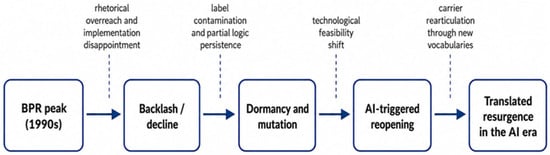

Disclaimer/Publisher’s Note: The statements, opinions and data contained in all publications are solely those of the individual author(s) and contributor(s) and not of MDPI and/or the editor(s). MDPI and/or the editor(s) disclaim responsibility for any injury to people or property resulting from any ideas, methods, instructions or products referred to in the content. |
© 2026 by the authors. Licensee MDPI, Basel, Switzerland. This article is an open access article distributed under the terms and conditions of the Creative Commons Attribution (CC BY) license.