


Abstract
This study examines AI-enabled talent acquisition from the perspective of prospective applicants and investigates how individual-level perceptions of AI-assisted selection are associated with anticipated procedural justice, organizational attractiveness, and perceived talent-market competitive positioning. Using a Partial Least Squares Structural Equation Modeling (PLS-SEM) approach, the proposed model explores the relationships among six key constructs: perceived AI expertise (AIEXP), trust in AI technology (TRUSTP), procedural justice (PJ), anxiety (ANX), organizational attractiveness (OA), and perceived talent-market competitive positioning (PTCP). Based on data collected from 202 respondents, predominantly aged 18–24, the results indicate significant positive associations of perceived AI expertise and trust in AI with anticipated procedural justice. Procedural justice exhibits the largest structural association with organizational attractiveness, which, in turn, is strongly associated with perceived talent-market competitive positioning. The association between anxiety and organizational attractiveness is negative but not statistically significant in the present sample. Beyond individual direct relationships, bootstrapped specific indirect effects support a sequential mechanism in which perceived AI expertise and trust in AI are associated with organizational attractiveness through anticipated procedural justice and, subsequently, with perceived talent-market competitive positioning through procedural justice and organizational attractiveness. The study contributes an integrative sequential perceptual evaluation framework that connects technology-related appraisals, anticipated process legitimacy, employer attractiveness, and perceived talent-market competitive positioning under the ex-ante condition of prospective applicant evaluations.
1. Introduction
In today’s economic landscape, marked by accelerated digitalization and increased labor market volatility, organizations are under growing pressure to rethink how they attract, evaluate, and secure talent. Human capital remains a critical source of differentiation, yet traditional recruitment and selection methods often prove insufficient in contexts characterized by large applicant pools, time pressure, and increasing demand for efficient and credible hiring decisions (Tuttle & Critchlow, 2025; Purohit & Banerjee, 2025). Recent research also suggests that artificial intelligence is contributing to profound transformations in labor market dynamics, managerial decision-making, and organizational competitiveness, reinforcing the strategic relevance of artificial intelligence (AI) adoption across organizational functions (Popa et al., 2024). In response, organizations are increasingly incorporating AI into recruitment and selection processes, turning talent acquisition into a digitally enabled capability that can reshape how organizations identify, evaluate, and secure talent, using tools such as applicant tracking systems, CV-screening algorithms, chatbots, and AI-assisted video interviews to improve efficiency, scalability, and decision consistency (Tuttle & Critchlow, 2025; Gupta, 2025).
At the same time, the integration of AI into talent acquisition is not merely a technical development, but also a strategic human resources management (HRM) issue. Prior research suggests that AI-enabled recruitment may influence how organizations are perceived by external candidates, particularly in terms of innovativeness, fairness, and employer attractiveness (Folger et al., 2022; Ahmadi et al., 2024; Younis et al., 2024; Popescu et al., 2023). While AI-based systems are often promoted as tools that can reduce human bias and increase procedural consistency, they may also generate skepticism, anxiety, and concerns about opacity or dehumanization in the hiring process (Figueroa-Armijos et al., 2023; Horodyski, 2023). As a result, evaluating the organizational value of AI in recruitment requires attention not only to technological capability and efficiency, but also to how such systems are perceived by potential applicants and how these perceptions translate into outcomes relevant to organizational positioning and performance (Melão & Reis, 2026).
Among the factors shaping applicant responses to AI-assisted selection, perceived competence, trust, and procedural justice appear particularly important. Research on applicant reactions shows that candidates are sensitive to whether selection procedures are viewed as fair, transparent, and capable of allowing them to demonstrate their qualifications (Bauer et al., 2001; Folger et al., 2022). In parallel, work on trust in automation and AI adoption indicates that confidence in technological systems influences whether users interpret automated decisions as legitimate and acceptable (Schaefer et al., 2016; C. Lee & Cha, 2023). Anxiety toward technology-mediated selection may also matter, especially when candidates fear inaccurate evaluation, loss of control, or reduced human interaction (van Esch & Mente, 2018; van Esch & Black, 2019; Horodyski, 2023).
Applicant-side evaluations are relevant not only as immediate reactions to a selection procedure, but also because recruitment practices communicate signals about the organization using them. When a selection process is perceived as credible, fair, and respectful, prospective applicants may infer broader organizational qualities, including competence, innovativeness, and concern for candidate treatment (Connelly et al., 2011; Folger et al., 2022). These inferences are reflected in organizational attractiveness, which captures the extent to which an employer is regarded as a desirable place to work and is associated with applicants’ willingness to pursue employment opportunities (Highhouse et al., 2003; Gomes & Neves, 2011).
Organizational attractiveness can therefore function as an employer-level evaluative bridge between perceptions of the recruitment process and comparative judgments about the organization’s position relative to other employers. When prospective applicants regard an organization as more attractive, they may also perceive it as more capable of differentiating itself and attracting talent in a competitive labor market. In the present study, this downstream judgment is conceptualized as perceived talent-market competitive positioning. It represents an individual-level comparative perception grounded in the relative-positioning logic of competitive advantage (Sigalas et al., 2013), rather than evidence of realized or sustainable firm-level advantage.
Recent international research has substantially advanced understanding of AI-enabled recruitment by examining responsible AI principles in HRM, applicant trust, perceived fairness, explainability, and organizational attraction. Reviews of responsible AI in HRM emphasize that technological capability must be considered together with bias and discrimination, perceived justice and trust, privacy, transparency, explainability, and meaningful human involvement (Bujold et al., 2024).
Empirical studies have approached applicant reactions through complementary research designs. Controlled experiments comparing AI and human evaluators have shown that lower trust in AI can reduce favorable applicant intentions and have identified serial perceptual mechanisms underlying AI receptivity (Deriu et al., 2024). A vignette-based experimental survey using covariance-based structural equation modeling demonstrated that trust and procedural justice mediate the relationships between AI-driven hiring, organizational attraction, and intention to apply (Babaee & Shank, 2025). Survey-based studies have also examined experienced AI users and applicants, linking perceptions of AI interaction, fairness, and anxiety with organizational attractiveness (Younis et al., 2024), and connecting AI interview explainability with organizational attractiveness through perceived organizational support and innovativeness (Zhou et al., 2026).
Despite these conceptual and empirical advances, an important theoretical problem remains unresolved. Existing research shows that applicants respond to AI-related characteristics such as trustworthiness, fairness, explainability, and perceived innovativeness, but it does not yet provide a sufficiently integrated explanation of how technology-level appraisals become evaluations of the employer. In particular, perceptions of AI capability and reliability do not automatically imply that applicants will view the selection procedure as legitimate or the organization as attractive. What remains unclear is the interpretive mechanism through which judgments about the technology are translated into judgments about procedural legitimacy and, subsequently, into comparative evaluations of the employer. Moreover, applicant-reaction research frequently concludes with outcomes such as organizational attraction or intention to apply, providing more limited insight into how these evaluations become comparative judgments about an employer’s relative position in the talent market.
A related empirical and conceptual problem concerns the timing of these evaluations. Much of the existing evidence derives from experimental scenarios, direct comparisons between AI and human decision makers, or samples with prior exposure to AI-mediated recruitment. Less is known about how prospective applicants form evaluations before interacting with a specific AI-assisted selection system, when judgments must be inferred from general beliefs about AI and from organizational signals. The unresolved issue is therefore not simply whether the individual constructs are related, but whether they operate as adjacent stages of a coherent applicant-side value-formation mechanism. The present study addresses this problem by theorizing and estimating a sequential perceptual evaluation model in which technology-related appraisals are connected with anticipated procedural justice, organizational attractiveness, and perceived talent-market competitive positioning, while the specific indirect effects assess whether these stages combine into the proposed sequence.
Against this background, the objective of this study is to explain the applicant-side translation mechanism through which individual perceptions of AI-assisted selection become evaluations of procedural justice, organizational attractiveness, and perceived talent-market competitive positioning. The unit of analysis is the individual respondent. Accordingly, the study does not estimate realized organizational value, firm-level performance, or the effectiveness of a digital transformation capability. Instead, it examines an applicant-side value-formation process in which AI-related appraisals shape perceptions of process legitimacy and employer quality. These perceptions are theoretically relevant to organizational value because, when shared or aggregated across applicants, they may contribute to employer image and talent-market positioning; however, such aggregate and behavioral effects are not directly measured in the present study.
To address this objective, the study uses cross-sectional survey data collected online in May 2026 from 202 respondents, predominantly aged 18–24. The questionnaire captures individual-level, ex ante evaluations of an anticipated AI-assisted selection context rather than retrospective assessments of actual participation in AI-mediated recruitment. The hypothesized relationships were estimated using partial least squares structural equation modeling (PLS-SEM) in SmartPLS 4, while the proposed sequential mechanism was further examined through bootstrapped specific indirect effects using 5000 subsamples. This research strategy enables the simultaneous assessment of the measurement model, the structural associations, and the indirect relationships connecting the successive stages of the proposed framework.
This study develops an integrative sequential perceptual evaluation framework for AI-enabled talent acquisition. Drawing on trust in automation, organizational justice, and signaling theory, the framework explains how technology-related appraisals can acquire employer-level and strategic meaning through a sequence of prospective applicant evaluations. Perceived AI expertise and trust in AI represent initial appraisals of system capability and reliability; anticipated procedural justice constitutes the process-legitimacy mechanism through which these appraisals are interpreted; and organizational attractiveness functions as the employer-level mechanism through which process legitimacy is translated into a comparative perception of the employer’s position in the talent market. The theoretical contribution therefore does not rest on treating each individual relationship as unexpected, but on integrating these relationships into a sequential mechanism that links perceptions of AI technology with evaluations of the employer and its talent-market position.
Three specific contributions follow from this framework. First, the study identifies anticipated procedural justice as the central mechanism through which perceived AI expertise and trust relate to organizational attractiveness. Second, it theorizes organizational attractiveness as the employer-level evaluative bridge through which candidate-side judgments of process legitimacy become perceptions of relative talent-market positioning. Third, it specifies an ex-ante scope condition: the framework addresses prospective applicants who may not have direct experience with AI-assisted hiring and who therefore form judgments from technological and organizational cues. Under this condition, perceived expertise and trust constitute a cognitive-legitimacy route, whereas anxiety represents a parallel affective route to organizational attractiveness.
The remainder of the article is organized as follows. Section 2 develops the theoretical background, formulates the research hypotheses, and presents the sequential perceptual evaluation framework. Section 3 describes the research design, measurement instrument, sample, and analytical procedure. Section 4 reports the measurement-model assessment, structural relationships, and specific indirect effects. Section 5 discusses the findings and develops their theoretical and managerial implications, limitations, and directions for future research. Section 6 presents the main conclusions of the study.
2. Theoretical Background and Hypothesis Development
Recent years have seen growing scholarly interest in the use of artificial intelligence in recruitment and selection, reflecting broader digital transformation trends in HRM and the emergence of AI-enabled talent acquisition as an increasingly strategic organizational capability. This increasing attention is consistent with the rapid adoption of AI-enabled tools such as applicant tracking systems, CV-screening algorithms, chatbots, and video interview platforms, particularly in the aftermath of the COVID-19 pandemic and the wider acceleration of organizational digitalization (Cummins et al., 2021; Guerra et al., 2023; Purohit & Banerjee, 2025).
Recent scholarship positions these developments within the broader transition toward digital and algorithmic HRM. Digital technologies are reshaping recruitment across candidate sourcing, screening, assessment, communication, and talent-acquisition decision making, transforming recruitment from an administratively supported activity into an increasingly data-driven organizational capability (Khalid, 2026). From an algorithmic HRM perspective, AI may improve processing efficiency, candidate matching, scalability, and decision consistency, but it simultaneously raises concerns related to bias, opacity, accountability, privacy, and the decreasing visibility of human judgment (Rismawati & Salju, 2026). Consequently, the organizational adoption of AI in recruitment should be approached as a socio-technical transformation involving not only technological performance but also governance, ethical safeguards, and stakeholder perceptions.
The literature reviewed in this section operates at two analytically distinct but connected levels. At the organizational level, prior research examines decisions concerning AI adoption, system design, governance, transparency, bias mitigation, and human oversight. These organizational characteristics are not modeled as firm-level variables in the present study. Instead, they constitute the recruitment context and provide signals from which prospective applicants may infer the competence, credibility, and legitimacy of AI-assisted selection. At the individual level, the empirical model examines how applicants interpret these signals through perceived AI expertise, trust in AI, anticipated procedural justice, organizational attractiveness, and perceived talent-market competitive positioning. Evidence concerning organizational adoption therefore supports the hypotheses by identifying the practices and system characteristics that may shape applicant perceptions, rather than by serving as direct organization-level predictors in the model.
Taken together, the literature does not suggest that AI use in recruitment produces uniformly positive or negative applicant reactions. One stream emphasizes efficiency, consistency, scalability, bias reduction, and signals of organizational innovativeness, whereas another highlights opacity, algorithmic bias, reduced human interaction, distrust, and perceived dehumanization. These perspectives are not necessarily contradictory. They indicate that applicant reactions depend less on the mere presence of AI than on how its competence, trustworthiness, fairness, and organizational meaning are interpreted. The hypotheses developed below therefore focus on the perceptual mechanisms that may explain why similar AI-enabled practices generate different evaluations across applicants and research contexts.
2.1. The Use of AI in Recruitment and Talent Selection
Recruitment, selection, and placement represent three interconnected human resource functions that are essential for developing effective talent attraction strategies. These processes not only facilitate the identification and attraction of suitable candidates but also ensure their strategic positioning within the organization, enabling them to fully leverage their potential (Tuttle & Critchlow, 2025).
Over the past decade, the talent selection landscape has undergone a major transformation, fundamentally changing the way organizations identify, attract, and select employees (Guerra et al., 2023). With the advancement of technology and digitalization, some organizations have replaced traditional recruitment paradigms with artificial intelligence and data-driven decision-making processes (Purohit & Banerjee, 2025).
Technologies used in recruitment encompass a wide range of tools designed to enhance the efficiency of identifying, attracting, and selecting candidates. These include applicant tracking systems equipped with advanced analytics capabilities, AI-based platforms for candidate identification and matching, and natural language processing (NLP) tools for CV analysis. Additionally, organizations employ predictive analytics to model candidate success, simulation tools, AI-assisted video interview platforms with behavioral analysis, and chatbots that facilitate candidate engagement and screening (Tuttle & Critchlow, 2025).
The recent literature nevertheless cautions against equating technological sophistication with responsible or unbiased selection. A multidisciplinary review of empirical research on responsible AI in HRM shows that the field must simultaneously address algorithmic bias, justice and trust, privacy, explainability, transparency, and the continuing role of human actors in AI-supported decisions (Bujold et al., 2024). Similarly, Soleimani et al. (2025) show that bias mitigation in AI-assisted recruitment requires an integrated approach extending across data selection, system design, implementation, organizational governance, and human oversight. From an organizational justice perspective, Bennett and Martin (2026) further argue that employees and applicants evaluate AI-supported talent decisions not only according to their technical outcomes but also according to whether the procedures appear transparent, equitable, and respectful. These organization-level practices are relevant to the present framework because they may become observable or inferable cues for prospective applicants. Transparency, oversight, bias safeguards, and responsible system design may inform whether applicants perceive the AI system as competent and the resulting procedure as legitimate. The current study does not assess the objective quality of these organizational practices; it examines the individual-level appraisals that applicants form in relation to an anticipated AI-assisted selection context.
Recent studies have also shown that such AI-based systems can analyze facial expressions and vocal patterns during video interviews, providing insights into personality traits, emotional intelligence, and communication skills (Gupta, 2025).
Despite the advantages of these tools in terms of efficiency and scalability, they may amplify existing biases in the selection process, potentially disadvantaging certain groups if not properly designed and monitored. According to Mihaljević et al. (2024), organizations must implement regular audits to evaluate AI-based procedural fairness, analyzing both final outcomes and intermediate stages, such as candidate screening or interview evaluation. It is also important to use safeguards such as diverse training data, algorithm transparency, and human oversight to prevent discriminatory effects. Therefore, continuous monitoring and collaboration among specialists are necessary to ensure procedural fairness.
Empirical evidence concerning AI and procedural fairness is mixed. Several studies indicate that automated selection procedures may be evaluated as less fair than human-led procedures, particularly when candidates perceive limited transparency, reduced opportunity to express themselves, or insufficient human oversight (Suen et al., 2019; Folger et al., 2022). Other research suggests that AI may receive more favorable evaluations when it is perceived as consistent, technically competent, and capable of reducing human bias (C. Lee & Cha, 2023; Manser Payne & O’Brien, 2024).
This divergence suggests that the presence of AI alone does not determine anticipated fairness. A more relevant appraisal is whether the technology is considered sufficiently knowledgeable and capable of producing accurate and appropriate evaluations. Perceived AI expertise may therefore reduce uncertainty regarding the quality of automated assessment and increase the legitimacy attributed to the selection procedure. Accordingly, evidence about the technical design and governance of organizational AI adoption provides the contextual basis for H1, while the hypothesized relationship itself remains entirely at the applicant level: it concerns the association between perceived AI expertise and anticipated procedural fairness. On this basis, the study examines whether respondents who perceive AI as more expert also tend to evaluate AI-assisted selection as more procedurally fair.
Hypothesis 1 (H1).
The perceived expertise of artificial intelligence technologies used in recruitment and selection is positively associated with perceived procedural fairness in AI-assisted selection processes.
2.2. Candidates’ Perceptions of AI-Assisted Selection Processes
Trust in automated recruitment is not uniform across individuals or contexts. It may be shaped by prior technological knowledge, individual predispositions, perceived transparency, and the degree to which users believe that the system can perform reliably (Schaefer et al., 2016; Dikmen & Burns, 2022). Greater domain knowledge may sometimes reduce reliance on automated systems because knowledgeable users have greater confidence in their own judgment (J. Lee & Moray, 1992; Romeo & Conti, 2026). Conversely, trust may increase when AI is perceived as reducing human bias or when sufficient information is provided about how automated evaluations are produced (Figueroa-Armijos et al., 2023; C. Lee & Cha, 2023).
Recent applicant-centered studies similarly show both skepticism toward AI evaluators and a consistent relationship between trust and favorable applicant reactions. Deriu et al. (2024) found that AI evaluators were perceived as less trustworthy than human evaluators, whereas Babaee and Shank (2025) showed that trust and procedural justice help explain how AI-driven hiring is connected with organizational attraction and intention to apply. The convergence across these studies lies not in the assumption that AI is inherently trusted, but in the importance of trust for the legitimacy attributed to AI-supported decisions. The present study therefore examines whether individuals with a stronger general propensity to trust AI also anticipate greater procedural fairness in AI-assisted selection. Organizational transparency and human oversight are therefore discussed as contextual cues that may facilitate trust, whereas TRUSTP represents the individual applicant’s general orientation toward the credibility and reliability of AI technology.
Thus, the second hypothesis focuses on candidates’ general propensity to trust artificial intelligence. It is assumed that candidates with a higher general level of trust in AI technology (TRUSTP) will perceive the recruitment and selection process as procedurally fair (PJ). In this sense, trust in AI is understood as a broader orientation toward the credibility and reliability of AI-based systems in evaluative contexts (Manser Payne & O’Brien, 2024).
Hypothesis 2 (H2).
The general propensity to trust artificial intelligence is positively associated with perceived procedural fairness in AI-assisted selection processes.
Regarding candidates’ reactions to the use of AI-based tools, this aspect remains insufficiently explored in the literature, and existing findings are inconclusive (Horodyski, 2023). On the one hand, some studies indicate that the integration of AI technologies may reduce candidates’ intention to apply for a job. This phenomenon is associated with factors such as anxiety related to technology use (van Esch & Mente, 2018), dependence on support from recruitment experts (Chen, 2023), and the predominantly unidirectional nature of the process, which limits interaction and the ability to ask questions. These aspects suggest less favorable candidate reactions to the recruitment process.
On the other hand, other research shows that AI-assisted recruitment systems are perceived as innovative and attractive, encouraging candidates to actively engage and complete the recruitment process (van Esch & Black, 2019). Moreover, these systems are associated with perceptions of novelty, autonomy, and ease of use, which increase motivation to interact. At the same time, the use of AI contributes to strengthening the organization’s image as modern and innovative (Black & van Esch, 2020). These findings therefore suggest more favorable candidate reactions to AI-assisted recruitment systems.
The literature therefore reveals competing affective mechanisms. Automated evaluation may increase anxiety by reducing perceived control, limiting interpersonal interaction, and creating uncertainty about how candidates are assessed. At the same time, perceptions of novelty, convenience, autonomy, and organizational innovativeness may offset these negative reactions. Consequently, the relationship between anxiety and organizational attractiveness may depend on the salience of these competing evaluations and may be weaker in contexts where respondents consider AI-assisted selection only hypothetically. Nevertheless, because anxiety reflects anticipated discomfort associated with automated evaluation, the expected direction of the relationship remains negative.
Because AI-assisted selection remains an emerging practice for many labor market participants, perceptions of such systems may be formed not only through direct experience but also through general beliefs about technology, fairness, and organizational modernity. More broadly, research on digitally transformed working arrangements indicates that individuals’ attitudes toward digital technologies influence how they perceive and adapt to technology-mediated forms of work (Saygılı & Öztırak, 2024). For this reason, the present study focuses on anticipated perceptions of AI-assisted recruitment rather than post-experience evaluations of actual AI-mediated hiring encounters. Against this background, the third hypothesis focuses on the anxiety associated with the use of AI in the selection process. In this context, anxiety reflects anticipated feelings of worry, stress, and reduced control that may arise when candidates imagine being evaluated by an automated system rather than through direct human interaction (van Esch & Mente, 2018; van Esch & Black, 2019; Horodyski, 2023). Such reactions may negatively influence how attractive the organization is perceived to be (OA).
Hypothesis 3 (H3).
Anxiety associated with the use of AI in the selection process is negatively associated with organizational attractiveness.
2.3. The Impact of AI Use on Organizational Attractiveness and Perceived Talent-Market Positioning
Organizational attractiveness refers to the extent to which an organization is perceived as a desirable place to work by potential applicants. Prior research shows that such attractiveness is closely related to applicants’ willingness to pursue employment opportunities and is shaped by how they interpret organizational signals during the recruitment process (Highhouse et al., 2003; Gomes & Neves, 2011).
At the organizational level, AI adoption in recruitment has been associated in prior research with potential efficiency gains, employer-brand signaling, reduced costs, and more consistent decision processes (Ahmadi et al., 2024). From the applicant perspective, however, these organizational benefits are not observed directly. They matter insofar as the organization’s use of AI communicates signals of innovativeness, competence, fairness, or candidate orientation. When these signals are interpreted favorably, they may contribute to higher organizational attractiveness; when AI is perceived as opaque, impersonal, or unreliable, the same adoption decision may generate less favorable employer evaluations (Younis et al., 2024). Organizational attractiveness is therefore treated in the present model as an individual-level evaluation of the employer rather than as an objective firm-level outcome.
Prior studies broadly converge on the relevance of procedural fairness for applicant evaluations, but they also suggest that AI-assisted recruitment conveys multiple and potentially competing organizational signals. A technologically advanced selection system may signal innovativeness and efficiency, while opacity or limited human interaction may signal impersonal treatment. Procedural justice is therefore theoretically important because it captures how candidates resolve these competing cues when evaluating the legitimacy of the recruitment process. When the procedure is anticipated as fair, candidates are more likely to interpret the organization’s use of AI as compatible with appropriate treatment and credible decision making, thereby supporting organizational attractiveness.
Procedural justice is expected to shape organizational attractiveness because applicants may interpret the fairness of the selection procedure as evidence about the organization responsible for that procedure. A process perceived as consistent, impartial, transparent, and respectful can signal that the employer values appropriate treatment and credible decision making. Conversely, an opaque or procedurally questionable AI-assisted process may generate less favorable inferences about the organization, even when the underlying technology appears advanced. Procedural justice therefore connects technology-related appraisals with employer-level evaluation by transforming expectations about the selection process into judgments about the attractiveness of the organization using it.
Hypothesis 4 (H4).
Perceived procedural fairness in AI-assisted selection processes is positively associated with organizational attractiveness.
Strategic management research associates AI adoption with improved information processing, operational efficiency, adaptability, and decision quality, but it also emphasizes that competitive benefits are contingent on how the technology is implemented and integrated into organizational capabilities (Krakowski et al., 2023; Song et al., 2025). AI adoption alone therefore does not imply superior or sustainable performance. In the recruitment context, applicant-reaction studies generally focus on outcomes such as organizational attractiveness and intention to apply, providing less insight into whether favorable employer evaluations also become comparative judgments about an organization’s position relative to other employers.
The present study addresses this distinction by focusing on perceived talent-market competitive positioning rather than realized competitive advantage. The construct captures whether prospective applicants generally regard employers using AI-assisted recruitment as differentiated and comparatively well positioned to attract talent. Organizational attractiveness is expected to provide the link between process-related evaluations and this comparative judgment: an organization regarded as a desirable employer is also more likely to be perceived as holding a favorable position relative to competing employers. This relationship remains perceptual and does not establish actual recruitment performance or sustainable firm-level advantage.
Accordingly, the fifth hypothesis examines whether organizational attractiveness is associated with perceived talent-market competitive positioning. If an organization is regarded as a more desirable potential employer, prospective applicants are also expected to perceive it as comparatively better positioned in the talent market.
Hypothesis 5 (H5).
Organizational attractiveness is positively associated with perceived talent-market competitive positioning.
Previous quantitative research has examined several components of the proposed framework through complementary empirical designs. Deriu et al. (2024) used three controlled experiments and a serial mediation analysis to show that AI evaluators may be perceived as less trustworthy than human evaluators, with consequences for job-acceptance intentions. Babaee and Shank (2025) employed a between-subject vignette-based experimental survey, independent-samples comparisons, and covariance-based structural equation modeling to demonstrate that trust and dimensions of procedural justice help explain differences in organizational attraction and intention to apply between AI-driven and human-driven hiring conditions. Survey-based evidence also indicates that fairness and anxiety may explain the association between perceived AI–user interaction and organizational attractiveness among external AI users (Younis et al., 2024).
Other quantitative studies further demonstrate that the relationships depend on the recruitment context and the specific AI characteristic under examination. Luo et al. (2025), using an online scenario-based experiment, found that procedural justice and organizational attractiveness mediated the relationship between interview format and job-application intention, while the effects also varied according to industry context. Zhou et al. (2026), using survey data from applicants with previous AI-interview experience, showed that perceived explainability was associated with organizational attractiveness through perceived organizational support and innovativeness. Collectively, these studies provide empirical support for individual segments of the applicant-evaluation process, but they primarily examine AI-versus-human conditions, specific system characteristics, experienced users, or outcomes terminating at organizational attractiveness and behavioral intention. The empirical contribution of the present study lies not in the use of structural equation modeling alone, but in estimating within a single PLS-SEM model an ex ante sequence connecting perceived AI expertise and general trust in AI with anticipated procedural justice, organizational attractiveness, and perceived talent-market competitive positioning, and in assessing the specific indirect effects linking these successive stages.
2.4. Theoretical Integration: A Sequential Perceptual Evaluation Framework
The proposed framework integrates trust in automation, organizational justice, and signaling theory to explain how prospective applicants translate perceptions of AI-assisted selection into employer-level evaluations. Trust in automation provides the basis for understanding why perceived system expertise and general trust in AI shape the credibility attributed to technology-supported evaluation (Schaefer et al., 2016). Organizational justice theory highlights the importance of anticipated fairness, consistency, and opportunity to demonstrate one’s qualifications when evaluating a selection procedure (Gilliland, 2008; Bauer et al., 2001). Signaling theory further suggests that recruitment practices communicate information about otherwise less observable organizational characteristics, allowing applicants to infer employer quality, values, and attractiveness from the design of the selection process (Connelly et al., 2011; Folger et al., 2022). The framework therefore does not assume that AI-assisted recruitment is inherently beneficial or detrimental. Instead, it reconciles divergent findings by distinguishing technology-related cognitive appraisals, anticipated process legitimacy, affective reactions, and employer-level evaluations as separate but connected stages. Within this framework, organizational AI adoption functions as the source of technological and organizational signals, whereas the empirical constructs represent applicants’ interpretations of those signals. The model therefore does not connect firm-level adoption variables directly with organizational outcomes; all estimated relationships concern individual-level perceptions and evaluative judgments.
Procedural justice occupies a central position in this framework because applicants cannot evaluate the organizational relevance of an AI system solely from perceptions of its technical capability. Perceived expertise indicates whether the technology appears capable of producing informed and accurate assessments, whereas trust reflects the extent to which applicants consider AI-based evaluation reliable and credible. These technology-related appraisals become consequential for employer evaluation when they inform expectations about how candidates will be treated during selection. Procedural justice therefore translates assessments of the technology into judgments about the legitimacy of the recruitment procedure, including its consistency, impartiality, transparency, and capacity to provide candidates with an appropriate opportunity to demonstrate their qualifications.
This legitimacy judgment also provides the theoretical connection with organizational attractiveness. Recruitment procedures represent an early point of contact between applicants and organizations and may signal how the employer exercises authority, makes decisions, and treats prospective employees. When an AI-assisted procedure is anticipated as fair, candidates may attribute favorable qualities to the organization using it, even when they have limited information about the employer. Procedural justice thus functions as the interpretive mechanism through which perceived AI expertise and trustworthiness acquire employer-level meaning, rather than merely as an additional favorable perception of the technology.
The pathway associated with anxiety follows a different theoretical logic. Anxiety is not primarily a judgment about whether the selection procedure is normatively legitimate; it represents an anticipated affective response to being evaluated through an automated system. Feelings of worry, stress, discomfort, or reduced control may directly color the applicant’s overall evaluation of the employer, even before a detailed fairness judgment is formed. For this reason, anxiety is modeled as a direct affective input to organizational attractiveness, whereas perceived AI expertise and trust follow a cognitive-legitimacy pathway through procedural justice.
The conceptual model is organized as a four-stage sequential explanatory mechanism. In the first stage, perceived AI expertise and general trust in AI represent cognitive appraisals of the technology’s capability and reliability. In the second stage, these appraisals shape anticipated procedural justice, which functions as the process-legitimacy mechanism through which the technology is evaluated. In the third stage, procedural justice informs organizational attractiveness, thereby translating a process-level judgment into an employer-level evaluation. In the fourth stage, organizational attractiveness informs perceived talent-market competitive positioning, converting employer attractiveness into a comparative judgment about the organization’s position relative to other employers. Anxiety is modeled as a parallel affective input to organizational attractiveness because it captures anticipated emotional discomfort associated with automated evaluation, rather than a cognitive assessment of the procedure’s fairness or legitimacy.
The proposed sequence builds on, but remains empirically distinct from, the experimental, survey-based, and structural-modeling approaches identified in recent applicant-reaction research. Babaee and Shank (2025) examine how trust and procedural justice explain differences between AI-driven and human-driven hiring in relation to organizational attraction and intention to apply. Zhou et al. (2026), by contrast, show how AI interview explainability is associated with organizational attractiveness through perceived organizational support and innovativeness among applicants with prior AI-interview experience. The present framework extends this stream by examining how perceived AI expertise and general trust in AI jointly feed into anticipated procedural justice and how this legitimacy judgment is subsequently connected with organizational attractiveness and perceived talent-market competitive positioning. It also focuses explicitly on ex ante evaluations that may precede direct interaction with a specific AI-assisted selection system.
The model is deliberately specified as a sequential and parsimonious structure. Perceived AI expertise and trust in AI are not linked directly to organizational attractiveness because technological capability and reliability do not, by themselves, constitute evaluations of the employer. Within the framework, these appraisals acquire employer-level meaning only when they shape expectations regarding the fairness and legitimacy of the selection procedure. Likewise, procedural justice is not linked directly to perceived talent-market competitive positioning because organizational attractiveness is theorized as the employer-level evaluation through which process legitimacy becomes a comparative positioning judgment. The hypotheses therefore represent adjacent stages of one unified mechanism rather than a collection of independent pairwise relationships. Because the data are cross-sectional, the proposed mechanism should be interpreted as a theoretically ordered pattern of associations rather than as experimentally established causality.
The framework is explicitly bounded to ex ante evaluations by prospective applicants, including individuals without direct prior experience of AI-mediated hiring. Under this scope condition, respondents evaluate an anticipated recruitment context rather than the observed performance of a specific AI system. They must therefore infer the likely quality of the procedure and the employer from general beliefs about AI and from the signals conveyed by the organization’s use of technology. The framework consequently explains the formation of pre-experience applicant perceptions rather than post-experience reactions or objectively realized organizational performance. From a level-of-analysis perspective, the framework therefore offers a micro-foundational account of potential organizational value. It explains how individual applicants form judgments that may contribute to employer reputation and comparative talent-market positioning, but it does not test whether these perceptions aggregate into actual recruitment outcomes, organizational performance, or sustainable firm-level advantage.
Taken together, H1 and H2 specify the technology-appraisal-to-process-legitimacy stage, H4 specifies the process-legitimacy-to-employer-evaluation stage, and H5 specifies the employer-evaluation-to-perceived-positioning stage. H3 captures a parallel affective route to employer evaluation. The specific indirect effects reported in Section 4.1 assess whether these adjacent paths combine into the proposed sequential mechanism.
Based on the existing literature, a conceptual model was developed to illustrate the proposed hypotheses and their relationships. Figure 1 presents the conceptual model.
Figure 1.
Sequential perceptual evaluation framework and research hypotheses. Source: Developed by the authors.
3. Materials and Methods
The study was conducted using a Google Forms questionnaire designed to examine individual-level, perception-based evaluations of AI-assisted recruitment and selection. The unit of analysis was the individual respondent, and the empirical model estimates relationships among prospective applicants’ perceptions and evaluative judgments. The objective was not to assess organizational performance or digital transformation capability directly, but to investigate how perceived AI expertise, trust in AI technology, and anxiety are associated with anticipated procedural justice, organizational attractiveness, and perceived talent-market competitive positioning. Given the emerging nature of AI-assisted selection and the limited likelihood that all respondents had direct prior exposure to such systems, the questionnaire captured prospective and anticipated perceptions rather than post-experience evaluations of actual AI-mediated hiring processes.
Before completing the construct measures, all respondents were presented with the same standardized introductory text establishing the context of the study. The introduction explained that the questionnaire concerned perceptions of the use of artificial intelligence-based technologies in recruitment and selection and instructed respondents to answer as potential candidates in a situation in which an organization uses such technologies. To make the context more concrete, the text provided examples including CV screening, automatically evaluated online tests, automatically analyzed video interviews, and algorithm-generated recommendations.
The introductory text presented to respondents was as follows: “This questionnaire is part of an academic study concerning perceptions of the use of artificial intelligence-based technologies in recruitment and selection. Responses are anonymous and will be used exclusively for research purposes. Completion takes approximately 5–7 min. Please respond to the following statements by considering a situation in which an organization uses artificial intelligence-based technologies in the recruitment and selection process, for example, CV screening, automatically evaluated online tests, automatically analyzed video interviews, or algorithm-generated recommendations. Your responses should reflect your perceptions and reactions as a potential candidate in such a process.”
This standardized instruction provided all respondents with a common general frame of reference. However, it did not describe a fictitious organization, impose a single AI application, specify the degree of decision automation, or manipulate the level of human involvement. The study should therefore be distinguished from a vignette-based experiment involving a precisely defined AI system or recruitment scenario.
The measurement instrument was prepared through a deductive, theory-driven process comprising three stages. First, the conceptual domain of each construct was defined on the basis of its original theoretical and measurement source. Second, the wording of the selected items was contextualized to AI-assisted recruitment and selection while preserving the substantive meaning of the underlying construct. Third, the complete item set was reviewed within the research team for construct–item correspondence, clarity, redundancy, and suitability for the anticipated applicant perspective examined in the study.
For the established constructs, adaptation involved contextual rewording rather than the development of new conceptual dimensions. Perceived AI expertise and trust in AI technology were adapted from Manser Payne and O’Brien (2024). The items were reformulated to refer specifically to the capability, reliability, and trustworthiness of artificial intelligence used in recruitment and candidate evaluation. Procedural justice was adapted from Bauer et al. (2001), retaining the original emphasis on fairness, equitable treatment, opportunity to demonstrate one’s qualifications, and satisfaction with the evaluation procedure. Organizational attractiveness was adapted from Highhouse et al. (2003), with additional reference to Lievens et al. (2001), and was contextualized to an organization using AI-assisted selection.
The anxiety measure was developed for the present study because the available measures did not fully correspond to the anticipated, ex ante recruitment context. Its content domain was defined as the affective discomfort expected when imagining participation in an AI-assisted selection process. Based on prior research on applicant reactions to AI-enabled and technology-mediated recruitment (van Esch & Black, 2019; Horodyski, 2023), four manifestations were represented: worry, stress, feeling overwhelmed, and general discomfort or unhappiness. One item was formulated for each manifestation, with all items referring conditionally to participation in an AI-assisted selection process.
Perceived talent-market competitive positioning was developed by adapting the relative-positioning logic of Sigalas et al. (2013) from the organizational level to the applicant-perception level. Because respondents were asked to consider a general situation in which an organization uses AI-assisted recruitment, the items refer generically to organizations or companies using AI rather than to a named employer. The indicators capture respondents’ comparative beliefs regarding whether such employers are differentiated, occupy a stronger position than competing employers, and are perceived as more capable of attracting talent.
The item review conducted within the research team was an internal content-oriented assessment rather than a formal independent expert-panel validation. No separate cognitive-interview phase or formal pilot study was conducted before the main data collection. Consequently, the initial support for content correspondence derives from the theoretical grounding of the items, their explicit mapping to the construct domains, and the internal review of wording and redundancy. The empirical measurement properties were subsequently examined in the achieved sample through indicator loadings, Cronbach’s alpha, rho_a, composite reliability, average variance extracted, the heterotrait–monotrait ratio, and the Fornell–Larcker criterion. These psychometric assessments provide evidence regarding reliability and construct validity in the present sample but do not substitute for independent pretesting or external content validation.
The questionnaire was structured into sections corresponding to the analyzed variables. The first section included demographic variables such as age, gender, area of residence, and level of education. These variables were collected solely to describe the achieved sample and to delimit the scope within which the findings could be interpreted; they were not specified as theoretical predictors, moderators, or control variables and were therefore not included in the conceptual or structural model. The questionnaire included four items for perceived AI expertise (AIEXP), four items for trust in AI technology (TRUSTP), five items for procedural justice (PJ), four items for anxiety associated with AI-assisted selection (ANX), four items for organizational attractiveness (OA), and five items for perceived talent-market competitive positioning (PTCP). The complete wording and the source of each item are presented in Appendix A.
The questionnaire was designed to capture respondents’ perceptions and attitudes toward AI-assisted recruitment, together with their evaluations of the selection process and the employer using it. All substantive items were assessed using the same five-point Likert-type agreement scale, ranging from 1 (strongly disagree) to 5 (strongly agree). The five-category format was selected to balance sufficient response differentiation with a simple and consistent response task across the relatively brief online questionnaire. Methodological evidence indicates that, for agree–disagree items, five response categories can provide satisfactory measurement quality without requiring the additional distinctions imposed by scales with more response options (Revilla et al., 2014). Accordingly, respondents were asked to express their level of agreement with statements referring to AI-assisted selection as a potential recruitment context. This means that the data reflect anticipated applicant perceptions of AI-supported hiring practices rather than retrospective assessments based on direct participation in a specific AI-assisted interview or selection process.
Data collection took place in May 2026 and yielded 202 submitted questionnaires. All submitted questionnaires were retained in the analytical dataset, and no responses were excluded during data screening. Consequently, the initial and final analytical samples were identical (N = 202).
The data were initially organized in Microsoft Excel and subsequently analyzed using partial least squares structural equation modeling (PLS-SEM) in SmartPLS 4.1.1.8 (Ringle et al., 2024). PLS-SEM was selected because the principal analytical objective was to explain variance across a sequence of applicant perceptions and to estimate multiple direct and specific indirect associations within an emerging theoretical framework that includes both contextually adapted and newly developed measures. In contrast to covariance-based structural equation modeling, which primarily emphasizes reproduction of the observed covariance matrix and global model fit in confirmatory applications, PLS-SEM is a variance-oriented approach that focuses on estimating structural relationships and explaining variance in endogenous constructs. The choice does not imply that covariance-based SEM would have been infeasible; rather, PLS-SEM was considered more closely aligned with the study’s explanatory, model-development, and sequential-mechanism objectives (Hair et al., 2019; Sarstedt et al., 2021).
The adequacy of the achieved sample was assessed using the inverse square root approach proposed for PLS-SEM by Kock and Hadaya (2018). Adapting the procedure to the two-tailed significance level of 0.05 used in the present analysis and a target statistical power of 0.80, a sample of 202 respondents provides sensitivity for detecting standardized path coefficients of approximately 0.20 or greater. The achieved sample was therefore considered adequate for estimating the principal relationships proposed in the model, although its sensitivity remains more limited for very small structural associations.
PLS-SEM relaxes the requirement of multivariate normality, but its use does not eliminate the need for theoretically justified model specification and appropriate measurement assessment. Interpretation of the estimates presumes independent observations, approximately linear and additive structural relationships, correctly specified reflective measurement models, and the absence of severe collinearity. Following the recommended two-stage procedure, the reflective measurement models were assessed before evaluating the structural model. Indicator reliability, internal consistency, convergent validity, and discriminant validity were examined using indicator loadings, Cronbach’s alpha, rho_a, rho_c, average variance extracted, the heterotrait–monotrait ratio, and the Fornell–Larcker criterion. The structural model was subsequently evaluated using variance inflation factors, path coefficients, coefficients of determination (R2), effect sizes (f2), and specific indirect effects (Hair et al., 2019; Sarstedt et al., 2021).
Because the sampling distributions of PLS-SEM estimates are not assumed to be normal, the statistical significance of the direct and specific indirect effects was evaluated using nonparametric bootstrapping with 5000 subsamples, two-tailed tests, and a significance level of 0.05. The resulting estimates are interpreted as sample-based structural associations and explained variance within the theoretically specified model.
4. Results
4.1. Sample Profile
Table 1 presents the demographic profile of the achieved sample. The descriptive variables were used to characterize the respondents and to delimit the population to which the findings can be interpreted, rather than as predictors or control variables in the structural model.
Table 1.
Demographic profile of the achieved sample (N = 202). Source: Author’s own elaboration.
The sample was strongly concentrated in the 18–24 age category, which represented 88.6% of all respondents. It was also predominantly urban, while 80.2% of participants reported having completed undergraduate, master’s, or doctoral studies. The findings should therefore be interpreted primarily as reflecting the anticipated evaluations of younger, predominantly urban, and relatively highly educated prospective labor-market participants. The sample composition does not support population-level generalization across age, residence, or educational groups, and demographic differences were not examined because these variables were not included in the theoretically specified model.
4.2. Measurement Model Assessment
The PLS-SEM analysis followed the recommended two-stage procedure. The reflective measurement model was assessed first to determine whether the indicators measured their intended constructs with adequate reliability and validity. Only after establishing satisfactory measurement properties was the structural model evaluated.
4.2.1. Indicator Reliability and Internal Consistency
Table 2 reports the indicator loadings, internal-consistency coefficients, average variance extracted, and indicator-level variance inflation factors for the six reflective constructs.
Table 2.
Reliability of indicators and constructs. Source: Author’s own elaboration using SmartPLS 4 (Ringle et al., 2024).
All indicator loadings exceeded 0.70, indicating that each item shared a substantial proportion of variance with its intended construct. Cronbach’s alpha, rho_a, and rho_c values were also above the recommended threshold of 0.70 for every construct, showing that the indicators consistently represented the same underlying conceptual domain (Hair et al., 2019; Sarstedt et al., 2021). The indicator-level VIF values ranged from 1.631 to 3.173 and did not indicate problematic collinearity or excessive redundancy among the items. Taken together, these findings suggest that the construct scores used in the subsequent structural analysis were estimated with satisfactory indicator reliability and internal consistency.
4.2.2. Convergent Validity
Convergent validity was evaluated using the average variance extracted. As shown in Table 2, the AVE values ranged from 0.656 to 0.785 and therefore exceeded the recommended threshold of 0.50 for all constructs (Hair et al., 2019). Thus, each latent construct explained substantially more than half of the variance in its corresponding indicators. This result indicates that the indicators assigned to each construct converge sufficiently on the same underlying concept and supports the use of the latent-variable scores in testing the proposed structural relationships.
4.2.3. Discriminant Validity
Table 3 presents the results of the discriminant validity assessment for the constructs included in the study. Discriminant validity was evaluated using the heterotrait–monotrait ratio (HTMT) and the Fornell–Larcker criterion. Following Henseler et al. (2015), HTMT values below 0.90 indicate acceptable discriminant validity for conceptually related constructs. In the present study, all HTMT values were below this threshold, with the highest value being 0.872. In addition, the square root of the average variance extracted for each construct exceeded its correlations with the other constructs, satisfying the Fornell–Larcker criterion (Fornell & Larcker, 1981). Although several constructs are conceptually and empirically closely related, particularly procedural justice, organizational attractiveness, and perceived talent-market competitive positioning, the results indicate that they remain sufficiently distinguishable. This distinction is important for the structural analysis because it reduces the likelihood that the estimated relationships merely reflect measurement overlap between theoretically adjacent stages of the proposed framework.
Table 3.
Discriminant validity assessment. Source: Author’s own elaboration using SmartPLS 4 (Ringle et al., 2024).
Overall, the results of the measurement-model assessment provide an adequate empirical basis for examining the proposed structural relationships. They support the reliability and validity of the construct measures in the present sample, although they do not by themselves establish causal validity or out-of-sample robustness.
Having established satisfactory indicator reliability, internal consistency, convergent validity, and discriminant validity, the analysis proceeded to the assessment of the structural model.
4.3. Structural Model Assessment
The structural model was evaluated using the coefficients of determination, standardized path coefficients, bootstrapped significance tests, and effect sizes.
The coefficients of determination shown in Figure 2 indicate that perceived AI expertise and trust in AI jointly explain 62.4% of the variance in procedural justice (R2 = 0.624). Procedural justice and anxiety explain 63.2% of the variance in organizational attractiveness (R2 = 0.632), while organizational attractiveness explains 58.4% of the variance in perceived talent-market competitive positioning (R2 = 0.584). Accordingly, the model accounts for more than half of the observed variance in each endogenous construct. Within the achieved sample, these values indicate substantial explanatory relevance for the proposed sequence of applicant perceptions, while not constituting evidence of predictive performance in other samples or populations.
Figure 2.
Structural model. Source: Author’s own elaboration using SmartPLS 4 (Ringle et al., 2024).
As shown in Table 4, perceived AI expertise was positively associated with procedural justice (β = 0.339; p < 0.001), supporting H1. Its effect size (f2 = 0.144) indicates a meaningful, although comparatively moderate, incremental contribution to explaining procedural justice. Trust in AI technology exhibited a stronger positive association with procedural justice (β = 0.509; p < 0.001), supporting H2. The corresponding effect size (f2 = 0.325) shows that trust made a substantial incremental contribution to the explained variance in procedural justice. These findings indicate that both perceived capability and general technological trust are relevant to anticipated process legitimacy, with trust displaying the stronger structural contribution in the present model.
Table 4.
Hypothesis Testing. Source: Author’s own elaboration using SmartPLS 4 (Ringle et al., 2024).
The association between anxiety and organizational attractiveness was negative but not statistically significant (β = −0.083; p = 0.072), and its effect size was negligible (f2 = 0.017); therefore, H3 was not supported. Although the coefficient exhibited the hypothesized negative direction, its small magnitude and statistical uncertainty indicate insufficient evidence for the proposed relationship in the achieved sample. The result should therefore be interpreted as a lack of empirical support for H3 rather than as evidence that anxiety has no relevance to applicants’ evaluations. By contrast, procedural justice exhibited a strong positive association with organizational attractiveness (β = 0.765; p < 0.001; f2 = 1.439), supporting H4, while organizational attractiveness was strongly associated with perceived talent-market competitive positioning (β = 0.764; p < 0.001; f2 = 1.404), supporting H5. The very large incremental contributions of procedural justice and organizational attractiveness indicate that these constructs represent the principal explanatory links in the proposed sequence. Thus, the structural results provide strong internal support for the cognitive-legitimacy pathway, whereas the parallel affective pathway involving anxiety was not supported in the present sample.
These results indicate empirical support for most of the proposed relationships in the present sample, highlighting the role of perceived AI expertise, trust in AI, procedural justice, and organizational attractiveness in shaping prospective applicants’ evaluations of AI-assisted recruitment.
Beyond statistical significance, the magnitude of the coefficients reveals important differences in the explanatory relevance of the proposed relationships. The association between perceived AI expertise and procedural justice was moderate in standardized terms (β = 0.339), while its incremental effect size approached the conventional medium threshold (f2 = 0.144). Trust in AI technology showed a stronger association with procedural justice (β = 0.509) and an effect size between the conventional medium and large benchmarks (f2 = 0.325), indicating that trust contributed more strongly than perceived expertise to explaining anticipated fairness judgments. By contrast, the anxiety–organizational attractiveness relationship was weak (β = −0.083) and its incremental effect was negligible (f2 = 0.017), suggesting limited substantive relevance in the present sample.
The largest effects occurred in the central sequential pathway. A one-standard-deviation increase in procedural justice was associated with a 0.765-standard-deviation increase in organizational attractiveness, controlling for anxiety, and the corresponding effect size was very large (f2 = 1.439). Similarly, a one-standard-deviation increase in organizational attractiveness was associated with a 0.764-standard-deviation increase in perceived talent-market competitive positioning, with a very large effect size (f2 = 1.404). These magnitudes indicate that anticipated procedural justice and organizational attractiveness are not only statistically significant but also constitute the principal explanatory links in the proposed applicant-side evaluation sequence.
4.4. Specific Indirect Effects
To examine whether the direct relationships combine into the sequential mechanism proposed in the theoretical framework, the specific indirect effects were assessed through bootstrapping. As shown in Table 5, perceived AI expertise had a significant indirect effect on organizational attractiveness through procedural justice (β = 0.259; t = 4.951; p < 0.001). Trust in AI technology also had a significant indirect effect on organizational attractiveness through procedural justice (β = 0.390; t = 6.866; p < 0.001).
Table 5.
Specific indirect effects. Source: Authors’ own elaboration using SmartPLS 4 (Ringle et al., 2024).
The sequential indirect effects from perceived AI expertise and trust in AI technology to perceived talent-market competitive positioning through procedural justice and organizational attractiveness were statistically significant (β = 0.198; t = 4.570; p < 0.001 and β = 0.298; t = 6.352; p < 0.001, respectively). Procedural justice also had a significant indirect effect on perceived talent-market competitive positioning through organizational attractiveness (β = 0.585; t = 12.767; p < 0.001). By contrast, the indirect effect of anxiety on perceived talent-market competitive positioning through organizational attractiveness was not statistically significant (β = −0.063; t = 1.825; p = 0.068). These results support the proposed cognitive-legitimacy sequence, in which technology-related appraisals are connected with employer-level and strategic perceptions through anticipated procedural justice and organizational attractiveness. The proposed affective route involving anxiety was not supported in the present sample. The significant indirect relationships indicate that the supported direct paths do not operate only as isolated pairwise associations. Instead, they combine into a coherent sequence through which technology-related appraisals are connected with employer-level and comparative positioning judgments. In particular, the significant AIEXP → PJ → OA → PTCP and TRUSTP → PJ → OA → PTCP effects provide empirical support for the sequential role assigned to procedural justice and organizational attractiveness. By contrast, the nonsignificant ANX → OA → PTCP effect is consistent with the absence of support for the proposed affective route. All reported relationships should be interpreted within the composition of the achieved sample and as associations among anticipated perceptions rather than as evidence of actual applicant behavior.
4.5. Integrative Summary of Results
Overall, the measurement-model assessment supported the reliability and validity of the six constructs, providing an adequate basis for interpreting the structural relationships. Four of the five hypothesized direct relationships received empirical support. Perceived AI expertise and trust in AI technology were positively associated with anticipated procedural justice, supporting H1 and H2, while procedural justice was strongly associated with organizational attractiveness and organizational attractiveness was strongly associated with perceived talent-market competitive positioning, supporting H4 and H5. By contrast, the negative association between anxiety and organizational attractiveness was weak and not statistically significant; therefore, H3 was not supported. The specific indirect effects further showed that perceived AI expertise and trust in AI were connected with organizational attractiveness through procedural justice and with perceived talent-market competitive positioning through the sequential roles of procedural justice and organizational attractiveness. The indirect pathway involving anxiety was not statistically significant. Taken together, the findings support the proposed cognitive-legitimacy sequence, whereas the parallel affective pathway did not receive empirical support in the present sample.
5. Discussion
Taken together, the findings indicate that the applicant-side value of AI-enabled talent acquisition emerges through a layered interpretive process rather than from technology adoption alone. The pattern of direct and specific indirect effects is consistent with a sequence in which appraisals of AI capability and trustworthiness shape anticipated process legitimacy, procedural legitimacy informs employer attractiveness, and organizational attractiveness informs perceived talent-market competitive positioning. This interpretation shifts the theoretical focus from whether an organization uses AI to how its use is socially evaluated and translated into employer-level judgments by prospective applicants. Rather than demonstrating the effects of actual participation in AI-mediated hiring, the study offers insight into how potential applicants may interpret AI-enabled recruitment as an emerging strategic HRM practice.
The analysis of the specific indirect effects clarifies the theoretical mechanism underlying the model. Perceived AI expertise and trust in AI were indirectly connected with organizational attractiveness through procedural justice (β = 0.259 and β = 0.390, respectively). Both constructs also exhibited significant sequential indirect effects on perceived talent-market competitive positioning through procedural justice and organizational attractiveness (β = 0.198 and β = 0.298, respectively). In addition, procedural justice had a significant indirect effect on perceived talent-market competitive positioning through organizational attractiveness (β = 0.585). These findings indicate that technology-related appraisals can acquire employer-level and strategic meaning through successive judgments of process legitimacy and organizational attractiveness, rather than operating only as isolated direct associations.
This mechanism must be interpreted within its ex-ante scope condition. Because respondents were not required to have direct experience with AI-assisted hiring, their evaluations reflect signals and expectations rather than observations of an actual system’s performance. In the absence of direct experiential evidence, prospective applicants may rely on general beliefs about AI capability and trustworthiness to infer procedural fairness and employer quality. The framework therefore complements research on actual applicant experiences by explaining how attitudes toward AI may shape organizational evaluations before candidates enter an AI-mediated selection process. The nonsignificant indirect effect involving anxiety indicates that the proposed affective route was not supported, whereas the cognitive-legitimacy sequence received consistent support in the present sample.
At the level of prospective applicants’ perceptions, the findings indicate that general trust in AI and perceived system competence are positively associated with anticipated procedural justice. Respondents who evaluated AI as more trustworthy and competent also tended to evaluate an anticipated AI-assisted selection process as fairer. When organizations succeed in designing AI-assisted processes that are perceived as objective, competent, and capable of reducing human bias, they project an image of modernity and fairness (C. Lee & Cha, 2023). This form of perceived technological fairness appears to support organizational attractiveness by influencing how candidates interpret the quality and legitimacy of AI-assisted selection. From an evaluation perspective, these findings suggest that the effectiveness of AI-enabled recruitment should not be assessed solely through efficiency assumptions, but also through behavioral indicators such as trust, perceived fairness, and attractiveness. This broader evaluation logic is consistent with research suggesting that AI-supported systems should be assessed through multiple indicators and in relation to the interplay between algorithmic capabilities and human-centered intervention (Šola et al., 2025).
The findings both converge with and qualify previous applicant-reaction research. They are consistent with evidence identifying trust and procedural justice as important mechanisms connecting AI-enabled selection with organizational attraction and applicant intentions (Babaee & Shank, 2025). They also complement research showing that explainability can support organizational attractiveness through perceived organizational support and innovativeness among applicants with prior AI-interview experience (Zhou et al., 2026). The present results extend these studies by indicating that general trust in AI and perceived AI expertise are connected with organizational attractiveness through anticipated procedural justice even before direct interaction with a particular AI-assisted selection system.
At the same time, the findings should not be interpreted as showing that applicants generally regard AI-assisted selection as fairer or more trustworthy than human-led selection. Experimental studies have frequently reported less favorable evaluations of AI evaluators, including lower trust and procedural fairness and weaker applicant intentions relative to human-evaluator conditions (Suen et al., 2019; Folger et al., 2022; Deriu et al., 2024). The apparent difference may arise from the empirical context. Previous studies often compare a specific AI-based procedure with a human alternative or expose respondents to a concrete recruitment scenario, whereas the present study examines variation in generalized ex ante appraisals without an AI-versus-human comparison. The positive associations identified here therefore mean that respondents who regarded AI as more competent and trustworthy also anticipated greater procedural justice; they do not establish an overall applicant preference for AI-based selection.
The strong procedural justice–organizational attractiveness relationship should likewise be viewed as one important explanatory pathway rather than as the only mechanism through which AI-assisted recruitment may shape employer evaluations. Previous research indicates that organizational attractiveness may also be influenced by perceived innovativeness, organizational support, explainability, interpersonal treatment, and the visibility of human involvement. The very large association observed in the present model indicates that anticipated process legitimacy was particularly salient in this sample, but it does not exclude these parallel explanations. Because these alternative mechanisms were not included simultaneously, future comparative models should examine whether procedural justice retains its relative explanatory importance when innovativeness, organizational support, perceived dehumanization, and human oversight are incorporated as competing or complementary mediators.
Second, the study identifies a strong individual-level association between organizational attractiveness and perceived talent-market competitive positioning. Respondents who evaluated an organization as a more attractive potential employer also tended to perceive it as comparatively better positioned in the talent market. This finding does not demonstrate that the organization gains access to a more valuable applicant pool, improves recruitment performance, or achieves an actual competitive advantage. It captures a comparative employer judgment formed by prospective applicants. The result is consistent with research treating AI-enabled recruitment as a possible signal of organizational innovativeness and employer orientation (Ahmadi et al., 2024). An alternative interpretation is also possible. Organizational attractiveness and perceived talent-market competitive positioning may both reflect a broader favorable evaluation of the employer, rather than a strictly sequential process in which attractiveness produces comparative positioning. The discriminant-validity results indicate that the constructs are empirically distinguishable, but the cross-sectional and common-source design cannot establish their temporal ordering or exclude a broader employer-evaluation halo. The relationship therefore complements existing employer-attractiveness research by identifying a downstream comparative judgment, but it does not demonstrate that attractiveness creates an actual competitive position in the labor market. Longitudinal and multi-source research is needed to determine whether favorable applicant evaluations subsequently aggregate into application behavior, applicant-pool quality, and objective recruitment outcomes.
The anxiety–organizational attractiveness relationship requires a qualified interpretation. Its negative sign was consistent with the hypothesized direction, but the standardized coefficient was weak (β = −0.083), the incremental effect size was negligible (f2 = 0.017), and the relationship did not reach the prespecified significance threshold (p = 0.072). One possible explanation concerns the ex ante nature of the study. Anticipated evaluations of a general AI-assisted recruitment context may generate less intense affective reactions than direct participation in a consequential automated selection event. Anxiety may therefore become more salient when candidates experience uncertainty, reduced control, or limited human interaction in an actual recruitment process.
A second explanation concerns the breadth of the standardized context presented to respondents. Participants were given several examples of AI use, including CV screening, automated testing, video-interview analysis, and algorithm-generated recommendations. Because these practices may evoke different levels of discomfort and perceived control, variation in the situations imagined by respondents may have weakened a common anxiety association. In addition, when anxiety and procedural justice were considered simultaneously as predictors of organizational attractiveness, procedural justice accounted for most of the explanatory relevance, suggesting that cognitive evaluations of process legitimacy may dominate generalized affective discomfort in pre-experience judgments. These explanations were not tested directly and should therefore remain tentative. The findings do not demonstrate that anxiety is generally unimportant; they indicate that it did not make a statistically reliable incremental contribution to organizational attractiveness in the present sample. The concentration of respondents aged 18–24 also prevents conclusions regarding whether this relationship differs across age or career groups.
5.1. Theoretical Implications
The findings generate four main theoretical implications. First, they refine understanding of how applicant-side perceptions can inform the evaluation of AI-enabled talent acquisition as a digital transformation capability. The study does not measure the realized organizational value of that capability. Rather, it identifies a micro-level perceptual mechanism through which the use of AI may acquire organizational relevance. From the perspective of prospective applicants, technological capability must be interpreted as credible and procedurally legitimate before it becomes associated with employer attractiveness and perceived comparative positioning. The significant indirect associations of perceived AI expertise and trust in AI with organizational attractiveness through procedural justice show that technology-related appraisals acquire employer-level meaning through anticipated fairness judgments. The framework therefore conceptualizes stakeholder legitimacy as a potential micro-foundation of organizational value, while leaving the aggregation of individual perceptions into actual recruitment performance and organizational outcomes for future research.
Second, the study extends the role attributed to procedural justice in AI-assisted selection. Procedural justice is commonly examined as an applicant reaction or as an outcome of particular selection characteristics. In the proposed framework, it also functions as an interpretive bridge between evaluations of the technology and evaluations of the organization. Perceived AI expertise and trust do not automatically signal that an employer is attractive. They become organizationally consequential when prospective applicants infer that the resulting selection procedure will be fair, credible, and capable of allowing them to demonstrate their qualifications. This positions anticipated procedural justice as a process-legitimacy mechanism rather than merely as an isolated favorable reaction to AI use.
Third, the findings contribute to signaling explanations of recruitment by specifying a sequence through which a technology-supported procedure may shape employer positioning. In an ex ante context, prospective applicants have incomplete information about both the AI system and the organization using it. They therefore interpret the expected fairness of the selection process as a signal of less observable organizational qualities, including competence, values, and treatment of candidates (Connelly et al., 2011; Folger et al., 2022). Organizational attractiveness represents the employer-level evaluation generated from this signal, while perceived talent-market competitive positioning represents a subsequent comparative judgment. The significant indirect effect of procedural justice on PTCP through organizational attractiveness supports this micro-to-strategic sequence. Importantly, the framework links applicant perceptions with perceived employer positioning without equating such perceptions with objectively realized or sustainable competitive advantage.
Fourth, the contrast between the supported cognitive-legitimacy sequence and the nonsignificant affective route involving anxiety suggests that applicant reactions to AI-assisted recruitment should not be treated as a single undifferentiated response. In the present ex ante setting, generalized judgments of system capability, trustworthiness, and fairness were more consistently connected with employer evaluations than anticipated anxiety. One possible interpretation is that affective responses become more salient when individuals face a concrete AI-mediated selection event, whereas prospective evaluations rely more strongly on abstract beliefs and organizational signals. This interpretation remains tentative because direct experience was not manipulated or measured as a grouping variable and should therefore be examined in experimental or longitudinal research.
Together, these implications provide a multistage behavioral evaluation framework for AI-enabled talent acquisition: technology-related appraisal, anticipated process legitimacy, employer-level evaluation, and perceived strategic positioning. This framework extends the evaluation of digital HRM beyond operational indicators such as processing speed, cost reduction, and screening efficiency. It suggests that evaluations of digital transformation initiatives should also consider how external stakeholders interpret the credibility, fairness, and organizational meaning of AI-supported processes. At the same time, because the final outcomes in this study remain perception-based, the framework should be viewed as an explanation of applicant-side value formation rather than as evidence of realized organizational performance.
5.2. Practical and Managerial Implications
From a managerial perspective, the findings suggest that prospective applicants’ perceptions of AI competence, trustworthiness, and procedural fairness are relevant to how they evaluate AI-assisted recruitment and the employer using it. Because the study examines individual-level anticipated perceptions rather than actual organizational interventions or recruitment outcomes, the implications below should be understood as considerations for managerial practice rather than as demonstrated causal effects. The relative magnitude of the structural relationships suggests that, within prospective applicants’ evaluations, anticipated procedural justice and organizational attractiveness are substantially more consequential than generalized anxiety, while trust in AI contributes more strongly to fairness judgments than perceived AI expertise.
Organizations may consider communicating clearly how AI is used during recruitment, what role it plays in candidate evaluation, and where human oversight remains present. In the present sample, higher perceived AI expertise was associated with higher anticipated procedural justice. Providing understandable information about the system’s purpose, evaluation criteria, and limitations may therefore be relevant to applicants’ fairness judgments, although the effectiveness of such communication was not directly tested in this study.
Higher general trust in AI was also associated with more favorable anticipated procedural justice. Managers may therefore consider maintaining visible human review, offering channels through which candidates can request clarification or feedback, and explaining how automated recommendations are incorporated into final decisions. Such practices may reduce uncertainty and support favorable applicant evaluations, but the present results do not establish that they will necessarily increase trust, application rates, process completion, or job-offer acceptance.
Finally, the strong association between organizational attractiveness and perceived talent-market competitive positioning suggests that applicant-side evaluations should be considered when implementing AI-supported recruitment. Transparent and candidate-centered practices may be consistent with more favorable employer perceptions. However, experimental and field evidence is required before concluding that such practices improve employer-brand performance, applicant quality, recruitment efficiency, or actual competitive positioning. AI-assisted recruitment should therefore be evaluated using both applicant-perception indicators and objective organizational outcomes.
5.3. Research Limitations and Future Research
Despite its relevant findings, this study has several limitations that should be considered when interpreting the results. First, the achieved sample is limited in both size and demographic balance. Of the 202 respondents, 179, representing 88.6% of the sample, were aged 18–24. The results therefore primarily describe the anticipated perceptions of younger prospective labor market participants and cannot be generalized to applicants across the full age distribution of the labor market. The very small number of respondents in the older categories also prevented meaningful subgroup or multigroup comparisons by age. Future research should employ larger and age-balanced samples, potentially using stratified or quota-based recruitment, to test whether the proposed relationships remain stable across age groups, career stages, and levels of professional experience.
Second, the study relies on self-reported survey data collected at a single point in time, which limits causal inference and may be subject to common method bias despite acceptable VIF values. Third, the respondents did not necessarily have direct prior experience with AI-assisted selection processes. Consequently, the study captures anticipated and prospective perceptions of AI-mediated hiring rather than evaluations grounded in actual participation in AI-assisted interviews or selection procedures. Although this ex-ante setting represents a limitation for generalizing the results to actual applicant experiences, it also defines the scope condition of the proposed framework: the model explains how potential applicants form technology-, process-, and employer-related judgments before direct interaction with a specific AI-assisted selection system. It does not establish how these perceptions evolve after actual exposure or whether they correspond to objectively realized organizational outcomes. Future research could address this limitation by examining real applicant experiences or by comparing reactions to experimentally designed recruitment scenarios involving AI-assisted versus human-led selection processes.
An additional limitation concerns the nature of the final endogenous construct. The study measures prospective applicants’ perceptions of an employer’s relative positioning in the talent market, not objectively realized or sustainable competitive advantage. The results therefore cannot establish whether organizations using AI achieve superior recruitment outcomes, attract higher-quality candidates, reduce turnover, or sustain a competitive advantage over time. Future research should combine applicant perceptions with organization-level indicators, such as applicant quality, offer-acceptance rates, time-to-hire, retention, employer-brand performance, and longitudinal evidence of comparative recruitment outcomes.
Finally, the predominance of respondents from urban environments may reflect perspectives shaped by greater exposure to digital technologies and may therefore limit the transferability of the findings to less technologically developed contexts.
Future research should consequently evaluate the proposed framework across more heterogeneous populations and research designs. Age-balanced or stratified samples would permit formal tests of whether the relationships differ across age groups and career stages. Experimental studies could manipulate AI versus human involvement, system explainability, human oversight, and direct exposure to AI-assisted selection. Field and longitudinal studies could subsequently examine whether anticipated perceptions translate into actual application behavior, process completion, offer acceptance, employer-brand outcomes, and comparative recruitment performance. Such designs would also permit a clearer distinction between short-term perceived positioning and objectively realized or sustainable organizational advantage.
6. Conclusions
The objective of this study was to explain the applicant-side mechanism through which perceptions of AI-assisted selection become evaluations of the recruitment procedure, the employer, and its relative position in the talent market. The findings are consistent with a sequential perceptual evaluation framework in which perceived AI expertise and trust in AI are associated with anticipated procedural justice, procedural justice is strongly connected with organizational attractiveness, and organizational attractiveness is subsequently associated with perceived talent-market competitive positioning. The specific indirect effects further indicate that perceived AI expertise and trust acquire employer-level relevance through anticipated process legitimacy and organizational attractiveness. By contrast, the proposed affective pathway involving anxiety did not receive empirical support in the present sample.
The study’s central insight is that the applicant-side value attributed to AI-enabled recruitment does not derive from technology adoption alone. Perceptions of technological capability and reliability become relevant to employer evaluation when prospective applicants interpret the resulting selection procedure as fair and legitimate. Procedural justice therefore represents the principal bridge between technology-related appraisals and organizational attractiveness, while organizational attractiveness connects process legitimacy with comparative employer positioning. This framework contributes an individual-level explanation of how AI-assisted recruitment may acquire strategic meaning before applicants directly experience a specific system. The conclusions remain bounded to generalized ex ante perceptions in a predominantly young sample and do not demonstrate actual applicant behavior, recruitment performance, or objectively realized competitive advantage.
Author Contributions
Conceptualization, B.M. and O.-I.B.; methodology, O.-I.B.; software, B.M.; validation, O.-I.B. and R.-A.C.; formal analysis, B.M. and O.-I.B.; investigation, B.M.; resources, B.M.; data curation, B.M. and O.-I.B.; writing—original draft preparation, B.M.; writing—review and editing, R.-A.C. and O.-I.B.; visualization, B.M. and O.-I.B.; supervision, O.-I.B. and R.-A.C.; project administration, O.-I.B. and R.-A.C.; funding acquisition, O.-I.B. and R.-A.C. All authors have read and agreed to the published version of the manuscript.
Funding
This research received no external funding.
Institutional Review Board Statement
The survey did not collect direct identifiers, such as names, email addresses, phone numbers, IP addresses, or employer identifiers, and did not collect special-category personal data, and the results are reported only in aggregated form. According to the Ethics Confirmation Letter issued by the Faculty of Management, Bucharest University of Economic Studies (ASE), formal prior IRB approval was not mandatory for this type of minimal-risk, anonymous, non-interventional survey study.
Informed Consent Statement
Informed consent was obtained from all subjects involved in the study.
Data Availability Statement
The data presented in this study are available upon request from the corresponding author due to privacy and confidentiality considerations. Although no direct personal identifiers were collected, the dataset contains individual-level survey responses combined with demographic variables, and participants were informed that their responses would be treated confidentially and used for academic research purposes. Any data sharing is therefore subject to a case-by-case assessment of the request.
Conflicts of Interest
The authors declare no conflicts of interest.
Abbreviations
The following abbreviations are used in this manuscript:
| AI | Artificial intelligence |
| AIEXP | AI expertise |
| ANX | Anxiety |
| CV | Curriculum vitae |
| HR | Human resources |
| HRM | Human resources management |
| NLP | Natural language processing |
| OA | Organizational attractiveness |
| PJ | Procedural justice |
| PLS-SEM | Partial least squares structural equation modeling |
| PTCP | Perceived talent-market competitive positioning |
| TRUSTP | Trust in AI technology |
Appendix A. Variables and Questionnaire Items
Table A1.
Measurement constructs, item codes, questionnaire items, and sources.
References
- Ahmadi, M. A., Fachrunisa, R. A., Esaputra, A. B., Kurniawan, F., & Abdillah, M. I. T. (2024). Transforming human resources recruitment: The impact of artificial intelligence (AI) on organizational attractiveness and applicant intent. Benefit: Jurnal Manajemen Dan Bisnis, 9(1), 102–117. [Google Scholar] [CrossRef] [Scilit]
- Babaee, A., & Shank, D. B. (2025). Trust and procedural justice mediate the effects of AI hiring on organizational attraction and intent to apply. Discover Artificial Intelligence, 5(1), 375. [Google Scholar] [CrossRef] [Scilit]
- Bauer, T. N., Truxillo, D. M., Sanchez, R. J., Craig, J. M., Ferrara, P., & Campion, M. A. (2001). Applicant reactions to selection: Development of the selection procedural justice scale (SPJS). Personnel Psychology, 54(2), 387–419. [Google Scholar] [CrossRef] [Scilit]
- Bennett, N., & Martin, C. L. (2026). AI as a talent management tool: An organizational justice perspective. Business Horizons, 69(2), 241–252. [Google Scholar] [CrossRef] [Scilit]
- Black, J. S., & van Esch, P. (2020). AI-enabled recruiting: What is it and how should a manager use it? Business Horizons, 63(2), 215–226. [Google Scholar] [CrossRef] [Scilit]
- Bujold, A., Roberge-Maltais, I., Parent-Rocheleau, X., Boasen, J., Sénécal, S., & Léger, P. M. (2024). Responsible artificial intelligence in human resources management: A review of the empirical literature. AI and Ethics, 4(4), 1185–1200. [Google Scholar] [CrossRef] [Scilit]
- Chen, Z. (2023). Collaboration among recruiters and artificial intelligence: Removing human prejudices in employment. Cognition, Technology & Work, 25(1), 135–149. [Google Scholar] [CrossRef] [Scilit] [PubMed]
- Connelly, B. L., Certo, S. T., Ireland, R. D., & Reutzel, C. R. (2011). Signaling theory: A review and assessment. Journal of management, 37(1), 39–67. [Google Scholar] [CrossRef] [Scilit]
- Cummins, T. P., Rabe, B., Maga, A., & Liana, S. R. (2021). The impact of digital transformation on the organization’s response to the COVID-19 challenge. International Journal of Management and Human Science (IJMHS), 5(4), 16–30. [Google Scholar] [CrossRef] [Scilit]
- Deriu, V., Pozharliev, R., & De Angelis, M. (2024). How trust and attachment styles jointly shape job candidates’ AI receptivity. Journal of Business Research, 179, 114717. [Google Scholar] [CrossRef] [Scilit]
- Dikmen, M., & Burns, C. (2022). The effects of domain knowledge on trust in explainable AI and task performance: A case of peer-to-peer lending. International Journal of Human-Computer Studies, 162, 102792. [Google Scholar] [CrossRef] [Scilit]
- Figueroa-Armijos, M., Clark, B. B., & da Motta Veiga, S. P. (2023). Ethical perceptions of AI in hiring and organizational trust: The role of performance expectancy and social influence. Journal of Business Ethics, 186(1), 179–197. [Google Scholar] [CrossRef] [Scilit]
- Folger, N., Brosi, P., Stumpf-Wollersheim, J., & Welpe, I. M. (2022). Applicant reactions to digital selection methods: A signaling perspective on innovativeness and procedural justice. Journal of Business and Psychology, 37(4), 735–757. [Google Scholar] [CrossRef] [Scilit]
- Fornell, C., & Larcker, D. F. (1981). Evaluating structural equation models with unobservable variables and measurement error. Journal of Marketing Research, 18(1), 39–50. [Google Scholar] [CrossRef] [Scilit]
- Gilliland, S. (2008). The tails of justice: A critical examination of the dimensionality of organizational justice constructs. Human Resource Management Review, 18(4), 271–281. [Google Scholar] [CrossRef] [Scilit]
- Gomes, D., & Neves, J. (2011). Organizational attractiveness and prospective applicants’ intentions to apply. Personnel Review, 40(6), 684–699. [Google Scholar] [CrossRef] [Scilit]
- Guerra, J. M. M., Danvila-del-Valle, I., & Méndez-Suárez, M. (2023). The impact of digital transformation on talent management. Technological Forecasting and Social Change, 188, 122291. [Google Scholar] [CrossRef] [Scilit]
- Gupta, S. (2025). Leveraging existing trained AI models for enhanced interview preparation. Journal of Computer Science and Technology Studies, 7(7), 479–485. [Google Scholar] [CrossRef] [Scilit]
- Hair, J. F., Risher, J. J., Sarstedt, M., & Ringle, C. M. (2019). When to use and how to report the results of PLS-SEM. European Business Review, 31(1), 2–24. [Google Scholar] [CrossRef] [Scilit]
- Henseler, J., Ringle, C. M., & Sarstedt, M. (2015). A new criterion for assessing discriminant validity in variance-based structural equation modeling. Journal of the Academy of Marketing Science, 43(1), 115–135. [Google Scholar] [CrossRef] [Scilit]
- Highhouse, S., Lievens, F., & Sinar, E. F. (2003). Measuring attraction to organizations. Educational and Psychological Measurement, 63(6), 986–1001. [Google Scholar] [CrossRef] [Scilit]
- Horodyski, P. (2023). Applicants’ perception of artificial intelligence in the recruitment process. Computers in Human Behavior Reports, 11, 100303. [Google Scholar] [CrossRef] [Scilit]
- Khalid, K. (2026). Digital technologies reshaping recruitment and talent acquisition. In Digital HRM and emerging technologies (pp. 35–57). Routledge. [Google Scholar]
- Kock, N., & Hadaya, P. (2018). Minimum sample size estimation in PLS-SEM: The inverse square root and gamma-exponential methods. Information Systems Journal, 28(1), 227–261. [Google Scholar] [CrossRef] [Scilit]
- Krakowski, S., Luger, J., & Raisch, S. (2023). Artificial intelligence and the changing sources of competitive advantage. Strategic Management Journal, 44(6), 1425–1452. [Google Scholar] [CrossRef] [Scilit]
- Lee, C., & Cha, K. (2023). FAT-CAT—Explainability and augmentation for an AI system: A case study on AI recruitment-system adoption. International Journal of Human-Computer Studies, 171, 102976. [Google Scholar] [CrossRef] [Scilit]
- Lee, J., & Moray, N. (1992). Trust, control strategies and allocation of function in human-machine systems. Ergonomics, 35(10), 1243–1270. [Google Scholar] [CrossRef] [Scilit] [PubMed]
- Lievens, F., Decaesteker, C., Coetsier, P., & Geirnaert, J. (2001). Organizational attractiveness for prospective applicants: A person–organisation fit perspective. Applied Psychology, 50(1), 30–51. [Google Scholar] [CrossRef] [Scilit]
- Luo, W., Zhang, Y., & Mu, M. (2025). Why might AI-enabled interviews reduce candidates’ job application intention? The role of procedural justice and organizational attractiveness. Humanities and Social Sciences Communications, 12(1), 1278. [Google Scholar] [CrossRef] [Scilit]
- Manser Payne, E. H., & O’Brien, C. A. (2024). The search for AI value: The role of complexity in human-AI engagement in the financial industry. Computers in Human Behavior: Artificial Humans, 2(1), 100050. [Google Scholar] [CrossRef] [Scilit]
- Melão, N., & Reis, J. (2026). Generative artificial intelligence in HRM practice: Patterns, profiles, and theoretical insights. Administrative Sciences, 16(3), 113. [Google Scholar] [CrossRef] [Scilit]
- Mihaljević, H., Müller, I., Dill, K., Yollu-Tok, A., & Von Grafenstein, M. (2024). More or less discrimination? Practical feasibility of fairness auditing of technologies for personnel selection. AI & Society, 39(5), 2507–2523. [Google Scholar] [CrossRef] [Scilit]
- Popa, I., Cioc, M. M., Breazu, A., & Popa, C. F. (2024). Identifying sufficient and necessary competencies in the effective use of artificial intelligence technologies. Amfiteatru Economic, 26(65), 33–52. [Google Scholar] [CrossRef] [Scilit]
- Popescu, R. I., Sabie, O. M., & Trușcă, M. I. (2023). The contribution of artificial intelligence to stimulating the innovation of educational services and university programs in public administration. Transylvanian Review of Administrative Sciences, 19(70), 85–108. [Google Scholar] [CrossRef] [Scilit]
- Purohit, R., & Banerjee, T. (2025). Artificial intelligence-based organizational decision-making in recruitment practice. Human Systems Management, 44(1), 173–186. [Google Scholar] [CrossRef] [Scilit]
- Revilla, M. A., Saris, W. E., & Krosnick, J. A. (2014). Choosing the number of categories in agree–disagree scales. Sociological Methods & Research, 43(1), 73–97. [Google Scholar] [CrossRef] [Scilit]
- Ringle, C. M., Wende, S., & Becker, J.-M. (2024). SmartPLS 4. Available online: https://www.smartpls.com (accessed on 29 March 2026).
- Rismawati, R., & Salju, S. (2026). Algorithmic HRM: Opportunities and ethical challenges in AI-driven talent acquisition. In Exploring human resource innovations in e-economy (pp. 1–30). IGI Global Scientific Publishing. [Google Scholar]
- Romeo, G., & Conti, D. (2026). Exploring automation bias in human–AI collaboration: A review and implications for explainable AI. Ai & Society, 41(1), 259–278. [Google Scholar] [CrossRef] [Scilit]
- Sarstedt, M., Ringle, C. M., & Hair, J. F. (2021). Partial least squares structural equation modeling. In Handbook of market research (pp. 587–632). Springer International Publishing. [Google Scholar] [CrossRef] [Scilit]
- Saygılı, Ö., & Öztırak, M. (2024). The effect of employees’ attitudes towards digital technology on their perceptions towards remote working and other forms of flexible working. International Journal of Business and Economic Studies, 6(4), 227–248. [Google Scholar] [CrossRef] [Scilit]
- Schaefer, K. E., Chen, J. Y., Szalma, J. L., & Hancock, P. A. (2016). A meta-analysis of factors influencing the development of trust in automation: Implications for understanding autonomy in future systems. Human Factors, 58(3), 377–400. [Google Scholar] [CrossRef] [Scilit] [PubMed]
- Sigalas, C., Pekka Economou, V., & B. Georgopoulos, N. (2013). Developing a measure of competitive advantage. Journal of Strategy and Management, 6(4), 320–342. [Google Scholar] [CrossRef] [Scilit]
- Soleimani, M., Intezari, A., Arrowsmith, J., Pauleen, D. J., & Taskin, N. (2025). Reducing AI bias in recruitment and selection: An integrative grounded approach. The International Journal of Human Resource Management, 36(14), 2480–2515. [Google Scholar] [CrossRef] [Scilit]
- Song, Y., Qiu, X., & Liu, J. (2025). The impact of artificial intelligence adoption on organizational decision-making: An empirical study based on the technology acceptance model in business management. Systems, 13(8), 683. [Google Scholar] [CrossRef] [Scilit]
- Suen, H. Y., Hung, K. E., & Lin, C. L. (2019). TensorFlow-based automatic personality recognition used in asynchronous video interviews. IEEE Access, 7, 61018–61023. [Google Scholar] [CrossRef] [Scilit]
- Šola, H. M., Qureshi, F. H., & Khawaja, S. (2025). Human-centred design meets AI-driven algorithms: Comparative analysis of political campaign branding in the Harris–Trump presidential campaigns. Informatics, 12(1), 30. [Google Scholar] [CrossRef] [Scilit]
- Tuttle, L., & Critchlow, K. (2025). Digital transformation in talent acquisition: Modern approaches to recruitment and selection. International Journal of Research in Human Resource Management, 7(1), 351–357. [Google Scholar] [CrossRef] [Scilit]
- van Esch, P., & Black, J. S. (2019). Factors that influence new generation candidates to engage with and complete digital, AI-enabled recruiting. Business Horizons, 62(6), 729–739. [Google Scholar] [CrossRef] [Scilit]
- van Esch, P., & Mente, M. (2018). Marketing video-enabled social media as part of your e-recruitment strategy: Stop trying to be trendy. Journal of Retailing and Consumer Services, 44, 266–273. [Google Scholar] [CrossRef] [Scilit]
- Younis, R. A. A., Salama, M. R., & Rashwan, M. M. S. (2024). How does perception of artificial intelligence-user interaction (PAIUI) impact organizational attractiveness among external users? An empirical study testing the mediating variables. Computers in Human Behavior: Artificial Humans, 2(1), 100048. [Google Scholar] [CrossRef] [Scilit]
- Zhou, Q., Wu, C. H., Long, H., & Zhang, X. (2026). Explainable AI interviews and organizational attractiveness: The roles of perceived organizational support and innovativeness. Administrative Sciences, 16(3), 144. [Google Scholar] [CrossRef] [Scilit]
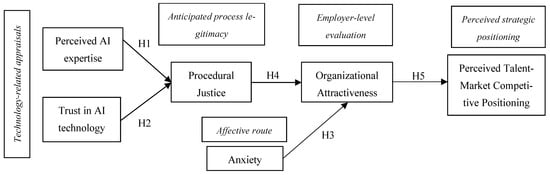
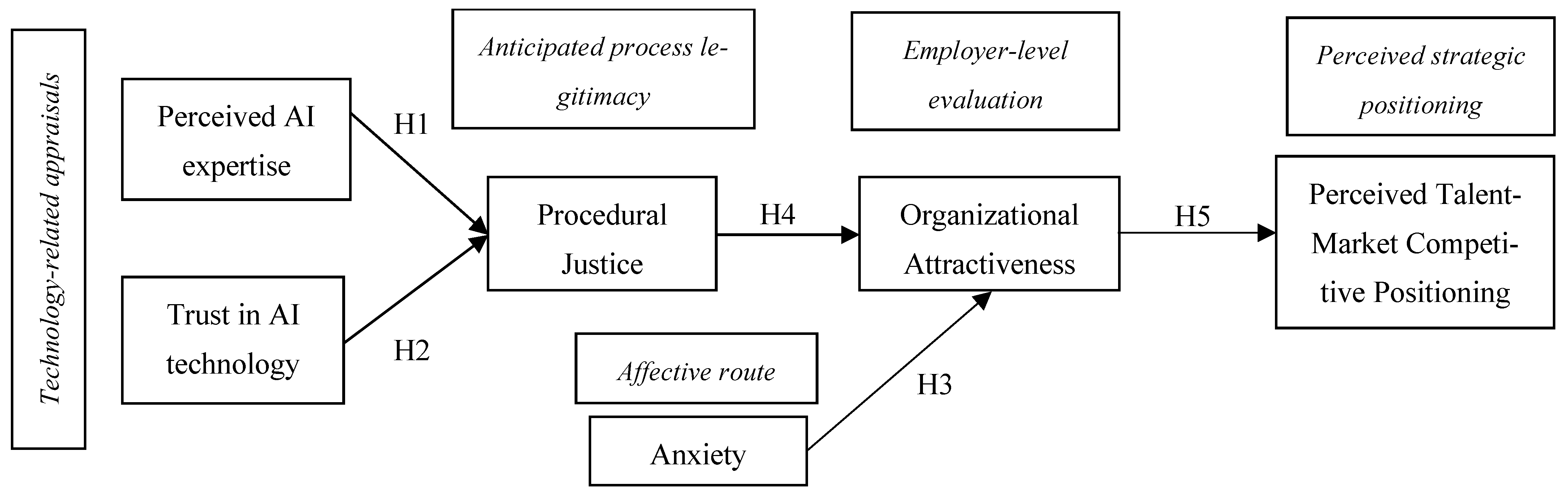
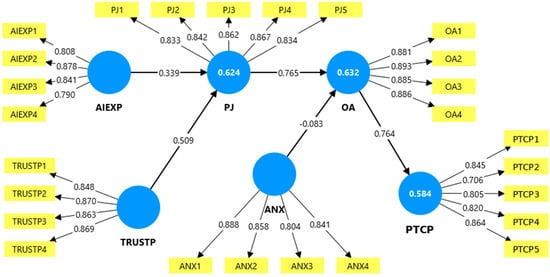
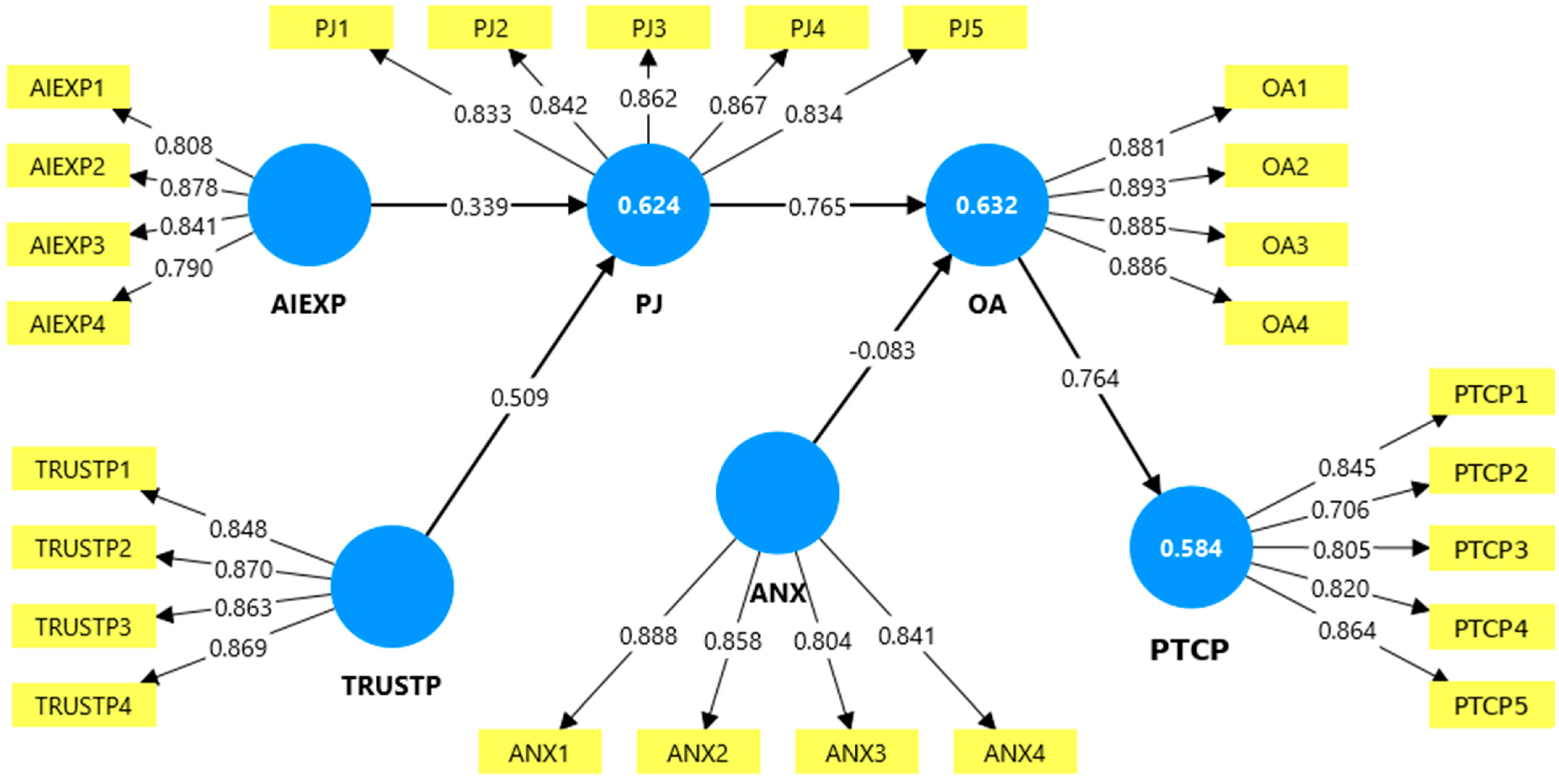

Disclaimer/Publisher’s Note: The statements, opinions and data contained in all publications are solely those of the individual author(s) and contributor(s) and not of MDPI and/or the editor(s). MDPI and/or the editor(s) disclaim responsibility for any injury to people or property resulting from any ideas, methods, instructions or products referred to in the content. |
© 2026 by the authors. Licensee MDPI, Basel, Switzerland. This article is an open access article distributed under the terms and conditions of the Creative Commons Attribution (CC BY) license.