


Abstract
While digitalization is expected to increase the demand for continuing workforce training in European economies, large-scale, cross-country panel data on macro-level relationships between participation in adult learning and digitalization remain insufficient. This study examines how digital diffusion, employment in the information and communication technologies sector, research and development intensity, and institutional quality are associated with adult learning participation across EU-27 member states. An unbalanced panel dataset covering the 27 EU member states for the period 2015–2023 was created from Eurostat and Sustainable Development Goals monitoring indicators. The empirical strategy includes cross-sectional dependence diagnostics, unit root and cointegration tests, fixed-effects estimation with Driscoll–Kraay standard errors, moderation analysis, and robustness checks based on alternative covariance specifications and first differences. The level-fixed-effects results show positive associations between individual internet use, as a proxy for economy-wide digital diffusion, and research and development intensity with adult learning participation (β = 0.110, p < 0.01; β = 2.451, p < 0.01, respectively). Employment in the information and communication technologies sector is not statistically significant, and institutional quality does not significantly moderate the association between individual internet use and adult learning participation. In hypothesis terms, H1 (digital diffusion) and H3 (research and development intensity) are supported in the level specification, whereas H2 (information and communication technologies employment) and H4 (institutional quality moderation) are not supported. When standard errors are clustered at the country level, the key coefficients lose significance, so these level estimates are descriptive structural associations rather than causal effects. The first-difference estimator does not reproduce the level relationships, indicating that the findings primarily reflect cross-country structural associations rather than within-country dynamic effects. Country-group analysis reveals a fourfold difference in mean adult learning participation between the lowest and highest digital diffusion quartiles (5.3% vs. 20.3%). The findings inform EU digital and skills policy by suggesting that the expansion of digital infrastructure should be coordinated with adult learning targets within the 2030 Digital Compass framework.
1. Introduction
Digital transformation has become a central driver of change in labor markets, work organization, and human-capital requirements. Value creation, organizational processes, and the ways individuals interact with technology in their work and daily lives are being reshaped (Verhoef et al., 2021). As digital technologies diffuse across societies and economies, workers are increasingly expected to update their skills, adapt to technology-mediated work practices, and participate in continuous learning (Hetmańczyk, 2024). The World Economic Forum (2023) similarly emphasizes that technological change is transforming skill requirements across occupations and increasing the need for reskilling and upskilling. This transformation includes broader digital access, internet use, and technology-supported learning opportunities across societies, labor markets, and workplaces.
The European Union has placed digital skills and lifelong learning at the center of its digital transformation agenda. The 2030 Digital Compass emphasizes the need to strengthen digital capacities, improve citizens’ digital skills, and support the adaptation of economies to technological change (European Commission, 2021). In this context, adult learning participation is an important macro-level indicator for assessing whether national workforces are positioned to respond to changing skill demands.
Despite the growing policy relevance of digital skills and lifelong learning, cross-country panel evidence on the relationship between digital diffusion and adult learning participation remains limited. Existing research has generally examined digital transformation, digital business strategy, or organizational adaptation at the firm level (Matt et al., 2015; Verhoef et al., 2021; Vial, 2019). However, less attention has been paid to whether countries with broader digital diffusion have higher adult learning participation rates. Addressing this gap matters because policy increasingly treats digital expansion and workforce learning as linked, yet the macro-level evidence supporting that assumption remains thin and largely untested across countries.
EU-wide policies assume that as economies digitize, the workforce will continue to learn. However, large-scale panel data are scarce on whether higher digital diffusion correlates with higher adult learning participation, and whether this correlation holds within countries or only between countries over time. Knowing which holds is important for policy design, as a cross-country pattern would necessitate structural investment, while a within-country dynamic would highlight short-term programs. To examine this, the study analyzes an unbalanced panel of EU-27 countries for the period 2015–2023. Eurostat’s annual adult learning participation rate (ALP) is the dependent variable and serves as a national proxy for workforce learning and human-capital development capacity. The main explanatory variable is individual internet use (INTUSE), measured as the share of individuals aged 16–74 who used the internet in the last three months, and used here as a proxy for economy-wide digital diffusion. Because internet use may reflect not only access but also broader inequalities in digital resources, skills, and usage capacities, INTUSE should be interpreted as a broad digital diffusion indicator rather than as a direct measure of advanced digital technology adoption (Van Deursen & Van Dijk, 2019). The remaining explanatory variables are information and communication technologies (ICT) sector employment share, research and development (R&D) intensity, and a country-level institutional quality score. The main estimator consists of a panel fixed-effects model with Driscoll–Kraay standard errors. This model is supported by cross-sectional dependence, unit root, and cointegration diagnostics. Additionally, a first-difference estimator is used to separate level relationships from year-to-year variations.
The study offers three contributions. First, it provides comparative cross-country panel evidence on how digital diffusion and R&D intensity relate to adult learning participation across the EU-27, a relationship that micro and survey studies have not tested at this scale. Second, comparing level and first-difference estimates shows that the association is cross-country and structural rather than within-country and dynamic, clarifying what macro indicators can and cannot establish about workforce learning. Third, it draws policy implications for coordinating digital infrastructure and adult learning targets under the EU 2030 Digital Compass, while explicitly acknowledging the limits of the evidence. The remaining sections present the literature review, theoretical framework, and hypothesis development; the materials and methods; the results; the discussion; and the conclusion.
2. Theoretical Framework
2.1. Literature Review
Digital diffusion and adult learning have become increasingly important research themes as economies adapt to technological change, digitalized work practices, and shifting skill requirements. Recent studies emphasize that digital technologies reshape access to learning, skills renewal, and workforce adaptability across broader societal and labor-market contexts (Alkandari et al., 2026; Poláková et al., 2023; Trenerry et al., 2021). Automation and related digital technologies also alter labor demand and occupational structures, increasing the need for reskilling and continuous learning opportunities (Acemoglu & Restrepo, 2020; Nedelkoska & Quintini, 2018). Adult learning participation therefore serves as a relevant macro-level indicator of how economies respond to changing skill requirements.
Participation in adult learning is a key indicator of how societies and labor markets respond to changing skill demands. In digitally integrated economies, individuals are more frequently exposed to online services, digital communication, platform-based work practices, and technology-mediated learning opportunities. This can increase the demand for and accessibility of adult learning. In contemporary labor markets, learning is becoming continuous, contextual, and technology-mediated, extending beyond formal education programs (Noe et al., 2014; OECD, 2023). Similarly, OECD skills policy reports highlight that economies with stronger learning systems are better positioned to adapt to technological transitions and changing labor-market requirements (OECD, 2025). From this perspective, individual internet use captures the broader digital environment where participation in adult learning becomes more likely.
ICT sector employment represents a more specific dimension of the digital economic structure (Uddin et al., 2026). A higher share of ICT-related employment may indicate stronger demand for advanced digital skills, more intensive knowledge work, and a labor-market structure more exposed to technological change (Almeida et al., 2025). The skill-biased technological change literature suggests that technological development increases demand for analytical, interactive, and problem-solving competencies (Autor et al., 2003; Goldin & Katz, 2008). However, the relationship between ICT sector employment and adult learning participation is not necessarily direct. Digital skill requirements may diffuse across the entire economy rather than remain concentrated within the ICT sector alone (OECD, 2026). Therefore, ICT employment is included as a separate explanatory variable to examine whether sectoral digital intensity is associated with adult learning participation, beyond the broader diffusion captured by INTUSE.
R&D intensity is another structural factor that may shape participation in adult learning. The absorptive capacity literature argues that research and development activities increase organizations’ and economies’ ability to recognize, assimilate, and apply new knowledge (Cohen & Levinthal, 1990). Innovation-driven growth models also link R&D expenditure to knowledge accumulation and the demand for human capital development (Acemoglu & Johnson, 2024; Grossman & Helpman, 1991). In R&D-intensive economies, technological upgrading, innovation activity, and knowledge-based production may create stronger incentives for lifelong learning, upskilling, and reskilling (Griffith et al., 2004). Accordingly, R&D intensity is expected to be positively associated with adult learning participation within a broader human-capital development system.
Institutional quality also influences the extent to which digital diffusion and innovation capacity are translated into learning participation. Institutional frameworks shape incentives for long-term investment, policy implementation, public service quality, and the coordination of skills strategies (Hall & Soskice, 2001; Kaufmann et al., 2011; North, 1990; Rodrik et al., 2004). In the EU context, however, institutional variation may be partly compressed by common policy frameworks, regulatory convergence, and shared digital and skills agendas. For this reason, institutional quality is included not only as a direct contextual factor but also as a potential moderator of the relationship between INTUSE and adult learning participation. This allows the analysis to test whether countries with stronger institutional environments convert digital diffusion into adult learning participation more effectively.
2.2. Theoretical Framework
This study is grounded in three complementary theoretical perspectives: Human Capital Theory, Dynamic Capabilities Theory, and the Technology–Organization–Environment (TOE) framework. Together, these perspectives provide a multi-level explanation of why digital diffusion, innovation capacity, and institutional conditions may be associated with adult learning participation across EU economies.
Human Capital Theory provides the primary foundation for linking adult learning participation to economic and technological change. According to Becker (1964) and Schultz (1961), education and training are productive investments that increase individual capabilities and support broader economic performance. From this perspective, adult learning participation reflects a national capacity to renew skills, update competencies, and maintain workforce adaptability. In digitally embedded economies, where individuals are more exposed to online services, digital communication, and technology-mediated work practices, the expected return to continuous learning may increase. Therefore, INTUSE, as a proxy for economy-wide digital diffusion, can be theoretically linked to adult learning participation through changes in skill demand and the broader accessibility of learning opportunities.
Dynamic Capabilities Theory complements this argument by emphasizing adaptation, learning, and resource reconfiguration in response to changing environmental conditions. Teece (2018) defines dynamic capabilities as the capacity to integrate, build, and reconfigure resources in response to technological and market change. Winter (2003) further argues that learning processes are central to the development of such capabilities. At the macro level, R&D intensity can be interpreted as an indicator of innovation capacity and knowledge accumulation. Economies with higher R&D intensity are likely to face stronger pressures to upskill and reskill because innovation-oriented production systems require continuous renewal of human capital. Thus, the expected association between R&D intensity and adult learning participation is grounded in the idea that innovation capacity and learning capacity develop jointly.
The TOE framework offers a contextual perspective on how technological and institutional conditions shape learning-related outcomes. Although the framework was originally developed to explain technology adoption at the organizational level (Tornatzky & Fleischer, 1990), its logic can be extended to the macro level by distinguishing technological, economic, and environmental conditions. In this study, INTUSE represents the technological diffusion environment, ICT sector employment represents the digital skills structure of the economy, R&D intensity represents innovation capacity, and institutional quality represents the broader environmental condition within which digital and learning policies are implemented. This framework is particularly useful for examining whether institutional quality strengthens the association between digital diffusion and adult learning participation.
The integrated framework, therefore, positions adult learning participation as a macro-level expression of workforce learning and human-capital development capacity. INTUSE captures the breadth of digital diffusion, ICT sector employment captures the structural presence of digital skills in the labor market, R&D intensity captures innovation-driven demand for knowledge renewal, and institutional quality captures the policy and governance environment. This theoretical structure aligns the hypotheses with the macro-level measurement strategy used in the empirical analysis.
2.3. Hypothesis Development
Digital diffusion may increase participation in adult learning by changing both the demand for skills and the accessibility of learning opportunities. As internet use becomes more widespread, individuals are increasingly exposed to digital services, online communication, platform-based work practices, and technology-mediated learning environments. This broader digital embeddedness may raise awareness of skill gaps, increase access to learning resources, and strengthen the perceived need for continuous skills renewal. From a Human Capital Theory perspective, education and training are productive investments that increase individual capabilities and support economic adaptation (Becker, 1964; Schultz, 1961). Recent evidence also suggests that digital automation and digital transformation increase the importance of reskilling, upskilling, and training motivation among workers in European countries (Śledziewska et al., 2025), while EU-27 evidence links digital skills, internet use, ICT human capital, and digital transformation performance to the broader digital policy agenda (Sofrankova et al., 2025). In this study, INTUSE is used as a proxy for economy-wide digital diffusion. Based on this reasoning, the following hypothesis is proposed:
H1.
INTUSE, as a proxy for economy-wide digital diffusion, is positively associated with adult learning participation.
ICT sector employment represents the structural presence of digital occupations and digital skills within the economy. A higher share of ICT-related employment may indicate stronger demand for analytical, technical, and problem-solving competencies. The skill-biased technological change literature suggests that technological development increases the demand for skilled labor and shifts labor markets toward more knowledge-intensive tasks (Autor et al., 2003; Goldin & Katz, 2008; Spitz-Oener, 2006). Recent EU-focused studies also emphasize the roles of ICT specialists, ICT graduates, and digital skills in shaping digital transformation performance and human capital capacity (Mamatzakis et al., 2026; Sofrankova et al., 2025). However, this relationship may not be automatic, because ICT employment can remain concentrated in specialized sectors without necessarily translating into wider adult learning participation across the whole workforce. Therefore, employment in the ICT sector is expected to be positively associated with adult learning participation. However, the relationship is treated as an empirical question rather than assumed to be uniform across countries. Accordingly, the second hypothesis is formulated as follows:
H2.
The ICT sector’s employment share is positively associated with adult learning participation.
R&D intensity is expected to be associated with adult learning participation because innovation-oriented economies require continuous knowledge renewal. The absorptive capacity perspective holds that R&D activity strengthens organizations’ and economies’ ability to identify, assimilate, and apply new knowledge (Cohen & Levinthal, 1990). Innovation-driven growth models similarly link R&D expenditure to knowledge accumulation and to the demand for human capital development (Grossman & Helpman, 1991). The Dynamic Capabilities Theory further emphasizes that adaptation to technological and market changes depends on learning and resource reconfiguration (Teece et al., 1997; Winter, 2003). Recent macro- and regional-level evidence also links R&D intensity, digitalization, innovation performance, and human-capital capacity, suggesting that innovation systems depend not only on technological investment but also on the availability of learning-oriented human capital (Bıyıklı, 2025; Mamatzakis et al., 2026). Economies with higher R&D intensity are therefore likely to generate stronger demand for upskilling, reskilling, and lifelong learning. In this context, adult learning participation can be understood as part of the broader human-capital infrastructure that supports innovation capacity. Based on this argument, the following hypothesis is proposed:
H3.
R&D intensity is positively associated with adult learning participation.
Institutional quality may shape the extent to which digital diffusion is translated into adult learning participation. Institutions influence incentive structures, policy implementation capacity, public service quality, and the coordination of long-term human-capital strategies (Hall & Soskice, 2001; Rodrik et al., 2004). The World Governance Indicators have also been widely used to capture institutional quality in cross-country empirical research (Kaufmann et al., 2011). From the perspective of the Technology–Organization–Environment framework, institutional quality represents the broader environmental condition that may strengthen or weaken the association between technological diffusion and learning-related outcomes (Tornatzky & Fleischer, 1990). Recent EU-27 evidence further shows that public governance and digital transformation are closely interlinked, particularly through government effectiveness, digital public services, and human capital involved in digitally intensive activities (Crăciun et al., 2023). In higher-quality institutional settings, digital diffusion may therefore be more effectively supported by public services, policy coordination, and skills strategies, thereby increasing its association with adult learning participation. Accordingly, the fourth hypothesis is formulated as follows:
H4.
Institutional quality moderates the association between INTUSE and adult learning participation, strengthening this association where institutional quality is higher.
3. Materials and Methods
3.1. Data and Sample
The dataset is an unbalanced panel covering the 27 member states of the European Union over the 2015–2023 period. The final sample contains 242 country-year observations across 27 countries and 9 years. The panel is unbalanced because INTUSE is unavailable in Greece for 1 year. All variables were compiled from official open-access Eurostat datasets and Eurostat-hosted SDG monitoring indicators. The study period begins in 2015, when the relevant digital and socioeconomic indicators are systematically available for EU member states, and ends in 2023, the most recent year with sufficient coverage across the variables used in the analysis.
The country-year structure of the dataset allows the study to examine whether differences in digital diffusion, ICT sector employment, R&D intensity, and institutional quality are associated with adult learning participation across EU economies. Because the analysis uses aggregated country-level indicators, the results should be interpreted as macro-level associations rather than individual- or firm-level behavioral effects.
3.2. Variables
The dependent variable of the study is adult learning participation (ALP), compiled from Eurostat’s labor force survey indicator on participation in education and training. ALP reflects the share of individuals aged 25–64 who participated in any education or training activity during the four weeks preceding the survey. In this study, ALP is used as a national indicator of workforce learning and human-capital development capacity. It should not be interpreted as a direct measure of firm-level leadership development programs, managerial training, or organizational training investment.
The main explanatory variable is INTUSE, measured as the share of individuals aged 16–74 who used the internet in the last three months. INTUSE is used as a proxy for economy-wide digital diffusion and serves as the empirical indicator for testing H1, which proposes a positive association between digital diffusion and adult learning participation. INTUSE should not be interpreted as a direct measure of enterprise-level AI adoption, firm-level digital transformation, or the use of specific advanced digital technologies. The second explanatory variable is ICT sector employment, which captures the share of ICT-related employment in total employment and represents the digital skills intensity of the economy and the demand for highly skilled labor. This variable serves as the empirical indicator for testing H2, which proposes a positive association between ICT sector employment and adult learning participation.
The third explanatory variable is R&D intensity (RD), measured as gross domestic expenditure on research and development as a percentage of GDP. RD captures the innovation capacity of the economy and the extent to which knowledge production and technological upgrading may generate demand for continuous skills renewal. It serves as the empirical indicator for testing H3, which proposes a positive association between R&D intensity and adult learning participation.
The fourth variable is institutional quality (GOV), measured by the institutional quality score used in the Eurostat SDG monitoring framework. GOV is included as a country-level contextual variable and as a moderator in the interaction model. It is used to test H4, which proposes that institutional quality strengthens the association between INTUSE and adult learning participation. In this study, GOV should be interpreted as a country-level institutional indicator rather than as a measure of organizational or firm-level quality.
The control variables include GDP per capita, employment rate, and tertiary education attainment. GDP per capita is logarithmically transformed and included to control for differences in economic development and resource capacity across countries. The employment rate controls for general labor-market conditions, while tertiary education attainment captures the broader human-capital base that may influence participation in adult learning. Together, these controls reduce the risk that the estimated associations are driven solely by differences in income, labor-market structure, or educational composition.
3.3. Econometric Model and Estimation Strategy
The empirical strategy follows a sequential panel-data approach. First, cross-sectional dependence is examined using Pesaran’s CD test, given the high degree of economic, institutional, and policy integration among EU member states (Pesaran, 2021). Second, the time-series properties of the variables are assessed using both the Im–Pesaran–Shin panel unit root test and Pesaran’s cross-sectionally augmented IPS test (Im et al., 2003; Pesaran, 2007). The use of CIPS is particularly relevant because it allows for cross-sectional dependence across countries. Third, the existence of a long-run equilibrium relationship among the variables is examined using Westerlund’s panel cointegration test with bootstrapped p-values (Westerlund, 2007).
The baseline empirical model estimates the association between adult learning participation and the explanatory variables using a two-way fixed-effects specification. Country fixed effects control for time-invariant, country-specific heterogeneity, while time fixed effects control for common shocks affecting EU member states in a given year. The baseline model is specified as follows:
where ALP denotes adult learning participation, INTUSE denotes individual internet use as a proxy for economy-wide digital diffusion, ICT denotes ICT sector employment share, RD denotes R&D intensity, GOV denotes institutional quality, ln(GDPPC) denotes the logarithm of GDP per capita, EDU denotes tertiary education attainment, and EMP denotes the employment rate. The term α_i captures country fixed effects, λ_t captures year fixed effects, and ε_{i,t} is the error term.
ALP_{i,t} = α_i + β1INTUSE_{i,t} + β2ICT_{i,t} + β3RD_{i,t} + β4GOV_{i,t} +
β5ln(GDPPC_{i,t}) + β6EDU_{i,t} + β7EMP_{i,t} + λ_t + ε_{i,t}
β5ln(GDPPC_{i,t}) + β6EDU_{i,t} + β7EMP_{i,t} + λ_t + ε_{i,t}
To test the moderating role of institutional quality, INTUSE and GOV were mean-centered before constructing the interaction term. The moderation model is specified as follows:
ALP_{i,t} = α_i + β1INTUSE_{i,t} + β2GOV_{i,t} + β3(INTUSE_{i,t} ×
GOV_{i,t}) + β4ICT_{i,t} + β5RD_{i,t} + β6ln(GDPPC_{i,t}) + β7EDU_{i,t} +
β8EMP_{i,t} + λ_t + ε_{i,t}
GOV_{i,t}) + β4ICT_{i,t} + β5RD_{i,t} + β6ln(GDPPC_{i,t}) + β7EDU_{i,t} +
β8EMP_{i,t} + λ_t + ε_{i,t}
In this model, the coefficient of the interaction term, β3, indicates whether institutional quality strengthens or weakens the association between INTUSE and ALP. A positive and statistically significant coefficient would support the moderation hypothesis.
Because the diagnostic tests indicate cross-sectional dependence, heteroskedasticity, and possible serial correlation, the fixed-effects models are estimated with Driscoll–Kraay standard errors (Driscoll & Kraay, 1998). These standard errors are appropriate for macro-panel settings in which observations may be correlated across countries and over time. In addition, alternative covariance specifications are used as robustness checks, including different Driscoll–Kraay bandwidths, country-clustered standard errors, and time-clustered standard errors.
The unit root and cointegration results are treated with caution. If the variables are classified as integrated and no cointegration relationship is detected, level specifications may reflect level-based associations rather than short-run dynamic effects. For this reason, a first-difference estimator is added as a conservative robustness check. The first-difference model is specified as follows:
ΔALP_{i,t} = θ1ΔINTUSE_{i,t} + θ2ΔICT_{i,t} + θ3ΔRD_{i,t} + θ4ΔGOV_{i,t} +
θ5Δln(GDPPC_{i,t}) + θ6ΔEDU_{i,t} + θ7ΔEMP_{i,t} + λ_t + υ_{i,t}
θ5Δln(GDPPC_{i,t}) + θ6ΔEDU_{i,t} + θ7ΔEMP_{i,t} + λ_t + υ_{i,t}
The first-difference estimator removes country-specific levels and examines whether year-to-year changes in the explanatory variables are associated with year-to-year changes in adult learning participation. Therefore, the fixed-effects level estimates and the first-difference estimates are interpreted together. The analysis is not presented as a causal test; rather, it evaluates whether digital diffusion, ICT sector employment, R&D intensity, and institutional quality are associated with adult learning participation in a macro-panel setting.
4. Results
4.1. Descriptive Statistics
The sample comprises an unbalanced panel of EU-27 countries for the period 2015–2023, totaling 242 country-year observations. The dependent variable, ALP, has a mean of 11.828% and a standard deviation of 8.068%. The wide range between 0.900% and 38.800% indicates substantial cross-country variation in participation in education and training among adults aged 25–64. The main explanatory variable, INTUSE, has a mean value of 85.391%, suggesting a generally high level of internet use across EU member states. However, the range from 55.760% to 99.350% indicates that meaningful differences in digital diffusion persist across countries. The ICT sector accounts for an average of 3.523% of total employment, while R&D intensity averages 1.665% of GDP, indicating variation in digital labor market structure and innovation capacity. The institutional quality score (GOV) ranges from 41.000 to 91.000, with a mean of 63.934, reflecting heterogeneity in governance and institutional conditions across EU economies. The control variables also show notable variation: the mean logged GDP per capita is 10.317, tertiary education attainment is 34.440%, and the employment rate is 73.450%. The descriptive statistics are presented in Table 1.
Table 1.
Descriptive Statistics (EU-27, 2015–2023).
4.2. Correlation Structure
The correlation matrix indicates positive and statistically significant associations between adult learning participation (ALP) and all explanatory and control variables. The strongest bivariate association with ALP is observed for institutional quality (GOV) (r = 0.789), followed by INTUSE (r = 0.697), R&D intensity (RD) (r = 0.652), and ICT sector employment (ICT) (r = 0.611). These correlations suggest that countries with higher levels of institutional quality, internet use, innovation capacity, and ICT-sector employment report higher adult learning participation. However, these are descriptive bivariate associations and should not be interpreted as causal effects.
The explanatory variables are also positively correlated with one another. Relatively high correlations are observed between GOV and RD (r = 0.741), INTUSE and ln(GDPPC) (r = 0.747), and INTUSE and GOV (r = 0.715), indicating that digital diffusion, income level, innovation capacity, and institutional quality are structurally related across EU economies. Because pooled correlations may reflect persistent between-country differences, multicollinearity was also assessed after the within-demeaning transformation used in the fixed-effects framework. Although raw pooled VIF values are high due to cross-country structural variation, the within-demeaned VIF values remain below the conventional threshold of 10, with a maximum value of 7.86. This suggests that multicollinearity does not pose a critical threat to the fixed-effects estimation. The correlation matrix is presented in Table 2.
Table 2.
Pearson Correlation Matrix (EU-27, 2015–2023).
4.3. Cross-Sectional Dependence Tests
Cross-sectional dependence was examined using Pesaran’s CD test, given the strong economic, institutional, and policy interdependence among EU member states. The results indicate statistically significant cross-sectional dependence for seven of the eight variables. For the dependent variable, adult learning participation (ALP), the CD statistic is 17.633. It is statistically significant at the 1% level, suggesting that ALP rates across EU countries are affected by common shocks or shared regional dynamics. The main digital diffusion proxy, INTUSE, also exhibits strong cross-sectional dependence (CD = 47.749, p < 0.001), as do the ICT sector employment, R&D intensity, GDP per capita, tertiary education attainment, and employment rate.
By contrast, the institutional quality variable (GOV) does not show statistically significant cross-sectional dependence (CD = 0.457, p = 0.647). This suggests that institutional quality follows more country-specific trajectories and is less synchronized across EU member states than the economic, labor-market, and digital indicators. Overall, these findings justify the use of unit root tests that account for cross-sectional dependence and support the application of Driscoll–Kraay standard errors in the fixed-effects estimations. The results are presented in Table 3.
Table 3.
Pesaran Cross-Sectional Dependence Test Results (EU-27, 2015–2023).
4.4. Panel Unit Root Tests
Panel unit root tests were conducted to examine the time-series properties of the variables before estimating the panel models. Because the Pesaran CD test indicated cross-sectional dependence for most variables, both first-generation and second-generation unit root tests were applied. Specifically, the Im–Pesaran–Shin (IPS) test was used alongside Pesaran’s cross-sectionally augmented IPS (CIPS) test, which is more appropriate when cross-sectional dependence is present.
The results provide mixed, but generally cautious, evidence regarding the stationarity of the series. At levels, the null hypothesis of a unit root cannot be consistently rejected for most variables across both IPS and CIPS tests. Some variables show partial evidence of stationarity in one specification but not in the other, which is not unexpected given the panel’s short time dimension (T = 9). After first differencing, the evidence becomes stronger for several variables, particularly INTUSE, RD, GOV, and EDU, although the CIPS results remain weaker for ALP, ln(GDPPC), and EMP.
Given this mixed evidence, the variables are treated conservatively as potentially integrated processes in the subsequent analysis. This motivates the use of Westerlund’s panel cointegration test in the next step and also supports the inclusion of a first-difference estimator as a robustness check. The results of the panel unit root tests are presented in Table 4.
Table 4.
Panel Unit Root Test Results (EU-27, 2015–2023).
4.5. Panel Cointegration Tests
Because the unit root tests suggest that the variables may be conservatively treated as integrated processes, the next step is to examine whether a long-run equilibrium relationship exists among the variables. For this purpose, Westerlund’s error-correction-based panel cointegration test was applied with bootstrapped p-values. This approach is appropriate in the present setting because it provides inference that is more robust to cross-sectional dependence across countries.
The results do not provide statistically significant evidence of cointegration. Across the four Westerlund statistics, the null hypothesis of no cointegration is not rejected. The bootstrap p-values for Gt, Ga, Pt, and Pa range between 0.487 and 0.513, indicating that the data do not support a stable long-run equilibrium relationship between adult learning participation (ALP) and the explanatory variables in this short EU-27 panel.
This result has important implications for interpretation. The absence of cointegration means that level specifications should not be interpreted as evidence of a stable long-run causal relationship. At the same time, the short time dimension of the panel (T = 9) may limit the power of panel cointegration tests to detect structural relationships. Therefore, the level fixed-effects models are retained as descriptive macro-panel specifications, but their results are interpreted cautiously as level-based structural associations rather than causal or dynamic effects. To further address this concern, a first-difference estimator is included in the robustness analysis to examine whether year-to-year changes in INTUSE, ICT sector employment, R&D intensity, institutional quality, and the control variables are associated with year-to-year changes in ALP. The Westerlund panel cointegration test results are presented in Table 5.
Table 5.
Westerlund Panel Cointegration Test Results (EU-27, 2015–2023).
4.6. Baseline Panel Fixed Effects with Driscoll–Kraay SE
The baseline regression analysis proceeds through a five-stage cumulative model. Each stage adds one explanatory variable, allowing the stability of the coefficients and the contribution of each regressor to be observed. All models include country fixed effects and year fixed effects. Driscoll–Kraay standard errors are used because the diagnostic tests indicate cross-sectional dependence and because this covariance estimator is robust to cross-sectional dependence, serial correlation, and heteroskedasticity.
Across Models M2–M5, the coefficient for INTUSE remains positive and statistically significant at the 1% level. In the full model, the coefficient is 0.110, indicating that a 1-percentage-point increase in internet use is associated with a 0.110-percentage-point increase in adult learning participation, holding the other covariates and fixed effects constant. This finding supports H1 in the level specification. However, given the unit root and cointegration results reported above, this association should be interpreted as a level-based macro-panel association rather than as evidence of a causal or short-run dynamic effect.
ICT sector employment (ICT) is not statistically significant in any model. In the full specification, the coefficient is small and imprecisely estimated (β = 0.074, SE = 0.603), suggesting that H2 is not supported. R&D intensity (RD) is positive and statistically significant in Models M4 and M5. In the full model, the coefficient is 2.451, suggesting that higher R&D intensity is associated with higher adult learning participation in the level specification, which is consistent with H3. Institutional quality (GOV) is negative but statistically insignificant in the full model (β = −0.036, SE = 0.074). Therefore, H4 is not evaluated through the main effect of GOV but through the interaction model reported in Section 4.7.
Among the control variables, GDP per capita and tertiary education attainment are positively and statistically significantly associated with adult learning participation across the specifications. In the full model, ln(GDPPC) is positive and significant (β = 3.663, p < 0.01), and tertiary education attainment is also positive and significant (β = 0.390, p < 0.01). The employment rate is negative but statistically insignificant in the full model. The within R2 of the full model is 0.242, indicating that the fixed-effects specification explains a moderate share of within-country variation in adult learning participation. The regression results are presented in Table 6.
Table 6.
Panel Fixed Effects Results with Driscoll–Kraay Standard Errors (EU-27, 2015–2023).
4.7. Moderation Analysis
H4 tests whether country-level institutional quality (GOV) moderates the association between INTUSE and adult learning participation (ALP). To reduce multicollinearity, INTUSE and GOV were mean-centered before constructing the interaction term. Two models are estimated: M1 includes the main effects only, while M2 adds the INTUSE × GOV interaction.
The results show that INTUSE remains positive and statistically significant in both models. In the interaction model, the coefficient of INTUSE is 0.123 and remains significant at the 1% level. However, the interaction term between INTUSE and GOV is not statistically significant (β = 0.001, SE = 0.002, p = 0.651). This indicates that institutional quality does not significantly strengthen or weaken the association between INTUSE and ALP in the EU-27 panel. Therefore, H4 is not supported.
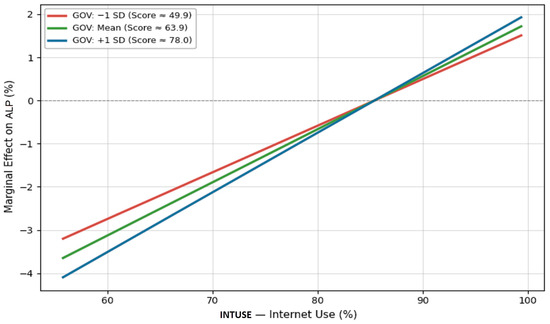
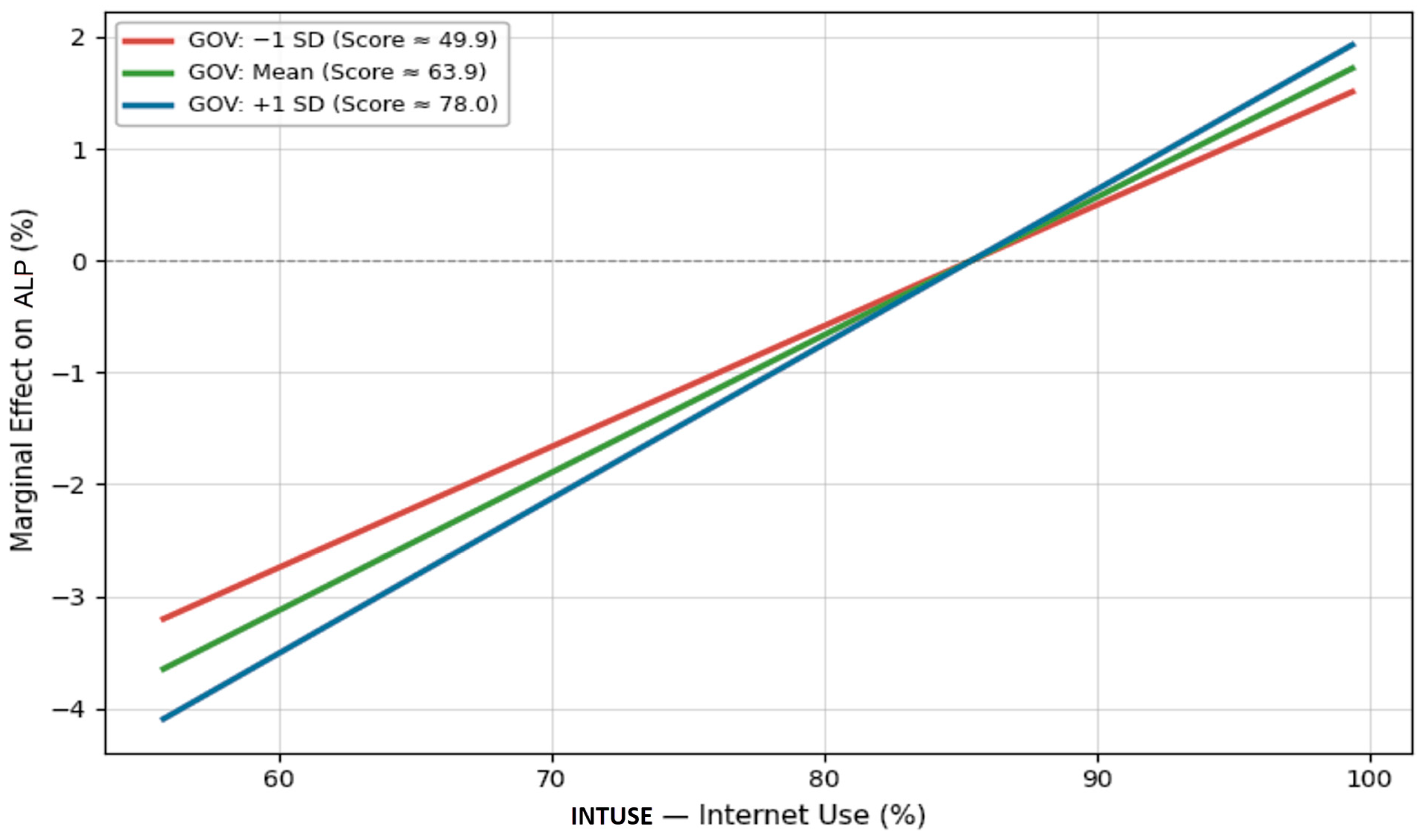
The main effect of GOV is also statistically insignificant in both models. ICT sector employment remains insignificant, while R&D intensity remains positive and statistically significant. Including the interaction term does not materially improve model fit. Overall, the moderation results suggest that the positive level association between INTUSE and ALP is broadly similar across different levels of institutional quality. The results are presented in Table 7, and the marginal-effects plot is shown in Figure 1.
Table 7.
Moderation Analysis Results—Interaction of INTUSE and GOV (EU-27, 2015–2023).
Figure 1.
Moderating Role of Institutional Quality (GOV) in the INTUSE–ALP Association (EU-27, 2015–2023). Note. Marginal associations are computed from Model 2 in Table 7 at three levels of GOV: −1 SD (score ≈ 49.9), mean (score ≈ 63.9), and +1 SD (score ≈ 78.0). INTUSE and GOV are mean-centered. Shaded areas are omitted because the interaction term is statistically insignificant (β = 0.001, SE = 0.002, p = 0.651).
Figure 1 visualizes the marginal association between INTUSE and ALP at three levels of institutional quality (GOV): one standard deviation below the mean, the mean, and one standard deviation above the mean. Consistent with the statistically insignificant interaction coefficient, the three marginal-association lines follow an almost parallel pattern. This indicates that institutional quality does not meaningfully alter the association between INTUSE and ALP in the EU-27 panel.
4.8. Robustness Checks
The robustness of the baseline findings is assessed in two ways. First, the covariance estimator is varied while keeping the level fixed-effects specification unchanged. The model is re-estimated using Driscoll–Kraay standard errors with alternative bandwidths, country-clustered standard errors, and year-clustered standard errors. Second, a first-difference estimator is used to examine whether year-to-year changes in the explanatory variables are associated with year-to-year changes in adult learning participation (ALP).
The covariance comparison shows that the point estimates remain unchanged across the alternative standard error specifications. The association between INTUSE and ALP remains statistically significant under the Driscoll–Kraay and year-clustered specifications. However, when standard errors are clustered at the country level, the standard error of INTUSE increases substantially, and the coefficient becomes statistically insignificant. R&D intensity shows a similar pattern: it remains significant under Driscoll–Kraay and year-clustered standard errors but loses significance under country-clustered standard errors. This finding indicates that the evidence is not uniformly robust across all inferential assumptions and supports a cautious interpretation of the level estimates.
The first-difference estimator provides an additional and more conservative check. Once country-specific levels are removed, the positive association between INTUSE and ALP no longer holds. The coefficient for ΔINTUSE is weak and statistically insignificant, and the R&D coefficient fails to retain the positive association observed in the level specification. This divergence suggests that the main results should not be interpreted as evidence that short-run increases in internet use or R&D intensity within a country directly increase adult learning participation. Rather, the level estimates should be read as macro-level structural associations across EU economies.
Taken together, the robustness checks qualify the baseline findings. H1 and H3 are supported in the level fixed-effects specification, but the evidence is weaker under country-clustered inference and is not reproduced in first differences. H2 and H4 remain unsupported. Therefore, the empirical results are best interpreted as descriptive panel evidence on the structural associations between digital diffusion, innovation capacity, and adult learning participation, rather than as causal estimates or short-run dynamic effects. The results are presented in Table 8.
Table 8.
Robustness Checks—Alternative Standard Error Specifications (EU-27, 2015–2023).
4.9. ALP Trends by INTUSE Quartile
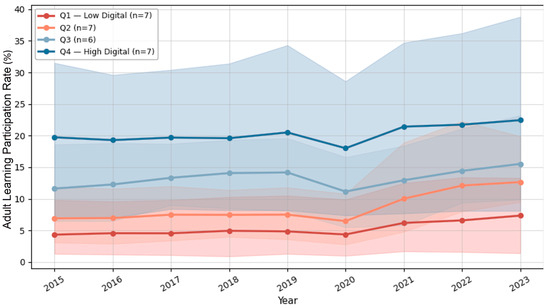
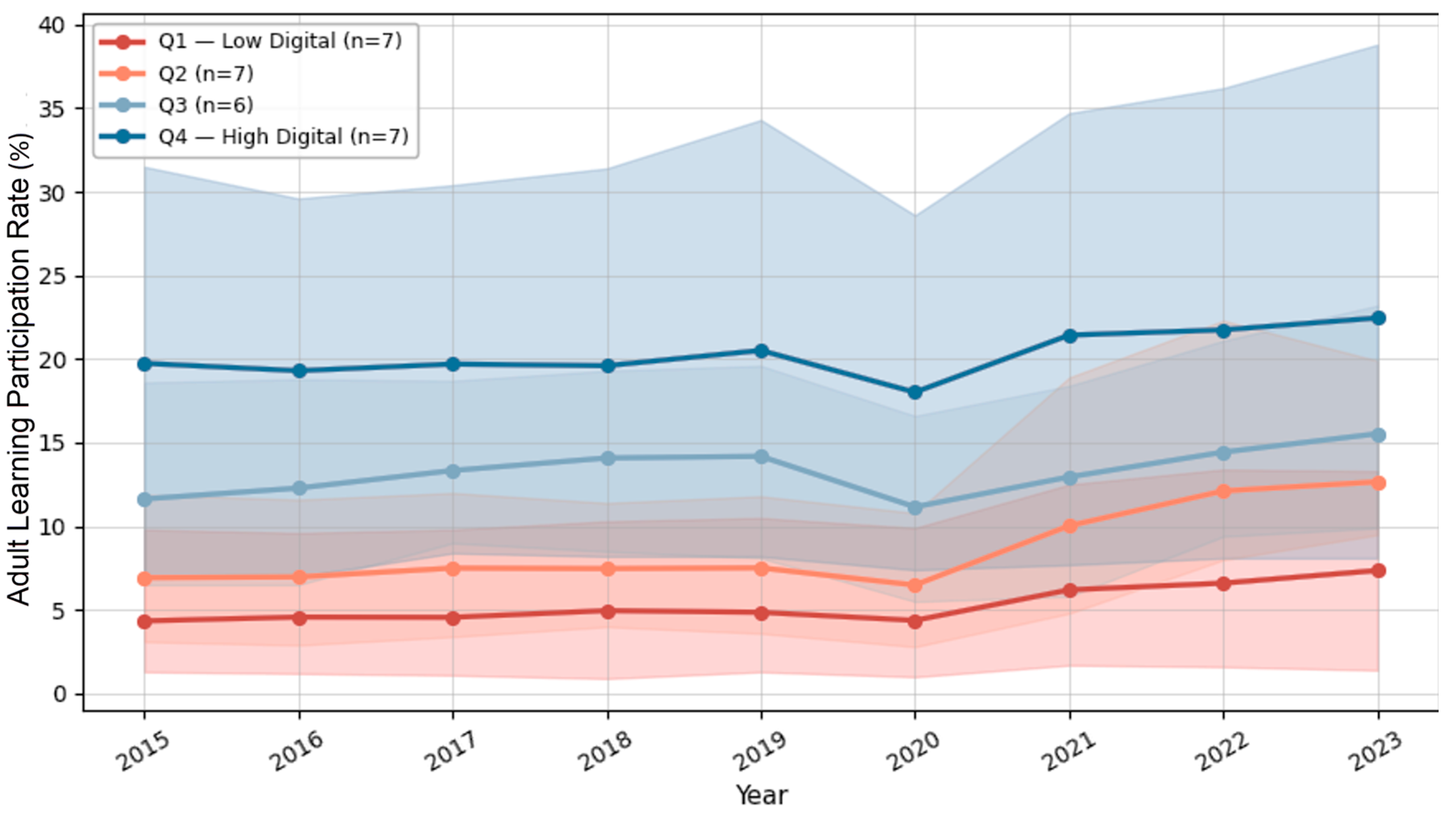
To provide a descriptive visualization of the relationship between digital diffusion and adult learning participation, countries were grouped into quartiles based on their average INTUSE over the 2015–2023 period. The group averages reveal a clear gradient in adult learning participation (ALP) across the INTUSE quartiles. Countries in the lowest INTUSE quartile report an average ALP rate of 5.3%, whereas countries in the highest INTUSE quartile report an average ALP rate of 20.3%. The intermediate quartiles also follow an increasing pattern, with average ALP rates of 8.6% in Q2 and 13.3% in Q3.
This descriptive pattern supports the view that participation in adult learning is higher in countries with more widespread internet use. However, the quartile analysis should be interpreted solely as descriptive evidence. It does not establish that increases in internet use within a country cause adult learning participation to rise. Instead, it illustrates the structural cross-country gradient between digital diffusion and adult learning participation across EU economies. The trends are presented in Figure 2.
Figure 2.
ALP Trends by INTUSE Quartile. Note. Countries are assigned to quartiles based on their mean INTUSE values over the 2015–2023 period. Q1: INTUSE 68.6–79.7, average ALP = 5.3%; Q2: INTUSE 81.2–86.0, average ALP = 8.6%; Q3: INTUSE 86.8–89.8, average ALP = 13.3%; Q4: INTUSE 90.1–97.8, average ALP = 20.3%. ALP = adult learning participation; INTUSE = individual internet use, used as a proxy for economy-wide digital diffusion. The figure is descriptive and should not be interpreted as causal evidence.
When the findings are evaluated collectively, the results indicate that H1 and H3 are supported in the level-fixed effects specification, whereas H2 and H4 are not. INTUSE, used as a proxy for economy-wide digital diffusion, is positively associated with adult learning participation (ALP) (β = 0.110, p < 0.01). R&D intensity is also positively associated with ALP (β = 2.451, p < 0.01). By contrast, ICT sector employment is not statistically significant across the model specifications, and institutional quality does not play a significant role as a main effect or moderator. These findings suggest that participation in adult learning is higher in EU countries with more widespread internet use and stronger R&D intensity. However, they do not provide evidence of short-run causal effects or of a significant moderating role of institutional quality.
5. Discussion
This study examined how INTUSE, ICT sector employment, R&D intensity, and institutional quality are associated with ALP across EU-27 economies. The findings provide a qualified pattern of evidence. In the level-fixed effects specification, INTUSE and R&D intensity are positively associated with ALP, consistent with H1 and H3. However, these associations are not reproduced in the first-difference robustness check. They should therefore be interpreted as level-based structural associations rather than short-run within-country dynamics or causal effects. ICT sector employment is not statistically significant, meaning that H2 is not supported. Institutional quality also does not significantly moderate the INTUSE–ALP association, meaning that H4 is not supported. Overall, the results suggest that participation in adult learning is higher in EU countries with greater digital diffusion and stronger innovation capacity. However, the evidence does not support stronger claims about enterprise-level AI adoption, firm-level leadership development investment, or direct causal effects (Tutar et al., 2011). These associations are read through the study’s theoretical lenses rather than reported in isolation: Human Capital Theory and Dynamic Capabilities Theory explain why digitally embedded, innovation-oriented economies sustain stronger learning environments, while the TOE framework clarifies why broad institutional quality alone does not condition the digital-diffusion mechanism in this panel.
The positive association between INTUSE and ALP in the level specification is consistent with the Human Capital Theory argument that technological change increases the value of continuous skills renewal. Countries with more widespread internet use may provide a more digitally embedded environment in which individuals encounter online services, digital work practices, platform-mediated communication, and technology-supported learning opportunities more frequently (Hossain et al., 2025). This can increase both the perceived need for learning and the accessibility of learning resources. The finding also aligns with recent European evidence emphasizing the growing importance of reskilling, upskilling, and training motivation under digital transformation and automation pressures (Śledziewska et al., 2025), as well as with EU-27 research linking internet use, digital skills, ICT-related human capital, and digital transformation performance (Sofrankova et al., 2025). However, because the first-difference results do not reproduce the positive association at the level, this finding should not be interpreted as evidence that short-run increases in internet use within a country directly raise adult learning participation. Rather, it suggests that EU countries with greater digital diffusion tend to have stronger adult learning participation within a broader structural learning environment.
The non-significant association between ICT sector employment and adult learning participation provides an important qualification to the digital diffusion argument. Although ICT sector employment reflects the structural presence of digital occupations and specialized digital skills, the results indicate that a larger ICT employment share does not necessarily translate into higher adult learning participation across the whole adult population. One possible explanation is that ICT employment is concentrated in specific sectors, occupations, and high-skill labor-market segments. In contrast, ALP captures broad participation in education and training among adults aged 25–64. Therefore, sectoral digital specialization may remain too narrow to attract broader participation in learning unless inclusive lifelong learning systems and cross-sectoral skills policies support it. This interpretation is consistent with recent EU-focused evidence showing that ICT specialists, digital skills, and internet use are related but distinct dimensions of digital transformation and human-capital capacity (Mamatzakis et al., 2026; Sofrankova et al., 2025). Thus, the lack of support for H2 suggests that digital labor-market specialization alone is insufficient; broader access to learning opportunities and institutionalized reskilling pathways may be necessary for ICT-related structural change to translate into higher adult learning participation.
The positive association between R&D intensity and adult learning participation supports the view that innovation and learning capacities are closely linked. From the absorptive capacity perspective, economies and organizations that invest more heavily in R&D are more likely to require the continuous acquisition, assimilation, and application of new knowledge (Cohen & Levinthal, 1990). This interpretation is also consistent with Dynamic Capabilities Theory, which emphasizes learning, adaptation, and resource reconfiguration in the face of technological and market change (Teece et al., 1997; Winter, 2003). In the present study, higher R&D intensity is associated with higher ALP in the level specification, suggesting that innovation-oriented economies tend to have stronger adult learning environments. Recent evidence linking R&D intensity, digitalization, innovation performance, and human-capital capacity further supports this interpretation (Bıyıklı, 2025; Mamatzakis et al., 2026). However, as with INTUSE, the first-difference estimates do not confirm a short-run within-country dynamic. Therefore, the R&D finding should be interpreted as a structural association: countries with stronger innovation systems also tend to have higher adult learning participation, but the results do not establish that annual increases in R&D intensity directly increase adult learning participation.
The non-significant moderating effect of institutional quality further qualifies the TOE-based expectation. H4 proposed that stronger institutional environments would amplify the association between INTUSE and ALP by improving policy coordination, public-service quality, and the implementation capacity of lifelong learning strategies. However, the interaction between INTUSE and GOV is statistically insignificant, indicating that institutional quality does not meaningfully differentiate the INTUSE–ALP association in this EU-27 panel. This result does not necessarily invalidate the relevance of institutions for adult learning; rather, it suggests that the specific country-level GOV indicator used here may be too broad to capture the policy mechanisms through which digital diffusion is translated into adult learning participation. In addition, EU member states operate under shared regulatory, digital, and skills policy frameworks, which may reduce institutional variation, thereby weakening the observable moderating effect. Recent EU-27 evidence showing close links between public governance and digital transformation supports the relevance of governance conditions (Crăciun et al., 2023). However, the present findings suggest that such conditions do not significantly alter the relationship between digital diffusion and adult learning over the short panel period examined. Therefore, H4 is not supported, and the TOE framework should be interpreted cautiously in this macro-level setting.
Taken together, these findings refine rather than fully confirm the study’s theoretical expectations. The positive association between INTUSE and R&D intensity and ALP is broadly consistent with Human Capital Theory and Dynamic Capabilities Theory, as it suggests that digitally embedded, innovation-oriented economies tend to have stronger adult learning environments. However, the non-significant ICT and moderation results show that digital and institutional conditions do not operate automatically or uniformly. A larger ICT sector does not necessarily generate broad-based adult learning participation, and institutional quality does not significantly amplify the INTUSE–ALP association in the present panel. This indicates that macro-level adult learning participation is shaped less by isolated digital-sector indicators and more by the broader alignment of digital diffusion, innovation capacity, education systems, and lifelong learning infrastructures. Therefore, the study contributes to the literature by showing that digital diffusion and innovation capacity are associated with adult learning participation at the structural country level, while also demonstrating the limits of interpreting such associations as direct, short-run, or institutionally moderated effects.
5.1. Policy Recommendations
The findings also offer several policy implications for EU skills and digital transformation agendas. First, the positive level association between INTUSE and ALP suggests that digital diffusion and adult learning policies should not be designed separately. Expanding internet access, digital public services, and digital inclusion initiatives may create a more favorable environment for participation in adult learning, but these digital conditions must be linked to accessible lifelong learning pathways. EU and national policy frameworks should therefore coordinate digital infrastructure investments with adult education systems, online learning platforms, basic digital skills programs, and targeted reskilling opportunities for adults who are less likely to participate in training.
Second, the positive association between R&D intensity and ALP suggests that innovation policy should include a stronger human capital component. R&D-intensive economies appear to be embedded in broader learning environments, suggesting that innovation capacity depends not only on research expenditure or technological upgrading but also on the availability of workers who can continuously update their skills. Incentives for adult learning, employer-supported training schemes, and sectoral upskilling programs should therefore accompany policies supporting R&D, industrial innovation, and digital transformation. This is particularly important for ensuring that innovation-driven growth does not remain concentrated in high-skill groups but contributes to wider workforce development.
Third, the non-significant ICT employment result suggests that expanding the ICT sector alone may not be sufficient to increase adult learning participation across the broader population. ICT specialists may strengthen digital capacity in specific sectors, but adult learning participation requires inclusive systems that reach workers outside the core technology sector. This implies that policy should focus not only on producing more ICT professionals but also on diffusing digital skills across non-ICT occupations, small and medium-sized enterprises, older workers, and lower-skilled adults. Broad-based digital skills strategies are more effective than policies that focus narrowly on ICT employment growth.
Finally, the absence of a significant moderating effect of institutional quality suggests that general governance capacity may not be enough to explain differences in how digital diffusion translates into adult learning participation. More targeted institutional mechanisms may matter, such as the design of lifelong learning incentives, funding models for adult education, recognition of micro-credentials, employer participation in training, and coordination between education, labor-market, and innovation agencies. For EU policy, this means that the 2030 Digital Compass and related skills agendas should be implemented through concrete adult learning instruments rather than assuming that stronger general institutional quality will automatically convert digital diffusion into higher learning participation.
5.2. Limitations and Suggestions for Future Research
This study has several limitations. First, adult learning participation (ALP) is a broad, country-level indicator of adult participation in education and training among those aged 25–64. It captures workforce learning and human-capital development capacity, but it does not directly measure firm-level leadership development, managerial training, or organizational training investment (Tutar et al., 2011). Second, INTUSE is used as a proxy for economy-wide digital diffusion; it does not measure enterprise-level AI adoption, firm-level digital transformation, or the use of specific advanced digital technologies.
Third, the short panel structure covering EU-27 economies over 2015–2023 limits dynamic inference. The first-difference estimates do not reproduce the positive level associations for INTUSE and R&D intensity, so the findings should be interpreted as structural country-level associations rather than short-run within-country effects. Finally, institutional quality is measured through a broad country-level governance indicator, which may not capture specific adult learning policy mechanisms such as training incentives, micro-credential systems, or employer-supported learning schemes.
Future research should use longer panels, more direct indicators of enterprise digitalization and AI adoption, and micro- or firm-level data to examine whether digital transformation is linked to specific forms of adult learning, employee training, reskilling, and investment in leadership development.
6. Conclusions
This study examined the associations between INTUSE, ICT sector employment, R&D intensity, institutional quality, and adult learning participation (ALP) across EU-27 economies over the 2015–2023 period. By reframing the analysis around adult learning participation rather than firm-level leadership development investment, the study provides a more bounded assessment of how digital diffusion and innovation capacity relate to workforce learning at the macro level.
The findings show that INTUSE and R&D intensity are positively associated with ALP in the level-fixed effects specification. In contrast, ICT sector employment and the moderating role of institutional quality are not statistically significant. These results suggest that participation in adult learning is higher in EU countries with greater digital diffusion and stronger innovation capacity. However, the first-difference estimates do not reproduce the positive level associations, indicating that the results should be interpreted as structural country-level associations rather than short-run within-country dynamics or causal effects. Stated explicitly, H1 and H3 are supported, while H2 and H4 are not, and even the supported associations weaken once standard errors are clustered at the country level, which reinforces a descriptive rather than causal reading of the evidence.
The study contributes to the literature by linking digital diffusion, innovation capacity, and adult learning participation within a comparative EU panel framework. It also shows the limits of using broad macro-level indicators to infer firm-level training behavior, enterprise AI adoption, or leadership development investment. From a policy perspective, the findings suggest that digital infrastructure and innovation policies should be coordinated with adult learning, lifelong learning, and reskilling strategies. Strengthening digital access alone is unlikely to be sufficient unless it is accompanied by inclusive learning opportunities that reach the wider adult population.
Author Contributions
Conceptualization, H.T.; methodology, H.T. and S.N.; software, S.N.; validation, H.T., S.N. and N.K.; formal analysis, M.B.; investigation, H.T. and S.N.; resources, H.T., S.N. and M.B.; data curation, H.T. and M.B.; writing—original draft preparation, H.T.; writing—review and editing, N.V. and N.K.; visualization, H.T.; supervision, N.V.; project administration, M.B. All authors have read and agreed to the published version of the manuscript.
Funding
This research received no external funding.
Institutional Review Board Statement
Not applicable.
Informed Consent Statement
Not applicable.
Data Availability Statement
The original contributions presented in the study are included in the main text; further inquiries can be directed to the corresponding author.
Conflicts of Interest
The authors declare no conflicts of interest.
References
- Acemoglu, D., & Johnson, S. (2024). Power and progress: Our thousand-year struggle over technology and prosperity. Public Affairs. [Google Scholar]
- Acemoglu, D., & Restrepo, P. (2020). Robots and jobs: Evidence from US labor markets. Journal of Political Economy, 128(6), 2188–2244. [Google Scholar] [CrossRef] [Scilit]
- Alkandari, A., Alsaber, A., Jassem, S., AlReshaid, F., Alainati, S., & Al-Okaily, M. (2026). Digital competencies and job security: How digital transformation systems and a metaverse mindset reshape the workforce. Telematics and Informatics Reports, 22, 100323. [Google Scholar] [CrossRef] [Scilit]
- Almeida, R. K., Corseuil, C. H. L., & Poole, J. P. (2025). The impact of digital technology on worker tasks: Do labor policies matter? Journal of Development Economics, 175, 103475. [Google Scholar] [CrossRef] [Scilit]
- Autor, D. H., Levy, F., & Murnane, R. J. (2003). The skill content of recent technological change: An empirical exploration. The Quarterly Journal of Economics, 118(4), 1279–1333. [Google Scholar] [CrossRef] [Scilit]
- Becker, G. S. (1964). Human capital: A theoretical and empirical analysis, with special reference to education. University of Chicago Press. [Google Scholar]
- Bıyıklı, F. (2025). From digital transformation to innovation: An institutional-level evaluation of OECD countries’ sustainable development pathways. Ekonomi Politika ve Finans Araştırmaları Dergisi, 10(Özel Sayı), 88–106. [Google Scholar] [CrossRef] [Scilit]
- Cohen, W. M., & Levinthal, D. A. (1990). Absorptive capacity: A new perspective on learning and innovation. Administrative Science Quarterly, 35(1), 128. [Google Scholar] [CrossRef] [Scilit]
- Crăciun, A.-F., Țăran, A.-M., Noja, G. G., Pirtea, M. G., & Răcătăian, R.-I. (2023). Advanced modelling of the interplay between public governance and digital transformation: New empirical evidence from structural equation modelling and gaussian and mixed-markov graphical models. Mathematics, 11(5), 1168. [Google Scholar] [CrossRef] [Scilit]
- Driscoll, J. C., & Kraay, A. C. (1998). Consistent covariance matrix estimation with spatially dependent panel data. Review of Economics and Statistics, 80(4), 549–560. [Google Scholar] [CrossRef] [Scilit]
- European Commission. (2021). 2030 Digital compass: The European way for the digital decade. Available online: https://www.akeuropa.eu/sites/default/files/2021-05/Digital%20Compass_1.pdf (accessed on 12 December 2025).
- Goldin, C. D., & Katz, L. F. (2008). The race between education and technology. Belknap Press of Harvard University Press. [Google Scholar]
- Griffith, R., Redding, S., & Reenen, J. V. (2004). Mapping the two faces of R&D: Productivity growth in a panel of OECD industries. Review of Economics and Statistics, 86(4), 883–895. [Google Scholar] [CrossRef] [Scilit]
- Grossman, M., & Helpman, E. (1991). Innovation and growth in the global economy. MIT Press. [Google Scholar]
- Hall, P. A., & Soskice, D. (Eds.). (2001). Varieties of capitalism: The institutional foundations of comparative advantage (1st ed.). Oxford University Press. [Google Scholar] [CrossRef] [Scilit]
- Hetmańczyk, P. (2024). Digitalization and its impact on labour market and education. Selected aspects. Education and Information Technologies, 29(9), 11119–11134. [Google Scholar] [CrossRef] [Scilit]
- Hossain, M., Ahmad, F., Aleem, M., Bask, A., & Rajahonka, M. (2025). Emerging technologies in sharing economy: A review and research agenda. Technological Forecasting and Social Change, 218, 124218. [Google Scholar] [CrossRef] [Scilit]
- Im, K. S., Pesaran, M. H., & Shin, Y. (2003). Testing for unit roots in heterogeneous panels. Journal of Econometrics, 115(1), 53–74. [Google Scholar] [CrossRef] [Scilit]
- Kaufmann, D., Kraay, A., & Mastruzzi, M. (2011). The worldwide governance indicators: Methodology and analytical issues. Hague Journal on the Rule of Law, 3(02), 220–246. [Google Scholar] [CrossRef] [Scilit]
- Mamatzakis, E., Staikouras, C., & Tsamadias, C. (2026). Bayesian dynamic analysis on innovation adjustment to SME human capital capacity in EU regions. The Journal of Technology Transfer. [Google Scholar] [CrossRef] [Scilit]
- Matt, C., Hess, T., & Benlian, A. (2015). Digital transformation strategies. Business & Information Systems Engineering, 57(5), 339–343. [Google Scholar] [CrossRef] [Scilit]
- Nedelkoska, L., & Quintini, G. (2018). Automation, skills use and training. OECD Social, Employment and Migration Working Papers No. 202; OECD Social, Employment and Migration Working Papers, Vol. 202. OECD. [Google Scholar] [CrossRef]
- Noe, R. A., Clarke, A. D. M., & Klein, H. J. (2014). Learning in the twenty-first-century workplace. Annual Review of Organizational Psychology and Organizational Behavior, 1(1), 245–275. [Google Scholar] [CrossRef] [Scilit]
- North, D. C. (1990). Institutions, institutional change and economic performance (1st ed.). Cambridge University Press. [Google Scholar] [CrossRef] [Scilit]
- OECD. (2023). OECD skills outlook 2023: Skills for a resilient green and digital transition. OECD Publishing. [Google Scholar] [CrossRef] [Scilit]
- OECD. (2025). OECD skills outlook 2025, building the skills of the 21st century for all. Available online: https://www.oecd.org/en/publications/oecd-skills-outlook-2025_26163cd3-en.html (accessed on 5 December 2025).
- OECD. (2026). How workers use, or don’t use, their skills in the workplace. OECD Publishing. Available online: https://www.oecd.org/content/dam/oecd/en/publications/reports/2026/02/how-workers-use-or-don-t-use-their-skills-in-the-workplace_50117434/0e7c6dc9-en.pdf (accessed on 12 June 2026).
- Pesaran, M. H. (2007). A simple panel unit root test in the presence of cross-section dependence. Journal of Applied Econometrics, 22(2), 265–312. [Google Scholar] [CrossRef] [Scilit]
- Pesaran, M. H. (2021). General diagnostic tests for cross-sectional dependence in panels. Empirical Economics, 60(1), 13–50. [Google Scholar] [CrossRef] [Scilit]
- Poláková, M., Suleimanová, J. H., Madzík, P., Copuš, L., Molnárová, I., & Polednová, J. (2023). Soft skills and their importance in the labour market under the conditions of Industry 5.0. Heliyon, 9(8), e18670. [Google Scholar] [CrossRef] [Scilit] [PubMed]
- Rodrik, D., Subramanian, A., & Trebbi, F. (2004). Institutions rule: The primacy of institutions over geography and integration in economic development. Journal of Economic Growth, 9(2), 131–165. [Google Scholar] [CrossRef] [Scilit]
- Schultz, T. W. (1961). Investment in human capital. The American Economic Review, 51(1), 1–17. [Google Scholar]
- Sofrankova, B., Sira, E., Horvathova, J., & Mokrisova, M. (2025). Digital skills and digital transformation performance in the EU-27: A DESI-based nonparametric and panel data study. Economies, 13(11), 315. [Google Scholar] [CrossRef] [Scilit]
- Spitz-Oener, A. (2006). Technical change, job tasks, and rising educational demands: Looking outside the wage structure. Journal of Labor Economics, 24(2), 235–270. [Google Scholar] [CrossRef] [Scilit]
- Śledziewska, K., Włoch, R., & Wilamowski, M. (2025). Adapting to digital transformation: Determinants of training motivation in response to digital automation among workers in six EU countries. Oeconomia Copernicana, 16(2), 523–555. [Google Scholar] [CrossRef] [Scilit]
- Teece, D. J. (2018). Dynamic capabilities as (workable) management systems theory. Journal of Management & Organization, 24(3), 359–368. [Google Scholar] [CrossRef] [Scilit]
- Teece, D. J., Pisano, G., & Shuen, A. (1997). Dynamic capabilities and strategic management. Strategic Management Journal, 18(7), 509–533. [Google Scholar] [CrossRef] [Scilit]
- Tornatzky, L. G., & Fleischer, M. (1990). The processes of technological innovation (4. print). Lexington Books. [Google Scholar]
- Trenerry, B., Chng, S., Wang, Y., Suhaila, Z. S., Lim, S. S., Lu, H. Y., & Oh, P. H. (2021). Preparing workplaces for digital transformation: An integrative review and framework of multi-level factors. Frontiers in Psychology, 12, 620766. [Google Scholar] [CrossRef] [Scilit] [PubMed]
- Tutar, H., Altınöz, M., & Çakıroğlu, D. (2011). Is ethical leadership and strategic leadership a dilemma? A descriptive survey. Procedia—Social and Behavioral Sciences, 24, 1378–1388. [Google Scholar] [CrossRef] [Scilit]
- Uddin, M., Ali, A., & Siddik, A. B. (2026). Employment in the digital economy: Role of artificial intelligence and technological innovation. Technology in Society, 85, 103171. [Google Scholar] [CrossRef] [Scilit]
- Van Deursen, A. J., & Van Dijk, J. A. (2019). The first-level digital divide shifts from inequalities in physical access to inequalities in material access. New Media & Society, 21(2), 354–375. [Google Scholar] [CrossRef] [Scilit] [PubMed]
- Verhoef, P. C., Broekhuizen, T., Bart, Y., Bhattacharya, A., Qi Dong, J., Fabian, N., & Haenlein, M. (2021). Digital transformation: A multidisciplinary reflection and research agenda. Journal of Business Research, 122, 889–901. [Google Scholar] [CrossRef] [Scilit]
- Vial, G. (2019). Understanding digital transformation: A review and a research agenda. The Journal of Strategic Information Systems, 28(2), 118–144. [Google Scholar] [CrossRef] [Scilit]
- Westerlund, J. (2007). Testing for error correction in panel data. Oxford Bulletin of Economics and Statistics, 69(6), 709–748. [Google Scholar] [CrossRef] [Scilit]
- Winter, S. G. (2003). Understanding dynamic capabilities. Strategic Management Journal, 24(10), 991–995. [Google Scholar] [CrossRef] [Scilit]
- World Economic Forum. (2023). Future of jobs report 2023. Available online: https://www.weforum.org/publications/the-future-of-jobs-report-2023/ (accessed on 17 March 2025).

Disclaimer/Publisher’s Note: The statements, opinions and data contained in all publications are solely those of the individual author(s) and contributor(s) and not of MDPI and/or the editor(s). MDPI and/or the editor(s) disclaim responsibility for any injury to people or property resulting from any ideas, methods, instructions or products referred to in the content. |
© 2026 by the authors. Licensee MDPI, Basel, Switzerland. This article is an open access article distributed under the terms and conditions of the Creative Commons Attribution (CC BY) license.