


Abstract
Business schools, and universities more generally, find themselves within a constant tension between different and often conflicting institutional logics. Scholars have identified two primary and coexisting institutional logics in particular—an academic logic and a market logic—that universities must reconcile. To date, however, we still know little about how university leaders navigate persistent frictions between these institutional logics. To fill this gap, we conduct a grounded qualitative study of business schools’ top leaders who have recently introduced new revenue-generating programs. We develop a process model of institutional alignment that explains how leaders navigate and resolve tensions between competing logics over time. Our aim was to explore how these administrative leaders navigated frictions across institutional logics throughout the process of introducing, motivating, developing, and implementing these programs. We find that frictions between the competing institutional logics were indeed prominent in decision-makers’ minds and actions throughout the entire process. These frictions occurred at various levels, both within and outside the business school. To reduce these frictions, leaders describe employing adaptive strategies such as framing, collaboration, and structural adjustments to align the logics and position the new program as consistent with both. That is, the new programs are interpreted as institutional innovations that serve to align the logics.
1. Introduction
U.S. universities face declining state appropriations, demographic shifts, fluctuating enrollment, federal research funding cuts, and other environmental forces, which significantly affect the long-standing financial model that once sustained higher education (Delaney & Doyle, 2018). To enhance financial stability, many universities expanded their auxiliary enterprises, such as professional education, continuing studies, student housing, athletics that operate outside the core instructional and research missions (Jongbloed, 2015). The journey to develop innovative programs involves considerable strategy, design, and development (Echambadi et al., 2022).
While auxiliary enterprises have become central strategic pieces in universities’ efforts to sustain finances and drive innovation, their development highlights the complex interplay of competing values that characterizes higher education (in general). Universities operate within multiple institutional logics, which represent coexisting belief systems that shape what is viewed as legitimate or desirable action (Thornton et al., 2012; Thornton & Ocasio, 1999). The academic logic emphasizes scholarship, shared governance, and service to the public good. The market logic prioritizes efficiency, responsiveness, and competitive positioning. These logics coexist uneasily, creating institutional complexity for administrators who must reconcile conflicting expectations for quality, mission alignment, and revenue generation (Greenwood et al., 2011; Reay & Hinings, 2009).
While prior research has documented the coexistence of these logics in higher education, we know little about how organizational leaders navigate tensions associated with them and how university leaders navigate competing academic and market institutional logics when developing and implementing tuition-driven academic programs. To address this gap, we conduct a grounded qualitative study of business school deans, associate deans, and provosts involved in the creation and management of such programs. We develop a process model of institutional alignment that explains how actors navigate and resolve tensions between competing logics over time. This process perspective enables us to highlight the mechanisms through which leaders navigate and reconcile competing institutional demands.
Our model extends institutional theory’s macro- or field-level focus on how organizations conform to environmental expectations to maintain legitimacy in the face of competing institutional logics (Battilana & Lee, 2014; Pache & Santos, 2013) by examining how university leaders interpret and navigate conflicting logics at the decision-making level. While prior research theorizes mechanisms such as selective coupling, logic blending, and hybrid organizing and discusses them with limited case studies, there is limited research on how these processes unfold in practice. Our findings highlight how leaders (i.e., senior university administrators) experience these mechanisms across different institutional settings and the constraints they face, showing not only that such processes exist but also how they are enacted, negotiated, and sometimes contested.
Second, we advance research on financial strategy and governance in higher education by situating auxiliary and tuition-driven programs as critical arenas of institutional adaptation. Although prior studies describe how universities increasingly engage in market-oriented initiatives to offset declines in public funding (Gumport, 2000; Jongbloed, 2015), the organizational processes that enable these initiatives to coexist with traditional academic values remain underexplored. As universities pursue new, entrepreneurial pathways forward (Guerrero et al., 2024; Karlsdottir et al., 2023; Terjesen, 2022), a nuanced understanding of institutional logics that enable or constrain these efforts becomes increasingly vital.
Third, from a practical standpoint, our findings from sixteen successful provosts and business school deans inform university leadership seeking to design structures that balance entrepreneurial flexibility with institutional accountability. We build on existing research on how leadership framing and sensemaking play pivotal roles in reconciling competing expectations and maintaining legitimacy across stakeholder groups (Chia & Holt, 2008; Gioia & Chittipeddi, 1991; Grolleau & Meunier, 2024; Kraatz & Zajac, 1996; Pache & Santos, 2013) to explore practices such as selective coupling, logic blending, and value alignment that enable leaders to integrate financial imperatives with academic priorities, thereby fostering both organizational legitimacy and fiscal resilience. Finally, our integration of institutional theory with higher education finance highlights how hybridity, rather than a structural condition, is a dynamic process shaped by leaders’ interpretations, negotiations, and strategic choices. We thus bridge theory and practice by illustrating how universities navigate complexity not only to sustain operations but also to redefine their institutional missions amid ongoing transformation in the higher education landscape (Cai & Mountford, 2022; Engzell et al., 2024; Newfield, 2016).
2. Institutional Logics
The institutional logics perspective (i.e., the Alberta Institutional School) developed as an evolution of neo-institutional theory, which seeks to understand how organizations conform to, maintain, and sometimes transform socially constructed systems in pursuit of survival and legitimacy (Aguilera & Grøgaard, 2019; DiMaggio & Powell, 1983; Meyer & Rowan, 1977). Legitimacy, rather than efficiency, often drives organizations’ adoption of prevailing institutional norms: “institutional rules function as myths which organizations incorporate, gaining legitimacy, resources, stability, and enhanced survival prospects” (Meyer & Rowan, 1977, p. 340). Organizations respond isomorphically to institutional pressures such that conformity often occurs “without necessarily making organizations more efficient” (DiMaggio & Powell, 1983, p. 147).
Yet, a purely isomorphic perspective cannot fully explain variation or change within institutional fields. As Cantwell et al. (2010) and Thornton et al. (2012) observe, institutions and actors do not simply conform. Actors also exercise agency in interpreting and reshaping external pressures. This recognition gave rise to the institutional logics perspective, which extends the institutional tradition by emphasizing the coexistence of multiple, and sometimes conflicting, value systems within organizations. In their foundational work, Thornton and Ocasio (1999) define institutional logics as enduring, socially constructed configurations of beliefs, assumptions, and practices through which actors assign meaning and structure to organizational life. By shifting attention from structural conformity to meaning systems, the logic perspective provides a basis for analyzing the pluralistic environments in which universities operate.
Institutional logics are an outgrowth of institutional theory’s emphasis on conformity and cognitive processes (Aguilera & Grøgaard, 2019). While institutionalism centers on how organizations achieve legitimacy through alignment with environmental expectations, institutional logics broaden this view by integrating both macro-level institutional structures and micro-level agency. Institutional logics reflect the influence of broader social structures, encompassing economic and political systems, as well as professional, familial, and religious institutions, that shape organizational meaning. This perspective recognizes that institutions both constrain organizational behavior and provide the cultural frameworks and value systems through which actors interpret meaning and pursue change.
In organizational contexts such as higher education, these dynamics help explain why universities exhibit enduring structural similarities despite resource scarcity and environmental change (Bastedo, 2009; Gumport, 2000). Universities respond to external pressures for accountability, efficiency, and innovation while simultaneously adhering to the normative and professional standards that preserve academic legitimacy (Thornton et al., 2012). The persistence of collegial governance, accreditation requirements, and disciplinary norms reflects how universities internalize institutional expectations even as they pursue new strategic directions.
2.1. Institutional Logics, Organizational Complexity, and Hybridity
Research on institutional complexity highlights several ways organizations respond to competing forces and logics. According to Pache and Santos (2013), organizations respond to competing logics by selective coupling, where organizations adopt elements of multiple logics without fully integrating them; compartmentalization, where logics are separated across subunits; and blending, which involves hybrid practices that bridge conflicting demands. These responses reflect the agency of organizational actors, who interpret, negotiate, and sometimes transform institutional pressures to align with their own goals and resources (Reay & Hinings, 2009). Institutional logics thus provide both constraint and opportunity, defining what is legitimate while offering cultural resources that can be leveraged for innovation and change.
Institutional hybridity represents the organizational condition that arises when institutions combine elements of multiple, often competing, institutional logics within a single structure or system of practice (Battilana & Lee, 2014; Greenwood et al., 2011; Pache & Santos, 2013). In this sense, hybridity can be understood as an adaptive response to institutional complexity, as organizations navigate diverse and sometimes contradictory environmental expectations (Greenwood et al., 2011). Hybrid organizations encompass multiple institutional orders, including academic, market, and professional logics, and must continually reconcile the tensions that accompany them. Battilana and Lee (2014, p. 398) define hybrid organizing as “the activities, structures, processes, and meanings by which organizations make sense of and combine different institutional logics.” Rather than choosing between competing demands, hybrids integrate them in ways that preserve legitimacy with multiple audiences while maintaining internal coherence. Each strategy reflects varying degrees of integration and alignment, as organizations actively construct rather than passively experience institutional complexity (Reay & Hinings, 2009). These responses demonstrate that hybridity is not a fixed structural form but a dynamic process of ongoing negotiation among institutional logics, interests, and values.
2.2. Institutional Logics in Higher Education
In higher education, institutional complexity is evident as universities reconcile pressures for accountability, efficiency, and market responsiveness with enduring academic and professional norms (Bastedo, 2009). Two institutional logics dominate higher education: an academic logic, which emphasizes teaching, research, access, and shared governance, and a market logic, which stresses competition, responsiveness, efficiency, and financial sustainability (Cai & Mountford, 2022; Thornton et al., 2012). The coexistence of these logics reflects a persistent duality between mission and market that shapes university governance, strategy, and identity.
The academic logic emphasizes institutional commitments to teaching, scholarship, access, and community engagement, principles that align with the traditional mission of universities as public goods (Gumport, 2000; Kezar & Eckel, 2002; Thornton et al., 2012). Rooted in collegial governance and professional autonomy, the academic logic reinforces norms of quality, peer review, and intellectual integrity. Academic logic views education as a transformative social process rather than a commodity and situates institutional legitimacy in the pursuit of knowledge and public service. This normative orientation guides organizational behavior toward student development, scholarly excellence, and societal contribution (Cai & Mountford, 2022). Because academic logic centers on scholarly standards and peer judgment, it necessarily raises questions about the nature of knowledge and which claims merit institutional priority (Chia & Holt, 2008).
The market logic emphasizes efficiency, competition, responsiveness, and financial sustainability (Bastedo, 2009; Berman, 2012; Gumport, 2000; Slaughter & Leslie, 2001), and views students as consumers and education as a service shaped by market demand, often measured through enrollment growth, cost recovery, and return on investment. The shift toward a market-oriented logic in higher education is closely tied to declining public appropriations, increased competition, and external accountability pressures that compel universities to diversify their revenue streams and adopt entrepreneurial practices (Mainga et al., 2022; Murphy et al., 2016). Cai and Mountford (2022) observe that this market orientation has intensified as institutions confront fiscal constraints and changing stakeholder expectations, leading to the adoption of managerial frameworks, performance metrics, and market-driven governance structures. Market logics also lead to explorations of costs and cost-effectiveness in programs, such as blended learning in MBA programs (Soncin et al., 2022).
While these logics are often competing or even contradictory, universities routinely draw upon both in shaping their strategic decisions, as prior research demonstrates that organizations rarely adhere to a single logic, and instead mobilize multiple institutional orders in practice (Greenwood et al., 2011; Reay & Hinings, 2009; Thornton et al., 2012). The academic logic provides moral and normative grounding, while the market logic introduces pragmatic mechanisms for sustainability and adaptation (Bastedo, 2009; Cai & Mountford, 2022). The tension between the two is evident in program development, pricing, and partnerships, where decision-makers must reconcile the competing imperatives of mission alignment and revenue generation (Cai & Mountford, 2022; Thornton et al., 2012). Cai and Mountford (2022) describe this dynamic as a process of logic negotiation, in which universities selectively adopt or reframe market practices to maintain academic legitimacy. This ongoing negotiation underscores that universities do not simply oscillate between logics, and instead integrate and reinterpret logics to sustain institutional coherence (Cai & Mountford, 2022; Reay & Hinings, 2009; Thornton et al., 2012).
Empirical studies illustrate how competing logics manifest in practice. Auxiliary enterprises such as housing, athletics, and campus services exemplify how universities integrate market imperatives into mission-centered operations. Student housing and dining services, for instance, must remain financially self-sustaining while reinforcing community and student engagement goals (Phillips & Olson, 2013). Increasingly, these initiatives rely on public-private partnerships (PPPs), which allow universities to expand residential capacity without assuming capital debt, aligning with market imperatives for cost efficiency while preserving educational objectives related to community and student engagement (Khallaf et al., 2022; Murphy et al., 2016).
Athletics programs similarly embody a hybrid form of institutional logic. While motivated by competition, branding, and revenue generation, they are often justified through appeals to community, identity, and alumni engagement (Cheslock & Knight, 2015; Toma, 2003). Professional and continuing education programs, including Executive MBAs and online degrees, reflect the same pattern. Executive and online degrees employ market-based pricing and flexible delivery models to attract nontraditional learners while maintaining academic rigor and institutional reputation (Cai & Mountford, 2022; Oertel & Söll, 2017). Through these programs, universities demonstrate how academic and market logics coexist as interdependent elements.
The intersection of these logics contributes to the institutional complexity, compelling administrators to act as interpreters and negotiators of competing expectations. Leaders often engage in logic blending or compartmentalization, developing structures that accommodate both academic and market imperatives (Cai & Mountford, 2022). This process produces hybrid organizational forms, such as auxiliary units or professional divisions, that operate with entrepreneurial flexibility while remaining anchored to the institution’s educational mission (Battilana & Lee, 2014; Cai & Mountford, 2022; Greenwood et al., 2011).
2.3. Research Question
Extant institutional research on competing institutional logics takes a macro-level or field-level perspective to explore how organizations conform to environmental expectations to maintain legitimacy in the face of competing institutional logics (Battilana & Lee, 2014; Pache & Santos, 2013). However, we lack a micro-level theory of how decision-makers negotiate competing institutional logics from the individual’s vantage (see Coleman, 1990). To address this, we conducted a grounded theoretical qualitative study to investigate how business school leaders have navigated competing logics and negotiated with stakeholders with conflicting interests. Specifically, we ask: How do business school leaders navigate competing academic and market institutional logics when developing and implementing tuition-driven academic programs?
3. Methodology
3.1. Research Design
We employ a qualitative, grounded theory design. Grounded theory is well-suited to examining dynamic processes and sense-making within complex organizational contexts because it allows theory to emerge inductively from participants’ lived experiences rather than from predetermined hypotheses or propositions (Glaser & Strauss, 1967; Thornberg & Charmaz, 2014).
The research design reflects the methodological flexibility of (constructivist) grounded theory (Charmaz, 2017),1 which allows iterative movement between data collection, coding, and analysis. Rather than beginning with a fixed theoretical framework, the design evolves as insights emerge from the data. Early observations and memos inform subsequent interviews, allowing the researcher to refine lines of inquiry through the deliberate selection of participants and questions to elaborate developing categories. This iterative design enhances theoretical sensitivity, ensuring that the resulting framework remains empirically grounded in participants’ perspectives.
Because our study focuses on academic leaders working in diverse university settings, the design facilitates exploration of both shared patterns and contextual differences in how institutional logics are navigated. However, unlike comparative case study research, the purpose is not to contrast institutions per se, but to examine common processes across contexts that explain how leaders respond to institutional complexity. The analysis emphasizes conceptual development over case comparison, consistent with the logic of grounded theory (Thornberg & Charmaz, 2014).
This design captures the interpretive processes through which leaders frame legitimacy, mediate tensions between academic and market logics and adapt governance and financial structures to support mission-aligned innovation. The emergent theory reflects an iterative process of engagement with the data, moving from participants’ descriptive accounts to abstract, theoretically informed categories that explain how institutional innovation unfolds within higher education organizations. The design aligns with prior research that employs retrospective logic and narrative strategies to trace how organizations adapt to shifting institutional environments over time (Langley, 1999; Sonenshein, 2010).
3.2. Data Collection
Our semi-structured interviews elicit rich, contextualized accounts of how business school leaders navigate competing institutional logics when designing and managing tuition-driven academic programs. Sixteen university administrators, including deans, associate deans, provosts, and other senior leaders, were selected through purposive sampling based on their involvement in the creation, governance, or oversight of auxiliary academic initiatives such as executive MBAs, applied doctorates, or professional certificates. The goal of this sampling strategy was theoretical relevance, consistent with the grounded theory methodology (Thornberg & Charmaz, 2014). Participants represent a diverse range of institutional types and governance structures, allowing for variation in how competing institutional logics are experienced and interpreted. Theoretical saturation was assessed when additional interviews yielded no substantively new codes or categories; no new themes emerged after the fourteenth interview, and the final two interviews confirmed existing categories without generating novel concepts. The sample is intentionally bounded to U.S. business schools that successfully launched new revenue-generating programs; findings may transfer to other professional schools in similar fiscal contexts but should be applied cautiously to non-U.S. systems or non-tuition revenue strategies. All participants held a PhD in Business Administration or Economics. We recruited participants through the researchers’ network of university leaders and included only successful programs. Table 1 lists participants.
Table 1.
Interview Participants.
Interview questions (see Appendix A) invited participants to describe experiences that illuminate how they navigate competing institutional logics in the design and management of tuition-driven programs. Open-ended, exploratory questions allowed unanticipated themes to emerge, with follow-up prompts to deepen understanding of participants’ reasoning and actions. This flexible format allowed the conversation to evolve naturally, providing opportunities for participants to articulate their interpretations of events (Thornberg & Charmaz, 2014). Interviews were conducted via video conference and lasted 30 to 60 min. All sessions were recorded with participant consent and transcribed. Anonymity and confidentiality were maintained by removing identifying information in transcripts and reporting.
Data collection and analysis occurred iteratively. Preliminary coding began early in the process, informing subsequent interviews by highlighting concepts or tensions that warranted deeper exploration. This concurrent collection–analysis cycle supports theoretical sampling, refining participant selection and questioning based on emerging insights (Glaser & Strauss, 1967). A note on terminology: throughout this paper, we use “tuition-driven academic programs” and “revenue-generating programs” interchangeably to refer to the same category of professional, continuing, and online programs that generate net revenue beyond state-appropriated instruction. We standardize on “tuition-driven programs” as our primary term, as it best captures the funding mechanism these programs share.
3.3. Data Analysis
Our iterative analysis process is consistent with grounded theory principles designed to develop theoretical insights directly from participants’ experiences rather than from a priori propositions. Following Glaser and Strauss (1967), analysis began with a systematic engagement with the interview data to identify recurring concepts, relationships, and processes related to how leaders navigate competing institutional logics in the development of tuition-driven academic programs. This approach emphasizes theory generation that is grounded in the data itself, allowing categories and relationships to emerge inductively through constant comparison across cases. The two members of the research team who conducted all the interviews together then independently coded a subset of transcripts (four interviews, 25% of the sample); initial intercoder agreement was 78%, and disagreements were resolved through discussion until consensus was reached. Analytic memos documenting category development and evolving interpretations were maintained throughout to constitute an audit trail.
Transcribed interviews were reviewed multiple times to ensure immersion in the data. Initial open coding involved line-by-line examination of transcripts to surface key concepts, actions, and decision-making processes. Codes were kept close to the participants’ language to preserve the meanings embedded in narratives and to remain attentive to how they framed institutional tensions and strategies for resolution (Thornberg & Charmaz, 2014). Throughout this stage, analytic memos were written to capture reflections, potential patterns, and developing questions.
Through constant comparison, categories were refined, merged, or separated based on their explanatory relevance. As higher-order patterns became evident, selective coding was applied to integrate the major categories into a cohesive conceptual framework. This phase focused on identifying central processes that explain how academic leaders negotiated institutional complexity, legitimacy pressures, and financial imperatives in their organizational contexts. Theoretical propositions emerged inductively through the grounded analysis process.
Throughout the analysis, the constant comparative method guided interpretation across cases, ensuring categories were conceptually rich and empirically grounded (Glaser & Strauss, 1967). This process fostered reflexivity and theoretical sensitivity, enabling researchers to be aware of their personal assumptions while remaining anchored in participants’ realities (Thornberg & Charmaz, 2014).
4. Findings
This grounded, inductive approach surfaced interrelated themes and theoretical propositions that illuminate how institutional actors navigate competing logics to sustain innovation and mission alignment under fiscal pressure.
4.1. On the Coexistence and Conflict of Logics
In alignment with the institutional logics view reviewed previously, participants often described how the academic and market logics within higher education coexist but frequently collide. Administrators operate in an environment in which preserving the academic mission and pursuing financial sustainability are simultaneous imperatives (Kezar & Holcombe, 2017). These tensions emerged repeatedly as leaders spoke about balancing affordability and access with the reality of declining state support and competitive program markets. Several discussed the constant need to reconcile institutional values with fiscal demands. For example:
This is an access school, so the institution is always extra cautious about the cost of education. But there’s a constant need for revenue to fund things that are important… everything from scholarships to seed money for programs.(P10)
We are uniquely mission driven… yes, we want to educate students, but because it’s also a Christian school… there’s a mission fit to that. And so, the more students we could help build character in, that accomplishes our religious mission as well.(P3)
Together, these accounts suggest that administrators view innovation not as profit-seeking, but as a pragmatic strategy to sustain the institutional mission under fiscal pressure. However, not all stakeholders view these efforts positively. Even as institutions became more entrepreneurial, several participants describe moral and cultural resistance from faculty members who associate revenue generation or online learning with declining academic standards:
We knew that this would be a good program, but we somehow had a lot of resistance from the faculty before COVID. They just did not believe in it. Now, our competitors already started it before COVID and seemed to be successful, but our faculty members were not interested in it. But then after Covid, we had a drop in our state-side program enrollment, and our other revenue streams were becoming weaker, so it was time for us to look at this again, so we did.(P16)
This statement highlights the enduring influence of the academic logic, where resistance is grounded in the belief that certain forms of delivery or revenue generation are incompatible with scholarly quality (Cai & Mountford, 2022; Dudau et al., 2018; Thornton et al., 2012). Faculty opposition thus serves as a mechanism for protecting traditional norms, even as external and fiscal pressures demand adaptation.
Despite such resistance, financial necessity often reframed innovation as a matter of institutional preservation. For many participants, engaging with market logics was described as essential for survival. Revenue generation was not presented as profit-seeking but as a practical response to structural financial decline:
We are a very small fish in a very big pond and there’s some economies of scale really needed to survive. And really from a budget perspective, we needed to be bigger and take advantage of more economies of scale as a university, but also as a business school…Part of this motivation is self-interest of I need the university protected financially.(P3)
It was out of this necessity from taking it on the chin financially. It was one of the many levers that we could pull to try to soften the blow of what was going to be a major budget cut.(P14)
So, there is this tremendous market opportunity, but yet we’re seeing declining revenue streams. What’s the duct tape that brings them together? … Non-degree programs can be a tremendous source of revenue.(P7)
These accounts demonstrate that financial pragmatism is perceived as a dominant rationale for innovation across institutional contexts. Market-oriented initiatives are framed as necessary measures to preserve academic operations, protect institutional viability, and sustain access in the face of ongoing fiscal pressure.
These findings demonstrate that higher education administrators experience an enduring tension between academic and market logics. Participants described balancing affordability, access, and mission alignment against the fiscal constraints of declining appropriations and growing competition. Faculty resistance maintained traditional boundaries, while administrative actions reflected a pragmatic reconciliation of ideals and necessity. The coexistence of these logics does not result in wholesale replacement, but rather a negotiated coupling where market-driven practices are legitimized through appeals to mission and stewardship.
Proposition 1.
When academic and market logics prescribe conflicting legitimacy criteria, leaders respond not by choosing between them but by recasting revenue-generating activity in the language of institutional stewardship—a reframing that enables market-oriented action to proceed without triggering the cultural resistance that overt profit-seeking would provoke.
4.2. Internal and External Frictions
While participants described balancing academic and market priorities within their institutions, they also emphasized the frictions that emerge when innovative or revenue-generating ideas encounter the structural and political realities of higher education. These tensions occur both internally, within governance and organizational systems, and externally, where universities navigate accreditation, regulation, and stakeholder expectations. Participants frequently highlighted how internal procedures and governance processes slowed the pace of innovation:
The biggest constraint with those timelines is the internal university-level approvals process… All hopefully to initiate new revenues… So, we vote on it in the faculty meeting, then the curriculum committee approves it, and then I approve it. And then it goes to that other university committee. It’s a lot of time-consuming steps and it all has to be done in the Fall… It will be a year before anything is approved and a year and a half before anything is actually implemented.(P13)
There are so many approval steps, like a subcommittee, committee, full Senate. Then the Chancellor has to approve it, then it goes to the system where the President has to approve it, then the board of higher ed for a degree program… A single question from a committee that postpones two weeks until they meet again could cause you to miss a board submission date that then postpones you by an entire three months.(P6)
This tension is consistent with Pfeffer and Fong’s (2002) critique that market-oriented performance proxies and timetables often fail to reflect educational value creation, thereby intensifying friction between external demands and internal academic procedures. Beyond process, cultural differences created additional internal challenges:
It has been a very interesting ride getting the computer science faculty and finance faculty to speak the same language. And the financial incentives of the two colleges are very different. We are very tuition and enrollment dependent, and they are more funded research dependent. The priorities are different, the course loads are different.(P11)
Together, these accounts reveal internal frictions stemming from structural complexity and misaligned incentives, where decentralized governance and disciplinary cultures hinder collaborative innovation even when intent aligns. Participants described frictions that extended beyond institutional boundaries, often constraining their ability to respond to market needs. State regulations and system-level policies limited flexibility in ways that private institutions did not face:
We can’t set our own tuition rates, and that makes it hard to compete with private institutions that can adjust pricing overnight.(P2)
Accreditation and state oversight further slowed institutional responsiveness, even when leadership and faculty were aligned:
The certificates… the constraint is the SACSCOC reaccreditation visit this year and it was a brand-new thing for us… Those accreditation and state higher education board pieces are the most challenging time constraints to being nimble and starting new things… Trying to work within that system is a big issue. The business changes fast.(P13)
Political and reputational considerations also shaped administrative decisions, particularly when innovation risked being perceived as mission drift:
The community has made it clear that they expect more from us. Like if they’re going to be recruiting me in businesses and we’re right here downtown, taking up valuable space, we need to do our part.(P3)
These reflections illustrate external frictions extend beyond compliance to include reputational, political, and temporal constraints that limit how entrepreneurial universities can appear while maintaining mission alignment. Bridging these internal and external pressures required continuous negotiation across multiple constituencies. Administrators described how navigating such tensions demanded constant translation between faculty, administrators, and system offices:
We had to get people convinced. That was including getting the faculty members on board… the same thing with the Senate, the Provost office and then finally the Department of Ed, where they had a lot of questions, a lot of back and forth about this because it was unique.(P1)
You have to deal with the department chairs, the Deans. The Academic Senate has to approve it. But even when it’s approved, even through the Provost, it has to go to State education… you need to figure out who’s going to resist it and try to make deals with them.(P4)
Cross-boundary collaboration surfaced tensions between academic and financial priorities:
The Provost office loses their minds when I tell them that I want to pay a finance faculty member that’s already making $300,000 another $30,000 to teach a section of a course…My retort to that is give me more faculty lines, and then we wouldn’t have to do that.(P11)
Together, these accounts reveal that entrepreneurial leaders act as translators and mediators, negotiating expectations among faculty, administrators, and external authorities. Rather than eliminating conflict, they sustain innovation by managing legitimacy across both internal and external constituencies through strategic communication and relational negotiation.
Proposition 2.
In the absence of market mechanisms for resolving logic conflict, leaders develop substitute adaptive strategies (i.e., framing, coalition-building, and structural adjustment) that accomplish what price signals and competitive selection ordinarily accomplish in market settings: channeling competing interests toward a workable organizational equilibrium. These strategies enable responsiveness while preserving the legitimacy conditions on which academic institutions depend.
4.3. Adaptive Strategies and the Practice of Alignment
While participants acknowledged the constraints imposed by governance structures and regulatory oversight, they also emphasized the importance of adaptability and collaboration in sustaining innovation. Leaders described the work of aligning entrepreneurial ambitions with institutional mission as both iterative and collective, an ongoing practice of adjustment and negotiation. These adaptive strategies reflected a form of organizational learning in which administrators and faculty experimented, recalibrated, and restructured processes to move innovation forward without undermining academic integrity or compliance. Several participants explained that alignment began with how ideas were framed. Rather than leading with market rationales, leaders positioned new initiatives as extensions of the university’s core values:
Is it on brand for the school? That’s usually the first thing we look at, and we’re okay with that.(P5)
This emphasis on institutional identity shaped how opportunities were evaluated and communicated. Another participant described how leadership culture reinforced this framing by tying innovation to shared responsibility:
We have a chancellor who started about 3 years ago and tried to put innovation at the forefront… that has allowed us to understand and appreciate the compliance side.(P10)
For these leaders, framing was not rhetorical but strategic, positioning market-facing initiatives within the legitimate boundaries of academic and public service. Collaboration across departments and governance units emerged as a defining feature of alignment. Participants consistently stressed the importance of consulting others before moving forward, ensuring that proposed initiatives would not disrupt existing systems or relationships:
We worked with some of our other departments, recruiting, marketing, career management, and our associate dean of programs, just to make sure that we weren’t going to be causing problems elsewhere in the system if we went down this road.(P5)
In some cases, this cooperative approach reflects a deeply embedded cultural norm:
The school is really good at when we see something strategic in front of us to getting behind it and helping to make it work. Or at least, getting out of the way… Most people are willing to let others run with strategic initiatives when they think, yeah, okay, that’s good for the school.(P5)
These accounts illustrate how relational trust and shared purpose supported incremental change within hierarchical systems. Participants described how adaptive strategies often took structural form. Some institutions created new mechanisms to test or approve programs more efficiently, while others relied on champions within the faculty to advance proposals through formal channels:
The key is that you need the faculty or staff who have the expertise. You need some champions who put this together.(P10)
Another administrator explained how such collaboration accelerated both approval and investment:
We see support from the division of undergraduate education and academic planning. That is an office that collects all of these proposals and then they’ll review them, and they will identify all the troubling points. This is a proposal submitted by the partnership of two colleges. We support each other already. From the college perspective, both believe that we are willing to invest so then we invest quite a bit… This helps.(P16)
These structural actions were not workarounds but formal innovations that preserved transparency while allowing responsiveness. Adaptation also occurred through iterative learning, where failure and revision were viewed as institutional growth rather than mistakes to be punished:
I think our institution understands our model which is that you have to let us innovate otherwise nothing is going to happen. So, we get support to innovate and fail. Because they know if we fail, we’re not going to do it for five years. We are going to quit doing it and adjust, so that’s the biggest support we have, which is that they understand how it all works together for the College of Business and for the University.(P2)
There’s folks that you can call and ask for guidance on how do you go through all these different steps and what forms are needed and how much detail do they want, and that type of thing, so you know how you get the degree approved through campus. There’s a fair bit of help or guidance throughout that.(P5)
Such accounts highlight how capacity was developed, not through bypassing systems but through collaborative problem solving. Finally, several participants emphasized that alignment was a long, negotiated process requiring persistence and coordination across multiple governance levels:
In the last three years, there is a cultural shift to try to be innovative and adjust policy to allow for innovative programs to become a reality.(P10)
We started talking to our own faculty two years ago. It took quite a while to convince our faculty… The proposal was formally submitted to the university on 1 December… Finally in April, the Senate approved it, and then it went to the Chancellor.(P16)
This incremental progression demonstrates how leaders engage in continuous alignment, balancing urgency with legitimacy, and innovation with process. Collectively, the narratives reveal that higher education innovation unfolds through adaptive strategies that blend academic and market logics rather than privileging one over another. Leaders align new initiatives with institutional mission, foster cross-boundary collaboration, and adjust organizational structures to accommodate change while maintaining compliance. Universities evolve not by breaking with their traditions but by reinterpreting them in ways that sustain credibility and progress.
Proposition 3.
Institutional innovation arises through adaptive strategies that align academic and market logics, integrating framing, collaboration, and structural adjustment to enable responsiveness while preserving legitimacy.
Across all sixteen cases, participants depicted a higher education landscape characterized by both constraint and creativity—a complex interplay between academic traditions, financial imperatives, and public expectations. The three themes presented collectively illustrate how institutions navigate this complexity through ongoing adaptation rather than abrupt transformation.
Figure 1 presents the theoretical outcome integrating three core themes: coexistence and conflict of logics, frictions at internal and external levels, and adaptive strategies and the practice of alignment. Together, these elements depict an ongoing, cyclical process through which higher education institutions translate tensions into organizational learning and mission-driven innovation.
Figure 1.
Institutional Logics Navigation Model.
5. Discussion
Our study reveals that innovation in higher education is not a matter of choosing between academic and market logics but of aligning them in practice. We show that administrators did not perceive these logics as mutually exclusive or contradictory but as interdependent. Leaders also described the resulting tension of factoring in academic and market logics as one of balance rather than opposition. Our findings align with prior research suggesting that universities are increasingly functioning as hybrid organizations (Battilana & Lee, 2014; Cai & Mountford, 2022). Rather than rejecting market logic, administrators engaged in what Pache and Santos (2013) describe as selective coupling, adopting market mechanisms that advance mission-related goals while maintaining core academic norms. In doing so, they reinterpret financial imperatives through the language of stewardship and service, reframing revenue generation as essential to the institution’s long-term viability and social purpose. This reframing marks the first stage of alignment, in which leaders translate external pressures into narratives that resonate with deeply held academic values.
The intersection of academic and market logics produces frictions that manifest across both internal and external levels. Internally, decentralized governance structures, misaligned incentives, and disciplinary cultures create procedural inertia that constrains organizational agility. Administrators describe how shared governance processes, though essential to maintaining academic legitimacy, often extend approval timelines and dilute strategic focus. Externally, accreditation requirements, state regulations, and reputational risks impose additional constraints, reinforcing the slow pace of adaptation.
These frictions reflect the deeply institutionalized nature of universities as organizations that prize stability, conformity, and legitimacy (Meyer & Rowan, 1977). As DiMaggio and Powell (1983) explain, formal structures often persist not because they enhance efficiency, but because they signal compliance with accepted norms of appropriate behavior. Within higher education, such isomorphic pressures manifest through accreditation systems, performance reporting, and funding mechanisms that reward procedural adherence over innovation. The resulting complexity is what Greenwood et al. (2011) term institutional pluralism, a condition in which organizations must satisfy multiple, and sometimes contradictory, expectations from different audiences. The public choice and comparative institutional literature offer complementary explanations for why these frictions persist so predictably across institutions and over time. Von Mises (1944) and Niskanen (1971) demonstrate that organizations without residual claimants, where no individual captures the gains from innovation, can systematically generate bureaucratic drag. Buchanan and Devletoglou (1970) apply this logic to universities, predicting the governance resistance and incentive misalignment that our participants so vividly describe. Hall’s (2020) retrospective finds substantial empirical support for those predictions across fifty years of higher education research. Terjesen and Ryall (2025) extend this diagnosis into a prescriptive framework, identifying specific leadership and governance reforms capable of counteracting the administrative entrenchment our participants describe. Alchian’s (1950) foundational analysis further shows that the absence of market selection pressures allows inefficient organizational behaviors to persist indefinitely. Similarly, Becker’s (1962) analysis of irrational behavior demonstrates that a behavior that appears inefficient or irrational is often consistent with economic actors’ incentive structures and constraints. Engaging these bodies of work reframes our findings: the approval delays, faculty resistance, and misaligned incentives participants encountered are not organizational puzzles to be described but theoretical predictions to be explained. This also sharpens the contribution of Proposition 3: administrators develop framing, collaboration, and structural adjustment precisely because standard market mechanisms for resolving conflict (i.e., pricing, competition, profits) are unavailable to them.
Participants’ accounts illustrate how these institutionalized expectations shape decision-making. Lengthy internal reviews, overlapping committee structures, and risk-averse leadership behaviors were seen as both protective and limiting. For many, faculty and governance resistance stem less from opposition to innovation and more from concerns about preserving academic quality and institutional legitimacy. External state and accreditation bodies also shape strategic options. Leaders describe how efforts to introduce market-responsive programs often stalled under the weight of procedural review and regulatory oversight.
Within the conceptual model, these internal and external frictions represent the organizational terrain through which leaders must navigate in translating strategic ideas into actionable initiatives. They illustrate how alignment is continually mediated by systems of accountability, legitimacy, and risk that define the structure and culture of higher education institutions.
The third component of the emergent model, adaptive strategies, captures the practices through which administrators reconcile the demands of academic and market logics. Leaders employ framing, collaboration, and structural adjustment to mediate tensions between institutional values and financial realities. These practices are interpreted as mechanisms through which actors translate competing logics into coherent organizational action (Thornton et al., 2012). For example, by reframing entrepreneurial initiatives as mission-driven responses to environmental constraints, leaders legitimize market-oriented actions within an academic context. This again mirrors selective coupling, integrating elements from competing logics in ways that preserve credibility with multiple audiences (Pache & Santos, 2013). Participants achieve alignment by linking new programs to access, affordability, and community impact, thereby translating financial imperatives into the language of stewardship and service.
Similarly, administrators emphasize that navigating institutional complexity requires coalition-building across faculty, committees, and administrative units. Such collaboration enables leaders to bridge disciplinary divides, align incentives, and create shared ownership of initiatives. As Greenwood et al. (2011) observe, organizations embedded in multiple institutional orders must manage internal constituencies with differing value commitments. Participants’ efforts to cultivate trust and transparency functioned as essential preconditions for action, enabling innovation without undermining shared-governance norms.
In addition, leaders describe developing pilot programs, flexible budgeting mechanisms, or cross-unit governance structures that allow experimentation within formal policy boundaries. These actions exemplify the design of systems that reconcile divergent institutional demands within a single organizational framework (Battilana & Lee, 2014). Structural flexibility allows participants to maintain legitimacy while pursuing market-responsive strategies, illustrating how institutional adaptation unfolds through incremental, context-specific change rather than radical transformation. Together, these strategies demonstrate that alignment is not a one-time structural solution but an ongoing process of negotiation, translation, and recalibration.
The final component of the model illustrates the outcomes that study participants associate with efforts to align academic and market logics and the feedback loops through which these outcomes, in turn, are described as shaping organizational understanding and future strategy. Based on leaders’ interpretive accounts, the study’s participants describe institutions that effectively employ alignment strategies as associated with three interrelated outcomes: mission-aligned innovation, financial resilience, and institutional legitimacy. We treat these as perceived outcomes reported by participants rather than independently measured results; causal attribution would require longitudinal or comparative designs beyond the scope of this study.
Mission-aligned innovation refers to the capacity of institutions to pursue new programs and revenue models that expand access, enhance quality, and maintain fidelity to core educational values. By reframing market responsiveness as a means of mission advancement, administrators transform innovation from a source of cultural tension into an extension of institutional purpose. This dynamic exemplifies what Greenwood et al. (2011) describe as the generative potential of institutional complexity.
Financial resilience emerges as a second outcome of alignment. Through framing and structural adjustment, leaders diversify revenue without undermining academic priorities. As Pache and Santos (2013) note, hybrid organizations that effectively couple elements of distinct logics are better positioned to sustain legitimacy and resources across competing institutional environments. In our study, institutional leaders demonstrated similar adaptability, using entrepreneurial programs to offset public funding declines while protecting mission-driven initiatives.
The third outcome, institutional legitimacy, reinforces both internal and external confidence in the organization’s trajectory. When market-oriented initiatives are transparently linked to academic goals, they generate trust among faculty, governing boards, and public stakeholders. This outcome reflects Meyer and Rowan’s (1977) assertion that legitimacy, rather than technical efficiency, is the principal currency of institutional survival. By aligning actions with the expectations of multiple audiences, universities sustain credibility even amid structural change. Framing market-responsive initiatives as mission-consistent directly addresses what Alajoutsijärvi et al. (2015) call the legitimacy paradox: rather than “losing by gaining,” alignment practices convert market recognition into reinforced academic legitimacy.
The feedback loops in the model represent the cyclical nature of this process. As outcomes are realized, they reshape how academic and market logics are understood within the institution, informing subsequent strategies and decisions. Over time, this recursive process contributes to what Thornton et al. (2012) describe as the evolution of institutional logics through local interpretation and enactment. The alignment practices that once served to reconcile tension gradually redefine what constitutes appropriate innovation and mission fulfillment. In this way, cyclical realignment offers a processual route through the legitimacy paradox by translating external validation into renewed academic credibility (Alajoutsijärvi et al., 2015).
5.1. Theoretical Contributions
We extend the institutional logics perspective by addressing a key gap identified in recent scholarship: the limited understanding of how organizational actors reconcile competing logics in practice. Critically, our study does something foundational works in this tradition (i.e., Pache & Santos, 2013; Battilana & Lee, 2014; Reay & Hinings, 2009) do not do: it grounds the processes of selective coupling, logic blending, and hybrid organizing in the lived experiences of sixteen senior administrators navigating real fiscal pressure across diverse institutional contexts. Where prior work theorizes these processes or illustrates them with limited cases, we surface the specific micro-level mechanisms of reframing language, coalition sequencing, and structural pilot design through which leaders operationalize abstract theoretical strategies. In particular, our data revealed that the sequence in which leaders deploy these strategies matters: framing precedes coalition-building, which, in turn, enables structural adjustment; collapsing or reordering these steps characterized accounts in which alignment partially failed.
Rather than viewing multiple logics as sources of dysfunction, our findings support Greenwood et al. (2011) in showing that complexity enables innovation. Coexistence of academic and market logics creates tension, which prompts reflection and experimentation that foster mission-aligned adaptation. Institutional complexity is a catalyst for change rather than a barrier to coherence.
Prior research conceptualizes selective coupling as the structural integration of elements from different logics (Pache & Santos, 2013). The present study refines this perspective by emphasizing the processual nature of alignment. Administrators continuously interpret, negotiate, and recalibrate their actions to preserve legitimacy with diverse audiences.
Our model connects field-level constructs of institutional logics (Thornton et al., 2012) with the everyday behaviors of organizational actors. By demonstrating how leaders translate abstract logics into operational strategies, our research explores how macro-level structures evolve through micro-level agency. Our findings support Battilana and Lee’s (2014) argument that hybridity is enacted through organizational design and human practice rather than imposed through structure alone. More broadly, we show that hybridity serves as both a structural arrangement and a continuous process of sense-making and negotiation (Cai & Mountford, 2022; Reay & Hinings, 2009). Within universities, hybridity is enacted through leaders’ efforts to integrate academic and market logics into cohesive organizational practices that sustain mission and legitimacy. Our study extends the concept of hybridity from a description of mixed organizational forms to an ongoing practice of institutional adaptation (Battilana & Lee, 2014; Greenwood et al., 2011; Thornton et al., 2012).
Collectively, these contributions advance institutional logics perspectives by illuminating how alignment unfolds through the interpretive and relational work of leaders. This process-oriented view helps fill the gap identified by Newenham-Kahindi and Stevens (2018), demonstrating that the reconciliation of competing logics is not a discrete outcome but an iterative process of negotiation, translation, and adaptation that sustains organizational legitimacy over time.
5.2. Practical Implications
Our findings offer implications for business school leaders and university governance structures. First, they highlight the importance of embedding strategic framing into governance practices. Business school leaders do not simply adopt market-oriented initiatives; they actively translate them into mission-aligned narratives that resonate with faculty and institutional stakeholders. For deans and provosts, this suggests that introducing tuition-driven programs requires early investment in framing efforts (particularly in faculty forums and governance bodies/meetings) where the process of building legitimacy is likely to start. Framing should not be viewed as a symbolic effort but as a precondition for advancing proposals (through shared governance structures).
Second, our results underscore the role of coalition-building. In business schools, program approval depends on navigating multiple layers of authority, including faculty senates, provost offices, and external bodies. Leaders therefore benefit from stakeholder engagement, building support among key actors (e.g., department chairs, faculty, and administrators) before submitting a formal proposal. This highlights that alignment is not achieved solely through formal authority, but through a strong relational component. Third, the findings point to the value of structural experimentation (in environments where a large number of institutional constraints exist). Leaders should introduce mechanisms such as pilot programs, cross-unit collaborations, and flexible budgeting arrangements that allow experimentation while maintaining compliance with constraints and rules. Finally, our findings emphasize that alignment is an ongoing process. Leaders continuously reassess how initiatives are perceived across stakeholders and adjust accordingly. This implies that managing institutional complexity requires sustained attention to how strategies are understood and justified over time, rather than assuming that alignment, once achieved, remains stable. Taken together, the four strategies identified here represent the adaptive repertoire available to leaders operating within existing governance architectures; institutions or systems seeking more fundamental relief from the frictions participants describe may need to address those architectures directly, through reforms to leadership structures and administrative scope (Terjesen & Ryall, 2025).
5.3. Limitations and Directions for Future Research
Although our study is based on sixteen senior administrators across a range of institutional types and missions, the limited sample size may constrain the extent to which the findings can be extended to other university settings.
An important scope condition is that all participants led institutions that successfully launched new revenue-generating programs. The model therefore describes successful navigation of institutional complexity; the strategies identified may look different, or may fail entirely, in cases where logic alignment breaks down. Future research should deliberately sample cases of failed program launches to identify where and why the adaptive processes documented here prove insufficient. Future research could extend these insights in several ways. First, comparative studies across institutional types, such as public, private, faith-based, and research-intensive universities, would deepen understanding of how variations in governance, funding sources, budget models, and mission shape the dynamics of alignment. Such comparisons could also clarify whether certain alignment strategies are context-specific or broadly transferable across higher education systems. Second, longitudinal research could trace how alignment practices evolve over time, particularly in response to shifts in state appropriations, demographic changes, or market conditions. Following institutions through multiple budget cycles or strategic plan iterations would reveal whether alignment efforts lead to durable, structural, and cultural change, or whether tensions reemerge in new forms. Such designs could also test whether institutions that have adopted governance reforms of the type proposed by Terjesen and Ryall (2025), specifically reductions in administrative layers and clarifications of executive authority, may experience different alignment trajectories than those that rely solely on the adaptive within-system strategies documented here. Third, since this study focused on business school leaders, it may primarily reflect the administrative vantage point. Future studies could extend these insights by adopting a multi-stakeholder approach and by including faculty, staff, and other relevant actors to survey how the alignment of logics unfolds across multiple organizational echelons.
Finally, mixed-methods and quantitative approaches could build on these findings by empirically testing the relationships among alignment strategies, financial outcomes, and perceptions of legitimacy. Surveys or institutional datasets could assess whether universities that more effectively integrate academic and market logics demonstrate greater resilience or stakeholder trust during periods of financial stress. Consistent with Pettigrew and Starkey (2016), future research should examine educational and societal impact metrics (e.g., stakeholder trust, learner outcomes, community value creation) alongside financial indicators. Such designs would evaluate whether alignment capabilities translate into enduring legitimacy and demonstrable impact across audiences central to higher education’s mission.
6. Conclusions
Our findings suggest that leaders navigate institutional complexity through three interrelated processes: framing, collaboration, and structural adaptation. Framing involves redefining market-oriented initiatives as mission-consistent actions that reinforce academic purpose. Collaboration reflects cross-boundary engagement among faculty, administrators, and external stakeholders to generate shared ownership and legitimacy. Structural adaptation encompasses the formal and informal adjustments to governance and financial mechanisms that institutionalize new practices while maintaining compliance and academic quality.
These interconnected processes form the basis of our institutional logics navigation model, which depicts leadership not as the elimination of institutional logics conflict but as the capacity to interpret, integrate, and mediate competing demands across organizational levels. In doing so, it advances understanding of how universities sustain mission-aligned innovation under conditions of fiscal pressure, regulatory oversight, and cultural resistance.
Author Contributions
I.G. and S.T. conducted all the interviews. I.G. started the manuscript as a PhD student. S.T., Y.T. and M.P. all assisted in the revisions to the manuscript including theorizing. All authors have read and agreed to the published version of the manuscript.
Funding
This research received no external funding.
Institutional Review Board Statement
The study was conducted in accordance with the Declaration of Helsinki, and approved by the Institutional Review Board of Florida Atlantic University (protocol code IRB2309144 and 28 September 2023).
Informed Consent Statement
Informed consent was obtained from all subjects involved in the study.
Data Availability Statement
The original contributions presented in this study are included in the article. Further inquiries can be directed to the corresponding author.
Conflicts of Interest
The authors declare no conflicts of interest.
Appendix A
- Interview Questions
- Can you tell us about the new tuition-based revenue stream that you created? What is the program? How many students and revenues?
- How did you first become aware of this opportunity? Were other universities implementing similar programs? Did an internal unit provide the stimulus?
- How did you first become aware that this opportunity might be accessible for your school/unit?
- How did you assess the viability of this opportunity?
- How did you develop this opportunity internally? Can you provide a timeline?
- What support did you receive during the planning/development stage, and how did this help?
- What obstacles did you encounter during the planning/development stage, and how did you work through them?
- What support did you receive during the implementation stage, and how did this help?
- What obstacles did you encounter during the implementation stage, and how did you work through them?
- Have you observed that other colleges/universities have implemented similar programs? What are your observations of these programs?
- How did you develop the internal financial models for the program?
- Is there anything else that you would like to share about the process?
Note
| 1 | Constructivist grounded theory adopts the methodological strategy of grounded theory, but moves beyond the common philosophical foundations of earlier versions by “(1) assuming a relativist epistemology, (2) acknowledging your and your research participants, multiple standpoints, roles, and realities, (3) adopting a reflexive stance toward your background, values, actions, situations, relationships with research participants, and representations of them, and (4) situating your research in the historical, social, and situational conditions of its production” (Charmaz, 2017, p. 299). |
References
- Aguilera, R. V., & Grøgaard, B. (2019). The dubious role of institutions in international business: A road forward. Journal of International Business Studies, 50, 20–35. [Google Scholar] [CrossRef] [Scilit]
- Alajoutsijärvi, K., Juusola, K., & Siltaoja, M. (2015). The legitimacy paradox of business schools: Losing by gaining? Academy of Management Learning & Education, 14, 277–291. [Google Scholar] [CrossRef] [Scilit]
- Alchian, A. A. (1950). Uncertainty, evolution, and economic theory. Journal of Political Economy, 58(3), 211–221. [Google Scholar] [CrossRef] [Scilit]
- Bastedo, M. N. (2009). Convergent institutional logics in public higher education: State policymaking and governing board activism. The Review of Higher Education, 32, 209–234. [Google Scholar] [CrossRef] [Scilit]
- Battilana, J., & Lee, M. (2014). Advancing research on hybrid organizing—Insights from the study of social enterprises. Academy of Management Annals, 8, 397–441. [Google Scholar] [CrossRef]
- Becker, G. S. (1962). Irrational behavior and economic theory. Journal of Political Economy, 70(1), 1–13. [Google Scholar] [CrossRef] [Scilit]
- Berman, E. P. (2012). Creating the market university: How academic science became an economic engine. Princeton University Press. [Google Scholar]
- Buchanan, J. M., & Devletoglou, N. E. (1970). Academia in anarchy: An economic diagnosis. Basic Books. [Google Scholar]
- Cai, Y., & Mountford, N. (2022). Institutional logics analysis in higher education research. Studies in Higher Education, 47, 1627–1651. [Google Scholar] [CrossRef] [Scilit]
- Cantwell, J., Dunning, J. H., & Lundan, S. M. (2010). An evolutionary approach to understanding international business activity: The co-evolution of MNEs and the institutional environment. Journal of International Business Studies, 41, 567–586. [Google Scholar] [CrossRef] [Scilit]
- Charmaz, K. (2017). Constructivist grounded theory. The Journal of Positive Psychology, 12(3), 299–300. [Google Scholar] [CrossRef] [Scilit]
- Cheslock, J. J., & Knight, D. B. (2015). Diverging revenues, cascading expenditures, and ensuing subsidies: The unbalanced and growing financial strain of intercollegiate athletics on universities and their students. Journal of Higher Education, 86, 417–447. [Google Scholar] [CrossRef] [Scilit]
- Chia, R., & Holt, R. (2008). The nature of knowledge in business schools. Academy of Management Learning & Education, 7, 471–486. [Google Scholar] [CrossRef] [Scilit]
- Coleman, J. S. (1990). Foundations of social theory. Harvard University Press. [Google Scholar]
- Delaney, J. A., & Doyle, W. R. (2018). Patterns and volatility in state funding for higher education, 1951–2006. Teachers College Record, 120, 42. [Google Scholar] [CrossRef] [Scilit]
- DiMaggio, P. J., & Powell, W. W. (1983). The iron cage revisited: Institutional isomorphism and collective rationality in organizational fields. American Sociological Review, 48, 147–160. [Google Scholar] [CrossRef] [Scilit]
- Dudau, A., Kominis, G., & Szocs, M. (2018). Innovation failure in the eye of the beholder: Towards a theory of innovation shaped by competing agendas within higher education. Public Management Review, 20, 254–272. [Google Scholar] [CrossRef] [Scilit]
- Echambadi, R., Saiyed, A., Scagnoli, N. I., & Viswanathan, M. (2022). Launching an online business program at scale: A retrospective case study of disruptive innovation before the pandemic. Journal of Management Education, 46, 751–777. [Google Scholar] [CrossRef] [Scilit]
- Engzell, J., Karabag, S. F., & Yström, A. (2024). Academic intrapreneurs navigating multiple institutional logics: An integrative framework for understanding and supporting intrapreneurship in universities. Technovation, 129, 102892. [Google Scholar] [CrossRef] [Scilit]
- Gioia, D. A., & Chittipeddi, K. (1991). Sensemaking and sensegiving in strategic change initiation. Strategic Management Journal, 12, 433–448. [Google Scholar] [CrossRef] [Scilit]
- Glaser, B. G., & Strauss, A. L. (1967). The discovery of grounded theory: Strategies for qualitative research. Routledge. [Google Scholar]
- Greenwood, R., Raynard, M., Kodeih, F., Micelotta, E. R., & Lounsbury, M. (2011). Institutional complexity and organizational responses. Academy of Management Annals, 5, 317–371. [Google Scholar] [CrossRef]
- Grolleau, G., & Meunier, L. (2024). Legitimacy through research, not rankings: A provocation and proposal for business schools. Academy of Management Learning & Education, 23, 325–342. [Google Scholar] [CrossRef] [Scilit]
- Guerrero, M., Siegel, D., Terjesen, S., Feldman, M., & Lockett, A. (2024). Assessing the impact of university innovation and entrepreneurial ecosystems: Managerial and policy implications. Academy of Management Perspectives, 38, 441–452. [Google Scholar] [CrossRef]
- Gumport, P. J. (2000). Academic restructuring: Organizational change and institutional imperatives. Higher Education, 39, 67–91. [Google Scholar] [CrossRef] [Scilit]
- Hall, J. C. (2020). Academia in anarchy: 50 years on. Public Choice, 183(3), 405–416. [Google Scholar] [CrossRef] [Scilit]
- Jongbloed, B. (2015). Universities as hybrid organizations: Trends, drivers, and challenges for the European university. International Review of Public Administration, 45, 207–225. [Google Scholar] [CrossRef] [Scilit]
- Karlsdottir, V., Torfason, M. T., Edvardsson, I. R., & Heijstra, T. M. (2023). Assessing academics’ third mission engagement by individual and organisational predictors. Administrative Sciences, 13(1), 9. [Google Scholar] [CrossRef] [Scilit]
- Kezar, A., & Eckel, P. D. (2002). The effect of institutional culture on change strategies in higher education: Universal principles or culturally responsive concepts? Journal of Higher Education, 73, 435–460. [Google Scholar] [CrossRef] [Scilit]
- Kezar, A., & Holcombe, E. M. (2017). Shared leadership in higher education: Important lessons from research and practice. American Council on Education. [Google Scholar]
- Khallaf, R., Kang, K., Hastak, M., & Othman, K. (2022). Public-private partnerships for higher education institutions in the United States. Buildings, 12, 1888. [Google Scholar] [CrossRef] [Scilit]
- Kraatz, M. S., & Zajac, E. J. (1996). Exploring the limits of the new institutionalism: The causes and consequences of illegitimate organizational change. American Sociological Review, 61, 812–836. [Google Scholar] [CrossRef] [Scilit]
- Langley, A. (1999). Strategies for theorizing from process data. Academy of Management Review, 24, 691–710. [Google Scholar] [CrossRef] [Scilit]
- Mainga, W., Murphy-Braynen, M. B., Moxey, R., & Quddus, S. A. (2022). Graduate employability of business students. Administrative Sciences, 12(3), 72. [Google Scholar] [CrossRef] [Scilit]
- Meyer, J. W., & Rowan, B. (1977). Institutionalized organizations: Formal structure as myth and ceremony. American Journal of Sociology, 83, 340–363. [Google Scholar] [CrossRef] [Scilit]
- Murphy, G. B., Tocher, N., & Ward, B. (2016). An examination of public private academic partnerships: Does program success enhance university performance outcomes? Public Organization Review, 16, 95–115. [Google Scholar] [CrossRef] [Scilit]
- Newenham-Kahindi, A., & Stevens, C. E. (2018). An institutional logics approach to liability of foreignness. Journal of International Business Studies, 49, 881–901. [Google Scholar] [CrossRef] [Scilit]
- Newfield, C. (2016). The great mistake: How we wrecked public universities and how we can fix them. Johns Hopkins University Press. [Google Scholar]
- Niskanen, W. A. (1971). Bureaucracy and representative government. Aldine-Atherton. [Google Scholar]
- Oertel, S., & Söll, M. (2017). Universities between traditional forces and modern demands: The role of imprinting on the missions of German universities. Higher Education, 73, 1–18. [Google Scholar] [CrossRef] [Scilit]
- Pache, A. C., & Santos, F. (2013). Inside the hybrid organization: Selective coupling as a response to competing institutional logics. Academy of Management Journal, 56, 972–1001. [Google Scholar] [CrossRef] [Scilit]
- Pettigrew, A., & Starkey, K. (2016). The legitimacy and impact of business schools: Key issues and a research agenda. Academy of Management Learning & Education, 15, 649–664. [Google Scholar] [CrossRef] [Scilit]
- Pfeffer, J., & Fong, C. (2002). The end of business schools? Less success than meets the eye. Academy of Management Learning & Education, 1, 78–95. [Google Scholar] [CrossRef] [Scilit]
- Phillips, C. R., & Olson, J. E. (2013). To what extent are the final cost objectives of universities subsidized? Proceedings of ASBBS, 20, 722–737. [Google Scholar]
- Reay, T., & Hinings, C. R. (2009). Managing the rivalry of competing institutional logics. Organization Studies, 30, 629–652. [Google Scholar] [CrossRef] [Scilit]
- Slaughter, S., & Leslie, L. L. (2001). Expanding and elaborating the concept of academic capitalism. Organization, 8, 154–161. [Google Scholar] [CrossRef] [Scilit]
- Soncin, M., Agasisti, T., Frattini, F., Patrucco, A., & Pero, M. (2022). The costs, quality, and scalability of blended learning in postgraduate management education. Journal of Management Education, 46, 1052–1085. [Google Scholar] [CrossRef] [Scilit]
- Sonenshein, S. (2010). We’re changing-or are we? Untangling the role of progressive, regressive, and stability narratives during strategic change implementation. Academy of Management Journal, 53, 477–512. [Google Scholar] [CrossRef] [Scilit]
- Terjesen, S. (2022). Reducing higher education bureaucracy and reclaiming the entrepreneurial university. In K. Wennberg, & C. Sandstrom (Eds.), Questioning the entrepreneurial state. Series: International Studies in Entrepreneurship. Springer. [Google Scholar]
- Terjesen, S., & Ryall, M. (2025). A blueprint for building better university leadership and cutting administrators. Issue brief. Manhattan Institute for Policy Research. [Google Scholar]
- Thornberg, R., & Charmaz, K. (2014). Grounded theory and theoretical coding. In U. Flick (Ed.), The SAGE handbook of qualitative data analysis (pp. 153–169). Sage. [Google Scholar]
- Thornton, P. H., & Ocasio, W. (1999). Institutional logics and the historical contingency of power in organizations: Executive succession in the higher education publishing industry, 1958–1990. American Journal of Sociology, 105, 801–843. [Google Scholar] [CrossRef] [Scilit] [PubMed]
- Thornton, P. H., Ocasio, W., & Lounsbury, M. (2012). The institutional logics perspective: A new approach to culture, structure, and process. Oxford University Press. [Google Scholar]
- Toma, J. D. (2003). Football U.: Spectator sports in the life of the American university. University of Michigan Press. [Google Scholar]
- Von Mises, L. (1944). Bureaucracy. Yale University Press. [Google Scholar]
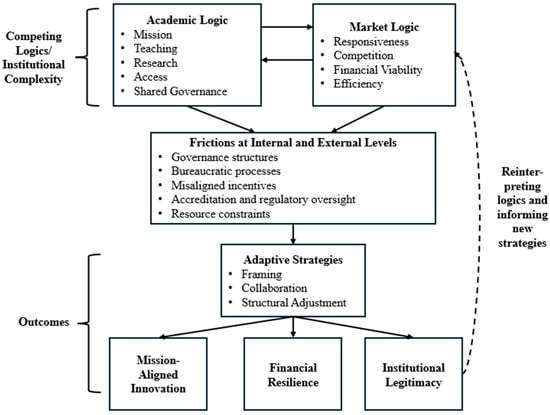

Disclaimer/Publisher’s Note: The statements, opinions and data contained in all publications are solely those of the individual author(s) and contributor(s) and not of MDPI and/or the editor(s). MDPI and/or the editor(s) disclaim responsibility for any injury to people or property resulting from any ideas, methods, instructions or products referred to in the content. |
© 2026 by the authors. Licensee MDPI, Basel, Switzerland. This article is an open access article distributed under the terms and conditions of the Creative Commons Attribution (CC BY) license.