


Abstract
Motivation: In modern organizations where remote and hybrid work has become normalized, fostering trust without frequent face-to-face interaction is a critical management challenge. This study aims to explore how non-verbal digital dynamics associate with trust formation within hybrid product development teams from a teamwork science perspective, integrating Big Five traits and established trust scales. Methods: The empirical study observed twelve product development teams (N = 40) participating in a major innovation competition over an eight-month period. Dynamic behavioral data, including speaking time, nodding, smiling, and silence, were extracted from online workshop recordings using synchronized behavioral coding validated by high inter-rater reliability (Cohen’s Kappa k ≥ 0.78). These were integrated with Big Five personality traits, mutual trust scales, and idea value metrics into a Bayesian Network (BN) to model probabilistic dependencies. The structural model was validated using the Akaike Information Criterion (AIC) and Bayesian Information Criterion (BIC) to ensure predictive robustness. Furthermore, we performed sensitivity analysis on the BN to quantify how specific shifts in non-verbal cues—particularly nodding and the functional categories of silence—disproportionately affect the “Mutual Trust” node. While this exploratory study utilizes a sample of “digital native” student teams, it provides a critical baseline for “high digital fluency” collaboration, which we contextualize against the “asymmetric cues” found in multi-generational corporate environments. Results: Sensitivity analysis identified specific probabilistic associations suggesting that effective role fulfillment is the strongest predictor of idea originality. Crucially, nodding was identified as a behavioral ‘digital reward’ that enhances psychological safety, facilitating divergent thinking. Smiling showed a strong association with feasibility and consensus-building during convergent phases. The model further identifies distinct behavioral ‘fingerprints’: high-trust sequences are characterized by frequent non-verbal backchanneling and deliberate “thinking silences,” whereas low-trust sequences exhibit a disproportionate increase in unproductive lapses (e.g., a 10% increase in lapses correlating with an 18% decrease in trust probability). Furthermore, a probabilistic pathway was identified where teams with highly open members and frequent non-verbal validation exhibit higher mutual support behaviors. Conclusions: This research offers empirical insights into how trust can be modeled in hybrid environments through specific combinations of behavioral and personality traits. Practically, this study proposes “Hybrid Team Protocols”—such as intentional backchanneling and the normalization of deliberative silence—as actionable Organizational Development (OD) interventions. These provide managers with data-driven guidelines to visualize and monitor the quality of digital collaboration while emphasizing the ethical necessity of transparent implementation to prevent “digital performance” and ensure psychological safety across diverse organizational structures.
1. Introduction
In the post-pandemic era, remote and hybrid work arrangements have transitioned from temporary measures to permanent organizational structures. Leading firms have identified “mutual trust” among employees as the single most critical factor for successful remote operations (Next Generation Recruitment Navi, 2025). This aligns with broader discussions within the Japan Business Federation, which emphasize trust as the foundation for effective communication and progress monitoring in environments where physical supervision is limited. Despite this practical urgency, conventional trust-building frameworks, such as the integrative model proposed by Mayer et al. (1995), primarily assume high-density information exchange through face-to-face contact.
However, a significant research gap exists in understanding how trust is associated with digitalized, screen-mediated interactions. While trust has traditionally been viewed as a construct developed through intensive face-to-face interaction (Murase, 2020), modern product development increasingly relies on virtual collaboration and Design Thinking methodologies (Brown, 2009). These processes inherently require high psychological safety (Edmondson, 1999) to facilitate the interpersonal risk-taking necessary for divergent thinking.
Crucially, in this study, we distinguish between trust—defined as the willingness to be vulnerable based on positive expectations of the intentions or behavior of another (Mayer et al., 1995)—and psychological safety, which represents a shared belief that the team is safe for interpersonal risk-taking (Edmondson, 1999). In digital environments, it remains unclear how specific non-verbal dynamics—such as nodding, smiling, and deliberate silences—serve as antecedents to psychological safety or as direct indicators of mutual trust. Recent studies in teamwork science, which integrate systemic frameworks such as the Big Five personality traits and validated trust scales (Salas et al., 2005; Newman et al., 2020; Feitosa & Salas, 2021), suggest that micro-behaviors are critical. Yet, there is a lack of empirical evidence linking these micro-interactions to macro-level organizational trust through probabilistic modeling.
While the current study utilizes an exploration sample of university student teams, their interactions offer a valuable foundational model of “digital native” collaboration. As these teams participated in intensive, long-term innovation competitions that required professional-level deliverables, their behavioral patterns provide preliminary insights into the goal-oriented collaboration increasingly seen in hybrid corporate environments (Larson & DeChurch, 2020). We acknowledge that student teams represent a specific demographic characterized by high digital fluency and a lack of the formal organizational hierarchies found in corporate R&D. However, rather than limiting generalizability, this “high-fluency” cohort serves as a critical baseline for quantifying digital trust dynamics. Understanding these “native” interaction norms is essential for managers who must facilitate multi-generational hybrid teams. Without such a baseline, there is a heightened risk of “asymmetric cues,” where a lack of digital backchanneling (e.g., nodding) by one generation is misperceived as a lack of trust or engagement by another.
This study aims to address this gap by integrating teamwork science with Bayesian Network (BN) modeling to identify the complex interplay between personality, behavior, and performance. Our research objective is to identify the probabilistic dependencies associated with trust and creativity in hybrid teams, while specifically addressing the interpretive risks of “digital performance”—the phenomenon where team members mimic behavioral cues to satisfy surveillance metrics.
This study offers three key contributions:
- Empirical Linking of Micro-to-Macro Dynamics: It links micro-level non-verbal interaction data to established organizational trust metrics through long-term tracking of hybrid innovation teams.
- Probabilistic and Non-Linear Modeling: It utilizes a Bayesian Network to model the complex pathways between personality (Big Five), dynamics, and performance, using sensitivity analysis to identify the disproportionate impact of specific behaviors like unproductive silence.
- Actionable OD Interventions with Ethical Guardrails: It proposes data-driven Organizational Development (OD) interventions, offering protocols for managers to enhance creativity while explicitly addressing the ethical implications of behavioral monitoring and the necessity of normalizing deliberative silence.
2. Theoretical Framework and Literature Review
2.1. Trust and Psychological Safety in Hybrid Teamwork
Recent scholarship emphasizes that in hybrid environments, the “fragility of trust” is exacerbated by reduced social cues (Newman et al., 2020; Larson & DeChurch, 2020). While the integrative model of Mayer et al. (1995) remains foundational, the shift to screen-mediated collaboration requires an extension of this theory to include digital non-verbal backchanneling as functional substitutes for physical presence.
Crucially, within the broader framework of teamwork science, we distinguish between trust and psychological safety. Following Mayer et al. (1995), we define trust as the willingness to be vulnerable based on positive expectations of a specific partner’s competence, benevolence, and integrity. In contrast, psychological safety is defined as a shared belief held by members of a team that the team is safe for interpersonal risk-taking (Edmondson, 1999). While trust focuses on the relationship between specific parties, psychological safety describes the perceived social climate of the group (Newman et al., 2020). As these two constructs co-evolve, psychological safety functions as a critical antecedent and prerequisite for risk-taking behaviors (such as sharing unrefined ideas) that subsequently reinforce and stabilize long-term mutual trust.
In this study, following Mayer et al. (1995), “mutual trust” is operationalized as a state of reliance on team members’ competence and integrity, whereas psychological safety is treated as the climate that facilitates the expression of ideas. Table 1 provides the classification of these constructs, detailing how we operationalize “mutual trust” through three key dimensions: monitoring progress, help-seeking behavior, and communication transparency. By explicitly separating these dimensions, we address the requirement to distinguish between trust antecedents, the trust construct itself, and subsequent outcomes within the specific constraints of hybrid interaction.
Table 1.
Classification and operational definition of mutual trust.
While established models emphasize cognitive trust, our study expands this framework by empirically mapping how micro-level non-verbal backchanneling serves as an immediate, screen-mediated ‘digital reward’ that stabilizes the psychological safety climate. We posit that digital non-verbal backchanneling—such as nodding and smiling—serves as a functional mechanism that supports these behaviors in a hybrid environment (Seeber et al., 2024). Furthermore, we incorporate the pragmatics of silence, as the presence or absence of vocal activity provides critical information about a team’s cognitive synchronization. We differentiate between “deliberative” silence, which indicates collective processing, and “unproductive” silence, which indicates disengagement, necessitating a probabilistic assessment of how these distinct silences correlate with the co-evolution of psychological safety and trust.
2.2. Bayesian Networks in Teamwork Science
To map these relationships, we employ Bayesian Network (BN) modeling. Unlike traditional regression, which assumes linear effects and often implies unidirectional causality, BN identifies conditional probabilistic dependencies between variables (Suzuki & Kunitomo, 2006). This approach aligns with teamwork science principles by allowing us to observe how individual-level inputs, specifically Big Five personality traits (Input), influence interaction dynamics (Process), which subsequently correlate with trust and performance outcomes (Output).
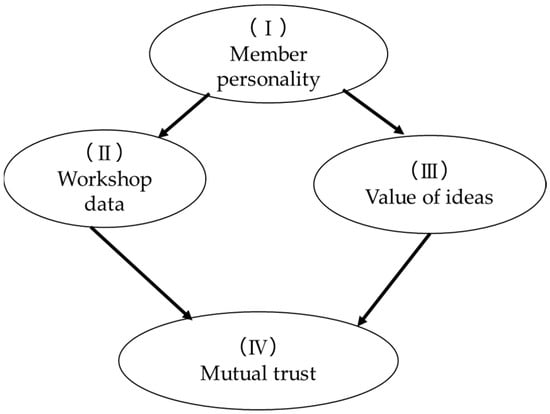
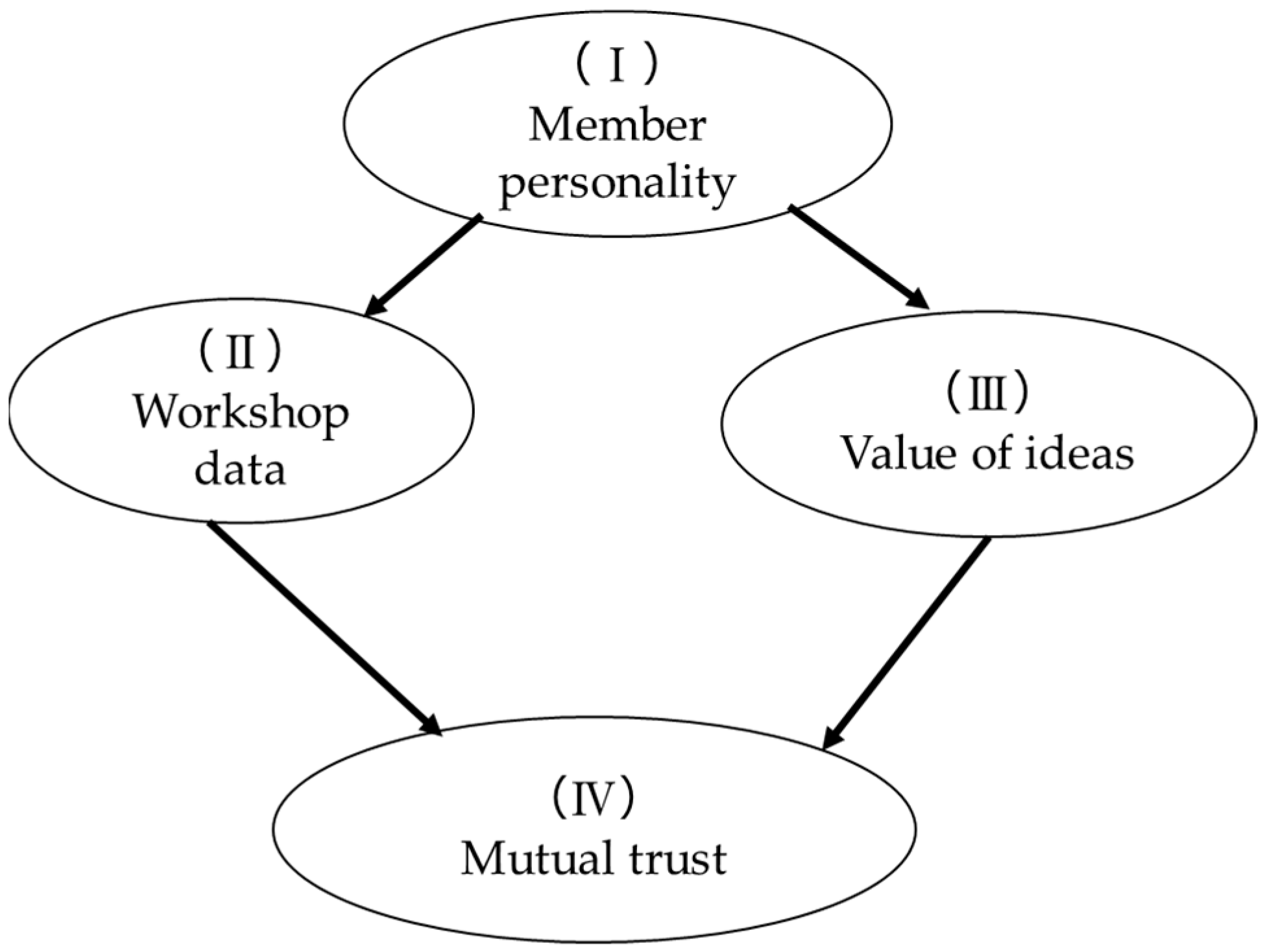
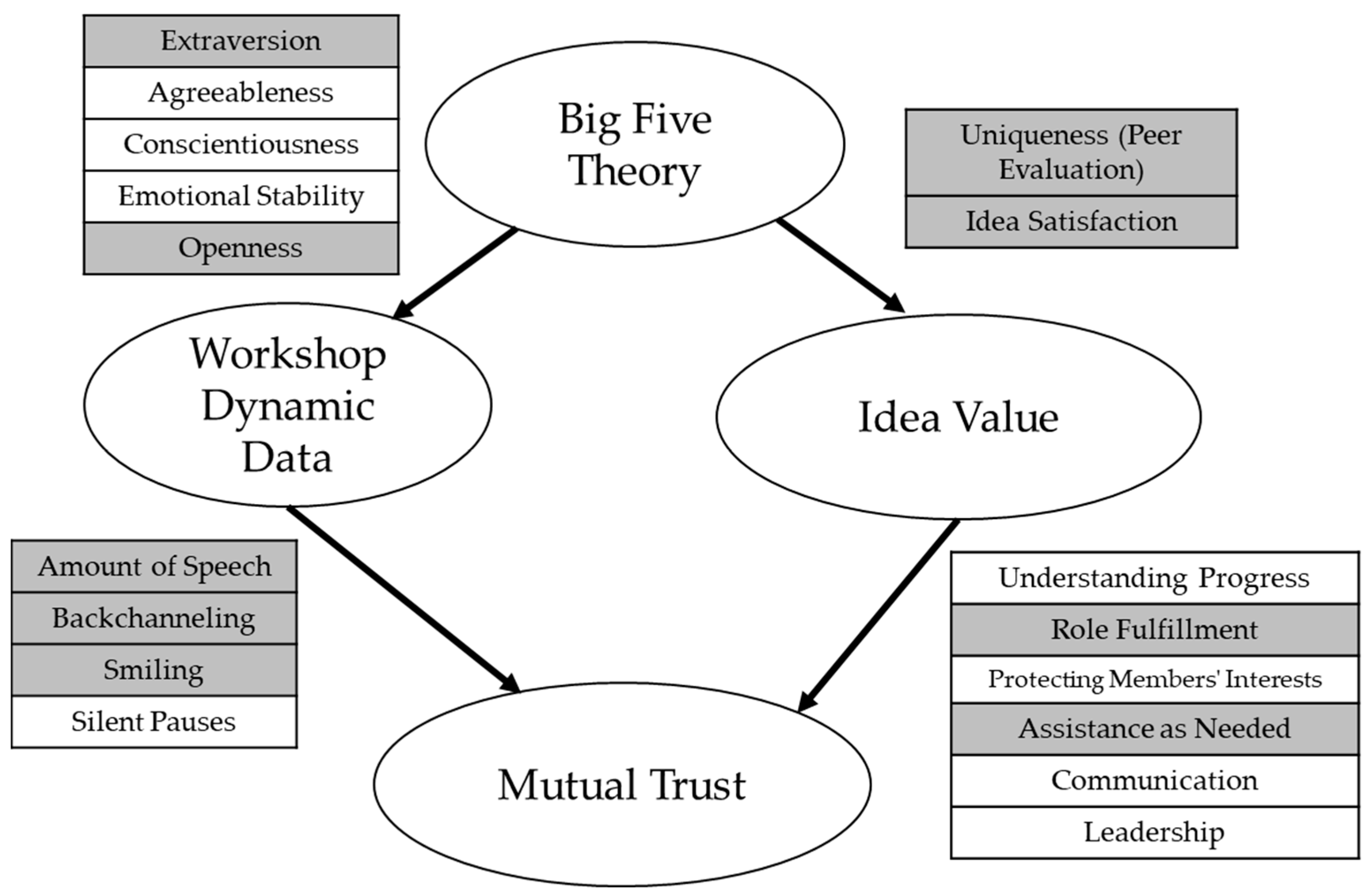
Recent advancements in organizational research demonstrate that BNs are robust tools for quantifying complex interpersonal dynamics in remote settings (Li et al., 2024; Mandali et al., 2025). As illustrated in Figure 1, this approach allows us to visualize the strength of probabilistic associations rather than assuming simple linear causality, thereby providing a more nuanced reflection of the non-linear nature of human teamwork. The use of BNs also facilitates sensitivity analysis, allowing us to simulate how changes in specific micro-behaviors (e.g., increased silence or nodding) propagate through the network to shift the posterior probability of team-level trust. This method enables the identification of specific interaction sequences that distinguish high-performing teams from those experiencing disengagement, providing a data-driven basis for proactive organizational development (OD) interventions.
Figure 1.
Conceptual framework of the Bayesian Network model integrating personality, online dynamics, and team outcomes.
2.3. Research Hypotheses
Based on the synthesized literature, this study tests the following hypotheses focused on identifying probabilistic dependencies within the teamwork science framework:
H1.
High frequency of non-verbal backchanneling (nodding/smiling) in digital workshops is positively associated with the conditional probability of establishing a psychologically safe climate, which in turn correlates with mutual trust.
H2.
Team personality composition (Openness/Agreeableness) is associated with the probabilistic relationship between digital interaction patterns and idea originality.
H3.
Specific types of digital silence (deliberative vs. unproductive) exhibit disproportionate effects on the probability of mutual trust, as identified through sensitivity analysis.
3. Methodology
3.1. Research Design and Project Context
The study utilized a longitudinal design tracking twelve product development teams (N = 40) participating in the “Student Innovation College” (2022–2023 cohorts). To address concerns regarding the sample, we characterize these teams as an exploratory cohort of digital natives. While distinct from corporate R&D in terms of organizational hierarchy and formal accountability, these teams engaged in eight-month, goal-oriented innovation projects requiring professional-level deliverables. As digital natives, their interaction patterns provide a baseline for “high digital fluency” collaboration, which serves as a valuable comparative benchmark for understanding how non-verbal cues transition into multi-generational corporate settings. The context is summarized in Table 2, highlighting the alignment between academic innovation cycles and corporate project management phases.
Table 2.
Overview of the research context and project framework.
- Ethical Considerations: This study was conducted in accordance with the Declaration of Helsinki and was approved by the Institutional Review Board (IRB) of Aichi Gakuin University (Protocol code: 2025kenrin-kei02, approved on 2 March 2026). Informed consent was obtained from all individual participants. To protect privacy, all visual data used in the analysis have been anonymized, and identifiable facial features have been masked.
3.2. Investigation Process and Measurement
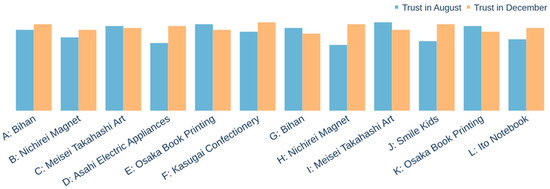
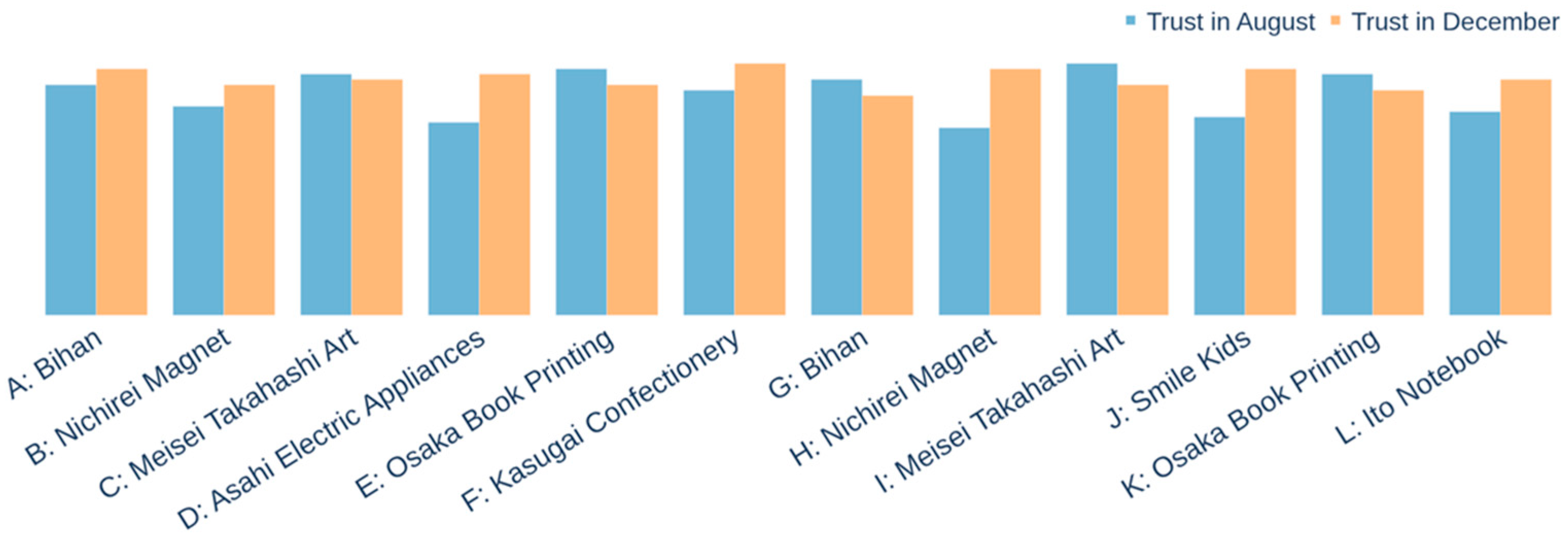
Trust was assessed at two points (August and December) to analyze the longitudinal development of mutual trust (Figure 2). Dynamic behavioral data were extracted from online workshops in June and July using a hybrid approach of automated analysis and manual annotation.
Figure 2.
Longitudinal changes in team-level mutual trust from August to December for 12 project teams.
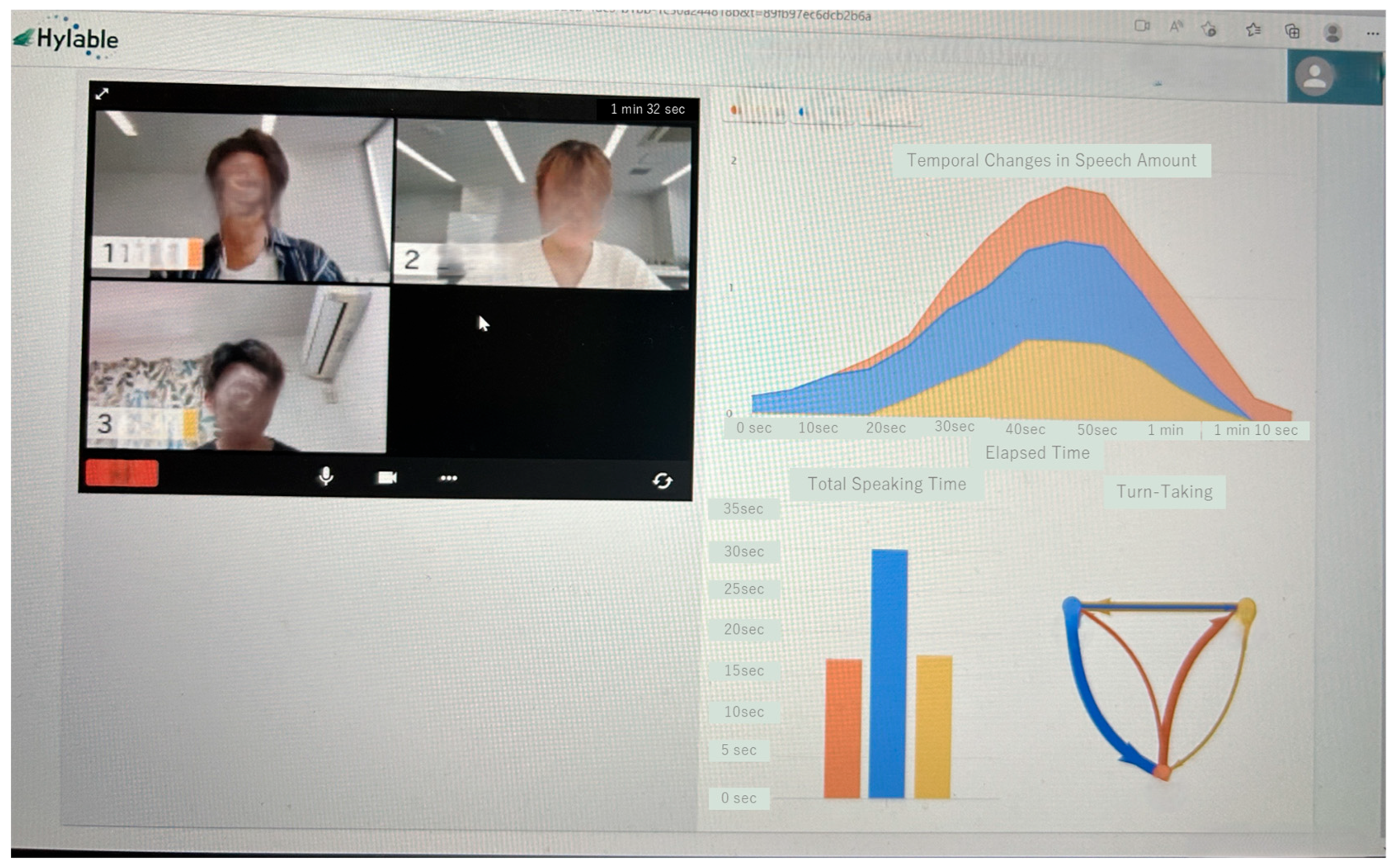
- Data Extraction and Software: Speaking time and turn-taking density were quantified via the “Hylable” system (Hylable Inc., Tokyo, Japan), which utilizes sound source localization to identify individual speakers (Figure 3). Visual cues (nodding and smiling) were extracted from video recordings and manually coded using ELAN (v6.x) software for high-precision time-series alignment.
Figure 3.
Visualization of inter action patterns and speaking time using the web-conferencing analysis system (Hylable).
- Nodding & Smiling Thresholds: Nodding was defined as a distinct vertical movement of the head lasting at least 0.5 s. Smiling was categorized into three levels of intensity based on facial muscle movements (Nishio & Koyama, 1997): Level 1 (slight upturn of lip corners), Level 2 (cheek elevation), and Level 3 (broad smile with eye narrowing), ensuring a granular operationalization. Table 3, Table 4 and Table 5 shows an example of counting nodding and smiling of a team that was working on a theme provided by Nichirei Magnet.
Table 3.
Example of nodding frequency during the ideation phase (Nichirei Magnet Team, 2022).
Table 4.
Classification of smile categories based on facial and bodily movements (Nichirei Magnet Team, 2022).
Table 5.
Excerpt of annotated smile episodes with contextual reasoning (Nichirei Magnet Team, 2022).
- Silent Periods: Pragmatic silences were categorized into six types following Taneichi (2019). The threshold for “silence” was set at 3.0 s of vocal inactivity. Crucially, we distinguish between “deliberative silences” (e.g., thinking/processing) and “unproductive lapses” (e.g., disengagement), which are treated as distinct variables in the sensitivity analysis of our BN model. Table 6 and Table 7 shows an example of counting silent periods of a team that was working on a theme provided by Nichirei Magnet.
Table 6.
Classification of silent periods as pragmatic interactional acts in dyadic communication (Nichirei Magnet Team, 2022).
Table 7.
Analysis of conversational dynamics before and after silent periods (Nichirei Magnet Team, 2022).
3.3. Data Reliability and BN Implementation
To ensure coding reliability, two independent researchers conducted double coding on 20% of the dataset. Inter-rater reliability achieved substantial agreement (Cohen’s k = 0.82 for nodding; k = 0.78 for smiling). Regarding the Bayesian Network (BN) implementation, we recognize that the 2400 observation segments (30 s windows) are interdependent as they are nested within 12 teams. To mitigate statistical bias, prevent overfitting, and ensure the predictive stability of the model, the following rigorous procedures were applied:
- Model Constraint and Structure Learning: We employed the Greedy Search (GS) algorithm for structure learning. To balance model fit and parsimony, we utilized the Akaike Information Criterion (AIC) and the Bayesian Information Criterion (BIC) as scoring functions. The BIC, in particular, was used to apply a stronger penalty for additional parameters, ensuring that only the most statistically significant and robust dependencies were retained.
- Variable Reduction: To maintain a model complexity proportionate to the number of teams, we limited the number of parent nodes per variable. This prevents the model from capturing idiosyncratic, team-specific noise and focuses on universal probabilistic associations across the exploration of the cohort.
- Cross-Validation: To reassure the robustness of our results, we performed a leave-one-team-out cross-validation. This process involves training the BN on 11 teams and testing its predictive accuracy on the 12th team, repeated for all teams. This ensures that the identified probabilistic pathways are not idiosyncratic to specific teams but represent stable patterns of collaboration.
- Sensitivity Analysis: We conducted a sensitivity analysis by varying the prior probabilities of specific micro-behaviors (e.g., nodding frequency and types of silence) to observe the resulting posterior probability shifts in the “Mutual Trust” node. This allows us to quantify the “weight” and disproportionate effects of these behaviors within the complex system.
4. Results
4.1. Structural Analysis of the Bayesian Network
The constructed Bayesian Network (BN), illustrated in Figure 4, visualizes the probabilistic dependencies within the product development teams. To address the constraints of the exploration sample size and ensure model stability, the structure was optimized using a Greedy Search (GS) algorithm. The network structure was validated by comparing scoring functions; we utilized the Akaike Information Criterion (AIC) to capture initial potential pathways and the Bayesian Information Criterion (BIC) to prune less significant links, thereby penalizing excessive complexity and preventing overfitting.
Figure 4.
Bayesian Network structural model for hybrid product development teams.
The network suggests that “Openness to Experience” (a key Big Five trait within our teamwork science framework) is a primary antecedent associated with the frequency of “Smiling” and “Nodding” during online workshops. These non-verbal cues exhibit a conditional dependency with the development of psychological safety and subsequent mutual trust by August. Specifically, Conditional Probability Table (CPT) analysis indicates that for teams with high “Openness,” the probability of frequent “Nodding” (Back-channeling) increases by approximately 22% over the prior probability. Furthermore, these non-verbal interactions are associated with a 15% increase in the likelihood of achieving high “Mutual Trust” scores. While the model does not imply a deterministic causal link, this probabilistic dependency suggests that digital backchanneling is a statistically significant indicator of trust formation in remote settings. Nodes that were statistically significant according to the chi-square test are indicated with gray shading in the table in Figure 4.
4.2. Sensitivity Analysis for Team Performance
Sensitivity analysis was performed by setting “Mutual Trust” and “Performance” as target nodes. Table 8 presents the shift from prior to posterior probabilities, quantifying the strength of association between behavioral variables and team outcomes. Notably, our sensitivity analysis addressed the disproportionate impact of silence: a 10% increase in “Unproductive Silence” correlates with a disproportionate 18% decrease in the posterior probability of “Mutual Trust.” In contrast, an increase in “Deliberative Silence” (thinking silence) showed no negative impact on trust nodes, confirming that the type—rather than the mere presence—of silence is the critical determinant of team climate.
Table 8.
Probability shifts for team performance and trust metrics.
- Indicators of Concept Originality (October): The analysis suggests that “Role Fulfillment” and “Nodding Frequency” in the early stages (June) are positively associated with idea originality. Nodding appears to function as a ‘digital reward’ that enhances psychological safety, potentially lowering the social risk for team members to propose unconventional ideas.
- Indicators of Feasibility and Satisfaction (December): In the final phase, “Smiling” and the reduction in “Unproductive Silence” show the strongest probabilistic association with feasibility. This suggests that as projects mature toward convergence, emotional cohesion becomes statistically associated with navigating technical trade-offs.
4.3. Probabilistic Interaction Sequences and Team Maturation
To address the stability and generalizability of the model across the cohort, we identified the behavioral ‘fingerprints’ that distinguish high-performing teams. Table 9 compares typical interaction sequences leading to high versus low trust based on the model’s conditional probabilities, derived from our leave-one-team-out cross-validation.
Table 9.
Typical interaction sequences based on BN probabilistic pathways.
The statistical convergence between these behavioral patterns and trust differentials suggests that the BN model functions as a probabilistic diagnostic tool. By utilizing specific probability thresholds derived from AIC/BIC-validated structures, this framework allows for the identification of behavioral patterns associated with team alignment, effectively acting as a ‘team health monitor’ for distributed innovation.
5. Discussion
5.1. Non-Verbal Backchanneling as a Catalyst for Psychological Safety
Our analysis reveals that “Nodding” during early-stage workshops is significantly associated with idea originality. Within the teamwork science framework, we interpret this as nodding functioning as a ‘digital reward’ that fosters psychological safety (Edmondson, 1999). In the ideation phase, team members perform the “risky” act of sharing unrefined insights (Brown, 2009). Our BN model suggests that in screen-mediated settings, frequent nodding provides the social validation necessary to lower these perceived barriers. By reinforcing a psychologically safe climate, nodding serves as a behavioral precursor that subsequently stabilizes mutual trust (Mayer et al., 1995). Thus, we clarify that nodding is an antecedent to psychological safety, which then fosters the interpersonal risk-taking required for breakthrough innovation.
5.2. Emotional Cohesion and the Transition to Convergent Thinking
As teams transition to the “Feasibility” phase, our results indicate that “Smiling Level 2” is positively associated with consensus-building. This suggests that while divergent thinking requires a safe space to be different (psychological safety), convergent thinking relies on emotional cohesion to navigate technical trade-offs (Kellermanns et al., 2005). Moderate smiling acts as an ‘emotional lubricant,’ facilitating negotiation during critical decision-making. This finding aligns with the ‘Digital Affective Regulation’ perspective, where specific behavioral patterns—nodding for ideation and smiling for alignment—co-evolve with the team’s developmental stage to mitigate the “fragility of trust” in distributed teams (Larson & DeChurch, 2020; Feitosa & Salas, 2021).
5.3. The Pragmatics of Silence and Team Maturation: Normalizing “Deliberative” Spaces
A primary contribution of this study is the distinction between types of silence. As teams develop higher “Role Fulfillment,” silence transitions from “unproductive lapses” to “deliberative spaces” for cognitive processing (Taneichi, 2019). Our sensitivity analysis underscores this by showing that unproductive lapses have a disproportionately negative impact on trust, whereas deliberative silence is a hallmark of high-trust sequences. For managers, this implies that “normalizing” deliberative silence is a critical Organizational Development (OD) intervention. Rather than viewing silence as a lack of engagement, leaders should explicitly facilitate 5–10 s “thinking pauses” to reduce the cognitive load and pressure of constant verbalization, which is a common cause of fatigue in hybrid settings.
5.4. Ethical Implications and the Risk of “Digital Performance”
A significant concern in the implementation of these findings is the risk of “digital performance”—where team members mimic cues like nodding or smiling to satisfy perceived surveillance metrics. If the “Digital Dashboard” is used as a tool for individual performance evaluation, it may inadvertently undermine the very psychological safety it seeks to monitor. To mitigate this, we argue that:
- Transparency is Mandatory: Teams must be informed that behavioral data are used for facilitation support, not evaluation.
- Aggregate Focus: Managers should focus on team-level probabilistic trends rather than individual “nodding counts.”
- Human-in-the-Loop: Automated metrics should only serve as a diagnostic ‘trigger’ for human-led facilitation, preventing the dehumanization of the collaborative process.
5.5. Contextualizing Digital Fluency Across Multi-Generational Teams
While our student sample provides a baseline for “digital native” collaboration, transitioning these findings to corporate settings requires accounting for the “Generation Gap” in digital fluency. Older professionals may rely more on formal turn-taking or explicit verbal confirmation, leading to “asymmetric cues” where a lack of digital backchanneling is misperceived as a lack of trust. In hierarchical R&D environments, the presence of senior leaders may also suppress natural non-verbal cues. Managers must be trained to recognize that a lack of nodding may reflect a different communication style or hierarchical caution rather than a lack of engagement. Our model provides the benchmark against which these variations can be measured in future multi-generational studies.
6. Conclusions and Future Work
6.1. Conclusions
This study investigated the probabilistic associations between personality traits, non-verbal interactions, and team performance within a hybrid product development context from a teamwork science perspective. By integrating multimodal dynamic data—speaking time, nodding, smiling, and silence—into a Bayesian Network (BN) model, we identified distinct probabilistic pathways that evolve alongside the Design Thinking process. The structural validity of these pathways was confirmed using the Akaike Information Criterion (AIC) and Bayesian Information Criterion (BIC), ensuring a balance between model complexity and predictive robustness. Furthermore, sensitivity analysis quantified the disproportionate impact of unproductive silence and the supportive role of deliberative silence in trust formation, addressing the non-linear nature of remote team dynamics.
Our findings highlight that “Nodding” is positively associated with “Idea Originality” during divergent phases, functioning as a behavioral indicator of psychological safety. In contrast, “Smiling” and the reduction in “unproductive silence” are associated with “Feasibility” during convergent phases, acting as emotional lubricants for consensus-building. The BN model provides a robust framework for visualizing these non-linear relationships and identifying the behavioral ‘fingerprints’ of high-trust interaction sequences. Crucially, the model identifies these patterns as probabilistic dependencies rather than deterministic causal mechanisms, providing a diagnostic foundation for the “Hybrid Team Protocols” (e.g., intentional backchanneling and structured silence) proposed as actionable organizational development (OD) interventions in this study to enhance digital synchronization and cognitive load management.
6.2. Limitations and Future Research
Despite these contributions, this study has limitations that outline a path for future inquiry:
- Scope and Generalization: Our sample consisted of an exploratory cohort of university student teams. While these ‘digital natives’ engaged in intensive, goal-oriented innovation, they differ from corporate R&D teams in terms of organizational hierarchy and motivational structure. Specifically, the high digital fluency of this cohort may influence the frequency and interpretation of non-verbal digital cues compared to multi-generational corporate environments where “asymmetric cues” may arise due to varying communication norms. We explicitly acknowledge that generational differences (‘Generation Gap’) and formal reporting lines in corporate settings may modulate these interaction patterns. Future studies should conduct comparative analyses between student cohorts and experienced professionals to validate the scalability of these findings across diverse organizational cultures and age demographics.
- Causality and Model Stability: As our model identifies probabilistic dependencies rather than deterministic causality, we cannot claim that non-verbal cues directly ‘cause’ trust. The identified dependencies serve as indicators within a complex system. Future research should utilize experimental designs with control groups to isolate the impact of specific non-verbal interventions and further refine the model’s predictive stability across varying team sizes and durations.
- Roadmap for Future Research: We propose three pillars for future work within the teamwork science framework:
- AI-Assisted Facilitation and Protocol Integration: Integrating AIC/BIC-validated BN analytics into communication platforms to provide real-time prompts for facilitators and automating the implementation of the proposed Hybrid Team Protocols to support digital synchronization.
- Corporate Hierarchy Integration: Testing the model in formal organizational structures to assess how power dynamics modulate these probabilistic pathways. This includes addressing the interpretive risks of “digital performance,” where monitoring might inadvertently lead to superficial behavioral mimicry.
- Automated Multimodal Integration: Shifting from labor-intensive manual coding toward deep-learning-based facial expression and gesture recognition. However, this technological advancement must be coupled with clear ethical frameworks to protect employee privacy and prevent the misuse of behavioral data in performance evaluations.
Funding
The article processing charge (APC) was funded by the Telecommunications Advancement Foundation.
Institutional Review Board Statement
The study was conducted in accordance with the Declaration of Helsinki, and approved by the Institutional Review Board (or Ethics Committee) of Aichi Gakuin (protocol code 2025kenrin-kei02 and date of approval 2 March 2026).
Informed Consent Statement
Informed consent was obtained from all subjects involved in the study. And written informed consent has been obtained from the patients to publish this paper.
Data Availability Statement
This study involves the measurement of dynamic data collected during workshops. Due to privacy protection considerations, the data are not shared. The Bayesian network analysis conducted in this study also uses dynamic data; therefore, the data are not made publicly available.
Conflicts of Interest
The authors declare no conflict of interest.
References
- Barber, B. (1983). The logic and limits of trust. Rutgers University Press. [Google Scholar]
- Brown, T. (2009). Change by design: How design thinking transforms organizations and inspires innovation. Harper Business Press. [Google Scholar]
- Dyer, J. H. (1997). Effective interfirm collaboration: How firms minimize transaction costs and maximize transaction value. Strategic Management Journal, 18(7), 535–556. [Google Scholar] [CrossRef]
- Edmondson, A. (1999). Psychological safety and learning behavior in work teams. Administrative Science Quarterly, 44(2), 350–383. [Google Scholar] [CrossRef] [Scilit]
- Feitosa, J., & Salas, E. (2021). Today’s virtual teams: Adapting lessons learned to the pandemic context. Organizational Dynamics, 50(1), 100777. [Google Scholar] [CrossRef] [Scilit] [PubMed]
- Hollander, E. P. (1992). Leadership, followership, self, and others. The Leadership Quarterly, 3(1), 43–54. [Google Scholar] [CrossRef] [Scilit]
- Kellermanns, F. W., Walter, J., Lechner, C., & Floyd, S. W. (2005). The lack of consensus about strategic consensus: Advancing theory and research. Journal of Management, 31(5), 719–737. [Google Scholar] [CrossRef] [Scilit]
- Larson, B. Z., & DeChurch, L. A. (2020). Leading teams in the digital age: Four perspectives on technology and what they mean for leading teams. The Leadership Quarterly, 31(1), 101377. [Google Scholar] [CrossRef] [Scilit] [PubMed]
- Li, X., Chen, J., Wang, G., Liu, Y., & Zhao, Y. (2024). Dynamic Bayesian network-enabled approach for organizational leadership measurement of complex construction projects. Buildings, 14(4), 1123. [Google Scholar] [CrossRef] [Scilit]
- Luhmann, N. (1979). Trust and power. Wiley. [Google Scholar]
- Mandali, H., Keighobadi, E., Ebrahimi, H., Moradi Hanifi, S., Ayat, S. M., & Ghashghaei, M. (2025). Machine learning and Bayesian network based on fuzzy AHP framework for risk assessment in process units. Scientific Reports, 15, 39083. [Google Scholar] [CrossRef] [Scilit] [PubMed]
- Mayer, R. C., Davis, J. H., & Schoorman, F. D. (1995). An integrative model of organizational trust. Academy of Management Review, 20(3), 709–734. [Google Scholar] [CrossRef] [Scilit]
- Murase, T. (2020). It is difficult to build trust through remote work alone. WORK MILL Webzine. Available online: https://workmill.jp/webzine/20201208_teamwork.html (accessed on 4 December 2025).
- Newman, S. A., Ford, R. C., & Marshall, G. W. (2020). Virtual team leader communication: Employee perception and organizational reality. International Journal of Business Communication, 57(4), 452–473. Available online: https://www.researchgate.net/publication/331104891 (accessed on 20 April 2026). [CrossRef] [Scilit]
- Next Generation Recruitment Navi. (2025). Comprehensive explanation of work style reform at Asahi group holdings. Available online: https://biz.jvisa.jp/asahighd-workstyle-reformer/ (accessed on 4 December 2025).
- Nishio, N., & Koyama, K. (1997). Temporal differences in eye and mouth movements classifying facial expressions of smiles. In Proceedings third IEEE international conference on automatic face and gesture recognition (pp. 206–213). IEEE. [Google Scholar]
- Salas, E., Sims, D. E., & Burke, C. S. (2005). Is there a “Big Five” in teamwork? Small Group Research, 36(5), 555–599. [Google Scholar] [CrossRef] [Scilit]
- Seeber, I., Fleischmann, C., Cardon, P., & Aritz, J. (2024). Fostering psychological safety in global virtual teams: The role of team-based interventions and digital reminder nudges. Group Decision and Negotiation, 33(6), 1405–1427. [Google Scholar] [CrossRef] [Scilit]
- Student Innovation College (S-Cale). (2025). S-Cale official website. Available online: https://s-colle.ws.hosei.ac.jp/ (accessed on 4 December 2025).
- Suzuki, Y., & Kunitomo, N. (2006). Bayesian statistics and its applications. University of Tokyo Press. [Google Scholar]
- Taneichi, A. (2019). A study of silence as a pragmatic interactional act in dyadic communication. The Japanese Association of Sociolinguistic Sciences, 43, 122–125. Available online: https://conference.wdc-jp.com/jass/43/contents/common/doc/P-10.pdf (accessed on 20 April 2026).
- Yamagishi, T., & Komiyama, H. (1995). Significance and the structure of trust. Theoretical and empirical research on trust and commitment relations. INSS Journal, 2, 1–59. Available online: https://www.inss.co.jp/wp-content/uploads/2025/07/1995_2J001_059.pdf (accessed on 20 April 2026).
- Yamagishi, T., & Yamagishi, M. (1993, October 16–17). The meaning and structure of trust: A Japan–U.S. comparison. 41st Annual Conference of the Japanese Group Dynamics Association (pp. 38–41), Tokyo, Japan. [Google Scholar]

Disclaimer/Publisher’s Note: The statements, opinions and data contained in all publications are solely those of the individual author(s) and contributor(s) and not of MDPI and/or the editor(s). MDPI and/or the editor(s) disclaim responsibility for any injury to people or property resulting from any ideas, methods, instructions or products referred to in the content. |
© 2026 by the author. Licensee MDPI, Basel, Switzerland. This article is an open access article distributed under the terms and conditions of the Creative Commons Attribution (CC BY) license.