

Greening the Mining Industry: Influencing Environmental Performance Through Green Organisational Culture—The Mediating Effect of Green Employee Behaviours



Abstract
1. Introduction
2. Theoretical Framework
2.1. Green Organisational Culture
- (a)
- The degree of cultural greening, which refers to the extent to which managers feel that green values and sustainability goals are reflected in organisational creations and artefacts.
- (b)
- The diffusion of cultural greening, which refers to the extent to which managers believe these feelings and behaviours are exhibited throughout the organisation.
- (c)
- Depth of cultural greening, which refers to the extent to which managers value green initiatives.
2.2. Green Environmental Performance
2.3. Green Employee Behaviour
2.4. Hypotheses Development
2.4.1. Green Organisational Culture and Green Performance
2.4.2. Green Organisational Culture and Employee Green Behaviour
2.4.3. Green Employee Behaviours and Environmental Performance
2.4.4. The Role of Green Employee Behaviour
3. Materials and Methods
3.1. Research Paradigm and Design
3.2. Population and Sampling
3.3. Research Instrument Measures
3.4. Reliability and Validity
3.5. Discriminant Validity
3.6. Empirical Results
3.6.1. Common Method Bias (CMB)
3.6.2. Evaluation of the Structural Model
4. Structural Equation Modelling
4.1. Direct Effects
4.2. Mediation Effects of Green Employee Behaviours
5. Discussion
5.1. Theoretical Significance
5.2. Practical Implications
6. Conclusions
7. Limitations and Future Research
Author Contributions
Funding
Institutional Review Board Statement
Informed Consent Statement
Data Availability Statement
Conflicts of Interest
References
- Abbas, J., & Dogan, E. (2022). The impacts of organisational green culture and corporate social responsibility on employees’ responsible behaviour towards society. Environmental Science and Pollution Research, 29(40), 60024–60034. [Google Scholar] [CrossRef]
- Abbas, J., & Khan, S. M. (2023). Green knowledge management and organisational green culture: An interaction for organisational green innovation and green performance. Journal of Knowledge Management, 27(7), 1852–1870. [Google Scholar] [CrossRef]
- Abbas, J., & Sağsan, M. (2019). Impact of knowledge management practices on green innovation and corporate sustainable development: A structural analysis. Journal of Cleaner Production, 229, 611–620. [Google Scholar] [CrossRef]
- Aggarwal, P., & Agarwala, T. (2025). Green organisational culture: An exploration of dimensions. Global Business Review, 26(4), 1103–1126. [Google Scholar] [CrossRef]
- Al-Alawneh, R., Othman, M., & Zaid, A. A. (2024). Green HRM impact on environmental performance in higher education with mediating roles of management support and green culture. International Journal of Organizational Analysis, 32(6), 1141–1164. [Google Scholar] [CrossRef]
- Allameh, M., Zamani, M., Mohammad, S., & Davoodi, R. (2011). Procedia computer the relationship between organizational culture and knowledge management (A case study: Isfahan university). Procedia Computer Science, 3, 1224–1236. [Google Scholar] [CrossRef]
- Alotaibi, H. S., Hashim, F., Nguyen, N. T., Alatawy, K., Alam, M. N., & Mashi, M. S. (2024). The effect of organisational green culture and organisational environmental ethics on green employee behaviour: The role of green innovative performance and green communication and feedback among employees of garment industry in Bangladesh. International Journal of Environment, Workplace and Employment, 8(1), 44–70. [Google Scholar] [CrossRef]
- Alshebami, A. S. (2021). Evaluating the relevance of green banking practices on Saudi Banks’ green image: The mediating effect of employees’ green behaviour. Journal of Banking Regulation, 22(4), 275–286. [Google Scholar] [CrossRef]
- Al-Swidi, A. K., Gelaidan, H., & Saleh, R. M. (2021). The joint impact of green human resource management, leadership and organizational culture on employees’ green behaviour and organisational environmental performance. Journal of Cleaner Production, 316, 128112. [Google Scholar] [CrossRef]
- Anwar, N., Mahmood, N. H. N., Yusliza, M. Y., Ramayah, T., Faezah, J. N., & Khalid, W. (2020). Green Human Resource Management for organisational citizenship behaviour towards the environment and environmental performance on a university campus. Journal of cleaner production, 256, 120401. [Google Scholar] [CrossRef]
- Awan, F. H., Dunnan, L., Jamil, K., & Gul, R. F. (2023). Stimulating environmental performance via green human resource management, green transformational leadership, and green innovation: A mediation-moderation model. Environmental Science and Pollution Research, 30(2), 2958–2976. [Google Scholar] [CrossRef]
- Ben Arfi, W., Hikkerova, L., & Sahut, J. M. (2018). External knowledge sources, green innovation and performance. Technological Forecasting and Social Change, 129, 210–220. [Google Scholar] [CrossRef]
- Bos-Nehles, A., Townsend, K., Cafferkey, K., & Trullen, J. (2023). Examining the ability, motivation and opportunity (AMO) framework in HRM research: Conceptualization, measurement and interactions. International Journal of Management Reviews, 25(4), 725–739. [Google Scholar] [CrossRef]
- Chin, W. W. (1998). The partial least squares approach to structural equation modeling. In Modern methods for business research (pp. 295–336). Psychology Press. [Google Scholar]
- Cohen, J. (1988). Statistical power analysis for the behavioural sciences (2nd ed.). Erlbaum. [Google Scholar]
- Fok, L., Zee, S., & Morgan, Y. C. T. (2022). Green practices and sustainability performance: The exploratory links of organizational culture and quality improvement practices. Journal of Manufacturing Technology Management, 33(5), 913–933. [Google Scholar] [CrossRef]
- Gefen, D., Straub, D., & Boudreau, M.-C. (2000). Structural equation modeling and regression: Guidelines for research practice. Communications of the Association for Information Systems, 4, 7. [Google Scholar] [CrossRef]
- Hair, J. F., Sarstedt, M., Ringle, C. M., & Mena, J. A. (2012). An assessment of the use of partial least squares structural equation modeling in marketing research. Journal of the Academy of Marketing Science, 40(3), 414–433. [Google Scholar] [CrossRef]
- Harman, H. H. (1976). Modern factor analysis. University of Chicago Press. [Google Scholar]
- Harris, L. C., & Crane, A. (2002). The greening of organizational culture: Management views on the depth, degree and diffusion of change. Journal of organizational change management, 15(3), 214–234. [Google Scholar] [CrossRef]
- Hulland, J. (1999). Use of partial least squares (PLS) in strategic management research: A review of four recent studies. Strategic Management Journal, 20(2), 195–204. [Google Scholar] [CrossRef]
- Israel, G. D. (1992). Determining sample size. Available online: https://www.psycholosphere.com/Determining%20sample%20size%20by%20Glen%20Israel.pdf (accessed on 25 November 2025).
- Katz, I. M., Rauvola, R. S., Rudolph, C. W., & Zacher, H. (2022). Employee green behavior: A meta-analysis. Corporate Social Responsibility and Environmental Management, 29(5), 1146–1157. [Google Scholar] [CrossRef]
- Khaddage-Soboh, N., Yunis, M., Imran, M., & Zeb, F. (2024). Sustainable practices in Malaysian manufacturing: The influence of CSR, transformational leadership, and green organizational culture on environmental performance. Economic Analysis and Policy, 82, 753–768. [Google Scholar] [CrossRef]
- Kock, N. (2015). Common method bias in PLS-SEM: A full collinearity assessment approach. International Journal of E-Collaboration (Ijec), 11(4), 1–10. [Google Scholar] [CrossRef]
- Mirahsani, N., Azizan, O., Shahriari, M., Rexhepi, G., & Najmi, A. (2024). Green culture toward employee green behavior; the mediation roles of perceived support and green identity. Environment, Development and Sustainability, 26(6), 16149–16172. [Google Scholar] [CrossRef]
- Mirhadian, N., Azizan, O., & Shahriari, M. (2024). The impact of green culture on employee organizational commitment: The mediating role of green identity. Journal of Human Behavior in the Social Environment, 34(6), 906–925. [Google Scholar] [CrossRef]
- Mondal, S., Singh, S., & Gupta, H. (2024). Examining the impact of green entrepreneurship drivers on sustainable development in the context of emerging country. Benchmarking, 32(9), 3584–3630. [Google Scholar] [CrossRef]
- Muisyo, P. K., & Qin, S. (2021). Enhancing the FIRM’S green performance through green HRM: The moderating role of green innovation culture. Journal of Cleaner Production, 289, 125720. [Google Scholar] [CrossRef]
- Muisyo, P. K., Su, Q., Ho, T. H., Julius, M. M., & Usmani, M. S. (2022). Implications of green HRM on the firm’s green competitive advantage: The mediating role of enablers of green culture. Journal of Manufacturing Technology Management, 33(2), 308–333. [Google Scholar] [CrossRef]
- Nisar, Q. A., Haider, S., Ali, F., Gill, S. S., & Waqas, A. (2024). The role of green HRM on environmental performance of hotels: Mediating effect of green self-efficacy & employee green behaviors. Journal of Quality Assurance in Hospitality and Tourism, 25(1), 85–118. [Google Scholar] [CrossRef]
- Noor Faezah, J., Yusliza, M. Y., Ramayah, T., Teixeira, A. A., & Alkaf, A. R. (2024). Mediating role of green culture and green commitment in implementing employee ecological behaviour. Journal of Management Development, 43(3), 253–282. [Google Scholar] [CrossRef]
- Pinzone, M., Guerci, M., Lettieri, E., & Redman, T. (2016). Progressing in the change journey towards sustainability in healthcare: The role of “Green” HRM. Journal of Cleaner Production, 122, 201–211. [Google Scholar] [CrossRef]
- PWC Global Mine Report. (2024). Preparing for impact (21st ed.). Available online: https://www.pwc.com/gx/en/mining/assets/pwc-global-mine-2024.pdf (accessed on 1 November 2025).
- Rubel, M. R. B., Kee, D. M. H., & Rimi, N. N. (2020). The influence of green HRM practices on green service behaviors: The mediating effect of green knowledge sharing. Employee Relations, 43(5), 996–1015. [Google Scholar] [CrossRef]
- Sahoo, S., Kumar, A., & Upadhyay, A. (2023). How do green knowledge management and green technology innovation impact corporate environmental performance? Understanding the role of green knowledge acquisition. Business Strategy and the Environment, 32(1), 551–569. [Google Scholar] [CrossRef]
- Saunders, M., Lewis, P., & Thornhill, A. (2009). Research methods for business students. Pearson Education. [Google Scholar]
- Shahzad, M. A., Jianguo, D., & Junaid, M. (2023). Impact of green HRM practices on sustainable performance: Mediating role of green innovation, green culture, and green employees’ behavior. Environmental Science and Pollution Research, 30(38), 88524–88547. [Google Scholar] [CrossRef]
- Sharma, S., Prakash, G., Kumar, A., Mussada, E. K., Antony, J., & Luthra, S. (2021). Analysing the relationship of adaption of green culture, innovation, green performance for achieving sustainability: Mediating role of employee commitment. Journal of Cleaner Production, 303, 127039. [Google Scholar] [CrossRef]
- UNDP. (2024). Africa green business and financing report 2024. Available online: https://www.undp.org (accessed on 24 November 2025).
- Worlanyo, A. S., & Jiangfeng, L. (2021). Evaluating the environmental and economic impact of mining for post-mined land restoration and land-use: A review. Journal of Environmental Management, 279, 111623. [Google Scholar] [CrossRef]
- Yeşiltaş, M., Gürlek, M., & Kenar, G. (2022). Organizational green culture and green employee behavior: Differences between green and non-green hotels. Journal of Cleaner Production, 343, 131051. [Google Scholar] [CrossRef]
- Yilmaz, K. (2013). Comparison of quantitative and qualitative research traditions: Epistemological, theoretical, and methodological differences. European Journal of Education, 48(2), 311–325. [Google Scholar] [CrossRef]
- Zacher, H., Rudolph, C. W., & Katz, I. M. (2023). Employee green behavior as the core of environmentally sustainable organizations. Annual review of organizational psychology and organizational behavior, 10(1), 465–494. [Google Scholar] [CrossRef]
- Zaid, A. A., Jaaron, A. A. M., & Talib Bon, A. (2018). The impact of green human resource management and green supply chain management practices on sustainable performance: An empirical study. Journal of Cleaner Production, 204, 965–979. [Google Scholar] [CrossRef]
- Zhang, B., Yang, L., Cheng, X., & Chen, F. (2021). How does employee green behavior impact employee well-being? An empirical analysis. International Journal of Environmental Research and Public Health, 18(4), 1669. [Google Scholar] [CrossRef]
- Zhou, M., Govindan, K., & Xie, X. (2020). How fairness perceptions, embeddedness, and knowledge sharing drive green innovation in sustainable supply chains: An equity theory and network perspective to achieve sustainable development goals. Journal of Cleaner Production, 260, 120950. [Google Scholar] [CrossRef]

| N | Percentage | ||
|---|---|---|---|
| Educational level | |||
| High school | 26 | 10% | |
| Diploma | 139 | 50% | |
| Degree | 112 | 40% | |
| Organisation tenure | <10 Years | 83 | 30% |
| 10–15 years | 110 | 40% | |
| >15 years | 84 | 30% |
| Variable | Factor Score | Alpha | AVE | CR | VIF | |
|---|---|---|---|---|---|---|
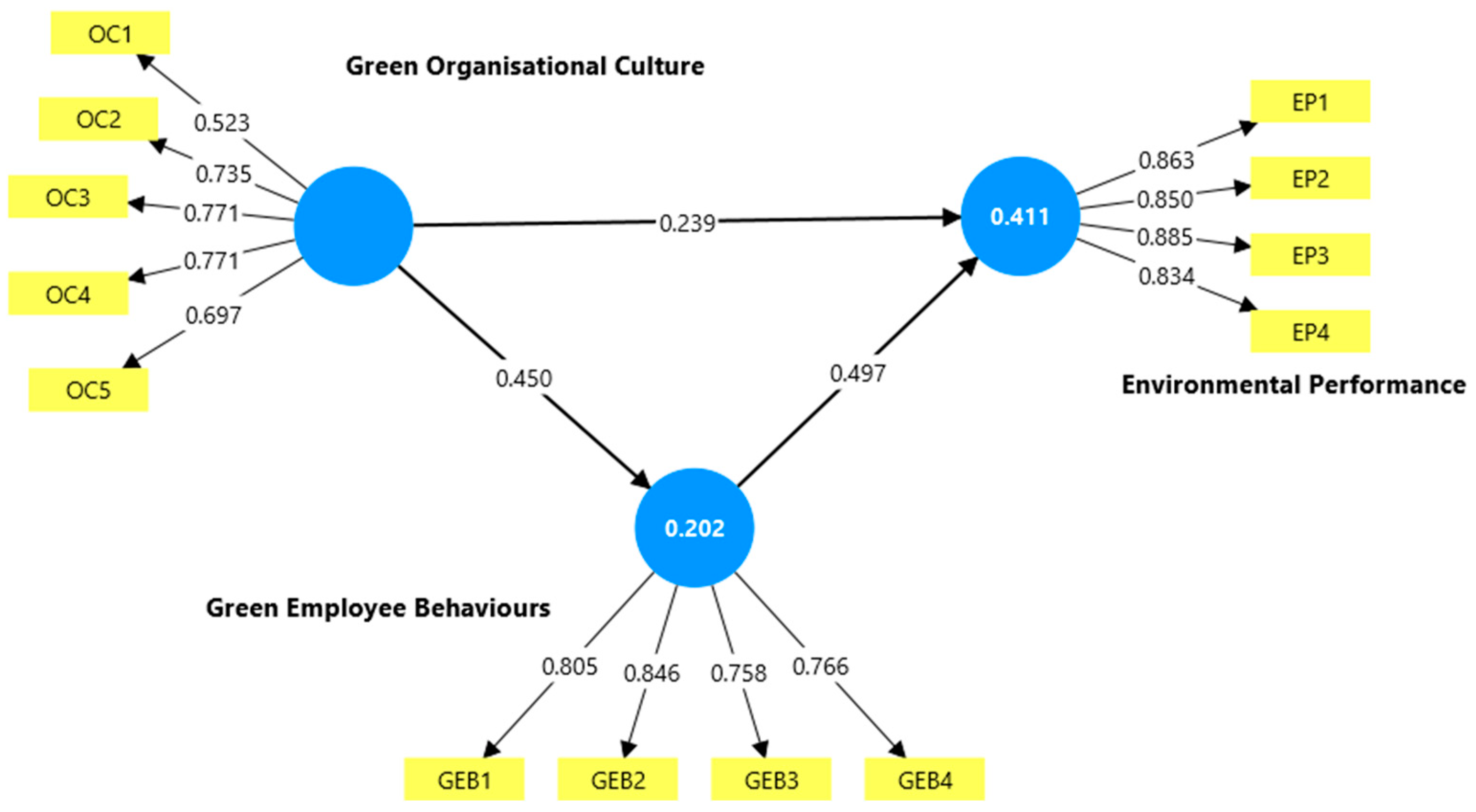
| Green organisational culture | 0.74 | 0.50 | 0.83 | |||
| GOC1 | Our organisation makes a concerted effort to make every employee understand the importance of environmental protection | 0.523 | 1.765 | |||
| GOC2 | Our organisation has a clear policy statement urging environmental awareness in every area | 0.735 | 1.675 | |||
| GOC3 | Preserving the environment is a central corporate value in our organisation | 0.771 | 1.876 | |||
| GOC4 | Our organisation links environmental objectives with our corporate goals | 0.771 | 1.897 | |||
| GOC5 | Our organisation designs processes that minimise environmental impact | 0.697 | 1.876 | |||
| Green employee behaviours | 0.81 | 0.63 | 0.87 | |||
| GEB1 | Today I completed my tasks in an environmentally friendly way. | 0.805 | 1.777 | |||
| GEB2 | I always perform my job duties using environmentally friendly solutions | 0.846 | 1.765 | |||
| GEB3 | I take part in environmentally friendly programmes | 0.758 | 1.877 | |||
| GEB4 | At work, I perform environmental tasks that are beyond organisational expectations | 0.766 | 1.654 | |||
| Environmental performance | 0.89 | 0.74 | 0.92 | |||
| EP1 | Our company uses resource materials that reduce pollution | 0.863 | 1.786 | |||
| EP2 | Our organisational processes lead to waste reduction | 0.850 | 1.766 | |||
| EP3 | This organisation is keen on the economic consumption of resources | 0.885 | 1.654 | |||
| EP4 | Our organisation is committed to recycling efficiency | 0.834 | 1.777 |
| Environmental Performance | Green Employee Behaviours | Green Organisational Culture | |
|---|---|---|---|
| Environmental performance | 0.858 | ||
| Green employee behaviours | 0.605 | 0.794 | |
| Green organisational culture | 0.463 | 0.450 | 0.705 |
| Exogenous Variable | Endogenous Variable | R2 |
|---|---|---|
| Green organisational culture + Green employee behaviours | Environmental performance | 0.411 |
| Green organisational culture | Green employee behaviours | 0.202 |
| Exogenous Variable | Endogenous Variable | F2 |
|---|---|---|
| Green organisational culture | Environmental Performance | 0.175 |
| Green organisational culture | Green Employee Behaviours | 0.222 |
| Green employee behaviours | Environmental Performance | 0.298 |
| Hypothesis | Path | Path Coefficient | p-Value | Decision |
|---|---|---|---|---|
| H1 | Green organisational culture >>> Environmental performance | 0.239 | 0.00 | Accepted |
| H2 | Green organisational culture >>> Green employee behaviours | 0.450 | 0.00 | Accepted |
| H3 | Green employee behaviours >>> Environmental performance | 0.497 | 0.00 | Accepted |
Disclaimer/Publisher’s Note: The statements, opinions and data contained in all publications are solely those of the individual author(s) and contributor(s) and not of MDPI and/or the editor(s). MDPI and/or the editor(s) disclaim responsibility for any injury to people or property resulting from any ideas, methods, instructions or products referred to in the content. |
© 2026 by the authors. Licensee MDPI, Basel, Switzerland. This article is an open access article distributed under the terms and conditions of the Creative Commons Attribution (CC BY) license.
Share and Cite
Makumbe, W.; Mutambara, E. Greening the Mining Industry: Influencing Environmental Performance Through Green Organisational Culture—The Mediating Effect of Green Employee Behaviours. Adm. Sci. 2026, 16, 205. https://doi.org/10.3390/admsci16050205
Makumbe W, Mutambara E. Greening the Mining Industry: Influencing Environmental Performance Through Green Organisational Culture—The Mediating Effect of Green Employee Behaviours. Administrative Sciences. 2026; 16(5):205. https://doi.org/10.3390/admsci16050205
Chicago/Turabian StyleMakumbe, William, and Emmanuel Mutambara. 2026. "Greening the Mining Industry: Influencing Environmental Performance Through Green Organisational Culture—The Mediating Effect of Green Employee Behaviours" Administrative Sciences 16, no. 5: 205. https://doi.org/10.3390/admsci16050205
APA StyleMakumbe, W., & Mutambara, E. (2026). Greening the Mining Industry: Influencing Environmental Performance Through Green Organisational Culture—The Mediating Effect of Green Employee Behaviours. Administrative Sciences, 16(5), 205. https://doi.org/10.3390/admsci16050205

