


Abstract
Amid rapid digital transformation in emerging economies, firms face increasing pressure to modernize accounting information systems (AIS) to enhance transparency and decision usefulness. Limited evidence exists on when IT investment yields differential returns across firm life-cycle stages, particularly in transition economies. Vietnam, as a transition economy with a state-led digital transformation agenda, provides a relevant context to examine whether firm age moderates the relationship between information technology (IT) investment and AIS quality. AIS quality is conceptualized through two dimensions: system quality and information quality. Using survey data from 649 Vietnamese enterprises, the study employs SPSS and the PROCESS macro (version 4.2) to test moderation effects. The results show that IT investment positively affects both system quality and information quality, while firm age also has a positive direct effect on AIS quality. However, the interaction between IT investment and firm age is negative, indicating that the marginal benefits of IT investment are weaker in mature firms than in younger firms, as structural rigidity and legacy system constraints limit the effective leverage of additional IT investment despite higher baseline AIS quality. The study contributes by linking the IS Success Model with an Organizational information processing theory-based contingency perspective, identifying firm age as a structural boundary condition that explains heterogeneous IT returns within an institutional digital governance context. The findings suggest that managers and policymakers should align digital investment and regulatory strategies with organizational maturity to support sustainable digital business ecosystems.
1. Introduction
Accounting information systems support firms in capturing, processing, and reporting financial and non-financial data for decision making, control, and external accountability. In the context of digital transformation, AIS quality is commonly conceptualized through system quality and information quality, which reflect the reliability of technological infrastructures and the usefulness of generated information, respectively (Delone & McLean, 1992, 2003). While prior studies establish the importance of these dimensions, they largely assume that improvements in AIS quality follow in proportion to increased technological inputs, overlooking potential heterogeneity in outcomes across firms. At the same time, digital technologies are increasingly positioned as enablers of higher-quality, more consistent reporting, particularly in emerging markets where institutional infrastructure is evolving (Sivaiah & Vinodan, 2026). In Vietnam, digital transformation is driven by a state-led agenda that emphasizes modernizing both public governance and enterprise operations (Vietnamese Prime Minister, 2020). This institutional setting creates a distinctive environment in which regulatory support, digital infrastructure development, and firm-level adoption co-evolve. Yet, it also introduces uneven implementation capacity across firms. As a result, the effectiveness of IT investment cannot be understood independently of firm-specific conditions and institutional constraints. That raises an important question: when and for whom does IT investment translate into higher AIS quality?
Although IT investment is widely regarded as a strategic resource that enhances organizational capabilities, existing evidence suggests that its value is contingent rather than universal. Resource-based arguments emphasize that IT investment yields performance gains when it is integrated effectively with organizational processes and capabilities (Huang et al., 2006). In AIS contexts, such integration implies a positive relationship between IT investment and both system quality and information quality (Lutfi, 2023; Romney & Steinbart, 2017). Furthermore, recent accounting literature links digital transformation to improvements in accounting information quality by strengthening internal controls and constraining opportunistic behaviors, thus reinforcing the plausibility of IT-enabled improvements in AIS outcomes (Z. Li et al., 2025). However, empirical findings remain inconclusive regarding the consistency of these effects, particularly in emerging economies, where structural and institutional conditions vary substantially. This inconsistency points to a critical gap in the literature: The lack of attention to boundary conditions explaining when IT investment leads to stronger or weaker AIS outcomes.
A persistent issue, though, concerns the varying impact IT investment has on AIS outcomes across firms. Firm age is a theoretically meaningful boundary condition because it shapes both information-processing capacity and the constraints that slow adaptation. From an organizational information processing theory (OIPT) perspective, firms facing uncertainty increase their capacity for information processing through investments in systems, rules, and lateral relations. Over time, accumulated routines and infrastructures can improve the organization’s ability to process information efficiently (Galbraith, 1974). Yet organizational inertia logic highlights a countervailing force: as organizations age, structural inertia can grow, making it harder to reconfigure processes and technologies quickly, even when resources are available (Hannan & Freeman, 1984). Empirically, prior work in broader IT contexts indicates that firm age can condition how IT-related efforts translate into performance outcomes, suggesting the value of explicitly modeling age as a moderator rather than just as a control variable (Subriadi et al., 2013).
So, firm age represents a theoretically meaningful but underexplored moderator in this relationship. From an organizational information-processing perspective, firms increase their information-processing capacity by investing in systems and structures to cope with uncertainty (Galbraith, 1974). Over time, accumulated routines and experience can enhance the efficiency of information processing. Still, this perspective alone is insufficient because it overlooks the constraining effects of organizational inertia. Structural inertia theory suggests that older firms face increasing rigidity due to path dependence, legacy systems, and entrenched routines, which limit their ability to reconfigure technologies and processes (Hannan & Freeman, 1984). This tension implies that firm age simultaneously enhances information-processing capacity while constraining adaptive flexibility. That, in turn, results in a non-uniform effect on how IT investment translates into AIS quality. Despite its theoretical relevance, as previously noted, firm age often has been treated merely as a control variable rather than a moderating mechanism. Doing so has left its role in shaping IT value under-theorized and empirically underexamined.
The present study addresses this gap in the literature by explicitly modeling firm age as a moderator of the relationship between IT investment and AIS quality within Vietnam’s institutional context. Specifically, it examines (1) the effects of IT investment on system quality and information quality and (2) how firm age conditions these effects by altering the balance between structural flexibility and organizational inertia. By situating the analysis within a transition economy characterized by state-led digital governance, the study also responds to calls for greater integration of institutional context into the understanding of technological outcomes. The study offers two key contributions. First, it advances AIS research by introducing a theoretically grounded moderation mechanism that reconciles information processing theory with organizational inertia, thereby explaining heterogeneous returns to IT investment across firm life-cycle stages. Second, it extends the literature on digital transformation in emerging economies by embedding firm-level technological outcomes within an institutional governance framework, highlighting how policy-driven digitalization interacts with organizational characteristics. Practically, the findings provide actionable insights for managers and policymakers by demonstrating that the effectiveness of IT investment depends not only on resource allocation but also on aligning digital strategies with organizational maturity and institutional conditions.
The remainder of the paper proceeds as follows. The next section reviews the literature and develops hypotheses. Section 3 describes the data, measures, and estimation strategy. Section 4 reports the empirical results, followed by a discussion of implications for AIS in Vietnam’s digital transformation context. Section 5 concludes with limitations and directions for future research.
2. Theoretical Framework
2.1. Quality of Accounting Information System
AIS can be understood as computer-based and socio-technical systems that capture, process, store, and disseminate accounting information to support organizational decision-making, coordination, and control (Granlund, 2011; Romney & Steinbart, 2017). Beyond their technical functions, AIS operates as information-processing infrastructures whose effectiveness depends on the alignment between technological capabilities and organizational information needs. This perspective highlights that AIS quality is not solely a function of system design but emerges from the interaction between technology, processes, and users (Appelbaum et al., 2017; Ghasemaghaei & Calic, 2019).
A dominant theoretical foundation for evaluating AIS quality is the information system (IS) success model, which conceptualizes system quality and information quality as key antecedents of system effectiveness (Delone & McLean, 2016). Meta-analytic and review studies indicate that while AIS research commonly adopts the IS success logic, there is substantial variation in how quality constructs are operationalized, underscoring the importance of explicitly specifying the focal dimensions of quality in a given empirical context (Petter et al., 2013; Urbach & Müller, 2011). For mandatory systems such as AIS, system quality and information quality are commonly regarded as core upstream determinants. In contrast, in voluntary systems, additional factors, such as service quality, may play a critical role, given that user adoption and continued usage are largely discretionary (Petter et al., 2008). System quality reflects the technical performance of the system, including reliability, flexibility, integration, and response time, whereas information quality reflects the usefulness of system outputs in terms of accuracy, timeliness, relevance, and completeness (Nelson et al., 2005; Petter et al., 2013). While prior studies consistently adopt these dimensions, they often implicitly assume a stable relationship between technological inputs and AIS outcomes, overlooking potential variation in how such inputs translate into quality across organizational contexts.
From an OIPT perspective, system quality represents the capacity of AIS to process and manage data flows efficiently, unlike information quality which reflects the effectiveness of that processing in generating decision-useful outputs (Wang & Strong, 1996). The distinction between these quality concepts is crucial because improvements in technological capacity (e.g., through IT investment) do not automatically translate into proportional improvements in information outcomes, particularly when organizational constraints limit the effective use of such capacity. Accordingly, AIS quality here is conceptualized as a two-dimensional construct comprising system quality and information quality, capturing both the technical and informational performance of AIS.
In other words, AIS system quality reflects the soundness of the accounting information-processing infrastructure, while AIS information quality encompasses the usefulness and reliability of AIS-generated accounting information for decision making and reporting. This framing is consistent with recent AIS studies that emphasize system quality and information quality as core indicators through which organizational and technological resources shape AIS effectiveness (Binh et al., 2022; Ghasemaghaei & Calic, 2020).
2.2. IT Investment, Firm Age, and AIS Quality
IT has been conceptualized as a broad and integrative set of technological resources that support the acquisition, processing, storage, and dissemination of accounting information. Early conceptualizations viewed technology as a mechanism that transforms input into outputs and shapes organizational control structures (Fisher, 1995; Fry, 1982). Building on this foundation, IT has been defined more comprehensively to include hardware, software, networks, databases, and related facilities that enable information creation and use across organizational processes (Applegate et al., 2009; Keen, 1991). It follows that IT investment is a strategic allocation of organizational resources to develop and enhance technological infrastructure and applications that support accounting processes. From a resource-based perspective, IT investment contributes to firm performance when it strengthens IT-enabled capabilities and improves organizational processes rather than functioning as a standalone input (Huang et al., 2006). In the context of AIS, IT investment enhances system integration, automation, and data processing capacity, thereby improving system quality and enabling the generation of higher-quality accounting information (Lutfi, 2023; Romney & Steinbart, 2017).
This relationship can be explained further through the OIPT perspective, which conceptualizes organizations as information-processing systems that must align processing capacity with information requirements (Galbraith, 1974). IT investment increases information-processing capacity by enhancing data handling, storage, and analytical capabilities within AIS, thereby enabling more efficient and accurate processing of accounting data. Empirical evidence from recent studies in AIS and digital transformation contexts generally supports this view, showing that IT capabilities and digital technology adoption improve system integration, process automation, and information quality (Al-Hattami et al., 2022; Alharasis & Alkhwaldi, 2024; Plekhanov et al., 2023). Similarly, IT-enabled improvements in accounting systems have been linked to more timely, accurate, and relevant information outputs, particularly in emerging-economy settings undergoing digital transformation (B. Li, 2025; Sánchez-Rodríguez & Spraakman, 2012).
At the same time, more recent evidence points to heterogeneous effects of digital transformation and system-related capabilities on AIS outcomes. While digital transformation initiatives may not always lead to immediate improvements in information quality due to implementation complexity and organizational misalignment (Hamdy et al., 2025), system competence and related capabilities have been found to influence AIS effectiveness and information quality positively (Zohry & Al-Dhubaibi, 2024). Despite this growing body of evidence, prior studies largely assume that the effects of IT investment on AIS quality are homogeneous across firms. That assumption overlooks important organizational conditions shaping how effectively IT investment is translated into system and information quality. In particular, variations in organizational characteristics, such as accumulated experience, structural flexibility, and legacy system constraints, may lead to differential returns on IT investment (Belhadi et al., 2024). Such possible influences highlight the need to identify boundary conditions that explain when and for whom IT investment yields greater improvements in AIS quality.
Accordingly, IT investment is expected to affect AIS quality positively, as reflected in both system and information quality.
Hypothesis H1.
IT investment positively affects AIS quality, such that greater IT investment is associated with both higher system quality and information quality.
Firm age represents a critical organizational characteristic that shapes how firms accumulate capabilities and respond to technological change over time. Drawing on the OIPT and organizational inertia view, firm age influences both the capacity to process information and the flexibility to adapt to new technologies, thereby creating a theoretically grounded moderation mechanism. From an information-processing perspective, older firms benefit from accumulated experience, established routines, and more structured processes, which can enhance their ability to utilize IT investments effectively (Duran & Castillo, 2023; Galbraith, 1974). Recent empirical evidence on digital transformation or technology adoption underscores that firm age influences how organizations mobilize existing routines and resources to absorb and utilize new technologies. The findings show that more experienced firms typically exhibit higher digital adoption readiness, but also potentially greater structural rigidity (Zhao et al., 2024; Zhou et al., 2026). In particular, research on digital transformation adoption demonstrates that longer-established companies with more operational experience are more likely to have sufficient capabilities and resources to support digital reforms and leverage technology for innovation and performance improvements (Zhao et al., 2024). These characteristics increase organizational information-processing capacity and can strengthen the positive effects of IT investment on AIS quality.
Hypothesis H2.
Firm age positively influences AIS quality through accumulated organizational capabilities.
While firm age may directly influence AIS quality, its more critical role lies in shaping how effectively firms convert IT investment into improvements in AIS outcomes. This moderating effect can be understood through the integration of OIPT and organizational inertia theory. From an OIPT perspective, IT investment enhances information processing capacity. However, the extent to which that capacity translates into improved AIS quality depends on the organization’s ability to adapt structures and processes appropriately. Recent investigations of digital transformation and information systems emphasize that organizational flexibility and adaptive capability are critical for effectively leveraging IT investments, particularly in dynamic environments (Plekhanov et al., 2023). These variables become particularly important when firms attempt to convert IT investment into AIS improvements. Younger and mid-age firms tend to exhibit greater structural flexibility, allowing them to translate IT investment more effectively into system integration and information quality gains, rather than merely possessing such capabilities. Empirical evidence suggests that firms with less rigid structures are more successful at aligning IT systems with business processes and achieving higher levels of system integration and information quality (Alharasis & Alkhwaldi, 2024; Côrte-Real et al., 2020). In contrast, older firms often operate with more formalized routines and legacy systems, which can limit their ability to exploit new technological investments fully. Legacy system constraints and organizational rigidity have been shown to reduce the effectiveness of digital transformation initiatives and slow the realization of IT-enabled benefits (B. Li, 2025; Vial, 2019).
Organizational inertia theory further explains this constraint by suggesting that as firms age, they develop stable structures and routines that resist change (Hannan & Freeman, 1984). Such rigidities can reduce responsiveness to technological innovation and create integration challenges between new IT systems and existing infrastructures. Empirically, prior work in broader IT contexts indicates that firm age can condition how IT-related efforts translate into performance outcomes, suggesting the value of explicitly modeling age as a moderator rather than treating it solely as a control variable (Subriadi et al., 2013). Empirical evidence in IT and digital transformation literature supports this view, indicating that older firms often experience diminishing returns from IT investment due to legacy constraints and slower adaptation. By comparison, more flexible firms are better positioned to realize performance gains from digital technologies (Subriadi et al., 2013; Plekhanov et al., 2023). The resultant theoretical tension provides a clear mechanism for moderation: Firm age alters the fit between information-processing capacity, enhanced by IT investment and organizational adaptability, thereby influencing the extent to which IT investment translates into improvements in AIS quality.
Hypothesis H3.
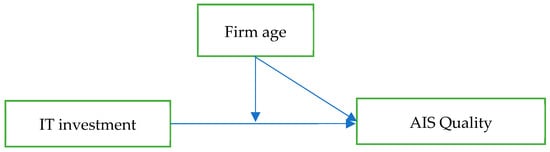
Firm age negatively moderates the relationship between IT investment and AIS quality, such that the positive effect of IT investment on AIS quality weakens as firm age increases.
Figure 1 depicts the theoretical model.
Figure 1.
The theoretical research model.
3. Materials and Methods
Variable measurement: The quality of AIS was conceptualized as two constructs comprising system quality and information quality, following Delone and McLean (2003). System quality reflects the technical performance of AIS, whereas information quality captures the content and format quality of accounting outputs. System quality and information quality have nine items (SQ1–SQ9) and eight items (IQ1–IQ8), respectively, adopted from Gorla et al. (2010). IT investment was operationalized as the extent to which firms allocate financial and technological resources to develop and upgrade their IS infrastructure, measured using four items (IT1–IT4) adapted from Sakaguchi and Dibrell (1998). System quality and information quality were assessed using a seven-point Likert scale, whereas IT investment was measured using a five-point Likert scale. The use of different Likert scales and the assurance of respondent anonymity were aimed at reducing potential common-method bias arising from respondents’ subjective perceptions (Chang et al., 2010). Firm age refers to the length of time (in years) that a firm has been in operation since its establishment, initially categorized into three groups: 1–5 years; 5–10 years; and >10 years, labeled 2, 3, and 4, respectively. To facilitate moderation analysis, firm age (Fage) is recoded into a binary variable, where firms operating for less than 10 years (categories 2 and 3) are coded as 0 and those with more than 10 years (category 4) are coded as 1. This dichotomization captures the distinction between young firms and mature firms and is consistent with prior research on firm life-cycle effects. To ensure measurement validity and reliability, construct validity was assessed through exploratory factor analysis (EFA). Reliability was confirmed through Cronbach’s alpha values exceeding recommended thresholds (Hair et al., 2014).
Data collection: Data were collected using a structured survey administered to enterprises in Vietnam with a convenience sampling approach. That approach was taken due to the absence of a comprehensive sampling frame of firms with accessible accounting personnel in Vietnam, a common constraint in emerging economy research contexts. Such an approach is widely used in accounting and AIS studies where access to firm-level respondents is limited but relevant expertise is required (Monteiro et al., 2024). To enhance sample diversity and reduce selection bias, multiple data collection channels were utilized, including email invitations to firms registered with tax and social insurance authorities, accounting-focused professional social media groups, and paper-based questionnaires distributed to accounting departments via internship networks. The use of multiple channels increases coverage across firm types and improves the representativeness of responses.
The questionnaire consisted of two sections. The first section captured demographic information (e.g., firm age and business sectors), while the second section measured variables. Whereas English is not the primary working language in Vietnam, the original items were developed in English and then translated into Vietnamese using an AI back-translation procedure to ensure linguistic equivalence due to the high accuracy rate of AI-based translation (Yu, 2024). The translated version was reviewed and refined with input from accounting experts and practitioners to ensure clarity and contextual relevance before official data collection began.
670 responses were obtained, including 166 paper-based and 504 online submissions. Following prior studies (e.g., Bethlendi & Urbanics, 2018), 21 responses from firms established for less than one year were excluded due to inadequate accounting and financial reporting records. The final sample, therefore, comprised 649 valid responses from firms operating for one year or more, which were retained for statistical analysis. Since the number of valid responses exceeds the commonly suggested threshold of 500 observations, the large sample size enhances estimation robustness by improving statistical power and reducing the sensitivity of results to non-normality and outliers (Hair et al., 2014). Table 1 presents demographic information describing the sample and the results of the non-response bias test.
Table 1.
Sample Demographics and Non-Response Bias Test.
A crosstab analysis based on early and late (30% of the sample, n = 195) respondents was carried out to assess potential non-response bias of the characteristics of respondents. The analysis explicitly examined whether any systematic differences existed between early and late responses (Armstrong & Overton, 1977). There are no significant differences in distribution observed across young and mature firms (χ2 = 2.672, p = 0.102), and across business sectors as well (χ2 = 5.308, p = 0.505). These results suggest that late-response bias is unlikely to compromise the validity of the survey data.
Data analysis: The study employed descriptive statistics, measurement quality assessment, and hypothesis testing using SPSS Statistics 26. Measurement quality was evaluated through reliability and validity tests. First, the EFA was conducted to examine the underlying factor structure and assess construct validity, followed by Cronbach’s alpha to evaluate the internal consistency and reliability of the latent constructs. Hypotheses were tested using regression analysis. To test the moderating effect of firm age, the PROCESS macro (version 4.2) was employed. Proceeding in this fashion is appropriate for moderation analysis because it enables the estimation of interaction effects and conditional relationships with robust standard errors, and has been applied widely in management and information systems research (Hayes, 2022).
4. Results
Using 7-point Likert scales, system quality and information quality showed relatively high item means, with SQ items ranging from 5.10 to 5.44 (SDs ≈ 1.25–1.42) and IQ items ranging from 5.37 to 5.61 (SDs ≈ 1.19–1.27). IT investment measured on a 5-point Likert scale exhibited more moderate item means (3.52–3.86) and variation (SDs ≈ 0.80–0.89). To assess measurement quality, we conducted separate EFAs using principal components extraction with Varimax rotation for the dependent constructs (system quality and information quality) and the explanatory construct (IT investment). Table 2 summarizes the results.
Table 2.
Results of quality measurement tests.
The EFA for the dependent measures supported a two-factor loading (system quality and information quality), with a KMO of 0.943 and a significant Bartlett’s test (χ2 = 9830.811, p < 0.001), explaining 68.667% of the cumulative variance. Internal consistency was strong (Cronbach’s α = 0.934 for system quality and 0.942 for information quality). For IT investment, the EFA supported a single-factor structure, with adequate sampling adequacy (KMO = 0.829) and a significant Bartlett’s test (χ2 = 1720.595, p < 0.001), explaining 78.124% of the cumulative variance and demonstrating high reliability (Cronbach’s α = 0.906). Based on the EFA results and measurement quality tests, the study operationalized system quality (SYSQ), information quality (INFOQ), and IT investment (TECH) as composite scores computed by averaging their respective measurement items.
After computing composite scores for each construct following the measurement quality assessment, regression models were estimated to examine the moderating effect of firm age. Based on the theoretical model, the research equations include:
Moderation analyses for both models (1) and (2) were conducted using the PROCESS macro (version 4.2), with the interaction term (TECH × Fage) included to test the conditional effect. Table 3 reports the empirical results of these analyses.
Table 3.
Summary of regression analyses with the moderator included.
As can be seen in Table 3, two moderation models were estimated with IT investment as the focal predictor, firm age category as the moderator, and the interaction term Int_1 demonstrating TECH × Fage as the test of moderation.
For system quality, the overall model is significant (R2 = 0.335, F(3, 645) = 108.41, p < 0.001). IT investment is associated positively with system quality (b = 0.930, SE = 0.055, t = 16.783, p < 0.001). Firm age also has a positive main effect (b = 1.950, SE = 0.398, t = 4.897, p < 0.001). Additionally, the interaction between IT investment and firm age is negative and statistically significant (b = −0.248, SE = 0.103, t = −4.69, p < 0.001). This interaction indicates that the effect of IT investment on system quality is conditional on firm age, with the positive association between IT investment and system quality becoming weaker at higher levels of firm age.
For information quality, the moderation model likewise is significant (R2 = 0.233, F(3, 645) = 65.159, p < 0.001). IT investment shows a positive main effect on information quality (b = 0.743, SE = 0.057, t = 13.067, p < 0.001), while the firm’s age is related positively to the accounting information system’s information quality too (b = 0.940, SE = 0.409, t = 2.299, p < 0.05). The interaction of IT investment and firm age is again negative and significant (b = −0.311, SE = 0.106, t = −2.944, p < 0.05), providing evidence that firm age moderates the relationship between IT investment and information quality. Consistent with a negative interaction, the conditional effect (simple slope) of IT investment on information quality decreases as a firm’s age increases. This effect implies that older firms experience diminishing marginal improvements in information quality from IT investment, relative to younger firms.
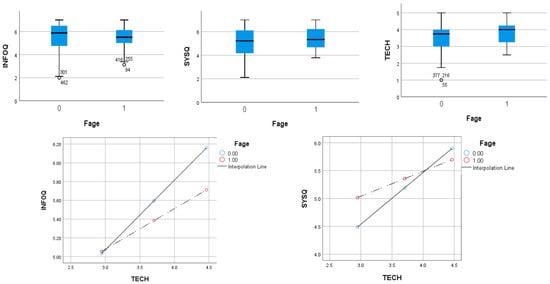
Figure 2 presents the distributions of information quality, system quality, and IT investment across firm-age groups, as well as interaction plots illustrating the moderating role of firm age. The box plots show that older firms tend to exhibit slightly higher median levels of IT investment and system quality, while differences in information quality across age groups are less pronounced. The interquartile ranges appear broadly comparable across groups, although several outliers are observed in both firm-age categories. Overall, the patterns suggest modest differences in central tendency rather than substantial distributional shifts across firm-age groups.
Figure 2.
Data used to visualize the conditional effect of the focal predictor at different levels of the moderator.
Moreover, the interaction plots in Figure 2 further illustrate the conditional effects of IT investment across firm-age categories. For information quality (INFOQ = Y), the simple slopes are non-parallel and tend to converge, indicating that the effect of IT investment on INFOQ is contingent on firm age. The slope is steeper for younger firms and flatter for older firms, suggesting greater marginal improvements in information quality from IT investment among younger firms. For system quality (SYSQ = Y), the pattern indicates a disordinal (crossover) interaction. Specifically, at lower levels of IT investment, older firms tend to exhibit higher predicted system quality, whereas at higher levels of IT investment, younger firms tend to outperform older firms. This pattern suggests a shift in the relative effectiveness of IT investment across firm-age groups, consistent with heterogeneous marginal returns.
5. Discussion
The findings provide strong support for H1, confirming that IT investment positively affects both system quality and information quality of AIS. These results are consistent with prior AIS research suggesting that investments in digital technologies enhance system integration, reliability, and processing capacity (Gorla et al., 2010), while simultaneously improving the accuracy, timeliness, and relevance of accounting information quality (Mansor et al., 2016; Meiryani & Susanto, 2018). In line with the theoretical framework, IT investment enhances organizations’ information-processing capacity by improving data handling, automation, and system interoperability. Firms are also better able to process accounting information efficiently and generate outputs with higher content richness and increased formatting quality. Although the positive effect of IT investment was already well established in prior research, the relatively stronger explanatory power observed here for system quality (R2 = 0.335) compared to information quality (R2 = 0.233) suggests a more nuanced interpretation. Namely, it appears that technological investments may have a more immediate impact on the technical infrastructure of AIS than on the quality of accounting outputs. This interpretation is consistent with Ghasemaghaei and Calic (2019). They showed that improvements in system capability do not automatically lead to proportional gains in information quality because the value of advanced data technologies depends on both data quality and a firm’s ability to generate actionable insights from them.
The results furthermore support H2, indicating that firm age has a positive direct effect on AIS quality. Apparently, older firms benefit from accumulated organizational capabilities, including established routines, formalized processes, and stronger internal controls, which contribute to more stable and reliable systems and information quality. The result thus agrees with prior studies (e.g., Duran & Castillo, 2023; Zhao et al., 2024) linking organizational maturity to enhanced information-processing effectiveness.
At the same time, the evidence also supports H3, revealing a negative moderating effect of firm age on the relationship between IT investment and AIS quality. Importantly, that moderating relationship does not contradict the positive direct effect. Instead, it indicates that while older firms achieve higher baseline AIS quality, they experience lower marginal gains from additional IT investment. In other words, firm age improves AIS quality but weakens the incremental impact of IT investment. This pattern demonstrates the value of IT investment to be contingent rather than uniform. By doing so, it adds a new insight to earlier conclusions about the role organizational conditions play in shaping IT business value (Côrte-Real et al., 2020; Plekhanov et al., 2023).
While earlier AIS studies often assume a linear relationship between IT investment and system outcomes, the present findings provide clear evidence of a diminishing returns mechanism. Theoretically, this effect can be explained by the interaction between information-processing capacity and organizational adaptability. IT investment enhances technical capacity, but its effectiveness depends on how well organizations integrate and utilize it. Firms with more established structures tend to operate with greater standardization and control. That supports consistent system performance but also may limit flexibility in adapting to new technologies. As a result, additional IT investment may yield smaller improvements because existing systems and processes are more difficult to reconfigure. Such an interpretation aligns with prior research showing that structural rigidity, legacy systems, and path dependency can constrain the effectiveness of digital investments (Cao & Iansiti, 2022; Vial, 2019). Conversely, entities with stronger organizational and technological readiness are better positioned to implement advanced information systems, while high data quality helps firms extract greater value from digital technologies (Alharasis & Alkhwaldi, 2024; Côrte-Real et al., 2020).
The distinction between system quality and information quality further supports this mechanism. While IT investment directly improves system functionality, gains in information quality depend on the effective use of system capabilities within organizational processes. When such alignment is limited, improvements in technical capacity do not translate fully into better information outcomes, reinforcing the observed weakening effect.
The crossover interaction in system quality provides additional nuance. At lower levels of IT investment, accumulated organizational capabilities support higher system quality. However, as IT investment increases, the ability to leverage new technologies becomes more critical, shifting the advantage toward firms that can adapt more effectively. Consequently, it seems that the relative importance of experience versus adaptability changes with the level of technological intensity.
The Vietnamese emerging economy context further clarifies these findings. Vietnam is undergoing a rapid, state-led digital transformation under the National Digital Transformation Program by the Vietnamese Prime Minister (2020), characterized by the widespread implementation of e-government systems, e-invoicing, and digital tax infrastructure. The nationwide rollout of mandatory e-government has substantially reshaped the institutional environment in which firms operate, including risk and fraud management for e-invoices (Lê & Lê, 2025). In this environment, IT investment is necessary but not sufficient for improving AIS quality. Firms with more complex or entrenched system architectures may face greater integration challenges, reducing the marginal effectiveness of additional investment. Recent evidence from emerging economies highlighting the difficulties of digital transformation in organizations with legacy systems buttresses that conclusion (Cao & Iansiti, 2022).
Finally, the findings contribute to the AIS literature by demonstrating that IT investment–AIS quality relationships are non-linear and context-dependent. Firm age plays a dual role: it enhances baseline AIS quality while simultaneously constraining the extent to which additional IT investment translates into further improvements. This research outcome provides a more nuanced understanding of IT value realization and directly responds to calls to incorporate organizational contingencies into AIS and digital transformation research. From a practical perspective, the evidence suggests that improving AIS quality requires more than increasing IT investment. Organizations need to complement technological upgrades with changes in processes, system integration, and organizational capabilities to realize the benefits of IT fully. At the policy level, the results indicate that digital transformation initiatives in emerging economies should be accompanied by support mechanisms that address organizational constraints. That is particularly important in the case of mature firms facing legacy system challenges.
6. Conclusions
This study examined when IT investment matters by investigating the moderating role of firm age in the relationship between IT investment and AIS quality. Conceptualizing AIS quality as system quality and information quality, the findings confirm that both IT investment and firm age exert positive direct effects on AIS quality. More importantly, the results reveal a negative interaction effect, indicating that the marginal returns of IT investment on AIS quality diminish as firm age increases. Although mature firms exhibit higher baseline AIS quality, additional IT investment thus generates greater incremental improvements in less mature firms. That clarifies when and for whom IT investment is most effective.
The study contributes to the literature by introducing firm age as a structural contingency in the relationship between IT investment and AIS quality, and by exploring heterogeneous IT returns across accounting environments. From a practical and policy perspective, the findings suggest that IT investment strategies should be aligned with organizational conditions rather than assuming uniform benefits. In emerging and transition economies such as Vietnam, digital transformation initiatives should be accompanied by support for system integration, legacy upgrading, and organizational capability development to enhance the effectiveness of IT investment. Future research may extend this work by: examining more deeply the relationships among variables using structural models, assessing additional organizational contingencies, and employing longitudinal or cross-country designs to capture better variations in IT value realization over time and across institutional contexts.
Author Contributions
Conceptualization, V.T.T.B., R.C.R. and N.T.H.D.; Methodology, V.T.T.B. and R.C.R.; Software, V.T.T.B.; Validation, V.T.T.B., R.C.R. and N.T.H.D.; Formal Analysis, V.T.T.B., R.C.R. and N.T.H.D.; Investigation, V.T.T.B.; Resources, V.T.T.B. and N.T.H.D.; Data Curation, V.T.T.B.; Writing—Original Draft Preparation, V.T.T.B., R.C.R. and N.T.H.D.; Writing—Review & Editing, V.T.T.B., R.C.R. and N.T.H.D.; Visualization, V.T.T.B.; Supervision, V.T.T.B. and R.C.R.; Project Administration, V.T.T.B.; Funding Acquisition, V.T.T.B., R.C.R. and N.T.H.D. All authors have read and agreed to the published version of the manuscript.
Funding
This study was conducted under the research project QG.24.41 “The effect of application of information technology on the quality of corporate accounting information systems in Vietnam” of Vietnam National University, Hanoi.
Institutional Review Board Statement
This study was approved by the Scientific Council of the Faculty of Accounting and Auditing, VNU University of Economics and Business, Hanoi. The study was reviewed and approved under the approval number QG.24.41.KTKT (approved on 1 January 2025). This study was conducted in accordance with the ethical standards of the institutional research committee and with the 1964 Helsinki Declaration and its later amendments or comparable ethical standards.
Informed Consent Statement
Participants were informed about the study and provided consent before taking part. Participation was voluntary, responses were anonymous, and the structured student survey involved no vulnerable groups and posed no foreseeable risks.
Data Availability Statement
The data in this study are not publicly available due to the confidentiality commitments made to survey participants. The anonymized data can be made available to qualified researchers upon reasonable request to the corresponding author.
Conflicts of Interest
The authors declare no conflicts of interest.
Abbreviations
The following abbreviations are used in this manuscript:
| AIS | Accounting information system |
| IT | Information technology |
References
- Alharasis, E. E., & Alkhwaldi, A. F. (2024, June 29–July 4). The implementation of advanced AIS and the accounting data quality: The case of Jordanian SMEs. International Conference on Human-Computer Interaction (pp. 149–173), Washington, DC, USA. [Google Scholar] [CrossRef] [Scilit]
- Al-Hattami, H. M., Abdullah, A. A. A. H., Kabra, J. D., Alsoufi, M. A. Z., Gaber, M. M. A., & Shuraim, A. M. A. (2022). Effect of AIS on planning process effectiveness: A case of SMEs in a less developed nation. The Bottom Line, 35(2/3), 33–52. [Google Scholar] [CrossRef] [Scilit]
- Appelbaum, D., Kogan, A., Vasarhelyi, M., & Yan, Z. (2017). Impact of business analytics and enterprise systems on managerial accounting. International Journal of Accounting Information Systems, 25, 29–44. [Google Scholar] [CrossRef] [Scilit]
- Applegate, L. M., Robert, D. A., & Deborah, L. S. (2009). Corporate information strategy and management: Text and case. Mc-GrawHill. [Google Scholar]
- Armstrong, J. S., & Overton, T. S. (1977). Estimating nonresponse bias in mail surveys. Journal of Marketing Research, 14(3), 396–402. [Google Scholar] [CrossRef] [Scilit]
- Belhadi, A., Mani, V., Kamble, S. S., Khan, S. A. R., & Verma, S. (2024). Artificial intelligence-driven innovation for enhancing supply chain resilience and performance under the effect of supply chain dynamism: An empirical investigation. Annals of Operations Research, 333(2), 627–652. [Google Scholar] [CrossRef] [Scilit]
- Bethlendi, A., & Urbanics, R. (2018). Critical financial and accounting issues of early-stage innovative enterprises. Investment Management and Financial Innovations, 15(4), 144–157. [Google Scholar] [CrossRef] [Scilit]
- Binh, V. T. T., Tran, N.-M., & Vu, M.-C. (2022). The effect of organizational culture on the quality of accounting information systems: Evidence from Vietnam. SAGE Open, 12(3), 1–12. [Google Scholar] [CrossRef] [Scilit]
- Cao, R., & Iansiti, M. (2022). Digital transformation, data architecture, and legacy systems. Journal of Digital Economy, 1(1), 1–19. [Google Scholar] [CrossRef] [Scilit]
- Chang, S. J., Van Witteloostuijn, A., & Eden, L. (2010). From the editors: Common method variance in international business research. Journal of International Business Studies, 41(2), 178–184. [Google Scholar] [CrossRef] [Scilit]
- Côrte-Real, N., Ruivo, P., & Oliveira, T. (2020). Leveraging internet of things and big data analytics initiatives in European and American firms: Is data quality a way to extract business value? Information & Management, 57(1), 103141. [Google Scholar] [CrossRef] [Scilit]
- Delone, W. H., & McLean, E. R. (1992). Information systems success: The quest for the dependent variable. Information Systems Research, 3(1), 60–95. [Google Scholar] [CrossRef] [Scilit]
- Delone, W. H., & McLean, E. R. (2003). The DeLone and McLean model of information systems success: A ten-year update. Journal of Management Information Systems, 19(4), 9–30. [Google Scholar] [CrossRef] [Scilit]
- Delone, W. H., & McLean, E. R. (2016). Information systems success measurement. Foundations and Trends in Information Systems, 2(1), 1–116. [Google Scholar] [CrossRef] [Scilit]
- Duran, J., & Castillo, R. (2023). Factors related to information and communication technologies adoption in small businesses in Colombia. Journal of Innovation and Entrepreneurship, 12(1), 55. [Google Scholar] [CrossRef] [Scilit]
- Fisher, J. (1995). Contingency-based research on management control systems: Categorization by level of complexity. Journal of Accounting Literature, 14, 24–52. [Google Scholar]
- Fry, L. W. (1982). Technology-structure research: Three critical issues. Academy of Management Journal, 25(3), 532–552. [Google Scholar] [CrossRef] [Scilit]
- Galbraith, J. (1974). Organization design: An information processing view. Interfaces, 4(3), 28–36. [Google Scholar] [CrossRef] [Scilit]
- Ghasemaghaei, M., & Calic, G. (2019). Does big data enhance firm innovation competency? The mediating role of data-driven insights. Journal of Business Research, 104, 69–84. [Google Scholar] [CrossRef] [Scilit]
- Ghasemaghaei, M., & Calic, G. (2020). Assessing the impact of big data on firm innovation performance: Big data is not always better data. Journal of Business Research, 108, 147–162. [Google Scholar] [CrossRef] [Scilit]
- Gorla, N., Somers, T. M., & Wong, B. (2010). Organizational impact of system quality, information quality, and service quality. The Journal of Strategic Information Systems, 19(3), 207–228. [Google Scholar] [CrossRef] [Scilit]
- Granlund, M. (2011). Extending AIS research to management accounting and control issues: A research note. International Journal of Accounting Information Systems, 12(1), 3–19. [Google Scholar] [CrossRef] [Scilit]
- Hair, J. F., Black, W. C., Babin, B. J., & Anderson, R. E. (2014). Multivariate data analysis (7th ed.). Pearson Education Limited. [Google Scholar]
- Hamdy, A., Diab, A., & Eissa, A. M. (2025). Digital transformation and the quality of accounting information systems in the public sector: Evidence from developing countries. International Journal of Financial Studies, 13(1), 30. [Google Scholar] [CrossRef] [Scilit]
- Hannan, M. T., & Freeman, J. (1984). Structural inertia and organizational change. American Sociological Review, 49(2), 149–164. [Google Scholar] [CrossRef] [Scilit]
- Hayes, A. F. (2022). Introduction to mediation, moderation, and conditional process analysis: A regression-based approach (3rd ed.). Guilford Publications. [Google Scholar]
- Huang, S.-M., Ou, C.-S., Chen, C.-M., & Lin, B. (2006). An empirical study of relationship between IT investment and firm performance: A resource-based perspective. European Journal of Operational Research, 173(3), 984–999. [Google Scholar] [CrossRef] [Scilit]
- Keen, P. G. W. (1991). Shaping the future: Business design through information technology. Harvard Business School Press. [Google Scholar]
- Lê, H. T., & Lê, T. T. (2025). Quản lý rủi ro trong quản lý hoá đơn điện tử tại Việt Nam [Risk management in electronic invoice management in Vietnam]. Tạp Chí Nghiên Cứu Tài Chính Kế Toán, 288(2), 36–40. [Google Scholar] [CrossRef] [Scilit]
- Li, B. (2025). Using Data mining technology to improve the reliability of accounting information cloud data. Informatica, 49(5), 49–64. [Google Scholar] [CrossRef] [Scilit]
- Li, Z., Han, J., Sun, X., & Cheng, L. (2025). Digital transformation and accounting information quality: The role of environmental uncertainty in the era of digital. International Review of Economics & Finance, 103, 104588. [Google Scholar] [CrossRef] [Scilit]
- Lutfi, A. (2023). Factors affecting the success of accounting information system from the lens of DeLone and McLean IS model. International Journal of Information Management Data Insights, 3(2), 100202. [Google Scholar] [CrossRef] [Scilit]
- Mansor, N. H. A., Mohamed, I. S., Ling, L. M., & Kasim, N. B. (2016). Information technology sophistication and goods and services tax in Malaysia. Procedia Economics and Finance, 35, 2–9. [Google Scholar] [CrossRef] [Scilit]
- Meiryani, & Susanto, A. (2018, June 22–24). The influence of information technology on the quality of accounting information system. 2018 2nd High Performance Computing and Cluster Technologies Conference (pp. 109–115), Beijing, China. [Google Scholar] [CrossRef] [Scilit]
- Monteiro, A. P., Vale, J., Leite, E., & Lis, M. (2024). Linking quality of accounting information system and financial reporting to non-financial performance: The role women managers. International Journal of Accounting Information Systems, 54, 100692. [Google Scholar] [CrossRef] [Scilit]
- Nelson, R. R., Todd, P. A., & Wixom, B. H. (2005). Antecedents of information and system quality: An empirical examination within the context of data warehousing. Journal of Management Information Systems, 21(4), 199–235. [Google Scholar] [CrossRef] [Scilit]
- Petter, S., Delone, W. H., & McLean, E. R. (2008). Measuring information systems success: Models, dimensions, measures, and interrelationships. European Journal of Information Systems, 17, 236–263. [Google Scholar] [CrossRef] [Scilit]
- Petter, S., DeLone, W. H., & McLean, E. R. (2013). Information systems success: The quest for the independent variables. Journal of Management Information Systems, 29(4), 7–62. [Google Scholar] [CrossRef] [Scilit]
- Plekhanov, D., Franke, H., & Netland, T. H. (2023). Digital transformation: A review and research agenda. European Management Journal, 41(6), 821–844. [Google Scholar] [CrossRef] [Scilit]
- Romney, M. B., & Steinbart, P. J. (2017). Accounting information systems (14th ed.). Pearson. [Google Scholar]
- Sakaguchi, T., & Dibrell, C. C. (1998). Measurement of the intensity of global information technology usage: Quantitizing the value of a firm’s information technology. Industrial Management & Data Systems, 98(8), 380–394. [Google Scholar] [CrossRef] [Scilit]
- Sánchez-Rodríguez, C., & Spraakman, G. (2012). ERP systems and management accounting: A multiple case study. Qualitative Research in Accounting & Management, 9(4), 398–414. [Google Scholar] [CrossRef] [Scilit]
- Sivaiah, P., & Vinodan, A. (2026). Digitalization in stages: Advancing sustainability reporting in SMEs through a maturity-based adoption model. Journal of Global Responsibility, 17(2), 250–292. [Google Scholar] [CrossRef] [Scilit]
- Subriadi, A. P., Hadiwidjojo, D., Rahayu, M., & Sarno, R. (2013). Firm age, firm size and information technology intencity industry factors in influencing information technology contribution to improve performance. Journal of Theoretical and Applied Information Technology, 54(3), 487–496. [Google Scholar]
- Urbach, N., & Müller, B. (2011). The updated DeLone and McLean model of information systems success. In Y. Dwivedi, M. Wade, & S. Schneberger (Eds.), Information systems theory: Explaining and predicting our digital society (Vol. 1, pp. 1–18). Springer. [Google Scholar]
- Vial, G. (2019). Understanding digital transformation: A review and a research agenda. The Journal of Strategic Information Systems, 28(2), 118–144. [Google Scholar] [CrossRef] [Scilit]
- Vietnamese Prime Minister. (2020). Decision No. 749/QD-TTg dated 3 June 2020 on introducing program for national digital transformation by 2025 with orientations towards 2030. Vietnamese Government. Available online: https://chinhphu.vn/default.aspx?pageid=27160&docid=200163 (accessed on 5 October 2023).
- Wang, R. Y., & Strong, D. M. (1996). Beyond accuracy: What data quality means to data consumers. Journal of Management Information Systems, 12(4), 5–33. [Google Scholar] [CrossRef] [Scilit]
- Yu, Y. (2024). Application of translation technology based on AI in translation teaching. Systems and Soft Computing, 6, 200072. [Google Scholar] [CrossRef] [Scilit]
- Zhao, X., Chen, Q.-A., Zhang, H., Chen, P., & Chen, S. (2024). A study on the influencing factors of corporate digital transformation: Empirical evidence from Chinese listed companies. Scientific Reports, 14(1), 6243. [Google Scholar] [CrossRef] [Scilit] [PubMed]
- Zhou, H., Zhang, Y., & Esa, M. B. (2026). Strategic orientation and firm performance of construction enterprises in Guangdong province: The moderating effect of digital technology adoption. International Journal of Economic Sciences, 15(1), 177–199. [Google Scholar] [CrossRef] [Scilit]
- Zohry, A. F., & Al-Dhubaibi, A. A. S. (2024). Optimizing business performance through effective accounting information systems: The role of system competence and information quality. Journal of Risk and Financial Management, 17(11), 515. [Google Scholar] [CrossRef] [Scilit]


Disclaimer/Publisher’s Note: The statements, opinions and data contained in all publications are solely those of the individual author(s) and contributor(s) and not of MDPI and/or the editor(s). MDPI and/or the editor(s) disclaim responsibility for any injury to people or property resulting from any ideas, methods, instructions or products referred to in the content. |
© 2026 by the authors. Licensee MDPI, Basel, Switzerland. This article is an open access article distributed under the terms and conditions of the Creative Commons Attribution (CC BY) license.