


Abstract
Algorithms drive automated management and marketing decisions, yet researchers study their effects on employees and consumers in separate streams, and neither captures how the two stakeholders are digitally enacted. Drawing on stakeholder theory and value-sensitive design, we develop an integrated framework explaining how algorithmic management and marketing jointly transform stakeholders’ well-being. Positioned within the techno-human being view, it treats the algorithm as a shared identity infrastructure and defines algorithmic control as using computational systems to direct, evaluate, and discipline a party to an exchange, enacted across the organization, its employees, and its consumers rather than configured by management alone. Multi-dimensional well-being is the psychological outcome of these algorithmics, encompassing both reduced ill-being and the sustained satisfaction, trust, and engagement that design for stakeholders’ flourishing supports. We theorize bidirectional spillover pathways, carried instrumentally through algorithmic control and psychologically through emotional contagion and appraisal, that produce negative spirals, in which controlling algorithms erode employee engagement and frustrate consumers, or positive synergies, in which supportive algorithms enhance well-being in both groups. Sustainable value creation therefore requires transparent, ethical algorithmic governance, and we propose a multi-level governance including ethics boards, value-sensitive development teams, and stakeholder voice mechanisms as a reflexive practice.
1. Introduction
The proliferation of artificial intelligence (AI), machine learning, and big data analytics has fundamentally transformed how organizations manage employees and engage with consumers. Algorithms now pervade both inside and outside of organizational boundaries, automating decision-making processes once reserved for human judgment (Kellogg et al., 2020; Mariani et al., 2022). Within organizations, algorithmic management—using algorithms to direct, evaluate, and discipline workers—has become ubiquitous in platform economies and is rapidly expanding into traditional employment contexts (Parent-Rocheleau & Parker, 2022; Zhang et al., 2025). Externally, algorithmic marketing uses algorithms to personalize advertisements, curate content, and optimize pricing in real time (Galli, 2022; Zhao & Tsubaki, 2025). While these algorithms promise greater efficiency and precision, they also raise profound questions about their impact on human daily sensemaking and well-being.
Despite their shared technological foundation, scholarly inquiries into the impacts of algorithmic management and marketing have followed largely separate trajectories. Research on algorithmic management, rooted primarily in information systems, labor relations, economics, organizational behavior, and human resource management, focuses on both economic outcomes such as organizational performance and psychological outcomes such as work engagement, job satisfaction, burnout, and turnover intentions (Kim et al., 2025; Liang et al., 2026; Lin et al., 2025). In parallel, consumer behavior and marketing scholars investigate how algorithmic marketing affects sales effectiveness and consumer well-being, trust, privacy concerns, and purchase intentions (Bhardwaj & Kalro, 2024; Voorveld et al., 2024). This disciplinary fragmentation has obscured a critical insight: employees and consumers are not isolated stakeholders, but interconnected actors who actively (re) form their social identities, and whose experiences with algorithmics mutually shape one another (Graf, 2007; Osterwalder & Pigneur, 2013).
Consider platform-based food delivery services, where algorithmics simultaneously manage delivery workers and target consumers. When algorithmic management reduces worker engagement through excessive monitoring or unrealistic performance targets, the resulting stress and burnout may degrade service quality and negatively affect consumer experiences (Li et al., 2025; Zhu et al., 2025). Conversely, when algorithmic marketing creates dissatisfied consumers through aggressive personalization or perceived manipulation, increased complaints and negative feedback loop back to workers, intensifying their job demands and psychological strain. These cross-boundary spillover pathways suggest that optimizing outcomes for one stakeholder group in isolation may inadvertently harm the other, creating negative feedback loops that undermine organizational performance and societal welfare (Pies & Valentinov, 2024).
Yet, current theoretical frameworks for information systems research lack the meta-assumption of techno-human entanglement and the conceptual apparatus to address these interdependencies (Möhlmann et al., 2023). Management research has predominantly examined algorithmic management through lenses such as self-determination theory (Lin et al., 2025), conservation of resources theory (Liang et al., 2026), and the job demands-resources model (Zhang et al., 2025), focusing exclusively on individual behavioral and attitudinal dynamics. Meanwhile, marketing scholars apply distinct theoretical frameworks—persuasion knowledge model, privacy calculus, and fairness heuristic theory—to understand consumer responses to algorithmic marketing (Friestad & Wright, 1994; Kelly et al., 2017; Lind, 2001). This theoretical and practical bifurcation perpetuates a fundamental blind spot: neither stream adequately accounts for how algorithmics, interacting with human identities, create value or harm across boundaries when they automate organizational decision-making (Sullivan et al., 2024).
Stakeholder theory offers a promising avenue for integration. Freeman’s (1984/2010) seminal work established that organizations create value through managing relationships with multiple stakeholder groups whose interests are inherently interconnected. It models how value is distributed when multiple stakeholders have simultaneous claims (Garcia-Castro & Aguilera, 2015) and examines the trade-offs the theory cannot dissolve (Pies & Valentinov, 2024). Applied to algorithmics, the theory provides the warrant for treating employees and consumers as parties to a single value-creation process rather than separate managerial problems, and the criterion by which governance should be judged: whether outcomes hold jointly across stakeholder groups. Recent extensions to AI contexts demonstrate that algorithmics dynamically (re)form stakeholder identities and relationships by automating decision-making processes that affect multiple groups simultaneously (Matthews et al., 2025). However, existing applications of stakeholder theory to algorithmic contexts have primarily focused on technology efficiency and governance structures (Deshpande & Sharp, 2022; Schuett et al., 2025) rather than examining the psychological pathways from an integrated control perspective through which algorithmics create bidirectional spillover between employees and consumers when significant real-time decisions are automated with algorithms.
This paper addresses this theoretical gap by developing an integrated multi-stakeholder framework that bridges multidisciplinary literatures to explain how algorithmics, rather than a techno-black box, jointly affect multi-stakeholders’ well-being as an integrated, multifaceted form of algorithmic control. We advance several primary theoretical contributions. First, we adopt a meta-assumption of a techno-human being view of algorithmics, positioning humans in an interactive control role within the algorithmics. With this deliberately chosen proposition, our paper contributes by aligning and creating vocabularies for meaningful, transdisciplinary scholarly communication and practical solution-finding. Second, we integrate previously siloed research streams to show that algorithmic management and marketing are not separate phenomena but interconnected components of organizational value creation processes that simultaneously affect multiple stakeholders across organizational boundaries. Third, we theorize novel spillover pathways showing how employee experiences with algorithmic control cascade to (re)form employee and consumer well-being (and vice versa), identifying both negative feedback loops and potential positive interactions. Lastly, we apply value-sensitive design (VSD) principles (Friedman & Hendry, 2019; Umbrello & van de Poel, 2021) to propose a practical governance framework, representing the critical human-in-the-loop configuration in information systems, that enables organizations to optimize algorithmics for the sustainable psychological development of human beings, rather than privileging one over another during their digital transformations.
2. The Siloed Literatures and the Gap Between Them
Empirical research on algorithmic management began with qualitative studies of platform work and has since acquired survey instruments and outcome measures. M. K. Lee et al. (2015) and Rosenblat and Stark (2016) documented how dispatch and rating systems direct drivers without a visible manager, and Veen et al. (2020) and Heiland (2021) traced the same control over the pace and geography of delivery work. A second wave asked what workers do when the governing logic is hidden: Möhlmann et al. (2023) examined sensemaking under opacity, Bucher et al. (2021) found workers complying in advance with rules they could only infer, and Jarrahi et al. (2020, 2021) mapped the resources workers assemble to protect some autonomy. Survey research then attached outcomes to these experiences, linking algorithmics to technostress (Cram et al., 2022), to workplace well-being across European organizations (Kinowska & Sienkiewicz, 2023), and to the double-edged pattern of engagement and depletion reported among Chinese platform workers (Li et al., 2025; Lin et al., 2025; Zhou et al., 2025). With a validated measure now available (Parent-Rocheleau et al., 2024), the stream has the tools to study almost anything about algorithmics within employment relationships.
Research on algorithmic marketing developed on the other side of these systems, using different methods and vocabulary. Computational audits established what firms do: Hannak et al. (2014) measured price discrimination and steering across e-commerce sites, and Chen et al. (2016) analyzed algorithmic pricing on Amazon Marketplace, both observing firm behavior without asking consumers anything. Experimental work then asked how people respond, with Garbarino and Lee (2003) testing dynamic pricing against trust, Aguirre et al. (2015) identifying the personalization paradox in which covert data collection undermines the advertising it enables, Banker and Khetani (2019) demonstrating the welfare costs of over-relying on recommendations, and S. Lee et al. (2025) testing whether privacy disclosures make personalized ads read as transparent or as surveillance. Survey research has mapped what consumers experience, such as know and feel, including cross-national attitudes toward personalization (Kozyreva et al., 2021), persuasion knowledge of advertising algorithms (Voorveld et al., 2024), and fatigue and resistance among young adults (Balaskas et al., 2025). Legal scholarship supplies also a parallel evidence base on harm, from digital vulnerability (Helberger et al., 2022) to dark patterns in practice (Federal Trade Commission, 2022).
The two bodies of evidence rarely overlap, and the separation runs deeper than emphasis. They sample different populations, favor different methods, and measure outcomes in vocabularies that do not translate directly, so researchers report drops in worker engagement and drops in consumer trust as separate findings even when they may be two readings of a single event: the service. Audit studies observe firm behavior but not the employees executing it; interview studies reach workers but not the customers they serve. No studies have sampled both employees and consumers exposed to the same algorithmics. The regulatory literature reinforces this divide: labor scholarship treats these systems as managerial prerogative, and consumer scholarship treats them as market conduct. The gap is conspicuous because service research settled the underlying linkage long ago. Heskett et al. (1994) proposed the service-profit chain; Pugh (2001) and Tsai and Huang (2002) demonstrated emotional transfer from employees to customers; Wang et al. (2011) showed customer mistreatment rebounding onto employee behavior; and Graf (2007) drew out the HRM consequences of customers as co-producers. That work predates the algorithmics emergence of the service encounter, and neither current stream has returned to it. Information systems research on algorithmics offers one way back in, since it has long treated business model design and other strategic objects as something that can be represented, visualized, and reasoned about explicitly (Osterwalder & Pigneur, 2013). Instruments for studying employee–consumer transmission exist; what is missing is a theoretical framework that captures both groups at once.
3. Positioning the Techno-Human Being View of Algorithmics
Research on algorithmic management rests on assumptions about what algorithms are and how they relate to the people they touch, and these assumptions are seldom stated. Sullivan et al. (2024) brought them into view through a hermeneutic analysis of the field and identified two worldviews. Techno-human dualism treats technology and people as separate entities and prioritizes one side over the other. Techno-human entanglement regards the social and the material as inseparable and prioritizes relations (Orlikowski & Scott, 2008). Each worldview contains two meta-understandings. The techno-centric and techno-mediated control views sit within dualism, while the techno-human enactment and techno-human being views sit within entanglement. Sullivan et al. (2024) end by appealing to scholars to choose a research position rather than inherit one. We take up that appeal here and state our position before presenting the propositions that follow.
Our framework is anchored in the techno-human being view. From this view, algorithmic management is a process of becoming with algorithmic technology, one through which identities are (re)formed, and meaning is generated (Schildt, 2017; Sullivan et al., 2024). The fit with our purpose is specific. The psychological common ground we theorize between employees and consumers, embedded within integrated algorithmic control, concerns who people become, cognitively and affectively, when algorithms sort and rate them. Workers under algorithmic management actively construct and defend their identities in response to the depersonalizing conditions of app-based work (Anicich, 2022). Consumer identities are assembled similarly, as platforms translate behavioral traces into categories that speak for a person (Cheney-Lippold, 2017; Puntoni et al., 2021). The two literatures describe similar psychological phenomena from opposite sides of the service encounter, yet they seldom engage one another. The techno-human being view offers a single vocabulary for both.
This choice also addresses a gap in the field. Sullivan et al. (2024) found the techno-human being view to be the least common meta-understanding in their corpus, and the studies they classify under it focus mainly on gig workers in the existing literature. They suggest that the view could help researchers examine what other stakeholders, structures, and organizations become when enmeshed with algorithmics. Our framework carries that suggestion toward the consumer. We treat the consumer as a stakeholder who becomes through the algorithmics that manage workers and employees, and we treat these two processes of becoming, including both active identity (re)forming and sense-making, as linked. In our account, bidirectional spillover is the movement of being and sense-making across organizational boundaries through business value-creation activities, such as a service encounter.
In the remainder of this section, we show how the techno-human being view shapes our treatment of the three facets Sullivan et al. (2024) use to compare meta-understandings: the algorithm, algorithmic control, and human-in-the-loop configurations.
3.1. The Algorithms as a Shared Infrastructure
Techno-dualist accounts define the algorithm as code or procedure, a discrete object that exists apart from the people who use it or are subject to it (Kellogg et al., 2020; Sullivan et al., 2024). The techno-human being view reads the algorithm as something that specifies, constrains, and enables identity formation by reconfiguring work (Schildt, 2017; Sullivan et al., 2024). We extend this reading across service relationships. In this sense, workers, employees, and consumers simultaneously feed the algorithms that connect them while being regulated or directed by their experiences encountering algorithmics. One stakeholder’s data trace becomes material for another stakeholder’s algorithmic identity, a dynamic that more generally describes profiling in digital encounters. We therefore conceptualize the algorithm as a shared identity configurator, meaning a relational arrangement through which employees and consumers become legible to the organization and to one another.
This conceptualization has two implications for the framework. First, the algorithm is the route along which spillover travels. The second implication is that the algorithm carries no settled meaning apart from these relations. The algorithm is what it becomes within each relation, and our spillover propositions describe how those relations bear on one another.
3.2. Algorithmic Control as Co-Enacted Experiences Across the Stakeholders
Within the dualist worldview, control is a resource processed either by technology or by the people using it. The techno-centric view assigns it largely to algorithms, whereas the techno-mediated control view assigns it to managers who exercise it through technology (Kellogg et al., 2020; Sullivan et al., 2024). The entanglement worldview treats control as a process that is enacted and continually reproduced. The techno-human being view adds that control and identity are knotted together, so workers’ understanding of themselves and their recognition of control are enacted jointly (Anicich, 2022; Sullivan et al., 2024). Our framework locates control as an integrated system within a triad of the organization, its employees, and its consumers. Through the techno-human being view, each of these control relations is also an identity dynamic under our framework.
Following Ouchi (1979) and Kellogg et al. (2020), we define algorithmic control as using computational systems to direct, evaluate, and discipline a party to an exchange. We treat control as enacted rather than merely configured (Wiener et al., 2016) and distinguish its mechanism, coerciveness, opacity, and the perceived control it leaves the affected party. Because the definition specifies a party to an exchange rather than an employee or worker, it also applies to consumers, which is what permits the joint treatment our framework requires. At the same time, the algorithmic features are not isolated from the system; a dynamic, adaptive rhythm connects involved parties’ experiences, including attitudes and behavior.
Four facets make algorithmic control measurable, each with an employee-side instrument and a consumer-side adaptation. Mechanism is what the system does: scheduling, monitoring, rating, and compensation/reward for workers/employees (Parent-Rocheleau et al., 2024), and recommendation, pricing, and targeting for consumers. Coerciveness is whether it constrains or equips, formalized as authoritative versus enabling enactment (Wiener et al., 2016) and operationalized as gatekeeping versus guiding control (Wiener et al., 2023). Opacity and contestability concern whether the controlled party can reconstruct the logic and challenge an outcome (Burrell, 2016; Lind, 2001); on the consumer side, they appear as awareness of algorithmic influence (Voorveld et al., 2024). Perceived control is the subjective residual, decomposed into behavioral, cognitive, and decisional forms (Averill, 1973) and measurable through autonomy instruments on both sides (Deci & Ryan, 2000; Ryan, 2023; Wertenbroch et al., 2020).
Control has been theorized and empirically tested independently in each of the three literatures our framework joins. Information systems (IS) research inherited Ouchi’s (1979) premise that organizations manage goal incongruence and performance ambiguity through distinct mechanisms, refined into modes of behavior, outcome, and self control (Kirsch, 1996), consolidated into an integrated model of IS control (Cram et al., 2016), and extended by the distinction between how controls are configured and how they are enacted, authoritatively or enablingly, between controller and controlee (Wiener et al., 2016); research on information systems carries this lineage forward (Kellogg et al., 2020; Möhlmann et al., 2021; Wiener et al., 2023). Management literature has treated control less as a design problem than as an experience, reviewing its formality, coerciveness, and singularity (Cardinal et al., 2017) and explaining workers’ or employees’ responses through autonomy need satisfaction (Deci & Ryan, 2000; Ryan, 2023), cognitive appraisal (Lazarus & Folkman, 1984), and fairness judgment (Lind, 2001). Marketing research has studied control continuously under other names, distinguishing its behavioral, cognitive, and decisional forms (Averill, 1973), demonstrating that perceived control mediates responses to the service encounter itself (Hui & Bateson, 1991), and more recently framing algorithmic marketing as a question of consumer autonomy (André et al., 2018; Wertenbroch et al., 2020). Each tradition thus supplies a vocabulary for control. Yet each stops at a different boundary- the project, the employment relationship, or the transaction- so none can describe what happens when one system controls both parties at once.
The literature on control in IS, management, and marketing converges on the view that control is not a single-directional mechanism strictly within organizational boundaries. Instead, each has moved from treating control as a configuration to treating it as an multi-faceded enactment between parties (Averill, 1973; Cardinal et al., 2017; Wiener et al., 2016); each distinguishes control that constrains from control that equips, whether termed authoritative and enabling, coercive and enabling, or manipulative and respectful; each explains outcomes through autonomy and perceived control (André et al., 2018; Deci & Ryan, 2000; Wertenbroch et al., 2020); and each identifies opacity and contestability as the decisive condition, proposing explanation and appeal as the remedy (Burrell, 2016; Lind, 2001; Wachter et al., 2018). Although marketing literature remains relatively thin on this topic, the convergence is substantive rather than terminological, since both sides of the organizational boundary use the construct of control and theorize it through the same instrumental and psychological common grounds. None supplies the connection among them, because each stops at its own boundary conditions, and our framework provides that connection.
3.3. Human-in-the-Loop Configurations as Sites of Becoming
Human-in-the-loop configurations are frequently proposed as a safeguard against adverse algorithmic outcomes. Dualist accounts present them as a way to restore human agency to automated processes, whether by improving the algorithm or by giving people authority to review and override its decisions (Adams-Prassl et al., 2023; Sullivan et al., 2024). The relational worldview treats this remedy with more caution. Dolata et al. (2022) note that the idea presumes an overseer who is critical, fair-minded, and able to assess algorithmic output from outside the system. In practice, algorithmic outputs shape what overseers attend to, and over time those outputs can come to prefigure the overseers’ responses. From the techno-human being view, the overseer becomes part of the loop (Dolata et al., 2022; Sullivan et al., 2024).
Our framework proposes a multi-level governance architecture comprising ethics boards, value-sensitive development teams, and stakeholder voice procedures. A dualist reading would treat these bodies as external checks on a technical system. We position them as entangled with the systems they oversee. Ethics board members, including representatives from employees, workers, and consumers, typically review dashboards and summaries that the algorithmics helps to generate, so their sense of what counts as a problem is partly formed by those representations. Development teams working with VSD are themselves changed by the values they seek to embed, and VSD treats this mutual shaping as a normal feature of design (Friedman & Hendry, 2019). The governance architecture is thus a set of places where overseers, employees, workers, and consumers become involved alongside the technology.
3.4. Scope of the Position
This position has limits that we wish to make explicit. Our framework advances propositions that relate constructs such as control to employee experiences and consumer experiences. Theorizing in this form separates entities for analytic purposes and borrows vocabulary associated with dualist research. We treat the separation as an analytic device for specifying relationships that can be examined empirically, and we make no ontological claim through it. We also recognize that the instrumental common ground in our framework, which concerns efficiency and performance outcomes, sits closer to the techno-mediated control view. Sullivan et al. (2024) show that meta-understandings can be combined within a single study, observe that researchers shift positions over time, and call for pluralism across positions. Our framework is anchored in the techno-human being view and draws on the techno-mediated control view where the instrumental side of the argument requires it. We state this openly so that readers working from either worldview can see where our claims originate and evaluate them on those terms.
4. Algorithmic Transformations on Employee and Consumer Experiences
What distinguishes contemporary algorithmics from earlier technological innovations is their capacity to operate simultaneously across organizational boundaries, creating interdependent effects that cascade between internal workforce management and external market interactions (Mariani et al., 2022; Parent-Rocheleau & Parker, 2022). This dual pathway marks a major paradigm shift in automated decision-making and organizational control, in which the same underlying algorithmics live with employees and consumers in temporally and spatially integrated ways, shaped by employees’ and consumers’ interdependent, multidimensional psychological outcomes, such as well-being and engagement.
Contemporary algorithmics share a common technological architecture characterized by four core capabilities that enable their influence across organizational boundaries: real-time data collection and surveillance, pattern recognition and prediction, automated decision-making, and adaptive learning (Kellogg et al., 2020; Shmueli & Koppius, 2011). These capabilities manifest differently in employee and consumer contexts but operate through the same underlying computational processes, creating what we call dual-facing algorithmics—systems that simultaneously process employee and consumer behavior data to optimize organizational outcomes.
First, algorithms continuously collect data, creating comprehensive digital records of employee activities and consumer behavior. In both permanent and temporary employment contexts, this surveillance encompasses keystroke logging, location tracking, productivity metrics, communication patterns, and performance evaluations (Möhlmann et al., 2021; Wood et al., 2019). For consumers, parallel data collection tracks browsing histories, purchase patterns, social media interactions, location data, and product engagement metrics (Galli, 2022; Wedel & Kannan, 2016). The granularity and pervasiveness of this dual surveillance create unprecedented organizational knowledge about stakeholders’ behavior, fundamentally altering traditional information asymmetries. Machine learning algorithms then identify patterns in these vast datasets to predict future behavior. For employees, predictive analytics forecasts productivity trajectories, identifies risks, and anticipates performance issues (Parent-Rocheleau et al., 2024; Zhang et al., 2025). For consumers, similar pattern recognition powers search engines’ recommendations, predicts purchase propensities, and anticipates product preferences (Banker & Khetani, 2019; De Bruyn et al., 2020). These predictive capabilities enable organizations to intervene proactively in stakeholder relationships, shifting from reactive to anticipatory management/marketing approaches. In addition, algorithmics automate decisions previously handled by human managers and marketers. In workforce management, algorithms autonomously assign tasks, allocate work schedules, evaluate performance, determine compensation, and even make hiring and termination decisions (Duggan et al., 2020; Jarrahi et al., 2021). In consumer markets, algorithms dynamically adjust prices, personalize advertising content, curate product recommendations, and determine service eligibility (Spann et al., 2015; Wedel & Kannan, 2016). This automation reduces human discretion in stakeholder interactions, replacing subjective judgment with ostensibly objective computational logic. Finally, these algorithmics continuously learn from stakeholder feedback, creating dynamic feedback loops. Employee reactions to dynamic algorithm directives inform subsequent task assignments and performance expectations (Parent-Rocheleau & Parker, 2022). Consumer responses to personalized marketing shape future content curation and targeting strategies (Zhao & Tsubaki, 2025). This adaptive learning makes algorithmics increasingly sophisticated at predicting and influencing stakeholders’ behavior and attitude over time and across spaces, while also becoming more opaque to those they govern (Burrell, 2016; Pasquale, 2015).
Critically, these four digital capabilities operate through shared algorithmic tools and organizational technological infrastructures such as information systems. The same data analytics platforms, machine learning models, and computational systems that process employee data often also analyze consumer data. This technological integration creates the instrumental conditions for cross-boundary effects: algorithmic decisions affecting employees may incorporate consumer satisfaction data, while algorithmic marketing strategies may reflect employee performance metrics.
4.1. Algorithmic Management: The Transformation of Employee Work Experience
Algorithmic control reconstitutes the employment relationship by prioritizing computational logic over direct human managerial decisions across core organizational functions (Kellogg et al., 2020; Parent-Rocheleau & Parker, 2022). The transformation operates along three dimensions that collectively reshape the employee experience: work allocation and task design, performance monitoring and evaluation, and behavioral direction and control (Möhlmann et al., 2021; Zhang et al., 2025). Each shapes how employees experience autonomy, competence, and relatedness, the psychological needs central to work engagement and well-being (Deci & Ryan, 2000; Lin et al., 2025).
Algorithms increasingly determine which tasks employees receive, when, and under what conditions (Jarrahi et al., 2021; Wood et al., 2019). Matching algorithms assign gig workers by proximity, performance history, and predicted efficiency (M. K. Lee et al., 2015; Rosenblat & Stark, 2016), and workforce management systems assign service tickets and schedule shifts in conventional organizations (Parent-Rocheleau & Parker, 2022), turning work from a negotiated social relationship into an optimized computational process.
The psychological adaptations and consequences cut both ways. Algorithms can enhance perceived fairness when task distribution appears meritocratic and transparent, resting on objective performance metrics rather than managerial favoritism (Liang et al., 2026). When they create unpredictable schedules, impose rigid constraints, or optimize for organizational efficiency without regard for employees’ preferences, workers experience reduced autonomy and increased uncertainty (Duggan et al., 2023; Möhlmann et al., 2021; Zhu et al., 2025), and penalties for declining tasks make participation coercive rather than voluntary (Wood et al., 2019). Task design compounds this by prescribing how work should be performed rather than what should be done, specifying routes, time windows, and interaction protocols (Heiland, 2021; Veen et al., 2020). Directives perceived as inflexible or incompatible with situational demands threaten professional competence and identity (Parent-Rocheleau & Parker, 2022).
A second salient dimension of algorithmic control is continuous surveillance and automated evaluation (Kellogg et al., 2020; Möhlmann et al., 2021). Algorithmics track productivity in real time, generating metrics from output counts to composite scores that incorporate speed, quality, ratings, and protocol adherence (M. K. Lee, 2018; Rosenblat & Stark, 2016), which often feed directly into compensation without managerial interaction (Duggan et al., 2020). Every action then contributes to an evolving performance profile (Wood et al., 2019). For some workers, this transparency enhances engagement by supplying clear feedback (Li et al., 2025), and objective metrics can mitigate bias in human evaluation (Liang et al., 2026), though gamification dynamics also intensify work through self-imposed pressure to maintain rankings (Cram et al., 2022; Zhou et al., 2025).
The darker side emerges when monitoring becomes invasive, metrics misalign with job quality, or criteria remain opaque (Burrell, 2016). Platform workers report that rating systems penalize them for factors beyond their control, such as traffic delays or customer irrationality (Rosenblat & Stark, 2016; Veen et al., 2020). When metrics appear unfair or incomprehensible, monitoring becomes a source of chronic stress rather than motivating feedback (Cheng et al., 2025; Zayid et al., 2024), and the inability to contest algorithmic judgments exacerbates powerlessness and injustice (M. K. Lee, 2018). Anxiety about ratings leads workers to accept dangerous or exploitative tasks to avoid penalties (Wood et al., 2019), a form of control operating through internalized pressure rather than direct coercion.
Algorithmics also direct behavior through real-time guidance, automated rewards and penalties, and dynamic feedback (Parent-Rocheleau & Parker, 2022; Zhang et al., 2025). Navigation apps guide drivers, messaging systems provide scripted responses, and tracking software alerts workers when their pace falls below target (Heiland, 2021; Kellogg et al., 2020), fragmenting work into micro-tasks and minimizing discretion (Wood et al., 2019). Discipline follows automatically, from reduced assignments and lower pay rates to deactivation, while high performers receive priority access and bonus multipliers (Möhlmann et al., 2021; Rosenblat & Stark, 2016).
How workers appraise these directives determines their psychological impact (Lazarus & Folkman, 1984). Guidance that reduces ambiguity may be experienced as a challenge that enhances competence, whereas control perceived as rigid, unreasonable, or disconnected from work realities threatens autonomy and dignity (Cheng et al., 2025; Zayid et al., 2024), and workers describe feeling managed by robots or reduced to algorithmic inputs rather than valued as human contributors (M. K. Lee et al., 2015).
Behavioral control also constrains voice and resistance (Liang et al., 2026). Unlike human managers, whom workers can persuade or appeal to, algorithmics appear impervious to input (Kellogg et al., 2020). When workers cannot influence the governing rules, and no human intervention is available, this helplessness is associated with diminished organizational citizenship and a breach of the psychological contract (Cheng et al., 2025). Some respond tactically by gaming metrics or sharing workarounds informally (Heiland, 2021; Veen et al., 2020), though surveillance makes these moves adversarial.
Algorithmic control therefore carries dual potentials. Designed transparently and implemented participatively, algorithms can enhance fairness, provide useful feedback, and enable efficient coordination; when they operate opaquely, evaluate unfairly, or optimize solely for organizational efficiency, they erode autonomy, intensify stress, and undermine dignity. As subsequent sections show, these experiences do not remain confined within organizational boundaries; they cascade outward, affecting consumers through degraded or enhanced service delivery.
4.2. Algorithmic Marketing: The Transformation of Consumer Purchase Experience
Just as algorithmic control reshapes how employees experience work, it also reshapes how consumers discover, evaluate, and purchase products and services (Galli, 2022; Mariani et al., 2022). Algorithmic marketing, which uses real-time data and machine learning to personalize interactions, optimize pricing, and curate content, has shifted from a supplementary tool to the primary way consumers encounter brands (Davenport et al., 2020; Wedel & Kannan, 2016). It operates along several facets that parallel algorithmic control in managing workers and employees, each with distinct opportunities and risks for consumer well-being: personalized recommendation, dynamic pricing, and behavioral targeting (Katsov, 2017; Zhao & Tsubaki, 2025).
Recommendation algorithms shape choice by determining which products, content, and information consumers encounter (De Bruyn et al., 2020). Analyzing past behavior, demographics, and peer patterns, they curate product displays, newsfeeds, and content suggestions (Banker & Khetani, 2019; Katsov, 2017), promising to reduce choice overload. Effective personalization delivers on that promise by lowering search costs, introducing preference-aligned products, and creating the pleasurable experience of being understood by a brand (Puntoni et al., 2021; Zhao & Tsubaki, 2025). Consumers may read accurate recommendations as evidence of attentiveness and care, which fosters psychological loyalty and satisfaction (D.-J. Lee & Sirgy, 2012).
Curation may equally limit autonomy by creating filter bubbles that restrict exposure to diverse options (Pariser, 2011). Algorithms prioritizing engagement or conversion over consumer welfare reinforce existing preferences rather than encourage exploration, trapping consumers in narrow choice sets (De Bruyn et al., 2020). Consumers are also increasingly aware that recommendations serve commercial interests, which triggers skepticism and persuasion knowledge defenses (Voorveld et al., 2024); when they read as manipulative rather than helpful, trust declines and psychological reactance follows (Brehm & Brehm, 1981). Personalization errors produce the opposite injury: the jarring experience of being misunderstood (Puntoni et al., 2021). Suggestions based on sensitive inferences about health, relationships, or finances feel invasive, fostering surveillance and algorithmic overreach (K. D. Martin & Murphy, 2017).
Pricing algorithms adjust prices dynamically according to demand, inventory, competitor prices, and individual consumer characteristics (Spann et al., 2015). Ride-sharing services surge at peak demand, airlines adjust fares continuously, and e-commerce platforms vary prices based on browsing history and predicted willingness to pay (Chen et al., 2016; Hannak et al., 2014), shifting from posted prices to personalized pricing regimes. Such pricing can improve efficiency by matching supply and demand in real time, and consumers may benefit when it lowers margins in slow periods or subsidizes price-sensitive buyers (Spann et al., 2015). Psychologically, however, it invites perceptions of unfairness (Kahneman et al., 1986), and consumers exposed to surge pricing or personalized discrimination express moral outrage at practices that appear to exploit their circumstances (Garbarino & Lee, 2003).
Opacity sharpens these concerns. Unable to tell whether they are receiving a personalized price or to reconstruct the logic behind price variation, consumers grow suspicious of pricing in general, eroding trust in brands and marketplaces (Kozyreva et al., 2021). This uncertainty creates anxiety and decision paralysis as consumers weigh whether to buy now or wait, and whether others pay less, turning purchasing into a strategic game against opaque systems. Pricing algorithms can also exploit vulnerability directly, charging consumers who need a ride home late at night or essential medications their maximum willingness to pay precisely when alternatives are fewest (K. Martin, 2019). Economically rational as this is, it suggests that algorithmics amplify rather than mitigate market-power imbalances.
The most psychologically intrusive dimension is behavioral targeting, the use of consumer data to identify persuasion vulnerabilities and deliver messages designed to maximize influence (Galli, 2022; Voorveld et al., 2024). Advertising algorithms analyze browsing patterns, social media activity, and demographic profiles to time, tailor, and frame messages for individual consumers (Wedel & Kannan, 2016), applying behavioral economics at an unprecedented scale (Susser et al., 2019). Targeting can benefit consumers by reducing irrelevant advertising and connecting them with products aligned with their needs. However, the accumulation of persuasive messages produces digital fatigue (Balaskas et al., 2025), and consumers report feeling followed across platforms in inescapable commercial surveillance (Voorveld et al., 2024). More troubling still, algorithmic persuasion can exploit psychological vulnerabilities, targeting unhealthy products to those with low self-control or using emotional appeals to drive impulsive purchases (Susser et al., 2019; Trivedi et al., 2022), which undermines autonomous decision-making and raises the question of whether algorithmic marketing enhances consumer welfare or optimizes commercial extraction.
Targeting also creates chronic anxiety. Consumers recognize that algorithmic marketing depends on extensive data collection, yet feel powerless to opt out given the ubiquity of data-driven platforms (K. D. Martin & Murphy, 2017). This privacy-personalization paradox, wanting the benefits of personalization while fearing intrusion, sustains psychological tension (Aguirre et al., 2015), and perceived violations of privacy norms erode trust and damage brand relationships.
Algorithmic marketing therefore carries the same dual potential as algorithmic management. Personalized recommendations, dynamic pricing, and targeted persuasion can enhance consumer well-being through relevant information, fair prices, and useful services, or undermine it through manipulation, exploitation, and the erosion of privacy and autonomy. Critically, consumers of algorithmic marketing are often employees subject to algorithmic management, and a single algorithm frequently governs both domains.
4.3. The Convergence Point: Algorithmics as the Control
The parallel analyses above reveal a striking convergence. Algorithmic management and algorithmic marketing are not two technologies but two sides of one formula, built on the same data surveillance, predictive analytics, automated decisions, and adaptive learning (Kellogg et al., 2020; Wedel & Kannan, 2016). Firms build that algorithm once and point it in two directions, so the design choices embedded in it- how much is observed, how much is disclosed, what the system optimizes, and whether its judgments can be questioned- reach employees and consumers alike. On this reading, well-being and engagement are not a separate concern to address after the algorithms are built. They are the psychological outcomes these algorithms produce, registered in different vocabularies on either side of the organizational boundary but generated by the same digital dynamics among all parties involved.
Reading well-being and engagement this way clarifies what the algorithmics actually do to people. The same opacity that prevents a worker from contesting a performance score prevents a consumer from reconstructing a price (Burrell, 2016; K. D. Martin & Murphy, 2017); the same optimization logic that treats worker time as a variable to be compressed treats consumer attention as a resource to be harvested; the same surveillance that generates a performance profile generates a consumer profile. These are not analogous pressures operating in separate domains, but one set of design choices producing psychological effects at two points of contact. Where the algorithm is opaque, punitive, and optimized narrowly, it yields strain, exhaustion, and perceived injustice among workers (Cheng et al., 2025; Cram et al., 2022; Zayid et al., 2024) and fatigue, intrusion, and distrust among consumers (Balaskas et al., 2025; K. D. Martin & Murphy, 2017). Where it is intelligible, contestable, and designed around stakeholder interests, it supports engagement, vitality, felt competence, and trust in the employment relationship (Deci & Ryan, 2000; Li et al., 2025) and satisfaction, trust, and durable loyalty in the consumer relationship (D.-J. Lee & Sirgy, 2012; Puntoni et al., 2021).
These two outcome dimensions, attitudes and behaviors, are not inverses, which matters for how algorithms are evaluated. Removing a punitive metric may reduce strain without producing engagement, and suppressing intrusive targeting may reduce irritation without producing trust. An algorithm that merely minimizes harm leaves both groups at a neutral point, whereas one designed for flourishing supports satisfaction, trust, and engagement that hold steady under pressure rather than requiring repeated repair (Bhardwaj & Kalro, 2024; VanderWeele, 2017). Well-being as a psychological and physical outcome is therefore multidimensional: it encompasses both the ill-being a system generates and the positive states it can sustain, and a system may do well on one while doing nothing for the other.
Because the algorithmics produces both outcomes, they move together. Employees do not leave algorithmic strain at the workplace door; it surfaces in delayed innovation and in the quality of service interactions, which service research has long shown transfers to customers (Heskett et al., 1994; Pugh, 2001; Tsai & Huang, 2002). Consumer frustration returns as ratings and complaints that feed evaluation algorithms and rebounds on the workers who absorbed it (Wang et al., 2011). The same channel carries positive states, as workers who find the system fair and intelligible retain the discretion and energy to serve well, which supports consumer satisfaction and generates the feedback that sustains engagement. The infrastructure thus closes a loop that existing scholarship has studied only in halves.
That loop tightens when the same individuals occupy several positions within it: employees and consumers, governors and users, technicians and data subjects. Platform workers are managed by algorithms while being targeted by them, and a ride-share driver may process both experiences through the same psychological mechanisms within a single day. Recognizing this shared algorithmic exposure plausibly amplifies spillover, since what people learn about these algorithms in one role shapes how they read them in the other. For organizations, this implies that no single stakeholder can govern stakeholders’ well-being alone. The algorithm is the unit of design/analysis, and sustainable value creation depends on its joint effects on employees and consumers (Harrison & Wicks, 2013).
5. Dual Cross-Boundary Spillover Pathways
After reviewing the evidence in each domain separately, we now theorize how employee experiences with algorithmic control spill over to (re) form consumer well-being, and how consumer experiences with algorithmic marketing feed back to promote or demote employee engagement. These bidirectional pathways, negative and positive, form our framework’s central contribution by bridging the fragmented management and marketing literatures through shared algorithms among employees and consumers.
Spillover occurs when digital impact in one domain cascades into another through connecting mechanisms (Edwards & Rothbard, 2000; Graf, 2007; Greenhaus & Powell, 2006), such as algorithms. Algorithmics provide instrumental connections, since algorithm-managed employees serve algorithm-targeted consumers. In contrast, psychological processes provide experiential ones, as employee strain surfaces in service delivery and consumer frustration returns as employee penalties. Together, these outcomes carry algorithmic effects across the organizational boundary.
5.1. E-to-C Spillovers: How Algorithmic Management Affects Consumer Well-Being
The most direct pathway runs through service delivery. Employees experiencing algorithmic strain, burnout, or disengagement provide lower-quality service (Lin et al., 2025; Zayid et al., 2024), which consumers encounter as reduced attentiveness, weaker problem-solving, shorter interactions, and less personalization (Heskett et al., 1994). Notably, this transmission persists even where algorithmic control raises measured productivity. When systems optimize efficiency by constraining discretion and eliminating service elements counted as unproductive, such as rapport-building and creative problem-solving, consumers may experience worse service even as employee output rises (Parent-Rocheleau & Parker, 2022). The algorithmic definition of productivity need not coincide with the consumer definition of quality.
Employee emotion travels through a second channel. Emotional contagion, the automatic mimicry and synchronization of affect in social interaction (Hatfield et al., 1994), transmits strain and frustration through facial expression, tone, and interaction patterns. Consumers detect and adopt these states even when service is technically adequate, and their satisfaction falls accordingly (Pugh, 2001; Tsai & Huang, 2002).
The same channels carry benefits. Where algorithmics protect autonomy and explain their judgments, employees feel resourced to invest discretionary effort in service quality (Meijerink & Bondarouk, 2023). A delivery platform that lets drivers choose routes, explains performance ratings, and lets workers contest unfair customer ratings through human review gives them grounds to see the system as fair; perceived justice in task assignment supports citizenship behaviors such as exceeding customer expectations to build durable trust (Kinowska & Sienkiewicz, 2023). Employee engagement and consumer well-being therefore need not trade off, and can reinforce one another where algorithms are designed to serve both (Freeman et al., 2007).
Proposition 1a.
Controlling algorithmic management practices negatively predict consumer well-being.
Proposition 1b.
Supportive algorithmic management practices positively predict consumer well-being.
5.2. C-to-E Spillovers: How Algorithmic Marketing Affects Employee Engagement
Customer ratings feed algorithmic performance scores that govern task assignment, compensation, and employment status (M. K. Lee, 2018; Rosenblat & Stark, 2016), so consumers frustrated by surge pricing, intrusive advertising, or recommendation failures express that frustration through channels that penalize the employee in front of them. A consumer annoyed by dynamic pricing rates the delivery driver poorly; a customer frustrated by algorithmic call routing marks down the representative who finally answers. Workers are thereby punished for marketing decisions they neither made nor can prevent, and they describe being unable to influence scores shaped by pricing, promotions, and platform policies elsewhere in the organization (Rosenblat & Stark, 2016; Veen et al., 2020). Linking consumer experience to employee outcomes can create unintended workforce consequences from aggressive marketing decisions.
Frustration also arrives directly. Consumers who feel exploited by pricing or manipulated by targeting vent at frontline workers, from service representatives fielding angry calls to platform workers absorbing rudeness triggered by surge pricing (Grandey et al., 2005; Wang et al., 2011). Such mistreatment functions as workplace aggression, raising stress, emotional exhaustion, and turnover intention, while the emotional labor of maintaining composure depletes the psychological resources engagement requires (Hochschild, 1983). The burden deepens when hostility reflects legitimate grievance about exploitative pricing, privacy violation, or discriminatory targeting, since employees asked to defend practices they find indefensible are caught between organizational demands and personal ethics.
Proposition 2a.
Exploitative algorithmic marketing practices negatively predict employee engagement.
Ethical algorithmic marketing reverses both mechanisms. Consider a retailer whose pricing algorithm includes explicit fairness constraints, varies prices only with legitimate supply-and-demand conditions, and discloses the logic behind those variations. Its frontline employees are not called upon to answer customers who discover they paid more than others for identical goods, nor to manage the sense of betrayal that price manipulation produces among loyal customers (Garbarino & Lee, 2003). The spillover then operates instrumentally and morally. Instrumentally, fewer hostile encounters reduce emotional resource depletion (Grandey et al., 2005; Wang et al., 2011), and consumers who receive honest recommendations, transparent data practices, and respectful personalization approach service interactions with goodwill rather than suspicion (S. Lee et al., 2025). Morally, employees avoid defending practices that conflict with their own standards.
Customers who trust the organization see employees as partners rather than adversaries, making problem-solving collaborative and professionally fulfilling (Pugh, 2001); these relationships also buffer employees against ordinary service failures, since trusted customers extend patience when something goes wrong (Tsai & Huang, 2002). Over time, organizations known for ethical algorithmic practice attract employees who value working for ethical employers, reinforcing the culture through selection (Brown et al., 2005).
Proposition 2b.
Ethical algorithmic marketing practices positively predict employee engagement.
6. Multi-Stakeholder Governance on Algorithmics—Human-in-the-Loop Configuration
Stakeholder theory reconceives the corporation not as a nexus of contracts aimed at maximizing shareholder returns, but as a hub of relationships with multiple groups with legitimate stakes in organizational activities (Freeman, 1984/2010; Freeman et al., 2007). Stakeholders—including employees, customers, suppliers, communities, and shareholders—contribute to and are affected by organizational value creation processes (Garcia-Castro & Aguilera, 2015). The theory’s core normative claim is that organizations have obligations to create value with and for stakeholders, rather than merely to extract value from them (Freeman et al., 2007). Similarly, optimizing algorithms for operational efficiency or conversion rates risks creating negative feedback loops in which organizational gains come at the expense of stakeholder well-being, ultimately undermining businesses’ long-term value-creation capacity (Freeman et al., 2007; Matthews et al., 2025). A governance framework, particularly the Human-in-the-Loop configuration for algorithmics, is needed that recognizes employees and consumers as interdependent stakeholders whose well-being outcomes are instrumentally linked through algorithmics.
Recent extensions of stakeholder theory to AI and algorithmic contexts demonstrate that these technologies fundamentally reshape stakeholder interactions and relationships (Matthews et al., 2025). Algorithmics automate decisions that shape timely stakeholder interactions, replacing discretionary human judgment with computational logic that embeds specific ethical and value priorities. When algorithms determine which employees receive tasks, how they are evaluated, which consumers see which advertisements, and what prices they pay, these technical systems become value-allocation mechanisms that distribute organizational resources and opportunities (Yurrita et al., 2022). The question becomes: whose ethics/values are embedded in these algorithms?
Algorithmics can also challenge conventional norms of organizational control. Organizations hold comprehensive data on employee and consumer behavior, while stakeholders have limited visibility into how algorithms process this data and make decisions (Burrell, 2016; Pasquale, 2015). This algorithmic opacity concentrates power in the hands of organizations that control the technology, potentially enabling the exploitation of less powerful stakeholders (Kellogg et al., 2020), such as their product/service consumers. Stakeholder theory requires addressing these power asymmetries through transparency and accountable human-in-the-loop mechanisms (Matthews et al., 2025). Algorithmics create interdependencies among stakeholders who may appear separate in traditional organizational analyses. As our framework demonstrates, algorithmic management affects consumers through employee service delivery, while algorithmic marketing affects employees through consumer feedback and complaints. These algorithmic effects mean organizational decisions that affect one stakeholder group inevitably cascade to others (Garcia-Castro & Aguilera, 2015). Stakeholder theory requires recognizing and managing these interdependencies rather than optimizing for individual groups in isolation.
Effective stakeholder governance begins with systematically identifying who has legitimate claims and how interests intersect (Deshpande & Sharp, 2022; Mitchell et al., 1997). We propose a three-level framework: Primary stakeholders—employees and consumers whose data are collected and whose behavior is directly influenced—possess the strongest normative claims (Deshpande & Sharp, 2022). Secondary stakeholders—employee families, local communities, suppliers, and regulators—are indirectly affected through their relationships with primary stakeholders (Ajmani et al., 2025). Organizational stakeholders—executives, technology teams, HR/marketing managers, and shareholders—shape system design and operation (Kallina & Singh, 2024). Critically, individuals often occupy multiple roles simultaneously (such as platform workers as both employees and consumers; shareholders as both employees and ethics board members), creating opportunities for cross-boundary empathy (Yurrita et al., 2022).
Stakeholder interests in value-creation processes sometimes conflict, creating trade-offs that require negotiation rather than optimization (Klein et al., 2019; Pies & Valentinov, 2024). When algorithms maximize organizational efficiency, they often constrain stakeholder autonomy—by tightly prescribing employee work processes to boost productivity while reducing worker discretion, or by optimizing consumer conversion rates while restricting product variety (De Bruyn et al., 2020; Parent-Rocheleau & Parker, 2022). Similarly, while both employees and consumers may value algorithm personalization—such as receiving skill-aligned tasks or relevant product recommendations—they also fear the extensive data surveillance required to enable such customization (Aguirre et al., 2015; Voorveld et al., 2024). Organizations face additional tensions when stakeholders demand algorithmic explainability to understand decision-making processes, yet firms resist transparency that might reveal competitive strategies or create gaming opportunities (Burrell, 2016; Kellogg et al., 2020). Stakeholder theory’s ordonomic approach advocates establishing fair processes for negotiating these inherent trade-offs rather than seeking impossible Pareto-optimal solutions, thereby creating governance structures in which all stakeholder voices are heard, trade-offs are transparent, and distributional impacts are monitored (Klein et al., 2019; Pies & Valentinov, 2024).
6.1. Value Sensitive Design for Operationalizing Stakeholder Values
While stakeholder theory establishes a new normative case for multi-stakeholder governance for algorithmics, VSD offers a practical way to embed stakeholders’ values into technological systems (Friedman & Hendry, 2019; Umbrello & van de Poel, 2021). VSD is a theoretically grounded approach to technology design that accounts for human values in a principled and comprehensive manner throughout the design process. Unlike purely technical design methodologies that treat values as constraints, or purely participatory approaches that privilege stakeholder preferences without ethical grounding, VSD integrates conceptual, empirical, and technical investigations to incorporate values systematically into technology (Friedman et al., 2006).
VSD is particularly well-suited to algorithmic design and review for several reasons. This approach recognizes that technologies are not value-neutral; design choices encode particular values—what data to collect, how to process it, and which outcomes to optimize (Friedman & Hendry, 2019). Designing an algorithm under VSD involves not only identifying value tensions and trade-offs, but also making implicit value priorities explicit. VSD’s iterative methodology enables ongoing refinement as algorithmics evolve and as understanding of their stakeholder impacts deepens (Umbrello & van de Poel, 2021). At the same time, VSD has been successfully adapted for AI systems to address challenges of algorithmic opacity, emergence, and autonomy (Umbrello & van de Poel, 2021).
6.2. Humanize Algorithmic Control Through VSD
This governance framework operates at interconnected levels. Strategic governance relies on AI ethics boards with genuine authority to set value priorities, review system designs before deployment, and adjudicate stakeholder concerns, ensuring diverse voices (employees, consumers, ethicists, technologists) inform algorithmic strategy (Schuett et al., 2025; Yurrita et al., 2022). Development teams support operational governance by integrating VSD practices with diverse expertise and using participatory design, in which stakeholders co-create algorithmic features alongside technical specialists (Delgado et al., 2023; Kallina & Singh, 2024; Madaio et al., 2020). Accessible voice and redress mechanisms enable individual governance by allowing stakeholders to contest decisions, request human review, and receive genuine remedies when harmed (Kellogg et al., 2020; M. K. Lee, 2018).
The resulting governance ecosystem embodies major principles such as algorithmic transparency providing stakeholders understandable decision explanations (Wachter et al., 2018), human agency preserving meaningful stakeholder autonomy and override capabilities (Friedman & Hendry, 2019; Voorveld et al., 2024), fairness by design promoting equitable treatment across groups (Chouldechova & Roth, 2020), privacy protection minimizing data collection while maintaining trust (K. D. Martin & Murphy, 2017), and well-being optimization incorporating employee engagement and consumer satisfaction as explicit objectives rather than constraints (Freeman et al., 2007).
The three components, including the ethics board, VSD team, and stakeholder voice system, hold distinct authority. Ethics boards ratify value priorities and withhold deployment, which requires binding authority and independent access to audit evidence rather than team-prepared summaries (Schuett et al., 2025). Development teams hold design authority within those priorities, resolving value tensions technically but escalating any conflict that would re-rank the priorities themselves (Friedman & Hendry, 2019). Voice mechanisms require reviewing individual decisions and route complaint patterns upward as evidence (M. K. Lee, 2018). Conflicts are governed procedurally: trade-offs are stated explicitly, distributional effects are monitored on both sides, and changes that degrade either group below an agreed floor require board ratification (Pies & Valentinov, 2024).
While our framework provides theoretical foundations for multi-stakeholder algorithmic governance, significant work remains to identify best practices for implementation. We encourage business scholars to investigate how organizations can effectively integrate algorithmic management and marketing/logistics systems under unified governance structures, what organizational capabilities enable successful VSD adoption across technical and social domains, how ethics boards can maintain genuine authority amid competing organizational pressures, and which implementation strategies most effectively break negative spillover cycles while fostering positive synergies. Such research will be essential to translate our theoretical framework into practical guidance organizations can adopt to realize algorithmics’ dual potential—enhancing both employee well-being and consumer welfare.
7. From Fragmentation to Integration: The Path Forward
The integrated multi-level framework for algorithmic management and marketing (see Figure 1) that we outline, grounded in stakeholder theory and operationalized through VSD, marks a fundamental departure from current business practice. Rather than optimizing algorithmics for narrow organizational metrics while treating employee and consumer impacts as externalities, this framework positions stakeholders’ well-being at the center of algorithmic system design and integration. We ask organizations to govern employee-facing and consumer-facing algorithms as a single object, even though human resources, marketing, logistics, and information technology usually keep vendors, metrics, and data separate. The spillover pathways also cross organizational boundaries because third-party vendors build and operate many of these information systems, and Adams-Prassl et al. (2023) warn that such arrangements spread responsibility for managerial decisions along the supply chain. Governing bidirectional spillover would therefore require vendor agreements that give the deploying organization access to the data and design choices behind both its employee-facing and consumer-facing systems. It also challenges assumptions about data privacy and information-sharing protocols in human resource management, marketing, logistics, and information systems research. Unlike techno-human dualism (Sullivan et al., 2024), our framework holds that users, overseers, employees, and consumers are all shaped by their involvement with algorithmics, so oversight remains challenging and requires continual revisiting (Dolata et al., 2022). The tension between augmentation and automation will also persist (Raisch & Krakowski, 2021).
Figure 1.
Integrated Multi-Stakeholder Framework for Algorithmic Management and Marketing.
Employment law has also shared similar concerns. Early scholarship treated algorithmic management as an extension of managerial prerogative, which labor law limits (De Stefano, 2019), and found that data protection rules offer workers only limited protection (Abraha, 2023). Later work turned to anticipatory and collective oversight (Adams-Prassl et al., 2023; Aloisi, 2024). Legislation has followed. The EU Platform Work Directive requires transparency and human oversight of automated monitoring and decision-making systems (Directive (EU) 2024/2831, 2024). The AI Act classifies employment AI as high-risk. It requires employers to inform workers’ representatives and affected workers before deployment (Regulation (EU) 2024/1689, 2024), although these obligations now apply from 2 December 2027 (Regulation (EU) 2026/1744, 2026). In the United States, measures such as New York City’s Local Law 144 and Connecticut’s 2026 AI Act add notice and anti-discrimination duties (Automated Employment Decision Tools, 2021; Connecticut Artificial Intelligence Responsibility and Transparency Act, 2026). These rules increasingly bring affected people into governance. Most still treat oversight as a separate safeguard (Sullivan et al., 2024) and regulate employees and consumers in separate domains. Our framework indicates what more integrated rules could address.
Consumer protection research has followed a parallel path. Helberger et al. (2022) describe vulnerability as a near-universal condition of data-driven digital markets, and Bar-Gill et al. (2023) show that algorithms can deepen harm for consumers who lack information or display behavioral biases. The AI Act has prohibited manipulative AI techniques and the exploitation of vulnerabilities since February 2025 (Regulation (EU) 2024/1689, 2024, Art. 5), and the Federal Trade Commission (2022) has treated manipulative dark patterns as potentially unfair or deceptive practices. Both bodies of law increasingly bring affected people into governance. Most rules still treat oversight as a separate safeguard (Sullivan et al., 2024) and regulate employees and consumers separately. Again, our framework shows how more integrated rules, or calls for ethical practices and governance, can help address these issues.
Importantly, this framework is not utopian. It does not assume that all stakeholder interests can be perfectly aligned or that trade-offs can be eliminated. Instead, it offers structured approaches to identify trade-offs, negotiate them fairly, and monitor their consequences with transparency. It does not require abandoning or sacrificing organizational efficiency or economic viability; rather, it redefines efficiency to incorporate stakeholder well-being and reframes viability as long-term sustainability rather than short-term extraction. It recognizes that implementing multi-stakeholder governance will require organizational investment—in ethics boards, stakeholder engagement, fairness audits, and transparency mechanisms—but positions these investments as essential to sustainable value creation in algorithmic economies.
Ultimately, closing the gap between fragmented algorithmic management and marketing research—and between fragmented algorithmic design and governance practices—requires reconceiving how organizations create value in an age of computational advancement. It requires moving from viewing employees and consumers as separate optimization problems to understanding them as interdependent stakeholders whose flourishing is structurally and dynamically linked with the design and implementation of the algorithmics. This integrated, multi-stakeholder approach represents the path from algorithmic fragmentation toward algorithmic flourishing—for employees, for consumers, and ultimately for organizations and communities. We remain cautiously optimistic. Stakeholder theory holds that value extends beyond economic returns (Harrison & Wicks, 2013), and governance that brings employee and consumer values into design may surface problems earlier and support hard-to-imitate innovations. The framework also bears on human flourishing, for which work is a principal pathway (VanderWeele, 2017). Among gig workers, algorithmic management already constrains the development of transferable career competencies (Duggan et al., 2022). Systems governed with all affected stakeholders in view might instead widen these opportunities, making governance a matter of collective human flourishing beyond any single firm. These benefits remain propositions. They depend on governance bodies having real authority and access to data, and future research should establish when integrated governance produces gains for employees, consumers, and firms, and when it does not.
Author Contributions
Conceptualization, Z.W. and E.J.W.; Validation, Z.W. and G.Z.; Formal analysis, Z.W. and E.J.W.; Writing—original draft, Z.W.; Writing—review and editing, Z.W. and E.J.W.; Project administration, Z.W. and G.Z. All authors have read and agreed to the published version of the manuscript.
Funding
This research received no external funding.
Institutional Review Board Statement
Not applicable.
Informed Consent Statement
Not applicable.
Data Availability Statement
No new data were created or analyzed in this study. Data sharing is not applicable to this article.
Conflicts of Interest
The authors declare no conflicts of interest.
References
- Abraha, H. (2023). Regulating algorithmic employment decisions through data protection law. European Labour Law Journal, 14(2), 172–191. [Google Scholar] [CrossRef] [Scilit]
- Adams-Prassl, J., Abraha, H., Kelly-Lyth, A., Silberman, M. S., & Rakshita, S. (2023). Regulating algorithmic management: A blueprint. European Labour Law Journal, 14(2), 124–151. [Google Scholar] [CrossRef] [Scilit]
- Aguirre, E., Mahr, D., Grewal, D., de Ruyter, K., & Wetzels, M. (2015). Unraveling the personalization paradox: The effect of information collection and trust-building strategies on online advertisement effectiveness. Journal of Retailing, 91(1), 34–49. [Google Scholar] [CrossRef] [Scilit]
- Ajmani, L. H., Abdelkadir, N. A., & Chancellor, S. (2025). Secondary stakeholders in AI: Fighting for, brokering, and navigating agency. In Proceedings of the 2025 ACM conference on fairness, accountability, and transparency (pp. 1095–1107). ACM. [Google Scholar] [CrossRef] [Scilit]
- Aloisi, A. (2024). Regulating algorithmic management at work in the European Union: Data protection, non-discrimination and collective rights. International Journal of Comparative Labour Law and Industrial Relations, 40(1), 37–70. [Google Scholar] [CrossRef] [Scilit]
- André, Q., Carmon, Z., Wertenbroch, K., Crum, A., Frank, D., Goldstein, W., Huber, J., van Boven, L., Weber, B., & Yang, H. (2018). Consumer choice and autonomy in the age of artificial intelligence and big data. Customer Needs and Solutions, 5(1–2), 28–37. [Google Scholar] [CrossRef] [Scilit]
- Anicich, E. M. (2022). Flexing and floundering in the on-demand economy: Narrative identity construction under algorithmic management. Organizational Behavior and Human Decision Processes, 169, 104138. [Google Scholar] [CrossRef] [Scilit]
- Automated Employment Decision Tools. (2021). New York City administrative code §§ 20-870–20-874. Available online: https://www.nyc.gov/site/dca/about/automated-employment-decision-tools.page (accessed on 8 August 2026).
- Averill, J. R. (1973). Personal control over aversive stimuli and its relationship to stress. Psychological Bulletin, 80(4), 286–303. [Google Scholar] [CrossRef] [Scilit]
- Balaskas, S., Konstantakopoulou, M., Yfantidou, I., & Komis, K. (2025). Algorithmic burnout and digital well-being: Modelling young adults’ resistance to personalized digital persuasion. Societies, 15(8), 232. [Google Scholar] [CrossRef] [Scilit]
- Banker, S., & Khetani, S. (2019). Algorithm overdependence: How the use of algorithmic recommendation systems can increase risks to consumer well-being. Journal of Public Policy & Marketing, 38(4), 500–515. [Google Scholar] [CrossRef] [Scilit]
- Bar-Gill, O., Sunstein, C. R., & Talgam-Cohen, I. (2023). Algorithmic harm in consumer markets. Journal of Legal Analysis, 15(1), 1–47. [Google Scholar] [CrossRef] [Scilit]
- Bhardwaj, P., & Kalro, A. D. (2024). Consumer well-being—A systematic literature review and research agenda using TCCM framework. International Journal of Consumer Studies, 48(1), e12991. [Google Scholar] [CrossRef] [Scilit]
- Brehm, S. S., & Brehm, J. W. (1981). Psychological reactance: A theory of freedom and control. Academic Press. [Google Scholar]
- Brown, M. E., Treviño, L. K., & Harrison, D. A. (2005). Ethical leadership: A social learning perspective for construct development and testing. Organizational Behavior and Human Decision Processes, 97(2), 117–134. [Google Scholar] [CrossRef] [Scilit]
- Bucher, E. L., Schou, P. K., & Waldkirch, M. (2021). Pacifying the algorithm: Anticipatory compliance in the face of algorithmic management in the gig economy. Organization, 28(1), 44–67. [Google Scholar] [CrossRef] [Scilit]
- Burrell, J. (2016). How the machine ‘thinks’: Understanding opacity in machine learning algorithms. Big Data & Society, 3(1), 1–12. [Google Scholar] [CrossRef] [Scilit]
- Cardinal, L. B., Kreutzer, M., & Miller, C. C. (2017). An aspirational view of organizational control research: Re-invigorating empirical work to better meet the challenges of 21st century organizations. Academy of Management Annals, 11(2), 559–592. [Google Scholar] [CrossRef] [Scilit]
- Chen, L., Mislove, A., & Wilson, C. (2016, April 11–15). An empirical analysis of algorithmic pricing on Amazon Marketplace. 25th International Conference on World Wide Web (pp. 1339–1349), Montréal, QC, Canada. [Google Scholar] [CrossRef] [Scilit]
- Cheney-Lippold, J. (2017). We are data: Algorithms and the making of our digital selves. New York University Press. [Google Scholar] [CrossRef] [Scilit]
- Cheng, M., Zhang, L., & Wang, H. (2025). The effect of artificial intelligence awareness on frontline service employees’ silence: The roles of psychological contract breach and moral identity. International Journal of Contemporary Hospitality Management, 37(5), 1845–1861. [Google Scholar] [CrossRef] [Scilit]
- Chouldechova, A., & Roth, A. (2020). A snapshot of the frontiers of fairness in machine learning. Communications of the ACM, 63(5), 82–89. [Google Scholar] [CrossRef] [Scilit]
- Connecticut Artificial Intelligence Responsibility and Transparency Act. (2026). Connecticut public act no. 26-15. Available online: https://www.cga.ct.gov/2026/act/pa/pdf/2026PA-00015-R00SB-00005-PA.pdf (accessed on 8 August 2026).
- Cram, W. A., Brohman, K., & Gallupe, R. B. (2016). Information systems control: A review and framework for emerging information systems processes. Journal of the Association for Information Systems, 17(4), 216–266. Available online: https://aisel.aisnet.org/jais/vol17/iss4/2. [CrossRef] [Scilit]
- Cram, W. A., Wiener, M., Tarafdar, M., & Benlian, A. (2022). Examining the impact of algorithmic control on Uber drivers’ technostress. Journal of Management Information Systems, 39(2), 426–453. [Google Scholar] [CrossRef] [Scilit]
- Davenport, T., Guha, A., Grewal, D., & Bressgott, T. (2020). How artificial intelligence will change the future of marketing. Journal of the Academy of Marketing Science, 48(1), 24–42. [Google Scholar] [CrossRef] [Scilit]
- De Bruyn, A., Viswanathan, V., Beh, Y. S., Brock, J. K.-U., & von Wangenheim, F. (2020). Artificial intelligence and marketing: Pitfalls and opportunities. Journal of Interactive Marketing, 51, 91–105. [Google Scholar] [CrossRef] [Scilit]
- Deci, E. L., & Ryan, R. M. (2000). The “what” and “why” of goal pursuits: Human needs and the self-determination of behavior. Psychological Inquiry, 11(4), 227–268. [Google Scholar] [CrossRef] [Scilit]
- Delgado, F., Yang, S., Madaio, M., & Yang, Q. (2023). The participatory turn in AI design: Theoretical foundations and the current state of practice. In 3rd ACM Conference on equity and access in algorithms, mechanisms, and optimization (Article 37). ACM. [Google Scholar] [CrossRef] [Scilit]
- Deshpande, A., & Sharp, H. (2022). Responsible AI systems: Who are the stakeholders? In 2022 AAAI/ACM conference on AI, ethics, and society (pp. 227–236). ACM. [Google Scholar] [CrossRef] [Scilit]
- De Stefano, V. (2019). “Negotiating the algorithm”: Automation, artificial intelligence, and labor protection. Comparative Labor Law & Policy Journal, 41(1), 15–46. [Google Scholar]
- Directive (EU) 2024/2831 of the European Parliament and of the Council of 23 October 2024 on Improving Working Conditions in Platform Work. (2024). Official Journal of the European Union, L, 2024/2831. Available online: https://eur-lex.europa.eu/eli/dir/2024/2831/oj/eng (accessed on 8 August 2026).
- Dolata, M., Feuerriegel, S., & Schwabe, G. (2022). A sociotechnical view of algorithmic fairness. Information Systems Journal, 32(4), 754–818. [Google Scholar] [CrossRef] [Scilit]
- Duggan, J., Carbery, R., McDonnell, A., & Sherman, U. (2023). Algorithmic HRM control in the gig economy: The app-worker perspective. Human Resource Management, 62(6), 883–899. [Google Scholar] [CrossRef] [Scilit]
- Duggan, J., Sherman, U., Carbery, R., & McDonnell, A. (2020). Algorithmic management and app-work in the gig economy: A research agenda for employment relations and HRM. Human Resource Management Journal, 30(1), 114–132. [Google Scholar] [CrossRef] [Scilit]
- Duggan, J., Sherman, U., Carbery, R., & McDonnell, A. (2022). Boundaryless careers and algorithmic constraints in the gig economy. The International Journal of Human Resource Management, 33(22), 4468–4498. [Google Scholar] [CrossRef] [Scilit]
- Edwards, J. R., & Rothbard, N. P. (2000). Mechanisms linking work and family: Clarifying the relationship between work and family constructs. Academy of Management Review, 25(1), 178–199. [Google Scholar] [CrossRef] [Scilit]
- Federal Trade Commission. (2022). Bringing dark patterns to light (Staff report). Available online: https://www.ftc.gov/reports/bringing-dark-patterns-light (accessed on 8 August 2026).
- Freeman, R. E. (2010). Strategic management: A stakeholder approach. Cambridge University Press. (Original work published 1984). [Google Scholar] [CrossRef] [Scilit]
- Freeman, R. E., Harrison, J. S., & Wicks, A. C. (2007). Managing for stakeholders: Survival, reputation, and success. Yale University Press. [Google Scholar]
- Friedman, B., & Hendry, D. G. (2019). Value sensitive design: Shaping technology with moral imagination. MIT Press. [Google Scholar] [CrossRef] [Scilit]
- Friedman, B., Kahn, P. H., Jr., & Borning, A. (2006). Value sensitive design and information systems. In P. Zhang, & D. Galletta (Eds.), Human-computer interaction in management information systems: Foundations (pp. 348–372). M. E. Sharpe. [Google Scholar]
- Friestad, M., & Wright, P. (1994). The persuasion knowledge model: How people cope with persuasion attempts. Journal of Consumer Research, 21(1), 1–31. [Google Scholar] [CrossRef] [Scilit] [PubMed]
- Galli, F. (2022). Algorithmic marketing. In Algorithmic marketing and EU law on unfair commercial practices (pp. 17–44). Springer. [Google Scholar] [CrossRef] [Scilit]
- Garbarino, E., & Lee, O. F. (2003). Dynamic pricing in internet retail: Effects on consumer trust. Psychology & Marketing, 20(6), 495–513. [Google Scholar] [CrossRef] [Scilit]
- Garcia-Castro, R., & Aguilera, R. V. (2015). Incremental value creation and appropriation in a world with multiple stakeholders. Strategic Management Journal, 36(1), 137–147. [Google Scholar] [CrossRef] [Scilit]
- Graf, A. (2007). Changing roles of customers: Consequences for HRM. International Journal of Service Industry Management, 18(5), 491–509. [Google Scholar] [CrossRef] [Scilit]
- Grandey, A. A., Fisk, G. M., Mattila, A. S., Jansen, K. J., & Sideman, L. A. (2005). Is “service with a smile” enough? Authenticity of positive displays during service encounters. Organizational Behavior and Human Decision Processes, 96(1), 38–55. [Google Scholar] [CrossRef] [Scilit]
- Greenhaus, J. H., & Powell, G. N. (2006). When work and family are allies: A theory of work-family enrichment. Academy of Management Review, 31(1), 72–92. [Google Scholar] [CrossRef] [Scilit]
- Hannak, A., Soeller, G., Lazer, D., Mislove, A., & Wilson, C. (2014). Measuring price discrimination and steering on e-commerce web sites. In 2014 Conference on internet measurement conference (pp. 305–318). ACM. [Google Scholar] [CrossRef] [Scilit]
- Harrison, J. S., & Wicks, A. C. (2013). Stakeholder theory, value, and firm performance. Business Ethics Quarterly, 23(1), 97–124. [Google Scholar] [CrossRef] [Scilit]
- Hatfield, E., Cacioppo, J. T., & Rapson, R. L. (1994). Emotional contagion. Cambridge University Press. [Google Scholar]
- Heiland, H. (2021). Controlling space, controlling labour? Contested space in food delivery gig work. New Technology, Work and Employment, 36(1), 1–16. [Google Scholar] [CrossRef] [Scilit]
- Helberger, N., Sax, M., Strycharz, J., & Micklitz, H.-W. (2022). Choice architectures in the digital economy: Towards a new understanding of digital vulnerability. Journal of Consumer Policy, 45(2), 175–200. [Google Scholar] [CrossRef] [Scilit] [PubMed]
- Heskett, J. L., Jones, T. O., Loveman, G. W., Sasser, W. E., & Schlesinger, L. A. (1994). Putting the service-profit chain to work. Harvard Business Review, 72(2), 164–174. [Google Scholar]
- Hochschild, A. R. (1983). The managed heart: Commercialization of human feeling. University of California Press. [Google Scholar]
- Hui, M. K., & Bateson, J. E. G. (1991). Perceived control and the effects of crowding and consumer choice on the service experience. Journal of Consumer Research, 18(2), 174–184. [Google Scholar] [CrossRef] [Scilit] [PubMed][Green Version]
- Jarrahi, M. H., Newlands, G., Lee, M. K., Wolf, C. T., Kinder, E., & Sutherland, W. (2021). Algorithmic management in a work context. Big Data & Society, 8(2). [Google Scholar] [CrossRef] [Scilit]
- Jarrahi, M. H., Sutherland, W., Nelson, S. B., & Sawyer, S. (2020). Platformic management, boundary resources for gig work, and worker autonomy. Computer Supported Cooperative Work, 29(1), 153–189. [Google Scholar] [CrossRef] [Scilit]
- Kahneman, D., Knetsch, J. L., & Thaler, R. H. (1986). Fairness and the assumptions of economics. Journal of Business, 59(4), S285–S300. [Google Scholar] [CrossRef] [Scilit] [PubMed]
- Kallina, E., & Singh, J. (2024). Stakeholder involvement for responsible AI development: A process framework. In 4th ACM conference on equity and access in algorithms, mechanisms, and optimization (Article 1). ACM. [Google Scholar] [CrossRef] [Scilit]
- Katsov, I. (2017). Introduction to algorithmic marketing: Artificial intelligence for marketing operations. Grid Dynamics. [Google Scholar]
- Kellogg, K. C., Valentine, M. A., & Christin, A. (2020). Algorithms at work: The new contested terrain of control. Academy of Management Annals, 14(1), 366–410. [Google Scholar] [CrossRef] [Scilit]
- Kelly, L., Kerr, G., & Drennan, J. (2017). Privacy concerns on social networking sites: A longitudinal study. Journal of Marketing Management, 33(17–18), 1465–1489. [Google Scholar] [CrossRef] [Scilit]
- Kim, S., Khoreva, V., & Vaiman, V. (2025). Strategic human resource management in the era of algorithmic technologies: Key insights and future research agenda. Human Resource Management, 64(2), 447–464. [Google Scholar] [CrossRef] [Scilit]
- Kinowska, H., & Sienkiewicz, Ł. J. (2023). Influence of algorithmic management practices on workplace well-being—Evidence from European organisations. Information Technology & People, 36(8), 21–42. [Google Scholar] [CrossRef] [Scilit]
- Kirsch, L. J. (1996). The management of complex tasks in organizations: Controlling the systems development process. Organization Science, 7(1), 1–21. [Google Scholar] [CrossRef] [Scilit]
- Klein, P. G., Mahoney, J. T., McGahan, A. M., & Pitelis, C. N. (2019). Organizational governance adaptation: Who is in, who is out, and who gets what. Academy of Management Review, 44(1), 6–27. [Google Scholar] [CrossRef] [Scilit]
- Kozyreva, A., Lorenz-Spreen, P., Hertwig, R., Lewandowsky, S., & Herzog, S. M. (2021). Public attitudes towards algorithmic personalization and use of personal data online: Evidence from Germany, Great Britain, and the United States. Humanities and Social Sciences Communications, 8, 117. [Google Scholar] [CrossRef] [Scilit]
- Lazarus, R. S., & Folkman, S. (1984). Stress, appraisal, and coping. Springer. [Google Scholar]
- Lee, D.-J., & Sirgy, M. J. (2012). Consumer well-being (CWB): Various conceptualizations and measures. In K. C. Land, A. C. Michalos, & M. J. Sirgy (Eds.), Handbook of social indicators and quality of life research (pp. 331–354). Springer. [Google Scholar] [CrossRef] [Scilit]
- Lee, M. K. (2018). Understanding perception of algorithmic decisions: Fairness, trust, and emotion in response to algorithmic management. Big Data & Society, 5(1), 2053951718756684. [Google Scholar] [CrossRef] [Scilit]
- Lee, M. K., Kusbit, D., Metsky, E., & Dabbish, L. (2015). Working with machines: The impact of algorithmic and data-driven management on human workers. In 33rd annual ACM conference on human factors in computing systems (pp. 1603–1612). ACM. [Google Scholar] [CrossRef] [Scilit]
- Lee, S., Moon, W.-K., & Song, Y. G. (2025). Is it transparent or surveillant? The effects of personalized advertising and privacy policy on advertising effectiveness. Journal of Interactive Advertising, 25(1), 1–21. [Google Scholar] [CrossRef] [Scilit]
- Li, F., Zhan, X., & Liu, Y. (2025). The double-edged sword effect of algorithmic management on work engagement of platform workers: The roles of appraisals and resources. Frontiers in Psychology, 16, 1522088. [Google Scholar] [CrossRef] [Scilit] [PubMed]
- Liang, T., Zhang, Y., Xiang, D., & Zhu, L. (2026). Voice in the algorithmic era: How perceived algorithmic control influences gig workers’ voice behavior. Frontiers in Psychology, 16, 1637658. [Google Scholar] [CrossRef] [Scilit] [PubMed]
- Lin, Q., Sun, R., & Zhu, Q. (2025). Perceived algorithmic control and gig workers’ work engagement: Assessing the mediating role of psychological empowerment and the moderating effect of deep acting. BMC Psychology, 13, 1237. [Google Scholar] [CrossRef] [Scilit] [PubMed]
- Lind, E. A. (2001). Fairness heuristic theory: Justice judgments as pivotal cognitions in organizational relations. In J. Greenberg, & R. Cropanzano (Eds.), Advances in organizational justice (pp. 56–88). Stanford University Press. [Google Scholar]
- Madaio, M. A., Stark, L., Wortman Vaughan, J., & Wallach, H. (2020). Co-designing checklists to understand organizational challenges and opportunities around fairness in AI. In 2020 CHI conference on human factors in computing systems (pp. 1–14). ACM. [Google Scholar] [CrossRef] [Scilit]
- Mariani, M. M., Perez-Vega, R., & Wirtz, J. (2022). AI in marketing, consumer research and psychology: A systematic literature review and research agenda. Psychology & Marketing, 39(4), 755–776. [Google Scholar] [CrossRef] [Scilit]
- Martin, K. (2019). Ethical implications and accountability of algorithms. Journal of Business Ethics, 160(4), 835–850. [Google Scholar] [CrossRef] [Scilit]
- Martin, K. D., & Murphy, P. E. (2017). The role of data privacy in marketing: A review and research agenda. Journal of the Academy of Marketing Science, 45(2), 135–155. [Google Scholar] [CrossRef] [Scilit]
- Matthews, M. J., Su, R., Yonish, L., McClean, S., Koopman, J., & Yam, K. C. (2025). A review of artificial intelligence, algorithms, and robots through the lens of stakeholder theory. Journal of Management, 51(6), 2627–2676. [Google Scholar] [CrossRef] [Scilit]
- Meijerink, J., & Bondarouk, T. (2023). The duality of algorithmic management: Toward a research agenda on HRM algorithms, autonomy and value creation. Human Resource Management Review, 33(1), 100876. [Google Scholar] [CrossRef] [Scilit]
- Mitchell, R. K., Agle, B. R., & Wood, D. J. (1997). Toward a theory of stakeholder identification and salience: Defining the principle of who and what really counts. Academy of Management Review, 22(4), 853–886. [Google Scholar] [CrossRef] [Scilit]
- Möhlmann, M., Alves de Lima Salge, C., & Marabelli, M. (2023). Algorithm sensemaking: How platform workers make sense of algorithmic management. Journal of the Association for Information Systems, 24(1), 35–64. [Google Scholar] [CrossRef] [Scilit]
- Möhlmann, M., Zalmanson, L., Henfridsson, O., & Gregory, R. W. (2021). Algorithmic management of work on online labor platforms: When matching meets control. MIS Quarterly, 45(4), 1999–2022. [Google Scholar] [CrossRef] [Scilit]
- Orlikowski, W. J., & Scott, S. V. (2008). Sociomateriality: Challenging the separation of technology, work and organization. Academy of Management Annals, 2(1), 433–474. [Google Scholar] [CrossRef]
- Osterwalder, A., & Pigneur, Y. (2013). Designing business models and similar strategic objects: The contribution of IS. Journal of the Association for Information Systems, 14(5), 237–244. [Google Scholar] [CrossRef] [Scilit]
- Ouchi, W. G. (1979). A conceptual framework for the design of organizational control mechanisms. Management Science, 25(9), 833–848. [Google Scholar] [CrossRef] [Scilit]
- Parent-Rocheleau, X., & Parker, S. K. (2022). Algorithms as work designers: How algorithmic management influences the design of jobs. Human Resource Management Review, 32(3), 100838. [Google Scholar] [CrossRef] [Scilit]
- Parent-Rocheleau, X., Parker, S. K., Bujold, A., & Gaudet, M.-C. (2024). Creation of the algorithmic management questionnaire: A six-phase scale development process. Human Resource Management, 63(1), 25–44. [Google Scholar] [CrossRef] [Scilit]
- Pariser, E. (2011). The filter bubble: What the internet is hiding from you. Penguin Press. [Google Scholar]
- Pasquale, F. (2015). The black box society: The secret algorithms that control money and information. Harvard University Press. [Google Scholar]
- Pies, I., & Valentinov, V. (2024). Trade-offs in stakeholder theory: An ordonomic perspective. Social Responsibility Journal, 20(5), 975–997. [Google Scholar] [CrossRef] [Scilit]
- Pugh, S. D. (2001). Service with a smile: Emotional contagion in the service encounter. Academy of Management Journal, 44(5), 1018–1027. [Google Scholar] [CrossRef] [Scilit]
- Puntoni, S., Reczek, R. W., Giesler, M., & Botti, S. (2021). Consumers and artificial intelligence: An experiential perspective. Journal of Marketing, 85(1), 131–151. [Google Scholar] [CrossRef] [Scilit]
- Raisch, S., & Krakowski, S. (2021). Artificial intelligence and management: The automation–augmentation paradox. Academy of Management Review, 46(1), 192–210. [Google Scholar] [CrossRef] [Scilit]
- Regulation (EU) 2024/1689 of the European Parliament and of the Council of 13 June 2024 Laying Down Harmonised Rules on Artificial Intelligence and Amending Regulations (EC) No 300/2008, (EU) No 167/2013, (EU) No 168/2013, (EU) 2018/858, (EU) 2018/1139 and (EU) 2019/2144 and Directives 2014/90/EU, (EU) 2016/797 and (EU) 2020/1828 (Artificial Intelligence Act). (2024). Official Journal of the European Union, L, 2024/1689. Available online: https://eur-lex.europa.eu/eli/reg/2024/1689/oj/eng (accessed on 8 August 2026).
- Regulation (EU) 2026/1744 of the European Parliament and of the Council of 8 July 2026 Amending Regulations (EU) 2024/1689, (EU) 2018/1139 and (EU) 2023/1230 as Regards the Simplification of the Implementation of Harmonised Rules on Artificial Intelligence (Digital Omnibus on AI). (2026). Official Journal of the European Union, L, 2026/1744. Available online: https://eur-lex.europa.eu/eli/reg/2026/1744/oj/eng (accessed on 8 August 2026).
- Rosenblat, A., & Stark, L. (2016). Algorithmic labor and information asymmetries: A case study of Uber’s drivers. International Journal of Communication, 10, 3758–3784. Available online: https://ijoc.org/index.php/ijoc/article/view/4892 (accessed on 8 August 2026).
- Ryan, R. M. (Ed.). (2023). The Oxford handbook of self-determination theory. Oxford University Press. [Google Scholar] [CrossRef] [Scilit]
- Schildt, H. (2017). Big data and organizational design: The brave new world of algorithmic management and computer augmented transparency. Innovation: Organization & Management, 19(1), 23–30. [Google Scholar] [CrossRef] [Scilit]
- Schuett, J., Reuel, A.-K., & Carlier, A. (2025). How to design an AI ethics board. AI and Ethics, 5(2), 863–881. [Google Scholar] [CrossRef] [Scilit]
- Shmueli, G., & Koppius, O. R. (2011). Predictive analytics in information systems research. MIS Quarterly, 35(3), 553–572. [Google Scholar] [CrossRef] [Scilit]
- Spann, M., Fischer, M., & Tellis, G. J. (2015). Skimming or penetration? Strategic dynamic pricing for new products. Marketing Science, 34(2), 235–249. [Google Scholar] [CrossRef] [Scilit]
- Sullivan, R., Veen, A., & Riemer, K. (2024). Furthering engaged algorithmic management research: Surfacing foundational positions through a hermeneutic literature analysis. Information and Organization, 34(4), 100528. [Google Scholar] [CrossRef] [Scilit]
- Susser, D., Roessler, B., & Nissenbaum, H. (2019). Technology, autonomy, and manipulation. Internet Policy Review, 8(2), 1–22. [Google Scholar] [CrossRef] [Scilit]
- Trivedi, J., Kasilingam, D., Arora, P., & Soni, S. (2022). The effect of augmented reality in mobile applications on consumers’ online impulse purchase intention: The mediating role of perceived value. Journal of Consumer Behaviour, 21(4), 896–908. [Google Scholar] [CrossRef] [Scilit]
- Tsai, W.-C., & Huang, Y.-M. (2002). Mechanisms linking employee affective delivery and customer behavioral intentions. Journal of Applied Psychology, 87(5), 1001–1008. [Google Scholar] [CrossRef] [Scilit]
- Umbrello, S., & van de Poel, I. (2021). Mapping value sensitive design onto AI for social good principles. AI and Ethics, 1(3), 283–296. [Google Scholar] [CrossRef] [Scilit] [PubMed]
- VanderWeele, T. J. (2017). On the promotion of human flourishing. Proceedings of the National Academy of Sciences, 114(31), 8148–8156. [Google Scholar] [CrossRef] [Scilit] [PubMed]
- Veen, A., Barratt, T., & Goods, C. (2020). Platform-capital’s ‘app-etite’ for control: A labour process analysis of food-delivery work in Australia. Work, Employment and Society, 34(3), 388–406. [Google Scholar] [CrossRef] [Scilit]
- Voorveld, H. A. M., Meppelink, C. S., & Boerman, S. C. (2024). Consumers’ persuasion knowledge of algorithms in social media advertising: Identifying consumer groups based on awareness, appropriateness, and coping ability. International Journal of Advertising, 43(6), 960–986. [Google Scholar] [CrossRef] [Scilit]
- Wachter, S., Mittelstadt, B., & Russell, C. (2018). Counterfactual explanations without opening the black box: Automated decisions and the GDPR. Harvard Journal of Law & Technology, 31(2), 841–887. [Google Scholar]
- Wang, M., Liao, H., Zhan, Y., & Shi, J. (2011). Daily customer mistreatment and employee sabotage against customers: Examining emotion and resource perspectives. Academy of Management Journal, 54(2), 312–334. [Google Scholar] [CrossRef] [Scilit]
- Wedel, M., & Kannan, P. K. (2016). Marketing analytics for data-rich environments. Journal of Marketing, 80(6), 97–121. [Google Scholar] [CrossRef] [Scilit]
- Wertenbroch, K., Schrift, R. Y., Alba, J. W., Barasch, A., Bhattacharjee, A., Giesler, M., Knobe, J., Lehmann, D. R., Matz, S., Nave, G., Parker, J. R., Puntoni, S., Zheng, Y., & Zwebner, Y. (2020). Autonomy in consumer choice. Marketing Letters, 31(4), 429–439. [Google Scholar] [CrossRef] [Scilit]
- Wiener, M., Cram, W. A., & Benlian, A. (2023). Algorithmic control and gig workers: A legitimacy perspective of Uber drivers. European Journal of Information Systems, 32(3), 485–507. [Google Scholar] [CrossRef] [Scilit]
- Wiener, M., Mähring, M., Remus, U., & Saunders, C. (2016). Control configuration and control enactment in information systems projects: Review and expanded theoretical framework. MIS Quarterly, 40(3), 741–774. [Google Scholar] [CrossRef] [Scilit]
- Wood, A. J., Graham, M., Lehdonvirta, V., & Hjorth, I. (2019). Good gig, bad gig: Autonomy and algorithmic control in the global gig economy. Work, Employment and Society, 33(1), 56–75. [Google Scholar] [CrossRef] [Scilit] [PubMed]
- Yurrita, M., Murray-Rust, D., Balayn, A., & Bozzon, A. (2022). Towards a multi-stakeholder value-based assessment framework for algorithmic systems. In 2022 ACM conference on fairness, accountability, and transparency (pp. 535–563). ACM. [Google Scholar] [CrossRef] [Scilit]
- Zayid, H., Alzubi, A., Berberoğlu, A., & Khadem, A. (2024). How do algorithmic management practices affect workforce well-being? A parallel moderated mediation model. Behavioral Sciences, 14(12), 1123. [Google Scholar] [CrossRef] [Scilit] [PubMed]
- Zhang, M. M., Cooke, F. L., Ahlstrom, D., & McNeil, N. (2025). The rise of algorithmic management and implications for work and organisations. New Technology, Work and Employment, 40(3), 659–671. [Google Scholar] [CrossRef] [Scilit]
- Zhao, Y., & Tsubaki, M. (2025). An algorithmic marketing approach to analyzing consumer well-being: Incorporating psychological factors in customer loyalty. Journal of Retailing and Consumer Services, 84, 104238. [Google Scholar] [CrossRef] [Scilit]
- Zhou, L., Lei, X., Cooke, F. L., Huang, X., & Zhang, J. (2025). The dual effects of algorithmic management on platform workers: An attribution perspective. Human Resource Management, 64(6), 1687–1707. [Google Scholar] [CrossRef] [Scilit]
- Zhu, J., Cao, Y., & Wang, Y. (2025). The “double-edged sword” effect of perceived algorithmic control on platform workers’ work engagement. Behavioral Sciences, 16(1), 33. [Google Scholar] [CrossRef] [Scilit] [PubMed]
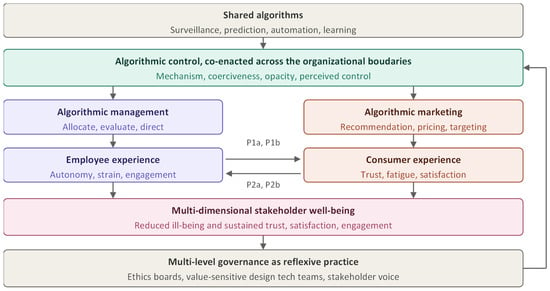
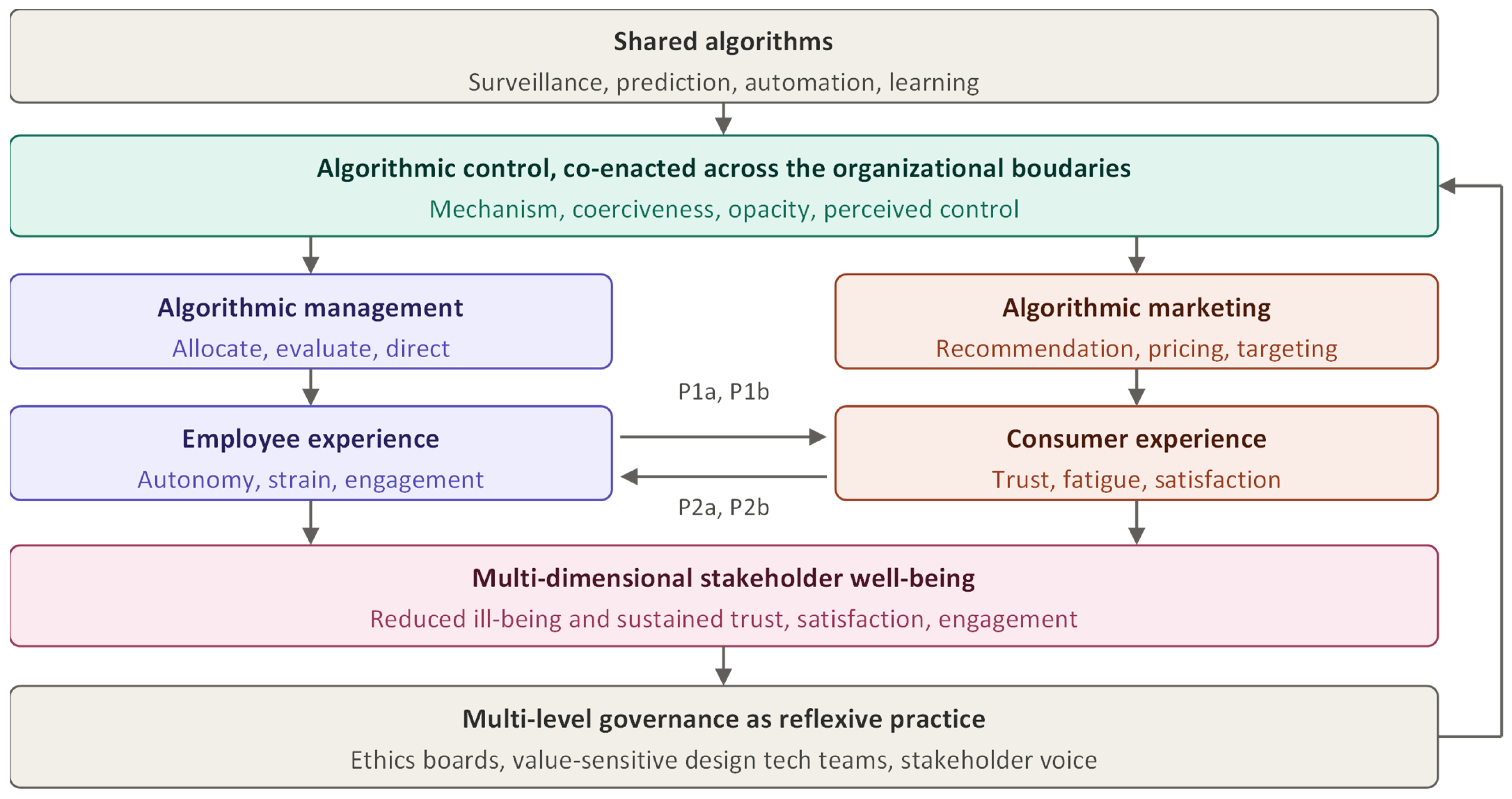
Disclaimer/Publisher’s Note: The statements, opinions and data contained in all publications are solely those of the individual author(s) and contributor(s) and not of MDPI and/or the editor(s). MDPI and/or the editor(s) disclaim responsibility for any injury to people or property resulting from any ideas, methods, instructions or products referred to in the content. |
© 2026 by the authors. Licensee MDPI, Basel, Switzerland. This article is an open access article distributed under the terms and conditions of the Creative Commons Attribution (CC BY) license.