


Abstract
This study aims to systematically synthesise the literature on how government auditing contributes to fiscal transparency and to explain the digital, institutional, regulatory, and organisational mechanisms through which effective auditing strengthens public accountability. Following the PRISMA 2020 reporting guidelines, the review searched Scopus and Web of Science for relevant studies published between 2017 and 2026. Following systematic screening, eligibility assessment, and quality appraisal, 32 studies were retained for thematic synthesis. The findings reveal four interconnected pathways linking government auditing to fiscal transparency: digital audit technology and innovation, audit institutional design and independence, regulatory and anti-corruption governance, and organisational and fiscal capacity. Although artificial intelligence, blockchain, and big-data analytics can strengthen audit efficiency, reliability, and fraud detection, their effectiveness depends considerably on institutional independence, regulatory enforcement, and organisational capacity. The synthesis further indicates that effective auditing can strengthen fiscal transparency and contribute to broader accountability outcomes, including corruption control, sustainable governance, and green development, although these effects vary across institutional contexts. Building on these findings, the study develops the Government Audit-Fiscal Transparency (GAFT) Framework, integrating Agency, Institutional, and Stakeholder theories to explain how these mechanisms jointly shape audit effectiveness, fiscal transparency, and accountability. The study recommends coordinated reforms combining digital investment with institutional independence, regulatory enforcement, and capacity development, while future research should empirically test the GAFT Framework across diverse institutional and geographical contexts.
1. Introduction
Fiscal transparency has become increasingly important to contemporary public governance as governments are expected not only to manage public resources efficiently but also to demonstrate how revenues are raised, expenditures are allocated, and financial decisions translate into public value. The scale of this responsibility is substantial. The Open Budget Survey 2023 assessed 125 countries representing approximately 95% of the world’s population and more than US$33.5 trillion in public expenditure, yet the global average budget-transparency score remained only 45 out of 100, considerably below the threshold of 61 considered sufficient to support informed public debate. Although global budget transparency has improved by approximately 24% since 2008 and average audit oversight reached 62 out of 100, weaknesses persist in legislative scrutiny, public participation, and the implementation of audit recommendations. These conditions reinforce the importance of government auditing because Supreme Audit Institutions, national audit offices, and subnational audit bodies occupy a critical position between public-resource management and the ability of citizens, legislatures, and other stakeholders to hold governments accountable. Government auditing therefore extends beyond financial verification by strengthening reporting reliability, exposing irregularities, improving fiscal discipline, and supporting confidence in public institutions (Coghill et al., 2026; Chen & Hu, 2025; Mukhamedyarova et al., 2025).
Despite this importance, scholarly debate remains unsettled regarding the mechanisms through which government auditing strengthens fiscal transparency and whether institutional reform or technological advancement necessarily translates into substantive accountability. One stream emphasises the transformative potential of artificial intelligence, blockchain, big-data analytics, and integrated financial-management systems, arguing that these technologies can strengthen verification, accelerate anomaly detection, reduce audit costs, and improve financial-information reliability (Bagrii et al., 2026; Sushko et al., 2026; Ievsieieva et al., 2026). A second stream emphasises institutional independence and organisational design because technological capability may have limited value when audit institutions lack autonomy, information access, adequate resources, or authority to enforce their findings (Mukhamedyarova et al., 2025; Kweyama & Nyide, 2026). This concern is particularly significant because recent international evidence indicates continuing challenges to the independence of Supreme Audit Institutions, including interference in budgetary processes and restrictions on information access. A third perspective emphasises regulatory and participatory mechanisms, including forensic auditing, anti-corruption measures, open-government initiatives, and social auditing, as complementary pathways for strengthening financial accountability (Filatova et al., 2025; López et al., 2023; Taqiuddin, 2023). Consequently, the debate has moved beyond whether auditing matters towards understanding which combinations of technological, institutional, regulatory, and organisational conditions enable auditing to produce meaningful transparency and accountability.
The motivation for this review arises from the practical importance of resolving this debate. Governments are simultaneously investing in digital audit infrastructure, reforming public financial-management systems, strengthening anti-corruption regulations, and expanding transparency requirements, yet these reforms do not produce comparable outcomes across institutional settings. For example, national auditing has been associated with improved local fiscal transparency in China (Chen & Hu, 2025), whereas earlier evidence indicates that formal budget reform alone does not proportionately reduce corruption perceptions (Zhang, 2017). Similarly, emerging digital audit technologies promise greater reliability and efficiency, but their effectiveness depends on institutional modernisation, regulatory support, staff capabilities, and implementation capacity (Sushko et al., 2026; Ponomarova et al., 2025; Kweyama & Nyide, 2026). Understanding these relationships is therefore important for explaining why technically or institutionally sound reforms may succeed in one context yet produce limited accountability improvements elsewhere. Such understanding can advance public auditing scholarship while helping the auditor general, regulators, legislators, and public financial-management authorities determine how reform resources should be sequenced and combined.
However, the existing literature has not adequately integrated these mechanisms into a coherent explanation of government audit-driven fiscal transparency. Digital-audit studies largely concentrate on technological efficiency and financial-information reliability without consistently tracing these improvements to fiscal transparency and wider accountability outcomes (Hajiyev et al., 2025; Sushko et al., 2026). Research on national audit institutions provides stronger evidence of institutional effects but remains concentrated in particular settings, especially China and transitional economies (Chen & Hu, 2025; Mukhamedyarova et al., 2025). Regulatory and anti-corruption studies similarly examine forensic auditing, disclosure requirements, and participatory accountability without sufficiently connecting these interventions to technological and institutional audit capabilities (Filatova et al., 2025; López et al., 2023). Related corporate and quasi-public audit research provides potentially transferable evidence on independence, expertise, monitoring quality, and non-linear governance effects (Attia et al., 2025; Ma et al., 2025), yet these insights remain largely disconnected from government-audit scholarship. Consequently, the literature remains fragmented across disciplinary and institutional boundaries, while existing reviews generally examine individual dimensions rather than explaining how digital innovation, institutional design, regulatory governance, and organisational capacity interact in shaping fiscal transparency.
Addressing this fragmentation constitutes the principal contribution of the present study. Rather than treating digitalisation, institutional independence, regulatory governance, and organisational capacity as separate explanations, this review synthesises their interconnected roles in shaping government audit effectiveness and fiscal transparency. Using Scopus and Web of Science and reported in accordance with the PRISMA 2020 guidelines, the review synthesises 32 studies published between 2017 and 2026 and develops the Government Audit-Fiscal Transparency (GAFT) Framework. The framework integrates Agency Theory, Institutional Theory, and Stakeholder Theory to explain how digital, institutional, regulatory, and capacity conditions interact through government audit effectiveness to influence fiscal transparency and broader accountability outcomes. The study therefore shifts attention from whether government auditing improves transparency towards the more theoretically and practically important questions of how, through which mechanisms, and under what institutional conditions auditing can strengthen fiscal transparency and public accountability. Accordingly, the study addresses the following research questions:
- RQ1. What digital, institutional, and regulatory mechanisms have been empirically or conceptually linked to government audit effectiveness and fiscal transparency between 2017 and 2026?
- RQ2. How do these mechanisms interact to produce, or fail to produce, downstream accountability outcomes such as corruption control and sustainable public and corporate governance?
- RQ3. What theoretical framework can integrate the fragmented digital-technology, institutional-design, and regulatory-governance literature into a coherent model of government audit-driven fiscal transparency?
2. Literature Review
2.1. Conceptualisation of Key Variables
2.1.1. Fiscal Transparency
Fiscal transparency is conceptualised across the reviewed literature through four interrelated dimensions comprising the completeness, timeliness, accessibility, and reliability of public financial information (Coghill et al., 2026; Chen & Hu, 2025). Within this broader perspective, the Public Expenditure and Financial Accountability (PEFA) framework operationalises transparency through indicators covering procurement, external audit, performance reporting, and fiscal-risk disclosure, as demonstrated by Coghill et al. (2026) in their comparison of Australian and German local governments. In contrast, Chinese studies adopt a more output-oriented perspective by measuring fiscal transparency through provincial disclosure indices associated with the disclosure and defence functions of national auditing (Chen & Hu, 2025), while related research examines fiscal transparency as a mechanism through which government environmental auditing contributes to corporate and urban green development (H. Wang et al., 2024; Li et al., 2025). The forensic-audit and anti-corruption literature broadens this conceptualisation further by positioning fiscal transparency as an accountability outcome that emerges when financial information can be independently verified against underlying transactions and when institutional safeguards encourage accurate reporting among traditionally low-disclosure actors (Filatova et al., 2025; López et al., 2023).
Despite these different perspectives, the literature converges on the understanding that fiscal transparency is not simply a matter of financial disclosure but reflects the extent to which public financial information is accessible, credible, verifiable, and capable of supporting accountability. Importantly, its strength varies across institutional domains because transparency tends to be greater where disclosure and external auditing are formally regulated, whereas weaker outcomes persist in more discretionary areas such as performance reporting and fiscal-risk disclosure (Coghill et al., 2026). This distinction between regulated and discretionary transparency provides an important analytical basis for the present review and subsequently informs the synthesis of evidence presented in Section 4.
2.1.2. Government Auditing and Audit Effectiveness
Government auditing is conceptualised at three institutional levels, encompassing supreme or national audit institutions that conduct ex post verification of government accounts (Chen & Hu, 2025; Mukhamedyarova et al., 2025), sector-specific government audits such as environmental audits of heavily regulated enterprises (H. Wang et al., 2024; Li et al., 2025), and internal or municipal audit and financial-management functions within public organisations (Kweyama & Nyide, 2026; Taqiuddin, 2023). A related stream conceptualises audit effectiveness at the firm level through audit-committee characteristics such as independence, financial expertise, size, and meeting frequency (Attia et al., 2025; Alomair & Al Naim, 2025; Ma et al., 2025; Adam et al., 2025), alongside audit-process attributes including fees, tenure, and technology adoption (Daryaei et al., 2024; Alnor et al., 2026). Although these studies do not directly examine government auditors, they capture mechanisms comparable to the independence and capacity conditions affecting supreme audit institutions (Mukhamedyarova et al., 2025), thereby providing relevant comparative evidence for this review.
2.1.3. Digital Audit Innovation
Digital audit innovation refers to the integration of artificial intelligence, blockchain, and big-data analytics into audit processes to improve detection accuracy, verification speed, and data integrity (Bagrii et al., 2026; Ievsieieva et al., 2026; Hajiyev et al., 2025; Shalhoob et al., 2024). Within this emerging landscape, blockchain provides trust-enhancing infrastructure that can reduce verification costs and support real-time auditing (Ievsieieva et al., 2026), while artificial intelligence strengthens risk assessment and anomaly detection, thereby improving audit quality and reducing earnings management (Alnor et al., 2026; Sushko et al., 2026). Beyond these technologies, some studies extend digital innovation to financial management information systems (FMIS/IFMIS), positioning digitalisation not only as an audit mechanism but also as an information infrastructure that supports fiscal transparency (Kweyama & Nyide, 2026).
2.1.4. Theoretical Frameworks
Three theoretical perspectives underpin the reviewed literature. Agency Theory (Jensen & Meckling, 1976) positions government auditing as a monitoring mechanism that reduces information asymmetry between citizens as principals and government agents, supporting studies that associate audit independence with stronger monitoring and reporting quality (Alnor et al., 2026; Attia et al., 2025). Institutional Theory (DiMaggio & Powell, 1983) explains how audit and disclosure practices converge across jurisdictions under regulatory and normative pressures, as reflected in open-government and anti-corruption reforms (Coghill et al., 2026; López et al., 2023). Complementing these perspectives, Stakeholder Theory (Freeman, 1984) views fiscal transparency as a means of addressing the informational needs of citizens, investors, and lenders rather than merely fulfilling technical compliance requirements (Herghiligiu et al., 2023; Taqiuddin, 2023). Together, these theories provide complementary explanations of monitoring, institutional pressure, and stakeholder accountability, thereby establishing the theoretical foundation for the integrative framework developed in Section 5 and compared in Table 1.
Table 1.
Comparative overview of theoretical frameworks applied in the reviewed literature.
2.2. Review of Previous SLR and Empirical Studies
Prior reviews related to this topic have largely examined individual mechanisms rather than integrating digital, institutional, and regulatory dimensions. Ma et al. (2025) synthesise audit-committee financial expertise but focus on United States private-sector governance without extending the evidence to government audit institutions. Similarly, Hajiyev et al. (2025) review the digitalisation of international auditing but do not trace digital innovations to fiscal-transparency or accountability outcomes. Within government-audit research, Chen and Hu (2025) and Li et al. (2025) provide Chinese provincial and city-level evidence, although their findings remain context-specific. Mukhamedyarova et al. (2025) broaden this perspective through cross-country comparison, but their correlational design limits causal interpretation, while Coghill et al. (2026) apply the PEFA framework across two high-income countries, with the four-case design limiting wider generalisability. Collectively, these studies provide important but fragmented evidence, as the existing literature has yet to integrate technological adoption, institutional design, and regulatory governance within a unified theoretical synthesis. Table 2 positions these studies against the present review and highlights its integrative contribution.
Table 2.
Comparative overview of selected prior reviews and their relationship to the present study.
A further limitation is the weak integration between technological and institutional perspectives. Studies examining AI- and blockchain-enabled auditing (Bagrii et al., 2026; Ievsieieva et al., 2026; Sushko et al., 2026) rarely connect their findings with research on audit independence and audit-committee effectiveness (Attia et al., 2025; Alomair & Al Naim, 2025), although both streams address mechanisms that shape audit effectiveness. Consequently, the literature provides fragmented explanations of how technological capability and institutional design interact to strengthen auditing and transparency. The present review addresses this fragmentation through the four-pillar synthesis developed in Section 5.2.
3. Methodology
3.1. Review Design
This review follows the PRISMA 2020 guidelines (Page et al., 2021) to ensure a transparent, replicable, and systematic review process encompassing the identification, screening, eligibility assessment, and inclusion of relevant studies. This review is reported in accordance with the PRISMA 2020 statement and checklist (Supplementary Materials); the completed PRISMA 2020 flow diagram is presented as Figure 1 in Section 3.4. No review protocol was prospectively registered in a public registry (e.g., PROSPERO), and no registration number is therefore applicable.
3.2. Search Strategy
Scopus and Web of Science were used to identify relevant studies, providing complementary coverage of peer-reviewed literature across auditing, public administration, accounting, and governance. The search combined two clusters of terms comprising an audit cluster (“government au-diting” OR “public auditing” OR “state auditing” OR “audit accountability”) and a transparency cluster (“fiscal transparency” OR “financial transparency” OR “budget transpar-ency” OR “transparency in government”), which were connected using the Boolean AND operator and applied to titles, abstracts, and keywords. In Scopus, the query was run in the TITLE-ABS-KEY field and limited to articles (DOCTYPE “ar”), English-language publications (LANGUAGE “English”), journal sources (SRCTYPE “j”), the final publication stage (PUBSTAGE “final”), and open-access publications (OA “all”). The Scopus search was executed in two runs with identical search terms and limits, the first covering 2016–2025 (PUBYEAR > 2015 AND PUBYEAR < 2026) and the second covering 2026 (PUBYEAR > 2025 AND PUBYEAR < 2027); the records from both runs were combined before duplicate removal, and the 2017–2026 publication window specified in Table 3 was applied during screening. In the Web of Science Core Collection, the same query was run in the Topic (TS) field with equivalent refinements for document type (Article), language (English), open access, and publication years. The searches in both databases were last conducted on 15 August 2026. The complete database-specific search strings are reported in Supplementary Table S1.
3.3. Inclusion and Exclusion Criteria
Table 3 sets out the criteria used to determine eligibility at both the title/abstract and full-text screening stages.
Table 3.
Inclusion and exclusion criteria.
3.4. Study Selection and Screening
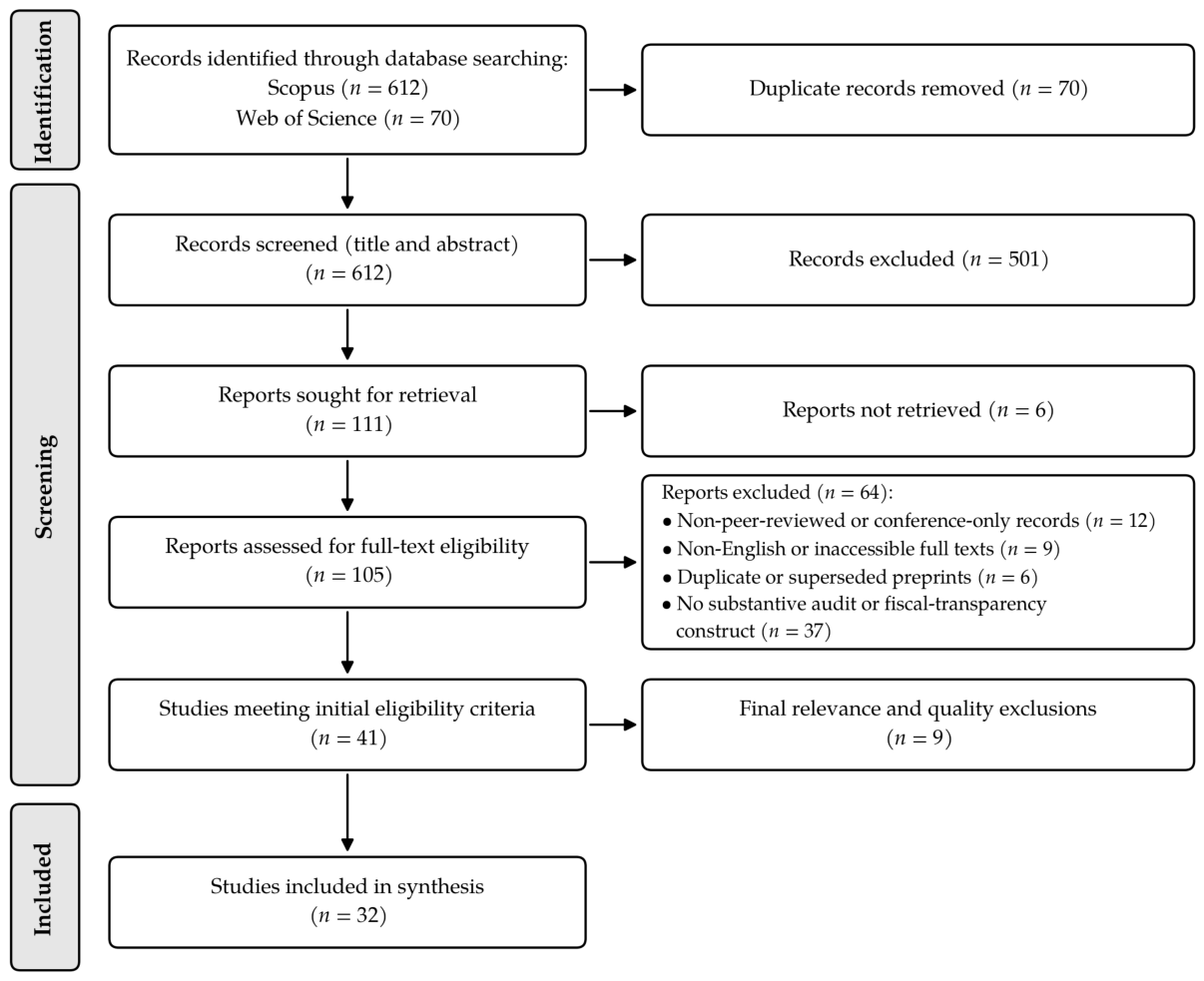
Database searching identified 682 records, comprising 612 from Scopus and 70 from Web of Science. After removing 70 duplicates, 612 records were screened by title and abstract, resulting in the exclusion of 501 records that did not sufficiently address auditing, fiscal transparency, or accountability. The remaining 111 reports were sought for full-text retrieval, of which six could not be retrieved, leaving 105 reports for eligibility assessment against the criteria presented in Table 3. Following full-text assessment, 64 reports were excluded because they were non-peer-reviewed or conference publications (n = 12), non-English or inaccessible (n = 9), duplicate or superseded preprints (n = 6), or did not substantively address audit or fiscal-transparency constructs (n = 37). Consequently, 41 studies met the initial eligibility criteria, after which the final relevance and quality assessment described in Section 3.5 excluded nine studies, resulting in 32 studies retained for the final synthesis. Figure 1 presents the complete PRISMA 2020 study-selection process. Title and abstract screening and full-text eligibility assessment were conducted by a single reviewer, and all inclusion and exclusion decisions were subject to supervisory review by a senior researcher, with uncertain cases resolved through discussion before a final decision was made.
Figure 1.
Screening process.
3.5. Quality Appraisal
Following full-text eligibility assessment, the 41 studies underwent structured quality appraisal to determine the final synthesis sample and assess confidence in the evidence. Each study was scored from 0 to 2 across four criteria covering the clarity of the research question, appropriateness of the research design, adequacy of the sample or data source, and clarity and traceability of the findings, producing a maximum score of 8 as detailed in Table 4. Studies scoring below 5, or those in which auditing or transparency remained peripheral despite meeting the initial eligibility criteria, were excluded. This assessment removed nine studies and resulted in a final sample of 32 studies for thematic synthesis. Quality appraisal was likewise performed by a single reviewer and verified through supervisory review. The individual criterion scores and total scores for all 41 appraised studies, together with the reason for excluding each of the nine studies removed at this stage, are reported in Supplementary Table S2. Of these nine studies, one (a teaching case without original data) scored below the threshold, while eight met the quality threshold but were excluded because auditing or fiscal and financial transparency was peripheral to their research focus, for example studies of SME financing choices, audit-fee determinants, or firm valuation.
Table 4.
Quality-appraisal criteria and scoring rubric.
3.6. Data Extraction and Thematic Synthesis
For the 32 included studies, data were systematically extracted on authorship and year, geographical and institutional context, theoretical framework, research design and methodology, sample or data source, principal findings, and identified gaps or limitations, as reported in Section 4. The synthesis employed a hybrid inductive–deductive thematic approach in which initial coding was guided by four mechanism categories comprising digital technology, institutional design, regulatory and anti-corruption governance, and organisational and fiscal capacity. These categories were subsequently refined through inductive analysis as additional patterns emerged from the evidence, including the distinction between regulated and discretionary transparency and the non-linear effects of audit-committee attributes. Data extraction was performed by a single reviewer using a predefined extraction template covering the fields listed above, and the extracted data were checked against the full texts of the included studies through supervisory review.
4. Results
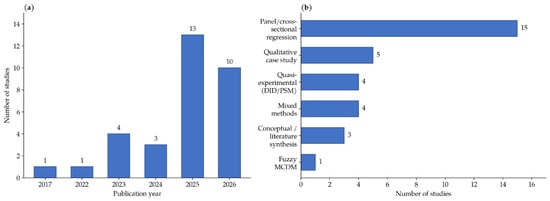
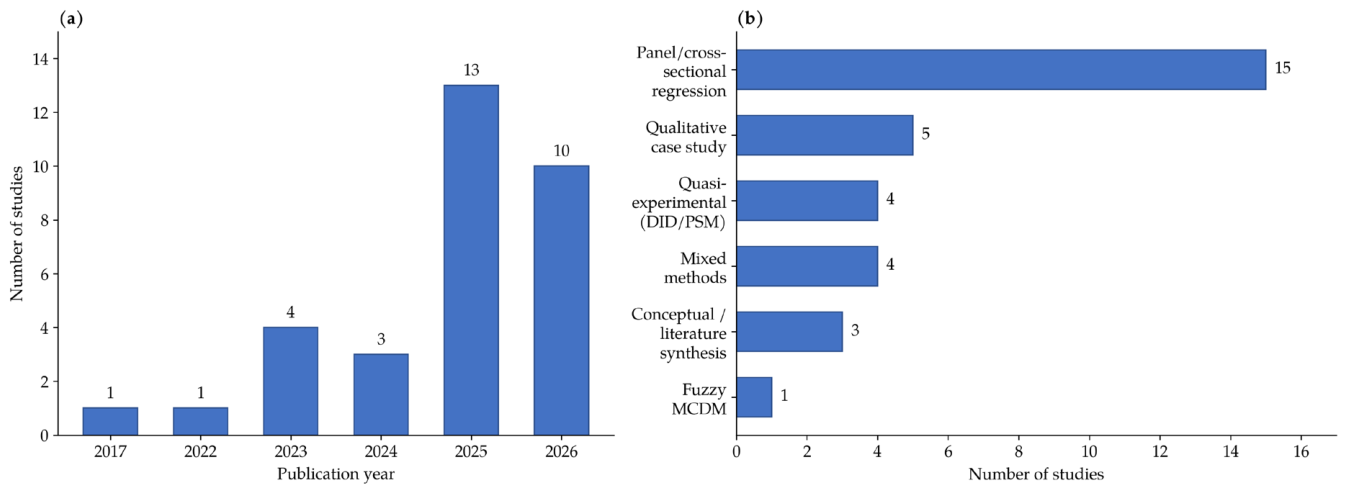
The 32 included studies were published between 2017 and 2026, with 23 studies (72%) appearing in 2025–2026, indicating growing scholarly attention to digital auditing and open-government reforms. Quantitative panel or cross-sectional regression designs dominated the literature (n = 15), followed by qualitative case studies (n = 5), quasi-experimental or difference-in-differences designs (n = 4), mixed-method studies combining regression with cases or Delphi approaches (n = 4), conceptual or literature-synthesis studies (n = 3), and one fuzzy multi-criteria decision-making study, as illustrated in Figure 2. Geographically, China (n = 6), Ukraine (n = 5), and Saudi Arabia (n = 4) were the most represented single-country contexts, while the remaining studies covered Vietnam, Egypt, Kazakhstan, South Africa, Australia and Germany jointly, Spain, India, Iran, Romania, Morocco, the United Kingdom, Azerbaijan, and the United States. In terms of organisational setting, 10 studies examined government or public-sector auditing directly (Bagrii et al., 2026; Coghill et al., 2026; Kweyama & Nyide, 2026; Mukhamedyarova et al., 2025; Chen & Hu, 2025; Li et al., 2025; Filatova et al., 2025; H. Wang et al., 2024; Taqiuddin, 2023; Zhang, 2017), eight examined quasi-public, non-governmental, or sector-neutral audit settings (such as political parties, state-owned enterprises, a hospital, a faith-based organisation, and general audit-technology practice), and 14 examined corporate settings. The corporate studies were retained as comparative evidence on audit-governance mechanisms that have analogues in public-sector audit bodies, and their role in the GAFT Framework is qualified in Section 5.2. Table 5 summarises the 32 included studies, while Section 4.1, Section 4.2, Section 4.3 and Section 4.4 present the four thematic pillars emerging from the synthesis, which are consolidated in Table 6.
Figure 2.
Profile of the 32 reviewed studies by (a) publication year and (b) research methodology.
Table 5.
Summary of the 32 studies included in the final synthesis.
Four coherent themes emerged from the thematic synthesis of the studies in Table 5, as presented in Section 4.1, Section 4.2, Section 4.3 and Section 4.4 below.
4.1. Theme 1—Digital Audit Technology and Innovation
The first theme captures the growing integration of AI, blockchain, and big-data analytics into audit processes. Bagrii et al. (2026) propose a cognitively stratified digital fiscal-control architecture integrating AI-based risk stratification, distributed-ledger traceability, and autonomous compliance verification, although the framework remains conceptual and requires empirical validation. Empirically, Sushko et al. (2026) demonstrate that combining AI, blockchain, and digital platforms increases financial-information reliability by more than 25% compared with traditional control procedures, while Ievsieieva et al. (2026) find that blockchain adoption reduces verification time and audit costs while improving reporting reliability in Ukraine. Complementary evidence from Alnor et al. (2026) associates AI adoption in Saudi-listed firms with significantly lower earnings management, partly through improved audit quality. Shalhoob et al. (2024) further identify data quality, privacy, system integration, staff skills, cost, and regulation as critical conditions determining whether big-data analytics strengthens error and fraud detection.
Across these studies, digital technologies consistently enhance audit efficiency and information reliability, but their effectiveness remains conditional on the surrounding institutional environment. Evidence from transitional and emerging economies demonstrates substantial benefits where digital reforms are supported by broader modernisation efforts (Sushko et al., 2026; Ievsieieva et al., 2026). However, these benefits become less certain where institutional capacity does not develop alongside technological investment. Ponomarova et al. (2025), for example, find that a “Digital Reinvention” scenario significantly predicts post-war Ukrainian accounting and auditing reform, although the model explains only approximately 41% of the variance. This finding indicates that technological advancement alone cannot fully explain audit reform and highlights the complementary importance of institutional and regulatory conditions examined in Section 4.2.
The theme also extends beyond technological adoption to the behavioural conditions influencing the expansion of audit functions. Hoai (2026) finds that Vietnamese audit firms’ willingness to provide ESG assurance is driven primarily by subjective norms rather than attitudes or perceived behavioural control. This evidence suggests that the expansion of auditing into emerging assurance domains depends not only on technological capability but also on professional and peer expectations, reinforcing the interaction between digital innovation and the broader institutional environment.
4.2. Theme 2—Audit Institutional Design and Independence
The second theme examines how the structure and independence of audit institutions, including national audit offices, municipal financial-management functions, and corporate audit committees, shape audit effectiveness. At the government level, Chen and Hu (2025) provide strong causal evidence that national audits improve local fiscal transparency in China through their disclosure and defence functions, with stronger effects in eastern provinces with higher land-finance dependence. Cross-national evidence from Mukhamedyarova et al. (2025) similarly associates stronger and more independent public-audit institutions with more effective local-budget governance, although legislative oversight and citizen participation remain comparatively weak even where audit institutions are formally strong. At the municipal level, Kweyama and Nyide (2026) find fragmented financial-management information systems in South African municipalities, characterised by underutilised modules and incomplete alignment with national chart-of-accounts standards. Together, these findings indicate that formal institutional structures are important but insufficient without effective implementation and complementary governance capacity.
Comparative corporate-governance evidence adds an important qualification by demonstrating that audit attributes do not necessarily influence reporting quality linearly. Attia et al. (2025) identify a U-shaped relationship between audit-committee attributes and earnings manipulation among Egyptian listed firms, indicating threshold effects in the influence of independence and committee size. Similarly, Alomair and Al Naim (2025) show that examining audit-committee independence and expertise separately reveals differentiated effects on the value relevance of financial reporting, while Ma et al. (2025) demonstrate that financial expertise strengthens monitoring through the combined advantages of information access and analytical capability. Although derived from corporate settings, these findings qualify a simple linear interpretation of audit independence and suggest that the effects of institutional strengthening may depend on the configuration and interaction of specific governance attributes.
Further comparative evidence reinforces this conditional perspective. Kharbach and Zaam (2026) associate effective internal auditing with stronger early fraud detection in Moroccan listed companies, while Thanh and Minh (2026) find that board independence and audit-committee presence strengthen accounting-information-system effectiveness in Vietnamese firms, although excessive board size weakens these benefits. Dang (2026) further shows that earnings management increases the cost of debt among Vietnamese listed firms, particularly those audited by Big Four firms, while Hassaan and Salah (2023) find that the positive relationship between corporate governance and financial transparency in Egypt strengthened following the 2016 currency-devaluation shock. Collectively, this comparative evidence suggests that audit and governance attributes can strengthen transparency, but their effects remain conditional on institutional configuration, organisational characteristics, and external pressures rather than following a uniformly linear pattern.
4.3. Theme 3—Regulatory and Anti-Corruption Governance
The third theme examines legal, regulatory, and participatory mechanisms that reinforce fiscal transparency alongside routine audit activity. Filatova et al. (2025) demonstrate that forensic-audit techniques applied to Ukraine’s public debt improve the verifiable consistency of financial statements, positioning forensic auditing as a specialised regulatory mechanism particularly relevant under fiscal stress. Similarly, López et al. (2023) show that institutional anti-corruption measures in Spain progressively improved the financial transparency and accounting quality of political-party disclosures, indicating that regulatory pressure can independently strengthen transparency in traditionally low-disclosure organisations. Taqiuddin (2023) extends this perspective to India’s Panchayati Raj Institutions, where social auditing, e-governance platforms, and citizen participation collectively strengthen financial and social accountability. These findings demonstrate that transparency emerges not solely through formal auditing but through the interaction of audit, regulatory, and participatory mechanisms.
However, regulatory reform does not automatically translate into substantive accountability. Zhang (2017) finds that formal budgetary restructuring in China does not proportionately reduce perceptions of corruption, revealing a gap between institutional reform and realised governance outcomes. When considered alongside the more recent findings of Chen and Hu (2025), which associate national auditing with improved local fiscal transparency, the evidence suggests that the effectiveness of fiscal and regulatory reforms varies across institutional and temporal contexts and depends on complementary enforcement, disclosure, and audit mechanisms.
W. Wang et al. (2025) provide a methodological extension to this theme by applying fuzzy multi-criteria decision-making to prioritise factors shaping accounting and auditing principles under regulatory uncertainty in a Chinese hospital. Although the single-institution design limits generalisability, the approach provides a structured basis for prioritising regulatory-compliance interventions and offers potential applicability to government-audit settings characterised by similarly complex regulatory environments.
4.4. Theme 4—Organisational and Fiscal Capacity, and Downstream Outcomes
The fourth theme examines how organisational and fiscal capacity conditions the extent to which audit and transparency mechanisms contribute to broader governance outcomes, particularly environmental and sustainability performance. H. Wang et al. (2024) show that government environmental auditing promotes green development among Chinese heavily polluting firms partly through improved fiscal transparency. Li et al. (2025) extend this evidence across prefecture-level cities, finding that environmental auditing improves urban green-economy outcomes, with stronger effects where baseline fiscal transparency is lower and outcomes moderated by fiscal decentralisation. This suggests that auditing may partly compensate for weak fiscal transparency rather than merely complement well-established transparency systems. Similarly, X. Wang and Hu (2022) find that performance-based budgeting reform improves the environmental, social, and governance performance of Chinese state-owned enterprises through fiscal-discipline and transparency mechanisms.
Organisational capacity further determines whether these mechanisms translate into effective outcomes. Kweyama and Nyide (2026) attribute uneven FMIS effectiveness in South African municipalities primarily to resource and skill constraints rather than institutional design alone. Comparative evidence from Chigogora et al. (2025) similarly identifies resource, training, and independence constraints as barriers to audit efficiency and accuracy in a faith-based organisational setting. Although derived outside government auditing, this evidence reinforces the broader finding that technological and institutional reforms require adequate human, organisational, and fiscal capacity for effective implementation. Capacity therefore operates as a complementary condition connecting the mechanisms identified in Themes 1 and 2 with transparency and accountability outcomes.
Further comparative evidence links these capacity and governance conditions to sustainability outcomes. Amer et al. (2025) find that earnings management reduces sustainability performance among UK listed firms, whereas IFRS adoption improves it, with institutional ownership and board independence conditioning these relationships. Considered alongside evidence from Chinese state-owned enterprises and heavily polluting firms (H. Wang et al., 2024; X. Wang & Hu, 2022), these findings indicate that the relationship between auditing, transparency, and broader governance outcomes depends substantially on organisational capacity and governance arrangements across institutional contexts.
4.5. Synthesis Across the Four Thematic Pillars
Table 6 consolidates the four themes by linking each thematic pillar to its underlying mechanism, representative studies, and contribution to the integrative framework developed in Section 5.2.
Table 6.
Synthesis of findings across the four thematic pillars.
5. Discussion
5.1. Interpreting the Findings in Relation to Theory and Prior Studies
The four themes identified in Section 4 align closely with the three theoretical perspectives introduced in Section 2.1.4 while also extending their explanatory boundaries. Consistent with Agency Theory, digital audit technology (Theme 1) and audit institutional independence (Theme 2) strengthen monitoring and reduce information asymmetry between government agents and citizen-principals (Jensen & Meckling, 1976; Chen & Hu, 2025; Alnor et al., 2026). However, the non-linear audit-committee findings of Attia et al. (2025) and Alomair and Al Naim (2025) qualify a simple linear application of agency-based monitoring logic. Their findings suggest that greater independence or monitoring intensity does not necessarily produce proportionate improvements in reporting quality. Although derived from corporate settings, this evidence raises an important proposition for government auditing because the effects of institutional independence may depend on how audit structures and capabilities are configured rather than on independence alone (Mukhamedyarova et al., 2025).
Institutional Theory provides a complementary explanation for the regulatory and anti-corruption mechanisms identified in Theme 3. Improvements in Spanish political-party disclosure following anti-corruption reforms (López et al., 2023) and the adoption of Open Government Partnership commitments across Australian and German local governments (Coghill et al., 2026) reflect coercive and normative pressures that encourage convergence towards recognised transparency practices (DiMaggio & Powell, 1983). However, Zhang (2017) shows that formal budget reform does not proportionately reduce perceptions of corruption, indicating that institutional adoption may occur without corresponding behavioural change. This finding distinguishes formal compliance from substantive transparency and demonstrates why regulatory structures require effective enforcement and implementation to produce meaningful accountability outcomes.
The capacity-related findings in Theme 4 similarly extend Stakeholder Theory. Herghiligiu et al. (2023) and Taqiuddin (2023) conceptualise fiscal and social transparency as mechanisms for addressing the informational needs of different stakeholder groups. The present synthesis demonstrates, however, that fulfilling these informational expectations depends on organisational capacity. Evidence from Kweyama and Nyide (2026) and comparative findings from Chigogora et al. (2025) indicate that institutions may recognise stakeholder demands and establish disclosure obligations while lacking the resources, skills, or operational capacity required to fulfil them effectively. This creates a capacity-dependent gap between stakeholder-oriented intentions and realised transparency outcomes that remains insufficiently incorporated into existing applications of Stakeholder Theory.
The synthesis also extends the prior literature by connecting theoretical and empirical streams that have largely developed separately. It advances Hajiyev et al. (2025) and Shalhoob et al. (2024) by linking digital audit adoption with fiscal-transparency and accountability outcomes rather than limiting analysis to audit-process efficiency, while the comparative evidence from Ma et al. (2025) provides insights into how expertise and monitoring mechanisms may inform government-audit research. The apparently contrasting findings of Chen and Hu (2025) and Zhang (2017) further demonstrate that formal fiscal reform and effective auditing should not be treated as equivalent mechanisms. One possible explanation lies in the distinction between regulated and discretionary transparency identified in Section 2.1.1. National auditing may directly strengthen regulated dimensions such as disclosure and external verification (Chen & Hu, 2025), whereas formal budget reform alone may be insufficient to transform discretionary and behaviourally embedded practices associated with corruption (Zhang, 2017). Together, these findings demonstrate the need for an integrative explanation of how technological, institutional, regulatory, and capacity mechanisms interact to shape audit effectiveness and fiscal transparency, providing the foundation for the GAFT Framework developed in Section 5.2.
5.2. The Government Audit-Fiscal Transparency (GAFT) Framework
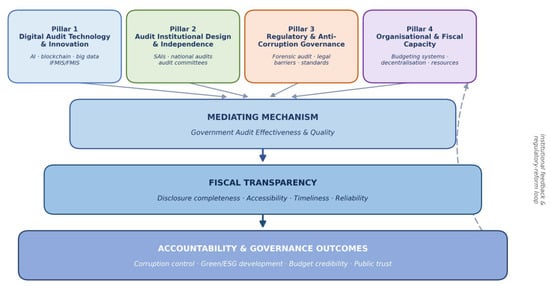
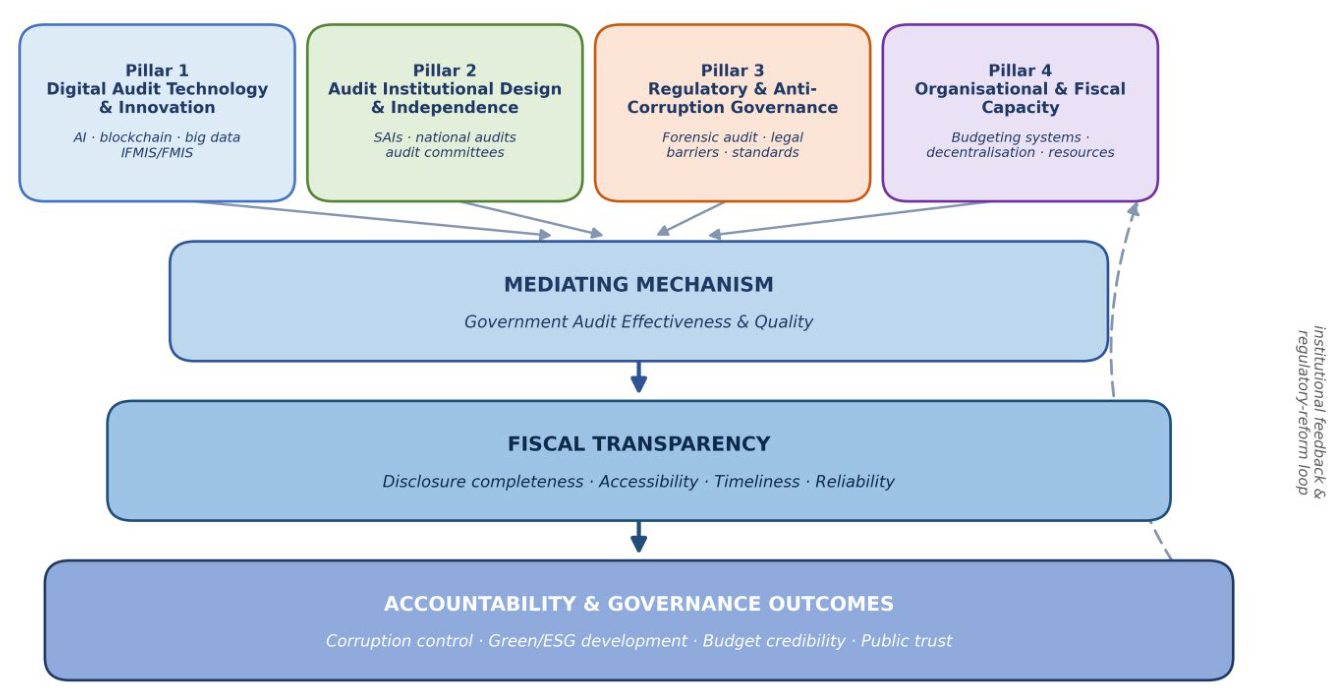
To integrate the four themes and preceding theoretical discussion, this review proposes the Government Audit-Fiscal Transparency (GAFT) Framework (Figure 3). The framework organises the identified mechanisms into four interrelated pillars that jointly shape government audit effectiveness, which is positioned as the central mechanism through which these conditions influence fiscal transparency and, subsequently, broader accountability and governance outcomes.
Figure 3.
The Government Audit-Fiscal Transparency (GAFT) Framework.
Pillar 1, Digital Audit Technology and Innovation, reflects evidence that AI, blockchain, and big-data analytics can strengthen audit reliability and efficiency (Sushko et al., 2026; Ievsieieva et al., 2026; Bagrii et al., 2026). Pillar 2, Audit Institutional Design and Independence, captures the influence of national-audit functions, institutional independence, and audit-governance attributes on monitoring effectiveness (Chen & Hu, 2025; Attia et al., 2025; Ma et al., 2025). Pillar 3, Regulatory and Anti-Corruption Governance, incorporates forensic auditing, anti-corruption measures, and participatory accountability mechanisms that reinforce transparency and compliance (Filatova et al., 2025; López et al., 2023; Taqiuddin, 2023). Pillar 4, Organisational and Fiscal Capacity, recognises that resources, skills, and fiscal conditions influence whether technological, institutional, and regulatory mechanisms are effectively implemented (Kweyama & Nyide, 2026; Li et al., 2025; Chigogora et al., 2025).
Rather than treating these pillars as independently sufficient conditions, the GAFT Framework positions them as complementary mechanisms that jointly shape government audit effectiveness. Audit effectiveness subsequently provides the central pathway through which these conditions can strengthen fiscal transparency (Chen & Hu, 2025; Coghill et al., 2026) and contribute to broader accountability and governance outcomes, including corruption control, green development, and sustainability performance (Zhang, 2017; H. Wang et al., 2024; X. Wang & Hu, 2022; Li et al., 2025). The framework further proposes a feedback relationship whereby improvements in transparency and accountability can reinforce subsequent institutional and regulatory reform (Coghill et al., 2026; López et al., 2023). Accordingly, the GAFT Framework conceptualises government audit effectiveness as the connecting mechanism through which digital, institutional, regulatory, and capacity conditions may be translated into fiscal transparency and wider governance outcomes.
The scope of the GAFT Framework also requires clarification because the reviewed evidence derives from different organisational settings. As reported in Section 4, 10 of the 32 included studies examine government or public-sector auditing directly; eight examine quasi-public, non-governmental, or sector-neutral settings; and 14 examine corporate settings. Corporate studies were retained because they isolate audit-governance mechanisms, such as audit-committee independence and expertise, audit-technology adoption, and internal-audit effectiveness, that have analogues in public-sector audit bodies. However, their findings cannot be assumed to transfer directly to government auditing, where audit mandates, political oversight, and accountability relationships differ. Table 7 therefore distinguishes the relationships in the framework that are directly supported by government-audit evidence from those that rest mainly on corporate or quasi-public evidence, or on theoretical integration across studies, and which should accordingly be treated as propositions requiring further empirical validation in government settings.
Table 7.
Evidential basis of the relationships specified in the GAFT Framework.
Accordingly, the GAFT Framework should be read as an integrative explanatory framework rather than an empirically validated causal model. Its relationships concerning institutional independence, regulatory and anti-corruption governance, and the broader accountability effects of government auditing are grounded in public-sector evidence, whereas the technology pathway, the threshold effects of independence, the mediating role of audit effectiveness, and the complementarity and feedback relationships among the pillars remain propositions that require direct testing in government audit institutions. The future research agenda in Section 5.5 is structured around testing these propositions.
5.3. Theoretical Implications
The GAFT Framework makes three principal theoretical contributions to the government auditing and fiscal-transparency literature. First, it integrates Agency Theory, Institutional Theory, and Stakeholder Theory within a unified audit-transparency framework, addressing the theoretical fragmentation identified in Section 1 and Section 2.2. Existing studies typically apply these perspectives independently, thereby explaining only particular dimensions of the audit-transparency relationship. Agency Theory explains how auditing reduces information asymmetry and strengthens monitoring between government agents and citizen-principals, while Institutional Theory explains how regulatory, normative, and legitimacy pressures shape audit and disclosure practices. Stakeholder Theory extends this reasoning by explaining why credible and accessible fiscal information matters to citizens, legislatures, investors, and other accountability actors. By integrating these perspectives, the GAFT Framework demonstrates that fiscal transparency cannot be adequately explained through monitoring, institutional pressure, or stakeholder responsiveness alone. Instead, meaningful transparency emerges from their interaction through audit effectiveness, thereby providing a more comprehensive theoretical explanation of how auditing contributes to public accountability.
Second, the framework extends conventional interpretations of audit independence by introducing the possibility of conditional and non-linear effects within Pillar 2. Government-audit research generally associates stronger institutional independence with improved audit and governance outcomes (Mukhamedyarova et al., 2025). However, comparative corporate evidence from Attia et al. (2025) and Alomair and Al Naim (2025) indicates that governance attributes may produce differentiated or non-linear effects rather than uniformly increasing reporting quality. The GAFT Framework therefore does not assume that progressively greater independence automatically generates proportionate improvements in audit effectiveness. Instead, it proposes that the benefits of institutional strengthening may depend on its interaction with expertise, organisational structure, regulatory authority, and implementation capacity. This proposition extends agency-based monitoring logic by shifting attention from the amount of independence towards the institutional configuration through which independence becomes effective. Because the underlying non-linear evidence originates primarily from corporate settings, however, its applicability to government audit institutions remains a theoretical proposition requiring direct empirical testing.
Third, the framework advances existing theory by positioning organisational and fiscal capacity as a substantive theoretical pillar rather than treating capacity merely as contextual background or a statistical control. Digital technologies may provide sophisticated audit capabilities, and institutional reforms may establish formal independence and regulatory authority, yet neither necessarily produces effective auditing when institutions lack skilled personnel, financial resources, interoperable systems, or implementation capability (Kweyama & Nyide, 2026; Chigogora et al., 2025). The GAFT Framework therefore conceptualises capacity as a complementary condition that influences whether technological, institutional, and regulatory mechanisms can be translated into effective audit practice. This extends digital-audit research, which often prioritises technological capability (Sushko et al., 2026), and institutional-design research, which emphasises formal audit structures and independence (Chen & Hu, 2025), by explaining why similar reforms may generate different outcomes across institutional settings.
Taken together, these contributions shift the theoretical focus from examining whether individual audit mechanisms improve transparency towards explaining how their interaction produces effective auditing under different institutional conditions. The GAFT Framework consequently offers a more integrated account in which technology strengthens audit capability, institutional design provides autonomy and monitoring authority, regulatory governance creates enforcement and accountability pressures, and organisational and fiscal capacity enables these mechanisms to function in practice. Government audit effectiveness connects these conditions with fiscal transparency, while transparency provides a pathway towards broader accountability and governance outcomes. In this way, the framework establishes theoretically testable relationships that future research can examine across countries, levels of government, and institutional settings.
5.4. Practical and Policy Implications
The GAFT Framework offers several practical implications for audit institutions, regulators, and public financial-management authorities. For auditors-general and national audit offices, digital investment should be implemented alongside institutional-independence reform and capacity development rather than pursued as a stand-alone modernisation strategy. The moderate explanatory power of digital-reform scenarios identified by Ponomarova et al. (2025) indicates that technological advancement may produce limited gains when institutional structures, regulatory arrangements, and implementation capabilities remain underdeveloped. Accordingly, investments in AI, blockchain, and data analytics should be accompanied by measures that strengthen auditor autonomy, professional skills, data access, and organisational readiness, enabling technological capabilities to translate into effective auditing and fiscal transparency.
For regulators and legislators, the evidence highlights the complementary role of regulatory and participatory mechanisms in strengthening accountability. Anti-corruption disclosure measures and citizen-based social auditing can reinforce formal audit systems by expanding scrutiny beyond conventional institutional channels (López et al., 2023; Taqiuddin, 2023). Such mechanisms may be particularly valuable in capacity-constrained settings where expanding formal audit structures alone may not generate corresponding improvements in transparency. Rather than treating regulatory enforcement, citizen participation, and institutional auditing as competing approaches, policymakers should coordinate these mechanisms to strengthen disclosure, verification, and public accountability.
At the municipal and subnational levels, effective digitalisation requires greater attention to implementation rather than technology acquisition alone. Kweyama and Nyide (2026) demonstrate that fragmented FMIS implementation, underutilised modules, and incomplete alignment with national chart-of-accounts standards can weaken the expected benefits of digital financial-management systems. Municipal authorities should therefore link FMIS and IFMIS investments with measurable implementation targets, staff capability development, system integration, and compliance with national accounting standards. This approach shifts digital reform from one-off technology procurement towards sustained institutional capability development.
Finally, policymakers responsible for state-owned and heavily regulated enterprises can use environmental and performance-based auditing as complementary mechanisms for strengthening transparency and sustainability governance. Evidence from H. Wang et al. (2024), X. Wang and Hu (2022), and Li et al. (2025) indicates that audit and budgeting interventions can improve environmental and green-development outcomes through fiscal-discipline and transparency channels. These findings suggest that audit mandates can support broader sustainability objectives, particularly where direct transparency reforms remain institutionally difficult. Collectively, the GAFT Framework therefore encourages coordinated reform across its four pillars, recognising that sustainable improvements in fiscal transparency are more likely when technological capability, institutional independence, regulatory governance, and organisational capacity are strengthened together.
5.5. Future Research Directions
Three future-research priorities follow from the gaps identified in Table 5 and Table 6 and the theoretical discussion above, summarised in Table 8 alongside a suggested research design for each.
Table 8.
Future research agenda.
Beyond these priorities, future research should examine the cross-context applicability of the GAFT Framework. Given that government-audit evidence in the reviewed literature is concentrated largely in China and post-Soviet transitional economies, it remains uncertain whether the four pillars and the proposed pathway through government audit effectiveness operate similarly across different institutional environments. Future systematic reviews and primary empirical studies should therefore test the framework across underrepresented contexts, particularly countries with different levels of institutional development, audit independence, digital maturity, and regulatory capacity. Such cross-country and comparative research would clarify whether the relationships proposed by the GAFT Framework are broadly transferable or contingent on specific institutional and governance conditions.
5.6. Limitations
This review has several limitations that qualify the findings and the GAFT Framework. First, the search was restricted to Scopus and Web of Science and to English-language, peer-reviewed journal articles published between 2017 and 2026; it was further limited to open-access publications, so relevant subscription-only studies may have been omitted. Relevant grey literature, non-English scholarship, and audit-office technical reports were therefore excluded, and forward/backward citation snowballing was not performed. Second, methodological quality was assessed using a general four-criterion appraisal rubric (Table 4) rather than a domain-specific risk-of-bias instrument, because the heterogeneous mix of econometric, qualitative, and conceptual designs in the corpus is not well served by any single standardised tool; this rubric informed inclusion decisions and confidence in individual studies but does not constitute a formal risk-of-bias assessment in the Cochrane sense. Third, reporting bias (e.g., the tendency for studies reporting significant or favourable audit effects to be more publishable) was not formally assessed and cannot be ruled out. In addition, study selection, quality appraisal, and data extraction were performed by a single reviewer with supervisory review rather than by two independent reviewers, which may increase the risk of selection and extraction error; the explicit eligibility criteria, the scoring rubric, and supervisory verification were used to mitigate this risk, and the individual appraisal scores are reported in Supplementary Table S2 to allow independent scrutiny. Fourth, because the included studies used heterogeneous designs, measures, and contexts, this review reports a narrative thematic synthesis rather than a meta-analysis, and no pooled effect sizes or formal heterogeneity statistics are reported; certainty in the synthesised findings is therefore expressed qualitatively, informed by study quality scores and the consistency of findings across studies, rather than through a formal certainty-rating framework such as GRADE. Finally, thematic coding, while conducted systematically, involves interpretive judgement, and the corpus remains geographically and sectorally uneven, with China, Ukraine, and Saudi Arabia comparatively over-represented; moreover, 14 of the 32 studies derive from corporate settings and are used as comparative evidence, so relationships in the GAFT Framework that rest mainly on this evidence are presented as propositions rather than established findings (Table 7); the GAFT Framework’s cross-context applicability accordingly requires further empirical testing, as noted in Section 5.5.
6. Conclusions
This systematic literature review synthesised 32 studies to examine how digital, institutional, regulatory, and organisational mechanisms shape government auditing and fiscal transparency. The findings demonstrate that fiscal transparency does not arise from any single reform mechanism but from the interaction of four interconnected pillars comprising digital audit technology and innovation, audit institutional design and independence, regulatory and anti-corruption governance, and organisational and fiscal capacity. Building on this synthesis, the proposed Government Audit-Fiscal Transparency (GAFT) Framework integrates Agency, Institutional, and Stakeholder theories and positions government audit effectiveness as the central mechanism through which these conditions can strengthen fiscal transparency and broader accountability outcomes. The framework’s relationships concerning institutional independence, regulatory governance, and the accountability effects of government auditing are supported by public-sector evidence, whereas its technology pathway, the threshold effects of independence, and the mediating role of audit effectiveness draw partly on corporate evidence and remain propositions requiring validation in government settings.
Importantly, the synthesis demonstrates that formal audit reform, technological advancement, and disclosure requirements do not automatically produce substantive accountability. Contrasting evidence from national auditing and budget reform (Chen & Hu, 2025; Zhang, 2017) indicates that reform outcomes depend on institutional capacity, effective enforcement, and complementary governance mechanisms. The GAFT Framework therefore advances understanding by explaining how technological, institutional, regulatory, and capacity conditions interact rather than treating them as independent drivers of transparency. Future research should empirically test the framework and its proposed mediation pathway through longitudinal and comparative designs, particularly across underrepresented institutional and geographical contexts. Such research would clarify the conditions under which government auditing can translate reform efforts into sustained fiscal transparency and stronger public accountability.
Supplementary Materials
The following supporting information can be downloaded at: https://www.mdpi.com/article/10.3390/admsci16100487/s1, PRISMA 2020 Checklist; Table S1: Database-specific search strings; Table S2: Individual quality-appraisal scores for the 41 studies assessed at the quality-appraisal stage.
Author Contributions
Conceptualization, J.C., A.A. and U.A.; methodology, J.C., A.A. and U.A.; software, U.A.; validation, J.C., A.A. and U.A.; formal analysis, J.C. and U.A.; investigation, J.C. and U.A.; resources, J.C. and A.A.; data curation, J.C. and U.A.; writing—original draft preparation, J.C. and U.A.; writing—review and editing, J.C., A.A. and U.A.; visualization, U.A.; supervision, A.A.; project administration, J.C. and A.A.; funding acquisition, J.C. All authors have read and agreed to the published version of the manuscript.
Funding
This research received no external funding.
Institutional Review Board Statement
Not applicable.
Informed Consent Statement
Not applicable.
Data Availability Statement
Data supporting the findings of this study are available from the corresponding author upon reasonable request.
Conflicts of Interest
The authors declare no conflicts of interest.
References
- Adam, S. H., Eltahir, I. A. E., Alnor, N. H. A., Taha, M. A., & Musa, E. H. E. (2025). The added value of audit committees within the framework of smart auditing to reduce profitability management practices in banks: Evidence from Saudi Arabia. WSEAS Transactions on Business and Economics, 22, 2337–2350. [Google Scholar] [CrossRef] [Scilit]
- Alnor, N. H. A., Al-Matari, E. M., Mohammed, O. A. A., Eisa, M. I. A., Berradia, H. M., & Eltahir, I. A. E. (2026). The role of artificial intelligence in audit quality and reducing earnings management. WSEAS Transactions on Business and Economics, 23, 863–876. [Google Scholar] [CrossRef] [Scilit]
- Alomair, A., & Al Naim, A. (2025). The role of audit committee attributes in enhancing financial reporting value relevance in Saudi Arabia. Cogent Business and Management, 12(1), 2583763. [Google Scholar] [CrossRef] [Scilit]
- Amer, A. M. M., Azimli, A., & Adedokun, M. W. (2025). Earnings management and IFRS adoption influence on corporate sustainability performance: The moderating roles of institutional ownership and board independence. Sustainability, 17(17), 7981. [Google Scholar] [CrossRef] [Scilit]
- Attia, E. F., Diab, A., Ezz Eldeen, H. H., & Abdou, H. A. (2025). Unravelling non-linear dynamics between audit committees and financial reporting quality in emerging markets. Cogent Business and Management, 12(1), 2524045. [Google Scholar] [CrossRef] [Scilit]
- Bagrii, K., Maliarchuk, O., Rylieiev, S., Yevdoshchak, V., & Skrypnyk, M. (2026). Information and analytical support of tax control in the context of digitalization of the fiscal system. International Journal of Information Engineering and Electronic Business, 18(4), 16–31. [Google Scholar] [CrossRef] [Scilit]
- Chen, Z., & Hu, M. (2025). Does national auditing improve local fiscal transparency? Evidence from China. International Studies of Economics, 20(2), 153–161. [Google Scholar] [CrossRef] [Scilit]
- Chigogora, C., Foster, H., & Katenga, J. (2025). Challenges and possible solutions faced by General Conference auditors in the Southern Asia-Pacific Division of Seventh-day Adventists. Human Behavior, Development and Society, 26(2), 185–197. [Google Scholar] [CrossRef] [Scilit]
- Coghill, K., Buchholz, G., & Waheduzzaman, W. (2026). Innovating fiscal transparency through open government partnerships: A comparative study of local governments in Australia and Germany. Administrative Sciences, 16(2), 106. [Google Scholar] [CrossRef] [Scilit]
- Dang, N. H. (2026). The impact of earnings management and tax avoidance on the cost of debt in Vietnamese listed firms. Finance: Theory and Practice, 30(3), 64–80. [Google Scholar] [CrossRef] [Scilit]
- Daryaei, A. A., Askarany, D., & Fattahi, Y. (2024). Impact of audit fees on earnings management and financial risk: An analysis of corporate finance practices. Risks, 12(8), 123. [Google Scholar] [CrossRef] [Scilit]
- DiMaggio, P. J., & Powell, W. W. (1983). The iron cage revisited: Institutional isomorphism and collective rationality in organizational fields. American Sociological Review, 48(2), 147–160. [Google Scholar] [CrossRef] [Scilit]
- Filatova, H., Ovcharova, N., & Kravchenko, O. (2025). Forensic audit of public debt in the financial control system of Ukraine. Accounting and Financial Control, 6(1), 1–12. [Google Scholar] [CrossRef] [Scilit] [PubMed]
- Freeman, R. E. (1984). Strategic management: A stakeholder approach. Pitman Publishing. [Google Scholar]
- Hajiyev, F., Babayev, N., & Gasimov, F. (2025). Organisation and areas of development of international audit in the digital economy. Scientific Bulletin of Mukachevo State University. Series Economics, 12(2), 23–33. [Google Scholar] [CrossRef] [Scilit]
- Hassaan, M., & Salah, W. (2023). Corporate governance, financial transparency and currency devaluation shocks: Evidence from Egypt. Corporate Governance, 23(6), 1251–1267. [Google Scholar] [CrossRef] [Scilit]
- Herghiligiu, I. V., Robu, I.-B., Istrate, M., Grosu, M., Mihalciuc, C. C., & Vilcu, A. (2023). Sustainable corporate performance based on audit report influence: An empirical approach through financial transparency and gender equality dimensions. Sustainability, 15(18), 14033. [Google Scholar] [CrossRef] [Scilit]
- Hoai, N. T. (2026). Supplying ESG assurance in an emerging market: A theory of planned behavior study. International Research Journal of Multidisciplinary Scope, 7(3), 68–78. [Google Scholar] [CrossRef] [Scilit]
- Ievsieieva, O., Tseben, R., Polishchuk, O., Zadniprovsky, O., & Kuzmenko, O. (2026). The economics of trust: Blockchain implementation prospects in accounting and auditing systems. Journal of Applied Economic Sciences, 21(3), 893–916. [Google Scholar] [CrossRef] [Scilit] [PubMed]
- Jensen, M. C., & Meckling, W. H. (1976). Theory of the firm: Managerial behavior, agency costs and ownership structure. Journal of Financial Economics, 3(4), 305–360. [Google Scholar] [CrossRef] [Scilit]
- Kharbach, M., & Zaam, H. (2026). The contribution of internal audits to the detection and prevention of financial fraud in listed companies: An empirical study. Multidisciplinary Reviews, 9(2), e2026051. [Google Scholar] [CrossRef] [Scilit]
- Kweyama, T. P., & Nyide, C. J. (2026). Evaluating the efficacy and best practices of financial management information systems for municipalities in an emerging economy. Journal of Governance and Regulation, 15(1), 106–116. [Google Scholar] [CrossRef] [Scilit]
- Li, X., Dong, B., Li, S., Xie, B., & Xie, L. (2025). Accelerating green growth: The impact of government environmental audits on urban green economy. Sustainability, 17(12), 5289. [Google Scholar] [CrossRef] [Scilit]
- López, Á. R., Gutiérrez, G. R., & Martín, G.-M. R. (2023). Anti-corruption barriers, financial transparency and accounting quality in political parties: Evidence from Spain. Revista de Contabilidad-Spanish Accounting Review, 26(1), 164–178. [Google Scholar] [CrossRef] [Scilit]
- Ma, Z., Shi, L., Yu, K., & Zhou, N. (2025). Audit committee financial experts: Leveraging their information advantage in accounting, auditing, and corporate governance. Encyclopedia, 5(2), 55. [Google Scholar] [CrossRef] [Scilit]
- Mukhamedyarova, L., Tussibayeva, G., Shakharova, A., Rudžionienė, K., Christauskas, Č., & Rakayeva, A. (2025). The influence of public audit bodies on the effectiveness of local budget governance. Administrative Sciences, 15(12), 493. [Google Scholar] [CrossRef] [Scilit]
- Page, M. J., McKenzie, J. E., Bossuyt, P. M., Boutron, I., Hoffmann, T. C., Mulrow, C. D., Shamseer, L., Tetzlaff, J. M., Akl, E. A., Brennan, S. E., Chou, R., Glanville, J., Grimshaw, J. M., Hróbjartsson, A., Lalu, M. M., Li, T., Loder, E. W., Mayo-Wilson, E., McDonald, S., … Moher, D. (2021). The PRISMA 2020 statement: An updated guideline for reporting systematic reviews. BMJ, 372, n71. [Google Scholar] [CrossRef] [Scilit] [PubMed]
- Ponomarova, N., Mykhalkiv, A., Kostash, T., Andrusiak, V., & Dovzhyk, O. (2025). Future scenarios and forecasts for the evolution of accounting and auditing in Ukraine post-war. Bangladesh Journal of Multidisciplinary Scientific Research, 10(4), 42–51. [Google Scholar] [CrossRef] [Scilit]
- Shalhoob, H., Halawani, B., Alharbi, M., & Babiker, I. (2024). The impact of big data analytics on the detection of errors and fraud in accounting processes. Revista de Gestão Social e Ambiental, 18(1), e06115. [Google Scholar] [CrossRef] [Scilit]
- Sushko, D., Samchyk, M., Nazarenko, O., Nazarenko, I., & Hanzhurenko, I. (2026). Using innovations in auditing to assess risks in transitional economies. African Journal of Applied Research, 12(4), 27–41. [Google Scholar] [CrossRef] [Scilit]
- Taqiuddin, M. (2023). Improving the accountability in PRIs: Key strategies and actions. Journal of Rural Development, 42(2), 144–153. [Google Scholar] [CrossRef] [Scilit]
- Thanh, D. N. T., & Minh, T. V. T. (2026). Technology-driven accounting information systems and control mechanisms: An empirical analysis. TEM Journal, 15(1), 269–276. [Google Scholar] [CrossRef] [Scilit]
- Wang, H., Tang, Z., Zhang, Z., & Deng, W. (2024). Can government environmental auditing and fiscal transparency promote the green development of heavy-polluting firms? Environmental Research Letters, 19(7), 074054. [Google Scholar] [CrossRef] [Scilit]
- Wang, W., Pan, J., Pan, J., Guo, Q., Kong, D., & Sun, Z. (2025). Optimizing accounting and auditing principles: A fuzzy MCDM approach to ranking key influencing factors. IEEE Access, 13, 138429–138448. [Google Scholar] [CrossRef] [Scilit]
- Wang, X., & Hu, S. (2022). Can performance-based budgeting reform improve corporate environment in ESG? Evidence from Chinese-listed firms. Frontiers in Environmental Science, 10, 982160. [Google Scholar] [CrossRef] [Scilit]
- Zhang, J. (2017). The illusion and the reality of Chinese budget reforms: Does budgeting influence corruption perception? Chinese Public Administration Review, 8(1), 1–22. [Google Scholar] [CrossRef] [Scilit]

Disclaimer/Publisher’s Note: The statements, opinions and data contained in all publications are solely those of the individual author(s) and contributor(s) and not of MDPI and/or the editor(s). MDPI and/or the editor(s) disclaim responsibility for any injury to people or property resulting from any ideas, methods, instructions or products referred to in the content. |
© 2026 by the authors. Licensee MDPI, Basel, Switzerland. This article is an open access article distributed under the terms and conditions of the Creative Commons Attribution (CC BY) license.