Skip Content
You are currently on the new version of our website. Access the old version .

Administrative Sciences

Administrative Sciences is an international, peer-reviewed, scholarly, open access journal on organization studies published monthly online by MDPI.

Quartile Ranking JCR - Q2 (Management)

All Articles (1,949)

The entrepreneurial performance of new ventures operating within the sustainable open innovation paradigm remains underexplored, particularly in terms of how specific sustainability-oriented practices translate into measurable performance outcomes. Prior research has largely examined sustainability, entrepreneurship, and open innovation in isolation, offering limited empirical evidence on their combined effects at the early venture stage. To address this gap, this study analyzes panel data from 407 new ventures incubated in science and technology parks, employing regression-based panel data analysis to examine the relationships between sustainable practices, open innovation engagement, and entrepreneurial performance. The findings suggest that new ventures widely adopt sustainable materials and energy as key strategies, which significantly influence entrepreneurial performance. In contrast, support from local communities does not have a statistically significant impact. Among the sociodemographic factors tested, only the number of years participating in open innovation networks shows a significant effect on entrepreneurial performance. Theoretically, this study advances sustainable open innovation literature by empirically integrating sustainability practices into entrepreneurship performance models. From a managerial perspective, the findings offer actionable insights for entrepreneurs and incubator managers, highlighting which sustainability strategies and network engagements are most likely to yield performance benefits in new ventures.

6 February 2026
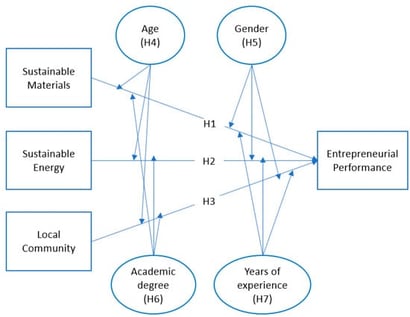
Research model with the established hypothesis and control variables.

The pursuit of disabled students’ inclusion in higher education remains a significant global concern, particularly in developing nations where systemic and institutional barriers persist. Despite progressive legislative and policy frameworks promoting inclusive education, Kenyan and Pakistani universities continue to encounter structural, financial, and attitudinal challenges that hinder equal participation in learning and research for disabled students. This study aims to identify, analyze, and prioritize the complementary support strategies necessary for disabled students’ inclusion in learning and research opportunities in both Kenyan and Pakistani higher education institutions. Employing a quantitative research design, data were gathered through structured questionnaires distributed among disabled students in institutions of higher learning. The data were analyzed using the fuzzy synthetic evaluation (FSE) approach, which integrates fuzzy logic with descriptive statistics to objectively determine the weight, level of agreement, and internal consistency of the identified support strategies. Among the six support strategies, Physical Facility Support emerged as the most crucial in Pakistan, followed by Attitudinal and Community Support. On the other hand, the Kenyan group indicated Policies and Advocacy as the most essential support strategy for disabled students’ inclusion in higher education. The findings underscore that the two countries differ in how they prioritize support strategies for the inclusion of students with disabilities. This study contributes theoretically by advancing the application of the FSE model within inclusion research, offering a rigorous, data-driven framework for understanding multidimensional support strategies for disabled students.

6 February 2026

  • Systematic Review
  • Open Access

This study examines how technological innovation and sustainability jointly reshape contemporary public administration by integrating digital transformation with public value creation. Using a mixed-method approach, we compile a Scopus-based bibliographic dataset and conduct descriptive and network analyses on 199 articles to map publication trends, methodological patterns, and core keyword clusters. We then perform an in-depth qualitative content analysis of 83 papers, coding public sector domains, actors, technological innovations, and sustainability dimensions. Findings highlight a shift from early e-government, centered on administrative efficiency, toward a paradigm of “sustainable digital governance”, where AI, IoT, blockchain and data analytics drive the twin digital–green transition. Five conceptual clusters and several application domains show that public value increasingly emerges within collaborative ecosystems involving administrations, firms, universities, citizens and digital platforms. The study offers an integrated overview of this evolving field and clarifies technology’s role as an enabling factor in sustainable governance. Building on the review results, we propose the Sustainable Public Innovation Ecosystem (SPIE) framework, which links systemic enablers (technological and sustainability innovation) governance efficiency and sustainable public value through ecosystem dynamics and governance mechanisms. It also outlines a future research agenda on hybrid actors ethical and regulatory issues, and approaches to measuring sustainable public value, providing guidance for scholars and policymakers designing digitally enabled and sustainability-oriented public reforms.

5 February 2026

Although toxic work environments are acknowledged as harmful, hospitality research rarely explains how toxic work environments translate into musculoskeletal discomfort through psychosocial mechanisms. Therefore, our study addresses that gap by integrating the stimulus–organism–response framework and the conservation of resources theory to examine the impact of a toxic work environment on employees’ perceptions of musculoskeletal discomfort mediated by perceived work stress and job dissatisfaction. Data were collected from hotel employees working in Johannesburg, South Africa. The study’s interrelationships were analyzed utilizing structural equation modeling. The results showed that a toxic work environment significantly increases work stress and job dissatisfaction, and that both mechanisms are associated with musculoskeletal discomfort. Moreover, the findings indicated that the indirect effect through job dissatisfaction is stronger than the indirect effect through work stress, suggesting that attitudinal erosion is a key channel linking toxic climate to physical discomfort. Our study is the first to combine the stimulus–organism–response framework and the conservation of resources theory to explain how sensory processes and resource allocation mechanisms would operate in the presence of a toxic environment, influencing employees’ psychological and health-related outcomes. Practically, managers should prioritize anti-toxicity policies, supervisor coaching, confidential reporting channels, and psychosocial support to reduce employee strain.

5 February 2026

News & Conferences

Issues

Open for Submission

Editor's Choice

Reprints of Collections

Advancing Nonprofit Management
Reprint

Advancing Nonprofit Management

Innovations, Challenges and Best Practices
Editors: Mary Tschirhart, Khaldoun AbouAssi
Emerging Trends in Innovative Learning Environments and Entrepreneurial Learning
Reprint

Emerging Trends in Innovative Learning Environments and Entrepreneurial Learning

Editors: Muhammad Zaheer Asghar, Samma Faiz Rasool

Get Alerted

Add your email address to receive forthcoming issues of this journal.

XFacebookLinkedIn
Adm. Sci. - ISSN 2076-3387