


Abstract
Biological Nitrogen Fixation (BNF) is a sustainable alternative to synthetic fertilizers that deliver bioavailable nitrogen to rice fields. However, the spatial variability of BNF and the relative contributions of soil physicochemical properties and trace-element availability remain poorly understood in long-term cultivated paddy soils. To address this knowledge gap, we conducted an incubation experiment using paddy soils collected from Zhejiang and Jiangxi provinces of China, and quantified BNF rates using acetylene reduction assay (ARA). BNF rates varied from 24 ± 3 to 368 ± 13 kg N ha−1 with substantial geographic variability (15.3-fold). We observed that soil BNF capacity of Zhejiang soils was much higher than in Jiangxi soils. Microbial community and correlation analysis revealed that Phylum Proteobacteria and genera Pseudomonas and Geobacter were abundant and showed positive association with high BNF sites. Redundancy analysis (RDA) and Random Forest modelling stated that available Molybdenum was the most important predictors of BNF. Overall, our findings demonstrated that soil physiochemical properties, micronutrient availability, and microbial community composition interact to regulate BNF in paddy soils.
1. Introduction
Nitrogen (N) remains one of the strongest nutritional constraints on crop productivity, and modern agriculture has relied heavily on synthetic N fertilizers to sustain high yields and meet rising food demand [1,2,3,4]. However, the agronomic benefits of fertilizer-N have been accompanied by major environmental costs because a substantial fraction of applied N is not recovered by crops, instead lost through ammonia volatilization, nitrate leaching, runoff, nitrification, denitrification, and nitrous oxide emissions [3,5]. These losses reduce nitrogen use efficiency, raise production costs, degrade soil and water quality, and intensify climate forcing, making improved N management a central challenge for sustainable agriculture in the coming decades [2,6,7].
This challenge is especially important in rice-based agroecosystems, where paddy soils create dynamic conditions for N transformation and loss. Flooded soils typically develop a thin oxidized surface layer overlying a largely reduced subsurface zone, creating strong redox gradients that govern microbial processes, nutrient transformations, and the balance between N retention and N loss [8,9]. Because rice remains a staple crop for a large proportion of the global population, improving N sustainability in paddy systems is essential for both food security and environmental protection [3]. These concerns have stimulated growing interest in biological pathways to reduce dependence on chemical fertilizers while maintaining soil fertility and crop productivity [10,11].
Among the available alternatives, biological nitrogen fixation (BNF) is particularly promising because it introduces new reactive N into agroecosystems through a naturally occurring microbial process. In soils, BNF is mediated by diazotrophic microorganisms that reduce atmospheric dinitrogen (N2) to ammonia through the nitrogenase enzyme complex [12]. In non-leguminous systems such as rice, this function is primarily carried out by free-living and associative diazotrophs inhabiting the rhizosphere, root-associated environments, and bulk soil [13]. Because BNF is biologically regulated and can offset a portion of fertilizer-derived N inputs, it is widely considered a key ecological process for the developing of more sustainable nutrient management strategies [14,15].
Despite this promise, the practical contribution of BNF in agricultural soils is difficult to predict because N fixation varies widely across soils, climates, land uses, and management regimes [16,17]. Considerable spatial variation in diazotrophic abundance, diversity, assembly mechanisms, and functional activity has been reported even among sites within the same broad agricultural region [16,18]. This variability has hindered the integration of BNF into fertilizer-management strategies and highlights the need to identify the environmental controls governing diazotrophic performance under contrasting edaphic conditions [19,20].
A growing body of evidence indicates that soil physicochemical properties are among the strongest regulators of diazotrophic community structure and N-fixation activity. Soil texture influences BNF by modifying pore connectivity, water retention, oxygen diffusion, and the formation of microsites suitable for nitrogenase activity [12]. Likewise, soil organic carbon, organic matter, residue quality, and native C: N status regulate the availability of energy and carbon substrates for heterotrophic diazotrophs, while broader nutrient status can alter diazotrophic abundance, network structure, and functional expression [21,22]. This evidence shows that BNF is governed not by microbial presence alone but by interactions between microbial communities and the surrounding soil environment [11,16].
These controls are especially relevant in paddy soils because flooding can simultaneously favor and constrain nitrogen fixation. On one hand, reduced or microaerophilic microsites can protect nitrogenase, which is highly sensitive to oxygen [23,24]. On the other hand, flooding alters soil chemistry, redox potential, and nutrient or metal availability, thereby restructuring ecological niches for diazotrophic microorganisms and shifting their activity along soil depth profiles [12,25,26]. Recent studies have further shown that diazotrophic community composition, diversity, co-occurrence patterns, and adaptive strategies can explain substantial differences in soil N-fixation potential across climatic gradients, restoration trajectories, and management systems [27].
Importantly, diazotrophic communities do not respond uniformly to environmental variation. Different taxa possess distinct ecological strategies, oxygen tolerances, substrate preferences, and stress-adaptation capacities, meaning that changes in soil properties may alter not only diazotroph abundance but also the identity of dominant taxa and the overall efficiency of N fixation [28,29]. Management history also plays an important role; long-term N fertilization, green manuring, organic amendments, intercropping, carbon inputs, and restoration practices can reshape diazotrophic communities and influence the relative contribution of deterministic and stochastic processes to community [19,20,21,30]. Comparative analysis of soils from different provinces is therefore a useful framework for determining whether regional differences in BNF are driven primarily by physicochemical constraints, microbial community restructuring, or their interaction [11,16].
Reliable assessment of BNF is essential for understanding its contribution to sustainable nitrogen management. Despite growing evidence that soil physicochemical properties influence diazotrophic communities, the relative contributions of soil physical, chemical, and microbial factors to BNF across paddy soils remain insufficiently understood. We hypothesized that (i) BNF rates vary significantly among paddy soils due to differences in physicochemical properties and micronutrient availability and (ii) diazotrophic community composition mediates spatial variation in BNF. Therefore, this study evaluated BNF potential in paddy soils from Zhejiang and Jiangxi provinces using the acetylene reduction assay (ARA) and investigated how soil properties and diazotrophic community characteristics jointly regulate nitrogen fixation. By linking soil heterogeneity, microbial community assembly, and nitrogenase activity, this study aims to improve understanding of the ecological controls of BNF and its potential contribution to sustainable rice production.
2. Materials and Methods
2.1. Site Description and Soil Collection
This experiment was conducted to determine spatial variation in biological nitrogen fixation (BNF) capacity across long-term rice-cultivated paddy soils in Zhejiang and Jiangxi provinces of China. The two provinces were selected to obtain geographically separated paddy soils and thereby capture naturally occurring heterogeneity in BNF and associated soil conditions. For this purpose, soils were collected from the plough layer (0–30 cm depth) of 12 actively cultivated paddy fields designated as sites according to their province names. The twelve paddy soil sites were chosen to represent a diverse array of geographical areas and altitudes where rice production has been consistently practiced for several decades. Table S2 (Supplementary File) delineates the precise locations of the paddy sites together with their geographical attributes. The temperature difference across the 12 sampling sites ranges from 15.8 to 19.2 °C, while annual precipitation varies from 1350 to 1900 mm. At each site, soil was collected from multiple points within the field, homogenized to form a composite sample, air-dried, and sieved (<2 mm) for initial physicochemical analysis and subsequent use in the pot experiment.
2.2. Physiochemical Properties and Trace Element Analysis of the Soil
According to the U.S. soil texture classification standard [31], we have divided the texture of the paddy field soil plough layer at different sample points. Soil physicochemical properties were analyzed following the methods described in [32,33]. Soil pH was measured in deionized water at a soil to-water ratio of 1:2.5 mixtures of soil and deionized water with a pH meter. Soil cation exchange capacity (CEC) was determined using the ammonium acetate 1 N method, Soil organic carbon (SOC) was determined using the Walkley–Black dichromate oxidation method, and soil organic matter (SOM) was estimated from SOC using a conversion factor of 1.724 [34]. Total nitrogen (TN) was determined by the dry-combustion method using a Vario MAX CN analyzer (Elementar Analysensysteme GmbH, Langenselbold, Germany) [35]. Total Phosphorous (TP) was determined by using the molybdenum-blue method following digestion with H2SO4-HClO4 [36]. Total potassium (TK) was determined after acid digestion by flame photometry using a standard K calibration curve [37], Total iron (TFe), Total manganese (TMn), Total Zinc (TZn), Total Copper (TCu) were determined following HF–HClO4 digestion by inductively coupled plasma optical emission spectrometry (ICP-OES) [38]. Available phosphorus (AP) was determined using the Olsen sodium bicarbonate extraction method. Soil P was extracted with 0.5 M NaHCO3 (pH 8.5) and quantified by the molybdenum-blue colorimetric method [39], available K (AK) was extracted with 1 M neutral ammonium acetate (NH4OAc, pH 7.0) and determined by flame photometry [40], whereas available Fe, Mn, Zn, Cu were extracted by DTPA, according to [41].
2.3. Experimental Design and Plant Growth Condition
In this project, since it was not possible to collect soil samples during the rice growth period at the soil sampling site, the method of planting rice in pots after soil sample collection was adopted. The pot experiment was conducted simultaneously with field rice cultivation under local environmental conditions in Jiangdu District, Yangzhou city, Jiangsu Province, China. Each pot (specifications: 10 cm × 10 cm × 35 cm volume) was filled with 1 kg of the respective homogenized soil. The experiment was conducted with three replicates per soil type, totaling (12 soils × 3 replicates = 36). Before transplanting rice seedlings, soils were flooded for one week and a compound N–P2O5–K2O (15–15–15) fertilizer was applied at the same rate to all pots, reflecting the common fertilization practice of local rice farmers. The application rate was calculated from the local field rate and converted to an equivalent rate per kilogram of soil. This supplied equivalent amounts of N, P2O5, and K2O according to the 15–15–15 formulation. Three rice seedlings were transplanted per pot. Water management consisted of continuous flooding (maintaining a 3–5 cm water layer) for the first month after transplanting, followed by intermittent flooding (alternating flooded and moist conditions) thereafter.
2.4. Measurement of Biological Nitrogen Fixation
In this study, the ARA method [42] was used to determine the biological nitrogen fixation potential of soil and ethylene concentrations were measured using gas chromatography. During the rice growth period, soil was taken weekly from potted rice plants, and the soil’s biological nitrogen fixation rate was determined by using the ARA method. While taking soil from the potted rice, a small core was used to collect soil from the entire thickness of the pot, and a portion of the soil sample was weighed to measure its water content. The remaining soil was returned to each respective pot, and this procedure was repeated three times. Sampling began after rice transplanting and continued until the rice field maturing period, once a week for a total of 13 weeks. After the field-drying period, biological nitrogen fixation in the rice field was low, so no further measurements were taken. The amount of biological nitrogen fixation over the entire rice growing season was calculated by summing weekly data (Supplementary File S1).
2.5. Microbial Communities Assessment and Statistical Analysis
At the mid-season of experiment, soil samples were collected from each pot. Total genomic DNA was extracted from 0.50 g of soil using the PowerSoil DNA Isolation Kit (Mo Bio Laboratories, Inc., Carlsbad, CA, USA) according to the manufacturer’s instructions. The extracted total DNA was dissolved in 50 µL sterile water (PCR grade water), DNA concentration and purity were checked using a NanoDrop ND-1000 spectrophotometer (NanoDrop Technologies, Wilmington, DE, USA) and 0.8% agarose gel electrophoresis. The bacterial 16S rRNA gene (V4 region) was amplified using primers 515F/806R [43] to assess total microbial diversity. Alpha diversity (Observed ASVs, Shannon, Simpson) was calculated after rarefaction, and beta diversity was assessed using Bray–Curtis dissimilarity and PCoA, with group differences tested by PERMANOVA.
Statistical comparisons among different soil sites were conducted via one-way analysis of variance (ANOVA), followed by Duncan’s multiple range test at the 95% confidence level. Threshold for all statistical significance was set at p < 0.05. Redundancy analysis (RDA) coupled with hierarchical partitioning was conducted to explore the associations between microbial communities and soil properties using the R “rdacca.hp” package version 4.5.1 [44]. Pearson’s correlation coefficient was used to evaluate the relationships between microbial community composition and soil properties, as well as the plant biomass, spatial variation in BNF and soil properties. The Random Forest model was executed with 1000 trees (ntree = 1000), and model accuracy was evaluated using the default internal bootstrap sampling method (out-of-bag, OOB), which excludes permutation testing [45].
3. Results
3.1. Soil Physicochemical Properties
The variability in physicochemical properties of soil parameters among the 12 paddy locations are represented in Table 1. The soil pH varied from 5.3 to 8.2, indicating a range from acidic to alkaline conditions that significantly affect microbial activity and nitrogenase efficiency. Samples with higher clay content (≥30%) consistently show lower BD (≈0.95–1.10 g cm−3) as represented in (Table S1), indicating greater aggregation and higher micro-porosity typical of fine-textured soils. The SOC varied between 14.97 and 35.10 g kg−1, whereas the TN ranged from 2.13 to 3.96 g kg−1, indicating differences in organic matter availability and baseline nitrogen levels among locations. Overall, AP levels were modest (0.45–2.12 mg kg−1), suggesting a possible phosphorus restriction that may restrict microbial growth and biological nitrogen fixation activities. The availability of micronutrients demonstrated significant geographical variability, particularly for Fe (5.66–574.40 mg kg−1) and Mn (0.12–70.45 mg kg−1), both of which are essential cofactors for nitrogenase activity. Copper, zinc, and molybdenum exhibited site-specific variability, with molybdenum concentrations ranging from 0.02 to 0.51 mg kg−1, a crucial element integral to the activity of the nitrogenase enzyme. The observed variations in pH, soil organic carbon, nutrient availability, and micronutrient delivery suggest significant influences on microbial nitrogen fixation capability in the studied paddy soils.
Table 1.
Soil chemical properties of paddy sites in Jiangxi and Zhejiang provinces.
3.2. Spatial Variation in Soil Biological Nitrogen Fixation (BNF) Rates
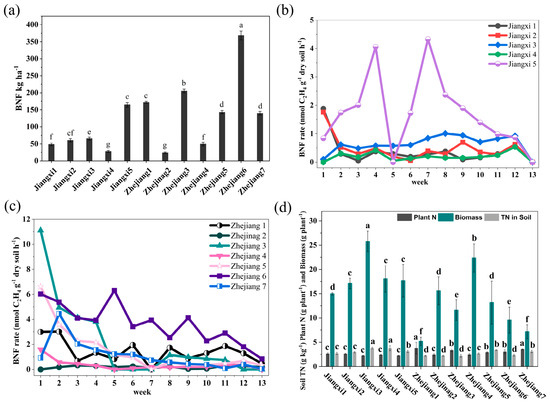
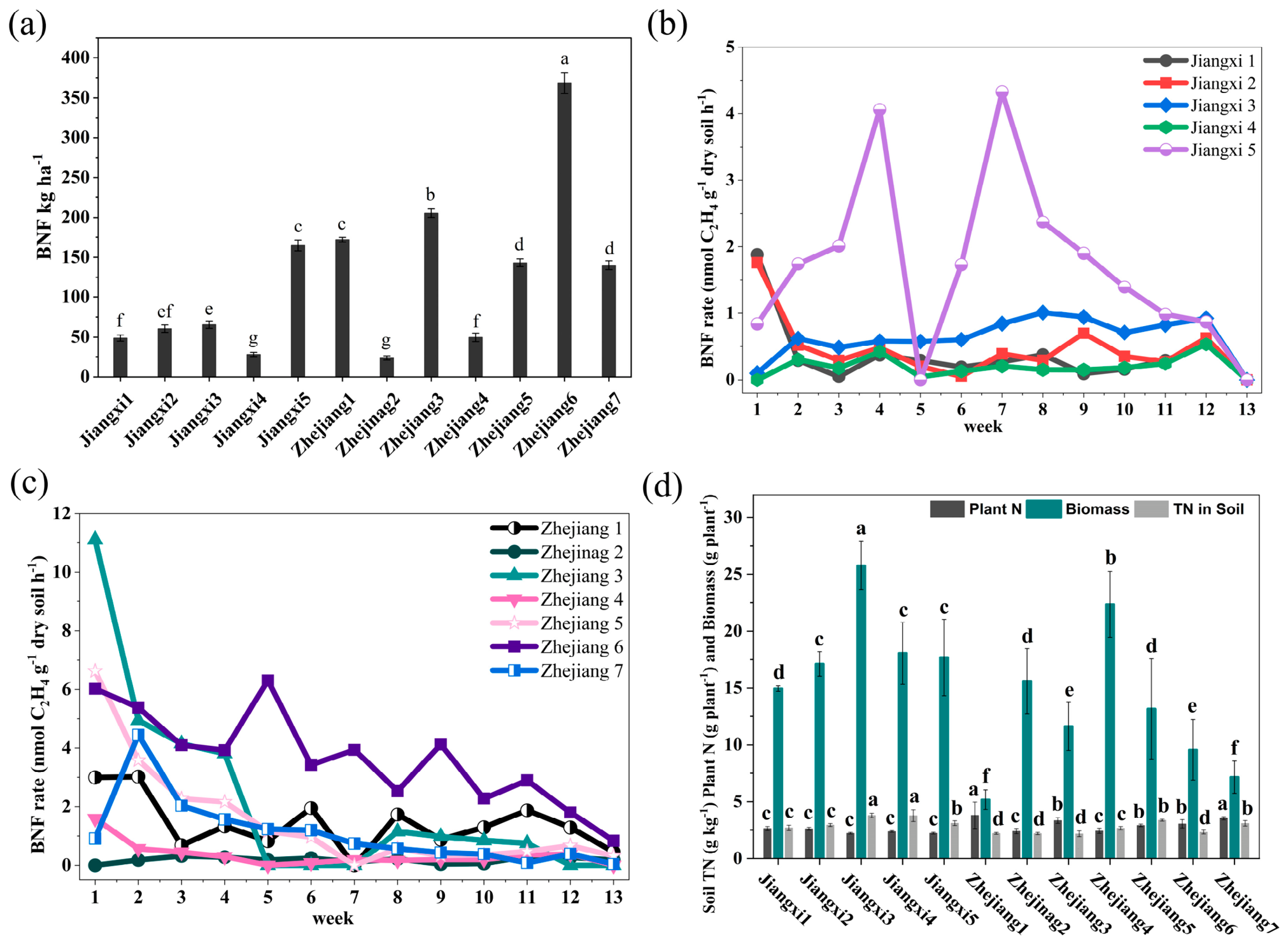
BNF varied from 24 ± 3 to 368 ± 13 kg N ha−1 among the 12 paddy soils Figure 1a, indicating a 15.3-fold disparity across locations. The overall coefficient of variation (CV) was 89.0%, indicating substantial variability in nitrogen-fixing activity. The variability of soil in Zhejiang (CV = 81.8%) was somewhat greater than that in Jiangxi (CV = 75.3%). The maximum BNF rate was recorded in Zhejiang 6 (368 ± 13 kg N ha−1), whereas the minimum BNF rate was seen in Zhejiang 2 (24 ± 3 kg N ha−1). The BNF varied from 28 ± 3 kg N ha−1 at Jiangxi 4 to 165 ± 7 kg N ha−1 at Jiangxi 5. Weekly N-Fixation rate demonstrated further notable disparities across provinces in the temporal patterns of ARA (nmol C2H4 g−1 dry soil h−1). Nitrogenase activity was often elevated and more variable in Zhejiang soils, with notable peaks early in the season, especially at Zhejiang 3 (11.10 nmol C2H4 g−1 dry soil h−1), Zhejiang 5 (6.63 nmol C2H4 g−1 dry soil h−1), and Zhejiang 6 (6.02 nmol C2H4 g−1 dry soil h−1) during the first two weeks of incubation Figure 1b,c. These peaks were followed by phases of stability and intermittent secondary peaks. Conversely, the activity in Jiangxi soils was comparatively lower and more constant during the incubation period, with only minor increases at few areas between weeks 9 to 12. By week 13, nitrogenase activity decreased to near-background levels across all soils, indicating a universal late-season reduction in diazotrophic activity. BNF rates differed substantially among sampling sites, with generally higher BNF capacity observed in the Zhejiang soils than in the Jiangxi soils.
Figure 1.
Biological nitrogen fixation (BNF) and Nitrogen Dynamics across Jiangxi and Zhejiang soils. (a) BNF rates of sampling sites, Jiangxi and Zhejiang using acetylene reduction assay (ARA). (b) Weekly BNF rate (nmol C2H4 g−1 dry soil h−1) over a 13-week incubation period, illustrating temporal dynamics of nitrogenase activity across Jiangxi sites (c) Weekly BNF rate (nmol C2H4 g−1 dry soil h−1) over a 13-week incubation period, illustrating temporal dynamics of nitrogenase activity across Zhejiang sites. (d) Soil total nitrogen (TN), plant nitrogen uptake, and plant biomass across Jiangxi and Zhejiang sampling sites. In panel (a), bars represent the mean BNF values for each site (n = 3), with error bars showing standard deviations while in panel (d) error bars showing standard error. Small letters above the error bars indicate significant differences among soil sites, based on Tukey’s post-hoc test.
3.3. Coupled Patterns of Soil Nitrogen, Plant N Uptake, Plant Biomass, and Biological Nitrogen Fixation
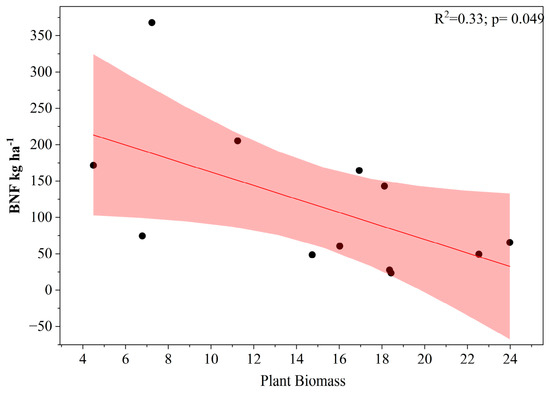
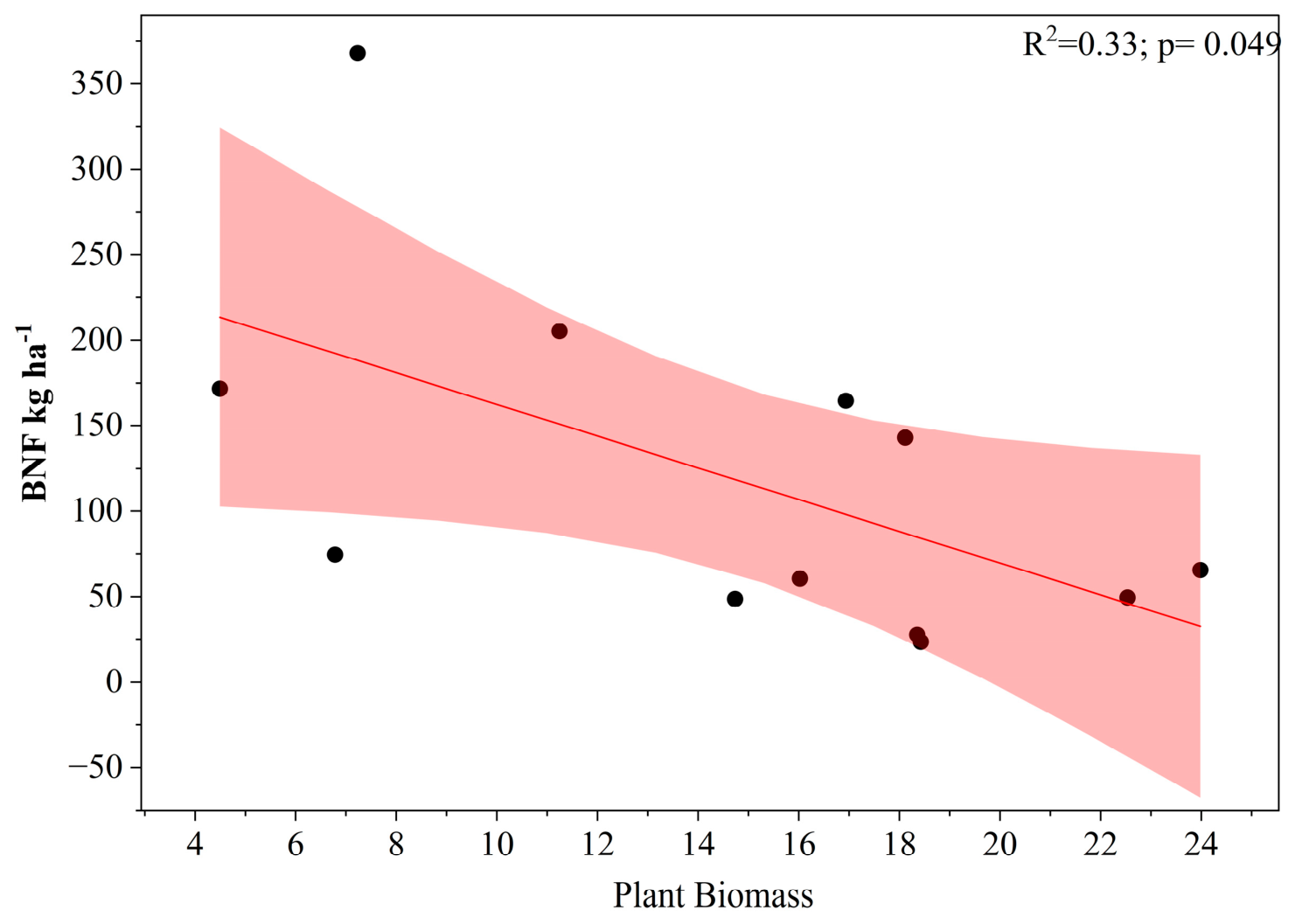
Across the 12 paddy sites, soil TN, plant biomass, and plant N uptake each measured in grams showed moderate variability, whereas BNF (kg N ha−1) exhibited exceptionally large differences, revealing contrasting nitrogen acquisition strategies across sites. Soil TN Figure 1d ranged from 2.2 ± 0.1 to 3.77 ± 0.19 g kg−1 a 1.7-fold range, and plant biomass varied 5.0-fold (5.18 ± 0.86 to 25.77 ± 2.14 g). Plant N uptake showed a narrower 1.7-fold range (2.22 ± 0.07 to 3.79 ± 1.16 g) and generally followed the biomass pattern, indicating that higher biomass sites extracted more nitrogen from the soil. In contrast, BNF varied 15.3-fold (24 ± 3 to 368 ± 13 kg N ha−1) Figure 1a, far exceeding the variability observed in soil TN or plant uptake. Several Zhejiang sites (Zhejiang-1, 3, & 6) exhibited 2.5–7× higher BNF than Jiangxi sites with similar or even higher soil TN, demonstrating strong microbial compensation where soil N availability or plant uptake alone was insufficient. Zhejiang 6, with the highest BNF fixed 15× more nitrogen than Jiangxi 4, despite Jiangxi 4 having the highest soil TN. Plant biomass was negatively associated with BNF, with the regression explaining 33% of the variation (R2 = 0.33, p = 0.049; Figure 2). BNF generally decreased with increasing plant biomass. This negative association indicates that higher BNF rates were not accompanied by greater plant biomass under the experimental conditions.
Figure 2.
Relationship between biological nitrogen fixation (BNF) and plant biomass across the 12 paddy soils. The solid line represents the fitted linear regression, and the shaded area indicates the 95% confidence interval. The relationship was negative (R2 = 0.33; p = 0.049).
3.4. BNF Soil Factor Relationship and Identification of Soil Drivers of BNF Through IF, VIF
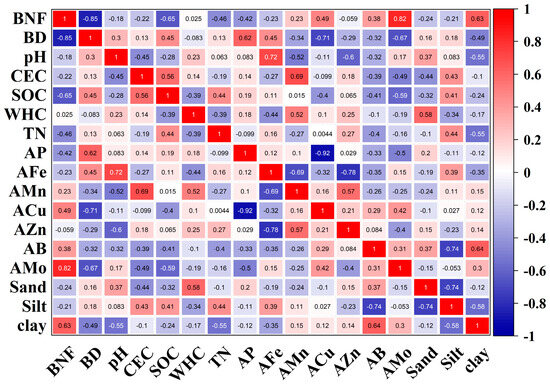
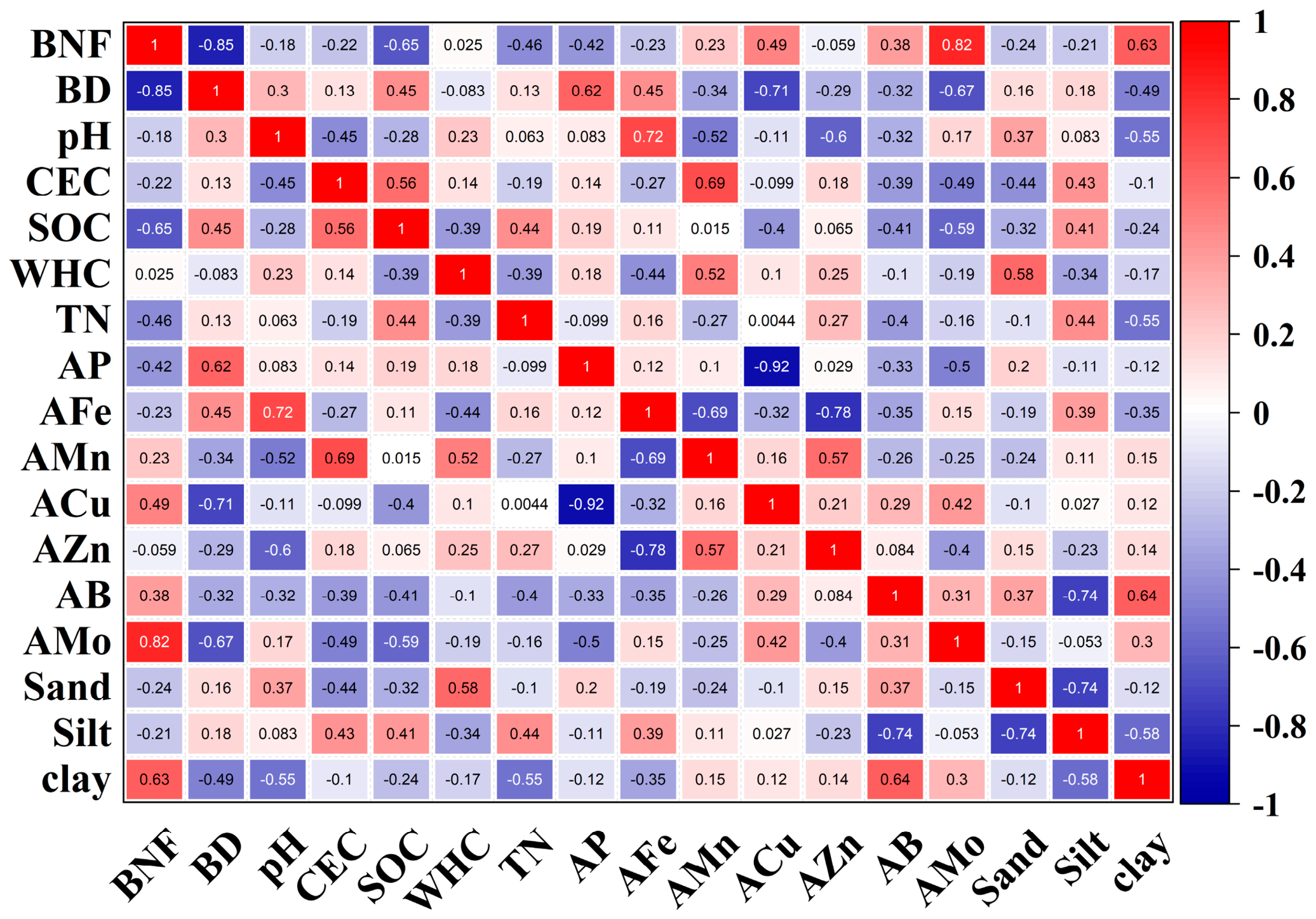
The Pearson correlation analysis indicated that certain soil micronutrients and physical features had the strongest association with variations in biological nitrogen fixation (BNF) as we can see in Figure 3. Molybdenum had the most robust positive correlation with BNF, aligning with its essential function as the primary cofactor of nitrogenase. While clay, Available copper (ACu), available manganese (AMn) and available iron (AFe) exhibited a modest positive correlation. Conversely, bulk density, soil organic carbon, and total nitrogen exhibited a negative correlation with biological nitrogen fixation. Moreover, the study of the important factor (IF) Figure S1A indicated that BD, AP, and Mo were the primary soil determinants for BNF, exhibiting the highest IF values of 0.75, 0.69, and 0.66, respectively, and showed a strong association with BNF. Clay had a considerable influence (IF = 0.45), whereas all other factors shown weak or negligible associations (IF < 0.35). The variance inflation factor (VIF) Figure S1B analysis indicated little multicollinearity among the main predictors (VIF = 1.50–2.85), except for manganese, which exhibited a somewhat elevated value (5.67). These trends together indicate that BNF is favored in soils exhibiting optimal physical structure and adequate micronutrient availability, whereas nutrient-dense or compacted soils hinder diazotrophic activity.
Figure 3.
Pearson correlation coefficients between biological nitrogen fixation (BNF) and key soil variables. Scale on the right side of the heatmap represents magnitude of the correlation, while color indicates direction and strength (red = positive, blue = negative).
3.5. Microbial Diversity
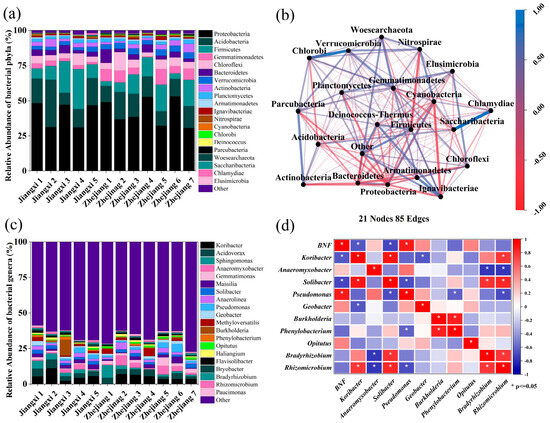
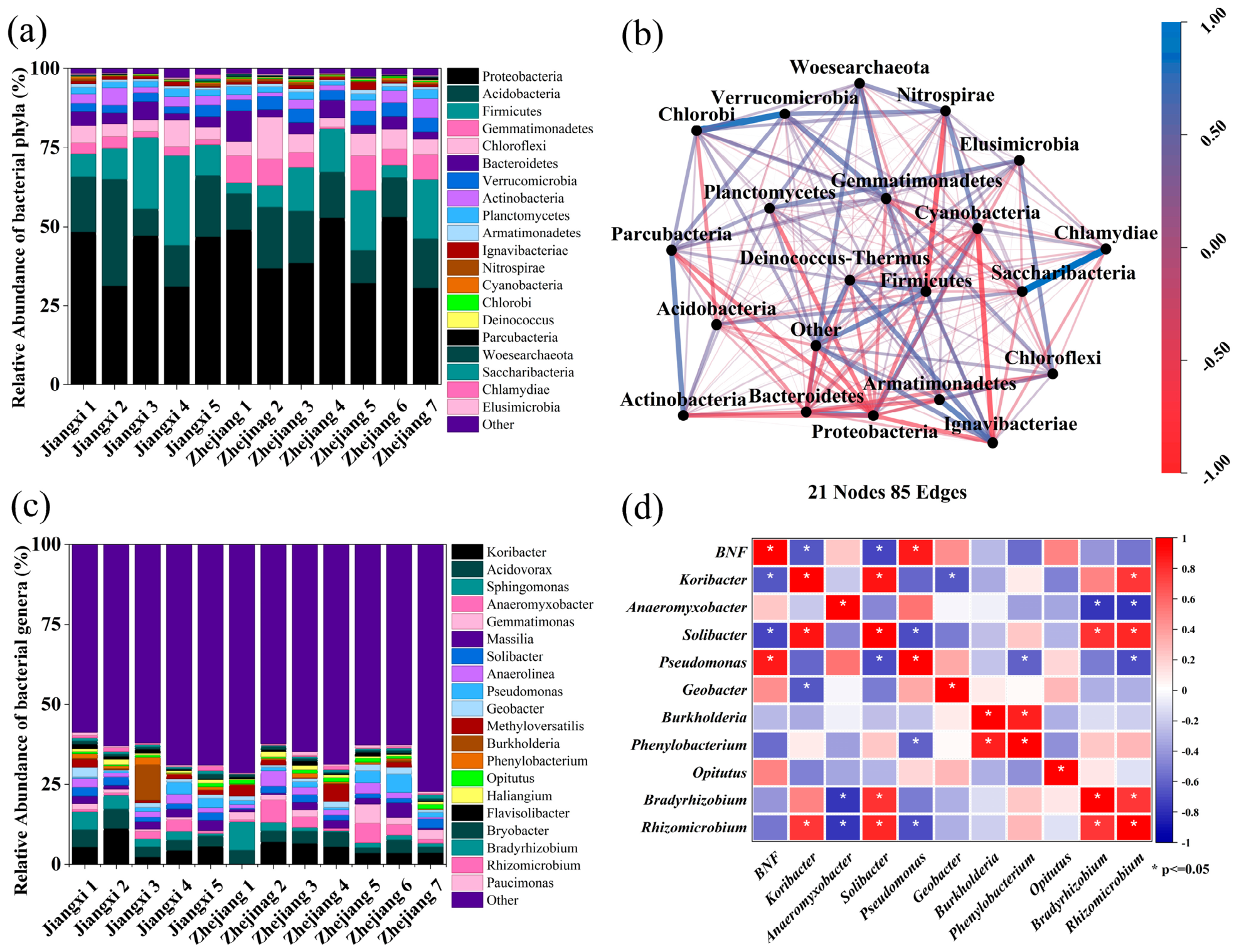
The twelve paddy sites across two provinces exhibited different biogeographic patterns of phyla and genera characterized by significant biological nitrogen fixation activity. Proteobacteria (32–53%), including several facultative and anaerobic diazotrophs capable of nitrogen fixation under diverse redox conditions, were prevalent in the highest BNF sites of Zhejiang Figure 4a. These sites were abundant in Gemmatimonadetes, Chloroflexi, and Bacteroidetes. We used a correlation threshold of |r| > 0.5 and developed a precisely constructed co-occurrence network of phyla Figure 4b including 21 nodes interconnected by 85 solid connections (47 positive and 38 negative). The network exhibited a comparatively elevated average degree (8.10), suggesting a robust ecological link across taxa. Community identification revealed a division of the network into four coherent modules, exhibiting a modularity of 0.41, which indicates a substantially modular non-random interaction pattern. Substantial positive and negative correlations indicate the presence of cooperative guilds and competitive or niche-segregated phyla. Overall, these topological characteristics indicate that the formation of microbial communities in paddy soils is influenced by organized ecological interactions rather than random co-occurrence.
Figure 4.
Microbial community composition and co-occurrence patterns across Jiangxi and Zhejiang paddy soils. (a) Relative abundance of dominant bacterial phyla. (b) Phylum-level co-occurrence network showing positive (blue) and negative (red) correlations. (c) Relative abundance of dominant bacterial genera. (d) Genus-level correlation heatmap, with significant correlations indicated by asterisks (p ≤ 0.05).
Figure 4c shows a considerable rise in Anaeromyxobacter, Geobacter, and Pseudomonas in high BNF Zhejiang soils. All these taxa possess the ability to fix nitrogen, decrease iron, denitrification and respire anaerobically. Oligotrophic and symbiotic genus such as Bradyrhizobium, Rhizomicrobium, Opitutus, and Candidatus Koribacter predominated in Jiangxi soils, characterized by reduced and more stable biological nitrogen fixation (BNF). The Pearson correlation analysis Figure 4d revealed a strong positive association between biological nitrogen fixation (BNF) and Pseudomonas (r = 0.70, p < 0.05), suggesting its potential as a principal diazotrophic contributor in soils with elevated BNF levels. In contrast, BNF exhibited a negative correlation with Acidobacteria species, including Koribacter and Solibacter, suggesting that these oligotrophic taxa diminish in circumstances conducive to active nitrogen fixation. Certain genera exhibited closely coordinated behavior, such as a substantial co-occurrence between Burkholderia and Phenylobacterium (r = 0.76) and a distinct negative correlation between Rhizomicrobium and Anaeromyxobacter (r = −0.56). Pearson correlation analysis between BNF, soil chemical properties, and diazotrophic taxa revealed (Figure S2) that BNF was strongly and positively associated with available Mo, while showing negative relationships with SOC and TN, indicating contrasting nutrient controls on N2-fixation. Among microbial groups, Pseudomonas and Anaeromyxobacter exhibited the strongest positive correlations with BNF, highlighting their functional relevance. Soil pH further structured microbial patterns, aligning positively with Bradyrhizobium and Solibacter, whereas SOC showed negative associations with taxa such as Opitutus. Strong microbial co-occurrence patterns, particularly Burkholderia–Phenylobacterium and Koribacter–Solibacter, reflected tightly linked community networks within the soil system. Collectively, these results indicate that BNF manifests within a structured interaction network of microorganisms, rather than as isolated taxon-level reactions.
3.6. Alpha Diversity Patterns
The 12 paddy habitats exhibited significant variation in microbial alpha diversity richness, whereas high evenness remained constant. The recorded species richness Figure S3B ranges from 1439 to 2137, with the peak species richness in Zhejiang 3 and the minimum in Zhejiang 4. The Chao1 estimate Figure S3A demonstrated significant richness (1833–2721), implying the existence of several uncommon species across all locations. The diversity indices, determined by richness and evenness, were elevated and comparable, with Shannon indices Figure S3C spanning from 7.38 to 8.74 and Simpson indices Figure S3D ranging from 0.974 to 0.992, indicating that the microbial communities exhibited high diversity and equilibrium. Zhejiang sites exhibited greater richness and Shannon diversity compared to Jiangxi sites. This aligns with the significantly elevated BNF rates seen at several locations in Zhejiang. This trend indicates that more diversified microbial communities may include a greater reservoir of potential diazotrophic species and enhanced functional redundancy, potentially augmenting biological nitrogen fixation under ideal environmental circumstances. The comparatively reduced variety reported in Jiangxi may correlate with the more moderate and steadier BNF rates seen at these locations. In conclusion, our findings suggest that microbial diversity is a strong predictor of the geographical distribution of biological nitrogen fixation (BNF) and may serve as a significant biological connection between soil environmental parameters and nitrogen fixation capacity in paddy ecosystems.
3.7. Beta Diversity Patterns and Their Relationship with BNF Across Sites
The Bray–Curtis Principal Coordinates Analysis (PCoA) showed variation in microbial community structures among the paddy soils of Jiangxi and Zhejiang Figure S4a,b Jiangxi samples were relatively closely within the ordination space (PCoA1: −0.069 to 0.038; PCoA2: −0.040 to 0.088), suggesting relatively similar community composition among these samples. Conversely, Zhejiang samples occupied a wider range of ordination space (PCoA1: −0.060 to 0.117; PCoA2: −0.086 to 0.034) across both ordination axes. Although the two provincial groups showed some overlap in ordination space, Zhejiang samples displayed greater dispersion than Jiangxi samples. The observed variation in microbial community composition was associated with variation in BNF among the sampling sites, however the PcoA did not show clear separation of microbial communities according to province.
3.8. Soil and Microbial Predictors of Biological Nitrogen Fixation: Insights from Redundancy Analysis and Random Forest Modeling
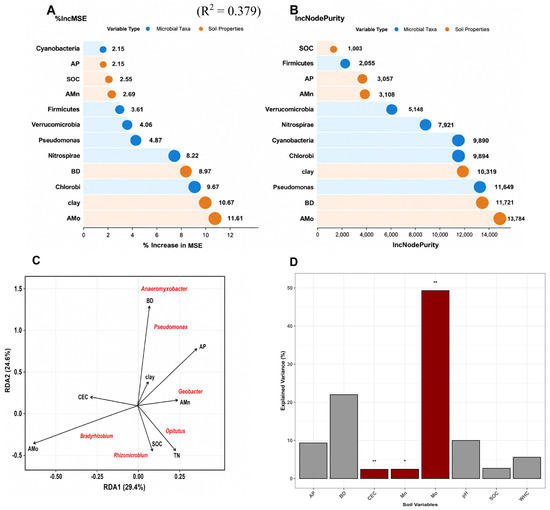
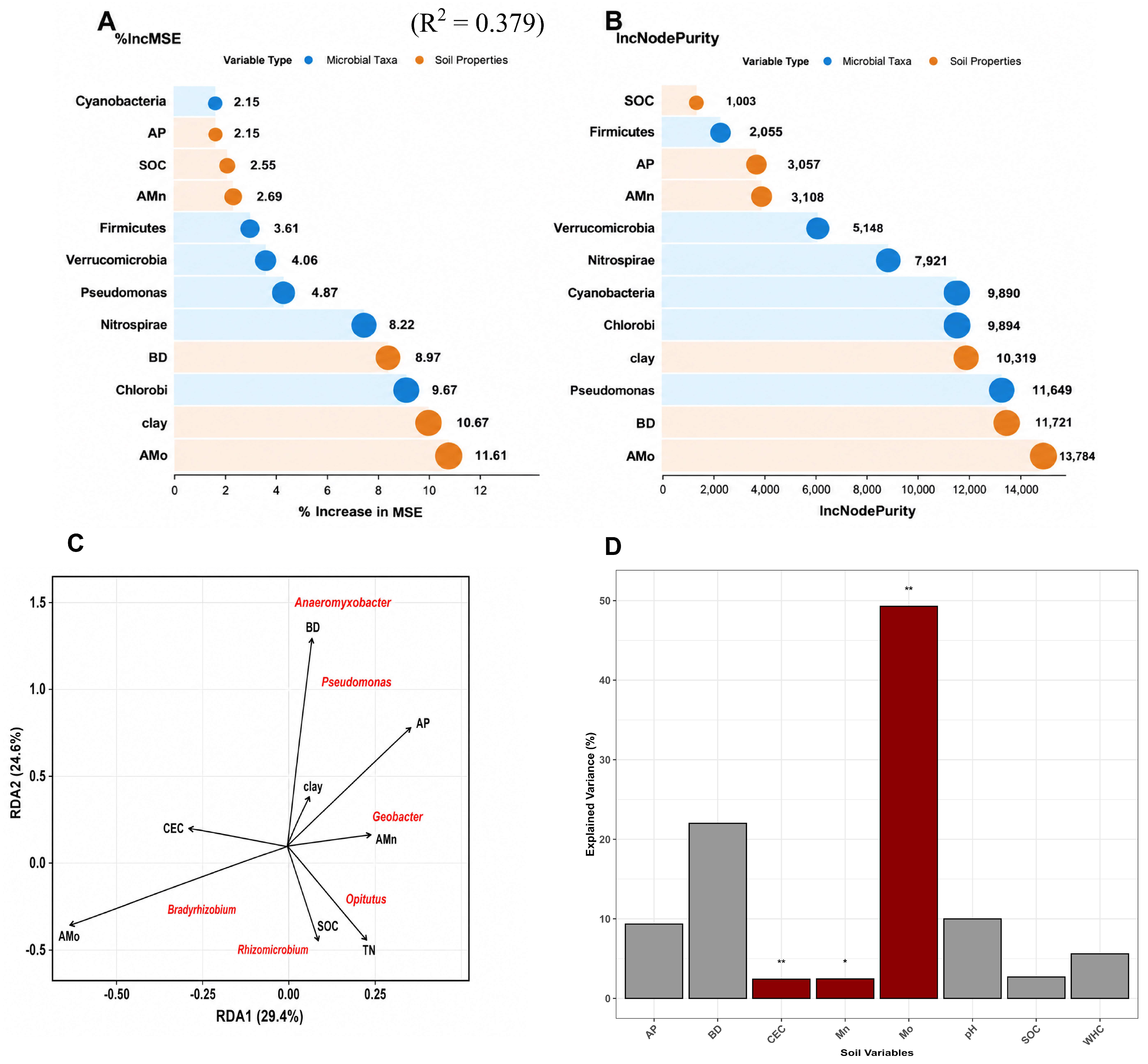
Redundancy analysis (RDA) demonstrated that the physicochemical characteristics of the soil substantially affected the composition of the diazotrophic community in the paddy soils Figure 5C,D. The first two axes of RDA accounted for 54.0% of the overall diversity in community organization. RDA1 and RDA2 accounted for 29.4% and 24.6% of the overall variation, respectively. Hierarchical partitioning identified molybdenum (Mo) as the primary environmental predictor, accounting for 49% of the variance in diazotrophic community composition. Permutation experiments corroborated the predominant influence of Mo on community structure (F = 16.15, p = 0.002), followed by cation exchange capacity (CEC; F = 10.39, p = 0.01) and Mn (p = 0.02). Soil pH, accessible phosphorus (AP), and copper (Cu) exhibited no significant correlation with the variance of diazotrophic communities (p > 0.10).
Figure 5.
Random Forest and redundancy analysis (RDA) identifying key soil variables shaping diazotrophic community structure across Jiangxi and Zhejiang paddy soils. (A) Variable importance based on %IncMSE, showing the relative contribution of soil properties and selected microbial taxa to model accuracy (R2 = 0.379). (B) Variable importance based on IncNodePurity, highlighting the strongest predictors of diazotroph distribution. (C) RDA ordination illustrating relationships between soil variables (AP, BD, clay, CEC, SOC, AMn, AMo) and abundant potentially diazotrophic and genera (Anaeromyxobacter, Pseudomonas, Geobacter, Opitutus, Rhizomicrobium, Bradyrhizobium). (D) Explained variation (%) of individual soil variables on potential diazotrophic bacterial community composition. Dark red bars indicate significant variables, while gray bars indicate non-significant variables. Significance levels: * p < 0.05, ** p < 0.01. Molybdenum (Mo) showed the most significant effect (p < 0.01) on community composition.
The Random Forest analysis indicated that the variance in biological nitrogen fixation (BNF) was significantly associated with soil physicochemical parameters and microbial community composition, with the optimized model accounting for 37.85% of the overall variation in BNF Figure 5A,B. The main predictors for BNF were determined by the percent increase in mean squared error (%IncMSE) as follows: availability molybdenum (AMo; 11.61%), clay content (10.67%), Chlorobi (9.67%), bulk density (BD; 8.97%), and Nitrospirae (8.22%). AMo, clay content, and bulk density (BD) were the most reliable contributors among the soil variables, whereas accessible phosphorus (AP), available manganese (AMn), and soil organic carbon (SOC) contributed comparatively less. Microbial taxa such as Chlorobi, Nitrospirae, Pseudomonas, Ignavibacteriae, Verrucomicrobia, and Deinococcus–Thermus served as significant predictors. Comparable patterns were seen for IncNodePurity values Figure 5B, with AMo, BD, Pseudomonas, Chlorobi, and Cyanobacteria identified as the principal contributors to the overall reduction in model impurity. The variability of BNF in paddy soils was linked to the combined influences of soil parameters and the makeup of the diazotrophic community.
4. Discussion
BNF significantly enhances available nitrogen content in paddy ecosystems, potentially reducing reliance on external fertilizer inputs [46]. BNF size significantly varies among locations due to the regulation of nitrogen fixation by the interplay of soil physicochemical properties, microbial community composition, and ecosystem nitrogen requirements [25]. The present work demonstrates that biological nitrogen fixation in paddy soils is influenced by several environmental conditions, as shown by the integration of ARA derived estimations of biological nitrogen fixation with soil characteristics, microbial diversity, community composition, and multivariate analysis. It arises from a hierarchical soil-microbe feedback mechanism in which the physical structure of the soil and nutrient availability determine the makeup of diazotrophic communities, hence regulating the magnitude and temporal dynamics of nitrogen fixation. This paradigm encapsulates the significant disparity observed between Jiangxi and Zhejiang, as well as the considerable variety in BNF across various locations.
4.1. Relationships Between Soil Physical Properties and Biological Nitrogen Fixation (BNF)
Among the soil physical properties evaluated, clay content and bulk density were identified as important predictors of BNF variation in random forest analysis. These result suggests that variation in soil physical condition may contribute substantially to differences in BNF among the sampled soils [47]. The observed association between clay content and BNF is likely related to the effects of soil texture on water retention capacity, oxygen transport, nutrient retention, and microscale redox heterogeneity. In the flooded paddy soils, these properties can generate spatially heterogenous microenvironments that potentially support different microbial processes, including BNF [8]. As a result, fine textured soils may offer more favorable environments for diazotroph establishment and persistence than coarse textured soils, owing to consistent moisture conditions and microorganisms’ protection from environmental variations [48].
Bulk density showed a negative association with BNF indicating that BNF tended to decrease as soil density increased. This association is plausible that higher bulk density reduce spore connectivity, thereby limiting gas exchange and alter the physical habitat available to microorganisms [47]. In paddy soil, such physical constraints would reduce the availability of suitable microhabitats for diazotrophic activity and may create suboptimal oxygen gradients for nitrogenase function. Collectively, these compaction-induced effects are consistent with the observed suppression of BNF under higher bulk density conditions [49].The identification of clay content and bulk density across multiple analytical approaches suggests that soil physical properties are important correlates and predictors of BNF variation in the sampled soils. These findings indicate that soil texture and bulk density may contribute to variation in the physical habitat experienced by diazotrophic communities [50].
4.2. Soil Nutrient Availability Associated BNF
Soil physical structure was the most significant predictor of BNF, but nutrient availability was also important. Across the different analysis AP, AMo, repeatedly emerged as variable associated with variation in BNF. Their importance was supported by correlation, RDA and RF modelling analysis our observation are consistent with Wong, et al. [51]. AP showed a positive association with BNF, indicating that soils with higher AP tended to exhibit higher BNF rates. This relationship is biologically plausible because N2 fixation requires substantial energy and ATP, making P availability potentially important for maintaining the energetic demands of diazotrophic. metabolism [52]. Sites with increased phosphorus availability may be better able to sustain the high metabolic expenditures of nitrogen fixation, resulting in faster fixation rates [53]. However, the present observational data cannot establish that increased P availability directly stimulates BNF.
Available Mo showed a positive association with BNF (r = 0.82]), indicating that BNF tended to increase with increasing Mo availability across the sampled soils. This relationship is biologically plausible because Mo is an essential component of the Fe-Mo-cofactor of Mo-dependent nitrogenase and therefore has a well-established role in N2 reduction [54,55]. The substantial relationship between Mo and BNF and diazotroph community structure shows that micronutrient availability associate enzyme activity and nitrogen fixer community composition [56]. Nevertheless, because Mo availability was not experimentally manipulated, the observed association should not be interpreted as direct evidence that Mo availability causally increased BNF. The importance of Mo was further supported by its contribution to diazotrophic community variation in the RDA and its relatively high predictive importance in the Random Forest model (%IncMSE = 11.6), suggesting that Mo availability may be an important environmental correlate of both BNF and diazotrophic community structure as reported by Rousk, et al. [57], Mo is the key component of nitrogenase enzyme and it helps to shape diazotrophs. Microbial communities were also associated by manganese and cation exchange capacity (CEC) [58]. Although their direct associations with BNF were weaker than those observed for AP and Mo, Mn and CEC were associated with variation in diazotrophic community composition. Their potential roles may relate to nutrient retention, electron-transfer processes, and soil redox conditions; however, these mechanisms were not directly tested in the present study. Overall, our findings suggest that nutrient availability determines the biophysical feasibility of N2 fixation [59,60].
4.3. Microbial Community Composition, Soil Conditions and BNF Variation
A key finding of this study is that soil physicochemical properties associate biological nitrogen fixation (BNF) not only through direct effects on nutrient availability and microbial activity, but also indirectly through their influence on diazotroph community assembly [25,61]. The RDA results indicate that variation in soil physicochemical properties was associated with variation in diazotroph community composition. Together with the observed relationships between microbial taxa and BNF, these findings suggest that community composition may represent an important ecological component associated with BNF variation [62]. This pattern suggests that differences in BNF among sites arise because local soil conditions select microbial taxa with distinct ecological strategies and nitrogen-fixing capabilities [63,64].
The alpha diversity results provide additional support for this mechanism. Zhejiang soils generally exhibited greater richness and slightly higher diversity than Jiangxi soils, suggesting a larger pool of potential diazotrophs and greater functional redundancy [65]. Higher microbial diversity may increase the range of taxa capable of contributing to ecosystem functions; however, diversity alone does not demonstrate greater BNF potential, and the present data suggest that community composition may be more informative than richness alone [16,66].
This interpretation is supported by the genus- and phylum-level analyses, which revealed clear shifts in diazotroph assemblages between provinces. High-BNF Zhejiang sites were enriched in Proteobacteria and contained greater abundances of Anaeromyxobacter, Geobacter, Pseudomonas, Gemmatimonas, and Anaerolinea and Pearson correlation analysis Figure 3 also supported that Pseudomonas is the most significant positively correlated genera with BNF as supported from previous studies that pseudomonas is keystone genera in paddy soil to support BNF in diazotrophs [67,68]. These taxa are commonly associated with metabolic flexibility and adaptation to fluctuating redox conditions typical of flooded paddy soils [69]. The greater abundance of these taxa coincided with higher BNF at several Zhejiang sites and may indicate differences in the functional potential of the diazotrophic communities. However, functional traits and metabolic responses were not directly measured, and therefore this interpretation remains hypothetical [70]. In contrast, Jiangxi soils were characterized by greater abundances of Bradyrhizobium, Rhizomicrobium, Opitutus, and Candidatus Koribacter, taxa generally associated with more stable nutrient environments and conservative resource-use strategies. The dominance of these genus corresponds with the lower and more uniform BNF rates observed across Jiangxi sites [19]. Collectively, these findings indicate that microbial community assembly represents a critical intermediate mechanism linking soil environmental conditions to ecosystem-level nitrogen fixation. Soil physicochemical properties act as environmental filters that shape diazotroph diversity and composition, while the resulting functional characteristics of microbial communities ultimately determine the magnitude and variability of BNF across paddy soils consistent with previous studies [71].
4.4. Community Heterogeneity and Spatial Variation in BNF Potential
The beta diversity analysis provides further evidence of an association between microbial community structure and BNF variation across the sampled paddy soils. Zhejiang communities occupied a broader ordination space than Jiangxi communities, indicating greater variation in community composition heterogeneity among sites. In contrast, Jiangxi samples clustered more tightly, reflecting relatively homogeneous microbial assemblages. Such variation in community composition may be associated with differences in functional potential and ecosystem processes [72,73].
The greater dispersion of Zhejiang communities indicates greater variation in diazotrophic assemblages among sites, which may reflect in soil properties, nutrient availability, and redox conditions. This compositional variation may correspond to differences in functional potential of diazotrophic communities, although functional traits were not directly assessed in present study [74,75]. In contrast, the tighter clustering of Jiangxi communities indicates greater compositional similarity among these sites. This pattern may reflect relatively similar environmental conditions, although environmental filtering was not directly assessed in this study. The relatively similar diazotrophic assemblages observed in Jiangxi may be associated with greater similarity in local ecological conditions, this pattern coincided with the comparatively narrower range of BNF rates observed across the Jiangxi sites. This interpretation is consistent with the narrower range of BNF observed across Jiangxi sites and with the higher soil TN and lower microbial variability characteristics of these soils [76,77].
The beta diversity patterns, together with the alpha diversity, taxonomic composition, and RDA results, suggest that differences in soil physicochemical properties are associated with variation in microbial community assembly and BNF. Soil environmental gradients create distinct ecological niches that select for different diazotrophic taxa and functional traits, ultimately determining the magnitude and stability of nitrogen fixation across sites. Thus, community composition may represent an important ecological component associated with the relationship between soil conditions and BNF variation across the sampled paddy soils [78,79].
4.5. Association Between Soil Nitrogen Availability, Plant Biomass and BNF
The relationships between BNF, soil TN, plant biomass, and plant N uptake provide important insights into the ecological role of nitrogen fixation [80]. Although biomass and plant N uptake generally increased together, BNF exhibited a contrasting pattern. Sites characterized by lower or moderate nitrogen availability frequently displayed elevated fixation rates, whereas sites with high soil TN generally exhibited reduced BNF. This pattern is consistent with the ecological expectation that N2 fixation may become more important under conditions of lower available N; however, the observed relationships do not establish that BNF directly responded to nitrogen demand in the present study [81]. Previous studies have proposed that diazotrophic activity can respond to N availability, with greater fixation under conditions of N limitation and reduced fixation when alternative N sources are abundant. Our observed negative association between TN and BNF is consistent with this framework [82]. The exceptionally high BNF rates observed in several Zhejiang sites provide a clear example of this compensatory response. Despite possessing only moderate soil nitrogen concentrations, these sites supported substantially greater fixation than several nitrogen-rich Jiangxi soils. This pattern is consistent with a potential contribution of BNF to N supply under relatively lower soil N availability, although direct compensation cannot be demonstrated from the present observational relationships.
4.6. A Soil–Microbe Framework for Regulating BNF in Paddy Ecosystems
When put together, the findings support a conceptual framework in which BNF is the outcome of interactions between soil physical structure, nutrient availability, microbial community assembly, and ecosystem nitrogen demand. Soil texture and bulk density were associated with variation in microorganisms’ physical habitat, while AP, Mo, and other nutrients were associated with variation in BNF and bacterial community structure. These environmental gradients may contribute to diversity in diazotroph community composition, resulting in the formation of various functional microbial communities. The size and timing of BNF are determined by the functional features reflected in these communities, and they adjust to local nitrogen limits. The higher BNF observed at several Zhejiang sites coincided with differences in soil physical properties, micronutrient availability, microbial diversity, and diazotrophic community composition. These factors may jointly contribute to the observed spatial variation in BNF, although their individual causal contributions cannot be separated using the present observational dataset. Higher-BNF Zhejiang soils were generally enriched in Proteobacteria and several diazotrophic genera, whereas Jiangxi soils showed greater representation of relatively oligotrophic taxa. However, the lack of clear province-level separation in PCoA suggests that these differences were more closely associated with local soil conditions than geographic location alone. In contrast, Jiangxi soils exhibited more homogeneous diazotrophic communities and relatively lower BNF, which may partly be associated with their comparatively higher N availability and consequently lower ecological demand for energetically costly N2 fixation.
4.7. Implications for Sustainable Nitrogen Management
The results have important implications for sustainable rice production. Management measures that improve soil structure, reduce compaction, maintain available phosphorus, and provide a sufficient supply of micronutrients may increase the importance of biological nitrogen fixation in crop nutrition. Maintaining varied and functionally viable microbial communities that can adjust to environmental changes and enable nitrogen fixation under a variety of field situations is also critical. These findings suggest that management practices aimed at maintaining favorable soil structure, adequate P and micronutrient availability, and diverse diazotrophic communities could potentially support BNF and contribute to improved nitrogen use efficiency. However, field-based experiments are needed to determine whether modifying these soil properties can effectively enhance BNF and reduce fertilizer requirements. Future studies should also monitor changes in soil redox conditions and the availability of nutrients and trace elements before and after flooding to better elucidate their roles in regulating BNF under paddy soil conditions.
5. Conclusions
This study revealed substantial spatial variation in biological nitrogen fixation (BNF) across long-term rice-cultivated paddy soils from Jiangxi and Zhejiang. BNF variation was associated with local soil physicochemical properties, micronutrient availability, and diazotrophic community composition. Available Mo, and clay content, emerged as important predictors, while Pseudomonas abundance was positively associated with BNF. Despite higher BNF in Zhejiang soils than Jiangxi soils, absence of clear province-level separation of microbial communities, suggesting that local soil conditions rather than geographic location alone better explain BNF variation. Overall, our findings highlight the importance of integrating soil properties and diazotrophic communities to understand spatial BNF patterns and provide a basis for future experiments evaluating soil management strategies to enhance biological N supply in paddy ecosystems.
Supplementary Materials
The following supporting information can be downloaded at: https://www.mdpi.com/article/10.3390/environments13090509/s1, Figure S1: Importance factor (IF) and Variance inflation factor (VIF)values of soil variables; Figure S2: Pearson correlation matrix showing relationships between BNF, soil chemical properties, and potentially known diazotrophic bacterial taxa; Figure S3: Alpha-diversity metrics of paddy soil microbial communities across Zhejiang (1–7) and Jiangxi (1–5) samples; Figure S4: Principal coordinates analysis (PCoA) of microbial community composition based on Bray–Curtis distances; Table S1: Soil physical and particle Size distribution percentage of paddy sites in Jiangxi and Zhejiang province; Table S2: Geographical Coordinates, Elevation, Temperature, and Rainfall Characteristics of Selected Paddy Soil sites of Zhejiang and Jiangxi province; Table S3: list of abbreviations used in manuscript. File S1.
Author Contributions
A.S.S.: writing original draft, methodology, formal analysis, data curation, writing original draft preparation; L.S.: Methodology, visualization, investigation, resources; Y.Y.: Data availability, investigation; Y.G.: analysis, visualization; F.A.: Review, editing; S.Z.: Writing—review & editing, Supervision, Conceptualization, Resources. All authors have read and agreed to the published version of the manuscript.
Funding
This study was funded by National Key R & D Project of China (2024YFD1701200).
Data Availability Statement
The data generated during and/or analyzed during the current study is available and can be provided by corresponding authors on reasonable request.
Acknowledgments
We sincerely acknowledge National Key R & D Project of China and all other who supported us during this journey.
Conflicts of Interest
The authors declare no conflict of interest.
References
- Billen, G.; Aguilera, E.; Einarsson, R.; Garnier, J.; Gingrich, S.; Grizzetti, B.; Lassaletta, L.; Le Noë, J.; Sanz-Cobena, A. Reshaping the European agro-food system and closing its nitrogen cycle: The potential of combining dietary change, agroecology, and circularity. One Earth 2021, 4, 839–850. [Google Scholar] [CrossRef] [Scilit]
- You, L.; Ros, G.H.; Chen, Y.; Shao, Q.; Young, M.D.; Zhang, F.; de Vries, W. Global mean nitrogen recovery efficiency in croplands can be enhanced by optimal nutrient, crop and soil management practices. Nat. Commun. 2023, 14, 5747. [Google Scholar] [CrossRef] [Scilit]
- Wang, J.; Sha, Z.; Zhang, J.; Qin, W.; Xu, W.; Goulding, K.; Liu, X. Improving nitrogen fertilizer use efficiency and minimizing losses and global warming potential by optimizing applications and using nitrogen synergists in a maize-wheat rotation. Agric. Ecosyst. Environ. 2023, 353, 108538. [Google Scholar] [CrossRef] [Scilit]
- Tufail, M.A.; Ayyub, M.; Tariq, L.; Iltaf, J.; Asbat, A.; Bashir, I.; Umar, W. Nitrogen fertilizers and the future of sustainable agriculture: A deep dive into production, pollution, and mitigation measures. Soil Sci. Plant Nutr. 2024, 70, 457–477. [Google Scholar] [CrossRef] [Scilit]
- Wei, Q.; Xu, J.; Liu, Y.; Wang, D.; Chen, S.; Qian, W.; He, M.; Chen, P.; Zhou, X.; Qi, Z. Nitrogen losses from soil as affected by water and fertilizer management under drip irrigation: Development, hotspots and future perspectives. Agric. Water Manag. 2024, 296, 108791. [Google Scholar] [CrossRef] [Scilit]
- Maaz, T.M.; Dobermann, A.; Lyons, S.E.; Thomson, A.M. Review of research and innovation on novel fertilizers for crop nutrition. npj Sustain. Agric. 2025, 3, 25. [Google Scholar] [CrossRef] [Scilit]
- Mingolla, S.; Rosa, L. Low-carbon ammonia production is essential for resilient and sustainable agriculture. Nat. Food 2025, 6, 610–621. [Google Scholar] [CrossRef] [Scilit]
- Yang, Z.; Chen, X.; Hou, J.; Liu, H.; Tan, W. Soil texture and pH exhibit important effects on biological nitrogen fixation in paddy soil. Appl. Soil Ecol. 2022, 178, 104571. [Google Scholar] [CrossRef] [Scilit]
- Li, H.-Y.; Wang, H.; Tao, X.-H.; Wang, X.-Z.; Jin, W.-Z.; Gilbert Jack, A.; Zhu, Y.-G.; Zhang, Z.-J. Continental-Scale Paddy Soil Bacterial Community Structure, Function, and Biotic Interaction. mSystems 2021, 6, e0136820. [Google Scholar] [CrossRef] [Scilit]
- Zhang, Y.; Wang, H.; Chen, P. Enhancing biological nitrogen fixation in rice paddy ecosystems: Challenges, opportunities, and sustainable strategies. Front. Microbiol. 2026, 17, 1714909. [Google Scholar] [CrossRef] [Scilit]
- Hu, W.; Wang, X.; Xu, Y.; Wang, X.; Guo, Z.; Pan, X.; Dai, S.; Luo, Y.; Teng, Y. Biological nitrogen fixation and the role of soil diazotroph niche breadth in representative terrestrial ecosystems. Soil Biol. Biochem. 2024, 189, 109261. [Google Scholar] [CrossRef] [Scilit]
- Wang, X.; Teng, Y.; Ren, W.; Li, Y.; Yang, T.; Chen, Y.; Zhao, L.; Zhang, H.; Kuramae Eiko, E. Variations of Bacterial and Diazotrophic Community Assemblies throughout the Soil Profile in Distinct Paddy Soil Types and Their Contributions to Soil Functionality. mSystems 2022, 7, e01047-21. [Google Scholar] [CrossRef] [Scilit]
- Bloch, S.E.; Clark, R.; Gottlieb, S.S.; Wood, L.K.; Shah, N.; Mak, S.-M.; Lorigan, J.G.; Johnson, J.; Davis-Richardson, A.G.; Williams, L.; et al. Biological nitrogen fixation in maize: Optimizing nitrogenase expression in a root-associated diazotroph. J. Exp. Bot. 2020, 71, 4591–4603. [Google Scholar] [CrossRef] [Scilit]
- Kristy, B.; Davidson, J.; Evans, S.E.; Tiemann, L.K. Reduced soil diazotroph diversity decreases nitrogen fixation rates, but depends on land management. Appl. Soil Ecol. 2025, 211, 106152. [Google Scholar] [CrossRef] [Scilit]
- Dittmann, G.; Ding, S.; Hopmans, E.C.; Schröter, S.A.; Orme, A.M.; Kothe, E.; Lange, M.; Gleixner, G. Bioavailable carbon additions to soil promote free-living nitrogen fixation and microbial biomass growth with N-free lipids. Soil Biol. Biochem. 2025, 203, 109748. [Google Scholar] [CrossRef] [Scilit]
- Li, X.; Luo, X.; Wang, A.; Chen, W.; Huang, Q. Control factors of soil diazotrophic community assembly and nitrogen fixation rate across eastern China. Geoderma 2023, 432, 116410. [Google Scholar] [CrossRef] [Scilit]
- Rui, J.; Long, X.; Wang, X.; Xiong, X.; Zhu, J. Soil microclimate and vegetation dynamics shape elevational and seasonal variations of diazotrophic communities in alpine grasslands. Front. Plant Sci. 2025, 16, 1587343. [Google Scholar] [CrossRef] [Scilit]
- Fan, K.; Weisenhorn, P.; Gilbert, J.A.; Shi, Y.; Bai, Y.; Chu, H. Soil pH correlates with the co-occurrence and assemblage process of diazotrophic communities in rhizosphere and bulk soils of wheat fields. Soil Biol. Biochem. 2018, 121, 185–192. [Google Scholar] [CrossRef] [Scilit]
- Zheng, M.; Xu, M.; Zhang, J.; Liu, Z.; Mo, J. Soil diazotrophs sustain nitrogen fixation under high nitrogen enrichment via adjustment of community composition. mSystems 2024, 9, e00547-24. [Google Scholar] [CrossRef] [Scilit]
- Zhou, Y.; Liu, L.; Guo, B.; Babar Baloch, F.; Wang, F.; Huang, Y.; Li, S.; An, T.; Li, B.; Wang, J. Transformative impact of three decades of nitrogen-based fertilization on diazotrophic communities and co-occurrence patterns in soils of Northeast China. Microbiol. Spectr. 2025, 13, e01443-24. [Google Scholar] [CrossRef] [Scilit]
- Guo, L.; Wang, C.; Zheng, M.; Li, W.; Cai, Z.; Wang, B.; Chen, J.; Shen, R.F. Fertilization practices affect biological nitrogen fixation by modulating diazotrophic communities in an acidic soil in southern China. Pedosphere 2023, 33, 301–311. [Google Scholar] [CrossRef] [Scilit]
- Feng, T.; Zheng, B.; Miao, P.; Li, W.; Li, Z.; Zheng, W.; Zhai, B. How soil organic carbon structures diazotrophic communities: Insights from apple orchards across China. J. Environ. Manag. 2026, 400, 128746. [Google Scholar] [CrossRef] [Scilit]
- Haskett, T.L.; Knights, H.E.; Jorrin, B.; Mendes, M.D.; Poole, P.S. A Simple in situ Assay to Assess Plant-Associative Bacterial Nitrogenase Activity. Front. Microbiol. 2021, 12, 690439. [Google Scholar] [CrossRef] [Scilit]
- Montes-Luz, B.; Conrado, A.C.; Ellingsen, J.K.; Monteiro, R.A.; de Souza, E.M.; Stacey, G. Acetylene Reduction Assay: A Measure of Nitrogenase Activity in Plants and Bacteria. Curr. Protoc. 2023, 3, e766. [Google Scholar] [CrossRef] [Scilit]
- Masuda, Y.; Satoh, S.; Miyamoto, R.; Takano, R.; Ishii, K.; Ohba, H.; Shiratori, Y.; Senoo, K. Biological nitrogen fixation in the long-term nitrogen-fertilized and unfertilized paddy fields, with special reference to diazotrophic iron-reducing bacteria. Arch. Microbiol. 2023, 205, 291. [Google Scholar] [CrossRef] [Scilit]
- Wang, X.; Wu, M.; Wei, Z.; Hazard, C.; Nicol, G.W.; Zhao, H.; Liu, B.; Zhang, J.; Shan, J.; Yan, X. Investigating drivers of free-living diazotroph activity in paddy soils across China. Soil Biol. Biochem. 2024, 199, 109601. [Google Scholar] [CrossRef] [Scilit]
- Wu, C.; Wei, X.; Hu, Z.; Liu, Y.; Hu, Y.; Qin, H.; Chen, X.; Wu, J.; Ge, T.; Zhran, M. Diazotrophic community variation underlies differences in nitrogen fixation potential in paddy soils across a climatic gradient in China. Microb. Ecol. 2021, 81, 425–436. [Google Scholar] [CrossRef] [Scilit]
- Wang, X.; Zhao, L.; Teng, Y.; Hu, W.; Xu, Y.; Ma, J.; Song, J.; Ren, W.; Zhang, J.; Zhu, H.; et al. Decoding the adaptive strategies of versatile diazotrophs to multi-metal(loid) stress in mercury-mining impacted farmland soils. J. Hazard. Mater. 2026, 507, 141760. [Google Scholar] [CrossRef] [Scilit]
- Xiong, C.; Brajesh, K.S.; Zhu, Y.-G.; Hu, H.-W.; Li, P.-P.; Han, Y.-L.; Han, L.-L.; Zhang, Q.-B.; Wang, J.-T.; Liu, S.-Y.; et al. Microbial species pool-mediated diazotrophic community assembly in crop microbiomes during plant development. mSystems 2024, 9, e01055-23. [Google Scholar] [CrossRef] [Scilit]
- Han, L.-L.; Wang, Q.; Shen, J.-P.; Di, H.J.; Wang, J.-T.; Wei, W.-X.; Fang, Y.-T.; Zhang, L.-M.; He, J.-Z. Multiple factors drive the abundance and diversity of the diazotrophic community in typical farmland soils of China. FEMS Microbiol. Ecol. 2019, 95, fiz113. [Google Scholar] [CrossRef] [Scilit]
- Su, X.; Sun, L.; Kang, Y.; Feng, M.; Zhu, J.; Wang, A.; He, Z.-Y.; Jin, S.; Liu, J.; He, J.-Z.; et al. Green manuring increases network complexity and deterministic assembly of diazotrophic community in a subtropical paddy soil. Appl. Soil Ecol. 2025, 208, 105997. [Google Scholar] [CrossRef] [Scilit]
- Shirazi, M.A.; Boersma, L. A Unifying Quantitative Analysis of Soil Texture. Soil Sci. Soc. Am. J. 1984, 48, 142–147. [Google Scholar] [CrossRef] [Scilit]
- Lu, R. Analytical Methods for Soil and Agro-Chemistry; China Agricultural Science and Technology Press: Beijing, China, 2000. [Google Scholar]
- Nelson, D.W.; Sommers, L.E. Total Carbon, Organic Carbon, and Organic Matter. In Methods of Soil Analysis; SSSA Book Series: Madison, WI, USA, 1996; pp. 961–1010. [Google Scholar]
- Gordon, D.C.; Sutcliffe, W.H. A new dry combustion method for the simultaneous determination of total organic carbon and nitrogen in seawater. Mar. Chem. 1973, 1, 231–244. [Google Scholar] [CrossRef] [Scilit]
- Grimshaw, H. The determination of total phosphorus in soils by acid digestion. In Proceedings of the ITE Symposium, New York, NY, USA, 16–20 August 1987; pp. 92–95. [Google Scholar]
- Cooper, J.A. The flame photometric determination of potassium in geological materials used for potassium argon dating. Geochim. Cosmochim. Acta 1963, 27, 525–546. [Google Scholar] [CrossRef] [Scilit]
- Jackson, M.L. Soil Chemical Analysis: Advanced Course: A Manual of Methods Useful for Instruction and Research in Soil Chemistry, Physical Chemistry of Soils, Soil Fertility, and Soil Genesis; UW-Madison Libraries Parallel Press: Madison, WI, USA, 2005. [Google Scholar]
- Lin, X.; Zhang, J.; Chen, H.; Han, L. Determination of available phosphorus in alkaline soil by molybdenum blue spectrophotometry. IOP Conf. Ser. Earth Environ. Sci. 2021, 781, 052003. [Google Scholar] [CrossRef] [Scilit]
- MacDonald, G.E.; Peck, N.H.; Vittum, M.T. Relationship between ammonium acetate-acetic acid and morgan’s solution for determining extractable P, K, Ca, and Mg in soils derived from calcareous glacial till. Commun. Soil Sci. Plant Anal. 1978, 9, 717–728. [Google Scholar] [CrossRef] [Scilit]
- Lindsay, W.L.; Norvell, W. Development of a DTPA soil test for zinc, iron, manganese, and copper. Soil Sci. Soc. Am. J. 1978, 42, 421–428. [Google Scholar] [CrossRef] [Scilit]
- Hardy, R.W.; Holsten, R.D.; Jackson, E.; Burns, R. The acetylene-ethylene assay for N2 fixation: Laboratory and field evaluation. Plant Physiol. 1968, 43, 1185–1207. [Google Scholar] [CrossRef] [Scilit]
- Bates, S.T.; Berg-Lyons, D.; Caporaso, J.G.; Walters, W.A.; Knight, R.; Fierer, N. Examining the global distribution of dominant archaeal populations in soil. ISME J. 2011, 5, 908–917. [Google Scholar] [CrossRef] [Scilit]
- Lai, J.; Zou, Y.; Zhang, J.; Peres-Neto, P.R. Generalizing hierarchical and variation partitioning in multiple regression and canonical analyses using the rdacca.hp R package. Methods Ecol. Evol. 2022, 13, 782–788. [Google Scholar] [CrossRef] [Scilit]
- Rigatti, S.J. Random forest. J. Insur. Med. 2017, 47, 31–39. [Google Scholar] [CrossRef] [Scilit]
- Hu, X.; Gao, W.; Wang, X.; Li, Y.; Shen, J.; Chen, X.; Guo, X.; Wang, L.; Niu, Y.; Zhang, M. Stage-specific biological nitrogen fixation depends on distinct carbon and nitrogen availability in long-term fertilized paddy fields. Funct. Ecol. 2026, 40, 692–705. [Google Scholar] [CrossRef] [Scilit]
- Masere, T.P.; Mhindu, R.L.; Chitata, T.; Parwada, C.; Mandumbu, R. Rethinking Biological Nitrogen Fixation (BNF) and Soil Fertility for Sustainable and Equitable Practices in Smallholder Farming Systems. In Biofertilizers for Sustainable Agriculture in Africa; Nciizah, A.D., Mupambwa, H.A., Nyambo, P., Eds.; Springer Nature: Singapore, 2026; pp. 183–203. [Google Scholar]
- Romanyà, J.; Casals, P. Biological Nitrogen Fixation Response to Soil Fertility Is Species-Dependent in Annual Legumes. J. Soil Sci. Plant Nutr. 2020, 20, 546–556. [Google Scholar] [CrossRef] [Scilit]
- Mrunalini, K.; Behera, B.; Jayaraman, S.; Abhilash, P.C.; Dubey, P.K.; Swamy, G.N.; Prasad, J.V.N.S.; Rao, K.V.; Krishnan, P.; Pratibha, G.; et al. Nature-based solutions in soil restoration for improving agricultural productivity. Land Degrad. Dev. 2022, 33, 1269–1289. [Google Scholar] [CrossRef] [Scilit]
- Jayakumar, A.; Chang, B.X.; Widner, B.; Bernhardt, P.; Mulholland, M.R.; Ward, B.B. Biological nitrogen fixation in the oxygen-minimum region of the eastern tropical North Pacific ocean. ISME J. 2017, 11, 2356–2367. [Google Scholar] [CrossRef] [Scilit]
- Xu, Q.; Hu, M.; Xu, S.; Ihenetu, S.C.; Chen, X.; Li, Y.; Yao, H. Effects of biofertilizers on nonsymbiotic nitrogen fixation in different paddy soils. Environ. Res. 2025, 275, 121416. [Google Scholar] [CrossRef] [Scilit]
- Wong, M.Y.; Neill, C.; Marino, R.; Silvério, D.; Howarth, R.W. Molybdenum, phosphorus, and pH do not constrain nitrogen fixation in a tropical forest in the southeastern Amazon. Ecology 2021, 102, e03211. [Google Scholar] [CrossRef] [Scilit]
- Hu, T.; Zhang, Y.; Wang, H.; Jin, H.; Liu, B.; Lin, Z.; Ma, J.; Wang, X.; Liu, Q.; Liu, H.; et al. Biological nitrogen fixation in paddy soils is driven by multiple edaphic factors and available phosphorus is the greatest contributor. Pedosphere 2024, 34, 993–1001. [Google Scholar] [CrossRef] [Scilit]
- Janati, W.; Benmrid, B.; Elhaissoufi, W.; Zeroual, Y.; Nasielski, J.; Bargaz, A. Will Phosphate Bio-Solubilization Stimulate Biological Nitrogen Fixation in Grain Legumes? Front. Agron. 2021, 3, 637196. [Google Scholar] [CrossRef] [Scilit]
- Zheng, M.; Zhou, Z.; Luo, Y.; Zhao, P.; Mo, J. Global pattern and controls of biological nitrogen fixation under nutrient enrichment: A meta-analysis. Glob. Change Biol. 2019, 25, 3018–3030. [Google Scholar] [CrossRef] [Scilit]
- Irshad, S.; Xie, Y.; Lyu, Y.; Zhang, Z.; Liu, X.; Wei, H.; Tuga, B.; Haynes, C.L.; Jiang, Y.; Sun, Y.; et al. Mo-Nitrogen nexus: Nanotechnology enhanced Mo-based nitrogen fixation towards environmental sustainability. Chem. Eng. J. 2025, 523, 168358. [Google Scholar] [CrossRef] [Scilit]
- Ma, J.; Bei, Q.; Wang, X.; Lan, P.; Liu, G.; Lin, X.; Liu, Q.; Lin, Z.; Liu, B.; Zhang, Y.; et al. Impacts of Mo application on biological nitrogen fixation and diazotrophic communities in a flooded rice-soil system. Sci. Total Environ. 2019, 649, 686–694. [Google Scholar] [CrossRef] [Scilit]
- Rousk, K.; Degboe, J.; Michelsen, A.; Bradley, R.; Bellenger, J.-P. Molybdenum and phosphorus limitation of moss-associated nitrogen fixation in boreal ecosystems. New Phytol. 2017, 214, 97–107. [Google Scholar] [CrossRef] [Scilit]
- Akter, M.; Kader, M.A.; Pierreux, S.; Gebremikael, M.T.; Boeckx, P.; Sleutel, S. Control of Fe and Mn availability on nitrogen mineralization in subtropical paddy soils. Geoderma 2016, 269, 69–78. [Google Scholar] [CrossRef] [Scilit]
- Reis Ely, C.R.; Perakis, S.S.; Cleveland, C.C.; Menge, D.N.L.; Reed, S.C.; Taylor, B.N.; Batterman, S.A.; Clark, C.M.; Crews, T.E.; Dynarski, K.A.; et al. Global terrestrial nitrogen fixation and its modification by agriculture. Nature 2025, 643, 705–711. [Google Scholar] [CrossRef] [Scilit]
- Piash, M.I.; Abe, M.; Itoh, T.; Iwabuchi, K.; Watanabe, T.; Maruyama, H. Enhancing Molybdenum Availability for Nitrogen Fixation with Manure Biochar: Effect on Soil Conditions and Nutrient Uptake. J. Soil Sci. Plant Nutr. 2025, 25, 9757–9767. [Google Scholar] [CrossRef] [Scilit]
- Li, S.; Huang, W.; Peng, C.; Jing, X.; Ding, J.; Chen, T.; Huang, R.; Hu, H.; Zhou, J.; Zhang, J.; et al. Enhancement of rice production and soil carbon sequestration utilizing nitrogen-fixing cyanobacteria. Appl. Soil Ecol. 2025, 207, 105940. [Google Scholar] [CrossRef] [Scilit]
- Luo, X.; Ye, X.; Wang, W.; Chen, Y.; Li, Z.; Wang, Y.; Huang, Y.; Ran, W.; Cao, H.; Cui, Z. Temporal dynamics of total and active root-associated diazotrophic communities in field-grown rice. Front. Microbiol. 2022, 13, 1016547. [Google Scholar] [CrossRef] [Scilit]
- Wang, C.; Li, J.Y.; Shi, R.Y.; Xu, R.K.; Shen, R.F. Contribution of soil diazotrophs to crop nitrogen utilization in an acidic soil as affected by organic and inorganic amendments. Plant Soil 2024, 504, 95–109. [Google Scholar] [CrossRef] [Scilit]
- Zhang, S.; Han, Y.; Wang, G.; Feng, L.; Lei, Y.; Xiong, S.; Yang, B.; Zhi, X.; Xin, M.; Jiao, Y. Opportunistic keystone diazotrophs from co-occurrence networks drive biological nitrogen fixation in peanut/cotton intercropping systems. J. Integr. Agric. 2025, 25, 1209. [Google Scholar] [CrossRef] [Scilit]
- Wang, W.; Shi, F.; Du, J.; Li, L.; Bai, T.; Xing, X. Soil factors that contribute to the abundance and structure of the diazotrophic community and soybean growth, yield, and quality under biochar amendment. Chem. Biol. Technol. Agric. 2023, 10, 54. [Google Scholar] [CrossRef] [Scilit]
- Masuda, Y.; Yamanaka, H.; Xu, Z.X.; Shiratori, Y.; Aono, T.; Amachi, S.; Senoo, K.; Itoh, H. Diazotrophic Anaeromyxobacter Isolates from Soils. Appl. Environ. Microbiol. 2020, 86, e00956-20. [Google Scholar] [CrossRef] [Scilit]
- Quadriya, H.; Rajendran, G.; Mir, M.I.; Surekha, K.; Hameeda, B. Role of Pseudomonas lini and Brevundimonas nasdae to enhance nitrogen use efficiency (NUE) and yield of Oryza sativa L. Int. J. Plant Prod. 2024, 18, 271–287. [Google Scholar] [CrossRef] [Scilit]
- Xu, L.-X.; Wang, F.; Yao, Y.; Yao, M.; Kuzyakov, Y.; Yu, G.-H.; Liu, C.-Q. Key role of microbial necromass and iron minerals in retaining micronutrients and facilitating biological nitrogen fixation in paddy soils. Fundam. Res. 2025, 5, 2612–2621. [Google Scholar] [CrossRef] [Scilit]
- Gao, W.; Hu, X.; Wang, X.; Zhang, M.; Ma, X.; Li, Y.; Shen, J.; Chen, X.; Guo, X.; Wang, L.; et al. Straw incorporation increases stage-specific biological nitrogen fixation by stimulating microbial carbon turnover and nitrogenase gene expression in paddy soil. J. Integr. Agric. 2026. [Google Scholar] [CrossRef] [Scilit]
- Masuda, Y.; Mise, K.; Xu, Z.; Zhang, Z.; Shiratori, Y.; Senoo, K.; Itoh, H. Global soil metagenomics reveals distribution and predominance of Deltaproteobacteria in nitrogen-fixing microbiome. Microbiome 2024, 12, 95. [Google Scholar] [CrossRef] [Scilit]
- Zhang, L.; Lei, S.; Qian, R.; Ochoa-Hueso, R.; Wang, X.; Wang, J.; Liao, L.; Liu, G.; Li, Q.; Zhang, C. Plant and microbial β diversities are better predictors of ecosystem functioning than their α diversities, but aridity weakens these associations. Plant Soil 2025, 512, 441–460. [Google Scholar] [CrossRef] [Scilit]
- Fu, R.; Ge, D.; Li, J.; Yu, Y.; Qian, Z.; Xu, X.; Li, C.; Zhu, B.; Tao, X. Nitrogen deposition reshapes biological nitrogen fixation and soil diazotrophic communities across urban and rural forests. Catena 2025, 256, 109101. [Google Scholar] [CrossRef] [Scilit]
- Ajayi, O.O.; Oluwadara, A.B. Role of Nitrogen Fixation in Carbon sequestration. ChemRxiv 2025. [Google Scholar] [CrossRef] [Scilit]
- Zhan, J.; Yang, W.; Guo, J.; Yu, Y.; Lai, S.; Liu, X.; Zhou, S. Iron plaques as terminal electron acceptors optimize clostridial fermentation and nitrogen fixation in rice rhizospheres. ISME J. 2026, 20, wrag088. [Google Scholar] [CrossRef] [Scilit]
- Butler, O.M.; Liang, G.; Matsumura, S.; Chen, C.R.; Kaiser, B.; Warren, C.R. Dynamics of nitrogenase cofactor elements and resource limitation of asymbiotic biological nitrogen-fixation during long-term pedogenesis. Plant Soil 2025, 525, 53–69. [Google Scholar] [CrossRef] [Scilit]
- Haynes, S.J.; Darnajoux, R.; Han, E.; Oleynik, S.; Zimble, E.; Zhang, X. Quantification of biological nitrogen fixation by Mo-independent complementary nitrogenases in environmental samples with low nitrogen fixation activity. Sci. Rep. 2022, 12, 22011. [Google Scholar] [CrossRef] [Scilit]
- Sharma, L.K.; Sharma, A.K.; Ogram, A.; Singh, H. Improving Biological Nitrogen Fixation to Improve Soil Nutrient Status. Edis 2023. [Google Scholar] [CrossRef] [Scilit]
- Ambrosini, V.G.; Ciampitti, I.A.; Fontoura, S.M.; Tamagno, S.; de Moraes, R.P.; Schwalbert, R.A.; Urquiaga, S.; Bayer, C. Environmental variables controlling biological nitrogen fixation in soybean. Symbiosis 2024, 93, 43–55. [Google Scholar] [CrossRef] [Scilit]
- Zhang, L.; Zhang, M.; Li, Y.; Li, J.; Jing, Y.; Xiang, Y.; Yao, B.; Deng, Q. Linkage of crop productivity to soil nitrogen dynamics under biochar addition: A meta-analysis across field studies. Agronomy 2022, 12, 247. [Google Scholar] [CrossRef] [Scilit]
- Wang, X.; Wu, X.; Zhang, F. Enzymatic pathway: A promising photocatalytic nitrogen fixation reaction mechanism. Adv. Funct. Mater. 2026, 36, e16463. [Google Scholar] [CrossRef] [Scilit]
- Kou-Giesbrecht, S.; Arora, V.K. Representing the dynamic response of vegetation to nitrogen limitation via biological nitrogen fixation in the CLASSIC land model. Glob. Biogeochem. Cycles 2022, 36, e2022GB007341. [Google Scholar] [CrossRef] [Scilit]

Disclaimer/Publisher’s Note: The statements, opinions and data contained in all publications are solely those of the individual author(s) and contributor(s) and not of MDPI and/or the editor(s). MDPI and/or the editor(s) disclaim responsibility for any injury to people or property resulting from any ideas, methods, instructions or products referred to in the content. |
© 2026 by the authors. Licensee MDPI, Basel, Switzerland. This article is an open access article distributed under the terms and conditions of the Creative Commons Attribution (CC BY) license.