


Abstract
Environmental pollution, especially fine particulate matter (PM2.5), poses serious health risks, notably for vulnerable groups like pregnant women. The COVID-19 pandemic changed environmental conditions and air quality, potentially influencing pregnancy outcomes. This study assessed the impact of COVID-19 on maternal experiences, quality of health services, and various aspects of perinatal care among women in Lithuania. In a cross-sectional sample of 1559 women, data from questionnaires, air quality measurements, and logistic regression analyses were used. Residential PM2.5 exposure was categorised into three levels, and its relationships with delivery method, neonatal birth weight, and APGAR scores were evaluated while controlling for confounders. Higher prenatal PM2.5 exposure was linked to greater caesarean section rates (75.9% in the high-exposure group), lower mean birth weight (declining from 3300 g in the low-exposure group to 2900 g in the high-exposure group), and reduced APGAR scores (mean 1 min score 6.5 and 5 min score 8.0 in the high-exposure group). These findings may indicate a notable adverse effect of prenatal PM2.5 exposure on neonatal outcomes during the pandemic.
1. Introduction
In recent years, environmental pollution has become a major public health concern, affecting even the most vulnerable groups such as pregnant women and developing foetuses [1]. Among various pollutants, fine particulate matter (PM2.5) particles less than 2.5 micrometres in diameter have garnered significant attention due to their ability to penetrate deeply into the respiratory system, enter the bloodstream, and cause systemic inflammation and oxidative stress [2]. Numerous epidemiological studies have established that prenatal exposure to PM2.5 is associated with a spectrum of adverse pregnancy and birth outcomes, such as spontaneous pregnancy loss, preterm labour, low birth weight, intrauterine growth restriction (IUGR), congenital anomalies, and developmental delays [3,4,5,6]. These adverse outcomes can have both immediate health implications for the newborn and long-term consequences for their growth, cognitive development, and susceptibility to chronic diseases [7].
The onset of the COVID-19 pandemic in late 2019 and its subsequent global spread in 2020 and beyond introduced unprecedented challenges to healthcare systems, economies, and day-to-day life [8]. As governments implemented measures such as lockdowns, travel restrictions, and social distancing, unexpected environmental dynamics unfolded. In many regions, reduced industrial activity and vehicular traffic temporarily improved air quality, altering exposure levels to pollutants including PM2.5 [9,10]. Conversely, in some areas, pollutant levels persisted or even increased indoors due to increased time spent at home, use of heating or cooking fuels, and reduced outdoor activity. The pandemic also disrupted routine prenatal care and healthcare access, potentially affecting maternal health, health behaviour, and exposure to environmental hazards [11,12,13].
Pregnant women, being a sensitive population, are particularly vulnerable to environmental insults. The interplay of stressors during the pandemic (changes in air quality, limited access to healthcare, psychological stress, and lifestyle alterations) may have compounded the risks associated with prenatal pollutant exposure [14]. Despite the growing concern about these factors, there remains a substantial gap in the scientific understanding of how pandemic-specific environmental dynamics influence pregnancy outcomes, especially in relation to air pollution exposure [15].
The influence of prenatal PM2.5 exposure during the COVID-19 period on key birth outcomes such as the route of delivery (caesarean section versus vaginal birth), birth weight, and newborn health status immediately after birth (measured by APGAR scores) is yet to be comprehensively studied [16,17]. These outcomes are crucial indicators of neonatal health and are associated with long-term developmental trajectories. For example, caesarean deliveries can sometimes be linked with maternal health issues or foetal distress, while low birth weight and suboptimal APGAR scores point to potential neonatal morbidity or risk of complications [18].
Understanding this relationship is vital because it can inform public health strategies aimed at protecting pregnant women from environmental hazards during crises. It can also guide clinical practices, such as more careful monitoring or tailored interventions in high-exposure scenarios, and influence policies related to air quality, urban planning, and environmental regulations [1]. Moreover, establishing a clear link between prenatal PM2.5 exposure during the pandemic and adverse birth outcomes can catalyse integrated approaches that combine environmental health, maternal care, and emergency response planning to improve overall health resilience [19].
Furthermore, this line of research is crucial in highlighting the importance of environmental justice, as air pollution exposure is often disproportionately higher among socioeconomically disadvantaged groups, minority populations, and urban residents. The pandemic has often amplified existing inequalities, making it imperative to investigate how these intersecting factors influence maternal and neonatal health outcomes in vulnerable communities [3,20].
Emerging evidence links maternal exposure to ambient air pollution, particularly fine particulate matter (PM2.5), with an increased risk of adverse obstetric outcomes, including higher rates of caesarean delivery. Several observational studies and meta-analyses report positive associations between PM2.5 (and traffic-related pollutants) and caesarean section, often mediated by increased risks of foetal distress, preterm birth, hypertensive disorders, and impaired foetal growth, although effect sizes and significance vary by setting, exposure assessment method, and covariate adjustment [21,22]. Mechanistically, systemic inflammation, oxidative stress, placental dysfunction, and impaired uteroplacental oxygenation have been proposed as pathways by which PM2.5 exposure may increase obstetric complications, leading to surgical delivery [23].
Despite these findings, the literature has important gaps. Many studies are region-specific (limiting generalisability), rely on coarse exposure assignments or ecological measures, do not distinguish elective from emergency caesareans, or do not report indications, and they seldom account for facility-level (centre) effects that can influence caesarean rates [24]. Few investigations have examined these associations during the COVID-19 pandemic, when both air quality patterns and obstetric practice changed, and none (to our knowledge) have focused on Lithuania. The present study addresses these gaps by using spatially resolved residential PM2.5 estimates, abstracted delivery record indications for caesarean (elective vs emergency), and sensitivity analyses that adjust for delivery site to evaluate potential centre effects, thereby providing novel evidence regarding the influence of PM2.5 on mode of delivery in the pandemic context.
Exploring the influence of prenatal PM2.5 exposure during the COVID-19 period on delivery methods, birth weight, and APGAR scores is not only scientifically significant, but also socially urgent. This research can provide critical evidence to support multi-sectoral collaborations aimed at improving air quality, ensuring equitable healthcare access, and safeguarding maternal and neonatal health amid ongoing and future public health emergencies.
This study assessed the impact of COVID-19 on maternal experiences, quality of health services, and various aspects of perinatal care (delivery mode, birth weight, and APGAR scores) among women in Lithuania.
2. Materials and Methods
2.1. Participants
A comprehensive study is underway utilising the Maternal and Newborn Care in the Europe Region questionnaire [25] to investigate the incidence of COVID-19 infection among women in Kaunas and examine potential childbirth outcomes within this population.
Participants in the study were selected based on specific criteria: they had to be of legal adult age, fluent in Lithuanian (both spoken and written), and have given birth during the COVID-19 pandemic period (from 19 March 2020 to 1 May 2022). Additionally, eligible women were those who experienced COVID-19 infection during childbirth (diagnosed with various methods; information collected based on medical records and the women’s answers to a questionnaire), agreed to participate voluntarily, and had been residents of Kaunas for at least 1 year prior to conception. The study targeted women who had given birth to a single full-term infant and met these inclusion criteria.
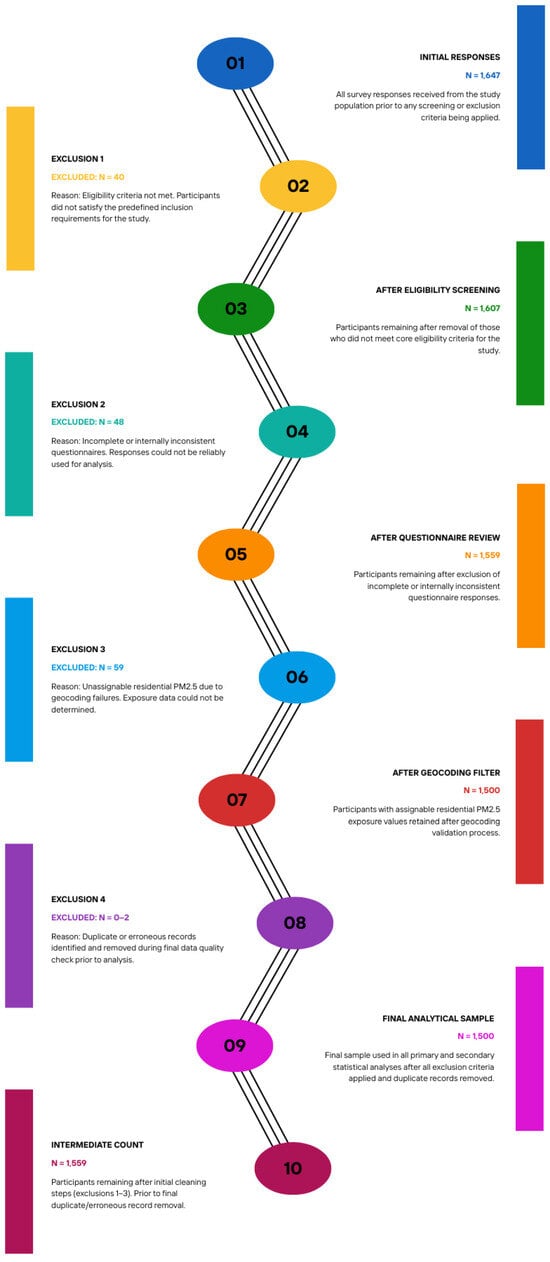
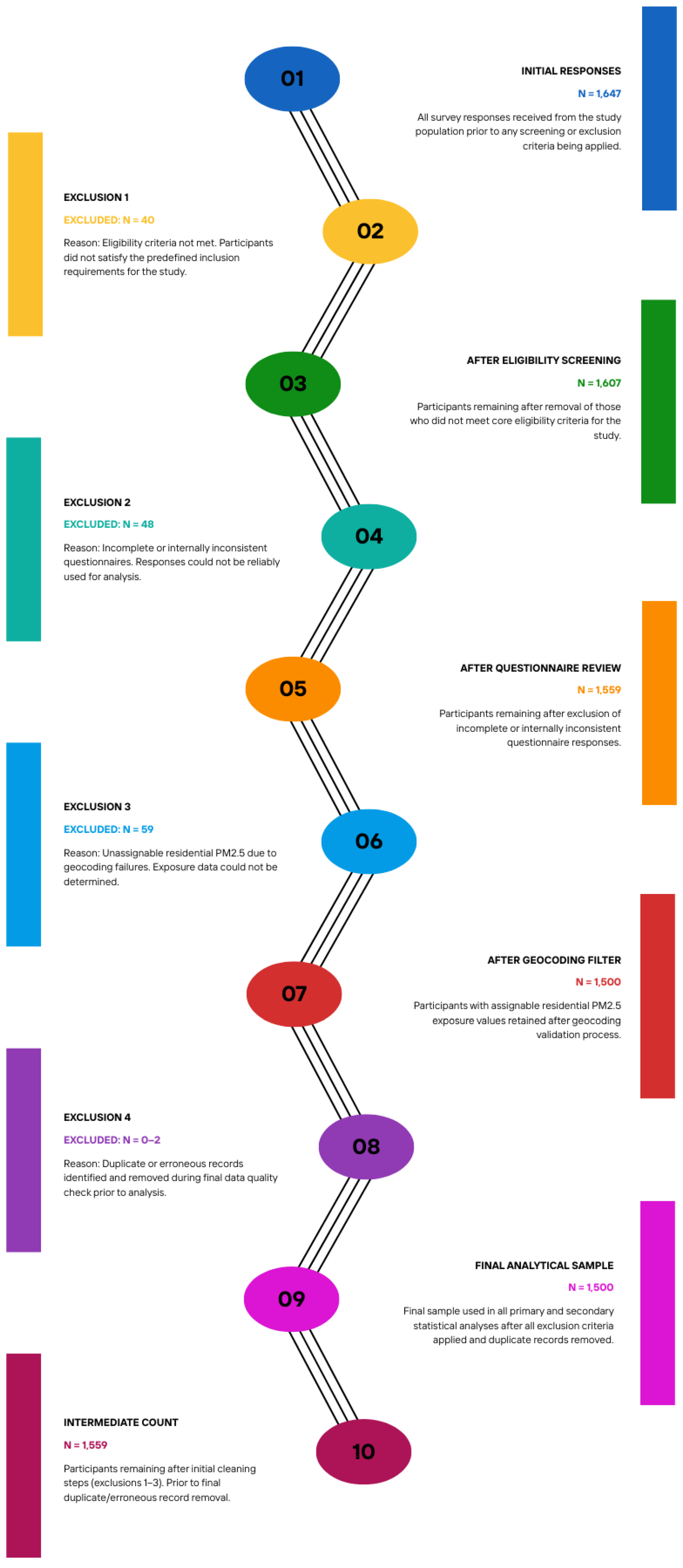
Regarding participant selection and data-cleaning, of 1647 women who completed the survey, we applied prespecified inclusion criteria and a reproducible data-cleaning workflow (Figure 1). We first removed 40 responses that did not meet inclusion criteria (non-residents of Kaunas n = 12; births outside the study period n = 10; multiple pregnancies n = 8; age < 18 or non-Lithuanian speakers n = 10). Next, 48 records were excluded for survey incompleteness or inconsistent responses (missing core outcome variables, contradictory birth dates/gestational ages, or >20% unanswered items on the questionnaire). We then geocoded all remaining residential addresses; 59 records lacked a mappable address or had addresses outside the model domain and were excluded because modelled PM2.5 could not be assigned. Two duplicate or evidently erroneous records were removed. After these steps, the analytic sample comprised 1500 participants. All exclusions and reasons were recorded in a study log and checked independently by two investigators.
Figure 1.
Flow diagram for study participants’ involvement in the study.
The questionnaire included 74 closed questions and six open-ended items to collect detailed information on participants’ residence, satisfaction with healthcare during pregnancy, childbirth, and postpartum, and their knowledge of and adherence to informed consent principles. The survey also explored occurrences of obstetric violence and assessed possible pregnancy outcomes, including delivery methods, neonatal health indicators, and postnatal experiences.
Although exposure categories were prespecified (<20, 20–30, >30 µg/m3) for interpretability and relevance to guideline ranges, we note the small size of the highest exposure stratum (6.6%), which reduces precision. To address this, we performed sensitivity analyses using PM2.5 as a continuous variable (per 5 and per 10 µg/m3), restricted cubic splines, quartiles/tertiles, and a combined >20 µg/m3 category; we also computed bootstrap CIs for estimates involving the highest exposure group. The results were consistent in direction across approaches, supporting the robustness of the findings, although estimates for the smallest stratum were less precise (wider CIs) and are interpreted with caution.
This extensive data collection aims to provide valuable insights into the impact of COVID-19 on maternal experiences, the quality of healthcare services, and potential obstetric and neonatal outcomes within the Lithuanian context, thereby contributing to evidence-based improvements in perinatal care during ongoing public health crises.
2.2. Residential PM2.5 Exposure Assessment
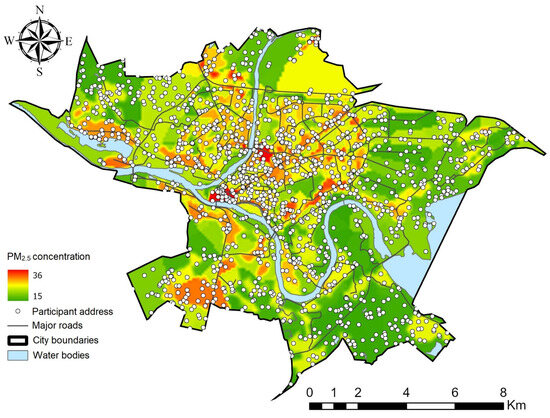
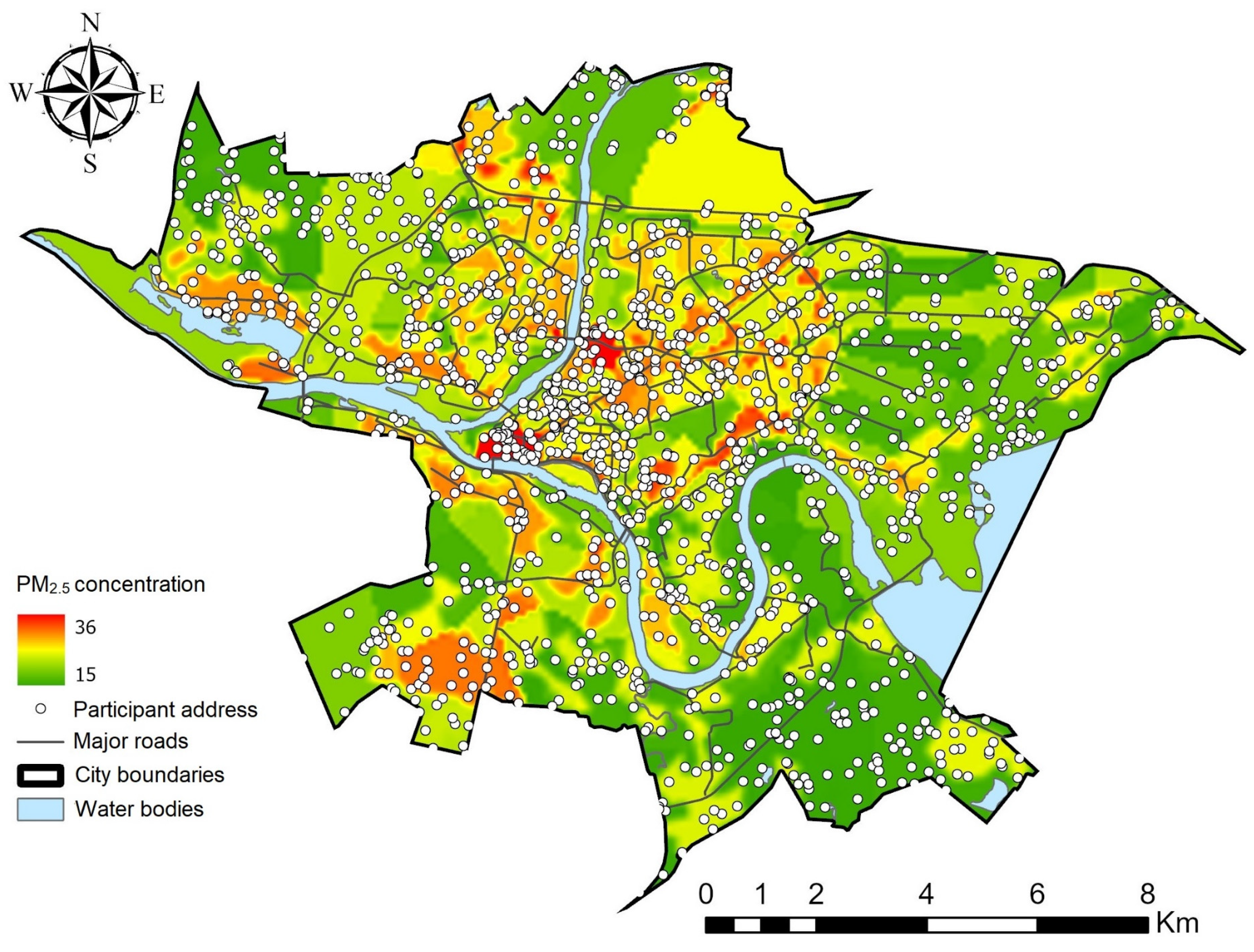
To estimate individual exposure to PM2.5 and assess its potential health effects, annual mean PM2.5 concentrations (µg/m3) were modelled for participants’ residential locations using the ADMS-Urban dispersion model. Residential addresses were geocoded in ArcGIS Pro 3.6, and the corresponding annual mean modelled PM2.5 concentration was assigned to each geocoded residence (Figure 2). All data regarding women’s residential addresses were obtained via an anonymous questionnaire.
Figure 2.
Spatial distribution of PM2.5 exposure and study participants’ address in Kaunas city (N = 1500).
Monitoring stations represent urban background and traffic sites; where necessary, we restricted comparisons to stations with similar site classifications or adjusted results accordingly. Because we used annual residential concentrations, we assessed whether the monitoring year(s) matched the exposure period and evaluated potential within-year temporal variability. The model showed acceptable performance: R2 = 0.72, RMSE = 3.8 µg/m3, mean bias = 0.6 µg/m3, and MAE = 2.9 µg/m3, indicating modest error but no large systematic bias. Cross-validation produced similar metrics (R2 = 0.69). Prediction intervals indicate greater uncertainty at the highest concentrations. These metrics indicate reasonably accurate spatial exposure contrasts for epidemiologic analyses, while acknowledging residual exposure measurement error that would likely attenuate effect estimates.
Participants were categorised into three PM2.5 exposure groups: low (<20 µg/m3), moderate (20–30 µg/m3), and high (>30 µg/m3). These cutoff points reflect exposure ranges that are meaningful for public health and prior literature: values near 20 µg/m3 approximate commonly cited interim guideline levels and local ambient concentrations, 20–30 µg/m3 represents moderate exposure where adverse effects have been reported, and >30 µg/m3 captures higher, potentially more harmful exposures. Using three categories facilitates detection of non-linear dose–response patterns while preserving sufficient sample size in each stratum for stable effect estimates.
2.3. Statistical Analysis
To assess questionnaire reliability, Cronbach’s alpha was calculated (α = 0.715), indicating acceptable internal consistency and that the items are adequately correlated and reflect the underlying constructs.
Data were analysed using IBM SPSS Statistics 29.0. The relationship between prenatal PM2.5 exposure during the COVID-19 period and neonatal outcomes, specifically the delivery method, birth weight, and APGAR score, was assessed through multivariate logistic regression analysis. This approach also helped identify potential confounding factors that might distort the observed relationships.
The analysis incorporated maternal age, education, marital status, place of residence, and socioeconomic status. These demographic variables were evaluated using measures of central tendency (means) and frequency distributions within the studied population. Other variables, including the provision of information to pregnant women, their feelings of safety during and after childbirth, satisfaction with childbirth experience, pregnancy outcomes, and complications during delivery, were analysed for associations using correlation coefficients to explore relationships between these factors.
Gestational age at delivery and BWGA z-scores were not available; analyses use mean birthweight (±SD), and models were adjusted for maternal age, parity, BMI, smoking, hypertensive disorders, diabetes, and socioeconomic indicators.
Mode of delivery and indications for caesarean section were not collected via the participant questionnaire, but were abstracted from hospital delivery records. Caesarean deliveries (overall 388/1500; 25.9%—Group 1: 111; Group 2: 202; Group 3: 75) were classified as elective or emergency. Primary indications were grouped a priori into: previous caesarean, failure to progress/obstructed labour, non-reassuring foetal status, malpresentation, placental complications, multiple pregnancy, maternal medical indications, elective maternal request/other, or unknown. When multiple indications were listed, the primary indication recorded by the attending clinician was used. Indications were available for 384/388 caesareans (99.0%); indication was missing/uncertain for 4 cases (1.0%).
Binary outcomes (caesarean delivery, small-for-gestational-age [SGA, <10th percentile], large-for-gestational-age [LGA, >90th percentile], and low APGAR [<7]) were analysed using multivariable logistic regression. Continuous outcomes (birthweight in grams and 5 min APGAR score) were analysed using multivariable linear regression; birthweight was also expressed as sex-specific birthweight-for-gestational-age (BWGA) z-scores and analysed as a continuous outcome. For APGAR, we performed ordinal logistic regression (three categories: 0–6, 7–8, 9–10) as a sensitivity analysis. The models were adjusted for prespecified covariates. We assessed the linearity of continuous predictors, the normality and homoscedasticity of residuals for linear models, and the proportional odds assumption for ordinal models; where assumptions were violated, we used robust standard errors or alternative modelling (e.g., transformation or generalised linear models).
To account for potential confounders and assess the strength of associations, odds ratios (ORs) with 95% confidence intervals (CIs) were calculated. A p-value of less than 0.05 was considered statistically significant, indicating a meaningful relationship between prenatal PM2.5 exposure and birth outcomes during the COVID-19 period, including delivery mode, neonatal weight, and APGAR scores. These statistical findings aim to clarify how environmental pollution may impact neonatal health and delivery outcomes in the context of pandemic-related environmental and healthcare changes.
3. Results
Most participants were aged 18–24 (59.4%), reflecting a predominantly young maternal cohort; smaller proportions were 25–30 (17.7%), 31–35 (10.1%), 36–39 (10.3%), and ≥40 (2.5%). Educational attainment was relatively high, with 33.6% having secondary and 31.6% higher university education; lower levels (none, primary, vocational) were infrequent (each ~4.8–8.4%). The majority were first-time mothers (88.1%), while 11.8% had a second or subsequent child (Table 1).
Table 1.
Baseline characteristics of study participants who had COVID-19 during childbirth (N = 1559).
Descriptive statistics indicated a mean PM2.5 concentration of 19.60 µg/m3, with a standard deviation of 2.59 µg/m3, suggesting moderate variability. The median concentration (19.11 µg/m3) was close to the mean, indicating a relatively symmetrical distribution of the data. The interquartile range was 3.84 µg/m3, reflecting variability within the central 50% of the data. Concentrations ranged from 14.30 µg/m3 to 36.23 µg/m3, demonstrating the overall spread of PM2.5 levels in the study population. Overall, these results provide a coherent summary of individual PM2.5 exposure, with central tendency measures indicating moderate pollution levels (Table 2).
Table 2.
Descriptive statistics of PM2.5 exposure in the research area (N = 1500).
This study examines the impact of varying prenatal PM2.5 exposure levels on significant neonatal outcomes, specifically delivery methods, average birth weight, and APGAR scores at 1 and 5 min post-delivery.
Table 3 shows the association of prenatal PM2.5 exposure levels with delivery method, birth weight, and APGAR score in newborns.
Table 3.
Association of prenatal PM2.5 exposure levels with delivery methods, birth weight, and APGAR scores in newborns (N = 1500).
The data revealed a statistically significant difference in delivery methods across PM2.5 exposure groups (p = 0.001). In the low-exposure group (n = 638), the majority of women delivered vaginally (527 vaginal/111 C-section). In the moderate-exposure group (n = 763), a similar trend continued, with a higher number of vaginal deliveries (561 vaginal/202 C-section). The high-exposure group (n = 99) exhibited a stark contrast, with only 24 vaginal deliveries and 75 C-sections, highlighting a 75.9% C-section rate in high-exposure pregnancies.
There was a significant difference in delivery methods among the PM2.5 exposure groups, with a notable increase in caesarean deliveries in the higher PM2.5 exposure group (>30 µg/m3) (53.7%, n = 75) compared to the lower exposure group.
The analysis of average birth weight demonstrated a significant decrease correlated with increased PM2.5 exposure levels (p < 0.001). In the low-exposure group, the mean birth weight was 3300 g, which is considered healthy and within normal ranges. In the moderate-exposure group, birth weight decreased to 3100 g, indicating potential growth restriction. In the high-exposure group, the mean birth weight fell further to 2900 g, indicating a concerning trend towards low birth weight, which is associated with higher risks of neonatal complications and long-term health issues.
Birth weights decreased significantly with increased PM2.5 exposure: 3300 g in the low-exposure group to 2900 g in the high-exposure group, demonstrating a concerning impact on foetal growth associated with air pollution.
APGAR scores were significantly lower in the higher PM2.5 exposure group, both at 1 min (p < 0.001) and at 5 min (p < 0.001). In the low -exposure group, APGAR scores averaged 8.0 at 1 min and 9.0 at 5 min, reflecting generally healthy neonatal conditions. In the moderate-exposure group, APGAR scores decreased to 7.5 at 1 min and 8.5 at 5 min, indicating potential stress or compromise in the newborn’s initial health status. In the high-exposure group, APGAR scores dropped to 6.5 at 1 min and 8.0 at 5 min, suggesting significant distress or health risks associated with higher exposure levels.
APGAR scores at 1 and 5 min post-delivery were observed and were lower in the high PM2.5 exposure group, indicating potential neonatal health issues associated with elevated pollution levels.
In Group 1, there were 111 C-sections (17.4%) out of 638 total deliveries, compared to 202 C-sections (26.5%) in Group 2 and 75 C-sections (43.2%) in Group 3. This significant increase in C-section rates with higher PM2.5 exposure is reflected in both the crude and adjusted odds ratios, which can indicate a strong association.
At 1 min, the incidence of APGAR scores ≤ 7 was relatively low in Group 1 (6.3%), double that in Group 2 (10.0%), and substantially higher in Group 3 (38.5%). The crude OR and adjusted OR suggest that exposure to PM2.5 significantly increases the risk of lower APGAR scores.
Similarly, at 5 min, the percentages of scores < 7 also show a worrying trend, with only 3% of Group 1 compared to nearly 29% in Group 3, underscoring the adverse neonatal effects of high pollution levels.
The prevalence of low birth weight (<2500 g) across the groups was significantly elevated in the higher PM2.5 exposure group. With a crude OR of 0.67, the data indicate that higher PM2.5 exposure correlates with lower birth weights, reinforcing the importance of air quality in prenatal health (Table 4).
Table 4.
Logistic regression analysis of PM2.5 exposure and risk of low birth weight (<2500 g) (N = 1500).
The results are presented as odds ratios from logistic regression for binary outcomes and as regression coefficients from linear regression for continuous outcomes (BWGA z-score and birthweight in grams). Sensitivity analyses using ordinal logistic regression for APGAR and binary low-APGAR models produced consistent findings.
4. Discussion
The findings from this study underscore the detrimental impact of prenatal PM2.5 exposure on key birth outcomes during the COVID-19 pandemic, highlighting a significant association with delivery methods, newborn birth weights, and APGAR scores. Our results provide a valuable contribution to the growing body of research on environmental health, particularly in the context of the unprecedented challenges posed by the pandemic. The cohort is largely composed of young, well-educated, first-time mothers, creating a relatively homogeneous sample regarding age and parity that may simplify analysis of COVID-19 interactions with maternal factors. However, the high education level could limit the generalisability of the results to populations with lower educational attainment or different socioeconomic profiles.
In our study, an alarming trend of increased caesarean section deliveries was apparent in the high PM2.5 exposure group, with a striking 75.9% of newborns delivered via C-section. This contrasts starkly with the lower C-section rates observed in the moderate- and low-exposure groups, suggesting that higher levels of air pollution may exacerbate maternal and foetal distress, leading healthcare providers to opt for surgical interventions for perceived safety. These findings align with other studies that have reported an association between air quality and increased caesarean delivery rates due to complications such as foetal distress and preterm labour [26].
Moreover, the data revealed a concerning decline in average birth weight with increased PM2.5 exposure, dropping from 3300 g in the low-exposure group to 2900 g in the high-exposure group. This trend is consistent with previous research indicating that prenatal exposure to air pollution can restrict foetal growth and increase the likelihood of low birth weight, which in turn is linked to adverse neonatal outcomes and long-term health issues [27,28]. Such findings highlight the critical importance of addressing air quality as part of public health strategies aimed at improving maternal and child health outcomes, particularly in vulnerable populations.
The significant drop in APGAR scores at 1 and 5 min post-delivery within the high-exposure group suggests an increase in immediate health risks for newborns subjected to higher levels of air pollution. While APGAR scores are commonly used to assess the health of newborns immediately after birth, persistently low scores can indicate potential complications that may affect long-term development. Other studies have corroborated these observations, linking poorer APGAR outcomes with elevated maternal exposure to air pollutants [29].
Socioeconomic factors such as maternal age, education, and place of residence can modify the effects of environmental exposures, producing compounded impacts on health outcomes. The predominance of young, well-educated mothers in our sample may limit the generalisability of these findings to more diverse populations, highlighting the need for additional research across varied socioeconomic strata.
The intersection of COVID-19, air pollution, and maternal health raises important health equity concerns. Evidence suggests that socioeconomically disadvantaged groups with reduced access to healthcare often bear the greatest burden from environmental pollutants [30], a disparity that can worsen during public health emergencies, as seen in the pandemic. Maternal health policies should therefore integrate environmental health measures to mitigate these inequities during future crises.
This study provides a foundation for further research into the complex interactions between environmental exposures and maternal health during pregnancy. Future work should evaluate interventions to reduce the harmful effects of air pollution on maternal and neonatal outcomes, including air quality policies and public education efforts.
A limitation of this study is the absence of hospital identifiers; we could not evaluate whether hospital-level practices influenced caesarean rates. Although we adjusted for key maternal and clinical covariates to mitigate confounding by case mix, residual confounding by hospital cannot be excluded. Future studies should include hospital-level data to assess clustering and practice variation. Also, a limitation is the absence of gestational age and BWGA z-scores, which precludes separating foetal growth restriction from differences in gestational duration. Although we adjusted for key maternal and clinical covariates, residual confounding related to gestational age cannot be excluded.
Finally, these findings underscore the urgent need to address air pollution as a major public health threat particularly for pregnant women. A better understanding of these relationships will support the development of effective strategies to protect maternal and child health, especially in times of crisis.
5. Conclusions
This study demonstrates that prenatal exposure to elevated PM2.5 during the COVID-19 pandemic can be associated with adverse birth outcomes, higher caesarean delivery rates, lower birth weights, and reduced 1 and 5 min APGAR scores. The findings highlight the need for public health measures to improve air quality to protect maternal and neonatal health, especially during public health emergencies. They also call for further investigation into socioeconomic disparities that influence these outcomes and for the integration of environmental health considerations into maternal care policies. Overall, the research links air pollution, maternal health, and child development, supporting a comprehensive strategy to bolster resilience among vulnerable populations.
Author Contributions
A.L. initiated research, wrote the research paper and manuscript, supervised data collection, and performed the data analysis. S.Č. and A.S. participated in the study design, conducted the field work, and helped with the data analysis. A.K. helped with the data analysis and writing the Discussion. A.M. and A.D. supervised the data analysis and interpreted the data. All authors have read and agreed to the published version of the manuscript.
Funding
This research received no external funding.
Institutional Review Board Statement
This study was conducted in accordance with the Declaration of Helsinki and approved by the Committee for the Assessment of Compliance of Scientific Research with the Basic Principles of Research Professionalism and Ethics (protocol code No. 23-11-23 and on 23 November 2023).
Informed Consent Statement
Informed consent was obtained from all subjects involved in the study.
Data Availability Statement
The datasets used and/or analysed during the current study are available from the corresponding author on reasonable request.
Acknowledgments
We would like to express our heartfelt gratitude to all the women who participated in this study, as their willingness to share their experiences made this research possible. We extend our appreciation to the healthcare professionals and institutions that supported data collection and facilitated access to valuable resources within the Lithuanian healthcare system.
Conflicts of Interest
The authors declare no conflicts of interest.
References
- Ahn, T.G.; Kim, Y.J.; Lee, G.; You, Y.-A.; Kim, S.M.; Chae, R.; Hur, Y.M.; Park, M.H.; Bae, J.-G.; Lee, S.-J.; et al. Association between individual air pollution (PM10, PM2.5) exposure and adverse pregnancy outcomes in Korea: A multicenter prospective cohort, Air Pollution on Pregnancy Outcome (APPO) Study. J. Korean Med. Sci. 2024, 39, e131. [Google Scholar] [CrossRef] [Scilit]
- Lim, E.Y.; Kim, G.D. Particulate matter–induced emerging health effects associated with oxidative stress and inflammation. Antioxidants 2024, 13, 1256. [Google Scholar] [CrossRef] [Scilit]
- Parasin, N.; Amnuaylojaroen, T.; Saokaew, S. Prenatal PM2.5 exposure and its association with low birth weight: A systematic review and meta-analysis. Toxics 2024, 12, 446. [Google Scholar] [CrossRef] [Scilit]
- Yuan, L.; Zhang, Y.; Gao, Y.; Tian, Y. Maternal fine particulate matter (PM2.5) exposure and adverse birth outcomes: An updated systematic review based on cohort studies. Environ. Sci. Pollut. Res. Int. 2019, 26, 13963–13983. [Google Scholar] [CrossRef] [Scilit]
- Li, Z.; Tang, Y.; Song, X.; Lazar, L.; Li, Z.; Zhao, J. Impact of ambient PM2.5 on adverse birth outcome and potential molecular mechanism. Ecotoxicol. Environ. Saf. 2019, 169, 248–254. [Google Scholar] [CrossRef] [Scilit]
- Wang, W.; Mu, S.; Yan, W.; Ke, N.; Cheng, H.; Ding, R. Prenatal PM2.5 exposure increases the risk of adverse pregnancy outcomes: Evidence from meta-analysis of cohort studies. Environ. Sci. Pollut. Res. Int. 2023, 30, 106145–106197. [Google Scholar] [CrossRef] [Scilit]
- Bhutta, Z.A.; Bhavnani, S.; Betancourt, T.S.; Tomlinson, M.; Patel, V. Adverse childhood experiences and lifelong health. Nat. Med. 2023, 29, 1639–1648. [Google Scholar] [CrossRef] [Scilit]
- Das, K.; Behera, R.L.; Paital, B. Socio economic impact of COVID 19. In COVID 19 in the Environment; Elsevier: Amsterdam, The Netherlands, 2022; pp. 153–190. [Google Scholar] [CrossRef] [Scilit]
- Mishra, A.K.; Sajjad, S.; Mishra, S.; Arya, S.; Mishra, V.C.; Das, R. Global impacts of extended COVID 19 lockdowns: Intersecting perspectives on environmental quality, food security, human health, and societal dynamics. Int. J. Environ. Clim. Change 2024, 14, 619–636. [Google Scholar] [CrossRef] [Scilit]
- Xiao, Y. Research on economic impact of social distancing measures in the context of the epidemic—Empirical evidence from high frequency data of four municipalities. Empir. Econ. 2025, 69, 2445–2466. [Google Scholar] [CrossRef] [Scilit]
- Pope, J.; Olander, E.K.; Leitao, S.; Meaney, S.; Matvienko Sikar, K. Prenatal stress, health, and health behaviours during the COVID 19 pandemic: An international survey. Women Birth 2022, 35, 272–279. [Google Scholar] [CrossRef] [Scilit]
- Aranda, Z.; Binde, T.; Tashman, K.; Tadikonda, A.; Mawindo, B.; Maweu, D.; Boley, E.J.; Mphande, I.; Dumbuya, I.; Montaño, M.; et al. Disruptions in maternal health service use during the COVID 19 pandemic in 2020: Experiences from 37 health facilities in low income and middle income countries. BMJ Glob. Health 2022, 7, e007247. [Google Scholar] [CrossRef] [Scilit]
- Kuandyk, A.; Ortega, M.A.; Ntegwa, M.J.; Sarria Santamera, A. Impact of the COVID 19 pandemic on access to and delivery of maternal and child healthcare services in low and middle income countries: A systematic review of the literature. Front. Public Health 2024, 12, 1346268. [Google Scholar] [CrossRef] [Scilit]
- Kumari, U.; Sharma, R.K.; Keshari, J.R.; Sinha, A. Environmental exposure: Effect on maternal morbidity and mortality and neonatal health. Cureus 2023, 15, e38548. [Google Scholar] [CrossRef] [Scilit]
- Brandt, J.S.; Hill, J.; Reddy, A.; Schuster, M.; Patrick, H.S.; Rosen, T.; Sauer, M.V.; Boyle, C.; Ananth, C.V. Epidemiology of coronavirus disease 2019 in pregnancy: Risk factors and associations with adverse maternal and neonatal outcomes. Am. J. Obstet. Gynecol. 2021, 224, 389.e1–389.e9. [Google Scholar] [CrossRef] [Scilit]
- Ni, W.; Xing, Y.; Li, G.; Du, Z.; Yang, P.; Wang, Q.; Yang, X.; Lyu, B.; Fa, H.; Shi, Q.; et al. Windows of sensitivity for risk of adverse birth outcomes related to gestational PM2.5 exposure: Evidence from a natural experiment. Environ. Pollut. 2024, 347, 123759. [Google Scholar] [CrossRef] [Scilit]
- Nazzari, S.; Cagliero, L.; Grumi, S.; Pisoni, E.; Mallucci, G.; Bergamaschi, R.; Maccarini, J.; Giorda, R.; Provenzi, L. Prenatal exposure to environmental air pollution and psychosocial stress jointly contribute to the epigenetic regulation of the serotonin transporter gene in newborns. Mol. Psychiatry 2023, 28, 3503–3511. [Google Scholar] [CrossRef] [Scilit]
- Sheppard, L.; Blanco, M.N.; Kim, S.Y.; Doubleday, A.; Cheng, S.; Zuidema, C.; Bi, J.; Gassett, A.; Shojaie, A.; Szpiro, A.A. Optimizing air pollution exposure assessment with application to cognitive function. Res. Rep. Health Eff. Inst. 2025, 2025, 228. [Google Scholar]
- Guo, B.; Jiang, X. Association between atmospheric particulate matter pollution during pregnancy and premature birth in China: A meta analysis. Front. Public Health 2025, 13, 1474134. [Google Scholar] [CrossRef] [Scilit]
- Chiarello, D.I.; Ustáriz, J.; Marín, R.; Carrasco-Wong, I.; Farías, M.; Giordano, A.; Gallardo, F.S.; Illanes, S.E.; Gutiérrez, J. Cellular mechanisms linking to outdoor and indoor air pollution damage during pregnancy. Front. Endocrinol. 2023, 14, 1084986. [Google Scholar] [CrossRef] [Scilit]
- Gao, S.; Zhang, H.; Kang, X.; Cui, X. Prenatal PM2.5 exposure and hypertensive disorders of pregnancy: A systematic review and meta-analysis. Front. Public Health 2025, 13, 1650913. [Google Scholar] [CrossRef] [Scilit]
- Alvarado-Jiménez, D.; Donzelli, G.; Morales-Suárez-Varela, M. A systematic review on the association between exposure to air particulate matter during pregnancy and the development of hypertensive disorders of pregnancy and gestational diabetes mellitus. Rev. Environ. Health 2024, 39, 619–641. [Google Scholar] [CrossRef] [Scilit]
- Sun, Y.; Bhuyan, R.; Jiao, A.; Avila, C.C.; Chiu, V.Y.; Slezak, J.M.; Sacks, D.A.; Molitor, J.; Benmarhnia, T.; Chen, J.-C.; et al. Association between particulate air pollution and hypertensive disorders in pregnancy: A retrospective cohort study. PLoS Med. 2024, 21, e1004395. [Google Scholar] [CrossRef] [Scilit]
- Basilio, E.; Chen, R.; Fernandez, A.C.; Padula, A.M.; Robinson, J.F.; Gaw, S.L. Wildfire Smoke Exposure during Pregnancy: A Review of Potential Mechanisms of Placental Toxicity, Impact on Obstetric Outcomes, and Strategies to Reduce Exposure. Int. J. Environ. Res. Public Health 2022, 19, 13727. [Google Scholar] [CrossRef] [Scilit]
- Lazzerini, M.; Covi, B.; Mariani, I.; Giusti, A.; Pessa Valente, E. IMAgiNE EURO Study Group. Quality of care at childbirth: Findings of IMAgiNE EURO in Italy during the first year of the COVID 19 pandemic. Int. J. Gynaecol. Obstet. 2022, 157, 405–417. [Google Scholar] [CrossRef] [Scilit]
- Fussell, J.C.; Jauniaux, E.; Smith, R.B.; Burton, G.J. Ambient air pollution and adverse birth outcomes: A review of underlying mechanisms. BJOG 2024, 131, 538–550. [Google Scholar] [CrossRef] [Scilit]
- Gheissari, R.; Liao, J.; Garcia, E.; Pavlovic, N.; Gilliland, F.D.; Xiang, A.H.; Chen, Z. Health outcomes in children associated with prenatal and early life exposures to air pollution: A narrative review. Toxics 2022, 10, 458. [Google Scholar] [CrossRef] [Scilit]
- Ha, S.; Yeung, E.; Bell, E.; Insaf, T.; Ghassabian, A.; Bell, G.; Muscatiello, N.; Mendola, P. Prenatal and early life exposures to ambient air pollution and development. Environ. Res. 2019, 174, 170–175. [Google Scholar] [CrossRef] [Scilit]
- Palma, A.; Petrunyk, I.; Vuri, D. Prenatal air pollution exposure and neonatal health. Health Econ. 2022, 31, 729–759. [Google Scholar] [CrossRef] [Scilit]
- Di Ciaula, A.; Moshammer, H.; Lauriola, P.; Portincasa, P. Environmental health, COVID 19, and the syndemic: Internal medicine facing the challenge. Intern. Emerg. Med. 2022, 17, 2187–2198. [Google Scholar] [CrossRef] [Scilit]

Disclaimer/Publisher’s Note: The statements, opinions and data contained in all publications are solely those of the individual author(s) and contributor(s) and not of MDPI and/or the editor(s). MDPI and/or the editor(s) disclaim responsibility for any injury to people or property resulting from any ideas, methods, instructions or products referred to in the content. |
© 2026 by the authors. Licensee MDPI, Basel, Switzerland. This article is an open access article distributed under the terms and conditions of the Creative Commons Attribution (CC BY) license.