


Abstract
Radiological screening of construction materials is conventionally performed on bulk samples, yet occupants are exposed to fine, abradable, and respirable fractions. This study examines how particle-size distribution (PSD) governs the redistribution of 226Ra, 232Th, 40K, and anthropogenic 137Cs in construction materials and in ash from domestic biomass heating. In total, 27 materials were analysed by high-resolution HPGe gamma spectrometry, with granulometric segregation at coarse (PSD3) and fine (PSD7) resolution. PSD3 showed no monotonic effect, whereas PSD7 revealed a systematic rise of the activity concentration index toward the finest fractions. 40K and 137Cs showed the strongest particle-size dependence, indicating preferential accumulation in the fines; 137Cs was detected only in biomass-ash pellets, where it was enriched in the fines (EF = 2.73 relative to bulk; a single-material case study). Two models are proposed: a physically grounded surface-controlled model and a descriptive granulometric enrichment factor for material ranking, both fitted to the present dataset. A fraction-resolved dose assessment showed that the internal hazard index (Hin) rises toward the fines and exceeds unity (≈1.1) in the respirable ash and fireclay fractions even though their bulk values remain acceptable. Bulk screening, therefore, underestimates the dose-relevant burden carried by the fine fractions that workers and households actually inhale.
1. Introduction
Indoor environments represent the dominant setting for human radiation exposure, as people in modern societies spend the majority of their time indoors [1]. Building materials continuously emit external gamma radiation and can release radionuclide-containing dust, making their radiological quality an important environmental and public health issue [2]. This concern has become increasingly relevant with the growing use of industrial by-products such as coal ash, biomass ash, slag, and other secondary mineral resources in construction materials as part of circular-economy strategies [3]. These materials may introduce both naturally occurring radionuclides (226Ra, 232Th, and 40K) and anthropogenic radionuclides such as 137Cs into the indoor environment.
Current radiological assessment of construction materials is based primarily on bulk activity concentrations. The activity concentration index (Iγ), defined in the European Basic Safety Standards and related guidance documents [4,5,6,7,8], is widely used as the principal screening tool for evaluating the suitability of construction materials. However, this approach implicitly assumes that radionuclides are uniformly distributed throughout the material and therefore does not account for particle-size-dependent redistribution.
Although radionuclide enrichment in fine particles has been reported for soils, sediments, and combustion residues [9,10,11,12,13,14], construction materials continue to be evaluated almost exclusively using bulk samples. Consequently, it remains unclear whether conventional bulk screening adequately represents the radiological burden associated with inhalable fine fractions generated during construction, demolition, recycling, and routine handling. Furthermore, based on the literature reviewed, no study was identified that proposes a specific quantitative framework for describing radionuclide enrichment using granulometric parameters and ranking them across materials with respect to their propensity to concentrate activity in the fine fraction. This represents a specific gap in knowledge that this study aims to fill.
Particle-size effects are expected because finer particles possess a larger specific surface area and a greater abundance of adsorption sites capable of concentrating radionuclides [15]. Since occupants and construction workers are exposed primarily to fine, abradable, and respirable particles rather than intact bulk materials, radionuclide redistribution among particle-size fractions may significantly influence realistic exposure assessment [16,17,18]. Similar concerns apply to secondary mineral resources, particularly biomass ash, which is increasingly incorporated into construction products while also generating fine ash during domestic heating [19].
Most building materials originate from natural geological resources and therefore contain naturally occurring radionuclides, primarily 226Ra, 232Th, and 40K [20,21]. Industrial by-products such as fly ash and phosphogypsum may further modify radionuclide concentrations when incorporated into construction products [14,22]. Radiation from these materials contributes to external gamma exposure as well as internal exposure through radon and airborne dust [23].
Previous studies have demonstrated that the activity concentration index (Iγ) of most conventional construction materials generally complies with internationally accepted limits [12,24,25,26,27,28,29]. However, these assessments have almost exclusively been performed on bulk samples, despite evidence that radionuclide concentrations may vary substantially with particle size. Nevertheless, experimental studies have shown that natural radionuclides tend to be enriched in fine fractions due to their larger specific surface area [30], whereas radon emanation depends not only on particle size but also on microstructure, porosity, and mineralogical characteristics [31,32]—indicating that granulometric effects are material-dependent and cannot be generalised from bulk measurements alone.
The phenomenon itself has long been established, having been documented since the work of Megumi and Mamuro [33]. What has received little attention is the granulometric resolution at which such studies are conducted. Published work bins particle sizes into classes of widely differing granularity, yet this choice is treated as a methodological detail rather than as a factor that may condition whether an effect is detected at all. Because coarse binning averages activity across the transition from lattice-hosted to surface-associated material, a real redistribution may be attenuated below the threshold of detection, meaning that negative findings cannot readily be distinguished from insufficient resolution.
On the other hand, the anthropogenic radionuclide 137Cs requires special attention because evaporation during biomass combustion promotes its condensation on fine ash particles. Therefore, biomass ash often shows a pronounced enrichment of 137Cs in the finest fractions [22,34], making it a particularly suitable material for investigating the distribution of radionuclides as a function of particle size.
Despite these achievements, while the general association between particle size and radionuclide activity has been documented in numerous studies on soils, sediments, and combustion residues, systematic research, particularly with controlled granulometric fractionation and high-resolution analysis of fines, remains relatively limited. However, a review of the available literature did not reveal a comparable model explicitly describing radionuclide enrichment using material- and radionuclide-dependent parameters. More importantly, it remains unknown whether radionuclide enrichment in exposure-relevant fine fractions is sufficiently pronounced to influence radiological classification based on conventional bulk measurements.
To address this knowledge gap, this study investigates whether radionuclide redistribution among particle-size fractions systematically affects the radiological assessment of construction materials. In total, 27 conventional construction materials and secondary mineral resources were analysed using HPGe gamma spectrometry and two particle-size fractionation schemes (PSD3 and PSD7). In addition to evaluating the influence of granulometry on radionuclide activities and the activity concentration index (Iγ), a surface-controlled activity model is developed to interpret the enrichment mechanism, complemented by the granulometric enrichment factor (GEF) model for ranking materials.
Based on the identified knowledge gap, this study tests the following hypotheses:
H1.
Particle-size distribution systematically influences the redistribution of the natural radionuclides 226Ra, 232Th, and 40K in construction materials, with fine fractions acting as preferential carriers of radioactivity.
H2.
The anthropogenic radionuclide 137Cs exhibits stronger enrichment in fine fractions than naturally occurring radionuclides because of its high surface affinity, particularly in thermally processed secondary mineral materials.
H3.
High-resolution particle-size fractionation (PSD7) reveals radionuclide redistribution patterns that remain unresolved using conventional coarse fractionation (PSD3).
H4.
The magnitude of radionuclide enrichment depends on material type, with thermally processed and clay-rich materials exhibiting stronger enrichment than dense crystalline materials.
H5.
Because radionuclides preferentially accumulate in inhalable fine fractions, particle-size redistribution increases radiological hazard indices relative to bulk materials and may therefore lead to an underestimation of exposure when conventional bulk screening alone is applied.
These hypotheses are tested jointly in the present study, and the results are summarised in Section 3. The scope of the study is, however, deliberately bounded, and several limitations should be stated at the outset. The set of samples is representative of the regional construction market and is heterogeneous in origin. The high-resolution (PSD7) protocol could be applied only to the subset of samples that yielded sufficient mass per fraction (stone/schist, ash pellets, ceramic tiles, and fireclay), so the most granulometrically resolved conclusions rest on a limited number of material families. Detectable 137Cs was confined to a single biomass-ash material, so the caesium-specific findings are treated as a well-characterised case study rather than a population-level generalisation. Finally, the present manuscript characterises radionuclide redistribution radiometrically; the complementary mineralogical and microstructural analyses (XRD, SEM–EDS, and XRF) that would identify the host phases are the subject of ongoing work and are not claimed here. These constraints are revisited when the corresponding results are interpreted in Section 3 and in Section 4.
2. Materials and Methods
2.1. Sample Set
A total of 27 samples were collected from commercial suppliers and represent the dominant construction materials available on the regional market in Vojvodina, supplemented with secondary mineral substrates of construction interest. The composition of the sample set is summarised in Table 1.
Table 1.
Composition of the analysed sample set.
The materials span the principal process classes relevant to indoor exposure: high-temperature fired products (ceramic and granite tiles, brick, roof tile, and fireclay, fired at roughly 900–1250 °C), low-temperature or hydrothermally cured products (cement, AAC/Ytong blocks, and paving blocks), uncalcined natural aggregates and stone (granite, gravel, and schist), and a milled secondary by-product (biomass-ash pellets). The materials differ correspondingly in porosity and mineralogy—from dense, low-porosity igneous granite and vitrified tile to highly porous autoclaved aerated concrete and polydisperse ash. Because these process-, porosity-, and mineralogy-related parameters bear directly on radionuclide accessibility and on the granulometric behaviour interpreted in Section 3, they are an explicit object of the planned XRD/SEM–EDS/XRF campaign; the present manuscript reports the gamma-spectrometric and granulometric measurements, and quantitative calcination-temperature, porosity, and mineral-composition data for each sample are deferred to that companion characterisation rather than estimated here. The guiding significance for human habitation is direct: occupants are exposed not to idealised bulk material but to the surfaces and the fine, abradable, and respirable fractions of in-service products, so resolving how the dose-controlling radionuclides partition with particle size is a prerequisite for realistic indoor radiological screening of these material classes.
The inclusion of ash pellets is critical to this study: biomass ashes are increasingly proposed as supplementary cementitious materials, and they provide a pathway by which both 40K (intrinsic to plant biomass) and 137Cs (anthropogenic, fallout-derived) contribute to the radioactivity of construction materials.
2.2. Granulometric Protocol
Particle-size distribution (PSD) analysis was performed by dry sieving with an electromagnetic vibratory sieve shaker (Analysette 3 PRO, Fritsch GmbH, Idar-Oberstein, Germany). For each measurement, a representative sample mass of approximately 150 g was placed onto a nested set of analytical sieves (compliant with ISO 3310-1) from the same manufacturer. Sieving was conducted for 10 min at a constant vertical oscillation amplitude of 1.5 mm and repeated over multiple consecutive cycles until the minimum sample mass required for representative HPGe (Canberra Industries, Meriden, CT, USA) gamma spectrometry was obtained for every size fraction. Each sample was sieved into seven nominal size classes (PSD7): >500, 500–250, 250–125, 125–100, 100–75, 75–50, and <50 µm. Where individual fraction masses fell below the ≈100 g threshold required for representative gamma spectrometry, fractions were pooled into a coarser three-class scheme (PSD3): 1000–125 µm, 125–75 µm, and <75 µm. The PSD3 scheme was applied across the full set; the PSD7 scheme was applied to the subset of samples with sufficient mass per fraction (stone/shale, ash pellets, ceramic tiles, and fireclay). The samples were additionally grouped by material type (granite and ceramic tiles), yielding a total of six PSD3 groups.
Particle-size analysis was also performed by laser diffraction with a Malvern Mastersizer 2000 (Malvern Instruments, Malvern, Worcestershire, UK) equipped with a Scirocco 2000 dry-dispersion unit. To ensure high precision in accordance with Mie theory across the measured range of 0.02–2000 µm, specific optical and physical parameters were defined for each sample: refractive index (RI), absorption, and density. The analysis yielded several key descriptors—the surface-area-weighted mean D [3,2], the volume-weighted mean D [4,3], the percentiles d(0.1), d(0.5), and d(0.9), the Span = [d(0.9) − d(0.1)]/d(0.5), and the cumulative passing fractions % < 10, % < 63, and % < 75 µm.
2.3. Gamma Spectrometry
Activity concentrations of 226Ra (from the secular-equilibrium gamma lines of 214Pb at 295.2 and 351.9 keV and 214Bi at 609.3 and 1120.2 keV), 232Th (from 228Ac at 338.4, 911.2, and 968.9 keV and 212Pb at 238.6 keV), 40K (1460.82 keV), and 137Cs (661.7 keV) were determined with two low-level high-purity germanium (HPGe) coaxial detectors cooled with liquid nitrogen (a Be-window detector of 32.4% relative efficiency and a detector of 105.8% relative efficiency with a 0.89 mm-thick carbon-fibre endcap). Samples were sealed in cylindrical polypropylene containers (70 mm diameter, 62 mm height) and allowed to reach secular equilibrium (≥40 days) before counting. The counting time was approximately 18 h per sample; the sample mass was in the range 100–250 g. Energy and efficiency calibrations were performed with a certified multi-gamma source. Spectra were acquired and analysed with the Genie 2000 software, and the ANGLE 5 software was used for the necessary efficiency-transfer protocols. Results are reported in Bq kg−1 on a dry-mass basis with 1σ uncertainties.
2.4. Gamma Index (Iγ) and Enrichment Factor (EF)
The gamma index was computed in its standard EU Basic Safety Standards (BSS) form:
where the activity concentrations are in Bq kg−1. The fines-to-bulk enrichment factor for a radionuclide X was defined as
Iγ = CRa/300 + CTh/200 + CK/3000,
EFX = CX(fines, max)/CX(bulk material).
Here, CX(fines, max) denotes the highest activity concentration of X among the fine fractions; the fraction in which this maximum occurs varies between materials (e.g., <50 µm in some, 50–75 µm, or <125 µm in others). An EF > 1 indicates a preferential association of X with the fine fraction.
2.5. Statistical Analysis
Descriptive statistics were computed for each radionuclide and for Iγ. Spearman rank correlations have been used to test monotonic associations among radionuclides, between radionuclides and PSD descriptors, and between Iγ and the proportion of fines. Group differences across the three PSD3 classes were tested with the χ2 test; group differences across the seven PSD7 classes were tested with the related-samples Friedman two-way ANOVA by ranks, followed by post hoc pairwise comparisons. Differences between material families (granite vs. ceramic) were tested with the Mann–Whitney U test. Linear regression of Iγ, 40K, and 137Cs on the reciprocal of the surface-weighted mean diameter (1/D [3,2]) was used as a surface-area proxy. All tests were performed at α = 0.05 with two-sided p-values. Statistical analysis was performed using IBM SPSS Statistics software, v2024 (IBM Corp., Armonk, NY, USA).
3. Results and Discussion
3.1. Bulk Activity Concentrations and Iγ
Descriptive statistics for the 27 bulk samples are summarised in Table 2. 40K shows the largest range (5.0–1770 Bq kg−1), reflecting strong mineralogical contrasts across the sample set; 226Ra and 232Th span 9.1–83 and 1.1–73.0 Bq kg−1, respectively. The close agreement between the mean and median values for all three radionuclides indicates approximately symmetric distributions with no severe outliers in the bulk dataset.
Table 2.
Descriptive statistics of natural radionuclide activity and Iγ across 27 construction-material samples.
The mean Iγ of 0.52 is below the regulatory unity threshold, but several individual samples approach 0.93, leaving a narrow margin and underscoring the importance of resolving any granulometric redistribution that could push the dose-relevant fraction above unity.
3.2. Inter-Radionuclide Correlations
Spearman correlations among the three radionuclides (Table 3) show moderate 40K–232Th and 226Ra–232Th correlations, consistent with shared mineral hosts (e.g., K-feldspars, micas, and accessory phosphates) [35,36]. In contrast, 226Ra appears uncorrelated with 40K, signalling a different geochemical pathway, most likely co-precipitation with carbonates and chemisorption on Ca-rich phases [37,38].
Table 3.
Spearman rank correlations among radionuclides (** p < 0.001).
3.3. Coarse Granulometric Analysis (PSD3)
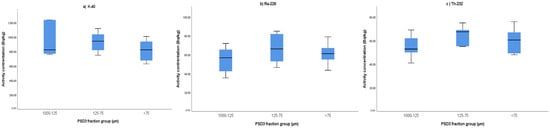
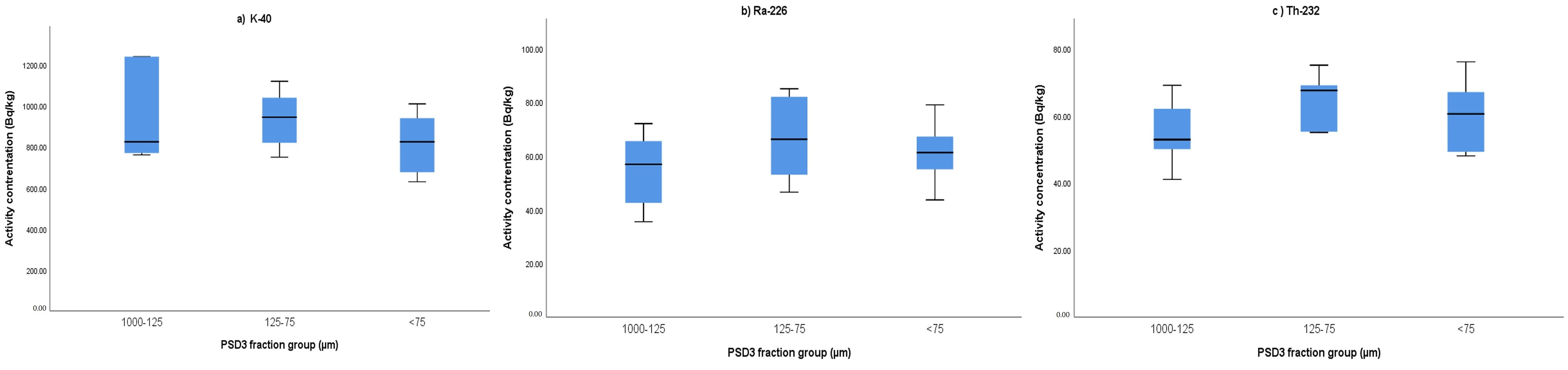
The distribution of the 226Ra, 232Th, and 40K activities within the three coarse classes (1000–125 µm; 125–75 µm; <75 µm) across all six PSD3 groups is shown in Figure 1.
Figure 1.
Distribution of 226Ra (a), 232Th (b), and 40K (c) activity concentrations across the PSD3 fraction groups.
Visual inspection of the three granulometric groups suggests a slightly elevated median activity concentration in the 125–75 µm fraction, with lower values in the coarsest (1000–125 µm) and finest (<75 µm) fractions, without a clear monotonic trend with particle size. Despite minor variations in the mean values, the Friedman test did not reveal significant differences among the PSD3 fraction groups (χ2(2) = 2.696, p = 0.260). The boxplots also show substantial overlap among the group distributions, indicating a lack of clear separation. The absence of strong PSD3–radionuclide associations suggests that aggregating particle-size fractions into a coarse three-class scheme is insufficient to resolve the underlying redistribution processes.
Spearman’s correlation analysis supports these findings: the PSD3 classification does not correlate significantly with the activity of any of the analysed radionuclides (226Ra: p = 0.482; 232Th: p = 0.532; 40K: p = 0.434). On the other hand, the PSD3 classification correlates strongly and negatively with the particle-size descriptors: d(0.5) (ρ = −0.866, p < 0.001), D [3,2] (ρ = −0.721, p = 0.001), and D [4,3] (ρ = −0.931, p < 0.001). Because the PSD3 classes do track particle size correctly, the binning methodology itself is sound, and the absence of a detectable redistribution is most parsimoniously attributed to insufficient granulometric resolution: aggregating fractions into three broad classes averages the activity over size ranges that span the transition from coarse, lattice-dominated to fine, surface-enriched material, diluting any gradient. Two qualifications are nonetheless warranted. First, the null PSD3 result should not be read as proof that resolution is the sole cause; the granite and ceramic materials to which PSD3 was applied are dense, low-porosity matrices in which radionuclides are largely held within the mineral lattice and accessory phases rather than on accessible surfaces, so the intrinsic mineral structure of these specific materials plausibly contributes to the weak granulometric signal independently of binning. Second, the Friedman result (χ2(2) = 2.696, p = 0.260) rests on a small number of groups with substantial within-class dispersion and broadly overlapping distributions; a non-significant p-value at this sample size reflects low statistical power as much as a true absence of effect and should be interpreted as “not resolved” rather than “no effect present.” The practical implication remains, however, robust: studies that pool size fractions into broad classes risk missing real redistribution effects, and the higher-resolution PSD7 scheme (Section 3.4) is required to discriminate the underlying behaviour.
The comparison of the six PSD3 groups of granite and ceramic materials by the Mann–Whitney test nevertheless reveals material-driven differences for 226Ra, which is significantly higher in the ceramic tiles (U = 17.5, Z = −2.032, p = 0.042), whereas 40K, Iγ, and 232Th do not differ significantly across the two material families (p > 0.05). This implies broadly comparable total radiological burdens but distinct radionuclide-partitioning behaviour.
3.4. High-Resolution Granulometric Analysis (PSD7)
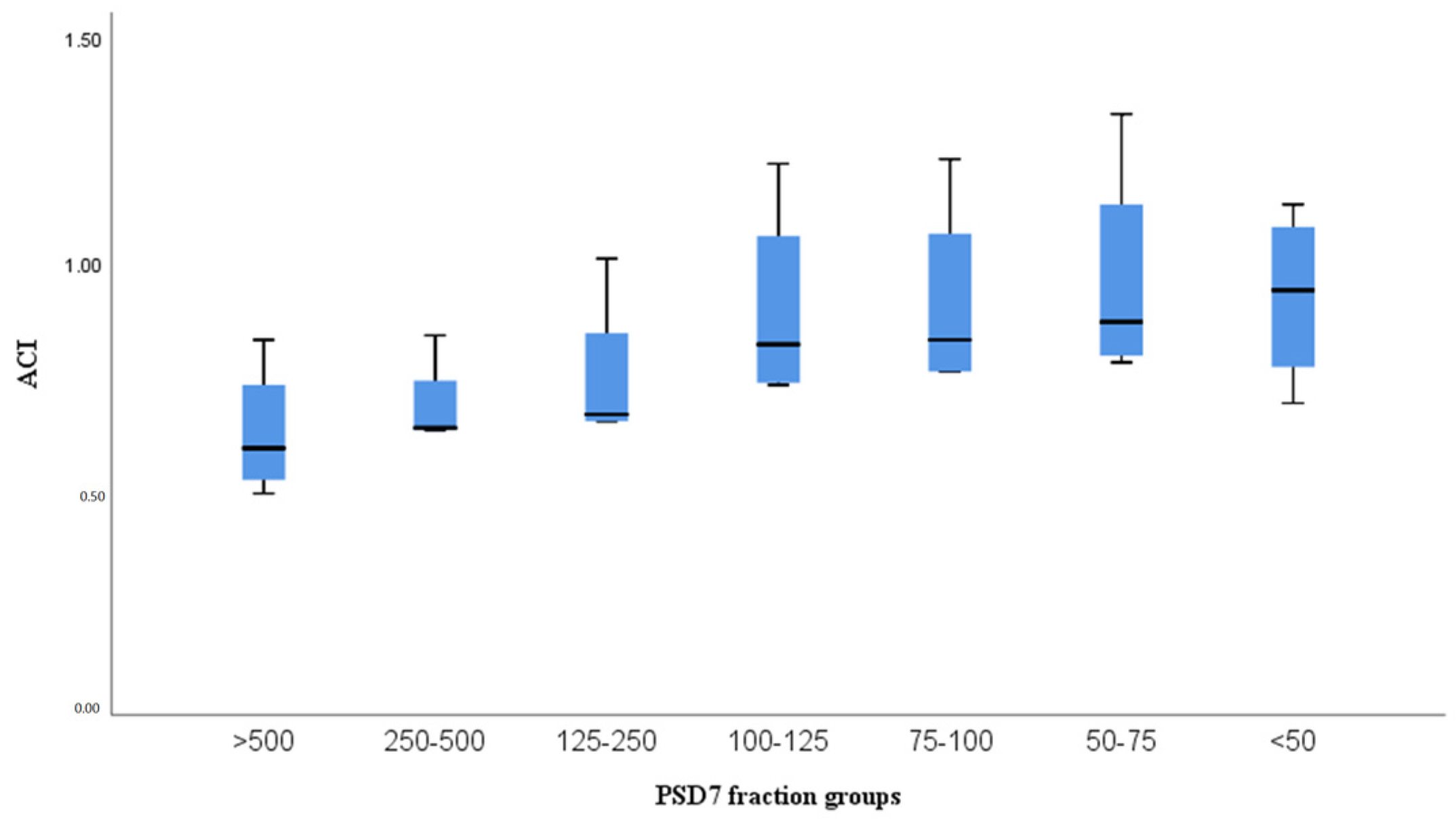
When the analysis is performed on the seven particle-size fractions (PSD7)—applied to the subset of samples with sufficient mass per fraction (shale/schist, ash pellets, ceramic tiles, and fireclay)—a clear and statistically significant effect emerges. The Friedman test on Iγ across the seven fractions yields χ2(6) = 20.368, p = 0.002. The mean ranks rise monotonically from the coarsest fraction (>500 µm, mean rank ≈ 1.50) to the finest fractions (75–50 µm, mean rank ≈ 6.50; <50 µm, mean rank ≈ 5.50), confirming a systematic enrichment of the Iγ in the fines, although not necessarily with a peak in the ultra-fine fraction.
Spearman correlations between Iγ and PSD descriptors are uniformly negative for particle size and positive for spread (Table 4). The Span shows a positive correlation (r = 0.563, p < 0.001), indicating that polydisperse materials are more prone to fines-driven enrichment.
Table 4.
Spearman correlations between particle-size descriptors and Iγ/40K/137Cs across the PSD7 fractions (* p < 0.05; ** p < 0.01).
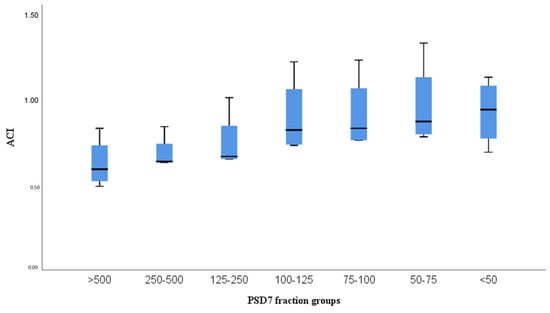
The trend of the Iγ values across the seven particle-size fractions (PSD7) is shown in Figure 2.
Figure 2.
Boxplot analysis of Iγ values across the seven PSD7 fraction groups.
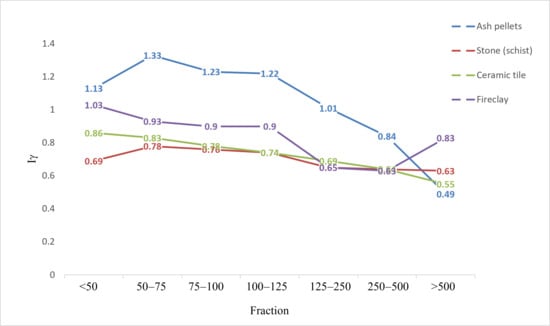
This global trend is not, however, uniform across materials (Figure 3). The most pronounced increase in Iγ was observed in the ash-pellet sample, with a sharp rise in the medium and fine fractions, peaking in the 75–50 µm range. The ceramic and shale samples exhibit a gradual, continuous increase toward the finest fractions, whereas fireclay shows a markedly weaker dependence of Iγ on particle size. This indicates that radionuclide activity depends not only on particle size but primarily on the material type.
Figure 3.
Distribution of Iγ values across the seven particle-size fractions, broken down by material (ash pellets, stone/schist, ceramic tile, and fireclay).
Figure 3 illustrates a moderate, near-monotonic enrichment of Iγ as the median particle size decreases, intermediate between the strong enrichment observed for the ash pellets and the near-flat fireclay response. For schist specifically—a coarse, layered metamorphic rock—the fraction-by-fraction behaviour of Iγ is also shown in Figure 3. The schist trace shows a measurable but moderate fines enrichment, smaller than in the other materials, and provides an instructive intermediate case for the GEF model introduced in Section 3.8.
For 226Ra and 232Th, the granulometric effect is not strictly linear: post hoc pairwise comparisons with Bonferroni correction revealed that the significant differences arise between the coarsest (>500 µm) and the fine 75–50 µm fractions (adjusted p = 0.022 for both radionuclides), with the intermediate fractions overlapping. 40K, in contrast, shows the strongest and most monotonic dependence on PSD descriptors and is the principal driver of the Iγ enrichment in the fines, exhibiting a negative correlation with D [3,2] (ρ = −0.517, p < 0.001), d(0.5) (ρ = −0.472, p = 0.011), and the other characteristic diameters and a positive correlation with the Span (ρ = 0.625, p < 0.001).
3.5. Iγ as a Function of Fines Content
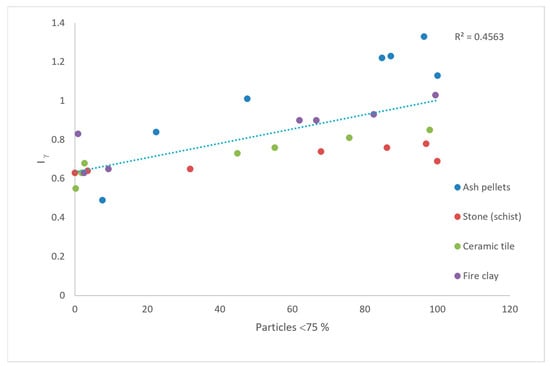
Plotting Iγ against the cumulative passing fraction at 75 µm (%<75 µm) yields a clear positive linear relationship. This visual trend is confirmed by a statistically significant linear regression (R = 0.675, p < 0.001). The coefficient of determination (R2 ≈ 0.46) is moderate, confirming that grain size is a real but not exclusive indicator of radioactivity in the samples; the residual variance is attributed to mineralogy and material type (Figure 4). The slopes of the regression lines, when computed per material, vary substantially: ash and fireclay show the steepest gradients, the ceramic tiles intermediate slopes, and the shale/stone the shallowest. However, this material-dependent variation should be interpreted as a descriptive observation rather than a statistically established interaction. The PSD7 design provides a single sample per material type; consequently, the differences between materials regarding particle size (visible in Figure 4) cannot be tested against within-material variability, and the material × fraction interaction term cannot be estimated. A mixed-effects or multilevel regression would be the appropriate tool to separate the particle-size and material-type contributions to the variance, but it requires replicate granulometric series per material family to estimate the random-effects structure—replication that the present design does not provide. These descriptive trends are consistent with hypothesis H4 but require further confirmation using a replicated dataset of materials, on which such a model is identified as the planned analysis. Results could provide a practical screening cue: products with a high fines content from clay-rich or thermally processed origins should be prioritised for radiometric quality control.
Figure 4.
Scatter plot with linear fit of the Iγ versus % < 75 µm for PSD7 (R2 ≈ 0.46).
Statistically significant positive correlations between the proportions of fine particles—% < 10 µm (ρ = 0.628), % < 63 µm (ρ = 0.707), % < 75 µm (ρ = 0.700), all p < 0.001—and Iγ confirm the preferential affinity of radionuclides for finer fractions; the effect is particularly pronounced for 40K (%<63 µm; ρ = 0.542, p < 0.001), whereas 226Ra and 232Th do not exhibit a significant dependence on granulation. The negative correlation between d(0.5) and Iγ (ρ = −0.678, p < 0.001) further confirms that a decrease in particle size is associated with an increase in activity. A complementary regression of 40K and 137Cs on the inverse surface-weighted mean diameter 1/D [3,2]—a proxy for specific surface area—is consistent with a surface-area contribution: 40K yields R = 0.493, R2 = 0.243, p = 0.008, while 137Cs yields R = 0.644, R2 = 0.415, p = 0.013. The greater explained variance for 137Cs is consistent with its known surface-bound behaviour, in which adsorption on clay-mineral edges and frayed-edge sites of micaceous phases dominates partitioning [31,32]. The 40K fit must, however, be interpreted with caution: with R2 = 0.243, the surface-area proxy accounts for only about one quarter of the variance, so roughly three quarters remains unexplained by 1/D [3,2] alone. The 1/D [3,2] regression should therefore be read as supporting evidence for a surface-area contribution to the 40K signal, not as a complete mechanistic description. A further caveat is that particle size and specific surface area are strongly collinear by construction (S ∝ 1/D for a fixed shape and density), so the present design cannot cleanly separate a “particle-size effect” from a “specific-surface-area effect”; the two are coupled descriptors of the same underlying geometry. The surface-controlled model described in Section 3.8 clarifies this coupling by linking activity directly to the particles’ relative total surface area. The residual variance—due to mineralogy, internal (volume-hosted) activity, and counting statistics—is what sets strongly surface-area-dependent materials apart from others. 226Ra and 232Th, in contrast, do not show a statistically significant correlation with the PSD descriptors at the present sample size (p > 0.05), implying that their distributions are primarily mineralogically—rather than surface—controlled.
3.6. 137Cs as an Anthropogenic Tracer in Biomass-Ash Pellets
Significant 137Cs activity was detected exclusively in the biomass-ash pellets. The caesium-specific results are therefore presented as a detailed single-material case study rather than as a population-level generalisation; the directional conclusions they support (surface control, fines enrichment, and the need for fines-resolved screening of biomass ash) are stated accordingly and would require a larger set of 137Cs-bearing materials for confirmation. A comparable detection pattern was reported by Chen et al. [39], who found measurable 137Cs in only a single-soil sample out of 30, underlining that sparse, sample-specific 137Cs detection is characteristic of environmental fallout caesium. The detection pattern is itself consistent with the well-known plant-uptake pathway, since 137Cs deposited in soils from atmospheric fallout is mobilised into biomass by root uptake and reconcentrated in the ash on combustion. Within the ash sample, 137Cs follows the same fines-enrichment pattern as the natural radionuclides—and to a more pronounced degree—with EFCs-137 = 2.73 in the 50–75 µm fraction relative to bulk. The combination of a high specific surface area, abundant clay-mineral and amorphous-aluminosilicate adsorption sites, and the strong affinity of Cs+ for these sites generates the observed enrichment. It is important to be precise about what this single 137Cs-bearing material can and cannot support. The mechanism invoked here is not inferred from the present sample; it is independently established in the literature: caesium volatilises during combustion and recondenses onto the high-surface-area fines of the resulting ash [22,34], and the proportionality between 137Cs uptake and specific surface area, together with its enrichment in clay- and silt-size fractions, has been documented repeatedly in soils and sediments [9,15,39,40,41]. The role of the present measurement is therefore confirmatory rather than foundational: it tests whether a biomass ash behaves as this established body of work predicts, and it does. The conclusion drawn from it is correspondingly bounded. The single material yields not one data point but seven granulometric fractions of the same ash, whose activities form a coherent, monotonic gradient with particle size rather than scattered values; this internal consistency, and the close parallel with the 40K gradient measured independently on the same fractions, is what makes the fines-enrichment pattern within this material robust. What the single sample cannot establish is the population-level magnitude of the effect across biomass ashes of different origin and contamination history; the enrichment factor reported here (EFCs-137 = 2.73) is accordingly presented as a material-specific value, not a generic constant, and the directional finding—that 137Cs, where present in such materials, concentrates in the fines—is what we carry forward to the exposure argument below.
The radiological implication is direct: when biomass-ash pellets are incorporated as a supplementary cementitious material or filler, the radiological burden is not uniformly distributed across the resulting product [17]. Operations that fractionate the ash (milling, sieving, and pneumatic transport) or release fines during the product life cycle (cutting, sanding, and demolition) can concentrate 137Cs in the respirable or deposit-prone fraction [18]. Bulk Iγ screening alone is therefore insufficient to capture this pathway and should be supplemented by a fines-fraction measurement. Particles below 75 µm are far from a laboratory abstraction: they are ubiquitous in real construction settings. Cement and many mineral additives are ground to median sizes within this range [17]. Biomass and fly ashes are naturally rich in particles smaller than 75 µm. Typical operations like cutting, grinding, drilling, sanding, sweeping, and demolition produce large amounts of fine, respirable dust. The inhalable (<~100 µm), thoracic (<~10 µm), and respirable (<~4 µm) dust fractions, all relevant for health, fall within the enriched size range identified here. The associated hazard can be assessed without new dose machinery by combining the fines-fraction activity measured in this study with established occupational and indoor frameworks: the fraction-specific Iγ flags whether the fine material would breach the unity criterion on its own, while size-resolved activity combined with standard dust-exposure and inhalation-dose models (e.g., ICRP respiratory-tract dosimetry, applied to measured airborne dust concentrations during the relevant operations) converts the enrichment into an effective dose to exposed workers and occupants. The practical recommendation that follows is to pair bulk screening with a <75 µm fraction measurement for milled, ash-bearing or readily abraded products and to control dust release during their processing and removal.
3.7. Enrichment Factors
Enrichment factors, computed as the maximum activity in a particular fraction relative to the bulk sample, for the four PSD7-resolved materials are reported in Table 5 and Table 6.
Table 5.
Enrichment factors (EF, fines vs. bulk) for 40K and 137Cs in selected materials.
Table 6.
Descriptive statistics of fines-enrichment factors.
The results indicate that ash pellets have the highest enrichment in 137Cs (approximately 2.7-fold), with more variable values and a larger standard deviation, which is consistent with Herzner et al. [17], Suarez-Navarro et al. [18], and Smołka-Danielowska et al. [42]. The ceramic tile and shale display moderate enrichment for 40K, while fireclay—a thermally homogenised, calcined refractory—shows only a moderate redistribution despite a noticeable trend of higher activity in the finer fractions. The contrast between fireclay and ash pellets is informative and leads to the general conclusion that high-temperature calcination tends to homogenise the radionuclide distribution across particle sizes, whereas low-temperature thermal processing (or its absence in milled secondary materials) preserves and even amplifies the surface-bound enrichment. Although the enrichment values for 40K remain lower than those for 137Cs, both radionuclides exhibit a consistent fines-associated granulometric trend.
3.8. Surface-Controlled Activity Model
To rationalise the surface-controlled enrichment, we develop a simple surface-controlled activity model. Since it is derived from the geometry of the particle population rather than being empirically fitted, this model provides a physical reference against which the descriptive ranking parameter introduced in Section 3.9 is interpreted. Consider a sample consisting of a large number of particles of different radii but identical density ρ, in which the radionuclide of interest is distributed only on the surfaces of the particles. The total activity of the sample is then
where ai is the activity per unit area for particles of surface Si and Ni is the number of particles whose surface area is Si. For spherical particles,
where mi is the total mass of all particles with surface Si. Substituting (2) and (3) into (1) yields
and, using ,
For a continuous distribution, the sum becomes the integral
If the activity per unit area is independent of particle size (ai = a = const.), Equation (5) reduces to
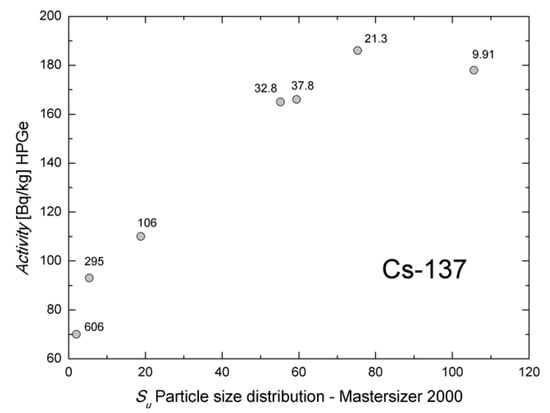
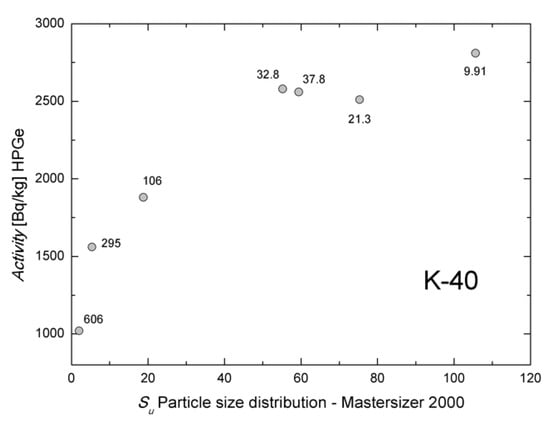
The sum in (7) is, up to a constant, the total surface area of all particles in the sample expressed in relative units (Su). To verify this relation, an ash sample was sieved into seven fractions; the activity concentrations of 137Cs and 40K were determined by HPGe gamma spectrometry, while the volumetric particle-size distribution was measured with the Mastersizer 2000 (Table 7) (Figure 5 and Figure 6).
Table 7.
Activity concentrations, relative total surface (Su), and volume-weighted mean diameter D [4,3] for the sieved ash fractions.
Figure 5.
Activity of 137Cs vs. the total relative surface.
Figure 6.
Activity of 40K vs. the total relative surface.
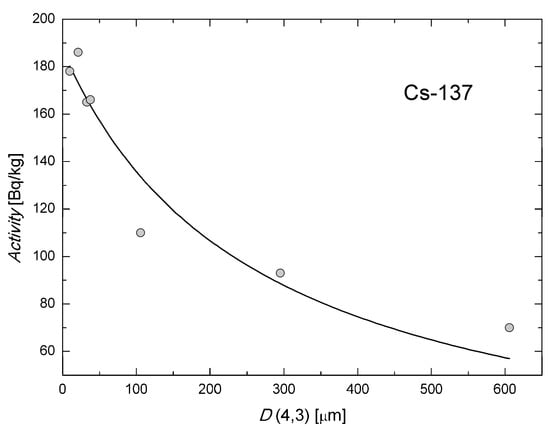
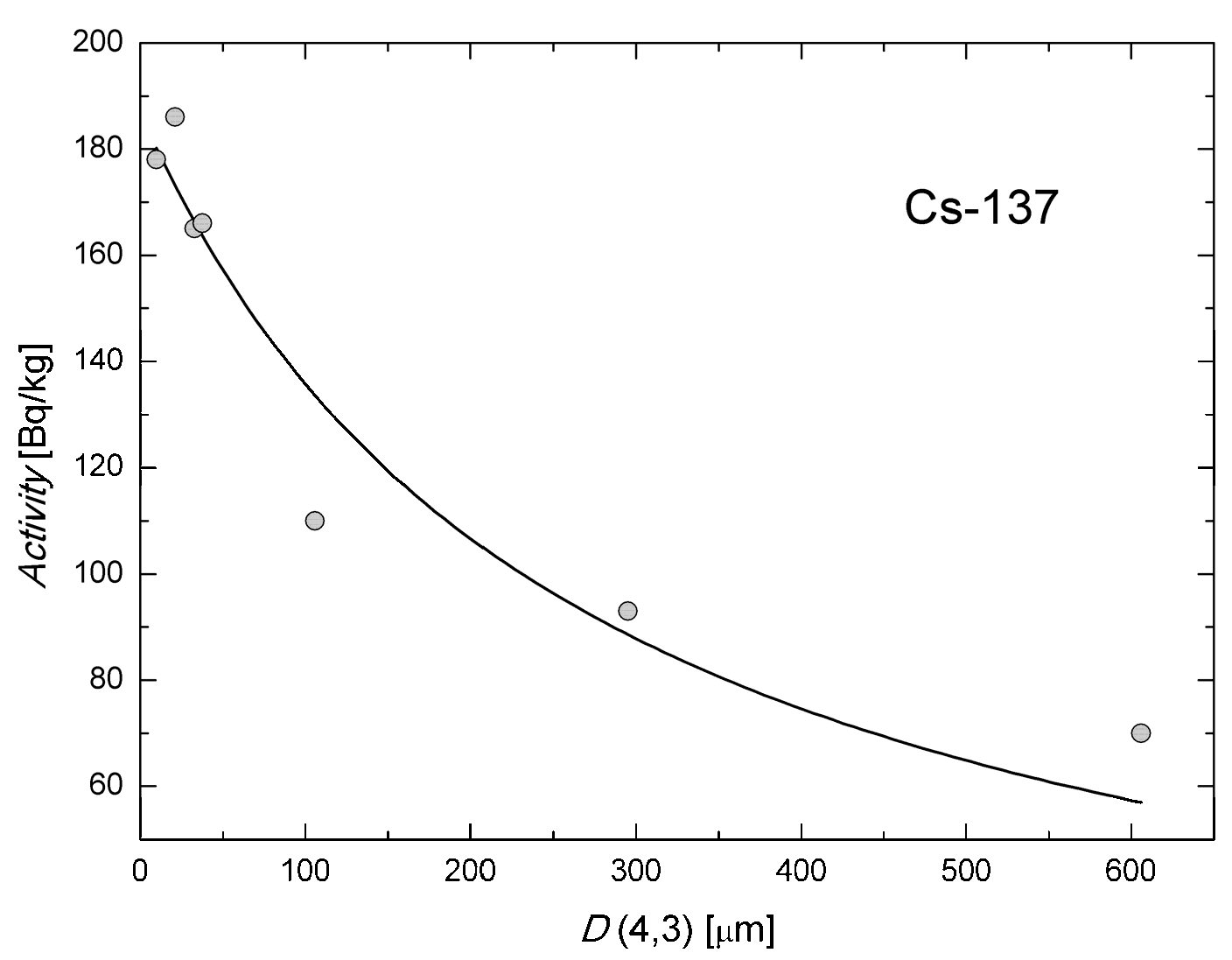
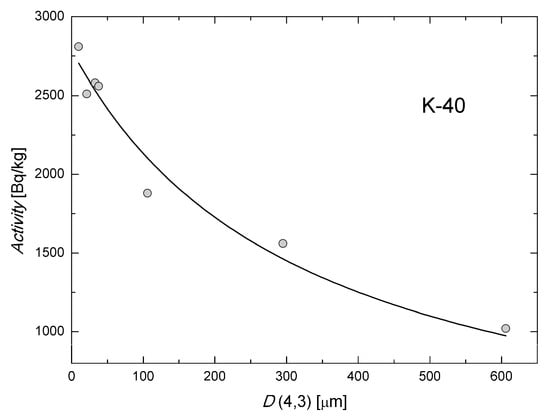
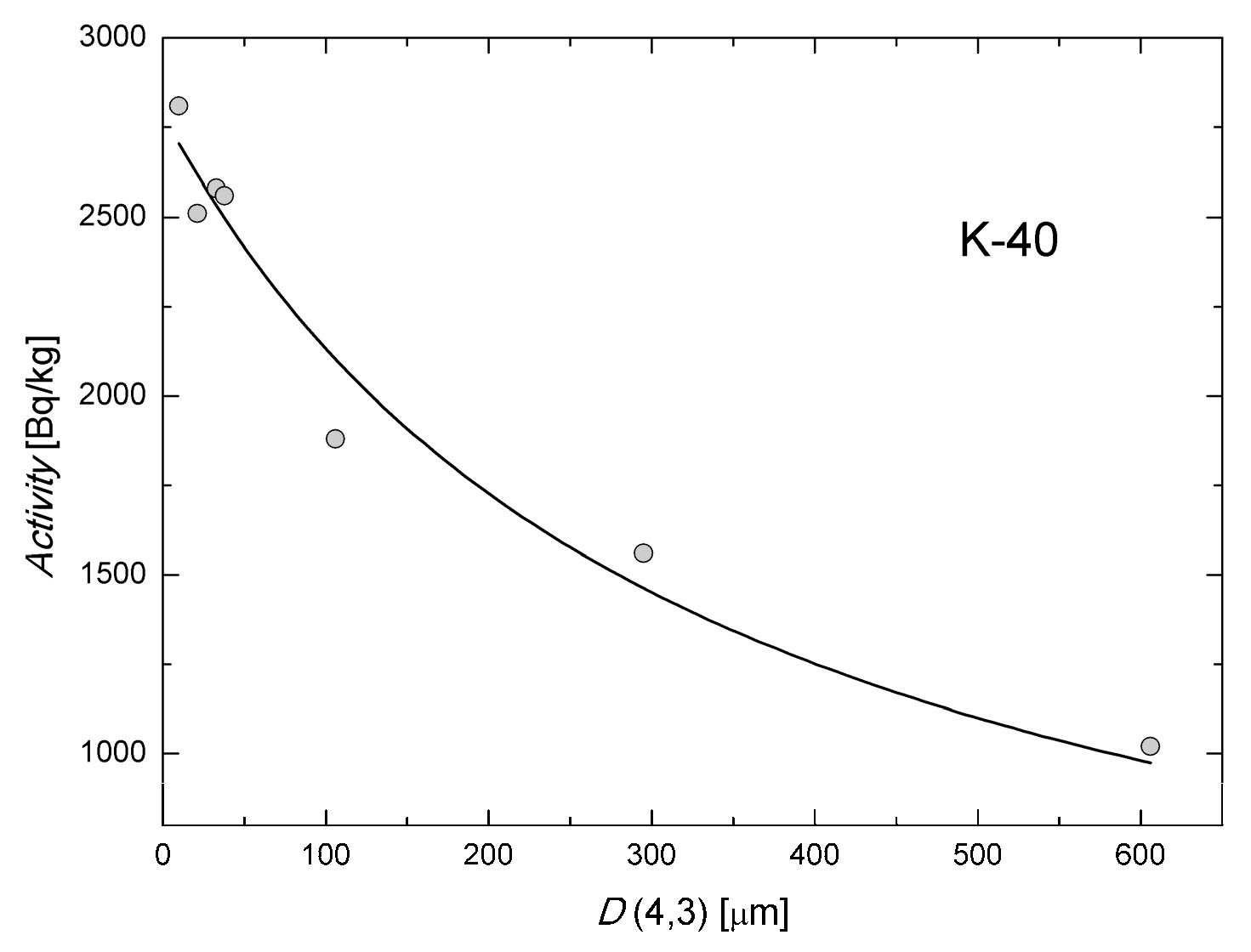
If particles of a particular size dominate, Equation (7) predicts that the activity is inversely proportional to the particle diameter. Fitting the data to
yields A0 = 187(9) Bq kg−1, D1/2 = 266(66) µm for 137Cs (Figure 7) and A0 = 2787(87) Bq kg−1, D1/2 = 326(53) µm for 40K (Figure 8). The agreement of the data with the surface-controlled prediction supports the interpretation that the fines enrichment of these radionuclides is controlled by the surface-area-to-volume ratio. It should be stated plainly that both the GEF and the surface-controlled models are, at this stage, descriptive fits to the present dataset rather than independently validated predictive tools. The number of fully PSD7-resolved materials is small, and no out-of-sample or cross-validation test has yet been performed; the reported R2 values quantify goodness of fit, not predictive accuracy on unseen materials, and the two-parameter forms are flexible enough that good in-sample agreement does not by itself establish generality. The models are therefore offered as physically motivated, falsifiable hypotheses that organise the observed behaviour on a common surface-area scale. Formal validation—leave-one-fraction-out cross-validation, application to an independent set of biomass ash and ceramic materials, and comparison against direct specific-surface-area (e.g., BET) measurements—is identified as a necessary next step before the models are used quantitatively for screening and is planned for the extended dataset described in the Section 4.
Figure 7.
137Cs activity of the samples vs. D (4,3).
Figure 8.
40K activity of the samples vs. D (4,3).
3.9. Granulometric Enrichment Factor (GEF) Model
The surface-controlled model from the previous section requires a full volumetric particle-size distribution and sufficient activity per fraction, thereby limiting its applicability to a subset of materials. For comparative screening across a wider range of products, a descriptive parameter based on a single, readily available particle-size descriptor is more practical. Therefore, we introduce the granulometric enrichment factor (GEF)—formulated on the surface-weighted mean diameter D [3,2], in contrast to the volume-weighted D [4,3] underlying the surface-controlled model—as a ranking tool that quantifies the magnitude of the fine-particle gradient on a common scale across materials, building on prior work on size-dependent enrichment [43,44].
The dependence of radionuclide activity on the granulometric parameters was first analysed using linear regression. For 137Cs and 40K, an increasing activity with decreasing particle size was observed, indicating a potential redistribution of radionuclides toward the finer fractions. However, the intensity and stability of this relationship varied across materials, and a linear model did not fully describe the nonlinear behaviour of the data, particularly in the domain of the finest fractions. These results imply that the linear approach provides only indicative evidence of the granulometric effect but is insufficient for its quantitative and physical interpretation.
In addition, normalisation to the bulk sample is limited, since the bulk samples are prepared with varying degrees of comminution and homogenisation, which affects their representativeness as reference values.
Granulometric enrichment factor (GEF) is defined as the ratio of the activity in a given fraction to the activity in the coarsest fraction (>500 µm):
GEF(D) = A(D)/A>500
This formulation isolates the granulometric gradient while minimising the influence of differences in bulk-sample preparation. Starting from the assumption that the surface contribution to the activity is approximately proportional to the specific surface area of the particles, the dependence of the activity on the characteristic size, in the ideal case, takes the form
which follows directly from the surface-area-to-volume ratio of the particles. Generalising this scaling, we propose
where the parameter a represents the magnitude of the radionuclide enrichment and the parameter b describes the sensitivity of the redistribution to particle size: b = 1 corresponds to idealised surface-controlled behaviour, while values of b < 1 indicate deviations from the ideal regime due to matrix effects, heterogeneity, and particle concentration. Table 8 summarises the GEF model parameters for the PSD7 samples.
A(D) ∝ 1/D,
GEF(D) = 1 + a·D [3,2]−b,
Table 8.
GEF model parameters and interpretation.
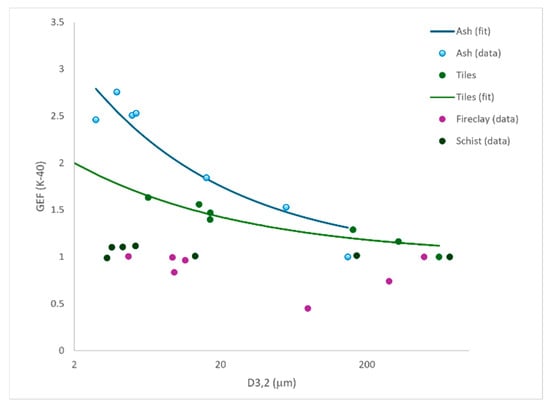
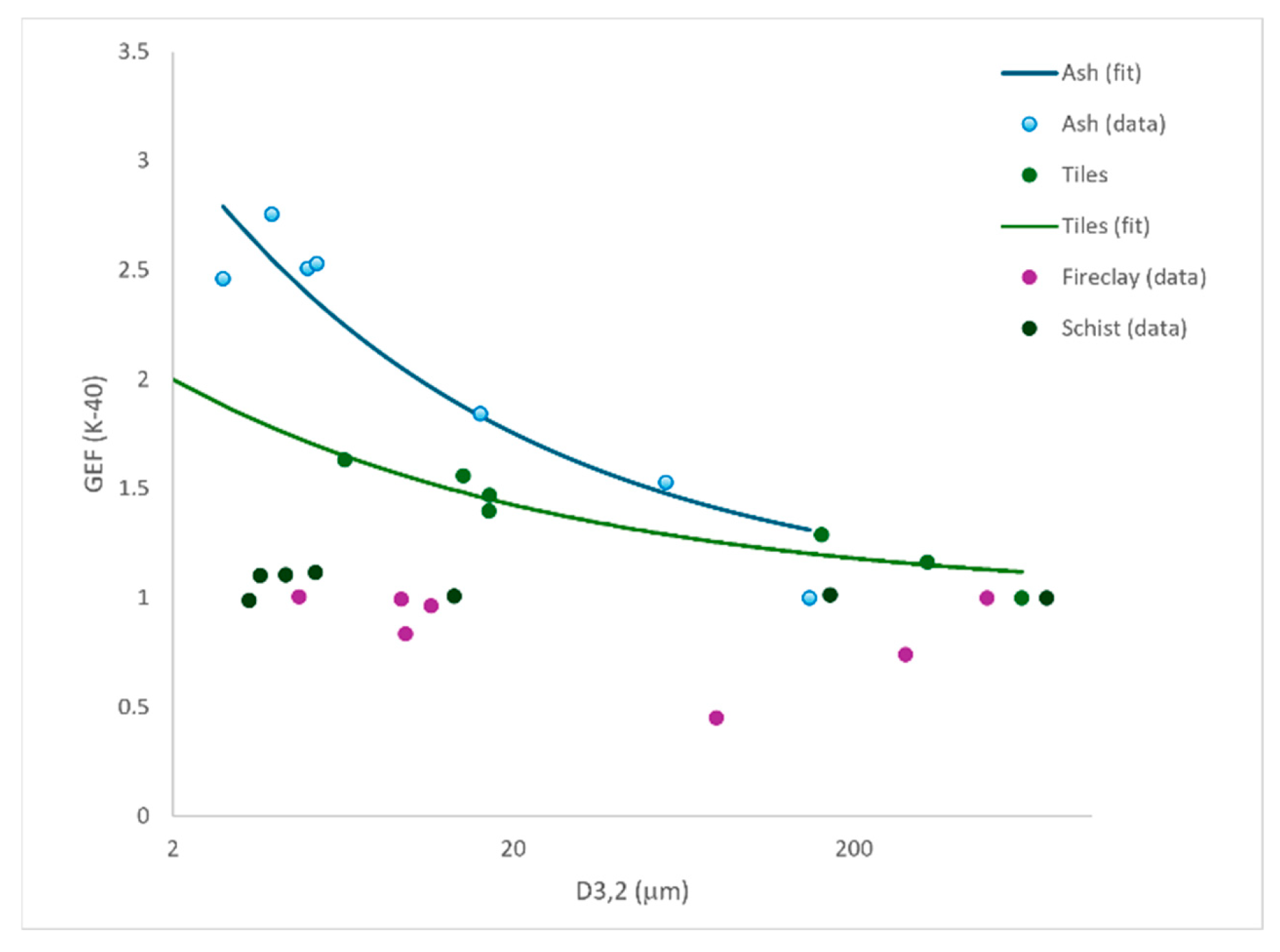
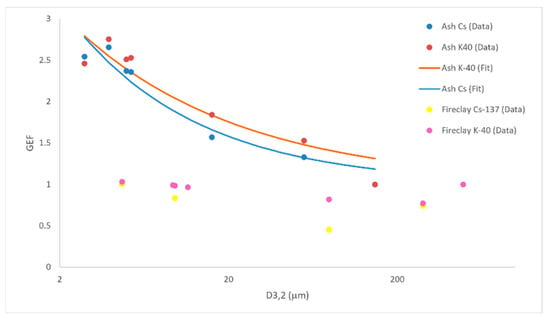
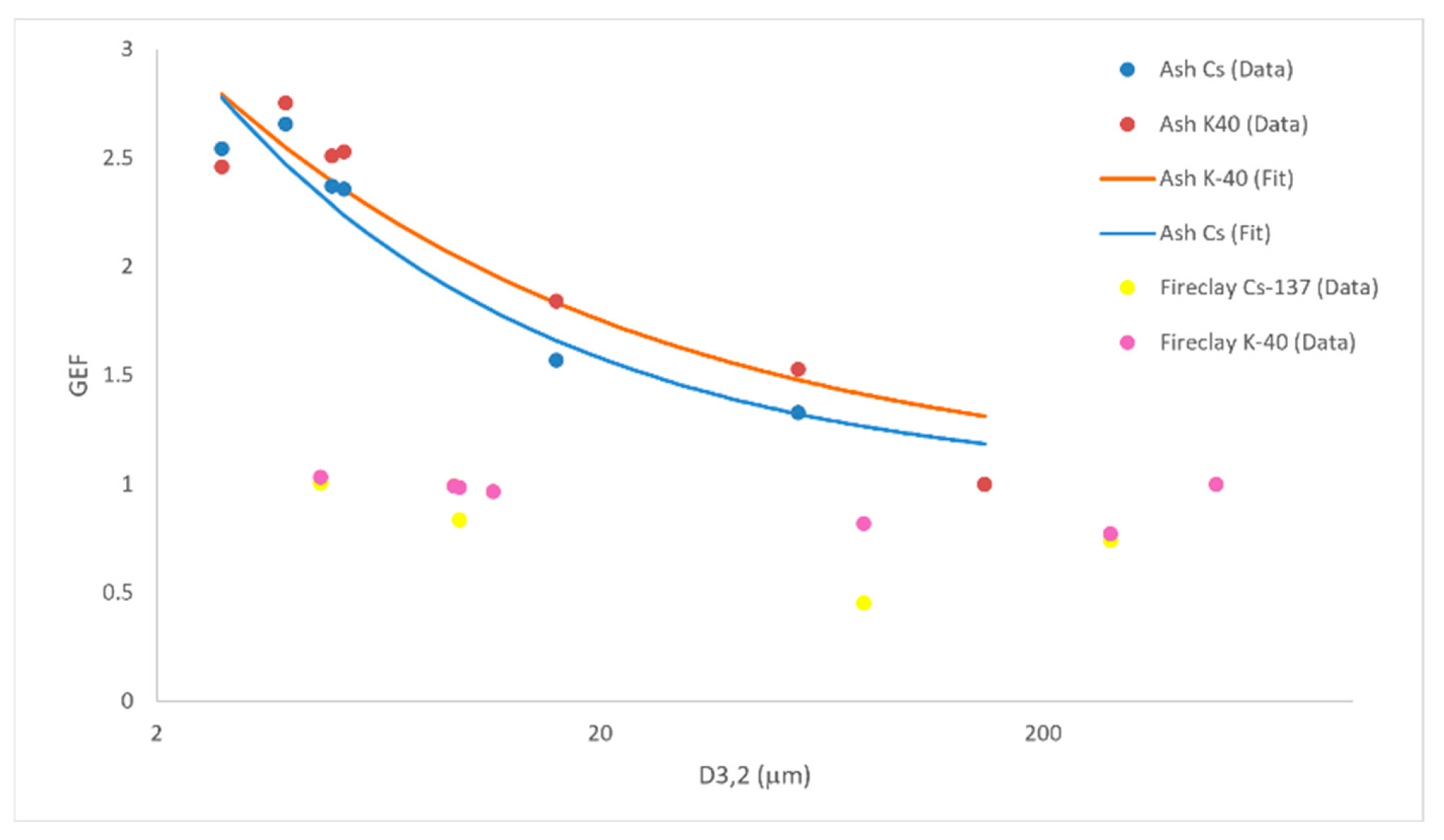
As shown in Table 8 and Figure 9 and Figure 10, the ash samples exhibit elevated GEF values for 137Cs and 40K in the finer fractions, whereas fireclay remains close to unity across the analysed PSD range. The observed increase in the Iγ with an increasing fines proportion does not, however, necessarily imply a strong granulometric enrichment in all materials, since some (e.g., fireclay) display a relatively homogeneous radionuclide distribution across fractions despite a moderate increase in the Iγ. This suggests that the radionuclide partitioning is controlled not only by particle size but also by the material origin, mineralogical composition, and thermochemical processes of formation. GEF parameters are not presented for fireclay. The primary reason is that the 137Cs activity (≈1.7 Bq kg−1) is at a level where the statistical uncertainty of the measurement is comparable to the signal itself; consequently, any parameters derived from fitting would describe noise rather than physical redistribution. For 40K, the GEF value fluctuates around unity across all fractions, and the fitting parameters do not deviate from zero; there is no discernible gradient to characterize. In both cases, only experimental values are shown. This fact in itself is informative: the model correctly identifies fireclay as a material in which comminution does not result in significant activity redistribution. Consequently, no GEF parameters are reported for fireclay, and it is excluded from mechanistic interpretation. More generally, the GEF model is well constrained (R2 ≥ 0.88) only for the materials with a genuine surface-controlled gradient and adequate counting statistics—biomass ash and ceramic tiles—and degrades for weakly graded or low-activity matrices such as schist, where the near-flat gradient yields a low R2 (0.29) and the both fitted parameters are consistent with zero within their standard errors (a = 0.13 ± 0.13; b = 0.43 ± 0.63), confirming the absence of a resolvable granulometric gradient rather than a poor fit to an existing one. The model is therefore best understood as describing the surface-controlled limit of granulometric enrichment; its applicability boundary is set by whether a material possesses accessible, radionuclide-bearing surface sites and sufficient activity for the fraction-wise gradient to rise above measurement noise, and a low R2 in such cases marks the failure of that precondition rather than a failure of the surface-area scaling itself. Viewed from the standpoint of exposure assessment rather than mechanism, this material-dependent behaviour is precisely what gives the GEF its practical value. The quantity of interest for occupational and environmental screening is not whether the surface-binding mechanism is exactly correct, but which materials will concentrate activity in the fine, releasable fraction when they are cut, milled, abraded, or burned and which will not. The fitted parameters separate these two classes directly: high a and GEF ranges well above unity (biomass ash and ceramic tiles) flag materials whose fines carry a disproportionate radiological burden and therefore warrant fines-resolved screening and dust control, whereas values close to unity (fireclay and schist) identify materials in which comminution does not materially redistribute activity and for which bulk screening remains adequate. Read this way, the low R2 for fireclay and schist is not a deficiency of the model but a useful negative result: the model correctly ranks them as low priority for fine-fraction hazard. Used as a screening and prioritisation tool—to triage materials by their propensity for fines enrichment rather than to assert a validated physical law—the GEF retains its usefulness even where its mechanistic fit is weak, although its predictive ranking across a wider range of materials still requires confirmation on an independent sample set.
Figure 9.
Granulometric enrichment factor as a function of particle size D [3,2].
Figure 10.
Comparison of the GEF behaviour for 137Cs and 40K in the ash and fireclay samples; experimental values only for fireclay.
3.10. Granulometric Redistribution of the Radiological Hazard Indices
Given that Iγ, Hin, and the absorbed dose rate D are not independent quantities—meaning they are linear combinations of the same three activity concentrations (CRa, CTh, and CK) differing only in weighting coefficients and are thus collinear—their coordinated increase toward finer fractions represents a single result expressed on several scales rather than independent lines of evidence. We retain Iγ as a screening index in accordance with EU regulations and Hin as the only index with a value exceeding unity; the Hex and AEDE indices have been omitted from the table, broken down by fraction.
To translate the granulometric redistribution of activity into an exposure-relevant quantity, the absorbed dose rate in indoor air (D) and the internal hazard indices (Hin) were computed for every PSD7 fraction from the measured 226Ra, 232Th, and 40K activities, using the standard UNSCEAR dose-rate coefficients (D = 0.92 CRa + 1.1 CTh + 0.08 CK, in nGy/h) and the conventional definition Hin = CRa/185 + CTh/259 + CK/4810. The indices are reported per fraction as a comparative screening measure of how the standard hazard metrics vary with particle size, rather than as absolute dwelling doses, which would also require room geometry and occupancy modelling. D exceeds the world-average indoor value of 84 nGy h−1 in every fraction of all four materials, ranging from 120 nGy h−1 (ash, >500 µm) to 324 nGy h−1 (ash, 50–75 µm); as a linear combination of the same three activities, it adds no information beyond Iγ and Hin and is therefore not tabulated per fraction.
The results (Table 9) confirm hypothesis H5. In all four materials, the indices increase from the coarsest to the finest fractions (peaking in the <50 or 50–75 µm), mirroring the activity redistribution. The effect is dose-relevant rather than merely statistical: in the ash pellets, Hin rises from 0.41 in the coarsest fraction to 1.09 in the 50–75 µm fraction and in fireclay from 0.88 to 1.10 in the finest fraction, so that the internal hazard index of the inhalable fines exceeds unity even though the corresponding bulk values (0.81 and 0.71, respectively) remain below it. Bulk screening would therefore classify these materials as acceptable, whereas the fine, inhalable fraction breaches the screening criterion. Notably, fireclay shows rising indices toward the fines despite displaying no granulometric enrichment in the GEF sense because its absolute 226Ra and 232Th concentrations are high; the dose-relevant redistribution and the surface-controlled enrichment are thus partly independent. Ceramic tiles show the same upward trend within the acceptable range (Hin from 0.56 to 0.88), while schist remains essentially flat (0.56 to 0.72), consistent with its negligible granulometric effect. These per-fraction indices follow the same UNSCEAR-based methodology applied to construction and refractory materials by Knežević Radić et al. [45] and used by Lee et al. [36] for soils, who likewise report all hazard indices below unity for bulk samples. The elevated fine-fraction indices found here for ceramic tiles are consistent with the independent finding of Djabou et al. [46], who measured the highest gamma index among Irish building materials in ceramic tiles, with values approaching the screening threshold (Iγ ≈ 0.9–1.0); the present results show that, once resolved by particle size, the fine fractions of such clay-rich, thermally processed materials can carry an even higher dose-relevant burden than their bulk index suggests.
Table 9.
Gamma index (Iγ) and internal hazard index (Hin) per granulometric fraction for the four PSD7-resolved materials.
4. Conclusions
Across 27 construction materials and secondary mineral substrates, we resolved the distribution of natural (226Ra, 232Th, and 40K) and anthropogenic (137Cs) radionuclides by particle size rather than on bulk material alone.
Although the granulometric effect on radionuclide activity appears to be surface-area-driven, whether it is detected at all depends on how finely the size fractions are binned. The coarse three-class scheme (PSD3) applied to granite and ceramic tiles did not confirm the effect (Friedman χ2(2) = 2.696, p = 0.260), despite correctly classifying samples by particle size. The seven-class scheme (PSD7) revealed a highly significant enhancement of Iγ toward the finest fractions (Friedman χ2(6) = 20.368, p = 0.002), together with a positive Iγ vs. % < 75 µm relationship (R = 0.675, p < 0.001). PSD7 (or finer) resolution should therefore be adopted as the minimum standard for granulometric studies of NORM in construction materials. This conclusion confirms H3.
It follows that bulk-scale gamma index (Iγ) screening, as prescribed by the EU Basic Safety Standards (EU-BSS) Annex VIII, is a necessary but insufficient criterion for the safe deployment of fine-grained or processed construction products. The bulk activities measured here (226Ra = 39 ± 23 Bq kg−1; 232Th = 36 ± 20 Bq kg−1; 40K = 623 ± 406 Bq kg−1) yielded a mean Iγ of 0.52, with the most active samples approaching the regulatory unity threshold (max Iγ = 0.93). Radiological screening of construction products that are milled, cut, sanded, abraded, or otherwise comminuted during fabrication or service should therefore be supplemented with a fines-fraction Iγ.
The fraction-resolved dose assessment points the same way. Internal hazard index (Hin), computed per PSD7 fraction, increases from the coarsest toward the finest fractions in all four materials examined, mirroring the activity redistribution. The effect is dose-relevant since the internal hazard index of the inhalable fines reaches 1.09 in biomass-ash pellets and 1.10 in fireclay, breaching the unity screening criterion, even though the corresponding bulk values (0.81 and 0.71) remain acceptable. Because these indices are reported as a comparative screening measure of how the standard hazard metrics redistribute with particle size rather than as absolute dwelling doses, the result confirms that bulk-scale screening can classify a material as compliant while its respirable fraction exceeds the hazard threshold—the dose-relevant counterpart to Iγ redistribution and direct support for hypothesis H5.
The four radionuclides exhibit distinct partitioning behaviours that map directly to their geochemical hosts. 40K and 137Cs exhibit behaviour indicative of surface control, which is derived from particle-size parameters rather than direct surface area measurements—characterised by monotonic enrichment in the fine particle fraction and strong negative correlations with d(0.1), d(0.5), d(0.9), D [3,2], and D [4,3]. 226Ra and 232Th are primarily mineralogically controlled by heavy-mineral and accessory-phase distributions: significant pairwise differences appear only between the coarsest and finest fractions, and no significant overall PSD correlation is observed. This dual control implies that fines enrichment cannot be predicted solely from particle fineness; mineral origin and the internal spatial distribution of radionuclides must also be considered.
Biomass-ash pellets emerge as a radiologically distinctive secondary mineral. They were the only source of detectable 137Cs in the dataset, with an enrichment factor EFCs-137 of 2.73 in the 50–75 µm fraction. This result rests on a single, well-characterised ash and is therefore presented as a case study rather than a population-level generalisation; its strength lies in the internal consistency of the seven-fraction gradient and its agreement with both the independently measured 40K gradient on the same fractions and the established combustion-volatilisation mechanism. As biomass ashes are increasingly evaluated as supplementary cementitious materials (SCMs) within circular-economy initiatives, this case indicates—and a larger set of 137Cs-bearing materials would be needed to confirm—that bulk Iγ screening alone may be inadequate for this material class and that a dedicated radiological screening protocol explicitly addressing the fine-fraction burden and including 137Cs—is therefore required before such by-products are incorporated into cementitious products. The same fine-fraction enrichment has a more immediate exposure implication beyond the construction supply chain. Because the activity in the ash concentrates in the sub-75 µm fraction—the inhalable and deposit-prone size range—the population most directly concerned is not only workers processing mineral products but also households that burn biomass pellets for domestic heating and handle the resulting fine ash when emptying and cleaning the firebox. This identifies a plausible inhalation and dust-contact pathway for residential exposure that bulk activity values do not capture. We emphasise that the present data establish this as a pathway, not as a quantified dose: converting the measured fraction-specific activities into an effective dose to workers or householders would require airborne dust concentrations during the relevant operations, handling frequencies, and inhalation-dose modelling, none of which were measured here. The practical recommendations that follow are correspondingly framed as screening and control measures—fines-resolved radiological screening of biomass ash and other comminuted or thermally processed materials, together with dust suppression and personal protection during cutting, milling, ash removal, and disposal—rather than as dose limits. Quantifying the associated occupational and residential doses through coupled dust-exposure and inhalation-dose measurement is identified as the priority next step.
The surface-controlled activity model, together with the GEF model, provides a quantitative description of fines enrichment. Nevertheless, both models represent descriptive fits to the datasets from which they were derived—seven fractions of a single ash for the surface-process-controlled model and four materials for the GEF model—without out-of-sample testing, cross-validation, or comparison with independently measured specific surface area; the reported R2 values quantify the quality of the fit and should not be interpreted as confirmation of a mechanism governed by surface processes. Within these constraints, fitted parameters place four different materials on a common scale, and the coupled behaviour of surface area and volume distribution aligns with the observed dual dependence on particle size and mineral origin. Formal validation on an independent set of samples—including direct surface area measurement via the BET method—is a prerequisite for the quantitative application of any model for screening purposes.
Future work will extend the PSD7 protocol to the full sample set, subject to fraction-mass constraints, and couple gamma spectrometry with mineralogical characterisation to identify the host minerals responsible for the enrichment of fines. Radon and thoron exhalation measurements per fraction will also be added to translate Iγ redistribution into dose-relevant terms.
Author Contributions
Conceptualisation, K.B. and S.S.C.; methodology, K.B. and I.L.; validation, S.F.; formal analysis, T.N., R.L., and J.H.; investigation, K.B., S.S.C., T.N., R.L., and S.F.; resources, I.L. and M.V.V.; data curation, R.L.; writing—original draft preparation, K.B. and S.S.C.; writing—review and editing, R.L., T.N., J.H., I.L., M.V.V., D.M., and S.F.; visualisation, J.H.; supervision, M.V.V. and D.M.; project administration, S.S.C. All authors have read and agreed to the published version of the manuscript.
Funding
This research was funded by the Provincial Secretariat for Higher Education and Scientific Research of Vojvodina through the project “Acoustics, Urban environment, Radionuclides from dust, and microclimate Assessment in construction and infrastructure projects in Vojvodina” (grant number 003864834 2025 09418 003 000 000 001 04 004).
Data Availability Statement
The data presented in this study are available on request from the corresponding author.
Acknowledgments
This research has been supported by the Ministry of Science, Technological Development and Innovation (Contract No. 451-03-34/2026-03/200156) and the Faculty of Technical Sciences, University of Novi Sad through project “Scientific and Artistic Research Work of Researchers in Teaching and Associate Positions at the Faculty of Technical Sciences, University of Novi Sad 2026” (No. 01-3609/1). During the preparation of this work, the authors used Claude v4.6 (Anthropic) to assist with language editing, formatting, consistency checking of the reference list, and improving the readability of the text. After using this tool/service, the authors reviewed and edited the content as needed and take full responsibility for the published article.
Conflicts of Interest
The authors declare no conflicts of interest.
References
- UNSCEAR. Scientific Reports on Global Exposure to Ionizing Radiation and Its Health and Environmental Effects; United Nations: New York, NY, USA, 2020–2024. [Google Scholar]
- International Atomic Energy Agency. Radiation Protection and the Management of Radioactive Waste in the Oil and Gas Industry; IAEA-TECDOC-1376; IAEA: Vienna, Austria, 2003; Available online: https://www-pub.iaea.org/MTCD/Publications/PDF/te_1376_web.pdf (accessed on 23 June 2026).
- Puri, L.; Hu, Y.; Naterer, G. Critical review of the role of ash content and composition in biomass pyrolysis. Front. Fuels 2024, 2, 1378361. [Google Scholar] [CrossRef] [Scilit]
- European Commission. Radiation Protection 112: Radiological Protection Principles Concerning the Natural Radioactivity of Building Materials; EC: Luxembourg, 1999. [Google Scholar]
- European Union. Council Directive 2013/59/Euratom of 5 December 2013 laying down basic safety standards for protection against the dangers arising from exposure to ionising radiation. Off. J. Eur. Union. 2014, L13, 1–73. [Google Scholar]
- UNSCEAR. Sources, Effects and Risks of Ionizing Radiation: UNSCEAR 2008 Report to the General Assembly with Scientific Annexes; United Nations: New York, NY, USA, 2008. [Google Scholar]
- UNSCEAR. Sources, Effects and Risks of Ionizing Radiation, Annex B; United Nations: New York, NY, USA, 2017. [Google Scholar]
- IAEA. Assessing the Need for Radiation Protection Measures in Work Involving Minerals and Raw Materials; Safety Reports Series No. 49; IAEA: Vienna, Austria, 2006. [Google Scholar]
- Uddin, M.A.M.; Allwood, D.; Rollog, M.D.A.; Rahman, M.M.; Brown, J.E.; Tyler, A.N. Association of 241Am and 137Cs in finer size-fractioned saltmarsh sediments from north-west England, UK and potential health risk to coastal population. Int. J. Environ. Anal. Chem. 2023, 103, 5611–5628. [Google Scholar] [CrossRef] [Scilit]
- Özcan Kilcan, C.; Reigo, U.A.; Tkaczyk, A.H. Development of an advanced life cycle impact assessment method to evaluate radioactivity in construction materials. Recycling 2025, 10, 195. [Google Scholar] [CrossRef] [Scilit]
- Laghi, L.; Zappi, A.; Mostacci, D.; Tositti, L. Assessing radiological hazards in building materials: A case study with a focus on the ceramic industry in Emilia-Romagna, Italy. Environ. Sci. Pollut. Res. 2025, 32, 7651–7662. [Google Scholar] [CrossRef] [Scilit] [PubMed]
- Sanjuán, M.Á.; Suarez-Navarro, J.A.; Argiz, C.; Estévez, E. Radiation dose calculation of fine and coarse coal fly ash used for building purposes. J. Radioanal. Nucl. Chem. 2021, 327, 1045–1054. [Google Scholar] [CrossRef] [Scilit]
- Xu, L.; Jiang, W.; Wang, F.; Chen, Q.; Xu, F. A big difference in 137Cs inventories based on two individual cores within a shallow lake, east China. J. Radioanal. Nucl. Chem. 2022, 331, 5763–5770. [Google Scholar] [CrossRef] [Scilit]
- Moreno de Los Reyes, A.M.; Suárez-Navarro, J.A.; Alonso, M.D.M.; Gascó, C.; Sobrados, I.; Puertas, F. New approach for the determination of radiological parameters on hardened cement pastes with coal fly ash. Materials 2021, 14, 475. [Google Scholar] [CrossRef] [Scilit] [PubMed]
- Park, C.W.; Kim, S.-M.; Kim, I.; Yoon, I.-H.; Hwang, J.; Kim, J.-H.; Yang, H.-M.; Seo, B.K. Sorption behavior of cesium on silt and clay soil fractions. J. Environ. Radioact. 2021, 233, 106592. [Google Scholar] [CrossRef] [Scilit] [PubMed]
- Lanzerstorfer, C. Combustion of Miscanthus: Composition of the ash by particle size. Energies 2019, 12, 178. [Google Scholar] [CrossRef] [Scilit]
- Herzner, V.; Katzlberger, C.; Pfeifer, C.; Weigl-Kuska, M. Dose assessment for wood fuels and their ashes available in Austria. Health Phys. 2025, 129, 388–398. [Google Scholar] [CrossRef] [Scilit] [PubMed]
- Suarez-Navarro, J.A.; Sanjuán, M.Á.; Mora, P.; Alonso, M.D.M. An Evaluation of the Radioactive Content of Ashes Obtained from the Use of Fuels from Recycled Materials by Co-Processing in the Cement Industry. Materials 2024, 17, 2287. [Google Scholar] [CrossRef] [Scilit] [PubMed]
- Mladenović Nikolić, N.N.; Kandić, A.B.; Trivunac, K.V.; Mirković, M.M.; Vukanac, I.S.; Nenadović, S.S.; Kljajević, L.M. Radiological and structural characterization of Raw and Alkali-Activated wood Ash and Metakaolin blends. Sustainability 2022, 14, 12960. [Google Scholar] [CrossRef] [Scilit]
- Anjos, R.M.; Ayub, J.J.; Cid, A.S.; Cardoso, R.; Lacerda, T. External gamma-ray dose rate and radon concentration in indoor environments covered with Brazilian granites. J. Environ. Radioact. 2011, 102, 1055–1061. [Google Scholar] [CrossRef] [Scilit] [PubMed]
- Coletti, C.; Cireśa, R.; Sassi, R.; Brattich, A.; Mazzucato, M. NORM in building materials: A delicate balance between sustainability and radiation protection. Sustainability 2020, 12, 10322. [Google Scholar]
- Bituh, T.; Petrinec, B.; Stipičević, S.; Serenčeš, M.; Hasenay, D.; Babić, D.; Kostelić, A.; Salajpal, K.; Horvatinec Isaković, J.; Atlija, B.; et al. Radiological characterization of wood ash and sheep wool: Relevance to applications in circular economy. Sustainability 2026, 18, 3443. [Google Scholar] [CrossRef] [Scilit]
- Smetsers, R.J.; Tomas, J.M. A practical approach to limit the radiation dose from building materials applied in dwellings, in compliance with the Euratom Basic Safety Standards. J. Environ. Radioact. 2019, 196, 40–49. [Google Scholar] [CrossRef] [Scilit] [PubMed]
- Amana, M.S.; Jubier, N.J.; Aldhuhaibat, M.J.R.; Salim, A.A. Assessment of radioactivity levels in some cement produced locally in Iraq. Radiat. Detect. Technol. Methods 2021, 5, 633–640. [Google Scholar] [CrossRef] [Scilit]
- Penabei, S.; Bongue, D.; Maleka, P.; Dlamini, T.; Saïdou; Guembou Shouop, C.J.; Halawlaw, Y.I.; Ngwa Ebongue, A.; Kwato Njock, M.G. Assessment of natural radioactivity levels and the associated radiological hazards in some building materials from Mayo-Kebbi region, Chad. Radioprotection 2018, 53, 265–278. [Google Scholar]
- Bavarnegin, E.; Moghaddam, M.V.; Fathabadi, N. Natural radionuclide and radiological assessment of building materials in high background radiation areas of Ramsar, Iran. J. Med. Phys. 2013, 38, 93–97. [Google Scholar] [PubMed]
- Beyala Ateba, J.F.; Owono Ateba, P.; Simo, A.; Ben-Bolie, G.H.; Mvondo Ze, A.D.; Ekobena Fouda, H.P.; Ndontchueng Moyo, M. Estimation of radiation hazard indices from syenite building rocks in the South-western region of Cameroon. Radioprotection 2017, 52, 247–253. [Google Scholar] [CrossRef] [Scilit]
- Ravisankar, R.; Vanasundari, K.; Suganya, M.; Rajalakshmi, A.; Chandrasekaran, A.; Vijayagopal, P.; Meenakshisundaram, V.; Pavunraj, M.; Vijayalakshmi, I.; Jebakumar, J.P.P. Multivariate statistical analysis of radiological data of building materials used in Tiruvannamalai, Tamilnadu, India. Appl. Radiat. Isot. 2014, 85, 114–127. [Google Scholar] [CrossRef] [Scilit] [PubMed]
- Gavela, S.; Papadakos, G.; Nikoloutsopoulos, N. Calculation of Activity Concentration Index for an Internal Space in a Concrete Structure. Buildings 2025, 15, 2075. [Google Scholar] [CrossRef] [Scilit]
- Elnobi, S.; Khater, A.E.M.; Abbady, A.G.E. Influence of grain size on radionuclide activity concentrations and radiological hazard of building material samples. Appl. Radiat. Isot. 2017, 130, 43–48. [Google Scholar] [CrossRef] [Scilit] [PubMed]
- Gijbels, K.; Nguyen, H.; Kinnunen, P.; Samyn, P.; Schroeyers, W.; Pontikes, Y.; Schreurs, S.; Illikainen, M. Radiological and leaching assessment of an ettringite-based mortar from ladle slag and phosphogypsum. Cem. Concr. Res. 2020, 128, 105954. [Google Scholar] [CrossRef] [Scilit]
- Gijbels, K.; Iacobescu, R.I.; Pontikes, Y.; Vandevenne, N.; Schreurs, S.; Schroeyers, W. Radon immobilization potential of alkali-activated materials containing ground granulated blast furnace slag and phosphogypsum. Constr. Build. Mater. 2018, 184, 68–75. [Google Scholar] [CrossRef] [Scilit]
- Megumi, K.; Mamuro, T. Concentration of uranium-series radionuclides in soils and rocks. J. Geophys. Res. 1977, 82, 353–356. [Google Scholar]
- Bülbül, F.; Courard, L. Turning waste into greener cementitious Building material: Treatment methods for biomass Ashes—A review. Materials 2025, 18, 834. [Google Scholar] [CrossRef] [Scilit] [PubMed]
- Shereif, A.S.; Heikal, M.T.S.; El Ela, A.S.A.; El Shabasy, A.; Masoud, A.E.; Csámer, Á. Gamma activity concentrations of 226Ra, 232Th, 40K, and health hazard assessments of granites from Wadi El-Nabi mining area, Egyptian Nubian Shield. Sci. Rep. 2026, 16, 39664. [Google Scholar] [CrossRef] [Scilit] [PubMed]
- Lee, J.; Kim, H.; Kye, Y.U.; Lee, D.Y.; Jo, W.S.; Lee, C.G.; Lee, Y.J.; Kim, J.S. Activity concentrations and radiological hazard assessments of 226Ra, 232Th, 40K, and 137Cs in soil samples obtained from the Dongnam Institute of Radiological & Medical Science, Korea. Nucl. Eng. Technol. 2023, 55, 2388–2394. [Google Scholar] [CrossRef] [Scilit]
- Bajoga, A.D.; Alazemi, N.; Shams, H.; Regan, P.H.; Bradley, D.A. Evaluation of naturally occurring radioactivity across the State of Kuwait using high-resolution gamma-ray spectrometry. Radiat. Phys. Chem. 2017, 137, 203–209. [Google Scholar] [CrossRef] [Scilit]
- Grandia, F.; Merino, J.; Bruno, J. Assessment of the Radium–Barium Co-Precipitation and Its Potential Influence on the Solubility of Ra in the Near-Field; Swedish Nuclear Fuel and Waste Management Co. (SKB): Stockholm, Sweden, 2008. [Google Scholar]
- Chen, T.-C.; Zeng, F.-C.; Lin, C.-C.; Yeh, Y.-L.; Huang, W.-H. Assessment of soil radioactivity associated with risk and correlation with soil properties near Maanshan Nuclear Power Plant, Taiwan. Appl. Sci. 2024, 14, 9239. [Google Scholar] [CrossRef] [Scilit]
- Rauwel, P.; Rauwel, E. Towards the extraction of radioactive cesium-137 from water via graphene/CNT and nanostructured Prussian blue hybrid nanocomposites: A review. Nanomaterials 2019, 9, 682. [Google Scholar] [CrossRef] [Scilit] [PubMed]
- Sekudewicz, I.; Gąsiorowski, M.; Jasińska, J.; Świerczyński, A.; Długosz, J.; Strzelecki, M.; Tomkowiak, A. Factors controlling 137Cs distribution in bottom sediments of Koronowo Reservoir (Poland). J. Soils Sediments 2022, 22, 3189–3208. [Google Scholar] [CrossRef] [Scilit]
- Smołka-Danielowska, D.; Jabłońska, M. Chemical and mineral composition of ashes from wood biomass combustion in domestic wood-fired furnaces. Int. J. Environ. Sci. Technol. 2022, 19, 5359–5372. [Google Scholar] [CrossRef] [Scilit]
- He, Q.; Walling, D.E. Interpreting particle size effects in the adsorption of 137Cs and unsupported 210Pb by mineral soils and sediments. J. Environ. Radioact. 1996, 30, 117–137. [Google Scholar] [CrossRef] [Scilit]
- Sahu, S.K.; Tiwari, M.; Bhangare, R.C.; Pandit, G.G. Enrichment and particle size dependence of polonium and other naturally occurring radionuclides in coal ash. J. Environ. Radioact. 2014, 138, 421–426. [Google Scholar] [CrossRef] [Scilit] [PubMed]
- Knežević Radić, J.; Hansman, J.; Mrđa, D.; Demirhan, K.; Velimirović, D.; Kuzmanović, P.; Forkapić, S. Survey of radiological properties of some commonly used building materials: Cement, chamotte and refractory products. J. Radioanal. Nucl. Chem. 2025, 334, 1715–1727. [Google Scholar] [CrossRef] [Scilit]
- Djabou, R.E.; Dodek, M.; Sainz, C.; Fuente, I.; Vintró, L.L.; Hanley, O.; Goggins, J.; Foley, M. Investigation of naturally-occurring radioactive materials (NORM) in building materials in Ireland. Eur. Phys. J. Spec. Top. 2026, 245, 353. [Google Scholar] [CrossRef] [Scilit]

Disclaimer/Publisher’s Note: The statements, opinions and data contained in all publications are solely those of the individual author(s) and contributor(s) and not of MDPI and/or the editor(s). MDPI and/or the editor(s) disclaim responsibility for any injury to people or property resulting from any ideas, methods, instructions or products referred to in the content. |
© 2026 by the authors. Licensee MDPI, Basel, Switzerland. This article is an open access article distributed under the terms and conditions of the Creative Commons Attribution (CC BY) license.