


Abstract
Sulfate is a natural major ion commonly found in the environment. Various anthropogenic activities can lead to the discharge of sulfate in high concentrations, causing negative effects on aquatic organisms. While chronic toxicity of sulfate for brackish water species was established, acute toxicity data were scarce. In this study, we tested the acute toxicity of sulfate to seven Baltic Sea species and, together with the literature data, derived the fifth percentile hazardous concentration (HC5) through a species sensitivity distribution (SSD) with 12 species. Acute sulfate sensitivity varied across taxa, with fish and crustaceans being much more sensitive than bivalves, algae, rotifers and bacteria, which led to a bimodal SSD. The most sensitive species tested were whitefish (Coregonus lavaretus) and vendace (Coregonus albula) during fertilization, and the most tolerant were cyanobacterium Synechococcus sp. and bacterium Aliivibrio fischeri. Acute HC5 using the model-averaging approach was 2489 (1016–3990) mg/L sulfate. With a Predicted No Effect Concentration of 1011 mg/L, the upper limit of the 95% confidence interval for the estimated percentage of species affected was below 5%. This new data contributes to the development of the maximum allowable concentration for the sulfate environmental quality standard in the northern Baltic Sea.
1. Introduction
Sulfate is a common major ion found in natural environments [1,2]. It originates from natural sources such as volcanic activities, rock weathering, sea spray, and decomposition of organic matter [1,2]. However, anthropogenic activities can contribute significantly to the accumulation of sulfate in aquatic systems. These include agriculture on acid sulfate soils, pulp and paper production, battery manufacturing and mining [1,2]. Although sulfate is generally considered to have a low toxic potential [3], in high concentrations it can cause negative or even lethal effects on aquatic species including fish, bivalves, crustaceans, insects and algae [4,5,6,7,8]. In boreal freshwater environments, natural sulfate concentrations are mostly low, with the median level being less than 5 mg/L in Finland [2]. In full-strength seawater, background sulfate concentrations are typically around 2700 mg/L [1]. However, maximum sulfate levels from industrial point sources can reach two thousand milligrams per litre and more [2]. An understanding of sulfate toxicity to biota in different aquatic environments is needed to facilitate the development of environmental regulatory standards in terms of sulfate discharge.
Although chronic toxicity of sulfate to brackish water species has been recently assessed [9], data on acute toxicity are not comprehensive; only two brackish water fish species and three algal species from the Baltic Sea have previously been studied [8,9]. So far, no acute data are available on other taxa such as crustaceans, bivalves and bacteria, which causes a knowledge gap for producing the maximum allowable concentration quality standards (MAC-QS) to safeguard against effects caused by temporary concentration peaks [10]. To develop MAC-QS, acute data on at least three taxa are needed [10]. Therefore, acute sulfate toxicity data are urgently needed to protect aquatic life in the coastal Baltic Sea, especially given the continuing growth of industrial activities and the potential increase in sulfate discharges into brackish waterbodies.
In this study, we examined the acute toxicity of sulfate using a selection of ecologically representative species across different taxa from the Baltic Sea. Acute toxicity is defined as adverse effects “occurring within a short time (up to 14 days)” after exposure to a certain substance [11]. We focused on the northern coastal Baltic Sea brackish water environments with a salinity range from 2 to 6‰. LC50 toxicity values were derived from the acute toxicity tests, denoting concentrations that lead to 50% mortality or growth reduction in the test organisms within the short-term exposure period defined for each test. The species sensitivity distribution (SSD) modelling was applied to the data obtained. This probabilistic approach is a commonly used statistical tool that ranks species LC50 values using a cumulative distribution function to derive a concentration hazardous to five percent (HC5) of species at the ecosystem level [10,11,12,13]. Acceptable SSD for HC5 derivation requires a minimum sample size of ten species covering at least eight taxonomic groups [10].
To address uncertainties in the HC5 estimate derived from the SSD modelling, numerical assessment factors (AF, typically 1 to 5) are used by dividing the HC5 by the AF to derive Predicted No Effect Concentrations (PNEC) [10]. Uncertainties in the HC5 estimate can arise from different sources, such as the quality of ecotoxicity data, representativeness of the test species, mode of toxic action of the substance, availability of mesocosm studies and comparisons to field studies [10]. Also, sample size and variability in species sensitivity introduce uncertainty in modelling [14,15]. Thus, in addition to the HC5, we also derived PNECs under different AF scenarios and presented the species percentages affected in each AF scenario with 95% confidence intervals. Specifically, PNEC under the protection goal of protecting over 95% species with a 95% probability was derived [16].
2. Materials and Methods
2.1. Test Species
Acute sulfate toxicity data were collected from 12 Baltic Sea species, among which seven species were tested in the current work while information on five additional species was obtained from the literature. A total of eight taxonomic groups were included: coregonid fish (Coregonus lavaretus, Coregonus albula), cyprinid fish (common roach Rutilus rutilus), crustaceans (Idotea balthica, Monoporeia affinis and Corophium volutator), rotifers (Brachionus plicatilis), bivalves (Macoma balthica), algae (Monoraphidium sp., Phaeodactylum tricornutum and cyanobacteria Synechococcus sp.) and bacteria (Aliivibrio fischeri). Among all the species data, data on C. lavaretus, C. albula, Monoraphidium sp., P. tricornutum and Synechococcus sp. were obtained from previously published studies [8,9]. Seven of the test species were sampled from Baltic Sea coastal areas to increase the ecological relevance of the data: C. lavaretus, C. albula, R. rutilus, I. balthica, M. affinis, C. volutator, and M. balthica. The rest of the test organisms were obtained from stock cultures originating from Baltic Sea populations (Monoraphidium sp., P. tricornutum, and Synechococcus sp.) or from commercial test kits (B. plicatilis and A. fischeri). The species were selected following the official guideline recommendations to cover at least eight taxonomic groups [10]. Since all test species are found in the Baltic Sea, the selection of species is ecologically representative of the local biota.
Extensive descriptions of the test protocols can be found in Supplementary Material S1. Details regarding species sampling locations, test conditions (temperature, oxygen, pH, etc.), acclimation, and test validity criteria can be found in Supplementary Material S2 Table S1.
2.2. Test Substance and Test Water
Dried sodium sulfate powder (Na2SO4, Merck, Darmstadt, Germany, purity ≥ 99.0%) was dissolved in the test water to produce different test concentrations. Toxicity of sulfate is mostly tested using sodium sulfate since sodium contributes the least to the overall toxicity compared with other cations such as potassium and magnesium [17]. Nominal exposure concentrations were determined through preliminary range-finding tests. Local Baltic Sea water was used in the toxicity tests, and its chemical properties varied depending on the sampling sites due to naturally varying conditions [18]. Detailed information on the water used in the different tests can be found in Supplementary Material S2 Table S2. A range of background salinity and sulfate levels was included in the tests to represent the natural variation in the water chemistry in the northern Baltic Sea area. Ambient sulfate concentrations used in control treatments ranged from 105 to 513 mg/L depending on the sampling site (salinity from 2 to 6‰). Ambient sulfate concentrations measured along the northern coastal Baltic Sea are within the range tested [9].
2.3. Test Protocols, Quality Control
Standardized test protocols were not available for most of the species used. Thus, test methodologies were adjusted from protocols designed for similar species or following good laboratory practices under the key principles of toxicity testing (See Supplementary Material S2 Table S1). The specific test protocols and test validity can be found in Supplementary Material S1. Exposure durations differed across taxa and followed standard protocols of the test species when such protocols are available, or protocols for testing similar species when no directly applicable protocols are available.
In tests using I. balthica, Monoraphidium sp., P. tricornutum, Synechococcus sp., and A. fischeri, the sulfate concentrations in test water were measured at the end of the exposure. In other tests, they were averaged from multiple water samples or using pooled water samples collected regularly from longer exposure periods (, KVVY, ALS and Syke, Finland). Results from tests where measurements were conducted multiple times suggested that sulfate concentrations did not change over the short exposure time, and one-time sulfate measurements at the end of the test were valid. pH of water was measured in the same samples, and experimental temperatures were continuously monitored (Supplementary Material S2 Table S1).
2.4. Toxicity Tests
2.4.1. Cyprinid Fish
Fertilization success of the common roach (Rutilus rutilus L.) in a 24 h exposure was used as the endpoint. The gametes used in the test were obtained from three females and six males, caught outside Raippaluoto, the Quark region of the Gulf of Bothnia. Since no standard protocol was available, the test methodology was adapted from similar protocols and studies [7,19]. Eggs from each female were fertilized with milt from all the males, and two replicates per female were prepared. The tests were conducted on individual Petri dishes, each containing ca. 50 to 100 eggs and 1.5 µL milt from each male. To activate the gametes, 25 mL control water was added to the Petri dish and left for 40 s before rinsing with control water. Sulfate solutions (240–8000 mg/L) were then added to the Petri dishes, which were kept at a stable temperature of 13.4 ± 0.4 °C (mean ± SD) for 24 h. Fertilization rate in the control treatments was 90%.
2.4.2. Mollusks
In the Baltic clam (Macoma balthica), survival of juveniles during a 7-day exposure period was used as the endpoint. Individuals < 4 mm in length were collected from the Tvärminne Archipelago, Gulf of Finland, in 2023. Since no standard protocol was available, the test methodology was adapted from a previous freshwater mussel study [6], where each juvenile clam was placed in a single well in 6-well plates and exposed to sulfate. A total of 120 test organisms were exposed to 10 mL of sulfate solutions (500–18,000 mg/L, 12 replicates per treatment) at 9.4 ± 0.1 °C in the dark. The test water was changed every other day. Food was provided as 15 µL Shellfish Diet diluted in 1 L of test water (Reed Mariculture Inc., Campbell, CA, USA) at the beginning and at every water change. The exposure lasted for 28 days, but only the acute survival data after the first 7 days were used here. Test temperature, pH, and conductivity for the entire exposure period remained stable. Survival in the control treatments after 7 days was 100%.
2.4.3. Crustaceans
Survival of juveniles of the Baltic isopod (Idotea balthica) in a 7-day exposure was used as the endpoint. Breeding adults were sampled from the Tvärminne Archipelago, Gulf of Finland, and juvenile isopods were collected in aquaria kept in the laboratory. The macroalgae Fucus vesiculosus was provided as food for both adults and juveniles. Since no standard protocol was available, the test methodology was adapted from a previous study [20], in which each juvenile was placed in a single well in 6-well plates for exposure. A total of 120 ca. one-month-old juveniles were exposed to 10 mL of sulfate solutions between 500 and 5000 mg/L at 15.1 ± 0.1 °C with 12 replicates per treatment. Photoperiod in the laboratory was 16L:8D (less than 500 lx, similar to the natural habitat of the organisms), and the test waters were changed every other day. Food was provided as 8 mm in diameter discs of F. vesiculosus for each organism. Survival in the control treatments was 92% after 7 days of exposure.
Survival of the amphipod species Monoporeia affinis and Corophium volutator in 7-day exposures was used as the endpoint for each species. Separate experiments were arranged for each species. The test organisms were collected from the Gulf of Riga and kept in the laboratory in aquaria with sediments for a two-week acclimation period in conditions similar to their natural habitats. Test methodology was adapted from a standard ISO protocol for amphipods [21], which uses 10 d survival as the endpoint and does not specify the age of test organisms (excluding breeding females or senescent individuals). The test setup consisted of 1 L vessels with oxygenated Baltic Sea water and pre-washed sediments at 7 ± 1 °C. A total of 240 individuals of adult C. volutator were exposed to sulfate solutions (202–6990 mg/L, 10 individuals per replicate, 4 replicates per treatment). For M. affinis, 432 adult individuals were used (184–13,589 mg/L, 12 individuals per replicate, 6 replicates per treatment). Temperature, pH, and conductivity of the test waters remained stable for the entire exposure period. No mortality occurred in the control treatments.
2.4.4. Rotifers
Mortality of the rotifer (Brachionus plicatilis) during a 96 h test was used as the endpoint. Cysts of B. plicatilis were obtained from the EBPI company, and < 2 h old hatchlings were used in the sulfate exposure on 6-well plates. General rotifer toxicity testing principles were followed [22]. For each sulfate treatment (180–18,000 mg/L), eight replicates were prepared. The exposure occurred in a climate-controlled growth chamber at 25 ± 1 °C in the dark. While in the standard acute protocol, 48 h mortality is used as the endpoint [23], data from this time point were not recorded in our study. No mortality occurred in the control treatments.
2.4.5. Bacteria
Luminescence inhibition level of the marine bacterium in 30 min was used as the endpoint. The standard test organism was obtained as freeze-dried ampoules from EBPI (1243-500 BioTox™ Kit, Burlington, ON, Canada), and the test was conducted following the ISO standard [24]. The experimental set-up consisted of six concentrations of sulfate (105–40,000 mg/L). It should be noted that the tested water samples were diluted 1:2 by the addition of the bacteria solution in the test setup; hence, all treatments (except the control) were prepared in two-fold concentrations to offset the dilution. The freeze-dried bacteria were first reconstituted in the reconstitution solution provided in the kit and incubated as a bacterial solution at +4 °C for 30 min, and then in a 15 °C cold block for another 30 min. Control and sulfate solution tubes were also placed in the 15 °C cold block. Then, 250 µL aliquots of bacteria solution were transferred into measuring tubes with 2 replicates for each treatment and set to stabilize in the cold block. After a 15 min stabilization period, the initial luminescence was measured, and the sulfate solution was transferred into the bacteria solution. The exposure started at sample contact, and the measurements were conducted 30 min after. 30 min luminescence was used as the endpoint per the standard ISO protocol [24]. The results were calculated by using natural seawater as the control and setting its luminescence inhibition level as the baseline to which the other treatment results were compared. All test criteria of the standard protocol were met.
2.5. Concentration–Response Data Analysis
A concentration–response analysis was conducted using the R package drc to derive LC50 values, which represent concentrations resulting in 50% mortality or reduction in the recorded endpoint (R version 4.4.1) [25,26]. After a visual inspection of the predicted model, the model for each species dataset was chosen based on the lowest AIC (Akaike information criterion). The models chosen for each test (2-, 3- or 4-parameter log-logistic or Weibull functions) [26] and their corresponding concentration–response curves are found in the Supplementary Material S2 Figure S1.
2.6. Species Sensitivity Distribution Modelling
SSD modelling was conducted using the R package ssdtools 2.4.0 using a model-averaging approach (R version 4.4.1) [27]. The available distributions from the package are log-normal, log-logistic, log-Gumbel, gamma, Gompertz, Weibull, BurrIII, log-normal/log-normal mixture and log-logistic/log-logistic mixture distributions, which are fitted to the toxicity values using maximum likelihood [27]. The model-averaging approach incorporates different distributional shapes and reduces the uncertainty from single distributions when datasets are small [13]. Following the principles of parsimony and redundancy, only distributions with the lowest AICc (Akaike information criterion corrected for small sample size) and different distributional shapes should be selected [13]. All models were first fitted, visually inspected, and ranked according to their AICc except the Gompertz model, which was removed after failing to fit the data. As log-normal/log-normal mixture and log-logistic/log-logistic mixture distributions represent highly similar shapes, only the former was selected due to its lowest AICc among all models. The models with the next lowest AICc are Weibull and gamma, both of which tend to yield overly conservative HC5 estimations [28] and have highly similar distributional shapes, and the latter was removed due to its higher AICc. The following model with the lowest AICc is the log-normal distribution. Therefore, log-normal/log-normal mixture distribution, Weibull distribution, and log-normal distributions were chosen, and a model-averaged HC5 with a 95% confidence interval was produced using weighted parametric bootstrap samples. In addition to the model-averaged HC5, single-distribution HC5s with 95% confidence intervals were also estimated for comparison. For all confidence intervals estimated, 10,000 parametric bootstrap samples were taken [27].
In the current study, the number of species tested, 12, satisfies the minimum sample size requirement (n ≥ 6) for using the log-normal/log-normal distribution [29]. Additionally, despite using a high number of parameters (five), the log-normal/log-normal mixture model turned out to have the lowest AICc and highest weight in model-averaging. Therefore, there was no reason to reject the inclusion of the log-normal/log-normal mixture model in the current model-averaging (for other examples of bimodal SSDs, see Warne et al. [30]).
Using the package ssdtools, the Predicted No Effect Concentration (PNEC) that protects over 95% of species with a 95% probability was numerically derived [9,16]. The hazardous concentration that would lead to a species affected percentage with an upper limit < 4.99% is chosen as the final PNEC [9]. Additionally, different PNECs and the corresponding species affected from scenarios with typical AF values (1, 2, 3, 4, and 5) were also derived with 95% confidence intervals for comparison.
3. Results
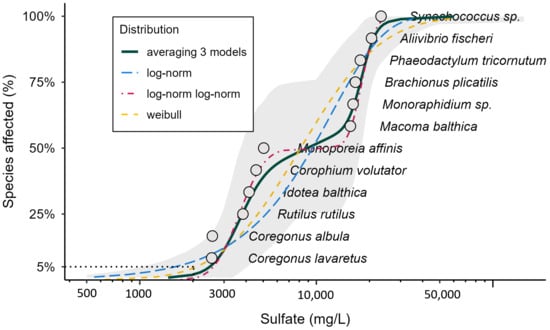
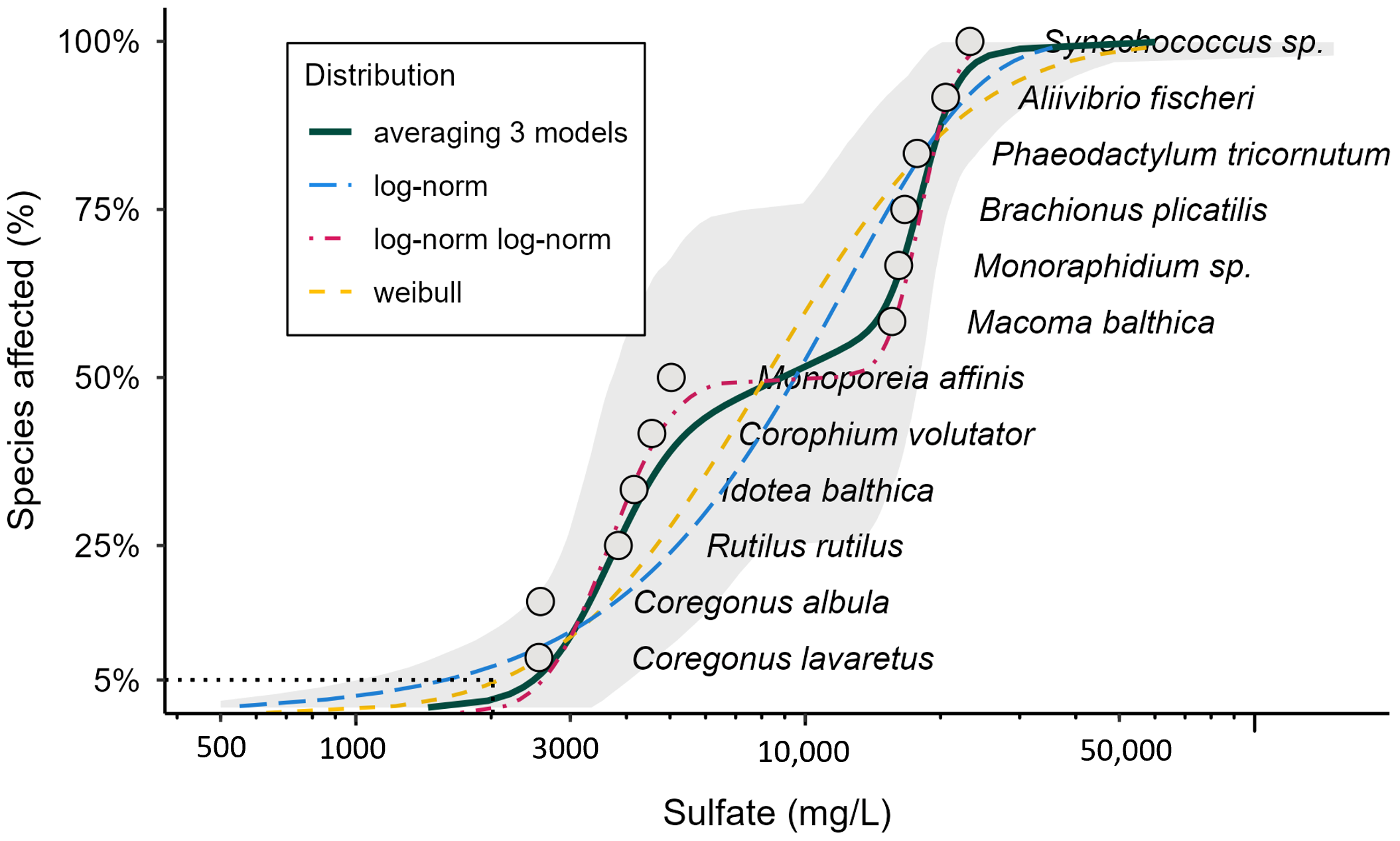
In the acute sulfate toxicity SSD modelling, LC50 values for the 12 Baltic Sea species were included. Acute toxicity varied considerably among the species tested. Fish and crustaceans (median LC50 = 3999 mg/L) were relatively more sensitive to sulfate than the rest of the studied taxa (median LC50 = 17,194 mg/L, Figure 1). The most sensitive species were C. lavaretus (LC50 = 2554 mg/L) and C. albula (LC50 = 2575 mg/L, Table 1). The least sensitive species were the cyanobacterium Synechococcus sp. (LC50 = 23,251 mg/L) and the bacterium A. fischeri (LC50 = 20,531 mg/L, Table 1).
Figure 1.
Acute species sensitivity distributions (SSDs) based on toxicity values from the tested 12 Baltic Sea species. Grey circles indicate 50% lethal concentration values for each species. Different model predictions by single distributions and model-averaging were plotted in different colours. Hazardous concentration to 5% of species (HC5) estimated by model-averaging was indicated with dark dotted lines at the lower left corner. Grey area represents 95% confidence intervals from model-averaged SSD predictions.
Table 1.
Acute 50% lethal concentration LC50 values (mg/L sulfate with 95% confidence intervals in brackets) from the tested Baltic Sea species. Test endpoint and statistical models used in concentration–response analysis were specified for each species.
Using a model-averaging approach including the log-normal/log-normal mixture distribution, the Weibull distribution and the log-normal distribution, the estimated HC5 with a 95% confidence interval was 2489 (1016–3990) mg/L sulfate (Table 2). For comparison, HC5 values estimated from single-distribution modelling were also provided (Table 2). With a PNEC of 1011 mg/L and an AF of 2.46, the percentage of species affected, estimated by model-averaging, was less than 5% with a 95% probability (Table 3). PNEC scenarios with typical AF values from 1 to 5 as integers were also provided in Table 3.
Table 2.
Statistical details for the distributions selected for model-averaging. Results of HC5 (hazardous concentration to 5% species, in mg/L sulfate) with 95% confidence intervals were estimated using the model-averaging approach and the single-distribution approach for comparison. Akaike information criterion corrected for small sample sizes (AICc) and model weight in model-averaging were provided.
Table 3.
Predicted No Effect Concentrations (PNEC, in mg/L sulfate) derived from the model-averaged HC5 under different assessment factor (AF) scenarios. Percentage of species affected under each AF scenario at the corresponding PNEC value was estimated with 95% confidence intervals.
4. Discussion
Acute sulfate sensitivity varied among the brackish water species. The most sensitive species were brackish water fish and crustaceans, while the least sensitive were algae and bacteria. This result is in line with previous sulfate exposure studies in freshwater by Karjalainen et al. [16], which found that the most sensitive freshwater species were the crustacean Ceriodaphnia dubia, and the least sensitive ones the common duckweed Lemna minor and the green algae Raphidocelis subcapitata.
High sulfate tolerance among algal species could be due to sulfate assimilation processes in those species, as sulfate can be reduced to sulfide and directly assimilated for use in regular metabolic activities in plants, algae and microorganisms [31,32]. However, in animals, sulfate assimilation may be limited, as sulfate has been suggested to be an impermeant anion to the gills of freshwater fish and crustaceans, although some sulfate anion transporters have been found in the gastrointestinal and renal systems of fish, and, to a limited extent, in the gills of unionid bivalves [33]. Vast species differences in sulfate sensitivity across trophic levels suggest that cascading changes in food webs could occur as a result of ill-regulated anthropogenic sulfate inputs.
As sulfate is primarily toxic by inducing non-specific osmotic stress [3], species salinity tolerance might be linked to their sulfate sensitivity. For example, in experiments conducted both in freshwater and brackish water, the non-vascular plant Fontinalis antipyretica was also among the most chronically sensitive species to sulfate [9,16]. It is a freshwater moss species commonly found in brackish water environments in the Gulf of Bothnia but not found in salinities higher than ca. 5‰ [34]. Similarly, the high sulfate sensitivity of the fish C. lavaretus, C. albula and R. rutilus in brackish water conditions may be related to the limited salinity tolerance of eggs during early development stages [8,9]. These fish are all freshwater fish by origin and their reproductive activities in the Baltic Sea are geographically limited to coastal waters with salinities < 3 or 4‰ [35,36]. However, since mechanistic understanding of sulfate toxicity is not investigated in the study, future work is needed to further establish the hypothesized link between sulfate sensitivity and salinity tolerance.
Based on the LC50 values of the brackish water species, a model-averaged SSD was fitted, thus incorporating the different distributional shapes and reducing uncertainties for small datasets [13]. While it has recently been suggested that the model-averaging approach and the single-distribution approach based on log-normal distributions may not substantially differ in their derivation of HC5 estimates, model-averaging can be advantageous when the best model fit is provided by a distribution other than the log-normal distribution [28]. This is the case with our study, where a clear bimodality in SSD was observed with heavy weight assigned to the log-normal/log-normal mixture distribution in model-averaging (with a model weight of 0.72). Bimodality was not observed in the freshwater sulfate SSD [16], nor was it observed in the chronic sulfate SSD performed for brackish water species, although chronically fish and crustaceans were also found to be more sensitive than bivalves, rotifers and algae [9]. The bimodality in the current study is likely due to the remarkably higher acute sensitivity of fish and crustacean species in comparison with the other species. Acute LC50s of fish based on egg fertilization success were within similar ranges as chronic LC10s based on hatching success, as fertilization and early embryonic development stages are the most sensitive stages to sulfate [7,8]. In the tests of the crustacean species M. affinis, C. volutator and I. balthica, 7-day LC50s were used in the SSD. Unlike typical Daphnia and gammarid tests, which use water-only exposures lasting from 48 to 96 h [37], the 7-day exposure time was necessary for infaunal amphipod species such as M. affinis and C. volutator, which were tested using sediments and require longer time to acclimate to sediment conditions and to show mortality [38,39]. Available protocols and previous amphipod studies used 10-day mortality as the acute endpoint [21,38,39]. While 10-day mortality was not available in our study, 7-day mortality was used as the substitute endpoint. In the test of isopod species I. balthica, no standard protocols exist, and mortality was hardly observed in 96 h, leading to the adoption of 7-day mortality as the endpoint. For the same reason, 7-day mortality was used as the endpoint in the bivalve test of M. balthica using juvenile clams. It is also important to note that a sample size of 12 species in the current acute SSD is still relatively small, albeit sufficient per the SSD data requirement [10]. Thus, testing of more species from different taxa might help discern whether the currently observed bimodality was an arbitrary consequence of a small dataset with a heavy representation of fish and crustacean species or an inherent characteristic of species sulfate sensitivity differences.
Chronic toxicity of sulfate was generally lower for species in the brackish water environment compared to species in freshwater environments [8,9], and the current study suggests that acute toxicity follows the same pattern. Compared to the HC5s from acute freshwater sulfate SSD (514 to 678 mg/L) [16], the acute HC5 for brackish water (2489 mg/L) is remarkably higher. Several reasons may explain this phenomenon. Firstly, increased water hardness and total concentrations of ions, especially of calcium, in brackish water can render sulfate less toxic to aquatic organisms [3,4]. Secondly, it is possible that species inhabiting the Baltic Sea have been adapted to the brackish water environment characterized by markedly higher ambient sulfate concentrations. In addition, differences in sulfate sensitivity can be due to genetic variability of the species in different environments, since they exist between populations of the same species living in freshwater and brackish water [36].
To safeguard against potential negative effects caused by short-term concentration peaks, acute PNECs can be derived for the development of a maximum allowable concentration environmental quality standard (MAC-EQS) [10]. The acute PNEC that would lead to the protection of over 95% of species in the Baltic Sea with a 95% probability is 1011 mg/L, over twofold the value of the chronic PNEC of 469 mg/L [9]. In the northern coastal Baltic Sea regions, ambient sulfate concentrations vary from around 200 to 500 mg/L, although almost freshwater conditions with extremely low sulfate concentrations can be found in river estuaries with large freshwater input and in the northernmost parts of the basin [9]. In these locations, the freshwater acute PNEC can be considered as the most relevant [16]. Otherwise, the acute brackish water PNEC derived in this study is relevant for the northern coastal areas of the Baltic Sea. In regions of higher salinity levels (over 6‰) such as the central and southern areas, the current PNEC may not be applicable as the derivation process included sensitive fish species with limited reproduction areas in coastal environments with lower salinity levels. Thus, in regions where salinity levels reach over 6‰, a new PNEC would need to be estimated from an SSD based on a new selection of ecologically relevant and representative species.
In the application of PNECs for regulatory decision-making, different types of uncertainties associated with their derivation should be acknowledged in addition to region-specific conditions. Some typical uncertainties in deriving PNECS via SSD modelling are the overall quality of the toxicity data, species representation, sample size for the SSD, variation in species sensitivity, toxic mode of action of the substance in question, statistical uncertainties in modelling, and comparisons to field data [10,15]. While the data provided by the current study greatly enlarged the available data pool for acute sulfate toxicity in brackish water, future work is needed to expand species representation in the SSD and to improve the overall quality of the toxicity data. For example, in addition to juveniles of the Baltic clam, embryo-larval development stage of the species can be tested following the protocol available for early stages of marine oysters and mussels [40]. SSD species representation and diversity could also be enhanced by including taxa such as aquatic insects and macrophytes, which are also recommended by the European Commission [10]. Furthermore, field and mesocosm studies would help assess species sulfate sensitivity under multispecies interactions in more realistic scenarios and reduce the uncertainties of PNEC applications.
To summarize, this study examined the acute sulfate sensitivity of multiple Baltic Sea species through toxicity tests. Based on the HC5 from a model-averaged SSD, a PNEC of 1011 mg/L sulfate was derived that would protect over 95% of species with a 95% probability in the northern coastal Baltic Sea. Brackish water fish and crustaceans were particularly sensitive to acute sulfate exposure compared to bivalve, a rotifer, algae, and bacteria, leading to a bimodal SSD. Due to the relatively small sample size of 12 species, more toxicity tests on brackish water species would therefore be needed to increase SSD sample size and taxa representation. The results of the current study contributed to the development of sulfate MAC-EQS in the northern Baltic Sea.
Supplementary Materials
The following supporting information can be downloaded at https://www.mdpi.com/article/10.3390/environments13080431/s1. Supplementary Material S1: Detailed toxicity test descriptions for each species and additional details on other possible endpoints; Supplementary Material S2: Details on species sampling sites, acclimation conditions, test conditions, test validity, water chemistry and statistical modelling.
Author Contributions
Conceptualization, A.K.K. and J.S.K.; methodology, X.H., M.T.L., J.J., M.M., E.S. and J.S.K.; software, X.H.; validation, X.H., M.T.L., K.K.L., J.J. and J.S.K.; formal analysis, X.H., M.T.L., J.J. and J.S.K.; investigation, X.H., M.T.L., J.J. and M.M.; data curation, X.H.; writing—original draft preparation, X.H.; writing—review and editing, X.H., M.T.L., K.K.L., A.K.K., J.J., M.M., E.S. and J.S.K.; visualization, X.H.; supervision, J.S.K.; project administration, J.S.K.; funding acquisition, X.H., E.S., A.K.K. and J.S.K. All authors have read and agreed to the published version of the manuscript.
Funding
This study was funded by the doctoral programme at the Department of Biological and Environmental Science from the University of Jyväskylä. Umicore Finland partially funded the implementation of toxicity tests at the University of Jyväskylä and the Finnish Environment Institute. Amphipod work was supported by the Latvian Council of Science (LCS) through the Fundamental and Applied Research project grant (lzp-2024/1-0524).
Institutional Review Board Statement
The tested animals in the study were only early-life-stage fish (eggs), crustaceans, rotifers and bivalves. According to the EU Directive 2010/63/EU, experimental animal permits were not required to perform those tests. Sampling and handling of animals were conducted according to the 3R principles.
Data Availability Statement
The data underlying this article are available in the article and in its online Supplementary Materials.
Acknowledgments
We would like to acknowledge the work of Mervi Koistinen, Emma Pajunen, Nina Honkanen, Rauni Kauppinen and Anne Palmgren. We also thank Essi Keskinen, Lari Veneranta, Kimmo Puosi, Veikko Kantojärvi, Kevin O’Brien, Tuula Väänänen and Alf Norkko for help in sampling.
Conflicts of Interest
The authors declare that they have no known competing financial interests or personal relationships that could have appeared to influence the work reported in this paper.
Abbreviations
The following abbreviations are used in this manuscript:
| EC50 | Effect concentration leading to 50% negative effect |
| LC50 | Lethal concentration leading to 50% mortality |
| SSD | Species sensitivity distribution |
| AF | Assessment factor |
| PNEC | Predicted no effect concentration |
References
- Zak, D.; Hupfer, M.; Cabezas, A.; Jurasinski, G.; Audet, J.; Kleeberg, A.; McInnes, R.; Kristiansen, S.; Petersen, R.; Liu, H.; et al. Sulphate in freshwater ecosystems: A review of sources, biogeochemical cycles, ecotoxicological effects and bioremediation. Earth-Sci. Rev. 2021, 212, 103446. [Google Scholar] [CrossRef] [Scilit]
- Ekholm, P.; Lehtoranta, J.; Taka, M.; Sallantaus, T.; Riihimäki, J. Diffuse sources dominate the sulfate load into Finnish surface waters. Sci. Total Environ. 2020, 748, 141297. [Google Scholar] [CrossRef] [Scilit] [PubMed]
- Erickson, J.; Mount, D.; Highland, T.L.; Hockett, J.R.; Hoff, D.J.; Jenson, C.T.; Norberg-King, T.J.; Forsman, B. Acute Toxicity of Major Geochemical Ions to Fathead Minnows (Pimephales Promelas): Part A—Observed Relationships for Individual Salts and Salt Mixtures. Environ. Toxicol. Chem. 2022, 41, 2078–2094. [Google Scholar] [CrossRef] [Scilit] [PubMed]
- Elphick, J.R.; Davies, M.; Gilron, G.; Canaria, E.C.; Lo, B.; Bailey, H.C. An aquatic toxicological evaluation of sulfate: The case for considering hardness as a modifying factor in setting water quality guidelines. Environ. Toxicol. Chem. 2011, 30, 247–253. [Google Scholar] [CrossRef] [Scilit] [PubMed]
- Hayward, E.E.; Gillis, P.L.; Bennett, C.J.; Prosser, R.S.; Salerno, J.; Liang, T.; Robertson, S.; Metcalfe, C.D. Freshwater mussels in an impacted watershed: Influences of pollution from point and non-point sources. Chemosphere 2022, 307, 135966. [Google Scholar] [CrossRef] [Scilit] [PubMed]
- Hu, X.; Mäkinen, M.; Taskinen, J.; Karjalainen, J. Sulfate sensitivity of early life stages of freshwater mussels Unio crassus and Margaritifera margaritifera. Ecotoxicology 2024, 33, 996–1008. [Google Scholar] [CrossRef] [Scilit] [PubMed]
- Karjalainen, J.; Mäkinen, M.; Karjalainen, A.K. Sulfate toxicity to early life stages of European whitefish (Coregonus lavaretus) in soft freshwater. Ecotoxicol. Environ. Saf. 2021, 208, 111763. [Google Scholar] [CrossRef] [Scilit] [PubMed]
- Mäkinen, M.; Hu, X.; Karjalainen, J. Differences in sulfate sensitivity of early development between brackish and freshwater coregonines. Int. J. Limnol. 2024, 60, 24. [Google Scholar] [CrossRef] [Scilit]
- Hu, X.; Leppänen, M.T.; Lehtonen, K.K.; Karjalainen, A.K.; Järvistö, J.; Mäkinen, M.; Samarawickrama, R.; Strode, E.; Karjalainen, J.S. Ecotoxicological Risk of Sulfate in Baltic Sea Brackish water Assessed Using Model-Averaged Species Sensitivity Distribution. Integr. Environ. Assess. Manag. 2026, 22, 765–776. [Google Scholar] [CrossRef] [Scilit] [PubMed]
- European Commission. Technical Guidance for Deriving Environmental Quality Standards. Guidance Document No: 27. Updated Version 2018. 2018. Available online: https://rvs.rivm.nl/sites/default/files/2019-04/Guidance%20No%2027%20-%20Deriving%20Environmental%20Quality%20Standards%20-%20version%202018.pdf (accessed on 1 January 2025).
- International Union of Pure and Applied Chemistry (IUPAC). IUPAC—Acute Toxicity (AT06800). Available online: https://goldbook.iupac.org/terms/view/AT06800 (accessed on 25 July 2026).
- Belanger, S.E.; Carr, G.J. SSDs revisited: Part II—Practical considerations in the development and use of application factors applied to species sensitivity distributions. Environ. Toxicol. Chem. 2019, 38, 1526–1541. [Google Scholar] [CrossRef] [Scilit] [PubMed]
- Fox, D.; Dam, R.; Fisher, R.; Batley, G.; Tillmanns, A.; Thorley, J.; Schwarz, C.J.; Spry, D.J.; McTavish, K. Recent Developments in Species Sensitivity Distribution Modeling. Environ. Toxicol. Chem. 2020, 40, 293–308. [Google Scholar] [CrossRef] [Scilit] [PubMed]
- Kamo, M.; Hayashi, T.I.; Iwasaki, Y. Revisiting assessment factors for species sensitivity distributions as a function of sample size and variation in species sensitivity. Ecotoxicol. Environ. Saf. 2022, 246, 114170. [Google Scholar] [CrossRef] [Scilit] [PubMed]
- Sorgog, K.; Kamo, M. Quantifying the precision of ecological risk: Conventional assessment factor method vs. species sensitivity distribution method. Ecotoxicol. Environ. Saf. 2019, 183, 109494. [Google Scholar] [CrossRef] [Scilit] [PubMed]
- Karjalainen, J.; Hu, X.; Mäkinen, M.; Karjalainen, A.; Järvistö, J.; Järvenpää, K.; Sepponen, M.; Leppänen, M.T. Sulfate sensitivity of aquatic organism in soft freshwaters explored by toxicity tests and species sensitivity distribution. Ecotoxicol. Environ. Saf. 2023, 258, 114984. [Google Scholar] [CrossRef] [Scilit] [PubMed]
- Mount, D.R.; Erickson, R.J.; Highland, T.L.; Hockett, J.R.; Hoff, D.J.; Jenson, C.T.; Norberg-King, T.J.; Peterson, K.N.; Polaske, Z.M.; Wisniewski, S. The acute toxicity of major ion salts to Ceriodaphnia dubia: I. influence of background water chemistry. Environ. Toxicol. Chem. 2016, 35, 3039–3057. [Google Scholar] [CrossRef] [Scilit] [PubMed]
- Telesh, I.V.; Khlebovich, V.V. Principal processes within the estuarine salinity gradient: A review. Mar. Pollut. Bull. 2010, 61, 149–155. [Google Scholar] [CrossRef] [Scilit] [PubMed]
- OECD. Fish Toxicity Testing Framework; OECD Publishing: Paris, France, 2014. [Google Scholar] [CrossRef] [Scilit]
- Mohan, A.; Matthews, B.; Räsänen, K. Direct and indirect effects of chemical pollution: Fungicides alter growth, feeding, and pigmentation of the freshwater detritivore Asellus aquaticus. Ecotoxicol. Environ. Saf. 2024, 285, 117017. [Google Scholar] [CrossRef] [Scilit] [PubMed]
- ISO 16712:2005; Water Quality—Determination of acute Toxicity of Marine or Estuarine Sediment to Amphipods. ISO: Geneva, Switzerland, 2005.
- ISO 20666:2008; Water Quality—Determination of the Chronic Toxicity to Brachionus calyciflorus in 48 h. ISO: Geneva, Switzerland, 2008.
- ISO 19820:2016; Water Quality—Determination of the Acute Toxicity to the Marine Rotifer Brachionus plicatilis. ISO: Geneva, Switzerland, 2016.
- ISO 11348-3:2007; Water Quality—Determination of the Inhibitory Effect of Water Samples on the Light Emission of Vibrio fischeri (Luminescent Bacteria Test)—Part 3: Method Using Freeze-Dried Bacteria. ISO: Geneva, Switzerland, 2007.
- R Core Team. A Language and Environment for Statistical Computing; R Foundation for Statistical Computing: Vienna, Austria, 2025; Available online: https://www.R-project.org/ (accessed on 29 July 2026).
- Ritz, C.; Baty, F.; Streibig, J.C.; Gerhard, D. Dose-Response Analysis Using R. PLoS ONE 2015, 10, e0146021. [Google Scholar] [CrossRef] [Scilit] [PubMed]
- Thorley, J.; Fisher, R.; Fox, D.; Schwarz, C. ssdtools v2: An R package to fit Species Sensitivity Distributions. J. Open Source Softw. 2025, 10, 7492. [Google Scholar] [CrossRef] [Scilit]
- Iwasaki, Y.; Yanagihara, M. Comparison of model-averaging and single-distribution approaches to estimating species sensitivity distributions and hazardous concentrations for 5% of species. Environ. Toxicol. Chem. 2025, 44, 834–840. [Google Scholar] [CrossRef] [Scilit] [PubMed]
- Fisher, R.; Fox, D.; Thorley, J. Final Report of the Joint Investigation into SSD Modelling and ssdtools Implementation for the Derivation of Toxicant Guidelines Values in Australia and New Zealand. Available online: https://apps.aims.gov.au/metadata/view/641b42fb-a882-4b58-ac4b-6201f90b6242 (accessed on 21 January 2026).
- Warne, M.; Batley, G.E.; van Dam, R.A.; Chapman, J.C.; Fox, D.R.; Hickey, C.W.; Stauber, J.L.; Fisher, R. Method for Deriving Australian and New Zealand Water Quality Guideline Values for Protecting Aquatic Ecosystems from Toxicants—Update of 2018 Version; Prepared for the Australian and New Zealand Guidelines for Fresh and Marine Water Quality. Australian and New Zealand Governments and Australian State and Territory Governments: Canberra, Australia, 2025. Available online: https://www.waterquality.gov.au/sites/default/files/documents/warne-etal-2025.pdf (accessed on 29 July 2026).
- Gao, Y.; Schofield, O.M.E.; Leustek, T. Characterization of Sulfate Assimilation in Marine Algae Focusing on the Enzyme 5′-Adenylylsulfate Reductase. Plant Physiol. 2000, 123, 1087–1096. [Google Scholar] [CrossRef] [Scilit] [PubMed]
- Kawano, Y.; Suzuki, K.; Ohtsu, I. Current understanding of sulfur assimilation metabolism to biosynthesize l-cysteine and recent progress of its fermentative overproduction in microorganisms. Appl. Microbiol. Biotechnol. 2018, 102, 8203–8211. [Google Scholar] [CrossRef] [Scilit] [PubMed]
- Griffith, M.B. Toxicological perspective on the osmoregulation and ionoregulation physiology of major ions by freshwater animals: Teleost fish, crustacea, aquatic insects, and Mollusca. Environ. Toxicol. Chem. 2016, 36, 576–600. [Google Scholar] [CrossRef] [Scilit] [PubMed]
- Rydin, H.; Snoeijs, P.; Diekmann, M. Swedish Plant Geography; Opulus Press Uppsala: Nyhammar, Sweden, 1999. [Google Scholar]
- Härmä, M.; Lappalainen, A.; Urho, L. Reproduction areas of roach (Rutilus rutilus) in the northern Baltic Sea: Potential effects of climate change. Can. J. Fish. Aquat. Sci. 2008, 65, 2678–2688. [Google Scholar] [CrossRef] [Scilit]
- López, M.E.; Nord, M.B.; Kaljuste, O.; Wennerström, L.; Hekim, Z.; Tiainen, J.; Vasemägi, A. Lack of panmixia of Bothnian Bay vendace—Implications for fisheries management. Front. Mar. Sci. 2022, 9, 1028863. [Google Scholar] [CrossRef] [Scilit]
- OECD. Test No. 202: Daphnia sp. Acute Immobilisation Test; OECD Publishing: Paris, France, 2004. [Google Scholar] [CrossRef] [Scilit]
- Bat, L. A Review of Sediment Toxicity Bioassays Using the Amphipods and Polychaetes. Turk. J. Fish. Aquat. Sci. 2005, 5, 119–139. [Google Scholar]
- Dewitt, T.H.; Swartz, R.C.; Lamberson, J.O. Measuring the acute toxicity of estuarine sediments. Environ. Toxicol. Chem. 1989, 8, 1035–1048. [Google Scholar] [CrossRef]
- ISO 17244:2025; Water Quality—Determination of the Toxicity of Water Samples on the Embryo-Larval Development of Japanese Oyster (Crassostrea gigas) and Mussel (Mytilus edulis or Mytilus galloprovincialis). ISO: Geneva, Switzerland, 2025.

Disclaimer/Publisher’s Note: The statements, opinions and data contained in all publications are solely those of the individual author(s) and contributor(s) and not of MDPI and/or the editor(s). MDPI and/or the editor(s) disclaim responsibility for any injury to people or property resulting from any ideas, methods, instructions or products referred to in the content. |
© 2026 by the authors. Licensee MDPI, Basel, Switzerland. This article is an open access article distributed under the terms and conditions of the Creative Commons Attribution (CC BY) license.