


Abstract
Rapid accumulation of soil lanthanum (La), cerium (Ce), and fluorine (F) caused by bastnasite mining development has increasingly become a concern worldwide in the past decades. However, the effects of the different chemical forms of these elements on the composition and diversity of soil dominant, moderate, and rare microorganisms are unclear. In this study, Planctomycetota was changed from dominant to moderate, caused by exchangeable and carbonate-bound forms of La and Ce. Both organic bound La (La_ORG) and water-soluble F (F_WS) were the crucial factors driving variations in the relative abundance of Patescibacteria and Bacteroidota from moderate to dominant, while the fungal phylum Chytridiomycota was changed from moderate to dominant, promoted by F_WS. La_ORG, the ferrum-manganese bound form of Ce, and F_WS displayed a negative correlation with the three rare bacterial phyla, i.e., Abditibacteriota, GAL15, and Deinococcota respectively. F_WS caused the disappearance of the rare fungal phylum Monoblepharomycota and the appearance of the rare bacterial phylum Fibrobacterota. Organic bound forms of both Ce and F showed a negative correlation with the bacterial Sobs and fungal Phylogenetic diversity indices, respectively. To summarize, the different chemical forms of La, Ce, and F showed varied effects on the composition and diversity of soil microbial communities.
1. Introduction
Rare earth elements (REEs) are one of the most critical groups of materials due to their extensive applications in new energy vehicles, ceramics, electronic products, aircrafts, and healthcare industries worldwide [1,2]. They are predominantly caused by the development of bastnaesite-rich deposits in the market [3,4]. The increasing demand in the market for REEs and unreasonable mining techniques have led to rapid accumulation of lanthanum (La), cerium (Ce), and fluorine (F) in the soil adjacent to the mining areas [5,6,7]. Excessive La, Ce, and F in agricultural soil exerts adverse effects on soil microorganisms [8,9], plants [10], and human health [11,12]. Soil microorganisms play crucial roles in soil aggregate formation, material transformations, and energy exchange, and are sensitive to soil environmental change [13]. Consequently, there is an urgent need to understand the effects of these three elements on the taxonomic composition and biodiversity of soil microbial communities. This is also important for developing effective strategies for the treatment of the polluted farmland soils.
Microorganisms play a crucial role in soil biogeochemical cycles, nutrient transformations, and other ecological processes. They exhibit various sensitivities and response levels to different pollutants in the soil [14]. For example, some pollutants may cause a drastic decrease in the relative abundance or even the complete disappearance of sensitive bacteria [6,15], while other pollutants may cause some resistant microbial populations with moderate relative abundance to become relatively dominant [16,17]. Accordingly, some researchers use the different responsive modes of microorganisms to soil pollutants as biological indicators for evaluating the soil ecosystem stability [18]. Although their contributions to ecosystem function are different due to various levels of relative abundance, they all play important and even indispensable roles, jointly affecting the material migration and energy exchange within the entire soil ecosystem [14]. From the perspectives of biodiversity conservation, microorganisms with low or rare relative abundance also play important roles in soil ecological processes [16,19]. Based on their relative abundances, the soil microorganisms are categorized into dominant (relative abundance > 1%), moderate (0.1% < relative abundance < 1%), and rare (relative abundance < 0.1%) groups [16,20]. In recent years, many studies have investigated the response variations of dominant microbial populations in soil to heavy metal pollution [14,16], while only a few studies have reported their responses to the pollution of rare earth elements in ion-type rare earth mining [6,21]. Moreover, studies have only focused on the effects of rare earth elements on dominant microbes [6,22]. Additionally, the limited literature on soil microbial responses to rare earth pollution rarely reported the performance of the microorganisms with moderate or rare relative abundances. To date, some researchers have investigated the driving effects of lead (Pb) on microorganisms with moderate or rare abundance [16]. Nevertheless, few studies have documented the effects of different chemical forms of rare earth elements (La, Ce) or fluorine (F) on the microorganisms with moderate or rare relative abundances in the soils adjacent to the bastnasite mining area. The rapid development of high-throughput sequencing [23] has greatly helped improve the understanding of the involvement of the heavy metal elements in soil ecological processes and provided the possibility to study the microbial responses to the accumulation of rare earth elements and fluorine pollution in the soil.
Previous studies reported that the relative abundances of Actinobacteria, Acidobacteria, and Verrucomicrobia declined as the rare earth concentration was increased, losing their status as dominant bacteria [24], while the relative abundances of Cyanobacteria and Pezizomycetes were significantly increased with the contents of rare earth elements [6,21]. Furthermore, severe rare earth element pollution can also alter the soil microbial diversity, leading to a decrease in the Shannon index of soil bacteria, while fungal communities remain relatively stable due to their strong buffering capacity [24]. However, these studies are primarily based on the investigations of the soil adjacent to ion-type rare earth mining areas with no F pollution. To date, there are no studies systematically evaluating the effects of La, Ce, and F pollutions caused by the development of bastnasite mining areas on taxonomic composition and diversity of the soil microbial community.
Similar to other elements, the toxicity of La, Ce, and F depends on the different chemical forms of these elements, especially the more biologically extractable forms [25,26]. For example, under hydroponic conditions, different chemical forms of La exhibit distinct toxicity effects on the growth of broad beans [27], while the toxicity levels of ionic La, neodymium (Nd), or samarium (Sm) to Daphnia similis are higher than those of their chelated forms [28]. However, it is still unclear how the different forms of these elements affect the composition, abundance, and diversity of the microbial community. Therefore, it is essential to explore the effects of the different forms of these elements on soil bacterial and fungal communities.
When pollutants enter the soil, the soil physicochemical properties, as well as the total amount and different forms of pollutants, may all affect the changes in microbial communities [29]. Studies have reported that the chemical forms of pollution elements are the predominant driving factors of the changes in the soil microbial communities. For example, the labile chemical forms of heavy metals, such as Cu, Zn, and Cd, are the predominant factors driving the variations in the relative abundances of Proteobacteria, Monocytes, and Firmicutes [30]. However, the pH level; the contents of organic matter, available nitrogen (AN), and available phosphorus (AP); and other soil properties may also be the primary driving factors for the microbial community succession [31]. To date, the studies on the driving factors of soil microbial communities have focused on co-pollution of multiple rare earth elements in ion-type rare earth mining areas [6,21,23] but have not involved fluorine pollution, and there has been no report on the research of the driving factors in the fluorine-polluted areas adjacent to bastnaesite mining regions. It has been shown that the total content of each rare earth element was the primary driving factor responsible for changes in the composition and diversity of the microbial community, followed by the conventional chemical properties of the soil [24]. However, it is technically challenging to systematically assess the effects of various forms of rare earth elements or fluorine on bacterial and fungal communities due to the numerous external environmental interferences [6]. Therefore, it is important to systematically determine whether the various chemical forms of these elements are the dominant driving factors responsible for the evolution of microbial communities.
Most previous studies concluded that only bioavailable chemical forms (water-soluble, exchangeable, and carbonate bound forms) of La, Ce, or F are the crucial factors promoting the changes in the soil microbial community composition and diversity. We hypothesize that the relatively stable forms (ferrum-manganese bound, organic bound, and residual forms) also are the crucial factors promoting the changes in the soil microbial community composition and diversity, leading to alterations in the microbial abundance and function. We performed three groups of pot experiments to investigate the effects of different chemical forms of La, Ce, and F on the soil microbial communities using the 16S rRNA gene and fungal ITS profiling, as well as correlation and redundancy analysis. The objectives of this study were to: (1) investigate the effects of different chemical forms of La, Ce, or F, individually and with different concentrations, on the composition and abundance of the soil microbial community; (2) assess the effect of the different chemical forms of these three elements and soil physicochemical properties on the α diversity indices of the soil microbial community; (3) identify the crucial factors driving the changes in the composition and diversity of the soil microbial community. The results provide a theoretical basis and experimental evidence for further research on the toxicity of different chemical forms of La, Ce, and F to the soil microorganisms and remediation of polluted farmland soil.
2. Materials and Methods
2.1. Soil Sample Collection
The soil samples used in this experiment were collected from the surface of the soil (0–20 cm in depth) of uncontaminated farmland in the surrounding areas of the rare earth mining region in Mianning, Sichuan, China (28°40′69″ N, 102°02′11″ E). These soil samples were placed into aseptic sampling bags and immediately transported to the laboratory for further processing. Prior to any treatment, gravel and plant remains were first removed from the soil samples, which were then air-dried, homogenized using a 4 mm nylon sieve, and used for soil pot experiments. The classification and properties of the soil samples are shown in Table 1.
Table 1.
Physicochemical properties of soil samples from unpolluted farmland around mining area. Values represent the mean with standard deviation (SD) for n = 3.
2.2. Soil Pot Experiment
We investigated the pollution level within 5 km of the farmland soil in the mining area, Mianning County (Sichuan, China), through a pre-experiment. A total of 15 sampling sites were set up by using the mesh sampling method, with 3 farmland soil samples collected at each site (collection depth 0–20 cm below the surface of the ground) and brought back to the laboratory in aseptic bags to test the contents of La, Ce, and F. The concentrations of La, Ce, and F ranged from 100 to 400, 200 to 800, and 600 to 2000 mg kg−1, respectively. Based on the pollution levels of these elements obtained in our pre-experiments, we designed the low (samples labeled with 1 and 2 in Table 2), middle (samples labeled with 3 in Table 2), and high (samples labeled with 4 and 5 in Table 2) concentrations of soil pot experiments. Therefore, the farmland soil was collected about 15 km away from the bastnaesite mine area in Mianning County (Sichuan, China) and used as the control (CK), containing the total contents of La, Ce, and F at 55.89, 177.24, and 540.73 mg kg−1, respectively. It was noted that these concentrations were less than those detected in the areas close to the mine zones.
Table 2.
Pollution levels (mg kg−1) of lanthanum (La), cerium (Ce), and fluorine (F) in soil pot experiments.
The La, Ce, and F elements at five different levels were provided by LaCl3·7H2O (accurately weighed at 0.5347, 1.0694, 2.1388, 4.2776, and 6.4163 g, respectively), CeCl3·7H2O (accurately weighed at 1.0694, 2.1388, 4.0102, 8.0205, and 12.0307 g, respectively), and NaF (accurately weighed at 4.0102, 8.0205, 12.0307, 18.7144, and 24.0614 g, respectively), all analytical grades and dissolved in 1 L of deionized water. Each experiment, with a control (without any added elements) was repeated in triplicate. The soil samples were incubated for 6 months at 20–25 °C and 70% field water holding capacity with an intermittent water supply. Then, the soil samples were collected and stored at −80 °C for soil microbial high-throughput sequencing analysis. The soil samples were also air-dried for the determination of soil physicochemical properties.
2.3. Determination of Soil Physicochemical Properties
The pH value was measured with a pH meter in the soil suspension in water (1:5, w/v). Soil organic matter (SOM) was measured using the dichromic acid method [32]. Total nitrogen (TN) was determined by the Kjeldahl method with potassium dichromate-concentrated sulfuric acid digested [33]. Total phosphorus (TP) was digested with sodium Mo-Sb colorimetry after sodium hydroxide alkali fusion [34]. Total potassium (TK) was measured by sodium hydroxide with molten-flame spectrophotometry [35]. Soil available nitrogen (AN) was determined by the alkaline hydrolysis method [36]. Soil available phosphorus (AP) was extracted with sodium bicarbonate and determined by Mo-Sb colorimetry [37]. Soil available potassium (AK) was extracted with ammonium acetate and determined by the flame photometric method [38].
2.4. Determination of Total Amount and Different Forms of La and Ce in Soil
The total La and Ce in soil was digested with HNO3:HCl:HClO4 (1:2:2, v/v/v), and then the total concentrations of La and Ce in soil were measured by ICP-OES (Agilent 720-ES). The improved Tessier method was used to extract and measure the contents of different forms of La and Ce as follows: (a) water-soluble (WS) form extracted with water at 25 °C; (b) exchangeable (EX) form extracted with 1 mol L−1 MgCl2 (pH = 7); (c) carbonate bound (CAR) form extracted with 1 mol L−1 NaAc (pH = 5); (d) ferrum-manganese bound (FeMn) form extracted with 0.25 mol L−1 NH2OH·HCl; (e) organic bound (ORG) form extracted first with 0.02 mol L−1 HNO3 and 30% H2O2, and then with a 3.2 mol L−1 NH4Ac and 20% HNO3 mixture; (f) residual (RES) form extracted using the same analytical method as that for total La and Ce in soil, as described above.
2.5. Determination of Total Amount and Different Forms of F in Soil
The total concentration of F in soil was determined by the fluoride ion selective electrode method after pretreatment with molten sodium hydroxide (GBT 22104-2008, China [39]). The five components of F in soil were measured as follows: (a) WS form extracted with water at 70 °C; (b) EX form extracted with 1 mol L−1 MgCl2; (c) FeMn form extracted with 0.04 mol L−1 NH2OH·HCl dissolved in a 20% (V/V) acetic acid solution; (d) ORG form extracted first with 0.04 mol L−1 HNO3 and 30% H2O2 (v/v), shaken, and then with 2.5 mL H2O2 solution—the mixture was continuously heated at a constant temperature (85 ± 2 °C) for 3 h, and after cooling, 3.2 mol L−1 NH4Ac was added for further extraction; (e) RES form extracted using the same analytical method as that for the total F in soil, as described above.
2.6. Analysis of Soil Microbial Community
To investigate the variations in the composition and diversity of the soil microbial community using high-throughput sequencing, soil microbial DNA was extracted from all experimental and control groups using a soil DNA kit (Omega Bio-tek Inc., Norcross, GA, USA). The quality of DNA extraction was determined by using 1% agarose gel electrophoresis. PCR amplifications of bacterial and fungal DNA templates were performed using bacterial specific primers 338F/806R and fungal specific primers [23]. PCR-amplified products were purified and sent to Shanghai Majorbio Bio-Pharm Technology Co., Ltd. (Shanghai, China) for sequencing with the Illumina MiSeq platform.
Bioinformatics analysis of the high-throughput sequencing data was performed using QIIME1.9.1 [40]. Low-quality reads were filtered by Phred score ≥ 20, removal of N bases, length cutoff ≥ 200 bp and strict primer matching. Chimeras were eliminated by combined de novo UCHIME detection and reference-based filtering against the SILVA138 (16S) and UNITE8.0 (ITS) databases before downstream analysis. A total of 1,923,174 and 2,155,119 optimized bacterial and fungal effective sequences, respectively, were obtained and grouped into different operational taxonomic units (OTUs) by using the USEARCH7-uparse algorithm based on the similarity of 97% and the average number of 412 and 242 bacterial and fungal sequences per sample [41]. Rarefaction curves for all samples plateaued with increasing reads, indicating sequencing saturation and reliable community profiling; curves are provided in Figure S1. All samples had coverage > 0.95 for both bacteria and fungi, confirming sufficient sequencing depth to capture most soil microbial taxa. All samples were rarefied to equal read counts to normalize sequencing depth variation.
The OTUs were annotated into various bacterial and fungal taxa with a confidence threshold of 70% [42], based on the 16S rRNA database of bacteria and archaea (Silva138) and the ITS database of fungi (Unite8.0) using the algorithm of the ribosome database project classifier (RDP Classifier 2.13). The community components of each sample were characterized at each taxonomic level. To further explore the effects of different pollution elements on the soil microorganisms, the microorganisms were categorized into dominant (relative abundance > 1%), moderate (0.1% < relative abundance < 1%), and rare (relative abundance < 0.1%) groups [16,20]. This two-cutoff classification was specially selected to match the characteristics of the soil samples and the analytical design of this study. The investigated soil harbors extremely diverse microbial communities following a long-tailed abundance distribution, and the thresholds of 1% and 0.1% can effectively distinguish three assemblages with differentiated ecological functions closely related to our research targets. Benefiting from saturated sequencing depth and high Good’s Coverage across all samples, low-abundance taxa at the 0.1% limit could be reliably quantified for cross-treatment comparison. Furthermore, the three-group division balanced the OTU number of each category, ensuring robust and stable outputs in downstream statistical analyses linking microbial groups to soil environmental variables.
The Sobs, Simpsoneven, Shannon, and phylogenetic diversity indices were calculated using the Mothur1.30.2 software to evaluate the effects of pollution element forms and soil properties on the α diversity of microbial communities.
2.7. Data Analysis
The standard material (GBW07405) was used for quality control, and the standard solution was added to the sample series every 8 samples to verify sensitivity and repeatability. The recovery of La, Ce, and F reached 95.6% within the quality control standard, indicating that our experimental data were reliable. The Shapiro–Wilk test was used to assess the normality of each dataset, and Levene’s test was applied to examine the homogeneity of variances across groups. SPSS19.0 was used for significance analysis, correlation analysis, and multiple regression analysis of the data for pollution element forms, soil properties, and microbial high-throughput sequencing. The difference was considered significant based on p < 0.05. Pearson correlation analysis was performed to explore the association among different forms of the three elements, soil properties, the α diversity, and the relative abundance of the microbial community, with the correlation heat map generated using Origin Pro 9.0 (OriginLab, Northampton, MA, USA). Using the “Vegan” software package (Ri386 4.1.3) in R Studio, redundancy analysis (RDA) was performed on the different chemical forms of pollution elements, soil properties, and the relative abundance of the microbial community to identify the dominant driving factors responsible for the microbial abundance changes.
The relative abundance of changes in microorganisms in different polluted soils was calculated using the equation: relative abundance change = [(Xt − Xc)/Xc] × 100%, where Xt and Xc represent the abundance of microorganisms in polluted and unpolluted soils, respectively.
3. Results
3.1. Physicochemical Properties of Soil and the Contents of Different Forms of La, Ce, and F
3.1.1. Physicochemical Properties of Soil
Different concentrations of La, Ce, and F elements caused significant differences in the physicochemical properties of contaminated soils (Figure S2). Compared with the control group (pH = 5.15), the pH values in the experimental groups were lowered as the concentrations of La and Ce increased, ranging from 3.18 to 3.72, while the pH values in the F-contaminated soils increased up to 5.68 as the F concentrations increased.
Compared with the control group, the variations in the contents of TN, TP, and TK in soil contaminated by La, Ce, and F were less than 2%, while the changes in the contents of SOM, AN, AP, and AK were more than 5% in the experimental groups treated with different pollutants.
3.1.2. Contents of Different Forms of La, Ce, and F
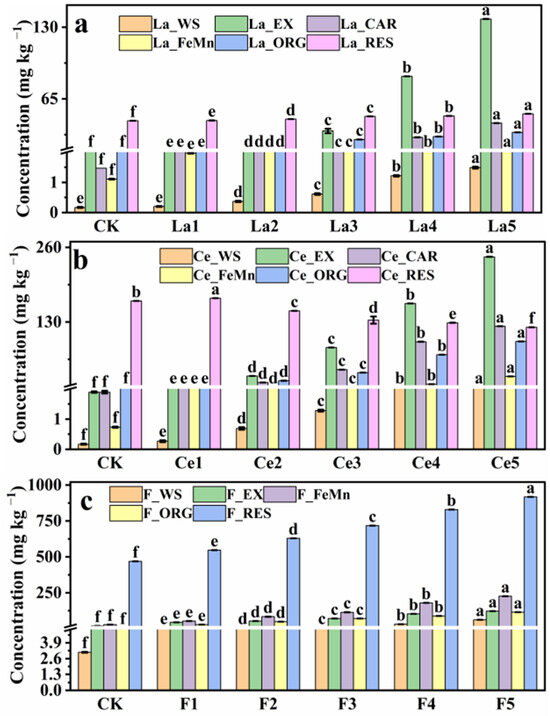
In La-contaminated soils, the contents of five chemical forms of La (i.e., La_WS, La_EX, La_CAR, La_FeMn, and La_ORG) were linearly improved with the increase in La concentrations, and all these upward trends were statistically significant (p < 0.05). Among them, La_EX showed the largest increments, from 3.76 to 49.04%, whereas the contents of La_RES were decreased from 87.5 to 18.35% with the increase in pollutant concentrations (Figure 1a).
Figure 1.
Contents of different forms of lanthanum (La), cerium (Ce), and fluorine (F) in contaminated soils of La (a), Ce (b), and F (c), respectively. WS, water-soluble form; EX, exchangeable form; CAR, carbonate bound form; FeMn, ferrum-manganese bound form; ORG, organic bound form; RES, residual form. Different lowercase letters represent significant differences in the contents of the same chemical form among different treatment groups.
In Ce-contaminated soils, the variations in the contents of different forms of Ce showed largely similar patterns to those in La-contaminated soils, showing significant increasing trends in five forms of Ce, except for Ce_RES, which was detected with decreased contents as the increment of Ce concentrations was increased (Figure 1b, p < 0.05). The largest increase was revealed in the content of Ce_EX, from 1.07 to 38.78%, while the content of Ce _RES was decreased from 94.10 to 19.24%.
In F-contaminated soils, the significant increased contents were detected in four chemical forms of F (i.e., F_WS, F_EX, F_FeMn, and F_ORG) as the increment of F concentrations was increased (Figure 1c, p < 0.05), with the highest increase shown in F_FeMn, from 5.31 to 15.74%. The content of F_RES declined from 86.83 to 61.43%.
3.2. Composition and Diversity of Microbial Community
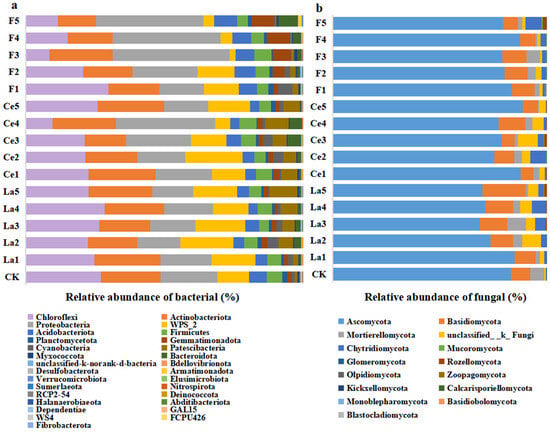
The unpolluted soil contained a total of 28 bacterial phyla (eight dominant, nine moderate, and 11 rare) (Figure 2a). In particular, the dominant phyla included Chloroflexi (28.77%), Proteobacteria (21.69%), Actinobacteria (19.19%), WPS_2 (10.29%), Acidobacteria (6.59%), Firmicutes (6.01%), Planctomycotes (1.85%), and Gemmatimonatedes (1.69%), accounting for 96.08% of the total relative abundance. The moderate phyla (e.g., Patescibacteria, Cyanobacteria, Myxococcita, and Bacteroidota) and rare phyla (e.g., Haloanaerobiota, Deinococota, GAL15, and Abditibacteriota) accounted for 3.59% and 0.33%, respectively, of the total relative abundance.
Figure 2.
Relative abundance of bacterial (a) and fungal (b) phyla in the soil microbial communities contaminated by lanthanum (La), cerium (Ce), and fluorine (F).
A total of 15 fungal phyla were detected in the control group (Figure 2b), with three dominant, including Ascomycota (81.79%), Basidiomycota (10.01%), and Mortierellomycota (6.56%), which together accounted for 98.36% of the total relative abundance. The three moderate phyla (i.e., Chytridiomycota, Mucoromycota, and unclassified_k fungi) and nice rare phyla (e.g., Orpidiomycota, Glomeromycota, Monolepharomycota, Basidiobolomycota, and Blastocladiomycota) accounted for 1.39% and 0.25%, respectively, of the total relative abundance.
It was noteworthy that after the soils were treated with the three elements, a total of four microbial phyla, i.e., Abditibacteriota, Halanaerobiaeota, GAL15, and Deinococcota, were not detected (i.e., disappearance) in soils treated with high concentrations of La, Ce, and F respectively, and the rare fungal phylum Monoblepharomycota disappeared in the soils treated with a high concentration of F. Additionally, one bacterial phylum (Fibrobacterota) newly appeared in F-polluted soils. Notably, the observed disappearance of several rare phyla should not be solely attributed to toxic filtering by exogenous La, Ce and F. The extremely low relative abundances of these phyla and sequencing-associated detection limitations represent important confounding factors. Despite saturated rarefaction curves and Good’s Coverage exceeding 0.95 for all samples (Figure S1), random sampling during sequencing and uniform read rarefaction may randomly eliminate trace supporting reads of ultra-rare taxa, leading to artificial false absence independent of actual in situ survival. Therefore, both pollutant-induced biological suppression and stochastic sequencing sampling bias need to be comprehensively considered when explaining the loss signals of rare phyla across contamination gradients.
3.3. Variations in the Relative Abundance of Microorganisms in Contaminated Soil
Compared with the uncontaminated soils, the relative abundance changes were varied in dominant, moderate, and rare bacterial and fungal phyla of the soils polluted by La, Ce, and F (Table S1). The phyla with more than a 30% or 80% change in their relative abundances were considered as significant or extremely significant taxa, respectively.
3.3.1. Dominant Microorganisms
In comparison with the control groups, a total of six bacterial phyla (i.e., Chloroflexi, Proteobacteria, Actinobacteria, WPS_2, Acidobacteria, and Firmicutes) maintained their predominant status, showing changes of less than 30% in their relative abundances in the three groups of soils contaminated by La, Ce, and F (Table S1). Planctomycetota became a moderate phylum due to the decreased relative abundance in polluted soils with high concentrations of these three elements, while Gemmatimonadota became dominant due to the increased relative abundance by more than 80% in the soils contaminated by La, Ce, and F.
Among the dominant fungal phyla, Mortierellomycota became moderate in three types of polluted soils due to the relative abundance decrease of 80%. Similarly, the relative abundance of Basidiomycota was increased by more than 80% in La-contaminated soil (Table S1).
3.3.2. Moderate Microorganisms
Compared with the control, the changes in the relative abundance of nine moderate bacterial phyla were all greater than 30% in the three polluted soils (Table S1). Among these phyla, the relative abundances of Patescibacteria and Bacteroidota were increased with the concentrations of La, Ce, and F, and both became the dominant bacteria.
The changes in the relative abundances of three moderate fungal phyla were greater than 30% (Table S1). In particular, although the relative abundance of Mucoromycota was increased more than 80%, this phylum maintained its status as moderate in F-contaminated soils, whereas the phylum Chytridiomycota became dominant due to the increased relative abundance of more than 80% in the three contaminated soils with high pollution levels of the three elements.
3.3.3. Rare Microorganisms
In comparison with the control groups, the variations exceeding 30% were detected in the relative abundances of 11 bacterial phyla in the contaminated soils (Table S1). Among these phyla, Abditibacteriota was not detected (i.e., complete disappearance) in three contaminated soils with high concentrations of the elements, while Halanaerobiaeota, GAL15, and Deinococcota completely disappeared in several groups of Ce- and F-contaminated soils, and Fibrobacterota was newly detected in F-contaminated soils.
The changes in the relative abundances of nine fungal phyla in the contaminated soils were more than 30% (Table S1). In particular, Monoblepharomycota completely disappeared in the highly polluted soils with F.
3.4. Alpha Diversity of Microbial Communities
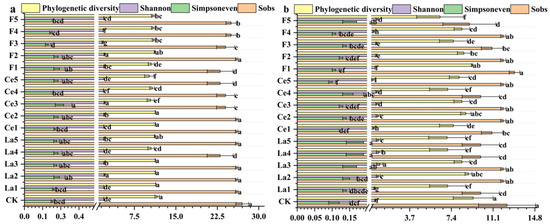
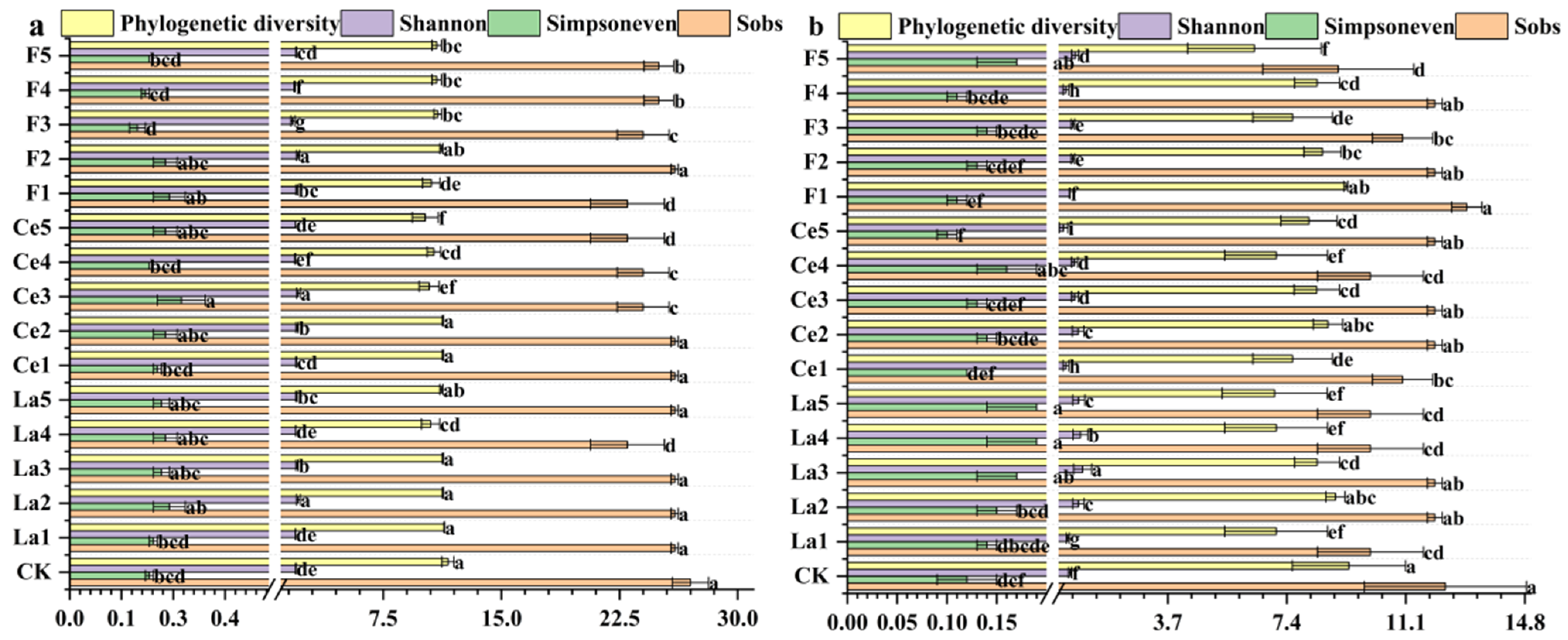
Compared to the control groups, the bacteria of the three groups of contaminated soils showed a decreasing trend in the Sobs index; the Simpsoneven index was first increased and then decreased with the increase in the three pollutant concentrations in the soils; and the Shannon index was revealed with a small change < 5% (Figure 3a). The phylogenetic diversity index showed a downward trend in the three contaminated soils, with a change < 5% identified in La- and F-polluted soils.
Figure 3.
Alpha diversity indices and phylogenetic diversity of soil bacterial (a) and fungal (b) taxa in the soil microbial communities contaminated by lanthanum (La), cerium (Ce), and fluorine (F). Different lowercase letters represent significant differences in the contents of the same chemical form among different treatment groups.
In comparison with the control group, the Sobs index of fungi was first increased and then decreased in the soils contaminated by La and Ce, and was decreased in the F-contaminated soil; the Sobs index values in the three polluted soils were lower than those of the control groups by 23.08, 23.08, and 30.77%, respectively (Figure 3b). The Simpsoneven index was increased by 71.74% in La-contaminated soil, and the Shannon index was first increased and then decreased in La- and Ce-polluted soils, with a varied changing pattern revealed in F-polluted soil. The phylogenetic diversity index showed a downward trend in all three soils contaminated by La, Ce, and F, which were detected with decreases of 25.11, 24.58, and 31.83%, respectively.
4. Discussion
4.1. Effects of Different Forms of La, Ce, and F on Microbial Community Composition
4.1.1. Dominant Microbial Communities
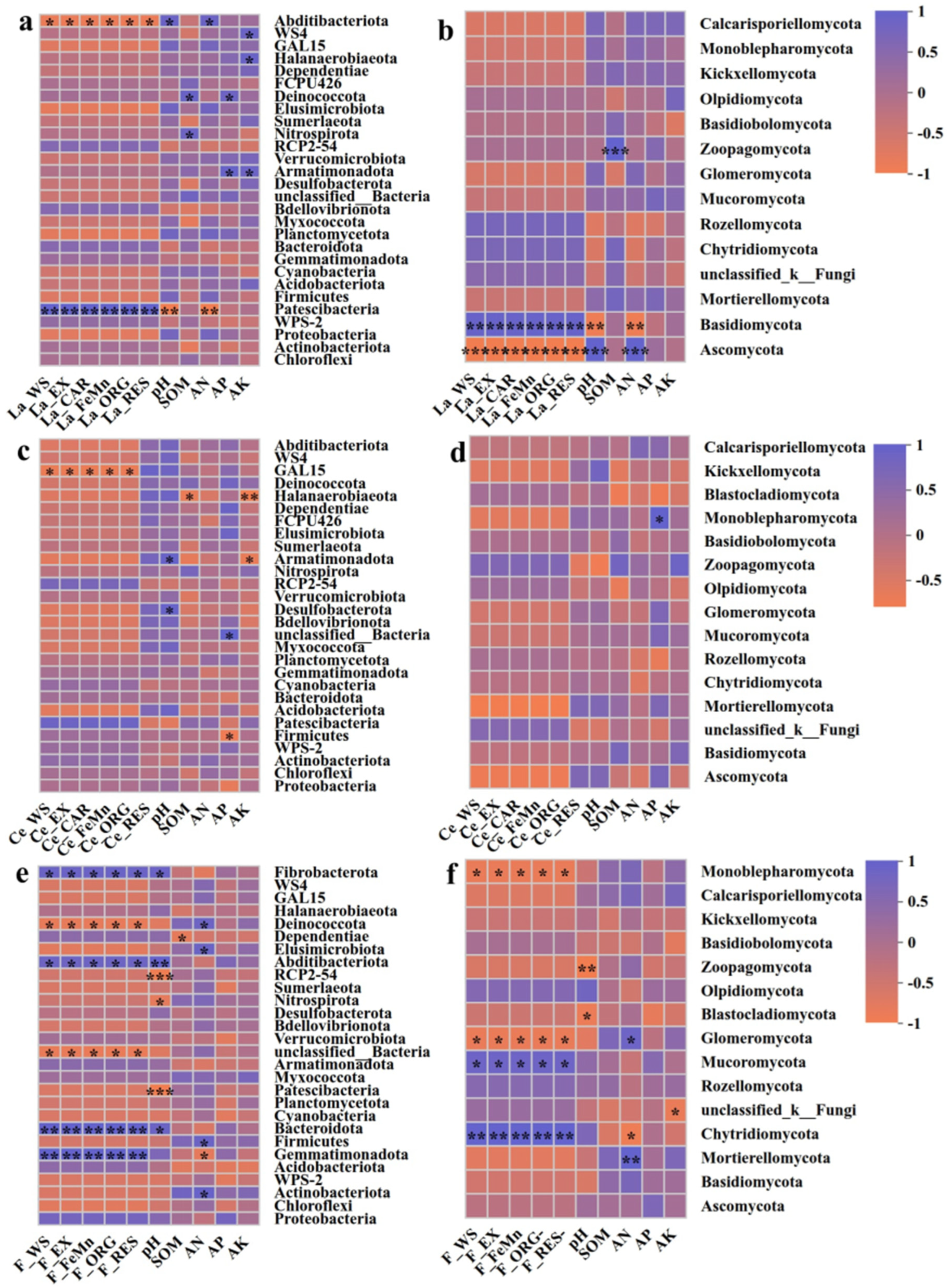
It is commonly known that the dominant microbial groups affect the balance and stability of soil ecosystems due to their crucial roles in shaping the microbial community composition [13,14]. Our study showed that seven out of eight dominant bacterial phyla (i.e., Chloroflexi, Proteobacteria, Actinobacteria, WPS_2, Acidobacteria, Firmicutes, and Planctomycetota), except for Gemmatimonadota, were shared in the control and polluted soils (Table S1). These results were consistent with those previously reported, showing that these phyla were also the common dominant bacteria in ion-type rare earth mine soils [6,22]. Moreover, Gemmatimonadota was significantly positively correlated with all five forms of F (Figure 4e; p < 0.05). Similar results were reported in studies based on the bastnaesite mining areas in Baotou and F-contaminated soils [9,43]. As the dominant genus of this phylum (Figure S3), which contains oligotrophic bacteria [44], Gemmatimonas was revealed to promote the mineralization of organic matter in soil due to its increased relative abundance [45]. These results suggested that the fluorophile bacteria could reduce the content of available organic matter in F-contaminated soil.
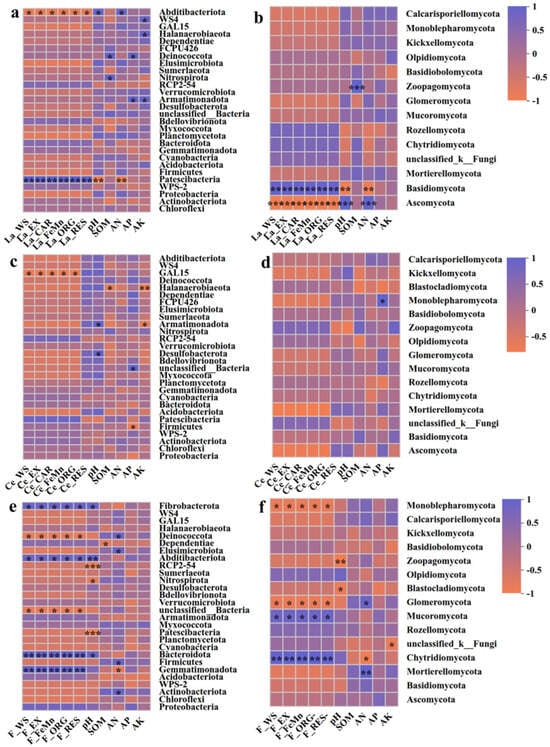
Figure 4.
Correlation analysis of bacterial (a,c,e) and fungal (b,d,f) communities and physicochemical properties, as well as the contaminated soils of different forms of lanthanum (La), cerium (Ce), and fluorine (F). *** p < 0.001; ** p < 0.01; * p < 0.05. WS, water-soluble form; EX, exchangeable form; CAR, carbonate bound form; FeMn, ferrum-manganese bound form; ORG, organic bound form; RES, residual form; SOM, soil organic matter; AN, soil available nitrogen; AP, soil available phosphorus; AK, soil available potassium.
Previous studies showed that based on the association between the relative abundance of Planctomycetota and the soil contents of La and Ce, Planctomycetota were considered dominant microbes in the bastnaesite mining area in Baotou, revealing a significantly negative correlation between the decreased relative abundance of Planctomycetota with the concentrations of La and Ce [43]. In our study, Planctomycetota was the only dominant phylum in unpolluted soil and became moderate due to the exponentially decreased relative abundance with the contents of La_EX, La_CAR, and Ce_CAR (Table S2, p < 0.05). It was noteworthy that the relative abundance of Planctomycetota was exponentially increased with the La_RES concentrations (Table S2, p < 0.05). Previous studies showed that as the dominant family of this phylum, Gemmataceae were anaerobic ammonia-oxidizing bacteria and involved in oxidization of NH4+ to NO2− in anoxic environments [46]. These results suggested that La, as well as both Ce_EX and Ce_CAR, may inhibit the proliferation of Gemmataceae and could weaken the ammonia oxidation function in La- and Ce-polluted soils. In summary, different rare earth elements or various forms of the same rare earth elements may show varied positive or negative effects on the relative abundances of soil microbiota.
Fungi are also core components of the soil microbiome, and the dominant fungal phyla play key roles in maintaining the stability of the soil ecosystem [24]. In our study, three dominant fungal phyla were identified (i.e., Ascomycota, Basidiomycota, and Mortierellomycota) (Table 2). These results were consistent with those previously reported showing the dominant status of Ascomycota and Basidiomycota in ion-type rare earth mine soils [21]. However, Mortierellomycota was not identified as a dominant phylum in ionized rare earth mining or bastnaesite mining soils in Baotou [21,24]. This variation was probably caused by the different soil texture and soil type in these two studies, i.e., our study showed that Mortierella was the dominant genus of this phylum (Figure S3), and its relative abundance was decreased by the varied soil texture and soil type, as previously reported [47]. In particular, the soil used in our study is Typic Ferri-Udic Argosols, while the ion-type mining area contained red soil [21] and the Baotou mining area was mainly represented by chestnut soil [24]. Notably, Ascomycota was positively correlated with the chemical forms of La, and Basidiomycota was negatively correlated with these chemical forms (Figure 4b); the relative abundance rates of these two phyla had no significant change. Moreover, the two phyla were uncorrelated with the chemical forms of Ce and F, indicating that these two dominant fungi may be tolerant to all three elements.
4.1.2. Moderate Microbial Communities
It has been reported that regardless of the abundance of microbes in the soil, all microbes play an indispensable role in maintaining specific soil ecological functions [14]. However, the effects of La, Ce, or F pollution elements on the microbial components with moderate relative abundance have been rarely reported. In our study, Patescibacteria and Bacteroidota were identified as moderate bacterial phyla in uncontaminated soils (Figure 2a), and both became the dominant bacteria in La- and F-contaminated soils, respectively. These results were in accordance with those reported on the rare earth tailing dam soil in Baotou [43]. Furthermore, our study indicated that Patescibacteria and Bacteroidota were significantly positively correlated with all chemical forms of La and F elements (Figure 4a,e; p < 0.05), respectively, with Saccharimonadales and Flavisolibacter identified as the predominant taxa of Patescibacteria and Bacteroidota, respectively (Figure S3). Studies showed that Saccharimonadales are the typical denitrifying bacteria [48], indicating that the increase in the relative abundance of Saccharimonadale could affect the soil nitrogen cycle in the La-polluted soil. Additionally, Flavisolibacter is one of the dominant genera in heavy metal-polluted areas, showing strong resistance to heavy metal pollution [49]. These results suggested that Flavisolibacter was fluorine resistant, potentially contributing to the enhanced soil resistance to F pollution. Combined with the above correlational analysis, these results imply that Flavisolibacter may potentially possess F-tolerant characteristics.
In the moderate fungal phyla, the increased relative abundances of Chytridiomycota and Mucoromycota showed a significant positive correlation with all five forms of F (Figure 4f; p < 0.05). Then, Chytridiomycota became the dominant phylum in F-contaminated soils. Studies showed that as the dominant taxon (Figure S3), s_unclassified_p_Chytridiomycota was revealed with the function of decomposing soil organic matter [50]. Therefore, the increased relative abundance of this phylum was probably responsible for the decreased content of organic matter in the contaminated soils.
4.1.3. Rare Microbial Communities
Although the rare microbes accounted for a small portion of the relative abundance in the soil communities, they play an essential role in maintaining multiple ecological functions in the soil ecosystem [18,19]. In our study, compared with the control groups, the complete disappearance or newly appeared rare microbial phyla were significantly associated with different forms of the three elements. First, Abditibacteriota, Deinococcota, and GAL15 displayed a significantly negative correlation with all forms of La and F, as well as most forms of Ce, except for Ce_RES (Figure 4a,c,e; p < 0.05), respectively. Moreover, these three phyla were not detected (i.e., disappeared) in the contaminated soils with La of 97.27 mg kg−1, F of 1232.31 mg kg−1, and Ce of 622.51 mg kg−1, respectively. Previous studies showed that GAL15 was the dominant phylum in ion-type rare earth mine areas [6]. However, our study showed that GAL15 was detected as the rare phylum in all three polluted soils and was not detected in some Ce-polluted soils. Therefore, the disappearance of GAL15 was caused by the stress of the other forms of Ce, except for Ce_RES. Second, the emergence of Fibrobacterota was only detected in F-contaminated soils, showing a significantly positive correlation with all five forms of F (Figure 4e; p < 0.05). Studies have indicated that the relative abundance of Fibrobacterota was significantly decreased in heavy metal-contaminated soils, suggesting that Fibrobacterota was not tolerant to heavy metals but may be fluorophile microorganisms [51]. Third, Halanaerobiaeota disappeared in Ce-contaminated soils with high concentrations of Ce, showing a significantly negative correlation with the contents of soil SOM and AK (Figure 4c; p < 0.05), suggesting that the change in soil physicochemical properties caused by the exogenous addition of pollution elements indirectly inhibited the microbial proliferation.
Among the rare fungal phyla, Glomeromycota was detected in the three contaminated soils and was significantly negatively correlated with all five forms of F (Figure 4f; p < 0.05). However, previous studies revealed this phylum as the dominant group in the ionized rare earth mining area and the bastnaesite mining area in Baotou [21,24]. This variation was probably due to the lower F concentrations in these studies, i.e., this phylum was sensitive to the high F concentration in our study, leading to the rarity of this group in F-contaminated soils. Monoblepharomycota disappeared in F-contaminated soils, showing a significant correlation with all five forms of F (Figure 4f; p < 0.05), suggesting its intolerance to F, as previously reported [52].
4.2. Effects of Different Forms of La, Ce, and F and Soil Properties on Microbial α Diversity
Microbial diversity is an effective indicator for evaluating the soil ecosystem defense functions under different environmental conditions, particularly under the pollution stress of heavy metal elements [20]. For example, studies showed that the stress of La, Ce, or F elements on soil microbes caused significant changes in the soil microbial diversity [6,29]. In our study, we further investigated the effects of different forms of these three elements on the soil microbial α diversity.
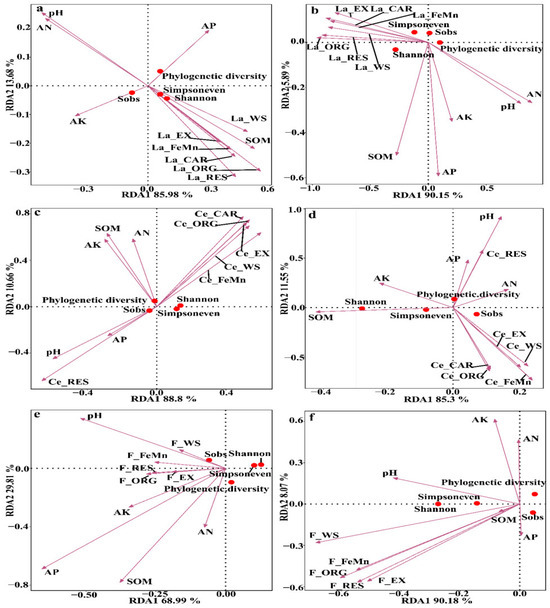
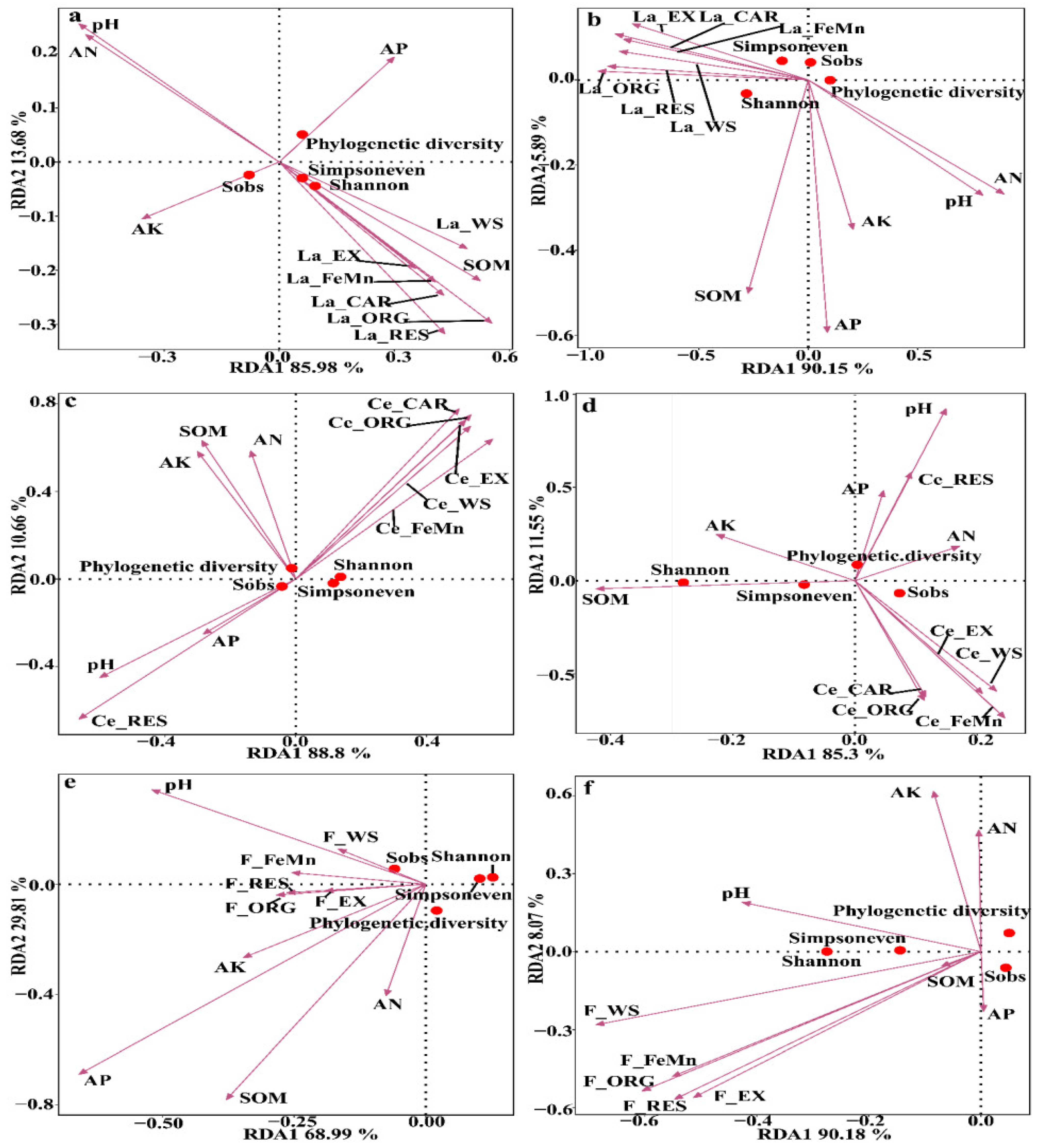
Our results showed that all six forms of La exhibited a significantly positive correlation (p < 0.05) with the bacterial Simpsoneven and Shannon indices, as well as the fungal Simpsoneven index, while the pH level and the content of AN showed a significantly negative correlation (p < 0.05) with these three indices, and the content of AK was significantly negatively correlated only with the fungal Simpsoneven index (Figure 5a,b). The key drivers of the positive effect on these indices were different, i.e., La_ORG was the crucial factor for the bacterial Simpsoneven and Shannon indices, and La_EX was responsible for the fungal Simpsoneven index. Previous studies indicated that La at concentrations higher than 500 mg kg−1 significantly reduced the α diversity of bacterial and fungal communities [53]. However, in our study, the highest concentration of La used in the treatment of soils was lower (300 mg kg−1), which was probably the cause for the positive effect of the forms of La on the bacterial Simpsoneven and Shannon indices and the fungal Simpsoneven index.
Figure 5.
Redundancy analysis of α diversity indices of bacterial (a,c,e) and fungal (b,d,f) microbes with different forms of lanthanum (La), cerium (Ce), and fluorine (F), as well as the physicochemical properties of soils contaminated by La, Ce, and F, respectively. WS, water-soluble form; EX, exchangeable form; CAR, carbonate bound form; FeMn, ferrum-manganese bound form; ORG, organic bound form; RES, residual form; SOM, soil organic matter; AN, soil available nitrogen; AP, soil available phosphorus; AK, soil available potassium.
Four chemical forms of Ce (i.e., Ce_WS, Ce_EX, Ce_FeMn, and Ce_ORG) exhibited significantly negative correlations with the bacterial Sobs index, while Ce_RES, pH level, and the content of AP displayed significantly positive correlations (Figure 5c; p < 0.05). Five forms of Ce, except for Ce_RES, showed significantly positive correlations (p < 0.05) with the fungal Sobs index, whereas the content of AK displayed a negative correlation (Figure 5d). Previous studies showed that a soil concentration of Ce over 500 mg kg−1 would decrease the bacterial community diversity, whereas the key effects of different forms of Ce on microbial diversity were varied [54]. Interestingly, our study identified Ce_ORG as the crucial driving factor of the negative effect of Ce on the bacterial Sobs index (Figure 5c), and Ce_WS was responsible for the positive effect of Ce on the fungal Sobs index (Figure 5d). These results indicated that the fungal diversity exhibited greater stability under the stress of active forms of Ce than the bacterial diversity.
In F-contaminated soils, two forms of F (i.e., F_WS and F_FeMn) and the pH level exhibited significantly positive correlations with the bacterial Sobs index and significantly negative correlations with the bacterial phylogenetic diversity index. The other three forms of F (i.e., F_EX, F_ORG, and F_RES) and four soil physicochemical properties (i.e., SOM, AN, AP, and AK) showed significantly negative correlations with the bacterial Simpsoneven and Shannon indices (Figure 5e; p < 0.05). Moreover, F_WS showed a positive effect on the bacterial Sobs index. Both the AP content and pH level were identified as the key factors of the negative effect on the bacterial Simpsoneven, Shannon, and phylogenetic diversity indices. However, the fungal phylogenetic diversity index was negatively affected by F_ORG (Figure 5f). To date, studies have indicated that an F concentration of 1000 mg kg−1 would lead to decreased microbial diversity [9]. It is noteworthy that our study showed that both the active form of F_WS and the more stable form of F_ORG were responsible for the negative effects of F on the soil microbial diversity.
4.3. Driving Factors of Different Microbial Communities in Polluted Soils
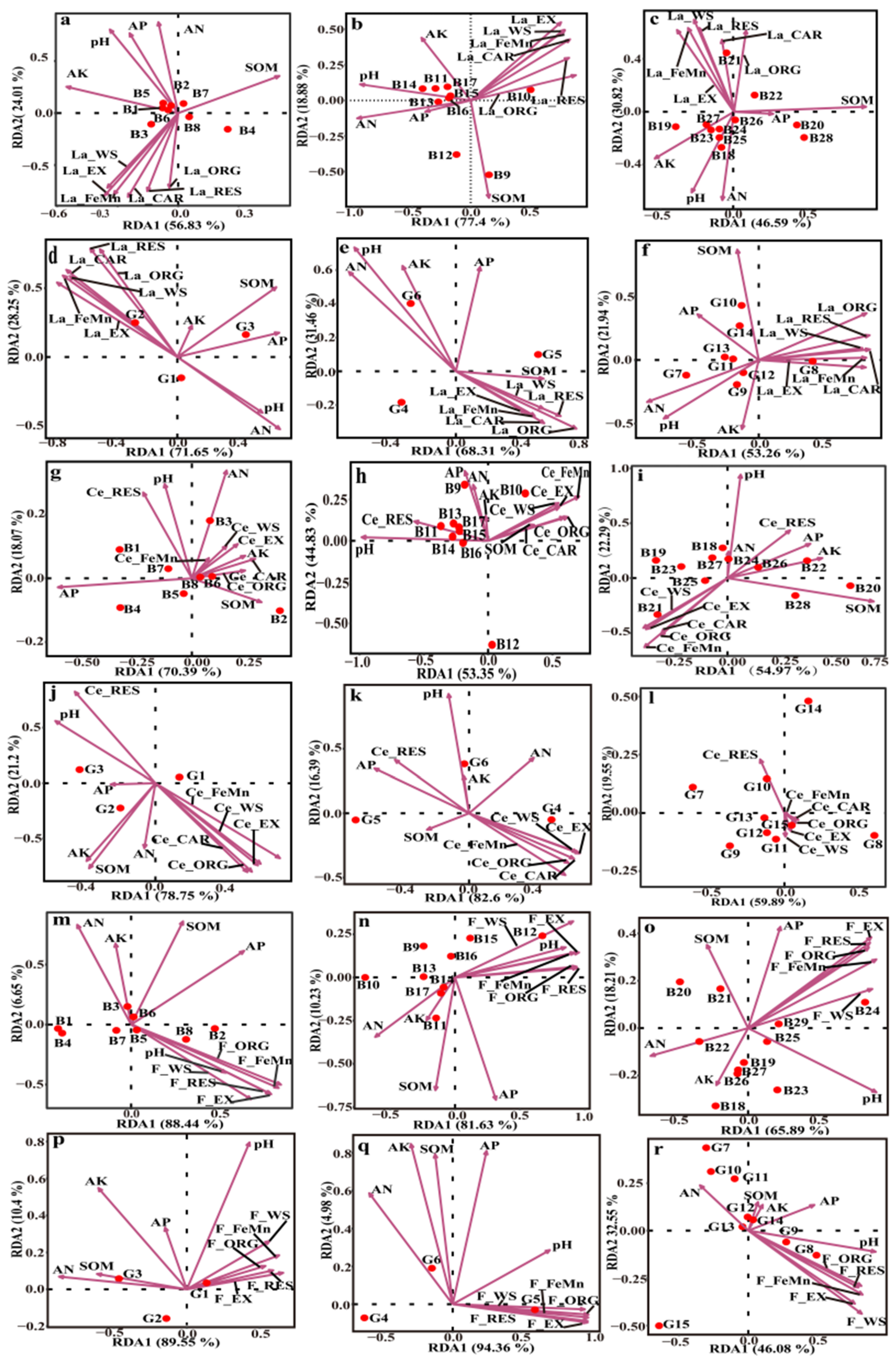
Studies have shown that rare earth elements or F at high concentrations cause changes in the microbial abundance or even lead to the complete disappearance of the microbes, and significant changes in soil physicochemical properties can also exert a considerable impact on the microorganism diversity [6,9]. However, under the joint effect of multiple soil factors, it is difficult to systematically identify the key driving factors for changes in the microbial composition and diversity [6]. In our study, the results revealed varied responses of dominant, moderate, and rare microbial groups to the different forms of the three elements and physicochemical properties of polluted soils. Therefore, we performed RDA to determine the main driving factors responsible for the variations in the taxonomic composition of the microbial community at the phylum level in the three groups of contaminated soils.
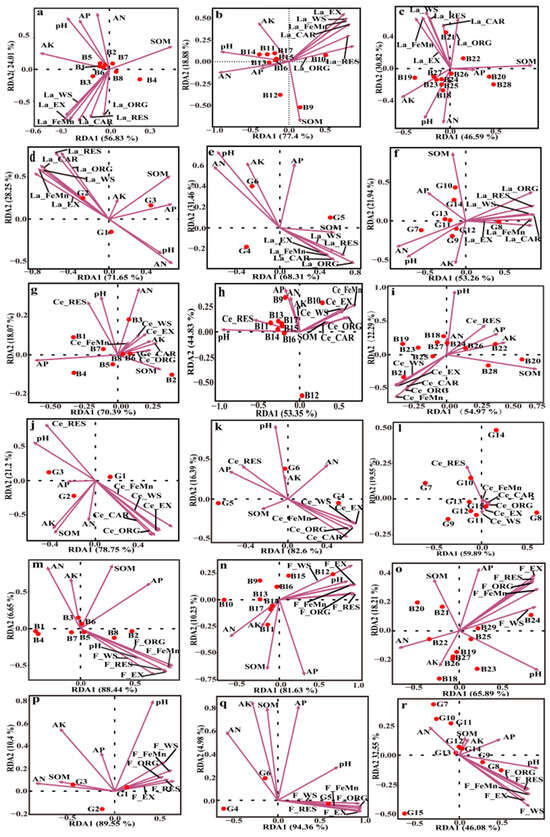
In La-polluted soils, La_ORG was revealed to show different effects on various microorganisms (Figure 6a–f). In particular, the relative abundance of Abditibacteriota (B24) exhibited a crucial negative correlation with La_ORG, and this phylum was undetectable in soils with high La concentrations (Figure 6c). In contrast, Patescibacteria (B10) showed a prominent positive correlation with La_ORG, which may facilitate its sharp proliferation and make it one of the dominant phyla under elevated La levels (Figure 6b). Studies demonstrated that the free ionic form of La showed high bioavailability and was identified as the key driving factor for changes in microbial abundance [55]. However, our study showed that La_ORG was the primary stress factor for the decrease in the relative abundance of Abditibacteriota, whereas it showed a positive effect on the increased relative abundance of Patescibacteria. The sensitivity of Abditibacteriota to La_ORG was probably caused by the promoted dissociation of La_ORG from solid particles into solution by ions in the soil, as previously reported [56]. Furthermore, studies showed that Patescibacteria was tolerant to the available forms of heavy metals such as Zn, Cd, arsenic (As), Pb, and Cu [57], suggesting Patescibacteria could be resistant to available forms of heavy metals, e.g., La_ORG, contributing to the variations in the soil microbial community.
Figure 6.
Redundancy analysis of the dominant (a,d,g,j,m,p), moderate (b,e,h,k,n,q), and rare (c,f,i,l,o,r) bacterial and fungal microbes with different forms of lanthanum (La), cerium (Ce), and fluorine (F), as well as the physicochemical properties of soils contaminated by La, Ce, and F, respectively. Bacterial phyla: B1, Chloroflexi; B2, Proteobacteria; B3, Actinobacteriota; B4, WPS_2; B5, Acidobacteriota; B6, Firmicutes; B7, Planctomycetota; B8, Gemmatimonadota; B9, Cyanobacteria; B10, Patescibacteria; B11, Myxococcota; B12, Bacteroidota; B13, unclassified-k-norank-d-bacteria; B14, Desulfobacterota; B15, Armatimonadota; B16, Verrucomicrobiota; B17, Bdellovibrionota; B18, Elusimicrobiota; B19, Sumerlaeota; B20, Nitrospirota; B21, RCP254; B22, Deinococcota; B23, Halanaerobiaeota; B24, Abditibacteriota; B25, Dependentiae; B26, GAL15; B27, WS4; B28 FCPU426; B29, Fibrobacterota. Fungal phyla: G1, Ascomycota; G2, Basidiomycota; G3, Mortierellomycota; G4, unclassified_k_Fungi; G5, Chytridiomycota; G6, Mucoromycota; G7, Glomeromycota; G8, Rozellomycota; G9, Olpidiomycota; G10, Zoopagomycota; G11, Kickxellomycota; G12, Calcarisporiellomycota; G13, Monoblepharomycota; G14, Basidiobolomycota; G15, Blastocladiomycota. WS, water-soluble form; EX, exchangeable form; CAR, carbonate bound form; FeMn, ferrum-manganese bound form; ORG, organic bound form; RES, residual form; SOM, soil organic matter; AN, soil available nitrogen; AP, soil available phosphorus; AK, soil available potassium.
In Ce-contaminated soil (Figure 6g–l), SOM and Ce_FeMn were identified as the crucial stress factors for the decreased relative abundances of Halanaerobiaeota (B23) and GAL15 (B26), respectively (Figure 6i). Previous studies suggested that acid-soluble and reduced forms of Ce were the key factors of bacterial community alterations [54]. However, our results showed that the more stable form of Ce_FeMn was the key driving factor for the negative effect of Ce on GAL15 in the polluted soil. This was probably because both La and Ce showed similar properties in the microbial community, as previously reported [58], suggesting that the more stable forms of La and Ce were the primary drivers of the variations in the microbial relative abundances.
Our results revealed more significant effects of different forms of F on the microbial community than those of La and Ce (Table 2). The results of RDA (Figure 6m–r) showed negative effects of F_WS on Deinococcota (B22), Glomeromycota (G7), and Monoblepharomycota (G13), and positive effects on Bacteroidota (B12), Abditibacteriota (B24), Fibrobacterota (B29), and Chytridiomycota (G5), while the increase in the relative abundance of Gemmatimonadetes (B8) was caused by F_ORG. Previous studies reported that the high F concentrations were toxic to numerous soil microorganisms [9,59]. These results were consistent with the findings revealed in our study, i.e., the results of RDA revealed four chemical forms of F, except for F_RES, were responsible for the variations in both the fungal and bacterial relative abundances, with F_WS showing the highest level.
5. Conclusions
This study demonstrated that different chemical forms of La, Ce, and F showed varied effects on the composition and diversity of soil microbial communities. In the dominant groups of microbes, a total of seven bacterial and two fungal phyla, except for bacterial Gemmatimonadota and fungal Mortierellomycota, were shared with those of the soil polluted with ionic rare earth, while the dominant bacterial phylum Planctomycetota became moderate due to the stresses of La, Ce_EX, and Ce_CAR. In the moderate groups, two moderate bacterial phyla (i.e., Patescibacteria and Bacteroidota) became dominant under the treatment of La_ORG and F_WS, respectively, while one moderate fungal phylum, Chytridiomycota, became dominant promoted by F_WS. In the rare groups, three bacterial phyla (i.e., Abditibacteriota, GAL15, and Deinococcota) disappeared in three polluted soils with high concentrations of La_ORG, F_WS, and Ce_FeMn, respectively, while F_WS of high concentrations stressed Monoblepharomycota to disappear and promoted Fibrobacterota to appear in F-polluted soils. Furthermore, Ce and F_ORG displayed crucial negative effects on the bacterial Sobs and the fungal phylogenetic diversity indices, respectively, while La_ORG, F_WS, La_EX, and Ce_WS showed primarily positive effects on the bacterial Sobs, Shannon, and Simpsoneven indices, as well as the fungal Simpsoneven and Sobs indices, respectively. Our pot experiment provides new insights into the toxicological effects of different chemical forms of La, Ce and F on the composition and diversity of microbial communities. However, these laboratory-derived results cannot be directly extrapolated to aged mining-contaminated soils due to inherent experimental limitations. Accordingly, we will further conduct field research to characterize variations in the microbial community composition and diversity within naturally contaminated mining soils.
Supplementary Materials
The following supporting information can be downloaded at: https://www.mdpi.com/article/10.3390/environments13070395/s1, Figure S1: Rarefaction curves of bacteria (a) and fungi (b); Figure S2: Physicochemical properties of contaminated soils by lanthanum (La) (a, d, g, and j), cerium (Ce) (b, e, h, and k), and fluorine (F) (c, f, I, and l). CK, control; SOM, soil organic matter; TN, total nitrogen; TP, total phosphorus; TK, total potassium; AN, available nitrogen; AP, available phosphorus; AK, available potassium.; Figure S3: Bacterial (a) and fungal (b) compositions at species level in the soil communities contaminated by lanthanum (La), cerium (Ce), and fluorine (F); Table S1: Relative abundance change (%) in dominant (DM), moderate (MM), and rare (RM) bacterial and fungal microbes in soil microbial communities contaminated by lanthanum (La), cerium (Ce), and fluorine (F); Table S2: Relationship between Planctomycetota abundance and the different forms of lanthanum (La) and cerium (Ce). a represent constant, b represent positive or negative correlation.
Author Contributions
Writing—original draft, Y.J.; Conceptualization, Y.J. and L.N.; Data curation, Y.J. and Y.C.; Methodology, Y.J.; Formal analysis, Y.J.; Investigation, Y.J., Y.C. and Y.Q.; Visualization, Y.J.; Project administration, L.N.; Funding acquisition, Y.J. and L.N.; Supervision, X.W. and Z.N.; Writing—reviewing and editing, Y.C., X.W., Z.N., Y.Y. and W.Z. All authors have read and agreed to the published version of the manuscript.
Funding
This research was funded by the Liangshan Prefecture Science and Technology Plan Project, grant number 24YYYJ0030, and the Xichang University Doctoral Program Initiation Project, grant number YBZ2025017.
Data Availability Statement
The datasets generated and/or analyzed in the current study are available in the NCBI repository [PRJNA1192586].
Acknowledgments
The authors acknowledge Majorbio Co., Ltd. (Shanghai) for sequencing assistance and Shirong Zhang, Guiying Wang, and Xiaomei Pan of Sichuan Agricultural University for supporting the investigation and research work.
Conflicts of Interest
The authors declare no conflicts of interest.
References
- Ji, R.; Yao, D.; Li, C.; Luo, J.; Liang, C.F.; Gao, Y.; Li, S.H.; Wang, X.R.; Lei, T. Bioaccessibility and Health Risk Assessment of Inhalable Heavy Metals in Soil from the Bayan Obo Mining Area, Northern China. Pol. J. Environ. Stud. 2026, 1, 210394. [Google Scholar] [CrossRef] [Scilit] [PubMed]
- Ma, C.G.; Liu, S.W.; Sun, Q.; Wei, J.X.; Xu, C.L.; Xue, Q.; Yan, T.T.; Hou, S.H.; Xie, M.M. Geochemical Distribution Characteristics, Traceability, and Health Risk Assessment of Potential Toxic Elements in Granite Weathering Crust-Type Rare Earth Mine and Its Surrounding Areas, Southeast China. Appl. Sci. 2026, 16, 1441. [Google Scholar] [CrossRef] [Scilit]
- Liu, Y.; Chakhmouradian, A.R.; Hou, Z.Q.; Song, W.L.; Kynický, J.D. Development of REE mineralization in the giant Maoniuping deposit (Sichuan, China): Insights from mineralogy, fluid inclusions, and trace-element geochemistry. Miner. Depos. 2019, 54, 701–718. [Google Scholar] [CrossRef] [Scilit]
- Hamza, A.; Zhong, L.T.; Nawab, J.; Laghari, Y.; Ghani, J.; Khan, S.; Cui, J.; Wei, Z.G. Spatial Distribution, Health Risk Assessment and Source Apportionment of Potentially Toxic Elements in Soils Near Rare Earth Mining Areas of China: A Meta-Analysis. Bull. Environ. Contam. Toxicol. 2025, 116, 425–437. [Google Scholar] [CrossRef] [Scilit] [PubMed]
- Guo, M.; Zhong, X.; Liu, W.; Wang, G.; Chao, Y.; Huot, H.; Qiu, R.; Morel, J.L.; Watteau, F.; Séré, G.; et al. Biogeochemical dynamics of nutrients and rare earth elements (REEs) during natural succession from biocrusts to pioneer plants in REE mine tailings in southern China. Sci. Total Environ. 2022, 828, 154361. [Google Scholar] [CrossRef] [Scilit] [PubMed]
- Liu, J.J.; Liu, W.; Zhang, Y.B.; Chen, C.J.; Wu, W.X.; Zhang, T.C. Microbial communities in rare earth mining soil after in-situ leaching mining. Sci. Total. Environ. 2021, 755, 142521. [Google Scholar] [CrossRef] [Scilit] [PubMed]
- Fan, C.F.; Yin, N.Y.; Cai, X.L.; Du, X.; Wang, P.F.; Liu, X.T.; Li, Y.P.; Chang, X.H.; Du, H.L.; Ma, J.N.; et al. Stabilization of fluorine-contaminated soil in aluminum smelting site with biochar loaded iron-lanthanide and aluminum-lanthanide bimetallic materials. J. Hazard. Mater. 2022, 426, 128072. [Google Scholar] [CrossRef] [Scilit] [PubMed]
- Chao, Y.Q.; Liu, W.S.; Chen, Y.M.; Chen, W.H.; Zhao, L.H.; Ding, Q.B.; Wang, S.Z.; Tang, Y.T.; Zhang, T.; Qiu, R.L. Structure, variation, and co-occurrence of soil microbial communities in abandoned sites of a rare earth elements mine. Environ. Sci. Technol. 2016, 50, 11481–11490. [Google Scholar] [CrossRef] [Scilit] [PubMed]
- Gan, C.D.; Jia, Y.B.; Yang, J.Y. Remediation of fluoride contaminated soil with nano-hydroxyapatite amendment: Response of soil fluoride bioavailability and microbial communities. J. Hazard. Mater. 2021, 405, 124694. [Google Scholar] [CrossRef] [Scilit] [PubMed]
- Zheng, H.X.; Yang, Y.L.; Liu, W.S.; Zhong, Y.; Cao, Y.; Qiu, R.L.; Liu, C.; Van der Ent, A.; Hodson, M.J.; Tang, Y.T. Rare earth elements detoxification mechanism in the hyperaccumulator Dicranopteris linearis: [silicon-pectin] matrix fixation. J. Hazard. Mater. 2023, 452, 131254. [Google Scholar] [CrossRef] [Scilit] [PubMed]
- Arafat, Y.; Shah, A.S.; Din, I.U.; Jamal, M.; Shah, M.D.S.; Kuchkarova, N.; Lin, W.X.; Lin, S.; Shao, H. Root interactions in wheat/fababean intercropping system enhanced growth performance and yield. Rhizosphere 2025, 33, 101007. [Google Scholar] [CrossRef] [Scilit]
- Zhuang, M.Q.; Xie, H.R.; Jiang, Y.; Xiao, P.R.; Wang, K.B.; Chu, Z.H.; Zhao, J.S.; Zhang, T.L. Probabilistic assessment of dietary rare earth elements intake among people living near a rare earth ore. Sci. Total. Environ. 2023, 856, 159141. [Google Scholar] [CrossRef] [Scilit] [PubMed]
- Coban, O.; De Deyn, G.B.; van der Ploeg, M. Soil microbiota as game-changers in restoration of degraded lands. Science 2022, 375, 990–1000. [Google Scholar] [CrossRef] [Scilit] [PubMed]
- Zhong, X.; Chen, Z.W.; Ding, K.B.; Liu, W.S.; Baker, A.J.M.; Fei, Y.H.; He, H.; Wang, Y.J.; Jin, C.; Wang, S.Z.; et al. Heavy metal contamination affects the core microbiome and assembly processes in metal mine soils across Eastern China. J. Hazard. Mater. 2022, 443, 130241. [Google Scholar] [CrossRef] [Scilit] [PubMed]
- Rillig, M.C.; Ryo, M.; Lehmann, A.; Aguilar-Trigueros, C.A.; Buchert, S.; Wulf, A.; Iwasaki, A.; Roy, J.; Yang, G.W. The role of multiple global change factors in driving soil functions and microbial biodiversity. Science 2019, 366, 886–890. [Google Scholar] [CrossRef] [Scilit] [PubMed]
- Pan, X.M.; Zhang, S.R.; Li, T.; Ouyang, J.Y.; Gong, G.S.; Wang, G.Y.; Xu, X.X.; Pu, Y.L.; Long, L.L.; Jia, Y.X. Response of microbiomes with different abundances to removal of metal fractions by soil washing. Ecotoxicol. Environ. Saf. 2022, 242, 113862. [Google Scholar] [CrossRef] [Scilit] [PubMed]
- Araujo, A.S.F.; Jia, X.; Miranda, A.R.L.; Pereira, A.P.D.; Melo, V.M.M.; Rocha, S.M.B.; Costa, R.M.; Saraiva, T.C.D.; Mendes, L.W.; Salles, J.F. Changes in the bacterial rare biosphere after permanent application of composted tannery sludge in a tropical soil. Chemosphere 2022, 313, 137487. [Google Scholar] [CrossRef] [Scilit] [PubMed]
- Crowther, T.W.; Vanden-Hoogen, J.; Wan, J.; Mayes, M.A.; Keiser, A.D.; Mo, L.; Averill, C.; Maynard, D.S. The global soil community and its influence on biogeochemistry. Science 2019, 365, v0550. [Google Scholar] [CrossRef] [Scilit] [PubMed]
- Wang, Z.K.; Leite, M.F.A.; Jiang, M.K.; Kuramae, E.E.; Fu, X.X. Responses of soil rare and abundant microorganisms to recurring biotic disturbances. Soil Biol. Biochem. 2023, 177, 108913. [Google Scholar] [CrossRef] [Scilit]
- Rocca, J.D.; Simonin, M.; Bernhardt, E.S.; Washburne, A.D.; Wright, J.P. Rare microbial taxa emerge when communities collide: Freshwater and marine microbiome responses to experimental mixing. Ecology 2020, 101, e02956. [Google Scholar] [CrossRef] [Scilit] [PubMed]
- Liu, J.J.; Li, C.; Ma, W.D.; Liu, W.; Wu, W.X. Molecular characterization of distinct fungal communities in the soil of a rare earth mining area. Microb. Ecol. 2022, 84, 1212–1223. [Google Scholar] [CrossRef] [Scilit] [PubMed]
- Wei, Z.W.; Hao, Z.K.; Li, X.H.; Guan, Z.B.; Cai, Y.J.; Liao, X.R. The effects of phytoremediation on soil bacterial communities in an abandoned mine site of rare earth elements. Sci. Total. Environ. 2019, 670, 950–960. [Google Scholar] [CrossRef] [Scilit] [PubMed]
- Nottingham, A.T.; Fierer, N.; Turner, B.L.; Whitaker, J.; Ostle, N.J.; McNamara, N.P.; Bardgett, R.D.; Leff, J.W.; Salinas, N.; Silman, M.R.; et al. Microbes follow Humboldt: Temperature drives plant and soil microbial diversity patterns from the Amazon to the Andes. Ecology 2018, 99, 2455–2466. [Google Scholar] [CrossRef] [Scilit] [PubMed]
- Luo, Y.; Zhang, D.; Guo, Y.; Zhang, S.H.; Chang, L.L.; Qi, Y.; Li, X.H.; Liu, J.G.; Guo, W.; Zhao, J.; et al. Comparative insights into influences of co-contamination by rare-earth elements and heavy metals on soil bacterial and fungal communities. J. Soils Sediments 2022, 22, 2499–2515. [Google Scholar] [CrossRef] [Scilit]
- Li, J.Q.; He, E.K.; Romero-Freire, A.; Cao, X.D.; Zhao, L.; Qiu, H. Coherent toxicity prediction framework for deciphering the joint effects of rare earth metals (La and Ce) under varied levels of calcium and NTA. Chemosphere 2020, 254, 126905. [Google Scholar] [CrossRef] [Scilit] [PubMed]
- Gunther, A.; Wollenberg, A.; Vogel, M.; Drobot, B.; Steudtner, R.; Freitag, L.; Hubner, R.; Stumpf, T.; Raff, J. Speciation and spatial distribution of Eu(III) in fungal mycelium. Sci. Total. Environ. 2022, 851, 158160. [Google Scholar] [CrossRef] [Scilit] [PubMed]
- Romero-Freire, A.; González, V.; Groenenberg, J.E.; Qiu, H.; Auffan, M.; Cotelle, S.; Giamberini, L. Cytotoxicity and genotoxicity of lanthanides for Vicia faba L. are mediated by their chemical speciation in different exposure media. Sci. Total. Environ. 2021, 79, 148223. [Google Scholar] [CrossRef] [Scilit] [PubMed]
- Egler, S.G.; Roldao, T.M.; Santos, G.O.; Heidelmann, G.P.; Giese, E.C.; Correia, F.V.; Saggioro, E.M. Acute toxicity of single and combined rare earth element exposures towards Daphnia similis. Ecotoxicol. Environ. Saf. 2023, 251, 114538. [Google Scholar] [CrossRef] [Scilit] [PubMed]
- Ropelewska, E.; Dziejowski, J.; Zapotoczny, P. Changes in the microbial activity and thermal properties of soil treated with sodium fluoride. Appl. Soil. Ecol. 2016, 98, 159–165. [Google Scholar] [CrossRef] [Scilit]
- Feng, W.; Zhang, S.; Zhong, Q.; Wang, G.; Pan, X.; Xu, X.; Zhou, W.; Li, T.; Luo, L.; Zhang, Y. Soil washing remediation of heavy metal from contaminated soil with EDTMP and PAA: Properties, optimization, and risk assessment. J. Hazard. Mater. 2020, 381, 120997. [Google Scholar] [CrossRef] [Scilit] [PubMed]
- Yang, T.Y.; Tang, G.T.; Li, L.; Ma, L.C.; Zhao, Y.Y.; Guo, Z.C. Interactions between bacteria and eukaryotic microorganisms and their response to soil properties and heavy metal exchangeability nearby a coal-fired power plant. Chemosphere 2022, 302, 134829. [Google Scholar] [CrossRef] [Scilit] [PubMed]
- Sun, B.; Gu, L.; Bao, L.; Zhang, S.; Wei, Y.; Bai, Z.; Zhuang, G.; Zhuang, X. Application of biofertilizer containing Bacillus subtilis reduced the nitrogen loss in agricultural soil. Soil Biol. Biochem. 2020, 148, 107911. [Google Scholar] [CrossRef] [Scilit]
- Saez-Plaza, P.; Navas, M.J.; Wybraniec, S.; Michalowski, T.; Asuero, A.G. An Overview of the kjeldahl method of nitrogen determination. part II. sample preparation, working scale, instrumental finish, and quality control. Crit. Rev. Anal. Chem. 2013, 43, 224–272. [Google Scholar] [CrossRef] [Scilit]
- Malá, J.; Lagová, M. Comparison of digestion methods for determination of total phosphorus in river sediments. Chem. Pap. 2014, 68, 1015–1021. [Google Scholar] [CrossRef] [Scilit]
- Zebec, V.; Rastija, D.; Lončarić, Z.; Bensa, A.; Popović, B.; Ivezić, V. Comparison of chemical extraction methods for determination of soil potassium in different soil types. Eurasian Soil Sci. 2017, 50, 1420–1427. [Google Scholar] [CrossRef] [Scilit]
- Sharma, K.L.; Lal, M.; Reddy, K.S.; Indoria, A.K.; Srinivas, K.; Singh, V.K.; Prabhakar, M.; Chandrika, D.S.; Vasavi, M.; Haindavi, P.; et al. Long term effect of different levels of surface crop residue application on hydrolyzable and non-hydrolyzable nitrogen fractions in sorghum (Sorghum bicolor (L.) moench)—Cowpea (Vigna unguiculata) system in rainfed alfisols. Commun. Soil Sci. Plant Anal. 2021, 53, 337–345. [Google Scholar] [CrossRef] [Scilit]
- Sinegani, A.A.S.; Hosseinpur, A. Evaluation of effect of different sterilization methods on soil biomass phosphorus extracted with NaHCO3. Plant Soil Environ. 2010, 56, 156–162. [Google Scholar] [CrossRef] [Scilit]
- Demiss, M.; Beyene, S.; Kidanu, S. Comparison of soil extractants and spectral reflectance measurement for estimation of available soil potassium in some ethiopian soils. Eurasian Soil Sci. 2020, 53, 1100–1109. [Google Scholar] [CrossRef] [Scilit]
- GBT 22104-2008; Soil Quality—Analysis of Fluoride—Ion Selective Electrometry. Ministry of Agriculture and Rural Affairs: Beijing, China, 2008.
- Bokulich, N.A.; Kaehler, B.D.; Rideout, J.R.; Dillon, M.; Bolyen, E.; Knight, R.; Huttley, G.A.; Caporaso, J.G. Optimizing taxonomic classification of marker-gene amplicon sequences with QIIME 2′s q2-feature-classifier plugin. Microbiome 2018, 6, 90. [Google Scholar] [CrossRef] [Scilit] [PubMed]
- Edgar, R.C. UPARSE: Highly accurate OTU sequences from microbial amplicon reads. Nat. Methods 2013, 10, 996–998. [Google Scholar] [CrossRef] [Scilit] [PubMed]
- Cole, J.R.; Wang, Q.; Cardenas, E.; Fish, J.; Chai, B.; Farris, R.J.; Kulam-Syed-Mohideen, A.S.; McGarrell, D.M.; Marsh, T.; Garrity, G.M.; et al. The Ribosomal Database Project: Improved alignments and new tools for rRNA analysis. Nucleic Acids. Res. 2009, 37, 141–145. [Google Scholar] [CrossRef] [Scilit] [PubMed]
- Luo, Y.; Yuan, H.; Zhao, J.; Qi, Y.; Cao, W.W.; Liu, J.M.; Guo, W.; Bao, Z.H. Multiple factors influence bacterial community diversity and composition in soils with rare earth element and heavy metal co-contamination. Ecotoxicol. Environ. Saf. 2021, 225, 112749. [Google Scholar] [CrossRef] [Scilit] [PubMed]
- Hao, C.K.; Du, P.; Ren, J.; Hu, L.J.; Zhang, Z.P. Halophyte Elymus dahuricus colonization regulates microbial community succession by mediating saline-alkaline and biogenic organic matter in bauxite residue. Sci. Total Environ. 2023, 905, 167140. [Google Scholar] [CrossRef] [Scilit] [PubMed]
- Kulikova, N.A.; Perminova, I.V. Interactions between humic substances and microorganisms and their implications for nature-like bioremediation technologies. Molecules 2021, 26, 2706. [Google Scholar] [CrossRef] [Scilit] [PubMed]
- Wang, Z.H.; Li, K.; Yan, F.F.; Xiang, Q.Y.; Zhao, X.K.; Ji, L.H.; Xin, Y.; Sun, J.Y.; Liu, C.M.; Xu, X.Y.; et al. Soil nitrogen content and key functional microorganisms influence the response of wetland anaerobic oxidation of methane to trivalent iron input. Chemosphere 2023, 322, 138183. [Google Scholar] [CrossRef] [Scilit] [PubMed]
- Cui, J.W.; Yang, B.G.; Zhang, M.L.; Song, D.L.; Xu, X.P.; Ai, C.; Liang, G.Q.; Zhou, W. Investigating the effects of organic amendments on soil microbial composition and its linkage to soil organic carbon: A global meta-analysis. Sci. Total Environ. 2023, 894, 164899. [Google Scholar] [CrossRef] [Scilit] [PubMed]
- Xue, Z.X.; Zhang, T.; Sun, Y.W.; Yin, T.X.; Cao, J.S.; Fang, F.; Feng, Q.; Luo, J.Y. Integrated moving bed biofilm reactor with partial denitrification-anammox for promoted nitrogen removal: Layered biofilm structure formation and symbiotic functional microbes. Sci. Total Environ. 2022, 839, 156339. [Google Scholar] [CrossRef] [Scilit] [PubMed]
- Zhou, Y.; Ma, J.; Yang, J.H.; Lv, Z.C.; Song, Z.Y.; Han, H.Y. Soybean rhizosphere microorganisms alleviate Mo nanomaterials induced stress by improving soil microbial community structure. Chemosphere 2023, 310, 136784. [Google Scholar] [CrossRef] [Scilit] [PubMed]
- Khomich, M.; Davey, M.L.; Kauserud, H.; Rasconi, S.; Andersen, T. Fungal communities in Scandinavian lakes along a longitudinal gradient. Fungal Ecol. 2017, 27, 36–46. [Google Scholar] [CrossRef] [Scilit]
- Li, P.F.; Hu, Q.W.; Zhao, H.; Vheng, C.B.; Li, G.; He, C.; He, X.M.; Zeng, C.Y.; Shen, D.K.; Jiao, Y.Z. Anaerobic co-digestion of model lignocellulosic components and sludge under pH adjustment: Component interactions and methanogenic performance. Biomass Bioenergy 2026, 251, 109597. [Google Scholar] [CrossRef] [Scilit]
- Passarini, M.R.Z.; Ottoni, J.R.; Costa, P.E.S.; Hissa, D.C.; Falcão, R.M.; Melo, V.M.M.; Balbino, V.Q.; Mendonça, L.A.R.; Lima, M.G.S.; Coutinho, H.D.M.; et al. Fungal community diversity of heavy metal contaminated soils revealed by metagenomics. Arch. Microbiol. 2022, 204, 255–266. [Google Scholar] [CrossRef] [Scilit] [PubMed]
- Hao, L.J.; Zhang, Z.C.; Hao, B.H.; Diao, F.W.; Zhang, J.X.; Bao, Z.H.; Guo, W. Arbuscular mycorrhizal fungi alter microbiome structure of rhizosphere soil to enhance maize tolerance to La. Ecotoxicol. Environ. Saf. 2021, 212, 111996. [Google Scholar] [CrossRef] [Scilit] [PubMed]
- Li, H.; Jiang, Q.; Li, R.Z.; Zhang, B.; Zhang, J.X.; Zhang, Y. Passivation of lead and cerium in soil facilitated by biochar-supported phosphate-doped ferrihydrite: Mechanisms and microbial community evolution. J. Hazard. Mater. 2022, 436, 129090. [Google Scholar] [CrossRef] [Scilit] [PubMed]
- Jomaa, M.; Pelletier, G.; Dieme, D.; Cote, J.; Fetoui, H.; Nong, A.; Bouchard, M. Toxicokinetics of praseodymium and cerium administered as chloride salts in Sprague-Dawley rats: Impacts of the dose and of co-exposure with additional rare earth elements. Arch. Toxicol. 2024, 97, 3061–3074. [Google Scholar] [CrossRef] [Scilit] [PubMed]
- Bergsten-Torralbaa, L.R.; Magalhãesc, D.P.; Giesec, E.C.; Nascimentod, C.R.S.; Pinhoe, J.V.A.; Bussf, D.F. Toxicity of three rare earth elements, and their combinations to algae, microcrustaceans, and fungi. Ecotoxicol. Environ. Saf. 2020, 201, 110795. [Google Scholar] [CrossRef] [Scilit] [PubMed]
- Tian, R.; Ning, D.; He, Z.; Zhang, P.; Spencer, S.J.; Gao, S.; Shi, W.; Wu, L.; Zhang, Y.; Yang, Y.; et al. Small and mighty: Adaptation of superphylum Patescibacteria to groundwater environment drives their genome simplicity. Microbiome 2020, 8, 51. [Google Scholar] [CrossRef] [Scilit] [PubMed]
- Zhang, H.C.; Xie, D.R.; Zhang, H.; Jiang, M.; Huang, H.; Wan, Y.; Liao, Y.; Zhao, S.L. Reaction mechanism of fluoride conversion into BF-4 during sulphuric acid leaching of roasted bastnaesite. J. Rare Earths 2021, 39, 186–193. [Google Scholar] [CrossRef] [Scilit]
- Cui, S.F.; Yang, J.Y. Effects of fluorine on the growth of broad bean (Vicia faba L.) and maize (Zea mays L.) and the response of microbial community in soils. Water Air Soil Pollut. 2021, 232, 27–41. [Google Scholar] [CrossRef] [Scilit]

Disclaimer/Publisher’s Note: The statements, opinions and data contained in all publications are solely those of the individual author(s) and contributor(s) and not of MDPI and/or the editor(s). MDPI and/or the editor(s) disclaim responsibility for any injury to people or property resulting from any ideas, methods, instructions or products referred to in the content. |
© 2026 by the authors. Licensee MDPI, Basel, Switzerland. This article is an open access article distributed under the terms and conditions of the Creative Commons Attribution (CC BY) license.