


Abstract
Ecological restoration and nature repair combat ecosystem and land degradation, biodiversity loss and climate change. Yet seedling recruitment failure and perilously low plant survival (6–11%, often less) result in mass seed wastage. To increase seed use efficiency for restoration, the germination stimulant karrikinolide or KAR1 (3-methyl-2H-furo[2,3-c]pyran-2-one) was evaluated for on-demand seed germination, seedling establishment and plant survival in Australian core restoration species. Our research demonstrated that KAR1 promoted on-demand germination in 82% of species across nine families. We also showed improved germination outcomes in stored and aged seeds and greater seedling establishment and plant survival in soil after KAR1 treatment. The commercially available stimulant, gibberellic acid (GA3), provided no assistance beyond seed germination, suggesting KAR1 cannot be readily substituted. We recommend that KAR1 has the potential to meaningfully enhance large-scale seed use efficiency for restoration once challenges like cost and KAR1 delivery issues are overcome.
1. Introduction
The UN Decade on Ecosystem Restoration (2021–2030) aims to restore 1 billion hectares of degraded land into resilient, self-sustaining ecosystems [1]. This global effort is logical for reversing biodiversity loss, improving human well-being and for business acumen: every dollar invested in restoration represents up to USD 30 in economic benefit, and restored environments store carbon and create resilience against climatic extremes and public health threats, such as pandemics [2]. Encouragingly, by restoring just 15% of priority area lands, it is estimated that 63% of extinctions may be avoidable and up to 34% of total atmospheric CO2 released since the Industrial Revolution could be sequestered (i.e., 335 gigatonnes) [3]. Nonetheless, ecological systems are simultaneously complex and complicated, making them wicked systems in which humans can struggle to accomplish restoration-done-right [4]. For example, native plant reintroductions over large scales (≥100 km2) can only be achieved economically by directly sowing seeds into the targeted area for repair [5,6,7], but at least 89% of these directly sown seeds experience establishment failure, resulting in perilously low plant survival (6–11%, often less) and mass seed wastage [8,9].
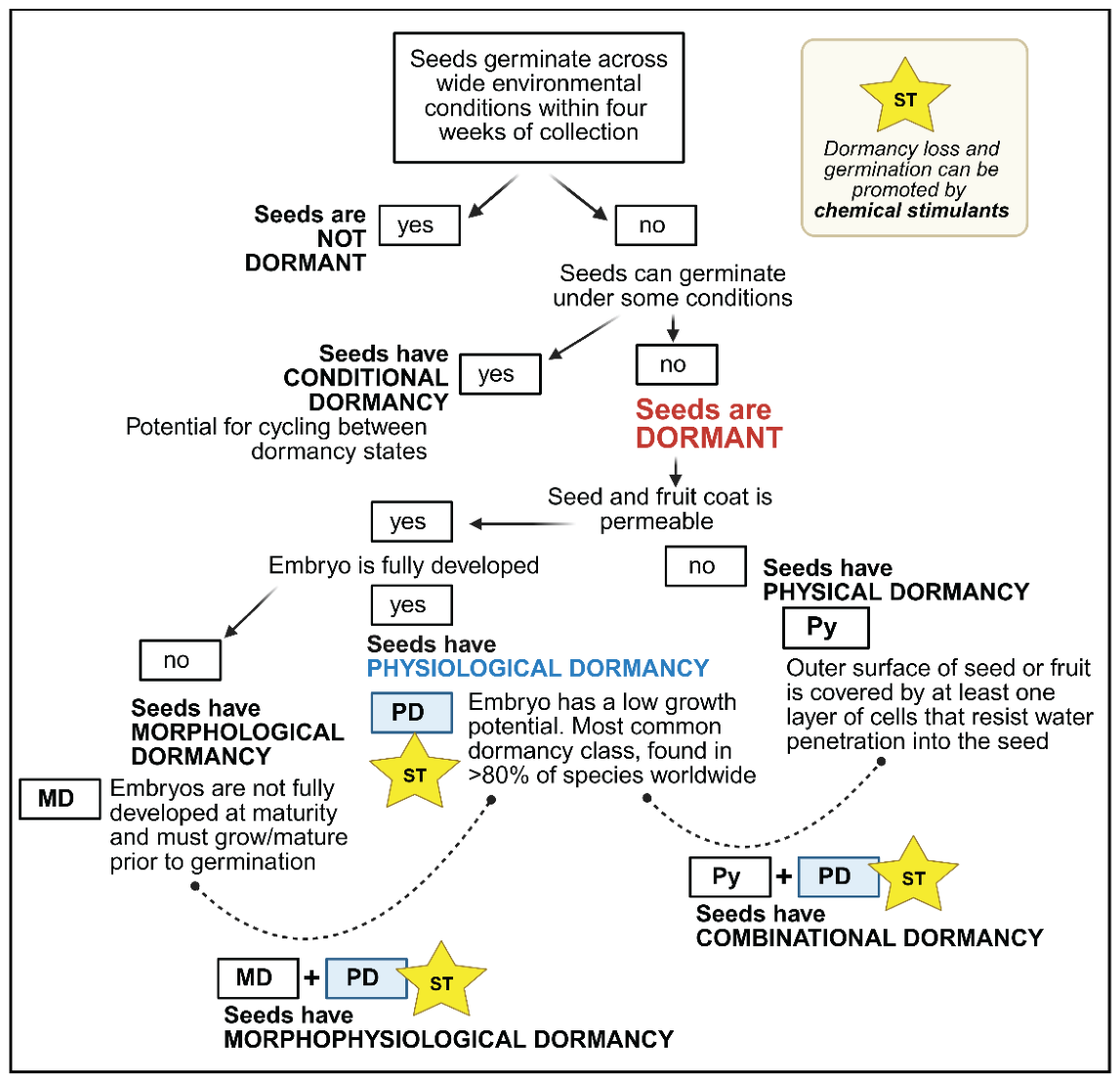
One tool to minimise seed wastage is ‘on-demand’ seed germination stimulation [5]. Chemical stimulants can directly promote on-demand germination by overcoming the most common dormancy class found in more than 80% of species worldwide, known as physiological dormancy (Figure 1) [9,10]. Such stimulation then enhances seed use efficiency by promoting seeds to germinate upon sowing during the ideal recruitment window (i.e., optimal temperature and moisture conditions), thereby providing seedlings the best chance to outgrow in-field challenges, such as predation, pathogens, weed competition and seed bank decline [9,11]. In this space, a well-documented stimulant in the literature is 3-methyl-2H-furo[2,3-c]pyran-2-one or karrikinolide (karrikin-1), abbreviated as KAR1 [12,13]. KAR1 was first discovered in nature as the most biologically active compound released by burning vegetation (viz., in charred plant materials and smoke), which enhances seed germination upon activation of molecular signalling pathways [12,14,15]. The subsequent availability of KAR1 through chemical synthesis [16], combined with the low quantities required for promoting germination across a broad range of species from both fire-prone and non-fire-prone environments, as well as across taxonomic groups and continents, gave the restoration sector hope for cost-effective, on-demand nature repair with substantially enhanced seed use efficiency [13,17,18]. Yet, although >1200 native plant species across >80 genera are responsive to chemical cues from smoke [19] and more than 20 years have passed since the KAR1 chemical synthesis [16] and patenting [13], there is still confusion around KAR1’s true usefulness for restoration.
To provide clarity for end-users in restoration and to guide future research and technology development, we appraise KAR1 for its capacity to enhance seedling recruitment and survival and, therefore, to provide meaningful progress towards the success of restoration activities. Although KAR1 in biochar and pyrolytic extracts is biologically active for germination of native seeds and crop abiotic stress tolerance [15], these pyrolytic products and smoke water/aerosols are not the focus of the research presented here. This omission is because such products contain complex organic compounds and toxins (4000-odd in smoke) [17] that are ‘hit-and-miss’, being permissive or inhibitory depending on the specific chemical cocktail formed and species-specific sensitivity to this chemistry [20].
Instead, here, we screen the effectiveness of pure KAR1 for promoting on-demand seed germination in 22 species across ten plant families that are critical for rebuilding nature and are therefore categorised as ‘core restoration species’ within Australia. Additionally, many are difficult to germinate and/or establish in nursery and/or in field environments (pers. comm. Greening Australia, 2024). For fourteen species, we compare KAR1 responses to the industry-accessible and registered germination stimulant, gibberellic acid (GA3). GA3 costs less than USD 600 for 10 g (Merck Millipore, USA) and is known to overcome seed dormancy in many native species [21] and sometimes effectively replaces smoke-related cues [22]. By contrast, KAR1 is presently used only for research, partly because of its prohibitively expensive chemical synthesis, estimated at USD 12,500 g−1 upon up-scaling [23].
Figure 1.
Chemical stimulants, including KAR1 and GA3, are recommended to overcome the most common dormancy class found in >80% of species worldwide, which is physiological dormancy (PD). Seeds with PD have a fully developed embryo with a low growth potential, and stimulants can initiate internal molecular signalling, which promotes dormancy loss and germination [9,24]. Stimulants can also assist in germination where seeds have a physical barrier to water penetration, plus PD (combinational dormancy, also requires physical dormancy alleviation) or embryos that are not fully developed and have PD (morphophysiological dormancy, also requires seeds to mature). The full complexity of dormancy and broader seed treatments is detailed by [9,10] but is beyond our scope here. This image was created with BioRender.com.
Thus, to determine if KAR1 can be replaced by the vastly cheaper GA3, we compare the effects of both stimulants on germination of freshly sourced seeds and germination of stored seeds (that have aged) across critical life phases, specifically establishment and survival in soil. Indeed, the use of KAR1 for extending the life of aged seeds is a critical value proposition for restoration practitioners since it is common to store seeds for years before use (pers. comm. Greening Australia, 2025), yet it has never been studied in native species. Similarly, native plant survival after KAR1 application to seeds has only been monitored in one identified study without control treatments [25], while most studies solely monitor germination in a Petri dish [23]. Yet in crops and Arabidopsis, KAR1 is known to stimulate post-germination seedling growth by accelerating transition to photoautotrophy and enhancing root growth, phloem formation, meristem growth and even tolerance to abiotic stress [23,26]. Hence, here we compare the trajectory of seedling establishment and survival in soil after KAR1 versus GA3 seed treatments to understand implications for seed use efficiency. Finally, to provide a realistic pathway forward for restoration practitioners, researchers, and policy makers, we conclude by providing future perspectives for KAR1, discussing the barriers to KAR1 commercial applications and upscaling, as well as suggesting future research and technology development to overcome such obstacles.
2. Materials and Methods
2.1. Plant Material and Chemicals
Seeds of native species were sourced from Nindethana Seed Services (Albany, WA and Richmond, NSW, Australia) in sealed plastic or foil packets and stored at 15 °C until use (and re-dried at 15–17% relative humidity after use). Twenty-two species across ten plant families were screened, and Table S1 in Supplementary Material provides collection date, location and previously available information on dormancy and seed pre-treatments for each species.
KAR1 was synthesised in the Gavin Flematti laboratory (School of Chemistry and Biochemistry, University of Western Australia), using their previously published methods [16,27]. GA3 was obtained from Sigma-Aldrich (St. Louis, MO, USA). KAR1 was dissolved in water to make a stock solution of 10 mg L−1, and GA3 was first dissolved in 95% ethanol, followed by water to make a stock solution of 50 mg mL−1. Both stock solutions were stored in the dark at 4 °C prior to use.
2.2. Seed Germination and Recruitment
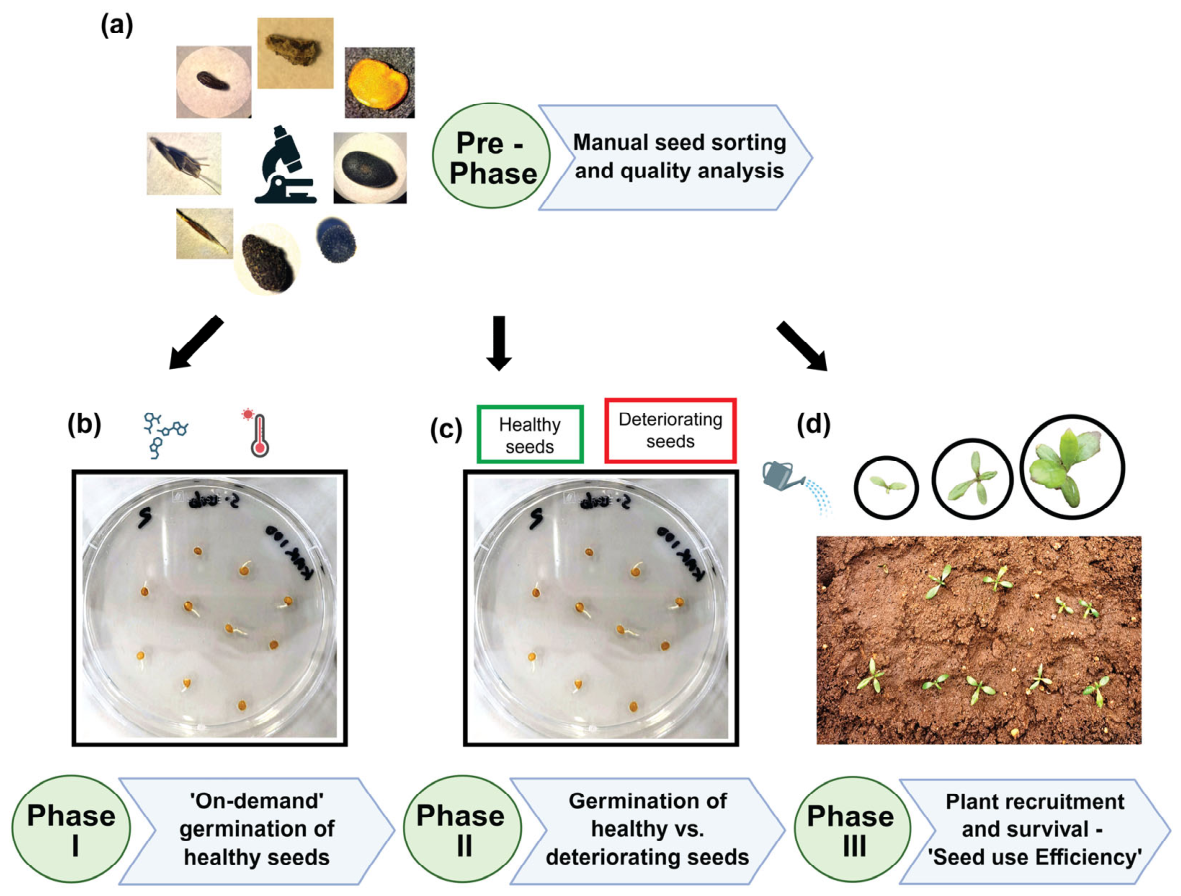
Seed quality and fill (presence of an embryo/endosperm) for a sample of seeds from all collections were determined under an Olympus SZ60 Stereomicroscope (Olympus, NSW, Australia) fitted with a 1× eyepiece and variable zoom (Figure 2a). Additionally, prior to all experiments, seeds that were damaged or visibly empty were removed from the analysis [21]. As documented in the literature, Poaceae seeds were cleaned using a 500 µm-sized mesh to enhance their germination, except for Austrostipa scabra and Chloris truncata, because manual cleaning does not enhance their germination [28].
Figure 2.
Study phases: (a) a pre-phase whereby damaged or empty seeds were removed from the analysis to ensure high seed quality; (b) Phase 1, which determined ‘on-demand’ germination of freshly obtained seeds using bioassays on agar with and without KAR1 and GA3; (c) Phase 2, which determined germination of fresh versus stored (aged) seeds for four species from two plant families and; (d) Phase 3, which determined plant recruitment (germination and establishment) and long-term survival in soil, thereby allowing calculation of seed use efficiency.
Germination of fresh seeds after KAR1 and GA3 pre-treatments was determined for 14 species across 10 families in Phase 1 studies (Figure 2b) using bioassays on agar, as this technique has been shown to outperform priming in solution [29]. Bioassays were prepared according to the protocol from [21], using 1% w/v agar (Sigma-Aldrich, USA) with and without stimulants in 90 mm plastic Petri dishes, which were wrapped in aluminium foil for darkness and sealed in plastic zip-lock bags. KAR1 concentrations tested in agar were 10 and 100 µg L−1 (67 and 670 nM, respectively), but also at up to 1000 µg L−1 (6.7 µM) for selected species, and GA3 concentrations in agar were 200 and 500 mg L−1 (0.577 mM and 1.444 mM, respectively) [21,30]. Bioassays were incubated in a Conviron growth cabinet (Winnipeg, MB, Canada) at 20/15 °C for winter species and 25/20 °C for summer species (Table S1 in Supplementary Material). The experimental unit was a Petri dish containing 10 seeds (Figure S1a in Supplementary Material), and Petri dishes were maintained in a randomised complete block design using three blocks per treatment (true biological replications). For two Eucalyptus species where seed numbers were low, four seeds were placed per Petri dish, and five blocks were used. The criterion for seed germination was radicle emergence to >2 mm, followed by normal seedling growth [21], recorded every c. 3–4 days.
To determine germination of freshly obtained seeds versus aged seeds after storage for Phase 2 studies (Figure 2c), we used the same protocol as in Phase 1 bioassays. Seeds of four species from the Solanaceae and Poaceae families were tested for their responses to KAR1 and/or GA3 in 2021, when seeds were freshly obtained, and retested in 2024, after storage at optimum conditions. A decline in stored seed health was evidenced by fungal contamination on ungerminated seeds [31].
To determine plant recruitment (germination and establishment) and survival in soil for Phase 3 studies (Figure 2d), we first calculated seed germination outcomes, using the same protocol as from Phase 1 with agar that contained optimised stimulant dosages. To determine seedling establishment, germinates were transferred into trays (380 × 140 mm, Bunnings Group Ltd., Victoria, Australia) containing an optimised soil blend with a pH of c. 5 (90% sandy loam, 10% AS-4454 certified compost, Centenary Landscaping Supplies, Darra, QLD, Australia; mixed with propagation sand and peat moss, Brunnings Garden Products Pty Ltd., Victoria, Australia; ratio of 60:30:10; Figure S1b in Supplementary Material). Plants were maintained for 8–12 weeks in growth cabinets under a 16/8 h light/dark cycle using 20/15 °C for winter species and 25/20 °C for summer species (Table S1 in Supplementary Material). To monitor long-term survival, plants at the two true leaf stage were transferred into 40 mm-sized forestry tubes (Garden City Plastics, QLD, Australia) with one plant per tube (Supplementary Figure S1c) and maintained under optimum conditions for 6–8 weeks. A low-phosphorus native plant liquid fertiliser was used once per week (Australian Native Focus, Growth Technology, Perth, WA, Australia), and irrigation was undertaken every second day until saturation (Figure S1d in Supplementary Material). These seedlings were subjected to hardening before transplantation and transferred to 145 mm pots and moved to a temperature-controlled glasshouse with moderate conditions (25 ± 10 °C) with daily automated watering and fertiliser application once per week (Figure S1e in Supplementary Material), where they were maintained for 3–6 months. Growth was monitored using a protocol modified from [21].
2.3. Statistical Analysis and Software
Generalised linear models (GLMs) with binomial error structure and the log link function were used to evaluate the effects of different treatments on seed germination, seedling establishment and plant survival [32]. Tukey’s test at the 5% level of significance (α = 0.05) was used for multiple mean comparisons unless stated otherwise. All statistical analyses and graphs were created using GraphPad Prism, version 10.2.2 (GraphPad Software, Boston, MA, USA). Figures were designed and assembled using BioRender.com (Toronto, Canada) and/or Adobe Illustrator 2025. All software licenses were provided by The University of Queensland. Raw data are deposited within UQRDM [2025-RD001812]. Minor adjustments to plant images were made using ImageJ 1.53t (NIH, USA). No generative artificial intelligence has been used in this paper.
3. Results
3.1. Phase 1: KAR1 as an ‘On-Demand’ Germination Stimulant Outperforms GA3
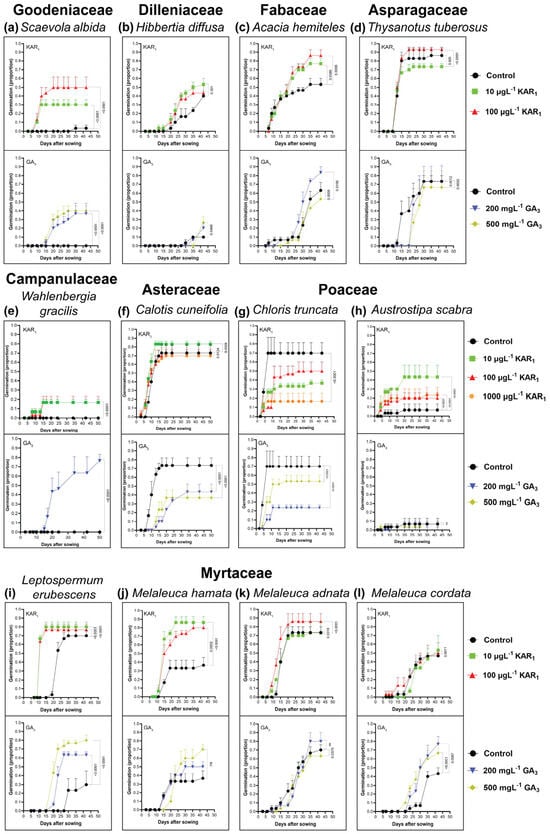
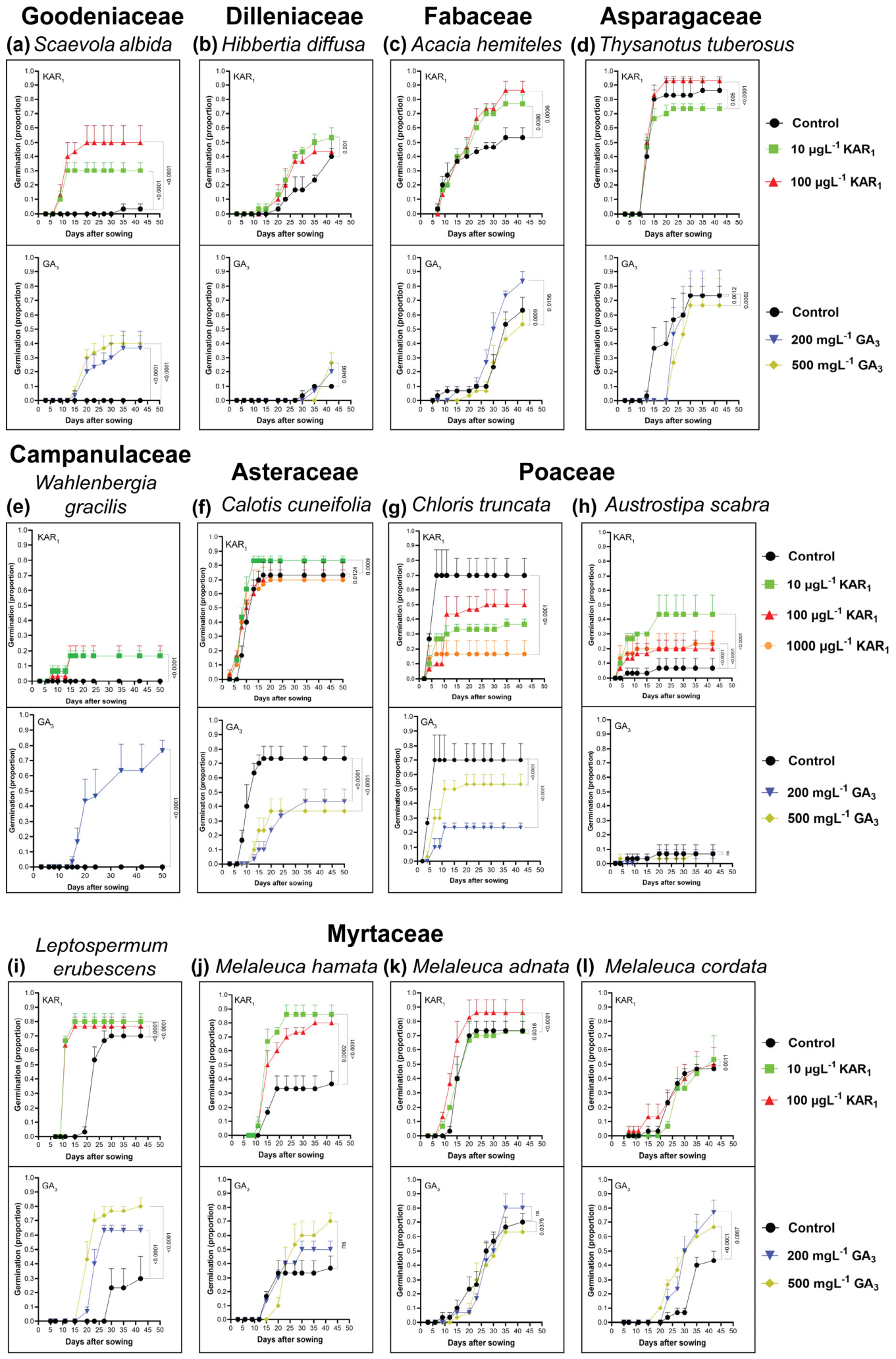
KAR1 outperformed GA3 with more germinates and/or faster germination for seven out of fourteen species across six out of nine families tested (Goodeniaceae, Figure 3a; Dilleniaceae, Figure 3b; Asparagaceae, Figure 3d; Asteraceae, Figure 3f; Poaceae, Figure 3h; and two species in Myrtaceae, Figure 3j,k). By contrast, GA3 outperformed KAR1 for only one Campanulaceae species (Figure 3e) and one species in the Myrtaceae (Figure 3l) family. Both stimulants were equally effective for Fabaceae (Figure 3c) and another species of Myrtaceae (Figure 3i). GA3 more commonly reduced germination below the control than KAR1, specifically at 500 mg L−1 for plant species in the Fabaceae (Figure 3c) and Myrtaceae (Figure 3k) families and at both GA3 dosages for one Asteraceae species (Figure 3f). Interestingly, both stimulants at one or both dosages suppressed germination for c. 30% of species tested (Asparagaceae, Figure 3d; Poaceae, Figure 3g; Fabaceae, Sapindaceae, Figure S2a,b in Supplementary Material, respectively). For the former two species, physical dormancy is reported (Table S1 in Supplementary Materials), and although beyond our scope here, stimulants should be retested after physical dormancy is removed [33].
Figure 3.
Seed germination (proportion) of healthy seeds for core restoration species across eight native plant families in response to KAR1 and GA3. Species are from families including (a) Goodeniaceae: Scaevola albida; (b) Dilleniaceae: Hibbertia diffusa; (c) Fabaceae: Acacia hemiteles; (d) Asparagaceae: Thysanotus tuberosus; (e) Campanulaceae: Wahlenbergia gracilis; (f) Asteraceae: Calotis cuneifolia; Poaceae: (g) Chloris truncata, (h) Austrostipa scabra; and Myrtaceae: (i) Leptospermum erubescens, (j) Melaleuca hamata, (k) M. adnata, (l) M. cordata. Plotted values are the mean + SEM of seed germination (proportion, n = 3) recorded on agar containing no stimulants (control) or 10, 100 and/or 1000 µg L−1 KAR1 and 200 or 500 mg L−1 GA3. The numbers represent p values after a post hoc Tukey test (α = 0.05).
3.2. Phase 2: Studies with Freshly Obtained Versus Stored (Aged) Seeds
3.2.1. KAR1 Outperforms GA3 for Germination of Stored (Aged) Seeds
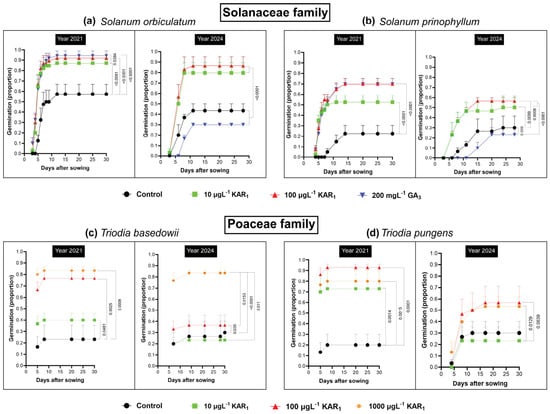
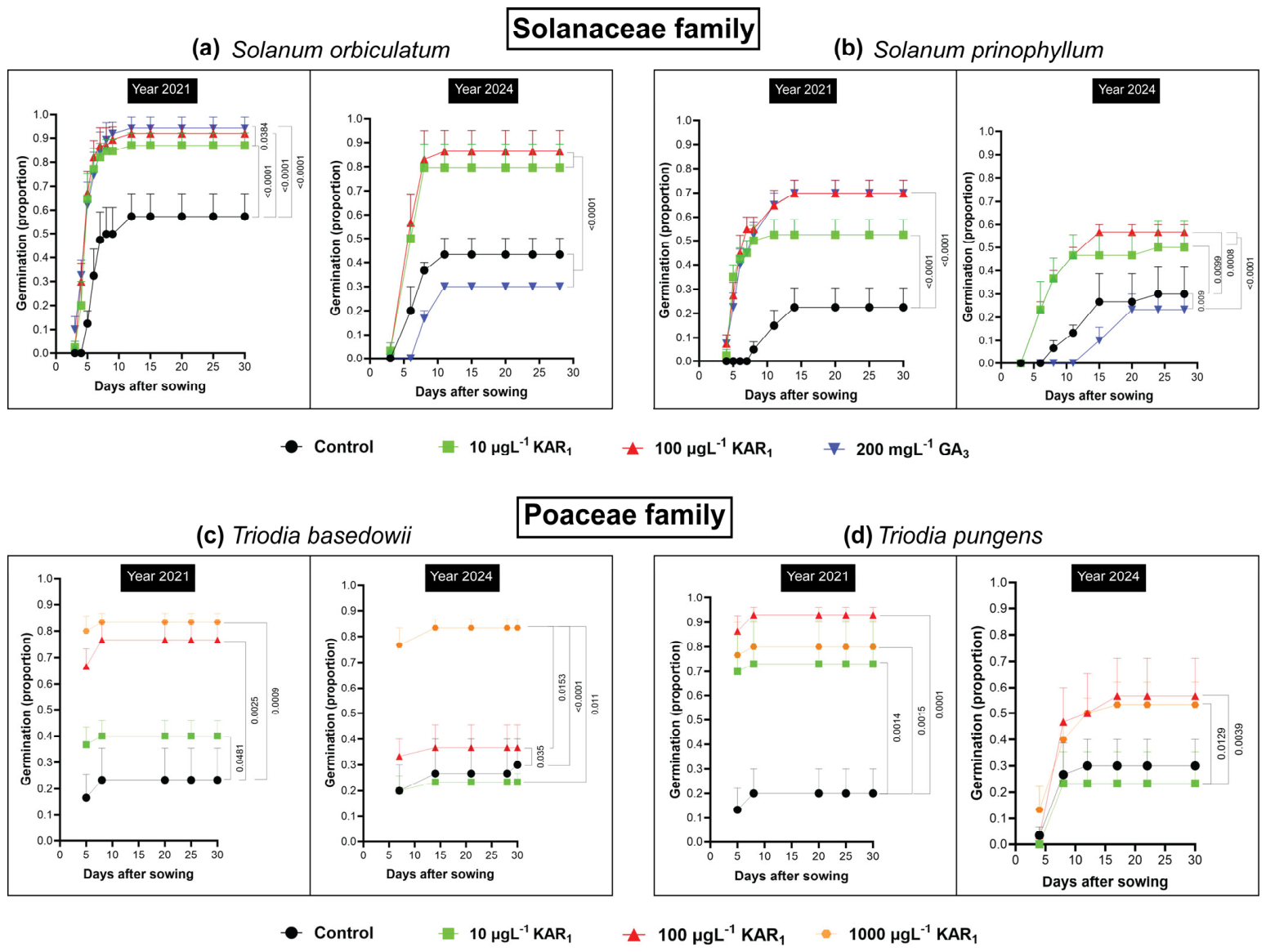
Freshly obtained seed germination was significantly stimulated by both GA3 and KAR1 for two Solanaceae species (Figure 4). Specifically for fresh seeds in 2021, GA3 (200 mg L−1) and KAR1 (100 µg L−1) germinated 92–94% of S. orbiculatum seeds relative to 57% in the control (Figure 4a, 2021) and up to 70% of seeds of S. prinophyllum relative to 23% in the control (Figure 4b, 2021).
Figure 4.
Seed germination (proportion) of fresh versus stored seeds sown in 2021 versus 2024, respectively, for core Australian restoration species across two native plant families. Species are from families including Solanaceae: (a) Solanum orbiculatum; (b) S. prinophyllum; and Poaceae: (c) Triodia basedowii; (d) T. pungens. Plotted values are the mean + SEM of seed germination (proportion, n = 3) recorded on agar containing no stimulants (control) or 10, 100 or 1000 µg L−1 KAR1 and/or 200 mg L−1 GA3. The numbers represent p values after a post hoc Tukey test, α = 0.05.
By contrast, when seeds were retested after three years of storage in 2024, only KAR1 (at 100 µg L−1) resulted in higher germination for both species, doubling germinates to 86% for S. orbiculatum relative to 43% in the control (Figure 4a, year 2024) and increasing germinates to 57% for S. prinophyllum relative to 30% in the control (Figure 4b, 2024). Meanwhile, GA3 reduced germination for aged seeds of both species in 2024 below the control to 30% and 23%, respectively (Figure 4a,b, 2024). Thus, GA3 performed poorly as seeds aged in storage, while KAR1 continued to enhance germination across years, hinting towards its broader application for seeds that might have aged while kept in storage for extended periods. Indeed, seeds are often stored for years before use in restoration (pers. comm. Greening Australia, 2024), hence this is an important value proposition for the sector.
3.2.2. Active KAR1 Dosage Increases as Seeds Age
To investigate further, we tested the germination effects of KAR1 for freshly obtained versus stored (aging) seeds for two native grass species (Poaceae) from arid Australia. For healthy seeds of Triodia basedowii, KAR1 improved germination to >75% relative to 23% in the control (Figure 4c, year 2021) at medium and high dosages (100 and 1000 µg L−1). By contrast, for aged seeds in 2024, only a high dosage of KAR1 improved germination to >75% relative to 30% in the control (Figure 4c, year 2024, KAR1 at 1000 µg L−1). Similarly, for fresh T. pungens seeds in 2021, low, medium and high KAR1 concentrations improved germination to ≥73% relative to 20% in the control (Figure 4d, year 2021, KAR1 at 10–1000 µg L−1). Meanwhile, for stored (aged) seeds in 2024, only medium and high KAR1 dosages showed a trend towards improved germination relative to the control (Figure 4d, year 2024, KAR1 at 100 and 1000 µg L−1), while the low KAR1 dosage had no effect. These studies thus confirmed that KAR1 continued to elicit a positive effect on germination for fresh and stored seeds, although in the case of the Poaceae family, the active dosage became higher as the seeds aged.
3.2.3. Active KAR1 Dosage for Seeds
As summarised in Table 1, 100 µg L−1 of KAR1 (670 nM, 100 ppb) resulted in the most germinates and/or fastest germination for species from Goodeniaceae (S. albida), Fabaceae (A. hemiteles), Myrtaceae (M. adnata), Solanaceae (S. orbiculatum, S. prinophyllum) and Poaceae (T. pungens, T. triandra, S. leiocladum) families and showed a trend for improved germination for three species from Asparagaceae (T. tuberosus) and Myrtaceae (E. melliodora, E. tereticornis) families. Two species responded equally to 10 and 100 µg L−1 of KAR1 from Campanulaceae (W. gracilis) and Myrtaceae (L. erubescens), while four species germinated best at 10 µg L−1 of KAR1 from Dilleniaceae (H. diffusa), Asteraceae (C. cunefolia), Poaceae (A. scabra) and Myrtaceae (M. hamata). Germination was reduced at 10 µg L−1 of KAR1 for one Asparagaceae species (T. tuberosus). Although 1000 µg L−1 of KAR1 was most beneficial for one Poaceae species (T. basedowii), this dose reduced germination below the control for two other Poaceae species (C. truncata, T. triandra).
Table 1.
The effects of KAR1 (K) and GA3 (G) for on-demand seed germination of twenty-two core restoration species across ten plant families. Data are combined from Figure 2 and Figure 3 and Figures S3 and S4 in the Supplementary Material. Taxon-specific information for Figures S2 and S3 is detailed in the Supplementary Material.
It is noteworthy that KAR1 effectiveness may show similar outcomes across provenances within species, after positive KAR1 outcomes were observed when two Myrtaceae species were retested from a second provenance (relative to Phase 1 species L. erubescens and M. hamata, respectively, Figure S4a,b in Supplementary Materials versus Figure 3h,i).
3.3. Phase 3: KAR1 Improves Plant Recruitment and Survival in Soil in Comparison to GA3
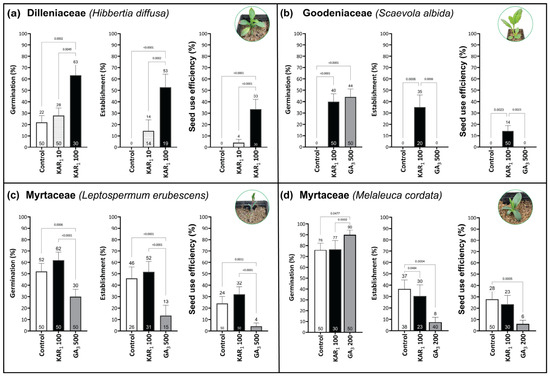
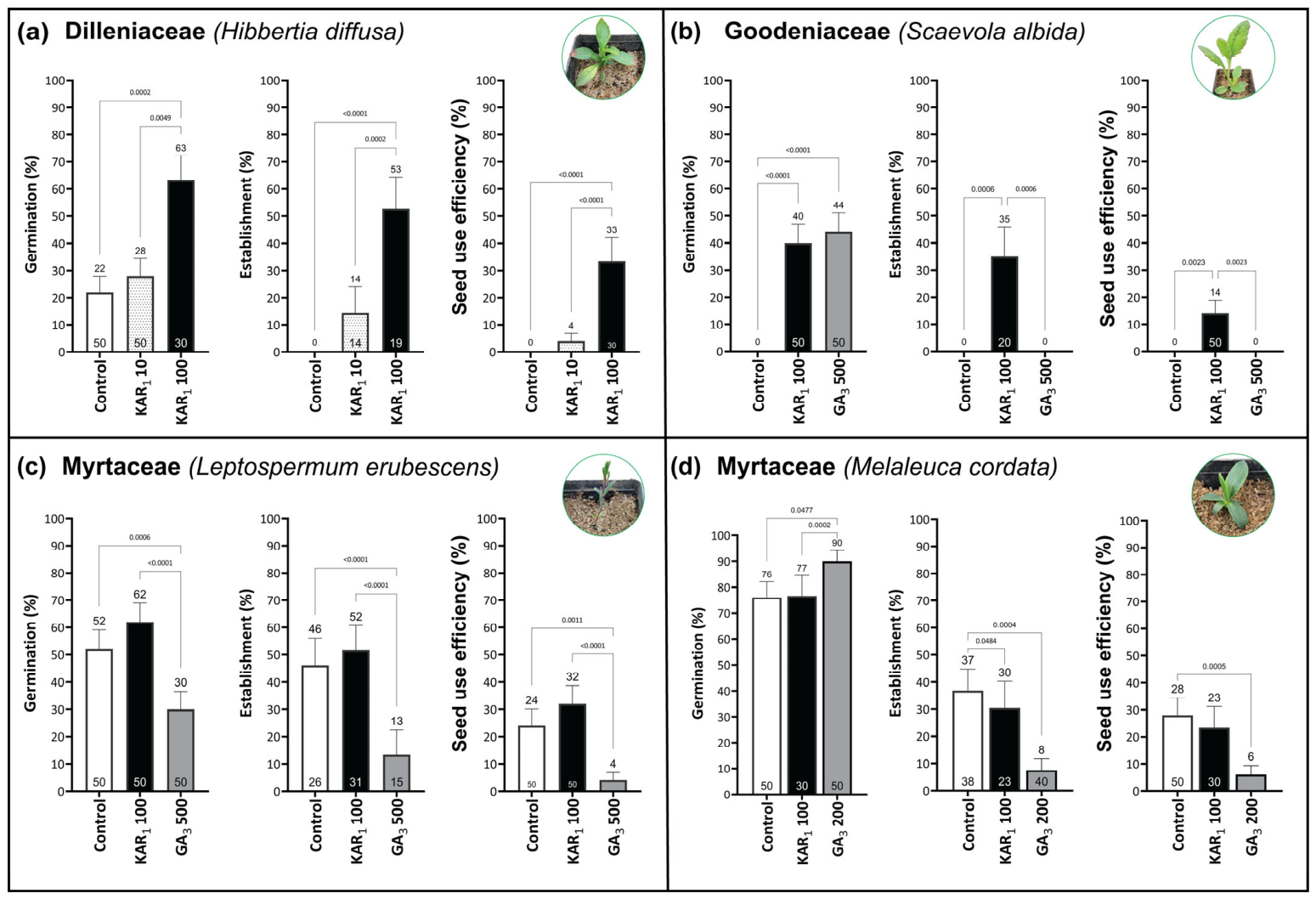
For native species, large seedling losses during recruitment have been observed, even with KAR1 pre-treatments [24,25]. Here, KAR1 drastically outperformed GA3 for seedling establishment and plant survival (Figure 5). Investigations used four restoration species that had significant germination responses to stimulants in Phase 1 studies, and stimulant dosages used were those that elicited the best germination outcomes (Figure 3, Table 1). Seed use efficiency (SUE) is here defined as the number of plants that emerged and survived out of the total number of seeds sown.
Figure 5.
Plant recruitment and seed use efficiency for four Australian core restoration species from three native plant families. Species were selected from three families, including (a) Dilleniaceae: H. diffusa; (b) Goodeniaceae: S. albida; (c) Myrtaceae: L. erubescens; (d) M. cordata, and treatments included no stimulants (control) or 10 or 100 µg L−1 KAR1 or 200 or 500 mg L−1 GA3. Bars and numbers above each bar are the mean + SEM of percentage seed germination, seedling establishment and seed use efficiency. The numbers above the lines represent mean separation, whereby p values indicate significant differences after a post hoc Tukey test, α = 0.05. Germination is defined as the number of germinates per agar plate out of the total number of seeds sown; establishment is the number of seedlings that grew in soil out of the total number of germinates transferred from agar; seed use efficiency is the number of plants that survived for 3–6 months out of the total number of seeds sown on agar.
Especially the medium KAR1 dose (100 µg L−1) significantly enhanced germination (40–76%), establishment (30–53%) and SUE (14–33%) for three out of four core restoration species, relative to control treatments (germination, 0–76%; establishment, 0–46%; seed use efficiency, 0–28%). By contrast, GA3 pre-treatments resulted in high germination (30–89%) but drastically hindered establishment (0–30%) and SUE (0–6%) for all species tested, with outcomes even below the untreated control (Figure 5).
For the first species tested from Dilleniaceae (Figure 5a, H. diffusa), KAR1 resulted in the highest germination (63%) relative to the control (22% without stimulants), which translated to vastly improved establishment (53% KAR1, 0% control) and SUE outcomes (33% KAR1, 0% control). H. diffusa was not tested with GA3 due to limited seed availability and a vastly stronger KAR1 response in Phase 1 studies (Figure 3b).
S. albida from the Goodeniaceae family (Figure 5b) had high germination with both stimulants (40–44%) relative to the control (0%). KAR1 pre-treatments then resulted in 35% of seedlings establishing in the soil, and SUE was 14%. By contrast, no seedlings established after GA3 pre-treatment, representing 0% SUE (Figure 5b).
For L. erubescens from the Myrtaceae family (Figure 5c), recruitment after KAR1 pre-treatment was high (62% germination, 52% establishment), which was reflected in a high SUE of 32%. This was greater than the control (24%). Meanwhile, recruitment with GA3 was low (30% germination, 13% establishment), which was reflected in a very low SUE (4%, Figure 5c). For M. cordata, also a Myrtaceae (Figure 5d), KAR1 did not enhance or harm germination, with c. 76% germination with KAR1 pre-treatment and in the control. This concurs with Phase 1 studies where no significant response to KAR1 was observed (Figure 3l). KAR1 then slightly reduced establishment relative to the control (non-significant, 30% KAR1, 37% control, Figure 5d), and this was reflected as a slightly lower SUE (non-significant, 23% KAR1, 28% control). Meanwhile, M. cordata had the highest germination with GA3 treatment (90%), but this still translated to the lowest establishment (8%) and a poor SUE (6%), well below the control (28%).
4. Discussion
4.1. KAR1 as a Stimulant to Enhance Seed Germination and Seedling Establishment
Twenty years after the promise of ‘on-demand’ native plant restoration with KAR1 [13,19], we show that KAR1 has the capacity to assist restoration practitioners in achieving successful plant establishment. Across our studies, KAR1 stimulated germination for 82% of core restoration species tested, including trees, shrubs, herbs and grasses, whereby germination of eighteen out of twenty-two species across nine out of ten families was enhanced by KAR1. Thus, we concur that as a stimulant that enhances seed germination, establishment uniformity and plant survival, here under optimum conditions, KAR1 has the potential to benefit restoration by enabling a new seedling to emerge in the optimal recruitment window and therefore outgrowing in-field challenges. This is particularly significant because many in-field challenges will be exacerbated by climate change, such as lower and more variable rainfall, pathogens, seed bank deterioration and competition from weeds [9,21,34,35]. And species from across continents are responsive to KAR1, such as from North and South America, South Africa, Australia and Europe/Asia [12,36,37,38], hence this stimulant promises far-reaching benefits. We also show that only 10–100 ppb of KAR1 (10–100 µg L−1, 67–670 nM) was most commonly beneficial, which concurs with the global trend of 10–150 ppb of KAR1 (10–150 µg L−1, 67 nM–1 µM) being most commonly bioactive for native seed germination [12,15,39].
4.2. KAR1 Cannot Be Readily Substituted by Stimulants Such as Gibberellic Acid (GA3)
We also demonstrate that KAR1 cannot be readily substituted, outperforming the commercially available germination stimulant ‘alternative’, gibberellic acid (GA3). Firstly, in germination bioassays with freshly sourced seeds, KAR1 outperformed GA3 with more germinates and/or faster germination for seven out of fourteen species across six out of nine families tested, while GA3 outperformed KAR1 for only two species. GA3 also more commonly reduced germination below the control than KAR1. These findings concur with Saraeian et al., who also observed that KAR1 outperformed GA3 in germinating seeds of three dormant Australian native species (Goodeniaceae family) [40].
Secondly, ours is the first study to show that KAR1 outperforms GA3 for stored (likely aged) native seeds. Here, KAR1 enhanced germination in stored seeds of four species, while GA3 drastically reduced germination, even below the control, once seeds had been stored and had aged. Oxidative damage increases as seeds age [31] and in crops, KAR1 has suppressed oxidative stress through reduced lipid peroxidation and increased antioxidant activity [23,41,42], improving aged and immature crop seed quality and resulting in higher seedling vigour [43,44]. Thus, we surmise that KAR1 may assist aged native seed germination via reduced oxidative damage. Given that seeds stored for extended periods may be the only seeds available for restoration (pers. comm. Greening Australia, 2024), our results have important implications for seed use and treatments by restoration practitioners to optimise on-ground outcomes.
Thirdly, plant survival studies here determined that KAR1 outperformed GA3 for plant recruitment, whereby KAR1 improved all life phases (germination, establishment, survival) above the control for three out of four core restoration species, while plant survival after GA3 treatment was far below the control (Figure 5). These results concur with Arabidopsis and crop studies, where karrikins concomitantly promoted seed germination and healthy seedling growth [45] while gibberellins caused seedling abnormalities [46] and poor crop growth [47]. From the previous literature, KAR1 and GA3 are both recommended as chemical stimulants to overcome physiological dormancy across species. Our work here suggests that GA3 may not be a viable alternative to KAR1 for many Australian native species.
It is notable that agar screening with KAR1 gave a good indication about long-term seed use efficiency, whereby species that germinated well in response to KAR1 on agar also showed improved recruitment and seed use efficiency outcomes than untreated seeds. Thus, we suggest the use of agar screening to obtain optimal KAR1 dosages prior to large-scale application for restoration. By contrast, positive results in agar screening with GA3 did not translate to improved soil establishment or seed use efficiency outcomes.
We note that our study was for Australian species, while studies from North America, Europe and Asia suggest that GA3 may be more commonly potent than KAR1 in these regions [48,49,50]. Also, broader stimulants should be tested in future studies, such as broader cues from fire that have assisted germination when combined with KAR1. Examples are cyanohydrin analogue, mandelonitrile [36,51], and syringaldehyde produced from burning lignin [51,52].
To date, there is very little understanding of long-term recruitment outcomes after KAR1 treatment of native seeds, and our results here are only the second study to monitor native plant survival after KAR1 treatment, albeit here under optimised nursery conditions. Indeed, only one study has monitored plant emergence and survival after KAR1 treatment for green roof applications, but without controls [25]. Three different studies have monitored emergence but not survival [12,24,53], and another monitored germinant density from a seed bank [54]. Most of the remaining studies have monitored germination only, usually in a Petri dish [23], indicating that more research is needed in this space. Future studies should also monitor underground root/rhizome formation, which can be variously impacted, since KAR1 treatment reduced rhizome development in a weed species (Solidago gigantea) [55] but increased radicle length in an underutilised African legume crop (Vigna subterranea (L.) Verdc) [56].
4.3. Progressing KAR1 to a Commercial Product for Large-Scale Restoration
Here, KAR1 was used for research purposes only. However, before KAR1 can progress to a product for large-scale restoration, there are several obstacles to overcome. Firstly, KAR1 is expensive, estimated to cost USD 12,500 g−1 upon upscale (currently >USD 600 for 5 mg) [23]. Secondly, there is no known up-scalable technology in the literature to reliably deliver KAR1 to native seeds.
Optimised priming methods with KAR1 show promise to improve recruitment for species with simple pre-treatment needs. This would include species where KAR1 germinates freshly collected seeds (named ‘inherently’ KAR1 responsive by Long et al. [57]) or those species for which dormancy can be overcome with simple pretreatments followed by KAR1 application, where simple pretreatments can include extended storage to overcome morphophysiological dormancy or outer appendage removal, such as awn removal in grasses [58] (named an ‘inducible’ KAR1 response by Long et al. [57]). Currently, priming seeds on agar with KAR1, as used here, is the best delivery method in the literature, with outcomes surpassing KAR1 priming in solution, but more work is needed to improve such techniques. Although seed coating technologies promise easier seed handling [59], at present, coating pre-primed seeds with standard seed coating materials tends to reduce germination and emergence [24,29,53], highlighting the need for further research.
KAR1 delivery becomes substantially more complicated for species that require complicated pre-treatments (also termed an ‘inducible’ KAR1 response by Long et al. [57]), such as burial in soil [60] and/or specific environmental cues such as warm/humid conditions to mimic a dry season (termed dry after-ripening [61]) or cool/hot conditions to mimic a winter or summer season (termed cold and warm stratification, respectively [9]). For these species, we propose that the next frontier is to deliver KAR1 to seeds in-field. Recruitment outcomes would be especially magnified if the technology allowed species to experience seasonal cues needed to induce KAR1 responsiveness in-field (e.g., dry, summer, winter), followed by KAR1 release in the optimal recruitment window. The co-delivery of broader actives, such as other stimulants, microbes, pesticides and/or nutrients, could further magnify recruitment success. Such technologies would ideally boost the number of surviving plants per seed input, thus also enhancing seed use efficiency and enabling ecosystem restoration and nature repair on a large scale.
4.4. Integrating KAR1 into Holistic and Multi-Disciplinary Restoration Programs
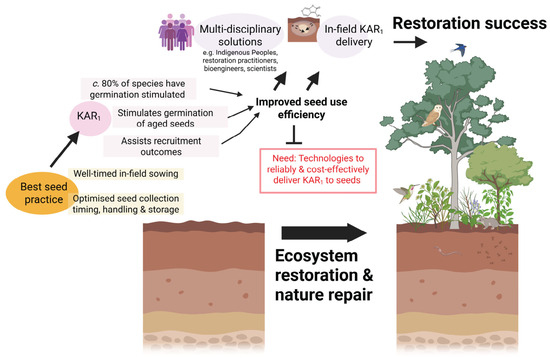
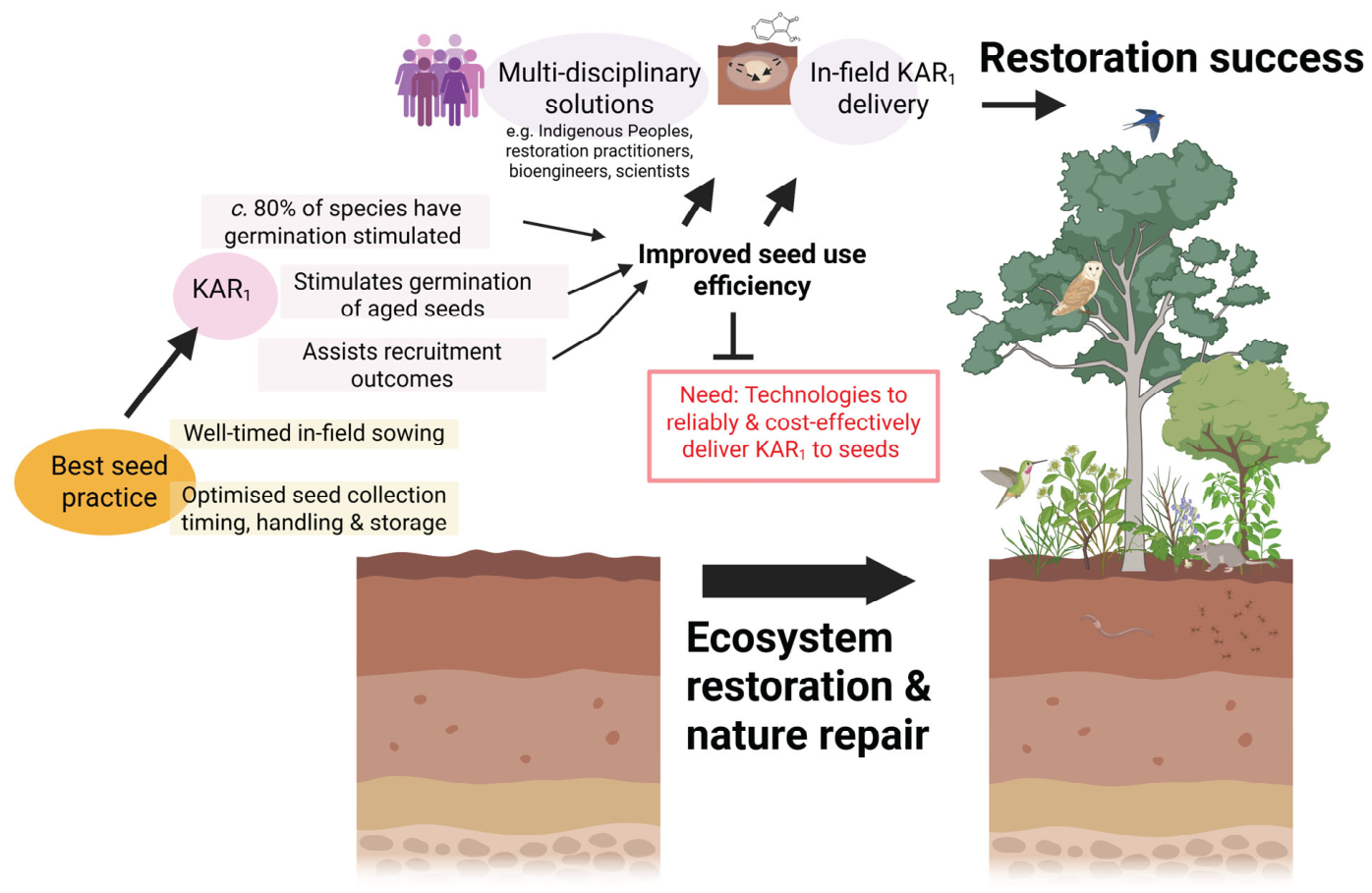
We acknowledge that many factors must align for effective ecological restoration and nature repair, as illustrated in Figure 6. This includes, for example, optimised seed collection timing, correct seed handling and storage, well-timed in-field seed sowing during optimal recruitment windows and prioritising areas with low/declining ecological stability [5,62,63]. In addition, it is today recognised that the contribution of Indigenous Peoples who occupy lands to be restored forms the cornerstone of international conservation policy and is critical in delivering on international goals [64]. Overall, to maximise plant survival per seed used, we suggest a combination of best practices in seed handling and timing of sowing, along with the development of new on-demand germination technologies. A cross-disciplinary approach, involving Traditional Owner knowledge, restoration practitioner experience, scientific rigour and innovation, has the greatest chance of achieving high-quality ecological restoration and large-scale nature repair.
Figure 6.
The role of KAR1 in enhancing seed use efficiency for ecosystem restoration and nature repair. This image was created with BioRender.com.
5. Conclusions
Today we live in an unprecedented ecological overshoot that has manifested as rampant ecosystem and land degradation. Thus, restoration over large scales is urgently needed, but success is often low. Here, we demonstrate that the germination stimulant KAR1 promoted seed germination in both fresh and stored seeds in 82% of Australian species across nine families. Additionally, KAR1 improved plant establishment and survival, therefore directly enhancing seed use efficiency. By contrast, the commercially available stimulant GA3 did not assist plant establishment or survival, resulting in poor seed use efficiency. The next frontier is an upscalable, cost-effective technology that can efficiently deliver KAR1 to seeds in-field, assisting in large-scale ecological restoration and nature repair.
Supplementary Materials
The following supporting information can be downloaded at: https://www.mdpi.com/article/10.3390/environments13070376/s1, The references [22,23,24,25,43,44,45,46,47,48,49,50] were cited in the Supplementary Materials.
Author Contributions
Conceptualisation, A.B. and J.K.; methodology, A.B., N.B.G., G.M. and K.T.; validation and data curation, A.B., N.B.G. and J.K.; visualisation, A.B., N.B.G. and J.K.; investigation, A.B. and J.K.; formal analysis, A.B., N.B.G. and J.K.; writing—original draft preparation, A.B. and J.K.; writing—review and editing, M.P. and J.K.; resources, J.K., M.P. and C.S.; supervision, J.K. and M.P.; funding acquisition, J.K. and M.P. All authors have read and agreed to the published version of the manuscript.
Funding
This research was funded by The Ian Potter Foundation as part of a grant to Greening Australia entitled ‘Research and development to build best practice into native seed production in a changing world’.
Data Availability Statement
The data presented in this study are available on request from the corresponding author. The data are stored within the University of Queensland Research Data Manager (UQRDM) with record identifier number 2025-RD001812 titled ‘Manuscript 2025: Karrikinolide maximises seed use efficiency for global ecosystem restoration and nature repair.’.
Acknowledgments
The authors acknowledge that this research utilises Traditional Indigenous Knowledge, which is wholly owned and shared by Bulugudu Limited (formerly known as Dugalunji Aboriginal Corporation) on behalf of the Indjalandji-Dhidhanu people. Bulugudu Limited has also provided direct financial, equipment, and in-kind support to this project. We acknowledge Gavin Flematti and Adrian Scaffidi for manufacturing the KAR1 utilised in this study. We would also like to acknowledge Edward Tsen from Greening Australia for all his help with this project.
Conflicts of Interest
Author Colin Saltmere is a UQ Adjunct Associate Professor and the Director of the company Bulugudu Limited. The remaining authors declare that the research was conducted in the absence of any commercial or financial relationships that could be construed as a potential conflict of interest.
Abbreviations
The following abbreviations are used in this manuscript:
| GA3 | Gibberellic acid |
| KAR1 | Karrikin-1, karrikinolide |
| PD | Physiological dormancy |
| SEM | Standard error of the mean |
| SUE | Seed use efficiency |
| UN | United Nations |
References
- United Nations, Department of Economic and Social Affairs Population Division. World Population Prospects 2019: Highlights (ST/ESA/SER.A/423). 2019. Available online: https://www.un.org/development/desa/pd/news/world-population-prospects-2019-0 (accessed on 10 March 2025).
- United Nations. Becoming. #GenerationRestoration: Ecosystem Restoration for People, Nature and Climate. Nairobi. 2021. Available online: https://wedocs.unep.org/bitstream/handle/20.500.11822/36251/ERPNC.pdf (accessed on 10 March 2025).
- Strassburg, B.B.N.; Iribarrem, A.; Beyer, H.L.; Cordeiro, C.L.; Crouzeilles, R.; Jakovac, C.C.; Junqueira, A.B.; Lacerda, E.; Latawiec, A.E.; Balmford, A.; et al. Global priority areas for ecosystem restoration. Nature 2020, 586, 724–729. [Google Scholar] [CrossRef] [Scilit] [PubMed]
- Cooke, S.J.; Bennett, J.R.; Jones, H.P. We have a long way to go if we want to realize the promise of the “Decade on Ecosystem Restoration”. Conserv. Sci. Pract. 2019, 1, e129. [Google Scholar] [CrossRef] [Scilit]
- Merritt, D.J.; Dixon, K.W. Restoration seed banks—A matter of scale. Science 2011, 332, 424–425. [Google Scholar] [CrossRef] [Scilit] [PubMed]
- Perez, D.R.; Gonzalez, F.; Ceballos, C.; Oneto, M.E.; Aronson, J. Direct seeding and outplantings in drylands of Argentinean Patagonia: Estimated costs, and prospects for large-scale restoration and rehabilitation. Restor. Ecol. 2019, 27, 1105–1116. [Google Scholar] [CrossRef] [Scilit]
- Raupp, P.P.; Ferreira, M.C.; Alves, M.; Campos, E.M.; Sartorelli, P.A.R.; Consolaro, H.N.; Vieira, D.L.M. Direct seeding reduces the costs of tree planting for forest and savanna restoration. Ecol. Eng. 2020, 148, 105788. [Google Scholar] [CrossRef] [Scilit]
- Corr, K. Revegetation Techniques—A Guide for Establishing Native Vegetation in Victoria; Greening Australia Victoria: Melbourne, Australia, 2003; Available online: https://www.greeningaustralia.org.au/wp-content/uploads/2017/11/GUIDE_A-guide-for-establishing-native-vegetation-in-Victoria.pdf (accessed on 5 November 2024).
- Kildisheva, O.A.; Dixon, K.W.; Silveira, F.A.O.; Chapman, T.; Di Sacco, A.; Mondoni, A.; Turner, S.R.; Cross, A.T. Dormancy and germination: Making every seed count in restoration. Restor. Ecol. 2020, 28, S256–S265. [Google Scholar] [CrossRef] [Scilit]
- Baskin, J.M.; Baskin, C.C. A classification system for seed dormancy. Seed Sci. Res. 2004, 14, 1–16. [Google Scholar] [CrossRef] [Scilit]
- Lewandrowski, W.; Erickson, T.E.; Dixon, K.W.; Stevens, J.C. Increasing the germination envelope under water stress improves seedling emergence in two dominant grass species across different pulse rainfall events. J. Appl. Ecol. 2017, 54, 997–1007. [Google Scholar] [CrossRef] [Scilit]
- Flematti, G.R.; Ghisalberti, E.L.; Dixon, K.W.; Trengove, R.D. A compound from smoke that promotes seed germination. Science 2004, 305, 977. [Google Scholar] [CrossRef] [Scilit] [PubMed]
- Flematti, G.R.; Ghisalberti, E.L.; Dixon, K.W.; Trengove, R.D. Identification of alkyl substituted 2H-Furo [2,3-c]pyran-2-ones as germination stimulants present in smoke. J. Agr. Food Chem. 2009, 57, 9475–9480. [Google Scholar] [CrossRef] [Scilit] [PubMed]
- Monemizadeh, Z.; Siahmarguee, A.; Soltani, E.; Torabi, B.; Baskin, C.C.; Azimmohseni, M.; Pausas, J.G.; Tavsanoglu, Ç.; Sadeghipour, H.R.; Ghaderi-Far, F. Fire and seed dormancy: A global meta-analysis. Ann. Bot. 2025, 135, 10591074. [Google Scholar] [CrossRef] [Scilit] [PubMed]
- Kochanek, J.; Long, R.L.; Lisle, A.T.; Flematti, G. Karrikins identified in biochars indicate post-fire chemical cues can influence community diversity and plant development. PLoS ONE 2016, 11, e0161234. [Google Scholar] [CrossRef] [Scilit] [PubMed]
- Flematti, G.R.; Ghisalberti, E.L.; Dixon, K.W.; Trengove, R.D. Synthesis of the seed germination stimulant 3-methyl-2H-furo [2,3-c]pyran-2-one. Tetrahedron Lett. 2005, 46, 5719–5721. [Google Scholar] [CrossRef] [Scilit]
- Rokich, D.P.; Dixon, K.W. Recent advances in restoration ecology, with a focus on the Banksia woodland and the smoke germination tool. Aust. J. Bot. 2007, 55, 375–389. [Google Scholar] [CrossRef] [Scilit]
- Rolando, S.S.; Norgrove, L.; Sutter, L.; Dienes-Nagy, A.; Bergoënd, A.; Simonnet, X. Smoke water and smoke-derived karrikinolide, KAR1, improved germination in some medicinal and aromatic plants. Sci. Rep. 2026, 16, 865. [Google Scholar] [CrossRef] [Scilit] [PubMed]
- Dixon, K.W.; Merritt, D.J.; Flematti, G.R.; Ghisalberti, E.L. Karrikinolide—A phytoreactive compound derived from smoke with applications in horticulture, ecological restoration and agriculture. Acta Hortic. 2009, 813, 155–170. [Google Scholar] [CrossRef] [Scilit]
- Kochanek, J.; Soo, R.M.; Martinez, C.; Dakuidreketi, A.; Mudge, A.M. Biochar for intensification of plant-related industries to meet productivity, sustainability and economic goals: A review. Resour. Conserv. Recycl. 2022, 179, 106109. [Google Scholar] [CrossRef] [Scilit]
- Kochanek, J.; Steadman, K.J.; Probert, R.J.; Adkins, S.W. Parental effects modulate seed longevity: Exploring parental and offspring phenotypes to elucidate pre-zygotic environmental influences. New Phytol. 2011, 191, 223–233. [Google Scholar] [CrossRef] [Scilit] [PubMed]
- Turner, S.R.; Merritt, D.J.; Renton, M.S.; Dixon, K.W. Seed moisture content affects afterripening and smoke responsiveness in three sympatric Australian native species from fire-prone environments. Austral Ecol. 2009, 34, 866–877. [Google Scholar] [CrossRef] [Scilit]
- Kochanek, J.; McGregor, G.; Tryggestad, K.A.; Flematti, G.R.; Wang, Y.; Krisantini, S. The role of karrikins to address pressing global challenges: Plant abiotic stress tolerance, biodiversity restoration and karrikin commercial realities. In Strigolactones, Alkamides and Karrikins in Plants: Recent Updates and Future Prospects; Mukherjee, S., Aftab, T., Eds.; Taylor & Francis Group: Boca Raton, FL, USA, 2023; pp. 249–271. [Google Scholar] [CrossRef] [Scilit]
- Kildisheva, O.A. Improving the Outcomes of Seed-Based Restoration in Cold and Hot Deserts: An Investigation into Seed Dormancy, Germination, and Seed Enhancement. Ph.D. Thesis, The University of Western Australia, Perth, WA, Australia, 2019. [Google Scholar] [CrossRef]
- Saraeian, Z.; Farrell, C.; Williams, N.S.G. Green roofs sown with an annual plant mix attain high cover and functional diversity regardless of irrigation frequency. Urban For. Urban Green. 2022, 73, 127594. [Google Scholar] [CrossRef] [Scilit]
- Antala, M.; Sytar, O.; Rastogi, A.; Brestic, M. Potential of karrikins as novel plant growth regulators in agriculture. Plants 2020, 9, 43. [Google Scholar] [CrossRef] [Scilit] [PubMed]
- Scaffidi, A.; Flematti, G.R.; Nelson, D.C.; Dixon, K.W.; Smith, S.M.; Ghisalberti, E.L. The synthesis and biological evaluation of labelled karrikinolides for the elucidation of the mode of action of the seed germination stimulant. Tetrahedron 2011, 67, 152–157. [Google Scholar] [CrossRef] [Scilit]
- Pedrini, S.; Lewandrowski, W.; Stevens, J.C.; Dixon, K.W. Optimising seed processing techniques to improve germination and sowability of native grasses for ecological restoration. Plant Biol. 2019, 21, 415–424. [Google Scholar] [CrossRef] [Scilit] [PubMed]
- Berto, B.; Ritchie, A.L.; Erickson, T.E. Seed-enhancement combinations improve germination and handling in two dominant native grass species. Restor. Ecol. 2021, 29, e13275. [Google Scholar] [CrossRef] [Scilit]
- Smahel, J.K. The Viability and Germination of Three Members of the Goodeniaceae Family. Bachelor Honours Thesis, The University of Queensland, Brisbane, QLD, Australia, 2002. Available online: https://espace.library.uq.edu.au/view/UQ:8dd5dd8 (accessed on 20 July 2024).
- Kochanek, J. Parental Growth Environment Modulates Seed Longevity: Investigations Using Australian Native Species. Ph.D. Thesis, The University of Queensland, Brisbane, QLD, Australia, 2008. [Google Scholar] [CrossRef] [Scilit]
- Li, S.Y.; Ma, H.Y.; Ooi, M.K.J. Fire-related cues significantly promote seed germination of some salt-tolerant species from non-fire-prone saline-alkaline grasslands in northeast China. Plants 2021, 10, 2675. [Google Scholar] [CrossRef] [Scilit] [PubMed]
- Commander, L.E.; Golos, P.J.; Miller, B.; Merritt, D.J. Seed germination traits of desert perennials. Plant Ecol. 2017, 218, 1077–1091. [Google Scholar] [CrossRef] [Scilit]
- Rivero, R.M.; Mittler, R.; Blumwald, E.; Zandalinas, S.I. Developing climate-resilient crops: Improving plant tolerance to stress combination. Plant J. 2021, 109, 373–389. [Google Scholar] [CrossRef] [Scilit] [PubMed]
- Li, N.; Euring, D.J.; Cha, J.Y.; Lin, Z.; Lu, M.Z.; Huang, L.J.; Kim, W.Y. Plant hormone-mediated regulation of heat tolerance in response to global climate change. Front. Plant Sci. 2021, 11, 627969. [Google Scholar] [CrossRef] [Scilit] [PubMed]
- Çatav, S.S.; Kücükakyüz, K.; Tavsanoglu, Ç.; Pausas, J.G. Effect of fire-derived chemicals on germination and seedling growth in Mediterranean plant species. Basic Appl. Ecol. 2018, 30, 65–75. [Google Scholar] [CrossRef] [Scilit]
- Long, R.L.; Williams, K.; Griffiths, E.M.; Flematti, G.R.; Merritt, D.J.; Stevens, J.C.; Turner, S.R.; Powles, S.B.; Dixon, K.W. Prior hydration of Brassica tournefortii seeds reduces the stimulatory effect of karrikinolide on germination and increases seed sensitivity to abscisic acid. Ann. Bot. 2010, 105, 1063–1070. [Google Scholar] [CrossRef] [Scilit] [PubMed]
- Gonzalez, S.; Franzese, J.; Ghermandi, L. Germination responses of native fire ephemerals of Patagonian grasslands to smoke water and karrikinolide. Front. Plant Sci. 2025, 16, 1550692. [Google Scholar] [CrossRef] [Scilit] [PubMed]
- Merritt, D.J.; Kristiansen, M.; Flematti, G.R.; Turner, S.R.; Ghisalberti, E.L.; Trengove, R.D.; Dixon, K.W. Effects of a butenolide present in smoke on light-mediated germination of Australian Asteraceae. Seed Sci. Res. 2006, 16, 29–35. [Google Scholar] [CrossRef] [Scilit]
- Saraeian, Z.; Farrell, C.; Hirst, M.; Williams, N.S.G. Relationships among seed mass, germination attributes and climate of natural distribution in Australian annual species. Aust. J. Bot. 2025, 73, BT25002. [Google Scholar] [CrossRef] [Scilit]
- Shah, F.A.; Ni, J.; Tang, C.G.; Chen, X.; Kan, W.J.; Wu, L.F. Karrikinolide alleviates salt stress in wheat by regulating the redox and K+/Na+ homeostasis. Plant Physiol. Bioch. 2021, 167, 921–933. [Google Scholar] [CrossRef] [Scilit] [PubMed]
- Sardar, R.; Ahmed, S.; Yasin, N.A. Seed priming with karrikinolide improves growth and physiochemical features of Coriandrum sativum under cadmium stress. Environ. Adv. 2021, 5, 100082. [Google Scholar] [CrossRef] [Scilit]
- Demir, I.; Ozden, E.; Yildirim, K.C.; Sahin, O.; Van Staden, J. Priming with smoke-derived karrikinolide enhances germination and transplant quality of immature and mature pepper seed lots. S. Afr. J. Bot. 2018, 115, 264–268. [Google Scholar] [CrossRef] [Scilit]
- Jain, N.; Van Staden, J. The potential of the smoke-derived compound 3-methyl-2H-furo[2,3-c]pyran-2-one as a priming agent for tomato seeds. Seed Sci. Res. 2007, 17, 175–181. [Google Scholar] [CrossRef] [Scilit]
- Bursch, K.; Niemann, E.T.; Nelson, D.C.; Johansson, H. Karrikins control seedling photomorphogenesis and anthocyanin biosynthesis through a HY5-BBX transcriptional module. Plant J. 2021, 107, 1346–1362. [Google Scholar] [CrossRef] [Scilit] [PubMed]
- Kusnetsov, V.V.; Doroshenko, A.S.; Kudryakova, N.V.; Danilova, M.N. Role of phytohormones and light in de-etiolation. Russ. J. Plant Physl. 2020, 67, 971–984. [Google Scholar] [CrossRef] [Scilit]
- Fukuda, M.; Matsuo, S.; Kikuchi, K.; Mitsuhashi, W.; Toyomasu, T.; Honda, I. Gibberellin metabolism during stem elongation stimulated by high temperature in lettuce. Acta Hortic. 2012, 932, 359–364. [Google Scholar] [CrossRef] [Scilit]
- Monthony, A.S.; Baetheke, K.; Erland, L.A.E.; Murch, S.J. Tools for conservation of Balsamorhiza deltoidea and Balsamorhiza sagittata: Karrikin and thidiazuron-induced growth. In Vitro Cell. Dev. Biol.-Plant 2020, 56, 398–406. [Google Scholar] [CrossRef] [Scilit]
- Zhou, J.F.; da Silva, J.A.T.; Ma, G.H. Effects of smoke water and karrikin on seed germination of 13 species growing in China. Cent. Eur. J. Biol. 2014, 9, 1108–1116. [Google Scholar] [CrossRef] [Scilit]
- Kildisheva, O.A.; Erickson, T.E.; Madsen, M.D.; Dixon, K.W.; Merritt, D.J. Seed germination and dormancy traits of forbs and shrubs important for restoration of North American dryland ecosystems. Plant Biol. 2019, 21, 458–469. [Google Scholar] [CrossRef] [Scilit] [PubMed]
- Çatav, S.S.; Akbas, K.; Kaplan, Y.F.; Kizil, C.; Bürün, B. Germination of 10 midland plant species from the eastern Mediterranean Basin: Effects of smoke, syringaldehyde, karrikinolide and cyanohydrin. Nord. J. Bot. 2024, 2024, e04457. [Google Scholar] [CrossRef] [Scilit]
- Cao, D.C.; Baskin, J.M.; Baskin, C.C.; Li, D.Z. Burning lignin: Overlooked cues for post-fire seed germination. Trends Plant Sci. 2023, 28, 386–389. [Google Scholar] [CrossRef] [Scilit] [PubMed]
- Erickson, T.E.; Munoz-Rojas, M.; Kildisheva, O.A.; Stokes, B.A.; White, S.A.; Heyes, J.L.; Dalziell, E.L.; Lewandrowski, W.; James, J.J.; Madsen, M.D.; et al. Benefits of adopting seed-based technologies for rehabilitation in the mining sector: A Pilbara perspective. Aust. J. Bot. 2017, 65, 646–660. [Google Scholar] [CrossRef] [Scilit]
- Younis, S.; Kasel, S. Do fire cues enhance germination of soil seed stores across an ecotone of wet eucalypt forest to cool temperate rainforest in the central highlands of south-eastern Australia? Fire 2023, 6, 138. [Google Scholar] [CrossRef] [Scilit]
- Baczek-Kwinta, R.; Grabowska-Joachimiak, A.; Baran, A.; Jamal, A.R. Karrikin 1 modulates germination and growth of invasive Solidago gigantea: Potential for ecological management and photoblastism research. Appl. Sci. 2026, 16, 1419. [Google Scholar] [CrossRef] [Scilit]
- Mathonsi, L.; Nkosi, S.; Gebashe, F.; Gupta, S.; Kulkarni, M.; Van Staden, J. Effect of smoke-water (SW) and smoke bioactive compound karrikinolide (KAR1) on seed germination, plumule and radicle growth of Vigna subterranea (L.) Verdc. (Bambara groundnut)—An underutilized African legume crop. S. Afr. J. Bot. 2025, 185, 516–525. [Google Scholar] [CrossRef] [Scilit]
- Long, R.L.; Stevens, J.C.; Griffiths, E.M.; Adamek, M.; Gorecki, M.J.; Powles, S.B.; Merritt, D.J. Seeds of Brassicaceae weeds have an inherent or inducible response to the germination stimulant karrikinolide. Ann. Bot. 2011, 108, 933–944. [Google Scholar] [CrossRef] [Scilit] [PubMed]
- Frischie, S.; Miller, A.L.; Pedrini, S.; Kildisheva, O.A. Ensuring seed quality in ecological restoration: Native seed cleaning and testing. Restor. Ecol. 2020, 28, S239–S248. [Google Scholar] [CrossRef] [Scilit]
- Bajpai, A.; Perry, K.; Wang, Y.; Ferguson, B.J.; Saltmere, C.P.; Kochanek, J. Advances and deficits of conventional and novel seed enhancement technologies. Preprints 2026. [Google Scholar] [CrossRef] [Scilit]
- Stevens, J.C.; Merritt, D.J.; Flematti, G.R.; Ghisalberti, E.L.; Dixon, K.W. Seed germination of agricultural weeds is promoted by the butenolide 3-methyl-2H-furo[2,3-c]pyran-2-one under laboratory and field conditions. Plant Soil. 2007, 298, 113–124. [Google Scholar] [CrossRef] [Scilit]
- Erickson, T.E.; Shackelford, N.; Dixon, K.W.; Turner, S.R.; Merritt, D.J. Overcoming physiological dormancy in seeds of Triodia (Poaceae) to improve restoration in the arid zone. Restor. Ecol. 2016, 24, S64–S76. [Google Scholar] [CrossRef] [Scilit]
- Ceccon, E.; Gonzalez, E.J.; Martorell, C. Is direct seeding a biologically viable strategy for restoring forest ecosystems? Evidences from a meta-analysis. Land. Degrad. Dev. 2016, 27, 511–520. [Google Scholar] [CrossRef] [Scilit]
- Lü, D.; Lü, Y.H.; Gao, G.Y.; Sun, S.Q.; Wang, Y.; Fu, B.J. A landscape persistence-based methodological framework for assessing ecological stability. Environ. Sci. Ecotechnol. 2024, 17, 100300. [Google Scholar] [CrossRef] [Scilit] [PubMed]
- Sze, J.S.; Carrasco, L.R.; Childs, D.; Edwards, D.P. Reduced deforestation and degradation in Indigenous Lands pan-tropically. Nat. Sustain. 2022, 5, 123–130. [Google Scholar] [CrossRef] [Scilit]

Disclaimer/Publisher’s Note: The statements, opinions and data contained in all publications are solely those of the individual author(s) and contributor(s) and not of MDPI and/or the editor(s). MDPI and/or the editor(s) disclaim responsibility for any injury to people or property resulting from any ideas, methods, instructions or products referred to in the content. |
© 2026 by the authors. Licensee MDPI, Basel, Switzerland. This article is an open access article distributed under the terms and conditions of the Creative Commons Attribution (CC BY) license.