


Abstract
The increasing demand for lithium (Li), cobalt (Co), and rare earth elements (REEs) driven by battery technologies, electrification and renewable energy systems has intensified the interest in recovery pathways as an alternative to conventional mining. High-salinity mine waters—including lithium brines, geothermal fluids, and metallurgical effluents—represent both an environmental liability and a significant secondary resource for metal recovery. However, extreme ionic strength, complex metal speciation, and strong competition from major ions severely limit the efficiency and selectivity of traditional extraction technologies. Microalgae and cyanobacteria are promising biological agents for metal recovery via biosorption, bioaccumulation, and extracellular polymeric substance (EPS)-mediated binding, especially in saline and hypersaline systems. This review synthesises current knowledge on microalgal-based recovery of Li, Co, and REEs from high-salinity waters, emphasising co-design principles that integrate strain physiology, their adaptation to the extreme operating conditions, water chemistry, and process engineering. Halotolerant and extremophilic taxa—Nannochloropsis oceanica, Galdieria sulphuraria, and Synechococcus elongatus—are examined as representative models for complementary metal-binding mechanisms and operational niches. Limitations such as weak affinity for lithium, competitive ion suppression, desorption inefficiencies, and scale-up challenges are discussed. Emerging strategies such as modular multi-strain systems, hybrid bio-physicochemical platforms, and biomass valorisation are also addressed. The review concludes that microalgal systems, when co-designed for selectivity and resilience, can contribute to the strategic recovery of critical materials that align with EU, UK and US policies.
1. Introduction
Critical minerals are raw materials that are essential for modern technologies, economic development, and the transition to low-carbon energy systems, yet face significant risks of supply disruption [1]. Relevant examples include lithium (Li), cobalt (Co) and other rare earth elements (REEs), which are critical raw materials for making batteries, permanent magnets, advanced electronics, and emerging low-carbon technologies [2]. Rare earth elements (e.g., lanthanides, yttrium and scandium) are particularly essential for Nd–Fe–B magnets, phosphors, catalysts, and high-efficiency motors. Demand for these elements is projected to double or triple in the coming decades, driven by demands for electrification, renewable energy projects, and grid-scale energy storage [3]. At the same time, supply chains remain highly geographically concentrated. For example, the Democratic Republic of Congo accounts for approximately 69% of the global supply of cobalt, while Chile, Australia and Argentina together hold around 78% of the global lithium reserves [4,5]. This creates strategic vulnerabilities and accelerates policy initiatives focusing on diversification, recycling and secondary resource recovery from the waste streams [6].
Common technologies for resource recovery are based on physical–chemical treatments, which are often not effective or suitable for high-salinity, low-pH waste streams with low concentrations of target metals, such as mining and industrial wastewaters. Consequently, there has been growing interest in using biological methods, including microalgae. While microalgae have been widely studied for nutrient removal and pollution remediation, critical-metal recovery differs from bulk remediation due to low concentrations of the target metals, strong ionic competition, and the need for efficient downstream recovery. Achieving selectivity therefore requires deliberate co-design integrating strain physiology, environmental adaptation, water chemistry, and process engineering. This review critically evaluates the potential of microalgal and cyanobacterial systems for selective recovery of Li, Co and REEs from high-salinity mining and industrial wastewaters. By reframing saline and acidic wastewaters as secondary resource streams, this review explores how microalgal systems can contribute to sustainable and effective recovery of critical materials within the current EU, US and UK regulatory contexts.
The aims are to:
- Review policy frameworks supporting critical element recovery from waste streams.
- Discuss the chemistry of major waste streams and associated recovery challenges.
- Evaluate halotolerant and extremophilic algal platforms (Nannochloropsis, Galdieria, Synechococcus) for Li, Co, and REE recovery.
- Assess strategies for recovery of adsorbed and accumulated metals from biomass, including desorption, biomass processing, and metal recycling pathways.
- Identify key limitations including selectivity, ion competition, and scalability.
- Discuss co-design strategies for integrating microalgal systems into circular mining and wastewater treatment frameworks.
2. Regulatory Frameworks
The European Union, United States and United Kingdom are particularly relevant regions for the development of technologies for critical element and REE recovery due to their combination of strong regulatory frameworks, technological capacity, and growing strategic interest in securing critical mineral supply chains. At the same time, they host extensive industrial and mining legacies that generate metal-rich waste streams, such as acid mine drainage, geothermal fluids, industrial effluents, and desalination brines, that represent potential secondary sources of critical elements.
Table 1 compares the regulatory and policy frameworks between the European Union (EU), United States (US), and United Kingdom (UK) that are relevant to the recovery of critical metals from saline waters, mine drainage, and industrial effluents. In the European Union, the Critical Raw Materials Act (2024) [7] establishes clear quantitative targets for domestic extraction (≥10%), processing (≥40%), and recycling (≥15%) of strategic materials. This policy is closely aligned with environmental legislation, including the Water Framework Directive (2000/60/EC) [8], the Mining Waste Directive (2006/21/EC) [9], and the Industrial Emissions Directive (2010/75/EU) [10], which impose strict discharge limits on pollutants from mining and industrial activities. Together with broader initiatives such as the EU Green Deal and the Circular Economy Action Plan, these frameworks create a regulatory environment that strongly incentivises the recovery of valuable metals from secondary resources. In this context, microalgal systems offer a dual-function approach by simultaneously achieving wastewater remediation and resource recovery, directly supporting EU priorities.
Table 1.
Comparative regulatory frameworks relevant to critical metal recovery from saline and mine waters (EU, US, UK).
In the United States, government support for critical materials is driven by a combination of strategic initiatives and regulatory requirements. The Department of Energy Critical Materials Strategy and the Infrastructure Investment and Jobs Act (2021) [11], alongside mechanisms such as the Defense Production Act, prioritise the development of domestic supply chains for critical minerals. Environmental regulation is primarily governed by the Clean Water Act (CWA) and the Resource Conservation and Recovery Act (RCRA), which require the treatment of contaminated effluents. In parallel, federal funding streams linked to the Bipartisan Infrastructure Law and the Inflation Reduction Act provide financial incentives for innovative recovery technologies, including those targeting unconventional resources such as lithium-rich brines and low-grade REE streams.
In the United Kingdom, the UK Critical Minerals Strategy (2022) [12] and the Net Zero Strategy highlight the importance of securing resilient supply chains while reducing environmental impacts (Table 1). Regulatory oversight is provided by the Environment Act (2021) [13], Environmental Permitting Regulations, and the Mining Waste Regulations (2009) [14], which collectively impose strict controls on pollutant discharge and waste management. At the same time, the UK Resource and Waste Strategy and emerging circular economy policies emphasise the valorisation of waste streams.
Across all three regions, a common theme is the increasing convergence of environmental protection, resource recovery, and critical mineral security objectives. Regulatory pressure to reduce pollutant discharge from mining and industrial activities, coupled with strategic policies aimed at strengthening domestic supplies of critical raw materials, is creating favourable conditions for the development of integrated recovery technologies. In parallel, circular economy strategies, recycling targets, net-zero commitments, and dedicated funding programmes—including Horizon Europe and LIFE in the EU, Department of Energy and ARPA-E initiatives in the USA, and UKRI and Innovate UK schemes in the UK—are providing direct and indirect support for innovative biological approaches to resource recovery. Microalgal systems are particularly well positioned within this policy landscape, as they can simultaneously remove contaminants, capture carbon, and recover valuable metals from dilute and complex waste streams. By combining wastewater treatment with resource valorisation, microalgal technologies align closely with emerging regulatory priorities for sustainable resource management, decarbonisation, and the transition towards a circular economy.
3. Secondary Sources of Critical Metals in Saline and Industrial Wastewaters
3.1. Lithium
Conventional lithium recovery from brines relies heavily on evaporation ponds, solvent extraction, ion exchange, or direct lithium extraction technologies [16]. A growing body of research has highlighted the potential of secondary waste streams as alternative sources of lithium. In addition to conventional mineral deposits and saline brines, lithium can be found in several industrial and environmental wastewaters generated by energy production, mining, and water treatment processes [17]. Among the most prominent sources are geothermal brines, where lithium is present in dissolved form and large volumes of fluid are circulated during geothermal energy production [18]. Similarly, oil and gas produced waters often contain measurable lithium concentrations and represent a significant but largely untapped resource due to the scale at which these saline wastewaters are generated [19]. Other potential sources include desalination reject brines, where lithium becomes concentrated during reverse osmosis processes, as well as mine tailings seepage and acid mine drainage associated with both active and legacy mining operations [20]. In addition, metallurgical and industrial effluents, including waste streams from battery manufacturing and hydrometallurgical recycling of lithium-ion batteries, may contain recoverable lithium.
3.2. Cobalt
Beyond conventional mining, cobalt can be mobilised and concentrated in several industrial and environmental wastewaters generated by mining, metallurgical processing, and manufacturing activities [20]. Among the most significant sources are acid mine drainage (up to 344,000 mg L−1) and mine tailings seepage (up to 14,165 mg kg−1), where the oxidative weathering of sulphide minerals releases cobalt and other trace metals into drainage waters [21]. In addition, metallurgical and refining effluents, particularly from nickel and copper processing, may contain measurable concentrations of cobalt due to its frequent co-occurrence with these metals in ore deposits [22]. Industrial wastewaters from battery manufacturing and recycling processes also represent an increasingly important secondary source, as hydrometallurgical recovery of lithium-ion batteries generates metal-rich leachates containing cobalt (5–20%) alongside lithium (5–7%), nickel (5–10%), and copper (6–12%) [23].
In aqueous systems, cobalt occurs primarily as dissolved Co2+ ions or inorganic complexes but can also be present in colloidal or particulate forms associated with iron and manganese oxides or mineral particles. Its speciation is largely controlled by environmental conditions such as pH, redox potential and ionic composition, which influence cobalt mobility and recovery potential [21].
3.3. Rare Earth Elements (REEs)
REEs typically occur in aqueous systems as trivalent cations (REE3+) and exhibit strong affinity for oxygen-containing ligands such as carboxylates, phosphates, and hydroxyl groups. Their chemistry facilitates adsorption onto mineral surfaces, complexation with dissolved organic matter, and precipitation as hydroxides or phosphates. For acid mine drainage and hydrometallurgical effluents, REEs may be mobilised through acid leaching of process residues [24,25]. Conventional treatment typically relies on neutralisation and precipitation, producing mixed sludges that limit metal separation. In addition, metallurgical processing residues and industrial effluents, particularly from phosphate fertiliser production, coal combustion, and metal refining, may contain measurable concentrations of REEs [26]. Coal ash and coal-related wastewaters have also been identified as important secondary sources, as REEs can be enriched during combustion and subsequent leaching [27,28].
3.4. Other Sources of Critical and Rare Minerals
The global expansion of desalination has generated large volumes of concentrated brine, typically 1.5–2 times more saline than seawater. Although dominated by Na+, Cl- and other major ions, these streams may contain trace lithium and other critical metals depending on the geological origin of the source water. Similarly, geothermal fluids and oilfield-produced waters often contain elevated lithium concentrations and are considered potential secondary lithium resources [18]. Geothermal and hydrothermal systems may also contain mobilised REEs, although recovery remains technically challenging due to the remote locations, low concentrations and competing ions. Furthermore, saline and acidic wastewaters are generated by biorefineries, particularly during dilute-acid pretreatment of lignocellulosic biomass, where hydrolysates contain elevated ionic strength and dissolved metals.
3.5. Chemical Characteristics of High-Salinity Mine Waters
High-salinity mine waters often exceed seawater salinity and are dominated by Na+, Mg2+, Ca2+, K+ and Cl−, creating strong competition for chemical binding sites. Lithium occurs primarily as Li+ with a small ionic radius and high hydration energy, which limits both chemical and biological selectivity. In contrast, Co2+ and REE3+ exhibit strong complexation with negatively charged functional groups, making them more amenable to biosorption and intracellular accumulation.
Table 2 summarises the dominant aqueous speciation of rare earth elements (REEs), cobalt (Co), and lithium (Li) in saline and acidic water systems relevant to biological and conventional recovery processes, together with the key geochemical factors influencing metal bioavailability and microalgal uptake. In sulphate-rich acidic environments, such as acid mine drainage, REEs predominantly occur as free lanthanide ions (Ln3+) and sulphate complexes (LnSO4+). Under these conditions, low pH and competition from co-occurring metal ions, including Fe3+, Al3+, and Ca2+, can reduce biosorption efficiency through protonation of negatively charged functional groups on the algal cell surface. In chloride-rich saline systems, including deep subsurface brines and seawater-derived waste streams, REEs and Co commonly form chloro-complexes, decreasing the proportion of free metal ions available for biological uptake. Furthermore, the high ionic strength of these environments and the abundance of major ions such as Na+, Mg2+, and Ca2+ intensify competition for binding sites, potentially limiting metal sorption and recovery efficiencies. Understanding these speciation dynamics is critical for optimising microalgal recovery processes, as metal bioavailability, selectivity, and uptake mechanisms are strongly governed by solution chemistry.
Table 2.
Comparative performance of microalgal, cyanobacterial, and conventional sorbent systems for rare earth element (REE) and metal recovery.
4. Traditional and Biological Methods of Recovery
Conventional recovery of critical metals such as lithium, cobalt and REEs is primarily based on established pyrometallurgical and hydrometallurgical processing routes developed within the mining and metallurgical industries (Table 2). Pyrometallurgical methods involve high-temperature treatments such as roasting, smelting and calcination to concentrate and separate metals from ores or intermediate products [39]. These approaches are also widely used for cobalt-bearing sulphide ores associated with nickel and copper deposits, where thermal reduction and slag separation enable the recovery of metal-rich phases [40]. However, pyrometallurgical processes are typically energy-intensive and associated with significant greenhouse gas emissions [41].
Hydrometallurgical techniques dominate the extraction and purification of many critical elements due to their higher selectivity and lower energy requirements. These processes generally involve chemical leaching of ores or solid residues using acidic or alkaline solutions, followed by separation and purification through solvent extraction, ion exchange, adsorption, or chemical precipitation [21,27,30]. For instance, conventional lithium recovery from brines relies heavily on evaporation ponds, solvent extraction, ion exchange, or emerging direct lithium extraction technologies [16], whereas cobalt and REEs are typically separated from leach solutions using complex solvent extraction circuits. Additional refining steps such as crystallisation or electrowinning may be employed to produce high-purity metal compounds [27].
Despite their widespread use in industries, these conventional methods often require multi-stage processing, large volumes of chemical reagents, and significant energy demand, particularly when treating low-grade ores or complex matrices. As global demand for critical minerals increases and ore grades decline, these limitations have prompted growing interest in alternative recovery strategies and secondary resources.
4.1. Biological Recovery Methods
Biological methods have emerged as promising alternatives for the recovery of critical metals from low-grade ores and dilute waste streams [42]. These strategies, commonly referred to as biomining (bioleaching) or biohydrometallurgy, exploit the metabolic activity or surface chemistry of microorganisms and biological materials to mobilise, concentrate, or recover metals from complex matrices [43,44].
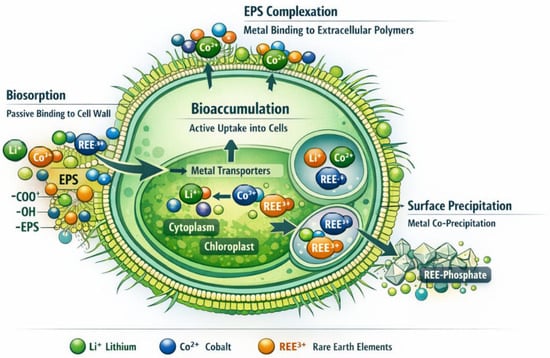
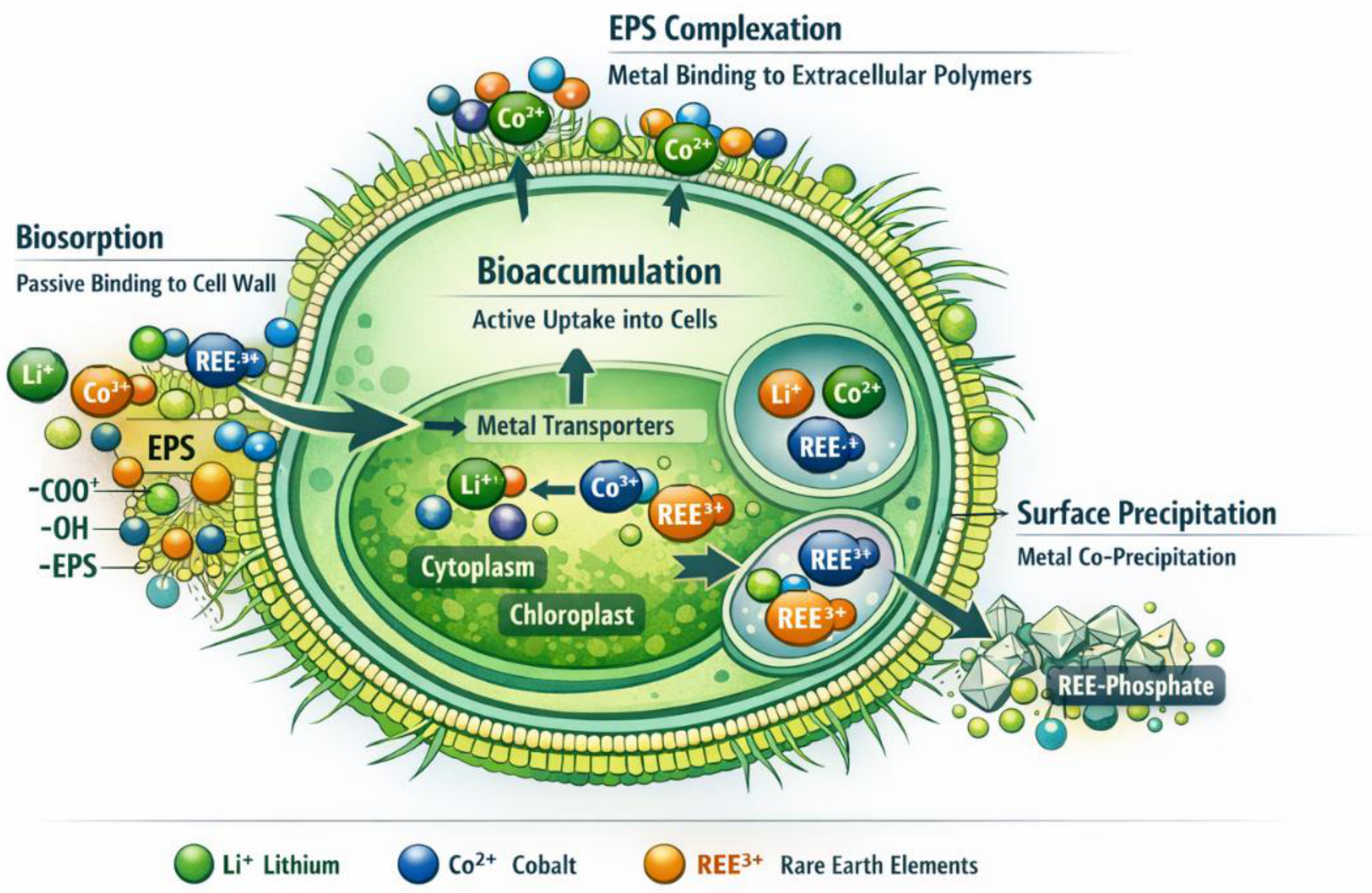
Owing to their remarkable physiological plasticity and ability to tolerate wide gradients of salinity and pH, microalgae and cyanobacteria represent promising microorganisms for applications in biohydrometallurgy (Figure 1). Halotolerant species such as Nannochloropsis thrive under marine and hypersaline conditions and produce extracellular polymeric substances that enhance metal-binding capacity [45,46,47]. Acidophilic red microalgae such as Galdieria sulphuraria grow at pH < 3 and tolerate elevated metal loads, making them promising candidates for treating AMD and geothermal fluids. Cyanobacteria such as Synechococcus elongatus combine rapid growth with well-characterised surface chemistry conducive to biosorption. Metal removal mechanisms include surface adsorption by microalgae via carboxyl and phosphate groups, EPS-mediated complexation, intracellular bioaccumulation, and biomineralisation. Salinity stress may stimulate EPS production by microalgae, potentially increasing binding capacity. These characteristics suggest that saline and acidic wastewaters represent not only tolerable but potentially advantageous environments for engineered microalgal systems for metal recovery (Table 2).
Figure 1.
Conceptual representation of microalgal and cyanobacterial mechanisms involved in the recovery of lithium (Li+), cobalt (Co2+), and rare earth elements (REE3+) from saline and industrial wastewaters. This figure was created by the authors with the assistance of AI-based tools for graphical visualisation. All scientific content and interpretation were validated by the authors. This figure is a conceptual schematic and is not drawn to scale. The illustrated mechanisms are based on experimentally validated biosorption, bioaccumulation, EPS-mediated complexation, and biomineralisation pathways reported in the cited literature. Depending on process configuration, these mechanisms may operate in batch, semi-continuous, or continuous systems.
As illustrated in Figure 1, metal recovery by microalgae and cyanobacteria can occur through several complementary mechanisms. Initial metal removal is typically dominated by passive biosorption onto negatively charged functional groups located on the cell surface, including carboxyl, hydroxyl, phosphate, sulphate, and amino groups. EPSs produced by many species can further enhance metal capture through complexation and retention within the extracellular matrix. Following surface binding, selected metal ions may undergo active transport across cellular membranes via metal transporters, resulting in intracellular bioaccumulation and sequestration. In addition, under favourable geochemical conditions, metals may undergo biomineralisation or surface precipitation as phosphate or mineral complexes associated with the biomass. While biosorption and EPS-mediated binding are widely reported and experimentally validated, intracellular accumulation and biomineralisation pathways appear to be more species- and condition-dependent, particularly for lithium and rare earth elements.
4.2. Passive Biosorption at the Cell Surface
Passive biosorption is typically the first step in metal capture and occurs through physicochemical interactions between metal ions and functional groups on the microalgal cell wall. Microalgal cell walls contain abundant carboxyl, hydroxyl, amino, phosphate and sulphate groups, which can bind metal ions through ion exchange, complexation and electrostatic interactions. These groups are present in structural polymers such as polysaccharides, proteins and glycoproteins that form the outer layer of the cell wall. The efficiency of biosorption depends on environmental conditions, particularly pH and ionic strength. At moderately acidic to neutral pH, negatively charged functional groups become deprotonated, increasing their affinity for cationic metals such as Co2+ and REE3+ (Figure 1). In saline systems, however, high concentrations of Na+, Mg2+ and Ca2+ may compete for these binding sites and reduce sorption efficiency. Despite this limitation, several studies have demonstrated that microalgae can effectively bind transition metals and REEs through rapid surface adsorption [38,48]. For example, Chlorella vulgaris adsorbs neodymium through Langmuir-type adsorption processes involving surface complexation and ion exchange mechanisms [49]. Similarly, cyanobacteria such as Arthrospira (Spirulina) platensis exhibit strong biosorption capacity due to abundant sulphated polysaccharides and phosphate groups in their cell walls [50].
4.3. EPS-Mediated Metal Complexation
Microalgae frequently produce extracellular polysaccharides (EPSs), particularly under environmental stresses such as high salinity or metal exposure. EPSs are complex matrices composed primarily of polysaccharides, proteins, lipids and nucleic acids that form a protective layer surrounding the cells [51,52]. These polymers contain numerous functional groups capable of binding metal ions, including carboxylate, hydroxyl and sulphate moieties. EPSs can therefore act as an additional sorption matrix that enhances metal capture beyond the cell wall itself [52]. EPS production often increases as a physiological response to osmotic stress, potentially improving metal-binding capacity under hypersaline conditions. Studies on cyanobacteria and green microalgae demonstrate that EPSs can bind various metals, including REEs, via coordination with polysaccharide functional groups [53]. EPS-mediated complexation also contributes to aggregation and flocculation that facilitate downstream biomass harvesting.
4.4. Active Bioaccumulation and Intracellular Sequestration
Unlike passive biosorption, bioaccumulation is a metabolic process in which metal ions are actively transported across the cell membrane into the cytoplasm. This process requires energy and therefore occurs only in living cells. Metal uptake may occur through transport proteins originally evolved for essential elements such as calcium, magnesium or iron, but which may also transport chemically similar ions. Once inside the cell, metals can be detoxified and stored through sequestration in vacuoles, polyphosphate granules or metalloproteins, as well as complexation with intracellular ligands such as phytochelatins and metallothioneins [54]. Although bioaccumulation generally occurs more slowly than biosorption, the transport systems offer higher selectivity for specific ions. This feature is particularly desirable for recovering valuable metals present at low concentrations.
4.5. Surface Precipitation and Biomineralisation
Another mechanism for metal capture involves surface precipitation or biomineralisation. In this process, metal ions react with functional groups or metabolic by-products near the cell surface, forming insoluble mineral phases. For REEs, precipitation as phosphate minerals is commonly observed, especially when phosphate is present in the growth medium. Microalgae can influence mineral formation by changing the local pH, releasing metabolic ligands, or accumulating phosphate-rich compounds. Recent nanoscale imaging studies have shown that REEs can be associated with phosphate-rich intracellular granules, indicating that biomineralisation may occur both outside and within the cells [55]. This mechanism is particularly relevant in engineered systems because it can facilitate separation of metal-containing particles from the aqueous phase.
4.6. Relative Importance of Different Uptake Mechanisms
For practical applications, these uptake mechanisms may occur simultaneously or vary throughout the cultivation process. Initial contact between biomass and metal-containing water is dominated by rapid biosorption, which may remove a large fraction of dissolved metals within minutes. Over longer time scales, bioaccumulation and precipitation processes contribute to additional uptake with enhanced selectivity. Understanding the interplay between these mechanisms is essential for designing efficient microalga-based metal recovery systems. Factors such as pH, ionic composition, biomass density, and physiological state of the culture can strongly influence the uptake pathways. Consequently, optimisation of metal recovery from saline wastewaters requires a co-design approach integrating biological properties of the selected microalgal species with chemical and engineering parameters of the treatment system [56].
4.7. Species-Specific Platforms for Metal Recovery from Waste Waters
Table 3 summarises studies of adsorption and bioaccumulation of REEs by microalgae and cyanobacteria. The organisms exhibit different uptake strategies depending on their physiology and environmental tolerance. Cyanobacteria such as Anabaena species show rapid biosorption of lanthanides from dilute aqueous solutions, with removal efficiencies exceeding 99% within a short time. These processes can be largely attributed to interactions between metal ions and negatively charged functional groups in the cell wall and extracellular polymeric substances (EPSs). In addition to whole-cell biosorption, extracted cyanobacterial EPSs also show significant metal-binding capacity, highlighting their potential as a bio-derived sorbent material.
Table 3.
Representative Microalgal and Cyanobacterial Species for Recovery of Rare Earth Elements and Associated Metals.
Most microalgal species cannot tolerate the extreme environmental conditions in mining and industrial wastewaters. Extremophilic microalgae therefore represent promising agents for metal recovery under harsh conditions. For example, the thermoacidophilic red alga Galdieria sulphuraria can grow under highly acidic and metal-rich conditions and has demonstrated the ability to accumulate rare earth elements [31], which makes it suitable for applications in acid mine drainage and metallurgical leachates where other microalgae cannot survive. Other useful taxa include Nannochloropsis and Synechococcus. The marine microalga Nannochloropsis oculata has been used as a biosorbent for metals such as Pb2+, and it has natural tolerance to marine and hypersaline conditions. The cyanobacterium Synechococcus elongatus has demonstrated efficient removal of metals including Pb, Cr and Ni in wastewater treatment systems, with rapid adsorption kinetics and high tolerance of high metal concentrations (Table 3).
Although direct studies on REE adsorption by Nannochloropsis and Synechococcus remain limited, their high surface-to-volume ratio, EPS production and salt tolerance make them promising candidates for engineered systems targeting lithium, cobalt and rare earth element recovery from high-salinity waters.
One of the most extensively studied extremophilic microalgae is the thermoacidophilic red alga Galdieria sulphuraria. This species can grow at pH values as low as 1–2 and temperatures up to 50 °C, enabling its application in acid mine drainage (AMD) and metallurgical leachates. Several studies have demonstrated its ability to accumulate rare earth elements (REEs) from acidic solutions, including lanthanides such as neodymium, dysprosium, and lanthanum [31,33]. Under controlled laboratory conditions, recovery efficiencies exceeding 90% have been reported for selected REEs at low concentrations, while biosorption capacities in the range of 80–130 μmol g−1 dry biomass have been observed [60]. The mechanism of uptake involves both passive biosorption to cell surface functional groups and active intracellular accumulation. Importantly, G. sulphuraria exhibits selectivity for trivalent metal ions, which facilitates separation of REEs from competing metals in complex waste matrices [31]. Beyond model solutions, this organism has also been successfully applied to the recovery of REEs from electronic waste streams, such as fluorescent lamp phosphor leachates, highlighting its potential for urban mining applications.
In saline and hypersaline environments, marine microalgae such as Nannochloropsis spp. have been investigated for their biosorption capabilities. Nannochloropsis oculata, in particular, demonstrates high tolerance to elevated salinity and has been used for the removal of heavy metals including Pb2+ and Cd2+ from aqueous systems [58]. Reported removal efficiencies typically range between 70 and 95%, depending on operational conditions and initial metal concentrations [61,62]. The primary mechanism is passive adsorption onto cell wall functional groups, including carboxyl, hydroxyl, and phosphate moieties, with extracellular polymeric substances (EPSs) further enhancing binding capacity. Although direct studies on lithium, cobalt, and REE recovery using Nannochloropsis remain limited, its robustness under saline conditions and high surface-to-volume ratio make it a promising candidate for applications in desalination brines, oil and gas produced waters, and coastal industrial effluents.
Cyanobacteria such as Synechococcus elongatus have also demonstrated considerable potential for metal removal in moderately contaminated wastewater systems. This species has been shown to efficiently remove metals such as lead, chromium, and nickel, with removal efficiencies commonly reported in the range of 60–90% [63]. Rapid adsorption kinetics are typically observed, with significant removal occurring within hours to days. The process involves an initial fast phase of surface adsorption, followed by slower intracellular uptake. The production of extracellular polymeric substances and the presence of reactive functional groups on the cell surface contribute to high metal-binding capacity. Due to its tolerance of neutral pH conditions and adaptability to photobioreactor systems, S. elongatus is particularly suitable for integration into industrial wastewater treatment and polishing processes, including electroplating effluents and mixed industrial discharges [64].
Despite these promising results, most studies on microalgal metal recovery remain at laboratory or bench scale, corresponding to technology readiness levels (TRL) of approximately 2–4. Pilot-scale demonstrations are still limited, and challenges associated with biomass harvesting, process scalability, and metal desorption must be addressed to enable industrial implementation [65]. Furthermore, it is important to distinguish between metal removal and true recovery. While many studies report high removal efficiencies, recovery of metals in a usable form requires additional downstream processing steps, such as desorption using acidic or chelating agents and subsequent purification.
Emerging research is beginning to explore the use of microalgae for the recovery of critical raw materials, including lithium, cobalt, and rare earth elements, from low-concentration and complex waste streams. Species such as Galdieria sulphuraria, Nannochloropsis spp., and Synechococcus spp. exhibit characteristics that are advantageous for these applications, including high surface area, EPS production, and tolerance to environmental stress. In particular, the ability of some microalgae to selectively bind specific metal ions offers opportunities for targeted recovery and separation processes. Future developments are likely to focus on engineered strains, optimisation of cultivation conditions, and integration with existing wastewater treatment and carbon capture systems. Such integrated approaches align with circular bioeconomy principles and offer significant potential for sustainable resource recovery from industrial waste streams. Microalgal metal recovery is best positioned as part of hybrid treatment approaches, supporting mine-water remediation, CO2 utilisation, and biomass valorisation. Targeting high-value metals (Co, REEs) rather than lithium alone is critical for economic viability.
4.8. Performance in Real Wastewaters Versus Synthetic Solutions
Most studies investigating the recovery of lithium (Li), cobalt (Co), and rare earth elements (REEs) using microalgae and cyanobacteria have been conducted using synthetic solutions under controlled laboratory conditions. While these studies provide valuable insights into uptake mechanisms and adsorption performance, they may not accurately represent the complexity of real industrial wastewaters [32,35].
Mining effluents, geothermal brines, acid mine drainage (AMD), and industrial process waters contain complex mixtures of competing ions, dissolved organic matter, suspended solids, and fluctuating physicochemical conditions. High concentrations of Na+, Mg2+, Ca2+, and Fe3+ can significantly affect metal speciation, bioavailability, and recovery efficiency. For example, high Mg2+/Li+ ratios in saline brines and competition from major cations in acidic waters may reduce metal uptake by microalgal biomass [66].
Although promising results have been reported using acidophilic species such as Galdieria sulphuraria in real acidic waste streams, pilot-scale validation remains limited. Future research should prioritise testing under authentic wastewater conditions to assess selectivity, biomass stability, regeneration performance, and integration with downstream metal recovery processes. Such studies are essential to bridge the gap between laboratory-scale proof-of-concept investigations and industrial implementation [30].
5. Post-Harvesting Recovery of Lithium, Cobalt and REEs
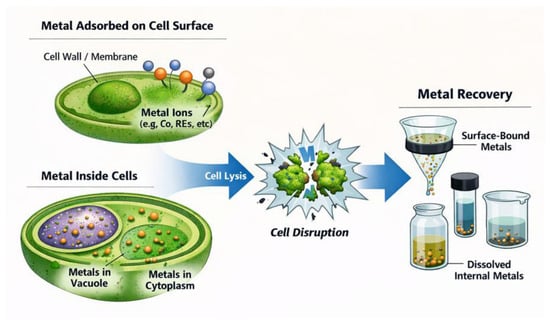
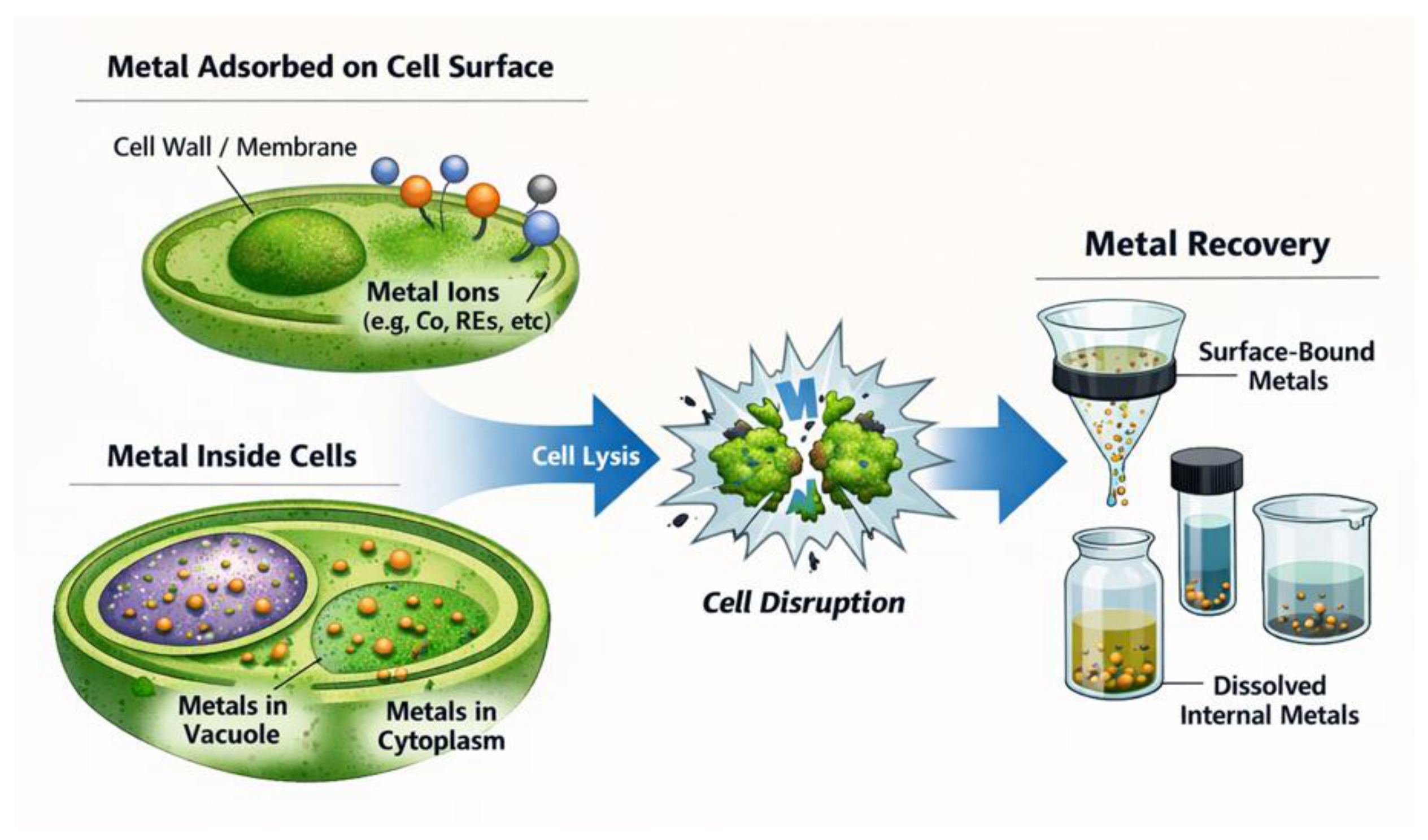
Biomass derived from bioremediation processes is increasingly recognised not as a terminal waste stream, but as a transient and selective concentrator of critical elements as sustainable and economically viable alternatives [67]. Following biosorption or bioaccumulation, metal-loaded biomass represents a secondary resource from which lithium (Li), cobalt (Co), and rare earth elements (REEs) can be recovered through integrated bio–hydrometallurgical strategies (Figure 2). Depending on the target metal, its localisation within the biomass, and the desired product purity, recovery may involve desorption using mineral acids or chelating agents, cell disruption techniques to release intracellularly accumulated metals, solvent extraction, ion exchange, membrane separation, electrodialysis, chemical precipitation, or thermal processing of residual biomass (Table 4). The selection of an appropriate recovery pathway requires balancing metal recovery efficiency, process selectivity, reagent consumption, energy demand, and scalability. While acid desorption remains the most widely applied laboratory-scale approach owing to its simplicity and high recovery efficiency, more selective technologies such as solvent extraction and ion exchange are often required to achieve the purity specifications needed for industrial applications. Importantly, where metal concentrations permit, the residual biomass may retain value as a feedstock for bioenergy, biochar, fertilisers, biostimulants, pigments, or other bioproducts, thereby improving overall process economics and supporting circular bioeconomy objectives.
Figure 2.
Schematic conceptual illustration of metal distribution and recovery pathways in microalgal systems. Metal ions (e.g., Li+, Co2+ and rare earth elements, REEs) are initially associated with the cell surface through adsorption to functional groups present on the cell wall and membrane (e.g., carboxyl, hydroxyl and extracellular polymeric substances). This figure was created by the authors with the assistance of AI-based tools for graphical visualisation. All scientific content and interpretation were validated by the authors.
Table 4.
Post-harvest metal recovery technologies applicable to microalgal and cyanobacterial biomass.
The hydrometallurgical route comprises sequential leaching and downstream separation/purification stages. Initially, metals are mobilised from the biomass matrix. Depending on their localisation (e.g., intracellular, cell wall–bound, or membrane-associated), this may require cell disruption and/or chemical leaching to solubilise the target metals into an aqueous phase. Once transferred into solution, metals are recovered and purified [68].
The primary association of metals occurs at the cell wall, where functional groups facilitate metal binding. Because of this, the recovery pathway is governed primarily by the physicochemical nature of metal–biomass interactions, which contain negatively charged functional groups [38]. Surface-bound metals are typically associated with the composition of microalgae cell membranes, with many functional groups, such as hydroxyl, carboxyl, amino, and ketone, which provide binding sites for the metals to attach [72].
This bonding can often be reversibly desorbed using mild eluents, including dilute mineral acids, organic acids (e.g., citrate), or saline solutions [73,74,75]. For example, Kuyucak and Volesky (1989) [76] showed that CaCl2 solution in HCl (pH 2–3) was the best eluent for desorbing cobalt (>96%) from Ascophyllum nodosum biomass. Hua et al., 2022 [21] showed that using 0.1 mol/L HNO3 as a desorption agent can recover 91.7% REEs in Spirulina biomass. In the case of Lithium, studies on desorption agents are limited, but Recepoğlu and Yüksel (2021) [77] recovered Li via desorption at 25 °C with a 1.0 M H2SO4 (97.4% recovery) using hazelnut shell waste as biosorbent material. Therefore, the adsorption–desorption approach is particularly effective for REEs and Co, which exhibit strong affinity for negatively charged and phosphorylated binding sites.
In contrast, intracellularly accumulated metals require more disruptive processing routes, including cell lysis followed by separation techniques. The most common techniques are solvent extraction [78], ion exchange [79] and selective precipitation [80,81]. However, [67] explored the separation of critical metals by membrane technology, identifying that combinations with solvent extraction techniques could increase the effectiveness.
However, most individual techniques exhibit inherent limitations, necessitating their integration into combined or hybrid processes, particularly when treating complex solutions containing multiple target elements requiring selective separation and purification. Future advancements in this field will likely depend on enhancing binding selectivity through biomass engineering, improving desorption efficiency, and developing scalable, economically viable process configurations capable of bridging the gap between laboratory-scale performance and industrial implementation.
5.1. Co-Design Framework for Microalgal Metal Recovery
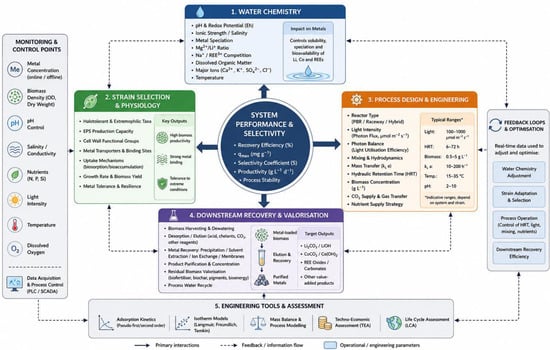
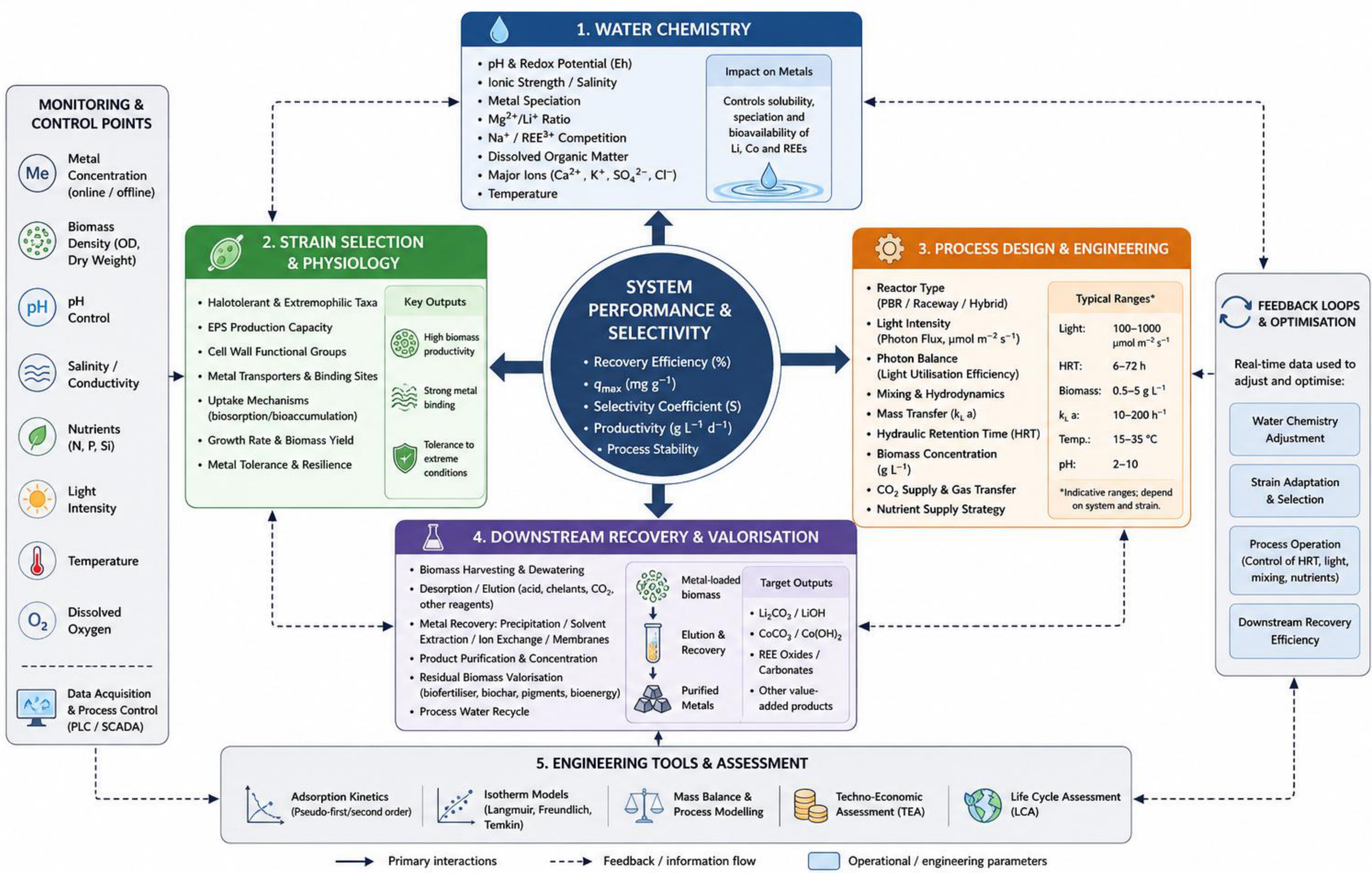
The recovery of critical metals from complex saline and industrial wastewaters using microalgal systems cannot be optimised through biological, chemical, or engineering parameters in isolation (Figure 3). Instead, system performance is governed by the interaction of these factors, requiring a co-design approach that integrates strain physiology, water chemistry, process configuration, and downstream recovery strategies [67].
Figure 3.
Co-design framework for selective recovery of lithium, cobalt and rare earth elements using microalgal and cyanobacterial systems.
Four interdependent design domains can be identified:
- (i)
- Strain selection and physiological traits.The choice of microalgal or cyanobacterial species determines tolerance to salinity, pH, temperature, and metal toxicity, as well as the dominant metal uptake mechanisms. Extremophilic species such as Galdieria sulphuraria are suited to acidic, metal-rich environments, while halotolerant taxa such as Nannochloropsis perform well in saline systems. Cyanobacteria such as Synechococcus elongatus offer rapid biosorption kinetics and adaptability to photobioreactor systems [48]. In addition, strain-specific properties such as extracellular polymeric substance (EPS) production, cell wall composition, and transport systems directly influence metal binding capacity and selectivity.
- (ii)
- Water chemistry and metal speciation.The physicochemical characteristics of the target wastewater strongly influence metal availability and recovery efficiency. Key parameters include ionic strength, pH, redox conditions, and the presence of competing ions such as Na+, Mg2+, and Ca2+. For example, lithium remains predominantly as a highly hydrated Li+ ion with weak binding affinity, whereas Co2+ and REE3+ exhibit stronger interactions with negatively charged functional groups [65]. High Mg/Li ratios and chloride complexation in brines significantly reduce selectivity, requiring tailored process strategies.
- (iii)
- Process configuration and reactor design.Operational parameters such as biomass concentration, hydraulic retention time, light availability, and mixing regime influence both uptake kinetics and overall system productivity. Batch systems may favour high removal efficiencies under controlled conditions, whereas continuous or semi-continuous systems are more suitable for industrial applications. Reactor design must also account for mass transfer limitations and light distribution, particularly in high-density cultures.
- (iv)
- Downstream recovery and metal extraction.The recovery of metals from biomass is a critical step that determines overall process viability. Surface-bound metals can be desorbed using mild eluents, whereas intracellular metals require more intensive processing such as cell disruption and hydrometallurgical separation [25,38]. The integration of biosorption with downstream techniques such as solvent extraction, ion exchange, or membrane separation is essential to achieve selective recovery and produce marketable products [69,70,71].
These four domains are highly interconnected. For instance, water chemistry dictates metal speciation, which influences the effectiveness of specific biological uptake mechanisms, while process configuration determines exposure time and biomass productivity. As such, the performance of microalgal systems is best understood as the result of coupled interactions rather than independent variables.
This co-design framework highlights that microalgal technologies are unlikely to succeed as standalone solutions but instead should be implemented as integrated components within hybrid treatment systems, particularly for the recovery of high-value metals such as cobalt and rare earth elements from complex waste streams [42,43,67].
The framework integrates four interdependent domains: water chemistry, strain selection, process design and downstream recovery. System performance is determined by interactions between metal speciation, competing ions, biomass physiology, reactor operation and metal recovery pathways. Engineering parameters including hydraulic retention time (HRT), biomass concentration, light availability, mass transfer and recovery efficiency are incorporated alongside process monitoring and feedback loops to support optimisation and scale-up. The framework may be applied to both batch and continuous treatment systems and provides a basis for future techno-economic assessment (TEA) and life cycle assessment (LCA) studies.
5.2. Techno-Economic Considerations and LCA
Microalgal recovery systems offer potential advantages over conventional hydrometallurgical processes through simultaneous wastewater treatment, carbon capture, and resource recovery (Figure 3). However, economic feasibility remains highly dependent on cultivation costs, biomass productivity, harvesting efficiency, and downstream metal recovery. Capital expenditure (CAPEX) is primarily associated with photobioreactors, mixing systems, CO2 delivery infrastructure, and harvesting equipment, while operational expenditure (OPEX) is dominated by energy consumption for mixing, pumping, dewatering, and biomass processing. Compared with direct lithium extraction (DLE), solvent extraction, and ion exchange technologies, biological systems generally exhibit lower chemical consumption but require longer residence times and larger treatment footprints [81]. The economic viability of microalgal systems may be improved through the valorisation of residual biomass as biofertilisers, biostimulants, pigments, biochar, or bioenergy feedstocks. Future studies should incorporate integrated techno-economic assessment (TEA) and life cycle assessment (LCA) to identify economically optimal process configurations and evaluate commercial deployment potential [82].
Although biological recovery processes are generally regarded as environmentally favourable compared with conventional mining and hydrometallurgical operations, their overall sustainability remains insufficiently quantified. Large-scale cultivation systems require energy for mixing, aeration, harvesting, and dewatering, while open systems may present risks of nutrient losses and eutrophication. Comprehensive life cycle assessment studies are therefore needed to evaluate carbon footprint, water consumption, nutrient requirements, land use, and environmental trade-offs associated with microalgal recovery systems. Integrating metal recovery with wastewater treatment and CO2 utilisation may substantially improve overall environmental performance.
6. Research Gaps
Despite significant advances in laboratory-scale studies, several fundamental limitations constrain the implementation of microalgal systems for critical metal recovery. A primary challenge is the low intrinsic selectivity of biological systems, particularly for lithium, which exhibits high hydration energy and limited interaction with functional groups on biomass surfaces. In contrast, divalent and trivalent cations such as Co2+ and REE3+ display stronger affinity for negatively charged ligands, leading to preferential adsorption. Additionally, high ionic strength in saline systems introduces strong competition from abundant ions such as Na+, Mg2+, and Ca2+, which significantly reduces effective binding capacity. This is particularly critical in lithium-rich brines, where Mg/Li ratios can exceed 10–100, making selective recovery extremely challenging. From an engineering perspective, most reported systems remain at low technology readiness levels (TRL 2–4), with limited pilot-scale validation. Key bottlenecks include biomass harvesting, regeneration efficiency, and integration with downstream recovery processes. Future research should focus on improving selectivity through strain engineering, optimising hybrid bio–physicochemical systems, and developing scalable reactor configurations tailored to specific wastewater chemistries. Future strain engineering strategies may include overexpression of phosphate and metal transporter proteins, enhanced production of extracellular polymeric substances (EPSs), modification of cell-wall functional groups, and improved tolerance to salinity, acidity, and metal toxicity. However, deployment of genetically modified microalgae remains subject to regulatory restrictions, biosafety considerations, and public acceptance challenges, particularly for open cultivation systems.
7. Conclusions
The accelerating global transition toward electrified energy systems is driving unprecedented demand for critical minerals such as lithium, cobalt, and rare earth elements. At the same time, conventional extraction pathways face increasing environmental, geopolitical, and resource constraints. High-salinity industrial and natural wastewaters, including geothermal brines, desalination concentrates, metallurgical effluents, and acid mine drainage, represent an underexploited reservoir of dissolved critical elements. This review highlights the emerging potential of microalgal and cyanobacterial systems as biological platforms capable of interacting with metal ions in complex aqueous environments through mechanisms including biosorption, bioaccumulation, and extracellular polymeric substance binding. Despite promising laboratory-scale results, significant challenges remain, including low metal concentrations, competition from dominant ions in hypersaline matrices, and the need for scalable cultivation and recovery systems. With appropriate co-design across biological and engineering domains, microalgal processes could contribute to transforming saline industrial wastewaters from environmental liabilities into valuable secondary resources, supporting more resilient and circular critical-material supply chains. Nannochloropsis offers robust remediation capacity, Galdieria enables high-value metal accumulation under extreme conditions, and cyanobacteria provide rapid biosorption kinetics. Integrated platforms combining these traits could support sustainable, circular recovery of strategic metals from high-salinity mine waters.
Despite encouraging laboratory-scale results, the commercial implementation of microalgal critical metal recovery remains constrained by limited field validation, insufficient techno-economic assessment, and a lack of comprehensive life cycle studies. Future research should prioritise pilot-scale demonstrations using authentic industrial wastewaters and integrated assessments of economic and environmental performance.
Author Contributions
Conceptualisation, A.S., J.I.G.-P. and K.W.T.; methodology, A.S. and J.I.G.-P.; validation, all authors; formal analysis, A.S.; investigation, A.S. and J.I.G.-P.; resources, K.W.T.; data curation, A.S.; writing—original draft preparation, A.S.; writing—review and editing, all authors; visualisation, J.I.G.-P.; supervision, A.S. and K.W.T.; project administration, A.S.; funding acquisition, A.S. and K.W.T. All authors have read and agreed to the published version of the manuscript.
Funding
This work was supported by UK Research and Innovation Building a Green Future strategic theme [grant number UKRI239]. Additional support for international collaboration development was provided through the ELEMENTAL Catalysing New UK-US Critical Minerals Research Partnerships Funding,- CM2025-12 Travel Grants & Short-Term Exchange funding programme, delivered in partnership with the UK Science and Technology Network.
Data Availability Statement
No new data were created or analysed in this study. Data sharing is not applicable to this article.
Acknowledgments
The authors gratefully acknowledge support from Swansea University and Texas A&M University–Corpus Christi for facilitating this academic collaboration. The authors also acknowledge the use of AI-assisted tools for the generation and refinement of illustrative figures during manuscript preparation.
Conflicts of Interest
The authors declare no conflicts of interest. The funders had no role in the design of the study; in the collection, analysis, or interpretation of information; in the writing of the manuscript; or in the decision to publish the results.
References
- Heydari, M.; Mitchell, P.; Cullen, L.; Andrieu, B.; Serrenho, A.C.; Cullen, J. A Systematic Review of Resilience in the Critical Minerals Supply Chains, Needed for the Low-Carbon Energy Transition. Renew. Sustain. Energy Transit. 2025, 8, 100127. [Google Scholar] [CrossRef] [Scilit]
- Bahini, Y.; Mushtaq, R.; Bahoo, S. Global Energy Transition: The Vital Role of Cobalt in Renewable Energy. J. Clean. Prod. 2024, 470, 143306. [Google Scholar] [CrossRef] [Scilit]
- International Energy Agency (IEA). Global Critical Minerals Outlook 2025; International Energy Agency (IEA): Paris, France, 2025. [Google Scholar]
- Das, J.; Young, M.H.; Gülen, G.; Harner, Z.Q.; Singh, S. Lithium Supply Chains: Environmental Impacts and Trade-Offs Analysis Using Life Cycle Assessment and Multi-Criteria Decision Making. Energy Rep. 2025, 13, 6566–6583. [Google Scholar] [CrossRef] [Scilit]
- Jin, P.; Wang, S.; Meng, Z.; Chen, B. China’s Lithium Supply Chains: Network Evolution and Resilience Assessment. Resour. Policy 2023, 87, 104339. [Google Scholar] [CrossRef] [Scilit]
- European Commission. Critical Raw Materials Resilience: Charting a Path towards Greater Security and Sustainability; Communication from the Commission to the European Parliament, the Council, the European Economic and Social Committee and the Committee of the Regions, COM(2020) 474 Final; European Commission: Brussels, Belgium, 2020; Available online: https://eur-lex.europa.eu/legal-content/EN/TXT/PDF/?uri=CELEX:52020DC0474 (accessed on 30 April 2026).
- European Parliament and Council of the European Union. Regulation (EU) 2024/1252 Establishing a Framework for Ensuring a Secure and Sustainable Supply of Critical Raw Materials (Critical Raw Materials Act). Official Journal of the European Union. 2024. Available online: http://data.europa.eu/eli/reg/2024/1252/oj (accessed on 30 April 2026).
- European Parliament and Council. Directive 2000/60/EC Establishing a Framework for Community Action in the Field of Water Policy (Water Framework Directive). Off. J. Eur. Communities 2000, L327, 1–73. Available online: http://data.europa.eu/eli/dir/2000/60/oj (accessed on 30 April 2026).
- European Parliament and Council. Directive 2006/21/EC on the Management of Waste from Extractive Industries. Off. J. Eur. Union 2006, L102, 15–34. Available online: http://data.europa.eu/eli/dir/2006/21/oj (accessed on 30 April 2026).
- European Parliament and Council. Directive 2010/75/EU on Industrial Emissions (Integrated Pollution Prevention and Control). Off. J. Eur. Union 2010, L334, 17–119. Available online: http://data.europa.eu/eli/dir/2010/75/oj (accessed on 30 April 2026).
- U.S. Congress. Infrastructure Investment and Jobs Act; (Public Law 117–58); U.S. Government Publishing Office: Washington, DC, 2021. Available online: https://www.congress.gov/117/plaws/publ58/PLAW-117publ58.pdf (accessed on 30 April 2026).
- UK Government. UK Critical Minerals Strategy; Department for Business, Energy and Industrial Strategy (BEIS): London, UK, 2022. Available online: https://www.gov.uk/government/publications/uk-critical-mineral-strategy/resilience-for-the-future-the-uks-critical-minerals-strategy (accessed on 30 April 2026).
- UK Parliament. Environment Act 2021; The Stationery Office: London, UK, 2021. Available online: https://www.legislation.gov.uk/ukpga/2021/30/contents (accessed on 30 April 2026).
- UK Government. The Mining Waste (England and Wales) Regulations 2009 (SI 2009/1810); The Stationery Office: London, UK, 2009. Available online: https://www.legislation.gov.uk/ukdsi/2009/9780111479360 (accessed on 30 April 2026).
- UK Government. Our Waste, Our Resources: A Strategy for England; Department for Environment, Food & Rural Affairs (Defra): London, UK, 2018. Available online: https://assets.publishing.service.gov.uk/media/5c18f11740f0b60bbee0d827/resources-waste-strategy-dec-2018.pdf (accessed on 30 April 2026).
- Ali, A.; Afrin, S.; Asif, A.H.; Arafat, Y.; Azhar, M.R. A Comprehensive Review on the Recovery of Lithium from Lithium-Ion Batteries and Spodumene. J. Environ. Manag. 2025, 391, 126512. [Google Scholar] [CrossRef] [Scilit] [PubMed]
- Kumar, A.; Fukuda, H.; Hatton, T.A.; Lienhard, J.H. Lithium Recovery from Oil and Gas Produced Water: A Need for a Growing Energy Industry. ACS Energy Lett. 2019, 4, 1471–1474. [Google Scholar] [CrossRef] [Scilit]
- Stringfellow, W.T.; Dobson, P.F. Technology for the Recovery of Lithium from Geothermal Brines. Energies 2021, 14, 6805. [Google Scholar] [CrossRef] [Scilit]
- Ettehadi, A.; Chuprin, M.; Mokhtari, M.; Gang, D.; Wortman, P.; Heydari, E. Geological Insights into Exploration and Extraction of Lithium from Oilfield Produced-Water in the USA: A Review. Energy Fuels 2024, 38, 10517–10541. [Google Scholar] [CrossRef] [Scilit]
- Lee, J.; Lee, S. Challenges, Opportunities, and Technological Advances in Desalination Brine Mining: A Mini Review. Adv. Ind. Eng. Chem. 2025, 1, 7. [Google Scholar] [CrossRef] [Scilit]
- Hua, Q.; Guo, H.; Wang, D.; Huang, Y.; Cao, Y.; Peng, W.; Fan, G. A New Strategy for Selective Recovery of Low Concentration Cobalt Ions from Wastewater: Based on Selective Chelating Precipitation-Flotation Process. J. Taiwan Inst. Chem. Eng. 2022, 141, 104605. [Google Scholar] [CrossRef] [Scilit]
- Ziwa, G.; Crane, R.; Hudson-Edwards, K.A. Geochemistry, Mineralogy and Microbiology of Cobalt in Mining-Affected Environments. Minerals 2020, 11, 22. [Google Scholar] [CrossRef] [Scilit]
- Moats, M.S.; Davenport, W.G. Nickel and Cobalt Production. In Treatise on Process Metallurgy; Elsevier: Amsterdam, The Netherlands, 2014; pp. 625–669. [Google Scholar]
- Peng, C.; Liu, F.; Aji, A.T.; Wilson, B.P.; Lundström, M. Extraction of Li and Co from Industrially Produced Li-Ion Battery Waste—Using the Reductive Power of Waste Itself. Waste Manag. 2019, 95, 604–611. [Google Scholar] [CrossRef] [Scilit] [PubMed]
- Binnemans, K.; Jones, P.T.; Müller, T.; Yurramendi, L. Rare Earths and the Balance Problem: How to Deal with Changing Markets? J. Sustain. Metall. 2018, 4, 126–146. [Google Scholar] [CrossRef] [Scilit]
- Ayora, C.; Macías, F.; Torres, E.; Lozano, A.; Carrero, S.; Nieto, J.-M.; Pérez-López, R.; Fernández-Martínez, A.; Castillo-Michel, H. Recovery of Rare Earth Elements and Yttrium from Passive-Remediation Systems of Acid Mine Drainage. Environ. Sci. Technol. 2016, 50, 8255–8262. [Google Scholar] [CrossRef] [Scilit] [PubMed]
- Peiravi, M.; Dehghani, F.; Ackah, L.; Baharlouei, A.; Godbold, J.; Liu, J.; Mohanty, M.; Ghosh, T. A Review of Rare-Earth Elements Extraction with Emphasis on Non-Conventional Sources: Coal and Coal Byproducts, Iron Ore Tailings, Apatite, and Phosphate Byproducts. Min. Metall. Explor. 2021, 38, 1–26. [Google Scholar] [CrossRef] [Scilit]
- Zhang, W.; Noble, A.; Yang, X.; Honaker, R. A Comprehensive Review of Rare Earth Elements Recovery from Coal-Related Materials. Minerals 2020, 10, 451. [Google Scholar] [CrossRef] [Scilit]
- Fischer, C.B.; Körsten, S.; Rösken, L.M.; Cappel, F.; Beresko, C.; Ankerhold, G.; Schönleber, A.; Geimer, S.; Ecker, D.; Wehner, S. Cyanobacterial Promoted Enrichment of Rare Earth Elements Europium, Samarium and Neodymium and Intracellular Europium Particle Formation. RSC Adv. 2019, 9, 32581–32593. [Google Scholar] [CrossRef] [Scilit] [PubMed]
- Paper, M.; Jung, P.; Koch, M.; Lakatos, M.; Nilges, T.; Brück, T.B. Stripped: Contribution of Cyanobacterial Extracellular Polymeric Substances to the Adsorption of Rare Earth Elements from Aqueous Solutions. Front. Bioeng. Biotechnol. 2023, 11, 1299349. [Google Scholar] [CrossRef] [Scilit] [PubMed]
- Minoda, A.; Sawada, H.; Suzuki, S.; Miyashita, S.; Inagaki, K.; Yamamoto, T.; Tsuzuki, M. Recovery of Rare Earth Elements from the Sulfothermophilic Red Alga Galdieria Sulphuraria Using Aqueous Acid. Appl. Microbiol. Biotechnol. 2015, 99, 1513–1519. [Google Scholar] [CrossRef] [Scilit] [PubMed]
- Singh, A.; Čížková, M.; Náhlík, V.; Mezricky, D.; Schild, D.; Rucki, M.; Vítová, M. Bio-Removal of Rare Earth Elements from Hazardous Industrial Waste of CFL Bulbs by the Extremophile Red Alga Galdieria Sulphuraria. Front. Microbiol. 2023, 14, 1130848. [Google Scholar] [CrossRef] [Scilit] [PubMed]
- Palmieri, M.; Iovinella, M.; Davis, S.J.; di Cicco, M.R.; Lubritto, C.; Race, M.; Papa, S.; Fabbricino, M.; Ciniglia, C. Galdieria Sulphuraria ACUF427 Freeze-Dried Biomass as Novel Biosorbent for Rare Earth Elements. Microorganisms 2022, 10, 2138. [Google Scholar] [CrossRef] [Scilit] [PubMed]
- Yushin, N.; Zinicovscaia, I.; Cepoi, L.; Chiriac, T.; Rudi, L.; Grozdov, D. Biosorption and Bioaccumulation Capacity of Arthospiraplatensis toward Europium Ions. Water 2022, 14, 2128. [Google Scholar] [CrossRef] [Scilit]
- Pinto, J.; Henriques, B.; Soares, J.; Costa, M.; Dias, M.; Fabre, E.; Lopes, C.B.; Vale, C.; Pinheiro-Torres, J.; Pereira, E. A Green Method Based on Living Macroalgae for the Removal of Rare-Earth Elements from Contaminated Waters. J. Environ. Manag. 2020, 263, 110376. [Google Scholar] [CrossRef] [Scilit] [PubMed]
- Pinto, J.; Colónia, J.; Abdolvaseei, A.; Vale, C.; Henriques, B.; Pereira, E. Algal Sorbents and Prospects for Their Application in the Sustainable Recovery of Rare Earth Elements from E-Waste. Environ. Sci. Pollut. Res. 2023, 30, 74521–74543. [Google Scholar] [CrossRef] [Scilit] [PubMed]
- Kang, J.-K.; Pham, B.N.; Lee, C.-G.; Park, S.-J. Biosorption of Cd2+, Cu2+, Ni2+, Pb2+ by Four Different Macroalgae Species (Costaria Costata, Hizikia Fusiformis, Gracilaria Verrucosa, and Codium Fragile). Int. J. Environ. Sci. Technol. 2023, 20, 10113–10122. [Google Scholar] [CrossRef] [Scilit]
- Monteiro, C.M.; Castro, P.M.L.; Malcata, F.X. Metal Uptake by Microalgae: Underlying Mechanisms and Practical Applications. Biotechnol. Prog. 2012, 28, 299–311. [Google Scholar] [CrossRef] [Scilit] [PubMed]
- Ebin, B.; Isik, M.I. Pyrometallurgical Processes for the Recovery of Metals from WEEE. In WEEE Recycling; Elsevier: Amsterdam, The Netherlands, 2016; pp. 107–137. [Google Scholar]
- Gong, J.; Pan, J.; Zhao, J.; Zhang, Q.; Hao, G.; Liu, Y.; Yu, H. Selective Recovery and Enrichment of Cobalt from Cobalt-Containing Slag by Carbothermal Reduction. Metals 2025, 15, 622. [Google Scholar] [CrossRef] [Scilit]
- Harvey, J.-P.; Courchesne, W.; Vo, M.D.; Oishi, K.; Robelin, C.; Mahue, U.; Leclerc, P.; Al-Haiek, A. Greener Reactants, Renewable Energies and Environmental Impact Mitigation Strategies in Pyrometallurgical Processes: A Review. MRS Energy Sustain. 2022, 9, 212–247. [Google Scholar] [CrossRef] [Scilit] [PubMed]
- Nancharaiah, Y.V.; Mohan, S.V.; Lens, P.N.L. Biological and Bioelectrochemical Recovery of Critical and Scarce Metals. Trends Biotechnol. 2016, 34, 137–155. [Google Scholar] [CrossRef] [Scilit] [PubMed]
- Cozma, P.; Bețianu, C.; Hlihor, R.-M.; Simion, I.M.; Gavrilescu, M. Bio-Recovery of Metals through Biomining within Circularity-Based Solutions. Processes 2024, 12, 1793. [Google Scholar] [CrossRef] [Scilit]
- Watling, H. Review of Biohydrometallurgical Metals Extraction from Polymetallic Mineral Resources. Minerals 2014, 5, 1. [Google Scholar] [CrossRef] [Scilit]
- Rocha, J.M.S.; Garcia, J.E.C.; Henriques, M.H.F. Growth Aspects of the Marine Microalga Nannochloropsis Gaditana. Biomol. Eng. 2003, 20, 237–242. [Google Scholar] [CrossRef] [Scilit] [PubMed]
- Zanella, L.; Vianello, F. Microalgae of the Genus Nannochloropsis: Chemical Composition and Functional Implications for Human Nutrition. J. Funct. Foods 2020, 68, 103919. [Google Scholar] [CrossRef] [Scilit]
- Cecchin, M.; Berteotti, S.; Paltrinieri, S.; Vigliante, I.; Iadarola, B.; Giovannone, B.; Maffei, M.E.; Delledonne, M.; Ballottari, M. Improved Lipid Productivity in Nannochloropsis Gaditana in Nitrogen-Replete Conditions by Selection of Pale Green Mutants. Biotechnol. Biofuels 2020, 13, 78. [Google Scholar] [CrossRef] [Scilit] [PubMed]
- Volesky, B. Biosorption and Me. Water Res. 2007, 41, 4017–4029. [Google Scholar] [CrossRef] [Scilit] [PubMed]
- Kucuker, M.A.; Wieczorek, N.; Kuchta, K.; Copty, N.K. Biosorption of Neodymium on Chlorella Vulgaris in Aqueous Solution Obtained from Hard Disk Drive Magnets. PLoS ONE 2017, 12, e0175255. [Google Scholar] [CrossRef] [Scilit] [PubMed]
- Laroche, C. Exopolysaccharides from Microalgae and Cyanobacteria: Diversity of Strains, Production Strategies, and Applications. Mar. Drugs 2022, 20, 336. [Google Scholar] [CrossRef] [Scilit] [PubMed]
- Babiak, W.; Krzemińska, I. Extracellular Polymeric Substances (EPS) as Microalgal Bioproducts: A Review of Factors Affecting EPS Synthesis and Application in Flocculation Processes. Energies 2021, 14, 4007. [Google Scholar] [CrossRef] [Scilit]
- Kumar, D.; Kastanek, P.; Adhikary, S.P. Exopolysaccharides from Cyanobacteria and Microalgae and Their Commercial Application. Curr. Sci. 2018, 115, 234. [Google Scholar] [CrossRef] [Scilit]
- Ciani, M.; Adessi, A. Cyanoremediation and Phyconanotechnology: Cyanobacteria for Metal Biosorption toward a Circular Economy. Front. Microbiol. 2023, 14, 1166612. [Google Scholar] [CrossRef] [Scilit] [PubMed]
- Balzano, S.; Sardo, A.; Blasio, M.; Chahine, T.B.; Dell’Anno, F.; Sansone, C.; Brunet, C. Microalgal Metallothioneins and Phytochelatins and Their Potential Use in Bioremediation. Front. Microbiol. 2020, 11, 517. [Google Scholar] [CrossRef] [Scilit] [PubMed]
- Plouviez, M.; Guieysse, B.; Wolmarans, K.; Matinong, A.M.E.; Buwalda, O.; Thånell, K.; Beinik, I.; Tuyishime, J.R.M.; Mitchell, V.; Kappen, P.; et al. Microalgae for the Extraction and Separation of Rare Earths: An STXM Study of Ce, Gd, and P. ACS Sustain. Resour. Manag. 2024, 1, 2225–2233. [Google Scholar] [CrossRef] [Scilit]
- Razzak, S.A.; Faruque, M.O.; Alsheikh, Z.; Alsheikhmohamad, L.; Alkuroud, D.; Alfayez, A.; Hossain, S.M.Z.; Hossain, M.M. A Comprehensive Review on Conventional and Biological-Driven Heavy Metals Removal from Industrial Wastewater. Environ. Adv. 2022, 7, 100168. [Google Scholar] [CrossRef] [Scilit]
- Manfredi, C.; Amoruso, A.J.; Ciniglia, C.; Giarra, A.; Iovinella, M.; Lombardo, F.; Marano, A.; Mondillo, N.; Pinto, G.; de Ballesteros, O.R.; et al. Rare Earth Elements Recovery from Bauxite by Biosorption onto Galdieria Sulphuraria: A Challenging Case of Study. J. Environ. Chem. Eng. 2025, 13, 117781. [Google Scholar] [CrossRef] [Scilit]
- Jean Felisco, R.M.; Billacura, M.P. Biosorption Mechanism of Microalgae Nannochloropsis Oculata and the Effect of Pb on Its Photosynthetic Activity. Sci. Int. 2018, 30, 115–119. [Google Scholar]
- Alshididi, S.S.B.; Al-Mashhadani, M.K.H.; Abed, I.J. Wastewater Treatment by the Cyanobacterium Species: Synechococcus Elongatus as Biosorption Material for Pb, Cr and Ni Heavy Metals. Asian J. Water Environ. Pollut. 2024, 21, 111. [Google Scholar] [CrossRef] [Scilit]
- Viana, T.; Ferreira, N.; Tavares, D.S.; Abdolvaseei, A.; Pereira, E.; Henriques, B. Eco-Friendly Methodology for Removing and Recovering Rare Earth Elements from Saline Industrial Wastewater. Environ. Sci. Pollut. Res. 2023, 30, 96617–96628. [Google Scholar] [CrossRef] [Scilit] [PubMed]
- Urrutia, C.; Yañez-Mansilla, E.; Jeison, D. Bioremoval of Heavy Metals from Metal Mine Tailings Water Using Microalgae Biomass. Algal Res. 2019, 43, 101659. [Google Scholar] [CrossRef] [Scilit]
- del Martínez-Macias, M.R.; Nateras-Ramírez, O.; López-Cervantes, J.; Sánchez-Machado, D.I.; Corona-Martínez, D.O.; Sánchez-Duarte, R.G.; Correa-Murrieta, M.A.; Aguilar-Ruiz, R.J. Effect of Pretreatment on Cd(II) and Pb(II) Biosorption by Nannochloropsis Oculata Microalgae Biomass. J. Appl. Phycol. 2024, 36, 1339–1352. [Google Scholar] [CrossRef] [Scilit]
- Parsy, A.; Sambusiti, C.; Baldoni-Andrey, P.; Elan, T.; Périé, F. Cultivation of Nannochloropsis Oculata in Saline Oil & Gas Wastewater Supplemented with Anaerobic Digestion Effluent as Nutrient Source. Algal Res. 2020, 50, 101966. [Google Scholar] [CrossRef] [Scilit]
- Dudeja, C.; Masroor, S.; Mishra, V.; Kumar, K.; Sansar, S.; Yadav, P.; Chaturvedi, N.; Singh, R.; Kumar, A. Cyanobacteria-Based Bioremediation of Environmental Contaminants: Advances and Computational Insights. Discov. Agric. 2025, 3, 42. [Google Scholar] [CrossRef] [Scilit]
- Sarker, N.K.; Kaparaju, P. Integrated Multi-Technology Framework for Algal Wastewater Treatment: A Comprehensive Review of Biofilm Reactors, Nano-Enhancement, AI Optimization, and 3D-Printed Architectures. ChemEngineering 2025, 9, 111. [Google Scholar] [CrossRef] [Scilit]
- Kastenhofer, J.; Spadiut, O.; Papangelakis, V.G.; Allen, D.G. Roles of PH and Phosphate in Rare Earth Element Biosorption with Living Acidophilic Microalgae. Appl. Microbiol. Biotechnol. 2024, 108, 262. [Google Scholar] [CrossRef] [Scilit] [PubMed]
- Botelho Junior, A.B.; Tenório, J.A.S.; Espinosa, D.C.R. Separation of Critical Metals by Membrane Technology under a Circular Economy Framework: A Review of the State-of-the-Art. Processes 2023, 11, 1256. [Google Scholar] [CrossRef] [Scilit]
- Mehta, K.; Jaiswal, D.; Nayak, M.; Prasannan, C.B.; Wangikar, P.P.; Srivastava, S. Elevated Carbon Dioxide Levels Lead to Proteome-Wide Alterations for Optimal Growth of a Fast-Growing Cyanobacterium, Synechococcus Elongatus PCC 11801. Sci. Rep. 2019, 9, 6257. [Google Scholar] [CrossRef] [Scilit] [PubMed]
- Vera, M.L.; Torres, W.R.; Galli, C.I.; Chagnes, A.; Flexer, V. Environmental Impact of Direct Lithium Extraction from Brines. Nat. Rev. Earth Environ. 2023, 4, 149–165. [Google Scholar] [CrossRef] [Scilit]
- Ahmed, M.; Oatley-Radcliffe, D.; Williams, P.M. Reverse Osmosis Brine Concentration Using Falling Film Freeze Crystallization Technology: A Pilot-Scale Study. Desalin. Water Treat. 2020, 203, 11–34. [Google Scholar] [CrossRef] [Scilit]
- Nayar, K.G.; Lienhard V, J.H. Brackish Water Desalination for Greenhouse Agriculture: Comparing the Costs of RO, CCRO, EDR, and Monovalent-Selective EDR. Desalination 2020, 475, 114188. [Google Scholar] [CrossRef] [Scilit]
- Wang, J.; Chen, C. Biosorbents for Heavy Metals Removal and Their Future. Biotechnol. Adv. 2009, 27, 195–226. [Google Scholar] [CrossRef] [Scilit] [PubMed]
- Hammaini, A.; González, F.; Ballester, A.; Blázquez, M.L.; Muñoz, J.A. Biosorption of Heavy Metals by Activated Sludge and Their Desorption Characteristics. J. Environ. Manag. 2007, 84, 419–426. [Google Scholar] [CrossRef] [Scilit] [PubMed]
- Wang, X.; Xia, S.; Chen, L.; Zhao, J.; Chovelon, J.; Nicole, J. Biosorption of Cadmium(II) and Lead(II) Ions from Aqueous Solutions onto Dried Activated Sludge. J. Environ. Sci. 2006, 18, 840–844. [Google Scholar] [CrossRef] [Scilit] [PubMed]
- Wei, L.; Li, J.; Xue, M.; Wang, S.; Li, Q.; Qin, K.; Jiang, J.; Ding, J.; Zhao, Q. Adsorption Behaviors of Cu2+, Zn2+ and Cd2+ onto Proteins, Humic Acid, and Polysaccharides Extracted from Sludge EPS: Sorption Properties and Mechanisms. Bioresour. Technol. 2019, 291, 121868. [Google Scholar] [CrossRef] [Scilit] [PubMed]
- Kuyucak, N.; Volesky, B. Desorption of Cobalt-laden Algal Biosorbent. Biotechnol. Bioeng. 1989, 33, 815–822. [Google Scholar] [CrossRef] [Scilit] [PubMed]
- Recepoğlu, Y.K.; Yüksel, A. Phosphorylated Hazelnut Shell Waste for Sustainable Lithium Recovery Application as Biosorbent. Cellulose 2021, 28, 9837–9855. [Google Scholar] [CrossRef] [Scilit]
- Tunsu, C.; Menard, Y.; Eriksen, D.Ø.; Ekberg, C.; Petranikova, M. Recovery of Critical Materials from Mine Tailings: A Comparative Study of the Solvent Extraction of Rare Earths Using Acidic, Solvating and Mixed Extractant Systems. J. Clean. Prod. 2019, 218, 425–437. [Google Scholar] [CrossRef] [Scilit]
- Leguay, S.; Campbell, P.G.C.; Fortin, C. Determination of the Free-Ion Concentration of Rare Earth Elements by an Ion-Exchange Technique: Implementation, Evaluation and Limits. Environ. Chem. 2016, 13, 478–488. [Google Scholar] [CrossRef] [Scilit]
- Cardenas Restrepo, E.A. Selective Recovery of Critical Minerals (Ni, Zn, Co, and Mn) From Acid Mine Drainage Utilizing Ion Exchange and Selective Precipitation Processes. Master’s Thesis, West Virginia University Libraries, Morgantown, WV, USA, 2025. [Google Scholar]
- Vaziri Hassas, B.; Rezaee, M. Selective Precipitation of Rare Earth and Critical Elements from Acid Mine Drainage—Part II: Mechanistic Effect of Ligands in Staged Precipitation Process. Resour. Conserv. Recycl. 2023, 188, 106655. [Google Scholar] [CrossRef] [Scilit]
- Quinn, J.C.; Davis, R. The potentials and challenges of algae-based biofuels: A review of the techno-economic, life cycle, and resource assessment modelling. Bioresour. Technol. 2015, 184, 444–452. [Google Scholar] [PubMed]

Disclaimer/Publisher’s Note: The statements, opinions and data contained in all publications are solely those of the individual author(s) and contributor(s) and not of MDPI and/or the editor(s). MDPI and/or the editor(s) disclaim responsibility for any injury to people or property resulting from any ideas, methods, instructions or products referred to in the content. |
© 2026 by the authors. Licensee MDPI, Basel, Switzerland. This article is an open access article distributed under the terms and conditions of the Creative Commons Attribution (CC BY) license.