


Abstract
The Anastasia River (southern Sakhalin Island) is a key salmon spawning ground, where summer storm floods can drastically alter benthic communities that form the diet of fish. This study assessed the impact of heavy rainfall on the benthic macroinvertebrates in the lower reaches of the river by analyzing taxonomic composition, biomass, and fatty acid (FA) profiles of dominant taxa before and after a flood event. A catastrophic decline in biomass was observed (from 35.7 ± 4.4 g m−2 to 1.74 ± 0.68 g m−2), alongside a significant shift in community structure. Crustaceans (dominated by Eogammarus kygi), with a unique FA profile rich in long-chain n-3 and n-6 polyunsaturated fatty acids (PUFAs), were the primary bearers of high nutritional value. All crustaceans exhibited omnivorous diets, with river crabs (Eriocheir japonica) having a broader spectrum than conspecifics inhabiting the marine littoral zone. Amphipods were key processors of allochthonous matter. The flood caused not only a quantitative but also a severe qualitative reduction in community nutritional value, with the content of physiologically crucial n-3 and n-6 PUFAs dropping by a factor of 25 and 15 on average, respectively. The disproportionately high loss of n-3 PUFAs indicates that the qualitative degradation of food resources by extreme floods may be an underestimated factor limiting the post-flood recovery of fish populations.
1. Introduction
In small river ecosystems, the trophic web is based on periphyton, which is supplemented to varying degrees by leaf litter [1,2,3]. This autochthonous and allochthonous organic matter (OM) is subsequently consumed by benthic invertebrates [4,5,6], which form the food base for ichthyofauna. The survival and growth of fish directly depend on the abundance, composition, and nutritional value of food resources. Terrestrial invertebrates can make a substantial contribution, in addition to benthic invertebrates, to fish diets, especially in small shaded rivers under conditions of limited primary food resources [7,8]. However, terrestrial invertebrates contain considerably lower levels of polyunsaturated fatty acids (PUFAs) in general and eicosapentaenoic acid (EPA, 20:5n-3) in particular, while having higher levels of linoleic acid (LIN, 18:2n-6) compared to aquatic ones [9,10]. Moreover, docosahexaenoic acid (DHA, 22:6n-3) is completely absent in terrestrial species [10,11]. Thus, periphyton and benthic invertebrates remain the key source of physiologically valuable long-chain PUFAs (LC-PUFAs) of the n-3 family, namely EPA and DHA, and other high-value compounds [6,12].
Aquatic ecosystems play a unique role in the biosphere as the primary source of EPA and DHA, which are of high physiological value for most animals [13,14,15,16]. EPA primarily serves as a substrate for the synthesis of eicosanoids (hormone-like substances), specifically, prostaglandin-3 (PGI3, PGE3, and PGH3), thromboxane-3 (TXA3 and TXB3), leukotriene-5 (LTB5), and resolvins (PE1 and PE2) [17,18,19]. Eicosanoids serve to regulate cardiovascular function, immune response, blood clotting and inflammatory processes. DHA plays a structural role in membranes, especially in neural tissue cells [20,21], and serves as a substrate for the synthesis of various resolvins, protectins, and maresins [22,23]. The prolonged absence of EPA and DHA, and additionally arachidonic acid of n-6 family (ARA, 20:4n-6) in diets leads to various pathologies: myocarditis, hepatic and intestinal steatosis, gill hemorrhage, fin erosion, spinal curvature, impaired immune response, etc. [24,25,26]. At the population level, this results in disrupted feeding behavior (increased risk of predation), decreased growth rate, and increased fish mortality [25,27]. Alpha-linolenic acid (ALA, 18:3n-3) and LIN are also physiologically important, as they serve as essential substrates for the synthesis of n-3 and n-6 LC-PUFAs in consumers [28,29].
The small rivers of southern and southeastern Sakhalin, with predominantly mountain-foothill type of channels, are key spawning areas for Pacific salmons, primarily pink (Oncorhynchus gorbuscha) and chum (Oncorhynchus keta) salmon [30]. The estuaries and lower reaches of these small rivers play a critical role in the adaptation of juveniles during their transition to the marine stage of life, as the success of smoltification depends on their hydrological regime and the quantity and biochemical quality of food resources, e.g., Refs. [31,32]. In addition to anadromous species, South Sakhalin rivers are home to a wide range of typically freshwater species that also depend on benthic fauna [33,34].
Under climate change, extreme weather events such as intense rainstorms are becoming more frequent, with some regions experiencing a pronounced increase in the intensity of short-term extreme precipitation [35]. Such regions include southern Sakhalin and the Russian Far East in general, where extreme weather events occur at higher rates [36,37]. These events lead to a rapid rise in water levels, increased current velocity and turbidity, and the restructuring of bottom substrates and benthic macroinvertebrate communities [38].
The impact of floods on the structure of benthic macroinvertebrate communities is being actively studied. In most rivers, intense rainstorms lead to a decline in species richness, density, and biomass of benthic invertebrates due to high flow velocity, substrate mobility and erosion, coupled with a drop in dissolved oxygen and changes in nutrient concentrations [39,40,41]. In small mountain and foothill rivers, similar to many in southern Sakhalin, extreme weather events are particularly hazardous, as they can cause abrupt changes in benthic communities, and recovery occurs more slowly than in low-gradient rivers [40,42]. Several studies describe the structural and functional reorganization of benthic macroinvertebrate communities after floods, e.g., Refs. [42,43], but there is a lack of research linking these changes to the nutritional value of benthic macroinvertebrates for fish. There are no data on changes in the biochemical quality of the fish food base, for example, on changes in the content of n-3 PUFAs, which are key nutrients for fish growth and development. Nevertheless, it is well known that the nutritional value of benthic invertebrates mainly depends on phylogenetic and trophic factors [44,45,46].
In this study, we assessed changes in the taxonomic composition and biomass of benthic macroinvertebrates before and after a rain-induced flood in a typical river in southern Sakhalin, the Anastasia River. The primary cause of these changes during the first days after the flood was presumably mechanical washout (i.e., the physical removal of organisms by increased water flow and bedload movement), rather than changes in water chemistry, as supported by the findings of other studies, e.g., Refs. [47,48]. We analyzed the qualitative and quantitative composition of the fatty acid profile in dominant taxa, characterized the trophic structure of the benthic macroinvertebrate community based on FA profiles, and quantitatively estimated the loss of nutritional value (primarily physiologically valuable PUFAs) in benthic macroinvertebrates for fish following an extreme hydrological event. This study provides the first assessment (from taxonomy to biochemistry) of the consequences of rainstorm floods for the food base of Sakhalin’s salmon rivers in the context of climate change.
2. Materials and Methods
2.1. Study Area, Hydrological Event, and Environmental Parameters
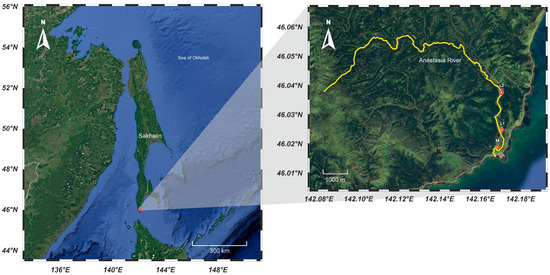
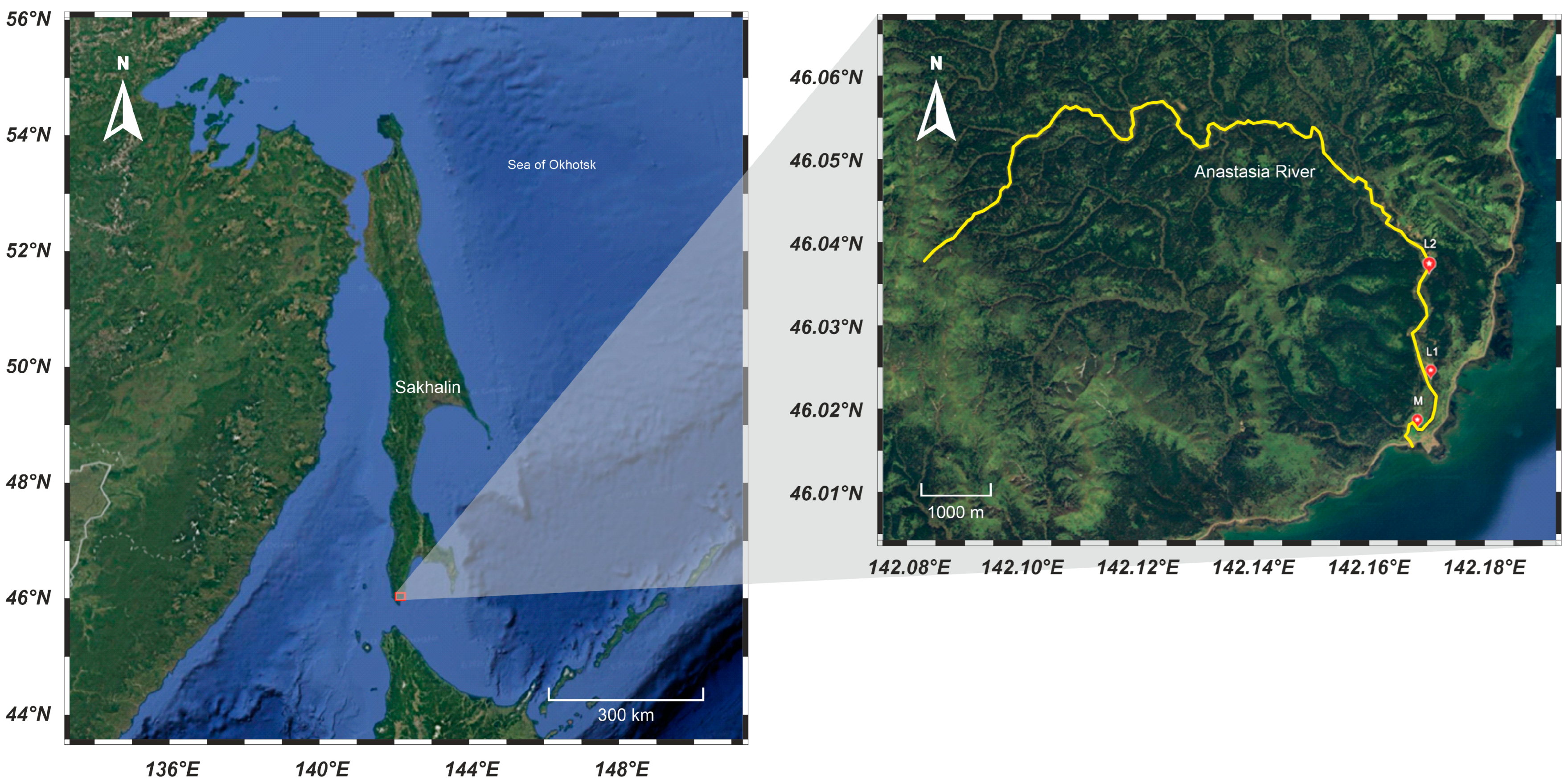
The study was conducted on the Anastasia River, located in Aniva Bay on Sakhalin Island and flowing into the Sea of Okhotsk. The river is 16 km long, with a catchment area of 24.1 km2 and an average water discharge of 0.43 m3 s−1 [49]. The river is a spawning ground for salmonids. Samples for studying the taxonomic composition, density, biomass, and fatty acid composition and content of benthic macroinvertebrates were collected along a 2.5 km river section. Sampling sites (Figure 1) were located at 500 m and 1.5–3 km upstream of the mouth. Sampling at the river mouth area was carried out before the rainstorm event, and in the lower reaches of the river, several days before the rainstorm and after it ended.
Figure 1.
Map of sampling sites in the Anastasia River, Sakhalin Island, Russia. Sampling points: M—the river mouth (46.01548° N, 142.16983° E), sampled before the rainstorm event (4–6 August); L1–L2—the lower reaches of the river (the area from 46.02405° N, 142.17975° E to 46.03754° N, 142.16996° E), sampled before the rainstorm (4–6 August) and after it ended (11–12 August).
According to observations from the “Cape Crillon” meteorological station (Hydrometeorological report No 7-3-41, Sakhalin Administration for Hydrometeorology and Environmental Monitoring, available at https://doi.org/10.5281/zenodo.19060043 accessed on 17 March 2026), due to the intensification of frontal boundaries, 100.8 mm of precipitation fell from 8 p.m. on 7 August to 8 a.m. on 8 August. This constituted 99% of the monthly precipitation norm. The very heavy rain was accompanied by very strong winds. Using the limiting intensity method, we estimated that the river’s discharge could have increased by more than two orders of magnitude (excluding losses due to absorption, evaporation, and retention). The river mouth before the flood and the day after is shown in Figure S1.
The substrate along the study section consisted of large pebbles with boulders, very slightly silted, with weak or absent biofilms on the stones. The water temperature during the study period varied between 14 and 22 °C. Measurements of pH (6.5 ± 0.17) and total dissolved solids (TDS: 57.3 ± 5.55 mg L−1) were conducted using an HI 98129 Combo (Hanna Instruments, Woonsocket, RI, USA) meter ten days after the end of the rainstorm to provide a general characterization of the river conditions.
2.2. Benthic Macroinvertebrate Sampling and Processing
Samples for the analysis of taxonomic composition, density, and biomass (wet weight) of benthic macroinvertebrates were collected using a Surber sampler (213 μm mesh size) in 3 to 6 replicates per site. Each replicate covered an area of 0.16 m2. Organisms were extracted from the samples and preserved in 96% ethanol. Identification, counting, and weighing were conducted using binocular microscopes (Olympus CX 41, Olympus Corporation, Tokyo, Japan; MBS-10, Lytkarino Optical Glass Factory, Lytkarino, Russia) and torsion balances (WT-500, Techniprot, Pruszków, Poland), respectively.
Additional benthic macroinvertebrate samples were collected for biochemical analysis. For this purpose, dominant (by biomass) groups were selected from the samples, sorted by large taxa, weighed, and placed in a chloroform-methanol mixture (2:1 by volume) for further fatty acid analysis. The number of individuals per sample ranged from 5 to 50 for most taxa, with the exception of Japanese mitten crabs (Eriocheir japonica), which comprised 2–3 individuals per sample due to their larger size. The samples were stored at −20 °C until subsequent biochemical processing. For fatty acid analysis, Japanese mitten crabs were collected from both the marine littoral zone and the river. This species is catadromous, migrating between freshwater and marine environments during its life cycle [50]. Specimens from the marine littoral zone were therefore sampled to assess the dietary plasticity of the species across these different habitats, providing a comparative basis for understanding potential shifts in trophic strategies.
2.3. Fatty Acid Analysis
Fatty acid analysis included the homogenization and lipid extraction, preparation of fatty acid methyl esters (FAMEs), and mass spectrometry analysis. The procedures followed Christie and Han [51]. Briefly, samples were homogenized mechanically in a porcelain mortar with the addition of glass beads. Lipids were extracted with a mixture of chloroform and methanol (2:1 by volume), distilled water was added, and the water–methanol phase was removed. The resulting extracts were dried by passing through a layer of anhydrous Na2SO4. Chloroform was evaporated using a rotary vacuum evaporator equipped with a water bath and cryostat (IKA RV8, IKA HB10, IKA RC2 control, IKA, Staufen, Germany) at 35 °C. FAMEs were obtained by acid-catalyzed transmethylation using a solid-state thermostat (Dry Block Heater 1, IKA, Staufen, Germany). A double volume of distilled water and 200 μL of hexane were added to the mixture, shaken vigorously for 2–3 min. After that, the FAMEs were purified to remove impurities using thin-layer chromatography and were eluted from the silica gel using chloroform.
Quantitative analysis of FAMEs was performed using a gas chromatograph with a flame ionization detector (Shimadzu GC 2010 Plus, Shimadzu, Kyoto, Japan). A 30-m capillary column, Supelcowax 10, with an internal diameter of 0.25 mm was used for the quantitative analysis. For precise identification of FAMEs, a gas chromatograph coupled with a mass spectrometric detector (Shimadzu GCMS-QP2010 Ultra, Shimadzu, Kyoto, Japan) was additionally used. Fatty acid peaks were identified by comparing the obtained mass spectra with those available in the Agilent databases (Wiley, NIST) and by comparing retention times with those of commercial standards (Supelco 37 Component FAME Mix: Sigma-Aldrich Co., St. Louis, MO, USA). The relative content of FAs was determined as the ratio of the peak area of a specific FA to the sum of the areas of all FA peaks. The absolute content of fatty acids was calculated based on the peak area, which corresponded to a known quantity of the internal standard (a solution of 19:0 methyl ester in chloroform, 0.5 mg mL−1; Nu-Check-Prep, Inc., Elysian, MN, USA) added to each sample prior to the biochemical procedures.
2.4. Assessment of the Diet of Benthic Macroinvertebrates
The diets of benthic macroinvertebrates were assessed using the analysis of FA-markers. This biochemical method has undergone extensive validation and is widely applied in trophic ecology [52,53]. Bacterial and plant taxa, including microalgae, have a specific set of enzymes and are capable of synthesizing specific fatty acids. When consumed, these FAs are incorporated into consumer tissues with minimal modification, thus carrying information about their dietary origin and serving as reliable biomarkers. A key advantage of this method is its ability to evaluate the assimilated portion of the diet, including visually unidentifiable components [53].
2.5. Quantitative Assessment of PUFA Content and Nutritional Value of the Benthic Community
To determine the nutritional value of benthic macroinvertebrates in the river mouth and lower reaches of the river and to assess the impact of rainfall flood on changes in the nutritional value of the community, the content of all essential and physiologically valuable n-3 PUFAs and n-6 PUFAs was calculated. The concentration (mg g–1 wet weight) of FAs was assessed using an added internal standard. Data on the biomass of each macroinvertebrate taxa and the concentration of FAs in benthic macroinvertebrate taxa collected at each station were used. This approach made it possible to calculate the total pool of essential PUFAs available in the benthic communities per unit area before and after the flood event.
2.6. Statistical Analysis
The normality of the data was checked using the Shapiro–Wilk test. Because of unequal variances (Bartlett’s test, p < 0.05), we used Welch’s ANOVA to test for differences in contents of 18:2n-6, 20:4n-6, 18:3n-3, 20:5n-3, 22:6n-3, and n-3, and n-6 PUFAs, (mg m–2) before rainfall flood at the river mouth area, before the flood in the lower reaches, and after the flood in the lower reaches, followed by the Games–Howell post hoc test for pairwise comparisons. All p-values were corrected for multiple testing using the Games–Howell procedure.
To visualize the separation among taxonomic groups and sampling sites and to identify the contribution of individual fatty acids, we performed a principal component analysis (PCA). Crabs were excluded from this analysis due to their ability to move freely over large distances within the river channel.
Hierarchical cluster analysis for FA profiles of benthic macroinvertebrates was performed using Euclidean distances with Ward’s clustering method. To reduce multicollinearity, FA variables were screened prior to analysis: pairwise Pearson correlations were calculated, and in cases where the correlation coefficient exceeded 0.75, one variable from each correlated pair was excluded. Of the 39 initial FAs, 12 were removed, and the remaining 27 were used in the final analysis.
For pairwise comparisons of FAs in crabs from the river and the marine littoral zone, an independent two-tailed Student’s t-test was used when the data were normally distributed and had homogeneous variances. The Mann–Whitney U test was applied when the data exhibited non-normality and heterogeneous variances.
Data processing and visualization were performed using RStudio (version 4.5.1) and Microsoft Excel. Figures were edited in CorelDRAW (version 24.3).
3. Results
3.1. Taxonomic Composition and Community Structure
A total of 39 taxa of benthic macroinvertebrates were identified in the Anastasia River, including 14 species and higher taxa of Diptera, 8 species of Ephemeroptera, 7 species of Trichoptera, 3 species each of Crustacea and Oligochaeta, 2 species of Plecoptera, and 1 species each of Megaloptera and Coleoptera (Table S1).
The communities were dominated by crustaceans (Table 1). Since crabs (E. japonica) are large and mobile, different sampling gear would be required for an accurate assessment of their density and biomass. Nevertheless, even the obtained results indicate their high density and biomass in the river (Table 1). Therefore, further community analysis was conducted excluding crabs.
Table 1.
Average (M ± SE) density (ind. m−2) and biomass (mg m−2) of the main taxonomic groups of benthic macroinvertebrates collected in the Anastasia River, Sakhalin Island, August 2025.
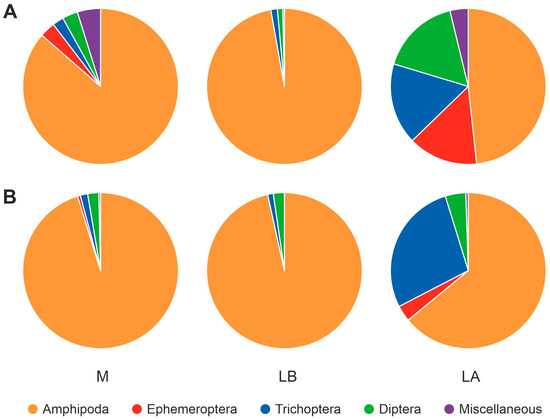
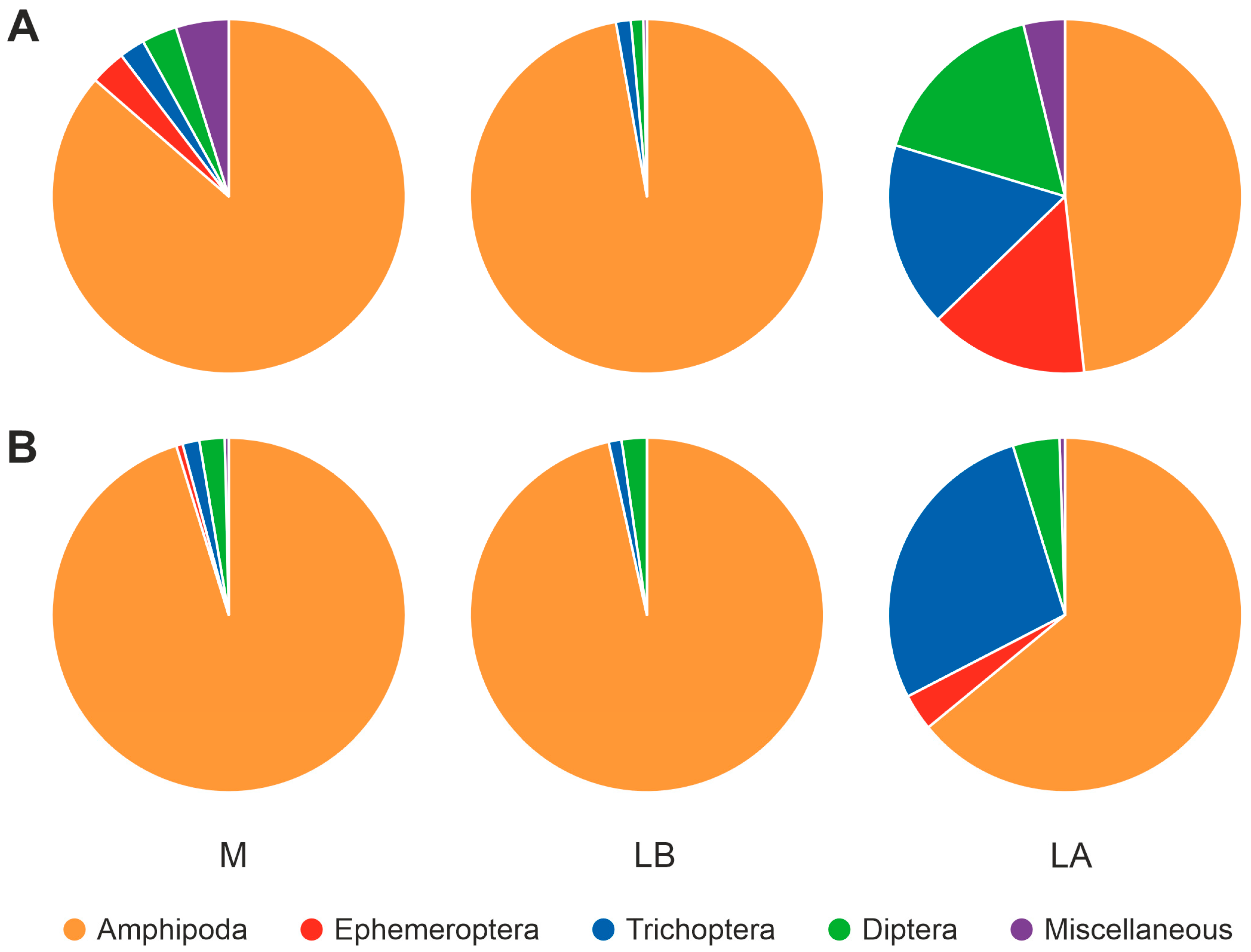
Amphipoda were represented by two species, with the larger one, E. kygi, dominating. At the river mouth area and in the lower reaches, before the flood, amphipods constituted an average of 86–97% of total abundance and 95–97% of total biomass. In the lower reaches, after the rainfall, their abundance and biomass decreased to 48% and 64%, respectively, while the proportion of caddisflies, mayflies, and dipterans in the community increased (Figure 2). On average, after the flood, the density and biomass of benthic macroinvertebrates in the lower reaches of the river were 23-fold and 20-fold lower, respectively, than before the rainfall. These changes were primarily driven by a sharp decline in Amphipoda, whose density and biomass decreased by a factor of 45 and 30, respectively. Substantial changes were also observed for Coleoptera and Diptera. Coleoptera density decreased 5-fold, while its biomass declined 10-fold. For Diptera, the change in density was negligible, but biomass decreased by a factor of 10. Crab density and biomass declined 15-fold and 50-fold, respectively (Table 1).
Figure 2.
Proportional abundance (A) and biomass (B) (% of total) of taxonomic groups of benthic macroinvertebrates, excluding Eriocheir japonica, before the flood at the river mouth area (M), before the flood in the lower reaches (LB), and after the flood in the lower reaches (LA) of the Anastasia River, Sakhalin Island, August 2025.
Before the flood in the lower reaches and the river mouth, juvenile amphipods (<7 mm) dominated, comprising 60% and 80% of the total biomass and abundance, respectively. After the flood, the proportion of juvenile amphipods decreased to 15% of biomass and 58% of abundance. The proportion of large individuals (≥7) doubled after the flood event.
3.2. Fatty Acid Profiles and Nutritional Value of Dominant Taxa
Over 70 FAs were detected in Amphipoda, Decapoda, Trichoptera, Ephemeroptera, Diptera, and Plecoptera. PUFAs (34.0–43.4%) dominated in all taxa, except in one stonefly. The contents of saturated fatty acids (SFAs; 27.3–34.4%) and monounsaturated fatty acids (MUFAs; 28.8–38.3%) were similar and slightly lower than that of PUFAs (Table S2).
Fatty acid profiles exhibited taxon-specific characteristics. Crustaceans were characterized by high percentages of all C20 MUFAs (20:1n-11, 20:1n-9, and 20:1n-7), PUFAs of the n-6 family (LIN, 20:2n-6, ARA, and 22:5n-6), and LC-PUFAs of the n-3 family (22:5n-3 and DHA). FA profiles of amphipods and crabs were similar, although crabs showed greater variability. In crabs, for instance, levels of LIN and ALA varied within 4.2–23.7% and 2.4–9.2%, respectively, versus 5.7–12.4% and 5.0–7.2% in amphipods.
In all insect larvae, C22 PUFAs, including physiologically valuable DHA, were either absent or present only in trace amounts. Non-case-building caddisflies (Glossosoma sp., H. orientalis, S. marmorata) were characterized by high relative percentages of short-chain MUFAs and PUFAs (C12 and C14 MUFAs, C12 and C14 PUFAs), 16:4n-3 (a marker for green microalgae), and ALA (a marker for green microalgae, cyanobacteria, and aquatic macrophytes). Caddisflies of the genus Goera sp. (case-building species) had the highest content of 14:0, 16:0, 16:1n-7, C16 PUFA (markers of green and diatom algae), 18:3n-6 (marker of some species of cyanobacteria), and 18:4n-3 (a marker of cryptophytes). Mayflies were characterized by high levels of C16 MUFA (16:1n-9, 16:1n-7, 16:1n-5), 18:1n-7, ALA, and 18:4n-3. Dipterans exhibited high variability in FA composition, with LIN levels ranging from 5.2% to 26.9%. This FA was the highest in dipterans. Leuctra sp. and Sweltsa sp. (P1) contained the highest levels of 13:0, i15:0, i17:0, ai17:0 (bacterial markers) and 18:1n-9, whereas P2 (species undetermined) contained the highest level of ALA (Table S2).
The total FA content ranged from 13.1 mg g–1 of wet weight (WW) in crabs to 29.0 mg g–1 WW in mayflies (Table S2). The concentration of LIN ranged from 0.5 mg g–1 WW in caddisflies to 1.9 mg g–1 WW in dipterans. The concentration of ALA ranged from 0.8 mg g–1 WW in crustaceans to 3.5 mg g–1 WW in mayflies. The concentration of ARA ranged from 0.1 mg g–1 WW in caddisflies to 0.6 mg g–1 WW in amphipods. The concentration of EPA ranged from 1.5 mg g–1 WW in caddisflies to 2.6 mg g–1 WW in mayflies. The maximum concentration of DHA was found in amphipods and amounted to 0.5 mg g–1 WW. In all insect taxa, DHA was present only in trace amounts. The n-3/n-6 ratio was highest in caddisflies and mayflies and lowest in dipterans, but was above 1 in all taxa.
3.3. Multivariate Analyses of Fatty Acid Composition
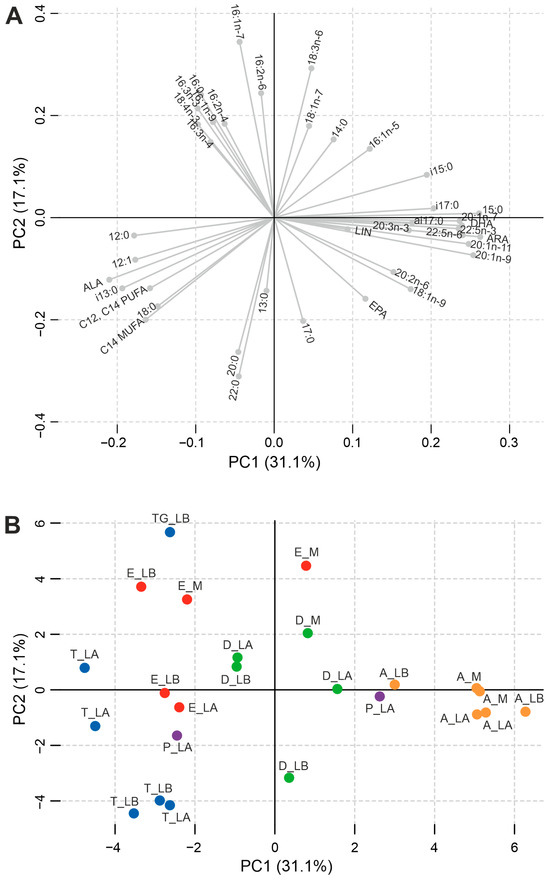
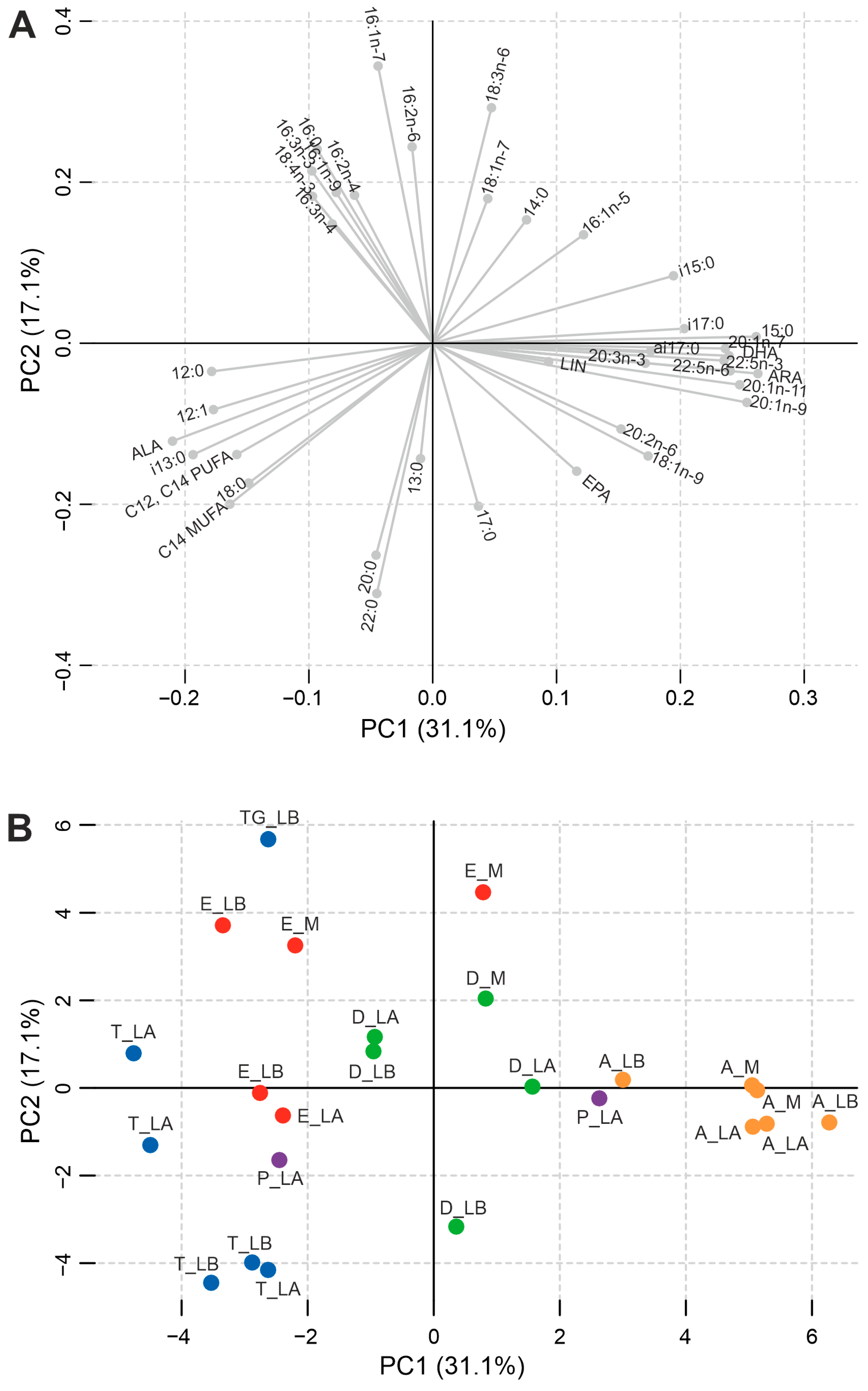
The benthic macroinvertebrates were visualized in the two-dimensional space defined by the first two principal components based on their fatty acid composition (Figure 3). Factor 1, explaining 31.1% of the total variance, represented a gradient from fatty acids with negative scores (ALA, i13:0, 12:0, C12 and C14 MUFAs, and C12 and C14 PUFAs) to those with positive scores (22:5n-3, 20:1n-7, DHA, 22:5n-6, 20:1n-11, 20:1n-9, 15:0, and ARA). Factor 2, explaining 17.1% of the total variance, represented a gradient from fatty acids with negative scores (22:0, 20:0, and 17:0) to those with positive scores (16:3n-3, 16:0, 16:2n-6, 18:3n-6, and 16:1n-7) (Figure 3).
Figure 3.
Principal component analysis (PCA) biplot visualizing the relative percentages of fatty acids (A) in benthic macroinvertebrates (B) from the Anastasia River, Sakhalin Island, August 2025. PC1 and PC2 explain 31.1% and 17.1% of the total variance, respectively. Symbols: A (orange)—amphipods, P (purple)—stoneflies, E (red)—mayflies, T (blue)—non-case-building caddisflies, TG (blue)—Goera sp. caddisflies, D (green)—dipterans. Sampling area: M—the river mouth; LB—the lower reaches before the flood; LA—the lower reaches after the flood. Fatty acid abbreviations: linoleic acid (LIN, 18:2n-6), arachidonic acid (ARA, 20:4n-6), eicosapentaenoic acid (EPA, 20:5n-3), and docosahexaenoic acid (DHA, 22:6n-3).
Amphipods were spatially separated from non-case-building caddisflies along Factor 1, while case-building caddisflies (Goera sp.) and mayflies were separated from non-case-building caddisflies along Factor 2 (Figure 3). The most homogeneous FA profiles were observed in amphipods, which formed the densest cluster, while caddisflies exhibited the most heterogeneous FA profiles. No association was found between the FA composition of the taxa and the distance of the collection sites from the river mouth.
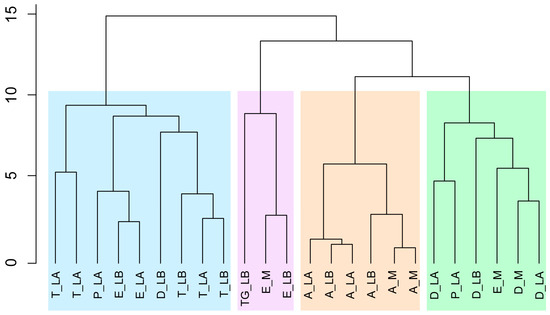
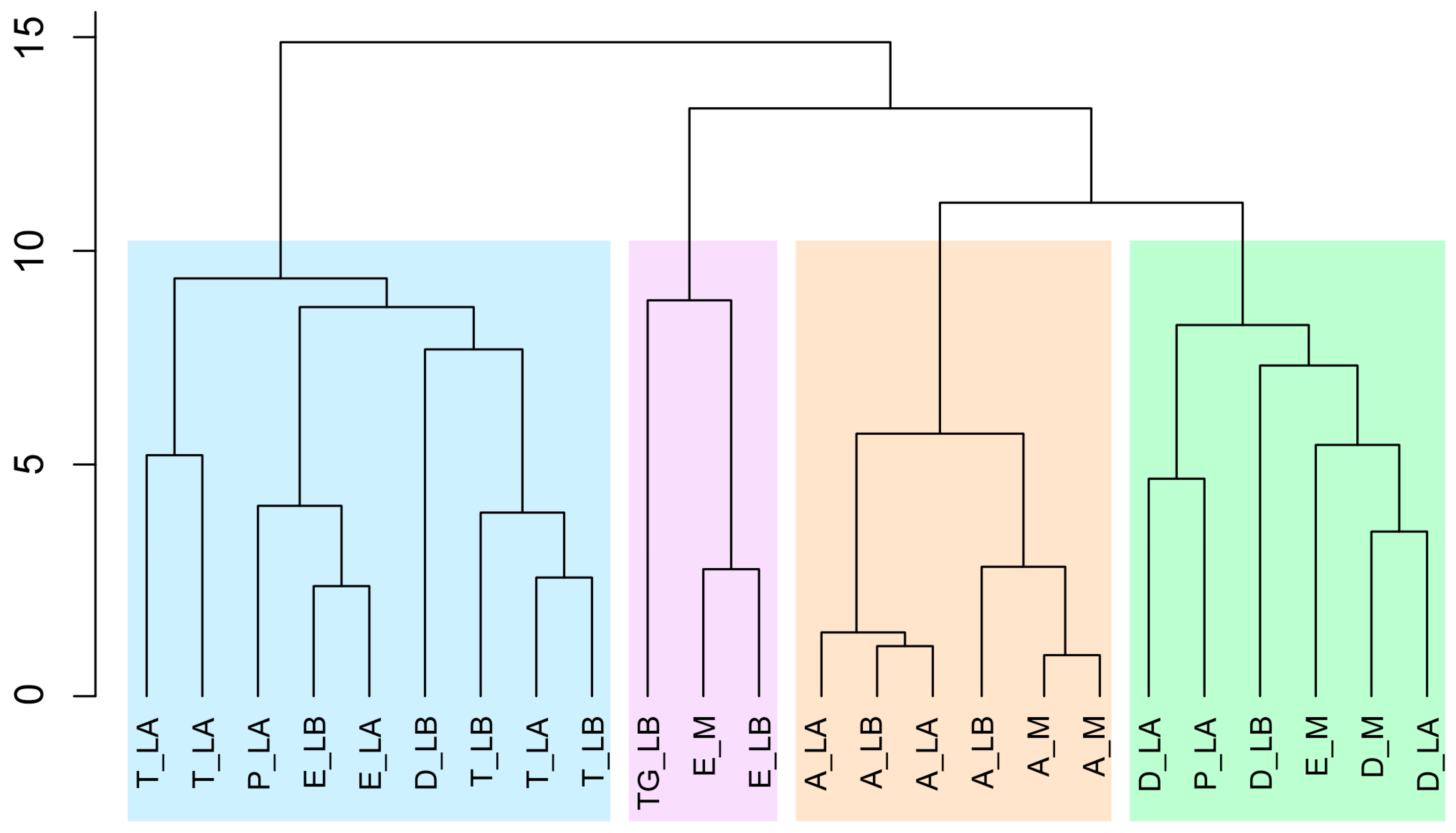
Based on fatty acid composition, amphipods from the river mouth area were separated from those collected further upstream. Amphipods collected at the maximum distance from the mouth showed a 2-fold higher level of LIN and a 1.5-fold lower level of EPA and DHA compared to those from the river mouth area. Caddisflies, excluding Goera sp., and dipterans tended to form distinct clusters, while mayflies and stoneflies were highly variable and grouped into different clusters (Figure 4). Goera sp. formed a distinct cluster with two samples of mayflies. Three caddisfly samples formed a separate subcluster and a tight grouping in the PCA (Figure 3 and Figure 4). Their FA profiles were characterized by high levels of 18:0, 20:0, and 22:0.
Figure 4.
Dendrogram of cluster analysis of the relative percentage of fatty acids in benthic macroinvertebrates of the Anastasia River, Sakhalin Island, August 2025. Symbols: A—amphipods, P—stoneflies, E—mayflies, T—non-case-building caddisflies, TG—Goera sp. caddisflies, D—dipterans. Sampling area: M—the river mouth; LB—the lower reaches before the flood; LA—the lower reaches after the flood. Shaded areas highlight the main clusters.
3.4. Impact of the Flood on the Nutritional Value of the Benthic Community
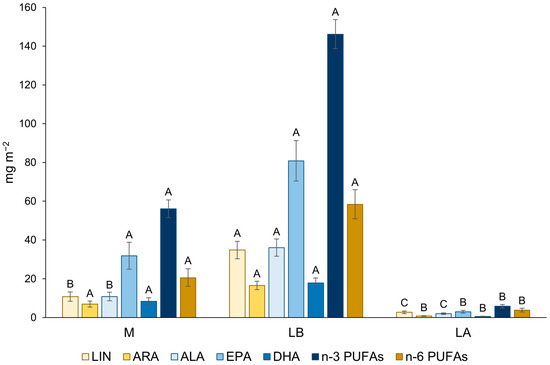
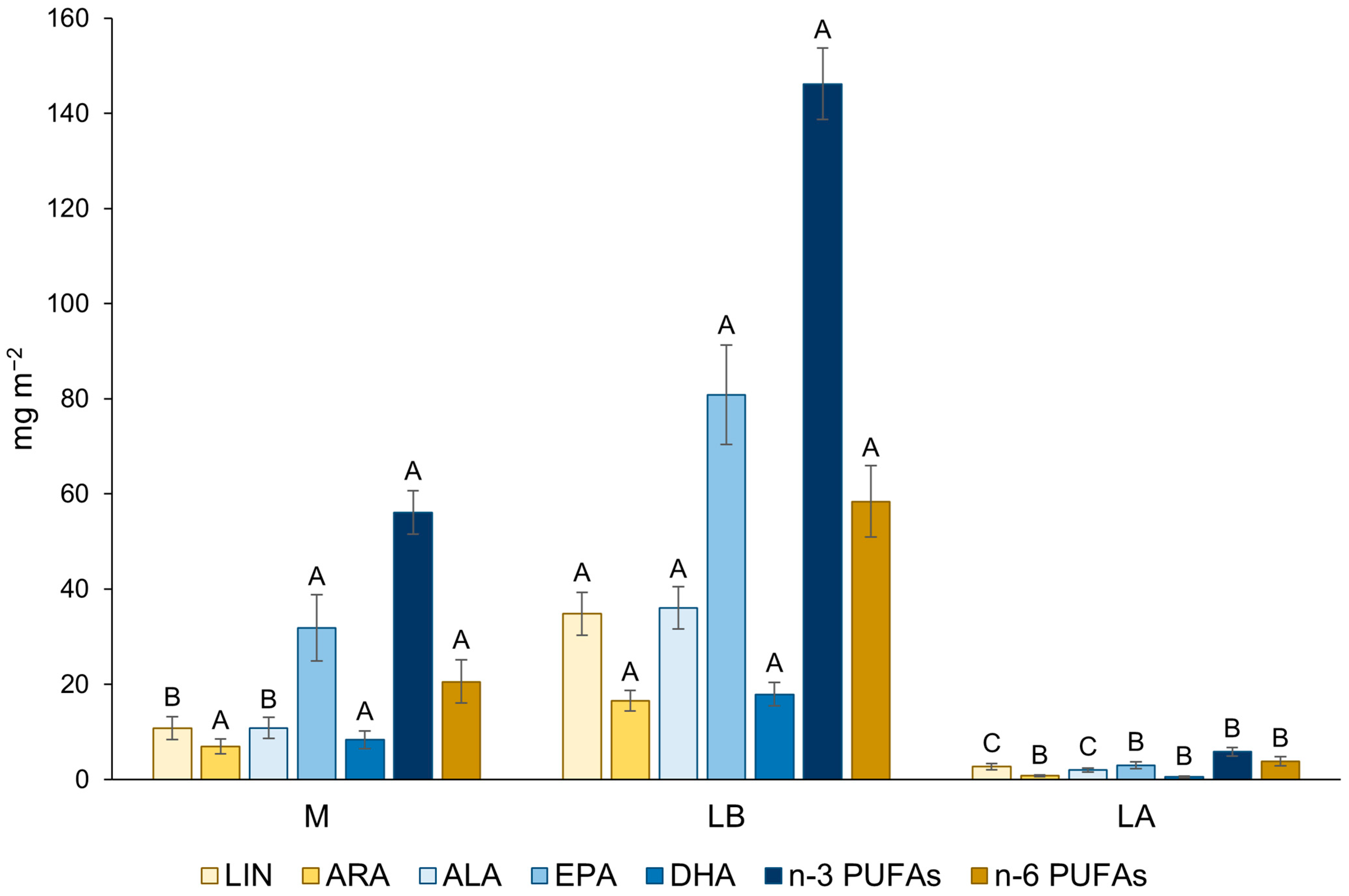
The content of LIN, ARA, ALA, EPA, and DHA, as well as the sums of n-3 and n-6 PUFAs, were quantified for the benthic macroinvertebrate community (mg m–2) at each river section (Figure 5). The intense and prolonged rainfall significantly reduced the PUFA content in benthic macroinvertebrate communities. The lowest nutritional value of the community for all measured FAs was recorded after the flood. The differences in the lower reaches of the river before and after the rain event for individual PUFAs ranged from 13-fold (for LIN) to 33-fold (for DHA). The decline in the value of n-3 PUFAs was more pronounced (25-fold) than that of n-6 PUFAs (15-fold). The river mouth area was characterized by a lower nutritional value of benthic macroinvertebrate community compared to the community in the lower reaches before the flood for LIN and ALA. The contents of ARA, EPA, DHA, n-3, and n-6 PUFAs did not differ significantly between these two sections (Figure 5).
Figure 5.
Content of essential and physiologically valuable fatty acids and the sum of n-3 and n-6 PUFAs (mg m–2, M ± SE) before rainfall flood at the river mouth area (M), before the flood in the lower reaches (LB), and after the flood in the lower reaches (LA) of the Anastasia River, Sakhalin Island, August 2025. Mean values labelled with different letters differ significantly at p < 0.05 (Welch’s ANOVA, Games–Howell post hoc test with correction for multiple comparisons, comparisons between sites for each PUFA). Fatty acid abbreviations: linoleic acid (LIN, 18:2n-6), arachidonic acid (ARA, 20:4n-6), eicosapentaenoic acid (EPA, 20:5n-3), and docosahexaenoic acid (DHA, 22:6n-3).
3.5. Fatty Acid Analysis of Riverine and Marine Littoral Crabs
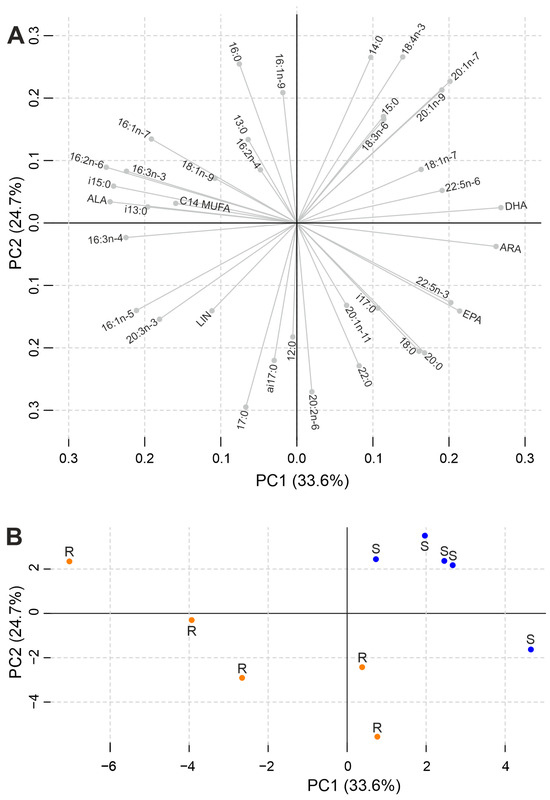
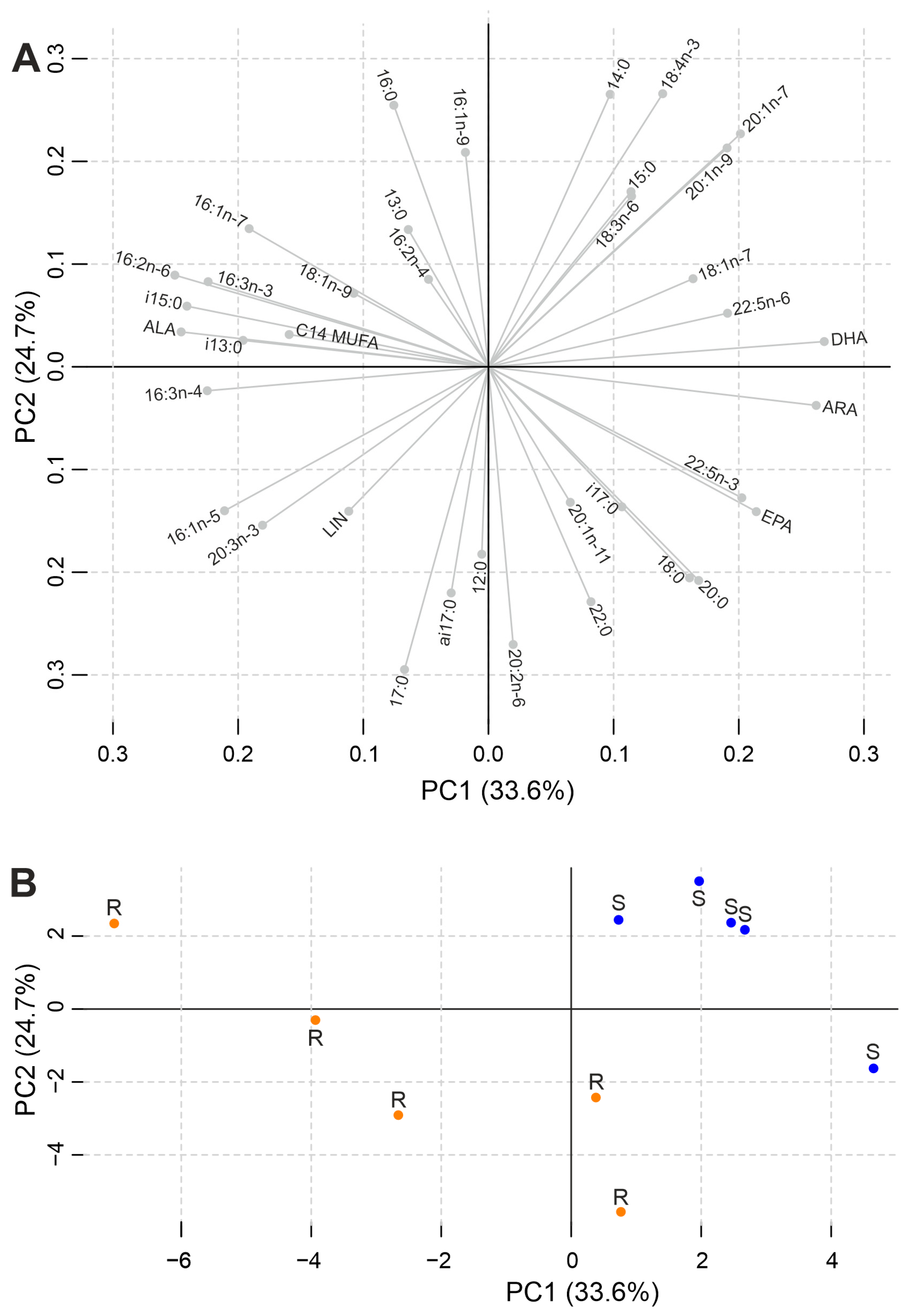
Factor 1, explaining 33.6% of the total variance, represented a gradient from fatty acids with negative scores (16:2n-6, ALA, i15:0, 16:3n-4, and 16:3n-3) to those with positive scores (ARA and DHA). Factor 2, explaining 24.7% of the total variance, represented a gradient from fatty acids with negative scores (17:0 and 20:2n-6) to those with positive scores (16:0, 14:0, and 18:4n-3) (Figure 6). Visually, marine littoral crabs were spatially separated from riverine crabs, with the marine littoral crabs forming a tighter cluster than those from the river (Figure 6). Indeed, marine littoral crabs had significantly higher percentages of marine algal FA-markers: DHA (6.6 ± 0.75 vs. 3.3 ± 0.58, p = 0.0054, t(8) = −3.78), ARA (5.7 ± 0.52 vs. 3.7 ± 0.54, p = 0.016, t(8) = −3.05), and 18:4n-3 (1.1 ± 0.15 vs. 0.3 ± 0.07, p = 0.008, U = 0.0). For 14:0, only a trend towards a higher level in marine littoral crabs was observed (2.2 ± 0.26 vs. 1.3 ± 0.16, p = 0.056, U = 2.0). In contrast, the levels of FA-markers of cyanobacteria, green and diatom algae, and aquatic macrophytes were significantly higher in riverine crabs: 16:3n-4 (1.0 ± 0.2 vs. 0.5 ± 0.03, p = 0.008, U = 0.0), LIN (8.9 ± 3.71 vs. 2.8 ± 0.08, p = 0.008, U = 0.0), and ALA (4.6 ± 1.21 vs. 2.0 ± 0.22, p = 0.032, U = 1.0). For 17:0 (0.9 ± 0.07 vs. 0.6 ± 0.06, p = 0.056, U = 2.0) and 16:3n-3 (0.6 ± 0.34 vs. 0.2 ± 0.02, p = 0.056, U = 2.0), only a trend towards higher levels in riverine crabs was detected.
Figure 6.
Principal component analysis (PCA) biplot visualizing the relative percentages of fatty acids (A) in crabs (Eriocheir japonica) from the Anastasia River and the marine littoral zone (B). PC1 and PC2 explain 33.6% and 24.7% of the total variance, respectively. Symbols: R (orange)—riverine crabs, S (blue)—marine littoral crabs. Fatty acid abbreviations: linoleic acid (LIN, 18:2n-6), arachidonic acid (ARA, 20:4n-6), eicosapentaenoic acid (EPA, 20:5n-3), and docosahexaenoic acid (DHA, 22:6n-3).
4. Discussion
Our study demonstrates that extreme rainfall events in southern Sakhalin lead not only to a structural change in the benthic macroinvertebrate communities, but also to a significant reduction in their nutritional value. For the first time, we have quantitatively shown that the losses of n-3 PUFAs exceed the losses of n-6 PUFAs by a factor of 1.7, decreasing 25-fold after the flood. Furthermore, the losses of the most valuable LC-PUFAs for fish (EPA, DHA, and ARA) were 1.8 times greater than the losses of shorter-chain PUFAs (LIN and ALA), precursors in synthesis of n-3 and n-6 LC-PUFAs. This implies that after a flood, fish will be limited not only by the quantity of food but also by its quality.
The amphipod E. kygi, rich in LC-PUFA (especially in DHA and ARA), was prey of higher nutritional value for fish in the Anastasia River. This amphipod is a mass-dominant and structure-forming component of benthic communities in some Sakhalin rivers [54]. Riverine amphipods can indeed be the most valuable source of lipids and, in particular, physiologically essential PUFAs for fish [8,55]. The significant drop in their biomass after the flood (from 97% to 64%) drove disproportionately high losses of n-3 PUFAs. Insects, whose proportion increased, do not compensate for this loss, as they do not synthesize or accumulate DHA and other C22 PUFAs. However, a disproportionate decline also affected EPA, the content of which in insects was as high as in amphipods. During the flood, in addition to the general drift of amphipods, there was also the elimination of medium-sized and, for some taxa, small-sized groups, which apparently had high nutritional value. In amphipods, young individuals were more susceptible to floods than large ones. We did not find any studies on size-dependent changes in fatty acid content in riverine macroinvertebrates, making this a promising topic for future research. A probable higher nutritional value of small- and medium-sized amphipods may be explained by several physiological and ecological mechanisms. First, ontogenetic dietary shifts are common in amphipods. Juveniles often feed on qualitatively different resources such as high-quality biofilms, bacteria, or specific algae compared to adults, which can result in age-specific fatty acid profiles [56]. Second, the nutritional value of the small-sized amphipod species Paramoera sp. may have been higher than that of the larger species E. kygi. Interspecific variation in fatty acid composition, including EPA and DHA content, was demonstrated in amphipods [45]. Thus, the flood may have selectively eliminated either juvenile stages of the dominant species or amphipod species characterized by high nutritional value. Our findings complement existing knowledge about the impact of severe floods on quantitative macroinvertebrate parameters, such as biomass and density [39,40,41,48,57], demonstrating that qualitative (biochemical) changes can be even more pronounced and critical for higher-order consumers.
This study was conducted on a single river following a single extreme flood event. Our findings strongly suggest that a decline in the proportion of amphipods, coupled with an increase in insect larvae within the community, leads to a reduction in C22 PUFA levels. The duration of the low biochemical quality of the benthic macroinvertebrate community after severe floods is likely linked to the ecosystem’s recovery rate. The recovery of benthic communities is known to be a long-duration process, ranging from several weeks [40] to several months [42], and in some cases, reorganization can last for several years [58]. This process can be influenced by multiple factors, including post-flood changes in water quality (e.g., nutrients, suspended solids) [40,59]. The long-term consequences for the health status of fish such as salmonids can be substantial. A decrease in dietary n-3 LC-PUFA directly leads to reduced contents of these biomolecules in consumer tissues, including muscles, liver, heart, and fat [8,55]. A sustained lack of n-3 LC-PUFA in the fish diet results in a decline in fish health, leading to a range of pathological conditions (myocarditis, hepatic and intestinal steatosis, fin erosion, spinal deformities, etc.), a reduction in the population’s growth rate, and an increase in fish mortality [24,25,60].
The use of FA-markers, whose application is extensively described in the literature [52,53], made it possible to determine the diet of the studied benthic macroinvertebrates and reveal their important ecological features. The high content of algae markers (ALA and C16 PUFAs), bacterial markers (branched FAs), and allochthonous OM (LIN) in amphipods confirms their role in the processing of terrestrial plant material and integrating various trophic pathways within the river ecosystem. Moreover, the increase in proportion of LIN in amphipods from 6% to 12% with distance from the estuary, indicates a greater contribution of allochthonous OM to the diet of these shredders. Diptera likely also participated in the consumption of allochthonous OM, as they contained the highest percentages of LIN. However, a cyanobacterial or fungal origin of this PUFA in Diptera cannot be ruled out, as it can be highly represented in some species or strains [61,62]. The highest degree of consumption of diverse algae (cyanobacteria, greens, diatoms, and cryptophytes) was found in caddisflies, especially in Goera sp. Other studied caddisflies consumed allochthonous OM, as a characteristic feature of their FA profile was high levels of 18:0, 20:0, and 22:0, which are markers of detritus and terrestrial plants [63,64]. Mayflies demonstrated feeding on autochthonous organisms, primarily cyanobacteria and green microalgae with high ALA content, and diatoms. Given that the most abundant species in the studied section of the Anastasia River was Rhithrogena gr. lepnevae, a grazer–scraper, our data on mayfly feeding preferences are consistent with those reported in the studies on periphyton consumption by mayflies [65,66]. The diet of stoneflies Leuctra sp. and Sweltsa sp. showed the highest proportion of detritus, including of allochthonous origin, and associated bacteria. The dietary preferences we identified for these stoneflies are consistent with previous studies based on gut content analysis of representatives of these genera [67]. However, some species of the genus Sweltsa are omnivorous and even predatory, as revealed by stable isotope analysis [68].
The differences found in the FA profile between freshwater and marine crabs E. japonica indicate significant trophic plasticity in this species and adaptation to available resources, which has not been previously described for Sakhalin populations. The river crabs were close in FA profile to amphipods, which reflects their phylogenetic relationship and demonstrates the similarity in the feeding spectra of these crustaceans.
Our results shift the problem of the impact of rainfall floods from the plane of “reduced food quantity” to the plane of “educed food quality”. Given the predicted increase in the frequency and intensity of heavy rainfall in the Far East, the effect we have identified may become a regular factor limiting the productivity of river ecosystems on Sakhalin Island, which are key spawning and permanent habitats for many fish species. While some valuable commercial fish species (pink and chum salmon) migrate to the sea shortly after hatching, other salmonids, such as Sakhalin taimen, char, the whitespotted char, masu salmon, and coho salmon, spend several years in rivers feeding on invertebrates before shifting to piscivory [69]. Among these fish, Sakhalin taimen (Parahucho perryi Brevoort, 1856), which spends the first 2–7 years of its life in rivers, is listed as a priority species requiring urgent restoration and conservation measures [70,71]. The prolonged recovery of the nutritional value of benthic macroinvertebrates can create “trophic windows” of unfavorable conditions for the entire fish fauna, including valuable fish species.
5. Conclusions
The comprehensive study conducted, integrating taxonomic and biochemical approaches, has for the first time demonstrated that extreme rainfall floods in the south of Sakhalin lead to a profound degradation of not only the quantitative (biomass and density) but also the qualitative (fatty acid content) characteristics of the benthic macroinvertebrate communities. Dominant amphipods, which are the primary source of long-chain polyunsaturated fatty acids, were the most vulnerable to the disturbance, limiting the food resources for the fish.
Supplementary Materials
The following supporting information can be downloaded at: https://www.mdpi.com/article/10.3390/environments13040183/s1, Figure S1: The mouth of the Anastasia River before (A) and the day after the heavy rainfall (B); Table S1: The taxonomic composition of benthic macroinvertebrates in the Anastasia River, August 2025; Table S2: Major fatty acids (% of total fatty acids and mg g–1 wet weight, M ± SE) in dominant benthic macroinvertebrates in the lower reaches of the Anastasia River, Sakhalin Island, August 2025.
Author Contributions
Conceptualization, O.N.M.; methodology, O.N.M. and S.P.S.; sampling, O.N.M.; software, O.N.M.; validation, S.P.S.; formal analysis, O.N.M. and S.P.S.; investigation, O.N.M.; resources, O.N.M.; data curation, O.N.M.; writing—original draft preparation, O.N.M.; writing—review and editing, O.N.M. and S.P.S.; visualization, O.N.M.; supervision, O.N.M.; project administration, O.N.M.; funding acquisition, O.N.M. All authors have read and agreed to the published version of the manuscript.
Funding
This research was funded by the Nonprofit Charitable Foundation “Support for Biological Research BIOM” (project No. 8/2025).
Data Availability Statement
The original data presented in the study are openly available at https://doi.org/10.5281/zenodo.19060043. This repository contains the original hydrological report (in Russian) and its English translation (see file Hydrometeorological report No 7-3-41.pdf).
Acknowledgments
The authors would like to thank Pavel P. Kormilets for editing the illustrations, Nadezhda Zueva for pH and TDS data, FSBI “Sakhalin UGMS” for their support in the water discharge calculation for the river, and Elena L. Krasova for checking the manuscript for linguistic errors and making improvements to it.
Conflicts of Interest
The authors declare no conflicts of interest.
Abbreviations
The following abbreviations are used in this manuscript:
| FA | fatty acid |
| ALA | alpha-linolenic acid (18:3n-3) |
| LIN | linoleic acid (18:2n-6) |
| ARA | arachidonic acid (20:4n-6) |
| EPA | eicosapentaenoic acid (20:5n-3) |
| DHA | docosahexaenoic acid (22:6n-3) |
| SFA | saturated fatty acid |
| MUFA | monounsaturated fatty acid |
| PUFA | polyunsaturated fatty acid |
| LC-PUFA | long-chain polyunsaturated fatty acid |
| FAME | fatty acid methyl esters |
| OM | organic matter |
| PCA | principal component analysis |
References
- Stoler, A.B.; Relyea, R.A. Reviewing the Role of Plant Litter Inputs to Forested Wetland Ecosystems: Leafing through the Literature. Ecol. Monogr. 2020, 90, e01400. [Google Scholar] [CrossRef] [Scilit]
- Wang, S.; Wang, T.; Xia, W.; Chen, Z.; Stewart, S.; Yang, F.; Cheng, G.; Wang, X.; Wang, D.; Xie, S. Longitudinal Pattern of Resource Utilization by Aquatic Consumers along a Disturbed Subtropical Urban River: Estimating the Relative Contribution of Resources with Stable Isotope Analysis. Ecol. Evol. 2021, 11, 16763–16775. [Google Scholar] [CrossRef] [Scilit] [PubMed]
- Sánchez-Hernández, J. Fresh Perspectives on the River Continuum Concept Require Trophic Ecology Approaches Focussed on Food Web Structure and Energy Mobilisation Routes. J. Anim. Ecol. 2023, 92, 957–964. [Google Scholar] [CrossRef] [Scilit] [PubMed]
- Balibrea, A.; Ferreira, V.; Balibrea, C.; Raposeiro, P.M.; Gonçalves, V. Contribution of Macroinvertebrate Shredders and Aquatic Hyphomycetes to Litter Decomposition in Remote Insular Streams. Hydrobiologia 2020, 847, 2337–2355. [Google Scholar] [CrossRef] [Scilit]
- Kislitsina, N.I.; Makhutova, O.N.; Mashonskaya, Y.O.; Shulepina, S.P.; Ivanova, E.A. Functional-Trophic Structure of the Community of Benthic Invertebrates of a Small Forest River. Inland Water Biol. 2025, 18, 1338–1353. [Google Scholar] [CrossRef] [Scilit]
- Huang, J.; Guo, F.; Kainz, M.; Bunn, S.; Ouyang, X.; Li, F.; Du, Q.; Zhang, Y. Quantitative Assessment of Trophic Flow Based on Polyunsaturated Fatty Acids Reveals That High-Quality Algae Support Aquatic Food Webs Irrespective of Dams. Limnol. Oceanogr. 2025, 70, 2008–2025. [Google Scholar] [CrossRef] [Scilit]
- Makhutova, O.N.; Mashonskaya, Y.O.; Borisova, E.V.; Kislitsina, N.I.; Shulepina, S.P. Fatty Acid Flux Disparities Between Aquatic and Terrestrial Ecosystems in a Shaded River Can Alter the Nutritional Content of Consumer Resources. Aquat. Sci. 2025, 87, 39. [Google Scholar] [CrossRef] [Scilit]
- Mashonskaya, Y.O.; Zuev, I.V.; Andrushchenko, P.Y.; Glushchenko, L.A.; Mikheev, P.B.; Makhutova, O.N. Influence of Nutritional Spectra on the Fatty Acid Composition of Muscle Tissue and the Omega-3 PUFA Content in the Brain, Muscle, and Adipose Tissues of Fish of the Genus Thymallus. Inland Water Biol. 2025, 18, 444–457. [Google Scholar] [CrossRef] [Scilit]
- Twining, C.W.; Brenna, J.T.; Lawrence, P.; Winkler, D.W.; Flecker, A.S.; Hairston, N.G., Jr. Aquatic and Terrestrial Resources Are Not Nutritionally Reciprocal for Consumers. Funct. Ecol. 2019, 33, 2042–2052. [Google Scholar] [CrossRef] [Scilit]
- Parmar, T.P.; Kindinger, A.L.; Mathieu-Resuge, M.; Twining, C.W.; Shipley, J.R.; Kainz, M.J.; Martin-Creuzburg, D. Fatty Acid Composition Differs Between Emergent Aquatic and Terrestrial Insects—A Detailed Single System Approach. Front. Ecol. Evol. 2022, 10, 952292. [Google Scholar] [CrossRef] [Scilit]
- Fontaneto, D.; Tommaseo-Ponzetta, M.; Galli, C.; Risé, P.; Glew, R.H.; Paoletti, M.G. Differences in Fatty Acid Composition Between Aquatic and Terrestrial Insects Used as Food in Human Nutrition. Ecol. Food. Nutr. 2011, 50, 351–367. [Google Scholar] [CrossRef] [Scilit] [PubMed]
- Bogatov, V.V.; Sushchik, N.N.; Kolmakova, A.A.; Gladyshev, M.I. Allochthonous versus Autochthonous Carbon Subsidies in Small River Food Webs Depend on Seasonality and Riparian Tree Species. Aquat. Sci. 2024, 86, 41. [Google Scholar] [CrossRef] [Scilit]
- Lands, W.E.M. Human Life: Caught in the Food Web. In Lipids in Aquatic Ecosystems; Kainz, M., Brett, M., Arts, M., Eds.; Springer: New York, NY, USA, 2009; pp. 327–354. [Google Scholar] [CrossRef] [Scilit]
- Gladyshev, M.I.; Sushchik, N.N.; Makhutova, O.N. Production of EPA and DHA in Aquatic Ecosystems and Their Transfer to the Land. Prostaglandins Other Lipid Mediat. 2013, 107, 117–126. [Google Scholar] [CrossRef] [Scilit]
- Grive, A.D.; Lau, D.C.P. Do Autochthonous Resources Enhance Trophic Transfer of Allochthonous Organic Matter to Aquatic Consumers, or Vice Versa? Ecosphere 2018, 9, e02299. [Google Scholar] [CrossRef] [Scilit]
- Yan, K.; Guo, F.; Kainz, M.J.; Li, F.; Gao, W.; Bunn, S.E.; Zhang, Y. The Importance of Omega-3 Polyunsaturated Fatty Acids as High-Quality Food in Freshwater Ecosystems with Implications of Global Change. Biol. Rev. 2024, 99, 200–218. [Google Scholar] [CrossRef] [Scilit]
- Simopoulos, A.P. Omega-3 Fatty Acids in Health and Disease and in Growth and Development. Am. J. Clin. Nutr. 1991, 54, 438–463. [Google Scholar] [CrossRef] [Scilit]
- Schmitz, G.; Ecker, J. The Opposing Effects of n-3 and n-6 Fatty Acids. Prog. Lipid Res. 2008, 47, 147–155. [Google Scholar] [CrossRef] [Scilit]
- Troesch, B.; Eggersdorfer, M.; Laviano, A.; Rolland, Y.; Smith, A.D.; Warnke, I.; Weimann, A.; Calder, P.C. Expert Opinion on Benefits of Long-Chain Omega-3 Fatty Acids (DHA and EPA) in Aging and Clinical Nutrition. Nutrients 2020, 12, 2555. [Google Scholar] [CrossRef] [Scilit] [PubMed]
- Feller, S.E. Acyl Chain Conformations in Phospholipid Bilayers: A Comparative Study of Docosahexaenoic Acid and Saturated Fatty Acids. Chem. Phys. Lipids 2008, 153, 76–80. [Google Scholar] [CrossRef] [Scilit]
- Wassell, S.R.; Stillwell, W. Docosahexaenoic Acid Domains: The Ultimate Non-Raft Membrane Domain. Chem. Phys. Lipids 2008, 153, 57–63. [Google Scholar] [CrossRef] [Scilit]
- Deng, B.; Wang, C.-W.; Arnardottir, H.H.; Li, Y.; Cheng, C.-Y.C.; Dalli, J.; Serhan, C.N. Maresin Biosynthesis and Identification of Maresin 2, a New Anti-Inflammatory and Pro-Resolving Mediator from Human Macrophages. PLoS ONE 2014, 9, e102362. [Google Scholar] [CrossRef] [Scilit]
- Ferreira, I.; Falcato, F.; Bandarra, N.; Rauter, A.P. Resolvins, Protectins, and Maresins: DHA-Derived Specialized Pro-Resolving Mediators, Biosynthetic Pathways, Synthetic Approaches, and Their Role in Inflammation. Molecules 2022, 27, 1677. [Google Scholar] [CrossRef] [Scilit]
- Sargent, J.R.; Tocher, D.R.; Bell, J.G. The Lipids. In Fish Nutrition, 3rd ed.; Halver, J.E., Hardy, R.W., Eds.; Academic Press: San Diego, CA, USA, 2002; pp. 181–257. [Google Scholar] [CrossRef] [Scilit]
- Glencross, B.D. Exploring the Nutritional Demand for Essential Fatty Acids by Aquaculture Species. Rev. Aquac. 2009, 1, 71–124. [Google Scholar] [CrossRef] [Scilit]
- Magalhães, R.; Guardiola, F.A.; Guerreiro, I.; Fontinha, F.; Moutinho, S.; Olsen, R.E.; Peres, H.; Oliva-Teles, A. Effect of Different Dietary Arachidonic, Eicosapentaenoic, and Docosahexaenoic Acid Content on Selected Immune Parameters in Gilthead Sea Bream (Sparus aurata). Fish Shellfish Immunol. Rep. 2021, 2, 100014. [Google Scholar] [CrossRef] [Scilit]
- Steinberg, C.E.W. LC-PUFAs in Reproduction and Behavior—‘Good Cop–Bad Cop?’. In Aquatic Animal Nutrition; Springer International Publishing: Cham, Switzerland, 2022; pp. 1251–1278. [Google Scholar] [CrossRef] [Scilit]
- Saini, R.; Keum, Y. Omega-3 and Omega-6 Polyunsaturated Fatty Acids: Dietary Sources, Metabolism, and Significance—A Review. Life Sci. 2018, 203, 255–267. [Google Scholar] [CrossRef] [Scilit] [PubMed]
- Monroig, Ó.; Shu-Chien, A.; Kabeya, N.; Tocher, D.; Castro, L. Desaturases and Elongases Involved in Long-Chain Polyunsaturated Fatty Acid Biosynthesis in Aquatic Animals: From Genes to Functions. Prog. Lipid Res. 2022, 86, 101157. [Google Scholar] [CrossRef] [Scilit]
- Zhivoglyadov, A.A.; Ignatyev, U.I.; Zhivoglyadova, L.A. Conditions of Reproduction and Population Dynamics of Pacific Salmons (Oncorhynchus): The Northeast of Sakhalin Island. J. Ichthyol. 2017, 57, 883–892. [Google Scholar] [CrossRef] [Scilit]
- Bell, J.G.; Tocher, D.R.; Farndale, B.M.; Cox, D.I.; McKinney, R.W.; Sargent, J.R. The Effect of Dietary Lipid on Polyunsaturated Fatty Acid Metabolism in Atlantic Salmon (Salmo salar) Undergoing Parr-Smolt Transformation. Lipids 1997, 32, 515–525. [Google Scholar] [CrossRef] [Scilit] [PubMed]
- Berge, G.M.; Witten, P.E.; Baeverfjord, G.; Vegusdal, A.; Wadsworth, S.; Ruyter, B. Diets with Different N−6/N−3 Fatty Acid Ratio in Diets for Juvenile Atlantic Salmon, Effects on Growth, Body Composition, Bone Development and Eicosanoid Production. Aquaculture 2009, 296, 299–308. [Google Scholar] [CrossRef] [Scilit]
- Dyldin, Y.V.; Orlov, A.M. Ichthyofauna of Fresh and Brackish Waters of Sakhalin Island: An Annotated List with Taxonomic Comments: 2. Cyprinidae–Salmonidae Families. J. Ichthyol. 2017, 57, 656–693. [Google Scholar] [CrossRef] [Scilit]
- Dyldin, Y.V.; Fricke, R.; Hanel, L.; Vorobiev, D.S.; Interesova, E.A.; Romanov, V.I.; Orlov, A.M. Freshwater and Brackish Water Fishes of Sakhalin Island (Russia) in Inland and Coastal Waters: An Annotated Checklist with Taxonomic Comments. Zootaxa 2021, 5065, 1–92. [Google Scholar] [CrossRef] [Scilit] [PubMed]
- Fowler, H.J.; Lenderink, G.; Prein, A.F.; Westra, S.; Allan, R.P.; Ban, N.; Barbero, R.; Berg, P.; Blenkinsop, S.; Xuan, H.; et al. Anthropogenic Intensification of Short-Duration Rainfall Extremes. Nat. Rev. Earth Environ. 2021, 2, 107–122. [Google Scholar] [CrossRef] [Scilit]
- Cherenkova, E.A.; Semenov, V.A.; Babina, E.D.; Aleshina, M.A.; Bokuchava, D.D. Modern and Projected Changes of Extreme Summer Precipitation in the Far East of Russia. In Proceedings of the 24th International Symposium on Atmospheric and Ocean Optics: Atmospheric Physics; SPIE: Bellingham, WA, USA, 2018; Volume 10833, p. 108337A. [Google Scholar] [CrossRef] [Scilit]
- Chernokulsky, A.V.; Kozlov, F.A.; Zolina, O.G.; Bulygina, O.N.; Mokhov, I.I.; Semenov, V.A. Observed Changes in Convective and Stratiform Precipitation in Northern Eurasia over the Last Five Decades. Environ. Res. Lett. 2019, 14, 045001. [Google Scholar] [CrossRef] [Scilit]
- Sabater, S.; Freixa, A.; Jiménez, L.; López-Dovál, J.; Pace, G.; Pascoal, C.; Perujo, N.; Craven, D.; González-Trujillo, J.D. Extreme Weather Events Threaten Biodiversity and Functions of River Ecosystems: Evidence from a Meta-Analysis. Biol. Rew 2023, 98, 450–461. [Google Scholar] [CrossRef] [Scilit]
- Robinson, C.; Uehlinger, U.; Monaghan, M. Stream Ecosystem Response to Multiple Experimental Floods from a Reservoir. River Res. Appl. 2004, 20, 359–377. [Google Scholar] [CrossRef] [Scilit]
- Chattopadhyay, S.; Oglęcki, P.; Keller, A.; Kardel, I.; Mirosław-Świątek, D.; Piniewski, M. Effect of a Summer Flood on Benthic Macroinvertebrates in a Medium-Sized, Temperate, Lowland River. Water 2021, 13, 885. [Google Scholar] [CrossRef] [Scilit]
- Marino, A.; Fenoglio, S.; Bo, T. The Impact of Catastrophic Floods on Macroinvertebrate Communities in Low-Order Streams: A Study from the Apennines (Northwest Italy). Water 2024, 16, 2646. [Google Scholar] [CrossRef] [Scilit]
- Gholizadeh, M. Effects of Floods on Macroinvertebrate Communities in the Zarin Gol River of Northern Iran: Implications for Water Quality Monitoring and Biological Assessment. Ecol. Process. 2021, 10, 56. [Google Scholar] [CrossRef] [Scilit]
- Theodoropoulos, C.; Vourka, A.; Stamou, A.; Rutschmann, P.; Skoulikidis, N. Response of Freshwater Macroinvertebrates to Rainfall-Induced High Flows: A Hydroecological Approach. Ecol. Indicat 2017, 73, 432–442. [Google Scholar] [CrossRef] [Scilit]
- Makhutova, O.N.; Sushchik, N.N.; Gladyshev, M.I.; Ageev, A.V.; Pryanichnikova, E.G.; Kalachova, G.S. Is the Fatty Acid Composition of Freshwater Zoobenthic Invertebrates Controlled by Phylogenetic or Trophic Factors? Lipids 2011, 46, 709–721. [Google Scholar] [CrossRef] [Scilit] [PubMed]
- Makhutova, O.N.; Shulepina, S.P.; Sharapova, T.A.; Dubovskaya, O.P.; Sushchik, N.N.; Baturina, M.A.; Pryanichnikova, E.G.; Kalachova, G.S.; Gladyshev, M.I. Contents of Polyunsaturated Fatty Acids Essential for Fish Nutrition in Zoobenthos Species. Freshw. Sci. 2016, 35, 1222–1234. [Google Scholar] [CrossRef] [Scilit]
- Makhutova, O.N.; Shulepina, S.P.; Sharapova, T.A.; Kolmakova, A.A.; Kravchuk, E.S.; Gladyshev, M.I. Intraspecies Variability of Fatty Acid Content and Composition of a Cosmopolitan Benthic Invertebrate Gammarus lacustris. Inland Waters 2018, 8, 356–367. [Google Scholar] [CrossRef] [Scilit]
- Bond, N.R.; Downes, B.J. The Independent and Interactive Effects of Fine Sediment and Flow on Benthic Invertebrate Communities Characteristic of Small Upland Streams. Freshw. Biol. 2003, 48, 455–465. [Google Scholar] [CrossRef] [Scilit]
- Scrimgeour, G.J.; Winterbourn, M.J. Effects of Floods on Epilithon and Benthic Macroinvertebrate Populations in an Unstable New Zealand River. Hydrobiologia 1989, 171, 33–44. [Google Scholar] [CrossRef] [Scilit]
- Shkolnyi, D.I. Physical and Geographical Features of the Crillon Peninsula. In Cape Crillon: History and Modernity on the Shores of Aniva Bay; Gordeev, I.I., Ed.; Paulsen: Moscow, Russia, 2025; ISBN 978-5-98797-466-7. [Google Scholar] [CrossRef] [Scilit]
- Chen, L.H.; Yang, J.L.; Barnes, M.D. Effect of Natural Disturbance on Migrations and Population Dynamics of a Catadromous Species, Eriocheir japonicus, Along the Lo-Mei Stream in Northern Taiwan. Hydrobiologia 2014, 726, 179–194. [Google Scholar] [CrossRef] [Scilit]
- Christie, W.W.; Han, X. Lipid Analysis: Isolation, Separation, Identification, and Lipidomic Analysis; Woodhead Publishing: Cambridge, UK, 2010. [Google Scholar]
- Nielsen, J.M.; Clare, E.L.; Hayden, B.; Brett, M.T.; Kratina, P. Diet Tracing in Ecology: Method Comparison and Selection. Methods Ecol. Evol. 2018, 9, 278–291. [Google Scholar] [CrossRef] [Scilit]
- Makhutova, O.N.; Sushchik, N.N.; Gladyshev, M.I. Fatty Acid–Markers as Foodweb Tracers in Inland Waters. In Encyclopedia of Inland Waters, 2nd ed.; Mehner, T., Tockner, K., Eds.; Elsevier: Oxford, UK, 2022; Volume 4, pp. 713–726. [Google Scholar] [CrossRef] [Scilit]
- Zhivoglyadova, L.A.; Dairova, D.S.; Labay, V.S. Composition, Structure, and Seasonal Dynamics of Macrozoobenthos from the Rivers of East Sakhalin. Izv. TINRO 2012, 171, 199–209. [Google Scholar]
- Makhutova, O.N.; Zuev, I.V.; Mashonskaya, Y.O.; Andrushchenko, P.Y.; Sultonov, S.A. Diets That Do Not Let Benthivorous Salmonid Fish, Thymallus baicalensis, Realize Their Potential for Accumulating Large Content of Omega-3 PUFAs in Muscle Tissue. Food Webs 2024, 38, e00337. [Google Scholar] [CrossRef] [Scilit]
- Shi, L.; Zhang, X.; Xiao, W.; Pan, B.; Liu, Z.; Xu, Y. Ontogenetic Diet Change of Hadal Amphipods in the New Britain Trench Revealed by Fatty Acid Biomarker and Stable Isotope Ratio. Deep Sea Res. Part I 2020, 160, 103276. [Google Scholar] [CrossRef] [Scilit]
- Robinson, C. Long-Term Changes in Community Assembly, Resistance, and Resilience Following Experimental Floods. Ecol. Appl. 2012, 22, 1949–1961. [Google Scholar] [CrossRef] [Scilit]
- Robinson, C.; Uehlinger, U.; Monaghan, M. Effects of a Multi-Year Experimental Flood Regime on Macroinvertebrates Downstream of a Reservoir. Aquat. Sci. 2003, 65, 210–222. [Google Scholar] [CrossRef] [Scilit]
- Le, C.T.U.; Paul, W.L.; Gawne, B.; Suter, P.J. Insight into the Multi-Decadal Effects of Floods on Aquatic Macroinvertebrate Community Structure in the Murray River Using Distributed Lag Nonlinear Models and Counterfactual Analysis. Sci. Total Environ. 2021, 757, 143988. [Google Scholar] [CrossRef] [Scilit]
- Závorka, L.; Crespel, A.; Dawson, N.J.; Papatheodoulou, M.; Killen, S.S.; Kainz, M.J. Climate Change-Induced Deprivation of Dietary Essential Fatty Acids Can Reduce Growth and Mitochondrial Efficiency of Wild Juvenile Salmon. Funct. Ecol. 2021, 35, 1960–1971. [Google Scholar] [CrossRef] [Scilit]
- Los, D.A.; Mironov, K.S. Modes of Fatty Acid Desaturation in Cyanobacteria: An Update. Life 2015, 5, 554–567. [Google Scholar] [CrossRef] [Scilit]
- Taube, R.; Fabian, J.; Wyngaert, S.; Agha, R.; Baschien, C.; Gerphagnon, M.; Kagami, M.; Krüger, A.; Premke, K. Potentials and Limitations of Quantification of Fungi in Freshwater Environments Based on PLFA Profiles. Fungal Ecol. 2019, 41, 256–268. [Google Scholar] [CrossRef] [Scilit]
- Shorland, F.B. The Distribution of Fatty Acids in Plant Lipids. In Chemical Plant Taxonomy; Swain, T., Ed.; Academic Press: London, UK, 1963; pp. 253–311. [Google Scholar]
- Batsale, M.; Bahammou, D.; Fouillen, L.; Mongrand, S.; Joubès, J.; Domergue, F. Biosynthesis and Functions of Very-Long-Chain Fatty Acids in the Responses of Plants to Abiotic and Biotic Stresses. Cells 2021, 10, 1284. [Google Scholar] [CrossRef] [Scilit]
- McShaffrey, D.; McCafferty, W. Feeding Behavior of Rhithrogena pellucida (Ephemeroptera: Heptageniidae). J. N. Am. Benthol. Soc. 1988, 7, 87–99. [Google Scholar] [CrossRef] [Scilit]
- Vilenica, M.; Brigić, A.; Sartori, M.; Mihaljević, Z. Microhabitat Selection and Distribution of Functional Feeding Groups of Mayfly Larvae (Ephemeroptera) in Lotic Karst Habitats. Knowl. Manag. Aquat. Ecosyst. 2018, 419, 32. [Google Scholar] [CrossRef] [Scilit]
- Henderson, J.; Hildrew, A.G.; Townsend, C.R. Detritivorous Stoneflies of an Iron-Rich Stream: Food and Feeding. In Mayflies and Stoneflies: Life Histories and Biology; Campbell, I.C., Ed.; Series Entomologica; Springer: Dordrecht, The Netherlands, 1990; Volume 44, pp. 249–254. [Google Scholar] [CrossRef] [Scilit]
- Yoshimura, M. Variations in Stable Isotope Ratios of Carbon (δ13C) and Nitrogen (δ15N) in Different Body Parts and Eggs of Adult Stoneflies (Plecoptera). Physiol. Entomol. 2013, 38, 306–313. [Google Scholar] [CrossRef] [Scilit]
- Gritsenko, O.F. Diadromous Fishes of Sakhalin (Systematics, Ecology, Fisheries); VNIRO Publishing: Moscow, Russia, 2002; ISBN 5-85382-258-6. [Google Scholar]
- Shilin, N.I. Sakhalin Taimen. In Red Data Book of the Russian Federation. Animals, 2nd ed.; VNII Ecology: Moscow, Russia, 2021; pp. 332–334. [Google Scholar]
- Makeev, S.S. About Strategy of Preservation Sakhalin Taimen. Vestn. Sakhalin. Muz. 2022, 4, 202–218. [Google Scholar]

Disclaimer/Publisher’s Note: The statements, opinions and data contained in all publications are solely those of the individual author(s) and contributor(s) and not of MDPI and/or the editor(s). MDPI and/or the editor(s) disclaim responsibility for any injury to people or property resulting from any ideas, methods, instructions or products referred to in the content. |
© 2026 by the authors. Licensee MDPI, Basel, Switzerland. This article is an open access article distributed under the terms and conditions of the Creative Commons Attribution (CC BY) license.