


Abstract
Aerobic bioprocessing can alter the compositional and structural properties of anaerobic digestate (DG), potentially affecting its performance as a soil amendment. This study assessed how the composting and vermicomposting of a mixed digestate (DG) affected contaminant retention and lettuce growth. The adsorption–desorption behavior of DG and its derived compost (CP) and vermicompost (VC) was evaluated for the fungicide penconazole (PEN), the herbicide S-metolachlor (S-MET), and the industrial contaminants bisphenol A (BPA) and 4-nonylphenol (NP). Adsorption was generally faster on DG than on CP or VC; the kinetic data were better described by a pseudo second-order model, suggesting a possible contribution of chemisorption. Among the three materials, DG exhibited the highest Freundlich adsorption constants (KF) for PEN and S-MET (3.95 and 1.36 L g−1, respectively), whereas CP and VC showed the highest KF values for BPA (2.54 L g−1) and NP (174 L g−1), respectively. All materials, particularly DG, exhibited pronounced desorption hysteresis for all four contaminants over three desorption cycles. Growth chamber microcosm experiments were conducted using a silt loam soil amended with each material at application rates of 10 and 30 Mg ha−1. Lettuce responses varied among amendments in terms of shoot and root biomass and root system expansion, with DG exerting the strongest phytostimulatory effects. DG increased root dry biomass by approximately 70% and 90% at 10 and 30 Mg ha−1, respectively, compared with the unamended control, resulting in significantly higher values than those recorded for CP and VC at the same application rates. At the higher application rate, shoot biomass in the DG treatment was approximately 30% greater than in CP and 20% greater than in VC. Overall, CP and VC showed only modest differences from DG in contaminant retention but supported less lettuce growth under the conditions tested. These findings underscore the need to consider both contaminant retention and agronomic performance when selecting digestate-based soil amendments.
1. Introduction
Despite growing awareness of soil multifunctionality and ecosystem services, intensive industrial and agricultural activities, combined with inadequate environmental monitoring and protection measures, continue to threaten soil health worldwide. Declining organic fertility and the accumulation of inorganic and organic contaminants are major concerns in agricultural soils across Europe and other regions, with implications for ecosystem functioning and food safety. Efforts to mitigate climate change by reducing fossil fuel consumption and increasing carbon sequestration have boosted the renewable energy sector. Over the last decade, bioenergy has maintained a steady 9% share of the global energy supply, with solid biomass accounting for nearly 83% of total bioenergy production [1].
In addition to biogas, anaerobic digestion (AD) produces digestate (DG), a by-product rich in organic carbon and plant nutrients [2,3]. Because of its high moisture content (approximately 90–95%), raw DG is generally mechanically separated into solid DG and clarified liquid fractions [4]. Depending on ingestate composition and AD operating conditions, including temperature, pH, and retention time, DG may have different physicochemical characteristics. Carbon contents typically range from 25% to 50% of dry matter [5,6,7].
As a soil amendment, DG supplies essential macronutrients, secondary nutrients, and micronutrients [8]. However, direct application may cause nitrogen losses and nutrient leaching [9,10]. Depending on ingestate nature, DG may also contain heavy metals and organic contaminants, including pharmaceutical and personal care products [11]. Further treatment through composting and vermicomposting produces compost (CP) and vermicompost (VC), respectively, and can enhance organic matter stabilization and humic-like substances formation [12], thereby modifying the functional properties of DG. During aerobic processing, microbial activity depletes readily biodegradable compounds and favors the relative enrichment of more stable aromatic macromolecules of high molecular weight. Changes in structure, stability, and humification are commonly assessed using fluorescence, infrared and Raman spectroscopy, and thermal analysis [13,14]. CP and VC can improve soil fertility, microbial activity, and plant growth [15,16]. Despite compositional differences, all three materials can potentially contribute to soil carbon storage [17].
DG, CP, and VC have also attracted increasing interest as low-cost bioadsorbents for environmental remediation [18]. Their porous structure, relatively large specific surface area, and abundance of reactive functional groups support the adsorption of inorganic and organic contaminants [19]. Adsorption and desorption can regulate contaminant mobility, bioavailability, and transfer within soil–plant–water systems [20], contributing to the environmental performance of these materials.
Pesticides and endocrine-disrupting chemicals (EDCs) are of particular concern because of their widespread occurrence, potential recalcitrance, and impacts on ecosystems and human health [21]. Intensive pesticide use and reuse of wastewater and waste biomass can introduce them into soils, potentially affecting microbial communities, crop quality, and food safety [22,23].
This study examined the fungicide penconazole (PEN; 1-[2-(2,4-dichlorophenyl)pentyl]-1,2,4-triazole), the herbicide S-metolachlor (S-MET; 2-chloro-N-(2-ethyl-6-methylphenyl)-N-[(2S)-1-methoxy-2-propanyl]acetamide), and the xenoestrogens bisphenol A (BPA; 4,4′-(2,2-propandiyl)diphenol) and 4-nonylphenol (NP). PEN controls fungal diseases in horticultural and ornamental plants [24] and has shown potential endocrine-disrupting effects on aquatic organisms [25]. S-MET controls broadleaf weeds in a variety of crops [26], is classified by the European Chemicals Agency (ECHA) as a suspected human carcinogen [27], and has also been identified as a potential EDC [28]. BPA, used in the manufacture of epoxy resins and polycarbonate plastics, exhibits estrogenic and anti-androgenic activity and occurs in numerous everyday consumer products [29]. NP is a precursor to nonylphenol polyethoxylates and is a product of their anaerobic degradation; these nonionic surfactants are used in detergents, emulsifiers, lubricants, and pesticide formulations.
These contaminants occur in intensively cultivated soils and those receiving wastewater and/or biosolids. Their persistence depends on soil properties, particularly organic matter content, and environmental conditions. Reported half-lives in soil include 55–207 days for PEN [30], 28–39 days for S-MET [31], and shorter, condition-dependent values for BPA [32] and NP [33]. Their fate in soil is governed by concurrent sorption, degradation, leaching, and plant uptake. Rapid adsorption modifies partitioning between the soil solution and solid phase, influencing mobility and bioavailability. Amendment sorptive properties, therefore, affect contaminant retention and release following single or repeated applications [34,35]. Retention by DG, CP, and VC may involve pore entrapment, hydrophobic partitioning, hydrogen bonding, van der Waals forces, and π–π interactions [19]. Composting and vermicomposting modify DG composition and structure [36]; however, their effects on contaminant retention and plant-growth-promoting properties remain poorly understood.
Lettuce (Lactuca sativa L.), a short-cycle crop with global production of approximately 28.2 Mt per year [37], was selected as the test plant. Its high sensitivity to inorganic and organic contaminants makes it suitable for bioassays assessing pollutant toxicity [38] and amendment effects [39]. Previous microcosm studies have shown that CP, DG, and manure can selectively regulate lettuce yield and physiological responses under inorganic contamination [40,41].
The environmental and agronomic functions of organic amendments are often investigated separately, with comparisons involving materials of different origins. A distinctive feature of this study is the evaluation of both functions using the parent DG and its two aerobic derivatives, CP and VC. Their common origin limits the influence of feedstock differences, enabling a comparison of how composting and vermicomposting affect contaminant retention and plant growth.
Specifically, adsorption kinetics and adsorption–desorption isotherms were used to characterize PEN, S-MET, BPA, and NP retention and the release of it by DG, CP, and VC under controlled aqueous conditions. Lettuce growth in soil microcosms provided a complementary assessment of the phytoregulatory effects of the same amendments. Together, these experiments provide a basis for further studies on contaminant uptake and accumulation in edible tissues. The findings may inform farmers’ selection of amendments according to their intended use and guide biowaste management towards products with suitable environmental and agronomic properties.
2. Materials and Methods
2.1. Chemicals, Amendments, Soil and Plant
The fungicide PEN (CAS n. 66246-88-6), the herbicide S-MET (CAS n. 87392-12-9), and the EDC NP (CAS n. 104-40-5), each with a purity ≥ 98%, together with the EDC BPA (CAS n. 80-05-7), with a purity > 99%, were purchased from Merck KGaA (Darmstadt, Germany). The molecular masses of PEN, S-MET, BPA, and NP were 284.18, 283.80, 228.29, and 220.36 g mol−1, respectively. Their corresponding log Kow values were 4.67, 3.24, 3.32, and 5.99; their water solubilities at 25 °C were 1.55, 50.9, 300 and 1.57 mg L−1, respectively [42]. All other chemicals used in the experiments were of extra-pure grade. Individual stock solutions of the compounds were prepared in HPLC-grade methanol at a concentration of 2000 mg L−1. These solutions were subsequently diluted with double-distilled water to obtain the working solutions used in all experiments, with the methanol content not exceeding 0.4%.
The amendments DG, CP, and VC were collected from an AD plant operated by C&F Energy Società Agricola S.r.l. located near Capaccio (Salerno, Italy). The ingestate consisted of 80% buffalo manure, 15% oil mill vegetation water, 3% agro-industrial waste, and 2% chicken manure. The AD process was carried out at 55–60 °C with a hydraulic retention time of 60 days. The rated power of the plant was 500 kW. The raw digestate leaving the digester was mechanically separated into a solid fraction (DG) and a clarified liquid fraction. The solid DG was first thermally treated at 65 °C for 5 days and then subjected to aerobic bioprocessing to produce CP and VC. Composting was conducted under controlled conditions for approximately two months. Vermicomposting involved an initial four-day period of open-air stabilization of DG, followed by the addition of earthworms (Eisenia foetida L.) and a two-month period under aerated conditions with daily watering to maintain at least 80% moisture (w/w). Further details on the production conditions and a full characterization of the three amendments are provided in Loffredo et al. [36], while selected physicochemical properties are summarized in Table 1.
Table 1.
Selected properties of digestate (DG) and its aerobically processed derivatives, compost (CP), and vermicompost (VC).
The silt loam soil used to fill the microcosm units was freshly collected from the Ap horizon (0–20 cm) of an organically managed citrus orchard located in the Sibari Plain (Calabrian region, Cosenza, Italy). The soil, classified as Calcari-Fluvic Cambisol showed a low carbonate content, a balanced Mg/K ratio, and an unbalanced Ca/Mg ratio, resulting in low calcium availability. The soil also exhibited good drainage and aeration, making it suitable for use in enclosed model systems. Soil physicochemical properties were determined using standard procedures [43] and are reported in Table S1.
Lettuce seeds (Lactuca sativa L. cv. ‘Romana’) were purchased from Fratelli Ingegnoli (Milan, Italy).
2.2. Scanning Electron Microscopy and Energy Dispersive X-Ray Analysis (SEM–EDX)
A few milligrams of each sample were mounted on adhesive carbon tape, coated with gold (Au), and examined using a high-resolution field-emission scanning electron microscope (VP FESEM SIGMA 300, ZEISS, Oberkochen, Germany) equipped with an EDX elemental analyzer (Oxford Instruments NanoAnalysis, High Wycombe, UK). SEM micrographs were acquired at various magnifications using backscattered electron detection at an acceleration voltage of 5 kV.
2.3. Adsorption and Desorption Experiments
Batch experiments were conducted separately with DG, CP, and VC, using aqueous mixtures containing PEN, S-MET, BPA, and NP. The experimental conditions adopted are summarized in Table 2; the experimental workflow is shown in Figure S1.
Table 2.
Experimental conditions for batch adsorption and sequential desorption of penconazole (PEN), S-metolachlor (S-MET), bisphenol A (BPA), and nonylphenol (NP) on digestate (DG), compost (CP), and vermicompost (VC).
The effect of the solution-to-amendment ratio was assessed using four amendment masses at a constant solution volume and contaminant concentration (Table 2). Adsorption kinetics and isotherms were subsequently evaluated in glass centrifuge tubes at the highest solution-to-amendment ratio. A 16 h equilibration period was selected from preliminary tests. Equilibrium was considered reached when the adsorbed amount did not differ significantly between consecutive sampling times (Student’s t-test, p ≤ 0.05, n = 3). Desorption was investigated immediately after adsorption using the samples initially added with each contaminant at 2 mg L−1. Three sequential desorption cycles were performed.
Before analysis, supernatants from all adsorption and desorption experiments were filtered through 0.45 µm cellulose acetate filters (Millipore™, Burlington, MA, USA). Aqueous concentrations were determined by UHPLC, as described in Section 2.4. The kinetic experiments included amendment blanks containing 2 mg of amendment in 20 mL of double-distilled water. An amendment-free control containing the contaminant mixture was processed after 16 h; no significant changes in aqueous concentrations were observed.
The amount of each compound adsorbed at time t, qt (mg g−1), was calculated as:
where C0 and Ct (mg L−1) are the initial concentration of the compound in solution and its concentration at time t, respectively, V (L) is the solution volume, and m (g) is the amendment mass. At equilibrium, Ct and qt are denoted as Ce and qe, respectively.
Experimental sorption kinetics data were fitted to the pseudo first-order (PFO) and pseudo second-order (PSO) kinetic models to estimate the rate constants and investigate the possible sorption mechanisms involved [44,45]. The nonlinear forms of the PFO and PSO equations, together with the definitions of the variables and constants, are reported in Table S2.
Experimental sorption isotherm data were described using the two-parameter nonlinear Freundlich [46], Langmuir [47], and Temkin [48] models, as well as the linear Henry model [49]; the corresponding equations are reported in Table S2. Experimental desorption data were also fitted to the Freundlich and Henry isotherm equations (Table S2). The hysteresis coefficient, H, was calculated as the ratio of the Freundlich desorption exponent (1/ndes) to the adsorption exponent (1/n), according to Barriuso et al. [50]. An H value below 1 denotes hysteresis, i.e., slow and incomplete desorption of the compound from the adsorbent surface.
2.4. Chromatographic Analysis
The residual concentrations of the compounds in the supernatants were measured using a UHPLC apparatus (Dionex Ultimate 3000 RSLC, Waltham, MA, USA) equipped with a WPS-3000 autosampler, an HPG-3200 RS pump, a DAD-3000 RS diode-array detector (Dionex Ultimate 3000 RSLC, Waltham, MA, USA), and an FLD-3400 RS fluorescence detector (Dionex Ultimate 3000 RSLC, Waltham, MA, USA). The chromatographic conditions used for the four contaminants are listed in Table 3. The compounds were quantified using the external standard method.
Table 3.
Chromatographic conditions for the analysis of penconazole (PEN), S-metolachlor (S-MET), bisphenol A (BPA), and nonylphenol (NP).
2.5. Plant Assays
2.5.1. Experimental Setup
The lettuce assay was conducted using soil microcosms under controlled growth chamber conditions. Before sowing, soil was amended separately with DG, CP, or VC at different application rates, alongside an unamended control. Descriptions of the experimental set-up, treatment conditions, and growth duration are summarized in Table 4.
Table 4.
Experimental setup and growth conditions used in the lettuce microcosm assays.
2.5.2. Plant Analysis: Total Biomass and Root Morphology
At the end of the 60-day growing period, the microcosms were opened and lettuce plants were carefully removed from the soil. Plants were separated into shoots and roots, rinsed with deionized water, and weighed separately to determine their fresh weights. Shoot dry weight (g) was determined after oven-drying at 70 °C for 72 h. Root systems were stained with 0.1% (w/v) toluidine blue O solution for 5 min, thoroughly rinsed with water, and scanned at a resolution of 600 dpi using a WinRhizo STD 1600 system (Régent Instruments Inc., Québec, QC, Canada). The images were processed using WinRhizo® root analysis software to determine total root length, root surface area, and root volume. Root dry weight was subsequently determined after oven-drying at 70 °C for 72 h. The shoot-to-root dry weight ratio was also calculated by dividing shoot dry weight by root dry weight.
2.5.3. Statistical Analysis
Soil and plant data were assessed for normality using the Kolmogorov–Smirnov test and for homogeneity of variances using Levene’s test. The block effect was not statistically significant (p > 0.05). Plant response data presented in Figures 5 and 6 were analyzed using two-way analysis of variance (ANOVA) with amendment type and application rate as factors. The least significant difference (LSD) test at p < 0.05 was used for pairwise comparisons of means. Statistical analyses were performed using Systat 13.0; graphs were generated using SigmaPlot 10.0 (both from SYSTAT Software Inc., Erkrath, Germany).
3. Results and Discussion
3.1. Micromorphological Characteristics of the Organic Amendments Studied
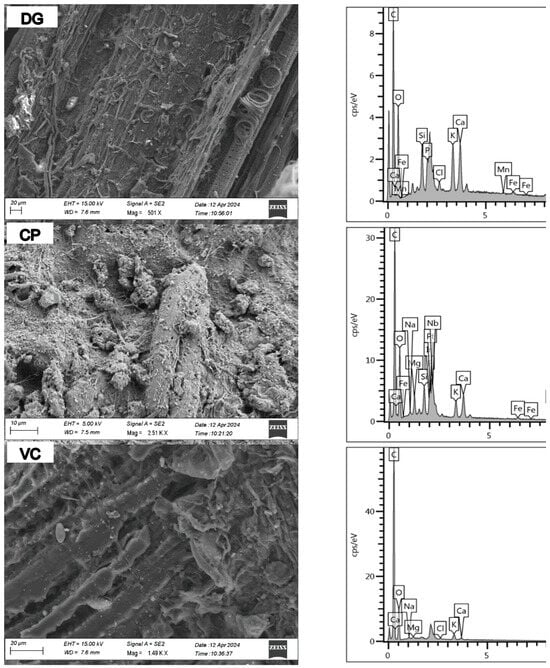
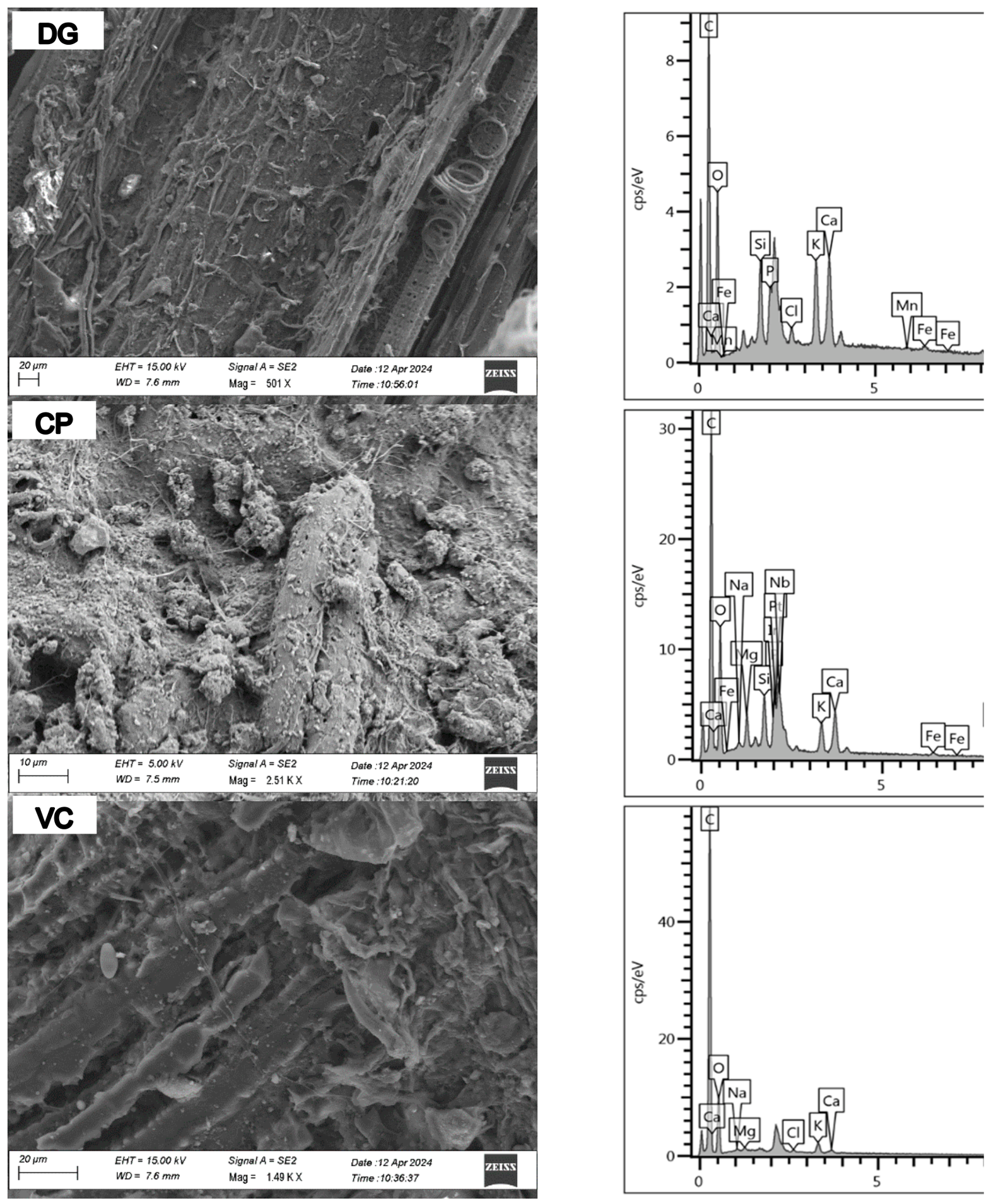
Scanning electron microscopy (SEM) images of all materials clearly revealed heterogeneous structure, highly porous texture with fibrous lignocellulosic residues, and numerous cavities, channels, and irregular surfaces (Figure 1). Distinct spiral-shaped structures in DG were consistent with preserved plant xylem tissues, while fine particulate deposits suggested mineral or organo–mineral aggregates. These features may facilitate solute diffusion and contaminant retention. Energy-dispersive X-ray (EDX) analysis revealed the presence of C, O, P, and alkali and alkaline earth metals, consistent with the composition of the biomass from which the materials originated (Figure 1). The relatively high electrical conductivity (EC) of DG may reflect its soluble salt content, whereas its alkaline pH may be associated with the degradation of organic acids and ammonia production during AD [51].
Figure 1.
Scanning electron microscopy (SEM) images and corresponding energy-dispersive X-ray (EDX) spectra of digestate (DG), compost (CP), and vermicompost (VC).
3.2. Adsorption and Desorption Study
3.2.1. Effects of the Solution-to-Amendment Ratio
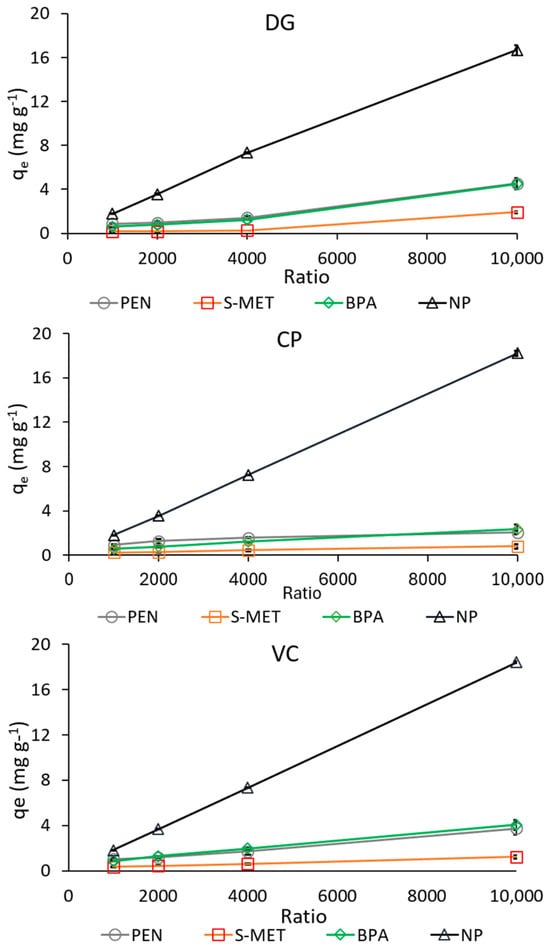
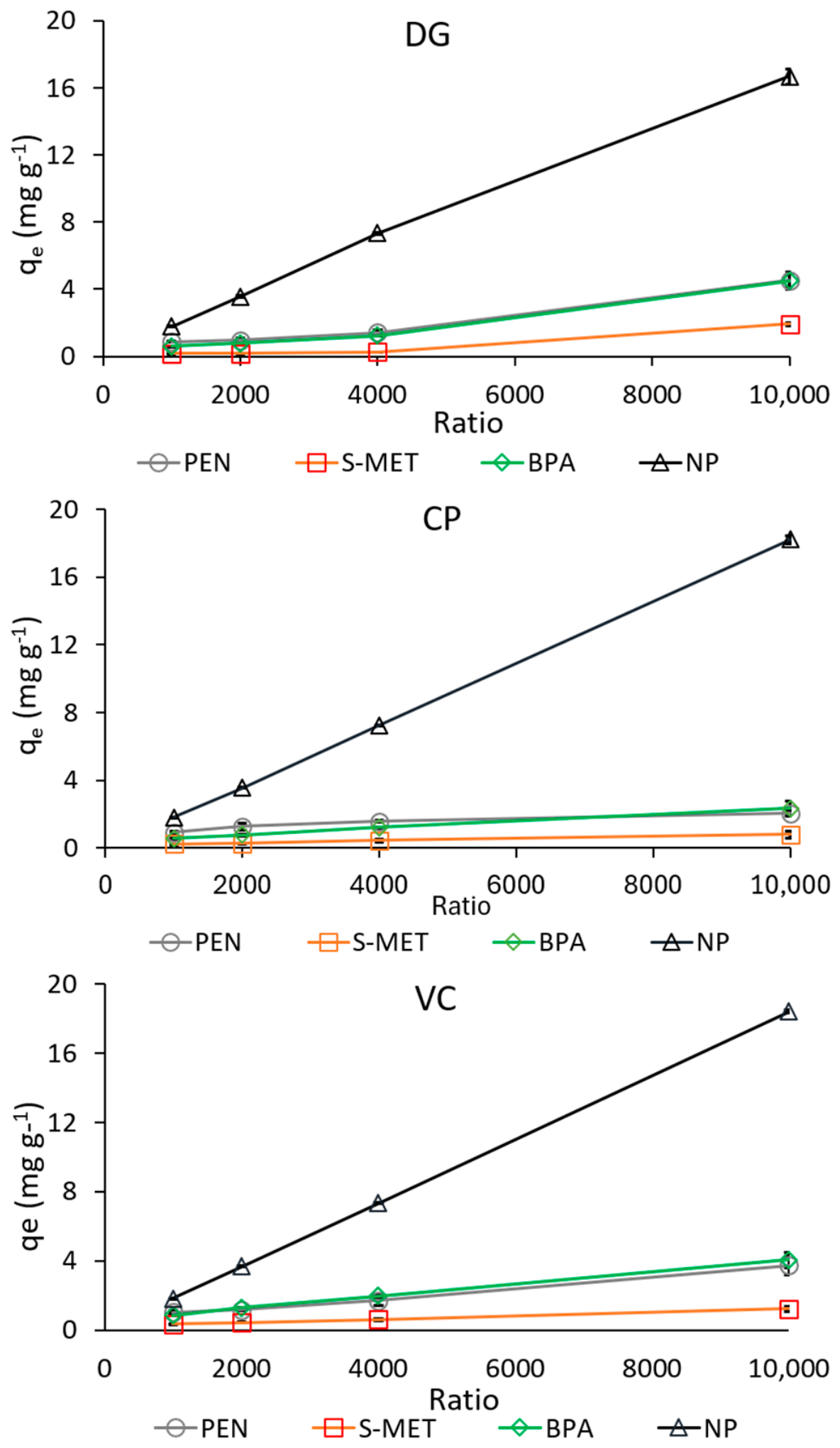
Increasing the solution-to-amendment ratio from 1000 to 10,000 mL g−1 raised the equilibrium amounts adsorbed per unit mass by 2.2–11.6-fold across the compounds and amendments; NP adsorption increased by approximately tenfold on all materials (Figure 2). This trend was previously observed and attributed to increased exposure of the internal surfaces of the materials [18]. At the highest ratio, PEN, S-MET, and BPA adsorption was significantly higher on DG than on CP and VC. This ratio was, therefore, selected for subsequent experiments with all three amendments.
Figure 2.
Effect of the solution-to-amendment ratio on the equilibrium adsorbed concentrations of penconazole (PEN), S-metolachlor (S-MET), bisphenol A (BPA), and 4-nonylphenol (NP) on digestate (DG), compost (CP), and vermicompost (VC). Vertical error bars indicate standard errors (n = 3).
3.2.2. Adsorption Kinetics
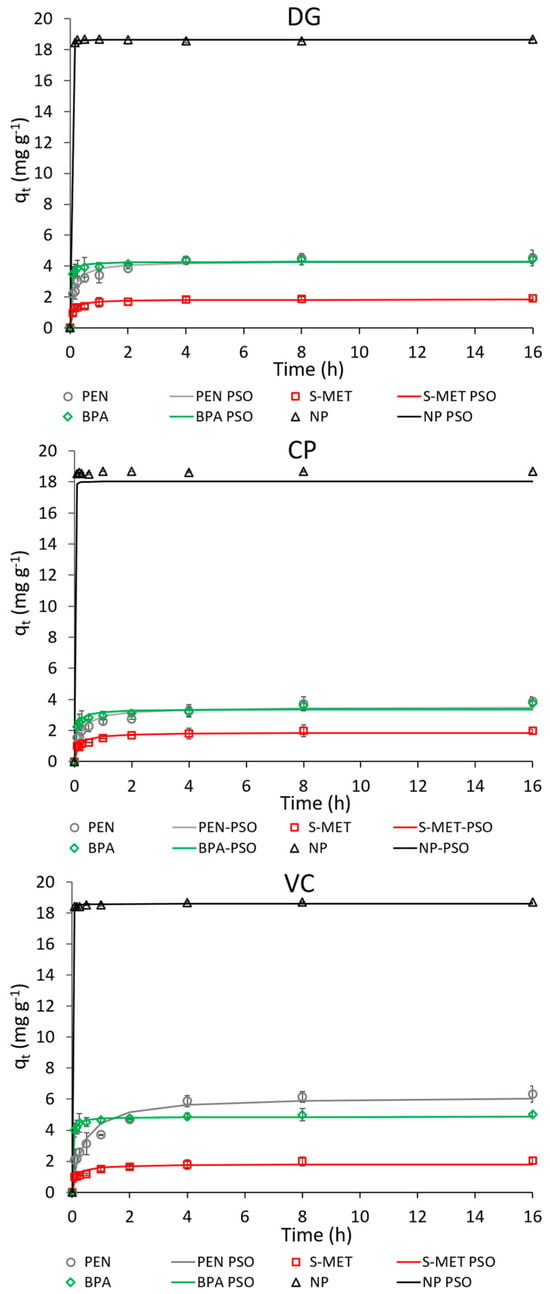
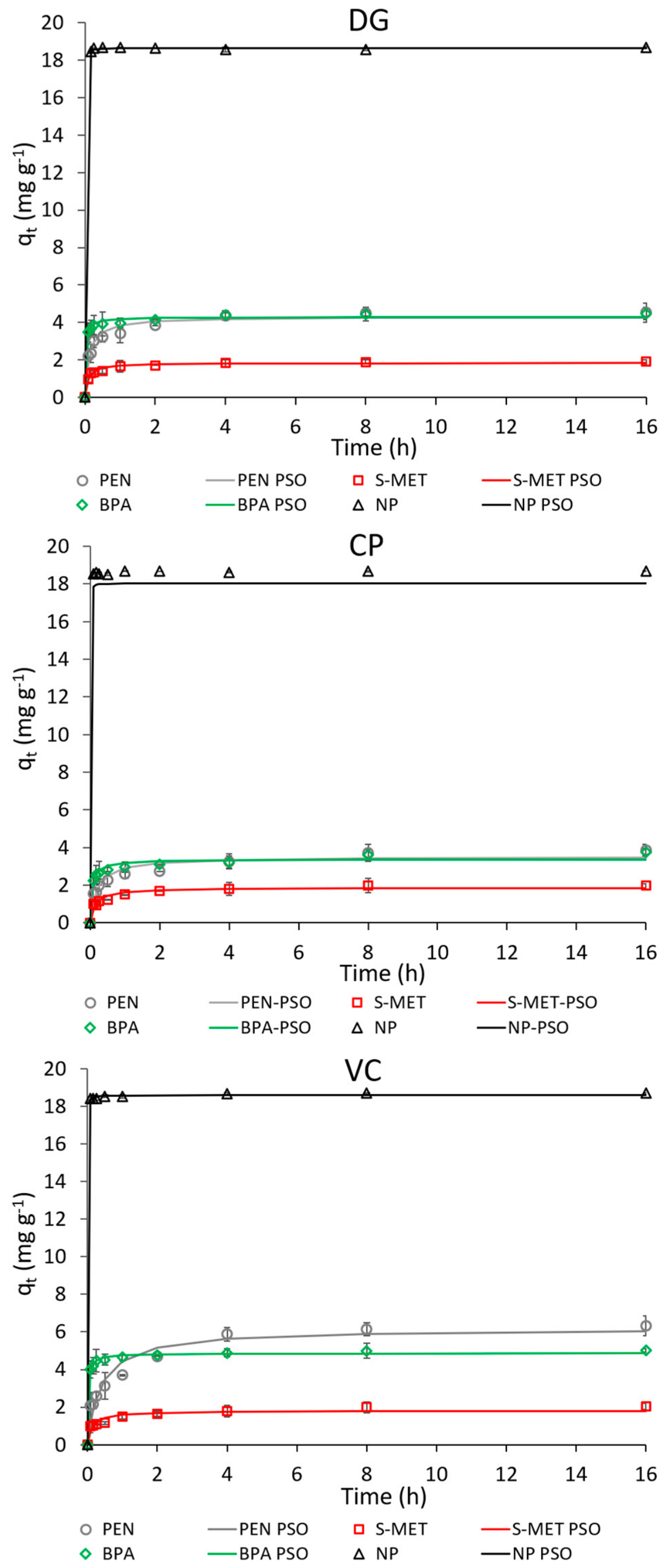
NP reached adsorption equilibrium within a few minutes on all amendments, whereas PEN, S-MET, and BPA required approximately 4 h on DG and 4–8 h on CP and VC (Figure 3). For these latter compounds, rapid retention during the first 30 min was followed by a slower stage. It is plausible that, in the initial phase, the most exposed and energetically favorable sites were rapidly occupied, whereas subsequently, diffusion towards internal sites became the rate-limiting step of the process.
Figure 3.
Adsorption kinetics of penconazole (PEN), S-metolachlor (S-MET), bisphenol A (BPA), and 4-nonylphenol (NP) onto digestate (DG), compost (CP), and vermicompost (VC). Points represent experimental data, and lines show fits of the pseudo second-order (PSO) kinetic model. Vertical error bars indicate standard errors (n = 3).
The experimental kinetic data were fitted into the nonlinear PFO and PSO equations (Table S2). The PFO model is generally associated with physisorption, whereas the PSO model assumes stronger interaction and high-energy bonds between the sorbate and the adsorbent (chemisorption). The PSO model generally described the kinetic data better than the PFO model, yielding higher r and lower SSR values (Table 5). The PSO rate constants (k2) for PEN, S-MET, and BPA were generally higher on DG than on its derivatives. On DG, the modelled equilibrium amounts adsorbed per unit mass (qe,2) followed the order of: S-MET (1.8 mg g−1) < BPA (4.3 mg g−1) ≈ PEN (4.3 mg g−1) < NP (18.6 mg g−1) (Table 5). A similar adsorption trend was observed on CP and VC, with the strong retention of NP consistent with its high hydrophobicity and low water solubility.
Table 5.
Kinetic parameters for the adsorption of penconazole (PEN), S-metolachlor (S-MET), bisphenol A (BPA), and 4-nonylphenol (NP) onto digestate (DG), compost (CP), and vermicompost (VC) estimated by fitting kinetic models to the experimental data using nonlinear regression.
3.2.3. Adsorption and Desorption Isotherms
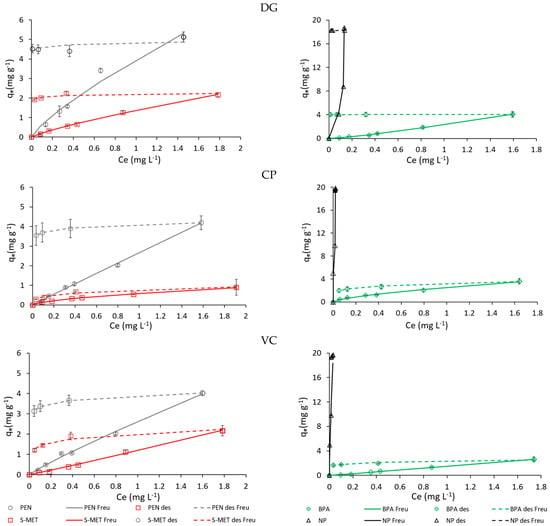
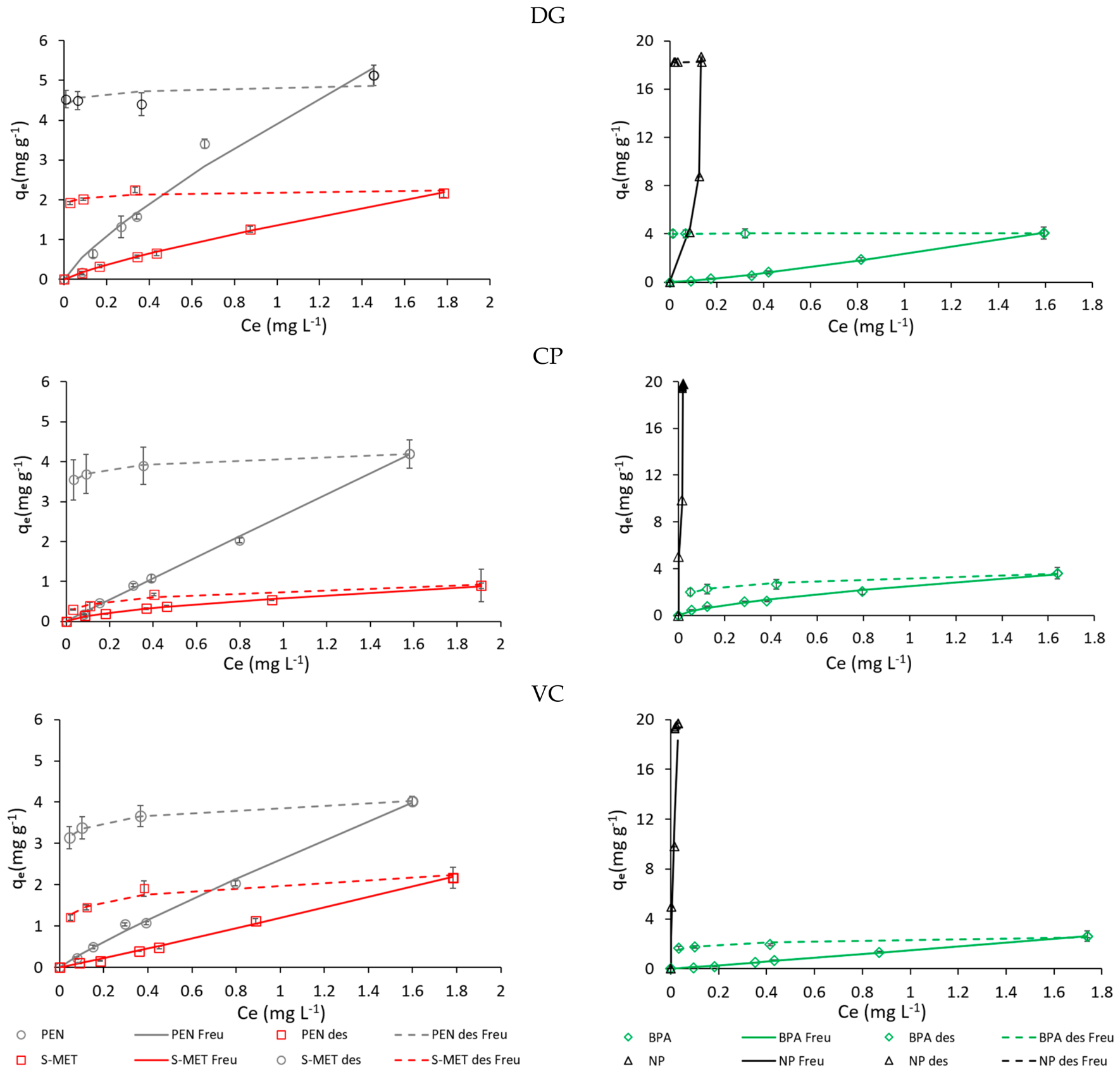
Adsorption isotherms showed broadly similar retention patterns among the amendments, with NP exhibiting the strongest affinity and S-MET the weakest (Figure 4; Table 6). The experimental data for the three amendments were fitted to the nonlinear Freundlich, Langmuir, and Temkin models, as well as the linear Henry equation. Freundlich and Langmuir models generally described the adsorption data satisfactorily; Henry fits were comparable for several compound–amendment combinations, while Temkin usually was the least appropriate. DG had the highest Freundlich KF values for PEN and S-MET, whereas CP and VC had the highest values for BPA and NP, respectively. NP adsorption on CP was poorly described by all models, limiting interpretation of its fitted parameters (Table 6).
Figure 4.
Adsorption and desorption isotherms of penconazole (PEN), S-metolachlor (S-MET), bisphenol A (BPA), and 4-nonylphenol (NP) on digestate (DG), compost (CP), and vermicompost (VC). Points represent experimental data, and lines show fits of the Freundlich model. Vertical error bars indicate standard errors (n = 3).
Table 6.
Adsorption isotherm parameters for penconazole (PEN), S-metolachlor (S-MET), bisphenol A (BPA), and 4-nonylphenol (NP) on digestate (DG), compost (CP), and vermicompost (VC), estimated by fitting isotherm models to the experimental data using nonlinear regression.
The Freundlich exponents were consistent with L-type adsorption of PEN and S-MET on DG (1/n < 1), whereas BPA and NP exhibited S-type isotherms (1/n > 1) in the Giles classification [52,53]. The latter behavior generally denotes cooperative adsorption and strong binding. For all three amendments, the distribution coefficient (Kd), Freundlich constant (KF), and the organic carbon-normalized partition coefficient (KOC) increased in the following order: S-MET < BPA < PEN << NP (Table 6). However, except for NP, all three parameters were generally higher for DG than for CP and VC.
This trend suggests that hydrophobicity played an important role in contaminant adsorption of contaminants onto the amendments. The Temkin parameter B followed the same trend as the adsorption constants. These results indicate progressively stronger adsorbate–adsorbent interactions along the same sequence. Positive B values of the Temkin equation are interpreted as evidence of heat release during adsorption; accordingly, the results obtained are consistent with an exothermic adsorption process.
Contaminants can interact with organic adsorbents through various concurrent mechanisms that influence the strength and reversibility of contaminant retention [54]. The coexistence of hydrophobic domains and polar functional groups in DG may, therefore, contribute to adsorption through partitioning, hydrogen bonding, and van der Waals forces [18]. Hydrophobic partitioning is likely to contribute to retention of all four compounds, while the phenolic hydroxyl groups of BPA and NP may additionally participate in hydrogen bonding, electron donor–acceptor or charge–transfer interactions. These interactions provide a possible explanation for the differences among contaminants without requiring a single dominant mechanism.
The modest changes in adsorption following aerobic processing are consistent with the shared structural and chemical features of the materials. During AD, labile organic compounds of initial biomass, including polysaccharides, proteins, amino acids, and fatty acids, are preferentially decomposed, resulting in the relative enrichment of more stable components and aromatic features in DG. The progressive formation of humic-like and fulvic-like substances leads to an increase in the degree of humification (DH%) [55]. These compositional changes are consistent with organic matter stabilization. Subsequent composting can increase the humic-like fraction. Provenzano et al. [55] reported that a composted DG exhibited a lower tryptophan-like to fulvic-like fluorescence ratio than the parent DG, consistent with increased humification. However, Tambone et al. [56] reported only modest compositional changes, with substantial retention of O-alkyl carbon associated with cellulose and hemicelluloses. Previous characterization of the amendments examined here showed broadly similar FTIR–ATR and Raman features, including hydrophilic functional groups and hydrophobic moieties, alongside differences in band intensities [36]. These spectroscopic findings also indicated that composting promoted the formation of aromatic functional groups characteristic of humic-like substances [36]. BET surface areas were approximately 0.97, 1.0 and 1.6 m2 g−1 for DG, CP, and VC, respectively [36]. The larger surface area of VC did not produce a consistent adsorption advantage, indicating that surface area alone does not explain the observed differences.
The desorption data were fitted to the Henry and Freundlich models (Figure 4; Table 7). For DG, PEN desorption was better described by the linear model, S-MET desorption was better described by the Freundlich model, and BPA desorption was described equally well by both. For CP and VC, the Freundlich model generally provided better fits for these three compounds. NP desorption was extremely limited from all amendments; neither model satisfactorily described its release from DG (Table 7). All the Freundlich desorption exponents (1/ndes) were below unity and substantially lower than the corresponding adsorption exponents, yielding hysteresis values (H) below 1 [50]. Hysteresis was positive and generally pronounced, indicating slow and limited release of the compounds. After three desorption cycles, DG released approximately 12%, 12%, 2%, and 2% of the adsorbed PEN, S-MET, BPA, and NP, respectively. Corresponding releases were 67%, 15%, 45%, and 2% from CP and 44%, 22%, 38%, and 2% from VC. Thus, DG retained PEN and BPA more strongly during desorption, whereas NP release remained minimal from all materials.
Table 7.
Desorption isotherm parameters for penconazole (PEN), S-metolachlor (S-MET), bisphenol A (BPA), and 4-nonylphenol (NP) on digestate (DG), compost (CP), and vermicompost (VC), estimated by fitting isotherm models to the experimental data using nonlinear regression.
Direct comparisons in the literature remain limited. To the best of our knowledge, no previous studies have quantified and modelled the adsorption of PEN, S-MET, and NP on DG, and of all four contaminants on VC. Regarding BPA, the KF value obtained in the present study (2.29 L g−1) was considerably higher than that previously reported for the same compound adsorbed on a mixed DG (0.13 L g−1) [18]. Studies in amended soils have shown increased PEN adsorption following compost addition [57] and increased S-MET adsorption in two compost-amended agricultural soils [35]. Recently, Carnimeo et al. [58] reported that soil amendment with CP and VC reduced the uptake and accumulation of organic contaminants, including BPA and NP, in cucumber plants. These findings support the relevance of these amendments to limit contaminant transfer from soil to plants, while the present batch results require verification in amended soils.
3.3. Lettuce Responses to Organic Amendment
3.3.1. Aboveground and Belowground Biomass Allocation
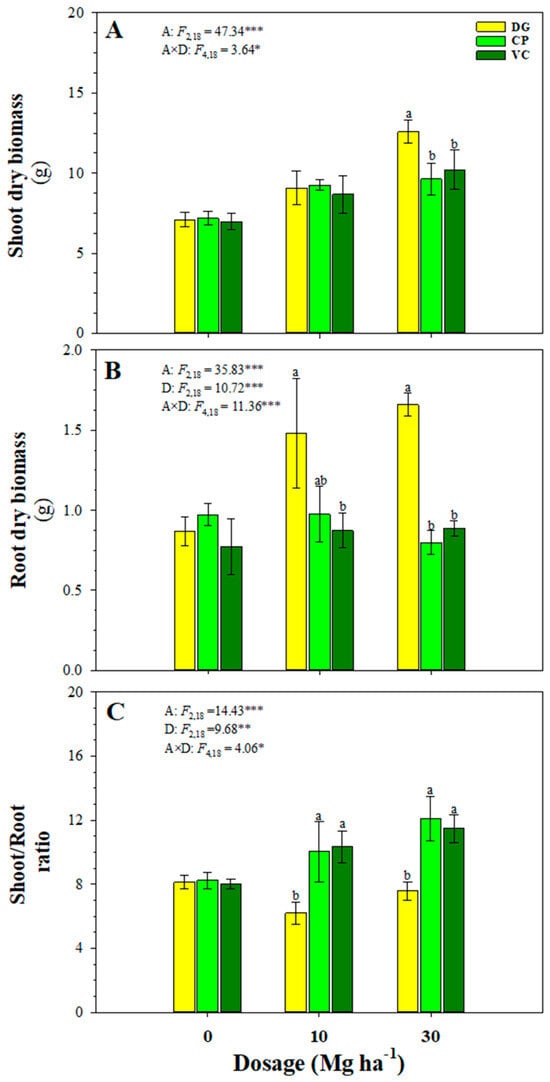
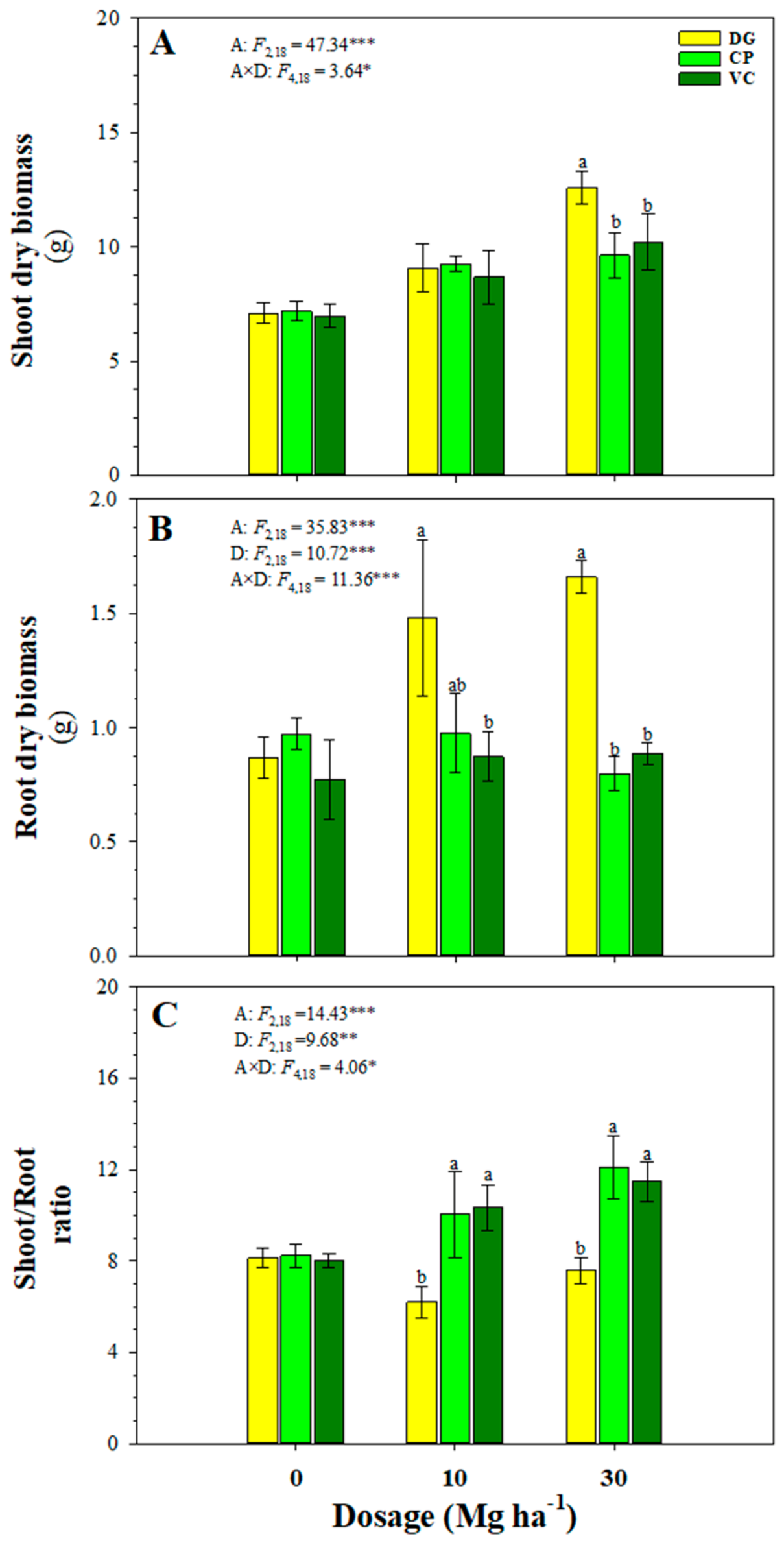
Lettuce growth was assessed under controlled microcosm conditions to complement the evaluation of amendment adsorption–desorption properties. Shoot dry biomass, root dry biomass, and their ratio responded markedly to the experimental treatments; in particular, DG promoted the greatest shoot and root biomass production (Figure 5A–C). Shoot dry biomass was strongly influenced by amendment type (p < 0.001) and its interaction with application rate (p < 0.05). At 30 Mt ha−1, shoot dry biomass was approximately 12.3 g with DG, compared with 9.6 g with CP and 10.2 g with VC (Figure 5A). A particularly marked stimulatory effect of DG was observed for root dry biomass, which increased by approximately 70% at 10 Mg ha−1 and nearly 90% at 30 Mg ha−1 relative to the control, significantly exceeding CP and VC at the same application rates (Figure 5B). DG also reduced the shoot-to-root dry biomass ratio, particularly at the lower application rate, whereas CP and VC caused a dose-dependent increase in this ratio (Figure 5C).
Figure 5.
Shoot dry biomass, root dry biomass, and shoot-to-root dry biomass ratio of lettuce plants grown in unamended soil (0 Mg ha−1) or soil amended with digestate (DG), compost (CP), or vermicompost (VC) at 10 or 30 Mg ha−1. Values are means ± standard deviations (n = 3). Within each application rate, different letters, where shown, indicate significant differences among amendment types (LSD test, p < 0.05). F-values and significance levels from two-way ANOVA are reported for amendment type (A), application rate (D), and their interaction (A × D): * p < 0.05; ** p < 0.01; *** p < 0.001.
The positive plant growth response to DG addition may reflect readily available nutrients, particularly mineral nitrogen, which promotes rapid vegetative growth, especially in short-cycle crops, such as lettuce [59,60], and root biomass allocation [61,62]. Hormone-like molecules released from solid DG may also contribute [63]. Slower nutrient release from stabilized organic matter may help to explain the weaker lettuce responses to CP and VC [64,65] and their greater allocation of biomass to aboveground tissues [66]. Collectively, these findings suggest that each amendment activates distinct mechanisms governing carbon and nutrient availability, biomass allocation between roots and shoots, and plant adaptation to amended soil conditions [67,68].
3.3.2. Root Morphology
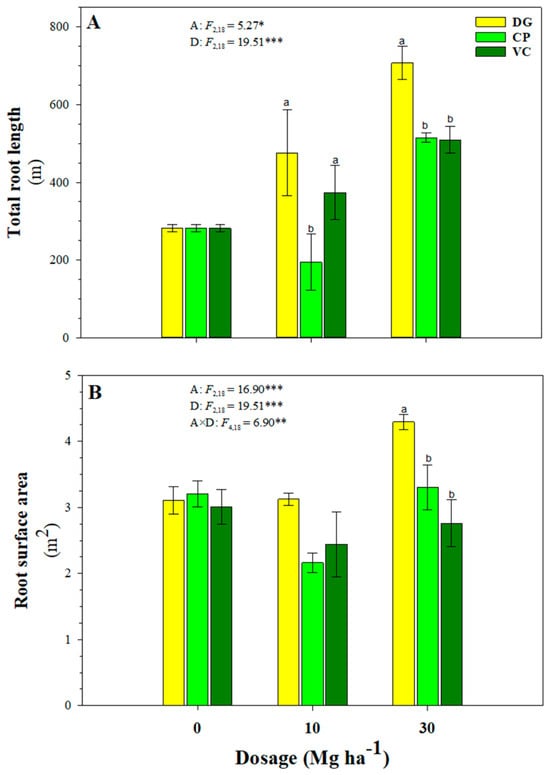
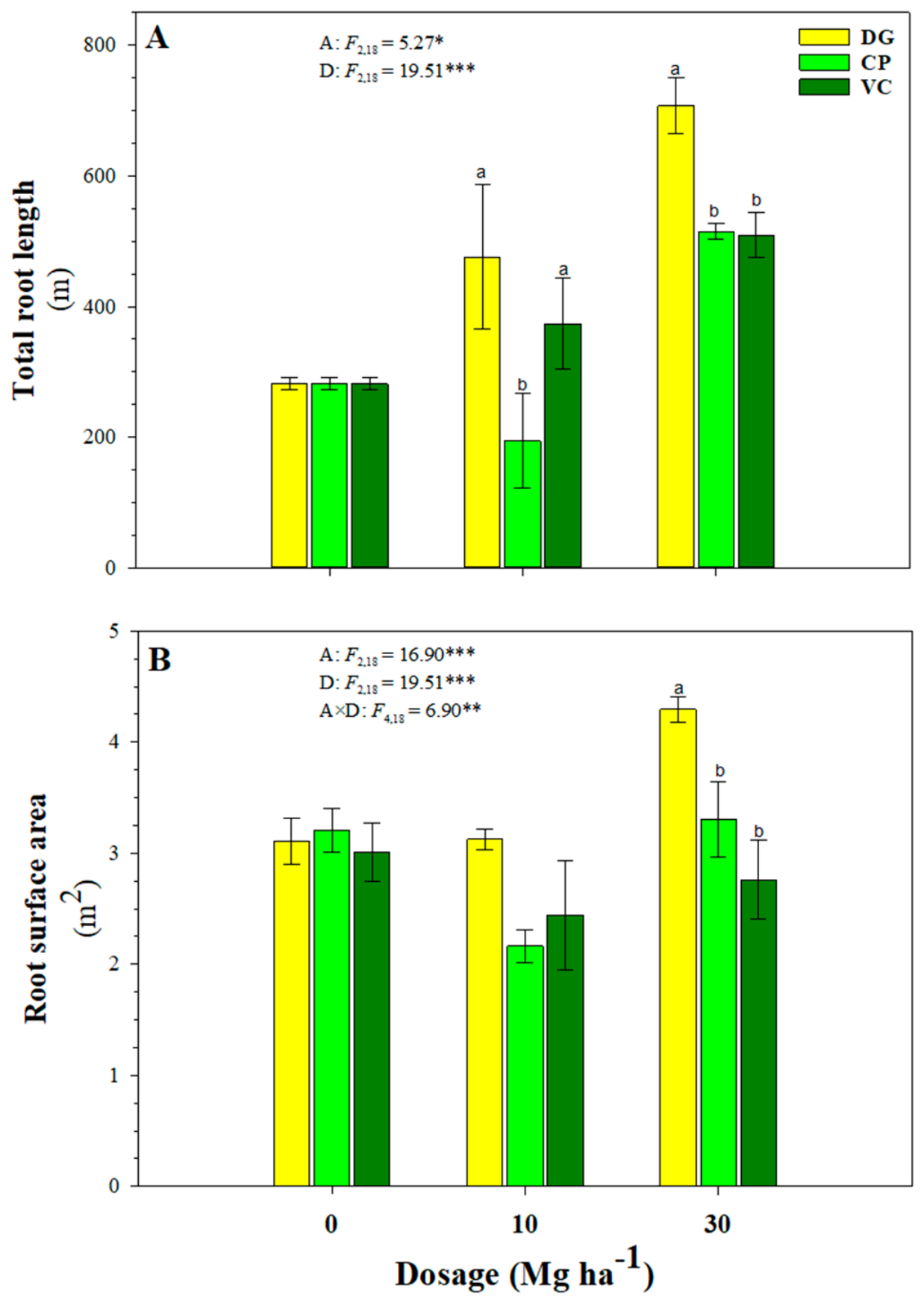
Total root length was significantly influenced by amendment type (p < 0.05) and application rate (p < 0.001), with no significant interaction (Figure 6A). DG addition promoted a marked linear increase in total root length from approximately 280 m in unamended soil to 526 m at 10 Mg ha−1 (+ 88%) and 665 m at 30 Mg ha−1 (+ 137%). Differently, CP and VC produced smaller increases, reaching 515 m and 473 m, respectively (Figure 6A). Root surface area was significantly affected by amendment type and application rate (both p < 0.001) and their interaction (p < 0.01; Figure 6B). Compared with plants grown in unamended soil, DG application at 30 Mg ha−1 increased root surface area by approximately 40% to 4.3 m2, whereas CP and VC reduced it at 10 Mg ha−1 and restored it to approximately 3.3 m2 at 30 Mg ha−1.
Figure 6.
Total root length and root surface area of lettuce plants grown in unamended soil (0 Mg ha−1) or soil amended with digestate (DG), compost (CP), or vermicompost (VC) at 10 or 30 Mg ha−1. Values are means ± standard deviations (n = 3). Within each application rate, different letters indicate significant differences among amendment types (LSD test, p < 0.05). F-values and significance levels from two-way ANOVA are reported for amendment type (A), application rate (D), and their interaction (A × D): * p < 0.05; ** p < 0.01; *** p < 0.001.
These results support the view that root morphological traits respond more sensitively than total dry biomass to amendment type, reinforcing their value as early indicators of soil–plant interactions. The greater root system expansion in this short-cycle crop under DG, particularly at the higher application rate, may reflect the enrichment of readily available nutrients associated with labile organic carbon inputs [69,70]. Together with the biomass results, these responses indicate that DG supported more rapid root development than its aerobic derivatives during the 60-day experiment. Potential longer-term benefits of CP and VC for soil fertility and nutrient management require further investigation.
3.4. Future Research Directions
Although adsorption–desorption experiments and lettuce microcosm assays provided important complementary information on the performance of DG, CP, and VC as soil amendments, their combined effects on the overall dynamics of contaminants in soil–plant systems remain to be established. Batch adsorption cannot be directly extrapolated to amended soils; plant growth responses do not predict contaminant uptake and accumulation in edible tissues. Future studies will, therefore, examine retention, degradation and uptake of PEN, S-MET, BPA, and NP in integrated soil–plant experiments, including the possible effects of amendment-induced changes in root morphology on rhizosphere processes. Linking soil improvement with reduced contaminant transfer is also consistent with the objectives of the of Directive (EU) 2025/2360, Soil Monitoring Law, which include improving soil health and reducing soil contamination to levels that are no longer harmful to human health and the environment [71].
Plant uptake represents a potential exposure pathway that should be considered alongside the agronomic benefits of amendment application. PEN and S-MET residues have been reported in lettuce following soil treatment [72,73]; BPA and NP uptake and distribution have been documented in hydroponic studies [74,75]. NP residues have also been detected in lettuce irrigated with reclaimed water [76]. These findings support the need to quantify contaminant accumulation under the specific soil and amendment conditions investigated here. Finally, longer-term experiments across different soils should establish whether contaminant retention persists as the amendments decompose, thus providing a stronger basis for selecting materials that support crop development while limiting contaminant transfer to edible plant parts.
4. Conclusions
This study provides new insights into how aerobic composting and vermicomposting modify the functional properties of anaerobic DG. Adsorption experiments with DG, CP, and VC revealed only modest differences in their capacities to retain PEN, S-MET, BPA, and NP. DG generally adsorbed contaminants more rapidly and retained PEN, S-MET, and BPA to a greater extent than CP and VC, whereas NP was adsorbed almost completely and instantaneously by all three amendments. Desorption exhibited pronounced hysteresis for all amendments and contaminants, particularly for BPA and NP onto DG, indicating slow and incomplete release over the three desorption cycles. More pronounced differences emerged in the 60-day microcosm experiments, in which DG promoted greater shoot and root biomass and more extensive root systems CP and VC. These findings indicate that aerobic processing did not consistently improve adsorption and reduced the short-term plant growth-promoting effects observed with the parent DG. Amendment selection should, therefore, consider agronomic effectiveness alongside practical aspects such as local availability, management requirements, and cost. These complementary laboratory and microcosm findings provide a basis for the further assessment of contaminant dynamics in amended soil–plant systems.
Supplementary Materials
The following supporting information can be downloaded at https://www.mdpi.com/article/10.3390/environments13120645/s1, Table S1: Major physicochemical properties of the Calcari-Fluvic Cambisol soil selected for filling the microcosms. Figure S1: Experimental workflow. Table S2: Sorption models considered in this study.
Author Contributions
Conceptualization, E.L.; methodology, E.L.; software, E.L., A.G., N.D. and G.S.; validation, E.L. and A.G.; formal analysis, E.L., A.G., N.D. and G.S.; investigation, E.L., A.G., N.D. and G.S.; resources, E.L. and A.G.; writing—original draft preparation, E.L. and A.G.; writing—review and editing, E.L.; visualization, E.L., A.G., N.D. and G.S.; supervision, E.L. and A.G.; funding acquisition, E.L. and A.G. All authors have read and agreed to the published version of the manuscript.
Funding
The present work contributes to the project PRIN 2022 PNRR entitled ‘Microbially-enriched biosorbents from waste recycling and soil-resident fungi as novel and sustainable tools to mitigate soil pollution by chemicals of emerging concern and prevent their entry and accumulation in vegetables’, Call 1409, dated 14 September 2022, financially supported by the European Union—NextGenerationEU—PNRR—Mission 4, Component 2, Investment 1.1. CUP: H53D23010520001. This manuscript reflects only the authors’ views and opinions, neither the European Union nor the European Commission can be considered responsible for them.
Data Availability Statement
The original contributions presented in this study are included in the article/Supplementary Materials. Further inquiries can be directed to the corresponding author.
Acknowledgments
The authors warmly thank Giancarlo Cattaneo, CEO of C&F Energy Società Agricola s.r.l., Altavilla Silentina, Italy, for kindly providing the organic amendments tested in this study. We acknowledge the Mediterranean University of Reggio Calabria and Department AGRARIA for supporting Giulio Scarpino during his PhD course in ‘Agricultural, Food and Forestry Science’. Sincere thanks to the reviewers of the article for their valuable comments and suggestions.
Conflicts of Interest
The authors declare no conflicts of interest.
References
- World Bioenergy Association (WBA). Global Bioenergy Statistics Report 2025, 12th ed.; World Bioenergy Association: Stockholm, Sweden, 2025; Available online: https://www.worldbioenergy.org/uploads/251118%20GBSR.pdf (accessed on 6 February 2026).
- Singh, L.; Kalia, V.C. (Eds.) Waste Biomass Management—A Holistic Approach; Springer: Cham, Switzerland, 2017. [Google Scholar] [CrossRef] [Scilit]
- Braguglia, C.M.; Gallipoli, A.; Gianico, A.; Pagliaccia, P. Anaerobic bioconversion of food waste into energy: A critical review. Bioresour. Technol. 2018, 248, 37–56. [Google Scholar] [CrossRef] [Scilit] [PubMed]
- Wang, W.; Lee, D.-J. Valorization of anaerobic digestion digestate: A prospect review. Bioresour. Technol. 2021, 323, 124626. [Google Scholar] [CrossRef] [Scilit] [PubMed]
- Cesaro, A. The valorization of the anaerobic digestate from the organic fractions of municipal solid waste: Challenges and perspectives. J. Environ. Manag. 2021, 280, 111742. [Google Scholar] [CrossRef] [Scilit] [PubMed]
- Slepetiene, A.; Ceseviciene, J.; Amaleviciute-Volunge, K.; Mankeviciene, A.; Parasotas, I.; Skersiene, A.; Jurgutis, L.; Volungevicius, J.; Veteikis, D.; Mockeviciene, I. Solid and Liquid Phases of Anaerobic Digestate for Sustainable Use of Agricultural Soil. Sustainability 2023, 15, 1345. [Google Scholar] [CrossRef] [Scilit]
- Font-Pomarol, J.; Molina-Peñate, E.; Artola, A.; Sánchez, A. New Trends in the Valorisation of the Solid Fraction of Digestate for the Production of Value-Added Bioproducts. Processes 2026, 14, 577. [Google Scholar] [CrossRef] [Scilit]
- Insam, H.; Gómez-Brandón, M.; Ascher, J. Manure-based biogas fermentation residues: Friend or foe of soil fertility? Soil Biol. Biochem. 2015, 84, 1–14. [Google Scholar] [CrossRef] [Scilit]
- Kumari, T.; O’Connor, J.; Zheng, Y.; Huxtable, A.; Dodd, M.S.; Jenkins, S.N.; Mickan, B.S. Aerated digestate management enhances soil properties, reduces greenhouse gas emissions, and shifts microbial communities. J. Environ. Manag. 2026, 406, 129852. [Google Scholar] [CrossRef] [Scilit] [PubMed]
- Möller, K.; Müller, T. Effects of anaerobic digestion on digestate nutrient availability and crop growth: A review. Eng. Life Sci. 2012, 12, 242–257. [Google Scholar] [CrossRef] [Scilit]
- Nkoa, R. Agricultural benefits and environmental risks of soil fertilization with anaerobic digestates: A review. Agron. Sustain. Dev. 2014, 34, 473–492. [Google Scholar] [CrossRef] [Scilit]
- Wang, N.; Huang, D.; Shao, M.; Sun, R.; Xu, Q. Use of activated carbon to reduce ammonia emissions and accelerate humification in composting digestate from food waste. Bioresour. Technol. 2022, 347, 126701. [Google Scholar] [CrossRef] [Scilit] [PubMed]
- Tambone, F.; Scaglia, B.; D’Imporzano, G.; Schievano, A.; Orzi, V.; Salati, S.; Adani, F. Assessing amendment and fertilizing properties of digestates from anaerobic digestion through a comparative study with digested sludge and compost. Chemosphere 2010, 81, 577–583. [Google Scholar] [CrossRef] [Scilit] [PubMed]
- Lü, F.; Shao, L.-M.; Zhang, H.; Fu, W.-D.; Feng, S.-J.; Zhan, L.-T.; Chen, Y.-M.; He, P.-J. Application of advanced techniques for the assessment of bio-stability of biowaste-derived residues: A minireview. Bioresour. Technol. 2018, 248, 122–133. [Google Scholar] [CrossRef] [Scilit] [PubMed]
- Chen, Y.; Camps-Arbestain, M.; Shen, Q.; Singh, B.; Cayuela, M.L. The long-term role of organic amendments in building soil nutrient fertility: A meta-analysis and review. Nutr. Cycl. Agroecosyst. 2018, 111, 103–125. [Google Scholar] [CrossRef] [Scilit]
- Blouin, M.; Barrere, J.; Meyer, N.; Lartigue, S.; Barot, S.; Mathieu, J. Vermicompost significantly affects plant growth. A meta-analysis. Agron. Sustain. Dev. 2019, 39, 34. [Google Scholar] [CrossRef] [Scilit]
- De Corato, U. Agricultural waste recycling in horticultural intensive farming systems by on-farm composting and compost-based tea application improves soil quality and plant health: A review under the perspective of a circular economy. Sci. Total Environ. 2020, 738, 139840. [Google Scholar] [CrossRef] [Scilit] [PubMed]
- Loffredo, E.; Carnimeo, C.; Silletti, R.; Summo, C. Use of the solid by-product of anaerobic digestion of biomass to remove anthropogenic organic pollutants with endocrine disruptive activity. Processes 2021, 9, 2018. [Google Scholar] [CrossRef] [Scilit]
- Senesi, N.; Loffredo, E.; D’Orazio, V.; Brunetti, G.; Miano, T.M.; La Cava, P. Adsorption of pesticides by humic acids from organic amendments and soils. In Humic Substances and Chemical Contaminants; Clapp, C.E., Hayes, M.H.B., Senesi, N., Bloom, P.R., Jardine, P.M., Eds.; Soil Science Society of America: Madison, WI, USA, 2015; pp. 129–153. [Google Scholar] [CrossRef] [Scilit]
- He, X.; Zhang, Y.; Shen, M.; Tian, Y.; Zheng, K.; Zeng, G. Vermicompost as a natural adsorbent: Evaluation of simultaneous metals (Pb, Cd) and tetracycline adsorption by sewage sludge-derived vermicompost. Environ. Sci. Pollut. Res. 2017, 24, 8375–8384. [Google Scholar] [CrossRef] [Scilit] [PubMed]
- Kaur, A.; Patowary, R. Understanding the impact of endocrine disrupting chemicals (EDCs) and mechanisms of microbial biodegradation: A review. Water Air Soil Pollut. 2026, 237, 532. [Google Scholar] [CrossRef] [Scilit]
- Khan, S.; Naushad, M.; Govarthanan, M.; Iqbal, J.; Alfadul, S.M. Emerging contaminants of high concern for the environment: Current trends and future research. Environ. Res. 2022, 207, 112609. [Google Scholar] [CrossRef] [Scilit] [PubMed]
- Burgos-Aceves, M.A.; Banaee, M.; Vazzana, I.; Betancourt-Lozano, M.; Gonzalez-Mille, D.J.; Aliko, V.; Faggio, C.; Ilizaliturri-Hernandez, C.A. Effect of emerging pollutants on the gut microbiota of freshwater animals: Focusing on microplastics and pesticides. Sci. Total Environ. 2024, 948, 174809. [Google Scholar] [CrossRef] [Scilit] [PubMed]
- Song, C.; Zeng, C.; Qin, T.; Lv, T.; Xu, Z.; Xun, Z.; Wang, L.; Chen, X.; Liu, B.; Peng, X. A dual-state-emission chalcone-based supramolecular probe for ratiometric detection of penconazole in environmental samples. Chem. Eng. J. 2023, 468, 143610. [Google Scholar] [CrossRef] [Scilit]
- Perdichizzi, S.; Mascolo, M.G.; Silingardi, P.; Morandi, E.; Rotondo, F.; Guerrini, A.; Prete, L.; Vaccari, M.; Colacci, A. Cancer-related genes transcriptionally induced by the fungicide penconazole. Toxicol. In Vitro 2014, 28, 125–130. [Google Scholar] [CrossRef] [Scilit] [PubMed]
- Kouame, K.B.J.; Savin, M.C.; Willett, C.D.; Bertucci, M.B.; Butts, T.R.; Grantz, E.; Roma-Burgos, N. S-metolachlor persistence in soil as influenced by within-season and inter-annual herbicide use. Environ. Adv. 2022, 9, 100318. [Google Scholar] [CrossRef] [Scilit]
- European Chemicals Agency (ECHA). Substance Information. Available online: https://echa.europa.eu/it/substance-information/-/substanceinfo/100.133.472 (accessed on 10 February 2026).
- Ou-Yang, K.; Feng, T.; Han, Y.; Li, G.; Li, J.; Ma, H. Bioaccumulation, metabolism and endocrine-reproductive effects of metolachlor and its S-enantiomer in adult zebrafish (Danio rerio). Sci. Total Environ. 2022, 802, 149826. [Google Scholar] [CrossRef] [Scilit] [PubMed]
- Metcalfe, C.D.; Bayen, S.; Desrosiers, M.; Muñoz, G.; Sauvé, S.; Yargeau, V. An introduction to the sources, fate, occurrence and effects of endocrine disrupting chemicals released into the environment. Environ. Res. 2022, 207, 112658. [Google Scholar] [CrossRef] [Scilit] [PubMed]
- European Food Safety Authority (EFSA). Conclusion regarding the peer review of the pesticide risk assessment of the active substance penconazole. EFSA J. 2008, 6, 175r. [Google Scholar] [CrossRef] [Scilit]
- Kupfersberger, H.; Klammler, G.; Schumann, A.; Brückner, L.; Kah, M. Modeling Subsurface Fate of S-Metolachlor and Metolachlor Ethane Sulfonic Acid in the Westliches Leibnitzer Feld Aquifer. Vadose Zone J. 2018, 17, 170030. [Google Scholar] [CrossRef] [Scilit]
- Choi, Y.J.; Lee, L.S. Aerobic Soil Biodegradation of Bisphenol (BPA) Alternatives Bisphenol S and Bisphenol AF Compared to BPA. Environ. Sci. Technol. 2017, 51, 13698–13704. [Google Scholar] [CrossRef] [Scilit] [PubMed]
- Langdon, K.A.; Warne, M.S.J.; Smernik, R.J.; Shareef, A.; Kookana, R.S. Degradation of 4-nonylphenol, 4-t-octylphenol, bisphenol A and triclosan following biosolids addition to soil under laboratory conditions. Chemosphere 2011, 84, 1556–1562. [Google Scholar] [CrossRef] [Scilit] [PubMed]
- Siedt, M.; Schäffer, A.; Smith, K.E.C.; Nabel, M.; Roß-Nickoll, M.; van Dongen, J.T. Comparing straw, compost, and biochar regarding their suitability as agricultural soil amendments to affect soil structure, nutrient leaching, microbial communities, and the fate of pesticides. Sci. Total Environ. 2021, 751, 141607. [Google Scholar] [CrossRef] [Scilit] [PubMed]
- Dollinger, J.; Bourdat-Deschamps, M.; Pot, V.; Serre, V.; Bernet, N.; Deslarue, G.; Montes, M.; Capowiez, L.; Michel, E. Leaching and degradation of S-metolachlor in undisturbed soil cores amended with organic wastes. Environ. Sci. Pollut. Res. 2022, 29, 20098–20111. [Google Scholar] [CrossRef] [Scilit] [PubMed]
- Loffredo, E.; Vona, D.; Porfido, C.; Giangregorio, M.M.; Gelsomino, A. Compositional and structural characterization of bioenergy digestate and its aerobic derivatives compost and vermicompost. J. Sustain. Agric. Environ. 2024, 3, e70002. [Google Scholar] [CrossRef] [Scilit]
- Food and Agriculture Organization of the United Nations (FAO). FAOSTAT. Available online: https://www.fao.org/faostat/en/#data (accessed on 19 January 2026).
- Organisation for Economic Co-operation and Development (OECD). OECD Guideline 208: Terrestrial Plant Test—Seedling Emergence and Seedling Growth Test; OECD: Paris, France, 2006. [Google Scholar] [CrossRef] [Scilit]
- Gelsomino, A.; Petrovičová, B.; Panuccio, M.R. Exhausted fire-extinguishing powders: A potential source of mineral nutrients for reuse and valorisation in compost enrichment for soilless cultivation. Sci. Total Environ. 2024, 906, 167633. [Google Scholar] [CrossRef] [Scilit] [PubMed]
- Alromian, F.M. Effect of type of compost and application rate on growth and quality of lettuce plant. J. Plant Nutr. 2020, 43, 2797–2809. [Google Scholar] [CrossRef] [Scilit]
- De Carolis, C.; Iori, V.; Narciso, A.; Gentile, D.; Casentini, B.; Pietrini, F.; Grenni, P.; Barra Caracciolo, A.; Iannelli, M.A. The effects of different combinations of cattle organic soil amendments and copper on lettuce (cv. Rufus) plant growth. Environments 2024, 11, 134. [Google Scholar] [CrossRef] [Scilit]
- ChemSpider. Available online: https://www.chemspider.com (accessed on 23 May 2026).
- Sparks, D.L.; Page, A.L.; Helmke, P.A.; Loeppert, R.H.; Soltanpour, P.N.; Tabatabai, M.A.; Johnston, C.T.; Sumner, M.E. (Eds.) Methods of Soil Analysis: Part 3. Chemical Methods; Soil Science Society of America and American Society of Agronomy: Madison, WI, USA, 1996. [Google Scholar] [CrossRef] [Scilit]
- Ho, Y.S. Second-order kinetic model for the sorption of cadmium onto tree fern: A comparison of linear and non-linear methods. Water Res. 2006, 40, 119–125. [Google Scholar] [CrossRef] [Scilit] [PubMed]
- Kumar, K.V. Linear and non-linear regression analysis for the sorption kinetics of methylene blue onto activated carbon. J. Hazard. Mater. 2006, B137, 1538–1544. [Google Scholar] [CrossRef] [Scilit] [PubMed]
- Freundlich, H.M.F. Uber die adsorption in losungen. J. Phys. Chem. 1906, 57, 385–470. [Google Scholar] [CrossRef] [Scilit] [PubMed]
- Langmuir, I. The adsorption of gases on plane surface of glass, mica and platinum. J. Am. Chem. Soc. 1918, 40, 1361–1403. [Google Scholar] [CrossRef] [Scilit]
- ALOthman, Z.A.; Badjah, A.Y.; Ali, I. Facile synthesis and characterization of multi walled carbon nanotubes for fast and effective removal of 4-tert-octylphenol endocrine disruptor in water. J. Mol. Liq. 2019, 275, 41–48. [Google Scholar] [CrossRef] [Scilit]
- Barrer, R.M.; Rees, L.V.C. Henry’s law adsorption constants. Trans. Faraday Soc. 1961, 57, 999–1007. [Google Scholar] [CrossRef] [Scilit]
- Barriuso, E.; Laird, D.A.; Koskinen, W.C.; Dowdy, R.H. Atrazine desorption from smectites. Soil Sci. Soc. Am. J. 1994, 58, 1632–1638. [Google Scholar] [CrossRef] [Scilit]
- Cristina, G.; Camelin, E.; Tommasi, T.; Fino, D.; Pugliese, M. Anaerobic digestates from sewage sludge used as fertilizer on a poor alkaline sandy soil and on a peat substrate: Effects on tomato plants growth and on soil properties. J. Environ. Manag. 2020, 269, 110767. [Google Scholar] [CrossRef] [Scilit] [PubMed]
- Prasannamedha, G.; Senthil Kumar, P.; Mehala, R.; Sharumitha, T.J.; Surendhar, D. Enhanced adsorptive removal of sulfamethoxazole from water using biochar derived from hydrothermal carbonization of sugarcane bagasse. J. Hazard. Mater. 2021, 407, 124825. [Google Scholar] [CrossRef] [Scilit] [PubMed]
- Giles, C.H.; MacEwan, T.H.; Nakhwa, S.N.; Smith, D. Studies in adsorption. Part XI. A system of classification of solution adsorption isotherms, and its use in diagnosis of adsorption mechanisms and in measurement of specific surface areas of solids. J. Chem. Soc. 1960, 163, 3973–3993. [Google Scholar] [CrossRef] [Scilit]
- Loffredo, E. Recent advances on innovative materials from biowaste recycling for the removal of environmental estrogens from water and soil. Materials 2022, 15, 1894. [Google Scholar] [CrossRef] [Scilit] [PubMed]
- Provenzano, M.R.; Malerba, A.D.; Pezzolla, D.; Gigliotti, G. Chemical and spectroscopic characterization of organic matter during the anaerobic digestion and successive composting of pig slurry. Waste Manag. 2014, 34, 653–660. [Google Scholar] [CrossRef] [Scilit] [PubMed]
- Tambone, F.; Terruzzi, L.; Scaglia, B.; Adani, F. Composting of the solid fraction of digestate derived from pig slurry: Biological processes and compost properties. Waste Manag. 2015, 35, 55–61. [Google Scholar] [CrossRef] [Scilit] [PubMed]
- Jiang, L.; Lin, J.L.; Jia, L.X.; Liu, Y.; Pan, B.; Yang, Y.; Lin, Y. Effects of two different organic amendments addition to soil on sorption-desorption, leaching, bioavailability of penconazole and the growth of wheat (Triticum aestivum L.). J. Environ. Manag. 2016, 167, 130–138. [Google Scholar] [CrossRef] [Scilit] [PubMed]
- Carnimeo, C.; Gelsomino, A.; Cirrottola, G.; Panuccio, M.R.; Loffredo, E. Compost and vermicompost in cucumber rhizosphere promote plant growth and prevent the entry of anthropogenic organic pollutants. Sci. Hortic. 2022, 303, 111250. [Google Scholar] [CrossRef] [Scilit]
- Brtnicky, M.; Kintl, A.; Holatko, J.; Hammerschmiedt, T.; Mustafa, A.; Kucerik, J.; Vitez, T.; Prichystalova, J.; Baltazar, T.; Elbl, J. Effect of digestates derived from the fermentation of maize-legume intercropped culture and maize monoculture application on soil properties and plant biomass production. Chem. Biol. Technol. Agric. 2022, 9, 43. [Google Scholar] [CrossRef] [Scilit]
- Caterino, D.; Follador, A.; Galbusera, J.; Guffanti, D.; Cocetta, G.; Geuna, F.; Dell’Orto, M.; Scaglia, B.; Passera, A.; Riva, E.; et al. Evolution of biogenic nitrogen from digestates for lettuce fertilization and the effect on the bacterial community. Horticulturae 2024, 10, 685. [Google Scholar] [CrossRef] [Scilit]
- Ren, A.T.; Abbott, L.K.; Chen, Y.; Xiong, Y.C.; Mickan, B.S. Nutrient recovery from anaerobic digestion of food waste: Impacts of digestate on plant growth and rhizosphere bacterial community composition and potential function in ryegrass. Biol. Fertil. Soils 2020, 56, 973–989. [Google Scholar] [CrossRef] [Scilit]
- Hammerschmiedt, T.; Kintl, A.; Holatko, J.; Mustafa, A.; Vitez, T.; Malicek, O.; Baltazar, T.; Elbl, J.; Brtnicky, M. Assessment of digestates prepared from maize, legumes, and their mixed culture as soil amendments: Effects on plant biomass and soil properties. Front. Plant Sci. 2022, 13, 1017191. [Google Scholar] [CrossRef] [Scilit] [PubMed]
- Scaglia, B.; Pognani, M.; Adani, F. The anaerobic digestion process capability to produce biostimulant: The case study of the dissolved organic matter (DOM) vs. auxin-like property. Sci. Total Environ. 2017, 589, 36–45. [Google Scholar] [CrossRef] [Scilit] [PubMed]
- Arancon, N.Q.; Owens, J.D.; Converse, C. The effects of vermicompost tea on the growth and yield of lettuce and tomato in a non-circulating hydroponics system. J. Plant Nutr. 2019, 42, 2447–2458. [Google Scholar] [CrossRef] [Scilit]
- Rizzo, P.F.; Young, B.J.; Pin Viso, N.; Carbajal, J.; Martínez, L.E.; Riera, N.I.; Bres, P.A.; Beily, M.E.; Barbaro, L.; Farber, M.; et al. Integral approach for the evaluation of poultry manure, compost, and digestate: Amendment characterization, mineralization, and effects on soil and intensive crops. J. Environ. Manag. 2023, 345, 119303. [Google Scholar] [CrossRef] [Scilit] [PubMed]
- Duggan, T.; Jones, P. Lettuce (Lactuca sativa ‘Webb’s Wonderful’) shoot and root growth in different grades of compost and vermicomposted compost. Acta Hortic. 2016, 1146, 33–40. [Google Scholar] [CrossRef] [Scilit]
- Scarpino, G.; Guerrero-Gallardo, L.; Gelsomino, A.; Sánchez-Rodríguez, A.R. Differential effects of organic amendments on soil P availability, plant P uptake efficiency and root traits of durum wheat at its earliest stage in calcareous and non-calcareous soils: A microcosm approach. J. Soil Sci. Plant Nutr. 2025, 25, 8889–8908. [Google Scholar] [CrossRef] [Scilit]
- García-Rández, A.; Orden, L.; Sánchez-Méndez, S.; Andreu-Rodríguez, F.J.; Sáez-Tovar, J.A.; Martínez-Sabater, E.; Bustamante, M.Á.; Pérez-Murcia, M.D.; Moral, R. Comparative evaluation of organic and synthetic fertilizers on lettuce yield and metabolomic profiles. Horticulturae 2025, 11, 1421. [Google Scholar] [CrossRef] [Scilit]
- Skrzypczak, D.; Trzaska, K.; Mironiuk, M.; Mikula, K.; Izydorczyk, G.; Witek-Krowiak, A.; Chojnacka, K. Recent innovations in fertilization with treated digestate from food waste to recover nutrients for arid agricultural fields. Environ. Sci. Pollut. Res. 2024, 31, 41563–41585. [Google Scholar] [CrossRef] [Scilit] [PubMed]
- Zapata-Morales, A.L.; Moreno-Andrade, I. Valorization of digestates from organic solid waste as fertilizers, soil improvers, and agricultural prebiotics: Panorama and perspectives. 3 Biotech 2025, 15, 333. [Google Scholar] [CrossRef] [Scilit] [PubMed]
- Directive (EU) 2025/2360 of the European Parliament and of the Council of 12 November 2025, (Soil Monitoring Law). Official Journal of the European Union, L Series, 26.11.2025, Bruxelles, B. ELI. Available online: http://data.europa.eu/eli/dir/2025/2360/oj (accessed on 7 September 2026).
- Food and Agriculture Organization of the United Nations (FAO); World Health Organization (WHO). Penconazole (182). In Pesticide Residues in Food 2016—Evaluations, Part I—Residues; FAO Plant Production and Protection Paper 231; FAO: Rome, Italy, 2017; p. 1834. Available online: https://www.fao.org/fileadmin/user_upload/IPM_Pesticide/JMPR/Evaluations/2016/PENCONAZOLE.pdf (accessed on 6 November 2026).
- European Food Safety Authority (EFSA); Alvarez, F.; Arena, M.; Auteri, D.; Binaglia, M.; Castoldi, A.F.; Chiusolo, A.; Colagiorgi, A.; Colas, M.; Crivellente, F.; et al. Peer review of the pesticide risk assessment of the active substance S-metolachlor excluding the assessment of the endocrine disrupting properties. EFSA J. 2023, 21, 7852. [Google Scholar] [CrossRef] [Scilit] [PubMed]
- Dodgen, L.K.; Li, J.; Parker, D.; Gan, J.J. Uptake and accumulation of four PPCP/EDCs in two leafy vegetables. Environ. Pollut. 2013, 182, 150–156. [Google Scholar] [CrossRef] [Scilit] [PubMed]
- Lu, J.; Wu, J.; Stoffella, P.J.; Wilson, P.C. Uptake and distribution of bisphenol A and nonylphenol in vegetable crops irrigated with reclaimed water. J. Hazard. Mater. 2015, 283, 865–870. [Google Scholar] [CrossRef] [Scilit] [PubMed]
- Hu, Y.; Ma, M.; Gao, L.; Wu, W.; Xu, D. Uptake, translocation and health risk assessment of nonylphenol in vegetables under reclaimed water irrigation. Irrig. Drain. 2025, 74, 627–640. [Google Scholar] [CrossRef] [Scilit]

Disclaimer/Publisher’s Note: The statements, opinions and data contained in all publications are solely those of the individual author(s) and contributor(s) and not of MDPI and/or the editor(s). MDPI and/or the editor(s) disclaim responsibility for any injury to people or property resulting from any ideas, methods, instructions or products referred to in the content. |
© 2026 by the authors. Licensee MDPI, Basel, Switzerland. This article is an open access article distributed under the terms and conditions of the Creative Commons Attribution (CC BY) license.