


Abstract
This study evaluated the temporal variability of the persistent inorganic composition and mineralogical content of leachate-derived solid samples collected from the San Nicolás landfill in Aguascalientes, Mexico. Monthly samples were collected over a one-year monitoring period, and the corresponding leachate-derived solids were characterized using inductively coupled plasma optical emission spectrometry, Fourier transform infrared spectroscopy, and X-ray diffraction. Calculated elemental composition variability factors revealed differences between samples collected during wet and dry periods, potentially associated with seasonal environmental conditions. The results indicated that sodium, potassium, calcium, and magnesium were the main inorganic constituents, with maximum concentrations of 344.12, 105.53, 23.24, and 5.97 mg/g, respectively, during the monitoring period. Halite and sylvite were the predominant mineral phases identified in the leachate-derived solid samples. These results provide a basis for future investigations into the environmental implications and potential valorization of leachate-derived solids.
1. Introduction
The final disposal of municipal solid waste (MSW) worldwide still relies on landfilling because of its low operating costs and limited implementation of valorization strategies [1,2]. The inevitable generation of leachate from landfills entails technological, environmental, and economic challenges that should be addressed to contribute to sustainable waste management. This liquid stream is characterized by a complex composition resulting from waste decomposition and water percolation processes that promote the dissolution, mobilization, and accumulation of xenobiotics, toxic inorganic elements, and organic matter [3,4,5,6,7]. The operating conditions of the landfill and its age, local climate, and waste degradation rate affect the leachate pollutant load and composition [8,9]. Several studies have reported that deficient leachate management can lead to water and soil pollution [9,10,11,12,13], with impacts that may extend hundreds of meters beyond landfill boundaries [14,15]. The environmental risks associated with landfilling can be intensified by increasing waste generation, insufficient monitoring, and restricted application of leachate treatment methods [7,16]. Herein, it is convenient to note that complex separation systems based on the integration of different technologies (e.g., physicochemical, biological, and membrane processes) are often required to reduce the concentration of pollutants contained in the leachate. However, their main limitations include high energy consumption, operating costs, and carbon footprint [17].
Best practices recommend the implementation of a systematic monitoring program to evaluate temporal variations in leachate composition to determine its pollution potential and identify valorization pathways [14,18]. Overall, leachate composition is characterized by temporal variability related to climatic conditions at the waste disposal site [18,19]. Studies based on long-term monitoring campaigns have concluded that heavy metal content (e.g., Fe, Pb, Cd, Zn) can represent a major fraction of leachate pollution load with significant temporal variations and different contaminant dynamics, particularly during the wet season [20,21,22]. Although landfill leachate composition has been extensively reported, several studies have not analyzed and discussed its temporal heterogeneity. Particularly, solids recovered from landfill leachate can provide a complementary perspective on the temporal evolution of its long-term composition and facilitate the characterization of non-volatile and recalcitrant constituents that may remain diluted in the liquid phase. This limitation is relevant for the inorganic fraction because its concentration may respond differently to changes in waste degradation rate, evaporation, water infiltration, and dissolution–precipitation processes. Few investigations have focused on the temporal monitoring of inorganic leachate composition with complementary spectroscopic and mineralogical characterization of the recovered solid phase. Therefore, this context emphasizes the relevance of characterization campaigns aimed at distinguishing highly variable constituents from persistent compositional and mineralogical features of solids recovered from leachate, including the presence of elements associated with its pollution potential and those promising for recovery and valorization within a circular economy framework.
Mexico faces increasing pressure on its infrastructure due to the substantial increase in MSW generation [23]. In 2022, it was estimated that more than 108,000 tons of MSW were collected daily; however, only a small proportion of them underwent treatment or valorization. Several disposal sites that are operated throughout the country lack systematic monitoring programs to evaluate the evolution of leachate composition and that of its derived solid fraction. This constrains the local capability to identify adequate treatment technologies, detect potential changes in leachate toxicity, develop reliable leachate management planning, and mitigate the long-term environmental impacts associated with waste disposal.
The aim of this study was to assess the temporal variability of the inorganic chemical content of leachate-derived solids obtained from monthly collected samples from the San Nicolas MSW landfill in Aguascalientes, Mexico. Elemental concentrations were determined using inductively coupled plasma optical emission spectroscopy (ICP-OES), while X-ray diffraction (XRD) and Fourier transform infrared (FTIR) spectroscopy were employed to investigate the temporal changes in the crystalline phases and chemical functionalities of the solid fraction recovered from the leachate. Elemental composition variability factors were calculated to characterize temporal patterns of inorganic constituents, including the presence of toxic heavy metals, and to explore the potential of leachate-derived solids for future recovery and valorization. These analyses aimed to identify both variable and persistent compositional and mineralogical characteristics, providing information on the inorganic phase of the recovered solids and a basis for future investigation of their environmental implications and potential valorization applications.
2. Materials and Methods
2.1. Leachate Monitoring Campaign
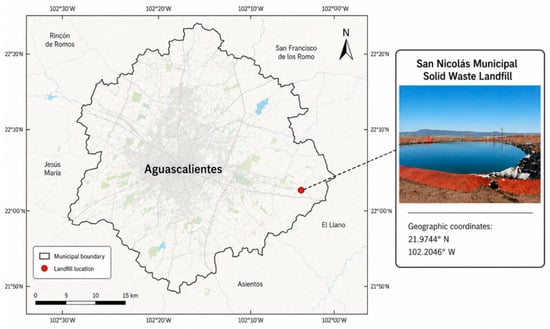
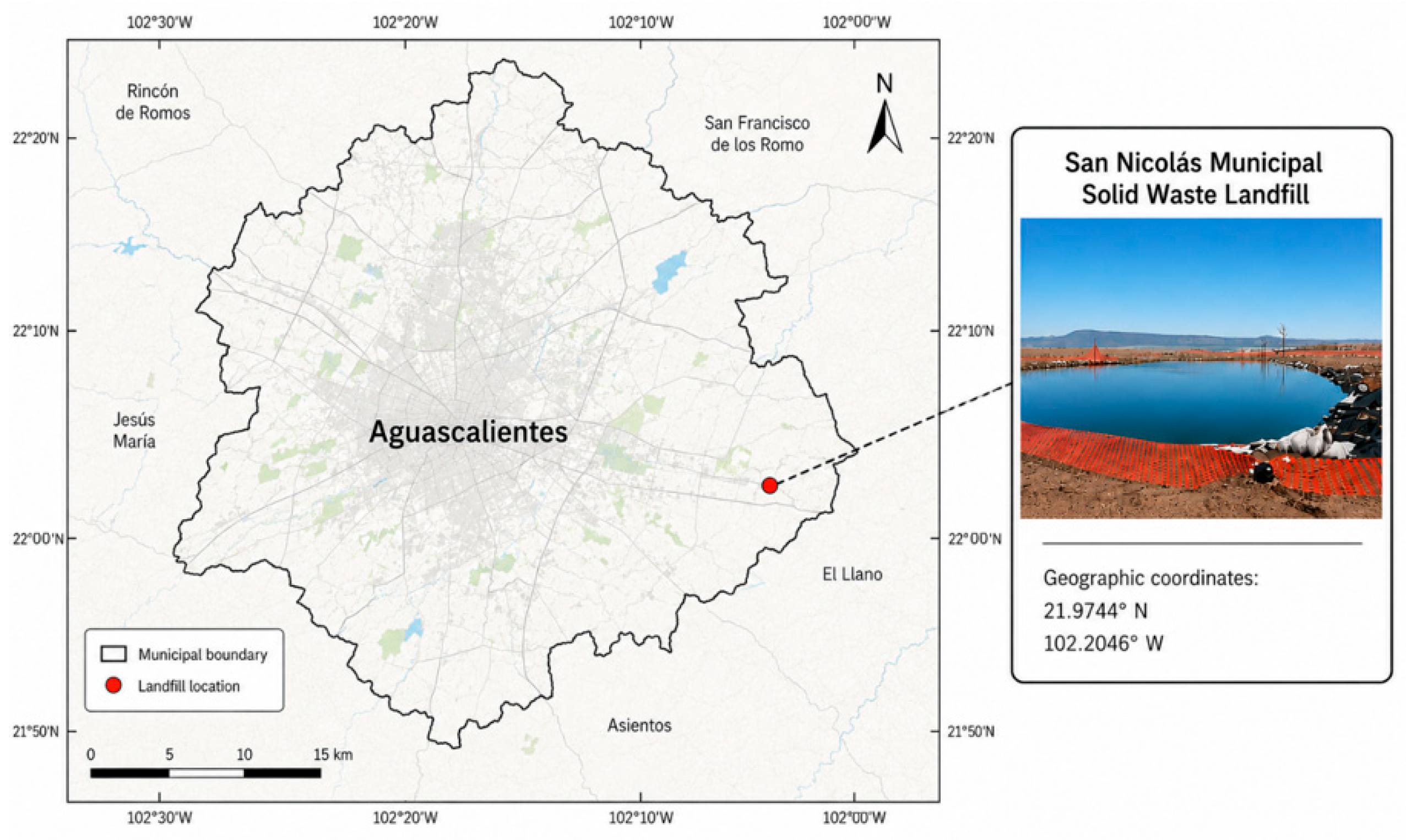
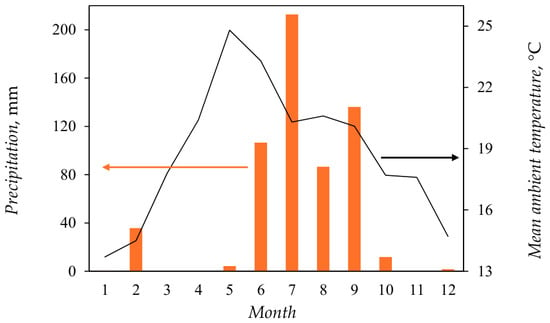
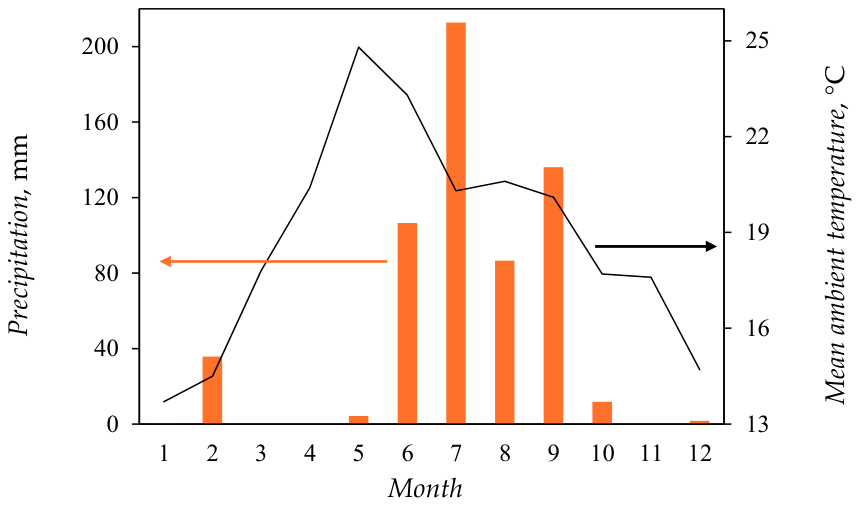
The leachate samples analyzed in this study were obtained from the San Nicolas MSW landfill located in Aguascalientes, Mexico; see Figure 1. This waste management infrastructure has been in service for 6 years, and the leachate samples reflected the characteristics of its usual operating conditions. Twelve monthly composite leachate samples were collected over a one-year monitoring period, with one composite sample representing each month. Official data [24] on monthly precipitation and average ambient temperature were used to characterize seasonal environmental conditions and to group the samples analyzed during the monitoring campaign; see Figure 2. Months 1–5 and 10–12 were classified as the dry period (n = 8), while months 6–9 were categorized as the wet period (n = 4). Sampling was conducted following standard recommendations for landfill leachate [25,26]. Ten 1 L surface subsamples were collected from different locations within the treatment lagoon and combined to obtain a representative leachate composite sample for monthly analysis. All samples were stored in pre-cleaned polypropylene containers at 4 °C until processing and characterization. The pH of the raw liquid leachate samples was measured using an OHAUS Aqua Searcher benchtop pH meter.
Figure 1.
Location of the San Nicolás MSW landfill in Aguascalientes, Mexico, from which leachate samples were collected in this study.
Figure 2.
Monthly precipitation (mm) and mean ambient temperature (°C) in Aguascalientes, Mexico, during the leachate sampling period reported in this study. Data were obtained from the Mexican National Meteorological Service via CONAGUA [24].
2.2. Characterization of Solid Phase Recovered from Leachate Samples
The inorganic constituents and mineral phases of the leachate-derived solids were analyzed to characterize their temporal variations. A 1 L aliquot of each composite leachate sample was dried at 50 °C until a constant mass was reached, without prior filtration or separation of suspended solids. Consequently, the recovered material represented the total solid phase, including both dissolved constituents retained upon drying and suspended solids originally present in the leachate. The resulting leachate-derived solid was weighed to determine its total mass, ground using a mortar, and sieved to a particle size < 0.3 mm prior to chemical characterization via elemental analysis, FTIR, and XRD. The elemental composition of the leachate-derived solids was determined using inductively coupled plasma optical emission spectrometry (ICP-OES) with a Thermo Scientific iCAP 7400 Duo spectrometer (Thermo Fisher Scientific, Bremen, Germany). For each monthly sample, 0.34 ± 0.02 g of dried and homogenized solid was acid-digested using concentrated high-purity HNO3. The resulting acidic solutions were diluted with deionized water (<1 μS/cm) to final volumes of 1000 mL, prior to ICP-OES analysis. Two replicates of each digestion were performed. The concentrations of 26 inorganic elements were calculated on a dry-mass basis and reported as mg per g of recovered leachate-derived solid. Linear calibration curves in the range of 0.01–10 mg/L (with coefficients of determination R2 > 0.995) prepared from certified standard solutions were used to determine the elemental composition. Dilution factors from 5 to 50 were applied for the quantification of Ca, K, Na, and Si, with the lowest value selected to minimize experimental uncertainty. The concentrations of the remaining elements were determined directly from the acid digestion solutions without further dilution. Analytical blanks and quality control standards were included in the analysis. Blank concentrations were below the LOQ; therefore, no blank correction was applied. It is convenient to note that, although ICP-OES calibration standards and quality control procedures were employed to ensure instrumental performance and analytical consistency, digestion-recovery experiments using certified reference materials or matrix-spiked samples were not performed. Therefore, the quantitative recovery of individual elements from the digested residues cannot be independently confirmed. In particular, elements associated with refractory mineral phases may not have been completely released during the digestion procedure. Consequently, the reported elemental concentrations should be interpreted as analytically determined concentrations under the applied digestion conditions rather than as necessarily representing the total elemental composition of the samples. This limitation is acknowledged when interpreting the elemental distribution and potential resource recovery applications of the residues. The certified standard solutions were also used to verify instrumental analytical performance. Three replicate measurements were determined per element in each sample, with relative standard deviations < 5%. The instrumental limit of quantification (LOQ) was set at 0.01 mg/L for each element, corresponding to the lowest calibration level and exceeding the respective instrumental limit of detection (LOD). The laboratory-reported concentrations already accounted for dilution factors, and the elemental concentrations reported by ICP-OES in mg/L for the digested solid solutions were converted to mg/g of recovered dry solid using Equation (S1) given in Supporting Information. Based on these calculations, a common LOQ of 0.03 mg/g was established for the elemental concentrations expressed on a dry-mass basis. Values below LOQ were distinguished from experimentally quantified concentrations and were replaced with 0.03 mg/g for the statistical analysis. These substituted values are identified with superscript letters in Table 1, Tables S2 and S4 and should not be interpreted as experimentally quantified concentrations. This distinction was consistently maintained throughout the data presentation and statistical calculations. Monthly dry residue yields (g/L) were determined for each sample; see Table S1 of the Supporting Information. Consequently, equivalent elemental concentrations (mg/L of leachate) were obtained by multiplying the elemental concentrations in the recovered solids (mg/g) by the corresponding dry residue yield (g/L). These estimates are presented in Table S2 of the Supporting Information and represent volume-based estimates derived from the recovered solids rather than direct measurements in the original liquid leachate.
Table 1.
Statistical metrics of the elemental composition of Cr, Cu, Fe, Ni, Pb, Zn, Na, K, Ca, and Mg determined for the leachate-derived solid samples obtained from the San Nicolás MSW landfill in Aguascalientes, Mexico.
FTIR spectroscopy was applied to examine the main chemical functionalities present in the leachate-derived solid samples. Spectra were recorded using a Thermo Scientific Nicolet iS10 spectrophotometer (Thermo Fisher Scientific, Madison, WI, USA) controlled by Omnic 9 software over the range of 4000–400 cm−1 at a spectral resolution of 4 cm−1, averaging 32 scans per spectrum. For each monthly sample, three replicates were prepared independently by mixing separate portions of the homogenized solid with spectroscopic-grade KBr and pressing each mixture until obtaining the corresponding pellet. Baseline correction and normalization were performed automatically using the instrument software. Absorption band assignments were supported by comparing the observed band positions and spectral patterns with reference spectra from the Thermo Scientific FTIR spectral library and with assignments published in the literature. FTIR spectral ratios were calculated separately for each KBr pellet using absorbance peak heights (A) at selected wavenumbers. Each ratio was calculated for the three independently prepared pellets, and the results were reported as the mean ± standard deviation (SD, n = 3) for each monthly sample. The spectral ratios were analyzed to identify potential changes in composition and humification, as reported in other studies [27,28]. The aromaticity index (AI) was calculated as A1630/A2931 and used as an indicator of the relative contribution of aromatic-type structures compared with aliphatic components. Additional spectral ratios were employed to evaluate humification- and mineral-associated changes: A1630/A1450 for the humification-related index (HRI), A871/A1450 for the carbonate-associated index (CAI), and A1047/A871 for the silicate/carbonate ratio (SCR). These indices were determined from the spectra of all the collected samples. Note that the conversion to transmittance was performed solely for graphical presentation and was not used to calculate the indices.
XRD was used to identify the predominant crystalline phases in the tested leachate-derived solid samples. Note that evaporation changed leachate concentration and may induce salt precipitation. Consequently, the phases identified by XRD describe the recovered residues and cannot be assumed to have existed as crystals in the original liquid phase. The diffraction patterns were recorded using an Empyrean X-ray diffractometer (Malvern-PANalytical) (Malvern Panalytical B.V., Almelo, The Netherlands) equipped with Bragg–Brentano geometry and operated at 45 kV and 40 mA with CuKα radiation (λ = 1.5406 Å) and a PIXcel1D-Medipix3 detector. A reflection–transmission spinner configuration was employed to analyze the samples in the 2θ range of 10–80°, with a counting time of 96.39 s per step and a step size of 0.0263° (2θ). The incident beam optics included a 0.05 rad Soller slit, fixed anti-scatter slits of 2°, fixed divergence slits of 1/2°, and a fixed mask of 0.76 mm. HighScore Plus software version 4.9 and reference diffraction patterns were applied for crystalline phase identification and semi-quantitative analysis. It is convenient to remark that the reported phase percentages were semi-quantitative estimates derived from the software for the assigned crystalline phases, rather than independently validated bulk mass fractions.
2.3. Statistical Analysis and Data Processing
Coefficients of variation (CV, %) were calculated for the elemental composition data of leachate-derived solids from monthly monitoring as follows:
where is the annual mean concentration (mg/g) of element i in the leachate-derived solids from the monitoring period and σi is the corresponding standard deviation. CV was used as a descriptive measure of the relative temporal stability of the inorganic composition of tested samples. The elemental composition of the leachate-derived solids was classified as exhibiting low (CV < 15%), moderate (15% ≤ CV ≤ 35%), or high temporal variability (CV > 35%). It is important to note that these categories were utilized exclusively to describe the magnitude of temporal fluctuations and were not interpreted as evidence of specific causal mechanisms.
Pearson’s correlation analysis was also performed to evaluate the linear relationship among the elemental concentrations in the leachate-derived solids and the pH of the liquid leachate over the twelve months of monitoring. Pearson correlation coefficients (r) were calculated using unrounded elemental concentrations expressed in mg/g of recovered dry solids. Values below LOQ were treated as missing values and excluded by pairwise deletion. The number of valid paired observations (n) was determined for each correlation, and only coefficients based on at least five valid paired observations (n ≥ 5) were reported. Two-tailed p-values were calculated to assess statistical significance (p < 0.05), without adjustment for multiple comparisons. The exploratory analysis aimed to identify possible temporal associations among the analyzed variables. Differences between the dry (n = 8) and wet (n = 4) sampling periods were assessed descriptively.
Monthly elemental composition variability factors (EF) were also obtained using the concentration data of leachate-derived solids via the following equation:
where Cij is the concentration (mg/g) of element i in month j. A modified heavy metal variability index (HMVI) was calculated to assess the relative temporal variation of the concentrations of selected toxic heavy metals in the leachate-derived solid samples.
where Ci,max is the maximum concentration (mg/g) of element i during the monitoring period and wi is the weight value reported by Kumar and Alappat [29]. Values of wi are reported in Table S3 of the Supporting Information. Note that the concentrations were normalized using the maximum value observed for each element during the monitoring period. This index was introduced as a dataset-dependent indicator of the relative variation and should not be interpreted as a measure of environmental contamination risk or compliance with regulatory standards. HMVI was calculated using the concentrations of As, Cr, Cu, Fe, Ni, Pb, and Zn because they are relevant contaminants considered in landfill leachate studies [20,29,30]. For the calculation of CV, EF, and HMVI, concentration values below LOQ were replaced with 0.03 mg/g.
3. Results and Discussion
3.1. Elemental Inorganic Composition and Its Seasonal Variability
The pH of liquid leachate samples ranged from 6.33 to 7.40, corresponding to near-neutral conditions that may occur during the intermediate or advanced stage of stabilization; see Table S4 of the Supporting Information. However, pH alone is insufficient to determine the stabilization stage of the landfill. The pH can influence the solubility, mobility, and speciation of inorganic constituents, including potentially toxic heavy metals, in landfill leachate. As a reference, young landfills typically exhibit lower leachate pH values because of the predominance of acidogenic processes, which may favor the solubilization and transport of metals and other inorganic constituents [31].
The results of the inorganic elemental composition of leachate-derived solid samples collected from the studied Mexican landfill are presented in Table 1 and Table S4. Overall, the elemental concentrations ranged from 0.03 to 344.12 mg/g, with the highest value corresponding to Na in month 9. Based on the mean concentrations recorded during the monitoring period, the analyzed elements were classified into three groups: a) minor elements (<0.2 mg/g) including Ag, Al, As, Ba, Be, Cd, Co, Cr, Cu, Mn, Mo, Ni, Pb, Sb, Se, Ti, Tl, V, and Zn; b) moderately abundant elements (0.2–10 mg/g) including B, Fe, Mg, and Ca; and c) major elements (>10 mg/g) including Si, K, and Na. Composition analysis revealed the presence of several trace elements (i.e., As, Be, Cd, Co, Mo, Sb, Tl, Se, and V), whose reported concentrations remained ≤ 0.03 mg/g. The near-neutral pH observed in the landfill leachate samples may have influenced the solubility and mobility of some inorganic constituents, potentially contributing to their distribution between the liquid phase and the corresponding recovered solids [30,32]. Similar inorganic compositions were observed in solids of samples collected during months 3–5, indicating limited compositional differences during this period. In contrast, the composition of solid samples from months 7, 8, and 9 differed from those collected in the other months.
Months 6–9 corresponded to the rainy season, with monthly precipitation ranging from 86.6 to 217 mm, according to meteorological records provided by the National Water Commission [24]. During this period, increased moisture content and water infiltration may have influenced the inorganic composition of the leachate-derived solids. In contrast, evaporation and reduced leaching during dry periods may have contributed to differences in solute concentrations. These environmental conditions could be associated with the temporal variations observed in the inorganic composition of the analyzed solids. In addition to rainfall, landfill operating conditions and internal physicochemical processes may influence temporal variations in leachate composition. Note that Patton and Guzman [33] discussed how abnormal internal conditions, including elevated temperatures and exothermic reactions, can affect waste degradation and leachate generation in MSW landfills. These processes may contribute to changes in the chemical composition of leachate and should be considered alongside climatic conditions when interpreting temporal variations in its inorganic constituents.
The landfilled waste streams may influence the presence and concentration of specific elements in the leachate-derived solid samples. For example, a relatively low concentration of Cu with occasional concentration peaks was observed during the one-year monitoring period; see Table 1. The occurrence of Cu in solid samples could be associated with various disposed materials, including electrical wiring, printed circuit boards, electronic devices, and other Cu-containing materials. The corrosion of Cu plumbing pipes and fittings disposed of may also contribute to its release. On the other hand, the presence of Cr may be attributed to various sources, such as detergents and cleaning products and leather goods (e.g., shoes or clothing) tanned with Cr salts. The presence of Fe in landfill leachate samples is common and associated with the decomposition of Fe-containing materials. As it is one of the most abundant elements in the Earth’s crust, its presence in a wide variety of everyday products and materials facilitates its incorporation into the leachate and its derived solid phase [34].
Na, K, Mg, and Ca were among the most abundant elements identified in the leachate-derived solids. These elements belong to the alkali and alkaline earth metal groups, whose ionic species are often highly mobile in aqueous environments due to the solubility of their common salts. Their occurrence in landfill liquid leachate has been attributed to the degradation of organic waste, dissolution of inorganic salts, presence of detergents and cleaning products, and weathering or leaching of construction and demolition materials [34,35,36]. Na and K were the dominant elements, accounting for approximately 66% and 30% of the total mineral load in the recovered solids, respectively, with maximum concentrations of 344.12 and 105.53 mg/g; see Table 1. These elements are commonly associated with the salinity of landfill leachates [18,37]. However, their concentrations in the recovered solids do not allow direct conclusions regarding their mobility under the observed leachate pH conditions. Previous studies have indicated that Na and K can influence the transport and distribution of other trace metals via cation exchange and ion competition [38,39].
The estimated equivalent elemental concentrations per unit volume of leachate are presented in Table S2 of the Supporting Information. These values were calculated from the elemental concentrations in the recovered dry residues and their corresponding monthly dry residue yields. Na and K generally exhibited the highest equivalent concentrations, reaching 13,662.88 and 9773.05 mg/L, respectively, in month 1. Ca and Mg also showed considerable monthly variations, with maximum concentrations of 638.07 and 457.15 mg/L, respectively, in month 1. B and Si exhibited distinct concentration patterns, reaching their highest estimated values in month 12 (151.44 and 3723.54 mg/L, respectively). The calculated concentrations varied throughout the monitoring period, reflecting differences in both the elemental composition and the amount of dry residue recovered from each monthly sample. Herein, it is important to recall that these values represent estimated elemental concentrations associated with the recovered dry residues and should not be interpreted as a direct measure of dissolved concentrations in the original leachate.
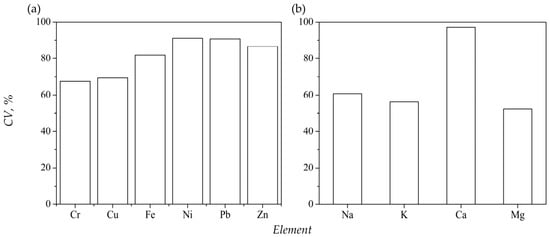
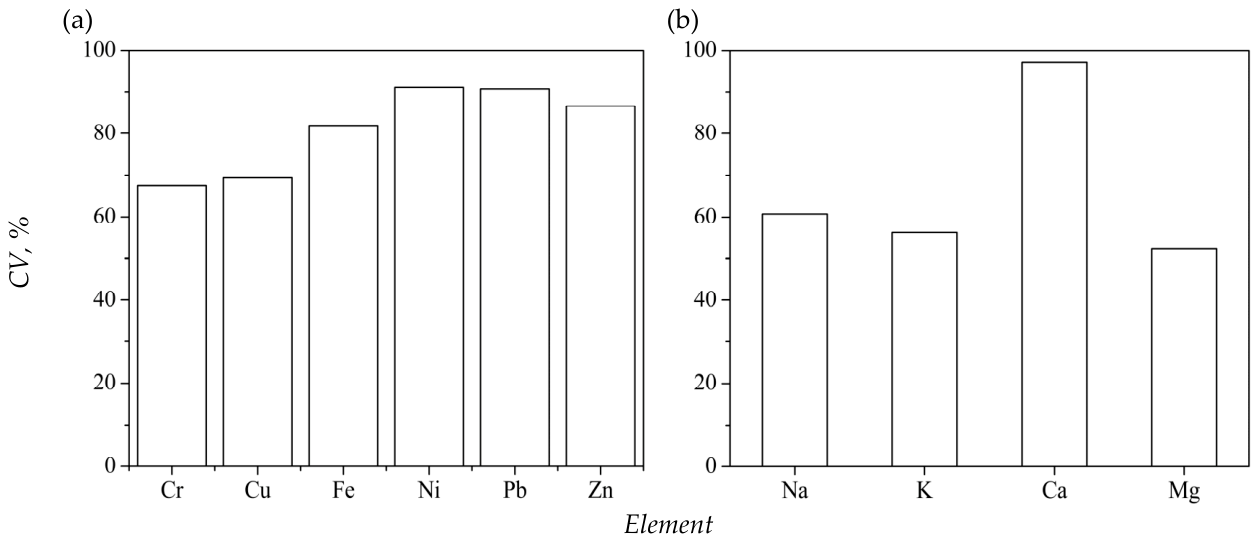
CV values revealed differences in the relative temporal variability of the elemental concentrations in the leachate-derived solid samples; see Figure 3 and Table S5. Approximately 61.5% of the elements exhibited high temporal variability (CV > 35%), based on the processed concentration dataset, indicating substantial fluctuations in their reported concentrations during the monitoring period. These elements included Cr, Cu, Fe, Ni, Pb, and Zn, which are commonly associated with the contaminant load of leachate, and Na, K, Ca, and Mg, which may be considered for future recovery and valorization studies. In contrast, Ag, As, Be, Cd, Co, Mo, Sb, Se, Tl, and V were excluded from the CV analysis because their concentrations were at or below the analytical reporting threshold throughout the monitoring period. At the opposite end, Si, B, and Al displayed the highest CV values, reaching 328.1%, 183.0%, and 131.4%, respectively. These findings are consistent with previous studies reporting temporal changes in the chemistry of landfill leachate [9,40,41,42]. The temporal mobilization and redistribution of several elements may be influenced by the combined effects of waste composition, environmental conditions, water infiltration, leaching, redox conditions, and chemical transformations associated with MSW degradation within the landfill system. However, the individual contributions of these factors could not be determined from the available measurements [40,42].
Figure 3.
Calculated coefficients of variation (CV, %) for the inorganic elemental concentration of leachate-derived solid samples. (a) Selected heavy metals and (b) elements with potential for recovery and valorization.
The results of the Pearson correlation analysis are presented in Table S6 of the Supporting Information. The analysis was performed using quantified elemental concentrations, excluding values below LOQ. The number of valid paired observations (n) and the corresponding p-values are also reported in Table S7 of the Supporting Information. Several elements exhibited similar monthly concentration patterns during the monitoring period. Positive correlations with unadjusted p-values below 0.05 were identified between B and Si (r = 0.981), Ca and Cr (r = 0.844), K and Ti (r = 0.842), Ba and Cr (r = 0.817), Ba and Ca (r = 0.785), K and Mg (r = 0.645), and B and pH (r = 0.576). B and Si exhibited the strongest positive correlation. However, a sensitivity analysis excluding December, which presented unusually high B and Si concentrations, resulted in a negative correlation (r = −0.909, n = 6, p = 0.0119), compared with the original positive correlation (r = 0.981, n = 7, p < 0.001). This change indicated that the positive association was strongly influenced by the December observation. Positive correlations were also identified among Ca, Cr, and Ba, suggesting comparable monthly variations in their concentrations. Similarly, the positive associations between K and Ti and between K and Mg indicated similar temporal trends, while a positive relationship between B concentrations and pH variations was identified. These associations complement CV analysis by providing information on the relationships between monthly elemental concentrations, rather than their individual degrees of variability. Overall, the correlation analysis identified groups of elements with similar temporal concentration patterns, although these statistical associations were exploratory, were not adjusted for multiple comparisons, and did not necessarily indicate common elemental sources or shared geochemical processes.
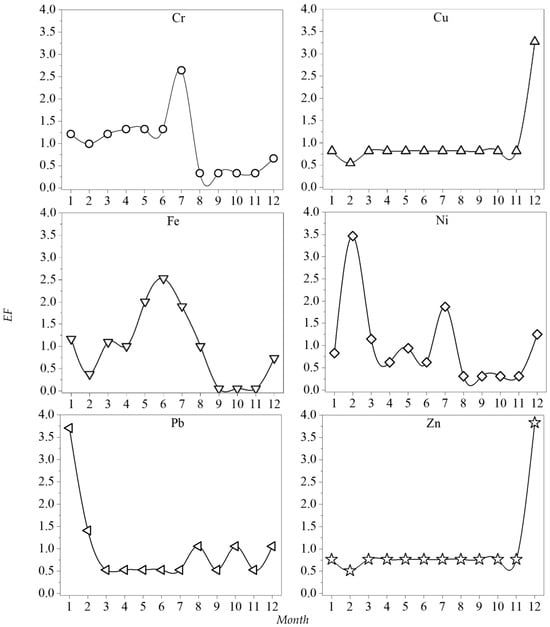
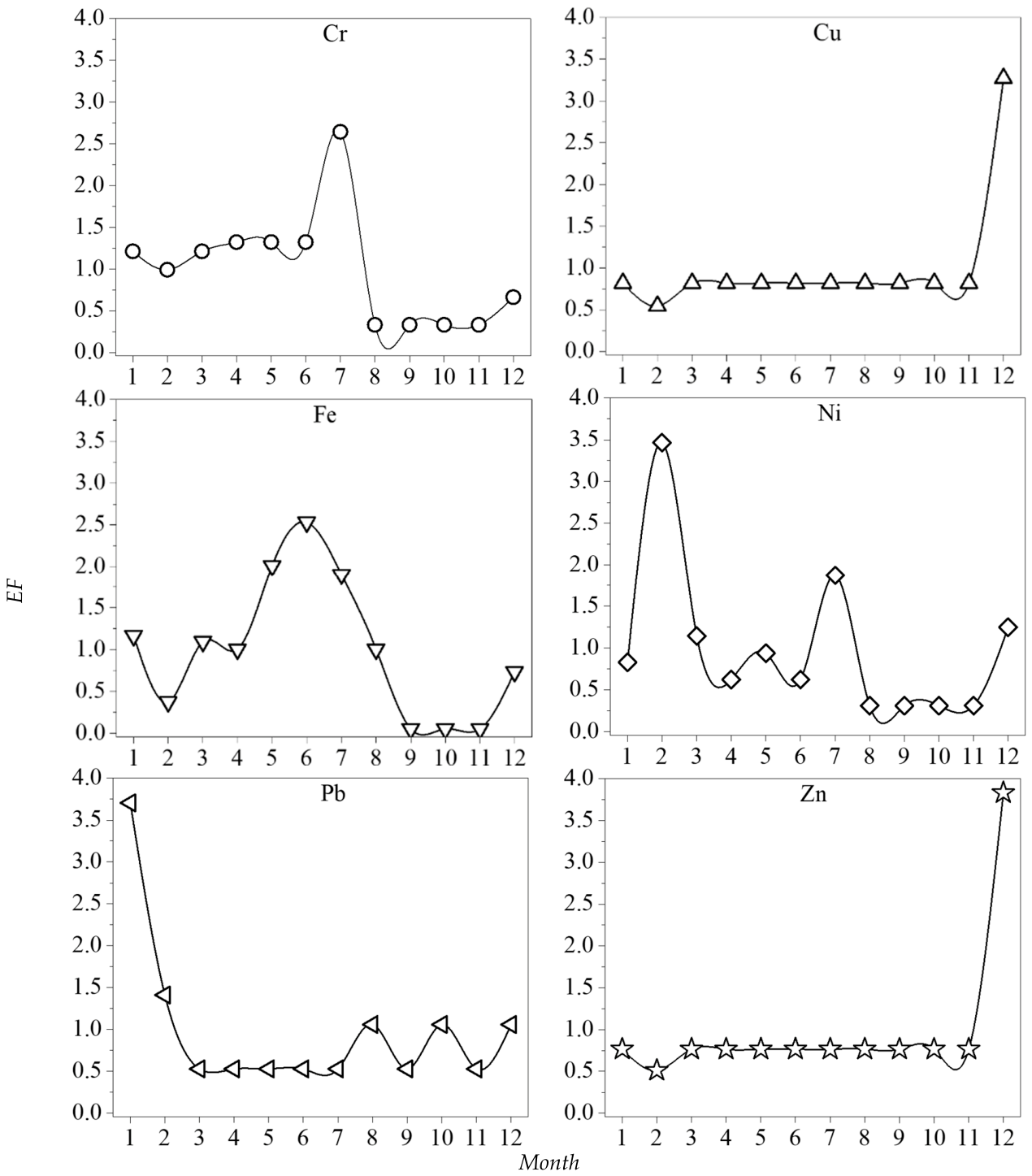
Figure 4 shows distinct temporal patterns in EF values of toxic heavy metals. Even at trace concentrations, these contaminants may deteriorate groundwater quality in the event of leachate leakage due to their persistence and potential mobility within the environment [43]. Overall, calculated EF values of As indicated limited temporal composition variability. In contrast, Cr, Fe, Ni, and Pb showed greater temporal variability, maybe reflecting the combined influence of waste composition, environmental conditions, and metal-specific physicochemical processes [22]. Cr and Fe reached their highest EF values during the wet season, coinciding with months of increased precipitation. Previous studies have suggested that water infiltration and leaching processes may influence metal mobilization in landfill environments [44]. Fe exhibited marked concentration fluctuations over the monitoring period. As stated, this metal is highly sensitive to changes in redox conditions, which affect its precipitation–dissolution processes. Episodic concentration peaks were also observed for Pb, Ni, Cu, and Zn, which reached EF values > 3 during specific months. The increase in concentration may result from the dynamic nature of element mobilization, partitioning, and accumulation processes within the landfill, which can also be associated with variations in waste streams (e.g., increased disposal of specific residues) and hydrological conditions [21,22,44].
Figure 4.
Calculated elemental composition variability factor (EF) for Cr, Cu, Fe, Ni, Pb, and Zn in leachate-derived solid samples.
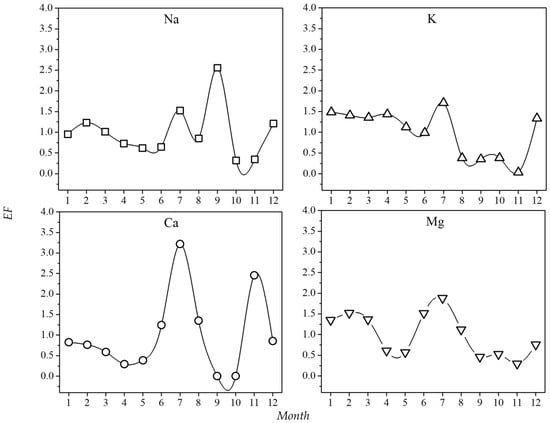
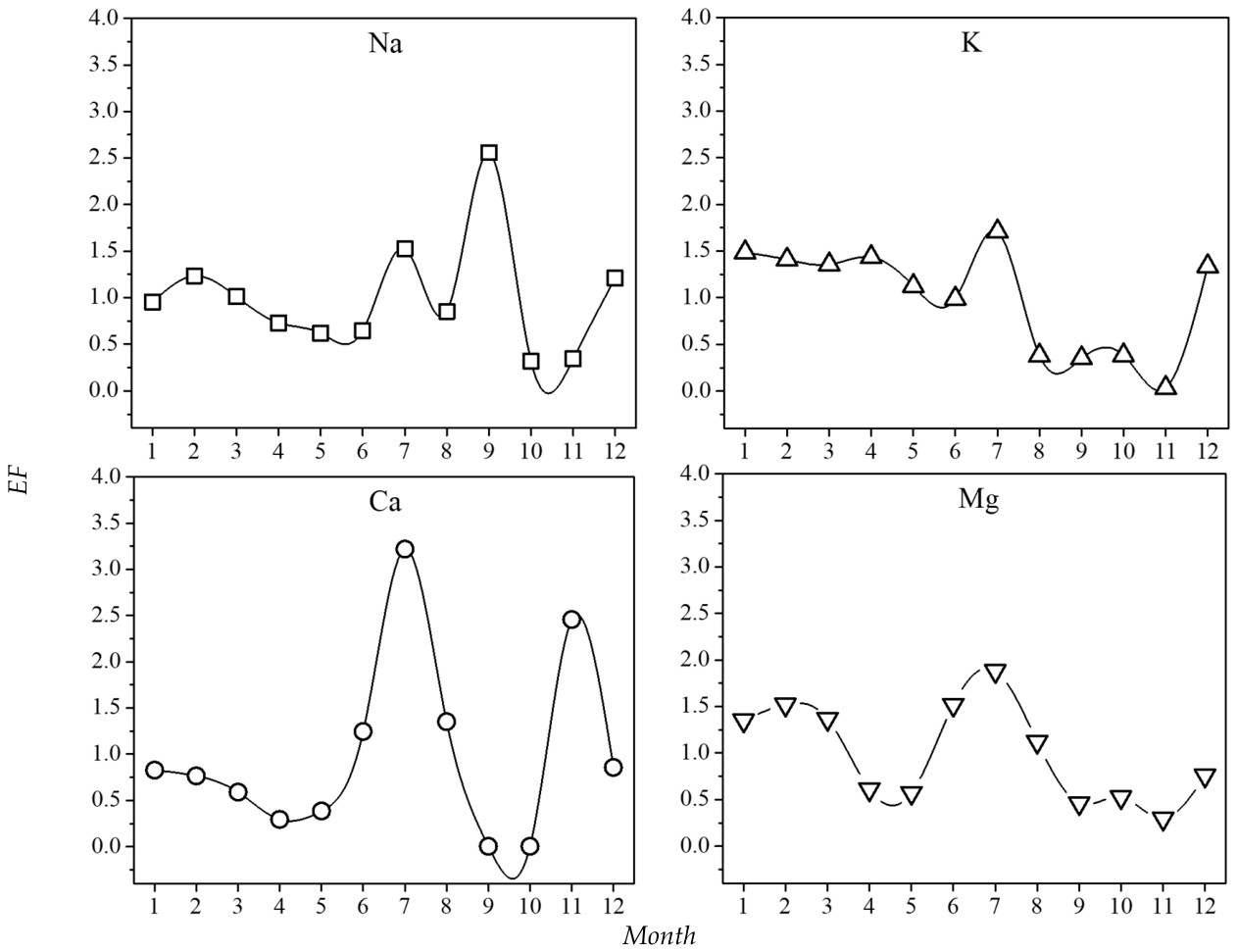
Na, K, Ca, and Mg generally exhibited EF values < 2; see Figure 5. Several calculated EF values were close to unity, suggesting monthly concentrations near their corresponding annual means. These elements may be considered for further evaluation of their potential recovery and valorization from leachate-derived solids. The highest temporal variability was observed for Ca, reaching a maximum EF of 3.22 during month 7, while a relevant concentration peak was identified for Na in month 9 (EF = 2.56). Relatively stable EF values were obtained for Mg and K during the monitoring period. Temporal variations in elemental concentrations were observed during the monitoring period. Ca and Cr exhibited the highest EF values in samples collected during the wet season, coinciding with increased precipitation. However, increments in EF values were also observed during relatively dry months, suggesting that the observed temporal variations were not exclusively associated with precipitation.
Figure 5.
Calculated elemental composition variability factor (EF) for Na, K, Ca, and Mg in leachate-derived solid samples.
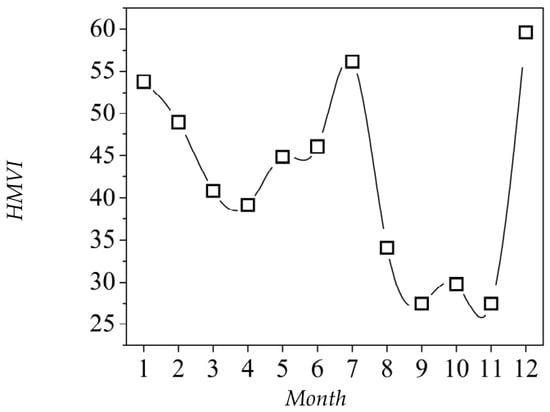
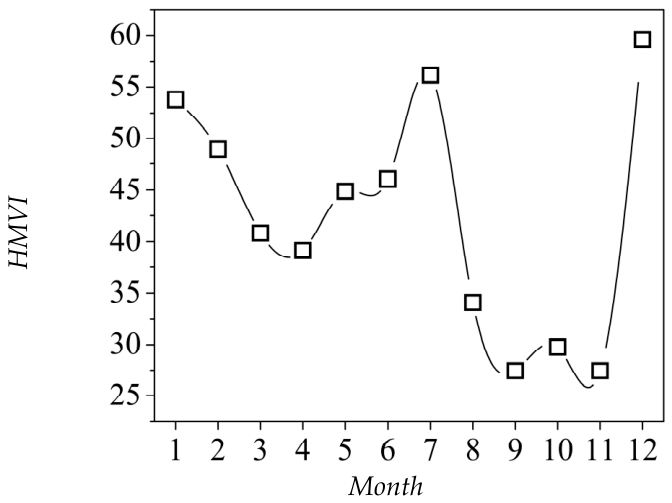
Figure 6 shows that the calculated HMVI values ranged from 27.45 to 59.55 and exhibited temporal variations during the monitoring period. The index showed a relatively high value in month 7, followed by a decrease in months 8 and 9 of the wet season. However, a relatively high HMVI value was also obtained in month 12, which was characterized by low precipitation. The results indicate temporal concentration variations for selected toxic heavy metals during the monitoring period, although their relationship with seasonal hydrological conditions and landfill process could not be established from the available measurements. Although calculated HMVI values were not a direct indicator of environmental pollution risk, the persistence and potential for accumulation of toxic pollutants justify the need for continuous monitoring programs, particularly given the possibility of changes in landfill physicochemical conditions that could alter their mobility.
Figure 6.
Calculated heavy metal variability index (HMVI) for the composition data of leachate-derived solid samples.
3.2. FTIR and XRD Characterization
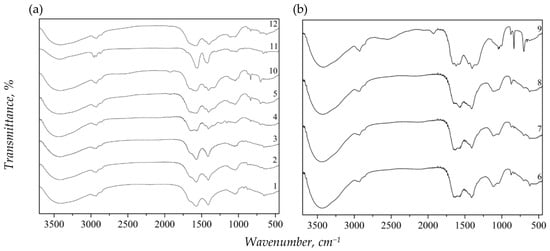
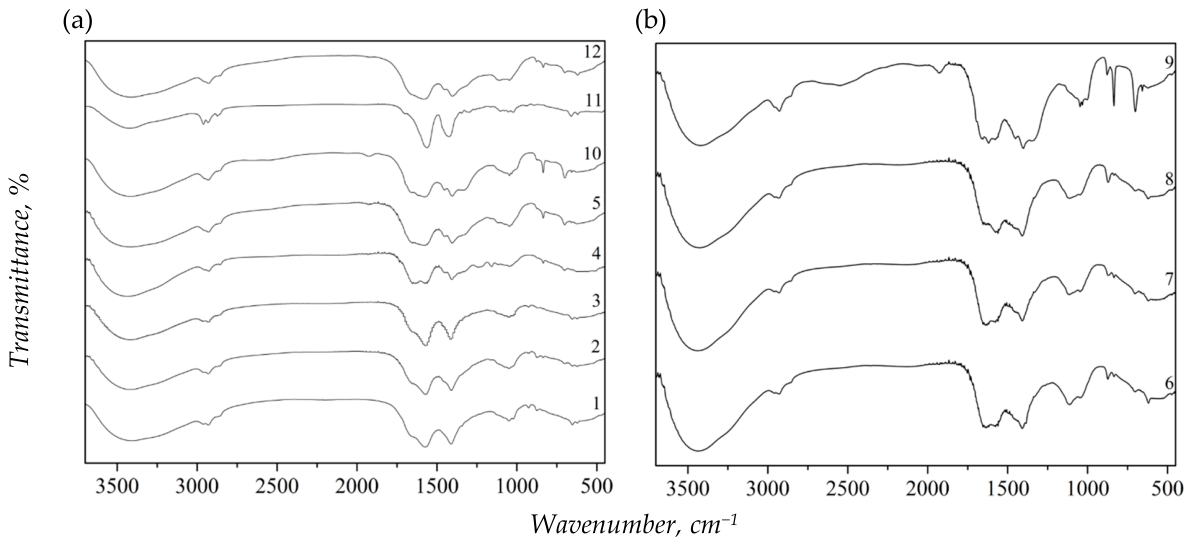
FTIR spectra of the leachate-derived solid samples are shown in Figure 7. The broad absorption band at 3450 cm−1 is characteristic of O–H stretching vibrations associated with hydroxyl-containing compounds (e.g., alcohols, phenols, and carboxylic acids) and adsorbed water [45,46,47]. This band remained prominent in samples collected during the wet season and in several samples of the dry season, except for month 11, where a marked decrease in intensity was observed. This behavior may be associated with the transformation of oxygenated organic constituents during waste degradation and humification processes occurring within the landfill [45,46,47]. The aliphatic fraction of the samples was linked to the absorption bands located at 2927 and 2853 cm−1, corresponding to the asymmetric and symmetric stretching vibrations of C–H bonds in methylene (CH2) and methyl (CH3) groups [48,49]. The gradual decrease in the intensity of these bands suggests a reduction in aliphatic structures, which is consistent with the degradation of lipid-derived compounds, waxes, and other aliphatic organic constituents present in landfilled residues [50,51]. The variation in the intensity of the absorption bands located at 1630 and 1550 cm−1, commonly attributed to C=C vibrations and asymmetric stretching of COO− groups, may indicate changes in the composition of humic-like substances and other aromatic organic compounds in the leachate-derived solids [45,49]. The spectrum of the sample collected in month 11 exhibited a particularly well-defined profile in this region, suggesting changes in the relative abundance and chemical environment of aromatic and carboxylate-containing structures. The absorption bands located in the range of 1450–1000 cm−1 may contain contributions from the bending vibrations of CH2 and CH3 groups and symmetric COO− stretching and carbonate-associated vibrations [50,51]. These bands were present in all spectra, although slight variations in intensity were observed, suggesting changes in the relative proportion of the components in the analyzed solid samples. Additional seasonal differences were observed in the fingerprint region. A band or shoulder at ~1100 cm−1 was more evident in the spectra of several samples collected during the wet season, while the band at 926 cm−1 attributed to C-C and C-H vibrations [52] was more pronounced in solid samples obtained during the dry season. This spectral region may include contributions from C-O stretching vibrations of oxygenated organic compounds and Si-O vibrations of siliceous constituents. These differences may reflect variations in the relative abundance and composition of organic and mineral components, potentially associated with water percolation and the resulting mobilization and redistribution of landfill constituents.
Figure 7.
FTIR spectra of the leachate-derived solid samples collected from the San Nicolás MSW landfill in Aguascalientes, Mexico. Samples from (a) dry season and (b) wet season.
Some changes were also identified in the absorption bands located in the lower wavenumber region, which are associated with the leachate mineral composition. It was observed that the absorption band near 875 cm−1 increased, suggesting mineral precipitation processes or interactions between the leachate and inorganic minerals present within the landfill. A low-intensity absorption band was located at ~595 cm−1, which was associated with S–O stretching vibrations characteristic of sulfated compounds [51,53], in the spectra of samples collected during the initial months of monitoring. Similar spectral profiles were found for samples from months 6–8 (wet season), while the spectrum of the month 9 sample displayed additional differences. FTIR spectra of months 10–12 (dry season) were more heterogeneous, although they retained several features observed in samples from the wet season. FTIR results suggested a relative increase in the spectral contribution of mineral phases and aromatic structures, which may be related to the progressive transformation of organic matter and stabilization processes related to MSW degradation.
Table 2 shows the results of the FTIR-derived spectral indices of the leachate-derived solid samples and their corresponding SD values, which were ≤ 5%. Higher AI and HRI values were obtained in samples from months 1, 3, and particularly month 11. AI ranged from 2.04 (month 4) to 4.39 (month 11), while HRI reached its maximum value of 1.92 in the sample from month 11, followed by month 3 (1.46) and month 1 (1.31). Overall, HRI and AI trends suggested temporal variations in organic matter composition, which was consistent with the transformation of organic matter into more humified forms [27]. CAI showed higher values in samples from months 6–8, reaching a maximum of 0.20 in the sample from month 7, whereas the lowest value was recorded in the sample of month 11 (0.02). This behavior suggested a greater relative contribution of carbonate-associated spectral features with respect to the 1450 cm−1 region during the samples obtained in months 6–8. In the sample from month 11, the low CAI coincided with the highest AI and HRI values, indicating a different balance between organic and mineral-associated spectral features. SCR ranged from 1.61 in the sample of month 8 to 9.01 in the sample of month 11, with comparatively high values also observed in samples of month 5 (4.49) and month 12 (4.97). Higher SCR values may indicate a greater contribution of spectral features primarily related to silicate-containing compounds relative to carbonate-associated species. However, it is convenient to indicate that the band at 1046 cm−1 may include contributions from both inorganic and oxygenated organic constituents. Consequently, the observed changes in SCR do not necessarily reflect an increase in the absolute abundance of silicate-containing compounds. The trends of AI, HRI, CAI, and SCR values indicated that the compositional changes in leachate-derived solid samples were not strictly seasonal and were likely influenced by multiple factors occurring within the landfill, as already discussed. HRI and AI results indicated that the composition in solids recovered from some sampling months (i.e., 1, 3, and 11) is of interest for the potential recovery of humic-like substances, which could be evaluated for applications such as liquid organic fertilizers [54,55]. Calculated SCR and CAI values for solid samples collected in months 6–8 suggested temporal changes in the relative contribution of oxygenated and mineral constituents. These findings may be relevant for future investigations into the potential incorporation of leachate-derived solids into mineral-based materials such as alkali-activated and cementitious systems, where these compositional characteristics should be considered. Previous studies have reported the stabilization/solidification of landfill leachate concentrates using Portland cement-based systems [56], while alkali-activated geopolymer matrices have been tested for the incorporation and immobilization of contaminants from landfill leachate concentrates [57]. However, further studies on the valorization of this solid fraction are needed to determine the feasibility of the proposed alternatives.
Table 2.
Calculated AI, HRI, CAI, and SCR values for leachate-derived solid samples obtained from the San Nicolás MSW landfill in Aguascalientes, Mexico.
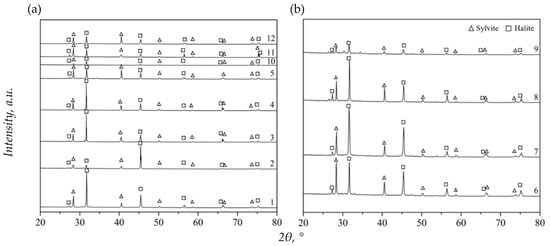
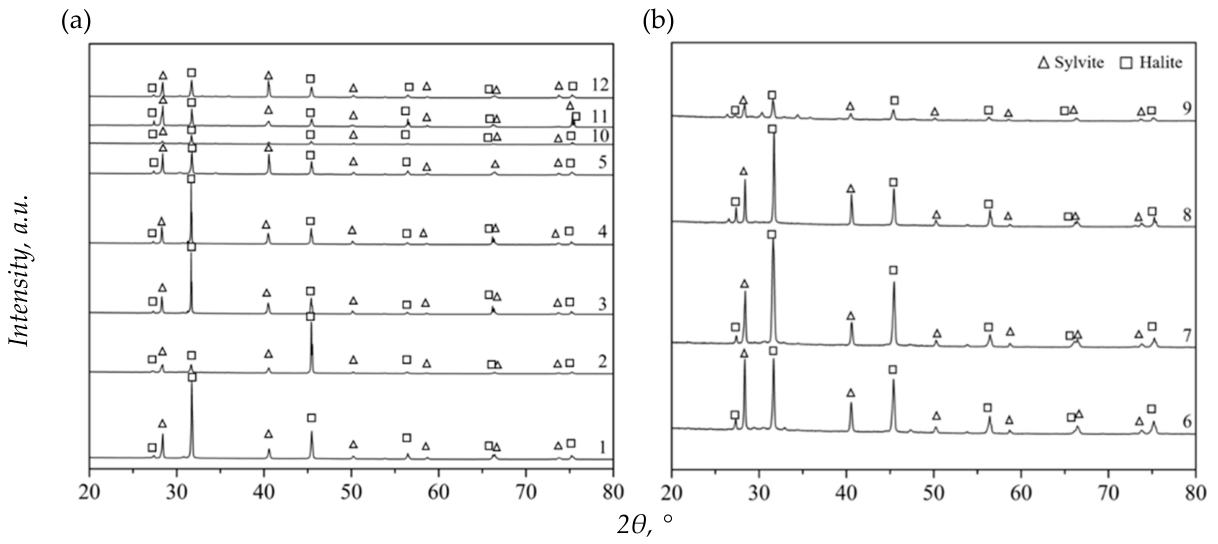
XRD patterns of the leachate-derived solid samples are shown in Figure 8. Two crystalline phases were identified: halite (NaCl) and sylvite (KCl). Halite was identified using reflections at ~27°, ~31°, ~45°, ~53°, ~56°, ~66°, ~72°, and ~75° 2θ, with hkl indices of (111), (002), (022), (113), (222), (004), (133), and (024), which agree with its cubic structure (ICDD: 98-024-0599). Sylvite was identified using the characteristic reflections at ~24°, ~28°, ~40°, ~47°, ~50°, ~58°, ~64°, ~66°, and ~73° 2θ, assigned to the (111), (002), (022), (113), (222), (004), (113), (024), and (224) planes of cubic potassium chloride (ICDD: 98-024-050). The predominance of these phases indicated that highly soluble sodium and potassium chloride salts constituted the main crystalline components of the solids recovered from leachate. It is convenient to remark that other elements identified via ICP-OES (i.e., Ca, Mg, Fe, and Si) may be associated with low-abundance constituents of phases with poor crystallinity, as low-intensity reflections were observed in some samples. Nevertheless, it was not possible to unambiguously determine their mineralogical forms by comparing them with available crystallographic databases based solely on elemental data.
Figure 8.
X-ray diffraction patterns of the leachate-derived solid samples collected from the San Nicolás MSW landfill in Aguascalientes, Mexico. Samples from (a) dry season and (b) wet season.
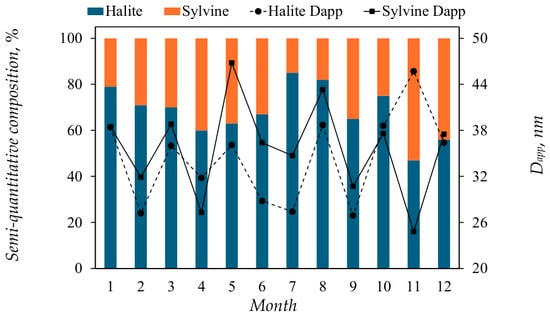
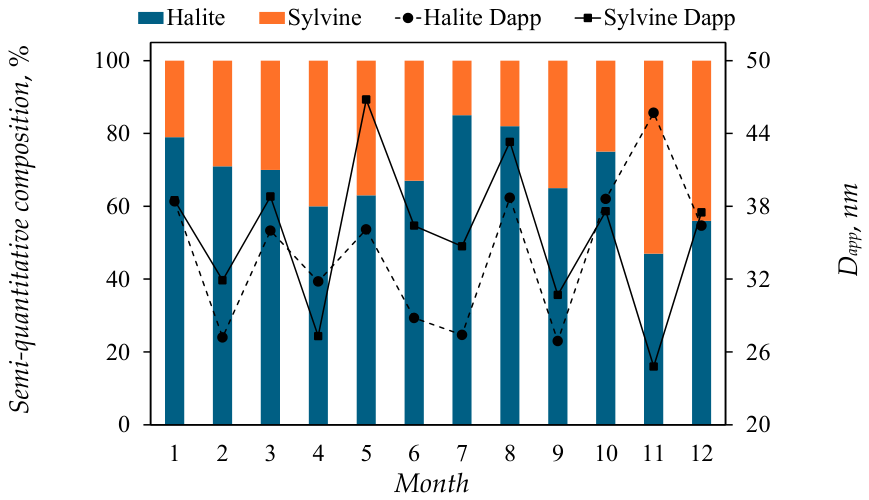
The relative abundance of halite and sylvite phases varied over the monitoring period; see Figure 9. Halite was generally the predominant phase, reaching its highest relative abundance in the sample from month 7 (85%), followed by samples from month 8 (82%) and month 1 (79%). Its contribution decreased toward the end of the sampling period, reaching 43 and 56% in samples from months 11 and 12, respectively. Sylvite became relatively more abundant when the proportion of halite decreased, with its highest contributions observed in the samples from months 11 (53%), 12 (44%), and 4 (40%). Overall, a seasonal trend was observed in the relative abundance of halite and sylvite in the solids recovered from leachate samples.
Figure 9.
Results of XRD semi-quantitative composition and calculated Dapp of the leachate-derived solid samples collected from the San Nicolás MSW landfill in Aguascalientes.
Halite accounted for 74.8% ± 10.2% of the crystalline fraction during the wet period, compared to 64.6% ± 11.6% during the dry period, whereas sylvite decreased from 34.9% ± 10.6% in the dry months to 25.3% ± 10.2% in the samples obtained from wet months. These variations indicate temporal changes in the relative contributions of NaCl and KCl to the crystalline fraction of recovered solids. The apparent diffraction domain size (Dapp) was estimated for NaCl and KCl using the Scherrer equation.
where K is the shape factor (assumed to be 0.9), λ is the X-ray wavelength (0.15406 nm), β is the measured full width at half maximum (FWHM) of the fitted diffraction peak expressed in radians, and θ is the corresponding Bragg angle. Dapp was calculated using a pseudo-Voigt function combined with a linear background. The median of peak-derived estimates with R2 ≥ 0.95 was reported for phases identified in monthly samples. No instrumental-broadening or microstrain correction was applied. The calculations indicated that Dapp also varied throughout the sampling period, although these variations did not follow parallel changes in phase abundance; see Figure 9. The monthly median Dapp values ranged from 26.9 to 45.7 nm for halite and from 24.8 to 46.8 nm for sylvite. For halite, the smallest apparent coherent domain sizes were observed in the samples of month 9 (26.9 nm), month 2 (27.2 nm), and month 7 (27.4 nm), while the largest value occurred in the samples from month 11 (45.7 nm). Sylvite showed a similarly variable pattern, with the largest Dapp recorded in the sample of month 5 (46.8 nm), followed by the sample of month 8 (43.3 nm), while comparatively smaller values were observed in the samples of month 4 (27.3 nm), month 9 (30.7 nm), and month 2 (31.9 nm). Differences between the seasonal periods were also observed for the apparent crystallite size of halite. Mean Dapp decreased from 36.3 ± 5.4 nm during the dry months to 30.5 ± 5.6 nm during the wet period. In contrast, sylvite exhibited similar Dapp values in the dry (35.4 ± 7.1 nm) and wet seasons (36.3 ± 5.3 nm). The results indicated that the recurring identification of halite and sylvite was consistent with the high Na and K concentrations determined via ICP-OES. These findings provide a basis for further investigation of leachate-derived solids as potential secondary mineral resources. However, additional characterization and experimental evaluation are required to determine their suitability for specific applications.
4. Conclusions
The results show that the inorganic composition of the solids recovered from landfill leachate exhibited temporal variability during the twelve-month monitoring period. Although the pH of liquid leachate remained relatively stable, elemental concentrations of recovered solids showed different degrees of variability. Differences between the wet and dry periods were evaluated descriptively, considering the limited number of samples collected during the wet season. Therefore, the contribution of waste degradation, climatic conditions, and physicochemical processes to the observed composition variations could not be established from the available measurements. Na, K, Ca, and Mg were the dominant inorganic constituents in the leachate-derived solid samples collected during the study. Persistent mineralogical content associated with NaCl and KCl was identified in the recovered solids. These findings provide a basis for further investigation of leachate-derived solids as potential secondary mineral resources. However, their suitability for recovery or use in functional materials requires additional characterization and experimental evaluation. The results of this study contribute to a better understanding of the temporal variability of inorganic constituents in leachate-derived solids and provide a basis for future studies aimed at evaluating their contamination potential and identifying suitable pathways for their valorization.
Supplementary Materials
The following supporting information can be downloaded at https://www.mdpi.com/article/10.3390/environments13120641/s1, Table S1. Estimated monthly dry residue yields of leachate samples from the San Nicolás MSW landfill. Table S2. Estimated equivalent elemental concentrations (mg/L) in monthly leachate samples from the San Nicolás MSW landfill, which were calculated from the elemental composition and gravimetric dry residue content of the recovered solids. Table S3. Weight values reported by Kumar and Alappat [29] and used in the calculation of HMVI. Table S4. Results of twelve-month monitoring of inorganic elemental composition and pH of leachate-derived solid samples collected from the San Nicolás MSW landfill in Aguascalientes, Mexico. Table S5. Coefficient of variation (CV) calculated for the inorganic elemental composition of leachate-derived solid samples collected from San Nicolás MSW landfill in Aguascalientes, Mexico, during the annual monitoring period. Table S6. Pearson correlation coefficient matrix for pH and inorganic elemental concentrations in leachate-derived solid samples collected from the San Nicolás MSW landfill in Aguascalientes, Mexico, during the annual monitoring period. Table S7. Pearson correlation coefficients (r), number of valid paired observations (n), and corresponding p values for pH of liquid leachate sample and inorganic elemental concentrations in leachate-derived solid samples collected from the San Nicolás MSW landfill in Aguascalientes, Mexico, during the annual monitoring period.
Author Contributions
Conceptualization, M.R.M.-V.; Methodology, M.L.-G.; Investigation, F.J.V.-D.; Writing original draft preparation, M.L.-G. and M.R.M.-V.; Software, D.I.M.-C.; Writing—review and editing, H.E.R.-Á. and A.B.-P. All authors have read and agreed to the published version of the manuscript.
Funding
This research received no external funding.
Institutional Review Board Statement
Not applicable.
Informed Consent Statement
Not applicable.
Data Availability Statement
Data are available from the corresponding author upon reasonable request.
Acknowledgments
The support provided by the #MatPoreLab and Secretaría de Servicios Públicos Municipales de Aguascalientes is acknowledged.
Conflicts of Interest
The authors declare no conflicts of interest.
References
- Hoornweg, D.; Bhada-Tata, P. What a Waste: A Global Review of Solid Waste Management; World Bank: Washington, DC, USA, 2012. [Google Scholar]
- Jurado, A.; Cabrera, G.; del Castillo, G. Assessment of the Circular Economy Strategy and Roadmap of the Autonomous City of Buenos Aires; LC/TS.2023/155; Economic Commission for Latin America and the Caribbean (ECLAC): Santiago, Chile, 2023; Available online: https://www.cepal.org/es/publicaciones/68717-diagnostico-la-estrategia-hoja-ruta-economia-circular-la-ciudad-autonoma-buenos (accessed on 28 August 2025).
- El-Saadony, M.T.; Saad, A.M.; Fahmy, M.A.; Mohammed, D.M.; Salem, H.M.; Abd El-Mageed, T.A.; Abu-Elsaoud, A.M.; Alsyaad, K.M.; Ahmed, A.E.; Al-Najjar, M.A.A.; et al. Hazardous Landfill Leachate: Integrated Treatment Strategies, Regulatory Fra-works, and Circular Economy Perspectives. Ecotoxicol. Environ. Saf. 2026, 312, 119878. [Google Scholar] [CrossRef] [Scilit] [PubMed]
- Kamara, I.N.; Raco, B.; Re, V.; Frazer-Williams, R.A.D. Integrated Assessment of Contaminants of Emerging Concern and Potentially Toxic Trace Elements in Groundwater Impacted by Uncontrolled Dump Sites: Human and Ecological Risks in Freetown, Sierra Leone. J. Hazard. Mater. Adv. 2026, 23, 101411. [Google Scholar] [CrossRef] [Scilit]
- Gunarathne, V.; Phillips, A.J.; Zanoletti, A.; Rajapaksha, A.U.; Vithanage, M.; Di Maria, F.; Pivato, A.; Korzeniewska, E.; Bontempi, E. Environmental Pitfalls and Associated Human Health Risks and Ecological Impacts from Landfill Leachate Contaminants: Current Evidence, Recommended Interventions and Future Directions. Sci. Total Environ. 2024, 912, 169026. [Google Scholar] [CrossRef] [Scilit] [PubMed]
- Dagwar, P.P.; Dutta, D. Landfill Leachate a Potential Challenge towards Sustainable Environmental Management. Sci. Total Environ. 2024, 926, 171668. [Google Scholar] [CrossRef] [Scilit] [PubMed]
- Xiang, R.; Wei, W.; Mei, T.; Wei, Z.; Yang, X.; Liang, J.; Zhu, J. A Review on Landfill Leachate Treatment Technologies: Comparative Analysis of Methods and Process Innovation. Appl. Sci. 2025, 15, 3878. [Google Scholar] [CrossRef] [Scilit]
- Teng, C.; Zhou, K.; Peng, C.; Chen, W. Characterization and Treatment of Landfill Leachate: A Review. Water Res. 2021, 203, 117525. [Google Scholar] [CrossRef] [Scilit] [PubMed]
- Abdel-Shafy, H.I.; Ibrahim, A.M.; Al-Sulaiman, A.M.; Okasha, R.A. Landfill Leachate: Sources, Nature, Organic Composition, and Treatment: An Environmental Overview. Ain Shams Eng. J. 2024, 15, 102293. [Google Scholar] [CrossRef] [Scilit]
- Lechuga Montenegro, J.; Vargas Hernández, S. El reciclaje de los residuos sólidos urbanos en México. Denarius 2016, 30, 39–67. Available online: https://www.redalyc.org/articulo.oa?id=695676759003 (accessed on 30 July 2025).
- Luo, H.; Cheng, Y.; He, D.; Yang, E.H. Review of Leaching Behavior of Municipal Solid Waste Incineration (MSWI) Ash. Sci. Total Environ. 2019, 668, 90–103. [Google Scholar] [CrossRef] [Scilit] [PubMed]
- García-Mondragón, D.; Cervantes-Zepeda, I.; Gómez-Demetrio, W.; Gallego-Alarcón, I.; García-Pulido, D.; González-Blanco, G. Gestión de los residuos sólidos en México: Análisis cualitativo de los diagnósticos básicos. Inter Discip. 2023, 11, 215–242. [Google Scholar] [CrossRef] [Scilit]
- Olivo Escudero, J.C.; Ortiz Aguirre, A.D.; Perea Valerio, M.; Rodríguez Herrero, P.H. The Evolution of Urban Solid Waste Regulations in Mexico: An Interdisciplinary and Comparative Law Approach. Actual. Jurídica Ambient. 2024, 145, 6–44. [Google Scholar] [CrossRef] [Scilit]
- Lu, Y.; Xie, Q.; Cao, C.; Huang, J.; Wang, J.; Ren, B.; Liu, Y. Determination of Leachate Leakage around a Valley Type Landfill and Its Pollution and Risk on Groundwater. Sci. Rep. 2025, 15, 9465. [Google Scholar] [CrossRef] [Scilit] [PubMed]
- Wang, F.; Song, K.; Lan, W.; Li, T.; Liu, J.; Liu, D. Identification and Assessment of Groundwater Pollution from Landfill Leachate Based on Geophysical, Spectroscopy, and Hydrogeochemical Methods. Sci. Rep. 2025, 15, 25558. [Google Scholar] [CrossRef] [Scilit] [PubMed]
- Mojiri, A.; Zhou, J.L.; Ratnaweera, H.; Ohashi, A.; Ozaki, N.; Kindaichi, T.; Asakura, H. Treatment of Landfill Leachate with Different Techniques: An Overview. Water Reuse 2021, 11, 66–96. [Google Scholar] [CrossRef] [Scilit]
- Sharma, V.; Nagpal, G.; Naveen, B.P.; Gupta, P. An Updated Review on Landfill Leachate Treatment Methods. Discov. Chem. 2026, 3, 34. [Google Scholar] [CrossRef] [Scilit]
- Kjeldsen, P.; Barlaz, M.A.; Rooker, A.P.; Baun, A.; Ledin, A.; Christensen, T.H. Present and Long-Term Composition of MSW Landfill Leachate: A Review. Crit. Rev. Environ. Sci. Technol. 2002, 32, 297–336. [Google Scholar] [CrossRef] [Scilit]
- Gómez, M.; Corona, F.; Hidalgo, M.D. Variations in the Properties of Leachate According to Landfill Age. Desalin. Water Treat. 2019, 159, 24–31. [Google Scholar] [CrossRef] [Scilit]
- Hoai, S.T.; Lan, H.N.; Viet, N.T.T.; Hoang, G.N.; Kawamoto, K. Characterizing Seasonal Variation in Landfill Leachate Using Leachate Pollution Index (LPI) at Nam Son Solid Waste Landfill in Hanoi, Vietnam. Environments 2021, 8, 17. [Google Scholar] [CrossRef] [Scilit]
- Alao, J.O.; Otorkpa, O.J.; Abubakar, F.; Eshimiakhe, D.; Aliyu, A.; Abdulsalami, M.; Abdulmalik, D.O. Geoelectrical Resistivity and Geochemistry Monitoring of Landfill Leachates Due to the Seasonal Variations and the Implications on Groundwater Systems and Public Health. Sci. Rep. 2024, 14, 26542. [Google Scholar] [CrossRef] [Scilit] [PubMed]
- Grba, N.; Mihajlović, V.; Benedeković, G.; Kojić, V.; Jakimov, D.; Dubovina, M.; Kovačić, M. Long-Term Multivariate Screening of a Recirculating Landfill Leachate Circuit: Pollutant Dynamics, Statistical Structure and Associated Risk to Biota. Processes 2026, 14, 2691. [Google Scholar] [CrossRef] [Scilit]
- Instituto Nacional de Estadística y Geografía (INEGI). Estadísticas a Propósito del Día Mundial del Medio Ambiente (5 de Junio); INEGI: Aguascalientes, Mexico, 2025. Available online: https://www.inegi.org.mx/contenidos/saladeprensa/aproposito/2025/EAP_MedioAmb_25.pdf (accessed on 12 October 2026).
- National Water Commission (CONAGUA). Climate Report in Mexico 2024; General Coordination of the National Meteorological Service: Mexico City, Mexico, 2024. [Google Scholar]
- U.S. Environmental Protection Agency (EPA). Conducting Remedial Investigations/Feasibility Studies for CERCLA Municipal Landfill Sites; EPA/540/P-91/001; Office of Emergency and Remedial Response, U.S. Environmental Protection Agency: Washington, DC, USA, 1991. Available online: https://nepis.epa.gov/Exe/ZyPURL.cgi?Dockey=10001Y79.TXT (accessed on 12 October 2026).
- ASTM D6051-15 (2023); Standard Guide for Composite Sampling and Field Subsampling for Environmental Waste Management Activities. ASTM International: West Conshohocken, PA, USA, 2023. [Google Scholar] [CrossRef] [Scilit]
- Zanquetti, A.; Rossi, F.A.B.; Piva, J.T.; dos Santos-Tonial, L.M. By-Product of Heparin Extraction as a Sustainable Alternative to Enhance the Use of Nitrogen in Agriculture. Environ. Prog. Sustain. Energy 2026, 45, e70247. [Google Scholar] [CrossRef] [Scilit]
- Silva, M.E.; Santos, M.; Brás, I. Characterization of Wastewater from Landfills—Amount and Type of Humic Substances Extracted from Leachate. E3S Web Conf. 2019, 80, 03002. [Google Scholar] [CrossRef] [Scilit]
- Kumar, D.; Alappat, B.J. Evaluating Leachate Contamination Potential of Landfill Sites Using Leachate Pollution Index. Clean Technol. Environ. Policy 2005, 7, 190–197. [Google Scholar] [CrossRef] [Scilit]
- Kumar, D.; Alappat, B.J. Analysis of Leachate Pollution Index and Formulation of Sub-Leachate Pollution Indices. Waste Manag. Res. 2005, 23, 230–239. [Google Scholar] [CrossRef] [Scilit] [PubMed]
- Wdowczyk, A.; Szymańska-Pulikowska, A. Differences in the Composition of Leachate from Active and Non-Operational Municipal Waste Landfills in Poland. Water 2020, 12, 3129. [Google Scholar] [CrossRef] [Scilit]
- Quist, N.; van Raffe, F.; Dijkstra, J.J.; Comans, R.N.J. Changing pH, Organic Matter, and Redox State Govern Contaminant Mobility during Waste Stabilization in Landfill Simulation Reactors. J. Hazard. Mater. 2026, 513, 142532. [Google Scholar] [CrossRef] [Scilit] [PubMed]
- Patton Witt, R.; Guzman, M.I. Coal Ash Triggers an Elevated Temperature Landfill Development: Lessons from the Bristol Virginia Solid Waste Landfill Neighboring Community. Environments 2024, 11, 201. [Google Scholar] [CrossRef] [Scilit] [PubMed]
- Mathews, J.C.; da Costa Assunção, F.P.; Pereira, D.O.; da Silva, J.C.C.; Almeida, F.F.S.; Almeida, A.C.P.; Mendonça, N.M.; de Sousa Brandão, I.W.; Menezes, A.O.; Borges, L.E.P.; et al. Metal Analysis of Leachate from the Organic Fraction of Urban Solid Waste (MSW) from the Municipality of Belém/PA. Sustainability 2024, 16, 8370. [Google Scholar] [CrossRef] [Scilit]
- Naveen, B.P.; Sumalatha, J.; Malik, R.K. A Study on Contamination of Ground and Surface Water Bodies by Leachate Leakage from a Landfill in Bangalore, India. Int. J. Geo-Eng. 2018, 9, 27. [Google Scholar] [CrossRef] [Scilit]
- Likando, N.M.; Dornack, C.; Hamutoko, J.T. Assessing the Physicochemical Parameters of Leachate from Biowaste Fractions in a Laboratory Setting, Using the Elusion Method. Environ. Earth Sci. 2023, 82, 610. [Google Scholar] [CrossRef] [Scilit]
- Renou, S.; Givaudan, J.G.; Poulain, S.; Dirassouyan, F.; Moulin, P. Landfill Leachate Treatment: Review and Opportunity. J. Hazard. Mater. 2008, 150, 468–493. [Google Scholar] [CrossRef] [Scilit] [PubMed]
- Droge, S.; Goss, K.U. Effect of Sodium and Calcium Cations on the Ion-Exchange Affinity of Organic Cations for Soil Organic Matter. Environ. Sci. Technol. 2012, 46, 5894–5901. [Google Scholar] [CrossRef] [Scilit] [PubMed]
- Thalmann, M.; Neubert, L.; Klitzke, S.; Ruhl, A.S.; Peters, A. Sorption of Organic Micropollutants to an Agricultural Soil: Effect of Ionic Strength, Cation Valence and pH. Water Air Soil Pollut. 2025, 236, 253. [Google Scholar] [CrossRef] [Scilit]
- Huang, Z.; Liu, G.; Zhang, Y.; Yuan, Y.; Xi, B.; Tan, W. Assessing the Impacts and Contamination Potentials of Landfill Leachate on Adjacent Groundwater Systems. Sci. Total Environ. 2024, 930, 172664. [Google Scholar] [CrossRef] [Scilit] [PubMed]
- Igwegbe, C.A.; López-Maldonado, E.A.; Landázuri, A.C.; Ovuoraye, P.E.; Ogbu, A.I.; Vela-García, N.; Białowiec, A. Sustainable Municipal Landfill Leachate Management: Current Practices, Challenges, and Future Directions. Desalin. Water Treat. 2024, 320, 100709. [Google Scholar] [CrossRef] [Scilit]
- Sossou, K.; Bala Prasad, S.; Agbotsou, K.E.; Saidou Souley, H.; Mudigandla, R. Characteristics of Landfill Leachate and Leachate Treatment by Biological and Advanced Coagulation Process: Feasibility and Effectiveness—An Overview. Waste Manag. Bull. 2024, 2, 181–198. [Google Scholar] [CrossRef] [Scilit]
- Parvin, F.; Tareq, S.M. Impact of Landfill Leachate Contamination on Surface and Groundwater of Bangladesh: A Systematic Review and Possible Public Health Risks Assessment. Appl. Water Sci. 2021, 11, 100. [Google Scholar] [CrossRef] [Scilit] [PubMed]
- Ingold, P.; Weibel, G.; Wanner, C.; Gimmi, T.; Churakov, S.V. Hydrological and Geochemical Properties of Bottom Ash Landfills. Environ. Earth Sci. 2024, 83, 180. [Google Scholar] [CrossRef] [Scilit]
- Szymańska-Pulikowska, A.; Wdowczyk, A.; Wiercik, P. Analysis of Changes on Substrates Filling Constructed Wetland Systems after Landfill Leachate Treatment—FTIR Study. J. Clean. Prod. 2023, 411, 137336. [Google Scholar] [CrossRef] [Scilit]
- Irto, A.; Crea, F.; Alessandrello, C.; De Stefano, C.; Somma, R.; Zaffino, G.; Zaccaro, S.; Papanikolau, G.; Cigala, R.M. Landfill Leachate from Municipal Solid Waste: Multi-Technique Approach for Its Fine Characterization and Determination of the Thermodynamic and Sequestering Properties towards Some Toxic Metals. Sci. Total Environ. 2024, 917, 170311. [Google Scholar] [CrossRef] [Scilit] [PubMed]
- Vali, N.; Zabihi, S.; Shamim, S.; Mohsenzadeh, A.; Pettersson, A. Slow-Pyrolysis of Municipal Sewage Sludge: Biochar Characteristics and Advanced Thermodynamics. Biomass Convers. Biorefin. 2025, 15, 21045–21065. [Google Scholar] [CrossRef] [Scilit]
- He, X.; Xi, B.; Wei, Z.; Guo, X.; Li, M.; An, D.; Liu, H. Spectroscopic Characterization of Water Extractable Organic Matter during Composting of Municipal Solid Waste. Chemosphere 2011, 82, 541–548. [Google Scholar] [CrossRef] [Scilit] [PubMed]
- Singh, A.; Chandel, M.K. Physicochemical and FTIR Spectroscopic Analysis of Fine Fraction from a Municipal Solid Waste Dumpsite for Potential Reclamation of Materials. Waste Manag. Res. 2021, 39, 374–385. [Google Scholar] [CrossRef] [Scilit] [PubMed]
- Lenz, S.; Böhm, K.; Ottner, R.; Huber-Humer, M. Determination of Leachate Compounds Relevant for Landfill Aftercare Using FT-IR Spectroscopy. Waste Manag. 2016, 55, 321–329. [Google Scholar] [CrossRef] [Scilit] [PubMed]
- Zhang, Z.; Teng, C.; Zhou, K.; Peng, C.; Chen, W. Degradation Characteristics of Dissolved Organic Matter in Nanofiltration Concentrated Landfill Leachate during Electrocatalytic Oxidation. Chemosphere 2020, 255, 127055. [Google Scholar] [CrossRef] [Scilit] [PubMed]
- Nandiyanto, A.B.D.; Oktiani, R.; Ragadhita, R. How to Read and Interpret FTIR Spectroscope of Organic Material. Indones. J. Sci. Technol. 2019, 4, 97–118. [Google Scholar] [CrossRef] [Scilit]
- Akter, S.; Shammi, M.; Jolly, Y.N.; Sakib, A.A.; Rahman, M.; Tareq, S.M. Characterization and Photodegradation Pathway of the Leachate of Matuail Sanitary Landfill Site, Dhaka South City Corporation, Bangladesh. Heliyon 2021, 7, e07924. [Google Scholar] [CrossRef] [Scilit] [PubMed]
- Barbosa Alves, L.; Alves da Silva, C.E.; Ramalho Quintaes, B.; Carbonelli Campos, J. Humic Substance Recovery from Reverse Osmosis Concentrate of a Landfill Leachate Treatment via Nanofiltration. AgriEngineering 2026, 8, 12. [Google Scholar] [CrossRef] [Scilit]
- Ye, W.; Liu, H.; Jiang, M.; Lin, J.; Ye, K.; Fang, S.; Xu, Y.; Zhao, S.; Van der Bruggen, B.; He, Z. Sustainable Management of Landfill Leachate Concentrate through Recovering Humic Substance as Liquid Fertilizer by Loose Nanofiltration. Water Res. 2019, 157, 555–563. [Google Scholar] [CrossRef] [Scilit] [PubMed]
- Hendrych, J.; Hejralová, R.; Kroužek, J.; Špaček, P.; Sobek, J. Stabilisation/Solidification of Landfill Leachate Concentrate and Its Residue Obtained by Partial Evaporation. Waste Manag. 2019, 95, 560–568. [Google Scholar] [CrossRef] [Scilit] [PubMed]
- Zhang, H.; Zeng, Y.; Wu, S.; Yuan, Y.; Pei, Y. Durability and Leaching Behaviour of One-Part Geopolymers Prepared from Landfill Leachate Concentrate. Process Saf. Environ. Prot. 2025, 202, 107661. [Google Scholar] [CrossRef] [Scilit]

Disclaimer/Publisher’s Note: The statements, opinions and data contained in all publications are solely those of the individual author(s) and contributor(s) and not of MDPI and/or the editor(s). MDPI and/or the editor(s) disclaim responsibility for any injury to people or property resulting from any ideas, methods, instructions or products referred to in the content. |
© 2026 by the authors. Licensee MDPI, Basel, Switzerland. This article is an open access article distributed under the terms and conditions of the Creative Commons Attribution (CC BY) license.