


Abstract
Antidepressants are among the most widely prescribed pharmaceutical compounds worldwide and are increasingly recognised as contaminants of emerging concern owing to their occurrence in wastewater as parent compounds and metabolites. Their continuous release into aquatic systems reinforces the need for reliable analytical methods for environmental monitoring. In this study, a solid-phase extraction coupled with gas chromatography-tandem mass spectrometry method was developed and validated for the determination of five antidepressants in wastewater: fluoxetine, citalopram, sertraline, paroxetine, and venlafaxine. Different extraction conditions were assessed in order to improve analytical performance. Method validation was carried out according to Food and Drug Administration guidelines. The method showed good linearity over the concentration range of 49–25,000 ng/L, with coefficients of determination higher than 0.99. Limits of detection ranged from 12 to 195 ng/L, while limits of quantification ranged from 49 to 195 ng/L. Precision and accuracy were within acceptable limits, with coefficients of variation below 15%, and recoveries ranged from 6.91% to 81.14%. Most analytes remained stable under the tested conditions. The method was successfully applied to 50 real wastewater samples, confirming its applicability to the routine monitoring of antidepressants in this complex environmental matrix.
1. Introduction
Contaminants of emerging concern (CECs) comprise a broad range of synthetic and naturally occurring chemicals, many of which are not regulated under existing environmental legislation, including pharmaceuticals, personal care products, pesticides, and per- and polyfluoroalkyl substances [1]. Over the past few decades, there has been an increase in the detection of these compounds in aquatic environments.
Among CECs, pharmaceuticals are of particular interest [2], especially psychotropic drugs (PD) [3]. Antidepressants (ADTs) are particularly relevant within this group, and their use has increased substantially worldwide. Depression is a prevalent mental health disorder characterised by persistent sadness, loss of interest, cognitive impairment, and physical symptoms, affecting individuals of all ages and backgrounds. According to the Portuguese Society of Psychiatry and Mental Health, approximately 50 million Europeans are affected by depression, with an estimated 8% prevalence in the Portuguese population [4,5].
Among available treatments, ADTs, particularly selective serotonin reuptake inhibitors (SSRIs) and serotonin-noradrenaline reuptake inhibitors (SNRIs), are widely prescribed because of their efficacy and favourable safety profiles compared with other classes, such as tricyclic antidepressants (TCAs) and monoamine oxidase inhibitors (MAOIs) [6,7,8,9,10]. Data from the National Authority of Portugal for Medicines and Health Products, I.P. (INFARMED) indicate a 43% increase in antidepressant consumption in Portugal between 2017 and 2023, including a 30% increase in SSRI use and a 45% increase in SNRI use [11].
The growing consumption of ADTs highlights the need for robust environmental monitoring to assess their presence in aquatic environments. As many SSRIs and SNRIs are lipophilic compounds, they persist in wastewater and natural water bodies. Consequently, they can accumulate in fish tissues, potentially affecting their behaviour, reproduction and stress response. Furthermore, if these are not effectively removed during wastewater treatment, humans may be exposed through the food chain, particularly through the consumption of contaminated aquatic organisms and agricultural crops irrigated with contaminated water.
The latter may absorb and accumulate these substances in their tissues. Although these compounds are generally present at trace concentrations, chronic exposure may cause adverse effects on ecosystems, highlighting the need for further research into the potential consequences for human health of exposure to these contaminants at environmentally relevant concentrations [12,13,14,15,16]. In this context, it is worth noting that ADTs are included in the list of 30 indicator organic and microbial CECs to be monitored when reclaimed water is reused for irrigation [17]. Detecting these substances, both in their metabolised and unchanged forms, requires sensitive and selective analytical methods. Sample preparation plays a critical role in extracting and concentrating target analytes from complex matrices before chromatographic analysis. This step enhances the method’s sensitivity by eliminating interferences and concentrating analytes to detectable levels. The ideal extraction method should be simple, efficient, cost-effective, and easily automated. Various extraction techniques, such as liquid–liquid extraction (LLE), solid-phase extraction (SPE), and solid-phase microextraction (SPME), among others, have been developed over the years, each with its advantages depending on the sample matrix and analytical requirements [18,19,20,21,22]. SPE, chosen for this study, remains one of the most versatile and widely used techniques, offering high recoveries, short extraction times, and the ability to process multiple samples simultaneously [23,24].
In this study, OASIS® PRIME MCX cartridges were employed, combining reverse-phase and cation-exchange properties, making them well-suited for the extraction of basic compounds such as antidepressants [25,26]. Wastewater analysis, including its application in wastewater-based epidemiology, can provide insights into pharmaceutical occurrence and use. Monitoring wastewater influents and effluents at wastewater treatment plants (WWTPs) is crucial, as improper disposal of antidepressants can result in their persistence in the environment, posing potential risks to both public health and aquatic ecosystems [27]. This study reports the development and validation of a methodology for the identification and quantification of widely prescribed ADTs, fluoxetine (FLX), citalopram (CIT), sertraline (SRT), venlafaxine (VLX), and paroxetine (PXT), in wastewater using SPE coupled with gas chromatography-tandem mass spectrometry (GC-MS/MS).
2. Materials and Methods
2.1. Reagents and Standards
Analytical reference standards of fluoxetine hydrochloride (FLX), venlafaxine hydrochloride (VLX), citalopram (CIT), and paroxetine (PXT) were obtained from Sigma-Aldrich (St. Louis, MO, USA), whereas sertraline hydrochloride (SRT) was generously supplied by Pfizer (Groton, MA, USA). Protriptyline (PTP), selected as the internal standard (IS), was purchased from Sigma-Aldrich (Lisbon, Portugal). All reference standards were supplied as solutions at a concentration of 1 mg/mL.
Analytical-grade methanol was purchased from Merck (Darmstadt, Germany), and ultrapure water was produced using a Milli-Q RG purification system (Millipore Corporation, Bedford, MA, USA). Additional reagents included hydrochloric acid (37%; Carlo Erba, Milan, Italy), ammonium hydroxide (25%, pro-analysis grade; J.T. Baker, Deventer, The Netherlands), and LC-grade formic acid and ammonium formate (Laborspirit, Santo Antão do Tojal, Portugal). The derivatisation reagents N-methyl-N-(trimethylsilyl)trifluoroacetamide (MSTFA) and trimethylchlorosilane (TMCS) were supplied by Macherey-Nagel (Düren, Germany).
Individual stock solutions were diluted with methanol to obtain the concentrations required for preparing the analytical working mixtures. These mixtures contained FLX, VLX, CIT, SRT, and PXT, each at concentrations of 1, 10, or 100 µg/mL. A separate PTP working solution was prepared in methanol at 50 µg/mL for use as the IS. All prepared solutions were maintained at 4 °C under light-protected conditions until analysis.
2.2. Materials
The OASIS® PRIME MCX (30 mg) and OASIS® HLB SPE cartridges were purchased from Waters (Lisbon, Portugal), whereas STRATATM-X and STRATATM-X-C cartridges (60 mg/3 mL) were obtained from Phenomenex (Madrid, Spain).
The following laboratory materials and equipment were used: volumetric flasks, beakers of various volumes, capped test tubes, volumetric pipettes, a 230V vortex mixer (Labnet International; VWR International, Carnaxide, Portugal), Gilson automatic micropipettes with maximum capacities of 20, 200, and 1000 μL (Gilson, Madrid, Spain), a Waters manifold (model WAT200683; Waters, Portugal), a refrigeration chamber maintained at 4 °C (Dagard Ibérica, Nelas, Portugal), a GAST vacuum pump (model DOA-P505-BN; Waters, Portugal), and a Turbovap LV (Biotage; Dias de Sousa, Alcochete, Portugal).
2.3. Water Sample Collection and Pretreatment
Wastewater samples were provided by WWTPs located across mainland Portugal and the Portuguese islands. The locations of these WWTPs are not disclosed for confidentiality reasons.
Influent and effluent samples were collected simultaneously at two sampling points in each WWTP using automatic samplers to obtain 24 h composite samples. Sampling was conducted on different days. After collection, they were transported to the laboratory under refrigeration and protected from light. All samples were stored in 500 mL glass bottles, kept at 4 °C and shielded from light until analysis.
Samples were processed on the day of collection. Following gentle rotational mixing to homogenise each sample, a 100 mL aliquot was collected and filtered through 13 µm-pore-size filter paper to remove coarse particulate matter. Finally, 50 µL of the internal standard solution was added before SPE.
2.4. Extraction Procedure
Following evaluation of different SPE sorbents, the selected extraction procedure used OASIS® PRIME MCX cartridges. The extraction method was optimised and comprised five steps: conditioning, sample loading, washing, drying, and elution. To ensure maximum efficiency of the technique, a manifold was employed to allow the simultaneous processing of multiple cartridges.
The SPE cartridges were conditioned with 2 mL of methanol followed by 2 mL of ultrapure water. The sample was then loaded onto the cartridge. The washing step involved the sequential addition of 2 mL of hydrochloric acid (0.1 M) in water and 2 mL of hydrochloric acid (0.1 M) in methanol. This was followed by vacuum drying for 10 min. The analytes of interest were eluted with 2 mL of 5% ammonia in methanol. Following extraction, the resulting extracts were evaporated to dryness under a gentle stream of nitrogen, derivatised with 50 μL of 5% TMCS in MSTFA for 2 min using a microwave (1000 W) and a 2 μL aliquot was injected into the chromatographic system to initiate the analysis.
2.5. Chromatographic System and Conditions
Analyses were carried out on an Agilent 7890A gas chromatography system interfaced with an Agilent 7000B triple quadrupole mass spectrometer (Agilent Technologies, Waldbronn, Germany). Sample introduction was performed using a programmable temperature vaporisation (PTV) injector supplied by Gerstel (Mülheim an der Ruhr, Germany). The chromatographic system incorporated an HP-5 MS fused-silica capillary column (30 m × 0.25 mm i.d., 0.25 µm film thickness; J&W Scientific, Folsom, CA, USA), with a stationary phase composed of 5% phenylmethylsiloxane.
The GC oven was programmed to start at 150 °C, with an initial isothermal period of 1 min, followed by a temperature ramp of 5 °C/min until reaching 280 °C. This final temperature was maintained for an additional 4 min, giving an overall chromatographic run time of 31 min. The injector and detector were operated at 250 °C and 280 °C, respectively. Samples (2 µL) were introduced under splitless conditions, while helium served as the carrier gas at a constant flow of 0.8 mL/min.
Mass spectrometric detection was conducted using electron ionisation (EI) at 70 eV, with the emission current adjusted to 35 µA. The collision cell was supplied with helium (1.5 mL/min) and nitrogen (2.5 mL/min). Data were collected in multiple reaction monitoring (MRM) mode, targeting specific precursor-to-product ion transitions for the compounds under investigation. Instrument control and data acquisition were managed through MassHunter WorkStation Acquisition software (revision B.02.01, Agilent Technologies).
3. Results
3.1. Identification of the Compounds Under Analysis
Chromatographic and mass spectrometric parameters were optimised to ensure adequate separation, identification, and detection of the five antidepressants investigated. The optimisation process included adjustments to the carrier gas flow rate, GC oven temperature programme, collision energies, and acquisition windows. Initially, individual analytical standards were analysed in full-scan mode to obtain the mass spectra of the target compounds. The resulting spectra were compared with reference library data to identify suitable precursor ions. The corresponding product ions were then selected considering their relative signal intensities and the absence of interfering signals.
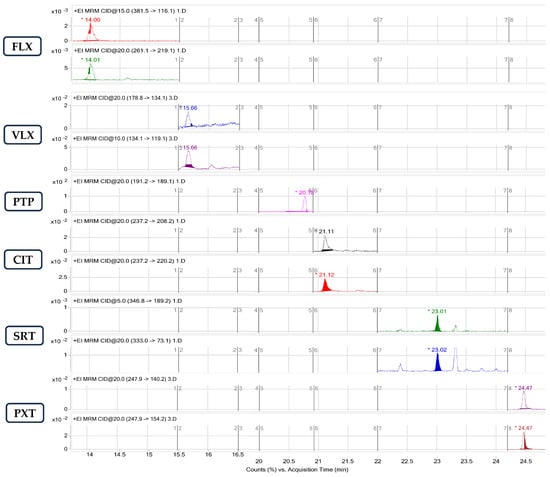
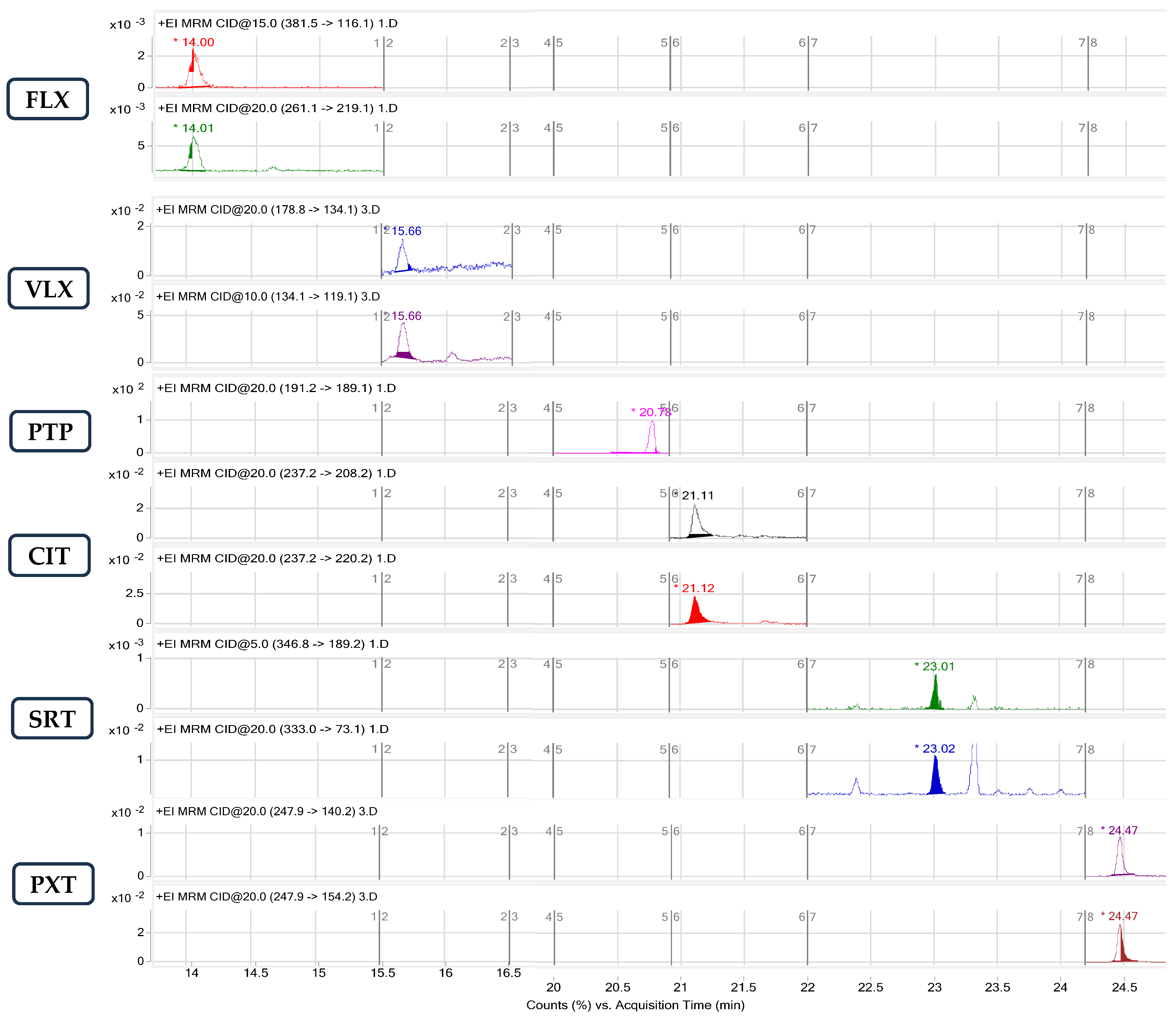
Following this preliminary assessment, multiple reaction monitoring (MRM) conditions were established to improve the selectivity and sensitivity of the analytical method. Acquisition windows and dwell times were subsequently adjusted to optimise the detection of each analyte. The resulting chromatographic profiles are illustrated in Figure 1, while Table 1 summarises the final MRM parameters, including retention times, monitored transitions, collision energies, and dwell times.
Figure 1.
Chromatograms of selected fragments obtained after the extraction of each antidepressant at 49 ng/L for Fluoxetine (FLX), Citalopram (CIT), and Sertraline (SRT), and 195 ng/L for Venlafaxine (VLX) and Paroxetine (PXT).
Table 1.
MRM method used throughout this work, with the retention times, transitions, collision energies, and dwell times for each compound.
3.2. Optimisation of the Extraction Procedure
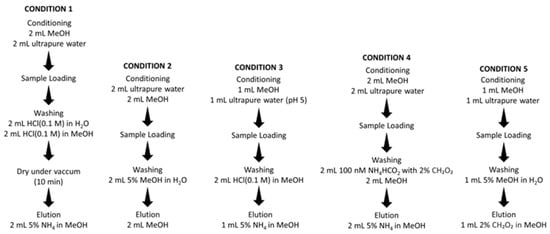
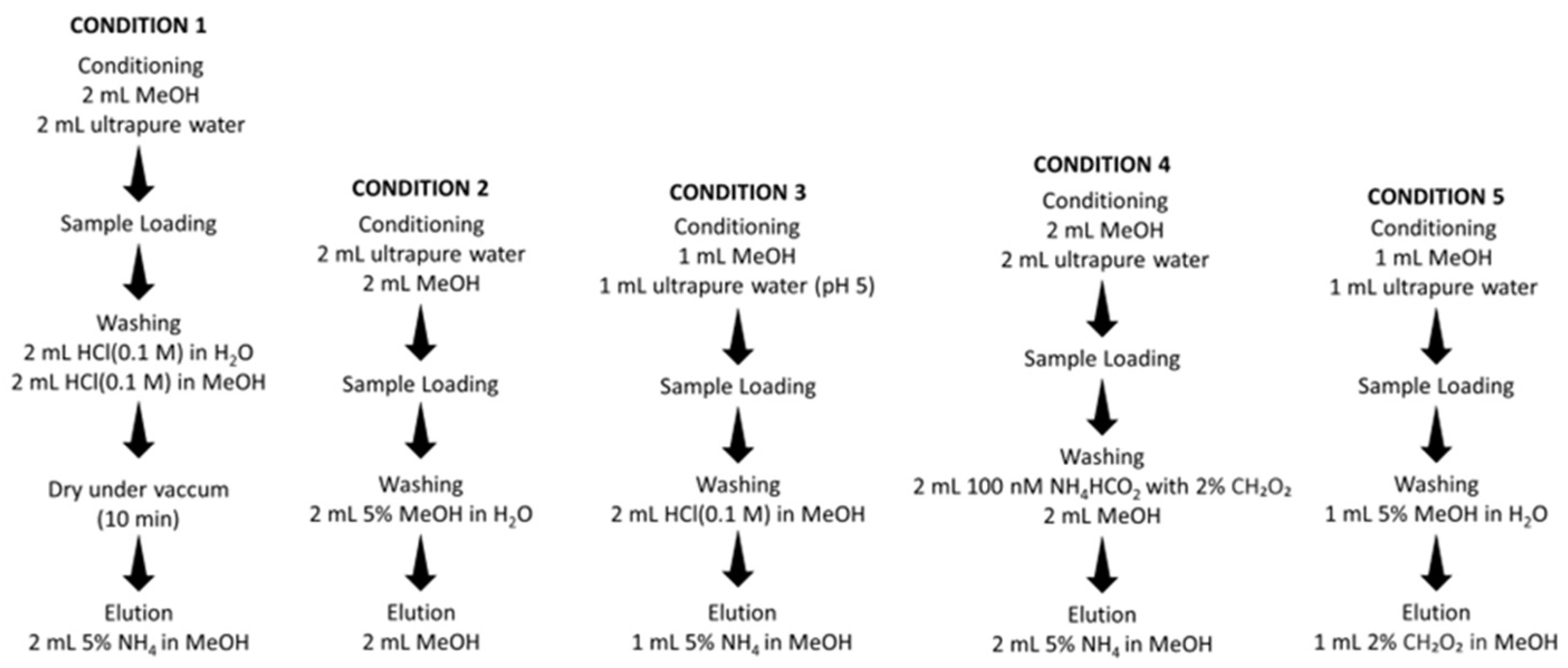
Analytes were extracted by solid-phase extraction (SPE), which enables their concentration and purification from relatively large sample volumes while reducing matrix interferences. A sample volume of 100 mL was selected, considering the low concentrations of the target compounds in real samples and the practicality of processing this volume through SPE cartridges while maintaining a practical extraction time. To optimise the extraction and purification of the analytes, four types of SPE cartridges were tested: one combining reversed-phase and cation exchange (OASIS® PRIME MCX), one for cation exchange (STRATATM-X-C), one for reversed-phase (STRATATM-X), and one based on hydrophilic-lipophilic balance (OASIS® HLB). In addition, various extraction protocols were evaluated, including changes in the type and volume of organic solvents used in the washing and elution steps. All tests were performed in triplicate to determine the most effective procedure (Figure 2).
Figure 2.
Sample protocols of SPE tested.
Condition 1 was based on a previously reported method for determining antipsychotics in WWTPs [28]. Because antipsychotics and antidepressants are predominantly basic compounds, this procedure was evaluated using the different SPE cartridges. Manufacturer-recommended procedures were also evaluated, with Conditions 2 to 5 corresponding to OASIS® HLB, STRATATM-X-C, OASIS® PRIME MCX, and STRATATM-X cartridges, respectively.
The selection of washing and elution solvents was based on the physicochemical properties of the target antidepressants, particularly their basic character and lipophilicity, as well as the retention mechanisms of the different SPE sorbents. For reversed-phase sorbents, such as OASIS® HLB and STRATA™-X, washing solutions containing low percentages of MeOH (5%) were selected according to the manufacturers’ recommended procedures, with the aim of removing weakly retained matrix constituents while minimising premature analyte elution. In contrast, mixed-mode strong cation-exchange sorbents, such as OASIS® PRIME MCX and STRATA™-X-C, combine hydrophobic and ionic retention mechanisms. Under acidic conditions, the target antidepressants are predominantly protonated, favouring their retention through electrostatic interactions with the negatively charged functional groups of the sorbent. Accordingly, the sequential washing steps with aqueous HCl (0.1 M) and HCl (0.1 M) in MeOH used in Condition 1 were selected to remove interfering compounds of different polarities while maintaining ionic retention of the target analytes. Subsequent elution with 5% NH4OH in MeOH was expected to weaken these ionic interactions and promote analyte desorption. These solvent combinations were selected according to established SPE principles and previously described procedures for the extraction of basic compounds.
In Condition 1, cartridge conditioning was performed using MeOH and ultrapure water, followed by washing with hydrochloric acid (HCl 0.1 M) in both water and MeOH, vacuum drying, and elution with 5% ammonia (NH4OH) in MeOH.
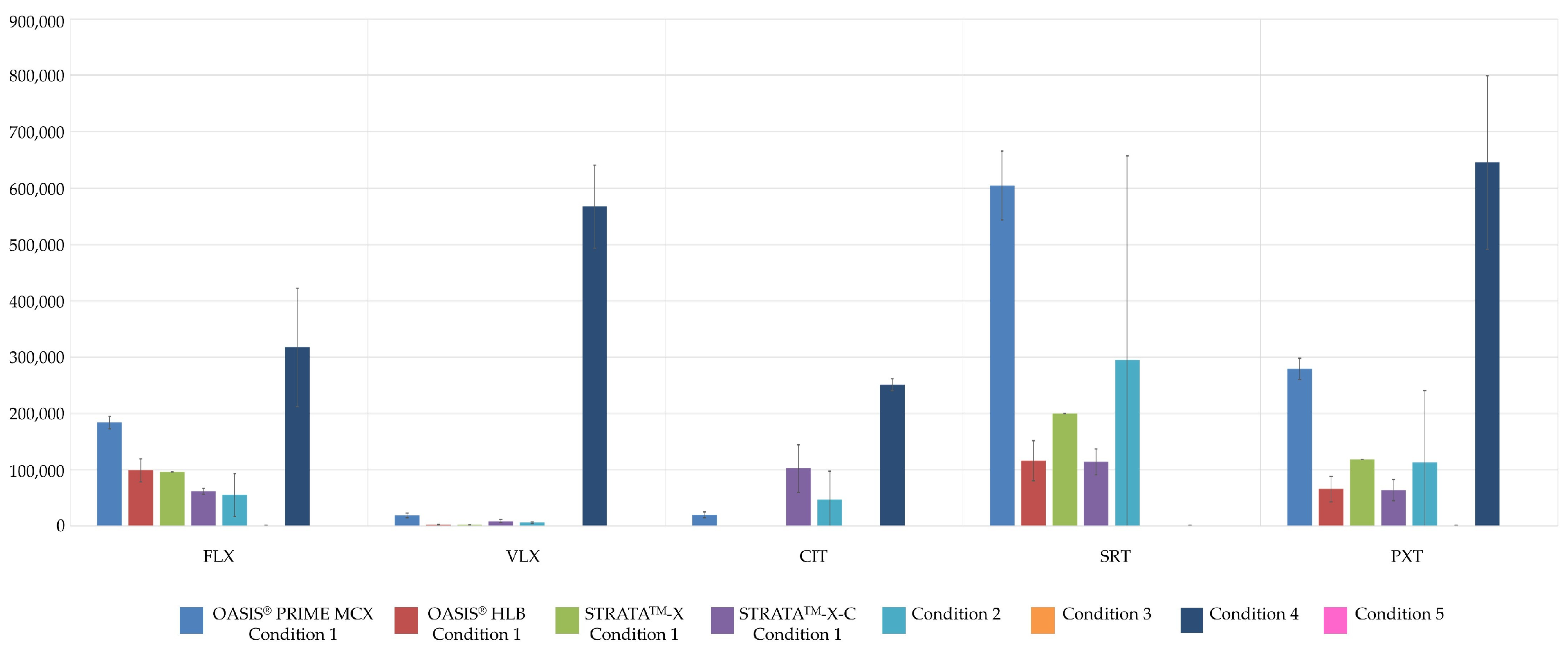
Condition 2 involved washing with 5% MeOH, followed by elution with pure MeOH. Although chromatographic responses were obtained for the target antidepressants, the analytical responses were generally lower than those achieved with Condition 1 using OASIS® PRIME MCX cartridges.
Condition 3 involved a washing step with HCl (0.1 M) in MeOH, followed by elution with 5% NH4OH in MeOH, using reduced solvent volumes and a simplified conditioning procedure. However, no appreciable chromatographic responses were observed for the target compounds under the tested conditions, and this procedure was therefore excluded from further consideration.
In Condition 4, the washing step involved 100 mM ammonium formate containing 2% formic acid and MeOH, followed by elution with 5% NH4OH in MeOH. This condition provided higher chromatographic peak areas for FLX, VLX, CIT, and PXT than those obtained with Condition 1 using OASIS® PRIME MCX cartridges. However, no detectable analytical response was obtained for SRT. As the simultaneous determination of all five antidepressants was required, the absence of a detectable response for SRT was the decisive factor in excluding Condition 4, despite its higher analytical responses for the remaining compounds.
Condition 5 involved washing with 5% MeOH and elution with 2% formic acid in MeOH. This procedure yielded no appreciable responses for the target analytes.
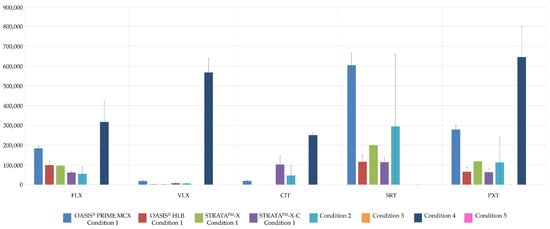
Figure 3 presents absolute chromatographic peak areas from the preliminary optimisation experiments, enabling comparison of analytical responses across SPE cartridges and extraction conditions. These peak areas should not be interpreted as extraction recoveries, which were determined separately during method validation.
Figure 3.
Comparison of absolute peak areas obtained for the five antidepressants using different SPE protocols and cartridges. Condition 1 was evaluated using four different SPE cartridges, whereas Conditions 2–5 corresponded to the respective manufacturer-recommended procedures.
Overall, Condition 1 using OASIS® PRIME MCX cartridges was selected as the most suitable procedure for simultaneously determining all five antidepressants. Although Condition 4 produced higher responses for four analytes, it did not allow the detection of SRT, whereas Condition 1 provided detectable analytical responses for all five target compounds and generally more favourable responses than Condition 2. The method was subsequently validated, including assessment of extraction recovery (Section 3.3.5).
3.3. Validation Procedure
Method validation aimed to demonstrate reliable identification and quantification of the target antidepressants in influent and effluent wastewater. Following the Food and Drug Administration (FDA) guidelines [29], selectivity, linearity, calibration, precision, accuracy, detection and quantification limits, stability, and recovery were evaluated over five days.
3.3.1. Selectivity
The method demonstrated selectivity, as no co-eluting interferences were observed for any of the target antidepressants or the internal standard in the analysis of ten blank samples (n = 10). Compound identification was performed according to the criteria established by the World Anti-Doping Agency (WADA) [30]. Two characteristic MRM transitions, corresponding to quantifier and qualifier ions, were monitored for each antidepressant (Table 1). Identification was based on the agreement between the retention times and relative abundances of diagnostic ions in the samples and reference standards analysed within the same analytical batch. The maximum acceptable retention-time deviation was 1% or 0.1 min, whichever was greater, without exceeding the chromatographic peak width at half maximum. The permitted deviations in relative ion abundances were ±10 absolute percentage points for abundances above 50%, ±20% relative for abundances above 25% and up to 50%, and ±5 absolute percentage points for abundances between 1% and 25%. A signal-to-noise ratio greater than 3:1 was required for both diagnostic transitions.
3.3.2. Linearity and Calibration Curve
Calibration curves were constructed using seven concentration levels ranging from 49 to 25,000 ng/L for FLX, CIT, and SRT and from 195 to 25,000 ng/L for VLX and PXT. Seven calibrators were established within each concentration range. Calibration standards were prepared in Milli-Q water by fortifying the highest concentration level with the analytical standards, followed by successive dilutions with Milli-Q water to obtain the remaining calibration levels. The IS was added to each calibrator prior to extraction. Linearity was evaluated over five days, with all calibration standards subjected to the optimised SPE procedure (Condition 1). The resulting data are presented in Table 2.
Table 2.
Linearity data (n = 5).
Weighted linear regression (1/x) was used to construct the calibration curves, using the ratio of the chromatographic peak area of each analyte to that of the internal standard (PTP), to account for heteroscedasticity across the wide calibration ranges. The criteria for a valid calibration model required an R2 of at least 0.99, with BIAS limits set at ±20% for the lower limit of quantification (LLOQ) and ±15% for the remaining calibrators. Quality controls (QCs) were prepared at four different concentrations (lower limit of quantification [LLOQ], low, intermediate, and high), with all QCs showing a BIAS within the limits set by the FDA [29]. The method demonstrated linearity for all compounds, with a weighted linear regression yielding R2 values above 0.99 and appropriate BIAS values. The LLOQ was defined as the lowest calibration concentration meeting the acceptance criteria for accuracy (bias within ±20%) and precision (CV ≤ 20%), in accordance with the FDA guidelines. The limit of detection (LOD) was established using a minimum signal-to-noise ratio (S/N) of 3:1. The selected LOD concentrations were evaluated in ten independently prepared replicates, with experimentally observed S/N ratios greater than 5:1.
The LLOQ values obtained were 49 ng/L for FLX, CIT, and SRT, and 195 ng/L for VLX and PXT. The LOD values obtained were 25 ng/L for FLX and SRT, 98 ng/L for PXT, 195 ng/L for VLX, and 12 ng/L for CIT.
Compared to Gonçalves et al. [31], our study has higher LOD and LLOQ; however, our approach has the advantage of requiring a fivefold smaller sample volume.
Furthermore, the proposed method achieved lower LOD and LLOQ values than some previously reported methods employing alternative extraction techniques, such as the MSPE procedure described by Ulusoy et al. [32]. The study by Leiviskä et al. [33], which utilised OASIS® HLB extraction cartridges and sample volumes of 50 and 100 mL, reported a higher LOQ value for CIT (73–105 ng/L) compared with the present study. It is also noteworthy that, although Huidobro-López et al. [34] reported lower LOQ values, the LOD values are very similar to those obtained in this study. However, the values presented by Huidobro-López et al. [34] reported instrumental LODs. Table 3 describes some extraction procedures found in the literature for the detection and quantification of the compounds under study in wastewater samples.
Table 3.
Methods described in the literature for the detection and quantification of the ADTs in wastewater samples.
It is also important to highlight that many studies report LOQs rather than LLOQs, which may contribute to differences in the quantification limits reported in the literature. Therefore, direct comparisons between methods should be made cautiously, considering the criteria used to establish these limits, sample volumes, and analytical methodologies. Nevertheless, the sensitivity achieved in the present study allowed the quantification of several antidepressants in treated wastewater samples (Table 9), supporting its use for monitoring these compounds at concentrations within the validated ranges.
3.3.3. Precision and Accuracy
Intraday, interday, and intermediate precision were assessed. Intraday precision was evaluated using fortified samples at low, intermediate, and high concentrations, prepared and analysed on the same day (n = 5; Table 4).
Table 4.
Intraday precision and accuracy.
Intraday precision and accuracy met the established acceptance criteria, with CV values below 20% and absolute bias values below 20% at the LLOQ, and both parameters below 15% at higher concentrations. Interday and intermediate precision were evaluated over five days using fortified samples at different concentration levels. Five calibration levels and four quality control (QC) concentrations were included in these assessments. The corresponding results are presented in Table 5 and Table 6.
Table 5.
Interday precision and accuracy.
Table 6.
Intermediate precision and accuracy.
Interday and intermediate precision and accuracy met the acceptance criteria, with bias and CV values within ±20%/20% at the LLOQ and ±15%/15% at higher concentrations, as applicable.
3.3.4. Stability
The stability study aims to verify whether the compounds undergo changes, such as degradation, over time. This makes it essential to test conditions that could arise in day-to-day scenarios between sample preparation and analysis. In the present study, the stability of processed samples was examined.
Stability of processed samples was evaluated at concentrations of 49, 195, 780, 3130, and 12,500 ng/L. Processed-sample stability was evaluated by analysing freshly prepared extracts and reinjecting them after 24 h of storage at room temperature. The results obtained (Table 7) showed that PXT exhibited limited stability, particularly at 195 ng/L (bias = −47.86%). However, during routine analysis, samples were injected immediately after completion of extraction and derivatization, without prolonged storage of the processed extracts. These findings highlight the importance of prompt chromatographic analysis, particularly for PXT at low concentrations.
Table 7.
Stability of processed samples (n = 3).
PXT exhibited limited stability after 24 h of storage at room temperature, particularly at lower concentrations. At 195 ng/L, a pronounced negative bias (−47.86%) and a high CV (24.89%) were observed. Similarly, at 780 ng/L, both bias (−18.80%) and CV (20.49%) exceeded the established acceptance criteria. These findings indicate that prolonged storage of processed samples may compromise the quantitative reliability of PXT, especially at low concentrations. Therefore, chromatographic analysis should be performed promptly after sample preparation to minimise potential stability-related changes. The remaining compounds were shown to be stable at low, intermediate, and high concentrations, as they did not exceed the BIAS limit specified by the guidelines.
3.3.5. Recovery and Matrix Effects
Extraction recovery was evaluated using Condition 1 with OASIS® PRIME MCX cartridges, corresponding to the extraction procedure selected during the optimisation experiments. Fortified ultrapure water samples were prepared at three concentration levels (195, 3130, and 25,000 ng/L) and analysed in triplicate. Recovery was calculated by comparing the chromatographic peak areas obtained after extraction with those of unextracted standard solutions at the corresponding concentrations. The results, expressed as recovery percentages, are presented in Table 8.
Table 8.
Recoveries (n = 3).
Although the washing and elution conditions were selected to favour analyte retention and subsequent desorption, the relatively low recoveries observed for some compounds, particularly FLX and VLX, indicate that analyte losses may have occurred during sample preparation. As the fraction passing through the SPE cartridge during sample loading and the individual washing fractions were not analysed separately, potential losses during these steps could not be distinguished from incomplete elution or losses occurring during subsequent sample preparation. Therefore, the contribution of each extraction step to the overall recovery could not be established. Further investigations involving the separate analysis of these fractions would be necessary to identify the main sources of analyte loss and support additional optimisation of the extraction procedure.
Although relatively low absolute recoveries were observed for FLX and VLX, the calibration standards were subjected to the same extraction procedure as the validation samples, allowing systematic and reproducible analyte losses to be reflected in the calibration curves. The suitability of PTP as a single internal standard was supported by the satisfactory accuracy and precision obtained for all five antidepressants during method validation (Table 4, Table 5 and Table 6).
When comparing the recoveries obtained with those from other studies (Table 3), it was observed that the recoveries obtained in the present study were lower than those reported in some previous studies. However, in the study by Asimakopoulos et al. [44], where various SPE cartridges were used, low recoveries for ADT were also reported. Baker and Kasprzyk-Hordern [56] state that attributing these low recoveries to the use of unsuitable SPE sorbents is misleading, as multiple factors may contribute to this, including contamination, sample degradation, or inconsistent sample processing techniques.
Asimakopoulos et al. [44] highlighted that chemical compounds can exhibit unique behaviours during the extraction process. Borova et al. [48] noted that high vacuum pressures (above 10 psi) can also affect recovery, leading to low recovery values for several chemical compounds. Zhong et al. [36] report low recovery rates for FLX and VLX. It should also be noted that some of these studies report relative rather than absolute recovery, whereas absolute recovery was determined in the present study.
It is important to clarify how extraction efficiency is assessed, as it may be evaluated in terms of either absolute or relative recovery. Absolute recovery, which was the approach used in this study, measures the fraction of analyte originally present in the matrix that is effectively recovered after the entire sample preparation and analytical procedure. This is determined by comparison with unextracted reference standards and therefore takes into account all possible losses throughout the process, such as adsorption to surfaces, degradation, or retention within the matrix. By contrast, relative recovery, which was also reported by several of the authors cited in Table 3, compares the amount of analyte recovered from a fortified real sample with that obtained from a fortified “blank” sample. This approach evaluates method performance in the real matrix relative to a control representing ideal or less complex conditions and generally results in higher recovery values than those obtained by absolute recovery [57,58]. Accordingly, absolute recovery reflects the amount recovered in relation to the amount that should theoretically have been extracted in the absence of losses or interferences, whereas relative recovery is based on a practical comparison between a fortified sample and a control. As some sources of loss affect both the sample and the control similarly, they may partially cancel each other out, leading to higher apparent recovery values.
To assess potential matrix effects and the suitability of the calibration procedure for both influent and effluent wastewater, an additional experiment was performed at an intermediate concentration of 3130 ng/L, using three independently prepared replicates for each matrix (n = 3). Matrix effects were evaluated by comparing the analyte-to-internal-standard peak area ratios obtained from wastewater extracts fortified after SPE with those obtained from similarly prepared Milli-Q water extracts, accounting for any initially present analyte concentrations. The results showed no relevant matrix-induced differences in analytical response, with matrix effects ranging from 9 to 16% in influent samples and 6 to 20% in effluent samples. Furthermore, wastewater samples fortified before extraction and quantified using the calibration curves prepared in Milli-Q water showed satisfactory accuracy and precision, with bias values ranging from −11.02 to +14.56% and coefficients of variation below 12.01% for all five antidepressants. These findings indicate that the calibration procedure using Milli-Q water was suitable for the quantitative determination of the target antidepressants in the influent and effluent matrices evaluated, under the tested conditions.
3.4. Application of the Method to Real Samples
To evaluate the applicability of the developed analytical method to real environmental samples, 50 wastewater samples collected from different WWTPs across Portugal, including the Autonomous Region of Madeira, were analysed.
Sampling was conducted over a one-year period, covering all four seasons (winter, spring, summer, and autumn). The concentrations of the target antidepressants, together with the sampling season, sample type (influent or effluent), and population density category, are presented in Table 9.
Table 9.
Concentrations of the target antidepressants in influent and effluent wastewater samples collected during different seasons from wastewater treatment plants in Portugal.
Influent and effluent samples were collected simultaneously from the same WWTPs during the same 24 h composite sampling periods. However, the hydraulic retention times of the WWTPs were not considered. Consequently, the collected samples do not necessarily represent the same wastewater fraction before and after treatment. Therefore, differences in the measured concentrations, including cases where higher concentrations were observed in effluents, should be interpreted with caution and cannot be used to assess removal efficiency. For this reason, removal efficiencies were not calculated. This situation is illustrated by samples 43 and 44, collected simultaneously from the influent and effluent of the same WWTP, in which CIT concentrations of 1390 and 1890 ng/L were obtained, respectively. As these samples were not hydraulically matched, the observed difference cannot be directly attributed to the treatment process.
As the primary objective of this study was to develop and validate an analytical method for the determination of antidepressants in wastewater, rather than to assess the treatment efficiency of individual WWTPs, the results are presented as the concentrations measured in the collected samples.
The concentrations of the target antidepressants varied considerably among the analysed wastewater samples, including those associated with different population-density categories. For example, during summer, CIT concentrations of 1240 and 1390 ng/L were observed in influent samples from areas classified as having high population density, whereas a concentration of 3440 ng/L was measured in an influent sample from an area classified as having low population density. These observations illustrate the variability of antidepressant concentrations across the sampled areas, without indicating a consistent relationship with population density.
Nevertheless, the available information does not allow a detailed assessment of geographical patterns or the identification of factors responsible for the observed differences. Pharmaceutical concentrations in wastewater may be influenced by several factors, including local consumption patterns, wastewater dilution, treatment processes, and the characteristics of the populations served. Furthermore, the sampling distribution across seasons and population-density categories was not balanced. Consequently, the present results should be interpreted as an assessment of the applicability and feasibility of the analytical method to wastewater samples collected under different conditions, rather than as evidence of spatial or seasonal trends in antidepressant occurrence or consumption.
This study compared the results obtained with data provided by INFARMED, which indicated an increase in the consumption of FLX, PXT, SRT, and VLX between 2017 and 2023, along with a decrease in the consumption of CIT. However, in the samples analysed, the most frequently detected compound was CIT, followed by SRT, VLX, FLX, and PXT, which contrasts with the consumption data. Comparisons with other studies revealed that the most frequently detected compounds were VLX, CIT, FLX, SRT, and PXT, with concentrations ranging from 2 to 1000 ng/L.
However, it should be noted that consumption data cannot be directly compared with wastewater detection data, as, in addition to environmental factors (e.g., persistence, biodegradability, solubility, and bioaccumulation of the compounds) interfering with the detection of these substances, the estimation of pharmaceuticals in wastewater also relies on parameters such as the detected concentration, the daily flow rate of the WWTPs, the number of inhabitants served by these facilities, and the excretion rate of the pharmaceuticals. FLX and SRT have high persistence due to their low biodegradability, making their removal from WWTPs more difficult. VLX and CIT, being more soluble, are more readily transported in the aquatic environment, making them more frequently detected. In contrast, PXT has lower solubility and a greater tendency to adsorb to particles [59,60].
In conclusion, drug consumption should not be the only factor considered when interpreting detections in water, as persistence and solubility also play important roles. The presence of pharmaceuticals in wastewater highlights the need for continuous monitoring, improvements in wastewater treatment at WWTPs, and the responsible use and disposal of medicines. Chronic exposure to these compounds, even at low concentrations, can have sublethal effects, such as behavioural and physiological changes in aquatic organisms.
4. Conclusions
This study aimed to develop and optimise an analytical method for the determination of ADTs, specifically CIT, FLX, SRT, PXT, and VLX, in wastewater using SPE, followed by GC-MS/MS analysis.
The method proved to be selective, precise, accurate, and linear within the studied ranges, in accordance with FDA validation guidelines and WADA qualification criteria for analytical methods. Linearity was demonstrated between 49 and 25,000 ng/L for CIT, FLX, and SRT, and between 195 and 25,000 ng/L for PXT and VLX, with R2 values higher than 0.99. Detection limits were 12 ng/L for CIT, 25 ng/L for FLX and SRT, 98 ng/L for PXT, and 195 ng/L for VLX, while recovery values ranged from 6.91% to 81.14%. Processed samples were generally stable under the tested conditions, except for PXT, which showed absolute bias values exceeding the established 15% threshold. The selected sample volume (100 mL) proved to be adequate, allowing analysis with satisfactory sensitivity.
An additional strength of this work lies in the simultaneous determination of SSRIs and SNRIs in wastewater using SPE with OASIS® PRIME MCX cartridges combined with GC-MS/MS. Moreover, the application of the method to samples collected from different locations across the country supports its suitability and feasibility for the analysis of antidepressants in complex wastewater matrices under real monitoring conditions.
Overall, the proposed methodology proved to be appropriate and robust, showing clear potential for application in environmental toxicology and wastewater-based monitoring of these classes of antidepressants, which are recognised CECs. In this way, it may contribute to improved environmental surveillance and to a better understanding of the potential impact of these contaminants on aquatic ecosystems and public health.
Author Contributions
G.C.: Conceptualization, Formal analysis, Investigation, Writing—Original Draft; S.S.: Formal analysis, Investigation, Supervision, Writing—Review and Editing; T.R.: Conceptualization, Formal analysis, Validation, Supervision, Writing—Review and Editing; M.B.: Formal analysis, Validation, Writing—Review and Editing; A.R.T.S.A.: Conceptualization, Methodology, Supervision, Writing—Review and Editing; E.G.: Conceptualization, Methodology, Project administration, Supervision, Writing—Review and Editing. All authors have read and agreed to the published version of the manuscript.
Funding
This research was partially supported by CICS-UBI (now known as RISE Health-UBI), which is financed by National Funds from Fundação para a Ciência e a Tecnologia (FCT) and by Fundo Europeu de Desenvolvimento Regional (FEDER) within the framework of PORTUGAL 2020 and Programa Operacional do Centro (CENTRO 2020), with the project references https://doi.org/10.54499/UIDB/00709/2020, https://doi.org/10.54499/UIDP/00709/2020 and UID/06397/2025.
Data Availability Statement
The data presented in this study are openly available in [Universidade da Beira Interior] at [https://ubibliorum.ubi.pt/collections/27393fd3-c241-48be-b6ff-e7d2715e7718] (accessed on 24 November 2024).
Conflicts of Interest
The authors declare no conflicts of interest.
Abbreviations
The following abbreviations are used in this manuscript:
| 2D-UHPLC-DAD | Two-dimensional ultra-high-performance liquid chromatography-diode array detector |
| ADTs | Antidepressants |
| CE-ESI-TOF-MS | Capillary electrophoresis via electrospray ionisation-time-of-flight mass spectrometry |
| CECs | Contaminants of emerging concern |
| CIT | Citalopram |
| CV | Coefficient of variation |
| DLLME | Dispersive liquid–liquid microextraction |
| FDA | Food and Drug Administration |
| FLX | Fluoxetine |
| GC | Gas chromatography |
| GC-FID | Gas chromatography-flame ionisation detector |
| GC-MS/MS | Gas chromatography-tandem mass spectrometry |
| GEL-EME | Gel electromembrane extraction |
| HPLC-DAD | High-performance liquid chromatography-diode array detector |
| HPLC-FLD | High-performance liquid chromatography-fluorescence detector |
| INFARMED | National Authority of Medicines and Health Products, I.P. (correspondente a Autoridade Nacional do Medicamento e Produtos de Saúde, I.P.). |
| IS | Internal standard |
| LC-MS/MS | Liquid chromatography-tandem mass spectrometry |
| LLE | Liquid–liquid extraction |
| LLOQ | Lower limit of quantification |
| LOD | Limit of detection |
| LOQ | Limit of quantification |
| MAOIs | Monoamine oxidase inhibitors |
| MRM | Multiple Reaction Monitoring |
| MSPE | Magnetic solid-phase extraction |
| MSTFA | N-methyl-N-(trimethylsilyl) trifluoroacetamide |
| n.s. | not specified |
| PD | Psychotropic drugs |
| PTP | Protriptyline |
| PXT | Paroxetine |
| QCs | Quality controls |
| SHS-HLLME | Homogeneous liquid–liquid microextraction based on switchable hydrophilicity solvent |
| SNRIs | Serotonin-noradrenaline reuptake inhibitors |
| SPE | Solid-phase extraction |
| SPME | Solid-phase microextraction |
| SRT | Sertraline |
| SS-LPME | Solvent-switchable liquid-phase microextraction |
| SSRIs | Selective serotonin reuptake inhibitors |
| TCAs | Tricyclic antidepressants |
| TMCS | Trimethyl chlorosilane |
| UHPLC-MS/MS | Ultra-high-performance liquid chromatography-tandem mass spectrometry |
| VLX | Venlafaxine |
| WADA | World Anti-Doping Agency |
| WWTPs | Wastewater treatment plants |
References
- Chen, L.; Yan, X.; Zhou, X.; Peng, P.; Sun, Q.; Zhao, F. Advances in the On-Line Solid-Phase Extraction-Liquid Chromatography-Mass Spectrometry Analysis of Emerging Organic Contaminants. TrAC Trends Anal. Chem. 2023, 160, 116976. [Google Scholar] [CrossRef] [Scilit]
- Niu, J.; Lu, Y.; Wang, H.; Qiao, X.; Wang, H.; Ma, C.; Liu, Y. Occurrence, Removal and Environmental Risk Assessment of Pharmaceutical Active Compounds (PhACs) and Metabolites in Hospital Wastewater. J. Hazard. Mater. 2024, 480, 136348. [Google Scholar] [CrossRef] [Scilit] [PubMed]
- Wang, C.; Guo, R.; Guo, C.; Yin, H.; Xu, J. Photodegradation of Typical Psychotropic Drugs in the Aquatic Environment: A Critical Review. Environ. Sci. Process. Impacts 2025, 27, 320–354. [Google Scholar] [CrossRef] [Scilit] [PubMed]
- American Psychiatric Association. Diagnostic and Statistical Manual of Mental Disorders, 5th ed.; American Psychiatric Association Publishing: Washington, DC, USA, 2022. [Google Scholar]
- Sociedade Portuguesa de Psiquiatria e Saúde Mental Depressão. Available online: https://www.sns24.gov.pt/tema/saude-mental/depressao/#o-que-e-a-depressao (accessed on 20 July 2024).
- Horst, W.D.; Preskorn, S.H. Mechanisms of Action and Clinical Characteristics of Three Atypical Antidepressants: Venlafaxine, Nefazodone, Bupropion. J. Affect. Disord. 1998, 51, 237–254. [Google Scholar] [CrossRef] [Scilit] [PubMed]
- Lochmann, D.; Richardson, T. Selective Serotonin Reuptake Inhibitors. In Handbook of Experimental Pharmacology; Macaluso, M., Preskorn, S., Eds.; Springer: Cham, Switzerland, 2018; Volume 250, pp. 135–144. [Google Scholar]
- Catterson, M.L.; Preskorn, S.H. Pharmacokinetics of Selective Serotonin Reuptake Inhibitors: Clinical Relevance. Pharmacol. Toxicol. 1996, 78, 203–208. [Google Scholar] [CrossRef] [Scilit] [PubMed]
- Preskorn, S.H. Dose-Effect and Concentration-Effect Relationships with New Antidepressants. Psychopharmacol. Ser. 1993, 10, 174–189. [Google Scholar] [CrossRef] [Scilit] [PubMed]
- Leonard, B.E. Principles and Practice of Psychopharmacotherapy, 3rd ed.; Janicak, P.G., Davis, J.M., Preskorn, S.H., Ayd, F.J., Eds.; Lippincott Williams and Wilkins: Philadelphia, PA, USA; Wiley: Hoboken, NJ, USA, 2001; Volume 18, 700p. [Google Scholar]
- Harmer, C.J.; Goodwin, G.M.; Cowen, P.J. Why Do Antidepressants Take so Long to Work? A Cognitive Neuropsychological Model of Antidepressant Drug Action. Br. J. Psychiatry 2009, 195, 102–108. [Google Scholar] [CrossRef] [Scilit] [PubMed]
- Liu, Y.; Lv, J.; Guo, C.; Jin, X.; Zuo, D.; Xu, J. Environmental Behavior, Risks, and Management of Antidepressants in the Aquatic Environment. Environ. Sci. Process. Impacts 2025, 27, 1196–1228. [Google Scholar] [CrossRef] [Scilit] [PubMed]
- Koumaki, E.; Konomi, A.; Gkotsis, G.; Nika, M.C.; Seintos, T.; Statiris, E.; Maragou, N.; Thomaidis, N.S.; Kouris, N.; Mamais, D.; et al. Circular Water Management in Agriculture: Screening of Contaminants of Emerging Concern in a Real-World Water-Soil-Crop System and Human Health Risk Assessment. J. Hazard. Mater. 2025, 492, 138167. [Google Scholar] [CrossRef] [Scilit] [PubMed]
- Sims, J.L.; Cole, A.R.; Moran, Z.S.; Mansfield, C.M.; Possamai, B.; Rojo, M.; King, R.S.; Matson, C.W.; Brooks, B.W. The Tissue-Specific Eco-Exposome: Differential Pharmaceutical Bioaccumulation and Disposition in Fish among Trophic Positions. Environ. Toxicol. Chem. 2024, 43, 1894–1902. [Google Scholar] [CrossRef] [Scilit] [PubMed]
- Brooks, B.W.; Chambliss, C.K.; Stanley, J.K.; Ramirez, A.; Banks, K.E.; Johnson, R.D.; Lewis, R.J. Determination of Select Antidepressants in Fish from an Effluent-dominated Stream. Environ. Toxicol. Chem. 2005, 24, 464–469. [Google Scholar] [CrossRef] [Scilit] [PubMed]
- Duarte, I.A.; Reis-Santos, P.; Fick, J.; Cabral, H.N.; Duarte, B.; Fonseca, V.F. Neuroactive Pharmaceuticals in Estuaries: Occurrence and Tissue-Specific Bioaccumulation in Multiple Fish Species. Environ. Pollut. 2023, 316, 120531. [Google Scholar] [CrossRef] [Scilit] [PubMed]
- Verlicchi, P.; Grillini, V.; Lacasa, E.; Archer, E.; Krzeminski, P.; Gomes, A.I.; Vilar, V.J.P.; Rodrigo, M.A.; Gäbler, J.; Schäfer, L. Selection of Indicator Contaminants of Emerging Concern When Reusing Reclaimed Water for Irrigation—A Proposed Methodology. Sci. Total Environ. 2023, 873, 162359. [Google Scholar] [CrossRef] [Scilit] [PubMed]
- Koçoğlu, E.S.; Bakırdere, S.; Keyf, S. A Novel Liquid-Liquid Extraction for the Determination of Sertraline in Tap Water and Waste Water at Trace Levels by GC-MS. Bull. Environ. Contam. Toxicol. 2017, 99, 354–359. [Google Scholar] [CrossRef] [Scilit] [PubMed]
- Sheng, L.H.; Chen, H.R.; Huo, Y.B.; Wang, J.; Zhang, Y.; Yang, M.; Zhang, H.X. Simultaneous Determination of 24 Antidepressant Drugs and Their Metabolites in Wastewater by Ultra-High Performance Liquid Chromatography-Tandem Mass Spectrometry. Molecules 2014, 19, 1212–1222. [Google Scholar] [CrossRef] [Scilit] [PubMed]
- McKenzie, K.; Moffat, C.F.; Moffat, C.F.; Petrie, B. Multi-Residue Enantioselective Determination of Emerging Drug Contaminants in Seawater by Solid Phase Extraction and Liquid Chromatography-Tandem Mass Spectrometry. Anal. Methods 2020, 12, 2881–2892. [Google Scholar] [CrossRef] [Scilit] [PubMed]
- Evans, S.E.; Davies, P.; Lubben, A.; Kasprzyk-Hordern, B. Determination of Chiral Pharmaceuticals and Illicit Drugs in Wastewater and Sludge Using Microwave Assisted Extraction, Solid-Phase Extraction and Chiral Liquid Chromatography Coupled with Tandem Mass Spectrometry. Anal. Chim. Acta 2015, 882, 112–126. [Google Scholar] [CrossRef] [Scilit] [PubMed]
- Ghorbani, M.; Mohammadi, P.; Keshavarzi, M.; Ziroohi, A.; Mohammadi, M.; Aghamohammadhasan, M.; Pakseresht, M. Developments of Microextraction (Extraction) Procedures for Sample Preparation of Antidepressants in Biological and Water Samples, a Review. Crit. Rev. Anal. Chem. 2023, 53, 1285–1312. [Google Scholar] [CrossRef] [Scilit] [PubMed]
- Berrueta, L.; Gallo, B.; Vicente, F. A Review of Solid Phase Extraction: Basic Principles and New Developments. Chromatographia 1995, 40, 474–483. [Google Scholar] [CrossRef] [Scilit]
- Ötles, S.; Kartal, C. Solid-Phase Extraction (SPE): Principles and Applications in Food Samples. Acta Sci. Pol. Technol. Aliment. 2016, 15, 5–15. [Google Scholar] [CrossRef] [Scilit] [PubMed]
- Moyo, B.; Tavengwa, N.T. Critical Review of Solid Phase Extraction for Multiresidue Clean-up and Pre-Concentration of Antibiotics from Livestock and Poultry Manure. Food Addit. Contam. Part A 2022, 39, 229–241. [Google Scholar] [CrossRef] [Scilit] [PubMed]
- Waters. Oasis Sample Extraction SPE Products. Available online: https://www.waters.com/waters/en_US/OasisSample-Extraction-Products/nav.htm?cid=513209&locale=- (accessed on 7 July 2024).
- Zarei, S.; Salimi, Y.; Repo, E.; Daglioglu, N.; Safaei, Z.; Güzel, E.; Asadi, A. A Global Systematic Review and Meta-Analysis on Illicit Drug Consumption Rate through Wastewater-Based Epidemiology. Environ. Sci. Pollut. Res. 2020, 27, 36037–36051. [Google Scholar] [CrossRef] [Scilit] [PubMed]
- Logarinho, F.; Rosado, T.; Lourenço, C.; Barroso, M.; Araujo, A.R.T.S.; Gallardo, E. Determination of Antipsychotic Drugs in Hospital and Wastewater Treatment Plant Samples by Gas Chromatography/Tandem Mass Spectrometry. J. Chromatogr. B 2016, 1038, 127–135. [Google Scholar] [CrossRef] [Scilit] [PubMed]
- FDA; CDER. Bioanalytical Method Validation Guidance for Industry Biopharmaceutics; FDA: Silver Spring, MD, USA, 2018.
- World Anti-Doping Agency. Minimum Criteria for Chromatographic-Mass Spectrometric Confirmation of the Identity of Analytes for Doping Control Purposes; WADA: Montreal, QC, Canada, 2021. [Google Scholar]
- Gonçalves, R.; Ribeiro, C.; Cravo, S.; Cunha, S.C.; Pereira, J.A.; Fernandes, J.O.; Afonso, C.; Tiritan, M.E. Multi-Residue Method for Enantioseparation of Psychoactive Substances and Beta Blockers by Gas Chromatography–Mass Spectrometry. J. Chromatogr. B 2019, 1125, 121731. [Google Scholar] [CrossRef] [Scilit] [PubMed]
- Sarıkaya, M.; Ulusoy, H.I.; Morgul, U.; Ulusoy, S.; Tartaglia, A.; Yılmaz, E.; Soylak, M.; Locatelli, M.; Kabir, A. Sensitive Determination of Fluoxetine and Citalopram Antidepressants in Urine and Wastewater Samples by Liquid Chromatography Coupled with Photodiode Array Detector. J. Chromatogr. A 2021, 1648, 462215. [Google Scholar] [CrossRef] [Scilit] [PubMed]
- Leiviskä, T.; Risteelä, S. Analysis of Pharmaceuticals, Hormones and Bacterial Communities in a Municipal Wastewater Treatment Plant—Comparison of Parallel Full-Scale Membrane Bioreactor and Activated Sludge Systems. Environ. Pollut. 2022, 292, 118433. [Google Scholar] [CrossRef] [Scilit] [PubMed]
- Huidobro-López, B.; López-Heras, I.; Alonso-Alonso, C.; Martínez-Hernández, V.; Nozal, L.; de Bustamante, I. Analytical Method to Monitor Contaminants of Emerging Concern in Water and Soil Samples from a Non-Conventional Wastewater Treatment System. J. Chromatogr. A 2022, 1671, 463006. [Google Scholar] [CrossRef] [Scilit] [PubMed]
- Bozyiğit, G.D.; Zaman, B.T.; Özdemir, O.K.; Kılınç, Y.; Chormey, D.S.; Bakırdere, S.; Engin, G.O. Removal of Two Antidepressant Active Pharmaceutical Ingredients from Hospital Wastewater by Polystyrene-Coated Magnetite Nanoparticles–Assisted Batch Adsorption Process. Environ. Monit. Assess. 2024, 196, 77. [Google Scholar] [CrossRef] [Scilit] [PubMed]
- Zhong, J.; Liu, X.; Chen, L.; Li, K.; Hu, Q.; Wu, K.; Zhou, J.; Shi, Y.; Fan, H. Simultaneous Separation and Determination of Several Chiral Antidepressants and Their Enantiomers in Wastewater by Online Heart-Cutting Two-Dimensional Liquid Chromatography. Ecotoxicol. Environ. Saf. 2023, 263, 115302. [Google Scholar] [CrossRef] [Scilit] [PubMed]
- Restrepo-Vieira, L.H.; Busetti, F.; Linge, K.L.; Joll, C.A. Development and Validation of a Direct Injection Liquid Chromatography-Tandem Mass Spectrometry Method for the Analysis of Illicit Drugs and Psychopharmaceuticals in Wastewater. J. Chromatogr. A 2022, 1685, 463562. [Google Scholar] [CrossRef] [Scilit] [PubMed]
- Bozyiğit, G.D.; Ayyıldız, M.F.; Chormey, D.S.; Engin, G.O.; Bakırdere, S. Trace Level Determination of Eleven Nervous System–Active Pharmaceutical Ingredients by Switchable Solvent-Based Liquid-Phase Microextraction and Gas Chromatography–Mass Spectrometry with Matrix Matching Calibration Strategy. Environ. Monit. Assess. 2022, 194, 58. [Google Scholar] [CrossRef] [Scilit] [PubMed]
- Christophoridis, C.; Veloutsou, S.; Mitsika, E.; Zacharis, C.K.; Christia, C.; Raikos, N.; Fytianos, K. Determination of Illicit Drugs and Psychoactive Pharmaceuticals in Wastewater from the Area of Thessaloniki (Greece) Using LC–MS/MS: Estimation of Drug Consumption. Environ. Monit. Assess. 2021, 193, 249. [Google Scholar] [CrossRef] [Scilit] [PubMed]
- Behpour, M.; Nojavan, S.; Asadi, S.; Shokri, A. Combination of Gel-Electromembrane Extraction with Switchable Hydrophilicity Solvent-Based Homogeneous Liquid-Liquid Microextraction Followed by Gas Chromatography for the Extraction and Determination of Antidepressants in Human Serum, Breast Milk and Wastewater. J. Chromatogr. A 2020, 1621, 461041. [Google Scholar] [CrossRef] [Scilit] [PubMed]
- López-García, E.; Mastroianni, N.; Postigo, C.; Barceló, D.; López de Alda, M. A Fully Automated Approach for the Analysis of 37 Psychoactive Substances in Raw Wastewater Based on On-Line Solid Phase Extraction-Liquid Chromatography-Tandem Mass Spectrometry. J. Chromatogr. A 2018, 1576, 80–89. [Google Scholar] [CrossRef] [Scilit] [PubMed]
- González-Mariño, I.; Castro, V.; Montes, R.; Rodil, R.; Lores, A.; Cela, R.; Quintana, J.B. Multi-Residue Determination of Psychoactive Pharmaceuticals, Illicit Drugs and Related Metabolites in Wastewater by Ultra-High Performance Liquid Chromatography-Tandem Mass Spectrometry. J. Chromatogr. A 2018, 1569, 91–100. [Google Scholar] [CrossRef] [Scilit] [PubMed]
- Lima, D.L.D.; Silva, C.P.; Otero, M. Dispersive Liquid-Liquid Microextraction for the Quantification of Venlafaxine in Environmental Waters. J. Environ. Manag. 2018, 217, 71–77. [Google Scholar] [CrossRef] [Scilit] [PubMed]
- Asimakopoulos, A.G.; Kannan, P.; Higgins, S.; Kannan, K. Determination of 89 Drugs and Other Micropollutants in Unfiltered Wastewater and Freshwater by LC-MS/MS: An Alternative Sample Preparation Approach. Anal. Bioanal. Chem. 2017, 409, 6205–6225. [Google Scholar] [CrossRef] [Scilit] [PubMed]
- Afonso-Olivares, C.; Čadková, T.; Sosa-Ferrera, Z.; Santana-Rodríguez, J.J.; Nováková, L. Simplified Solid-Phase Extraction Procedure Combined with Liquid Chromatography Tandem–Mass Spectrometry for Multiresidue Assessment of Pharmaceutical Compounds in Environmental Liquid Samples. J. Chromatogr. A 2017, 1487, 54–63. [Google Scholar] [CrossRef] [Scilit] [PubMed]
- Aydin, S.; Aydin, M.E.; Tekinay, A.; Kiliç, H. Antidepressants in Urban Wastewater Treatment Plant: Occurrence, Removal and Risk Assessment. Glob. NEST J. 2017, 19, 100–106. [Google Scholar] [CrossRef] [Scilit][Green Version]
- Gurke, R.; Rossmann, J.; Schubert, S.; Sandmann, T.; Rößler, M.; Oertel, R.; Fauler, J. Development of a SPE-HPLC-MS/MS Method for the Determination of Most Prescribed Pharmaceuticals and Related Metabolites in Urban Sewage Samples. J. Chromatogr. B 2015, 990, 23–30. [Google Scholar] [CrossRef] [Scilit] [PubMed]
- Borova, V.L.; Maragou, N.C.; Gago-Ferrero, P.; Pistos, C.; Thomaidis, N.S. Highly Sensitive Determination of 68 Psychoactive Pharmaceuticals, Illicit Drugs, and Related Human Metabolites in Wastewater by Liquid Chromatography-Tandem Mass Spectrometry. Anal. Bioanal. Chem. 2014, 406, 4273–4285. [Google Scholar] [CrossRef] [Scilit] [PubMed]
- Saussereau, E.; Lacroix, C.; Guerbet, M.; Cellier, D.; Spiroux, J.; Goullé, J.P. Determination of Levels of Current Drugs in Hospital and Urban Wastewater. Bull. Environ. Contam. Toxicol. 2013, 91, 171–176. [Google Scholar] [CrossRef] [Scilit] [PubMed]
- Gracia-Lor, E.; Sancho, J.V.; Hernández, F. Multi-Class Determination of around 50 Pharmaceuticals, Including 26 Antibiotics, in Environmental and Wastewater Samples by Ultra-High Performance Liquid Chromatography-Tandem Mass Spectrometry. J. Chromatogr. A 2011, 1218, 2264–2275. [Google Scholar] [CrossRef] [Scilit] [PubMed]
- Tarcomnicu, I.; Van Nuijs, A.L.N.; Simons, W.; Bervoets, L.; Blust, R.; Jorens, P.G.; Neels, H.; Covaci, A. Simultaneous Determination of 15 Top-Prescribed Pharmaceuticals and Their Metabolites in Influent Wastewater by Reversed-Phase Liquid Chromatography Coupled to Tandem Mass Spectrometry. Talanta 2011, 83, 795–803. [Google Scholar] [CrossRef] [Scilit] [PubMed]
- Lajeunesse, A.; Gagnon, C.; Sauvé, S. Determination of Basic Antidepressants and Their N-Desmethyl Metabolites in Raw Sewage and Wastewater Using Solid-Phase Extraction and Liquid Chromatography-Tandem Mass Spectrometry. Anal. Chem. 2008, 80, 5325–5333. [Google Scholar] [CrossRef] [Scilit] [PubMed]
- Schultz, M.M.; Furlong, E.T. Trace Analysis of Antidepressant Pharmaceuticals and Their Select Degradates in Aquatic Matrixes by LC/ESI/MS/MS. Anal. Chem. 2008, 80, 1756–1762. [Google Scholar] [CrossRef] [Scilit] [PubMed]
- Gómez, M.J.; Petrović, M.; Fernández-Alba, A.R.; Barceló, D. Determination of Pharmaceuticals of Various Therapeutic Classes by Solid-Phase Extraction and Liquid Chromatography-Tandem Mass Spectrometry Analysis in Hospital Effluent Wastewaters. J. Chromatogr. A 2006, 1114, 224–233. [Google Scholar] [CrossRef] [Scilit] [PubMed]
- Himmelsbach, M.; Buchberger, W.; Klampfl, C.W. Determination of Antidepressants in Surface and Waste Water Samples by Capillary Electrophoresis with Electrospray Ionization Mass Spectrometric Detection after Preconcentration Using Off-Line Solid-Phase Extraction. Electrophoresis 2006, 27, 1220–1226. [Google Scholar] [CrossRef] [Scilit] [PubMed]
- Baker, D.R.; Kasprzyk-Hordern, B. Critical Evaluation of Methodology Commonly Used in Sample Collection, Storage and Preparation for the Analysis of Pharmaceuticals and Illicit Drugs in Surface Water and Wastewater by Solid Phase Extraction and Liquid Chromatography-Mass Spectrometry. J. Chromatogr. A 2011, 1218, 8036–8059. [Google Scholar] [CrossRef] [Scilit] [PubMed]
- Samanipour, S.; Baz-Lomba, J.A.; Reid, M.J.; Ciceri, E.; Rowland, S.; Nilsson, P.; Thomas, K.V. Assessing Sample Extraction Efficiencies for the Analysis of Complex Unresolved Mixtures of Organic Pollutants: A Comprehensive Non-Target Approach. Anal. Chim. Acta 2018, 1025, 92–98. [Google Scholar] [CrossRef] [Scilit] [PubMed]
- Sulyok, M.; Stadler, D.; Steiner, D.; Krska, R. Validation of an LC-MS/MS-Based Dilute-and-Shoot Approach for the Quantification of >500 Mycotoxins and Other Sec-ondary Metabolites in Food Crops: Challenges and Solutions. Anal. Bioanal. Chem. 2020, 412, 2607–2620. [Google Scholar] [CrossRef] [Scilit] [PubMed]
- Laux, G. Serotonin Reuptake Inhibitors: Citalopram, Escitalopram, Fluoxetine, Fluvoxamine, Paroxetine, and Sertraline; Riederer, P., Laux, G., Nagatsu, T., Le, W., Riederer, C., Eds.; Springer: Cham, Switzerland, 2022. [Google Scholar]
- Ma, L.D.; Li, J.; Li, J.J.; Liu, M.; Yan, D.Z.; Shi, W.Y.; Xu, G. Occurrence and Source Analysis of Selected Antidepressants and Their Metabolites in Municipal Wastewater and Receiving Surface Water. Environ. Sci. Process. Impacts 2018, 20, 1020–1029. [Google Scholar] [CrossRef] [Scilit] [PubMed]

Disclaimer/Publisher’s Note: The statements, opinions and data contained in all publications are solely those of the individual author(s) and contributor(s) and not of MDPI and/or the editor(s). MDPI and/or the editor(s) disclaim responsibility for any injury to people or property resulting from any ideas, methods, instructions or products referred to in the content. |
© 2026 by the authors. Licensee MDPI, Basel, Switzerland. This article is an open access article distributed under the terms and conditions of the Creative Commons Attribution (CC BY) license.