


Abstract
The abundant water resources of the Northern Ladoga region are subject to anthropogenic pressures and geogenic influences associated with the distinctive geochemistry of the bedrock. Spring water is widely used for domestic purposes, including drinking. These waters are characterized by low salinity with a dominant Ca–HCO3 facies often enriched in SO42−. Geochemical signatures reflect sulfide and fluorite mineralization, particularly in springs near Pitkäranta, and are associated with elevated concentrations of Zn, Mn, Rb, Y, Cd, Mo, U, and Cu. NICA-Donnan speciation modeling indicates extensive complexation by dissolved organic matter (DOM) of Fe, Ni, Cd, Cu, Pb, U, Th, Co, and Al, with particularly stable complexes of Cu, Pb, U, and Th. Positive matrix factorization (PMF) modeling indicated that mining and its associated industrial heritage are the primary sources of potentially toxic elements, followed, to a lesser extent, by transport and road infrastructure, as well as natural sources.
1. Introduction
Water contamination by potentially toxic elements (PTEs) remains a critical challenge, posing significant risks to both environmental quality and human health [1,2]. Despite concerted efforts by the World Health Organization and UNICEF [3], in collaboration with numerous other organizations, to improve access to safe drinking water, hygiene, and sanitation, millions worldwide still lack reliable sources of high-quality water [4]. This lack of access necessitates the use of decentralized drinking-water sources. Such sources frequently include springs, which, for example, in Russia, are not subject to mandatory quality and sanitary monitoring. This issue is compounded by the cultural and religious significance of spring water, often associated with beliefs about its purity and curative properties that lack scientific support.
The Northern Ladoga region, located in the Republic of Karelia, Russia, is renowned for its distinctive landscapes, which have made it a popular tourist destination. The resulting rapid infrastructure development has increased environmental pressures. Additionally, key local industries—namely, stone extraction and processing, along with pulp and paper production—negatively affect the local ecosystem.
Furthermore, the region has a mining and industrial heritage [5], with the Ruskeala quarries among its best-known examples. The historic mines of the Pitkäranta area, located near the springs sampled for this study, exemplify this legacy. This area is also characterized by numerous Fe-Sn-Cu-Zn rare metal deposits and ore occurrences [6,7]. The region’s rocks contain a wide range of PTEs, including Pb, As, Cu, Ni, Zn, Cd, Co, V, U, W and others. This research focuses on key PTEs rather than a comprehensive elemental analysis. For instance, W—which has adverse effects on the nervous and cardiovascular systems—is relatively inert and rarely occurs in high concentrations in natural waters, including the spring waters of the Northern Ladoga region. Our research focuses on Pb, Cu, Zn, Ni, Cd, Co, and U—PTEs found in elevated concentrations in waters of sites affected by human activities (such as mines, waste ponds, and quarries) [8,9,10] as well as in certain natural water bodies [11].
Long-term consumption of drinking water with elevated levels of lead, copper, zinc, nickel, cadmium, cobalt, and uranium is associated with adverse health effects, including neurodevelopmental disorders, kidney and liver damage, cardiovascular diseases, bone pathologies, and cancer. Children, pregnant women, and individuals with chronic diseases are particularly vulnerable population groups. Numerous case studies and reviews conducted in recent years [12,13,14] have addressed this issue, underscoring the relevance of the research.
The revision of drinking-water guideline values is an active subject of scientific and regulatory discussion [15,16]. This discussion has been driven by the emergence of new medical data, as well as the development of high-precision analytical methods and water treatment technologies.
Ore production peaked during the 19th and early 20th centuries, after which the mines were abandoned. As environmental protection legislation was considerably less stringent at that time, no appropriate reclamation measures were implemented following the cessation of operations. Consequently, the abandoned mines and waste rock dumps continue to interact with the surrounding environment [8,9]. Additionally, dispersed ore mineralization in the host rocks directly affects the chemical composition of local surface waters [11] and groundwaters. Previous studies [17] have shown that spring waters in this region are characterized by meteoric recharge and rapid water exchange, exhibiting an ore-related geochemical signature. Nevertheless, the spring waters of the Northern Ladoga region remain insufficiently studied. Previous research has focused on their isotopic–geochemical characteristics [18] and assessed their social significance within Karelia [19]. However, these investigations did not address the processes controlling water chemistry or identify the sources of PTEs entering the region’s drinking water.
Although rich in freshwater, the Northern Ladoga region faces significant anthropogenic and geogenic pressures on its aquatic systems. In particular, the drinking spring waters in this region are impacted by pollution from both historical mining sites and active industrial facilities. Consequently, this study investigates the region’s spring waters to: (1) characterize their physicochemical parameters; (2) evaluate element migration intensities relative to the regional geochemical background values; (3) determine the speciation of PTEs, including their interaction with organic ligands using the NICA-Donnan model; and (4) quantify the contribution of various sources of PTEs to the water chemistry by positive matrix factorization modeling. This investigation is part of a comprehensive study of natural waters in the Northern Ladoga region. The integrated data will provide a more detailed understanding of the behavior of PTEs within the water–rock–organic matter system.
2. Overview of the Study Area
2.1. Geographical Location and Climatic Conditions
Administratively, the Northern Ladoga region is part of the Republic of Karelia, Russian Federation, and includes four districts: Lahdenpohja, Sortavala, Suojärvi, and Pitkäranta. The region has a temperate climate with both maritime and continental influences. Weather is highly variable, and Lake Ladoga moderates the climate, resulting in mild winters and cool summers. The average annual temperature is +3 °C, with February as the coldest month and July as the warmest. Mean annual precipitation is 650 mm. Due to its northern latitude, the region experiences significant seasonal variation in daylight hours [20].
Located at the edge of the Fennoscandian Shield, the region’s unique landscape was shaped by exposed crystalline bedrock. This has created a distinctive topography characterized by rugged terrain, indented bays, and numerous small coastal islands known as the Ladoga skerries.
2.2. Geological Description
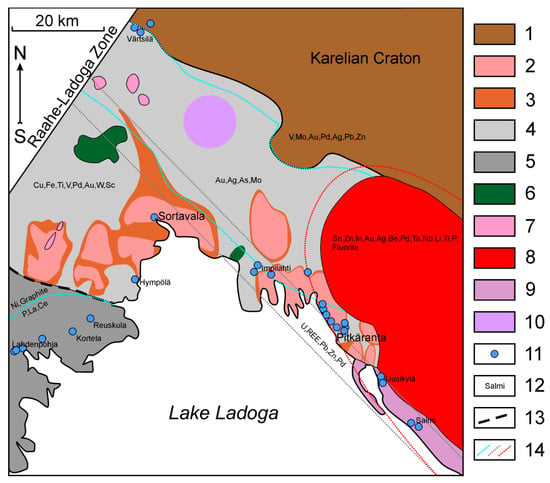
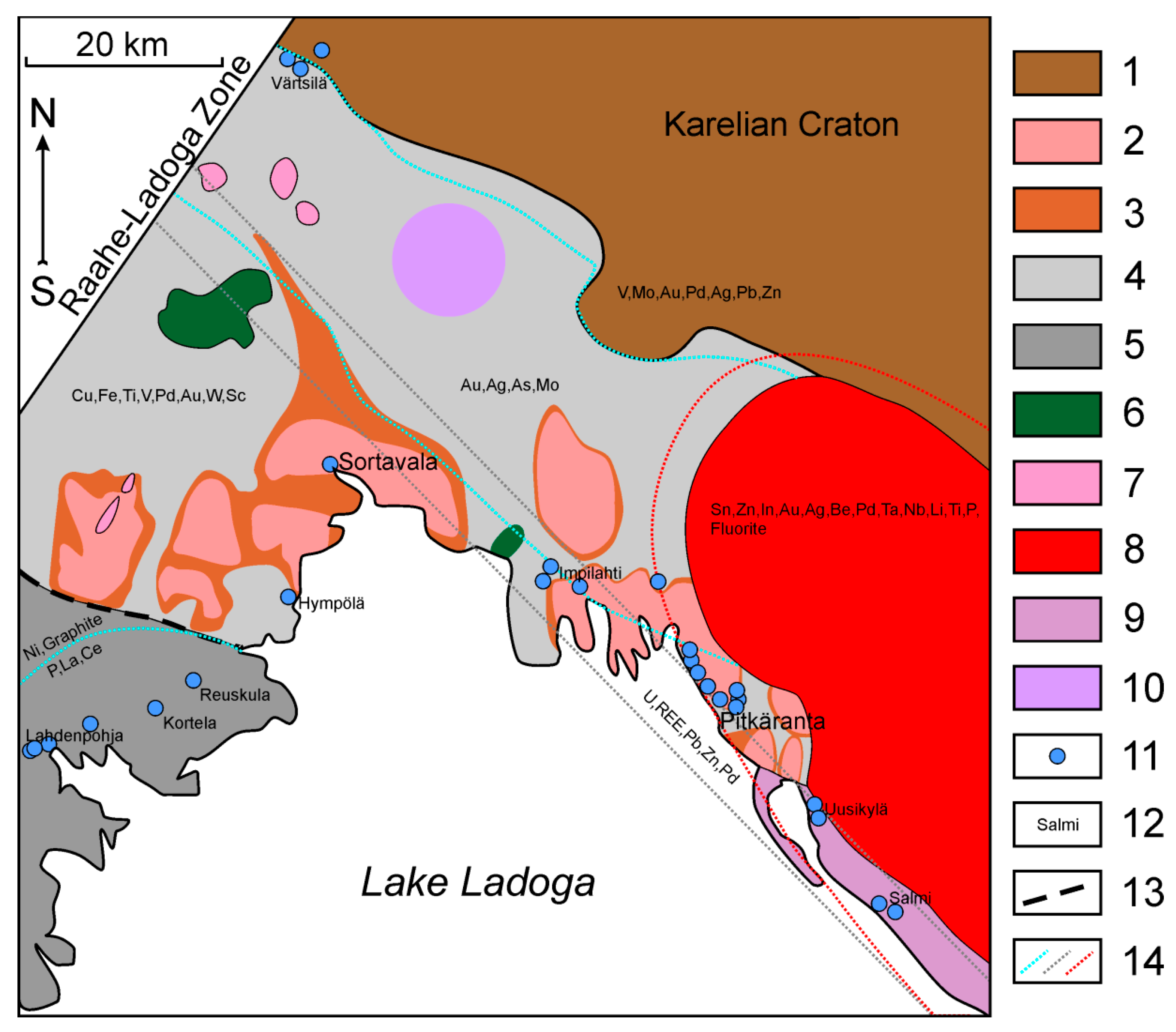
The study area contains Quaternary deposits and Precambrian rocks. The Quaternary deposits are mainly associated with glacial activity and comprise morainic, lacustrine, and fluvioglacial sediments. Recent sediments comprise peat, sapropel, and alluvial deposits formed by the reworking of glacial material [21]. The Precambrian rocks comprise four age-defined complexes: AR—rocks of the Karelian Craton; AR2–PR1, consisting predominantly of gneissic granites forming domes; metasedimentary rocks of Ludikovian strata—Sortavala group and the Kalevian strata—Ladoga suite [22]; Volcanosedimentary rocks of the Salmi Formation (1499 Ma) [23], represented mainly by mafic volcanic rocks and their tuffs (Kalevian and Ludikovian—regional stratigraphic units within the Fennoscandian Shield: Ludikovian—from the late Rhyacian to the early Orosirian; Kalevian—Orosirian) (Figure 1).
Figure 1.
Scheme of the geological, metamorphic, geodynamic, and metallogenic zoning of the Northern Ladoga region, with simplifications [24]. 1—Rocks of the Karelian Craton, 2—Remobilized basement (domes) during the Svecofennian orogeny, mainly gneiss-granite, AR2–PR1 (only the largest are shown). 3–4—Northern domain, greenschist- to amphibolite-facies metamorphism (Raahe-Ladoga zone): 3—Sortavala group. 4—Ladoga suite. 5—Southern domain, rocks similar to the Ladoga series [25] metamorphosed under granulite-facies conditions. 6—Post-orogenic ultramafic-mafic intrusions (Kaalamo and Vyalimäki). 7—Post-orogenic acidic intrusions. 8—Salmi anorthosite-rapakivi granite complex, Mesoproterozoic. 9—Volcanogenic-sedimentary rocks of the Salmi formation, Mesoproterozoic. 10—Yanisjärvi astrobleme, Upper Proterozoic. 11—Water sampling sites. 12—Names of settlements. 13—Tectonic contact between rocks of the northern and southern domains. 14—Contours of metallogenic areas; the list of elements is shown on the map.
During the Svecofennian orogeny (1960–1750 Ma), this territory underwent regional metamorphism [26], with the rocks being divided into northern and southern domains [25]. The northern domain underwent greenschist- to amphibolite-facies metamorphism, whereas the southern domain contains granulite-facies rocks analogous to the Ladoga suite [25]. The boundary between the Karelian Craton and the Svecofennian orogen is known as the Raahe–Ladoga zone. Within the study area, this zone corresponds to the northern domain.
The Ladoga region contains numerous igneous complexes with diverse compositions and tectonomagmatic settings. The largest include the Salmi anorthosite–rapakivi granite complex in the east and the Kaalamo and Vyalimyaki ultramafic to intermediate complexes in the north.
Economically significant ore mineralization is associated with these igneous complexes. Part of the mineralization is also linked to orogenic processes, concentrated in structurally weakened zones that permit fluid flow. The study area also contains a northwest-trending zone of uranium occurrences extending from the Karku unconformity-type U deposit near Salmi. One of the main geological features of this territory is the presence of carbonate horizons in the Sortavala series. These carbonate rocks (marble) acted as geochemical traps for hydrothermal fluids during the period from the Svecofennian orogeny [27] to the hydrothermal activity associated with magmatic intrusions [28]. These processes produced skarns and ore bodies with different metal associations. Thus, in the northwestern Ladoga region, scheelite-bearing ore occurrences are present at Latvasurjä, while in the east, Sn-Fe rare-metal polymetallic deposits are found (the Pitkäranta group of deposits).
As a result of glacial activity, secondary dispersion halos were removed, and the bedrock was exposed. The surface of the bedrock outcrops is highly dissected. This resulted in an extremely uneven accumulation of Quaternary deposits, which vary in thickness and extent, reaching tens of meters in the immediate vicinity of bedrock outcrops. The thin Quaternary cover suggests that interaction between groundwater and sulfide-bearing basement rocks occurs even at shallow depths.
3. Materials and Methods
3.1. Sampling Protocols and Field Measurements
This study is based on data from 30 water samples collected from springs in the Northern Ladoga region (Figure 1) in August–September 2023. Descriptions of the spring collection structures and photographs were compiled during fieldwork. The pH, Eh, electrical conductivity, temperature, and dissolved oxygen concentration were determined at the sampling point (PH-200, ORP-200, COM-100 (HM Digital, Signal Hill, CA, USA); WaterLiner WDO-64, Moscow, Russia). Prior to sampling, all field instrumentation was calibrated according to standard protocols: the pH meter was calibrated using buffer solutions (4.01, 6.86, and 9.18); the ORP meter with a +285 mV standard; the salinity meter with a 342 ppm solution; and the dissolved oxygen device via water-saturated air calibration.
Water samples were filtered using a syringe through disposable nylon membrane filters with a pore size of 0.45 µm and collected in 15 mL Falcon tubes for determination of elemental and ionic composition. Additionally, water samples were collected in 300 mL bottles, rinsed three times with the sampled water, for the determination of bicarbonate and dissolved organic carbon (DOC).
3.2. Laboratory Analyses
The main ions in natural waters were determined by ion chromatography using an ICS-6000-AnCat-AS system (Thermo Fisher Scientific, Waltham, MA, USA). A combined six-cation standard (Dionex 046070) and a seven-anion standard (Dionex 056933) were used to calibrate the instrument. The instrument is highly precise and determines concentrations at the ppb level. Elemental analysis was performed using inductively coupled plasma atomic emission spectrometry (ICP-AES) on an iCAP 6500 DUO instrument (Thermo Scientific, Waltham, MA, USA) and inductively coupled plasma mass spectrometry (ICP-MS) using X-series 7 instruments (Thermo Scientific). Sample preparation and measurements were carried out in accordance with the methodology given in [29]. To verify the accuracy of the sample analysis, a “Trace Metals in Drinking Water” standard reference material produced by High-Purity Standards (Charleston, SC, USA) was used. Bicarbonate concentrations were determined by titration. Determinations were performed in triplicate, followed by calculation of the mean value. Dissolved organic carbon concentrations were determined using an Almaz NC instrument. The instrument was calibrated using imidazole. Analytical quality was assessed using the ionic charge balance and by comparing the sum of measured ion concentrations with the total dissolved solids estimated from electrical conductivity.
3.3. Assessment of the Migration Intensity of Chemical Elements
To assess the aqueous migration intensity of chemical elements in spring waters, the approach described by A.I. Perelman [30] was used:
where mx is the concentration of element x in water (mg/L); a is the total dissolved solids concentration (mg/L); nx is the content of element x in the rock (%). Kx characterizes the element migration intensity in actively circulating waters and the degree of accumulation in waters with slow exchange or stagnant conditions. Clarke values for chemical elements in the upper part of the continental crust [31] were used as nx. Using various water types as case studies [32], Kx calculations showed that this approach allows for the comparative assessment of migration intensity for both major and trace elements. According to [30], the very strongly mobile group includes elements with Kx greater than 10. The Kx values in the ranges of 1–10 and 0.1–1 correspond to strong and moderate migration intensity. Values of Kx less than 0.1 indicate weak and very weak migration activity.
Kx = (mx × 100)/(a × nx),
3.4. Calculation of Chemical Element Speciation
Chemical element speciation was calculated in Visual MINTEQ (ver. 4.0) with the NICA-Donnan model. This model integrates the Non-Ideal Competitive Adsorption (NICA) and Donnan electrostatic submodels. The NICA formalism describes the chemical binding of ions to functional groups within organic matter, accounting for both the competition between different ions for binding sites and the inherent heterogeneity of these sites. Concurrently, the Donnan model conceptualizes organic matter as a gel-like phase. The negative charge of humic molecules induces an electrostatic attraction for counterions, which accumulate in the vicinity of the molecules, defining the Donnan phase. The distribution of ions between the bulk solution and this phase is governed by the Donnan equilibrium. Redox reactions were taken into account for redox-sensitive elements. Organic matter is represented in the model by the analytically determined concentration of dissolved organic carbon. A value of 0.67—standard for shallow waters in temperate climate zones—was used to calculate its active fraction. The NICA-Donnan approach and its limitations are described in detail in [33,34]. This model has been successfully applied to various geochemical problems, as evidenced by numerous publications [35,36,37]. Building on our positive experience in assessing heavy metal speciation in the waters of flooded mines [38] and natural water bodies in Karelia, we continue to apply this approach in the present study.
3.5. Positive Matrix Factorization
Positive Matrix Factorization (PMF) is a multivariate statistical technique employed to quantify the contribution of distinct sources or processes that influence observed values within a dataset. In environmental science, PMF is most frequently applied to air quality assessment and investigations of natural water chemistry. In this study, we used PMF to identify the sources of chemical elements, with a particular focus on potentially toxic ones, in springs used for potable water supply. The applicability of the method to these objectives has been demonstrated in [39,40,41]. The principles of PMF are described in [42,43]. This study employs the software product PMF 5.0, developed by the U.S. Environmental Protection Agency. Although models of this type ideally require 50–100 samples, our analysis was performed on a dataset of 30 samples. Because the rank-completeness condition is satisfied, the dataset was considered sufficient for the analysis. The uncertainty matrix was constructed using conservative estimates. The following coefficients were adopted for calculating relative uncertainty: 0.1 for major elements; 0.2 for Fe, Al, Mn, Cr, Ni, Co, Zn, Pb, and Y, with the coefficient increased to 0.5 for their trace concentrations; and 0.5 for Cd, Cs, Th, and U.
4. Results
4.1. Chemical Composition and Parameters of Spring Waters
The temperature of the spring waters ranged from 7 to 14 °C, with a mean of 10 °C. Regarding redox conditions, the majority of the studied waters were oxidizing, although some exhibited transitional characteristics. These transitional conditions were particularly evident in several springs in the Pitkäranta area. In our view, such transitional conditions are commonly associated with springs fed by deeper groundwater or those subject to stagnant hydrogeological regimes. pH values varied from slightly acidic to alkaline (Table 1). The highest pH values occurred in springs near Impilahti and Salmi and in the northwestern Ladoga region. Slightly acidic to neutral conditions were more typical of springs in and around Pitkäranta. Dissolved oxygen concentrations ranged from 1.4 to 10.5 mg/L. Water from 11 sampled springs met the WHO drinking-water recommendations [44] for turbidity. In other springs, turbidity exceeded 1 FNU, reaching 5 FNU in some samples. The salinity of spring waters was very low. In most samples, salinity did not exceed 100 mg/L. The prevailing chemical facies were HCO3 Ca and HCO3 Ca-Mg. Other hydrochemical facies were observed less frequently, including HCO3-SO4-Ca, HCO3-SO4-Ca-Mg, and HCO3-Ca-Na. All other types were represented by single samples.
Table 1.
Chemical composition and physicochemical parameters of spring waters in the Northern Ladoga region.
While spring waters in the Northern Ladoga region generally exhibit low trace element concentrations, previous research [17] has identified a notable exception. Specifically, springs located in the Pitkäranta area display significantly higher concentrations of elements such as Zn, Mn, Rb, Y, Cd, Mo, U, and Cu. This anomaly is likely attributable to the sulfide and fluorite mineralization typical of the Pitkäranta area [45]. A more detailed discussion of elemental accumulation intensity is based on an analysis of the calculated migration coefficients.
4.2. Migration Intensity of Chemical Elements
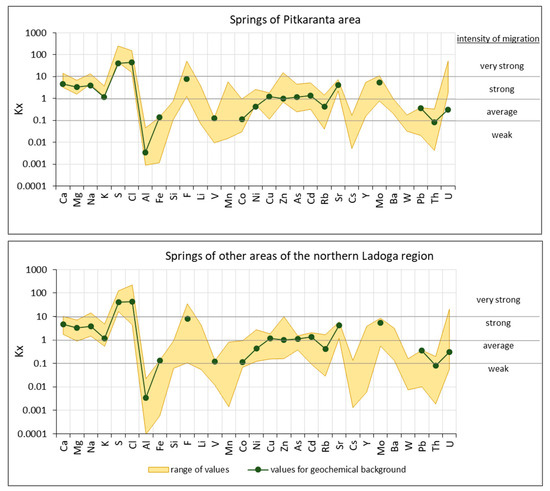
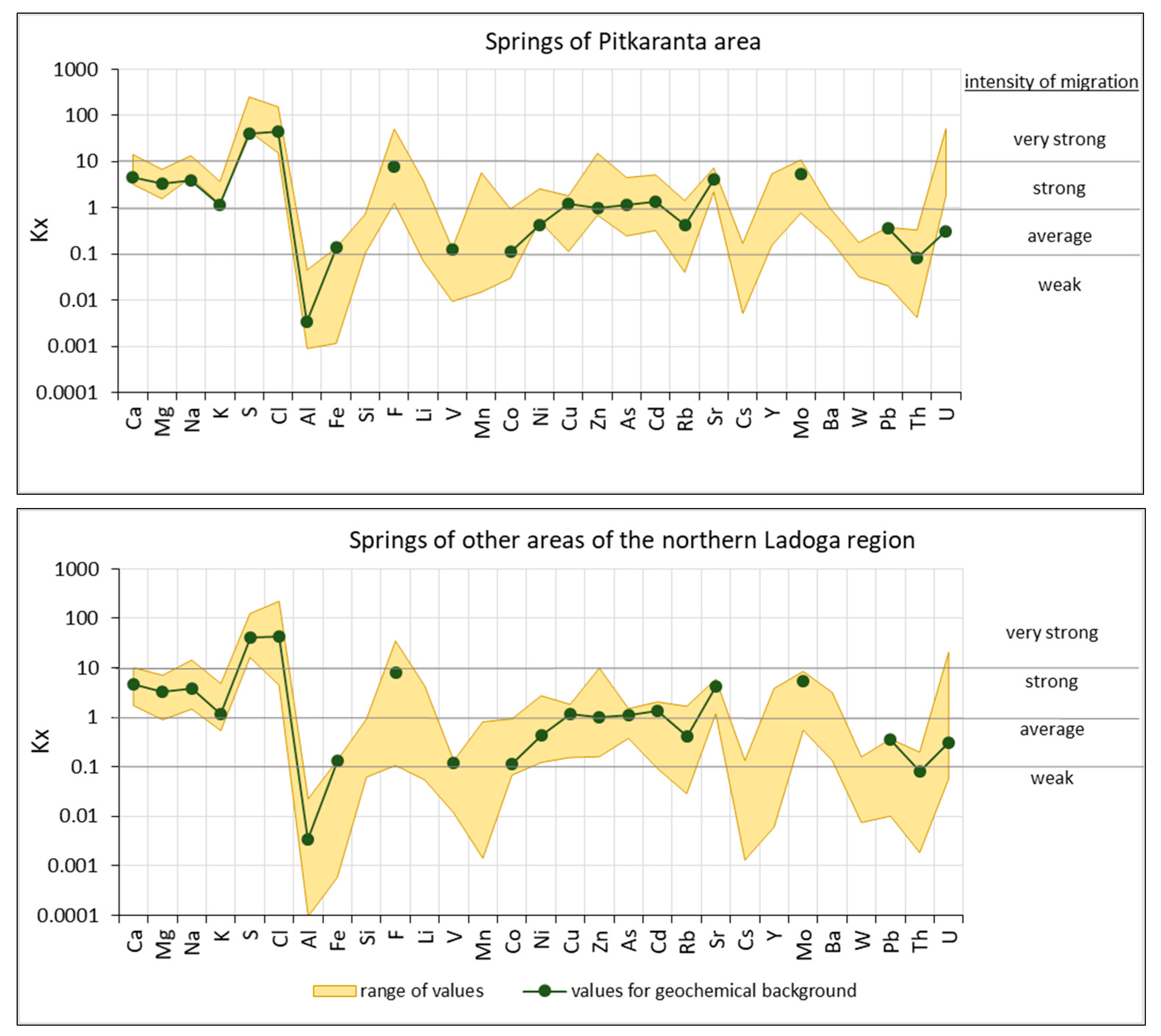
As previous studies [17] have demonstrated variations in the trace element profiles of spring waters across different areas of the Northern Ladoga region, the results of the migration coefficient calculations are presented graphically (Figure 2). For clarity of comparison, the data were divided into two distinct sets: one comprising springs from the Pitkäranta area, and the other comprising springs from the remaining districts.
Figure 2.
Aqueous migration coefficients of chemical elements in springs of the Northern Ladoga region.
Although the springs of the Pitkäranta area exhibited higher absolute concentrations of certain chemical elements, the distribution profiles of the migration coefficients were broadly similar. In this case, normalization to total dissolved solids eliminated the observed differences. However, the Pitkäranta area is characterized by elevated water migration coefficients for S, F, Zn, As, U, and Mn. In general, this association of elements is characteristic of the geochemistry of the rocks in the Pitkäranta mining area, which are presumably the primary source of these elements in spring water.
4.3. Chemical Element Speciation in Spring Water
This study modeled a system containing the following elements: O, H, C, S, Cl, Ca, Mg, Na, K, Fe, Mn, Al, Co, Ni, Cu, Zn, Pb, Cd, Cs, Sr, Y, Th, U. This selection was guided by previous research on regional waters [8,9,10,11,38] and considerations of their potential health impact. Based on the speciation modeling results, the dataset was analyzed and systematized. The elements were classified into several groups (Table 2), with the classification primarily based on the dominant bonding type. Furthermore, geochemical characteristics associated with speciation were identified for each group.
Table 2.
Summary of chemical element speciation in spring waters of the Northern Ladoga region.
The first group comprises the alkali metals Na, K, and Cs. These elements typically exist as free ions in various types of natural waters [46] and are characterized by a low affinity for organic matter. In the waters studied, their behavior was consistent with this pattern, and they were found predominantly as free ions (Table 2).
The second group includes the alkaline-earth metals (Ca, Mg, Sr) and the transition metals (Mn, Zn, Y). These elements share a predominance of inorganic species, accounting for over 90% of their total concentration. The fraction of organic forms varied in proportion to the DOC content. Notably, Ca, Mg, and Sr exhibited an identical speciation pattern: approximately 95% was present as free ions, with up to 2% as sulfate complexes and another ~2% bound in the Donnan phase. In contrast, the transition metals showed significant speciation differences. Yttrium was predominantly present as a carbonate complex (85%), whereas Mn and Zn had lower carbonate fractions (12% and 5%, respectively). Additionally, a significant proportion of hydroxyl complexes was calculated for Zn. These elements also displayed a slightly higher degree of association with organic matter; for example, 4% of Y was bound in the Donnan phase, and ~6% of Mn was complexed via carboxyl groups.
The third group includes Cu, Pb, Th, and U. In the studied waters, these elements were found at very low concentrations and were predominantly associated with organic ligands (Table 2). The binding was dominated by phenolic groups, which represent the strongest complexation type. In contrast, the contribution of carboxyl groups was negligible for U and Th, but reached 10% and 4% for Cu and Pb, respectively.
In the studied natural waters, Fe occurred in two oxidation states, depending on redox conditions. Although Fe(III) shares geochemical characteristics with elements in the fifth group, it is treated as a separate entity in this analysis. Iron exhibited a strong affinity for organic matter: 29% was bound via phenolic groups and 45% via carboxyl groups. Notably, samples with the highest DOC levels consistently showed a greater degree of Fe complexation. This high affinity of Fe for organic ligands is a well-documented phenomenon in natural waters across diverse landscapes [47,48,49,50]. Due to the similar geochemical behavior of Al in aqueous solutions and its analogous interaction with biota to that of Fe(III) [51,52], both elements are classified within the same group. In the studied waters, dissolved Al was partitioned equally between organic and inorganic forms: approximately 50% was complexed with organic matter via phenolic groups, while the remaining 50% was present as hydroxyl complexes. In addition, higher DOC concentrations were associated with increased Al binding to organic ligands.
The fifth group includes Ni, Co, Cd, and Fe(II)—elements generally classified as heavy metals with potential toxicity. However, the rationale for their grouping is primarily chemical rather than toxicological. According to WHO guidelines [44], Fe is not considered a priority toxicant in drinking water at hygienically significant concentrations; its main impact is on organoleptic properties (color, turbidity, taste). Consequently, no specific health-based limit has been established for Fe. Iron, Co, and Ni constitute the iron triad, a group of elements with remarkably similar properties. Cadmium, although not a formal member of this triad, is grouped with them due to its charge and similar ionic radius, which result in analogous geochemical behavior. On average, 40–60% of Ni, Cd, and Co were present as organic complexes involving various types of bonds, whereas for Fe, this proportion exceeded 90%. The remaining fraction of these metals was distributed among inorganic species, including free ions, as well as hydroxyl, carbonate, and sulfate complexes.
4.4. Sources of Potentially Toxic Elements in Spring Waters
An optimal factor solution was determined through iterative testing. The Q/Qexp statistic stabilized when the model reached four factors, showing no significant improvement with additional factors. With a Q/Qexp value of 1.5—an acceptable indicator of model adequacy—and residuals showing no anomalies across samples or chemical variables, this four-factor model was selected. Its physical and chemical interpretability further supports this decision. Since all samples were collected during a single sampling campaign, this interpretation cannot assess seasonal variations or temporal dynamics. The mathematical robustness of the PMF solution was confirmed by both error estimation methods. Bootstrap analysis was performed with 200 iterations and a mapping threshold of 0.8. Furthermore, displacement analysis revealed no rotational ambiguity: the algorithm detected no factor swaps (Swaps = 0), and the dQ% metric remained negligible (−0.028%), indicating the absence of rotational ambiguity and high mathematical stability of the solution.
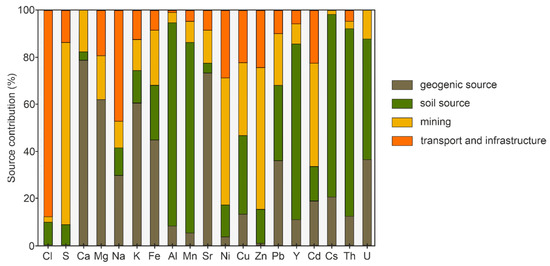
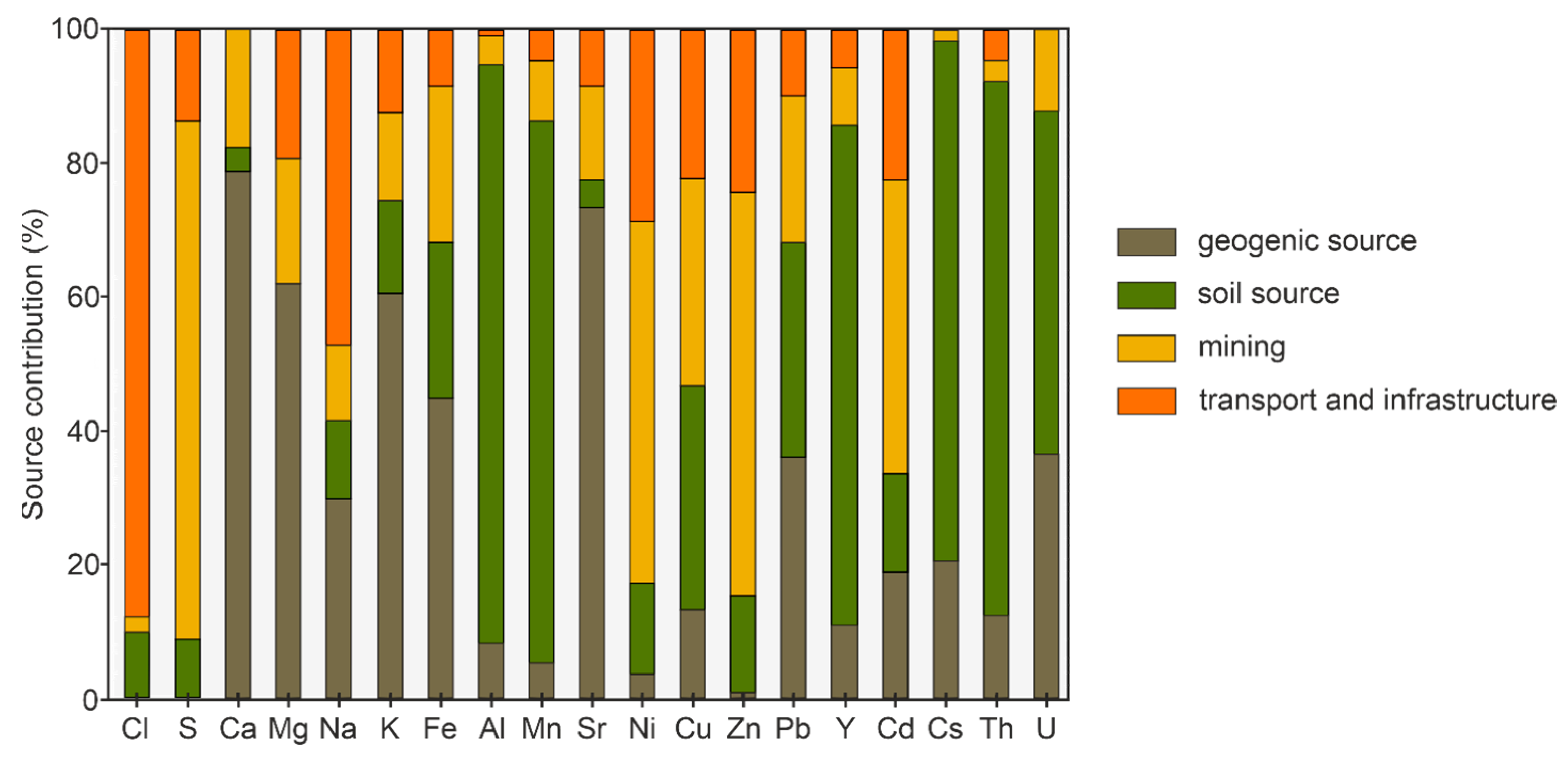
The first factor was identified as geogenic (Figure 3), based on its high contributions to major cations such as Ca (~80%), Mg and K (both approximately 60%), and to a lesser extent Na (~30%). This factor also accounted for approximately 70% of Sr, 10–20% of Al, Mn, Ni, Cu, Y, Cd, Cs, and Th, and more than 30% of U and Pb. The geogenic signature of these springs reflects water–rock interaction processes, where the contribution of trace elements—including PTEs—is attributed to disseminated sulfide and fluorite mineralization within the host rocks. This signature was most pronounced in springs within Pitkäranta, where the layout of the main streets reflects the geometry of the ore body mined during the 19th and early 20th centuries.
Figure 3.
PMF-derived source contributions to chemical element concentrations in springs of the Northern Ladoga region.
The soil-related PMF factor was identified by the presence of Fe, Al and Mn (Figure 3). This factor represents the mobilization of elements from soils, often associated with complexation by organic matter. According to PMF results, this factor exhibits dominant loadings for Mn, Al, Cs, Th, U, and Y (50–80%). For Cu, Pb, Cd, Ni, and Zn, contributions are moderate (15–30%). This conclusion is supported by speciation modeling results (Table 2), which indicate a strong affinity of most of these metals for organic matter. However, the inclusion of Cs in this group is anomalous, as it typically exists in natural waters as a free ion due to its low affinity for organic ligands.
Factor 3 is characterized by high loadings of S, Zn, Ni, and Cd, with moderate contributions from Fe, Cu, and Pb (Figure 3). This signature points to the oxidative dissolution of sulfide minerals—a process significantly intensified by mining activities such as rock excavation, crushing, and waste dump storage. This interpretation aligns with previous studies [17] consistently reporting elevated concentrations of PTEs in the Pitkäranta district. This area hosts numerous historic mines [38], associated waste rock dumps [8], and ore processing relics, as well as building stone quarrying operations [10].
The fourth factor was identified based on Cl and Na levels and less significant concentrations of heavy metals (Figure 3). Given the region’s northern location and cold winters, the presence of Cl and Na at elevated levels in shallow aquifers strongly points to runoff from road maintenance activities involving de-icing agents. Significantly, a large number of the sampled springs are situated near roadways. Furthermore, this profile is enriched in heavy metals commonly associated with transport and road infrastructure: Zn (tire wear), Cu (brake abrasion), Cd and Ni (fuel combustion and engine wear), Pb (legacy contaminant from past leaded gasoline usage).
5. Discussion
The results reveal spatial heterogeneity in the distribution of PTEs in spring water. For example, elevated concentrations of transport-associated elements were observed in spring waters near roads and within populated areas. Furthermore, springs within towns are also affected by urban infrastructure. In contrast, elements derived from soil sources exhibit a more uniform regional distribution, largely governed by DOC content. This relationship was supported by speciation calculations for the studied waters (Table 2). Notably, sampling density was highest in the Pitkäranta area (Figure 1), where population density is relatively high and spring water is extensively used for domestic supply, including drinking. This area also hosts diverse mineral resources and consequently experiences significant anthropogenic pressure from mining operations.
The Pitkäranta area features extensive bedrock exposure hosting skarn-type tin–iron ores. Mining activities led to the establishment of Pitkäranta, whose main streets follow the strike of the ore body. Historically, overburden and processing tailings were disposed of without regulation and reused in civil engineering. The technogenic soils formed in this manner contained significant amounts of sulfide and arsenide mineralization, along with a wide range of trace elements (Cd, As, Cu, Zn, Pb, etc.). The situation described here exemplifies the widespread challenge of managing historical waste piles and mining and industrial heritage in general. Extensive experience has been gained in monitoring historical waste piles, including the assessment of their environmental impact [8,53,54,55]. Overall, these assessments indicate that the stockpiled waste continues to have a negative impact—primarily through the contamination of regional natural waters with PTEs.
Large-scale gneisso-granite and granite quarrying has intensified the environmental pressure on regional water systems already affected by historical mining [10]. Located within the Salmi anorthosite–rapakivi complex, these operations expose sulfide-bearing host rocks [45]. Stone extraction, involving blasting and rock crushing, increases the reactive surface area of rock particles, thereby intensifying oxidative dissolution of sulfides. This process leads to the leaching and subsequent migration of chalcophile elements into local waters, including those classified as potentially toxic. In addition to chalcophile elements, previous studies [10] of quarry waters have shown elevated concentrations of Mn, Mo, and V. The Pitkäranta area, which experiences the greatest anthropogenic pressure, also has the region’s highest population density and a substantial concentration of employment. Drinking-water demand is therefore higher than in sparsely populated areas.
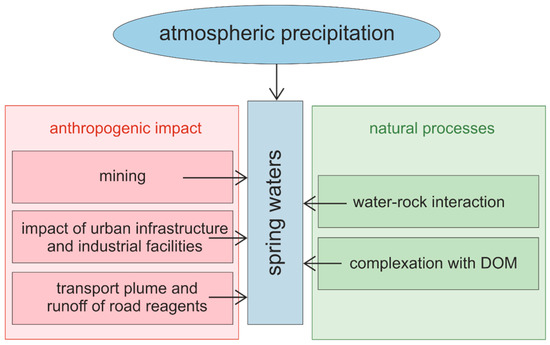
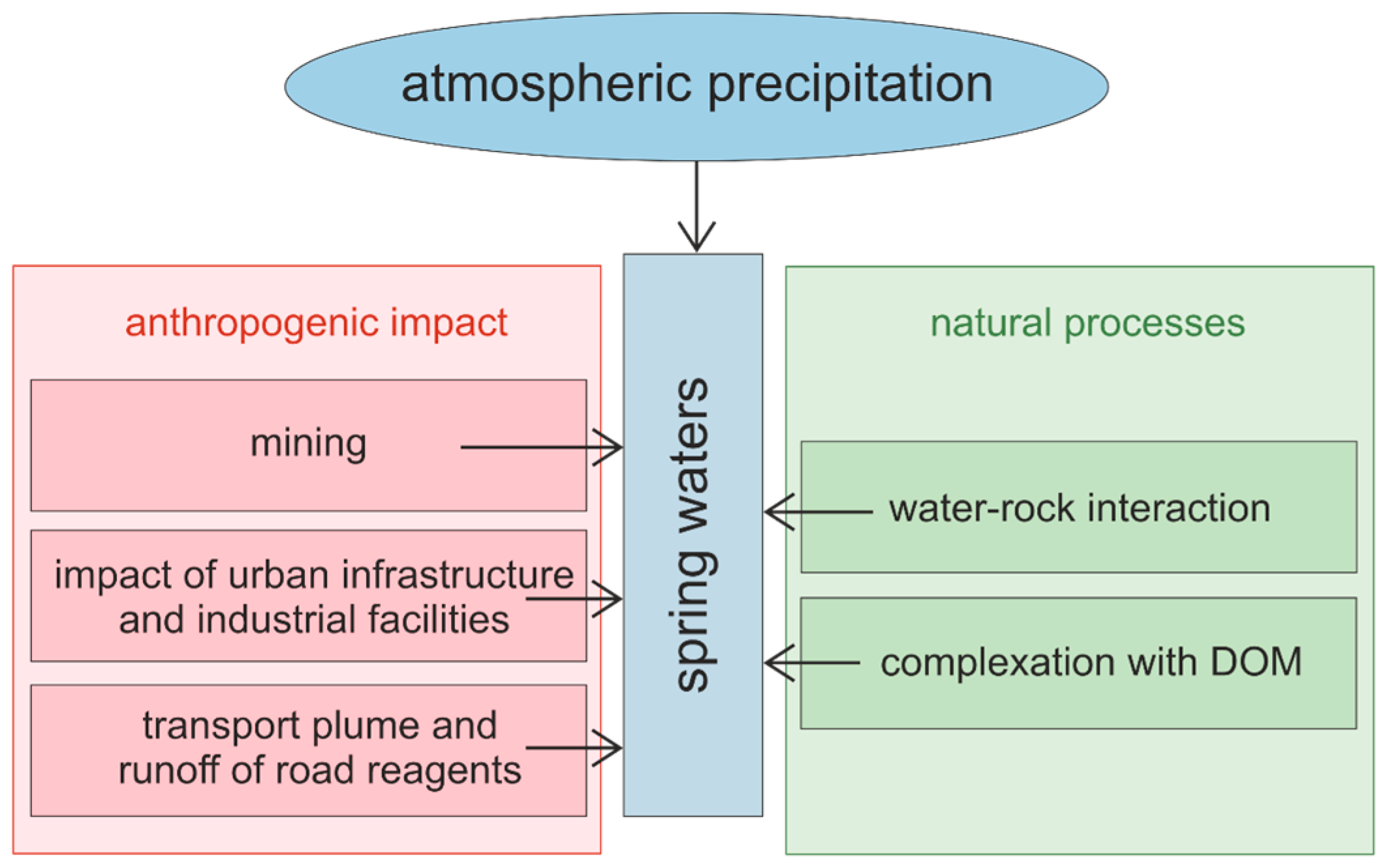
Previous isotopic studies [17] indicate that these springs are of meteoric origin, recharged predominantly during summer months. The springs are characterized by rapid water circulation and short filtration pathways, owing to the thin Quaternary cover. Furthermore, the waters exhibit very low salinity, with bicarbonate ions and calcium ions predominating among the anions and cations, respectively. These characteristics are typical of groundwater within the active water-exchange zone under similar climatic conditions [56]. PMF modeling (Figure 3) demonstrates that the hydrochemistry of regional springs is controlled by a combination of natural and anthropogenic factors (Figure 4).
Figure 4.
Conceptual model of spring water geochemistry in the Northern Ladoga region.
Water–rock interaction is fundamental to the evolution of the geochemistry of natural waters in diverse geological settings [57,58,59,60]. In our case, according to the results of PMF modeling, the major elements (Ca, Mg, and K) primarily reflect water–rock interaction. Furthermore, this process leaves a specific imprint on the broad range of PTE signatures characteristic of the region’s disseminated sulfide and fluorite mineralization. Mining was identified as the primary source of heavy metals associated with sulfide mineralization. This process represents water–rock interaction within anthropogenically disturbed environments, where the “rock” consists of overburden and tailings in waste dumps. Consequently, PTE concentrations in these anthropogenic materials significantly exceed background levels. PTEs enter natural waters via oxidative dissolution of sulfide minerals during interaction with waste rock. In its classic form, this process leads to acid mine drainage, which is highly damaging to the environment [61,62]. Carbonate dissolution buffers the system, resulting in neutral mine drainage with a circumneutral pH. Although neutral drainage is less damaging than acidic drainage, it still leads to the release of potentially toxic elements into the surrounding waters [63]. Mine waters in the Pitkäranta area are characterized by circumneutral pH levels and elevated concentrations of chalcophile elements [9]. Since ore extraction took place prior to the introduction of regulations governing mining waste management and mine closure, no preventive environmental protection measures were implemented. Consequently, a comprehensive environmental impact assessment is now required, followed by the selection of remediation strategies for the sites. Primary attention should be directed toward sites with a direct hydrological impact on regional water bodies, such as Krasnaya Glinka [8,64].
Hydrogeological conditions characterized by short flow paths and high filtration velocities limit the natural purification of groundwater. The regional climate also necessitates the use of road de-icing agents. Isotopic investigations [17] indicate that summer recharge predominates in the springs, while the winter component accounts for approximately 25%; consequently, the sampled spring water may contain residues from de-icing agents. In this scenario, during the spring period—characterized by intensive recharge from snowmelt—chloride and sodium concentrations would exceed current levels, potentially adversely affecting water quality. Consequently, comprehensive mitigation measures are required, including the use of abrasive or biodegradable alternatives, monitoring of application rates, mechanical snow removal, and planting of macrophytes along runoff pathways to water bodies. Overall, the problem of freshwater salinization is acute in many regions where winter de-icing agents are used [65].
Complexation between chemical elements and DOM is an important natural process. Waters of the Northern Ladoga region, typical of oligotrophic boreal regions, like those of other northern territories [66,67], are rich in DOM, which acts as an active complexing agent for heavy metals and other PTEs [68]. Modeling based on the NICA-Donnan approach (Table 2) indicates that Fe, Ni, Cd, Cu, Pb, U, Th, Co, and Al exhibit the strongest affinity for dissolved organic matter. Among these, complexes of Cu, Pb, U, and Th exhibit the highest stability because these elements bind primarily to dissolved organic matter via phenolic sites—functional groups less susceptible to degradation under fluctuating environmental conditions. Complexation by dissolved organic matter inhibits the precipitation of PTE-bearing secondary phases, thereby promoting their accumulation in natural waters. At the same time, this process reduces the bioavailability and toxicity of PTEs to aquatic biota [69,70].
In our future research, we plan to synthesize geochemical data on the natural waters of the Northern Ladoga region, which will enable a more detailed identification of the sources and migration pathways of PTEs in the environment.
6. Conclusions
This study summarizes the results of a synthesis of hydrochemical data on springs in the Northern Ladoga region and the calculation of chemical element speciation—with a focus on PTEs—using the NICA-Donnan model, alongside an assessment of migration intensity relative to background values. Additionally, PMF modeling was conducted to evaluate the contribution of pollutant sources. This investigation provides a new dataset characterizing the hydrochemistry of regional springs and elucidates the underlying geochemical patterns.
The main summary regarding hydrogeochemistry is as follows. These waters exhibit low salinity (below 100 mg/L in the majority of samples) with predominantly Ca–HCO3 facies, often accompanied by elevated SO42− contents; pH ranges from slightly acidic to alkaline (from 6.6 to 10.8). Springs in the Pitkäranta area show significantly higher concentrations of Zn, Mn, Rb, Y, Cd, Mo, U, and Cu. Despite this enrichment, water migration coefficients remain consistent across most districts. However, S, F, Zn, As, U, and Mn exhibit notably elevated mobility in the Pitkäranta area. At the same time, a wide range of PTEs (Ni, Cu, Zn, As, Sb, Cr, Mo, U) are classified as strongly mobile. Furthermore, exceedances of WHO guidelines were identified for turbidity, Mn, Al, and F in certain samples.
PMF modeling identified four main sources of chemical elements in the regional spring waters. A geogenic source accounts for the largest contribution to major cation concentrations and, to a lesser extent, to concentrations of various trace elements, thereby reflecting water–rock interaction under natural conditions. Meanwhile, mining and the associated industrial heritage constitute the principal source of S, Zn, Ni, and Cd, with secondary contributions from Cu, Fe, and other heavy metals. Soil was identified as the main source of elements with a high affinity for organic matter. Transport and road infrastructure constitute a significant source of Cl and Na, also influencing specific PTE concentrations. Based on the identified pollution sources, appropriate mitigation measures should be implemented, as outlined in the Discussion section.
NICA-Donnan speciation modeling indicates that Fe, Ni, Cd, Cu, Pb, U, Th, Co, and Al exhibit the highest affinity for dissolved organic matter. Notably, Cu, Pb, U, and Th bind primarily via phenolic functional groups that are more stable under changing environmental conditions.
Author Contributions
Conceptualization, E.S.; methodology, E.S.; validation, A.K.; formal analysis, E.S. and A.A.; investigation, E.S., A.A. and A.K.; writing—original draft preparation, E.S. and A.K.; writing—review and editing, A.K. and E.S.; visualization, E.S., A.A. and A.K. All authors have read and agreed to the published version of the manuscript.
Funding
Hydrogeochemical studies were conducted under the research program of the Geological Institute of the Russian Academy of Sciences (FMMG-2022-0001). The geological description and the metallogenic zoning map were prepared within the framework of the state assignment of the Institute of Geology, Karelian Research Centre, Russian Academy of Sciences, Petrozavodsk, Russia (FMEN-2023-0005).
Data Availability Statement
All data are contained within the article.
Acknowledgments
The authors thank Ilya Bugev for his assistance with the fieldwork. The authors are grateful to the scientific editor and the reviewers for their constructive comments.
Conflicts of Interest
The authors declare no conflicts of interest.
References
- Levin, R.; Villanueva, C.M.; Beene, D.; Cradock, A.L.; Donat-Vargas, C.; Lewis, J.; Martinez-Morata, I.; Minovi, D.; Nigra, A.E.; Olson, E.D.; et al. US Drinking Water Quality: Exposure Risk Profiles for Seven Legacy and Emerging Contaminants. J. Expo. Sci. Environ. Epidemiol. 2023, 34, 3–22. [Google Scholar] [CrossRef] [Scilit] [PubMed]
- Bhat, M.A.; Janaszek, A. Evaluation of Potentially Toxic Elements and Microplastics in the Water Treatment Facility. Environ. Monit. Assess. 2024, 196, 475. [Google Scholar] [CrossRef] [Scilit] [PubMed]
- Fast Facts: 1 In 4 People Globally Still Lack Access to Safe Drinking Water–WHO, UNICEF. Available online: https://www.unicef.org/press-releases/fast-facts-1-4-people-globally-still-lack-access-safe-drinking-water-who-unicef (accessed on 18 September 2026).
- Water.org. Water.Org–Water Charity for Safe Water & Sanitation. Available online: https://water.org/ (accessed on 18 September 2026).
- Shekov, V.A. (Ed.) Mining Road; Karelian Research Centre of the RAS: Petrozavodsk, Russia, 2014; p. 362. (In Russian) [Google Scholar]
- Trüstedt, O. Die Erzlagerstätten von Pitkäranta am Ladoga-See; Frenckellska Tryckeri-Aktiebolaget: Helsingfors, Finland, 1907; pp. 258–276. (In German) [Google Scholar]
- Grendal, G. Pitkäranta Brief Description of Pitkäranta Deposit, Mines, Factories; Typo-Lithography by A.E.; Wieneke: St. Petersburg, Russia, 1896; p. 50. [Google Scholar]
- Konyshev, A.A.; Sidkina, E.S.; Bugaev, I.A. A Study on the Long-Term Exposure of a Tailings Dump, a Product of Processing Sn-Fe-Cu Skarn Ores: Mineralogical Transformations and Impact on Natural Water. Sustainability 2024, 16, 1795. [Google Scholar] [CrossRef] [Scilit]
- Sidkina, E.S.; Soldatova, E.A.; Cherkasova, E.V.; Konyshev, A.A.; Vorobey, S.S.; Mironenko, M.V. Fate of Heavy Metals in the Surface Water-Dump Rock System of the Mine Lupikko I (Karelia): Field Observations and Geochemical Modeling. Water 2022, 14, 3382. [Google Scholar] [CrossRef] [Scilit]
- Konyshev, A.A.; Sidkina, E.S.; Soldatova, E.A.; Dogadkin, D.N.; Gromyak, I.N. Features of chemical element behavior in the water–rock system of the rubble stone quarry in Pitkäranta district (Karelia). Bull. Tomsk. Polytech. Univ. Geo Assets Eng. 2021, 332, 7–19. [Google Scholar] [CrossRef] [Scilit]
- Soldatova, E.A.; Sidkina, E.S.; Alisievich, V.D. Water Quality Assessment of Selected Natural and Artificial Water Bodies and Watercourses of the Pitkyaranta District (Republic of Karelia) by Chemical Indicators. Water Resour. 2025, 52, 1251–1267. [Google Scholar] [CrossRef] [Scilit]
- Shekhar, C.; Khosya, R.; Sharma, A.K.; Thakur, K.; Mahajan, D.; Kumar, R.; Kumar, S.; Sharma, A.K. A Systematic Review on Health Risks of Water Pollutants: Classification, Effects and Innovative Solutions for Conservation. Toxicol. Res. 2024, 14, tfaf014. [Google Scholar] [CrossRef] [Scilit] [PubMed]
- Latif, M.; Nasim, I.; Ahmad, M.; Nawaz, R.; Tahir, A.; Irshad, M.A.; Al-Mutairi, A.A.; Irfan, A.; Al-Hussain, S.A.; Zaki, M.E.A. Human Health Risk Assessment of Drinking Water Using Heavy Metal Pollution Index: A GIS-Based Investigation in Mega City. Appl. Water Sci. 2024, 15, 12. [Google Scholar] [CrossRef] [Scilit]
- Mirzaei, N.; Kalteh, S.; Zamani-Badi, H.; Moradpour, H.; Parmoozeh, Z.; Baziar, M. Estimating Human Health Risks Associated with Heavy Metal Exposure from Bottled Water Using Monte Carlo Simulation. Heliyon 2023, 9, e20647. [Google Scholar] [CrossRef] [Scilit] [PubMed]
- Vogelmann, E.S.; Prevedello, J.; Tiruneh, G.A. Drinking Water Quality Regulations: A Contrast Between Germany and Latin America. Environ. Qual. Manag. 2026, 35, e70278. [Google Scholar] [CrossRef] [Scilit]
- Meliker, J.; Gopang, M. Invited Perspective: Is It Time to Revisit the Allowable Maximum Contaminant Limit for Arsenic in Public Drinking Water? Environ. Health Perspect. 2024, 132, 101303. [Google Scholar] [CrossRef] [Scilit] [PubMed]
- Aidarkozhina, A.S.; Sidkina, E.S.; Ermakov, A.V.; Konyshev, A.A.; Bugaev, I.A. Springs of North Ladoga Region: Isotopic-Geochemical Characteristics of Water and Risk Assessment for the Population. Water Resour. 2025, 52, 977–986. [Google Scholar] [CrossRef] [Scilit]
- Tokarev, I.V.; Borodulina, G.S.; Kayukova, E.P.; Polyakov, V.A.; Varnakova, Y.V.; Zhdanov, S.V.; Markova, T.V. Investigation of groundwater in some Karelian regions by means of isotope and geochemical methods. Vestn. St. Peterbg. Univ. Seriya 7. Geol. I Geogr. 2008, 2, 25–36. (In Russian) [Google Scholar]
- Borodulina, G.S. Springs of Karelia—Natural Objects of Scientific and Social Significance. Russ. J. Appl. Ecol. 2022, 4, 53–65. (In Russian) [Google Scholar]
- Climate. Available online: https://parkladoga.ru:443/company/nature/prirodnyeusloviya/klimat/ (accessed on 18 September 2026).
- Maksimov, A.V.; Bogdanov, Y.B.; Voinova, O.A.; Kossovaya, O.L.; Bakhteev, A.R.; Evdokimova, I.O.; Gorbachevich, N.R.; Nogina, M.Y.; Nikonova, A.S.; Surikov, S.N.; et al. State Geological Map of the Russian Federation. Scale 1:1,000,000 (Third Generation). Baltic Series. Sheet P-(35),36–Petrozavodsk. Explanatory Letter; Kartograficheskaya Fabrika VSEGEI: St. Petersburg, Russia, 2015; p. 400. [Google Scholar]
- Bilibina, T.V. (Ed.) Metallogenic Map of the Eastern Part of the Baltic Shield, Scale 1:500,000; Nedra: Leningrad, Russia, 1980; p. 247. (In Russian) [Google Scholar]
- Rämö, O.T.; Mänttäri, I.; Vaasjoki, M.; Upton, B.G.J.; Sviridenko, L. Age and Significance of Mesoproterozoic CFB Magmatism, Lake Ladoga Region, NW Russia. Geol. Soc. Amer. Abstr. Programs 2001, 33, 6. [Google Scholar]
- Alekseev, I.A.; Amantov, A.V.; Amantova, M.G.; Babichev, A.V.; Baltybaev, S.K.; Bugaenko, I.V.; Voinov, A.S.; Golubtsova, N.S.; Zhamaletdinov, A.A.; Zaitsev, S.V.; et al. Ladoga Proterozoic Structure (Geology, Deep Structure, Metallogeny); KarSC RAS: Petrozavodsk, Russia, 2020; p. 436. (In Russian) [Google Scholar]
- Baltybaev, S.K.; Glebovitskii, V.A.; Levchenkov, O.A.; Berezhnaya, N.G.; Levskii, L.K. Age relationship between potassic and sodic migmatite provinces of Svecofennides, Ladoga region, Baltic Shield. Dokl. Earth Sci. 2002, 383, 292–295. [Google Scholar]
- Hermansson, T.; Stephens, M.B.; Corfu, F.; Andersson, J.; Page, L. Penetrative ductile deformation and amphibolite-facies metamorphism prior to 1851 Ma in the western part of the Svecofennian orogen, Fennoscandian Shield. Precambrian Res. 2007, 153, 29–45. [Google Scholar] [CrossRef] [Scilit]
- Sundblad, K. Lead Isotopic Evidence for the Origin of 1.8-1.4 Ga Ores and Granitoids in the Southeastern Part of the Fennoscandian Shield. Precambrian Res. 1991, 51, 265–281. [Google Scholar] [CrossRef] [Scilit]
- Larin, A.M. Rapakivi Granites and Associated Rocks; Nauka: St. Petersburg, Russia, 2011; p. 402. (In Russian) [Google Scholar]
- Karandashev, V.K.; Leikin, A.Y.; Khvostikov, V.A.; Kutseva, N.K.; Pirogova, S.V. Water Analysis by Inductively Coupled Plasma Mass Spectrometry. Inorg. Mater. 2016, 52, 1391–1404. [Google Scholar] [CrossRef] [Scilit]
- Perelman, A.I. Geochemistry of Natural Waters; Nauka: Moscow, Russia, 1982; p. 154. (In Russian) [Google Scholar]
- Grigoriev, N.A. Chemical Element Distribution in the Upper Continental Crust; UB RAS: Ekaterinburg, Russia, 2009; p. 383. (In Russian) [Google Scholar]
- Lepokurova, O.E.; Domrocheva, E.V. Elemental composition of natural waters and host sediments of the Kuzbass with an assessment of water migration (on the example of the Naryk-Ostashkin area). Bull. Tomsk. Polytech. Univ. Geo Assets Eng. 2021, 332, 200–213. [Google Scholar] [CrossRef] [Scilit]
- Milne, C.J.; Kinniburgh, D.G.; van Riemsdijk, W.H.; Tipping, E. Generic NICA−Donnan Model Parameters for Metal-Ion Binding by Humic Substances. Environ. Sci. Technol. 2003, 37, 958–971. [Google Scholar] [CrossRef] [Scilit] [PubMed]
- Gustafsson, J.P. Visual MINTEQ 3.0 User Guide; KTH, Department of Land and Water Recources: Stockholm, Sweden, 2011; p. 114. [Google Scholar]
- Avendaño, L.; Gledhill, M.; Achterberg, E.P.; Rérolle, V.M.C.; Schlosser, C. Influence of Ocean Acidification on the Organic Complexation of Iron and Copper in Northwest European Shelf Seas; a Combined Observational and Model Study. Front. Mar. Sci. 2016, 3, 58. [Google Scholar] [CrossRef] [Scilit]
- Mosley, L.M.; Daly, R.; Palmer, D.; Yeates, P.; Dallimore, C.; Biswas, T.; Simpson, S.L. Predictive Modelling of pH and Dissolved Metal Concentrations and Speciation Following Mixing of Acid Drainage with River Water. Appl. Geochem. 2015, 59, 1–10. [Google Scholar] [CrossRef] [Scilit]
- Weng, L.; Temminghoff, E.J.M.; Van Riemsdijk, W.H. Aluminum Speciation in Natural Waters: Measurement Using Donnan Membrane Technique and Modeling Using NICA-Donnan. Water Res. 2002, 36, 4215–4226. [Google Scholar] [CrossRef] [Scilit] [PubMed]
- Sidkina, E.S.; Toropov, A.S.; Konyshev, A.A. Speciation of Chemical Elements in the Waters of the Herberz Historical Mine, Karelia, Russia: Thermodynamic Calculations and Fractionation. Geochem. Int. 2024, 62, 1200–1218. [Google Scholar] [CrossRef] [Scilit]
- Aklilu, T.; Sahilu, G.; Ambelu, A.; Mehari, B. Positive Matrix Factorization in Distinguishing Water Pollution Sources in Upper Awash River Basin, Ethiopia. Water Sci. 2025, 39, 123–137. [Google Scholar] [CrossRef] [Scilit]
- Li, H.; Hopke, P.K.; Liu, X.; Du, X.; Li, F. Application of Positive Matrix Factorization to Source Apportionment of Surface Water Quality of the Daliao River Basin, Northeast China. Environ. Monit. Assess. 2015, 187, 80. [Google Scholar] [CrossRef] [Scilit] [PubMed]
- Ustaoğlu, F.; Yüksel, B.; Yazman, M.M.; Jaskuła, J.; Tokatlı, C. Chemometric Investigation of River System Contamination: Source Identification and Risk Assessment Using Positive Matrix Factorization and Monte Carlo Simulation. J. Contam. Hydrol. 2025, 273, 104627. [Google Scholar] [CrossRef] [Scilit] [PubMed]
- Paatero, P.; Tapper, U. Positive Matrix Factorization: A Non-Negative Factor Model with Optimal Utilization of Error Estimates of Data Values. Environmetrics 1994, 5, 111–126. [Google Scholar] [CrossRef] [Scilit]
- Norris, G.; Duvall, R.; Brown, S.; Bai, S. EPA Positive Matrix Factorization (PMF) 5.0 Fundamentals and User Guide; EPA/600/R-14/108; U.S. Environmental Protection Agency: Washington, DC, USA, 2014.
- World Health Organization. Guidelines for Drinking-Water Quality: Fourth Edition Incorporating the First and Second Addenda. Available online: https://www.who.int/publications/i/item/9789240045064 (accessed on 19 September 2026).
- Ivashchenko, V.I.; Golubev, A.I. New aspects of mineralogy and metallogeny of the Pitkyaranta ore district. Trans. Karelian Res. Cent. RAS 2015, 7, 127–148. (In Russian) [Google Scholar] [CrossRef] [Scilit][Green Version]
- Krainov, S.R.; Ryzhenko, B.N.; Shvets, V.M. Groundwater Geochemistry. Theoretical, Applied, and Ecological Aspects; TsentrLitNefteGaz: Moscow, Russia, 2012; p. 672. [Google Scholar]
- Ardiningsih, I.; Seyitmuhammedov, K.; Sander, S.G.; Stirling, C.H.; Reichart, G.-J.; Arrigo, K.R.; Gerringa, L.J.A.; Middag, R. Fe-Binding Organic Ligands in Coastal and Frontal Regions of the Western Antarctic Peninsula. Biogeosciences 2021, 18, 4587–4601. [Google Scholar] [CrossRef] [Scilit]
- Dauvalter, V.A. Geochemistry of Lakes in a Zone Impacted by an Arctic Iron-Producing Enterprise. Geochem. Int. 2020, 58, 933–946. [Google Scholar] [CrossRef] [Scilit]
- Gledhill, M.; Gosnell, K.; Humphreys, M.P.; Delaigue, L.; Helle, N.; Zhu, K.; Lodeiro, P.; Rey-Castro, C.; Achterberg, E.P. Chemical Controls on Iron Distributions across the Subsurface South Pacific Ocean. Nat. Commun. 2026, 17, 3533. [Google Scholar] [CrossRef] [Scilit] [PubMed]
- Otyukova, N.G. Present-Day Dynamics of Iron Concentration in Rybinsk Reservoir Water. Water Resour. 2022, 49, 993–998. [Google Scholar] [CrossRef] [Scilit]
- Perdue, E.M.; Beck, K.C.; Helmut Reuter, J. Organic Complexes of Iron and Aluminium in Natural Waters. Nature 1976, 260, 418–420. [Google Scholar] [CrossRef] [Scilit]
- Zhou, L.; Liu, F.; Liu, Q.; Fortin, C.; Tan, Y.; Huang, L.; Campbell, P.G.C. Aluminum Increases Net Carbon Fixation by Marine Diatoms and Decreases Their Decomposition: Evidence for the Iron–Aluminum Hypothesis. Limnol. Oceanogr. 2021, 66, 2712–2727. [Google Scholar] [CrossRef] [Scilit]
- Meloni, F.; Montegrossi, G.; Cabassi, J.; Bianchi, F.; Nisi, B.; Rappuoli, D.; Vaselli, O. Geochemical Surveys of Ground and Surface Waters in the Abandoned Hg-Mine of Abbadia San Salvatore (Central Italy): A Preparatory Investigation before Remediation. Water 2024, 16, 1210. [Google Scholar] [CrossRef] [Scilit]
- Faz, Á.; Martínez-Carlos, J.; Martínez-Martínez, S.; Zornoza, R.; Gabarrón, M.; Soriano Disla, J.M.; Gómez-López, M.D.; Acosta, J.A. The Transport of Sediments from the Cartagena-La Unión Mining District Leads to the Incorporation of Metal(Loid)S into the Marine Environment. Minerals 2025, 15, 117. [Google Scholar] [CrossRef] [Scilit]
- Mintaș, O.S.; Simeanu, C.; Berchez, O.; Marele, D.C.; Osiceanu, A.G.; Rusu, T. Impact of Red Sludge Dumps, Originating from Industrial Activity, on the Soil and Underground Water. Water 2023, 15, 898. [Google Scholar] [CrossRef] [Scilit]
- Eid, M.H.; Saeed, O.; Szűcs, P.; Ruman, M.; Dąbrowska, D.; Nourani, V. Seasonal Hydrochemical Characteristics of Spring Water in Southern Poland: Integrating Geochemical Modeling, Health Risk Analysis and Mitigation Strategies. Sci. Rep. 2025, 15, 25456. [Google Scholar] [CrossRef] [Scilit] [PubMed]
- Nordstrom, D.K.; Ball, J.W.; Donahoe, R.J.; Whittemore, D. Groundwater Chemistry and Water-Rock Interactions at Stripa. Geochim. Cosmochim. Acta 1989, 53, 1727–1740. [Google Scholar] [CrossRef] [Scilit]
- Lang, Y.-C.; Liu, C.-Q.; Zhao, Z.-Q.; Li, S.-L.; Han, G.-L. Geochemistry of Surface and Ground Water in Guiyang, China: Water/Rock Interaction and Pollution in a Karst Hydrological System. Appl. Geochem. 2006, 21, 887–903. [Google Scholar] [CrossRef] [Scilit]
- Redwan, M.; Abdel Moneim, A.A.; Amra, M.A. Effect of Water–Rock Interaction Processes on the Hydrogeochemistry of Groundwater West of Sohag Area, Egypt. Arab. J. Geosci. 2016, 9, 111. [Google Scholar] [CrossRef] [Scilit]
- Kharitonova, N.A.; Chelnokov, G.A.; Bragin, I.V.; Chudaev, O.V.; Shand, P.; Funikova, V.V. Major and Trace Element Geochemistry of CO2-Rich Groundwater in the Volcanic Aquifer System of the Eastern Sikhote-Alin (Russia). Environ. Earth Sci. 2020, 79, 55. [Google Scholar] [CrossRef] [Scilit]
- Akcil, A.; Koldas, S. Acid Mine Drainage (AMD): Causes, Treatment and Case Studies. J. Clean. Prod. 2006, 14, 1139–1145. [Google Scholar] [CrossRef] [Scilit]
- Hogsden, K.L.; Harding, J.S. Consequences of Acid Mine Drainage for the Structure and Function of Benthic Stream Communities: A Review. Freshw. Sci. 2012, 31, 108–120. [Google Scholar] [CrossRef] [Scilit]
- Nordstrom, D.K.; Blowes, D.W.; Ptacek, C.J. Hydrogeochemistry and Microbiology of Mine Drainage: An Update. Appl. Geochem. 2015, 57, 3–16. [Google Scholar] [CrossRef] [Scilit]
- Podlipskiy, I.I.; Dubrova, S.V.; Zelenkovskiy, P.S.; Lebedev, S.V.; Izosimova, O.S.; Chernova, E.N.; Nesterov, E.M.; Egorov, P.I. Geoecological zoning of modern geological objects composed of technogenic soils. Distribution of Zn, Cu, Pb, Fe, Hg and As in technogenic dispersed soils and bottom sediments. IOP Conf. Ser. Earth Environ. Sci. 2020, 579, 012016. [Google Scholar] [CrossRef] [Scilit]
- Kaushal, S.S.; Groffman, P.M.; Likens, G.E.; Belt, K.T.; Stack, W.P.; Kelly, V.R.; Band, L.E.; Fisher, G.T. Increased Salinization of Fresh Water in the Northeastern United States. Proc. Natl. Acad. Sci. USA 2005, 102, 13517–13520. [Google Scholar] [CrossRef] [Scilit] [PubMed]
- Stolpmann, L.; Coch, C.; Morgenstern, A.; Boike, J.; Fritz, M.; Herzschuh, U.; Stoof-Leichsenring, K.; Dvornikov, Y.; Heim, B.; Lenz, J.; et al. First Pan-Arctic Assessment of Dissolved Organic Carbon in Lakes of the Permafrost Region. Biogeosciences 2021, 18, 3917–3936. [Google Scholar] [CrossRef] [Scilit]
- Lapierre, J.-F.; Guillemette, F.; Berggren, M.; del Giorgio, P.A. Increases in Terrestrially Derived Carbon Stimulate Organic Carbon Processing and CO2 Emissions in Boreal Aquatic Ecosystems. Nat. Commun. 2013, 4, 2972. [Google Scholar] [CrossRef] [Scilit] [PubMed]
- Qiu, Z.; Liu, Y.; Wei, L.; Huang, X.; Wu, Q.; Luo, D.; Xiao, T.; Filimonova, E.A. Dissolved Organic Matter Regulating the Speciation and Transport of Potentially Toxic Metals in Groundwater: Environmental Implications and Perspectives. J. Contam. Hydrol. 2026, 280, 104950. [Google Scholar] [CrossRef] [Scilit] [PubMed]
- Al-Reasi, H.A.; Wood, C.M.; Smith, D.S. Characterization of Freshwater Natural Dissolved Organic Matter (DOM): Mechanistic Explanations for Protective Effects against Metal Toxicity and Direct Effects on Organisms. Environ. Int. 2013, 59, 201–207. [Google Scholar] [CrossRef] [Scilit] [PubMed]
- Dee, K.T.; Meyer, J.S.; Smith, K.S.; Ranville, J.F. Influence of Geochemical Fractionation of Fulvic Acid on Its Spectral Characteristics and Its Protection Against Copper Toxicity to Daphnia Magna. Environ. Toxicol. Chem. 2022, 42, 449–462. [Google Scholar] [CrossRef] [Scilit] [PubMed]

Disclaimer/Publisher’s Note: The statements, opinions and data contained in all publications are solely those of the individual author(s) and contributor(s) and not of MDPI and/or the editor(s). MDPI and/or the editor(s) disclaim responsibility for any injury to people or property resulting from any ideas, methods, instructions or products referred to in the content. |
© 2026 by the authors. Licensee MDPI, Basel, Switzerland. This article is an open access article distributed under the terms and conditions of the Creative Commons Attribution (CC BY) license.