


Abstract
Climate change constitutes a growing challenge for high-Andean communities worldwide, whose livelihoods depend directly on agriculture, livestock farming, and the stability of local ecosystems. In this context, the study seeks to understand the construction of social imaginaries among agricultural producers regarding the dynamics of climate variability, with the aim of analyzing both the vulnerabilities and adaptive capacities that emerge in their everyday practices. Based on a qualitative approach, supported by 32 interviews with key informants from 16 communities, 04 focus groups, and documentary analysis, field data were collected and processed using Atlas.ti software. The testimonies of community members from Cojata, Puno–Peru, revealed social imaginaries and collective responses linked to this phenomenon. The findings show feelings of concern and uncertainty, diverse interpretations of climate change dynamics, reconfiguration of cultural meanings, and the deployment of hybrid adaptation strategies that combine ancestral knowledge with contemporary resources. Overall, these findings show that social imaginaries play a central role in how communities face the climate crisis, revealing both the persistence of structural inequalities and the need to strengthen intercultural territorial policies that recognize local knowledge, promote communal cooperation, and foster a horizon of resilience and climate justice.
1. Introduction
Climate change constitutes a global challenge that acquires critical characteristics in the high-Andean communities of Peru, where agricultural producers depend on vulnerable systems to droughts, frosts, glacier retreat, and hydrological variability. The impacts include crop losses, livestock mortality, and the deterioration of food sovereignty and food security, as well as effects on cultural practices linked to The Pachamama [1,2,3]. In regions such as Puno, the fragility of water infrastructure has led to emergency measures in response to water deficits [4].
Beyond the biophysical dimension, climate change is also a symbolic and social phenomenon. Social imaginaries, understood as instituting matrices of meaning [5,6], shared horizons [7], and political devices [8], allow us to understand how communities interpret the crisis. In high-Andean communities, Andean imaginaries conceive nature as a subject of rights and reciprocity, in contrast to modern views of instrumentalization [9,10]. These epistemic tensions intersect with media discourses that project futures of collapse, incremental adaptation, or radical transformation [11,12], influencing youth and collective action. In everyday life, high-Andean producers construct narratives and practices that combine rituals, community agreements, and local technologies, reinforcing agency in the face of risk [13,14,15,16,17].
In this way, the article addresses climate change in the high-Andean communities of Puno, Peru, as a multidimensional phenomenon, where global governance structures, economic and geopolitical disputes, tensions over water and agricultural resources, and cultural processes of meaning-making converge. Thus, the study seeks to answer the central question: How are the social imaginaries of agricultural producers configured in the face of climate change in the high-Andean communities of Cojata, in Puno? Accordingly, the objective of the article is to analyze social imaginaries and adaptation practices of agricultural producers in order to understand how communal social meanings shape responses to the climate crisis, thereby contributing to the construction of more just and sustainable policies and strategies.
1.1. Social Imaginaries Regarding Climate Change
The study of social imaginaries regarding climate change is configured as an emerging theoretical field within the social sciences, aimed at understanding how societies produce collective meanings that give sense to the climate crisis and guide social, political, and cultural practices. From the foundational perspective of Castoriadis [5,6], social imaginaries are understood as instituting matrices that enable societies to create radical significations that structure collective experience and legitimize institutions and practices. This conception is expanded by Taylor [7], who defines them as shared frameworks that make social coordination possible, and by Baczko [8], who emphasizes their political dimension by highlighting their role in legitimizing social projects and ideological disputes.
However, there is a need for a critical approach to the concept. In this regard, Gauna [15] points out the risks of conceptual ambiguity, particularly the tendency to confuse social imaginaries with social representations or ideologies, which requires rigorous analytical delimitation. In this respect, Riffo-Pavón [18] proposes a conceptual articulation between social imaginaries, social representations, and discursive re-presentations, distinguishing levels of abstraction that make it possible to understand both deep structures of meaning and their discursive manifestations. Complementarily, García-Muñoz and Gómez-Gallego [14] highlight the importance of integrative methodologies capable of capturing the symbolic, discursive, and practical dimensions of social imaginaries.
From this framework, climate change is conceived not only as a physical-natural phenomenon but as a complex symbolic construction in which cultural meanings, media narratives, and everyday practices converge. Social imaginaries operate as horizons of possibility that condition interpretations of risk, responsibility, and forms of collective action in the face of the climate crisis. In this sense, in Latin America, Duque [13] identifies climate imaginaries permeated by collective emotions, where fear of environmental collapse coexists with hope for profound social transformations. These imaginaries do not merely transmit information but structure narratives that influence the capacity of the social agency.
For his part, Murcia-Murcia [16] deepens this discussion by noting that contemporary environmental imaginaries are organized around the dimensions of nature, development, and sustainability, within which technocratic visions—reducing the crisis to a problem of efficient management—are in tension with critical approaches that interpret climate change as a civilizational challenge. This tension reveals that imaginaries are simultaneously horizons of meaning and fields of symbolic dispute in which possible futures are defined.
Now, one of the axes that drives the analysis of social imaginaries regarding climate change is the contrast between Western imaginaries and Andean imaginaries of nature. Thus, Gallegos [10] shows that Western imaginary is based on an instrumental and extractivist rationality, while Andean imaginaries conceive nature as a relational subject endowed with rights and linked to community and spiritual balance. In this sense, Elizalde and Elizalde [9] expand this analysis by pointing out that territories of the Global South constitute spaces of confrontation between the modern rationality of capital and ancestral knowledge, revealing that the climate crisis is also epistemic and cultural.
From more situated approaches, Quispe-Mamani et al. [19] analyze local imaginaries around mining pollution, showing how direct experiences of environmental damage, mediated by community cultural frameworks, generate narratives of resistance to official technical discourses. Along this line, Stein [20], when addressing neoliberal intergovernmentalism in Peru, argues that socio-environmental conflicts express confrontations between imaginaries that legitimize different models of development and governance, where climate change acts as a catalyst of tensions between hegemonic and counter-hegemonic perspectives.
Given that discourse plays a key role in the configuration of imaginaries, Riffo-Pavón [18] introduces the concept of discursive re-presentations to emphasize that discourses do not passively reflect reality but symbolically reconstruct it. In this sense, climate imaginaries become visible and disputable through media, political, and community discourses [14]. In this regard, Prosser et al. [11], analyzing the Chilean press, show how youth imaginaries regarding climate change oscillate between representations of passivity and collective action, influencing public perception and possibilities for political participation. Convergently, Wright et al. [12] identify three archetypes of climate imaginaries: collapse, adaptation, and transformation, which organize future narratives and guide present decisions. In this respect, Stolz [21] warns that many of these future imaginaries are limited by a colonial gaze that reproduces Western perspectives, rendering alternatives from other cultures.
Regarding development, Riffo-Pavón [17] points out that dominant imaginaries have historically been associated with the Western paradigm of progress, economic growth, and technological modernization, legitimizing representations of well-being linked to consumption. In contrast, alternative imaginaries emerge, such as buen vivir (Andean philosophy of collective well-being), which propose civilizational horizons based on sufficiency, equity, and sustainability, in line with what is proposed by Murcia-Murcia [16] and Rodríguez et al. [22] regarding imaginaries of risk and their effects on public policy.
Finally, adaptation strategies and climate governance are deeply conditioned by social imaginaries. Studies such as those by Delgado et al. [23] and Rodríguez-Morales [24] show that community resilience is built through the articulation of ancestral knowledge and technical expertise, evidencing that responses to climate change are symbolic as well as technical. Therefore, social imaginaries regarding climate change are organized into three major tendencies: a hegemonic, technocratic one; a counter-hegemonic, civilizational and socio-environmental orientation; and an intermediate one, situated in local and community contexts. Understanding these configurations is fundamental to addressing climate change as a social, cultural, and political phenomenon, and not merely a technical one, opening the possibility of constructing more just and sustainable futures [9,16,17,19].
1.2. Approaches to Climate Change
The phenomenon of climate change cannot be addressed in isolation nor reduced to its biophysical dimension but rather must be understood as a complex process traversed by global institutional dynamics, economic debates, geopolitical disputes, sectoral policies, and local perceptions. All of this implies an articulated analysis from the global to the local level, positioning high-Andean rural communities as spaces where these interdependencies converge and materialize, showing that decisions adopted at macro scales directly affect territories characterized by high social and environmental vulnerability.
From the perspective of the global environmental governance and climate justice, Hincapié [25] argues that the international climate regime presents a structural contradiction between normative progress—expressed in principles such as sustainable development, intergenerational equity, and common but differentiated responsibility—and the limited effective implementation of these commitments. This gap is explained by institutional fragmentation, overlapping mandates, lack of political will, and corporate capture of decision-making processes. For high-Andean rural communities, these limitations translate into a scarcity of concrete resources and support to confront impacts such as droughts, frosts, or glacier retreat. In this context, the notion of climate justice becomes central, highlighting that populations who have contributed least to the climate crisis are those who suffer its consequences most intensely. The democratization of governance, incorporating social movements, Indigenous peoples, and non-hegemonic knowledge, emerges as a key strategy to reduce these inequalities and revalue local knowledge.
The economic approach to climate change is understood as a debate between the neoclassical paradigm and ecological economics. In this regard, Mora-Motta and León [26] explain that integrated assessment models have been structured around the dilemma between acting early or postponing mitigation measures. From neoclassical economics, Nordhaus [27] advocates gradual mitigation based on high social discount rates, prioritizing present well-being. In contrast, Stern [28] argues that intergenerational ethics demand immediate action, with discount rates close to zero, in order to avoid irreversible damage. Ecological economics questions the possibility of substituting natural capital with human or technological capital, proposing the notion of strong sustainability and even degrowth in overdeveloped economies. These approaches align with the findings of López and Hernández [29], who show that agricultural productivity in Latin America will be severely affected by climate change, with disproportionate impacts on small producers. Cartay et al. [30] reinforce this idea by noting that agriculture is simultaneously a victim and a source of emissions, which requires rethinking intensive productive models. In the case of high-Andean communities, this discussion reveals the incompatibility between unlimited economic growth and the sustainability of fragile ecosystems.
The third approach addresses the geopolitical dimension and environmental security. According to this perspective, Estenssoro [31] says that climate change has given rise to a “geopolitics of the environment,” in which natural and energy resources become strategic axes of dispute. This reconfiguration deepens asymmetries between the Global North and the Global South, shifting responsibilities toward peripheral countries. Stein [20] complements this analysis from Latin America and the Caribbean, showing that climate change acts as a multiplier of preexisting socio-environmental conflicts. In high-Andean communities, glacier retreat threatens water security and generates distributive tensions between rural areas and urban zones dependent on the same water sources. Therefore, Rodríguez-Morales [24] warns that the lack of planning and vulnerability maps increases exposure to extreme events, demonstrating that the geopolitics of climate change is also expressed in everyday conflicts over access to basic resources.
Now, from the perspective of water resources, agriculture, and support policies, Salazar et al. [32] note that agriculture accounts for the largest share of water consumption in Latin America, with inefficient irrigation practices that generate salinization and contamination. In the Peruvian case, where agriculture uses approximately 86% of available water, glacier retreat and the degradation of paramos reduce the natural capacity for hydrological regulation. Thus, Cartay et al. [30] show the high vulnerability of agricultural production to changes in temperature and precipitation, while López and Hernández [29] identify the Andean region as one of the most exposed. Studies such as those by Delgado et al. [23] and Campos et al. [33] show that rural communities develop autonomous adaptation strategies, although these lack institutional backing and articulation with long-term policies. In this regard, Wong et al. [34] warn that many agricultural incentives reinforce emission-intensive practices rather than promoting agroecological transitions.
Finally, the approach oriented toward education, perceptions, and adaptive capacities in rural communities highlights the SolarSPELL experience as an educational innovation that facilitates climate literacy in rural contexts without connectivity [35]. Plata-Rangel and Ibáñez-Velandia [36] show that although producers recognize the seriousness of climate change, their understanding of its causes and adaptation strategies is limited and based mainly on empirical experience. In addition, Rodríguez-Morales [24] emphasizes that the lack of institutional preparedness exacerbates vulnerability, reinforcing the need for environmental education oriented toward the generation of practical capacities and the integration of traditional knowledge with appropriate technological innovations.
In summary, climate change approaches must articulate global governance, economic dilemmas, geopolitical disputes, resource policies, and educational and community capacities. Only through this integration is it possible to understand the vulnerability of high-Andean rural communities and to guide responses that promote a more just and sustainable socio-ecological transformation
2. Materials and Methods
This research is framed within a qualitative methodological approach, as it seeks to understand the units of analysis from the perspective of the high-Andean communities of the district of Cojata, in Puno, in relation to climate change and its repercussions on community life. The qualitative approach allows for the interpretation of social phenomena by exploring the imaginaries, discourses, and practices of actors within their own context and natural environment [37].
The methodological design applied is phenomenology, which is oriented toward exploring, describing, and understanding the subjective and intersubjective experiences of actors regarding a phenomenon, and identifying the common elements of such experiences [38]. In this case, given the qualitative nature of the study, the analysis focuses on deepening the understanding of the experiences and social imaginaries of agricultural producers regarding climate change in the high-Andean communities of Cojata, without the intention of generalizing the results, but rather serving as a reference for other similar realities. The main analytical categories related to social imaginaries refer to emotions or feelings, thoughts, social meanings, and actions or practices of social actors regarding climate change. Each of these categories translates into the units of analysis of the socio-environmental phenomenon under study.
2.1. Participants and Research Techniques
The reference population consisted of authorities and representatives from 24 peasant communities in the District of Cojata. The sampling was non-probabilistic, applying purposive and convenience sampling techniques, complemented by snowball sampling. Through these techniques, key informants were identified who, in turn, facilitated contact with other participants until the required information was obtained [38].
The study population was composed of two representatives from each of 16 peasant communities: a communal lieutenant governor and a natural leader of the community. In total, 32 key informants participated in the study, all of whom possessed relevant information regarding the phenomenon of climate change in high-Andean communities. Both the communities and the representatives or key informants were selected based on their socio-political and environmental representativeness within the territory.
Various techniques were applied for field data collection. Documentary review facilitated the identification of background information on climate change in the region, the delimitation of objectives, the comparison of perspectives, and the construction of the theoretical framework, as well as the identification of theoretical and methodological gaps [39]. Subsequently, semi-structured interviews were conducted, allowing for the collection of testimonies through flexible conversations adapted to the communal context, exploring the social imaginaries of agricultural producers—namely, their feelings, thoughts, social meanings regarding risks, and practices and adaptation strategies in response to climate change [40]. Focus groups were also applied as a qualitative research technique, enabling collective discussion among participating actors regarding the social imaginaries of agricultural producers about climate change in high-Andean communities, under the guidance of a moderator [41]. Finally, direct observation was used, making it possible to record everyday practices, community interactions, and adaptive responses in concrete scenarios [38].
The applied instruments consisted of: bibliographic review sheets, which according to Santana [42] are useful in the initial stage for consulting key sources and supporting the argumentative base; interview guides, understood as flexible resources that allow thematic areas to be organized through guiding questions [43]; and observation sheets, which facilitated the detailed description of specific aspects related to social and environmental practices towards the climate change [44].
Additionally, to strengthen the theoretical and argumentative basis of the study regarding “social imaginaries” and “climate change,” the use of GenAI tools was employed.
2.2. Data Analysis Procedure
Data analysis was developed in five phases. First, the interviews were audio-recorded, manually transcribed into Word documents, and reviewed by the research team to ensure the quality of the collected data. Complementarily, bibliographic and observation records were digitized.
Second, all data were processed using the qualitative data analysis software Atlas.ti v.25 [45,46,47], which made it possible to organize, code, and categorize the data related to social imaginaries regarding climate change, facilitating the interpretation of the phenomenon under study [48].
In the third phase, through the constant comparative analysis strategy and the coding process, 398 quotations were identified, distributed across four main categories and various emergent subcategories that reflect imaginaries, adaptive practices, and forms of community organization in response to climate change. In the fourth phase, the most representative quotations were selected by subcategory of analysis, and semantic networks were developed for each central category. Finally, in the fifth phase, based on the semantic networks, analysis, discussion, and interpretation of the results were conducted using qualitative content analysis and discourse analysis techniques [46,49,50], which made it possible to understand how high-Andean communities construct meanings, practices, and strategies regarding the issue of the climate crisis.
3. Results
Addressing the problem of environmental crisis in high-Andean communities, such as those of the district of Cojata, is of vital importance for its analysis and understanding, and for influencing the adoption and design of public policies. In this sense, the article presents, analyzes, and interprets the most relevant findings regarding climate change from the perspective of the social imaginaries of agricultural producers, who directly experience climate variability in recent years. The findings of the study revolve around four main categories of social imaginaries: feelings, thoughts, social meanings, and actors’ practices regarding climate change in 16 peasant communities of the district of Cojata.
3.1. Feelings of Agricultural Producers Regarding Climate Change
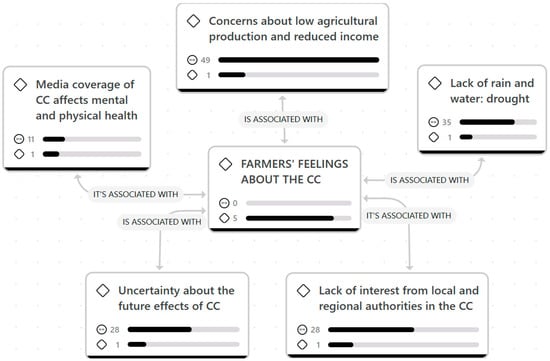
In the empirical field research, five subcategories of analysis emerged: (1) concern about low agricultural production and reduced income; (2) scarcity of rainfall and water: drought; (3) lack of interest by local and regional authorities regarding climate change; (4) uncertainty about the future effects of climate change; and (5) the mediatization of climate change and its impact on mental and physical health (see Figure 1).
Figure 1.
Feelings of agricultural producers regarding climate change. Source: authors’ own work based on Atlas.ti v.25.
Regarding concern about low agricultural production and reduced income (E = 49), the findings expressing concern over lower yields and income reveal risk imaginaries that guide everyday practices and decisions in agriculture. This concern is not only an “objective” datum of the agricultural reality, but a collective signification that organizes expectations and action [5,6,7].
“I had 500 alpacas and now it has been reduced to 320; this year I had livestock mortality in January and February, I buried them, there was nothing I could do. My animals became emaciated and I only recovered the hides; the meat could not be recovered because it had an odor and could not be sold. One to two were dying per day; those were the saddest months. Now it has stabilized somewhat, but I sense that deaths will continue. There is no pasture; I buy oats to feed them, but the price has increased—previously I bought it for 12 soles and now for 35 soles.”(Quotation 4:12).
The imaginary of scarcity of rainfall and water: drought (E = 35) functions as a semantic core that condenses lived experiences and local hydrological memory, linking sensory experience (loss of pastures and delays in sowing) with cultural frameworks [17]. This finding is corroborated by the following testimony:
“The growth of pastures is very low due to the lack of rainfall and irrigation water; rivers are decreasing and springs are drying up, and extreme frosts end up damaging crops. This affects livestock feeding, and the lack of water causes diseases such as dehydration in animals.”(Quotation 4:5).
As shown, the tension in terms of environmental rationalities arises between the instrumental-Western view of water as a resource to be optimized and Andean imaginaries that conceive water as a relational subject and a communal good of subsistence [10,51].
The lack of interest of local and regional authorities regarding climate change (E = 28) is understood as a clash between imaginaries of governance: a neoliberal-decentralized one that transfers responsibilities without resources, rendering local demands invisible; and a community-participatory one that calls for co-management and care of the territory [20].
“No project or initiative is seen from local or regional governments; nothing is seen because they do not remember us. Those of us in the countryside are forgotten by the authorities, and they only remember the town (city), carrying out works for them. Regarding regional authorities, it is even worse, because since we are on the border, they do not take us into account and leave us aside.”(Quotation 13:15).
Regarding uncertainty about the future effects of climate change (E = 28), this finding is consistent with future archetypes of collapse, adaptation, or transformation that can organize expectations and policies. In the case of Cojata, the following testimony reflects a tendency toward collapse:
“It is unknown; it is something unpredictable. We do not know whether it will rain or not; it is a concern. Nature is being lost—animals, plants; the soil is deteriorating, which will mainly affect the economy of those of us who live in the countryside. What will we feed ourselves with? What will we feed our animals with? Things will start to increase in price; resources will be exhausted.”(Quotation 10:17).
Thus, in Cojata, the collapse archetype predominates, where paralyzing effects emerge in the face of irreversible crises; the transformation archetype may emerge through collective or community agency [12].
In addition, the mediatization of climate change affects mental and physical health (E = 11), revealing the role of media discourses in shaping imaginaries. That is, the media do not only reflect the crisis but re-present and amplify emotional frames, such as fear or hope, that influence agency and well-being [11].
“We are devastated, especially elderly people. Seeing this situation broadcast on radio and newspapers or hearing people talk about what rural areas are going through, causes stress and headaches, affecting people emotionally due to concern and the crisis we are experiencing.”(Quotation 9:3).
3.2. Thoughts of Agricultural Producers Regarding Climate Change
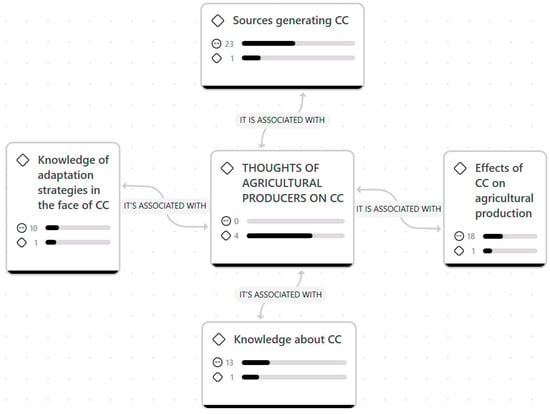
In the rational and cognitive dimension of the social imaginaries of agricultural producers regarding climate change, as shown in Figure 2, four subcategories of analysis emerged: (1) sources generating climate change; (2) effects of climate change on agricultural production; (3) knowledge about climate change; and (4) knowledge of adaptation strategies in response to climate change.
Figure 2.
Thoughts of agricultural producers regarding climate change. Source: authors’ own work based on Atlas.ti v.25.
The first emergent subcategory of analysis in this dimension concerns the sources generating climate change (E = 23), according to which human actions such as emissions, deforestation, and mining activate a social imaginary of culpability that organizes responsibilities and courses of action.
“We ourselves cause climate change, because we throw garbage anywhere and do not know how to take care of our environment, as well as illegal mining, which is one of the main causes of CC (…) we do not have water during drought periods because they contaminate it by discharging their tailings or mining waste into the river.”(Quotation 13:8).
The finding regarding the effects of climate change on agricultural production (E = 18) is manifested in yields, agricultural calendars, and water availability. Agriculture is highly vulnerable to variations in temperature and precipitation, with disproportionate impacts on small producers with limited access to technology [29,30].
“Our main concern is the mortality of our animals as a result of climate change. This will harm the economy of each livestock-producing family. We will not have good alpaca fiber to shear and sell at the end of each year, nor good meat to sell. Another concern is that we will not have money to cover our children’s school expenses”(Quotation 1:2).
Consistent with the above, knowledge about climate change (E = 13) is very important, but it must be contextualized knowledge that combines empirical experience: droughts, frosts, and melting with local narratives. This knowledge is woven at three levels: social imaginaries (horizons of meaning), social representations (practical schemes), and discursive re-presentations (narrative vehicles). These levels are intertwined in the everyday lives of producers [5,6,7,18].
“What I understand by CC is the change of seasons; that is, in spring it should start raining little by little, and in summer it generally rains heavily in this area, while in autumn and winter there are frosts and droughts. But since 2022 and in previous years it has not rained; there has simply been drought and very strong frosts. The absence of rainfall has been especially felt. This type of climate change had not been experienced for a long time; as they said on the radio, approximately 50 years ago this type of phenomenon occurred, and in recent years it has begun to occur again.”(Quotation 16:9).
To address the problem of the environmental crisis, knowledge of adaptation strategies in response to climate change (E = 10) is necessary. This social imaginary implies recognition of strategies such as diversification, water harvesting, terrace management, crop rotation, and conservation practices. However, in the high-Andean communities of Cojata, the effects of CC caught them unprepared:
“We did not know how to face these changes; we also lacked resources (financial means) and did not have the necessary tools. Faced with this scenario, we selected improved livestock and sent the rest to slaughter, because the pastures were insufficient. We prioritized the stronger animals and the newborns.”(Quotation 9:24).
3.3. Social Meanings of Agricultural Producers Regarding Climate Change
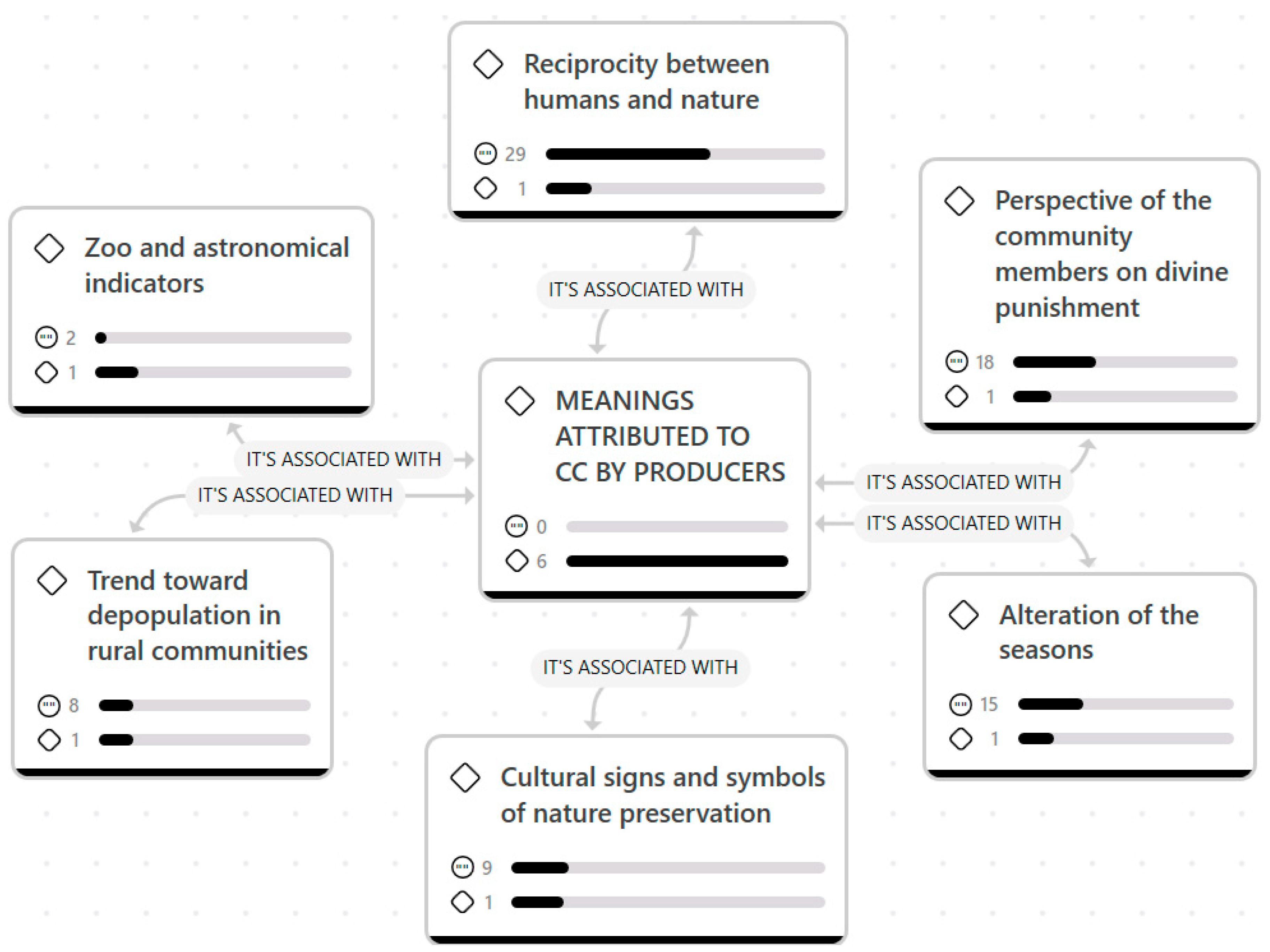
In the symbolic dimension of social imaginaries, as a result of the empirical field research and according to Figure 3, six subcategories of analysis emerged: (1) reciprocity between human beings and nature; (2) community perspectives on divine punishment; (3) alteration of the seasons of the year; (4) cultural signs and symbols of nature preservation; (5) tendency toward depopulation in rural communities; and (6) zoological and astronomical indicators. These subcategories make it possible to understand the dynamics of climate change in high-Andean communities.
Figure 3.
Social meanings of agricultural producers regarding climate change. Source: authors’ own work based on Atlas.ti v.25.
The finding related to reciprocity between human beings and nature (E = 29) reflects a relational imaginary that conceives nature as a subject endowed with rights and bonds of mutual care, rather than as a mere productive input. This is consistent with Andean imaginaries and the “environmental rationalities” of the Global South, which promote interdependencies between humans and non-humans [9,10].
“At present, I carry out my payment to the Holy Mother Earth, Pachamama, once a year, in the following way: with coca leaves, wine, carnations, llamp’o (animal fat used in Andean ritual offerings), incense, and white sugar, to make the corresponding offering. But before, our grandparents made their offerings during Carnival; they performed ch’allachi—a ritual offering to nature—for their sheep and symbolically married a male and female sheep, with their pinquilladas—traditional Andean musical performances—and they gathered with neighbors.”(Quotation 11:10).
The community perspective on divine punishment (E = 18) reveals a moral imaginary of climate, in which environmental imbalances are interpreted as consequences of ruptures in the pact of reciprocity with nature. In the Andean worldview, all elements of the environment have life, and everything flow—or should flow—in harmony.
“Climate change is occurring due to human pollution, but we also believe it may be because we no longer appreciate the Holy Mother Earth, Pachamama, as before. As they say, the earth asks and also feels thirst. If you give Mother Earth proper care, she gives back or blesses you with the production of your land and livestock”(Quotation 19:15).
From the experience of agricultural producers, the alteration of the seasons of the year (E = 15) is manifested as a semantic node that connects agricultural experience—planting and harvesting dates, frosts, and off-cycle rainfall—with expectations of a prosperous or bleak future.
“Times are changing. Before, one knew in which month it would rain or when there would be wind; now one does not know when it will rain or when it will freeze. This is also related to customs; they are no longer carried out as before to attract rain. Previously, people asked the Apus (sacred mountain spirits) and Pachamama and performed rituals, and the authorities had to practice them, because it was said that it depended on them.”(Quotation 15:8).
The imaginary of cultural signs and symbols of nature preservation (E = 9) is expressed through festivities, toponymy, offerings, and communal norms that function as cultural technologies of preservation, condensing ecological memory and regulating the use of common goods.
“In the month of August, on Alpaca Day, I make the first offering to the springs, collecting six liters of water before sunrise. This water is used to ch’alla with wine and cañihua—native Andean grain—(which means that alpacas will give birth abundantly, as cañihua cannot be counted), barley and wheat (meaning they will give birth strong), and corn, so that there will be more births, accompanied by a small prayer on Alpaca Day. Also, on June 24, Sheep Day, Saint John, we also perform ch’alla.”(Quotation 9:15).
The tendency toward depopulation in rural communities (E = 8) emerges as a forced adaptive response to water stress, loss of productive yields, and institutional weakening. Faced with the bleak scenario confronting high-Andean communities as a result of climate variability, migration becomes an option.
“Future generations no longer see themselves in the countryside; they seek better opportunities in cities. This happens because land in rural areas is becoming increasingly smaller for our children, and they say that with such small plots they will not survive. Therefore, they go to large cities to generate their own economic income.”(Quotation 12:12).
Within social meanings, zoological and astronomical indicators (E = 2) emerge as practices for controlling ecological time in high-Andean communities, based on the use of birds, insects, winds, lunar phases, or stellar positions as climate markers.
“Our ancestors observed animal signs, such as the fox (k’amaque): when it is on the plain there will be little rain, but if it is on the hill there will be abundant rain. They also observed lizards: when they are born in September and their tails are small with a pointed tip, it was said that lightning would threaten the communities that year.”(Quotation 2:11).
3.4. Adaptation Practices of Agricultural Producers to Climate Change
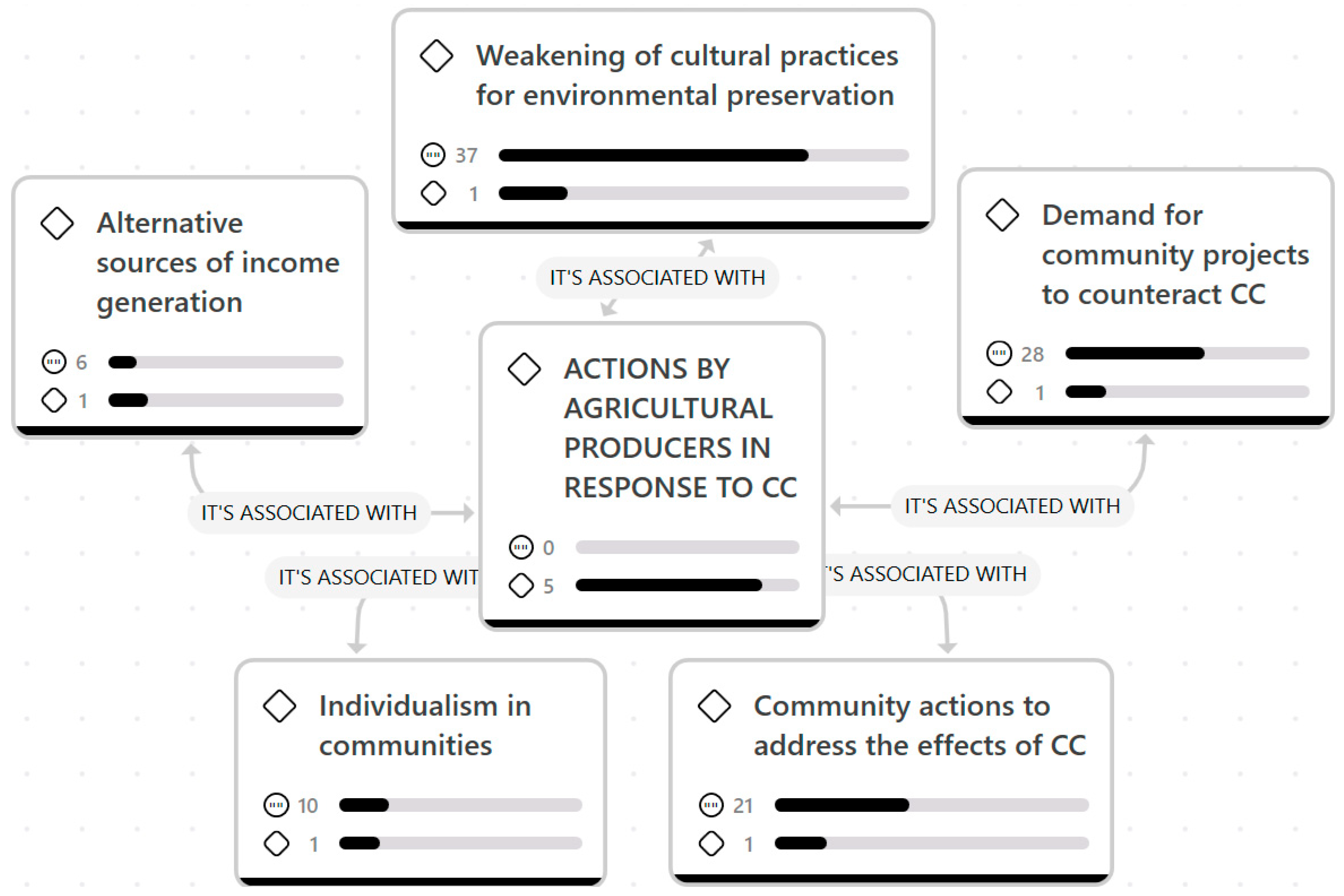
In the context of global climate change, high-Andean communities implement various adaptation strategies to this phenomenon. As shown in Figure 4, five subcategories of analysis emerged from the empirical field research process: (1) weakening of cultural practices of environmental preservation; (2) demand for community projects to counteract climate change; (3) community actions to address the effects of climate change; (4) individualism within communities; and (5) alternative sources of income generation.
Figure 4.
Adaptation practices of agricultural producers to climate change. Source: authors’ own work based on Atlas.ti v.25.
Regarding the weakening of cultural practices of environmental preservation (E = 37), as a result of the penetration of market economy principles and values into high-Andean communities, a mutation of social imaginaries has occurred, whereby nature shifts from being a subject of reciprocity and harmony to an object of exploitation [5,7]. In the context of climate change, this generates tensions between both positions.
“They (the ancestors) took time to perform their rituals, but nowadays only a small offering is made. The difference in the way offerings to Pachamama are carried out is that our ancestors did them themselves with full faith, whereas now a shaman is hired, because sometimes even the lieutenants do not know how to guide ancestral customs and find it more feasible to hire a shaman.”(Quotation 11:13).
The second emergent subcategory in the attitudinal dimension is the demand for community projects to counteract climate change (E = 28), which expresses a future-oriented imaginary that seeks to strengthen collective action in the face of the gap between institutional commitments at regional and national levels and local resources [12,25].
“It is unfortunate that the authorities of Cojata prefer to carry out projects that do not help address climate change. As secretary of the Peasant Federation, I have submitted the Sierra Azul irrigation project. Professionals came to evaluate the site, but there has been no progress. Many projects were not followed up properly and ended up going nowhere.”(Quotation 19:9).
On the other hand, community actions to address the effects of climate change (E = 21) reveal hybrid adaptations such as water harvesting, terraces, diversification, and monitoring of water sources, which combine ancestral knowledge with modern innovations [23,33].
“We are trying to bring water from wherever possible, but the sun is so strong that it is difficult to find springs because they dry up quickly. Due to the very strong frosts, we are also covering or wrapping, as we say, our thinnest alpacas, with the aim of preventing frost from killing them.”(Quotation 1:12).
Another emergent subcategory in the attitudinal dimension is individualism within communities (E = 10). The increase in individualism in rural communities, expressed in competition for resources and the weakening of the ayllu (a traditional Andean socio-economic and territorial unit) and mink’a (collective community labor), reflects the transition toward hegemonic imaginaries of progress and consumption [16,17]. As discussed above, the penetration of instrumental rationality into high-Andean communities has weakened communal principles of solidarity and social cooperation.
“As a community, we do not carry out collective actions. When someone wants to convene a meeting, there is simply no interest; each person looks out for themselves. Empathy and solidarity no longer exist. There are brothers and sisters who are more affected, but nobody cares, not even the authorities. It is especially sad for elderly people.”(Quotation 5:16).
Finally, alternative sources of income generation (E = 6) constitute one of the adaptation strategies adopted by high-Andean inhabitants. Income diversification through commerce, tourism, remittances, and bioeconomy activities is presented as an adaptive strategy that reduces agricultural exposure [29,30].
“Some families migrate to the town to seek other sources of income to support their families, since there are border areas where different types of businesses can be carried out. In addition, some of us engage in artisanal weaving, making clothing and taking advantage of alpaca fiber. We commercialize our alpaca and sheep fiber textiles at fairs.”(Quotation 1:3).
4. Discussion
Regarding the emotional dimension of the social imaginaries of agricultural producers in the face of climate change, concern about low agricultural production and reduced income is configured as an imaginary of anticipated loss that guides productive decisions and adjustment strategies. Producers translate climate variability into interpretive frameworks that enable or constrain action [14,17]. Here, the debate is expressed between a technocratic-economicist perspective—focused on efficiency, innovation, and risk management within the same productive model [16]—and a critical-civilizational perspective that interprets declining yields as a symptom of biophysical limits and structural unsustainability [9]. For small producers, postponing climate action implies externalizing costs onto vulnerable territories, deepening inequalities [26].
On the other hand, the scarcity of rainfall and water associated with drought emerges as a central material and symbolic experience [52]. Pressure on water resources—aggravated by glacier retreat, degradation of high-Andean ecosystems, and inefficient irrigation practices—turns water into an axis of dispute [32]. Communal responses, such as water harvesting, productive diversification, and conservation, demonstrate hybrid resiliencies that articulate ancestral knowledge and modern techniques [23,33], although their sustainability is limited by weak institutional support [34]. Thus, drought transcends the physical realm and is configured as a governance conflict [20].
In this sense, the lack of interest shown by local and regional authorities is expressed as a discursive re-presentation of abandonment, resulting from the gap between normative commitments and the local effects of the global climate regime [25,53]. This imaginary legitimizes practices of self-organization and reinforces the perception that socio-environmental conflicts are collisions between development and management models [19,20], highlighting the need for binding participation and intercultural territorial institutionalization [54].
Likewise, uncertainty regarding the future effects of climate change combines climatic, political, and distributive dimensions. It is not only about extreme events, but also about who assumes the costs and when [27,28,55]. In high-Andean territories such as Cojata, the lack of planning and vulnerability maps intensifies this uncertainty, transforming risks into social crises [24]. Traditional communal practices need to be accompanied by contextualized education and information systems that translate uncertainty into adaptive capacities [35,56].
Furthermore, the imaginary of the mediatization of climate change affects mental and physical health. Narratives of collapse generate eco-anxiety and somatization, while imaginaries of adaptation and transformation—albeit to a lesser extent—foster pro-environmental behaviors and support networks [12]. Therefore, the tension between instrumental climate literacy and situated pedagogy reveals that integrating local knowledge and cultural mediation is key to building psychosocial resilience in the face of catastrophist discourses [10,51,57].
From the cognitive dimension of the social imaginaries of agricultural producers in the face of climate change, the sources that generate climate change are socially constructed as a field of political and cultural dispute. When producers link climate change to extractive activities, consumption patterns, or local pollution, they articulate their territorial experience with global narratives [14,17]. In this way, technocratic imaginaries coexist—those that reduce the problem to a market failure manageable through economic instruments [27]—with critical-civilizational imaginaries that conceive it as a relational rupture between society and nature, particularly visible in the contrast between Western nature-as-resource and nature-as-subject within Andean imaginaries [10,51]. Identifying the sources of the problem thus implies assigning responsibility and questioning development models [9,25].
Now, the effects of climate change on agricultural production manifest as processes that are simultaneously biophysical and political. The reduction in water availability, associated with glacial retreat and the degradation of high-Andean ecosystems, intensifies droughts and frosts [32], turning extreme events into vulnerability multipliers in the absence of planning and risk maps [24]. These effects are interpreted either as technological gaps to be resolved through efficiency or as symptoms of an unsustainable socioecological metabolism that demands profound productive reconfigurations [16,58]. Moreover, limited knowledge about climate change reveals a gap between recognition of the problem and causal understanding. The media influence what is known and how people act through emotional scripts that oscillate between victimization and agency [11]. Overcoming this gap requires moving from instrumental climate literacy to a contextualized pedagogy that articulates local knowledge, emotions, and identities, thereby strengthening collective action capacity [14,35].
Consistent with the above, adaptation strategies involve adopting hybrid practices that combine modern techniques with ancestral knowledge, generating positive impacts on resilience, although limited by a lack of institutionalization [23,33]. The dispute between adaptation as management and adaptation as transformation reveals that understanding adaptation entails not only identifying technologies but also co-designing policies and incentives that recognize and enhance local capacities [25,58,59].
From the symbolic dimension attributed by agricultural producers to climate change, reciprocity between human beings and nature operates as an instituting meaning that organizes communal norms, rituals, and territorial management practices. More than a symbolic notion, reciprocity establishes moral obligations of care that guide forms of governance and collective action, shifting the emphasis from productive efficiency toward an ethical-ecological relationship [5,6,7,51]. This logic comes into tension with the technocratic-economicist imaginary, which reduces sustainability to management metrics [16]. From this relational matrix, the perspective of divine punishment is understood not as an irrational belief but as a cultural device of social regulation. Andean imaginaries interpret climatic imbalances as breaches of reciprocity with beings of nature, promoting practices aimed at containing harm [8,10,60]. Thus, the analytical challenge is not to oppose science and faith, but to translate between regimes of meaning in order to prevent guilt from turning into psychosocial distress devoid of agency [11].
On the other hand, the alteration of the seasons is perceived as a reconfiguration of agricultural time rather than as isolated variability. Producers recognize structural changes that legitimize deep territorial and productive adjustments, especially in the absence of planning and contextualized climate knowledge [23,24]. In this sense, cultural signs and symbols associated with the preservation of lagoons, hills, and rituals materialize effective rules of environmental governance. Their normative strength weakens when they are folklorized or instrumentalized but is strengthened when they are articulated with technical innovations and institutional support [17,34]. In addition, zoological and astronomical indicators condense multigenerational observations useful for risk management which, when integrated with scientific data, enable the co-production of relevant climate knowledge and strengthen community planning [35,59], demonstrating that effective adaptation requires dialogue between knowledge systems and the institutionalization of these local knowledge frameworks.
Nevertheless, climate change generates a tendency toward rural depopulation, which emerges as a cumulative effect of climatic, economic, and political vulnerabilities and therefore deserves policy concern and attention. This phenomenon, rather than an individual choice, expresses future imaginaries and structural arrangements that erode social capital [25,31].
Finally, regarding the practical and strategic dimension of agricultural producers in the face of climate change, the weakening of cultural practices of environmental preservation is explained by the hegemony of projects that delegitimize communal institutions and redefine development through technocratic and market-based logics [8,16]. The folklorization or co-optation of these practices erodes their normative force, increasing socioecological vulnerability. In response, the civilizational perspective recognizes them as social and ethical technologies of care that need to be reinstituted through the co-governance of the commons [9,10]. This weakening gives rise to a demand for community projects aimed at counteracting climate change. However, a project-based approach can fragment efforts and depoliticize structural conflicts [20]. The debate between gradual mitigation and early action reveals that postponing action implies externalizing costs onto communities that contribute least to emissions [27,28]. Therefore, priority is given to projects that strengthen rural public goods and align with principles of climate justice [32].
Community-based actions to address climate change express imaginaries of reciprocity translated into everyday practices which, when articulated with climate information and technical support, can increase resilience [35]. These actions demonstrate local agency in the face of the transfer of responsibilities without resources, characteristic of neoliberal intergovernmentality [20], and demand institutionalization through budgets and territorial governance. However, the rise in individualism is reinforced by environmental mediatization, which shifts structural responsibilities toward individual producer guilt, weakening community cooperation and deepening migratory processes [11,22]. Reversing this trend requires reactivating imaginaries of Buen Vivir and care through contextualized education and community-based mechanisms [51].
As a corollary of this fourth dimension, the search for alternative sources of income reveals a tension between adaptation as mere management and adaptation as transformation. That is, while diversification is necessary, only those alternatives aligned with agroecology, the bioeconomy, and climate justice contribute to collective sustainability, avoiding new extractive dependencies [9,25].
Limitations of the Study
The study presents limitations inherent to the qualitative approach and the phenomenological design, as the findings are based on in-depth subjective and intersubjective experiences of a limited, though representative, number of communal actors. The results do not seek statistical generalization but rather serve as a reference for similar realities. The non-probabilistic, purposive, and convenience sampling, limited to 16 communities and 32 key informants from the district of Cojata, may restrict the diversity of perspectives. Likewise, the selection of authorities and communal leaders prioritizes representative views at the communal level, which may underrepresent other relevant community voices. Therefore, for future research, it is recommended to address the phenomenon through a mixed-methods approach in order to ensure greater comprehensiveness of the study findings.
5. Final Reflections and Conclusions
The analysis of social imaginaries surrounding climate change in high-Andean communities shows that these are not merely subjective perceptions, but rather structures of meaning that mediate between local experience, knowledge, and collective action. In the district of Cojata, the feelings, thoughts, meanings, and practices of agricultural producers configure a symbolic framework that not only reflects vulnerabilities but also guides forms of resistance and adaptation in contexts marked by asymmetries of resources and power. This research thus demonstrates that understanding the climate crisis through social imaginaries broadens the perspective beyond technocratic diagnoses, recognizing the cultural, ethical, and political dimensions of the problem.
The feelings of agricultural producer’s express imaginaries of risk that translate into concerns about declining income, water scarcity, uncertainty, and the lack of interest shown by authorities. These emotions, far from being irrational, constitute collective frameworks that guide everyday practices and legitimize demands for climate justice, revealing that vulnerability is simultaneously climatic, economic, and political.
Thoughts about climate change show that understanding the problem is also a political act, as it involves disputing dominant narratives and making structural responsibilities visible. Although producers possess situated knowledge that combines empirical experience and public narratives, a gap persists between awareness and action. Overcoming this gap requires intercultural climate literacy processes and the co-production of knowledge capable of translating experience into collective agency.
Social meanings surrounding climate change reveal that categories such as reciprocity, divine punishment, cultural symbols, and ecological indicators operate as devices of social regulation and environmental ethics. These symbolic matrices sustain practices of territorial care and preservation of common goods. However, risks such as rural depopulation and the folklorization of knowledge threaten to weaken their normative effectiveness, making it necessary to recognize them in public policy not as decorative elements, but as genuine rules of environmental governance.
Community adaptation practices highlight the existence of hybrid strategies—water harvesting, terraces, income diversification, among others—that combine ancestral knowledge and modern technologies and have proven effective in the face of climate variability. However, their sustainability is limited by the weakening of cultural practices, the advance of individualism, and insertion into extractive markets. This situation demands institutionalization, adequate financing, and intercultural extension to transform these practices into long-term resilient capacities.
In sum, the study concludes that addressing climate change in high-Andean communities requires the design of an intercultural territorial climate policy aimed at recognizing local social imaginaries as the foundation of collective action. Specifically, this implies implementing “Intercultural Communal Climate Plans” in high-Andean communities, co-designed and co-managed by communities, local governments, and the private sector. These plans should integrate ancestral knowledge—such as terraces, wetlands, water harvesting, and agroclimatic calendars—with localized scientific information—forecast and risks maps—including a mandatory territorial climate budget and be implemented through communal committees with binding decision-making power for water management, agroecological adaptation, and sustainable economic diversification. Such measures would make it possible to transform local imaginaries into effective collective decisions, strengthen community cohesion, and increase socio-ecological resilience with a climate justice approach.
Author Contributions
Conceptualization, F.F.C.-C., D.A.S.-A., and E.Q.-M.; methodology, F.F.C.-C., L.J.M.-C., E.L.R.-C., G.B.-Q., D.A.S.-A. and E.Q.-M.; software, L.J.M.-C., E.L.R.-C., W.Q.-B. and E.Q.-M.; validation, F.F.C.-C., L.J.M.-C., E.L.R.-C., W.Q.-B. and B.V.M.-M.; formal analysis, F.F.C.-C., G.B.-Q., D.A.S.-A., W.Q.-B., B.V.M.-M. and E.Q.-M.; investigation, F.F.C.-C., L.J.M.-C., E.L.R.-C., G.B.-Q., D.A.S.-A., W.Q.-B., B.V.M.-M. and E.Q.-M.; resources, F.F.C.-C., G.B.-Q., D.A.S.-A., B.V.M.-M. and E.Q.-M.; data curation, L.J.M.-C., E.L.R.-C. and B.V.M.-M.; writing—original draft preparation, F.F.C.-C., L.J.M.-C., E.L.R.-C., G.B.-Q., D.A.S.-A., W.Q.-B. and E.Q.-M.; writing—review and editing, G.B.-Q., D.A.S.-A., W.Q.-B., B.V.M.-M. and E.Q.-M.; visualization, F.F.C.-C., L.J.M.-C., E.L.R.-C., G.B.-Q., D.A.S.-A., W.Q.-B., B.V.M.-M. and E.Q.-M.; supervision, W.Q.-B. and E.Q.-M.; project administration, W.Q.-B. and E.Q.-M.; funding acquisition, G.B.-Q., D.A.S.-A., W.Q.-B., B.V.M.-M. and E.Q.-M.; All authors have read and agreed to the published version of the manuscript.
Funding
No external funding was received for this research.
Institutional Review Board Statement
Given the non-interventionist, qualitative, and socially focused nature of this research, which does not involve any risk to participants, an ethical exemption has been granted. In this regard, a commitment has been made to protect participants’ personal data in an ethical and responsible manner.
Data Availability Statement
The original contributions presented in this study are included in the article. Further inquiries can be directed to the corresponding author.
Acknowledgments
Our thanks to all the key informants in the study, from the 16 high Andean communities of Cojata, in Puno, Peru. During the preparation of this article, the authors used the ChatGPT tool based on the GPT-4.1 model for literature search and review, as well as for the identification of theoretical approaches related to “social imaginaries” and “climate change.” Based on these core theoretical ideas, the theoretical foundation of the study was constructed and manually contextualized. The authors reviewed and edited the output and assume full responsibility for the content of this publication.
Conflicts of Interest
The authors of the study declare that they have no conflicts of interest.
References
- Belizario, G. Efectos del cambio climático en l agricultura de la cuenca Ramis, Puno, Perú. Rev. Investig. Altoandinas 2015, 17, 47–52. [Google Scholar] [CrossRef] [Scilit]
- Najarro, R.J. En tiempos de cambio climático: Relación agua–hombre en localidades altoandinas de Paras y Chuschi, Ayacucho. Alteritas. Rev. Estud. Sociocult. Andin. Amaz. 2020, 9, 89–126. [Google Scholar] [CrossRef] [Scilit]
- Sánchez, L.; Reyes, O. Medidas de Adaptación y Mitigación Frente al Cambio Climático en América Latina y el Caribe; Naciones Unidades: Santiago, Chile, 2015; Available online: http://repositorio.cepal.org/bitstream/handle/11362/39781/S1501265_es.pdf?sequence=1 (accessed on 5 September 2025).
- INDECI (Instituto Nacional de Defensa Civil). Déficit Hídrico en el Departamento de Puno; INDECI: Lima, Peru, 2023.
- Castoriadis, C. La Imaginación Radical Desde el Punto de Vista Filosófico y Psicoanalítico. Riv. Zona Erógena, Conferencia Dictada el 3 de Abril, Buenos Aires, Argentina, 1993. pp. 265–268. Available online: https://www.revista.diferencias.com.ar/index.php/diferencias/article/view/61 (accessed on 10 October 2025).
- Castoriadis, C. La Institución Imaginaria de la Sociedad, 1st ed.; Tusquets Editores: Buenos Aires, Argentina, 2007. [Google Scholar]
- Taylor, C. Imaginarios Sociales Modernos; PAIDÓS: Barcelona, Spain, 2006; Volume 25, p. 3. [Google Scholar]
- Baczko, B. Los Imaginarios Sociales. Memorias y Esperanzas Colectivas; Nueva Visión: Buenos Aires, Argentina, 1999. [Google Scholar]
- Elizalde, R.; Elizalde, A. La apuesta por la vida. Imaginación sociológica e imaginarios sociales en territorios ambientales del sur, de Enrique Leff. Polis 2019, 54, 185–189. [Google Scholar] [CrossRef] [Scilit]
- Gallegos, E. Desencuentros entre el imaginario social occidental y el imaginario social indígena: Elementos para una reflexión teórica sobre los imaginarios sociales nucleares en el marco del conflicto entre el estado-nación chileno y el pueblo mapuche. Rev. Cuhso 2021, 31, 548–571. [Google Scholar] [CrossRef] [Scilit]
- Prosser, G.; Caro-Zúñiga, C.A.; Arboleda-Ariza, J.C.; Schroder-Navarro, E.C.; González-Soto, M.L. Social imaginaries of youth in the Chilean press on climate change. Cuadernos. Info 2023, 54, 293–317. [Google Scholar] [CrossRef] [Scilit]
- Wright, C.; Nyberg, D.; De Cock, C.; Whiteman, G. Future imaginings: Organizing in response to climate change. Organization 2013, 20, 647–658. [Google Scholar] [CrossRef] [Scilit]
- Duque, D.E. El Cambio Climático su Imaginario Social Para la Participación Ciudadana; Facultad Latinoamericana de Ciencias Sociales: Quito, Ecuador, 2015; Available online: http://hdl.handle.net/10469/8754 (accessed on 10 August 2025).
- García-Muñoz, C.M.; Gómez-Gallego, R.Á. Aproximación epistemológica a los imaginarios sociales como categoría analítica en las ciencias sociales. Rev. Guillermo Ockham 2021, 19, 219–232. [Google Scholar] [CrossRef] [Scilit]
- Gauna, A.F. Alcance y problemas de la propuesta de Cornelius Castoriadis sobre los imaginarios sociales y el cambio social. Utopía y Prax. Latinoam. 2020, 25, 189–203. [Google Scholar]
- Murcia-Murcia, N. Imaginarios sociales sobre problemática ambiental: Nuevos senderos para una educación ambiental. Educ. y Humanismo 2023, 25, 62–78. [Google Scholar] [CrossRef] [Scilit]
- Riffo-Pavón, I. La construcción del mensaje político a partir de los imaginarios sociales y el Framing. Atenea 2022, 525, 45–63. [Google Scholar] [CrossRef] [Scilit]
- Riffo-Pavón, I. Imaginarios sociales, representaciones sociales y re-presentaciones discursivas. Cinta Moebio 2022, 74, 78–94. [Google Scholar] [CrossRef] [Scilit]
- Quispe-Mamani, E.; Chaiña Chura, F.F.; Salas Avila, D.A.; Belizario, G. Imaginario social de actores locales sobre la contaminación ambiental minera en el altiplano peruano. Rev. Cienc. Soc. 2022, XXVIII, 303–321. [Google Scholar] [CrossRef] [Scilit]
- Stein, A. Cambio climático y conflictividad socioambiental en América Latina y el Caribe. América Lat. Hoy 2018, 79, 9–39. [Google Scholar] [CrossRef] [Scilit]
- Stolz, L. A colonial lack of imagination: Climate futures between catastrophism and cruel eco-optimism. J. Polit. Ecol. 2024, 31, 759–769. [Google Scholar] [CrossRef] [Scilit]
- Rodríguez, J.J.; Rodríguez, C.E.; Gourdji, S.; Mason-D’Croz, D.; Obando-Bonilla, D.; Meza-Diez, J.; Prager, S.D. Impactos socioeconómicos del cambio climático en América Latina y el Caribe: 2020–2045. Cuad. Desarro. Rural 2016, 13, 11–34. [Google Scholar] [CrossRef] [Scilit]
- Delgado, L.E.; Torres-Gómez, M.; Tironi-Silva, A.; Marín, V.H. Estrategia de adaptación local al cambio climático para el acceso equitativo al agua en zonas rurales de Chile. América Lat. Hoy 2015, 69, 113–137. [Google Scholar] [CrossRef] [Scilit]
- Rodriguez-Morales, A.J. Climate change, rainfall, society and disasters in Latin America: Relationsand needs. Rev. Peru. Med. Exp. Salud Publica 2011, 28, 165–166. [Google Scholar] [CrossRef] [Scilit]
- Hincapié, S. Global environmental governance, human rights and socio-state capabilities in Latin America. Rev. CIDOB d’Afers Int. 2022, 130, 19–43. [Google Scholar] [CrossRef] [Scilit]
- Mora-Motta, A.; León, N. Cambiando de perspectiva en la economía de la mitigación del cambio climático. Cuad. Econ. 2017, 36, 169–195. [Google Scholar] [CrossRef] [Scilit]
- Nordhaus, W. A Question of Balance: Weighing the Options on Global Warming Policies; Yale University Press: New Haven, CT, USA; London, UK, 2008. [Google Scholar]
- Stern, N. The economics of climate change. Am. Econ. Rev. Pap. Proc. 2008, 98, 1–37. [Google Scholar] [CrossRef] [Scilit]
- López, A.J.; Hernádez, D. Cambio climático y agricultura: Una revisión de la literatura con énfasis en América Latina. Trimest. Econ. 2016, 4, 459–496. [Google Scholar] [CrossRef] [Scilit]
- Cartay, R.; Poveda, E.; Buzetta, M.F. El cambio climático y la producción agrícola familiar y empresarial en América Latina. Agroalimentaria 2022, 28, 191–212. [Google Scholar] [CrossRef] [Scilit]
- Estenssoro, F. Crisis ambiental y cambio climático en la política global: Un tema crecientemente complejo para américa latina. Universum 2010, 2, 57–77. [Google Scholar] [CrossRef] [Scilit]
- Salazar, O.; Chinchilla-Soto, C.; De los Santos-Villalobos, S.; Ayala, M.; Benavides, L.; Berriel, V.; Cardoso, R.; Chavarrí, E.; Anjos, R.M.D.; González, A.L.; et al. Water consumption by agriculture in Latin America and the Caribbean: Impact of climate change and applications of nuclear and isotopic techniques. Int. J. Agric. Nat. Resour. 2022, 49, 1–21. [Google Scholar] [CrossRef] [Scilit]
- Campos, M.; Herrador, D.; Manuel, C.; Mccall, M.K. Estrategias de adaptación al cambio climático en dos comunidades rurales De México y el Salvador. Boletín Asoc. Geógrafos Españoles 2013, 61, 329–349. [Google Scholar] [CrossRef] [Scilit]
- Wong, S.A.; Rondinone, G.; De Salvo, C.P. Agricultural support policies and GHG emissions from agriculture in Latin America: Relationships and policy implications for climate change. Iberoam. J. Dev. Stud. 2023, 12, 102–140. [Google Scholar] [CrossRef] [Scilit]
- Gómez, M.G.; De la Garza, L.A.; Hosman, L. Uso de bibliotecas digitales solares para la enseñanza del cambio climático en comunidades rurales. Rev. Interam. Bibliotecol. 2022, 45, 1–16. [Google Scholar] [CrossRef] [Scilit]
- Plata-Rangel, Á.M.; Ibáñez-Velandia, A.Y. Education on climate change in rural communities in the municipality of la Calera (Cundinamarca, Colombia). Rev. Luna Azul 2020, 51, 198–222. [Google Scholar] [CrossRef] [Scilit]
- Hernández, R.; Fernández, C.; Baptista, P. Metodología de la Investigación; McGraw-Hill/Interamericana Editores, S.A. de C.V.: México, Mexico, 2014. [Google Scholar]
- Hernández-Sampieri, R.; Mendoza, C.P. Metodología de la Investigación. Las Rutas Cuantitativa, Cualitativa y Mixta; McGraw-Hill Interamericana Editores: México, Mexico, 2018. [Google Scholar]
- Valencia, V.E. Revisión Documental en el Proceso de Investigación; Universidad Tecnológica de Pereira: Pereira, Colombia, 2014. [Google Scholar]
- Díaz, L.; Torruco, U.; Martínez, M.; Varela, M. La Entrevista, Recurso Flexible y Dinámico. Investig. Educ. Médica 2013, 2, 162–167. [Google Scholar] [CrossRef] [Scilit]
- Valles, M.S. Técnicas Cualitativas de Investigación Social. Reflexión Metodológica y Práctica Profesional; Editorial Síntesis, S.A.: Madrid, Spain, 1999. [Google Scholar]
- Santana, L. Guías para Elaborar Fichas Bibliográficas En la Redacción de Ensayos, Monografías y Tesis; Univ. Puerto Rico: San Juan, PR, USA, 2008. [Google Scholar]
- Bracho, Y. Gestión de Calidad en las Empresas del Sector Azucarero del Occidente Venezolano. Capítulo III Marco Metodológico; Universidad Rafael Belloso Chacin: Maracaibo, Venezuela, 2007. [Google Scholar]
- Gonzáles, J. Técnicas e Instrumentos de Investigación Científica, 1st ed.; Enfoques Consulting EIRL: Arequipa, Peru, 2019. [Google Scholar]
- Barquín, A.; Arratibel, N.; Quintas, M.; Alzola, N. Percepción de las familias sobre la diversidad socioeconómica y de origen en su centro escolar. Estud. Cualitativo. Rev. Investig. Educ. 2022, 40, 89–105. [Google Scholar] [CrossRef] [Scilit]
- Quispe-Mamani, E.; Porto, H.; Ayamamani, P.; Turpo, O. Mediatización y crisis sociopolítica en Perú. Imaginarios y prácticas de actores sociales. Cuadernos. Info 2023, 56, 22–43. [Google Scholar] [CrossRef] [Scilit]
- San Martín, D. Teoría fundamentada y Atlas.ti: Recursos metodológicos para la investigación educativa. Rev. Electrónica Investig. Educ. 2016, 18, 112–127. [Google Scholar]
- Quispe-Mamani, E.; Quispe, W.; Turpo, O. Recentralización, conflictos intergubernamentales y desigualdad territorial: Perspectiva de gobiernos locales en Perú. Rev. Adm. Pública 2023, 57, 1–22. [Google Scholar] [CrossRef] [Scilit]
- Cáceres, P. Análisis cualitativo de contenido: Una alternativa metodológica alcanzable. Psicoperspectivas 2003, II, 53–81. [Google Scholar] [CrossRef] [Scilit]
- Sayago, S. El Análisis del Discurso Como Técnica de Investigación Cualitativa y Cuantitativa en las Ciencias Sociales. Cinta Moebio 2014, 49, 1–10. [Google Scholar] [CrossRef] [Scilit]
- Leff, E. Imaginarios sociales y sustentabilidad. Cult. Represent. Soc. 2010, 5, 42–121. [Google Scholar]
- Cavieres, L.A.; Llambí, L.D.; Anthelme, F.; Hofstede, R.; Arroyo, M.T.K. High-Andean vegetation under environmental change: A continental synthesis. Annu. Rev. Environ. Resour. 2025, 50, 219–245. [Google Scholar] [CrossRef] [Scilit]
- Lechón, W. Acción frente al cambio climático: Gobernanza multinivel de los gobiernos subnacionales y locales en Ecuador. Estado Comunes 2023, 1, 39–59. [Google Scholar] [CrossRef] [Scilit]
- Borgen-Eide, G.; Gubrium, E. Climate change in Norway: Destabilized social imaginaries of welfare, growth, and nature in a rich oil state. Nat. Space 2025, 8, 1002–1019. [Google Scholar] [CrossRef] [Scilit]
- Martínez-Alier, J. Los conflictos ecológicos-distributivos y los indicadores de Sustentabilidad. Polis Rev. Latinoam. 2006, 13, 1–15. [Google Scholar]
- Sandoval-Díaz, J.; Navarrete, M.; Cuadra, D. Revisión sistemática sobre la capacidad de adaptación y resiliencia comunitaria ante desastres socionaturales en América Latina y el Caribe. Rev. Estud. Latinoam. Sobre Reducción Riesgo Desastr. REDER 2023, 7, 187–203. [Google Scholar] [CrossRef] [Scilit]
- Reyes-García, V.; Attoh, E.M.N.A.N.; Barrington-Leigh, C.; Benyei, P.; Calvet-Mir, L.; Chakauya, R.; Al Faisal, A.; Galbraith, E.D.; Glauser, M.; Izquierdo, A.E.; et al. Experienced climate change impacts help explain subjective well-being-Evidence from 14 nature-dependent communities. People Nat. 2025, 1–15. [Google Scholar] [CrossRef] [Scilit]
- Leff, E. La Ecología Política en América Latina. Un Campo en construcción. P. Rev. Latinoam. 2003, 5, 1–16. [Google Scholar] [CrossRef] [Scilit]
- Lamprea-Quiroga, P.S.; Sanabria-Marin, R. Diálogos entre perspectivas campesinas y científicas como estrategia para aumentar la resiliencia al cambio climático en un altiplano andino colombiano. Rev. Estud. Latinoam. Sobre Reducción Riesgo Desastr. REDER 2024, 8, 128–144. [Google Scholar] [CrossRef] [Scilit]
- Gomel-Apaza, Z.P.; Ishizawa-Oba, J.; Granados-Carbajal, R.E.; Gamwell, A. Usos de conocimientos tradicionales de conservación de la agrobiodiversidad en adaptación al cambio climático en comunidades indígenas de Puno, Perú. Rev. Espiga 2023, 22, 140–163. [Google Scholar] [CrossRef] [Scilit]
Disclaimer/Publisher’s Note: The statements, opinions and data contained in all publications are solely those of the individual author(s) and contributor(s) and not of MDPI and/or the editor(s). MDPI and/or the editor(s) disclaim responsibility for any injury to people or property resulting from any ideas, methods, instructions or products referred to in the content. |
© 2026 by the authors. Licensee MDPI, Basel, Switzerland. This article is an open access article distributed under the terms and conditions of the Creative Commons Attribution (CC BY) license.