


Abstract
Natural environments are known to support psychological well-being and cognitive functioning, but it remains unclear whether these benefits extend to immersive virtual environments, how they compare with different urban settings, and whether age or personality modulate them. This study compared cognitive responses across forest and urban virtual environments, including urban settings differing in architectural and visual characteristics. Sixty-nine healthy young and older adults completed a Go/No-Go task before and after exploring three 360° virtual environments: a forest, a historic-centre urban cityscape, and a peripheral urban area. Across age groups, Go-trial accuracy improved more after exposure to the historic-centre urban environment than the peripheral urban environment. Post-error slowing decreased more after forest exposure compared with the peripheral urban environment. In exploratory analyses, higher neuroticism was associated with slower reaction times following forest and historic-centre urban exposure in older adults, with a smaller, non-significant association after peripheral urban exposure. These preliminary findings, which require replication, suggest that environmental characteristics and naturalness may each influence attentional performance in immersive environments, and that emotional reactivity may be related to older adults’ post-exposure responses. Immersive virtual reality may be a useful tool for studying how physical surroundings shape cognition across the lifespan.
1. Introduction
Research into the psychological and physiological effects of environmental exposure has largely focused on natural settings, with substantial evidence linking green space to mental and physical health benefits (Astell-Burt et al., 2014; Gascon et al., 2015; Triguero-Mas et al., 2017; Twohig-Bennett & Jones, 2018). However, most people spend the majority of their time in heterogeneous urban environments (ranging from historic, architecturally distinctive areas to peripheral, largely built-up settings with few natural features). Comparing three qualitatively distinct environments (a forest, a historic-centre urban area, and a peripheral urban area with few natural features) should allow us conceptually to distinguish, even if not fully causally isolate, the specific contribution of naturalness from that of broader environmental and perceptual characteristics, a distinction that the traditional “nature versus city” dichotomy fails to capture and which is supported by evidence showing that aesthetic and affective responses to environmental contexts do not always covary linearly with their degree of naturalness (Felisberti et al., 2026). Research on restorative environments has extensively investigated forest exposure (shinrin-yoku; for a review, see Siah et al., 2023), reporting consistent benefits in both healthy and clinical populations (Bielinis et al., 2020; Chun et al., 2017), including reduced stress and cortisol (Antonelli et al., 2019), mood regulation (Bang et al., 2018; Lim et al., 2020; Wen et al., 2019), anxiety (Farrow & Washburn, 2019; Yeon et al., 2021; Zhou et al., 2019), improvements in general health (Grilli & Sacchelli, 2020) and physiological functioning (Rajoo et al., 2020). These effects are commonly explained through Stress Reduction Theory (Ulrich, 1983) and Attention Restoration Theory (Kaplan & Kaplan, 1989), both of which predict that artificial environments dominated by concrete should be comparatively less restorative and more demanding on attentional and self-regulatory resources: a prediction rarely directly tested against corresponding benefits attributed to nature.
Despite this substantial body of work on psychological and physiological outcomes, research on the cognitive effects of environmental exposures remains limited, and the gap widens as the focus narrows: relatively few studies have specifically examined attention, and even fewer have studied inhibitory control, the process of suppressing inappropriate or context-incongruent responses, essential whenever behavior needs to be flexibly adapted to changing environmental demands. Some encouraging results exist; woodland walks have been shown to improve sustained attention (Pasanen et al., 2018) and directed attention (Berman et al., 2008), with comparable benefits reported in children and adolescents (Buczyłowska et al., 2023; Mygind et al., 2019). Inhibitory control, however, has been studied much less frequently. A recent study showed that exposure to a forest, compared to an urban environment, improved inhibitory control in a Go/No-Go task, with the effect modulated by participants’ trait anxiety (Benedetti et al., 2024), a result that underscores how little is still known about this process and its interaction with the type of environment.
An even less explored aspect concerns the efficiency of post-error behavioral adaptation, typically measured by post-error slowing (PES), i.e., the tendency to slow down after making an error. This is generally interpreted as a reflection of strategic caution (conflict monitoring models) or a transient attentional response to error salience (orienting theory). Because the PES is thought to reflect error monitoring and/or attentional responses to errors rather than accuracy per se, it may be particularly sensitive to the type of low-effort, restorative attentional engagement thought to be promoted by natural environments, yet it has received virtually no attention in the literature. Virtual immersion has proven to be a valuable methodological tool for this line of research, replicating many of the benefits of real-world exposure (Spano et al., 2023) while allowing different pre-existing environments to be selected and compared under standardised viewing conditions, minimising confounds related to weather, time of day, or incidental disturbances typical of real-world exposure, thereby providing an advantage particularly relevant for examining the contribution of specific urban environmental characteristics, including architectural and visual features. It is also a practical resource for people with limited access to green spaces, such as those living in dense urban areas or with limited mobility. Virtual exposure to forest environments has been associated with improved inhibitory control compared to urban conditions (Benedetti et al., 2023; Zabini et al., 2020) and broader psychological benefits (Yu et al., 2020) that appear to scale with the proportion of greenness in the stimuli (Sun et al., 2023), although findings are not always consistent (Leung et al., 2022; Reese et al., 2022; Song et al., 2023) and may depend on individual factors such as age, personality, or individual differences in emotional reactivity (Palanica et al., 2019).
Age is one such factor, and its role in shaping cognitive and emotional responses to different environments remains poorly understood. Age modulates physiological and subjective responses to exposure to virtual nature (Pavic et al., 2024), and a short virtual nature session has been found to improve attention and mood in older adults, without corresponding changes in physiological markers of stress (Chou et al., 2026). This suggests that age should be considered a moderating variable when examining how natural and built environments influence cognition. This dimension has not yet been explored in relation to inhibitory control in particular, nor in combination with a systematic comparison between different types of urban environments.
Neuroticism is a personality trait characterized by a predisposition to experience negative emotions, heightened sensitivity to threat, and increased reactivity to stress (H. J. Eysenck & Eysenck, 1975). These tendencies have been associated with reduced attentional control and impaired inhibitory functioning (Berggren & Derakshan, 2014; M. W. Eysenck et al., 2007), with high-neuroticism individuals showing greater vulnerability to distractors and reduced efficiency in goal-directed behavior (Pacheco-Unguetti et al., 2012). Age represents a critical factor in this relationship. While neuroticism levels tend to decline across adulthood (Roberts et al., 2006), individual differences in this trait remain meaningful for cognitive functioning in later life (Curtis et al., 2015). Older adults generally exhibit slower processing speed and reduced cognitive efficiency (Salthouse, 2010). Emerging evidence suggests that exposure to natural environments can mitigate some of the cognitive costs associated with high anxiety. For instance, Benedetti et al. (2024) found that trait anxiety was negatively correlated with Go/No-Go accuracy following urban exposure, but positively correlated with accuracy improvement following forest exposure, indicating that natural settings may counteract anxiety-related attentional deficits. This finding aligns with theoretical frameworks such as Attention Restoration Theory (Kaplan & Kaplan, 1989) and Stress Reduction Theory (Ulrich, 1983), which propose that natural environments facilitate recovery from cognitive fatigue and stress.
Overall, these considerations highlight two related aspects that are still poorly explored in the literature. On the one hand, urban environments are mostly treated as a single category, even though they represent the predominant daily habitat for most people, including many older adults with limited access to green spaces. On the other hand, inhibitory control, despite its central role in adaptive behavior, remains one of the least studied cognitive processes in this field, particularly with respect to age and environments that vary in perceptual quality rather than simply naturalness, and its post-error component in particular has not, to our knowledge, been examined in relation to environmental exposure at all. In light of these premises, the present study used an immersive 360° virtual experience to compare the effects of three environmental contexts (a forest, a historic-centre urban environment, and a peripheral urban environment with few natural features) on attention and inhibitory control (Go/No-Go task, including both response accuracy and post-error slowing as an index of error monitoring and attentional recovery efficiency). By distinguishing between two qualitatively different urban environments, rather than treating “the city” as a single condition, this experimental design helps disentangle, at a descriptive rather than fully causal level, effects specifically related to environmental naturalness from those more broadly associated with perceptual quality. Because both inhibitory control and attentional processes can vary with age, and because individual differences in personality traits such as neuroticism have been shown to modulate attentional control and emotional reactivity to environmental stimuli, we compared young and older adults and assessed neuroticism to test whether the cognitive effects of virtual environment exposure are associated with age and personality.
Expanding on Benedetti et al. (2023, 2024), this study used immersive 360° environments instead of 2D videos. It also compared two distinct urban conditions (a historic-centre and a peripheral urban environment) rather than a single urban category, included older as well as young adults, and examined post-error slowing and neuroticism as an individual-difference factor. Key metrics evaluated response execution and sustained attention (Go-trial accuracy), response inhibition (No-Go commission errors), and post-error behavioral adjustment (PES).
We hypothesised that, relative to the peripheral urban environment, exposure to the forest and to the historic-centre urban environment would (H1) reduce commission errors in No-Go trials; (H2) increase Go-trial accuracy, an index of response execution and sustained attention; and (H3) reduce post-error slowing (PES), an index of post-error behavioural adjustment. We further expected that these effects might be modulated by age group (H4). The role of neuroticism, including any difference between age groups, was examined in exploratory analyses.
2. Materials and Methods
2.1. Participants
Sixty-nine healthy volunteers participated in the study and were categorized into two age groups. The older adult group included 33 participants (mean age = 67.5, SD = 3.9; women = 57.6%; age range = 60–75), while the young adult group consisted of 36 participants (mean age = 24.4, SD = 8.0; women = 66.7%; age range = 20–53). A sensitivity analysis (G*Power 3.1.9.7; Faul et al., 2007; α = 0.05, power = 0.80, assumed correlation among repeated measures = 0.50, ε = 1) showed that, with N = 69, the 3 (Environment) × 2 (Age Group) ANOVA could detect Environment and Environment × Age Group effects of f ≈ 0.16 (ηp2 ≈ 0.025), and Age Group effects of f ≈ 0.28. For the ΔPES analysis (N = 51, ε = 0.661), the minimum detectable Environment and Environment × Age Group effect was f ≈ 0.21. All participants reported normal or corrected-to-normal vision and no history of neurological or psychiatric disorders. Health status was self-reported. Recruitment took place in Florence through local advertisements. This study was performed according to the Declaration of Helsinki and was approved by the Ethical Committee of the University of Florence (No. 253, 2023). All participants gave their written informed consent to the procedure and the processing of personal data. Prior to the experimental session, each subject was blind to the purpose of this study, which was carefully explained after the completion of the experiment.
2.2. Virtual Environments
Participants were immersed in 360° virtual environments representing natural or urban contexts, accessed through Google Earth’s immersive view. The scenes were static 360° panoramas. Participants viewed the environments through a Meta Quest 2 head-mounted display, and the headset view was mirrored on a computer screen. Each environment comprised three spots, visited in a standardised sequence along a fixed virtual route (the same for all participants). Within each location, participants could turn around and look freely in the 360° scene. Exposure was standardised in duration; participants spent 3 min in each spot, for a total of 9 min per environment. No audio was presented. Testing was individual, with one participant at a time and an experimenter present throughout. The experimenter followed the exploration on the mirrored screen, measured the time spent in each location, and checked that the exploration followed the procedure.
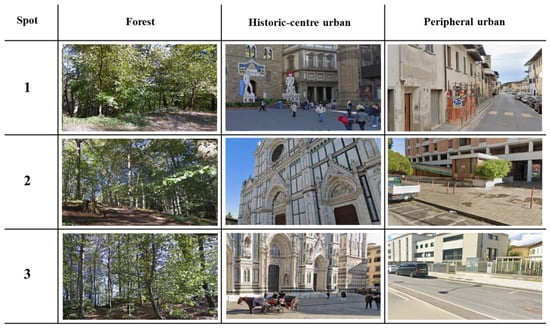
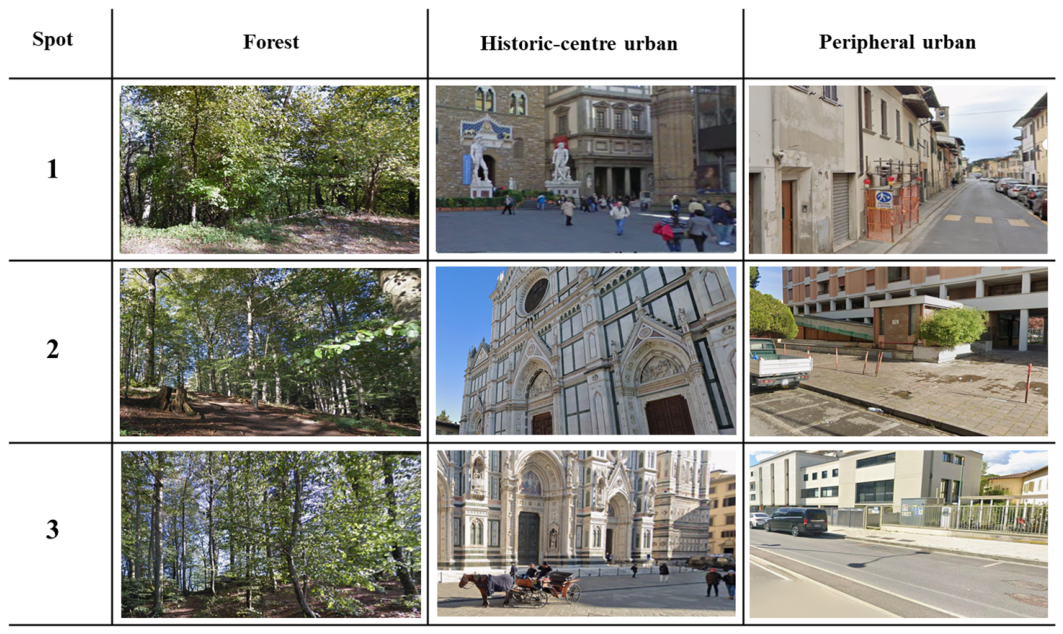
The forest environment consisted of a 360° virtual scene set in three distinct spots of the Italian Apennine Mountains with no human presence (Spot 1: 44.163056, 10.886389; Spot 2: 43.710278, 11.931667; Spot 3: 43.712000, 11.931667).
The peripheral urban environment was a 360° virtual scene set at three locations in peripheral urban areas of Florence (Italy) (Spot 1: 43.795327, 11.150784; Spot 2: 43.785008, 11.231560; Spot 3: 43.794782, 11.222462).
The historic-centre urban environment consisted of a 360° virtual view of the historic center of Florence (Italy), specifically: “Piazza della Signoria” (43.769444, 11.255556), “Piazza Santa Croce” (43.768611, 11.261944) and “Piazza del Duomo” (43.773333, 11.255278).
The three environments also differed in the presence of people and vehicles. The forest scenes contained no people or vehicles. The historic-centre scenes included pedestrians, but no motor vehicles. The peripheral scenes contained motor vehicles (parked and in traffic) and pedestrians. The locations and viewpoints were selected by one experimenter according to predefined operational criteria. Natural environments were characterised by abundant vegetation and natural elements, with limited visible human-made structures. Historical urban environments were characterised by historic architecture, monumental buildings, and culturally significant urban features. Peripheral urban environments were characterised by predominantly modern or utilitarian architecture, limited vegetation, and a greater presence of infrastructure and human-made elements.
Examples of the 360° scenes used in the three environmental conditions are shown in Figure 1.
Figure 1.
Examples of the three spots in each environment: forest, historic-centre urban, and peripheral urban.
2.3. Go/No-Go Task
The Go/No-Go task required participants to respond rapidly to Go stimuli and inhibit responses to No-Go stimuli. White arrows were presented centrally on a gray background: upward arrows served as Go signals, whereas downward arrows served as No-Go signals. Each stimulus was displayed for 200 ms, followed by a 1000 ms blank interval. Participants could respond during the entire 1200-ms interval, including both the stimulus presentation and the subsequent blank interval. The task consisted of 100 randomized trials, with Go trials representing 80% of the sequence (i.e., 80 Go and 20 No-Go trials per block). A short practice phase ensured task comprehension before the experimental run. Go trials without a response were scored as omissions. OpenSesame (3.2.6 Kafkaesque, Koffka; Mathôt et al., 2012) was used for stimuli production and response recording.
2.4. Procedure
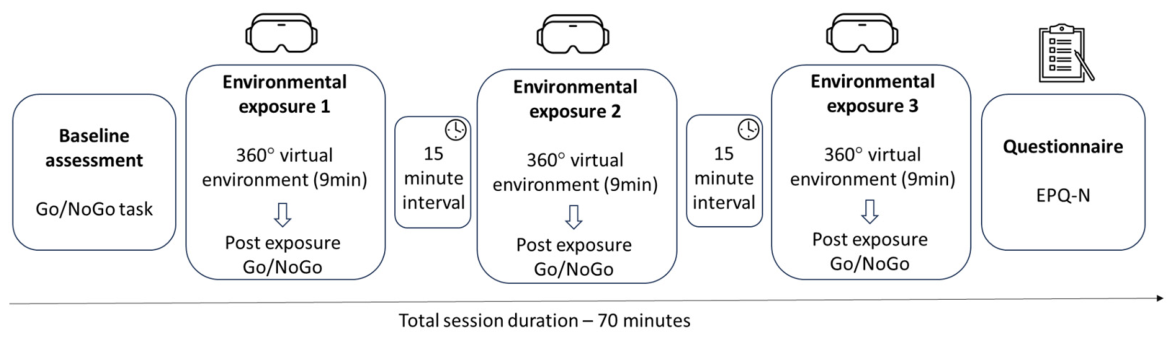
The experiment was conducted in a single session during which each participant completed all three environmental conditions: the peripheral urban environment, the historic-centre urban environment, and the forest environment. At the beginning of the session, participants performed the Go/No-Go task once on a tablet, providing a common baseline cognitive assessment for all three conditions. Participants then explored the first immersive 360° environment through a head-mounted display and immediately afterwards repeated the Go/No-Go task on the same tablet. After completing the task, participants rested, seated and without demanding activities, for 15 min before exploring the second environment and repeating the same procedure. The same sequence was followed for the third environment after a further 15-min rest interval (Figure 2). The entire session, including baseline assessment, environmental exposures, rest intervals, and post-exposure testing, lasted approximately 70 min.
Figure 2.
Flowchart of the experimental procedure.
The order of the three environments was counterbalanced across participants using the six possible presentation sequences to reduce systematic sequence effects. Consequently, all change scores (Δ = post − pre) were calculated relative to the same initial baseline and, for the second and third environments, may also reflect practice, fatigue, and carry-over effects from preceding exposures.
Neuroticism was assessed using the Neuroticism (N) scale of the Eysenck Personality Questionnaire-Revised (EPQ-R), a widely validated self-report instrument. The Eysenck model conceptualizes neuroticism as a stable personality trait characterized by a predisposition to experience negative emotions, including anxiety, depression, guilt feelings, low self-esteem, and moodiness (H. J. Eysenck & Eysenck, 1975). We used the Italian short form of the EPQ-R developed by Colledani et al. (2018), comprising 48 yes/no items, including a 12-item Neuroticism scale (score range: 0–12). The questionnaire was completed at the end of the experimental session, using the same version and administration procedure for both age groups. Neuroticism scores were lower in older adults (M = 4.33, SD = 2.39) than in young adults (M = 7.39, SD = 3.30). Internal consistency in the present sample was α = 0.79 for young adults and α = 0.64 for older adults. The experimental procedure is summarized in Figure 2.
2.5. Data Analysis
The Go/No-Go performance was quantified by extracting reaction times and accuracy measures for each participant in the pre- and post- exposure phases across the three environmental conditions (forest, peripheral urban, historic-centre urban). To capture the effect of environment exposure, change scores (Δ = post − pre) were computed for all indices. Outliers were identified on change scores (Δ = post − pre) as values deviating more than 3 standard deviations from the sample mean of the corresponding condition. A small number of extreme change scores were identified. One older adult showed very large Go-trial accuracy changes in all three conditions, and a few isolated extreme values were present for Go-trial reaction time and commission errors. No data-entry error or protocol violation was identified for these participants. All participants were therefore retained, and the three change-score ANOVAs (Go-trial accuracy, commission errors, and Go-trial reaction time) included the full sample of N = 69. As a sensitivity check, the Go-trial accuracy analysis was repeated after excluding the participant with extreme accuracy changes.
To examine behavioral adjustments following errors in the Go/No-Go task, Post-Error Slowing (PES) was calculated as the difference in reaction time between correct Go trials following an error (post-error trials) and correct Go trials following a correct response (post-correct trials), such that PES = RT_post-error − RT_post-correct. Positive PES values therefore indicate slower responses following errors, consistent with post-error slowing. PES Δ scores (ΔPES = post-exposure PES − pre-exposure PES) were then calculated for each environmental condition, with pre-exposure scores serving as the baseline reference. Negative ΔPES values indicate a reduction in post-error slowing following environmental exposure. To test whether post-exposure performance metrics differed significantly from pre-exposure baseline values (i.e., whether change scores differed significantly from zero), two-tailed one-sample t-tests against zero were conducted on the PES change scores for each environmental condition. Participants who made no commission errors in one or more blocks (baseline and post-exposure assessments across the three environmental conditions) were excluded from the post-error slowing (PES) analysis. The final sample included 51 participants, while 18 participants were excluded (6 older adults and 12 young adults). The median number of commission errors per block was 4 (range = 0–20) across the full sample.
Go-trial accuracy, ΔPES, commission-error, and Go-trial reaction-time change scores were each analyzed with repeated-measures ANOVAs, with environment condition (forest, historic-centre urban, peripheral urban) as the within-subject factor and age group (young, older adults) as the between-subject factor. Greenhouse–Geisser corrections were applied when the assumption of sphericity was not met (Mauchly’s test, p < 0.05), effect sizes are reported as partial η2, and significant effects were followed by Bonferroni-adjusted post hoc tests. Post hoc differences are reported with Bonferroni-adjusted p-values and are expressed as the first-named minus the second-named condition. The 95% confidence intervals for pairwise comparisons are unadjusted for multiple comparisons, whereas the accompanying p-values are Bonferroni-adjusted. The four primary outcomes (Go-trial accuracy, ΔPES, commission errors, and Go-trial reaction time) were analyzed in separate ANOVAs without correction across outcomes; a post hoc Holm correction across the four omnibus environment effects is reported in the Limitations.
To explore the role of neuroticism in the effects of the environments on Go/No-Go performance as a function of age groups, Pearson correlation analyses were conducted. Neuroticism scores (EPQ-N) were correlated with change scores (Δ = post − pre) for each environmental condition and outcome measure. Separate correlation models were run for young and older adult groups. All analyses were performed using JASP (Version 0.98.1; JASP Team, 2026).
3. Results
Descriptive statistics for Go-trial reaction time, Go-trial accuracy, No-Go commission errors and post-error slowing at baseline and after each environment are reported in Table 1.
Table 1.
Behavioral performance metrics in the Go/No-Go task before and after virtual environment exposure in young and older adults.
Commission-error Δ scores did not differ significantly across environment conditions, and neither a main effect of Age Group nor an Environment Condition × Age Group interaction was observed. Mauchly’s test indicated a violation of sphericity (W = 0.854, p = 0.005, ε = 0.873); therefore, Greenhouse–Geisser-corrected results are reported. The analysis revealed no significant main effect of Environment Condition, F(1.75, 118.70) = 0.13, p = 0.852, ηp2 = 0.002, no main effect of Age Group, F(1, 67) = 0.22, p = 0.641, ηp2 = 0.003, and no Environment Condition × Age Group interaction, F(1.75, 118.70) = 0.08, p = 0.902, ηp2 = 0.001. All Bonferroni-adjusted pairwise comparisons were non-significant (all pBonf > 0.05).
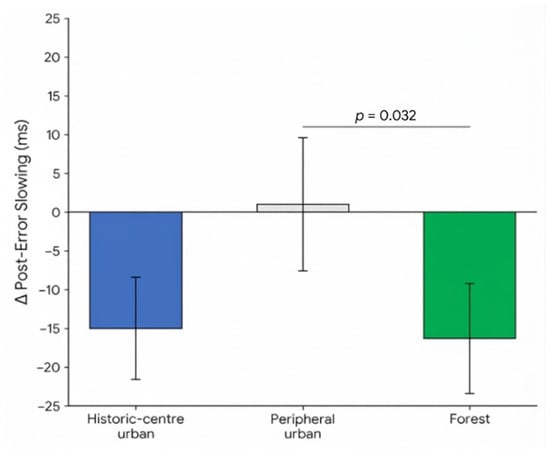
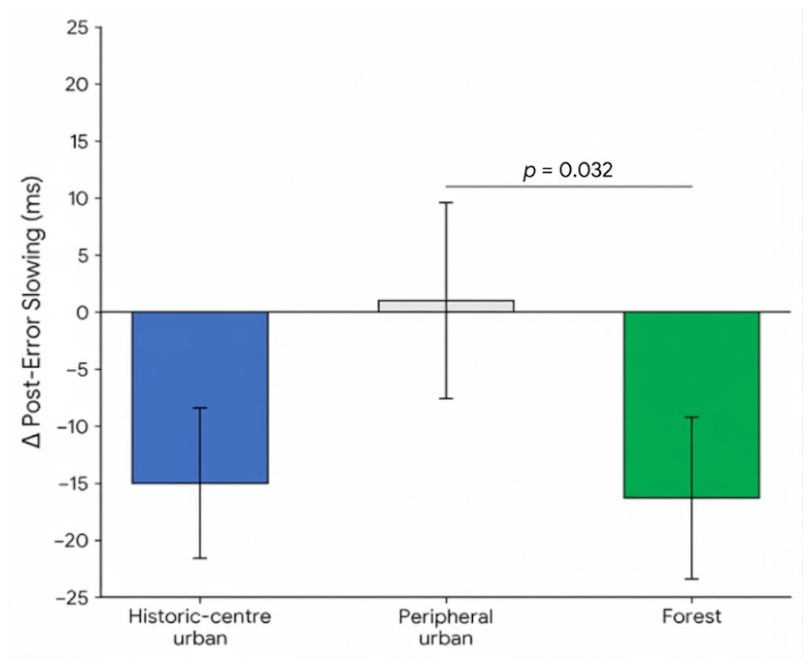
For ΔPES, Mauchly’s test indicated a violation of sphericity (W = 0.488, p < 0.001, Greenhouse–Geisser ε = 0.661); therefore, Greenhouse–Geisser-corrected results are reported. The analysis included the 51 participants with a computable PES in all three conditions (27 older and 24 young adults). The repeated-measures ANOVA revealed a significant main effect of Environment Condition, F(1.32, 64.80) = 5.19, p = 0.018, ηp2 = 0.096. Bonferroni-adjusted post hoc comparisons showed a significant difference between the forest and peripheral urban environments (t(49) = −2.65, pBonf = 0.032; mean difference = −21.7 ms, unadjusted 95% CI [−38.1, −5.3]). The difference between the historic-centre urban and peripheral urban environments was not statistically significant (t(49) = −2.22, pBonf = 0.094; mean difference = −21.1 ms, unadjusted 95% CI [−40.2, −2.0]), and no significant difference emerged between the historic-centre urban and forest environments (t(49) = 0.14, pBonf = 1.000; mean difference = 0.6 ms, unadjusted 95% CI [−8.1, 9.4]). The analysis revealed no significant main effect of Age Group, F(1, 49) = 0.52, p = 0.476, ηp2 = 0.010, and no significant Environment Condition × Age Group interaction, F(1.32, 64.80) = 1.05, p = 0.330, ηp2 = 0.021 (Figure 3).
Figure 3.
Post-Error Slowing (PES) effect across environmental conditions. The blue bar refers to the historic-centre urban environment (n = 56), the gray bar refers to the peripheral urban environment (n = 60), and the green bar refers to the forest (n = 58). Bars depict available-case condition means, whereas the Bonferroni-adjusted pairwise comparison (p = 0.032) derives from the complete-case repeated-measures ANOVA (N). Error bars represent standard errors of the mean.
One-sample t-tests against zero further examined whether ΔPES differed from baseline within each environment. These tests included all participants with a computable PES in the respective condition: n = 58 for the forest condition, n = 56 for the historic-centre urban condition, and n = 60 for the peripheral urban condition. ΔPES was significantly negative following exposure to the forest environment (M = −16.27 ms, SD = 54.69), t(57) = −2.27, p = 0.027, and the historic-centre urban environment (M = −15.03 ms, SD = 49.32), t(55) = −2.28, p = 0.027. In contrast, ΔPES did not differ significantly from zero following exposure to the peripheral urban environment (M = 0.90 ms, SD = 66.51), t(59) = 0.10, p = 0.917.
For Go-trial accuracy change scores (ΔGo accuracy), Mauchly’s test did not indicate a violation of sphericity (W = 0.937, p = 0.119). The repeated-measures ANOVA revealed a significant main effect of Environment Condition, F(2, 134) = 4.10, p = 0.019, ηp2 = 0.058.
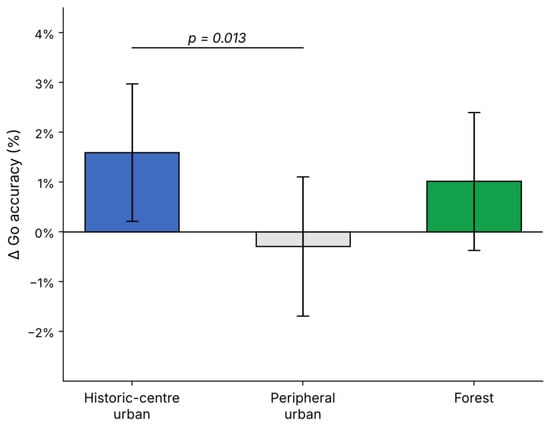
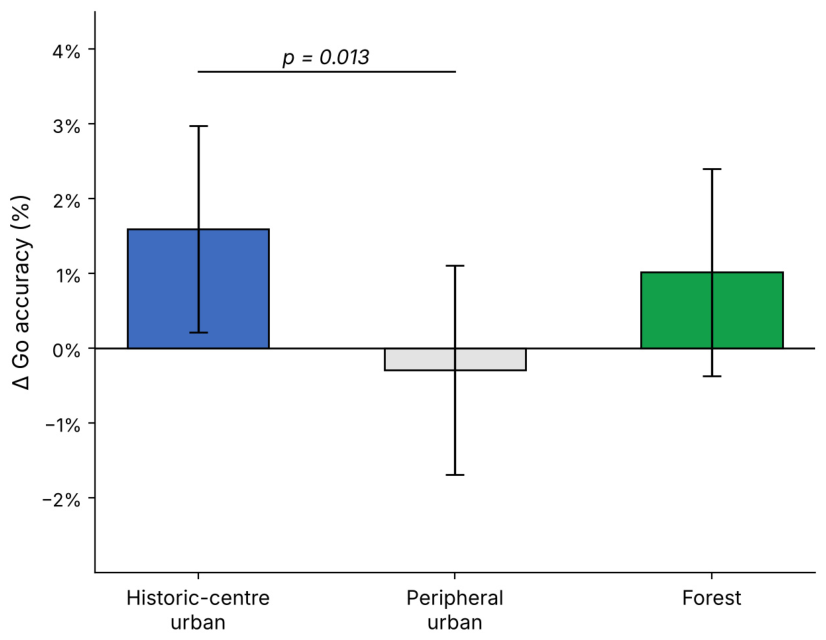
Bonferroni-adjusted post-hoc comparisons indicated that Go-trial accuracy improved significantly more following exposure to the historic-centre urban environment than after the peripheral urban environment, t(67) = 2.95, pBonf = 0.013 (mean difference = 1.87%, unadjusted 95% CI [0.61, 3.13]). Accuracy changes following forest exposure did not differ significantly from either the historic-centre urban environment (t(67) = −0.92, pBonf = 1.000; mean difference = −0.57%, unadjusted 95% CI [−1.81, 0.67]) or the peripheral urban environment (t(67) = 1.74, pBonf = 0.260; mean difference = 1.30%, unadjusted 95% CI [−0.19, 2.79]) (Figure 4). The Environment effect and the historic-centre versus peripheral difference were unchanged when the participant with extreme accuracy changes was excluded (N = 68: F(2, 132) = 4.52, p = 0.013; pBonf = 0.011). Neither a main effect of Age Group (F(1, 67) = 0.93, p = 0.337, ηp2 = 0.014) nor an Environment Condition × Age Group interaction emerged (F(2, 134) = 0.15, p = 0.861, ηp2 = 0.002).
Figure 4.
Changes in Go-trial accuracy from pre- to post-exposure. Each bar represents the mean change score for one environmental condition. The blue bar represents the historic-centre urban environment, the gray bar the peripheral urban environment, and the green bar the forest environment. Positive values indicate increased accuracy, whereas negative values indicate decreased accuracy. Error bars represent ±1 SEM (N = 69).
For Go-trial reaction time change scores (ΔGo RT), Mauchly’s test indicated a violation of sphericity (W = 0.721, p < 0.001, ε = 0.771); therefore, Greenhouse–Geisser-corrected results are reported. A 3 (Environment Condition: Forest, Historic-centre urban, Peripheral urban) × 2 (Age Group: Young, Older adults) repeated-measures ANOVA revealed no significant main effect of Environment Condition, F(1.54, 104.90) = 0.66, p = 0.481, ηp2 = 0.010, ε = 0.771. No significant main effect of Age Group was observed, F(1, 67) = 0.81, p = 0.371, ηp2 = 0.012, nor did an Environment Condition × Age Group interaction emerge, F(1.54, 104.90) = 0.42, p = 0.612, ηp2 = 0.006. Bonferroni-adjusted post-hoc pairwise comparisons confirmed no significant differences between environmental conditions (all pBonf > 0.90).
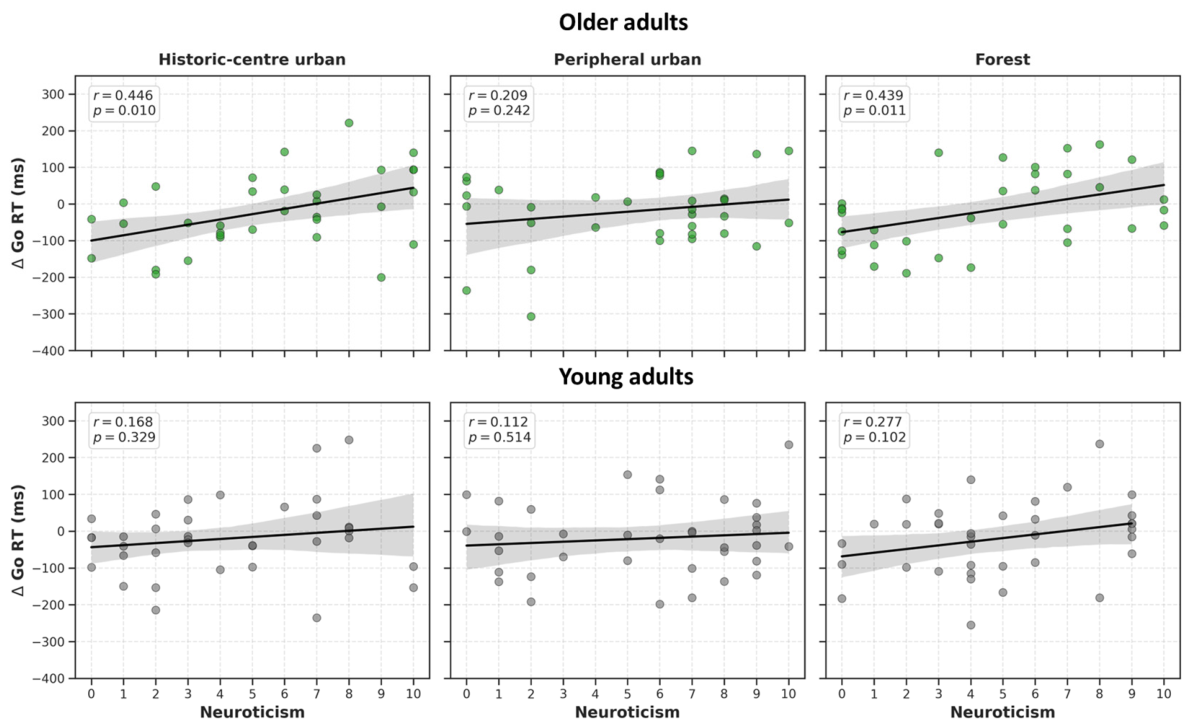
In exploratory correlation analyses within older adults, Neuroticism correlated positively with Go-trial reaction time changes (ΔGo RT) following exposure to both the forest (r = 0.439, p = 0.011) and historic-centre urban (r = 0.446, p = 0.010) environments, indicating that higher neuroticism in older adults was associated with relative cognitive slowing post-exposure. A positive but non-significant association was also observed after the peripheral urban environment (r = 0.209, p = 0.242). In young adults, these associations were not statistically significant (Figure 5).
Figure 5.
Scatter plots showing the relationship between neuroticism and reaction-time change scores (ΔGo RT) following exposure to the historic-centre urban, peripheral urban, and forest environments, separately for older adults (top row) and young adults (bottom row). Positive ΔGo RT values indicate slower responses after exposure. Each dot represents an individual participant; green dots denote older adults and gray dots denote young adults. Solid black lines indicate fitted linear regressions, and shaded areas represent 95% confidence intervals around the fitted regression lines. Pearson correlation coefficients (r) and p-values are reported in each panel.
The remaining exploratory correlations were not statistically significant (uncorrected); for completeness, in young adults, the correlation between neuroticism and accuracy changes in the peripheral urban condition was r = −0.319, p = 0.058.
4. Discussion
The aim of the present study was to investigate, through immersive exposure to 360° environments, whether the cognitive effects commonly attributed to natural environments are specifically linked to their naturalness or can be partly traced back to more general characteristics of the environmental stimulus, such as perceptual quality. We evaluated inhibitory control using the Go/No-Go task across three environmental contexts (a forest, a historic-centre urban environment, and a peripheral urban environment) in two age groups (young and older adults) and further examined whether individual differences in neuroticism were associated with these environmental effects.
Overall, the results outline a selective rather than generalized picture. In the Go/No-Go task, accuracy on Go trials increased more after the historic-centre urban environment compared to the peripheral urban area, while accuracy changes following forest exposure did not differ significantly from either of the other conditions. Post-error slowing (PES) decreased more after forest exposure than after peripheral urban exposure, with the historic-centre urban environment showing a similar but non-significant trend relative to the peripheral condition, and no reduction occurred after the peripheral urban environment. The forest and historic-centre urban environments did not differ from each other on either accuracy or PES. No significant effects were observed on reaction times or commission errors, and age did not significantly modulate these results. Because presentation order was counterbalanced but not modeled statistically and no no-exposure control was included, these between-condition differences cannot be attributed to environmental exposure alone.
Regarding the hypotheses, H1 (fewer commission errors after the forest and historic-centre environments than after the peripheral environment) was not supported. H2 (higher Go accuracy) received preliminary support only for the historic-centre versus the peripheral environment, not for the forest. H3 (smaller PES) received preliminary support only for the forest versus the peripheral environment. Neither effect remains statistically significant after Holm correction across the four primary outcomes, so both require replication. H4 (age moderation) was not supported.
The clearest improvement in accuracy was observed not for the forest but for the historic-centre urban setting, tentatively calling into question a traditional dichotomy that attributes cognitive benefits exclusively to nature. However, this should not be interpreted as evidence that a particular feature (e.g., aesthetics) constitutes the causal mechanism given that the three conditions differed simultaneously along multiple dimensions, such as naturalness, architectural characteristics, visual complexity, familiarity, historical-cultural content and emotional involvement; it is more prudent to conclude that some characteristics of built environments can contribute to the efficiency of the response in inhibitory control tasks, and that the quality of the environmental experience cannot be reduced to the sole presence of natural elements. This reading is consistent with the evidence that affective responses to environments depend on individual and perceptual characteristics rather than on the degree of naturalness of the stimulus (Felisberti et al., 2026); an urban environment can share psychologically relevant properties with a natural one (visual attractiveness, pleasantness, ability to capture attention without a high cognitive control) even if it is not “natural” in the strict sense. Neurophysiological evidence points in a similar direction. McDonnell et al. (2025), using EEG, showed that natural images can produce lower parietal alpha power than urban images, indicating greater visual engagement, while frontal theta power, an index of cognitive/attentional demand, did not differ significantly between the two conditions.
Although the present study lacks neurophysiological measurements, this suggests that naturalness is not the decisive factor per se, but the way in which the stimulus orients and engages attentional resources, and that particular environments can produce a spontaneous involvement that partially shares functional properties attributed to nature. The advantage observed here for the historic-centre urban environment in Go/No-Go accuracy could preliminarily reflect a similar mechanism, although this parallel with the neurophysiological findings of McDonnell et al. (2025) remains speculative. If a fluid and engaging mode of attentional orienting is indeed what distinguishes the forest and historic-centre urban environments from the peripheral urban environment, its influence should not be limited to accuracy alone but should also be detectable in indices reflecting the efficiency of post-error attentional recovery.
A significant effect of environmental condition on post-error slowing was observed, with a decrease after exposure to both forest and historic-centre urban environments, whereas no reduction occurred after peripheral urban environment relative to pre-exposure. Because there was no no-exposure control, within-condition changes cannot be separated from practice and time-on-task, so this pattern is interpreted only relative to the peripheral urban condition. Bonferroni-adjusted post hoc comparisons indicated that this reduction reached statistical significance only for the forest vs. peripheral urban comparison, while the historic-centre urban environment showed a comparable but non-significant trend relative to the peripheral urban environment. PES has traditionally been interpreted according to two complementary perspectives: conflict-monitoring models, according to which slowing down reflects an increase in strategic caution following error detection, and orienting theory, according to which it reflects an automatic and transient attentional response to error salience; temporarily diverting resources away from the task. These two accounts imply different readings of a reduction in PES: smaller slowdown could indicate less strategic caution (conflict monitoring) or less attentional capture by the error (orienting). The present data cannot distinguish between them, because neither error monitoring nor attentional recovery was measured directly. The larger reduction in PES after the forest than after the peripheral urban environment, and, as a non-significant trend, after the historic-centre urban environment, is therefore compatible with a reduced attentional response to errors, as would be expected from a stress-reduction effect, in line with Stress Reduction Theory (Ulrich, 1983) and Attention Restoration Theory (Kaplan & Kaplan, 1989), but it is equally compatible with reduced post-error caution, and it should not be read as improved performance. Because PES is a multi-determined phenomenon whose direction depends on the mechanism engaged (Notebaert et al., 2009; Danielmeier & Ullsperger, 2011), studies including direct measures of error monitoring are needed. Moreover, because several PES estimates rested on relatively few post-error observations, this result should be regarded as preliminary and interpreted with caution.
Performance after exposure to the forest and historic-centre urban environments did not differ significantly from each other with regard to either accuracy or PES. The larger accuracy change after the historic-centre environment and the larger PES reduction after the forest should therefore not be taken as evidence that the two environments affected different cognitive processes.
While age did not moderate the effects of environmental exposure on PES or accuracy, individual differences in personality traits, particularly neuroticism, revealed a more nuanced pattern. The findings also provide preliminary insights into the potential association between neuroticism and cognitive responses across environmental conditions. In older adults, neuroticism was significantly associated with slower Go-trial reaction times following forest and historic-centre urban exposure, a pattern that could be consistent with a speed-accuracy trade-off (Ratcliff, 1978; Wickelgren, 1977), although the absence of corresponding accuracy improvements suggests that emotional or attentional interference may also play a role. Building on the work of Benedetti et al. (2024), who examined trait anxiety in young adults using 2D video presentations of forest and urban environments, the present study extends this line of research by investigating the broader construct of neuroticism across age groups using immersive 360° environmental contexts. In exploratory analyses, neuroticism (a trait encompassing anxiety, depression, and emotional reactivity) was associated with slower reaction times after environmental exposure in older adults, possibly through different cognitive mechanisms (Curtis et al., 2015). This association was also positive, although smaller and non-significant, after the peripheral urban environment (r = 0.209), and all six coefficients were positive; it cannot therefore be considered environment-specific. Because all change scores share the same baseline, the correlations are not independent and may partly reflect baseline reaction speed. Moreover, neuroticism scores were lower and less variable in older adults, and the internal consistency of the scale was lower (α = 0.64 vs. 0.79 in young adults), which limits the reliability of the older-adult correlations and the comparison between age groups.
Comparison with the literature on virtual exposure offers further interpretative elements. Mostajeran et al. (2021), comparing forest and urban environments through slideshows and 360° videos, found that the forest environment had a positive effect on cognition regardless of presentation modality, while photo slideshows were more effective than immersive 360° videos in reducing physiological arousal, for either environment. This suggests that the presence of nature and the degree of immersion are not in themselves sufficient to determine cognitive improvement, and that presentation modality can modulate the physiological impact of the stimulus, independently of its cognitive effects, indicating that the effects depend on the interaction between stimulus, modality, duration, and the cognitive process being investigated. Since the present study relied exclusively on 360° immersive environments, this may partly help explain the weaker, non-significant improvement observed after the forest condition on Go/No-Go accuracy, reflecting a limited effect, difficult to detect with the brief exposure and sample size adopted, while the significance obtained on the PES suggests that this index may be more sensitive to transient changes in attentional/emotional state than to accuracy alone. More recent reviews also indicate that the effects of natural environments on cognition, particularly on sustained attention, directed attention and memory, are heterogeneous (Bell et al., 2025; Fu et al., 2025). Indeed, experimental findings on this point are mixed; Pasanen et al. (2018), for instance, found that restoration-based engagement tasks during nature walks improved sustained attention performance without producing significant effects on self-reported mood, a pattern that runs counter to the more general trend and underscores a partial dissociation between affective and cognitive restoration.
A relevant aspect concerns the circumscription of the observed effect. The advantage in Go/No-Go concerns accuracy in Go trials, not commission errors in No-Go trials, a measure more directly related to inhibitory control in the narrow sense. Accuracy in Go trials primarily reflects the ability to maintain attention and correctly execute the required response, rather than inhibitory control; this pattern therefore points to a transient change in attentional efficiency or response preparation, not to a specific enhancement of response inhibition. This distinction is relevant in light of the study by Benedetti et al. (2023), in which exposure to a virtual forest environment was associated with an improvement in inhibitory control, an effect subsequently shown to be modulated by the level of trait anxiety (Benedetti et al., 2024).
The absence of effects on commission errors in the present study could therefore partly reflect differences in experimental paradigms, presentation modality (2D videos vs. immersive 360° environments), duration of exposure, or the inclusion of two distinct urban conditions rather than a single urban category. In particular, the inclusion of a historic-centre urban environment highlights an often overlooked aspect of nature-urban comparisons. The urban environment is not a homogeneous category, and some of its characteristics can produce cognitive responses similar to those of nature. The lack of effects on reaction times reinforces this limited interpretation; a general increase in processing speed should have led to a systematic reduction in reaction times, a pattern that did not occur. The improvement in accuracy therefore appears to represent a limited modification of attentional state, to which it is not appropriate to attribute too broad a functional significance, especially considering the short duration of exposure.
Taken together, this selective pattern of findings, an accuracy advantage for the historic-centre urban environment, a PES advantage that was statistically significant for forest relative to the peripheral urban environment and present as a non-significant trend for the historic-centre urban environment, null effects on commission errors, and exploratory neuroticism–reaction time associations in older adults, suggests reformulating the initial research question. Rather than asking whether nature is cognitively advantageous compared to the city, it seems more productive to investigate which environmental characteristics, naturalness, but also perceptual quality, aesthetics, complexity, and familiarity, drive specific cognitive effects, and how they interact with individual differences such as age and personality. The fact that the historic-centre urban condition produced the greatest improvement in accuracy suggests that certain characteristics of built environments can contribute to these effects, without identifying aesthetic quality as the specific causal mechanism. The exploratory neuroticism findings offer hypotheses for future work on individual differences in emotional reactivity.
If confirmed in larger and better-controlled studies, these findings would tentatively suggest that improving the perceptual and architectural quality of urban spaces could complement, rather than replace, strategies based on increasing urban greenery, especially where access to nature is limited, while also highlighting the need to consider personality traits when designing interventions for different populations.
Several limitations should be acknowledged. The relatively small sample size may have limited the statistical power of some analyses. Two environmental effects emerged across four primary outcome measures (Go-trial accuracy, p = 0.019; ΔPES, p = 0.018), and neither would remain statistically significant after Holm correction across the four outcomes (Holm-adjusted p = 0.072 for both); no such correction was applied in the main analyses. These effects should therefore be regarded as preliminary and in need of replication, and the support for H2 and H3 should not be read as confirmatory evidence. PES estimates often rested on few post-error trials (median of four commission errors per block). The PES finding should therefore be regarded as preliminary. Because PES was computed with the traditional method, it may also be confounded by global performance fluctuations (Dutilh et al., 2012), and neither a robust PES estimator nor post-error accuracy was analysed. A single baseline preceded all exposures and there was no no-exposure control, so change scores for later exposures may include practice, fatigue, and carry-over effects; although the six presentation sequences were used to counterbalance order across participants (with 69 participants they could not be exactly equally represented), presentation order was not modeled statistically. Performance differences between conditions therefore cannot be attributed to environmental exposure alone. Health status was self-reported; cognitive screening, education, prior VR experience, and cybersickness were not assessed. Scenes were selected by one experimenter without independent rating, and imagery dates and lighting may differ across conditions. The neuroticism correlations were exploratory and no correction for multiple comparisons was applied. Older adults showed faster baseline Go-trial reaction times alongside higher commission error rates than young adults, which may reflect a speed-oriented response strategy that should be considered when interpreting the neuroticism–RT correlations. Moreover, the three environments differed in several respects, including naturalness, visual complexity, brightness, architectural features, familiarity and historical-cultural content. Although the design allowed comparisons between environments differing in naturalness and overall environmental characteristics, it did not permit the independent effects of these features to be established. In addition, subjective ratings of aesthetic quality, perceived naturalness, restorativeness and mood were not collected, limiting the interpretation of participants’ perceptions of the environments.
Future studies should recruit larger samples and systematically manipulate environmental features, including greenery, spatial enclosure, visual complexity, brightness and architectural quality. Controlling exposure duration and navigation, incorporating subjective ratings and, where appropriate, cognitive screening and cybersickness assessments, would help clarify the relationship between environmental characteristics and cognitive performance. Comparing multiple levels of aesthetic quality within both natural and urban settings would also help establish whether naturalness and aesthetic quality contribute independently or interact in their effects on cognition.
5. Conclusions
The present study does not provide evidence of a generalized and specifically nature-dependent cognitive advantage, but outlines a more nuanced picture, in which some characteristics of the environment and its perceptual quality may contribute to response accuracy in inhibitory control tasks. The findings provide preliminary evidence that a historic urban setting is associated with improvement in Go-trial accuracy and that forest exposure is associated with a larger reduction of post-error slowing than a peripheral urban setting, without evidence of age-specific effects. In exploratory analyses, higher neuroticism was associated with slower reaction times in older adults after forest and historic-centre urban exposure, with a similar but non-significant association after peripheral urban exposure (not environment-specific). Immersive virtual reality appears to be a feasible tool for investigating how environments relate to cognition across the lifespan; future studies should include direct measures of perceived aesthetics and restoration, better-controlled stimuli and larger samples. These findings should be interpreted with caution; neither main effect survived Holm correction across the four primary outcomes, presentation order was counterbalanced but not modeled statistically, the PES estimates rested on relatively few post-error observations, and replication in larger, better-controlled studies is needed.
Author Contributions
Conceptualization, G.G., S.M. and M.P.V.; methodology, V.B.; formal analysis, L.P.; investigation, A.D.B. and A.A.; resources, G.G. and M.P.V.; data curation, L.P., A.D.B. and S.M.; writing—original draft preparation, L.P. and M.P.V.; writing—review and editing, V.B. and F.R.B.; visualization, L.P.; supervision, M.P.V. All authors have read and agreed to the published version of the manuscript.
Funding
This research received no external funding.
Institutional Review Board Statement
This study was performed according to the Declaration of Helsinki and was approved by the Ethical Committee of the University of Florence (No. 253, 2023).
Informed Consent Statement
Informed consent was obtained from all subjects involved in the study.
Data Availability Statement
The raw data supporting the conclusions of this article will be made available by the authors on request.
Conflicts of Interest
The authors declare no conflicts of interest.
References
- Antonelli, M., Barbieri, G., & Donelli, D. (2019). Effects of forest bathing (Shinrin-Yoku) on levels of cortisol as a stress biomarker: A systematic review and meta-analysis. International Journal of Biometeorology, 63, 1117–1134. [Google Scholar] [CrossRef] [Scilit] [PubMed]
- Astell-Burt, T., Mitchell, R., & Hartig, T. (2014). The association between green space and mental health varies across the lifecourse: A longitudinal study. Journal of Epidemiology and Community Health, 68, 578–583. [Google Scholar] [CrossRef] [Scilit] [PubMed]
- Bang, K.-S., Kim, S., Song, M. K., Kang, K. I., & Jeong, Y. (2018). The effects of a health promotion program using urban forests and nursing student mentors on the perceived and psychological health of elementary school children in vulnerable populations. International Journal of Environmental Research and Public Health, 15, 1977. [Google Scholar] [CrossRef] [Scilit] [PubMed]
- Bell, C. N., St George, R., Honan, C., Bell, L. J., Jolly, A. T., & Matthews, A. (2025). The relationship between nature exposures and attention restoration, as moderated by exposure duration: A systematic review and meta-analysis. Journal of Environmental Psychology, 104, 102632. [Google Scholar] [CrossRef] [Scilit]
- Benedetti, V., Gavazzi, G., Giganti, F., Carlo, E., Becheri, F. R., Zabini, F., Giovannelli, F., & Viggiano, M. P. (2023). Virtual forest environment influences inhibitory control. Land, 12, 1390. [Google Scholar] [CrossRef] [Scilit]
- Benedetti, V., Giganti, F., Cotugno, M., Noferini, C., Gavazzi, G., Gronchi, G., Righi, S., Meneguzzo, F., Becheri, F. R., Li, Q., & Viggiano, M. P. (2024). Interplay among anxiety, digital environmental exposure, and cognitive control: Implications of natural settings. Behavioral Sciences, 14, 323. [Google Scholar] [CrossRef] [Scilit] [PubMed]
- Berggren, N., & Derakshan, N. (2014). Inhibitory deficits in trait anxiety: Increased stimulus-based or response-based interference? Psychonomic Bulletin & Review, 21, 1339–1345. [Google Scholar] [CrossRef] [Scilit] [PubMed]
- Berman, M. G., Jonides, J., & Kaplan, S. (2008). The cognitive benefits of interacting with nature. Psychological Science, 19, 1207–1212. [Google Scholar] [CrossRef] [Scilit] [PubMed]
- Bielinis, E., Jaroszewska, A., Łukowski, A., & Takayama, N. (2020). The effects of a forest therapy programme on mental hospital patients with affective and psychotic disorders. International Journal of Environmental Research and Public Health, 17, 118. [Google Scholar] [CrossRef] [Scilit] [PubMed]
- Buczyłowska, D., Zhao, T., Singh, N., Jurczak, A., Siry, A., & Markevych, I. (2023). Exposure to greenspace and bluespace and cognitive functioning in children—A systematic review. Environmental Research, 222, 115340. [Google Scholar] [CrossRef] [Scilit] [PubMed]
- Chou, C.-C., Lin, J.-N., Yu, C.-P., Chen, C.-W., Yeh, A.-Y., & Lin, Y.-K. (2026). Effects of a virtual reality–based natural environment intervention on attention and mood in community-dwelling older adults: Randomized controlled trial. JMIR Aging, 9, e87861. [Google Scholar] [CrossRef] [Scilit] [PubMed]
- Chun, M. H., Chang, M. C., & Lee, S.-J. (2017). The effects of forest therapy on depression and anxiety in patients with chronic stroke. International Journal of Neuroscience, 127, 199–203. [Google Scholar] [CrossRef] [Scilit] [PubMed]
- Colledani, D., Anselmi, P., & Robusto, E. (2018). Using item response theory for the development of a new short form of the Eysenck Personality Questionnaire-Revised. Frontiers in Psychology, 9, 1834. [Google Scholar] [CrossRef] [Scilit] [PubMed]
- Curtis, R. G., Windsor, T. D., & Soubelet, A. (2015). The relationship between Big-5 personality traits and cognitive ability in older adults—A review. Aging, Neuropsychology, and Cognition, 22(1), 42–71. [Google Scholar] [CrossRef] [Scilit] [PubMed]
- Danielmeier, C., & Ullsperger, M. (2011). Post-error adjustments. Frontiers in Psychology, 2, 233. [Google Scholar] [CrossRef] [Scilit] [PubMed]
- Dutilh, G., van Ravenzwaaij, D., Nieuwenhuis, S., van der Maas, H. L. J., Forstmann, B. U., & Wagenmakers, E.-J. (2012). How to measure post-error slowing: A confound and a simple solution. Journal of Mathematical Psychology, 56, 208–216. [Google Scholar] [CrossRef] [Scilit]
- Eysenck, H. J., & Eysenck, S. B. G. (1975). Manual of the Eysenck personality questionnaire. Hodder & Stoughton. [Google Scholar]
- Eysenck, M. W., Derakshan, N., Santos, R., & Calvo, M. G. (2007). Anxiety and cognitive performance: Attentional control theory. Emotion, 7, 336–353. [Google Scholar] [CrossRef] [Scilit] [PubMed]
- Farrow, M. R., & Washburn, K. (2019). A review of field experiments on the effect of forest bathing on anxiety and heart rate variability. Global Advances in Health and Medicine, 8, 2164956119848654. [Google Scholar] [CrossRef] [Scilit] [PubMed]
- Faul, F., Erdfelder, E., Lang, A.-G., & Buchner, A. (2007). G*Power 3: A flexible statistical power analysis program for the social, behavioral, and biomedical sciences. Behavior Research Methods, 39(2), 175–191. [Google Scholar] [CrossRef] [Scilit] [PubMed]
- Felisberti, F. M., Parraga, C. A., & Harrison, N. (2026). Psychological determinants of aesthetic and affective preferences for nature and urban scenes: Anxiety, nature exposure, and mental imagery. Empirical Studies of the Arts, 44, 22–46. [Google Scholar] [CrossRef] [Scilit]
- Fu, Y., Yang, P. B., Lam, T. L. H., Lau, B. W. M., & Tan, D. G. H. (2025). The effect of the natural environment on cognition, mood and stress in adults: A systematic review. Journal of Environmental Psychology, 106, 102802. [Google Scholar]
- Gascon, M., Triguero-Mas, M., Martínez, D., Dadvand, P., Forns, J., Plasència, A., & Nieuwenhuijsen, M. J. (2015). Mental health benefits of long-term exposure to residential green and blue spaces: A systematic review. International Journal of Environmental Research and Public Health, 12, 4354–4379. [Google Scholar] [CrossRef] [Scilit] [PubMed]
- Grilli, G., & Sacchelli, S. (2020). Health benefits derived from forest: A review. International Journal of Environmental Research and Public Health, 17, 6125. [Google Scholar] [CrossRef] [Scilit] [PubMed]
- JASP Team. (2026). JASP (Version 0.98.1) [Computer software]. JASP Team.
- Kaplan, S., & Kaplan, R. (1989). The experience of nature: A psychological perspective. Cambridge University Press. [Google Scholar]
- Leung, G. Y. S., Hazan, H., & Chan, C. S. (2022). Exposure to nature in immersive virtual reality increases connectedness to nature among people with low nature affinity. Journal of Environmental Psychology, 83, 101863. [Google Scholar] [CrossRef] [Scilit]
- Lim, P. Y., Dillon, D., & Chew, P. K. H. (2020). A guide to nature immersion: Psychological and physiological benefits. International Journal of Environmental Research and Public Health, 17, 5989. [Google Scholar] [CrossRef] [Scilit] [PubMed]
- Mathôt, S., Schreij, D., & Theeuwes, J. (2012). OpenSesame: An open-source, graphical experiment builder for the social sciences. Behavior Research Methods, 44(2), 314–324. [Google Scholar] [CrossRef] [Scilit] [PubMed]
- McDonnell, A. S., LoTemplio, S. B., Scott, E. E., & Strayer, D. L. (2025). Nature images are more visually engaging than urban images: Evidence from neural oscillations in the brain. Frontiers in Human Neuroscience, 19, 1575102. [Google Scholar] [CrossRef] [Scilit] [PubMed]
- Mostajeran, F., Krzikawski, J., Steinicke, F., & Kühn, S. (2021). Effects of exposure to immersive videos and photo slideshows of forest and urban environments. Scientific Reports, 11(1), 3994. [Google Scholar] [CrossRef] [Scilit] [PubMed]
- Mygind, L., Kjeldsted, E., Hartmeyer, R., Mygind, E., Bølling, M., & Bentsen, P. (2019). Mental, physical and social health benefits of immersive nature-experience for children and adolescents: A systematic review and quality assessment of the evidence. Health & Place, 58, 102136. [Google Scholar] [CrossRef] [Scilit] [PubMed]
- Notebaert, W., Houtman, F., Van Opstal, F., Gevers, W., Fias, W., & Verguts, T. (2009). Post-error slowing: An orienting account. Cognition, 111(2), 275–279. [Google Scholar] [CrossRef] [Scilit] [PubMed]
- Pacheco-Unguetti, A., Acosta, A., Lupiáñez, J., Román, N., & Derakshan, N. (2012). Response inhibition and attentional control in anxiety. Quarterly Journal of Experimental Psychology, 65, 646–660. [Google Scholar] [CrossRef] [Scilit] [PubMed]
- Palanica, A., Lyons, A., Cooper, M., Lee, A., & Fossat, Y. (2019). A comparison of nature and urban environments on creative thinking across different levels of reality. Journal of Environmental Psychology, 63, 44–51. [Google Scholar] [CrossRef] [Scilit]
- Pasanen, T., Johnson, K., Lee, K., & Korpela, K. (2018). Can nature walks with psychological tasks improve mood, self-reported restoration, and sustained attention? Results from two experimental field studies. Frontiers in Psychology, 9, 2057. [Google Scholar] [CrossRef] [Scilit] [PubMed]
- Pavic, K., Vergilino-Perez, D., & Gricourt, T. (2024). Age-related differences in subjective and physiological emotion evoked by immersion in natural and social virtual environments. Scientific Reports, 14, 15320. [Google Scholar] [CrossRef] [Scilit] [PubMed]
- Rajoo, K. S., Karam, D. S., & Abdullah, M. Z. (2020). The physiological and psychosocial effects of forest therapy: A systematic review. Urban Forestry & Urban Greening, 54, 126744. [Google Scholar] [CrossRef] [Scilit]
- Ratcliff, R. (1978). A theory of memory retrieval. Psychological Review, 85, 59–108. [Google Scholar] [CrossRef] [Scilit]
- Reese, G., Stahlberg, J., & Menzel, C. (2022). Digital Shinrin-Yoku: Do nature experiences in virtual reality reduce stress and increase well-being as strongly as similar experiences in a physical forest? Virtual Reality, 26, 1245–1255. [Google Scholar] [CrossRef] [Scilit]
- Roberts, B. W., Walton, K. E., & Viechtbauer, W. (2006). Patterns of mean-level change in personality traits across the life course: A meta-analysis of longitudinal studies. Psychological Bulletin, 132, 1–25. [Google Scholar] [CrossRef] [Scilit] [PubMed]
- Salthouse, T. A. (2010). Selective review of cognitive aging. Journal of the International Neuropsychological Society, 16, 754–760. [Google Scholar] [CrossRef] [Scilit] [PubMed]
- Siah, C. J. R., Goh, Y. S., Lee, J., Poon, S. N., Ow Yong, J. Q. Y., & Tam, W.-S. W. (2023). The effects of forest bathing on psychological well-being: A systematic review and meta-analysis. International Journal of Mental Health Nursing, 32, 1038–1054. [Google Scholar] [CrossRef] [Scilit] [PubMed]
- Song, I., Baek, K., Kim, C., & Song, C. (2023). Effects of nature sounds on the attention and physiological and psychological relaxation. Urban Forestry & Urban Greening, 86, 127987. [Google Scholar] [CrossRef] [Scilit]
- Spano, G., Theodorou, A., Reese, G., Carrus, G., Sanesi, G., & Panno, A. (2023). Virtual nature, psychological and psychophysiological outcomes: A systematic review. Journal of Environmental Psychology, 89, 102044. [Google Scholar] [CrossRef] [Scilit]
- Sun, Y., Li, F., He, T., Meng, Y., Yin, J., Yim, I. S., Xu, L., & Wu, J. (2023). Physiological and affective responses to green space virtual reality among pregnant women. Environmental Research, 216, 114499. [Google Scholar] [CrossRef] [Scilit] [PubMed]
- Triguero-Mas, M., Donaire-Gonzalez, D., Seto, E., Valentín, A., Martínez, D., Smith, G., Hurst, G., Carrasco-Turigas, G., Masterson, D., van den Berg, M., Ambròs, A., Martínez-Íñiguez, T., Dedele, A., Ellis, N., Grazulevicius, T., Voorsmit, M., Cirach, M., Cirac-Claveras, J., Swart, W., … Nieuwenhuijsen, M. J. (2017). Natural outdoor environments and mental health: Stress as a possible mechanism. Environmental Research, 159, 629–638. [Google Scholar] [CrossRef] [Scilit] [PubMed]
- Twohig-Bennett, C., & Jones, A. (2018). The health benefits of the great outdoors: A systematic review and meta-analysis of greenspace exposure and health outcomes. Environmental Research, 166, 628–637. [Google Scholar] [CrossRef] [Scilit] [PubMed]
- Ulrich, R. S. (1983). Aesthetic and affective response to natural environment. In I. Altman, & J. F. Wohlwill (Eds.), Behavior and the natural environment (pp. 85–125). Plenum Press. [Google Scholar]
- Wen, Y., Yan, Q., Pan, Y., Gu, X., & Liu, Y. (2019). Medical empirical research on forest bathing (Shinrin-Yoku): A systematic review. Environmental Health and Preventive Medicine, 24, 70. [Google Scholar] [CrossRef] [Scilit] [PubMed]
- Wickelgren, W. A. (1977). Speed-accuracy tradeoff and information processing dynamics. Acta Psychologica, 41, 67–85. [Google Scholar] [CrossRef] [Scilit]
- Yeon, P.-S., Jeon, J.-Y., Jung, M.-S., Min, G.-M., Kim, G.-Y., Han, K.-M., Shin, M.-J., Jo, S.-H., Kim, J.-G., & Shin, W.-S. (2021). Effect of forest therapy on depression and anxiety: A systematic review and meta-analysis. International Journal of Environmental Research and Public Health, 18, 12685. [Google Scholar] [CrossRef] [Scilit] [PubMed]
- Yu, C.-P., Lee, H.-Y., Lu, W.-H., Huang, Y.-C., & Browning, M. H. E. M. (2020). Restorative effects of virtual natural settings on middle-aged and elderly adults. Urban Forestry & Urban Greening, 56, 126863. [Google Scholar] [CrossRef] [Scilit]
- Zabini, F., Albanese, L., Becheri, F. R., Gavazzi, G., Giganti, F., Giovannelli, F., Gronchi, G., Guazzini, A., Laurino, M., Li, Q., Marzi, T., Mastorci, F., Meneguzzo, F., Righi, S., & Viggiano, M. P. (2020). Comparative study of the restorative effects of forest and urban videos during COVID-19 lockdown: Intrinsic and benchmark values. International Journal of Environmental Research and Public Health, 17(21), 8011. [Google Scholar] [CrossRef] [Scilit] [PubMed]
- Zhou, C., Yan, L., Yu, L., Wei, H., Guan, H., Shang, C., Chen, F., & Bao, J. (2019). Effect of short-term forest bathing in urban parks on perceived anxiety of young-adults: A pilot study in Guiyang, Southwest China. Chinese Geographical Science, 29, 139–150. [Google Scholar] [CrossRef] [Scilit]

Disclaimer/Publisher’s Note: The statements, opinions and data contained in all publications are solely those of the individual author(s) and contributor(s) and not of MDPI and/or the editor(s). MDPI and/or the editor(s) disclaim responsibility for any injury to people or property resulting from any ideas, methods, instructions or products referred to in the content. |
© 2026 by the authors. Licensee MDPI, Basel, Switzerland. This article is an open access article distributed under the terms and conditions of the Creative Commons Attribution (CC BY) license.