


Abstract
Childhood maltreatment is associated with self-reported stress response, but the roles of basic psychological need satisfaction and frustration remain unclear. This cross-sectional study examined statistical indirect associations through six need dimensions in 345 Chinese adults, including 74 with and 271 without a reported psychiatric diagnosis. Self-report measures assessed childhood maltreatment, need experiences, and stress response. Regression and mediation models adjusted for age, sex, subjective socioeconomic status, and reported psychiatric diagnosis status. Competence frustration and autonomy frustration were positively associated with stress response, whereas competence satisfaction was negatively associated. In the parallel model, competence frustration was the only specific indirect effect remaining significant after false discovery rate (FDR) correction (B = 0.144, β = 0.083, FDR-adjusted p = 0.002). Exploratory subtype analyses suggested partially differentiated patterns involving emotional abuse, emotional neglect, and physical neglect. Exploratory sensitivity analyses provided no robust evidence of moderation by reported psychiatric diagnosis status. The findings provide preliminary support for need-related indirect associations in this sample. They do not establish causal mechanisms, independent subtype-specific pathways, or the superiority of competence frustration over other need dimensions.
1. Introduction
Stress response refers to individuals’ emotional, physical, and behavioral responses to stressful experiences or environmental demands appraised as taxing or exceeding their coping resources (Lazarus & Folkman, 1987; Schneiderman et al., 2005). Dysregulated stress responses vary in intensity and regulation across individuals and are associated with a range of mental health disorders (Haering et al., 2024; Hostinar et al., 2023). Accordingly, stress response may be conceptualized as a dimensional construct rather than as a disorder-specific symptom.
Examining stress response as a continuous dimension may provide a common framework for studying individuals across varying mental health backgrounds. The present study focuses on self-reported stress response, referring to individuals’ subjective reports of emotional, physical, and behavioral manifestations of stress.
Childhood maltreatment is a major form of early adversity and includes emotional abuse, physical abuse, sexual abuse, emotional neglect, and physical neglect (Bernstein et al., 2003). As a distal developmental risk factor, childhood maltreatment has been associated with later stress-related functioning (Heim & Nemeroff, 2001). Some research has linked childhood abuse to higher negative affect and more physical symptoms (Mosley-Johnson et al., 2021), and childhood trauma to greater daily perceived stress (Rogerson et al., 2024). Longitudinal research has further associated childhood parental abuse with elevated daily negative affect and more threatening appraisals of everyday stressors (Zainal et al., 2024). These findings provide a rationale for examining the association between childhood maltreatment and adult stress response.
Beyond their shared classification as childhood maltreatment, these subtypes differ in the nature of the adverse experiences they involve. Different subtypes may therefore have distinct implications for later self-reported stress response. Abuse-related experiences are typically characterized by threat, hostility, humiliation, or coercion, whereas neglect-related experiences involve deprivation of care, emotional responsiveness, protection, or support (McLaughlin et al., 2014). Prior research suggests that maltreatment subtypes may show overlapping but partly distinct associations with later psychological difficulties (Cecil et al., 2017; Lobbestael et al., 2010). Therefore, examining both overall childhood maltreatment and specific maltreatment subtypes may provide a more refined understanding of their associations with adult stress response.
Self-Determination Theory (SDT) provides a useful framework for understanding the psychological processes involved in the association between childhood maltreatment and adult stress response. According to SDT, basic psychological needs include autonomy, competence, and relatedness. Autonomy refers to the experience of volition and psychological freedom, competence refers to the experience of effectiveness and capability, and relatedness refers to the experience of connection and being cared for by others (Ryan & Deci, 2000). Satisfaction of these needs supports psychological growth, adjustment, and well-being, whereas frustration of these needs is associated with maladjustment, vulnerability, and ill-being (Vansteenkiste & Ryan, 2013). Importantly, need satisfaction and need frustration are related but distinct processes rather than simply opposite ends of a single continuum (B. Chen et al., 2015).
Childhood maltreatment may be associated with both basic psychological need satisfaction and frustration. At the overall level, emerging evidence suggests that individuals with greater exposure to childhood maltreatment tend to report lower need satisfaction and greater need frustration, and that these need-related experiences are further associated with psychological functioning and adaptation (Rashid et al., 2025; Rodrigue et al., 2025). However, childhood maltreatment is a heterogeneous construct, and its different subtypes may not be uniformly related to basic psychological need experiences. Emerging studies have linked specific forms of maltreatment, particularly emotional maltreatment and emotional neglect, to lower basic psychological need satisfaction or broader disruptions in basic psychological needs (Xie & Wang, 2025; Yang et al., 2025). From an SDT perspective, coercion may be relevant to autonomy frustration, repeated criticism or humiliation to competence frustration, and rejection to relatedness frustration. Neglect may involve limited support for choice, guidance, or emotional connection, which could be associated with lower autonomy, competence, and relatedness satisfaction, respectively (Ryan & Deci, 2000; Vansteenkiste & Ryan, 2013). However, studies directly comparing multiple maltreatment subtypes across both need satisfaction and need frustration remain scarce.
Basic psychological need experiences may also be relevant to stress response. From an SDT perspective, the extent to which autonomy, competence, and relatedness are satisfied or frustrated may be related to how individuals experience and respond to stressful demands. Consistent with this view, research suggests that higher need satisfaction is associated with more adaptive stress appraisals and physiological stress responses, whereas greater need frustration is associated with higher subjective stress and psychological strain (Barański & Poprawa, 2024; Lorenz et al., 2026; Quested et al., 2011).
Taken together, childhood maltreatment is associated with basic psychological need satisfaction and frustration, and basic psychological need experiences are also associated with multiple aspects of stress-related functioning. However, it remains unclear which specific need dimensions are uniquely associated with adult stress response when examined together, and whether different maltreatment subtypes show partially differentiated patterns of indirect effects through need satisfaction and frustration.
The present cross-sectional study examined the roles of basic psychological need satisfaction and frustration in the association between childhood maltreatment and self-reported adult stress response. We first examined statistical indirect associations between overall childhood maltreatment and adult stress response through the six need dimensions in a parallel model. We then explored whether different maltreatment subtypes showed partially differentiated patterns of statistical indirect associations through the need dimensions. We hypothesized that childhood maltreatment would be associated with higher adult stress response, lower need satisfaction, and higher need frustration. We further expected a significant total indirect effect through the six need dimensions in the statistical mediation model, with need-frustration dimensions expected to show particularly consistent indirect effects.
2. Materials and Methods
2.1. Participants
Participants were recruited in China between July 2024 and July 2026. Recruitment was conducted through referrals from clinical collaborators and through non-clinical or community-based channels. Clinical referrals were made by physicians from the Department of Psychiatry and Psychosomatics, Zhongda Hospital, Southeast University (Nanjing, China), and the Department of Psychiatric Rehabilitation, Xi’an Mental Health Center (Xi’an, China). Eligibility criteria were: (1) being 18–64 years of age; (2) being able to understand the study information and questionnaire items; (3) completing the questionnaires independently; and (4) providing informed consent. Participants completed all questionnaires used in the present analysis online.
Before inclusion in the final analyses, questionnaires were screened for substantial missing data, duplicate submissions, implausibly short completion times, patterned responding or serious logical inconsistencies. Of the 426 initial participants, 81 were excluded: 9 for incomplete data, 6 for duplicate submissions, 60 for implausibly short completion times, and 6 for patterned responding or logical inconsistencies. Exclusion counts were reported in mutually exclusive categories, with each excluded record counted once. Following individual-level record matching and quality screening, 345 participants with complete and eligible data were retained for the final analyses. No a priori sample size calculation or power analysis was conducted for the present study.
Participants in the final analytic sample ranged in age from 18 to 46 years. For all participants, reported psychiatric diagnosis status was based solely on self-reported psychiatric history, irrespective of recruitment channel. Of the 345 participants, 74 reported a current or past psychiatric diagnosis, whereas 271 reported no psychiatric diagnosis. Among participants reporting a diagnosis, 51 were recruited through referrals from clinical collaborators and 23 through non-clinical or community-based recruitment channels.
2.2. Measures
2.2.1. Sociodemographic Characteristics
Sociodemographic information included age, sex, subjective socioeconomic status (subjective SES), and reported psychiatric diagnosis status. Subjective socioeconomic status was assessed using the socioeconomic status ladder of the Chinese version of the MacArthur Scale of Subjective Social Status (Adler et al., 2000; Y. Chen et al., 2014). Participants placed themselves on a 10-rung ladder representing their perceived socioeconomic standing, with higher scores indicating higher subjective socioeconomic status.
2.2.2. Childhood Maltreatment
Childhood maltreatment was assessed using the Chinese version of the self-reported Childhood Trauma Questionnaire—Short Form (CTQ-SF) (Bernstein et al., 2003; He et al., 2019). The CTQ-SF consists of 28 items assessing childhood maltreatment experiences before the age of 16 years. It includes five subscales: emotional abuse, physical abuse, sexual abuse, emotional neglect, and physical neglect. Each subscale contains 5 clinical items, and the remaining 3 items are minimization/denial items. Each item is rated on a 5-point Likert scale from 1 (never true) to 5 (very often true).
The total childhood maltreatment score was calculated from the 25 clinical items after reverse-coding the relevant items. The 3 minimization/denial items were not included in the total score. The total score ranged from 25 to 125, and each of the five subscale scores ranged from 5 to 25, with higher scores indicating more severe childhood maltreatment. Established CTQ-SF cut-off scores were used to characterize the presence of each maltreatment subtype: emotional abuse ≥ 13, physical abuse ≥ 10, sexual abuse ≥ 8, emotional neglect ≥ 15, and physical neglect ≥ 10 (Bernstein & Fink, 1998). A binary indicator of any childhood maltreatment was created to indicate whether a participant met the cut-off for at least one maltreatment subtype. Because maltreatment subtypes were not mutually exclusive, participants could meet cut-off criteria for more than one subtype.
The CTQ-SF has shown good internal consistency and test–retest reliability in previous research (Bernstein et al., 2003; Hagborg et al., 2022). Previous research has also supported the five-factor structure of the Chinese version in samples of undergraduates and patients with depression (He et al., 2019). In the current sample, the CTQ-SF total score showed excellent internal consistency (Cronbach’s α = 0.926). Cronbach’s α values were 0.866 for emotional abuse, 0.869 for physical abuse, 0.917 for sexual abuse, 0.879 for emotional neglect, and 0.705 for physical neglect.
2.2.3. Stress Response
Stress response was assessed using the self-reported Stress Response Questionnaire (SRQ) (Zhong et al., 2005). The SRQ consists of 28 items assessing emotional, physical, and behavioral responses to stress over the past month. Participants rated their general experiences rather than their reactions to a specific stressful event. It includes three subscales: emotional response (12 items; e.g., “I feel gloomy and depressed”), physical response (8 items; e.g., “I feel weak or fatigued easily”), and behavioral response (6 items; e.g., “I feel too lazy to move”). The remaining two items (item 2: eating less than before; item 16: increased smoking or alcohol consumption) are included in the total stress response score. Each item is rated on a 5-point Likert scale from 1 (strongly disagree) to 5 (strongly agree).
The total stress response score was calculated as the sum of the three subscale scores plus items 2 and 16. The total score ranged from 28 to 140, with higher scores indicating higher self-reported stress response. The SRQ has demonstrated good reliability in previous research (Gao et al., 2022; Zhong et al., 2005). Previous research has also reported positive correlations with the Self-Rating Anxiety Scale (r = 0.585) and the Self-Rating Depression Scale (r = 0.574), providing evidence of convergent validity (Zhong et al., 2005). In the current sample, the SRQ total score showed excellent internal consistency (Cronbach’s α = 0.965).
2.2.4. Basic Psychological Need Satisfaction and Frustration
Basic psychological need satisfaction and frustration were assessed using the Chinese version of the self-reported Basic Psychological Need Satisfaction and Frustration Scale (BPNSFS) (B. Chen et al., 2015). The BPNSFS consists of 24 items assessing satisfaction and frustration of three basic psychological needs in participants’ current lives. It includes six subscales: autonomy satisfaction (e.g., “I feel a sense of choice and freedom in the things I undertake”); competence satisfaction (e.g., “I feel confident that I can do things well”); relatedness satisfaction (e.g., “I feel that the people I care about also care about me”); autonomy frustration (e.g., “I feel forced to do many things I would not choose to do”); competence frustration (e.g., “I have serious doubts about whether I can do things well”); and relatedness frustration (e.g., “I feel excluded from the group I want to belong to”). Each subscale contains 4 items rated on a 5-point Likert scale from 1 (strongly disagree) to 5 (strongly agree).
Each BPNSFS subscale score was calculated as the sum of its four items, with a range of 4–20. Higher scores indicated greater satisfaction or frustration of the corresponding basic psychological need. The six subscale scores were analyzed separately, and no overall BPNSFS total score was calculated. The BPNSFS has shown good internal consistency in previous research (B. Chen et al., 2015; Rashid et al., 2025). Previous research has also supported its six-factor structure (B. Chen et al., 2015). In the current sample, the six basic psychological need dimensions showed acceptable to good internal consistency, with Cronbach’s α values of 0.761 for autonomy satisfaction, 0.874 for competence satisfaction, 0.825 for relatedness satisfaction, 0.787 for autonomy frustration, 0.818 for competence frustration, and 0.748 for relatedness frustration.
2.3. Statistical Analyses
In this cross-sectional study, all statistical tests were two-sided where applicable, with statistical significance set at α = 0.05 unless otherwise specified. Analyses were performed in R version 4.3.2 (R Foundation for Statistical Computing, Vienna, Austria; R Core Team, 2023), and mediation models were estimated using the lavaan package, version 0.6-19 (Rosseel, 2012).
Preliminary analyses included descriptive statistics, between-group comparisons, correlation analyses, and common method variance testing. Categorical variables were summarized as frequencies and percentages. Continuous variables were summarized as means and standard deviations or medians and interquartile ranges, as appropriate. Group differences were examined using chi-square or Fisher’s exact tests for categorical variables, Welch’s t tests for age and subjective socioeconomic status, and Mann–Whitney U tests for the remaining continuous variables. Effect sizes were reported as φ for categorical variables, Hedges’ g for Welch’s t tests, and rank-biserial r for Mann–Whitney U tests (Hedges, 1981; Kerby, 2014). Potential common method variance was examined using Harman’s single-factor test (Podsakoff et al., 2003). Spearman’s rank-order correlations were used to examine bivariate associations among the main study variables, and p values were adjusted using the Benjamini–Hochberg false discovery rate (FDR) procedure (Benjamini & Hochberg, 1995).
Hierarchical multiple regression was conducted to examine the incremental associations of sociodemographic characteristics, overall childhood maltreatment, and basic psychological need dimensions with adult stress response. SRQ total score was entered as the dependent variable. Age, sex, subjective SES, and reported psychiatric diagnosis status were entered in Step 1; the CTQ-SF total score was added in Step 2; and the six BPNSFS dimensions were entered simultaneously in Step 3. Changes in explained variance were evaluated using ΔR2, and the final model estimated the adjusted association of each need dimension with stress response after accounting for the other predictors. Because the regression blocks and predictors were prespecified, coefficient-level p values were not separately adjusted for multiple testing. Model assumptions and robustness were evaluated using variance inflation factors (VIFs), the Breusch–Pagan test for heteroscedasticity (Breusch & Pagan, 1979), and heteroscedasticity-consistent type 3 (HC3) standard errors (MacKinnon & White, 1985). Cook’s distance, leverage values, studentized residuals, and standardized differences in estimated regression coefficients (DFBETAs) were also inspected for the final model. All observations were retained in the main regression analysis. As a sensitivity analysis, the model was re-estimated after excluding observations with Cook’s distance > 4/n, leverage > 3p/n, or an absolute studentized residual > 3, where p represented the number of estimated parameters, including the intercept. DFBETAs were examined descriptively but were not used as automatic exclusion criteria.
A parallel mediation model was estimated to examine statistical indirect associations between overall childhood maltreatment and adult stress response through the six basic psychological need dimensions. CTQ-SF total score was specified as the predictor, SRQ total score as the outcome, and the six BPNSFS dimensions as simultaneous parallel mediators. Residual covariances among the mediators were freely estimated, and age, sex, subjective SES, and reported psychiatric diagnosis status were included as covariates in both the mediator and outcome equations. Reported psychiatric diagnosis status was included as a covariate to describe associations after accounting for reported psychiatric history. This adjustment should not be interpreted as fully accounting for current psychopathology or treatment effects.
Within this overall parallel model, an exploratory post hoc analysis compared the specific indirect effect with the largest point estimate with each of the remaining five specific indirect effects. Indirect effects and contrasts were evaluated using 5000 bootstrap resamples with bias-corrected 95% confidence intervals (CIs) (Preacher & Hayes, 2008). Reported p values were based on normal-theory z tests using bootstrap standard errors (SEs). The Benjamini–Hochberg false discovery rate procedure was applied separately to the six specific indirect-effect p values and the five contrast p values (Benjamini & Hochberg, 1995). For these multiple-testing families, statistical significance was determined based on the FDR-adjusted p values, with bias-corrected 95% confidence intervals reported as interval estimates.
Exploratory maltreatment subtype analyses were conducted to describe patterns of statistical indirect associations between the five childhood maltreatment subtypes and self-reported adult stress response across the six need dimensions. To limit model complexity relative to the available sample size, six separate multiple-predictor single-mediator models were estimated rather than a single model containing all five maltreatment subtypes and all six mediators simultaneously.
In each model, continuous CTQ-SF subscale scores for emotional abuse, physical abuse, sexual abuse, emotional neglect, and physical neglect were entered simultaneously as predictors, allowing the association of each subtype to be estimated after accounting for overlap with the other four subtypes. One BPNSFS dimension was specified as the mediator in each model, resulting in separate models for autonomy satisfaction, competence satisfaction, relatedness satisfaction, autonomy frustration, competence frustration, and relatedness frustration. SRQ total score was specified as the outcome. Age, sex, subjective SES, and reported psychiatric diagnosis status were included as covariates in both the mediator and outcome equations. In each model, indirect effects were evaluated using 5000 bootstrap resamples with bias-corrected 95% confidence intervals (Preacher & Hayes, 2008). Reported p values were based on normal-theory z tests using bootstrap standard errors. The Benjamini–Hochberg false discovery rate procedure was applied separately to the five specific indirect-effect p values (Benjamini & Hochberg, 1995). For these multiple-testing families, statistical significance was determined based on the FDR-adjusted p values, with bias-corrected 95% confidence intervals reported as interval estimates.
Finally, exploratory sensitivity analyses examined whether the main findings varied by reported psychiatric diagnosis status. In the hierarchical regression analysis, interactions of diagnosis status with CTQ-SF total score and the six BPNSFS dimensions were entered simultaneously and evaluated using an omnibus F test, with individual interaction-term p values adjusted for FDR. In the parallel mediation analysis, a product-term model was used to estimate conditional specific and total indirect effects for participants with and without a reported psychiatric diagnosis. The between-group difference in the total indirect effect was tested separately, whereas the six specific indirect-effect differences were adjusted using the Benjamini–Hochberg false discovery rate procedure. In the maltreatment subtype analyses, the same approach was applied separately to each of the six single-mediator models, with FDR correction applied to the five subtype-specific indirect-effect differences within each model. All between-group differences in conditional indirect effects were evaluated using 5000 bootstrap resamples with bias-corrected 95% confidence intervals. Age, sex, and subjective SES were retained as covariates. Given the relatively small and diagnostically heterogeneous subgroup reporting a psychiatric diagnosis, all moderation analyses were considered exploratory.
3. Results
3.1. Demographic and Sample Characteristics
Descriptive statistics and between-group comparisons are presented in Table 1. Compared with the no reported psychiatric diagnosis group, the psychiatric diagnosis group was older on average and had a higher proportion of females. They also showed a higher prevalence of childhood maltreatment across all CTQ-SF cut-off categories, higher childhood maltreatment scores, higher stress response, lower basic psychological need satisfaction, and higher basic psychological need frustration. No significant group difference was observed in subjective SES.
Table 1.
Demographic and sample characteristics by reported psychiatric diagnosis status (N = 345).
Multiple reported psychiatric diagnoses were common: 31 participants (41.9%) reported one diagnosis, 22 (29.7%) reported two diagnoses, and 21 (28.4%) reported three or more diagnoses. Because diagnostic categories were not mutually exclusive, percentages could exceed 100%. The most frequently reported categories were anxiety disorders (n = 47, 63.5%), depressive disorders (n = 42, 56.8%), bipolar disorder (n = 17, 23.0%), and obsessive–compulsive disorder (n = 17, 23.0%). Other reported categories included eating disorders (n = 8, 10.8%), stress-related disorders (n = 5, 6.8%), and other psychiatric conditions (n = 10, 13.5%). The distributions of the number of reported diagnoses and diagnostic categories are visualized in Supplementary Figure S1.
3.2. Preliminary Analyses
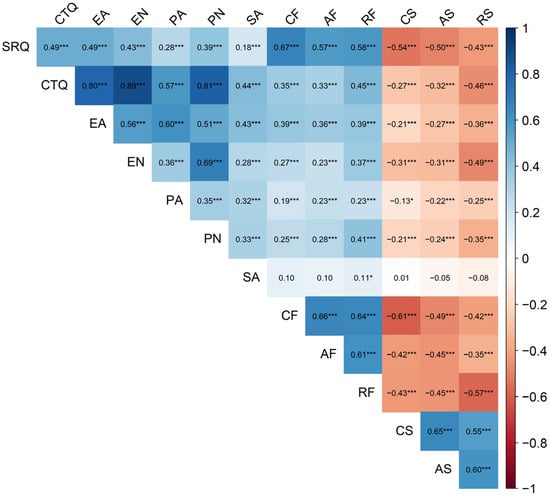
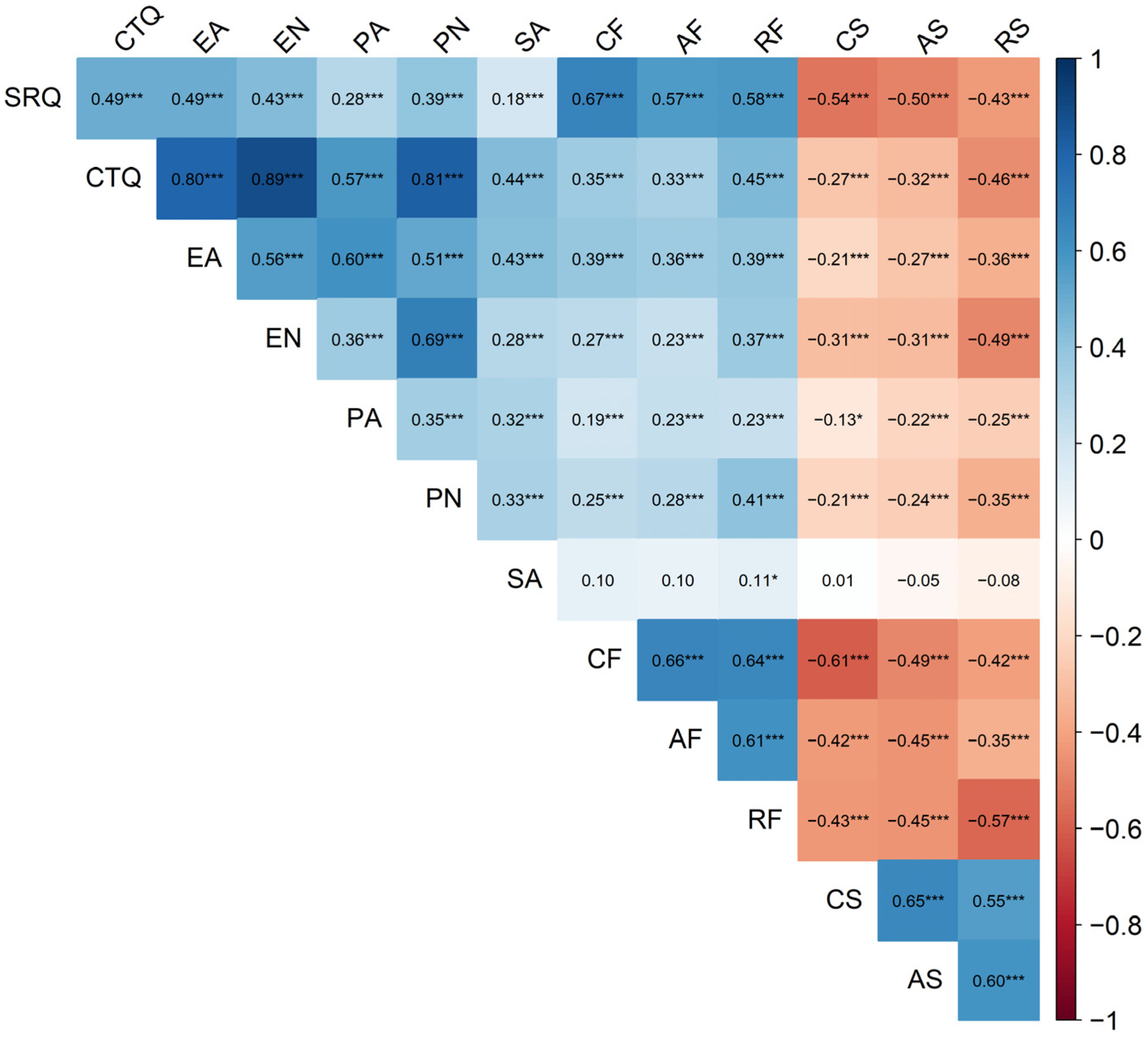
Bivariate Spearman correlations showed that stress response was positively associated with childhood maltreatment and its subtypes (ρ = 0.18 to 0.49). Stress response was also positively correlated with all need frustration dimensions (ρ = 0.57 to 0.67). In contrast, it was negatively correlated with all need satisfaction dimensions (ρ = −0.54 to −0.43). The three need satisfaction dimensions were moderately to strongly intercorrelated (ρ = 0.55 to 0.65), as were the three need frustration dimensions (ρ = 0.61 to 0.66). Childhood maltreatment subtypes were also moderately intercorrelated (ρ = 0.28 to 0.69). All correlations summarized above remained significant after FDR correction. Full correlation coefficients are presented in Supplementary Table S1 and visualized in Figure 1. Harman’s single-factor test was conducted to assess the potential influence of common method variance. The first unrotated factor accounted for 30.68% of the total variance.
Figure 1.
Spearman correlation heatmap of childhood maltreatment, basic psychological need satisfaction and frustration, and stress response variables. Values in cells represent Spearman’s rank correlation coefficients (ρ). Blue indicates positive correlations, red indicates negative correlations, and darker colors indicate stronger correlations. Significance levels are based on p values adjusted for the false discovery rate (FDR). CTQ = Childhood Trauma Questionnaire—Short Form total score; SRQ = Stress Response Questionnaire total score; EA = emotional abuse; EN = emotional neglect; PA = physical abuse; PN = physical neglect; SA = sexual abuse; AS = autonomy satisfaction; CS = competence satisfaction; RS = relatedness satisfaction; AF = autonomy frustration; CF = competence frustration; RF = relatedness frustration. * p < 0.05, *** p < 0.001.
3.3. Hierarchical Multiple Regression Analyses
Hierarchical multiple linear regression analyses were conducted to examine the incremental associations of childhood maltreatment and basic psychological need dimensions with stress response. Sex was coded as 0 = male and 1 = female, and reported psychiatric diagnosis status was coded as 0 = no reported diagnosis and 1 = reported current or past psychiatric diagnosis.
In Model 1, demographic variables explained 22.1% of the variance in SRQ total scores (R2 = 0.221, adjusted R2 = 0.212, F(4, 340) = 24.10, p < 0.001). Among these Step 1 variables, reported psychiatric diagnosis status was significantly associated with higher SRQ total scores, β = 0.493, p < 0.001, indicating that participants with a reported current or past psychiatric diagnosis showed higher stress response than those without a reported diagnosis. Age, sex, and subjective SES were not significantly associated with SRQ total scores.
In Model 2, the addition of CTQ-SF total score significantly improved the model, increasing the explained variance to 34.8%, ΔR2 = 0.127, p < 0.001. CTQ-SF total score was positively associated with stress response, β = 0.399, p < 0.001. Subjective SES was significantly associated with stress response, β = −0.101, p = 0.023, while reported psychiatric diagnosis status remained significant, β = 0.318, p < 0.001; age and sex remained non-significant.
In Model 3, the inclusion of the six basic psychological need dimensions further increased the explained variance to 61.8%, ΔR2 = 0.269, p < 0.001. In the final model, reported psychiatric diagnosis status, β = 0.218, p < 0.001, CTQ-SF total score, β = 0.198, p < 0.001, autonomy frustration, β = 0.123, p = 0.012, competence satisfaction, β = −0.152, p = 0.003, and competence frustration, β = 0.280, p < 0.001, remained significantly associated with SRQ total score. Details are presented in Table 2.
Table 2.
Hierarchical multiple linear regression predicting SRQ total score (N = 345).
Model diagnostics indicated no serious multicollinearity (VIFs = 1.08–2.73) and no evidence of heteroscedasticity in the final model, χ2(11) = 12.99, p = 0.294. Analyses using HC3 heteroscedasticity-consistent standard errors yielded substantively unchanged conclusions. Influence diagnostics identified 26 potentially influential observations, but excluding them in a sensitivity analysis (n = 319) did not materially alter the principal findings. Psychiatric diagnosis status, CTQ-SF total score, competence satisfaction, autonomy frustration, and competence frustration remained significant, and the coefficient for competence frustration was virtually unchanged (B = 2.059 vs. 2.060), although relatedness frustration became significant in the sensitivity model (B = 0.758 vs. 0.952).
3.4. Parallel Mediation Analyses
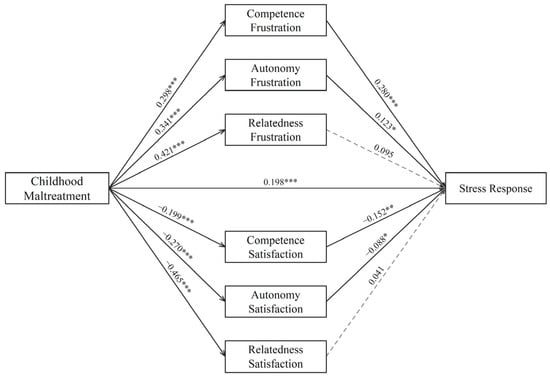
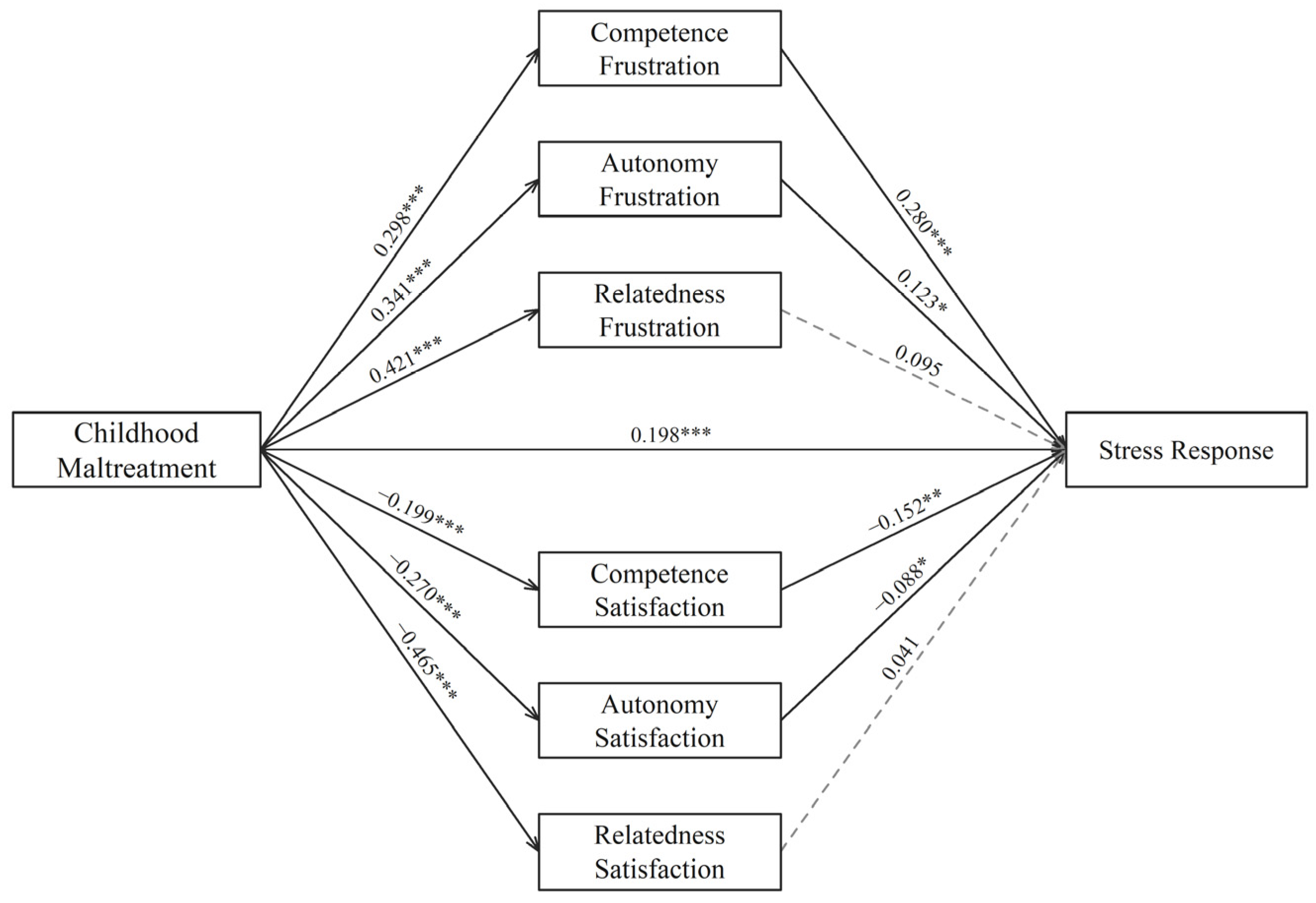
A parallel mediation model was estimated to quantify the specific and total indirect effects linking overall childhood maltreatment to adult stress response through the six basic psychological need dimensions. The total indirect effect through the six need dimensions was significant, B = 0.347, SE = 0.063, bias-corrected 95% CI [0.225, 0.472], p < 0.001, standardized β = 0.201. The direct effect of childhood maltreatment on stress response also remained significant, B = 0.342, SE = 0.074, 95% CI [0.193, 0.485], p < 0.001, standardized β = 0.198.
Among the six indirect effects, only competence frustration remained significant after FDR correction, B = 0.144, SE = 0.041, bias-corrected 95% CI [0.075, 0.234], p < 0.001, FDR-adjusted p = 0.002, β = 0.083. The indirect effects through autonomy frustration and competence satisfaction were nominally significant before correction but did not remain significant after FDR correction. The indirect effect through autonomy satisfaction had a bias-corrected bootstrap confidence interval excluding zero but was not significant based on either the unadjusted or FDR-adjusted p value. The indirect effects through relatedness satisfaction and relatedness frustration were not significant after FDR correction, as their bootstrap confidence intervals also included zero.
Within the fitted cross-sectional model, the total indirect effect accounted for approximately 50.4% of the total effect, whereas the direct effect accounted for approximately 49.6%. Specifically, the pathway through competence frustration accounted for approximately 20.9% of the total effect and 41.5% of the total indirect effect. The model explained 61.8% of the variance in SRQ total score. Specific, total indirect, direct, and total effects are summarized in Table 3; standardized path coefficients are displayed in Figure 2.
Table 3.
Parallel mediation of the association between childhood maltreatment and stress response through six basic psychological need dimensions.
Figure 2.
Parallel mediation model linking childhood maltreatment to stress response through six basic psychological need dimensions. Values on the arrows represent standardized path coefficients (β). Significance symbols and line types are based on unadjusted p values for individual paths. Solid lines indicate statistically significant paths, whereas dashed lines indicate non-significant paths. The direct path represents the association between childhood maltreatment and stress response after accounting for all six mediators. All paths were adjusted for age, sex, subjective socioeconomic status (SES), and reported psychiatric diagnosis status. Residual covariances among the six mediators are omitted for clarity. Significant component paths do not, by themselves, establish a significant indirect association; false discovery rate (FDR)-adjusted tests of the specific indirect effects are reported in Table 3. * p < 0.05, ** p < 0.01, *** p < 0.001.
In the exploratory post hoc analysis, the indirect effect through competence frustration had the largest point estimate in the model. Among the five pairwise contrasts, it was significantly larger only than the indirect effect through relatedness satisfaction after FDR correction, unstandardized difference = 0.177, SE = 0.058, bias-corrected 95% CI [0.069, 0.298], p = 0.002, adjusted p = 0.012, and the completely standardized difference was 0.102. Contrasts with autonomy satisfaction and competence satisfaction were significant before correction but did not remain significant after FDR adjustment, whereas contrasts with autonomy frustration and relatedness frustration were not significant. Full pairwise contrasts are presented in Supplementary Table S2.
3.5. Exploratory Maltreatment Subtype Analyses
To further examine whether childhood maltreatment subtypes showed partially differentiated need-related indirect associations with adult stress response, exploratory maltreatment subtype analyses were conducted. In each model, the five continuous CTQ-SF subscale scores were entered simultaneously as predictors, and one basic psychological need dimension was specified as the mediator. Age, sex, subjective SES, and reported psychiatric diagnosis status were included as covariates. Given the intercorrelations among the CTQ-SF subtypes, this approach was used to estimate subtype-specific indirect effects while accounting for shared variance among maltreatment subtypes.
After FDR correction within each mediator model, emotional abuse showed significant indirect associations with stress response through competence frustration, B = 1.159, bias-corrected 95% CI [0.681, 1.687], FDR-adjusted p < 0.001; autonomy frustration, B = 0.637, bias-corrected 95% CI [0.230, 1.123], FDR-adjusted p = 0.024; and relatedness frustration, B = 0.660, bias-corrected 95% CI [0.222, 1.147], FDR-adjusted p = 0.013. Emotional neglect showed significant indirect associations through reduced competence satisfaction, B = 0.557, bias-corrected 95% CI [0.231, 0.927], FDR-adjusted p = 0.008; reduced autonomy satisfaction, B = 0.421, bias-corrected 95% CI [0.164, 0.785], FDR-adjusted p = 0.031; and reduced relatedness satisfaction, B = 0.564, bias-corrected 95% CI [0.319, 0.899], FDR-adjusted p < 0.001. Physical neglect also showed a significant indirect association through relatedness frustration, B = 0.725, bias-corrected 95% CI [0.247, 1.254], FDR-adjusted p = 0.013. No indirect associations involving physical abuse or sexual abuse remained significant after FDR correction. Significant indirect effects are summarized in Table 4. Complete estimates from the six separate single-mediator models are provided in Supplementary Tables S3–S8.
Table 4.
Significant subtype-specific indirect effects linking childhood maltreatment subtypes to stress response.
3.6. Sensitivity Analyses
Exploratory sensitivity analysis showed that adding the seven interaction terms involving reported psychiatric diagnosis status did not significantly improve the final regression model, F(7, 326) = 0.694, p = 0.677, and none of the individual interaction terms was significant before or after FDR correction (unadjusted p values ranged from 0.165 to 0.961; adjusted p values ranged from 0.949 to 0.961; Supplementary Table S9).
In the parallel mediation model, the between-group difference in the total indirect effect was not significant, B = −0.159, bias-corrected 95% CI [−0.416, 0.098], p = 0.221. None of the six specific indirect-effect differences remained significant after FDR correction (unadjusted p values ranged from 0.265 to 0.986, adjusted p values ranged from 0.963 to 0.986). All 13 interaction terms involving reported psychiatric diagnosis status were nonsignificant before and after FDR correction (unadjusted p values ranged from 0.234 to 0.966, adjusted p values ranged from 0.955 to 0.966; Supplementary Table S10).
Across the six subtype single-mediator models, between-group differences in total effects were nonsignificant (unadjusted p values ranged from 0.059 to 0.852). Across all six models, none of the five subtype-specific indirect-effect differences remained significant after FDR correction (unadjusted p values ranged from 0.041 to 0.890; adjusted p values ranged from 0.204 to 0.890). Likewise, across all six models, none of the 11 interaction terms remained significant after FDR correction (unadjusted p values ranged from 0.017 to 0.987; adjusted p values ranged from 0.189 to 0.987; Supplementary File S1).
Overall, these exploratory analyses did not provide robust evidence that the associations differed by reported psychiatric diagnosis status; however, the null moderation findings should not be interpreted as evidence of equivalence between groups.
4. Discussion
The present study examined whether basic psychological need satisfaction and frustration were involved in the association between childhood maltreatment and adult stress response. The hypotheses were only partially supported, and four main findings emerged. First, in the final regression model, competence frustration and autonomy frustration were positively associated with stress response, whereas competence satisfaction was negatively associated with stress response. Second, in the overall parallel mediation model, competence frustration was the only specific indirect effect that remained significant after FDR correction. Third, the maltreatment subtype analyses revealed partially differentiated patterns. Finally, exploratory sensitivity analyses provided no robust evidence that the overall or subtype-specific indirect effects differed by reported diagnosis status, although these null findings do not establish equivalence between groups.
Among these findings, competence frustration showed a consistent pattern across the regression and mediation analyses in this sample. In SDT, competence frustration refers to feeling ineffective or incapable of meeting environmental demands (B. Chen et al., 2015; Ryan & Deci, 2000; Vansteenkiste & Ryan, 2013). Repeated criticism, humiliation, invalidation, helplessness, or inadequate support during childhood may be associated with enduring perceptions of incapability. The present findings are broadly consistent with prior work. Barański and Poprawa (2024) also found that a profile characterized mainly by low competence satisfaction and high competence frustration showed higher perceived stress and stronger threat appraisal.
Nevertheless, its importance should not be overstated. The need dimensions were substantially correlated, and each specific indirect effect in the parallel model is conditional on the other five dimensions. The pattern of statistical support may therefore partly depend on their simultaneous inclusion. In the exploratory contrasts, its indirect effect was significantly larger only than that through relatedness satisfaction after FDR correction; comparisons with the other four need dimensions did not establish differences.
Exploratory maltreatment subtype analyses suggested partially differentiated need-related patterns. Emotional abuse was indirectly associated with stress response through all three need-frustration dimensions, whereas emotional neglect was indirectly associated with stress response through lower levels of all three need-satisfaction dimensions. Physical neglect was also indirectly associated with stress response through relatedness frustration. These findings are consistent with the distinction between need frustration and need satisfaction proposed by SDT (B. Chen et al., 2015). However, these subtype models adjusted for co-occurring maltreatment subtypes but not for the other need dimensions. They therefore do not establish frustration-related associations independent of satisfaction, or satisfaction-related associations independent of frustration. Significance in one model and nonsignificance in another does not establish a difference between effects; direct comparisons within a common analytical framework and independent replication are needed.
One possible interpretation of these exploratory patterns concerns differences in the nature of emotional abuse and emotional neglect. Emotional abuse often involves active criticism, humiliation, coercion, rejection, or emotional invalidation, experiences that may be particularly relevant to the frustration of autonomy, competence, and relatedness. Emotional neglect, by contrast, is characterized more by the absence of emotional responsiveness, recognition, encouragement, and support, which may reduce opportunities for these needs to be satisfied. This interpretation is consistent with recent SDT-based studies. These studies have linked childhood trauma and maltreatment to basic psychological need experiences and poorer psychological adjustment, although the relative roles of need satisfaction and need frustration vary across studies (Rashid et al., 2025; Rodrigue et al., 2025; Zhou et al., 2025). This interpretation may be considered in relation to dimensional models of childhood adversity that distinguish threat-related from deprivation-related experiences and propose partly different developmental processes (McLaughlin, 2016; McLaughlin et al., 2014; Sheridan & McLaughlin, 2014).
Notably, physical neglect showed a more specific pattern, with an indirect association with stress response through relatedness frustration. This pathway may reflect the interpersonal meaning of unmet caregiving and basic care needs. Insufficient care, protection, or supervision may involve not only unmet material needs but also the absence of stable and reliable caregiver responsiveness and support (McLaughlin & Sheridan, 2016; Zeanah & Humphreys, 2018).
In contrast, neither physical abuse nor sexual abuse showed indirect effects that remained significant after FDR correction. However, these null findings should not be interpreted as indicating that these forms of maltreatment are unimportant. Physical abuse and sexual abuse scores were at the minimum of 5 for 66.1% and 82.3% of the sample, respectively, which may have limited the precision of subtype-specific indirect-effect estimates. Because all five maltreatment subtypes were modeled simultaneously, associations specific to physical and sexual abuse may also have been difficult to isolate because of their overlap with other maltreatment experiences (Cecil et al., 2017; Lobbestael et al., 2010). In addition, the associations of physical and sexual abuse with adult stress response may involve other trauma-relevant needs and belief domains not fully captured by the six basic psychological need dimensions assessed in this study, particularly concerns involving safety, trust, power and control, self-worth, and intimacy (McCann et al., 1988; Wenninger & Ehlers, 1998).
Several limitations should be considered when interpreting these findings. First, the cross-sectional design precludes conclusions about temporal ordering or causal mediation. The proposed ordering was theoretically informed because childhood maltreatment represents a developmentally earlier exposure, basic psychological need experiences represent more proximal psychological processes, and stress response was assessed as the current outcome. Nevertheless, the temporal relationship between current need satisfaction or frustration and stress response cannot be established. Elevated stress response may also interfere with experiences of autonomy, competence, and relatedness, and bidirectional associations remain possible. The observed indirect effects should therefore be interpreted as theoretically informed statistical associations rather than evidence of causal mediation (Maxwell & Cole, 2007).
Second, childhood maltreatment, basic psychological needs, and stress response were assessed using self-report measures, which may have introduced retrospective recall bias, reporting bias, and shared method variance. Retrospective reports of childhood adversity provide important information but may be influenced by memory processes and current psychological state (Hardt & Rutter, 2004). Although Harman’s single-factor test did not indicate that a single factor accounted for most of the covariance among the measures, this test has limited sensitivity and cannot rule out method-related bias (Chang et al., 2010; Podsakoff et al., 2003). In addition, competence frustration and the SRQ may capture partially overlapping negative subjective experiences, although they assess conceptually distinct constructs. Such overlap may have contributed to the observed associations, but the discriminant validity of these measures was not directly examined in the present study. Longitudinal, multi-informant, and multimethod studies are needed to reduce shared method variance and strengthen temporal inference.
Third, statistical power may have been limited for the less frequently reported maltreatment subtypes, particularly physical and sexual abuse. Their relatively low prevalence, together with the simultaneous inclusion of all five maltreatment subtypes, may have reduced the precision of the estimates and made subtype-specific indirect effects more difficult to isolate. The corresponding null findings should therefore be interpreted cautiously rather than as evidence that these indirect effects are absent.
Fourth, the reported psychiatric diagnosis group was diagnostically heterogeneous, with anxiety and depressive disorders most frequently reported and multiple diagnoses being common. Psychotic disorders, neurodevelopmental disorders, neurocognitive disorders, and conditions involving substantial cognitive impairment were insufficiently represented. Participants who did not report a psychiatric diagnosis were not assessed using a structured clinical interview and should not be regarded as a clinically confirmed healthy control group. Some may have experienced subclinical symptoms or undiagnosed mental health difficulties. Psychiatric diagnosis status was therefore included as a binary indicator reflecting broad differences in psychiatric history and did not capture current symptom severity, functional impairment, comorbidity, illness duration, or treatment history. Accordingly, the study was not designed or adequately powered to compare specific diagnostic groups or comorbidity profiles. Overall, the findings are best understood as need-related associations observed among adults with varying reported mental health status, rather than as evidence of disorder-specific or diagnosis-invariant mechanisms.
Finally, the SRQ assesses broad emotional, physical, and behavioral stress responses rather than trauma-specific symptoms. The findings should therefore be interpreted as reflecting broad stress-related functioning among adults with varying reported mental health status and should not be generalized directly to post-traumatic stress disorder (PTSD) or complex PTSD. Moreover, SRQ scores may reflect differences in current stressor exposure. Because this exposure was not adjusted for in the analyses, its contribution to SRQ scores could not be assessed. The sample consisted predominantly of young adults, which may limit the generalizability of the findings to middle-aged and older populations.
Future research should use longitudinal designs with multiple assessment waves to clarify the temporal ordering of childhood maltreatment, basic psychological need experiences, and stress response. Larger and more diagnostically balanced samples, structured diagnostic assessments, and continuous measures of symptom severity and functioning are also needed to examine whether these associations differ across specific clinical populations. Ecological momentary assessment and experimental approaches may further examine whether competence frustration is associated with changes in stress appraisal, perceived coping resources, coping behavior, and subsequent emotional, physiological, and behavioral responses. Drawing on the Cognitive Integration Model, such studies could jointly assess internal needs, external demands, available resources, and cognitive appraisal alongside coping and stress responses to distinguish stress generation from its downstream consequences (Gu et al., 2026). Future studies may additionally examine trauma-relevant needs and processes beyond autonomy, competence, and relatedness, particularly in relation to physical and sexual abuse, and determine whether the observed patterns generalize across cultural contexts.
These findings may also inform future intervention research. Given the observed association involving competence frustration, approaches aimed at strengthening perceived competence, mastery, and coping efficacy may warrant further investigation among adults with childhood maltreatment histories and elevated stress response. The exploratory findings on maltreatment subtypes may also inform future research, but do not establish that intervention targets should differ by maltreatment subtype. Such possibilities should be evaluated in longitudinal and experimental studies before differential treatment recommendations are made.
5. Conclusions
In conclusion, competence frustration emerged as the most consistent need-related dimension in the association between childhood maltreatment and adult stress response in these analyses. However, its specific indirect effect was not significantly larger than those through most other need dimensions after FDR correction. Exploratory maltreatment subtype analyses also revealed partially differentiated patterns. These findings highlight the importance of distinguishing need satisfaction from need frustration when examining the psychological correlates of childhood maltreatment. Longitudinal, multimethod, and experimental studies are needed before these associations can be interpreted as developmental or causal mechanisms.
Supplementary Materials
The following supporting information can be downloaded at: https://www.mdpi.com/article/10.3390/bs16112184/s1, Figure S1: Psychiatric diagnostic characteristics of participants with reported psychiatric diagnoses; Table S1: Means, standard deviations, and Spearman correlations among study variables; Table S2: Exploratory post hoc contrasts between the competence-frustration indirect effect and the other specific indirect effects; Table S3: Complete results of the maltreatment subtype mediation model with competence frustration as the mediator; Table S4: Complete results of the maltreatment subtype mediation model with autonomy frustration as the mediator; Table S5: Complete results of the maltreatment subtype mediation model with relatedness frustration as the mediator; Table S6: Complete results of the maltreatment subtype mediation model with competence satisfaction as the mediator; Table S7: Complete results of the maltreatment subtype mediation model with autonomy satisfaction as the mediator; Table S8: Complete results of the maltreatment subtype mediation model with relatedness satisfaction as the mediator; Table S9: Sensitivity analysis of the final regression model by reported psychiatric diagnosis status; Table S10. Sensitivity analyses of the parallel mediation model by reported psychiatric diagnosis status; File S1: Sensitivity analyses of maltreatment subtype models by reported psychiatric diagnosis status.
Author Contributions
Conceptualization, Y.L., H.G. and C.L.; methodology, Y.L., H.G. and C.L.; software, Y.L.; formal analysis, Y.L.; investigation, Y.L.; data curation, Y.L.; writing—original draft preparation, Y.L.; writing—review and editing, Y.L., H.G. and C.L.; visualization, Y.L.; supervision, C.L.; project administration, Y.L., H.G. and C.L. All authors have read and agreed to the published version of the manuscript.
Funding
This research received no external funding.
Institutional Review Board Statement
The questionnaire data used in this study were collected with ethical approval from the Ethics Committee of the School of Life Sciences, Central South University (Approval No. 2023-1-27; approved on 14 May 2023). The present analyses were conducted using de-identified data. All procedures involving participant recruitment, informed consent, data collection, and data handling were carried out in accordance with the Declaration of Helsinki.
Informed Consent Statement
Informed consent was obtained from all subjects involved in the study.
Data Availability Statement
The de-identified data and analysis code supporting the findings of this study are available from the corresponding author upon reasonable request. The data are not publicly available due to applicable ethical and privacy restrictions.
Acknowledgments
The authors thank Qing Yang (School of Psychology, Shaanxi Normal University, Xi’an 710062, China); Zhi Xu (Department of Psychiatry and Psychosomatics, Zhongda Hospital, School of Medicine, Jiangsu Provincial Key Laboratory of Brain Science and Medicine, Southeast University, Nanjing 210009, China); and Pu Zhi (Department of Psychiatric Rehabilitation, Xi’an Mental Health Center, Xi’an 710061, China) for their respective contributions to study implementation and participant recruitment, including the provision of recruitment resources, and for reviewing the manuscript. During the preparation of this manuscript, the authors used ChatGPT (GPT-5, OpenAI, San Francisco, CA, USA) to assist with English language editing and improve clarity of expression. The tool was also used to help check analysis code for syntax and readability. The authors have reviewed, edited, and verified the output and take full responsibility for the content of this publication.
Conflicts of Interest
The authors declare no conflicts of interest.
Abbreviations
The following abbreviations are used in this manuscript:
| SES | socioeconomic status |
| CTQ-SF | Childhood Trauma Questionnaire Short Form |
| SRQ | Stress Response Questionnaire |
| BPNSFS | Basic Psychological Need Satisfaction and Frustration Scale |
| SDT | Self-Determination Theory |
| FDR | false discovery rate |
| CI | confidence interval |
| SE | standard error |
| SD | standard deviation |
| IQR | interquartile range |
| VIFs | variance inflation factors |
| HC3 | heteroscedasticity-consistent type 3 |
| DFBETAs | standardized differences in estimated regression coefficients |
| PTSD | post-traumatic stress disorder |
| AS | autonomy satisfaction |
| CS | competence satisfaction |
| RS | relatedness satisfaction |
| AF | autonomy frustration |
| CF | competence frustration |
| RF | relatedness frustration |
| EA | emotional abuse |
| EN | emotional neglect |
| PN | physical neglect |
| PA | physical abuse |
| SA | sexual abuse |
References
- Adler, N. E., Epel, E. S., Castellazzo, G., & Ickovics, J. R. (2000). Relationship of subjective and objective social status with psychological and physiological functioning: Preliminary data in healthy white women. Health Psychology, 19(6), 586–592. [Google Scholar] [CrossRef] [PubMed]
- Barański, M., & Poprawa, R. (2024). Interpersonal differences in stress, coping, and satisfaction with life in the context of individual profiles of satisfaction and frustration of basic psychological needs. Health Psychology Report, 12(1), 26–38. [Google Scholar] [CrossRef] [Scilit] [PubMed]
- Benjamini, Y., & Hochberg, Y. (1995). Controlling the false discovery rate: A practical and powerful approach to multiple testing. Journal of the Royal Statistical Society: Series B (Methodological), 57(1), 289–300. [Google Scholar] [CrossRef] [Scilit]
- Bernstein, D. P., & Fink, L. (1998). Childhood trauma questionnaire: A retrospective self-report: Manual. Psychological Corporation. [Google Scholar]
- Bernstein, D. P., Stein, J. A., Newcomb, M. D., Walker, E., Pogge, D., Ahluvalia, T., Stokes, J., Handelsman, L., Medrano, M., Desmond, D., & Zule, W. (2003). Development and validation of a brief screening version of the Childhood Trauma Questionnaire. Child Abuse & Neglect, 27(2), 169–190. [Google Scholar] [CrossRef] [Scilit] [PubMed]
- Breusch, T., & Pagan, A. (1979). A simple test for heteroscedasticity and random coefficient variation. Econometrica, 47(5), 1287–1294. [Google Scholar] [CrossRef] [Scilit]
- Cecil, C. A., Viding, E., Fearon, P., Glaser, D., & McCrory, E. J. (2017). Disentangling the mental health impact of childhood abuse and neglect. Child Abuse & Neglect, 63, 106–119. [Google Scholar] [CrossRef] [Scilit] [PubMed]
- Chang, S.-J., van Witteloostuijn, A., & Eden, L. (2010). From the editors: Common method variance in international business research. Journal of International Business Studies, 41(2), 178–184. [Google Scholar] [CrossRef] [Scilit]
- Chen, B., Vansteenkiste, M., Beyers, W., Boone, L., Deci, E. L., Van der Kaap-Deeder, J., Duriez, B., Lens, W., Matos, L., Mouratidis, A., Ryan, R. M., Sheldon, K. M., Soenens, B., Van Petegem, S., & Verstuyf, J. (2015). Basic psychological need satisfaction, need frustration, and need strength across four cultures. Motivation and Emotion, 39(2), 216–236. [Google Scholar] [CrossRef] [Scilit]
- Chen, Y., Yao, S., & Xia, L. (2014). Validity and reliability of the Chinese version of the subjective socioeconomic status scale in a general adult population. Chinese Mental Health Journal, 28(11), 869–874. [Google Scholar]
- Gao, Q., Xu, H., Shi, K., Zhang, Y., Zhang, C., Jiang, Q., Wei, X., & Liu, T. (2022). Quarantine and demographic characteristics as predictors of perceived stress and stress responses during the third year of COVID-19 in China. Frontiers in Psychiatry, 13, 962285. [Google Scholar] [CrossRef] [Scilit] [PubMed]
- Gu, H., Lei, Y., Zhang, Y., Chen, C., & Liu, C. (2026). Unified definition of psychological stress and the cognitive integration model. PsyArXiv. [Google Scholar] [CrossRef] [Scilit]
- Haering, S., Kooistra, M. J., Bourey, C., Chimed-Ochir, U., Doubková, N., Hoeboer, C. M., Lathan, E. C., Christie, H., & de Haan, A. (2024). Exploring transdiagnostic stress and trauma-related symptoms across the world: A latent class analysis. European Journal of Psychotraumatology, 15(1), 2318190. [Google Scholar] [CrossRef] [Scilit] [PubMed]
- Hagborg, J. M., Kalin, T., & Gerdner, A. (2022). The Childhood Trauma Questionnaire-Short Form (CTQ-SF) used with adolescents—Methodological report from clinical and community samples. Journal of Child & Adolescent Trauma, 15(4), 1199–1213. [Google Scholar] [CrossRef] [Scilit] [PubMed]
- Hardt, J., & Rutter, M. (2004). Validity of adult retrospective reports of adverse childhood experiences: Review of the evidence. Journal of Child Psychology and Psychiatry, 45(2), 260–273. [Google Scholar] [CrossRef] [Scilit] [PubMed]
- He, J., Zhong, X., Gao, Y., Xiong, G., & Yao, S. (2019). Psychometric properties of the Chinese version of the Childhood Trauma Questionnaire-Short Form (CTQ-SF) among undergraduates and depressive patients. Child Abuse & Neglect, 91, 102–108. [Google Scholar] [CrossRef] [Scilit] [PubMed]
- Hedges, L. V. (1981). Distribution theory for Glass’s estimator of effect size and related estimators. Journal of Educational Statistics, 6(2), 107–128. [Google Scholar] [CrossRef] [Scilit]
- Heim, C., & Nemeroff, C. B. (2001). The role of childhood trauma in the neurobiology of mood and anxiety disorders: Preclinical and clinical studies. Biological Psychiatry, 49(12), 1023–1039. [Google Scholar] [CrossRef] [Scilit] [PubMed]
- Hostinar, C. E., Swartz, J. R., Alen, N. V., Guyer, A. E., & Hastings, P. D. (2023). The role of stress phenotypes in understanding childhood adversity as a transdiagnostic risk factor for psychopathology. Journal of Psychopathology and Clinical Science, 132(3), 277–286. [Google Scholar] [CrossRef] [Scilit] [PubMed]
- Kerby, D. S. (2014). The simple difference formula: An approach to teaching nonparametric correlation. Comprehensive Psychology, 3, 1. [Google Scholar] [CrossRef] [Scilit]
- Lazarus, R. S., & Folkman, S. (1987). Transactional theory and research on emotions and coping. European Journal of Personality, 1(3), 141–169. [Google Scholar] [CrossRef] [Scilit]
- Lobbestael, J., Arntz, A., & Bernstein, D. P. (2010). Disentangling the relationship between different types of childhood maltreatment and personality disorders. Journal of Personality Disorders, 24(3), 285–295. [Google Scholar] [CrossRef] [Scilit] [PubMed]
- Lorenz, T., Michels, N., Neubauer, A. B., Soenens, B., & Giletta, M. (2026). From basic psychological need frustration to stress responses: Examining how bullying victimization sensitizes daily-life experiences in adolescence. Journal of Youth and Adolescence, 55(5), 1236–1250. [Google Scholar] [CrossRef] [Scilit] [PubMed]
- MacKinnon, J. G., & White, H. (1985). Some heteroskedasticity-consistent covariance matrix estimators with improved finite sample properties. Journal of Econometrics, 29(3), 305–325. [Google Scholar] [CrossRef] [Scilit]
- Maxwell, S. E., & Cole, D. A. (2007). Bias in cross-sectional analyses of longitudinal mediation. Psychological Methods, 12(1), 23–44. [Google Scholar] [CrossRef] [Scilit] [PubMed]
- McCann, I. L., Sakheim, D. K., & Abrahamson, D. J. (1988). Trauma and victimization: A model of psychological adaptation. The Counseling Psychologist, 16(4), 531–594. [Google Scholar] [CrossRef] [Scilit]
- McLaughlin, K. A. (2016). Future directions in childhood adversity and youth psychopathology. Journal of Clinical Child & Adolescent Psychology, 45(3), 361–382. [Google Scholar] [CrossRef] [Scilit] [PubMed]
- McLaughlin, K. A., & Sheridan, M. A. (2016). Beyond cumulative risk: A dimensional approach to childhood adversity. Current Directions in Psychological Science, 25(4), 239–245. [Google Scholar] [CrossRef] [Scilit] [PubMed]
- McLaughlin, K. A., Sheridan, M. A., & Lambert, H. K. (2014). Childhood adversity and neural development: Deprivation and threat as distinct dimensions of early experience. Neuroscience & Biobehavioral Reviews, 47, 578–591. [Google Scholar] [CrossRef] [Scilit] [PubMed]
- Mosley-Johnson, E., Campbell, J. A., Garacci, E., Walker, R. J., & Egede, L. E. (2021). Stress that endures: Influence of adverse childhood experiences on daily life stress and physical health in adulthood. Journal of Affective Disorders, 284, 38–43. [Google Scholar] [CrossRef] [Scilit] [PubMed]
- Podsakoff, P. M., MacKenzie, S. B., Lee, J. Y., & Podsakoff, N. P. (2003). Common method biases in behavioral research: A critical review of the literature and recommended remedies. Journal of Applied Psychology, 88(5), 879–903. [Google Scholar] [CrossRef] [Scilit] [PubMed]
- Preacher, K. J., & Hayes, A. F. (2008). Asymptotic and resampling strategies for assessing and comparing indirect effects in multiple mediator models. Behavior Research Methods, 40(3), 879–891. [Google Scholar] [CrossRef] [Scilit] [PubMed]
- Quested, E., Bosch, J. A., Burns, V. E., Cumming, J., Ntoumanis, N., & Duda, J. L. (2011). Basic psychological need satisfaction, stress-related appraisals, and dancers’ cortisol and anxiety responses. Journal of Sport and Exercise Psychology, 33(6), 828–846. [Google Scholar] [CrossRef] [Scilit] [PubMed]
- Rashid, A., van der Kaap-Deeder, J., Abbate, M., & Costa, S. (2025). The mediating role of emotion regulation and basic psychological needs: Association between childhood trauma and young adults’ psychological functioning from a self-determination theory perspective. Journal of Trauma & Dissociation, 26(2), 178–199. [Google Scholar] [CrossRef] [Scilit] [PubMed]
- R Core Team. (2023). R: A language and environment for statistical computing (Version 4.3.2) [Computer software]. R Foundation for Statistical Computing. Available online: https://www.R-project.org/ (accessed on 11 November 2026).
- Rodrigue, C., Bőthe, B., & Dion, J. (2025). Role of sports motivation and basic psychological needs in the relationship between child maltreatment and psychological adaptation in adolescents. Child Maltreatment, 30(2), 304–317. [Google Scholar] [CrossRef] [Scilit] [PubMed]
- Rogerson, O., O’Connor, R. C., & O’Connor, D. B. (2024). The effects of childhood trauma on stress-related vulnerability factors and indicators of suicide risk: An ecological momentary assessment study. Journal of Affective Disorders, 352, 479–489. [Google Scholar] [CrossRef] [Scilit] [PubMed]
- Rosseel, Y. (2012). lavaan: An R package for structural equation modeling. Journal of Statistical Software, 48(2), 1–36. [Google Scholar] [CrossRef] [Scilit]
- Ryan, R. M., & Deci, E. L. (2000). Self-determination theory and the facilitation of intrinsic motivation, social development, and well-being. American Psychologist, 55(1), 68–78. [Google Scholar] [CrossRef] [PubMed]
- Schneiderman, N., Ironson, G., & Siegel, S. D. (2005). Stress and health: Psychological, behavioral, and biological determinants. Annual Review of Clinical Psychology, 1, 607–628. [Google Scholar] [CrossRef] [Scilit] [PubMed]
- Sheridan, M. A., & McLaughlin, K. A. (2014). Dimensions of early experience and neural development: Deprivation and threat. Trends in Cognitive Sciences, 18(11), 580–585. [Google Scholar] [CrossRef] [Scilit]
- Vansteenkiste, M., & Ryan, R. M. (2013). On psychological growth and vulnerability: Basic psychological need satisfaction and need frustration as a unifying principle. Journal of Psychotherapy Integration, 23(3), 263–280. [Google Scholar] [CrossRef] [Scilit]
- Wenninger, K., & Ehlers, A. (1998). Dysfunctional cognitions and adult psychological functioning in child sexual abuse survivors. Journal of Traumatic Stress, 11(2), 281–300. [Google Scholar] [CrossRef] [Scilit] [PubMed]
- Xie, Z., & Wang, J. L. (2025). Linking emotional maltreatment to adolescent prosocial behavior: The roles of basic psychological needs satisfaction and self-talk. Journal of Interpersonal Violence. ahead of print. [Google Scholar] [CrossRef] [Scilit] [PubMed]
- Yang, J., Brandon, R., Zhang, A., Yang, Y., & Zhang, H. (2025). Childhood emotional neglect and psychological distress among Chinese college students: The mediating roles of basic psychological needs and coping styles. Children and Youth Services Review, 177, 108479. [Google Scholar] [CrossRef] [Scilit]
- Zainal, N. H., Soh, C. P., & Van Doren, N. (2024). Daily stress reactivity and risk appraisal mediates childhood parental abuse predicting adulthood psychopathology severity: An 18-year longitudinal mediation analysis. Journal of Affective Disorders, 358, 138–149. [Google Scholar] [CrossRef] [Scilit] [PubMed]
- Zeanah, C. H., & Humphreys, K. L. (2018). Child abuse and neglect. Journal of the American Academy of Child & Adolescent Psychiatry, 57(9), 637–644. [Google Scholar] [CrossRef] [Scilit] [PubMed]
- Zhong, X., Jiang, Q., Qian, L., & Wu, Z. (2005). Correlation between stress reaction and social support, life events, coping style in medical personnel. Chinese Journal of Clinical Psychology, 13(1), 70–72. [Google Scholar] [CrossRef]
- Zhou, K., Zhu, X., Lu, C., Yang, Y., & Chen, S. (2025). Adverse childhood experiences, basic psychological needs, and adolescent affective distress: Revisiting the buffering role of resilience factors. Journal of Research on Adolescence, 35(4), e70080. [Google Scholar] [CrossRef] [Scilit] [PubMed]

Disclaimer/Publisher’s Note: The statements, opinions and data contained in all publications are solely those of the individual author(s) and contributor(s) and not of MDPI and/or the editor(s). MDPI and/or the editor(s) disclaim responsibility for any injury to people or property resulting from any ideas, methods, instructions or products referred to in the content. |
© 2026 by the authors. Licensee MDPI, Basel, Switzerland. This article is an open access article distributed under the terms and conditions of the Creative Commons Attribution (CC BY) license.