


Abstract
This study examined the mediating role of health literacy in the relationship between body appreciation and psychological well-being among women who regularly exercise at fitness centers, controlling for the body mass index (BMI). Using a correlational design, 580 women who had exercised at fitness centers in Malatya and Elazığ, Türkiye, for at least two months and twice weekly completed the Body Appreciation Scale, Psychological Well-Being Scale, and Health Literacy Survey 19-Europe-Q12. Pearson correlations and structural equation modeling were performed, with indirect effects tested using 5000 bootstrap resamples. Body appreciation positively predicted psychological well-being (β = 0.426, p < 0.001) and health literacy (β = 0.509, p < 0.001), while health literacy positively predicted psychological well-being (β = 0.465, p < 0.001). The indirect effect through health literacy was significant (β = 0.237, 95% CI [0.185, 0.291]), supporting partial mediation. BMI negatively predicted body appreciation but positively predicted health literacy and psychological well-being. The model explained 60.1% of the variance in psychological well-being and 29.2% in health literacy. These findings suggest that body appreciation and health literacy may represent psychosocial resources associated with psychological well-being among women exercising regularly, beyond differences in BMI.
1. Introduction
An individual’s relationship with their body is not limited to subjective evaluations of physical appearance but represents a multidimensional construct associated with self-perception, health behaviours, social functioning, and psychological well-being (Rodgers et al., 2023; Rusticus, 2023). For women in particular, the body constitutes a psychosocial domain that is continuously interpreted through social norms, cultural beauty ideals, media representations, and interpersonal evaluations, in addition to its biological characteristics (Ward et al., 2023). At the societal level, the ideal female body is often defined as thin, fit, young, and flawless, which may lead women to evaluate their bodies according to external standards and adopt a critical attitude towards their appearance (Santoniccolo et al., 2023). Such processes have been associated with body dissatisfaction, appearance-related anxiety, self-objectification, low self-esteem, and various psychological difficulties (Rodgers et al., 2023). Nevertheless, contemporary body image research indicates that an exclusive focus on body dissatisfaction and pathology is insufficient to explain the positive and protective dimensions of individuals’ relationships with their bodies (Linardon et al., 2023a).
In response to this limitation, the positive body image perspective conceptualises positive body image not merely as the absence of negative body image but as an independent and multidimensional construct encompassing body acceptance, respect for the body, appreciation of its unique characteristics, valuing body functionality, and the development of a protective cognitive filter against societal beauty ideals (Alleva et al., 2017; Tylka & Wood-Barcalow, 2015). Body appreciation, one of the principal indicators of positive body image, is defined as an accepting, respectful, and favourable attitude towards one’s body regardless of body weight, shape, or conformity to socially prescribed ideals (Avalos et al., 2005; Tylka & Wood-Barcalow, 2015). From this perspective, the body is regarded not merely as an aesthetic object to be evaluated by others, but as a functional whole that enables individuals to experience life, move, engage in productive activities, and interact socially (Alleva et al., 2017; Linardon et al., 2023a). Body appreciation therefore reflects a comprehensive and protective relationship with the body rather than temporary satisfaction with changeable physical characteristics.
The holistic nature of positive body image is also meaningful within the framework of Objectification Theory. Objectification Theory proposes that women’s frequent evaluation in social and cultural environments on the basis of their bodies and physical appearance may lead them to internalise an external observer’s perspective over time (Fredrickson & Roberts, 1997; Ward et al., 2023). Through this process, women may come to perceive their bodies not as lived and functioning entities but as objects that are observed and evaluated by others (Fredrickson & Roberts, 1997). This orientation, referred to as self-objectification, may result in persistent body surveillance, body shame, appearance anxiety, and the depletion of psychological resources (Moradi & Huang, 2008; Ward et al., 2023). Fitness centres may provide women with opportunities to experience strength, health, competence, and body functionality; however, they may also constitute social environments in which appearance-based comparisons and norms concerning body weight and shape become particularly salient (Cowley & Schneider, 2025; Prichard & Tiggemann, 2008). The psychological outcomes of exercise in fitness settings appear to depend not only on exercise frequency or type but also on individuals’ reasons for exercising and the perspective from which they evaluate their bodies. Exercise undertaken to alter appearance or obtain external approval may reinforce self-objectification and body-related concerns, whereas exercise motivated by health, functionality, enjoyment, empowerment, and personal development may be associated with more favourable body evaluations (Prichard & Tiggemann, 2008; Salvador et al., 2023).
Body appreciation is not merely a body-specific indicator of psychological health. It is closely related to psychological well-being as an important component of general self-acceptance, self-worth, and the capacity to evaluate one’s life positively (Rodgers et al., 2023; Tylka & Wood-Barcalow, 2015). Findings from systematic reviews and meta-analyses indicate that body appreciation is positively associated with adaptive constructs such as self-esteem, self-compassion, and life satisfaction, and negatively associated with depression, anxiety, eating pathology, body surveillance, and sociocultural appearance pressures (Linardon et al., 2022). Longitudinal findings further suggest that body appreciation may predict lower depressive symptoms and higher levels of flourishing, self-esteem, and psychological well-being over time (Modica & Markley, 2024). These findings suggest that body appreciation may not only be an outcome of psychological well-being but may also function as an important psychological resource that supports well-being.
Psychological well-being does not merely refer to the absence of negative emotions or mental disorders. According to the eudaimonic perspective, psychological well-being concerns the realisation of one’s potential, the development of meaning and purpose in life, the establishment of positive interpersonal relationships, effective environmental mastery, autonomous functioning, and acceptance of oneself as a whole (Ryff, 1989, 2022). The flourishing-oriented approach developed by Diener et al. (2010) similarly conceptualises well-being as an integration of psychosocial resources, including positive relationships, self-esteem, purposefulness, competence, optimism, and the experience of a meaningful life. Psychological well-being is therefore more comprehensive than temporary happiness or positive affect and reflects an individual’s capacity to lead an effective, productive, and meaningful life.
The potential effect of body appreciation on psychological well-being may be explained through self-acceptance and the development of a harmonious relationship with the body (Tylka & Wood-Barcalow, 2015). Individuals who accept and respect their bodies may be less likely to base their self-worth exclusively on their appearance (Linardon et al., 2022; Rodgers et al., 2023). When confronted with societal beauty norms, these individuals may evaluate such messages more critically, demonstrate greater psychological resilience to negative appearance-related feedback, and direct their attention towards body functionality rather than physical appearance alone (Linardon et al., 2023b; Tylka & Wood-Barcalow, 2015). Such an orientation may strengthen self-acceptance and personal competence, thereby supporting psychological well-being. Prospective findings demonstrating that positive body image is associated with both general psychological well-being and self-acceptance among women further support this explanation (Linardon et al., 2023b).
However, the relationship between body appreciation and psychological well-being may not be adequately explained through direct psychological mechanisms alone (Rodgers et al., 2023). A positive attitude towards the body may also influence how individuals seek health-related information, recognise bodily symptoms, evaluate health messages, use appropriate healthcare services, and make health-promoting decisions (Sørensen et al., 2012). In this context, health literacy emerges as a key cognitive and behavioural resource that may help explain how body appreciation is translated into psychological well-being (Liu et al., 2020).
Although health literacy was traditionally limited to the ability to read and understand health-related information, it is now recognised as a substantially broader domain of competence (Nutbeam, 2008). According to the integrated model developed by Sørensen et al. (2012), health literacy refers to individuals’ capacity to access health-related information, understand it, appraise its reliability and personal relevance, and apply it within the domains of healthcare, disease prevention, and health promotion. Rather than treating health literacy as an individual reading skill, this model conceptualises it as a dynamic psychosocial resource that influences the quality of health decisions and an individual’s effectiveness within the healthcare system (Sørensen et al., 2012). Individuals with higher health literacy may therefore be better able to interpret bodily symptoms, distinguish reliable health resources, assess health risks, use preventive services, and experience greater control over their health behaviours (Liu et al., 2020; World Health Organization, 2022).
The relationship between health literacy and psychological well-being may be explained through several mechanisms. Individuals who can access and effectively use health-related information may experience less uncertainty when confronted with health problems, participate more actively in decision-making processes, and develop a stronger sense of competence in managing their health (Sørensen et al., 2012). In contrast, inadequate health literacy may result in misunderstanding health information, relying on unreliable sources, underusing preventive services, experiencing decisional conflict, and developing increased health-related anxiety (Berkman et al., 2011). Health literacy is therefore associated not only with physical health outcomes but also with perceived control, self-efficacy, functioning, and mental health. Findings from a systematic review and meta-analysis showing that health literacy interventions may reduce symptoms of depression and anxiety further support this relationship (Magallón-Botaya et al., 2023).
The potential association between body appreciation and health literacy may be considered within the framework of positive body image and self-care. Positive body image involves perceiving the body not as a passive object of appearance but as a valuable entity that deserves protection and support (Tylka & Wood-Barcalow, 2015). Individuals who value their bodies may be more likely to seek health information, attend to bodily signals, seek healthcare, and engage in health-promoting behaviours. Body appreciation has indeed been positively associated with the use of preventive healthcare services, medical help-seeking, and various health-promoting behaviours (Nolen & Panisch, 2022). From this perspective, positive body image may serve as a psychological resource that strengthens motivation to access health information, evaluate it, and use it in health-related decision-making by encouraging individuals to perceive their bodies as worthy of care and protection (Sørensen et al., 2012; Tylka & Wood-Barcalow, 2015).
Following this theoretical pathway, health literacy may function as a mediating mechanism in the relationship between body appreciation and psychological well-being (Sørensen et al., 2012; Tylka & Wood-Barcalow, 2015). Women who develop an accepting and respectful attitude towards their bodies may be more attentive to bodily functioning and health needs. This sensitivity may encourage health-information-seeking and appraisal behaviours, thereby supporting health literacy (Nolen & Panisch, 2022). Higher health literacy may subsequently enable individuals to make more informed decisions about their health, distinguish more effectively between health risks and recommendations, and develop a stronger sense of control over their health (Liu et al., 2020; Sørensen et al., 2012). Increased competence, control, and autonomy in health-related decision-making may, in turn, contribute to psychological well-being (Ryff, 1989, 2022). Body appreciation may therefore be associated with psychological well-being both directly, through self-acceptance and positive self-evaluation, and indirectly, through the potential mediating role of health literacy.
Examining these relationships among women who attend fitness centres is particularly important. Fitness centres may promote health awareness, body functionality, and perceived personal competence through regular physical activity (Cowley & Schneider, 2025; Salvador et al., 2023). However, they may also intensify appearance-based evaluations because of mirrors, body measurements, idealised physiques, and social comparisons (Prichard & Tiggemann, 2008; Ward et al., 2023). A high level of physical activity among women who exercise at fitness centres therefore cannot automatically be assumed to indicate positive body image or high psychological well-being. The favourable or unfavourable consequences of exercise may be shaped through the interaction of body-related evaluations, exercise motivation, health-related cognitive resources, and sociocultural messages within the exercise environment (Prichard & Tiggemann, 2008; Salvador et al., 2023). In the Turkish sociocultural context, women’s body-related evaluations may also be influenced by family expectations and socially constructed appearance ideals. Previous research involving Turkish women has demonstrated significant associations between the internalization of thinness ideals, family-related appearance pressures, and concerns about body shape and weight (Yokusoglu et al., 2024). These sociocultural influences provide an important contextual perspective for examining body appreciation among women attending fitness centers in Malatya and Elazığ, two provinces located in Eastern Anatolia. Examining the relationships among body appreciation, health literacy, and psychological well-being in women who exercise regularly may therefore contribute to a more comprehensive understanding of the psychosocial outcomes of physical activity.
Body mass index (BMI) should also be considered when evaluating these relationships. In addition to being associated with social evaluations of body shape and weight, BMI may influence perceptions of health risks, experiences within healthcare settings, and individuals’ evaluations of their own bodies (Puhl & Lessard, 2020; World Health Organization, 2026). Among women in particular, higher BMI values may be associated with lower body appreciation because of weight stigma and socially prescribed thinness ideals (Rodgers et al., 2023; Ward et al., 2023). However, the association between BMI and psychological well-being is neither linear nor unidirectional and may vary according to physical activity level, physical competence, health status, muscle mass, and the meaning attributed to the body (Rodgers et al., 2023; Salvador et al., 2023). Although higher BMI may be associated with less favorable psychological outcomes in some populations, its relationship with psychological well-being may be less straightforward among physically active women, for whom perceived physical competence and bodily functionality may be particularly relevant. With regard to health literacy, systematic evidence generally indicates an inverse association with excess body weight, although findings are less consistent among adults (Michou et al., 2018). This variability suggests that the associations of BMI with psychological well-being and health literacy may differ across populations and health-related contexts. In the present study, BMI was therefore treated not as a primary psychological variable but as a control variable that might confound the relationships among body appreciation, health literacy, and psychological well-being.
Although numerous studies have examined the relationship between body appreciation and psychological well-being, the mechanisms through which health literacy may shape this association remain insufficiently understood (Linardon et al., 2022; Sørensen et al., 2012). Existing research has primarily focused on outcomes such as body dissatisfaction, eating behaviours, depression, anxiety, and self-esteem. By comparison, less attention has been given to how individuals with a positive attitude towards their bodies process health information and how this cognitive competence contributes to psychological flourishing (Linardon et al., 2022; Rodgers et al., 2023). Furthermore, a substantial proportion of health literacy research has focused on healthcare utilisation, chronic disease management, and physical health outcomes, while integrative models examining its associations with positive body image and psychological well-being remain limited (Berkman et al., 2011; Sørensen et al., 2012). Research examining body appreciation, health literacy, and psychological well-being within the same structural model is particularly limited among women who regularly exercise (Salvador et al., 2023; Zhang et al., 2024).
The primary aim of this study was therefore to examine the mediating role of health literacy in the relationship between body appreciation and psychological well-being among women who regularly exercise at fitness centres. The research model was grounded in the Positive Body Image Perspective, Objectification Theory, the eudaimonic conceptualisation of psychological well-being, and the Integrated Model of Health Literacy. Within this theoretical framework, body appreciation was expected to directly support psychological well-being by promoting acceptance of oneself and one’s body. It was also expected to increase health literacy by strengthening self-care and personal responsibility for health. Health literacy was, in turn, expected to contribute to psychological well-being through more informed health decisions, greater self-efficacy, and a stronger sense of control over health. Accordingly, the following hypotheses were tested:
H1.
Body appreciation positively and significantly predicts psychological well-being.
H2.
Body appreciation positively and significantly predicts health literacy.
H3.
Health literacy positively and significantly predicts psychological well-being.
H4.
Health literacy mediates the relationship between body appreciation and psychological well-being.
H5.
The direct and indirect relationships among body appreciation, health literacy, and psychological well-being remain significant after controlling for BMI.
2. Materials and Methods
2.1. Research Design
This cross-sectional study employed a correlational research design. In the hypothesized model, body appreciation was specified as the independent variable, psychological well-being as the dependent variable, health literacy as the mediator, and body mass index (BMI) as a control variable. The model was designed to examine the direct and indirect statistical associations among these variables within a mediation framework.
The analyses were conducted using data obtained from 580 women who met the eligibility criteria. Ethical approval was obtained from the İnönü University Social and Human Sciences Research and Publication Ethics Committee (Approval Date: 26 March 2026; Session No. 5; Decision No. 9). All procedures were conducted in accordance with applicable ethical principles, with particular attention to participant rights, confidentiality, and research integrity.
2.2. Participants
The minimum required sample size was determined using G*Power software, version 3.1.9.7 (Heinrich Heine University Düsseldorf, Düsseldorf, Germany). An a priori power analysis was conducted assuming an effect size of 0.02, a significance level of 0.05 (α), statistical power of 0.80 (1 − β), and three predictor variables. Based on these parameters, the minimum required sample size was calculated as 550 participants (Faul et al., 2007). To exceed this threshold and improve statistical precision, a total of 580 volunteers were included in the study.
The participants were women registered at various fitness centers in the provinces of Malatya and Elazığ, Türkiye, who had exercised at least twice per week during the preceding two months and voluntarily agreed to participate. The inclusion criteria were being female, having exercised at least twice per week for a minimum of two months, and having sufficient cognitive and physical capacity to complete the data collection instruments. Participants aged 18 years or older were required to provide written informed consent. For participants younger than 18 years, written informed consent was obtained from their parents or legal guardians at the participating fitness centers, and written assent was also obtained from the participants themselves.
Individuals with a serious physical or cognitive impairment that prevented them from completing the questionnaires, those who provided incomplete or invalid responses, and those who did not complete the data collection process were excluded. Of the 598 questionnaires collected, 18 were excluded: ten had fewer than 10 valid responses to the HLS19-Q12, and eight were incomplete. The final analytical sample comprised 580 participants. The study was conducted in accordance with the principles of the Declaration of Helsinki and relevant ethical standards. All personal data were protected in accordance with confidentiality principles. The demographic characteristics of the participants are presented in Table 1.
Table 1.
Demographic characteristics of the participants.
The participants had a mean age of 27.66 years (SD = 9.83; range, 16–65 years). Their mean BMI was 29.20 kg/m2 (SD = 5.06; range, 17.67–42.89 kg/m2), and their mean weekly exercise duration was 100.20 min (SD = 46.15; range, 60–420 min).
2.3. Data Collection Instruments
Participants first completed the Demographic Information Form, which included questions concerning age, height, body weight, and weekly exercise duration. They subsequently completed the Health Literacy Survey 19-Europe-Q12 (HLS19-Q12), the Body Appreciation Scale (BAS), and the Psychological Well-Being Scale (PWBS).
2.3.1. Demographic Information Form
The Demographic Information Form was used to collect information on participants’ age, height, body weight, and weekly exercise duration. BMI was calculated from the reported height and body weight data.
2.3.2. Body Appreciation Scale (BAS)
Body appreciation was assessed using the Body Appreciation Scale (BAS), originally developed by Avalos et al. (2005) and adapted into Turkish by Bakalım and Taşdelen-Karçkay (2016). The Turkish version consists of nine items rated on a five-point Likert scale ranging from 1 (“never”) to 5 (“always”). The scale contains no reverse-scored items, and higher scores indicate greater body appreciation.
The Turkish adaptation study reported the following model-fit indices for women: χ2/df = 6.32, goodness-of-fit index (GFI) = 0.92, comparative fit index (CFI) = 0.93, and root mean square error of approximation (RMSEA) = 0.11. The Cronbach’s alpha coefficient for the total scale was reported as 0.87 (Bakalım & Taşdelen-Karçkay, 2016). In the present study, confirmatory factor analysis (CFA) yielded the following fit indices: χ2/df = 3.66, GFI = 0.969, CFI = 0.984, standardized root mean square residual (SRMR) = 0.028, and RMSEA = 0.068. The scale also demonstrated high internal consistency, with a Cronbach’s alpha coefficient of 0.920.
2.3.3. Psychological Well-Being Scale (PWBS)
Psychological well-being was assessed using the Psychological Well-Being Scale (PWBS), developed by Diener et al. (2010) and adapted into Turkish by Telef (2013). The scale consists of eight positively worded items rated on a seven-point Likert scale ranging from 1 (“strongly disagree”) to 7 (“strongly agree”). Higher scores indicate greater psychological well-being.
In the Turkish adaptation study, confirmatory factor analysis supported a unidimensional structure, with χ2/df = 4.64, RMSEA = 0.08, SRMR = 0.04, GFI = 0.96, normed fit index (NFI) = 0.94, CFI = 0.95, and incremental fit index (IFI) = 0.95. The Cronbach’s alpha coefficient was 0.80 (Telef, 2013). In the present study, the fit indices were χ2/df = 4.18, RMSEA = 0.074, SRMR = 0.019, GFI = 0.995, NFI = 0.982, CFI = 0.986, and IFI = 0.986. The Cronbach’s alpha coefficient was 0.937, indicating high internal consistency.
2.3.4. Health Literacy Survey 19-Europe-Q12 (HLS19-Q12)
Health literacy was assessed using the Health Literacy Survey 19-Europe-Q12 (HLS19-Q12), developed by Pelikan et al. (2022) and adapted into Turkish by Terzi et al. (2024). The instrument has a unidimensional structure and consists of 12 items assessing perceived difficulty in accessing, understanding, appraising, and applying health-related information. Items are rated as 1 (“very difficult”), 2 (“difficult”), 3 (“easy”), 4 (“very easy”), or 99 (“do not know”). Responses coded from 1 to 4 were considered valid. “Do not know” responses (coded 99) and unanswered items were treated as missing and excluded from both the numerator and denominator when calculating the score. The percentage score was calculated by dividing the number of items answered as “easy” or “very easy” by the number of valid responses and multiplying by 100. A score was calculated only when at least 80% of the 12 items had valid responses, corresponding to a minimum of 10 valid responses. Questionnaires with fewer than 10 valid HLS19-Q12 responses were excluded from the analytical sample. Scores ranged from 0 to 100, with higher scores indicating higher health literacy.
In the Turkish adaptation study, confirmatory factor analysis yielded χ2/df = 1.283, GFI = 0.867, CFI = 0.949, Tucker–Lewis index (TLI) = 0.935, IFI = 0.951, RMSEA = 0.063, and SRMR = 0.073. The Cronbach’s alpha coefficient was 0.88 (Terzi et al., 2024). In the present study, confirmatory factor analysis yielded χ2/df = 4.30, GFI = 0.984, CFI = 0.966, TLI = 0.953, IFI = 0.966, SRMR = 0.028, and RMSEA = 0.075. The instrument demonstrated high internal consistency, with a Cronbach’s alpha coefficient of 0.939.
2.4. Data Collection Procedure
Before data collection, participants were informed in detail about the purpose, scope, procedures, voluntary nature, and confidentiality principles of the study. Data were collected face-to-face by researchers experienced in field-based data collection at fitness centers in Malatya and Elazığ. The questionnaires were administered before or after training sessions at times that did not interfere with the participants’ exercise programs.
Participants were informed that the data would be used exclusively for scientific purposes, that their information would remain confidential, and that they could withdraw from the study at any time without providing a reason or experiencing any disadvantage. Written informed consent was obtained from participants aged 18 years or older. For participants younger than 18 years, written parental or guardian consent and participant assent were obtained.
Participants were instructed that there were no right or wrong answers and that responses should reflect their own experiences and evaluations. This instruction was intended to reduce socially desirable responding. The Demographic Information Form was administered first, followed by the HLS19-Q12, BAS, and PWBS. The same standardized instructions and administration sequence were used for all participants. Participants were asked to answer all items, and clarification regarding the response procedure was provided when necessary without directing their answers. Completion of the questionnaires required approximately 10 min.
Data collection was conducted in settings that were as quiet, orderly, and free from distractions as possible. All data were collected anonymously and were not linked to personally identifying information. Data security and confidentiality were maintained throughout the study.
2.5. Data Analysis
Statistical analyses were performed using JASP, version 0.18.3.0 (University of Amsterdam, Amsterdam, The Netherlands). The distributions of the study variables were evaluated using skewness and kurtosis coefficients. All values were within the interval of −2 to +2 and were therefore considered acceptable for approximate normality (Kim, 2013; Mishra et al., 2019; Tabachnick & Fidell, 2019).
Pearson correlation analysis was used to examine bivariate associations among the study variables. Before testing the structural model, linearity was visually evaluated using scatterplots. Multicollinearity was assessed using tolerance and variance inflation factor (VIF) values. All values were within acceptable limits, with VIF values below 5 and tolerance values above 0.20 (Hair et al., 2014).
For participants meeting the minimum valid-response requirement for the HLS19-Q12, scores were calculated using the available valid responses without imputing missing item responses.
In the mediation model, body appreciation was specified as the independent variable, psychological well-being as the dependent variable, health literacy as the mediator, and BMI as a control variable. BMI was modeled as a predictor of body appreciation, health literacy, and psychological well-being. The mediation analysis was conducted as a path analysis using observed composite scale scores for body appreciation, health literacy, and psychological well-being, rather than latent variables. The confirmatory factor analyses of the individual scales were conducted separately and were not incorporated into the mediation model. The BMI-adjusted path model was saturated, with zero degrees of freedom (df = 0). The direct and indirect associations among the study variables were estimated using the Maximum Likelihood (ML) method. The statistical significance of the indirect effect was evaluated using a non-parametric bootstrap procedure with 5000 resamples. Bias-corrected 95% confidence intervals were examined, and an indirect effect was considered statistically significant when its confidence interval did not include zero (Preacher & Hayes, 2008). Standardized regression coefficients were reported. Statistical significance was set at a two-sided p value of less than 0.05.
As a sensitivity analysis, the mediation model was re-estimated with age (years) and weekly exercise duration (minutes) included alongside BMI as covariates. Each covariate was specified as a predictor of body appreciation, health literacy, and psychological well-being, and covariances among the covariates were freely estimated. The BMI-adjusted model was also re-estimated using the same analytical procedure to facilitate comparison. Both models included the same 580 participants and were estimated using maximum likelihood in R (version 4.6.1) with the lavaan package (version 0.6-21). Indirect associations were evaluated using 5000 non-parametric bootstrap resamples and bias-corrected 95% confidence intervals. Unstandardized estimates and their bootstrap confidence intervals were reported alongside standardized coefficients. The sensitivity model was also saturated (df = 0). Consequently, global model fit could not be used to test the proposed theoretical structure in either model, and statistically significant paths alone should not be interpreted as validating that structure.
3. Results
The descriptive statistics, bivariate correlations, and collinearity diagnostics for body appreciation, psychological well-being, health literacy, and BMI are presented in Table 2.
Table 2.
Descriptive statistics, correlations, and collinearity diagnostics for the study variables.
Body appreciation was positively correlated with psychological well-being (r = 0.642, p < 0.001) and health literacy (r = 0.482, p < 0.001). A weak negative correlation was observed between body appreciation and BMI (r = −0.109, p = 0.008). Psychological well-being was positively correlated with health literacy (r = 0.686, p < 0.001) and showed a weak positive correlation with BMI (r = 0.122, p = 0.003). Health literacy was also positively correlated with BMI (r = 0.192, p < 0.001). The mean body appreciation score was 3.61 (SD = 0.94), the mean psychological well-being score was 5.41 (SD = 1.37), the mean health literacy score was 75.32 (SD = 30.46), and the mean BMI was 29.20 kg/m2 (SD = 5.06). Skewness values ranged from −1.296 to 0.573, whereas kurtosis values ranged from −0.687 to 0.566. The tolerance values ranged from 0.398 to 0.897, and the VIF values ranged from 1.115 to 2.513, indicating no evidence of problematic multicollinearity.
According to Table 3, health literacy was positively associated with psychological well-being (β = 0.465, SE = 0.037, z = 12.63, p < 0.001, 95% CI [0.390, 0.534]). Body appreciation was also positively associated with psychological well-being (β = 0.426, SE = 0.033, z = 13.07, p < 0.001, 95% CI [0.360, 0.489]) and health literacy (β = 0.509, SE = 0.034, z = 14.97, p < 0.001, 95% CI [0.441, 0.574]). BMI was negatively associated with body appreciation (β = −0.109, SE = 0.045, z = −2.46, p = 0.014, 95% CI [−0.199, −0.023]). In contrast, BMI was positively associated with health literacy (β = 0.248, SE = 0.035, z = 7.16, p < 0.001, 95% CI [0.179, 0.316]) and psychological well-being (β = 0.080, SE = 0.028, z = 2.88, p = 0.004, 95% CI [0.027, 0.133]). The indirect association between body appreciation and psychological well-being through health literacy was statistically significant (β = 0.237, SE = 0.027, z = 8.87, p < 0.001, 95% CI [0.185, 0.291]). Because the direct association between body appreciation and psychological well-being remained significant after health literacy was included in the model, the findings supported partial mediation. The total association between body appreciation and psychological well-being was also positive and statistically significant (β = 0.663, SE = 0.030, z = 22.08, p < 0.001, 95% CI [0.599, 0.717]). The model explained 60.1% of the variance in psychological well-being (R2 = 0.601). Body appreciation and BMI jointly explained 29.2% of the variance in health literacy (R2 = 0.292), whereas BMI explained 1.0% of the variance in body appreciation (R2 = 0.010).
Table 3.
Direct, indirect, and total effects of the mediation model.
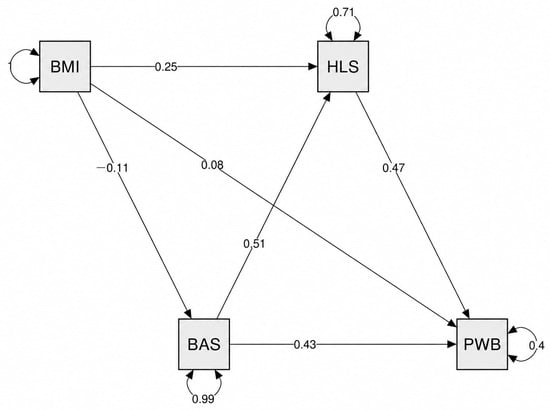
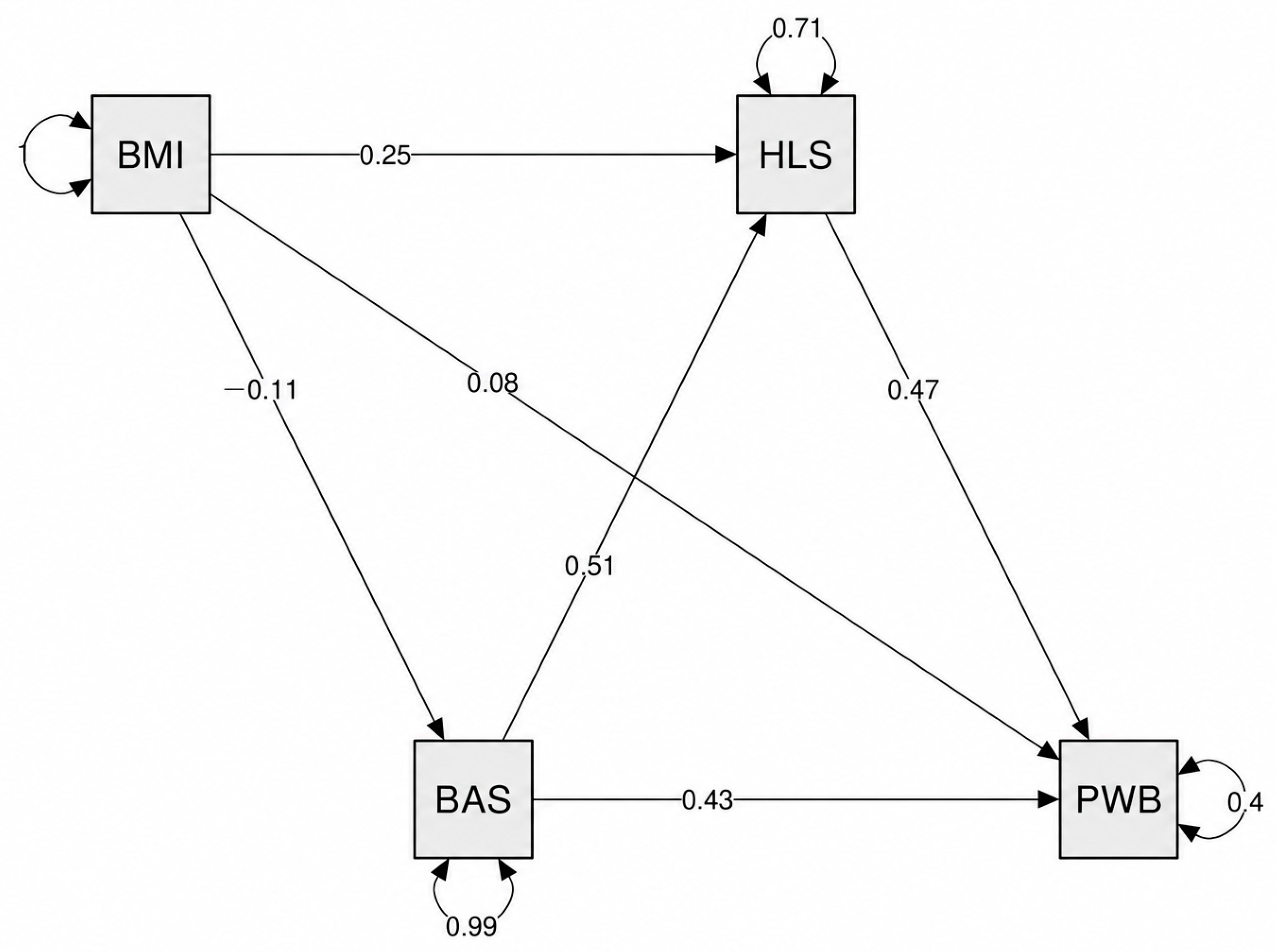
As illustrated in Figure 1, BMI was negatively associated with body appreciation (β = −0.11) and positively associated with health literacy (β = 0.25) and psychological well-being (β = 0.08). Body appreciation was positively associated with health literacy (β = 0.51) and psychological well-being (β = 0.43), while health literacy was positively associated with psychological well-being (β = 0.47). These findings indicate that health literacy partially mediated the association between body appreciation and psychological well-being after controlling for BMI. The residual variances were 0.99 for body appreciation, 0.71 for health literacy, and 0.40 for psychological well-being.
Figure 1.
Mediation model of the association between body appreciation and psychological well-being through health literacy, controlling for BMI.
In the sensitivity analysis additionally adjusting for age and weekly exercise duration, the standardized association between body appreciation and health literacy was 0.487, and the association between health literacy and psychological well-being was 0.460. The direct association between body appreciation and psychological well-being was 0.403. The indirect association remained positive, with a bootstrap confidence interval excluding zero (B = 0.327, bias-corrected 95% CI [0.248, 0.414]; β = 0.224). In the re-estimated BMI-adjusted model, the corresponding indirect association was B = 0.346, 95% CI [0.269, 0.428], and β = 0.237. Additional adjustment therefore attenuated the standardized indirect estimate by approximately 5.5%. A comparison of the models is presented in Table 4.
Table 4.
Comparison of the BMI-adjusted and sensitivity models.
4. Discussion
This study examined the indirect association between body appreciation and psychological well-being through health literacy among women who regularly exercised at fitness centers, with BMI included as a control variable. The findings showed that body appreciation was positively associated with both psychological well-being and health literacy, that health literacy was positively associated with psychological well-being, and that a statistically significant indirect association between body appreciation and psychological well-being was observed through health literacy. BMI was negatively associated with body appreciation but positively associated with health literacy and psychological well-being. The persistence of the main direct and indirect associations after adjustment for BMI suggests that the relationships among body appreciation, health literacy, and psychological well-being cannot be explained solely by body size.
The first main finding was that body appreciation was positively and significantly associated with psychological well-being, supporting the first hypothesis. Women who reported more accepting, respectful, and positive attitudes toward their bodies also reported higher levels of psychological well-being. This finding suggests that body appreciation is not merely an evaluation of physical appearance but may represent a broader psychological resource associated with self-acceptance, maintenance of self-worth, and the capacity to lead a meaningful and competent life.
This finding is consistent with previous evidence linking positive body image to psychological well-being, self-esteem, self-compassion, and life satisfaction (Linardon et al., 2022; Rodgers et al., 2023; Tylka & Wood-Barcalow, 2015). Body appreciation encompasses acceptance of and respect for the body and appreciation of its functionality, which may be relevant to self-acceptance and a sense of competence (Avalos et al., 2005; Tylka & Wood-Barcalow, 2015). From the perspective of Objectification Theory, appearance-based self-evaluation may be associated with body surveillance, shame, and anxiety (Fredrickson & Roberts, 1997; Moradi & Huang, 2008). A more accepting and function-oriented relationship with the body may therefore offer a theoretical explanation for the observed association with psychological well-being (Linardon et al., 2023a; Tylka & Wood-Barcalow, 2015). However, self-objectification and these proposed explanatory processes were not directly assessed in the present study.
The inclusion of women who regularly exercised at fitness centers is particularly relevant to the interpretation of this finding. Fitness centers can foster physical competence, empowerment, health awareness, and appreciation of body functionality, but they may also intensify appearance-based evaluation through mirrors, body measurements, idealized physiques, and social comparisons (Cowley & Schneider, 2025; Prichard & Tiggemann, 2008; Salvador et al., 2023). Regular exercise alone therefore cannot be assumed to guarantee positive body image or higher psychological well-being. The psychological consequences of exercise may vary according to how individuals evaluate their bodies and the reasons underlying their participation in exercise (Prichard & Tiggemann, 2008; Salvador et al., 2023). This distinction can be further understood through Self-Determination Theory (SDT), which emphasizes the importance of autonomous and controlled forms of motivation in shaping behavioral and psychological outcomes (Ryan & Deci, 2000; Teixeira et al., 2012). Exercise undertaken for enjoyment or personally valued health and functional goals reflects relatively autonomous motivation, whereas exercise driven primarily by appearance-related pressures or the need for external approval reflects more controlled regulation. From this perspective, women who exercise for autonomous reasons may be more likely to appreciate their bodies for their health and functionality rather than primarily for their appearance. The present findings suggest that women who maintain a positive relationship with their bodies may be better positioned to benefit psychologically from the health- and empowerment-related potential of fitness environments.
These motivational differences may also be relevant to the indirect association between body appreciation and psychological well-being through health literacy observed in the present study. Among women with more autonomous exercise motivation, greater body appreciation may be associated with a stronger orientation toward seeking, critically evaluating, and applying health information to support personal health and bodily functioning. In this context, health literacy may be more closely associated with psychological well-being through greater perceived competence and autonomy in health-related decision-making. Conversely, among women whose exercise participation is predominantly driven by appearance-related pressures or external approval, health information may be interpreted primarily in terms of weight control and conformity to appearance ideals, potentially weakening the positive association between health literacy and psychological well-being. Accordingly, autonomous and controlled exercise motivations may represent theoretically relevant factors influencing the strength of the observed indirect association. Further research examining exercise motivation alongside body appreciation, health literacy, and psychological well-being could clarify these potential differences.
The second main finding was that body appreciation was positively and significantly associated with health literacy, supporting the second hypothesis. As body appreciation increased, participants reported greater perceived ability to access, understand, appraise, and apply health-related information in everyday decision-making. The comparatively strong association between body appreciation and health literacy suggests that a positive relationship with the body may extend to health-related cognitive and behavioral processes.
The association between body appreciation and health literacy is consistent with the view that valuing the body may be relevant to self-care and engagement with health information (Tylka & Wood-Barcalow, 2015). Previous research linking body appreciation to preventive healthcare use, medical help-seeking, and health-promoting behaviors supports this interpretation (Nolen & Panisch, 2022). Fitness centers provide a relevant context because participants encounter information about exercise, nutrition, and weight management (Cowley & Schneider, 2025), although exposure alone does not ensure accurate interpretation or appropriate application (Sørensen et al., 2012). A positive relationship with the body may be associated with using such information for health and functionality rather than solely for appearance change (Linardon et al., 2023a; Prichard & Tiggemann, 2008). Together, these perspectives offer a theoretical context for the observed association (Sørensen et al., 2012; Tylka & Wood-Barcalow, 2015), but information-seeking behavior, self-care motivation, and the purposes for which participants used health information were not directly assessed.
The third main finding was that health literacy was positively and significantly associated with psychological well-being, supporting the third hypothesis. Women who reported greater ability to access, understand, evaluate, and use health information also reported higher psychological well-being. This association may be explained by reductions in health-related uncertainty and by stronger feelings of informed decision-making, self-efficacy, and control.
Within the integrated model of health literacy, individuals are regarded not as passive recipients of health information but as active agents who seek, appraise, and apply information in health-related decisions (Sørensen et al., 2012). Individuals who can interpret health information accurately may experience less uncertainty when facing health concerns, distinguish reliable from unreliable sources, and participate more effectively in decisions concerning their health. These processes may strengthen perceived control over health and daily life. Perceived control, competence, and autonomy are central components of psychological well-being (Ryff, 1989, 2022).
In contrast, limited health literacy may contribute to misunderstanding health messages, difficulty making decisions when confronted with conflicting information, increased health-related anxiety, and a reduced sense of competence in managing one’s health (Berkman et al., 2011; Liu et al., 2020). Evidence that health literacy interventions may reduce symptoms of depression and anxiety further supports the relationship between health literacy and psychological outcomes (Magallón-Botaya et al., 2023). The present findings therefore reinforce the view that health literacy is not merely a technical skill associated with healthcare use or disease management, but also a psychosocial resource that may support broader psychological functioning.
The central finding of the study was a statistically significant indirect association between body appreciation and psychological well-being through health literacy. The indirect association between body appreciation and psychological well-being through health literacy was statistically significant, and the bootstrap confidence interval did not include zero, supporting the fourth hypothesis within the specified statistical model. Because the direct association between body appreciation and psychological well-being remained statistically significant after health literacy was included in the model, both direct and indirect associations were supported.
The total association between body appreciation and psychological well-being was β = 0.663, whereas the indirect association through health literacy was β = 0.237. The indirect association accounted for approximately 35.7% of the estimated total association within the specified model. This proportion describes the relative magnitude of the statistical indirect association and does not establish the extent of any causal effect operating through health literacy. The findings are consistent with the proposed theoretical relationships among body appreciation, health literacy, and psychological well-being, although the cross-sectional design does not establish their temporal or causal ordering. The remaining direct association may also reflect associations involving self-acceptance, self-esteem, self-compassion, social confidence, appreciation of body functionality, and resilience to appearance-related pressures.
The observed indirect association can be interpreted within a theoretical framework integrating the positive body image perspective and the integrated model of health literacy (Sørensen et al., 2012; Tylka & Wood-Barcalow, 2015). Women who develop a positive attitude toward their bodies may be more likely to perceive their bodies as worthy of care and protection, attend to health needs, and engage more constructively with health-related information. Such an orientation may be associated with greater health literacy. Higher health literacy may, in turn, help women critically evaluate messages concerning exercise, nutrition, weight management, and physical appearance (Nutbeam, 2008; Sørensen et al., 2012). This may enable them to make decisions that are more appropriate to their individual needs rather than relying on unrealistic beauty standards or health recommendations lacking scientific support (Ward et al., 2023). The ability to make more informed health decisions may strengthen self-efficacy and perceived control, thereby contributing to psychological well-being (Ryff, 1989, 2022).
This finding is especially important for women who are exposed to large amounts of health- and appearance-related content through social media and fitness culture. Women who exercise regularly may encounter unsupported dietary advice, promises of rapid weight loss, idealized body representations, and standardized exercise programs (Cowley & Schneider, 2025; Ward et al., 2023). Individuals with higher health literacy may be better able to assess the reliability, personal relevance, and possible consequences of such messages (Nutbeam, 2008; Sørensen et al., 2012). Health literacy may therefore function as a cognitive resource that helps protect women from the psychological effects of misleading health information and sociocultural appearance pressures. This interpretation is consistent with the view that positive body image involves a protective cognitive filter against societal beauty ideals (Tylka & Wood-Barcalow, 2015).
The model explained 60.1% of the variance in psychological well-being. Although this finding indicates a substantial proportion of explained variance within the present sample, it should not be interpreted as evidence of equivalent predictive performance across different populations. The relatively high R2 value may partly reflect conceptual similarities between body appreciation and psychological well-being. Although the two scales assess theoretically distinct constructs, both encompass aspects of positive self-evaluation and self-acceptance, while the psychological well-being measure also incorporates self-esteem and perceived competence. This conceptual proximity may contribute to the strength of the observed associations and potentially inflate estimates of the model’s explanatory capacity. Furthermore, because all variables were assessed using self-report measures within the same data collection session, shared method variance may also have contributed to the observed relationships. Accordingly, the explained variance should be interpreted in relation to the characteristics of the measures and the present sample, and the model’s predictive performance requires evaluation in independent samples. Body appreciation and BMI together explained 29.2% of the variance in health literacy, suggesting that health literacy is associated with psychological factors but is also likely to be influenced by other determinants, such as educational attainment, socioeconomic status, access to healthcare, digital skills, and previous health-related experiences.
The associations involving BMI also require careful interpretation. BMI was negatively associated with body appreciation, indicating that higher BMI values were associated with lower levels of body appreciation (Rodgers et al., 2023). This finding may be explained by sociocultural ideals of thinness and fitness, weight stigma, and appearance-related pressures directed toward women (Ward et al., 2023). Body weight may be socially interpreted not only as a health-related indicator but also as a marker of social acceptance and physical attractiveness. Women with higher BMI values may therefore experience greater exposure to negative evaluation, social comparison, and weight stigma, which may contribute to lower body appreciation (Puhl & Lessard, 2020; Rodgers et al., 2023).
Nevertheless, BMI explained only 1.0% of the variance in body appreciation, indicating that it was a statistically significant but limited correlate of body appreciation. This finding suggests that women with similar BMI values may develop substantially different attitudes toward their bodies and that body appreciation cannot be understood solely in terms of weight or body size. Appreciation of body functionality, internalization of societal beauty ideals, social support, exercise motivation, and self-compassion may be more influential determinants of body appreciation than BMI alone.
The positive association between BMI and health literacy was an initially unexpected finding. Individuals with higher BMI values may be more frequently exposed to health information concerning weight management, nutrition, physical activity, and chronic disease risk, or may be more likely to seek such information. More frequent contact with health professionals, greater exposure to discussions of weight-related health risks, and increased perceived need to manage one’s health may have contributed to higher health literacy scores. However, because of the cross-sectional design, the finding should not be interpreted as evidence that higher BMI increases health literacy. The association may also reflect characteristics specific to women who attend fitness centers or differences in the accuracy with which individuals report their weight and health status.
The weak positive association between BMI and psychological well-being should likewise be interpreted cautiously. This finding does not indicate that higher BMI generally results in greater psychological well-being. The association was small and should be considered within the specific context of women attending fitness centers in Malatya and Elazığ, Türkiye. Its generalizability to other populations remains uncertain. Although the sensitivity analysis additionally adjusted for age and weekly exercise duration, the present data do not establish why the positive association was observed. Body composition and participants’ perceptions of body weight were not assessed and therefore cannot be used to explain this finding.
The persistence of the main associations among body appreciation, health literacy, and psychological well-being after adjustment for BMI supported the fifth hypothesis. This finding suggests that the psychological relationships identified in the model were not merely consequences of body weight or body size. In particular, the continued significance of both the direct association between body appreciation and psychological well-being and the indirect association through health literacy indicates that positive body image may represent an important psychological resource independently of BMI. Body appreciation and health literacy should therefore be considered psychosocial factors that extend beyond body size in explaining psychological well-being among women who exercise regularly.
The sensitivity analysis indicated that the positive indirect association persisted after additional adjustment for age and weekly exercise duration, although the standardized estimate decreased from 0.237 to 0.224. This finding suggests that, within the specified model, the observed indirect association was not fully accounted for by these measured characteristics. However, its persistence does not exclude confounding by unmeasured factors, particularly educational attainment and socioeconomic circumstances. Furthermore, the cross-sectional design does not establish temporal ordering among the study variables. The sensitivity analysis therefore provides additional evidence concerning the statistical association rather than evidence of causal mediation.
A notable strength of this study is that body appreciation, health literacy, and psychological well-being were examined within the same mediation model while controlling for BMI. The role of health literacy in the association between positive body image and psychological well-being has received limited empirical attention. Additional strengths include the relatively large sample of 580 participants, the high internal consistency of the measures in the present sample, and the use of bootstrap resampling to evaluate the indirect association.
5. Limitations and Directions for Future Research
This study has several limitations. First, the cross-sectional and correlational design does not permit causal conclusions. Although the theoretical model specified body appreciation as an antecedent of health literacy and psychological well-being, reverse or reciprocal associations are also possible. For example, women with higher psychological well-being may develop more positive attitudes towards their bodies, and individuals with higher health literacy may form more realistic body-related evaluations. Longitudinal and experimental studies are therefore needed to establish temporal ordering and examine possible causal relationships more clearly.
Second, all variables were assessed using self-report instruments. The findings may therefore have been affected by social desirability bias, common method variance, and recall error. In particular, assessing body appreciation and psychological well-being within the same data collection session may have inflated their association because both measures involve positive self-evaluation. Future studies could combine self-report measures with clinical interviews, behavioural indicators, healthcare utilisation records, or reports from multiple sources.
Third, the sample consisted exclusively of women who exercised at fitness centres in Malatya and Elazığ. Caution is therefore required when generalising the findings to women living in other geographical regions, individuals who do not exercise, men, or participants engaged in different forms of physical activity. Women who regularly attend fitness centres may differ from the general female population in terms of health awareness, socioeconomic status, exercise motivation, and social support. Future studies should include participants from diverse geographical regions, different exercise settings, and non-exercising comparison groups.
Fourth, BMI provides only a limited indication of body composition and does not distinguish between fat mass and muscle mass. This limitation is especially important among individuals who exercise regularly. Future research should incorporate additional indicators, such as body fat percentage, waist circumference, muscle mass, physical fitness, and perceived health status. Moreover, because height and weight were self-reported, the possibility of measurement error should be considered.
Fifth, several potentially relevant variables were not included in the model, including educational attainment, income, marital status, chronic disease, history of mental health problems, exercise experience, exercise motivation, social media use, and experiences of weight stigma. Health literacy may be strongly associated with education and socioeconomic status, whereas body appreciation may be influenced by exercise motivation and appearance-related pressures. Future studies should control for these characteristics or examine their potential moderating roles. In particular, the association between body appreciation and psychological well-being may vary depending on whether exercise is motivated by health and functionality or by weight loss and appearance change. Although the sensitivity analysis additionally adjusted for age and weekly exercise duration, residual confounding remains possible. Educational attainment and socioeconomic circumstances were not measured and could not be included as covariates. Their potential associations with health literacy, body appreciation, and psychological well-being may partly account for the estimated direct and indirect associations. The direction and magnitude of this potential bias cannot be determined from the available data. Accordingly, persistence of the indirect association after additional adjustment should not be interpreted as demonstrating independence from all relevant confounding factors.
Sixth, the HLS19-Q12 measures perceived difficulty in accessing and using health information and may not directly reflect objective health knowledge or performance-based competence. Future research could combine perceived health literacy measures with objective or performance-based assessments to examine the ability to evaluate and apply health information more comprehensively.
Seventh, questionnaires were administered at fitness centers before or after exercise sessions. The possible influence of the assessment setting and timing relative to exercise could not be determined from the present data. The study assessed general psychological well-being rather than changes in momentary mood following exercise, and endorphin levels were not measured. Consequently, the findings cannot establish whether acute exercise-related physiological responses contributed to participants’ reported well-being. Future studies could use repeated assessments before, immediately after, and at a defined interval after exercise, including assessments outside fitness centers, to distinguish short-term mood changes from more general psychological well-being.
Finally, the inclusion of participants younger than 18 years requires consideration of developmental differences. Body image, engagement with health information, and psychological well-being may differ across adolescence and adulthood. Future studies could conduct multigroup analyses across age categories or use more developmentally homogeneous samples to determine whether the model differs according to developmental stage.
6. Conclusions
This study demonstrated that body appreciation was positively associated with psychological well-being both directly and indirectly through health literacy among women who regularly exercised at fitness centres. The findings support a statistically significant indirect association through health literacy within the proposed model, suggesting that health literacy may represent a relevant psychosocial factor in the relationship between body appreciation and psychological well-being. Even after controlling for BMI, the significant direct and indirect associations remained, indicating that these relationships were not solely attributable to differences in body size. These findings provide a basis for further investigating body appreciation and health literacy as potential targets for interventions aimed at psychological well-being among women who exercise regularly. However, longitudinal and experimental research is needed to determine whether changes in these factors lead to improvements in psychological well-being.
Author Contributions
Conceptualization, M.A. and M.G.; methodology, M.A. and M.G.; formal analysis, M.A. and M.G.; investigation, M.A., M.G., Y.E.K. and G.P.G.; data curation, M.A., M.G., Y.E.K. and G.P.G.; writing—original draft preparation, M.A., M.G. and Y.E.K.; writing—review and editing, M.A., M.G., Y.E.K. and G.P.G.; supervision, M.A. and M.G. All authors have read and agreed to the published version of the manuscript.
Funding
This research was funded by the Scientific Research Projects Coordination Unit (BAP) of İnönü University, grant number SBA-2026-4891.
Institutional Review Board Statement
The study was conducted in accordance with the Declaration of Helsinki and approved by the İnönü University Social and Human Sciences Scientific Research and Publication Ethics Committee (Decision No. 9; 26 March 2026).
Informed Consent Statement
Informed consent was obtained from all participants involved in the study.
Data Availability Statement
The data supporting the findings of this study are available from the corresponding author upon reasonable request.
Acknowledgments
During the preparation of this manuscript, the authors used ChatGPT (GPT-6, OpenAI) for language editing and translation purposes. The authors reviewed and edited the output and take full responsibility for the content of this publication.
Conflicts of Interest
The authors declare no conflicts of interest.
Abbreviations
The following abbreviations are used in this manuscript:
| BAS | Body Appreciation Scale |
| BMI | Body Mass Index |
| CI | Confidence Interval |
| CFA | Confirmatory Factor Analysis |
| CFI | Comparative Fit Index |
| GFI | Goodness-of-Fit Index |
| HLS | Health Literacy Scale |
| HLS19-Q12 | Health Literacy Survey 2019–Europe, 12-item version |
| IFI | Incremental Fit Index |
| PWB | Psychological Well-Being |
| RMSEA | Root Mean Square Error of Approximation |
| SD | Standard Deviation |
| SEM | Structural Equation Modeling |
| SRMR | Standardized Root Mean Square Residual |
| TLI | Tucker–Lewis Index |
| VIF | Variance Inflation Factor |
References
- Alleva, J. M., Tylka, T. L., & Van Diest, A. M. K. (2017). The Functionality Appreciation Scale (FAS): Development and psychometric evaluation in US community women and men. Body Image, 23, 28–44. [Google Scholar] [CrossRef] [Scilit] [PubMed]
- Avalos, L., Tylka, T. L., & Wood-Barcalow, N. (2005). The body appreciation scale: Development and psychometric evaluation. Body Image, 2(3), 285–297. [Google Scholar] [CrossRef] [Scilit] [PubMed]
- Bakalım, O., & Taşdelen-Karçkay, A. (2016). Beden memnuniyeti ölçeği: Türk kadın ve erkek üniversite öğrencilerinde faktör yapısı ve psikometrik özelliklerinin değerlendirilmesi. Mersin University Journal of the Faculty of Education, 12(1), 410–422. [Google Scholar] [CrossRef] [Scilit]
- Berkman, N. D., Sheridan, S. L., Donahue, K. E., Halpern, D. J., & Crotty, K. (2011). Low health literacy and health outcomes: An updated systematic review. Annals of Internal Medicine, 155(2), 97–107. [Google Scholar] [CrossRef] [Scilit] [PubMed]
- Cowley, E. S., & Schneider, J. (2025). “I sometimes feel like I can’t win!”: An exploratory mixed-methods study of women’s body image and experiences of exercising in gym settings. PLoS ONE, 20(1), e0316756. [Google Scholar] [CrossRef] [Scilit] [PubMed]
- Diener, E., Wirtz, D., Tov, W., Kim-Prieto, C., Choi, D. W., Oishi, S., & Biswas-Diener, R. (2010). New well-being measures: Short scales to assess flourishing and positive and negative feelings. Social Indicators Research, 97(2), 143–156. [Google Scholar] [CrossRef] [Scilit]
- Faul, F., Erdfelder, E., Lang, A. G., & Buchner, A. (2007). G*Power 3: A flexible statistical power analysis program for the social, behavioral, and biomedical sciences. Behavior Research Methods, 39(2), 175–191. [Google Scholar] [CrossRef] [Scilit] [PubMed]
- Fredrickson, B. L., & Roberts, T. A. (1997). Objectification theory: Toward understanding women’s lived experiences and mental health risks. Psychology of Women Quarterly, 21(2), 173–206. [Google Scholar] [CrossRef] [Scilit]
- Hair, J. F., Black, W. C., Babin, B. J., & Anderson, R. E. (2014). Multivariate data analysis (7th ed.). Pearson Education. [Google Scholar]
- Kim, H. Y. (2013). Statistical notes for clinical researchers: Assessing normal distribution (2) using skewness and kurtosis. Restorative Dentistry & Endodontics, 38(1), 52–54. [Google Scholar] [CrossRef] [Scilit] [PubMed]
- Linardon, J., Anderson, C., & McClure, Z. (2023a). Body appreciation predicts better mental health and wellbeing: A short-term prospective study. Body Image, 45, 20–24. [Google Scholar] [CrossRef] [Scilit] [PubMed]
- Linardon, J., McClure, Z., Tylka, T. L., & Fuller-Tyszkiewicz, M. (2022). Body appreciation and its psychological correlates: A systematic review and meta-analysis. Body Image, 42, 287–296. [Google Scholar] [CrossRef] [Scilit] [PubMed]
- Linardon, J., Messer, M., & Tylka, T. L. (2023b). Functionality appreciation and its correlates: Systematic review and meta-analysis. Body Image, 45, 65–72. [Google Scholar] [CrossRef] [Scilit] [PubMed]
- Liu, C., Wang, D., Liu, C., Jiang, J., Wang, X., Chen, H., Ju, X., & Zhang, X. (2020). What is the meaning of health literacy? A systematic review and qualitative synthesis. Family Medicine and Community Health, 8(2), e000351. [Google Scholar] [CrossRef] [Scilit] [PubMed]
- Magallón-Botaya, R., Méndez-López, F., Oliván-Blázquez, B., Silva-Aycaguer, L. C., Lerma-Irureta, D., & Bartolomé-Moreno, C. (2023). Effectiveness of health literacy interventions on anxious and depressive symptomatology in primary health care: A systematic review and meta-analysis. Frontiers in Public Health, 11, 1007238. [Google Scholar] [CrossRef] [Scilit] [PubMed]
- Michou, M., Panagiotakos, D. B., & Costarelli, V. (2018). Low health literacy and excess body weight: A systematic review. Central European Journal of Public Health, 26(3), 234–241. [Google Scholar] [CrossRef] [Scilit] [PubMed]
- Mishra, P., Pandey, C. M., Singh, U., Gupta, A., Sahu, C., & Keshri, A. (2019). Descriptive statistics and normality tests for statistical data. Annals of Cardiac Anaesthesia, 22(1), 67–72. [Google Scholar] [CrossRef] [Scilit] [PubMed]
- Modica, C. A., & Markley, A. E. (2024). Reciprocal longitudinal associations between positive body image and wellbeing among early-adult women. Body Image, 51, 101770. [Google Scholar] [CrossRef] [Scilit] [PubMed]
- Moradi, B., & Huang, Y. P. (2008). Objectification theory and psychology of women: A decade of advances and future directions. Psychology of Women Quarterly, 32(4), 377–398. [Google Scholar] [CrossRef] [Scilit]
- Nolen, E., & Panisch, L. S. (2022). The relationship between body appreciation and health behaviors among women and adolescent girls: A scoping review. Health & Social Work, 47(2), 113–122. [Google Scholar] [CrossRef] [Scilit] [PubMed]
- Nutbeam, D. (2008). The evolving concept of health literacy. Social Science & Medicine, 67(12), 2072–2078. [Google Scholar] [CrossRef] [Scilit] [PubMed]
- Pelikan, J. M., Link, T., Straßmayr, C., Waldherr, K., Alfers, T., Bøggild, H., Griebler, R., Lopatina, M., Mikšová, D., Nielsen, M. G., Peer, S., & Vrdelja, M. (2022). Measuring comprehensive, general health literacy in the general adult population: The development and validation of the HLS19-Q12 instrument in seventeen countries. International Journal of Environmental Research and Public Health, 19(21), 14129. [Google Scholar] [CrossRef] [Scilit] [PubMed]
- Preacher, K. J., & Hayes, A. F. (2008). Asymptotic and resampling strategies for assessing and comparing indirect effects in multiple mediator models. Behavior Research Methods, 40(3), 879–891. [Google Scholar] [CrossRef] [Scilit] [PubMed]
- Prichard, I., & Tiggemann, M. (2008). Relations among exercise type, self-objectification, and body image in the fitness centre environment: The role of reasons for exercise. Psychology of Sport and Exercise, 9(6), 855–866. [Google Scholar] [CrossRef] [Scilit]
- Puhl, R. M., & Lessard, L. M. (2020). Weight stigma in youth: Prevalence, consequences, and considerations for clinical practice. Current Obesity Reports, 9(4), 402–411. [Google Scholar] [CrossRef] [Scilit] [PubMed]
- Rodgers, R. F., Laveway, K., Campos, P., & de Carvalho, P. H. B. (2023). Body image as a global mental health concern. Cambridge Prisms: Global Mental Health, 10, e9. [Google Scholar] [CrossRef] [Scilit] [PubMed]
- Rusticus, S. (2023). Body image. In F. Maggino (Ed.), Encyclopedia of quality of life and well-being research. Springer. [Google Scholar] [CrossRef] [Scilit]
- Ryan, R. M., & Deci, E. L. (2000). Self-determination theory and the facilitation of intrinsic motivation, social development, and well-being. American Psychologist, 55(1), 68–78. [Google Scholar] [CrossRef] [PubMed]
- Ryff, C. D. (1989). Happiness is everything, or is it? Explorations on the meaning of psychological well-being. Journal of Personality and Social Psychology, 57(6), 1069–1081. [Google Scholar] [CrossRef]
- Ryff, C. D. (2022). Positive psychology: Looking back and looking forward. Frontiers in Psychology, 13, 840062. [Google Scholar] [CrossRef] [Scilit] [PubMed]
- Salvador, R., Monteiro, D., Rebelo-Gonçalves, R., & Jiménez-Castuera, R. (2023). Interpersonal behavior, basic psychological needs, motivation, eating behavior, and body image in gym/fitness exercisers: A systematic review. Sustainability, 15(20), 14914. [Google Scholar] [CrossRef] [Scilit]
- Santoniccolo, F., Trombetta, T., Paradiso, M. N., & Rollè, L. (2023). Gender and media representations: A review of the literature on gender stereotypes, objectification and sexualization. International Journal of Environmental Research and Public Health, 20(10), 5770. [Google Scholar] [CrossRef] [Scilit] [PubMed]
- Sørensen, K., Van den Broucke, S., Fullam, J., Doyle, G., Pelikan, J., Slonska, Z., Brand, H., & (HLS-EU) Consortium Health Literacy Project European. (2012). Health literacy and public health: A systematic review and integration of definitions and models. BMC Public Health, 12, 80. [Google Scholar] [CrossRef] [Scilit] [PubMed]
- Tabachnick, B. G., & Fidell, L. S. (2019). Using multivariate statistics (7th ed.). Pearson. [Google Scholar]
- Teixeira, P. J., Carraça, E. V., Markland, D., Silva, M. N., & Ryan, R. M. (2012). Exercise, physical activity, and self-determination theory: A systematic review. International Journal of Behavioral Nutrition and Physical Activity, 9, 78. [Google Scholar] [CrossRef] [Scilit] [PubMed]
- Telef, B. B. (2013). Psikolojik iyi oluş ölçeği: Türkçeye uyarlama, geçerlik ve güvenirlik çalışması. Hacettepe University Journal of Education, 28(3), 374–384. [Google Scholar]
- Terzi, H., Akca, A., & Ayaz-Alkaya, S. (2024). Adaptation of the health literacy survey 19-Europe-Q12 into Turkish culture: A psychometric study. Journal of Evaluation in Clinical Practice, 30, 1782–1790. [Google Scholar] [CrossRef] [Scilit] [PubMed]
- Tylka, T. L., & Wood-Barcalow, N. L. (2015). What is and what is not positive body image? Conceptual foundations and construct definition. Body Image, 14, 118–129. [Google Scholar] [CrossRef] [Scilit] [PubMed]
- Ward, L. M., Daniels, E. A., Zurbriggen, E. L., & Rosenscruggs, D. (2023). The sources and consequences of sexual objectification. Nature Reviews Psychology, 2, 496–513. [Google Scholar] [CrossRef] [Scilit]
- World Health Organization. (2022). Health literacy development for the prevention and control of noncommunicable diseases: Volume 3. Recommended actions. World Health Organization. [Google Scholar]
- World Health Organization. (2026). Obesity and overweight. Available online: https://www.who.int/news-room/fact-sheets/detail/obesity-and-overweight (accessed on 4 August 2026).
- Yokusoglu, C., Sertel Berk, O., Yucel, B., & Yager, J. (2024). Sociocultural predictors of body shape and weight concerns in Türkiye: Differences between healthy women and patients with eating disorders. Dusunen Adam Journal of Psychiatry and Neurological Sciences, 37(2), 76–84. [Google Scholar] [CrossRef] [Scilit] [PubMed]
- Zhang, Y., Wen, Z., Zhu, Y., & Guan, G. (2024). Effects of physical exercise on body esteem among females: A meta-analysis. BMC Public Health, 24(1), 3387. [Google Scholar] [CrossRef] [Scilit] [PubMed]

Disclaimer/Publisher’s Note: The statements, opinions and data contained in all publications are solely those of the individual author(s) and contributor(s) and not of MDPI and/or the editor(s). MDPI and/or the editor(s) disclaim responsibility for any injury to people or property resulting from any ideas, methods, instructions or products referred to in the content. |
© 2026 by the authors. Licensee MDPI, Basel, Switzerland. This article is an open access article distributed under the terms and conditions of the Creative Commons Attribution (CC BY) license.