


Abstract
Sleep is important to university students’ mental health, but longitudinal evidence on associations between sleep and anxiety is limited among engineering undergraduates. Using a three-wave balanced panel of 281 engineering undergraduates (W1–W3) at a Chinese university, this study examined longitudinal associations among sleep quality, sleep duration, and anxiety symptoms using a cross-lagged panel model, complemented by individual fixed-effects and adjacent-wave change-score analyses. Anxiety symptoms and sleep-quality problems were descriptively higher at W2 and W3 than at W1, while average sleep duration changed little. Poorer sleep quality at W2 was significantly associated with higher anxiety at W3, and higher anxiety at W2 was significantly associated with poorer sleep quality at W3. Average paths in both directions across the two adjacent-wave intervals were significant; interval-specific reciprocal prospective associations were statistically detectable only from W2 to W3. Independent cross-lagged associations between sleep duration and anxiety were generally weak. Complementary analyses showed significant contemporaneous within-person associations and synchronous changes between deteriorating sleep quality and increasing anxiety. These findings advance the understanding of the relationship between sleep quality and anxiety and may inform further research on sleep support and anxiety risk identification in demanding educational contexts.
1. Introduction
The university years represent a critical transition from adolescence to adulthood, during which students navigate academic demands, interpersonal relationships, changing roles, and uncertainty about future careers in an increasingly autonomous environment. In this context, anxiety remains a persistent concern in higher education (Gale & Parker, 2014; Kahu & Nelson, 2018; Liu & Wang, 2024; Thompson et al., 2021; Trautwein & Bosse, 2017). In the World Health Organization World Mental Health International College Student project, self-report screening of 13,984 full-time first-year students at 19 universities in eight countries found lifetime and 12-month screening prevalence rates of generalized anxiety disorder of 18.6% and 16.7%, respectively, indicating that anxiety is common among university students (Auerbach et al., 2018). Anxiety among Chinese university students also warrants attention. A survey of more than 40,000 students at 106 universities across China also reported anxiety symptoms in a substantial proportion of respondents (Han et al., 2025). Longitudinal evidence further suggests that anxiety does not develop uniformly across university students; distinct academic self-efficacy trajectory groups have shown different patterns of anxiety across the four years of college (Liu & Zhang, 2026). Anxiety is associated not only with poorer emotional experiences and life satisfaction, but also with lower learning engagement and academic performance, as well as poorer long-term educational and socioeconomic outcomes (Brumariu et al., 2023; Duong, 2021; Essau et al., 2014; K. A. Gregory et al., 2024). Recent studies in Chinese higher education likewise show that self-esteem and academic performance are prospectively associated with lower subsequent anxiety among first-generation college students, whereas higher anxiety is prospectively associated with poorer subsequent self-rated health among students at elite universities (Liu et al., 2026a, 2026b). Identifying key factors that shape the development of anxiety among university students and clarifying how these processes unfold over time are therefore important practical tasks for promoting students’ overall development and addressing mental health risks in a timely manner.
Sleep is an important and relatively modifiable health-related behavior associated with university students’ mental health. Previous research has shown that delayed sleep schedules, insufficient sleep, irregular sleep rhythms, and inadequate restoration after sleep are common among university students (Henrich et al., 2023; S. Hershner, 2015; Hurdiel et al., 2017), making sleep quality in this population an important concern. Among 1125 university students in the United States, more than 60% were classified as having poor sleep quality (Lund et al., 2010). A related review further showed that approximately 50% of university students experienced daytime sleepiness, more than 70% slept fewer than eight hours per night, and sleep problems could impair learning, mood, and daytime functioning (S. D. Hershner & Chervin, 2014). Unlike sleep duration, which mainly reflects the amount of sleep, sleep quality encompasses sleep initiation, sleep continuity, restoration after sleep, and daytime functioning, and may have stronger associations with health, emotional experience, and daily functioning (Pilcher et al., 1997). In the present study, sleep quality was assessed as students’ overall subjective evaluation of their sleep quality. The university years involve marked changes in academic demands, pace of life, and schedule structure. Students must coordinate study, social activities, and rest in a more autonomous environment, and these changes in lifestyle and time use may increase the risk of irregular sleep rhythms and poorer sleep quality (Doane et al., 2015; Norbury & Evans, 2019; Oftedal et al., 2024). Current understanding of the relationship between sleep quality and anxiety remains incomplete, and there is still no consistent account of their temporal order or direction of association.
Theoretically, sleep quality and anxiety may be bidirectionally associated, but sufficient empirical investigation is still lacking. On the one hand, sleep is an important process for restoring cognitive control and maintaining emotional stability. Impaired sleep may weaken the regulation of negative emotions and heighten sensitivity to threatening information, thereby increasing the risk of anxiety (Goldstein & Walker, 2014; Palmer & Alfano, 2017). On the other hand, the cognitive model of insomnia suggests that persistent worry, repetitive negative thinking, and heightened psychological and physiological arousal accompanying anxiety may disrupt sleep initiation and maintenance and reduce sleep continuity and restoration (Cox & Olatunji, 2016; Harvey, 2002). Poorer sleep quality may therefore be associated with a subsequent increase in anxiety, while higher anxiety may also be associated with subsequent deterioration in sleep quality. Although a small number of longitudinal studies and reviews have provided initial support for this bidirectional association (Alvaro et al., 2013), existing evidence remains limited by differences in time scale, sample composition, and analytical approach, warranting further empirical examination in the present study.
Notably, engineering undergraduates provide a practically relevant educational context for examining this longitudinal association. As future engineering and technical professionals, engineering undergraduates typically complete specialist coursework, laboratory and practical training, and engineering projects that place substantial demands on time management, sustained attention, problem solving, and recovery. A previous systematic review showed that stress, anxiety, and sleep problems are recurring themes in research on engineering undergraduates, but the available evidence is still dominated by cross-sectional designs (Asghar et al., 2024). The culture of stress in engineering education and its links with anxiety, depression, and help-seeking behavior also make the dynamic relationship between insufficient recovery from sleep and anxiety especially worthy of attention (Hammer et al., 2024; Jensen & Cross, 2021; Jensen et al., 2023). Examining how sleep quality and anxiety are associated with each other over time among engineering undergraduates may therefore help explain student adjustment in demanding educational contexts and provide a basis for universities to improve support systems for engineering students.
Against this background, the present study used three-wave longitudinal data from Chinese engineering undergraduates and focused on a cross-lagged panel model to examine the relationship between sleep quality and anxiety. An individual fixed-effects model and an adjacent-wave change-score model were used to examine concurrent within-person associations and synchronous changes within the same students. The study contributes by examining the temporal pattern of associations between self-reported global sleep quality (hereafter, sleep quality) and anxiety among engineering undergraduates and by comparing the longitudinal information provided by sleep quality and sleep duration. The empirical findings may deepen the understanding of the relationship between sleep and anxiety among engineering undergraduates in Chinese higher education and inform further research on sleep support and anxiety risk identification in university settings.
2. Literature Review
2.1. Sleep Quality and Anxiety
Previous research has shown that sleep quality is closely related to the mental health of university students, although most studies have focused mainly on correlations between sleep quality and mental health indicators. Evidence from a survey of 546 university students in southeast England showed that 46% of participants rated their sleep as fairly bad or very bad, and that poor sleep quality was significantly and positively associated with higher anxiety (Norbury & Evans, 2019). Across two studies of university students, Pilcher et al. (1997) used seven consecutive days of sleep diaries and questionnaires to compare the associations of sleep quality and sleep duration with health, well-being, and daytime sleepiness. Among participants who slept an average of approximately seven hours per night, sleep quality generally had stronger associations than sleep duration with health status, affective balance, life satisfaction, and several negative emotions. An analysis of self-report survey data from 3483 French students aged 18 to 30 found that poor sleep quality was significantly associated with all dimensions of mental health, particularly anxiety (Montagni et al., 2020). A cross-sectional online survey of 1125 students aged 17 to 24 at a university in the United States found that students classified as having poor sleep quality reported significantly more physical and mental health problems than those with good sleep quality (Lund et al., 2010). A systematic review and meta-analysis of 34 studies further identified a moderate correlation between poorer sleep quality and stress, although the available evidence came mainly from cross-sectional studies and could not establish temporal order (Gardani et al., 2022). Overall, concurrent associations between sleep quality and anxiety, as well as other mental health outcomes, are well established, but their temporal interplay remains insufficiently understood and requires longitudinal investigation.
There are clear theoretical grounds for a longitudinal association between sleep quality and anxiety. Sleep helps integrate emotional information and restore prefrontal regulation of emotional responses. Impaired sleep may heighten negative emotional responses and threat sensitivity and reduce the ability to disengage from worry and negative thinking (Ben Simon et al., 2020; Federico et al., 2022; Motomura et al., 2013; Goldstein & Walker, 2014; Palmer & Alfano, 2017; Walker, 2009; Walker & van der Helm, 2009). Poorer sleep quality may therefore not only coexist with current anxiety but also serve as a risk indicator for subsequent anxiety (A. M. Gregory et al., 2005). The reverse pathway also has a theoretical basis. According to the cognitive model of insomnia, persistent worry about stressful events, sleep itself, and the consequences of insufficient sleep may produce cognitive and physiological arousal and lead individuals to monitor sleep-related threat cues excessively, thereby interfering with sleep initiation and maintenance (Harvey, 2002). Overall, sleep quality and anxiety may theoretically form a bidirectional association, but direct empirical evidence concerning their full bidirectional longitudinal relationship remains limited and requires further examination.
At the same time, a small number of longitudinal studies have provided initial evidence of this bidirectional association. Doane et al. (2015) followed 82 adolescents about to enter university across three assessments. More subjective sleep problems before high school graduation predicted higher anxiety during the first semester of university, while higher anxiety during the first semester predicted more sleep problems in the second semester, suggesting that the direction of the cross-lagged association may differ across stages. Peltz et al. (2017) conducted a seven-day morning-and-evening diary study of 283 university students in the United States, whose mean age was 19.9 years. Better sleep quality on the previous night predicted lower anxiety symptoms that day, while higher anxiety symptoms during the day predicted poorer sleep quality that night, indicating a possible worsening cycle between sleep quality problems and anxiety at the daily level. A prospective study in the general population also found a significant positive association between anxiety and insomnia, with baseline insomnia significantly associated with new-onset high anxiety at the one-year follow-up (Jansson-Fröjmark & Lindblom, 2008). Among 686 male Chinese university students, analyses using continuous variables supported bidirectional cross-lagged associations between sleep quality and anxiety. However, when cutoffs were used to construct incident outcomes, only poorer sleep quality at baseline significantly predicted new-onset anxiety one year later; baseline anxiety did not significantly predict new-onset poor sleep quality (Zou et al., 2020). The available evidence nevertheless remains limited. Intensive diary studies mainly capture short-term daily dynamics between sleep and anxiety and cannot reveal their longitudinal relationship over periods of several months or longer. To reduce the burden of repeated measurement, Peltz et al. (2017) used a modified GAD-2 that was suitable for assessing daily fluctuations in anxiety but provided relatively limited coverage of anxiety symptoms. Some studies also used small samples or included only one sex, which limits their direct generalizability to particular groups of Chinese university students. Previous reviews have likewise noted the small number of available longitudinal studies and substantial heterogeneity in age, samples, and sleep indicators across studies (Alvaro et al., 2013). The bidirectional relationship between sleep quality and anxiety among university students therefore needs to be examined using more targeted samples and multi-wave designs.
Although sleep quality and sleep duration are related, they reflect different aspects of sleep health. Sleep duration describes the number of hours actually slept, whereas overall subjective sleep quality reflects an individual’s overall assessment of the sleep experience and recovery. Even when sleep duration is similar, students may differ in sleep initiation, continuity during the night, and restoration after sleep. Conversely, temporary reductions in sleep duration may reflect changes in task schedules and do not necessarily indicate persistent impairment in sleep functioning. Previous research has found that sleep quality generally has stronger associations with health and emotional indicators than sleep duration (Pilcher et al., 1997). It is therefore necessary to examine sleep quality and sleep duration separately as related but non-interchangeable indicators when analyzing longitudinal associations between sleep and anxiety.
The context of engineering education further highlights this research question. In a systematic review of 34 studies of engineering undergraduates, Asghar et al. (2024) found that stress was the most frequently examined issue, while anxiety and sleep-related problems also appeared repeatedly; however, most studies used cross-sectional designs. Related research has also identified an “engineering stress culture,” in which some students view high stress and psychological distress as normal parts of engineering study, with stress, anxiety, and depression related to engineering identity and sense of inclusion (Jensen & Cross, 2021). Interview research has further identified the engineering workload as a central source of students’ stress and found that students face barriers when seeking support and often rely on peers to cope with stress (Jensen et al., 2023). Help-seeking among engineering students is also jointly shaped by attitudes, subjective norms, personal agency, and the accessibility of services (Hammer et al., 2024). These studies suggest that engineering students are situated within training environments characterized by distinctive cultural and academic demands, yet they have not directly examined how sleep quality and anxiety are reciprocally associated over time within the same cohort of students.
2.2. The Present Study
Several issues in the previous literature require further attention. First, sleep quality and anxiety may be associated with each other, but most evidence comes from cross-sectional research. Existing longitudinal studies vary considerably in time scale, sample composition, and the treatment of variables, and the bidirectional association still needs to be verified in samples of university students. Second, conventional cross-sectional research cannot distinguish stable between-person differences from within-person change. For example, students who generally sleep poorly may also generally have higher anxiety, but this does not mean that the same students necessarily experience increased anxiety when their sleep deteriorates during a particular period. In addition to the cross-lagged panel model, the present study therefore used an individual fixed-effects model and an adjacent-wave change-score model to provide complementary evidence. Third, there has been insufficient empirical attention to the dynamic relationship between sleep and mental health among Chinese university students, particularly engineering undergraduates. As noted above, engineering undergraduates often experience course loads, demanding specialist study, and pressure related to career development, making this group a particularly relevant context in which to examine the relationship between sleep and anxiety. We therefore proposed the following hypotheses:
Hypothesis 1.
Poorer sleep quality is significantly associated with higher subsequent anxiety symptoms.
Hypothesis 2.
Higher anxiety symptoms are significantly associated with subsequent poorer sleep quality.
Hypothesis 3.
Sleep quality and sleep duration are expected to show different patterns of cross-lagged associations with anxiety across waves.
3. Materials and Methods
3.1. Participants and Procedure
This study used longitudinal data from engineering undergraduates at a Chinese university with particular strengths in engineering. The survey followed engineering undergraduates across multiple waves and covered key aspects of their health behaviors, psychological conditions, growth and development, and demographic characteristics, providing an important data basis for examining the relationship between anxiety and sleep quality among the same participants. The first wave of data was collected in November 2023 (hereafter W1), the second wave from June to July 2024 (hereafter W2), and the third wave from December 2024 to January 2025 (hereafter W3), yielding 576, 433, and 454 valid survey records, respectively. Data from the different waves were matched using anonymized individual identification codes to construct the longitudinal data used in this study. Students who had complete total anxiety symptom scores, sleep quality data, and sleep duration data in all three waves were included in the analysis. This produced a three-wave balanced panel of 281 students, comprising 843 person-wave observations. The final sample included 205 men (73.0%) and 76 women (27.0%). At baseline, first-, second- and third-year students accounted for 43.1%, 47.7%, and 9.3% of the sample, respectively; 90.4% of the students were of Han ethnicity, and 60.1% had siblings. The participants had a mean baseline age of 18.78 years (SD = 0.94).
3.2. Measures
3.2.1. Anxiety
Students’ anxiety symptoms were measured using the Generalized Anxiety Disorder Scale (GAD-7). The scale consists of seven items asking respondents how often they had been bothered by the following problems during the preceding two weeks: “feeling nervous, anxious, or on edge,” “not being able to stop or control worrying,” “worrying too much about different things,” “trouble relaxing,” “being so restless that it is hard to sit still,” “becoming easily annoyed or irritable,” and “feeling afraid as if something awful might happen.” The original response options for each item ranged from 1 to 4, representing “not at all,” “several days,” “more than half the days,” and “nearly every day,” respectively. To correspond with the standard GAD-7 scoring method, each item was recoded from a 1–4 scale to a 0–3 scale, and the seven item scores were summed to produce a total anxiety score ranging from 0 to 21. A higher score indicated more severe anxiety symptoms reported by the students. A GAD-7 total score was calculated only when a respondent had provided a valid response to all seven items. Anxiety showed high internal consistency across the three waves, with Cronbach’s α coefficients of 0.930, 0.956, and 0.969 at W1, W2, and W3, respectively.
3.2.2. Sleep Quality
Sleep quality was measured using a single global item that asked respondents to rate their overall sleep quality during the preceding month. Responses were given on a four-point scale, where 1 indicated “very good,” 2 “fairly good,” 3 “fairly poor,” and 4 “very poor.” In this study, higher scores indicated poorer perceived sleep quality, reflecting more severe sleep quality problems. We also constructed sleep variables closely related to sleep quality. Sleep duration was measured by asking respondents to report the number of hours they had actually slept per night, on average, during the preceding month. The questionnaire also stated that actual sleep duration was not the same as time spent in bed. Values between 1 and 12 h were treated as valid, and sleep duration was included as a continuous variable in the main analyses. These indicators were included in the analyses to provide a more comprehensive picture of sleep and its characteristics among the Chinese engineering undergraduates in the sample.
3.3. Data Analysis
In this study, statistical analyses were conducted using Stata 15.1 (StataCorp LLC, College Station, TX, USA) and Mplus 7.4 (Muthén & Muthén, Los Angeles, CA, USA). First, descriptive statistics for the main variables in the complete three-wave analytical sample were calculated, including the means, standard deviations, minimum values, and maximum values of anxiety, sleep quality, and sleep duration. Pearson correlation analyses were then used to examine contemporaneous and cross-wave bivariate associations among the main variables across the three waves. On this basis, cross-lagged panel models were used to examine cross-wave associations among anxiety, sleep quality, and sleep duration. The models simultaneously estimated the autoregressive paths of each variable, cross-lagged paths between different variables, and correlations or residual correlations among variables within the same wave. Six models were constructed in sequence. Model 1 estimated only the autoregressive paths of anxiety, sleep quality, and sleep duration. Model 2 added paths from sleep quality and sleep duration to subsequent anxiety. Model 3 added paths from anxiety to subsequent sleep quality and sleep duration. Model 4 simultaneously estimated the bidirectional paths between the sleep indicators and anxiety but did not include cross-lagged paths between sleep quality and sleep duration. Model 5 was the full three-variable model and estimated all cross-lagged paths between adjacent waves. Model 6 included only anxiety and sleep quality and was used to examine whether the core results remained consistent when sleep duration was not included. In all six models, anxiety was specified as a latent variable using the GAD-7 items at each wave, while sleep quality and sleep duration were treated as observed variables. Sex, baseline year of study, and baseline evaluation of professional development prospects were controlled for.
Model fit was evaluated using the chi-square statistic (χ2), root mean square error of approximation (RMSEA), standardized root mean square residual (SRMR), comparative fit index (CFI), and Tucker–Lewis index (TLI). These indices were considered jointly, with commonly used cutoff values treated as general guidelines rather than absolute decision rules. In addition, we estimated the average effects of cross-lagged paths in the same direction across the two adjacent time intervals. Wald tests were used to examine whether the path coefficients differed significantly between W1–W2 and W2–W3, thereby assessing whether the longitudinal associations varied across the survey periods.
Finally, as complementary analyses, this study also used individual fixed-effects models and adjacent-wave change-score models. The individual fixed-effects models controlled for all time-invariant individual differences and included wave fixed effects, with standard errors clustered at the individual level. The adjacent-wave change-score models pooled the W1–W2 and W2–W3 change intervals to examine whether within-person changes in anxiety, sleep quality, and sleep duration occurred concurrently. The individual fixed-effects and adjacent-wave change-score models provide complementary evidence on concurrent within-person covariation and synchronous change, respectively.
4. Results
4.1. Descriptive Statistics and Correlation Analysis
Table 1 presents the descriptive statistics for anxiety, sleep quality, and sleep duration across the three waves. The results show that the total anxiety symptom score among the engineering undergraduates in the sample increased from 3.858 at W1 to 6.573 at W2 and then decreased slightly to 6.206 at W3, while remaining higher than at W1. The sleep quality score increased from 1.861 at W1 to 2.135 at W2 and was 2.093 at W3. Because a higher score indicates poorer sleep quality, this finding shows that the engineering undergraduates reported poorer overall sleep quality at W2 and W3 than at W1. Mean sleep duration remained relatively stable across the three waves, ranging from 7.159 to 7.263 h. Overall, the descriptive statistics indicate higher anxiety symptom levels and poorer subjective sleep quality at W2 and W3 than at W1, whereas mean sleep duration changed little across waves.
Table 1.
Descriptive Statistics of Anxiety and Sleep Variables across Waves.
Table 2 presents the correlations among anxiety, sleep quality, and sleep duration across the three waves. The contemporaneous correlation analyses showed that anxiety and sleep quality scores were significantly positively correlated at all three waves (W1: r = 0.371; W2: r = 0.270; W3: r = 0.455, p < 0.001). Because a higher sleep quality score indicates poorer sleep quality, this finding shows that engineering undergraduates with higher levels of anxiety reported poorer sleep quality. Anxiety and sleep duration were significantly negatively correlated at all three waves (W1: r = −0.264; W2: r = −0.201; W3: r = −0.261, p < 0.001), indicating that higher anxiety was associated with shorter sleep duration. Sleep quality scores were also significantly negatively correlated with sleep duration (W1: r = −0.164, p < 0.01; W2: r = −0.300, p < 0.001; W3: r = −0.367, p < 0.001), indicating that poorer sleep quality was generally accompanied by shorter sleep duration. Some cross-wave cross-correlations were also in the expected direction: the W2 sleep quality score was significantly positively correlated with W3 anxiety (r = 0.284, p < 0.001), and W2 anxiety was significantly positively correlated with the W3 sleep quality score (r = 0.281, p < 0.001).
Table 2.
Correlation among Anxiety, Sleep Quality, and Sleep Duration across Waves.
4.2. Cross-Lagged Model Analysis
Table 3 reports the fit indices for the six cross-lagged models, and Table 4 presents the standardized coefficients for the autoregressive and cross-lagged paths in Models 1–5. Overall, the CFI, TLI, RMSEA, and SRMR values were within commonly used ranges for acceptable model fit. Relative to Model 1, χ2 and SRMR values were numerically lower after adding cross-lagged paths. The fit indices for Model 5 were χ2 = 815.456, df = 345, CFI = 0.930, TLI = 0.913, RMSEA [90% CI] = 0.070 [0.063, 0.076], and SRMR = 0.056. Model 5 was specified as the theory-driven full model and included all cross-lagged paths between adjacent waves among the three variables. It was therefore used as the primary model for interpreting the longitudinal associations among the variables. Model 6 included only the two core variables of anxiety and sleep quality. Because its variable composition differed from that of the three-variable models, its fit indices should not be compared directly with those of Models 1–5. The fit indices for Model 6 were χ2 = 728.130, df = 283, CFI = 0.932, TLI = 0.917, RMSEA [90% CI] = 0.075 [0.068, 0.082], and SRMR = 0.058. These values also indicated acceptable fit and provided a supplementary sensitivity check for the pattern of cross-lagged associations between anxiety and sleep quality.
Table 3.
Fit Indices of the Models.
Table 4.
Overview of the Standardized Stability and Cross-Lagged Coefficients.
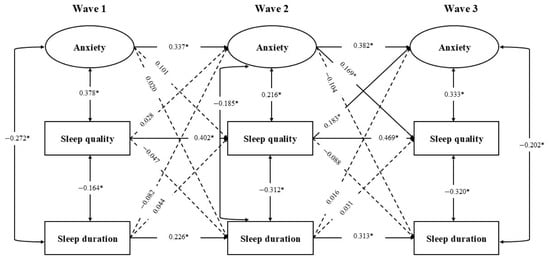
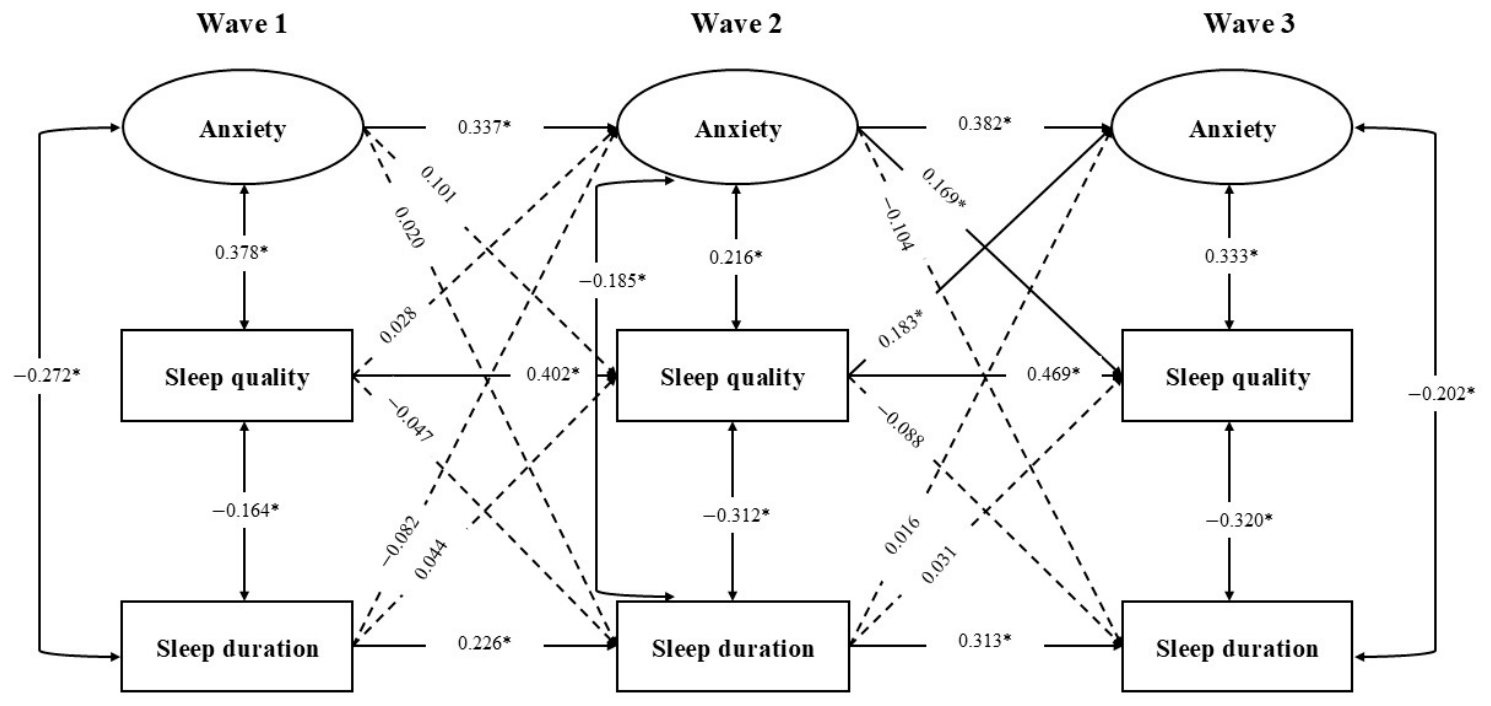
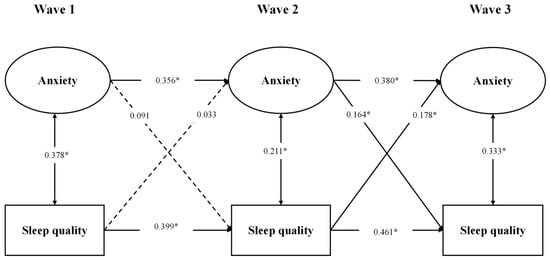
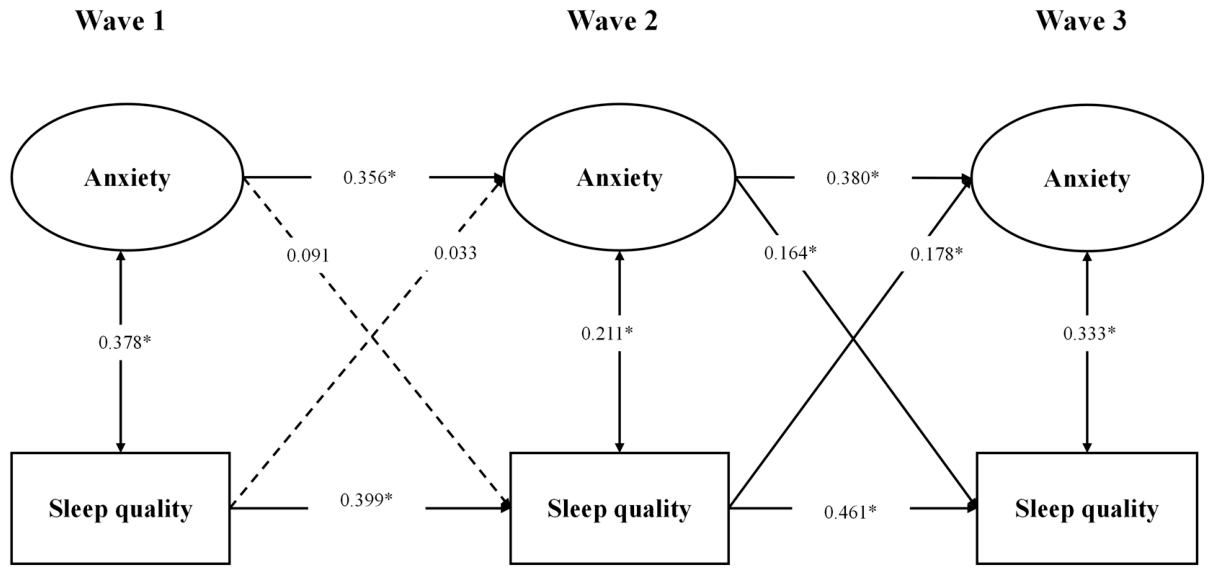
Figure 1 presents the estimated results of the three-variable cross-lagged panel model (Model 5), which included anxiety, sleep quality, and sleep duration. Anxiety, sleep quality, and sleep duration all showed significant cross-wave stability. The autoregressive coefficients for anxiety from W1 to W2 and from W2 to W3 were β = 0.337 and 0.382, respectively; those for sleep quality were β = 0.402 and 0.469; and those for sleep duration were β = 0.226 and 0.313 (all p < 0.05). After controlling for the prior level of each variable, the other cross-lagged paths, and contemporaneous correlations, none of the cross-lagged paths among the variables from W1 to W2 reached statistical significance. From W2 to W3, W2 anxiety was significantly and positively associated with the W3 sleep quality score (β = 0.169, p < 0.05). Because higher sleep quality scores indicate poorer sleep quality, this finding shows that higher anxiety symptoms were associated with poorer subsequent sleep quality. At the same time, the W2 sleep quality score was significantly and positively associated with W3 anxiety (β = 0.183, p < 0.05). Associations involving sleep duration were generally weak, although the inference for the W2 anxiety to W3 sleep-duration path depended on the method (see Table 4). Overall, the model results provided evidence consistent with reciprocal prospective associations between anxiety and sleep quality from W2 to W3: anxiety at W2 was prospectively associated with poorer sleep quality at W3, and poorer sleep quality at W2 was prospectively associated with anxiety at W3. Figure 2 presents the simplified two-variable Model 6. Both anxiety symptoms and sleep quality showed significant cross-wave stability. In the model that did not include sleep duration, the W2 sleep quality score remained significantly associated with W3 anxiety symptoms (β = 0.178, p < 0.05), and W2 anxiety symptoms were also significantly associated with the W3 sleep quality score (β = 0.164, p < 0.05). The direction and significance of these results were consistent with those of the full three-variable model (Model 5), indicating that the pattern was consistent across the two model specifications.
Figure 1.
Standardized path coefficients for the three-variable cross-lagged panel model (Model 5). Solid lines indicate statistically significant paths; dashed lines indicate nonsignificant paths. * p < 0.05. Covariate paths and estimates are omitted for clarity.
Figure 2.
Standardized path coefficients for the two-variable cross-lagged panel model (Model 6). Solid lines indicate statistically significant paths; dashed lines indicate nonsignificant paths. * p < 0.05. Covariate paths and estimates are omitted for clarity.
In addition, we estimated the average effects of cross-lagged paths in the same direction across the two adjacent time intervals and used Wald tests to compare whether the path coefficients differed significantly between W1–W2 and W2–W3. In the full cross-lagged model, the average path from sleep quality to subsequent anxiety was significant (b = 0.104, SE = 0.046, p = 0.024), as was the average path from anxiety to subsequent sleep quality (b = 0.159, SE = 0.060, p = 0.008). None of the average cross-lagged effects involving sleep duration reached statistical significance (p > 0.05). Further Wald tests found no statistically significant difference in the core paths between sleep quality and anxiety across W1–W2 and W2–W3 (χ2 (2) = 3.678, p = 0.159). The reciprocal cross-lagged associations were statistically detectable only from W2 to W3; however, the joint Wald test did not provide evidence of statistically significant differences between the two intervals.
4.3. Fixed-Effects Models
Table 5 reports the results of the individual fixed-effects models controlling for wave effects. After controlling for stable individual characteristics that did not vary over time, variation in sleep quality and sleep duration among engineering undergraduates showed significant within-person associations with anxiety. Specifically, for each one-point increase in the sleep quality score (i.e., poorer sleep quality), the total anxiety score increased by an average of 1.171 points (95% CI [0.457, 1.885], p = 0.001). For each additional hour of sleep per night, the total anxiety score decreased by an average of 0.649 points (95% CI [−1.126, −0.172], p = 0.008). In the model with the sleep quality score as the dependent variable, each one-point increase in the total anxiety score was associated with an average increase of 0.023 points in the sleep quality score (95% CI [0.008, 0.038], p = 0.002), indicating that increased anxiety was significantly associated with poorer sleep quality. At the same time, each additional hour of sleep duration was associated with an average decrease of 0.168 points in the sleep quality score (95% CI [−0.243, −0.094], p < 0.001), indicating that longer sleep duration was associated with better sleep quality. In the model with sleep duration as the dependent variable, each one-point increase in the total anxiety score was associated with an average decrease in sleep duration of 0.022 h, or approximately 1.3 min (95% CI [−0.038, −0.007], p = 0.005). Each one-point increase in the sleep quality score was associated with an average decrease in sleep duration of 0.292 h, or approximately 17.5 min (95% CI [−0.421, −0.163], p < 0.001).
Table 5.
Individual Fixed-Effects Models of Anxiety Symptoms, Sleep Quality, and Sleep Duration.
4.4. Change-Score Models
Table 6 reports the results of the change-score models that pooled the two adjacent change intervals, W1–W2 and W2–W3. Changes in sleep quality were significantly positively associated with changes in anxiety. Specifically, for each one-point increase in the sleep quality score, the change in anxiety symptoms among engineering undergraduates increased by an average of 1.033 points (95% CI [0.165, 1.901], p = 0.020). The association was in the direction of increases in sleep duration corresponding to decreases in anxiety symptoms, but it did not reach statistical significance (b = −0.499, 95% CI [−1.050, 0.052], p = 0.076). In the models with changes in the sleep indicators as the outcome variables, each one-point increase in the change in anxiety symptoms was associated with an average increase of 0.019 points in the change in the sleep quality score (95% CI [0.002, 0.037], p = 0.029), indicating that increases in anxiety symptoms and poorer sleep quality occurred concurrently across adjacent-wave intervals. At the same time, each one-hour increase in the change in sleep duration was associated with an average decrease of 0.177 points in the change in the sleep quality score (95% CI [−0.253, −0.100], p < 0.001). Further analysis of changes in sleep duration showed a negative association between changes in anxiety symptoms and changes in sleep duration, although it did not reach statistical significance (b = −0.018, 95% CI [−0.037, 0.001], p = 0.064). In contrast, each one-point increase in the change in the sleep quality score was associated with an average decrease in the change in sleep duration of 0.340 h, or approximately 20.4 min (95% CI [−0.495, −0.184], p < 0.001). Overall, the change-score models further supported a pattern of concurrent change between increased anxiety and poorer sleep quality and showed significant concurrent change between poorer sleep quality and shorter sleep duration across adjacent survey intervals.
Table 6.
Stacked Adjacent Change-Score Models.
5. Discussion
The university years are widely recognized as both a developmental period in which mental health risks are concentrated and an important stage marked by substantial changes in learning patterns, daily routines, and demands for self-management. For engineering undergraduates, who must manage specialized courses, laboratory and practical work, and project assignments, sleep problems and anxiety may accumulate together under high academic demands. However, longitudinal evidence on the relationship between sleep and anxiety in this population remains relatively limited. Against this background, the present study used three-wave data from the same cohort of Chinese engineering undergraduates to examine the longitudinal relationship between sleep quality and anxiety. The findings extend research on sleep and anxiety from contemporaneous correlations to multi-wave longitudinal analysis and distinguish sleep quality from sleep duration in their adjusted associations, which inform further research on targeted sleep-health promotion and psychological support.
First, the descriptive results showed that, compared with W1, engineering undergraduates reported descriptively higher levels of anxiety symptoms and higher sleep quality scores, indicating descriptively poorer subjective sleep quality, at W2 and W3, whereas mean sleep duration changed little across waves. This finding is consistent with previous evidence that sleep problems are common among university students and that sleep quality may provide information beyond sleep duration in reflecting differences in emotional and daytime functioning (S. D. Hershner & Chervin, 2014; Lund et al., 2010; Pilcher et al., 1997). The correlation analyses showed that, within the same survey wave, more severe anxiety symptoms were significantly associated with poorer sleep quality and shorter sleep duration, and poorer sleep quality was significantly associated with shorter sleep duration.
Second, the prospective association between poorer sleep quality and subsequent anxiety is consistent with the sleep–emotion regulation perspective. Previous research suggests that impaired sleep may weaken cognitive control and the regulation of negative emotions while increasing sensitivity to threat (Goldstein & Walker, 2014; Palmer & Alfano, 2017; Walker, 2009; Walker & van der Helm, 2009). In the present study, poorer sleep quality at W2 was significantly associated with higher anxiety at W3. This path remained significant in the simplified model, and the average path across the two intervals was also statistically significant. This finding is broadly consistent with the longitudinal evidence reported by Doane et al. (2015), Peltz et al. (2017), Jansson-Fröjmark and Lindblom (2008), and Zou et al. (2020).
Third, the reverse cross-lagged association between anxiety and subsequent deterioration in sleep quality supports the basic expectations of the cognitive model of insomnia. Persistent worry, repetitive negative thinking, and cognitive and physiological arousal may interfere with sleep onset and maintenance (Cox & Olatunji, 2016; Harvey, 2002). The reverse path observed in this study is consistent with the findings of Doane et al. (2015) and Peltz et al. (2017). Zou et al. (2020) also found a bidirectional relationship in analyses using continuous variables, but baseline anxiety did not significantly predict the subsequent onset of poor sleep quality when a binary incident outcome was used. This suggests that the findings may be affected by the time scale and the way variables are operationalized (Alvaro et al., 2013). The interval-specific paths were significant only from W2 to W3, whereas the average paths in both directions were significant, and joint Wald tests indicated no statistically significant differences in the key paths across the two intervals. The evidence for reciprocal prospective associations between sleep quality and anxiety was most apparent from W2 to W3, highlighting the importance of considering measurement windows and specific learning contexts in future research.
Fourth, sleep duration and anxiety did not show a consistent independent cross-lagged association. The individual fixed-effects model showed that, within the same student, shorter sleep was usually accompanied by higher anxiety. After prior status and sleep quality were controlled, sleep duration did not consistently predict anxiety at the next wave, and the adjacent-wave change-score model did not yield a statistically significant result. This does not mean that sleep duration is unimportant. Rather, sleep duration may be more sensitive to current task schedules and daily rhythms, while a linear measure of hours cannot capture sleep regularity, sleep timing, social jetlag, or the potentially nonlinear relationships associated with excessively short or long sleep. Considered together with the findings of Pilcher et al. (1997) and Peltz et al. (2017), sleep quality showed more consistent adjusted associations with anxiety than self-reported sleep duration in this sample. Evidence from the individual fixed-effects model and the adjacent-wave change-score model provided important complements to the cross-lagged panel model.
Fifth, this study extends the longitudinal research on student adjustment and recovery in engineering education. Previous reviews have identified stress, anxiety, and sleep problems as persistent concerns in research on engineering undergraduates, but most of the evidence has come from cross-sectional designs (Asghar et al., 2024). A culture of stress in engineering may also normalize heavy workloads and sustained strain as part of professional training and may affect students’ help-seeking behavior and access to support (Hammer et al., 2024; Jensen & Cross, 2021; Jensen et al., 2023). The present study further suggests that, in demanding engineering education settings, students’ sleep experiences, opportunities for recovery, and changes in anxiety should not be treated as peripheral to their training. Instead, they may be considered in an overall assessment of student adjustment and the quality of engineering education.
Finally, this study suggests several potential implications for educational practice that warrant further evaluation. First, when identifying risks to student adjustment, universities may consider looking beyond sleep duration and conducting repeated, low-burden assessments of overall subjective sleep quality at multiple time points to identify periods when poorer sleep quality and anxiety co-occur. Second, sleep and psychological support for engineering students should not rely solely on individual self-discipline. Universities may also further evaluate whether the scheduling of courses, laboratory and practical training, and project assignments, including the clustering of deadlines, affects students’ opportunities for recovery. Third, tiered support approaches may also warrant further consideration. These could include general sleep-health education, brief screening during potentially demanding periods, and professional assessment or referral for students whose co-occurring sleep problems and anxiety affect daily functioning. Because these specific institutional practices were not directly examined in the present study, their effectiveness should be evaluated in future research. Overall, universities may consider integrating sleep risk identification, optimization of training schedules, and tiered support to make sleep support and responses to anxiety risk more targeted.
6. Limitations
Given the data and focus of the study, several limitations remain, and the present work should be refined and extended in future research. First, the sample focused on engineering undergraduates. Further evidence is needed before the findings can be generalized to other types of universities, students in other disciplines, populations from different cultural backgrounds, or more sex-balanced student samples. Without a comparison group from other disciplines, the engineering context should be viewed primarily as a sample characteristic rather than an explanation for the observed associations. Second, anxiety and sleep were measured mainly through self-report. Although the GAD-7 showed high internal consistency in this study, subjective reports may still be affected by differences in individual perception, and shared subjective appraisal may also have contributed to the observed association between sleep quality and anxiety. Future research could combine objective sleep indicators or more multidimensional measures to provide convergent evidence for the present findings. Both sleep quality and sleep duration were assessed using single self-report items. In particular, the single global sleep-quality item did not capture dimensions such as sleep latency, sleep continuity, sleep disturbances, restorative quality, and daytime functioning, and may therefore have limited measurement precision, warranting further investigation in future research. The primary analyses treated the four-category sleep-quality item as continuous, assuming equal spacing between categories. Third, although the cross-lagged panel model, individual fixed-effects model, and adjacent-wave change-score model provided complementary evidence on prospective and contemporaneous associations, residual confounding cannot be fully ruled out in this observational study. Future studies could include variables such as academic stress, course load, social support, and personality and use more intensive measurement or intervention designs to examine specific mechanisms and their time scales, thereby further extending and enriching the current findings.
7. Conclusions
First, the descriptive results showed that engineering undergraduates in this sample reported descriptively higher levels of anxiety symptoms and higher sleep quality scores, indicating descriptively poorer subjective sleep quality, at W2 and W3 than at W1, whereas mean sleep duration changed little across the three waves.
Second, the cross-lagged panel model showed that poorer sleep quality at W2 was significantly associated with higher anxiety at W3, and higher anxiety at W2 was also significantly associated with poorer sleep quality at W3. The average cross-lagged paths in both directions were statistically significant, providing evidence consistent with reciprocal prospective associations between sleep quality and anxiety. These reciprocal associations were statistically detectable only from W2 to W3, while the joint Wald test did not provide evidence of statistically significant differences between the two intervals.
Third, subjective sleep quality provided more consistent longitudinal information than sleep duration. The individual fixed-effects model and adjacent-wave change-score model further showed a significant contemporaneous within-person association and concurrent change between deteriorating sleep quality and increasing anxiety within the same student. These results provide complementary evidence on cross-lagged and contemporaneous associations between sleep quality and anxiety.
Fourth, in demanding engineering education settings, students’ sleep experiences and opportunities for recovery may be considered in an overall assessment of student adjustment and the quality of engineering education. Universities could combine sleep assessment at multiple time points, optimization of course and project pacing, and tiered support, with particular attention to identifying and supporting students whose co-occurring sleep problems and anxiety have affected their daily functioning. Such approaches may provide potential directions for more targeted sleep support and responses to anxiety risk.
Author Contributions
Conceptualization, X.L.; methodology, X.C.; formal analysis, X.C.; investigation, X.C.; writing—original draft preparation, X.L. and X.C.; writing—review and editing, X.L. and X.C. All authors have read and agreed to the published version of the manuscript.
Funding
The study is funded by the Shanghai Philosophy and Social Sciences Planning Project (Grant Number: 2025EZH003).
Institutional Review Board Statement
The study was conducted in accordance with the Declaration of Helsinki and approved by the Ethics Committee of Tianjin University (protocol code TJUE-2023-231, 1 September 2023).
Informed Consent Statement
Informed consent was obtained from all subjects involved in the study.
Data Availability Statement
Data will be made available upon reasonable request.
Conflicts of Interest
The authors declare no conflicts of interest.
References
- Alvaro, P. K., Roberts, R. M., & Harris, J. K. (2013). A systematic review assessing bidirectionality between sleep disturbances, anxiety, and depression. Sleep, 36(7), 1059–1068. [Google Scholar] [CrossRef] [Scilit] [PubMed]
- Asghar, M., Minichiello, A., & Ahmed, S. (2024). Mental health and wellbeing of undergraduate students in engineering: A systematic literature review. Journal of Engineering Education, 113(4), 1046–1075. [Google Scholar] [CrossRef] [Scilit]
- Auerbach, R. P., Mortier, P., Bruffaerts, R., Alonso, J., Benjet, C., Cuijpers, P., Demyttenaere, K., Ebert, D. D., Green, J. G., Hasking, P., Murray, E., Nock, M. K., Pinder-Amaker, S., Sampson, N. A., Stein, D. J., Vilagut, G., Zaslavsky, A. M., Kessler, R. C., & WHO WMH-ICS Collaborators. (2018). WHO World Mental Health surveys international college student project: Prevalence and distribution of mental disorders. Journal of Abnormal Psychology, 127(7), 623–638. [Google Scholar]
- Ben Simon, E., Rossi, A., Harvey, A. G., & Walker, M. P. (2020). Overanxious and underslept. Nature Human Behaviour, 4(1), 100–110, (Correction in 2020, Nature Human Behaviour, 4, 1321). [Google Scholar] [CrossRef] [Scilit] [PubMed]
- Brumariu, L. E., Waslin, S. M., Gastelle, M., Kochendorfer, L. B., & Kerns, K. A. (2023). Anxiety, academic achievement, and academic self-concept: Meta-analytic syntheses of their relations across developmental periods. Development and Psychopathology, 35(4), 1597–1613. [Google Scholar] [CrossRef] [Scilit] [PubMed]
- Cox, R. C., & Olatunji, B. O. (2016). A systematic review of sleep disturbance in anxiety and related disorders. Journal of Anxiety Disorders, 37, 104–129. [Google Scholar] [CrossRef] [Scilit] [PubMed]
- Doane, L. D., Gress-Smith, J. L., & Breitenstein, R. S. (2015). Multi-method assessments of sleep over the transition to college and the associations with depression and anxiety symptoms. Journal of Youth and Adolescence, 44(2), 389–404. [Google Scholar] [CrossRef] [Scilit] [PubMed]
- Duong, C. D. (2021). The impact of fear and anxiety of COVID-19 on life satisfaction: Psychological distress and sleep disturbance as mediators. Personality and Individual Differences, 178, 110869. [Google Scholar] [CrossRef] [Scilit] [PubMed]
- Essau, C. A., Lewinsohn, P. M., Olaya, B., & Seeley, J. R. (2014). Anxiety disorders in adolescents and psychosocial outcomes at age 30. Journal of Affective Disorders, 163, 125–132. [Google Scholar] [CrossRef] [Scilit] [PubMed]
- Federico, G., Alfano, V., Garramone, F., Mele, G., Salvatore, M., Aiello, M., & Cavaliere, C. (2022). Self-reported sleep quality across age modulates resting-state functional connectivity in limbic and fronto-temporo-parietal networks: An exploratory cross-sectional fMRI study. Frontiers in Aging Neuroscience, 14, 806374. [Google Scholar] [CrossRef] [Scilit] [PubMed]
- Gale, T., & Parker, S. (2014). Navigating change: A typology of student transition in higher education. Studies in Higher Education, 39(5), 734–753. [Google Scholar] [CrossRef] [Scilit]
- Gardani, M., Bradford, D. R. R., Russell, K., Allan, S., Beattie, L., Ellis, J. G., & Akram, U. (2022). A systematic review and meta-analysis of poor sleep, insomnia symptoms and stress in undergraduate students. Sleep Medicine Reviews, 61, 101565. [Google Scholar] [CrossRef] [Scilit] [PubMed]
- Goldstein, A. N., & Walker, M. P. (2014). The role of sleep in emotional brain function. Annual Review of Clinical Psychology, 10(1), 679–708. [Google Scholar] [CrossRef] [Scilit] [PubMed]
- Gregory, A. M., Caspi, A., Eley, T. C., Moffitt, T. E., O’Connor, T. G., & Poulton, R. (2005). Prospective longitudinal associations between persistent sleep problems in childhood and anxiety and depression disorders in adulthood. Journal of Abnormal Child Psychology, 33(2), 157–163. [Google Scholar] [CrossRef] [Scilit] [PubMed]
- Gregory, K. A., Vidourek, R. A., King, K. A., & Merianos, A. L. (2024). Examination of current anxiety problems with school engagement and volunteer and paid work among US adolescents. The Journal of School Nursing, 40(5), 547–557. [Google Scholar] [CrossRef] [Scilit] [PubMed]
- Hammer, J. H., Wright, C. J., Miller, M. E., & Wilson, S. A. (2024). The Undergraduate Engineering Mental Health Help-Seeking Instrument (UE-MH-HSI): Development and validity evidence. Journal of Engineering Education, 113(4), 1198–1225. [Google Scholar] [CrossRef] [Scilit]
- Han, S.-S., Zhang, Y.-S., Zhu, W., Ye, Y.-P., Li, Y.-X., Meng, S.-Q., Feng, S., Li, H., Cui, Z.-L., Zhang, Y., Zhang, Q., Wang, G.-X., Lou, H., Li, B., & Xu, C.-Y. (2025). Status and epidemiological characteristics of depression and anxiety among Chinese university students in 2023. BMC Public Health, 25(1), 1189. [Google Scholar] [CrossRef] [Scilit] [PubMed]
- Harvey, A. G. (2002). A cognitive model of insomnia. Behaviour Research and Therapy, 40(8), 869–893. [Google Scholar] [CrossRef] [Scilit] [PubMed]
- Henrich, L. C., Antypa, N., & van den Berg, J. F. (2023). Sleep quality in students: Associations with psychological and lifestyle factors. Current Psychology, 42(6), 4601–4608. [Google Scholar] [CrossRef] [Scilit]
- Hershner, S. (2015). Is sleep a luxury that college students cannot afford? Sleep Health: Journal of the National Sleep Foundation, 1(1), 13–14. [Google Scholar] [CrossRef] [Scilit] [PubMed]
- Hershner, S. D., & Chervin, R. D. (2014). Causes and consequences of sleepiness among college students. Nature and Science of Sleep, 6, 73–84. [Google Scholar] [CrossRef] [Scilit] [PubMed]
- Hurdiel, R., Watier, T., Honn, K., Pezé, T., Zunquin, G., & Theunynck, D. (2017). Effects of a 12-week physical activities programme on sleep in female university students. Research in Sports Medicine, 25(2), 191–196. [Google Scholar] [CrossRef] [Scilit] [PubMed]
- Jansson-Fröjmark, M., & Lindblom, K. (2008). A bidirectional relationship between anxiety and depression, and insomnia? A prospective study in the general population. Journal of Psychosomatic Research, 64(4), 443–449. [Google Scholar] [CrossRef] [Scilit] [PubMed]
- Jensen, K. J., & Cross, K. J. (2021). Engineering stress culture: Relationships among mental health, engineering identity, and sense of inclusion. Journal of Engineering Education, 110(2), 371–392. [Google Scholar] [CrossRef] [Scilit]
- Jensen, K. J., Mirabelli, J. F., Kunze, A. J., Romanchek, T. E., & Cross, K. J. (2023). Undergraduate student perceptions of stress and mental health in engineering culture. International Journal of STEM Education, 10(1), 30. [Google Scholar] [CrossRef] [Scilit] [PubMed]
- Kahu, E. R., & Nelson, K. (2018). Student engagement in the educational interface: Understanding the mechanisms of student success. Higher Education Research & Development, 37(1), 58–71. [Google Scholar] [CrossRef] [Scilit]
- Liu, X., Shen, A., & Zhang, H. (2026a). From self-esteem and academic performance to anxiety: A cross-lagged study of Chinese first-generation college students. Behavioral Sciences, 16(6), 999. [Google Scholar] [CrossRef] [Scilit] [PubMed]
- Liu, X., & Wang, J. (2024). Depression, anxiety, and student satisfaction with university life among college students: A cross-lagged study. Humanities and Social Sciences Communications, 11, 1172. [Google Scholar] [CrossRef] [Scilit]
- Liu, X., Zhang, X., & Liu, Y. (2026b). How anxiety shapes students’ self-rated health at elite universities: A longitudinal study. Behavioral Sciences, 16(2), 197. [Google Scholar] [CrossRef] [Scilit] [PubMed]
- Liu, X., & Zhang, Y. (2026). Trajectory patterns of academic self-efficacy, the related factors, and anxiety among Chinese college students. New Directions for Child and Adolescent Development, 2026(1), 9993323. [Google Scholar] [CrossRef] [Scilit]
- Lund, H. G., Reider, B. D., Whiting, A. B., & Prichard, J. R. (2010). Sleep patterns and predictors of disturbed sleep in a large population of college students. Journal of Adolescent Health, 46(2), 124–132. [Google Scholar] [CrossRef] [Scilit] [PubMed]
- Montagni, I., Qchiqach, S., Pereira, E., Tully, P. J., & Tzourio, C. (2020). Sex-specific associations between sleep and mental health in university students: A large cross-sectional study. Journal of American College Health, 68(3), 278–285. [Google Scholar] [CrossRef] [Scilit] [PubMed]
- Motomura, Y., Kitamura, S., Oba, K., Terasawa, Y., Enomoto, M., Katayose, Y., Hida, A., Moriguchi, Y., Higuchi, S., & Mishima, K. (2013). Sleep debt elicits negative emotional reaction through diminished amygdala-anterior cingulate functional connectivity. PLoS ONE, 8(2), e56578, (Correction in 2013, PLoS ONE, 8). [Google Scholar] [CrossRef] [Scilit] [PubMed]
- Norbury, R., & Evans, S. (2019). Time to think: Subjective sleep quality, trait anxiety and university start time. Psychiatry Research, 271, 214–219. [Google Scholar] [CrossRef] [Scilit] [PubMed]
- Oftedal, S., Fenton, S., Hansen, V., Whatnall, M. C., Ashton, L. M., Haslam, R. L., Hutchesson, M. J., & Duncan, M. J. (2024). Changes in physical activity, diet, sleep, and mental well-being when starting university: A qualitative exploration of Australian student experiences. Journal of American College Health, 72(9), 3715–3724. [Google Scholar] [CrossRef] [Scilit] [PubMed]
- Palmer, C. A., & Alfano, C. A. (2017). Sleep and emotion regulation: An organizing, integrative review. Sleep Medicine Reviews, 31, 6–16. [Google Scholar] [CrossRef] [Scilit] [PubMed]
- Peltz, J. S., Rogge, R. D., Pugach, C. P., & Strang, K. (2017). Bidirectional associations between sleep and anxiety symptoms in emerging adults in a residential college setting. Emerging Adulthood, 5(3), 204–215. [Google Scholar] [CrossRef] [Scilit]
- Pilcher, J. J., Ginter, D. R., & Sadowsky, B. (1997). Sleep quality versus sleep quantity: Relationships between sleep and measures of health, well-being and sleepiness in college students. Journal of Psychosomatic Research, 42(6), 583–596. [Google Scholar] [CrossRef] [Scilit] [PubMed]
- Thompson, M., Pawson, C., & Evans, B. (2021). Navigating entry into higher education: The transition to independent learning and living. Journal of Further and Higher Education, 45(10), 1398–1410. [Google Scholar] [CrossRef] [Scilit]
- Trautwein, C., & Bosse, E. (2017). The first year in higher education—Critical requirements from the student perspective. Higher Education, 73(3), 371–387. [Google Scholar] [CrossRef] [Scilit]
- Walker, M. P. (2009). The role of sleep in cognition and emotion. Annals of the New York Academy of Sciences, 1156(1), 168–197. [Google Scholar] [CrossRef] [Scilit] [PubMed]
- Walker, M. P., & van der Helm, E. (2009). Overnight therapy? The role of sleep in emotional brain processing. Psychological Bulletin, 135(5), 731–748. [Google Scholar] [CrossRef] [Scilit] [PubMed]
- Zou, P., Wang, X., Sun, L., Liu, K., Hou, G., Yang, W., Liu, C., Yang, H., Zhou, N., Zhang, G., Ling, X., Liu, J., Cao, J., Ao, L., & Chen, Q. (2020). Poorer sleep quality correlated with mental health problems in college students: A longitudinal observational study among 686 males. Journal of Psychosomatic Research, 136, 110177. [Google Scholar] [CrossRef] [Scilit] [PubMed]

Disclaimer/Publisher’s Note: The statements, opinions and data contained in all publications are solely those of the individual author(s) and contributor(s) and not of MDPI and/or the editor(s). MDPI and/or the editor(s) disclaim responsibility for any injury to people or property resulting from any ideas, methods, instructions or products referred to in the content. |
© 2026 by the authors. Licensee MDPI, Basel, Switzerland. This article is an open access article distributed under the terms and conditions of the Creative Commons Attribution (CC BY) license.