6.1. How Can an Integrated, Case-Study-Based Assessment Model Guide Decision Making to Accelerate Academically Gifted Students?
The three cases were initially identified based on their academic performance patterns over the three semesters prior to the study. The Cognitive Abilities Test (CogAT) was subsequently administered to validate and deepen understanding of these classifications. The following sections present the following for each case: (a) the initial academic profile that informed selection, (b) the CogAT results that confirmed the cognitive basis of that profile, and (c) the integrated analysis of cognitive, academic, and psychosocial data that informed the acceleration decision.
6.1.1. Case Study 1 (M.F.)
Prior to the study, analysis of M.F.’s academic records over the three preceding semesters revealed a pattern of consistently high performance across all subjects, with grades ranging from 94% to 100% in mathematics, biology, physics, chemistry, and computer science. This pattern was classified as “Even High.”
Cognitive Ability Assessment (CogAT)
Following selection, the CogAT was administered to validate this classification.
Table 1 displays M.F.’s CogAT profile.
As shown in
Table 1, M.F. demonstrates an “Even High” cognitive profile, characterized by uniformly high scores across all three batteries with minimal variability (standard deviation of SAS scores = 7.6 points). Her composite SAS of 148 places her at the 99th percentile nationally. According to the interpretive framework of the CogAT (
Lohman & Lakin, 2017), such a profile suggests well-integrated intellectual resources, balanced cognitive strengths, and the capacity for rapid learning when appropriately challenged.
No claims about specific learning behaviors or social preferences are derived from Table 1 alone; those are reported below from qualitative and psychosocial data.
Academic Achievement Assessment
A predictive linear model (
Section 5.1) was used to generate individualized expected performance benchmarks.
Table 2 presents the analysis.
As shown in
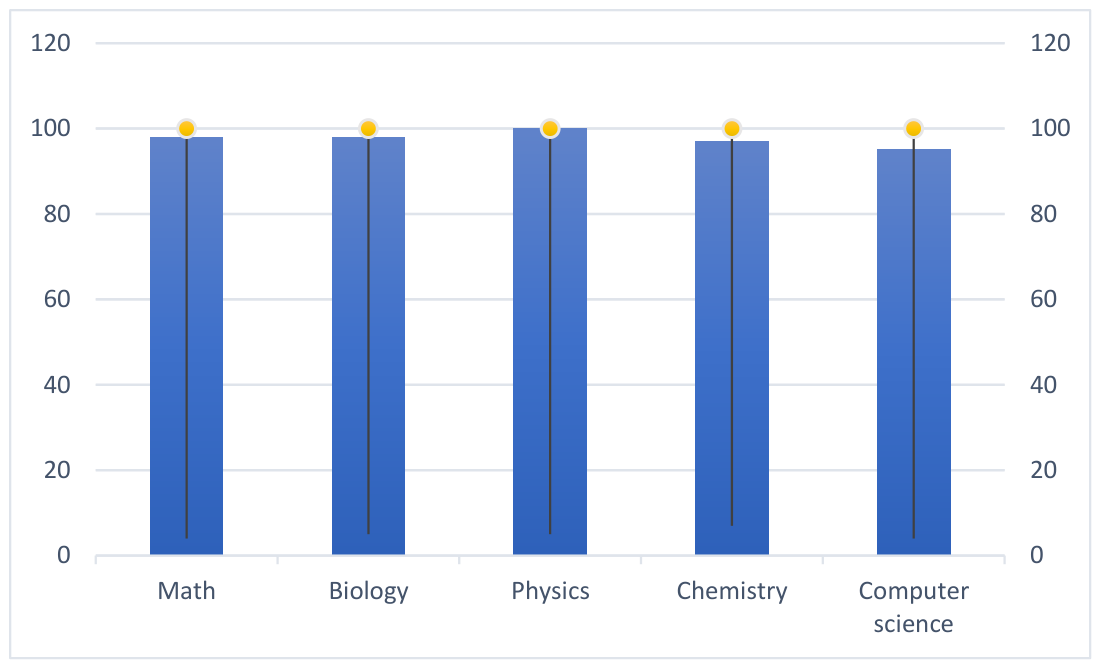
Table 2, M.F. consistently exceeded model expectations across all subjects, with an average positive performance gap of +5 points. Her sustained high achievement (grades 95–100%) validates the “Even High” pattern identified in the cognitive assessment. The largest positive gap (+7 in Chemistry) indicates that she performed substantially above the expected benchmark in a subject often considered challenging.
Figure 1 shows M.F.’s even profile.
Teacher interview data confirmed these academic findings. Her mathematics teacher stated: “M.F. has exceptional cognitive development, mathematical prowess, and a high level of motivation to tackle challenging tasks.” Another teacher added: “M.F. has an outstanding memory and a remarkable ability to transfer and apply knowledge to solve new problems.”
Student interview: When asked how skipping a grade affected her studies, M.F. responded: “I became more motivated and challenged. Before I was accelerated, I felt bored because I would rush through assignments and have to wait for my classmates. Now, I feel the assignments challenge me, and I don’t feel like my time is being wasted.”
Parent interviews: M.F.’s mother said: “We are very proud of M.F. When the school suggested acceleration, we felt some apprehension, like any parents, but we saw her passion and enthusiasm, and it was the right decision.” Her father added: “I was in favor of acceleration because I saw that she had not progressed in her old class. Boredom was evident in her behavior. Currently, she has integrated with peers who challenge her intellectually.”
Psychosocial and Dispositional Assessment (PDAS)
Teachers completed the PDAS to assess M.F.’s emotional maturity, social adjustment, and attitude toward acceleration.
Table 3 summarizes the ratings.
As shown in
Table 3, teachers rated M.F. highly on all dimensions. She demonstrates maturity in emotional regulation, shows no sensitivity or aggression toward feedback, and reflects on criticism to adjust her behavior. Regarding peer relationships, teachers noted that she has well-developed social skills appropriate for her age and interacts effectively with both same-age and older peers, though she does prefer the company of older students—a preference consistent with her cognitive maturity. Her attitude toward acceleration is very favorable, with strong intrinsic motivation. Parental support was rated as extremely supportive and committed, with no evidence of excessive pressure or neglect.
Student interview (emotional and social aspects): M.F. stated: “Before acceleration, I constantly felt frustrated and bored, and I often felt angry or sad for no clear reason. Now these feelings have almost disappeared because my mental energy is occupied with something satisfying. My parents support me. They ask about my studies and celebrate my achievements, but they don’t comment on every single grade.” Regarding peer relationships, she said: “I finally feel like I’m in the proper place; my bond with my new classmates has deepened, making me feel at ease and understood.”
Integration and Acceleration Decision—Student M.F.
The case study data for student M.F. clearly converges in three areas. Cognitively, the student demonstrates a consistently high level on the CogAT, with minimal variation across all tests, and a total SAS score of 148 (99th percentile).
Academically, her performance after the acceleration program consistently exceeded typical expectations, with an average positive difference of 5 points in all subjects, and maintained grades between 95% and 100%. Psychosocially, she received high ratings in all dimensions of the Personal Functioning Assessment Scale (PDAS), demonstrating her emotional maturity, positive peer relationships, strong motivation, and family support. In interviews, she reported increased satisfaction and a greater sense of belonging in the acceleration program she attended.
Based on the convergence of these three pieces of evidence, the researcher concludes that student (M.F.) is an ideal candidate for grade-wide acceleration. Her balanced cognitive status indicates that she possesses the intellectual resources necessary to meet the demands of the accelerated curriculum. Her academic performance demonstrates that the intervention has been academically beneficial. Her psychosocial readiness—in terms of emotional regulation, positive peer relationships, strong self-motivation, and family support—indicates that she possesses the non-cognitive resources necessary to cope with the social and emotional dimensions of academic acceleration. However, ongoing monitoring remains essential to ensure continued adjustment over time.
6.1.2. Case Study 2 (S.L.)
Prior to the study, analysis of S.L.’s academic records over the three preceding semesters revealed a pattern of high performance in some subjects (Computer Science, Biology) alongside persistent weakness in others (Mathematics, Physics, Chemistry). This pattern was classified as “Uneven.”
Cognitive Ability Assessment (CogAT)
Following selection, the CogAT was administered to validate this classification.
Table 4 displays S.L.’s CogAT profile.
As shown in
Table 4, S.L. exhibits a highly
uneven cognitive profile. Her verbal reasoning ability is relatively high (SAS = 124, PR = 93), but her quantitative reasoning and nonverbal reasoning scores are significantly lower (SAS = 75, PR = 6 for both). The discrepancy between her verbal and quantitative scores is 49 SAS points, and the standard deviation across the three batteries is 28.2—substantially exceeding the 1.5 threshold that indicates significant profile variability. Her composite score (SAS = 89, PR = 25) masks these critical discrepancies. No claims about learning behaviors or academic struggles are derived from
Table 4 alone; those are reported below from academic, interview, and psychosocial data.
Academic Achievement Assessment
Table 5 presents S.L.’s academic performance, comparing current post-acceleration grades to model-predicted expectations.
As shown in
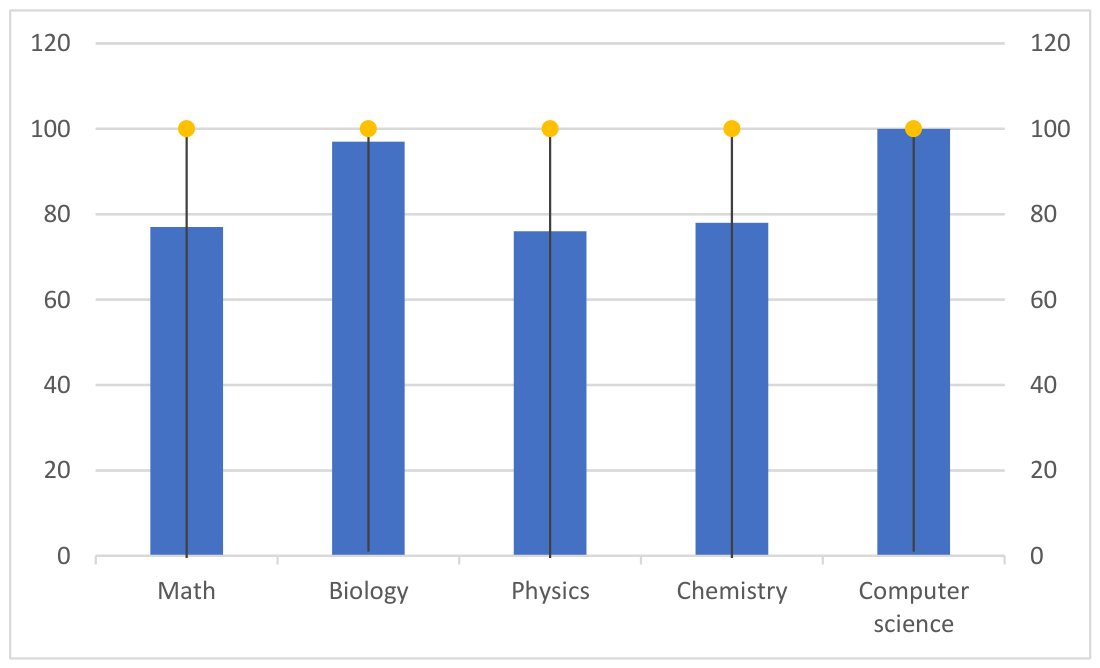
Table 5, S.L.’s academic performance mirrors her uneven cognitive profile. She excels in Computer Science (100%, top 1%) and Biology (97%, top 4%), but her performance in Mathematics (77%), Physics (76%), and Chemistry (78%) is substantially lower—below her own pre-acceleration averages and below model expectations (negative gaps ranging from −1 to −4 points).
Figure 2 shows the uneven profile of student S.L.
Teacher interview data confirmed this pattern. One teacher stated: “The student excels at computer science and biology, but struggles with mathematics and physics.” Another teacher added: “Acceleration widened the gap for the student because the curriculum assumes she is capable of everything at the same level, and this did not apply to the student.”
Student interview: When asked how skipping a grade affected her studies, S.L. responded: “I used to feel confident about myself academically, but after the acceleration, especially in mathematics, I started to doubt my abilities. The low grades made me afraid of these subjects instead of loving them.”
Parent interview: S.L.’s mother said: “My daughter is a genius in computers and loves biology, but her performance in the other subjects is not at the same level. We believe that with a little help, her performance will improve.”
Psychosocial and Dispositional Assessment (PDAS)
Teachers completed the PDAS to assess S.L.’s emotional maturity, social adjustment, and attitude toward acceleration.
Table 6 summarizes the ratings.
As shown in
Table 6, teachers reported that S.L. sometimes exhibits emotional disturbance and is often highly sensitive to criticism. Although she is capable of considering feedback, her sensitivity and occasional defensive reactions suggest difficulties in emotional regulation, potentially exacerbated by academic frustration.
Teacher comment (mathematics teacher): “Despite S.L.’s excellence in some subjects, her feeling that she is not the best in her new class—compared to how she was before acceleration—sometimes leaves her frustrated and downhearted.”
Student interview (emotional and social): S.L. stated: “I feel that every comment from my teacher is a personal attack and a sign that I am incompetent. That’s what makes me get angry quickly.” Regarding peer relationships, she said: “I feel like a stranger in both places. My old classmates see me as ‘the advanced one’ who left them, and my new classmates are older and have different interests. Sometimes I feel like I don’t belong to any group, and it’s a very lonely feeling.”
Student attitude toward acceleration: When asked about her view on acceleration, S.L. said: “Sometimes I think the acceleration decision was terrible. I feel constant pressure because the curriculum advances so quickly, and if I miss even a little point, I feel like I’m falling behind my classmates.”
Parental support: Teachers noted that parental involvement sometimes tends toward excessive interference, placing pressure on the student. One teacher commented: “There is general parental support, but it is mixed with excessive pressure, which contributes to the student’s anxiety and inconsistent performance.” S.L. shared: “I feel anxious and afraid of how my parents will react to my results in some subjects. I study out of fear of failure or disappointing expectations.” Her mother acknowledged: “Sometimes I push her to study more because I am afraid that she will neglect the difficult subjects and fall further behind. I know that I am putting pressure on her, but my fear for her drives me to do so.” The mother also expressed worry: “I am very worried about her. I see her exhausted, frustrated, and struggling to keep up with her peers. She is no longer that cheerful child. I want her to withdraw from the acceleration because she is paying a heavy psychological price. But her father sees it as a failure. We argue, so I no longer know what the right decision is.” The father stated: “We spend a lot of money on private lessons. The problem is not speeding up; the problem is her lack of focus!”
Integration and Acceleration Decision—Student S.L.
The data from Student S.L.’s case study reveal consistent patterns across cognitive, academic, psychological, and social domains. Cognitively, the student exhibits significant variability in her CogAT scores: high verbal ability (SAS = 124, 93rd percentile) coupled with remarkably low scores in quantitative and nonverbal reasoning (SAS = 75, 6th percentile for both), with a 49-point difference between her highest and lowest SAS scores in these two domains.
Academically, her performance reflects this cognitive disparity; she excels in subjects requiring intensive language skills, such as computer science and biology, but underperforms in quantitative subjects like mathematics, physics, and chemistry. Psychologically and socially, while she demonstrates high motivation in her areas of strength, she also suffers from emotional distress, hypersensitivity to criticism, social isolation, and conflicting parental pressures.
Based on the convergence of these three pieces of evidence, the researcher concludes that full academic acceleration is not appropriate for S.L.’s needs. Her academic profile suggests that the most suitable intervention is acceleration in specific subjects—limited to computer science and biology, where she excels—along with targeted academic intervention in mathematics, physics, and chemistry to address her weaknesses. Psychosocial support focused on emotional regulation and building self-confidence is also strongly recommended. This interpretation is offered with the understanding that ongoing monitoring and periodic adjustments are essential to ensure her well-being and academic progress.
6.1.3. Case Study 3 (T.M.)
Prior to the study, T.M.’s academic records over the three preceding semesters showed a pattern of high performance across most subjects, with averages of 84% in mathematics and 90% in physics. However, following acceleration, his performance declined sharply to 47% in mathematics and 45% in physics, while remaining strong in biology, chemistry, and computer science. This pattern was classified as “Declining Uneven.”
Cognitive Ability Assessment (CogAT)
Following selection, the CogAT was administered to validate this classification.
Table 7 displays T.M.’s CogAT profile.
As shown in
Table 7, T.M. presents an uneven cognitive profile. His verbal (SAS = 102, PR = 55) and quantitative (SAS = 103, PR = 57) scores fall within the average range. However, his nonverbal reasoning score (SAS = 84, PR = 16) is significantly lower, representing a relative weakness in fluid reasoning—the ability to solve novel problems, recognize patterns, and reason spatially independent of learned knowledge. The discrepancy between his quantitative and nonverbal scores is 19 SAS points, with a standard deviation of 10.6 across the three batteries. His composite score (PR = 40) masks this domain-specific weakness. No claims about academic decline or learning behaviors are derived from
Table 7 alone; those are reported below from academic, interview, and psychosocial data.
Academic Achievement Assessment
Table 8 presents T.M.’s academic performance before and after acceleration.
As shown in
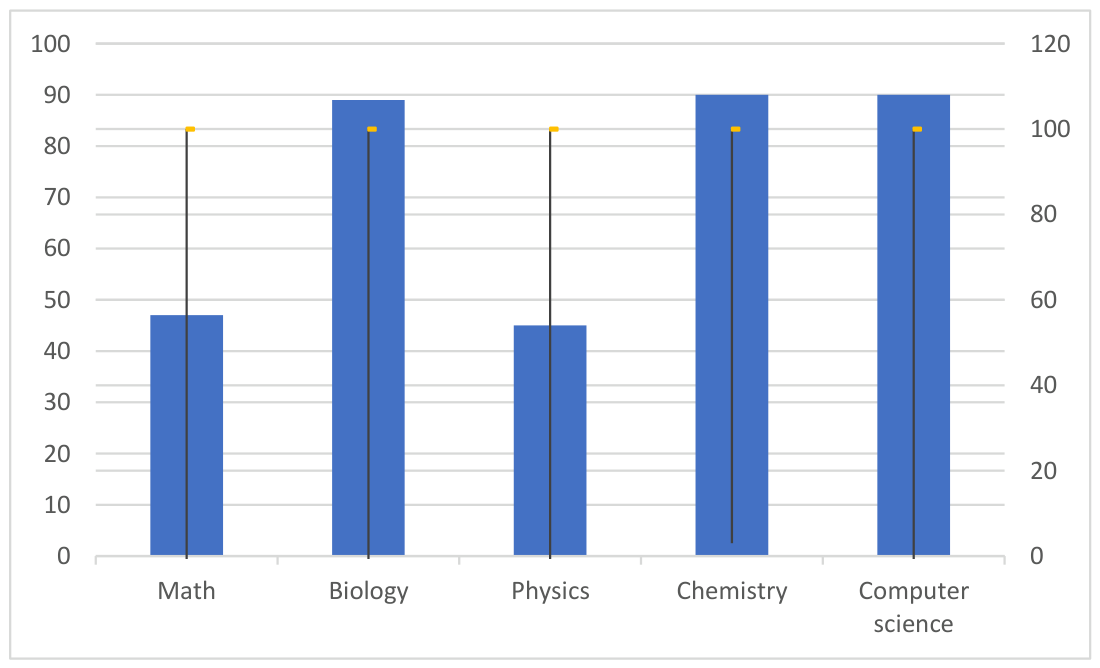
Table 8, T.M.’s profile is critically uneven. He maintains strong performance in biology (89%), chemistry (90%), and computer science (90%)—subjects that rely more heavily on verbal and quantitative knowledge. However, he shows a precipitous drop in mathematics (from 84% to 47%, a −37-point gap) and physics (from 90% to 45%, a −45-point gap). These are the subjects that demand fluid reasoning and spatial-analytical thinking—domains in which his CogAT nonverbal score indicates relative weakness. This uneven pattern is also illustrated in
Figure 3.
Teacher interview data confirmed this pattern. The mathematics teacher stated: “Student T.M. has clear challenges and significant difficulties in connecting abstract concepts. He can memorize steps, but he finds it very difficult to apply them to new problems.” The physics teacher added: “I observe a stark gap between T.M.’s ability to grasp theory and his inability to apply it in solving physics problems.”
Student interview: T.M. acknowledged: “I have serious difficulties in mathematics. I need help and support to understand some concepts and math problems.” When asked whether subjects became easier or harder after acceleration, he said: “After my acceleration, I was forced to seek help and take private tutoring in mathematics just to keep up with my classmates.” He also revealed: “I have an anxiety about physics that causes me to ‘freeze’ intellectually when faced with any practical application.”
All of T.M.’s teachers expressed concern about his continuation in the acceleration program. One stated: “I believe the decision to accelerate should be reviewed; he is always stressed and fatigued from trying to keep up with his peers.”
Psychosocial and Dispositional Assessment (PDAS)
Teachers completed the PDAS to assess T.M.’s emotional maturity, social adjustment, and attitude toward acceleration.
Table 9 summarizes the ratings.
As shown in
Table 9, T.M. frequently displays emotional instability and is often highly sensitive to criticism. He sometimes reacts with aggression or defensiveness. His social skills are rated as less developed than those of his peers, with few friendships and difficulty integrating into his accelerated study group.
School counselor report: “What concerns me more than the grades is the change in T.M.’s psychological and social state. I’ve noticed obvious withdrawal, irritation, and deep frustration. Acceleration has not provided him with a stimulating challenge; rather, it has presented him with repeated experiences of failure in specific areas, threatening his self-esteem and overall motivation to learn. The emphasis should immediately change from ‘catching up with the curriculum’ to regaining his confidence as a learner.”
Student interview (emotional and social): T.M. stated: “I feel psychological pressure and am unable to keep up with my classmates.” Regarding his attitude toward acceleration, he said: “I don’t regret accelerating; it was a beneficial experience that showed my inadequacies, which I am working hard to overcome.” However, his teacher disagreed, as noted above.
Parental support and conflict: T.M. expressed fear of failure and inability to meet parental expectations: “‘You are lazy; you need to work harder.’ They refused to recognize that acceleration could be part of the problem. They made me believe that the failure was entirely my fault, which compounded my feelings of powerlessness and guilt.” He added: “My mother is concerned and wants me to reverse the acceleration for my psychological well-being. I feel like I’m a battleground for them, and no one asks what I want. There is no space for error or experimenting. I must strictly adhere to their plan, or else I am ‘uncooperative’ or ‘a quitter.’”
Integration and Acceleration Decision—Student T.M.
The data from student T.M.’s case study are consistent across cognitive, academic, psychological, and social domains. Cognitively, he shows inconsistent performance on the CogAT: his verbal and quantitative scores are within the average range, but he demonstrates significant weakness in nonverbal reasoning (16th percentile), indicating difficulties with fluid reasoning—that is, the ability to solve novel problems, recognize patterns, and reason spatially independently of acquired knowledge.
Academically, his performance after the accelerated program was highly inconsistent: while he maintained strong results in biology, chemistry, and computer science, he experienced a sharp decline in mathematics (a 37-percentage point drop) and physics (a 45-percentage point drop)—precisely the subjects that require flexible reasoning. Psychologically and socially, he exhibits emotional instability, hypersensitivity to criticism, social withdrawal, and conflicting views with his parents; his school counselor has expressed serious concern about his mental health.
Based on the convergence of these three pieces of evidence, the researcher believes that accelerating student (T.M.) academically necessitates reconsidering the granting of full academic excellence. His marked weakness in logical reasoning is perfectly aligned with his sharp decline in mathematics and physics, two subjects that heavily rely on this type of thinking. Furthermore, his psychological distress coincides with his academic difficulties, and the convergence of cognitive, academic, and psychosocial factors indicates a clear incompatibility with the full academic acceleration program.
Accordingly, the researcher recommends considering reintegrating the student into an age-appropriate class, while offering enrichment programs in his areas of strength (biology, chemistry, and computer science) as a viable and beneficial alternative. Should the accelerated learning continue despite this evidence, a comprehensive support plan becomes essential. This plan should include targeted academic intervention in mathematics and physics, social and psychological support to restore his self-confidence, and guidance for parents to address any conflicting expectations. This interpretation is offered with the understanding that the case study design does not allow for causal inferences, and that ongoing follow-up is necessary regardless of the enrollment decision.