Eight-Week Mindfulness Training Effectively Improves Performance in Children with ADHD: A Comparison with Cognitive-Behavioral Training

Abstract
1. Introduction
1.1. Cognitive-Behavioral Training and Mindfulness Training for Children with ADHD
1.2. Limitations of Previous Research
1.3. Test Anxiety and Self-Concept in Children with ADHD
2. Methods
2.1. Participants
2.2. Procedure
2.3. Measures
2.4. Data Analysis
3. Results
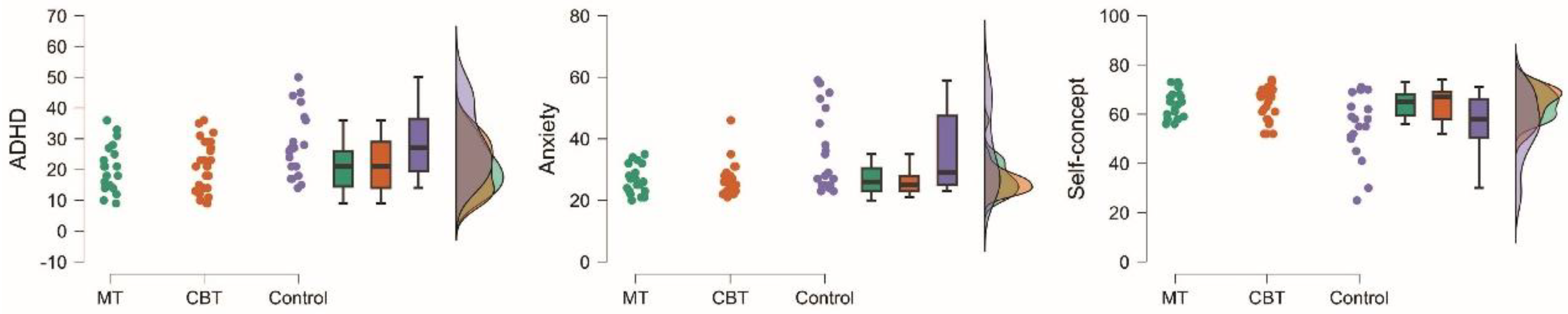
3.1. Comparison of Intervention Effects
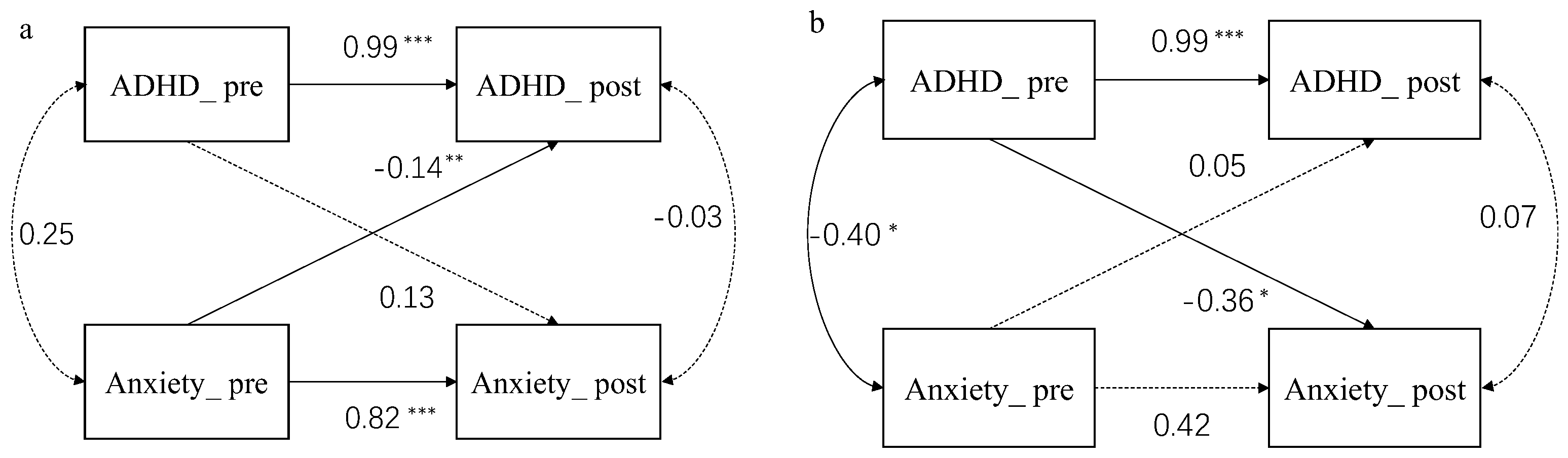
3.2. Exploratory Cross-Lagged Associations
4. Discussion
Limitations and Future Research
Supplementary Materials
Author Contributions
Funding
Institutional Review Board Statement
Informed Consent Statement
Data Availability Statement
Conflicts of Interest
References
- American Psychiatric Association. (2013). Diagnostic and statistical manual of mental disorders: DSM-5. American Psychiatric Association. [Google Scholar]
- Biesecker, B., Austin, J., & Caleshu, C. (2017). Theories for psychotherapeutic genetic counseling: Fuzzy trace theory and cognitive behavior theory. Journal of Genetic Counseling, 26(2), 322–330. [Google Scholar]
- Cairncross, M., & Miller, C. J. (2020). The effectiveness of mindfulness-based therapies for ADHD: A meta-analytic review. Journal of Attention Disorders, 24(5), 627–643. [Google Scholar] [PubMed]
- Canu, W. H., Elizondo, M., & Broman-Fulks, J. J. (2017). History of ADHD traits related to general test and specific math anxiety in college students. Learning and Individual Differences, 58, 56–63. [Google Scholar] [CrossRef] [Scilit]
- Cardaciotto, L., Herbert, J. D., Forman, E. M., Moitra, E., & Farrow, V. (2008). The assessment of present-moment awareness and acceptance: The Philadelphia mindfulness scale. Assessment, 15(2), 204–223. [Google Scholar] [CrossRef] [Scilit] [PubMed]
- Chorozoglou, M., Smith, E., Koerting, J., Thompson, M. J., Sayal, K., & Sonuga-Barke, E. J. (2015). Preschool hyperactivity is associated with long-term economic burden: Evidence from a longitudinal health economic analysis of costs incurred across childhood, adolescence and young adulthood. Journal of Child Psychology and Psychiatry, 56(9), 966–975. [Google Scholar] [CrossRef] [Scilit] [PubMed]
- Dan, O., & Raz, S. (2015). The relationships among ADHD, self-esteem, and test anxiety in young adults. Journal of Attention Disorders, 19(3), 231–239. [Google Scholar] [PubMed]
- Danielson, M. L., Bitsko, R. H., Ghandour, R. M., Holbrook, J. R., Kogan, M. D., & Blumberg, S. J. (2018). Prevalence of parent-reported ADHD diagnosis and associated treatment among US children and adolescents, 2016. Journal of Clinical Child & Adolescent Psychology, 47(2), 199–212. [Google Scholar] [CrossRef] [Scilit]
- Doshi, J. A., Hodgkins, P., Kahle, J., Sikirica, V., Cangelosi, M. J., Setyawan, J., Erder, M. H., & Neumann, P. J. (2012). Economic impact of childhood and adult attention-deficit/hyperactivity disorder in the United States. Journal of the American Academy of Child & Adolescent Psychiatry, 51(10), 990–1002. [Google Scholar] [CrossRef] [Scilit]
- Erskine, H. E., Ferrari, A. J., Nelson, P., Polanczyk, G. V., Flaxman, A. D., Vos, T., Whiteford, H. A., & Scott, J. G. (2013). Research review: Epidemiological modelling of attention-deficit/hyperactivity disorder and conduct disorder for the global burden of disease study 2010. Journal of Child Psychology and Psychiatry, 54(12), 1263–1274. [Google Scholar] [CrossRef] [Scilit] [PubMed]
- Fallah, N., Abdolahzadeh, F., & Yaaghobi, M. (2023). Mindfulness and anxiety among foreign language teachers: The role of cognitive reappraisal and self-efficacy. Mindfulness, 14(12), 3020–3032. [Google Scholar] [CrossRef] [Scilit]
- Faraone, S. V., Bellgrove, M. A., Brikell, I., Cortese, S., Hartman, C. A., Hollis, C., Newcorn, J. H., Philipsen, A., Polanczyk, G. V., Rubia, K., Sibley, M. H., & Buitelaar, J. K. (2024). Attention-deficit/hyperactivity disorder. Nature Reviews Disease Primers, 10(11), 15020. [Google Scholar] [CrossRef] [Scilit]
- Gan, R., Xue, J., & Chen, S. (2023). Do mindfulness-based interventions reduce burnout of college students in China? A randomized controlled trial. Mindfulness, 14(4), 880–890. [Google Scholar] [CrossRef] [Scilit]
- Gavrilova, L., & Zawadzki, M. J. (2023). Examining how headspace impacts mindfulness mechanisms over an 8-week app-based mindfulness intervention. Mindfulness, 14(9), 2236–2249. [Google Scholar] [CrossRef] [Scilit]
- Gould, K. L., Porter, M., Lyneham, H. J., & Hudson, J. L. (2018). Cognitive-behavioral therapy for children with anxiety and comorbid attention-deficit/hyperactivity disorder. Journal of the American Academy of Child & Adolescent Psychiatry, 57(7), 481–490. [Google Scholar] [CrossRef] [Scilit]
- Groenman, A. P., Hornstra, R., Hoekstra, P. J., Steenhuis, L., Aghebati, A., Boyer, B. E., Buitelaar, J. K., Chronis-Tuscano, A., Daley, D., Dehkordian, P., Dvorsky, M., Franke, N., DuPaul, G. J., Gershy, N., Harvey, E., Hennig, T., Herbert, S., Langberg, J., Mautone, J. A., … van den Hoofdakker, B. J. (2022). An individual participant data meta-analysis: Behavioral treatments for children and adolescents with attention-deficit/hyperactivity disorder. Journal of the American Academy of Child & Adolescent Psychiatry, 61(2), 144–158. [Google Scholar] [CrossRef] [Scilit]
- Houck, G., Kendall, J., Miller, A., Morrell, P., & Wiebe, G. (2011). Self-concept in children and adolescents with attention deficit hyperactivity disorder. Journal of Pediatric Nursing, 26(3), 239–247. [Google Scholar] [CrossRef] [Scilit] [PubMed]
- Huang, Q., & Zhou, R. (2019). The development of test anxiety in Chinese students. Chinese Journal of Clinical Psychology, 27(1), 113–118. [Google Scholar]
- Hyseni Duraku, Z., Konjufca, J., Hoxha, L., Blakaj, A., Bytyqi, B., Mjekiqi, E., & Bajgora, S. (2023). Reducing STEM test anxiety through classroom mindfulness training for lower secondary school children: A pilot study. International Journal of Adolescence and Youth, 28(1), 2242478. [Google Scholar] [CrossRef] [Scilit]
- John Lothes, I. I., Mochrie, K., Wilson, M., & Hakan, R. (2021). The effect of dbt-informed mindfulness skills (what and how skills) and mindfulness-based stress reduction practices on test anxiety in college students: A mixed design study. Current Psychology, 40, 2764–2777. [Google Scholar]
- Johnson, B. T., Acabchuk, R. L., George, E. A., Nardi, W., Sun, S., Salmoirago-Blotcher, E., Scharf, J., & Loucks, E. B. (2023). Mental and physical health impacts of mindfulness training for college undergraduates: A systematic review and meta-analysis of randomized controlled trials. Mindfulness, 14(9), 2077–2096. [Google Scholar] [CrossRef] [Scilit] [PubMed]
- Kabat-Zinn, J. (2003). Mindfulness-based interventions in context: Past, present, and future. Clinical Psychology: Science and Practice, 10(2), 144–156. [Google Scholar] [CrossRef] [Scilit]
- Lambez, B., Harwood-Gross, A., Golumbic, E. Z., & Rassovsky, Y. (2020). Non-pharmacological interventions for cognitive difficulties in ADHD: A systematic review and meta-analysis. Journal of Psychiatric Research, 120, 40–55. [Google Scholar] [CrossRef] [Scilit] [PubMed]
- Lee, Y. C., Chen, C. R., & Lin, K. C. (2022). Effects of mindfulness-based interventions in children and adolescents with ADHD: A systematic review and meta-analysis of randomized controlled trials. International Journal of Environmental Research and Public Health, 19(22), 15198. [Google Scholar] [CrossRef] [Scilit] [PubMed]
- Li, J., Chen, Y., & Xiao, Q. (2019). Exploring the application of mindfulness meditation in the interventions for the children with ADHD. Journal of Psychological Science, 42(2), 470–476. [Google Scholar]
- Lindsay, E. K., & Creswell, J. D. (2017). Mechanisms of mindfulness training: Monitor and Acceptance Theory (MAT). Clinical Psychology Review, 51, 48–59. [Google Scholar] [CrossRef] [Scilit] [PubMed]
- Lindsay, E. K., & Creswell, J. D. (2019). Mindfulness, acceptance, and emotion regulation: Perspectives from monitor and acceptance theory (MAT). Current Opinion in Psychology, 28, 120–125. [Google Scholar] [CrossRef] [Scilit] [PubMed]
- Lindstrom, W., Nelson, J. M., & Foels, P. (2020). Postsecondary attention-deficit/hyperactivity disorder and deliberate practice: Study time, study quality, and self-perceptions. Psychology in the Schools, 57(1), 44–61. [Google Scholar]
- Miller, C. J., & Brooker, B. (2017). Mindfulness programming for parents and teachers of children with ADHD. Complementary Therapies in Clinical Practice, 28, 108–115. [Google Scholar] [CrossRef] [Scilit] [PubMed]
- Moore, D. A., Richardson, M., Gwernan-Jones, R., Thompson-Coon, J., Stein, K., Rogers, M., Garside, R., Logan, S., & Ford, T. J. (2019). Non-pharmacological interventions for ADHD in school settings: An overarching synthesis of systematic reviews. Journal of Attention Disorders, 23(3), 220–233. [Google Scholar] [PubMed]
- Nelson, J. M. (2013). Self-concept of college students with ADHD: Discordance between self-and parent-reports. Journal of Attention Disorders, 17(2), 163–170. [Google Scholar] [PubMed]
- Nelson, J. M., Lindstrom, W., & Foels, P. A. (2014). Test anxiety and college students with attention deficit hyperactivity disorder. Journal of Psychoeducational Assessment, 32(6), 548–557. [Google Scholar] [CrossRef] [Scilit]
- Nimmo-Smith, V., Merwood, A., Hank, D., Brandling, J., Greenwood, R., Skinner, L., Law, S., Patel, V., & Rai, D. (2020). Non-pharmacological interventions for adult ADHD: A systematic review. Psychological Medicine, 50(4), 529–541. [Google Scholar] [CrossRef] [Scilit] [PubMed]
- Piers, E. V. (1984). Piers-Harris children’s self-concept scale-revised manual. Western Psychological Services. [Google Scholar]
- Riise, E. N., Wergeland, G. J. H., Njardvik, U., & Öst, L. G. (2021). Cognitive behavior therapy for externalizing disorders in children and adolescents in routine clinical care: A systematic review and meta-analysis. Clinical Psychology Review, 83, 101954. [Google Scholar] [CrossRef] [Scilit] [PubMed]
- Robe, A., & Dobrean, A. (2023). The effectiveness of a single session of mindfulness-based cognitive training on cardiac vagal control and core symptoms in children and adolescents with attention-deficit/hyperactivity disorder (ADHD): A preliminary randomized controlled trial. European Child & Adolescent Psychiatry, 32(10), 1863–1872. [Google Scholar]
- Sayal, K., Prasad, V., Daley, D., Ford, T., & Coghill, D. (2018). ADHD in children and young people: Prevalence, care pathways, and service provision. The Lancet Psychiatry, 5(2), 175–186. [Google Scholar] [CrossRef] [Scilit] [PubMed]
- Shi, H. L., Liu, W. P., Ding, R. J., & Qian, Z. C. (2019). Clinical effects of cognitive behavior training on children patients with attention deficit hyperactivity disorder. China Journal of Health Psychology, 27(12), 1765–1768. [Google Scholar]
- Siebelink, N. M., Bögels, S. M., Speckens, A. E., Dammers, J. T., Wolfers, T., Buitelaar, J. K., & Greven, C. U. (2022). A randomised controlled trial (MindChamp) of a mindfulness-based intervention for children with ADHD and their parents. Journal of Child Psychology and Psychiatry, 63(2), 165–177. [Google Scholar] [PubMed]
- Siebelink, N. M., Kaijadoe, S. P. T., van Horssen, F. M., Holtland, J. N. P., Bögels, S. M., Buitelaar, J. K., Speckens, A. E. M., & Greven, C. U. (2021). Mindfulness for children with ADHD and mindful parenting (MindChamp): A qualitative study on feasibility and effects. Journal of Attention Disorders, 25(13), 1931–1942. [Google Scholar] [PubMed]
- Silvestri, P. R., Baglioni, V., Cardona, F., & Cavanna, A. E. (2018). Self-concept and self-esteem in patients with chronic tic disorders: A systematic literature review. European Journal of Paediatric Neurology, 22(5), 749–756. [Google Scholar] [CrossRef] [Scilit] [PubMed]
- Snell, T., Knapp, M., Healey, A., Guglani, S., Evans-Lacko, S., Fernandez, J. L., Meltzer, H., & Ford, T. (2013). Economic impact of childhood psychiatric disorder on public sector services in Britain: Estimates from national survey data. Journal of Child Psychology and Psychiatry, 54(9), 977–985. [Google Scholar] [CrossRef] [Scilit] [PubMed]
- Song, P., Zha, M., Yang, Q., Zhang, Y., Li, X., & Rudan, I. (2021). The prevalence of adult attention-deficit hyperactivity disorder: A global systematic review and meta-analysis. Journal of Global Health, 11, 04009. [Google Scholar] [CrossRef] [Scilit] [PubMed]
- Spielberger, C. D. (2010). Test anxiety inventory. In The Corsini encyclopedia of psychology (p. 1). Wiley. [Google Scholar]
- Swanson, J. M. (1981). The SNAP rating scale for the diagnosis of the attention deficit disorder. ERIC Clearinghouse. [Google Scholar]
- Vacher, C., Romo, L., Dereure, M., Soler, M., Picot, M. C., & Purper-Ouakil, D. (2022). Efficacy of cognitive behavioral therapy on aggressive behavior in children with attention deficit hyperactivity disorder and emotion dysregulation: Study protocol of a randomized controlled trial. Trials, 23(1), 124. [Google Scholar] [CrossRef] [Scilit] [PubMed]
- Valero, M., Cebolla, A., & Colomer, C. (2022). Mindfulness training for children with ADHD and their parents: A randomized control trial. Journal of Attention Disorders, 26(5), 755–766. [Google Scholar] [PubMed]
- Van der Oord, S., Bögels, S. M., & Peijnenburg, D. (2012). The effectiveness of mindfulness training for children with ADHD and mindful parenting for their parents. Journal of Child and Family Studies, 21, 139–147. [Google Scholar] [PubMed]
- Van de Weijer-Bergsma, E., Formsma, A. R., de Bruin, E. I., & Bögels, S. M. (2012). The effectiveness of mindfulness training on behavioral problems and attentional functioning in adolescents with ADHD. Journal of Child and Family Studies, 21, 775–787. [Google Scholar] [PubMed]
- Xu, W., Wang, Y., & Liu, X. (2015). Effectiveness of 8-week mindfulness training improving negative emotions. Chinese Mental Health Journal, 29(7), 497–502. [Google Scholar]
- Young, Z., Moghaddam, N., & Tickle, A. (2020). The efficacy of cognitive behavioral therapy for adults with ADHD: A systematic review and meta-analysis of randomized controlled trials. Journal of Attention Disorders, 24(6), 875–888. [Google Scholar] [CrossRef] [Scilit] [PubMed]
- Zhang, D., Chan, S. K. C., Lo, H. H. M., Chan, C. Y. H., Chan, J. C. Y., Ting, K. T., Gao, T. T., Lai, K. Y. C., Bögels, S. M., & Wong, S. Y. S. (2017). Mindfulness-based intervention for Chinese children with ADHD and their parents: A pilot mixed-method study. Mindfulness, 8, 859–872. [Google Scholar]
- Zhang, Y. P., & Liu, X. W. (2005). A case study of cognitive-behavioral training on a primary school student with inattentive behavior. Chinese Mental Health Journal, 19(12), 835–838. [Google Scholar] [CrossRef] [Scilit]
- Zheng, Y., Gu, X., Jiang, M., & Zeng, X. (2022). How might mindfulness-based interventions reduce job burnout? Testing a potential self-regulation model with a randomized controlled trial. Mindfulness, 13(8), 1907–1922. [Google Scholar] [CrossRef] [Scilit]
- Zhou, J., Guo, L., & Chen, Y. (2013). Reliability and validity of the Chinese version of Swanson, Nolan, and Pelham version IV rating scale-parent form for attention-deficit /hyperactivity disorder. Chinese Mental Health Journal, 27(6), 424–428. [Google Scholar]
- Zhou, J., Zheng, Y., Zeng, X., Jiang, M., & Oei, T. P. (2021). A randomized controlled trial examining a second-generation mindfulness-based intervention that is compatible with Confucian values: Mindfulness-based positive psychology. Mindfulness, 12, 1412–1423. [Google Scholar] [CrossRef] [Scilit]


| MT (n = 19) | CBT (n = 25) | Control (n = 19) | |
|---|---|---|---|
| Age | 8.53 ± 0.61 | 8.40 ± 0.58 | 8.26 ± 0.56 |
| Sex (% male) | 58% | 44% | 58% |
| ADHD symptoms | 26.32 ± 10.03 | 26.68 ± 11.49 | 27.58 ± 10.26 |
| Test Anxiety | 31.21 ± 6.83 | 31.85 ± 5.53 | 34.12 ± 8.10 |
| Self-concept | 55.32 ± 8.38 | 58.08 ± 12.43 | 56.00 ± 11.67 |
| Variables | Pre | Post | ||||
|---|---|---|---|---|---|---|
| MT | CBT | Control | MT | CBT | Control | |
| ADHD Symptoms | 26.32 ± 10.03 | 26.68 ± 11.49 | 27.58 ± 10.26 | 20.63 ± 7.8 | 21.12 ± 8.45 | 28.32 ± 11.05 |
| Test Anxiety | 31.21 ± 6.83 | 31.85 ± 5.53 | 34.12 ± 8.1 | 26.68 ± 4.7 | 26.64 ± 5.21 | 36.05 ± 13.05 |
| Self-concept | 55.32 ± 8.38 | 58.08 ± 12.43 | 56 ± 11.67 | 64.37 ± 5.67 | 64.04 ± 6.77 | 55.47 ± 13.21 |
| MT (n = 19) | CBT (n = 25) | Control (n = 19) | F | p | η2 | |
|---|---|---|---|---|---|---|
| ADHD Symptoms | 20.63 ± 7.80 | 21.12 ± 8.45 | 28.32 ± 11.05 | 4.38 | 0.02 | 0.13 |
| Test Anxiety | 26.68 ± 4.70 | 26.64 ± 5.21 | 36.05 ± 13.10 | 8.54 | <0.001 | 0.22 |
| Self-concept | 64.37 ± 5.67 | 64.04 ± 6.77 | 55.47 ± 13.21 | 6.27 | 0.003 | 0.17 |
Disclaimer/Publisher’s Note: The statements, opinions and data contained in all publications are solely those of the individual author(s) and contributor(s) and not of MDPI and/or the editor(s). MDPI and/or the editor(s) disclaim responsibility for any injury to people or property resulting from any ideas, methods, instructions or products referred to in the content. |
© 2026 by the authors. Licensee MDPI, Basel, Switzerland. This article is an open access article distributed under the terms and conditions of the Creative Commons Attribution (CC BY) license.
Share and Cite
Zhao, C.; Sun, Y.; Zhang, W. Eight-Week Mindfulness Training Effectively Improves Performance in Children with ADHD: A Comparison with Cognitive-Behavioral Training. Behav. Sci. 2026, 16, 1128. https://doi.org/10.3390/bs16071128
Zhao C, Sun Y, Zhang W. Eight-Week Mindfulness Training Effectively Improves Performance in Children with ADHD: A Comparison with Cognitive-Behavioral Training. Behavioral Sciences. 2026; 16(7):1128. https://doi.org/10.3390/bs16071128
Chicago/Turabian StyleZhao, Chenguang, Yifei Sun, and Wei Zhang. 2026. "Eight-Week Mindfulness Training Effectively Improves Performance in Children with ADHD: A Comparison with Cognitive-Behavioral Training" Behavioral Sciences 16, no. 7: 1128. https://doi.org/10.3390/bs16071128
APA StyleZhao, C., Sun, Y., & Zhang, W. (2026). Eight-Week Mindfulness Training Effectively Improves Performance in Children with ADHD: A Comparison with Cognitive-Behavioral Training. Behavioral Sciences, 16(7), 1128. https://doi.org/10.3390/bs16071128