


Abstract
Environmental sustainability is crucial for human survival and the future of new generations. Anticipating regret can influence decision-making and promote sustainable behaviors. This study examines the effect of anticipated regret on pro-environmental behaviors among young adults (18–30) using regret-based short videos called “EkoToks.” A total of 128 participants were randomly assigned to an experimental group, receiving regret-evoking videos, or a control group, receiving informational videos. Pro-environmental behaviors were measured at baseline, post-test, and at three-month follow-up. Results showed significant short-term improvements in the experimental group compared to the control group, with higher scores in total pro-environmental behavior, prosocial behavior, reuse, recycling, and pro-environmental actions. At follow-up, the experimental group continued to outperform the control group in terms of total behavior, prosocial behavior, recycling, reuse, pro-environmental actions, and waste reduction. Regression analyses revealed that post-test regret significantly predicted further improvements at follow-up (compared to post-test) in total behavior, prosocial behavior, reuse, and pro-environmental actions. These findings highlight the effectiveness of anticipated regret in improving environmental behaviors, particularly low-cost ones.
1. Introduction
Environmental sustainability is crucial for human survival and future generations. Several studies highlight the link between environmental challenges and human behavior, encouraging individuals, groups, and communities to reduce their ecological footprint through pro-environmental actions (Appannagari, 2017; Cook et al., 2013; Trenberth, 2018). Despite the growing interest in sustainability, many people do not adopt “green habits” (O’Brien, 2008). Thus, psychological research is increasingly focused on understanding the factors that drive pro-environmental actions to develop effective interventions. These efforts align with the 17 Sustainable Development Goals (SDGs) outlined in the 2030 Agenda (see Steiner et al., 2018).
Pro-environmental behavior includes actions like recycling, minimizing energy consumption, reusing items, buying eco-friendly products, and participating in pro-environmental actions—all of which aim to reduce individuals’ impact on the environment. Recent studies suggest that pro-environmental behavior may emerge early in development (for example, see Hu & Wu, 2022; Geraci et al., 2024). Geraci et al. (2023) showed that 7-month-old infants already display a preference for agents engaging in explicit pro-environmental actions. Specifically, infants preferred agents who collected waste from the environment compared to those who ignored it, indicating a rudimentary form of environmental moral evaluation. This early sensitivity to environmental actions underscores the importance of considering both cognitive and socioemotional processes in the development of ecological responsibility. As suggested by Geraci et al. (2024), children progressively refine their capacity to evaluate different types of pro-environmental behaviors, distinguishing not only between harmful and beneficial actions, but also between the underlying intentions and their consequences. Further studies on environmental education highlighted that both environmental knowledge and connectedness to nature play a central role in fostering ecological behavior during development (Otto & Pensini, 2017). Longitudinal studies showed that childhood experiences with nature and family environmental values can predict environmentally responsible behavior in adulthood (Evans et al., 2018).
Kollmuss and Agyeman (2002) provided a comprehensive model to explain the factors influencing pro-environmental behaviors. This model incorporates various theories and integrates external factors, such as socio-demographic, institutional, economic, social, and cultural aspects, as well as internal factors, including motivation, knowledge, awareness, values, and emotions. Kollmuss and Agyeman’s model effectively clarifies the disparity between acquiring environmental knowledge and demonstrating pro-environmental actions. For instance, according to Kempton et al. (1995), environmental awareness alone is not sufficient for pro-environmental behavior due to cognitive and emotional limitations. Regarding cognitive limitations, the non-immediacy of the many environmental issues included makes them intangible and difficult to grasp emotionally. Furthermore, it is also considered the gradual nature of ecological destruction, which humans are not good at perceiving, and the complexity of environmental systems, leading people to adopt simpler mental shortcuts. Emotionally, people may not feel invested due to three conditions: (i) a lack of awareness of the causes and consequences of environmental degradation, (ii) resistance to information that conflicts with personal values, and (iii) the adoption of immature defense mechanisms to cope with painful feelings related to environmental issues. These defense mechanisms—such as apathy, denial, and detachment—often hinder individuals from adopting environmentally friendly behaviors. On the other hand, counterfactual emotions, such as regret, have been found to be more effective than negative emotions like fear or anger in motivating pro-environmental behavior (Chawla, 1999; Newhouse, 1990).
Regret has been central to decision-making theories, starting with Savage’s “minimax regret rule”, which suggests that individuals aim to minimize potential regret when making choices (Savage, 1972). Building on this foundation, Loomes and Sugden’s “regret theory” further illustrated the psychological experience of regret as a driving force in decision-making (Loomes & Sugden, 1982). Expanding these ideas, Zeelenberg and Pieters (2007) developed their “regret regulation theory,” explaining that regret is a cognitive emotion that helps individuals learn from past decisions to optimize future outcomes. Unlike other emotions, regret involves self-reflection on missed opportunities, promoting behavior changes (Lecci et al., 1994). Prior research has shown that emphasizing anticipated regret can influence behaviors in areas such as alcohol consumption, drug use, junk food intake, speeding, and safe sex practices, encouraging more responsible decision-making (Parker et al., 1996; Richard et al., 1996). Onwezen et al. (2014) compared the predictive power of different moral emotions, including pride, guilt, and anticipated regret, in driving pro-environmental behaviors. While both pride and guilt influenced sustainable actions, anticipated regret was found to be the strongest predictor. Carfora et al. (2017) reported the effect of anticipated regret on behaviors like increasing fruit and vegetable consumption, promoting water intake (Carfora et al., 2018), and reducing red meat consumption (Carfora et al., 2019) among young adults. Their studies used a combination of regret manipulation and informational messages to test the effects on participants’ behavior. For instance, in the red meat study, participants in the emotional condition received regret-inducing messages about the consequences of meat consumption, while those in the control group received neutral messages. Results showed that participants exposed to emotional messages had a significant decrease in red meat consumption compared to those exposed to purely informational messages.
Carfora et al. (2017) examined the impact of anticipated regret on consumption behavior, which represents only one aspect of pro-environmental behavior. While the study successfully demonstrated that anticipated regret could change specific behaviors, it did not comprehensively cover other domains of sustainable behavior, such as mobility or waste reduction. Therefore, additional research is needed to assess whether regret can be an effective motivator across a wider range of pro-environmental behaviors.
Although recent studies (Hysa et al., 2021; Schmidt et al., 2022) suggest that visual and interactive content is more impactful than traditional messaging for encouraging sustainable behaviors, the integration of mobile-based video interventions with the experimental manipulation of emotions, in the context of sustainability research, remains underexplored. This study advances this approach by using EkoToks, short, engaging videos combined with regret-based emotional triggers, which offer a more effective strategy for behavior change compared to traditional, text-based interventions like those used by Carfora et al. (2019). While Carfora and colleagues sent daily chatbot messages to influence behaviors such as reducing meat consumption, the EkoTok videos in this study provide a richer, more immersive experience, enhancing emotional engagement and making environmental consequences feel more immediate. The term refers to the communicative format of the intervention, which is inspired by the style of short-form social media videos (e.g., TikTok), characterized by brief duration, visual immediacy, and high engagement. This novel method is particularly well-suited to younger generations, who are more responsive to interactive and visual stimuli compared to passive messaging. Young adults, who possess higher neuroplasticity, are especially adaptable to interventions involving technology. Furthermore, in the context of sustainability, younger people—as opposed to children—go through a phase of separation from caregivers and learn how to live independently and autonomously, including decision-making and managing their daily environmental impact (Bradshaw et al., 2013; Spear, 2013).
Aims
Although previous research has highlighted the importance of emotions in influencing sustainable decision-making, the role of anticipated regret in environmental communication remains relatively underexplored. This study aims to investigate the role of anticipated regret as a motivational mechanism for pro-environmental behaviors among young adults. Since limited attention has been given to how emotionally framed messages can influence everyday environmental behaviors, we introduced “EkoTok”—short, engaging videos delivered through automated messaging—to overcome psychological barriers (i.e., the intangibility of environmental consequences) and promote pro-environmental actions. The key strength of this study lies in integrating emotional theories with modern communication technologies focused on a specific population (young adults) uniquely positioned to make impactful decisions that can shape a more sustainable future through individual choice.
2. Methods
2.1. Research Design
The study protocol was approved by the Local Ethics Committee (protocol code 016/CEpsi—29 June 2023). Undergraduate students at the University of Foggia participated as volunteers at the study.
2.1.1. Screening and Exclusion Criteria
Only participants aged between 18 and 30 years were included. Screening was conducted excluding prior psychopathological diagnoses, current drug treatment, current acute psychopathological symptoms, and/or special dietary regimens (diets, intolerances, vegan diet, vegetarian diet). Additional exclusion criteria were the presence of high levels of anxiety and/or prodromal signs of eating disorders, as measured respectively by the Self-Rating Anxiety Scale (SAS; Innamorati et al., 2006; Zung, 1971) and the Eating Attitudes Test-26 (EAT-26; Dotti & Lazzari, 1998; Garner et al., 1983). The Anxiety index was calculated using the Self-Rating Anxiety Scale and only participants with a score lower than 45 were included in the study (Zung, 1971). This choice was primarily driven by ethical considerations, as the planned experimental manipulation involved exposure to emotional content potentially harmful to the psychophysical well-being of participants experiencing acute phases of subclinical and/or clinical anxiety syndromes. The choice to exclude participants with scores above 20 on the EAT-26, as well as vegans or vegetarians, was made to minimize possible sample-related biases in pro-environmental measures related to food consumption.
2.1.2. Procedure
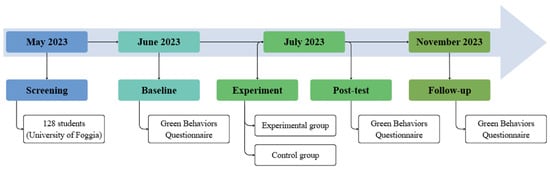
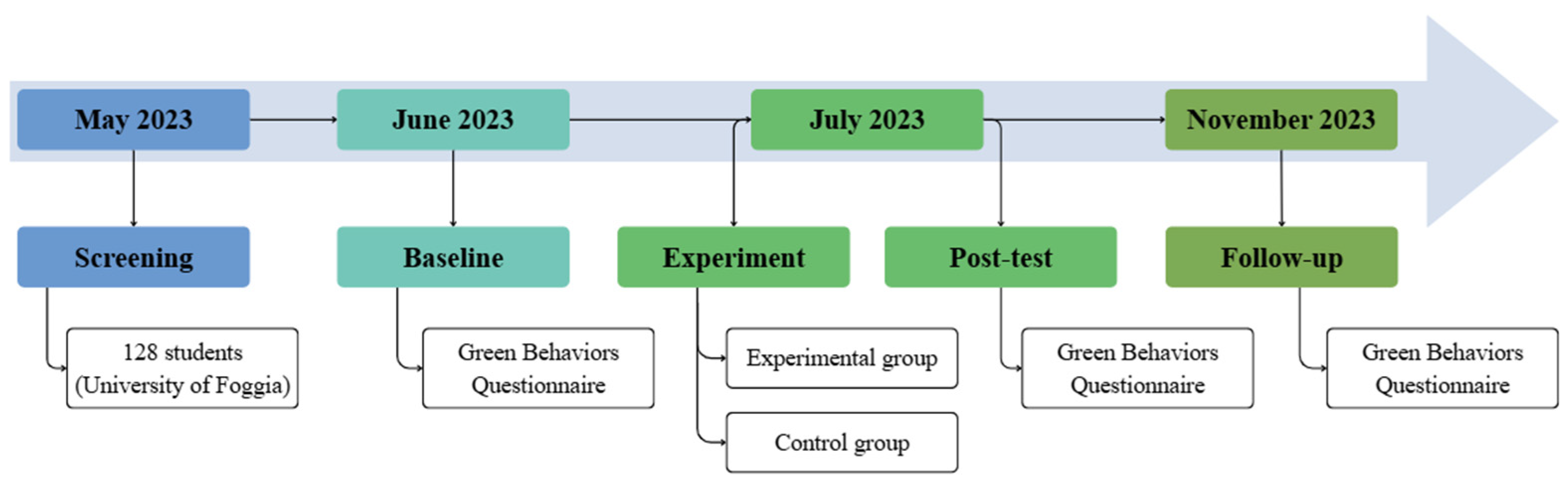
At baseline (see Section 2.3 “Materials”), participants were randomly divided into the experimental group (EG) and the control group (CG). Preliminary analyses confirmed that the two groups did not significantly differ in age, gender, or socio-economic status (SES). During the experimental phase, all participants received, for ten consecutive days, an EkoTok (a short video delivered via an automated mobile chat; see Section 2.3.2) in the morning (9 a.m.). While the EG received the same educational videos with anticipated regret manipulation, the CG received the videos without any experimental manipulation. At the end of each video, participants in both groups were instructed to answer a control question. Pro-environmental behavior was assessed using an ad hoc questionnaire in both groups at post-test and at a three-month follow-up. Figure 1 shows the longitudinal design of the study.
Figure 1.
Longitudinal study design with initial screening, baseline, experimental phase, and follow-up assessments of pro-environmental behavior in both the EG and the CG.
2.2. Sample
A priori power analysis was conducted using G*Power version 3.1, assuming a statistical power of 0.95, an alpha level of 0.05, and a target effect size of 0.25 for repeated measures design with three within-subject time points and two between-subject groups. The analysis indicated a required minimum sample size of 124 participants. A total of 128 participants were recruited, and socio-demographic data were collected (Table 1). The sample was predominantly female (71%), with a mean age of approximately 23 years. Most participants lived with their parents (78%) and 61% reported not being responsible for daily shopping activities. Parental SES was assessed using the Hollingshead four-factor index (Hollingshead, 1975). It provides a score based on the parental level of education, occupation, gender, and marital status. For each participant, we considered the number of inhabitants associated with their residence, distinguishing those who live in an urban context (>15,000 inhabitants) and those in a rural context (<15,000 inhabitants). Most participants resided in urban areas (72%).
Table 1.
Characteristics of sample. SES: socio-economic status; data are N (%) or mean (SD).
2.3. Materials
2.3.1. Self-Report Measures
The Green Behaviors Questionnaire assesses different subscales associated with sustainable behavior (prosocial behavior, purchase, consume, reuse, recycling, waste reduction, mobility, and pro-environmental actions) and was developed ad hoc based on a review of the literature on the topic (De Young, 1985; Kaiser et al., 1999; Lange & Dewitte, 2019; Markle, 2013; Tilikidou et al., 2002). The subscales were defined based on the main behavior targeted by each item within the consumption–waste cycle. Although some conceptual overlap between domains (e.g., recycling, reuse, and waste reduction) is possible, each item was assigned to the dimension that best reflects its dominant behavioral function. The questionnaire consisted of 64 items (Table 2).
Table 2.
Green Behaviors Questionnaire. Items marked with an asterisk are reverse scored.
Each item response was rated on a Likert scale ranging from 1 (Never) to 5 (Always). The prosocial behavior score was derived from the sum of items 1–8; the purchase score was derived from the sum of items 9–16; the consume score was derived from the sum of items 17–24; the reuse score was derived from the sum of items 25–32; the recycling score was derived from the sum of items 33–40; the waste score was derived from the sum of items 41–48; the mobility score was derived from the sum of items 49–56; and the pro-environmental actions score was derived from the sum of items 57–64. Higher scores correspond to more favorable behaviors for the specific scale. The overall score was computed as the sum of the items, with higher scores indicating more pro-environmental behaviors. The scale showed an average score of 155 with a standard deviation (SD) of 19.38, indicating some variability in responses. The reliability of the scale was confirmed by Cronbach’s alpha (α) of 0.812, which suggested good internal consistency. Additionally, McDonald’s omega (ω) was slightly higher at 0.827, further supporting the scale’s reliability in measuring the construct.
The Marlowe–Crowne Social Desirability Scale (MC-SDS) was administered to quantify social desirability through self-assessment. The score obtained on this measure was used as a covariate in the statistical analyses.
2.3.2. EkoTok
For 10 consecutive days, participants were invited to watch EkoToks (average duration 90 s) addressing specific pro-environmental behaviors (See Table A1 in Appendix A for description of the EkoTok messages). Each EkoTok was designed to highlight the human impact on the environment and the immediate and future environmental consequences of specific behaviors. In the EkoTok delivered to the EG, these consequences were introduced following the statement “You may regret…”. Participants in the CG viewed short informational videos on the same topics, without any reference to anticipated regret. The visual materials and informational content were the same; the only difference concerned the additional segment introducing the regret manipulation. Specifically, in the EG videos, the message “You may regret…” was displayed on a black screen before presenting the consequences of the behavior. After viewing all EkoToks, two ad hoc scales were administered, each consisting of 14 items, to evaluate post-experiment psychological outcomes: a scale on the perceived regret (Likert scale 1–5) and another on the future intentions (Likert scale 0–4). Higher scores correspond to greater regret and greater intentions to implement concrete pro-environmental behaviors in the future in participants’ daily lives. Finally, two questions (Likert scale 1–5; 1 = Not at all to 5 = very much) were asked to obtain information about the effectiveness and satisfaction perceived by the participants and investigate whether there are differences between the two groups. The Green Behaviors Questionnaire was administered again both at post-test and at follow-up.
2.4. Data Analysis
The Statistical Package for the Social Sciences (SPSS, version 30) was used for data processing and analysis (IBM Corp., 2017). Preliminary independent sample T-tests were performed to assess the comparability of the two groups in terms of socio-demographic variables and baseline pro-environmental behaviors. Repeated-measures analysis of covariances (ANCOVAs) were performed using groups as the between variable and time as the within-subject variable. The social desirability scale score was used as a covariate of no interest in the analyses.
Independent sample t-tests were conducted (i) to test the difference between the averages of the two groups at the perceived regret scales measured in the post-test; (ii) to test the difference between the averages of the two groups in the perceived liking and effectiveness of the experiment. It also carried out regression analysis between post-experiment psychological outcomes (separately as predictors) and pro-environmental behaviors measured at follow-up (dependent variables).
To reduce the likelihood that the results were influenced by potential confounding variables, additional analyses were conducted. Specifically, to exclude the effect of urbanicity on mobility dimension, we conducted a repeated measures (three time points) ANCOVA between the groups and participant’s residence (urban: >15,000 inhabitants vs. rural: <15,000 inhabitants); moreover, to exclude that results in the purchasing conditions were affected by SES, we performed the analysis by including three related SES subgroups (low, medium, and high). Participants with low SES have a score < 20; participants with medium SES have scores between 20 and 40; participants with high SES have scores between 40 and 66. The classification was based on previous studies that highlighted the impact of SES on pro-environmental behavior (Kollmuss & Agyeman, 2002). Statistical significance for analyses was set at p < 0.05.
3. Results
The two groups were not statistically different at baseline in terms of socio-demographic variables and pro-environmental behaviors (Table 3).
Table 3.
Descriptive statistics of measures between groups at three time points. ns = Not significant.
3.1. Repeated Measures ANCOVA
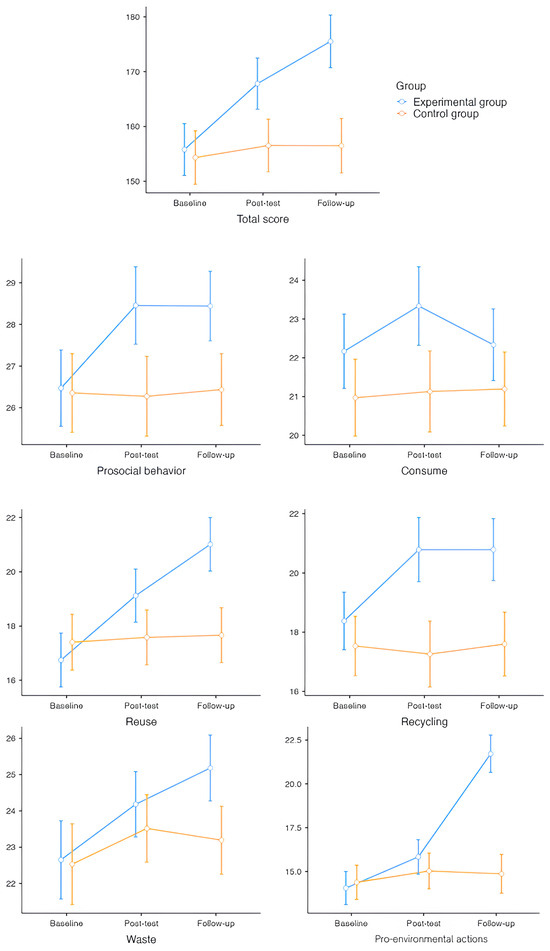
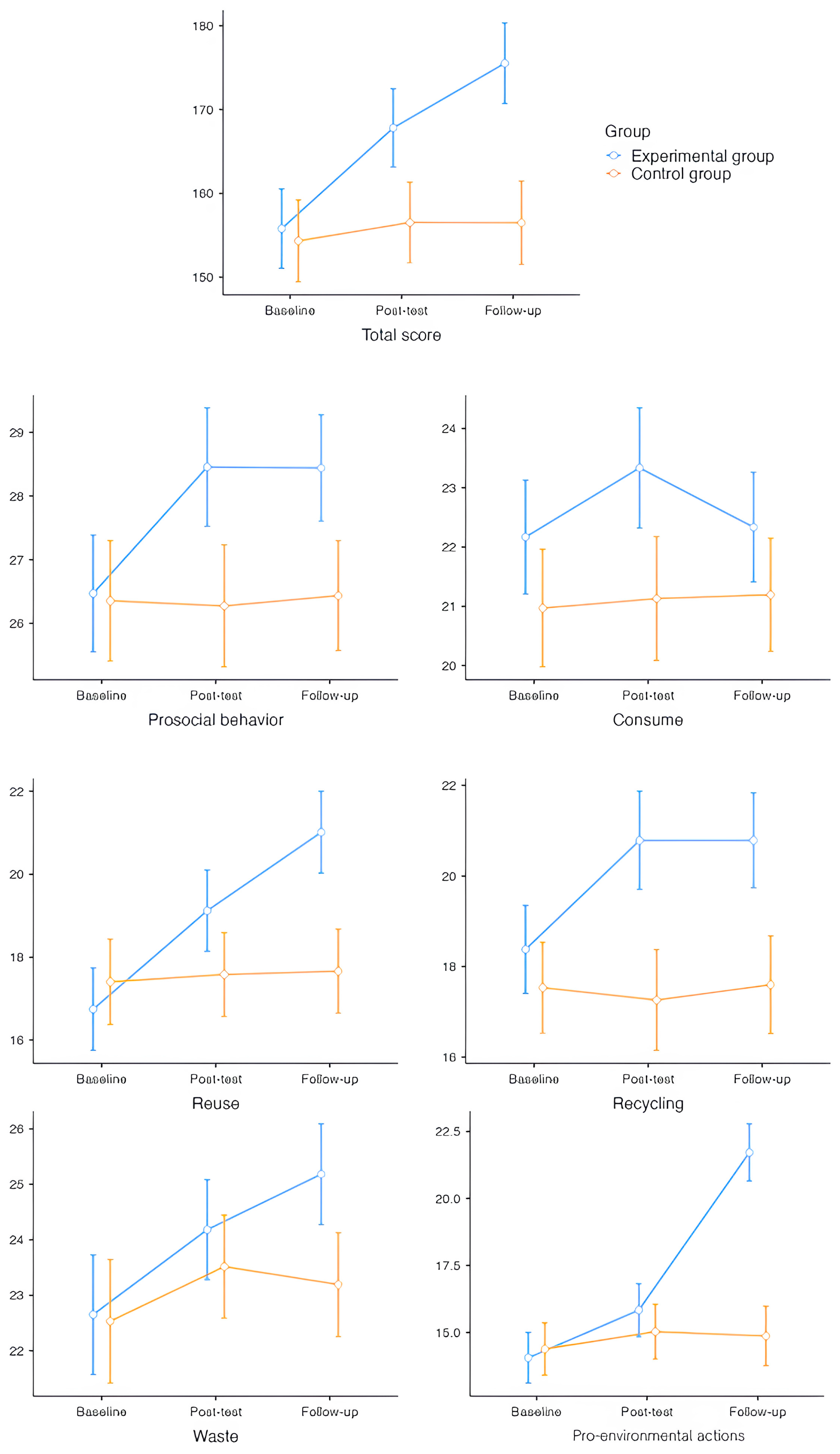
The repeated measures ANCOVA, with group as the between-subject factor, time as the within-subject factor, and social desirability as a covariate of no interest, yielded the results shown in Figure 2. We did not include the ANCOVA plots for the purchase and mobility subscales in Figure 2 because no significant changes were observed for these measures.
Figure 2.
Interaction between the averages of the two groups within the three measurement times of pro-environmental behavior.
Regarding prosocial behavior, a main effect of group was observed, F(1,126) = 6.33, p = 0.013, with the EG outperforming the CG t(126) = 2.52, p = 0.01. No significant main effect of time was observed. There was a significant interaction between group and time, F(2,252) = 7.82, p < 0.001, indicating that changes over time differed between the groups. In the CG, no significant changes were observed between time points. However, in the EG, significant improvements were observed. Between baseline and post-test, scores improved significantly, t(127) = −3.389, p = 0.002, and further improvements were noted between baseline and follow-up, t(127) = −4.33, p < 0.001. At post-test, the EG exhibited significantly higher scores than the CG, t(126) = 3.318, p = 0.022. At follow-up, the EG also showed significantly higher scores than the CG, t(126) = 3.24, p = 0.018.
No main effects or interaction were observed for purchase in the standard group analysis. However, an explorative analysis including SES as a factor revealed a main effect of SES, F(2,122) = 3.66, p = 0.033. Participants from the low SES group showed higher scores than those from the medium SES group.
For consume, a main effect of group was observed, F(1,126) = 5.39, p = 0.022, with the EG outperforming the CG, t(126) = 2.32, p = 0.022. No significant main effect of time was observed. There was a significant interaction between group and time, F(2,252) = 3.27, p = 0.039, so that in the CG there were no significant changes across time, while in the EG, the data showed a trend towards improvement between baseline and post-test, t(127) = 2.68, p = 0.085, and a significant decrease between post-test and follow-up, t(127) = 5.67, p < 0.01. At post-test, the EG exhibited higher scores than the CG, t(126) = 2.97, p = 0.040.
Regarding the reuse subscale, a main effect of group was observed, F(1,126) = 5.91, p = 0.016, with the EG outperforming the CG, t(126) = 2.43, p = 0.016. A significant main effect of time was also found, F(2,252) = 3.68, p = 0.029, with significant improvements between baseline and post-test, t(127) = −3.81, p < 0.001, between baseline and follow-up, t(127) = −6.00, p < 0.001, and between post-test and follow-up, t(127) = −2.39, p = 0.048. The interaction between group and time was significant, F(2,252) = 11.78, p < 0.001. In the EG, scores improved significantly between baseline and post-test, t(127) = −5.086, p < 0.001, and further between baseline and follow-up, t(127) = −8.16, p < 0.001, and between post-test and follow-up, t(127) = −3.34, p = 0.014. At follow-up, the EG exhibited significantly higher scores than the CG, t(126) = 4.69, p < 0.001.
For recycling, a main effect of group was observed, F(1,126) = 13.90, p < 0.001, with the EG outperforming the CG, t(126) = 3.73, p < 0.001. No significant main effect of time was observed. There was a significant interaction between group and time, F(2,252) = 11.78, p < 0.001. In the CG, no significant changes were observed between time points, while in the EG, scores improved significantly between baseline and post-test, t(127) = −4.455, p < 0.001, and further between baseline and follow-up, t(127) = −5.22, p < 0.001. At post-test, the EG exhibited significantly higher scores than the CG, t(126) = 4.44, p < 0.001, and again at follow-up, t(126) = 4.14, p < 0.001.
The 2 × 3 repeated measures ANCOVA for the waste subscale revealed a significant interaction between group and time, F(2,252) = 11.78, p < 0.001. No significant main effect of group or time was observed. In the EG, scores improved significantly between baseline and follow-up, t(127) = −5.21, p < 0.001, and further between post-test and follow-up, t(127) = −5.65, p < 0.001. At follow-up, the EG exhibited higher scores than the CG, t(126) = 3.064, p = 0.031.
No main effects or interactions were observed in mobility. However, a significant three-way interaction between group, time, and residence (rural vs. city) was found, F(2,123) = 5.92, p = 0.003. The effect of the intervention varied by location, with rural participants in the EG showing a significant increase in scores from baseline to post-test, t(123) = −2.49, p = 0.044, and a trend at follow-up suggesting more complex interactions.
Regarding the pro-environmental actions, a main effect of group was observed, F(1,126) = 14.54, p < 0.001, with the EG outperforming the CG, t(126) = 3.81, p < 0.001. Significant main effects of time were observed, F(2,252) = 5.65, p = 0.029. Significant improvements were observed between baseline and post-test, t(127) = −3.74, p < 0.001, between baseline and follow-up, t(127) = −11.57, p < 0.001, and between post-test and follow-up, t(127) = −10.70, p < 0.001. There was a significant interaction between group and time, F(2,252) = 73.73, p < 0.001. In the EG, scores improved significantly between baseline and post-test, t(127) = −3.930, p = 0.002, and further between baseline and follow-up, t(127) = −15.59, p < 0.001, and between post-test and follow-up, t(127) = −3.34, p = 0.014. At follow-up, the EG exhibited significantly higher scores than the CG, t(126) = −15.77, p < 0.001. For the total score, a main effect of group was observed, F(1,126) = 12.1, p < 0.001, indicating differences between the CG and the EG, t(126) = −3.48, p < 0.001. The main effect of time was not significant. A significant interaction between group and time was found, F(2,252) = 19.45, p < 0.001. In the EG, significant changes were observed between baseline and post-test t(127) = −5.37, p < 0.001, baseline and follow-up, t(127) = −8.08, p < 0.001, and post-test to follow-up, t(127) = −11.29, p < 0.001. In the CG, no significant changes were observed over time. At post-test, the EG exhibited significantly higher scores than the CG, t(126) = 3.31, p = 0.002. At follow-up, the EG showed significantly higher scores than the CG, t(126) = 5.42, p < 0.001.
3.2. Differences Between Groups on Post-Intervention Psychological Outcomes
The EG showed higher scores on the perceived regret scale (t(126) = 3512; p < 0.005) than the CG. As shown in Table 4, perceived regret scores predicted several pro-environmental outcomes at follow-up, including total score (β = 0.646; t = 3.074; p = 0.02), prosocial behavior (β = 0.098; t = 2.854; p = 0.05), reuse (β = 0.126; t = 2.97; p = 0.04), and pro-environmental actions (β = 0.16; t = 2.961; p = 0.04). In addition, at post-test, the EG reported significantly higher future intention scores than the CG (p < 0.01), indicating a stronger willingness to adopt pro-environmental behaviors in the future following the intervention. However, exploratory regression analyses weighted by group did not reveal significant associations between future intentions and follow-up behavioral measures. Finally, the two groups showed no differences in perceived effectiveness and satisfaction.
Table 4.
Regression analyses predicting follow-up pro-environmental behaviors. ns = not significant.
4. Discussion
The present study aimed to examine the effect of anticipated regret on pro-environmental behaviors using regret-based videos in a sample of over 100 young Italian adults. The results of our study provide evidence supporting the role of anticipated regret in motivating pro-environmental behaviors, aligning with previous research (Carfora et al., 2019; Onwezen et al., 2014). This clearly emerges from the group by time interaction on the total score of the Green Behaviors Questionnaire, in which the EG, but not the CG, exhibited higher scores at both post-test and follow-up compared to baseline. Below, we discuss our findings from a short- and long-term perspective, including non-significant effects, observed across all the questionnaire scales.
4.1. Short-Term Effects: Baseline vs. Post-Test
In the short term, there was a significant increase in pro-environmental behaviors within the EG between baseline and post-test. In contrast, the CG did not show significant changes. At post-test, the EG scored significantly higher than the CG, supporting the role of regret in promoting behavioral change (Zeelenberg, 1999).
The EG also exhibited a substantial rise in prosocial behaviors, while the CG remained unchanged. This aligns with previous studies suggesting that moral emotions like regret can drive cooperative and prosocial actions (Bandura, 1986) and their interdependence with pro-environmental behavior (Tapia-Fonllem et al., 2013).
Pro-environmental actions within the EG also increased significantly between baseline and post-test. However, no significant differences were observed between the EG and the CG in the short term. Differences emerged only in the long term, suggesting that, while regret can motivate pro-environmental actions, it may take time for such behaviors to manifest as collective action (Van Zomeren et al., 2012). Participants in the EG may have had fewer immediate opportunities to engage in pro-environmental actions, with more pronounced behaviors developing over time.
Recycling behaviors showed marked improvements between baseline and post-test in the EG, while no significant changes occurred in the CG. The EG’s post-test score, significantly higher than that of the CG, indicates that anticipated regret was particularly effective in encouraging recycling. This supports Diekmann and Preisendörfer’s low-cost hypothesis, which suggests that low-cost behaviors, like recycling, are more easily influenced by emotional triggers (Diekmann & Preisendörfer, 1998).
Reuse behaviors also improved within the EG, although no significant differences were found between the EG and the CG at post-test. This may be due to the accessibility and ease of reuse potentially diminishing the intervention’s impact (e.g., peer-to-peer online marketplace or global e-commerce focused on secondhand fashion and accessories). Platforms that reward users economically or socially might encourage continuous behavior change, particularly for younger adults who may see financial and social gains from such platforms (Bocken et al., 2016).
Consumption behaviors, however, did not show significant improvements within the EG between baseline and post-test, although the EG did score higher than the CG at post-test. Consumption choices, particularly for students, are often influenced by deeper values and economic factors (Sheth et al., 2011), making them harder to shift through emotional interventions alone. Additionally, the high baseline score for consumption likely contributed to a ceiling effect, limiting the potential for significant short-term changes.
4.2. Long-Term Effects: Baseline vs. Follow-Up
In the long term, the EG exhibited sustained improvements in many pro-environmental behaviors. The total pro-environmental score continued to rise from baseline to follow-up, which supports the theory of regret heuristics that suggests that individuals use past regrets to guide future decisions, leading to lasting behavior changes (Slovic et al., 2002). The CG did not exhibit such changes, highlighting the enduring influence of regret-based interventions.
Prosocial behavior also improved significantly in the EG between baseline and follow-up, further supporting the idea that regret can drive lasting moral motivation (Zeelenberg & Pieters, 2007). Reuse and recycling behaviors followed a similar pattern, with sustained improvements observed in the EG, supporting Diekmann and Preisendörfer’s low-cost hypothesis (Diekmann & Preisendörfer, 1998).
Pro-environmental actions also exhibited continued improvement from baseline to follow-up in the EG. This suggests that the emotional engagement triggered by anticipated regret led to ongoing participation in collective environmental actions (Van Zomeren et al., 2012). Over time, participants likely found more opportunities to engage in pro-environmental actions, such as discussing environmental issues or accessing environmentally relevant content.
Interestingly, waste reduction behaviors only showed significant improvements at the long-term follow-up, suggesting that more complex behaviors may require more time to develop.
4.3. Post-Test vs. Follow-Up
Regression analyses indicated that perceived regret at post-test predicted further improvements at follow-up, particularly in pro-environmental behavior, prosocial behavior, reuse, and pro-environmental actions.
The results showed that recycling behaviors remained stable between post-test and follow-up, while reuse behaviors continued to increase. Recycling is often a low-effort, routine action that participants can easily incorporate into their daily lives, as supported by Diekmann and Preisendörfer’s low-cost hypothesis, which suggests that simple, habitual actions like recycling are quickly adopted and require less reinforcement (Diekmann & Preisendörfer, 1998). In contrast, reuse behaviors demand more active decision-making and involve greater personal incentives, such as saving money or earning income from platforms. According to Ajzen’s Theory of Planned Behavior, the complexity and cognitive engagement required for reuse may explain why this behavior continued to grow, as participants gradually integrated it into their habits (Ajzen, 1991). Additionally, the economic and psychological benefits linked to reuse could have reinforced these behaviors more consistently than recycling, which might have already reached a habitual plateau (Lally et al., 2010). Waste reduction behaviors—such as turning off lights, conserving water, and reducing paper use—improved significantly between baseline and follow-up, despite showing no immediate change at post-test. The delayed improvement can also be explained by affective heuristics theory (Slovic et al., 2002), suggesting that, over time, participants developed positive emotional associations with these actions, reinforcing long-term behavior change. In contrast, consumption behaviors, such as using insecticides, air fresheners, and reading product labels, showed initial improvement but declined between post-test and follow-up. This trend can be explained by the seasonality effect, as the post-test occurred in summer when insecticide use is higher, but by autumn (follow-up), the demand for these products had decreased. Additionally, behaviors like reading labels and selecting eco-friendly products require higher cognitive effort, making them harder to sustain without continued reinforcement. According to Ajzen’s Theory of Planned Behavior, these actions demand more deliberate control, and without constant motivation, the intention to maintain these behaviors diminished (Ajzen, 1991).
4.4. Non-Significant Results: Purchase and Mobility
No significant changes were found in purchasing behaviors in either group, although SES played a role. Participants with lower SES reported greener purchasing behaviors, likely due to necessity rather than environmental concern (Stephens, 2007). Financial barriers faced by middle-class participants may have further hindered their ability to adopt green practices. In this dimension, an inconsistency with Carfora et al. was observed, which may be explained by differences in the conceptualization and measurement of pro-environmental behaviors (Carfora et al., 2019). A key distinction in our study is the separation of “purchase” behaviors from “consume” behaviors, allowing for a clearer understanding of how different actions contribute to environmental outcomes. For example, the environmental impact of purchasing red meat occurs at the point of purchase, regardless of whether the individual consumes it. This impact persists even if the product is discarded and can be further amplified if it is wasted. Conversely, consumption behaviors, such as using chemical air fresheners or pesticides, generate environmental impacts at the point of use, independent of the purchase. Moreover, Carfora et al. did not account for the influence of autonomy over purchasing decisions, which could be an important factor in shaping pro-environmental behaviors (Carfora et al., 2019). Our sample was predominantly composed of students living with their parents and not frequently engaged in purchasing. In contrast, the study by Carfora et al. did not provide specific details on the living arrangements of their participants, but it is likely that the Milan sample had a higher proportion of students living away from home (Carfora et al., 2019). This difference in living arrangements could be significant because students living independently may have more autonomy over their purchasing decisions, making anticipated regret a more potent motivator for behavior change. Mobility behaviors also did not show significant improvements, consistent with the high-cost hypothesis (Diekmann & Preisendörfer, 1998). Changes in mobility often involve substantial lifestyle adjustments, such as switching from car use to public transportation. It would be interesting to further disambiguate the exploratory analysis, which revealed that rural participants (a minority compared to urban residents) in the EG showed greater improvements, in line with Berenguer et al., who found that those living in cities hold more environmental responsibility values but show a less pro-environmental orientation when attitude and behavioral intentions scales are used (Berenguer et al., 2005). People living in rural contexts present greater attitudes of environmental responsibility and greater coherence in expressing behavioral intentions compatible with environmental protection also in terms of travel.
5. Limitations and Future Implications
Our study had several limitations. First, recruitment was conducted through a convenience sample, consisting exclusively of university students recruited from a single Italian university. This may limit the generalizability of the findings to other populations. Future studies should replicate the intervention with more diverse samples, including older adults and adolescents from different sociocultural backgrounds. Second, pro-environmental behaviors were measured through self-report questionnaires. Although statistically controlled, self-report measures could still be affected by response bias or discrepancies between intentions and actual behavior. In the future, they could integrate behavioral or observational measures, such as actual purchasing decisions, energy consumption monitoring, or mobility tracking (Lange & Dewitte, 2019). Third, the intervention period was relatively short (ten days). Although a three-month follow-up was conducted, longer follow-ups would be necessary to determine whether regret-based interventions produce stable long-term behavioral change. This limitation was aligned with Świątkowski et al. (2024): although behavioral interventions can promote pro-environmental actions, their long-term stability remains insufficiently explored across contexts and populations. Finally, some behavioral domains, particularly mobility and purchase, appeared resistant to change. These behaviors are often constrained by economic resources and infrastructure, suggesting that emotional interventions alone may not be sufficient to influence more costly environmental behaviors.
Despite the aforementioned limits, the present findings contribute to the growing literature on the psychological determinants of pro-environmental behavior by providing empirical support for the role of anticipated regret as a motivational mechanism. The study underscores the role of affective heuristics, as proposed by Slovic and colleagues, in fostering long-term reflection and behavioral shifts (Slovic et al., 2002). In line with that, the results suggest that emotions can facilitate behavioral change by making the future consequences of environmentally harmful actions more psychologically salient. Moreover, the study extends previous research on anticipated regret by demonstrating that its influence is not limited to specific behaviors (e.g., dietary choices), but can generalize across multiple domains of sustainable behavior, including prosocial actions, recycling, reuse, and pro-environmental actions. This supports the idea that regret may function as a cross-domain motivational driver in sustainability-related decision-making (Zeelenberg & Pieters, 2007).
From an applied perspective, our results suggest that digital interventions based on anticipated regret may represent an effective strategy to promote sustainable behaviors. The EkoTok format, consisting of brief emotionally framed videos delivered through automated messaging systems, offers several practical advantages. It is easily disseminated through smartphones, requires minimal resources, and can be integrated into educational programs. Educational institutions and policymakers could adopt similar interventions to complement traditional environmental education programs. This approach could also be adapted to other domains of behavior change beyond environmental sustainability, including health behaviors, responsible consumption, and civic engagement, where emotional anticipation may play a critical role in motivating long-term behavioral commitment.
6. Conclusions
The findings of this study demonstrate that anticipated regret can effectively motivate pro-environmental behaviors, particularly low-cost and habitual actions such as recycling, reuse, and prosocial behaviors. Our results support the hypothesis that behaviors requiring minimal psychological or physical effort are more easily influenced by emotional triggers. In contrast, higher-cost behaviors such as mobility and consumption were more resistant to change, likely due to the greater effort or structural adjustments they require. These results highlight the importance of designing interventions that address specific barriers, such as SES and the complexity of the behavior itself, to facilitate sustainable behavior change. The effectiveness of EkoToks can be understood considering the “non-tangibility of consequences” often associated with cognitive limitations that impact environmental choices. To explore the internalization of affective heuristics, future research could use scenarios in which participants imagine how they would act and feel in emotionally charged situations. While this method is efficient and can evoke strong emotions, it has limitations. The decisions made in imagined situations may not reflect real-life choices, and social desirability might also influence responses. Although social desirability was controlled for in this study, future work could benefit from testing implicit responses to pro-environmental behaviors. EkoToks—used for the first time in this study and well-received by both the EG and CG—proved to be effective in increasing pro-environmental behaviors, including prosocial behavior, reuse, recycling, waste reduction and on pro-environmental actions. Therefore, this strategy could be applied at an individual level and easily disseminated via smartphones to promote multiple dimensions of sustainable behavior. Considering this psychological mechanism, it would be valuable to test the use of immersive or mixed virtual reality paradigms for EkoTok delivery, in order to make the consequences of one’s behaviors more “tangible” across all behavioral domains considered.
Author Contributions
Conceptualization: T.Q. and P.P.; Data curation: A.B. and E.T.; Formal analysis: A.B.; Funding acquisition: P.P.; Investigation: A.B., T.Q. and P.P.; Methodology: A.B., T.Q., P.P., L.C., G.S. and E.T.; Project administration: T.Q. and P.P.; Resources: T.Q. and P.P.; Software: T.Q. and P.P.; Supervision: T.Q. and P.P.; Validation: A.B.; Visualization: A.B., G.S., E.T., L.C., T.Q. and P.P.; Roles/Writing—original draft: A.B., T.Q. and P.P.; Writing—review and editing: A.B., T.Q., P.P., G.S., E.T. and L.C. All authors have read and agreed to the published version of the manuscript.
Funding
This research received no external funding.
Institutional Review Board Statement
The study was conducted in accordance with the Declaration of Helsinki, and approved by the Ethics Committee of University of Foggia (protocol code 016/CEpsi—29 June 2023).
Informed Consent Statement
Informed consent was obtained from all participants involved in the study.
Data Availability Statement
The datasets used and analyzed during the current study are available from the corresponding author on reasonable request.
Acknowledgments
We extend our gratitude to the dedicated students of the “Scienze e Tecniche Psicologiche” course at the University of Foggia who contributed significantly to this study by contributing to data collection.
Conflicts of Interest
The authors declare no conflicts of interest.
Abbreviations
The following abbreviations are used in this manuscript:
| ANCOVA(s) | Analysis of covariance(s) |
| CG | Control group |
| EAT-26 | Eating Attitudes Test-26 |
| EG | Experimental group |
| ES | Effect size |
| MC-SDS | Marlowe–Crowne Social Desirability Scale |
| N | Sample size |
| SAS | Self-Rating Anxiety Scale |
| SD | Standard deviation |
| SDGs | Sustainable Development Goals |
| SES | Socio-economic status |
| SPSS | The Statistical Package for the Social Sciences |
| A | Cronbach’s alpha |
| Ω | McDonald’s omega |
Appendix A
Table A1.
EkoTok phrases said only to the EG are shown in bold.
References
- Ajzen, I. (1991). The theory of planned behavior. Organizational Behavior and Human Decision Processes, 50(2), 179–211. [Google Scholar] [CrossRef] [Scilit]
- Appannagari, R. R. (2017). Environmental pollution causes and consequences: A study. North Asian International Research Journal of Social Science & Humanities, 3(8), 151–161. [Google Scholar]
- Bandura, A. (1986). Social foundations of thought and action: A social cognitive theory. Prentice-Hall. [Google Scholar]
- Berenguer, J., Corraliza, J. A., & Martín, R. (2005). Rural-urban differences in environmental concern, attitudes, and actions. European Journal of Psychological Assessment, 21(2), 128–138. [Google Scholar] [CrossRef] [Scilit]
- Bocken, N., Miller, K., & Evans, S. (2016, June 16–17). Assessing the environmental impact of new circular business models. New Business Models Conference, Rotterdam, The Netherlands. [Google Scholar]
- Bradshaw, J., Martorano, B., Natali, L., & De Neubourg, C. (2013). Children’s subjective well-being in rich countries. Child Indicators Research, 6(4), 619–635. [Google Scholar] [CrossRef] [Scilit]
- Carfora, V., Caso, D., Palumbo, F., & Conner, M. (2018). Promoting water intake. the persuasiveness of a messaging intervention based on anticipated negative affective reactions and self-monitoring. Appetite, 130, 236–246. [Google Scholar] [CrossRef] [Scilit]
- Carfora, V., Caso, D., Sparks, P., & Conner, M. (2017). Moderating effects of pro-environmental self-identity on pro-environmental intentions and behaviour: A multi-behaviour study. Journal of Environmental Psychology, 53, 92–99. [Google Scholar] [CrossRef] [Scilit]
- Carfora, V., Catellani, P., Caso, D., & Conner, M. (2019). How to reduce red and processed meat consumption by daily text messages targeting environment or health benefits. Journal of Environmental Psychology, 65, 101319. [Google Scholar] [CrossRef] [Scilit]
- Chawla, L. (1999). Life paths into effective environmental action. The Journal of Environmental Education, 31(1), 15–26. [Google Scholar] [CrossRef] [Scilit]
- Cook, J., Nuccitelli, D., Green, S. A., Richardson, M., Winkler, B., Painting, R., Way, R., Jacobs, P., & Skuce, A. (2013). Quantifying the consensus on anthropogenic global warming in the scientific literature. Environmental Research Letters, 8(2), 024024. [Google Scholar] [CrossRef] [Scilit]
- De Young, R. (1985). Encouraging environmentally appropriate behavior: The role of intrinsic motivation. Journal of Environmental Systems, 15(4), 281–292. [Google Scholar] [CrossRef] [Scilit]
- Diekmann, A., & Preisendörfer, P. (1998). Environmental behavior: Discrepancies between aspirations and reality. Rationality and Society, 10(1), 79–102. [Google Scholar] [CrossRef] [Scilit]
- Dotti, A., & Lazzari, R. (1998). Validation and reliability of the Italian EAT-26. Eating and Weight Disorders—Studies on Anorexia, Bulimia and Obesity, 3(4), 188–194. [Google Scholar] [CrossRef] [Scilit]
- Evans, G. W., Otto, S., & Kaiser, F. G. (2018). Childhood origins of young adult environmental behavior. Psychological Science, 29(5), 679–687. [Google Scholar] [CrossRef] [Scilit]
- Garner, D. M., Olmstead, M. P., & Polivy, J. (1983). Development and validation of a multidimensional eating disorder inventory for anorexia nervosa and bulimia. International Journal of Eating Disorders, 2(2), 15–34. [Google Scholar] [CrossRef] [Scilit]
- Geraci, A., Franchin, L., & Benavides-Varela, S. (2023). Evaluations of pro-environmental behaviors by 7-month-old infants. Infant Behavior and Development, 72, 101865. [Google Scholar] [CrossRef] [Scilit]
- Geraci, A., Franchin, L., & Commodari, E. (2024). Evaluations of pro-environmental behaviours in preschool age. European Journal of Developmental Psychology, 21(5), 770–794. [Google Scholar] [CrossRef] [Scilit]
- Hollingshead, A. B. (1975). Four factor index of social status [Unpublished manuscript]. Yale University.
- Hu, C., & Wu, Z. (2022). They can and will: Preschoolers encourage pro-environmental behavior with rewards and punishments. Journal of Environmental Psychology, 82, 101842. [Google Scholar] [CrossRef] [Scilit]
- Hysa, B., Karasek, A., & Zdonek, I. (2021). Social media usage by different generations as a tool for sustainable tourism marketing in society 5.0 idea. Sustainability, 13(3), 1018. [Google Scholar] [CrossRef] [Scilit]
- IBM Corp. (2017). IBM SPSS statistics for windows (Version 25.0). IBM Corp.
- Innamorati, M., Lelli, M., Aiello, S., Di Lorenzo del Casale, F. L., Russo, S., & Ferrari, V. (2006). Validazione convergente e discriminante della versione italiana della Zung Self-Rating Depression Scale [Convergent and discriminant validation of the Italian version of the Zung Self-Rating Depression Scale]. Psicoterapia Cognitiva e Comportamentale, 12(3), 343–353. [Google Scholar]
- Kaiser, F. G., Wölfing, S., & Fuhrer, U. (1999). Environmental attitude and ecological behaviour. Journal of Environmental Psychology, 19(1), 1–19. [Google Scholar] [CrossRef] [Scilit]
- Kempton, W., Boster, J. S., & Hartley, J. A. (1995). Environmental values in American culture. MIT Press. [Google Scholar]
- Kollmuss, A., & Agyeman, J. (2002). Mind the gap: Why do people act environmentally and what are the barriers to pro-environmental behavior? Environmental Education Research, 8(3), 239–260. [Google Scholar] [CrossRef] [Scilit]
- Lally, P., Van Jaarsveld, C. H. M., Potts, H. W. W., & Wardle, J. (2010). How are habits formed: Modelling habit formation in the real world. European Journal of Social Psychology, 40(6), 998–1009. [Google Scholar] [CrossRef] [Scilit]
- Lange, F., & Dewitte, S. (2019). Measuring pro-environmental behavior: Review and recommendations. Journal of Environmental Psychology, 63, 92–100. [Google Scholar] [CrossRef] [Scilit]
- Lecci, L., Okun, M. A., & Karoly, P. (1994). Life regrets and current goals as predictors of psychological adjustment. Journal of Personality and Social Psychology, 66(4), 731–741. [Google Scholar] [CrossRef]
- Loomes, G., & Sugden, R. (1982). Regret theory: An alternative theory of rational choice under uncertainty. The Economy Journal, 92(368), 805. [Google Scholar] [CrossRef] [Scilit]
- Markle, G. L. (2013). Pro-environmental behavior: Does it matter how it’s measured? Development and validation of the pro-environmental behavior scale (PEBS). Human Ecology, 41(6), 905–914. [Google Scholar] [CrossRef] [Scilit]
- Newhouse, N. (1990). Implications of attitude and behavior research for environmental conservation. The Journal of Environmental Education, 22(1), 26–32. [Google Scholar] [CrossRef] [Scilit]
- O’Brien, C. (2008). Sustainable happiness: How happiness studies can contribute to a more sustainable future. Canadian Psychology/Psychologie Canadienne, 49(4), 289–295. [Google Scholar] [CrossRef] [Scilit]
- Onwezen, M. C., Bartels, J., & Antonides, G. (2014). The self-regulatory function of anticipated pride and guilt in a sustainable and healthy consumption context. European Journal of Social Psychology, 44(1), 53–68. [Google Scholar] [CrossRef] [Scilit]
- Otto, S., & Pensini, P. (2017). Nature-based environmental education of children: Environmental knowledge and connectedness to nature, together, are related to ecological behaviour. Global Environmental Change, 47, 88–94. [Google Scholar] [CrossRef] [Scilit]
- Parker, D., Stradling, S. G., & Manstead, A. S. R. (1996). Modifying beliefs and attitudes to exceeding the speed limit: An intervention study based on the theory of planned behavior. Journal of Applied Social Psychology, 26(1), 1–19. [Google Scholar] [CrossRef] [Scilit]
- Richard, R., Van Der Pligt, J., & De Vries, N. (1996). Anticipated regret and time perspective: Changing sexual risk-taking behavior. Journal of Behavioral Decision Making, 9(3), 185–199. [Google Scholar] [CrossRef]
- Savage, L. J. (1972). The foundations of statistics (2nd ed.). Dover Publications. [Google Scholar]
- Schmidt, J., Reichstein, C., & Härting, R.-C. (2022). Influence of augmented reality on consumer behaviour in online retailing. In W. Abramowicz, S. Auer, & M. Stróżyna (Eds.), Business information systems workshops (Vol. 444, pp. 131–143). Lecture Notes in Business Information Processing. Springer. [Google Scholar] [CrossRef] [Scilit]
- Sheth, J. N., Sethia, N. K., & Srinivas, S. (2011). Mindful consumption: A customer-centric approach to sustainability. Journal of the Academy of Marketing Science, 39(1), 21–39. [Google Scholar] [CrossRef] [Scilit]
- Slovic, P., Finucane, M., Peters, E., & MacGregor, D. G. (2002). Rational actors or rational fools: Implications of the affect heuristic for behavioral economics. The Journal of Socio-Economics, 31(4), 329–342. [Google Scholar] [CrossRef] [Scilit]
- Spear, L. P. (2013). Adolescent neurodevelopment. Journal of Adolescent Health, 52(2), S7–S13. [Google Scholar] [CrossRef] [Scilit]
- Steiner, G., Geissler, B., Schreder, G., & Zenk, L. (2018). Living sustainability, or merely pretending? From explicit self-report measures to implicit cognition. Sustainability Science, 13(4), 1001–1015. [Google Scholar] [CrossRef] [Scilit] [PubMed]
- Stephens, C. (2007). Environmental justice: A critical issue for all environmental scientists everywhere. Environmental Research Letters, 2(4), 045001. [Google Scholar] [CrossRef] [Scilit]
- Świątkowski, W., Surret, F. L., Henry, J., Buchs, C., Visintin, E. P., & Butera, F. (2024). Interventions promoting pro-environmental behaviors in children: A meta-analysis and a research agenda. Journal of Environmental Psychology, 96, 102295. [Google Scholar] [CrossRef] [Scilit]
- Tapia-Fonllem, C., Corral-Verdugo, V., Fraijo-Sing, B., & Durón-Ramos, M. (2013). Assessing sustainable behavior and its correlates: A measure of pro-ecological, frugal, altruistic and equitable actions. Sustainability, 5(2), 711–723. [Google Scholar] [CrossRef] [Scilit]
- Tilikidou, I., Adamson, I., & Sarmaniotis, C. (2002). The measurement instrument of ecologically-conscious consumer behaviour. New Medit, 1(4), 46–53. [Google Scholar]
- Trenberth, K. E. (2018). Climate change caused by human activities is happening and it already has major consequences. Journal of Energy & Natural Resources Law, 36(4), 463–481. [Google Scholar] [CrossRef] [Scilit]
- Van Zomeren, M., Postmes, T., & Spears, R. (2012). On conviction’s collective consequences: Integrating moral conviction with the social identity model of collective action. British Journal of Social Psychology, 51(1), 52–71. [Google Scholar] [CrossRef] [Scilit] [PubMed]
- Zeelenberg, M. (1999). The use of crying over spilled milk: A note on the rationality and functionality of regret. Philosophical Psychology, 12(3), 325–340. [Google Scholar] [CrossRef] [Scilit]
- Zeelenberg, M., & Pieters, R. (2007). A theory of regret regulation 1.0. Journal of Consumer Psychology, 17(1), 3–18. [Google Scholar] [CrossRef] [Scilit]
- Zung, W. W. K. (1971). Self-Rating Anxiety Scale (SAS) [Database record]. APA PsycTests. [Google Scholar] [CrossRef] [Scilit]

Disclaimer/Publisher’s Note: The statements, opinions and data contained in all publications are solely those of the individual author(s) and contributor(s) and not of MDPI and/or the editor(s). MDPI and/or the editor(s) disclaim responsibility for any injury to people or property resulting from any ideas, methods, instructions or products referred to in the content. |
© 2026 by the authors. Licensee MDPI, Basel, Switzerland. This article is an open access article distributed under the terms and conditions of the Creative Commons Attribution (CC BY) license.