


The Negative Mental Health Consequences of Social Media Use in South Africa: The Role of Smartphone Addiction


Abstract
1. Introduction
2. Materials and Methods
2.1. Participants and Procedure
2.2. Measures
2.3. Ethics
2.4. Data Analysis
3. Results
4. Discussion
5. Conclusions
Author Contributions
Funding
Institutional Review Board Statement
Informed Consent Statement
Data Availability Statement
Conflicts of Interest
Abbreviations
| SMUIS | Social Media Use Integration Scale |
| SABAS | Smartphone Application-Based Addiction Scale |
| CESD-10 | Center for Epidemiological Studies Depression Scale-10 |
| PCL-5 | Posttraumatic Stress Disorder Checklist for DSM-5 |
| BHS-9 | Beck Hopelessness Scale-9 |
| STAI-T5 | Trait scale of the State-Trait Anxiety Inventory-5 |
References
- Aberson, C. L. (2019). Applied power analysis for the behavioral sciences. Routledge. [Google Scholar]
- Alonzo, R., Hussain, J., Stranges, S., & Anderson, K. K. (2021). Interplay between social media use, sleep quality, and mental health in youth: A systematic review. Sleep Medicine Reviews, 56, 101414. [Google Scholar] [CrossRef]
- American Psychiatric Association. (2022). Diagnostic and statistical manual of mental disorders: DSM-5-TR (5th ed., text revision. ed.). American Psychiatric Association Publishing. [Google Scholar]
- Andresen, E. M., Malmgren, J. A., Carter, W. B., & Patrick, D. L. (1994). Screening for depression in well older adults: Evaluation of a short form of the CES-D. American Journal of Preventive Medicine, 10(2), 77–84. [Google Scholar] [CrossRef] [PubMed]
- Balsamo, M., Carlucci, L., Innamorati, M., Lester, D., & Pompili, M. (2020). Further insights into the beck hopelessness scale (BHS): Unidimensionality among psychiatric inpatients. Frontiers in Psychiatry, 11, 727. [Google Scholar] [CrossRef]
- Bantjes, J., Breet, E., Saal, W., Lochner, C., Roos, J., Taljaard, L., Mortier, P., Auerbach, R. P., Bruffaerts, R., Kessler, R. C., & Stein, D. J. (2022). Epidemiology of non-fatal suicidal behavior among first-year university students in South Africa. Death Studies, 46(4), 816–823. [Google Scholar] [CrossRef]
- Beck, A. T., Weissman, A., Lester, D., & Trexler, L. (1974). The measurement of pessimism: The hopelessness scale. Journal of Consulting and Clinical Psychology, 42(6), 861–865. [Google Scholar] [CrossRef]
- Bekalu, M. A., McCloud, R. F., & Viswanath, K. (2019). Association of social media use with social well-being, positive mental health, and self-rated health: Disentangling routine use from emotional connection to use. Health Education & Behavior, 46(S2), 69S–80S. [Google Scholar] [CrossRef]
- Blevins, C. A., Weathers, F. W., Davis, M. T., Witte, T. K., & Domino, J. L. (2015). The posttraumatic stress disorder checklist for DSM-5 (PCL-5): Development and initial psychometric evaluation. Journal of Traumatic Stress, 28(6), 489–498. [Google Scholar] [CrossRef]
- Bozkurt, A., & Tu, C.-H. (2016). Digital identity formation: Socially being real and present on digital networks. Educational Media International, 53(3), 153–167. [Google Scholar] [CrossRef]
- Brand, M., Young, K. S., Laier, C., Wölfling, K., & Potenza, M. N. (2016). Integrating psychological and neurobiological considerations regarding the development and maintenance of specific Internet-use disorders: An Interaction of Person-Affect-Cognition-Execution (I-PACE) model. Neuroscience & Biobehavioral Reviews, 71, 252–266. [Google Scholar] [CrossRef]
- Busch, P. A., & McCarthy, S. (2021). Antecedents and consequences of problematic smartphone use: A systematic literature review of an emerging research area. Computers in Human Behavior, 114, 106414. [Google Scholar] [CrossRef]
- Carter, B., Ahmed, N., Cassidy, O., Pearson, O., Calcia, M., Mackie, C., & Kalk, N. J. (2024). ‘There’s more to life than staring at a small screen’: A mixed methods cohort study of problematic smartphone use and the relationship to anxiety, depression and sleep in students aged 13–16 years old in the UK. BMJ Mental Health, 27(1), e301115. [Google Scholar] [CrossRef]
- Chang, C.-W., Chen, J.-S., Huang, S.-W., Potenza, M. N., Su, J.-A., Chang, K.-C., Pakpour, A. H., & Lin, C.-Y. (2023). Problematic smartphone use and two types of problematic use of the internet and self-stigma among people with substance use disorders. Addictive Behaviors, 147, 107807. [Google Scholar] [CrossRef]
- Chang, K., Li, X., Zhang, L., & Zhang, H. (2022). A double-edged impact of social smartphone use on smartphone addiction: A parallel mediation model. Frontiers in Psychology, 13, 808192. [Google Scholar] [CrossRef]
- Coetzee, B., Booysen, D. D., Padmanabhanunni, A., & Kagee, A. (2024). Demographic correlates of indices of psychological well-being and COVID-19 related distress among South African university students. International Journal of Mental Health, 53(2), 192–211. [Google Scholar] [CrossRef]
- Cohen, J. (2013). Statistical power analysis for the behavioral sciences. Routledge. [Google Scholar]
- Contractor, A. A., Weiss, N. H., & Elhai, J. D. (2019). Examination of the relation between PTSD symptoms, smartphone feature uses, and problematic smartphone use. Social Science Computer Review, 37(3), 385–403. [Google Scholar] [CrossRef]
- Contractor, A. A., Weiss, N. H., Tull, M. T., & Elhai, J. D. (2017). PTSD’s relation with problematic smartphone use: Mediating role of impulsivity. Computers in Human Behavior, 75, 177–183. [Google Scholar] [CrossRef] [PubMed]
- Csibi, S., Griffiths, M. D., Cook, B., Demetrovics, Z., & Szabo, A. (2018). The psychometric properties of the smartphone application-based addiction scale (SABAS). International Journal of Mental Health and Addiction, 16(2), 393–403. [Google Scholar] [CrossRef]
- De Doncker, K., & McLean, N. (2022). Social media, sleep difficulties and depressive symptoms: A case study of South African youth in Cape Town. Technology in Society, 70, 102038. [Google Scholar] [CrossRef]
- DeVon, H. A., Block, M. E., Moyle-Wright, P., Ernst, D. M., Hayden, S. J., Lazzara, D. J., Savoy, S. M., & Kostas-Polston, E. (2007). A psychometric toolbox for testing validity and reliability. Journal of Nursing Scholarship, 39(2), 155–164. [Google Scholar] [CrossRef]
- Drapeau, A., Marchand, A., & Beaulieu-Prévost, D. (2012). Epidemiology of psychological distress (Vol. 69). Intech. [Google Scholar]
- Ellison, N. B., Steinfield, C., & Lampe, C. (2007). The benefits of Facebook “friends:” Social capital and college students’ use of online social network sites. Journal of Computer-Mediated Communication, 12(4), 1143–1168. [Google Scholar] [CrossRef]
- Frison, E., & Eggermont, S. (2016). Exploring the relationships between different types of Facebook use, perceived online social support, and adolescents’ depressed mood. Social Science Computer Review, 34(2), 153–171. [Google Scholar] [CrossRef]
- Galanis, P., Katsiroumpa, A., Katsiroumpa, Z., Mangoulia, P., Gallos, P., Moisoglou, I., & Koukia, E. (2025). Association between problematic TikTok use and mental health: A systematic review and meta-analysis. AIMS Public Health, 12(2), 491–519. [Google Scholar] [CrossRef]
- Ge, J., Liu, Y., Cao, W., & Zhou, S. (2023). The relationship between anxiety and depression with smartphone addiction among college students: The mediating effect of executive dysfunction. Frontiers in Psychology, 13, 1033304. [Google Scholar] [CrossRef]
- Godard, R., & Holtzman, S. (2024). Are active and passive social media use related to mental health, wellbeing, and social support outcomes? A meta-analysis of 141 studies. Journal of Computer-Mediated Communication, 29(1), zmad055. [Google Scholar] [CrossRef]
- Gong, C., & Li, Y. (2025). The influence of PTSD on problematic internet use among Chinese earthquake survivors: The mediating role of fear of missing out and rumination. Alpha Psychiatry, 26(4), 46030. [Google Scholar] [CrossRef]
- Hair, J. F., Jr., Hult, G. T. M., Ringle, C. M., & Sarstedt, M. (2021). A primer on partial least squares structural equation modeling (PLS-SEM). Sage Publications. [Google Scholar]
- Hawes, T., Zimmer-Gembeck, M. J., & Campbell, S. M. (2020). Unique associations of social media use and online appearance preoccupation with depression, anxiety, and appearance rejection sensitivity. Body Image, 33, 66–76. [Google Scholar] [CrossRef]
- Helliwell, J. F., Layard, R., Sachs, J. D., De Neve, J.-E., Aknin, L. B., & Wang, S. (2026). World happiness report 2026. Wellbeing Research Centre, University of Oxford. [Google Scholar]
- Jenkins-Guarnieri, M., Wright, S., & Johnson, B. (2013). Social media use integration scale (SMUIS). Psychology of Popular Media Culture, 2, 38–50. [Google Scholar] [CrossRef]
- Kaplan, A. M., & Haenlein, M. (2010). Users of the world, unite! The challenges and opportunities of Social Media. Business Horizons, 53(1), 59–68. [Google Scholar] [CrossRef]
- Koç, T., & Turan, A. H. (2021). The relationships among social media intensity, smartphone addiction, and subjective wellbeing of turkish college students. Applied Research in Quality of Life, 16(5), 1999–2021. [Google Scholar] [CrossRef]
- Kross, E., Verduyn, P., Demiralp, E., Park, J., Lee, D. S., Lin, N., Shablack, H., Jonides, J., & Ybarra, O. (2013). Facebook use predicts declines in subjective well-being in young adults. PLoS ONE, 8(8), e69841. [Google Scholar] [CrossRef] [PubMed]
- Lee, H. Y., Jamieson, J. P., Reis, H. T., Beevers, C. G., Josephs, R. A., Mullarkey, M. C., O’Brien, J. M., & Yeager, D. S. (2020). Getting fewer “likes” than others on social media elicits emotional distress among victimized adolescents. Child Development, 91(6), 2141–2159. [Google Scholar] [CrossRef] [PubMed]
- Lee, Y., Jeon, Y. J., Kang, S., Shin, J. I., Jung, Y.-C., & Jung, S. J. (2022). Social media use and mental health during the COVID-19 pandemic in young adults: A meta-analysis of 14 cross-sectional studies. BMC Public Health, 22(1), 995. [Google Scholar] [CrossRef]
- Lekgothoane, L., & Kaminer, D. (2024). South African university students’ use of mental health content on Instagram. Psychology of Popular Media, 13(3), 363–372. [Google Scholar] [CrossRef]
- Li, X., Zhou, Y., & Liu, L. (2024). Relationship between loneliness, hopelessness, coping style, and mobile phone addiction among non-suicidal self-injury adolescents. Psychology Research and Behavior Management, 17, 3573–3584. [Google Scholar] [CrossRef]
- Lopes, L. S., Valentini, J. P., Monteiro, T. H., Costacurta, M. C. d. F., Soares, L. O. N., Telfar-Barnard, L., & Nunes, P. V. (2022). Problematic social media use and its relationship with depression or anxiety: A systematic review. Cyberpsychology, Behavior, and Social Networking, 25(11), 691–702. [Google Scholar] [CrossRef]
- Maree, T. (2017). The social media use integration scale: Toward reliability and validity. International Journal of Human-Computer Interaction, 33(12), 963–972. [Google Scholar] [CrossRef]
- Marino, C., Canale, N., Melodia, F., Spada, M. M., & Vieno, A. (2021). The overlap between problematic smartphone use and problematic social media use: A systematic review. Current Addiction Reports, 8(4), 469–480. [Google Scholar] [CrossRef]
- Mehmood, A., Bu, T., Zhao, E., Zelenina, V., Alexander, N., Wang, W., Siddiqi, S. M., Qiu, X., Yang, X., Qiao, Z., Zhou, J., & Yang, Y. (2021). Exploration of psychological mechanism of smartphone addiction among international students of China by selecting the framework of the I-PACE model. Frontiers in Psychology, 12, 758610. [Google Scholar] [CrossRef]
- Milam, L. C., Dick, O. G., McGettrick, C. R., Brown, J. B., & Woodward, M. J. (2026). PTSD symptoms and problematic smartphone use in young adults are indirectly associated via avoidance-focused coping. International Journal of Mental Health and Addiction, 24(1), 420–431. [Google Scholar] [CrossRef]
- Montag, C., Sariyska, R., Wegmann, E., Brand, M., & Demetrovics, Z. (2021). How to overcome taxonomical problems in the study of Internet use disorders and what to do with “smartphone addiction”? Journal of Behavioral Addictions, 9(4), 908–914. [Google Scholar] [CrossRef] [PubMed]
- Mostert, N. (2025). Measuring problematic smartphone use among students using the smartphone addiction scale. South African Family Practice, 67(1), 6120. Available online: https://hdl.handle.net/10520/ejc-mp_safp_v67_n1_a6120 (accessed on 28 February 2026). [CrossRef] [PubMed]
- Nkwo, M., Sakpere, A., Gilbert, S., Alhasani, M., & Orji, R. (2025). Factors associated with problematic mobile phone use among sub-saharan African populations: Moderating effect of gender. ACM Journal on Computing and Sustainable Societies, 3(4), 1–26. [Google Scholar] [CrossRef]
- O’Day, E. B., & Heimberg, R. G. (2021). Social media use, social anxiety, and loneliness: A systematic review. Computers in Human Behavior Reports, 3, 100070. [Google Scholar] [CrossRef]
- Padmanabhanunni, A., & Pretorius, T. B. (2024a). Further refinement of the center for epidemiological studies depression scale-10: Complementary evidence from item response theory and classical test theory. Psych, 6(1), 21–34. [Google Scholar] [CrossRef]
- Padmanabhanunni, A., & Pretorius, T. B. (2024b). The elusive search for the factor structure of the posttraumatic stress disorder checklist for DSM-5: Evidence of its unidimensionality. Traumatology, 31(2), 227–236. [Google Scholar] [CrossRef]
- Padmanabhanunni, A., & Pretorius, T. B. (2025). The impact of smartphone addiction on PTSD symptoms among South African university students: Resilience as a protective factor. Healthcare, 13(23), 3087. [Google Scholar] [CrossRef]
- Padmanabhanunni, A., & Wiid, C. (2022). From fear to fortitude: Differential vulnerability to PTSD among South African university students. Traumatology, 28(1), 167–174. [Google Scholar] [CrossRef]
- Pivetta, E., Harkin, L., Billieux, J., Kanjo, E., & Kuss, D. J. (2019). Problematic smartphone use: An empirically validated model. Computers in Human Behavior, 100, 105–117. [Google Scholar] [CrossRef]
- Pretorius, T. B., & Padmanabhanunni, A. (2023). Anxiety in brief: Assessment of the five-item trait scale of the state-trait anxiety inventory in South Africa. International Journal of Environmental Research and Public Health, 20(9), 5697. [Google Scholar] [CrossRef] [PubMed]
- Pretorius, T. B., & Padmanabhanunni, A. (2024). A unidimensional short form of the Beck Hopelessness Scale (BHS-7) derived using item response theory. Scientific Reports, 14(1), 6021. [Google Scholar] [CrossRef] [PubMed]
- Radloff, L. S. (1977). The CES-D scale: A self-report depression scale for research in the general population. Applied Psychological Measurement, 1(3), 385–401. [Google Scholar] [CrossRef]
- Ratan, Z., Parrish, A.-M., Zaman, S., Alotaibi, M., & Hosseinzadeh, H. (2021). Smartphone addiction and associated health outcomes in adult populations: A systematic review. International Journal of Environmental Research and Public Health, 18(22), 12257. [Google Scholar] [CrossRef]
- R Development Core Team. (2020). R: A language and environment for statistical computing. R Foundation for Statistical Computing. Available online: http://www.R-project.org/ (accessed on 12 December 2023).
- Ridner, S. H. (2004). Psychological distress: Concept analysis. Journal of Advanced Nursing, 45(5), 536–545. [Google Scholar] [CrossRef] [PubMed]
- Rozgonjuk, D., Montag, C., & Elhai, J. D. (2022). Smartphone addiction. In H. M. Pontes (Ed.), Behavioral addictions: Conceptual, clinical, assessment, and treatment approaches (pp. 97–117). Springer International Publishing. [Google Scholar] [CrossRef]
- Salari, N., Zarei, H., Hosseinian-Far, A., Rasoulpoor, S., Shohaimi, S., & Mohammadi, M. (2025). The global prevalence of social media addiction among university students: A systematic review and meta-analysis. Journal of Public Health, 33(1), 223–236. [Google Scholar] [CrossRef]
- Sánchez-Fernández, M., & Borda-Mas, M. (2023). Problematic smartphone use and specific problematic Internet uses among university students and associated predictive factors: A systematic review. Education and Information Technologies, 28(6), 7111–7204. [Google Scholar] [CrossRef]
- Seabrook, E. M., Kern, M. L., & Rickard, N. S. (2016). Social networking sites, depression, and anxiety: A systematic review. JMIR Mental Health, 3(4), e50. [Google Scholar] [CrossRef]
- Shava, H., & Chinyamurindi, W. T. (2018). Determinants of social media usage among a sample of rural South African youth. South African Journal of Information Management, 20(1), 1–8. Available online: https://hdl.handle.net/10520/EJC-ded446041 (accessed on 28 February 2026). [CrossRef]
- Skogen, J. C., Hjetland, G. J., Bøe, T., Hella, R. T., & Knudsen, A. K. (2021). Through the looking glass of social media. Focus on self-presentation and association with mental health and quality of life. A cross-sectional survey-based study. International Journal of Environmental Research and Public Health, 18(6), 3319. [Google Scholar] [CrossRef]
- Spielberger, C. D. (1985). Assessment of state and trait anxiety: Conceptual and methodological issues. Southern Psychologist, 2(4), 6–16. [Google Scholar]
- Stanković, M., Nešić, M., Čičević, S., & Shi, Z. (2021). Association of smartphone use with depression, anxiety, stress, sleep quality, and internet addiction. Empirical evidence from a smartphone application. Personality and Individual Differences, 168, 110342. [Google Scholar] [CrossRef]
- Stebleton, M. J., Kaler, L. S., & Potts, C. (2022). “Am I even going to be well-liked in person?”: First-year students’ social media use, sense of belonging, and mental health. Journal of College and Character, 23(3), 210–226. [Google Scholar] [CrossRef]
- Steinfield, C., Ellison, N. B., & Lampe, C. (2008). Social capital, self-esteem, and use of online social network sites: A longitudinal analysis. Journal of Applied Developmental Psychology, 29(6), 434–445. [Google Scholar] [CrossRef]
- Talan, T., Yunus, D., & Kalinkara, Y. (2023). Relationships between smartphone addiction, academic performance, life satisfaction, hopelessness and cyberloafing among university undergraduate students. i-Manager’s Journal of Educational Technology, 19(4), 24–36. [Google Scholar] [CrossRef]
- Taylor, S. H., Zhao, P., & Bazarova, N. N. (2022). Social media and close relationships: A puzzle of connection and disconnection. Current Opinion in Psychology, 45, 101292. [Google Scholar] [CrossRef]
- Valkenburg, P. M., van Driel, I. I., & Beyens, I. (2022). The associations of active and passive social media use with well-being: A critical scoping review. New Media & Society, 24(2), 530–549. [Google Scholar] [CrossRef]
- Verduyn, P., Schulte-Strathaus, J. C. C., Kross, E., & Hülsheger, U. R. (2021). When do smartphones displace face-to-face interactions and what to do about it? Computers in Human Behavior, 114, 106550. [Google Scholar] [CrossRef]
- Wang, J., & Wang, S. (2025). The emotional reinforcement mechanism of and phased intervention strategies for social media addiction. Behavioral Sciences, 15(5), 665. [Google Scholar] [CrossRef] [PubMed]
- Wang, X., Wang, Y., Yang, S., Li, Z., & Fu, C. (2025). Social appearance anxiety and body checking behavior in the relationship between social media addiction and depressive symptoms among college students. Frontiers in Psychiatry, 16, 1608527. [Google Scholar] [CrossRef] [PubMed]
- Wilson, C., Talbot, C. V., & Scott, G. G. (2024). Online self-presentation: Psychological predictors and outcomes. Telematics and Informatics Reports, 14, 100147. [Google Scholar] [CrossRef]
- Wong, T. K., & Hamza, C. A. (2025). Online self-presentation, self-concept clarity, and depressive symptoms: A within-person examination. Journal of Youth and Adolescence, 54(4), 997–1013. [Google Scholar] [CrossRef]
- Yang, F., Li, M., & Han, Y. (2023). Whether and how will using social media induce social anxiety? The correlational and causal evidence from Chinese society. Frontiers in Psychology, 14, 1217415. [Google Scholar] [CrossRef] [PubMed]
- Zhou, H., Dang, L., Lam, L. W., Zhang, M. X., & Wu, A. M. S. (2021). A cross-lagged panel model for testing the bidirectional relationship between depression and smartphone addiction and the influences of maladaptive metacognition on them in Chinese adolescents. Addictive Behaviors, 120, 106978. [Google Scholar] [CrossRef] [PubMed]
- Zsido, A. N., Teleki, S. A., Csokasi, K., Rozsa, S., & Bandi, S. A. (2020). Development of the short version of the spielberger state—Trait anxiety inventory. Psychiatry Research, 291, 113223. [Google Scholar] [CrossRef] [PubMed]

| Variables | 1 | 2 | 3 | 4 | 5 | 6 |
|---|---|---|---|---|---|---|
| 1. Social media use | — | |||||
| 2. Smartphone addiction | 0.43 ** | — | ||||
| 3. Depression | 0.18 ** | 0.17 ** | — | |||
| 4. PTSD | 0.35 ** | 0.40 ** | 0.47 ** | — | ||
| 5. Hopelessness | 0.06 | 0.08 | 0.43 ** | 0.21 ** | — | |
| 6. Anxiety | 0.35 ** | 0.37 ** | 0.47 ** | 0.73 ** | 0.20 ** | — |
| 32.88 | 21.92 | 14.05 | 32.57 | 2.60 | 11.91 | |
| SD | 10.69 | 6.64 | 5.80 | 18.62 | 2.39 | 4.34 |
| Skewness | 0.40 | −0.18 | 0.20 | 0.12 | 0.83 | 0.06 |
| Kurtosis | −0.51 | −0.57 | −0.50 | −0.61 | −0.28 | −0.99 |
| α | 0.87 | 0.81 | 0.76 | 0.94 | 0.78 | 0.89 |
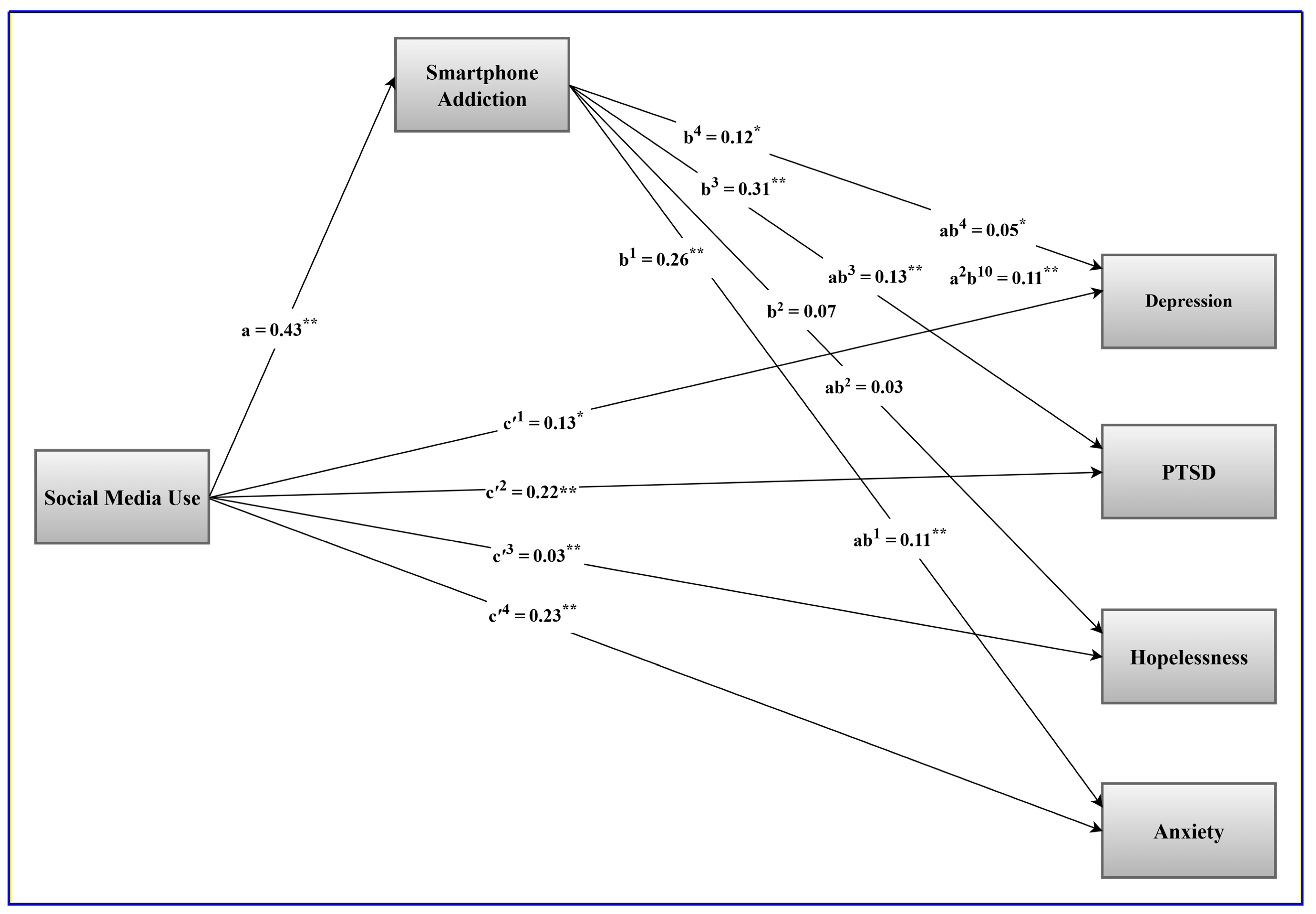
| Type of Effect | Effect | B | SE | 95% CI | β | p |
|---|---|---|---|---|---|---|
| Direct effects | Social media use → Depression | 0.07 | 0.03 | [0.02, 0.12} | 0.13 | 0.01 |
| Social media use → PTSD | 0.38 | 0.08 | [0.22, 0.52] | 0.22 | <0.001 | |
| Social media use → Hopelessness | 0.01 | 0.01 | [−0.02,0.03] | 0.03 | 0.51 | |
| Social media use → Anxiety | 0.10 | 0.02 | [0.06, 0.13] | 0.23 | <0.001 | |
| Smartphone addiction → Depression | 0.10 | 0.03 | [0.02, 0.19] | 0.12 | 0.01 | |
| Smartphone addiction → PTSD | 0.86 | 0.13 | [0.61, 1.11] | 0.31 | <0.001 | |
| Smartphone addiction → Hopelessness | 0.02 | 0.02 | [−0.01, 0.06] | 0.07 | 0.18 | |
| Smartphone addiction → Anxiety | 0.17 | 0.03 | [0.11, 0.23] | 0.26 | <0.001 | |
| Indirect effects | Social media use → Smartphone addiction → Depression | 0.03 | 0.01 | [0.00, 0.06] | 0.05 | — a |
| Social media use → Smartphone addiction → PTSD | 0.23 | 0.04 | [0.15, 0.32] | 0.13 | — | |
| Social media use → Smartphone addiction → Hopelessness | 0.01 | 0.01 | [−0.00, 0.02] | 0.03 | — | |
| Social media use → Smartphone addiction → Anxiety | 0.05 | 0.01 | [0.03, 0.07] | 0.11 | — |
Disclaimer/Publisher’s Note: The statements, opinions and data contained in all publications are solely those of the individual author(s) and contributor(s) and not of MDPI and/or the editor(s). MDPI and/or the editor(s) disclaim responsibility for any injury to people or property resulting from any ideas, methods, instructions or products referred to in the content. |
© 2026 by the authors. Licensee MDPI, Basel, Switzerland. This article is an open access article distributed under the terms and conditions of the Creative Commons Attribution (CC BY) license.
Share and Cite
Pretorius, T.B.; Padmanabhanunni, A. The Negative Mental Health Consequences of Social Media Use in South Africa: The Role of Smartphone Addiction. Behav. Sci. 2026, 16, 633. https://doi.org/10.3390/bs16050633
Pretorius TB, Padmanabhanunni A. The Negative Mental Health Consequences of Social Media Use in South Africa: The Role of Smartphone Addiction. Behavioral Sciences. 2026; 16(5):633. https://doi.org/10.3390/bs16050633
Chicago/Turabian StylePretorius, Tyrone B., and Anita Padmanabhanunni. 2026. "The Negative Mental Health Consequences of Social Media Use in South Africa: The Role of Smartphone Addiction" Behavioral Sciences 16, no. 5: 633. https://doi.org/10.3390/bs16050633
APA StylePretorius, T. B., & Padmanabhanunni, A. (2026). The Negative Mental Health Consequences of Social Media Use in South Africa: The Role of Smartphone Addiction. Behavioral Sciences, 16(5), 633. https://doi.org/10.3390/bs16050633

