Emotional Abuse and Psychological Distress in Individuals with Multiple Sclerosis: The Mediation Role of Internalized Shame and Chronic Illness Stigma


Abstract
1. Introduction
1.1. Multiple Sclerosis: Clinical Features and Disease Burden
1.2. Psychological Distress in Multiple Sclerosis
1.3. Illness Stigma in Multiple Sclerosis
1.4. Internalized Shame in Multiple Sclerosis
1.5. Implications of Emotional Abuse
1.6. Study Rationale
2. Materials and Methods
2.1. Method and Design
2.2. Participants
2.3. Measures
2.3.1. Emotional Abuse
2.3.2. Internalized Shame
2.3.3. Perceived Stigma
2.3.4. Psychological Distress
2.4. Procedures
2.5. Statistical Analyses
3. Results
3.1. Descriptives and Correlations
3.2. Mediation Model
4. Discussion
5. Conclusions
Author Contributions
Funding
Institutional Review Board Statement
Informed Consent Statement
Data Availability Statement
Conflicts of Interest
References
- Allen, J. G., Fonagy, P., & Bateman, A. W. (2008). Mentalizing in clinical practice. American Psychiatric Pub. [Google Scholar]
- Badenes-Ribera, L., Georgieva, S., Tomás, J. M., & Navarro-Pérez, J. J. (2024). Internal consistency and test–retest reliability: A reliability generalization meta-analysis of the Childhood Trauma Questionnaire—Short Form (CTQ-SF). Child Abuse & Neglect, 154, 106941. [Google Scholar] [CrossRef]
- Badour, C. L., Resnick, H. S., & Kilpatrick, D. G. (2017). Associations between specific negative emotions and DSM-5 PTSD among a national sample of interpersonal trauma survivors. Journal of Interpersonal Violence, 32(11), 1620–1641. [Google Scholar] [CrossRef]
- Barberis, N., Calaresi, D., Cannavò, M., & Verrastro, V. (2023a). Trait emotional intelligence and quality of life in women with polycystic ovary syndrome: Dysmorphic concerns and general distress as mediators. Comprehensive Psychiatry, 122, 152373. [Google Scholar] [CrossRef]
- Barberis, N., Cannavò, M., Cuzzocrea, F., Saladino, V., & Verrastro, V. (2023b). Illness perceptions and factors of distress as mediators between trait emotional intelligence and quality of life in endometriosis. Psychology, Health & Medicine, 28(7), 1818–1830. [Google Scholar] [CrossRef]
- Barberis, N., Cannavò, M., Trovato, M., & Verrastro, V. (2023c). Pathways from trait emotional intelligence to factors of distress in Rosacea: The mediating role of social phobia and self-esteem. Journal of Affective Disorders, 331, 362–368. [Google Scholar] [CrossRef] [PubMed]
- Barta, T., & Kiropoulos, L. (2023). The mediating role of stigma, internalized shame, and autonomous motivation in the relationship between depression, anxiety, and psychological help-seeking attitudes in multiple sclerosis. International Journal of Behavioral Medicine, 30(1), 133–145. [Google Scholar] [CrossRef]
- Beck, J. G., McNiff, J., Clapp, J. D., Olsen, S. A., Avery, M. L., & Hagewood, J. H. (2011). Exploring negative emotion in women experiencing intimate partner violence: Shame, guilt, and PTSD. Behavior Therapy, 42(4), 740–750. [Google Scholar] [CrossRef]
- Bernstein, D. P., Fink, L., Handelsman, L., & Foote, J. (1998). Childhood trauma questionnaire. Assessment of family violence: A handbook for researchers and practitioners. APA PsycTests. [Google Scholar]
- Bottesi, G., Ghisi, M., Altoè, G., Conforti, E., Melli, G., & Sica, C. (2015). The Italian version of the depression anxiety stress scales-21: Factor structure and psychometric properties on community and clinical samples. Comprehensive Psychiatry, 60, 170–181. [Google Scholar] [CrossRef]
- Bullivant, B., Rhydderch, S., Griffiths, S., Mitchison, D., & Mond, J. M. (2020). Eating disorders “mental health literacy”: A scoping review. Journal of Mental Health, 29(3), 336–349. [Google Scholar] [CrossRef] [PubMed]
- Cannavò, M., Gullo, J., Falgares, G., Lamis, D. A., & Barberis, N. (2025a). Pain interference and distress in chronic migraine: Observing the influence of traumatic experiences through the lenses of the theory of mentalizing. Psychology, Health & Medicine, 30(7), 1450–1464. [Google Scholar] [CrossRef]
- Cannavò, M., Sanchez-Ruiz, M.-J., & Barberis, N. (2024). Structural links from trait emotional intelligence to life satisfaction and depressive symptoms in women with breast cancer: Post-traumatic responses as mediators. Archives of Women’s Mental Health, 27(3), 383–392. [Google Scholar] [CrossRef]
- Cannavò, M., Spagnuolo, R., Gullo, J., & Barberis, N. (2025b). Observing the influence of shame and guilt in inflammatory bowel disease: A systematic review. Clinical Neuropsychiatry, 22(3), 185–195. [Google Scholar] [CrossRef]
- Cook, D. R. (1988). Measuring shame: The internalized shame scale. Alcoholism Treatment Quarterly, 4(2), 197–215. [Google Scholar] [CrossRef]
- Cook, D. R. (1994). Internalized shame scale: Technical manual. Channel Press. [Google Scholar]
- DeCou, C. R., Mahoney, C. T., Kaplan, S. P., & Lynch, S. M. (2019). Coping self-efficacy and trauma-related shame mediate the association between negative social reactions to sexual assault and PTSD symptoms. Psychological Trauma: Theory, Research, Practice, and Policy, 11(1), 51–54. [Google Scholar] [CrossRef]
- Dobson, R., & Giovannoni, G. (2018). Multiple sclerosis—A review. European Journal of Neurology, 26(1), 27–40. [Google Scholar] [CrossRef]
- Dolezal, L. (2022). Shame anxiety, stigma and clinical encounters. Journal of Evaluation in Clinical Practice, 28(5), 854–860. [Google Scholar] [CrossRef] [PubMed]
- Dorahy, M. J. (2010). The impact of dissociation, shame, and guilt on interpersonal relationships in chronically traumatized individuals: A pilot study. Journal of Traumatic Stress, 23(5), 653–656. [Google Scholar] [CrossRef]
- Dorahy, M. J., Middleton, W., Seager, L., Williams, M., & Chambers, R. (2016). Child abuse and neglect in complex dissociative disorder, abuse-related chronic PTSD, and mixed psychiatric samples. Journal of Trauma & Dissociation, 17(2), 223–236. [Google Scholar]
- Earnshaw, V. A., & Quinn, D. M. (2011). The impact of stigma in healthcare on people living with chronic illnesses. Journal of Health Psychology, 17(2), 157–168. [Google Scholar] [CrossRef]
- Elliot, V. L., Morgan, D., Kosteniuk, J., Froehlich Chow, A., & Bayly, M. (2019). Health-related stigma of noncommunicable neurological disease in rural adult populations: A scoping review. Health & Social Care in the Community, 27(4), e158–e188. [Google Scholar] [CrossRef]
- Fisher, P. L., Salmon, P., Heffer-Rahn, P., Huntley, C., Reilly, J., & Cherry, M. G. (2020). Predictors of emotional distress in people with multiple sclerosis: A systematic review of prospective studies. Journal of Affective Disorders, 276, 752–764. [Google Scholar] [CrossRef]
- Fonagy, P., & Bateman, A. W. (2016). Adversity, attachment, and mentalizing. Comprehensive Psychiatry, 64, 59–66. [Google Scholar] [CrossRef] [PubMed]
- Fonagy, P., & Luyten, P. (2009). A developmental, mentalization-based approach to the understanding and treatment of borderline personality disorder. Development and Psychopathology, 21(4), 1355–1381. [Google Scholar] [CrossRef]
- Georgieva, S., Tomás, J. M., & Navarro-Pérez, J. J. (2021). Systematic review and critical appraisal of the Childhood Trauma Questionnaire—Short Form (CTQ-SF). Child Abuse & Neglect, 120, 105223. [Google Scholar] [CrossRef]
- Gilbert, P. (2000). The relationship of shame, social anxiety and depression: The role of the evaluation of social rank. Clinical Psychology & Psychotherapy, 7(3), 174–189. [Google Scholar] [CrossRef]
- Hayat, F., Brown, L. J., & Rafique, R. (2025). Psychometric validation of the 8-Item Urdu stigma scale for chronic illness (SSCI-8) in people with Parkinson’s disease. Aging & Mental Health, 29(4), 696–703. [Google Scholar] [CrossRef]
- Howell, E. F. (2014). Ferenczi’s concept of identification with the aggressor: Understanding dissociative structure with interacting victim and abuser self-states. The American Journal of Psychoanalysis, 74(1), 48–59. [Google Scholar] [CrossRef]
- IBM Corp. (2023). IBM SPSS statistics for Windows (Version 29.0) [Computer software]. IBM Corp. [Google Scholar]
- Karan, E., Niesten, I. J., Frankenburg, F. R., Fitzmaurice, G. M., & Zanarini, M. C. (2014). The 16-year course of shame and its risk factors in patients with borderline personality disorder. Personality and Mental Health, 8(3), 169–177. [Google Scholar] [CrossRef] [PubMed]
- Kaufman, J., & Zigler, E. F. (1996). Child abuse and social policy. In E. F. Zigler, S. Lynn Kagan, & N. W. Hall (Eds.), Children, families, and government: Preparing for the twenty-first century (pp. 233–255). Cambridge University Press. [Google Scholar]
- Kavaliunas, A., Danylaite Karrenbauer, V., & Hillert, J. (2021). Socioeconomic consequences of multiple sclerosis: A systematic literature review. Acta Neurologica Scandinavica, 143(6), 587–601. [Google Scholar] [CrossRef]
- Khan, G., & Hashim, M. J. (2025). Epidemiology of Multiple Sclerosis: Global, regional, national and sub-national-level estimates and future projections. Journal of Epidemiology and Global Health, 15(1), 21. [Google Scholar] [CrossRef]
- Klaassen, J. A. (2001). The taint of shame: Failure, self-distress, and moral growth. Journal of Social Philosophy, 32(2), 174–196. [Google Scholar] [CrossRef]
- Kobelt, G., Thompson, A., Berg, J., Gannedahl, M., & Eriksson, J. (2017). New insights into the burden and costs of multiple sclerosis in Europe. Multiple Sclerosis Journal, 23(8), 1123–1136. [Google Scholar] [CrossRef]
- Lear, M. K., Lee, E. B., Smith, S. M., & Luoma, J. B. (2022). A systematic review of self-report measures of generalized shame. Journal of Clinical Psychology, 78(7), 1288–1330. [Google Scholar] [CrossRef]
- Little, T. D., Cunningham, W. A., Shahar, G., & Widaman, K. F. (2002). To parcel or not to parcel: Exploring the question, weighing the merits. Structural Equation Modeling: A Multidisciplinary Journal, 9(2), 151–173. [Google Scholar] [CrossRef]
- Lovibond, P. F., & Lovibond, S. H. (1995). The structure of negative emotional states: Comparison of the Depression Anxiety Stress Scales (DASS) with the Beck Depression and Anxiety Inventories. Behaviour Research and Therapy, 33(3), 335–343. [Google Scholar] [CrossRef]
- Major, B., & O’Brien, L. T. (2005). The social psychology of stigma. Annual Review of Psychology, 56, 393–421. [Google Scholar] [CrossRef] [PubMed]
- Makara-Studzińska, M., Tyburski, E., Załuski, M., Adamczyk, K., Mesterhazy, J., & Mesterhazy, A. (2022). Confirmatory factor analysis of three versions of the depression anxiety stress scale (DASS-42, DASS-21, and DASS-12) in Polish adults. Frontiers in Psychiatry, 12, 770532. [Google Scholar] [CrossRef]
- Marsh, H. W., Hau, K. T., Balla, J. R., & Grayson, D. (1998). Is more ever too much? The number of indicators per factor in confirmatory factor analysis. Multivariate Behavioral Research, 33(2), 181–220. [Google Scholar] [CrossRef] [PubMed]
- Matheson, K., & Anisman, H. (2009). Anger and shame elicited by discrimination: Moderating role of coping on action endorsements and salivary cortisol. European Journal of Social Psychology, 39(2), 163–185. [Google Scholar] [CrossRef]
- Meek, C., Das Nair, R., Evangelou, N., Middleton, R., Tuite-Dalton, K., & Moghaddam, N. (2022). Psychological flexibility, distress, and quality of life in secondary progressive multiple sclerosis: A cross-sectional study. Multiple Sclerosis and Related Disorders, 67, 104154. [Google Scholar] [CrossRef] [PubMed]
- Mikulincer, M., & Shaver, P. R. (2016). Attachment in adulthood: Structure, dynamics, and change (2nd ed.). Guilford Press. [Google Scholar]
- Molina, Y., Choi, S. W., Cella, D., & Rao, D. (2013). The stigma scale for chronic illnesses 8-item version (SSCI-8): Development, validation and use across neurological conditions. International Journal of Behavioral Medicine, 20(3), 450–460. [Google Scholar] [CrossRef]
- Montalban, X., Lebrun-Frénay, C., Oh, J., Arrambide, G., Moccia, M., Pia Amato, M., Amezcua, L., Banwell, B., Bar-Or, A., Barkhof, F., Butzkueven, H., Ciccarelli, O., Chataway, J., Cohen, J. A., Comi, G., Correale, J., Deisenhammer, F., Filippi, M., Fiol, J., … Thompson, A. J. (2025). Diagnosis of multiple sclerosis: 2024 revisions of the McDonald criteria. The Lancet Neurology, 24(10), 850–865. [Google Scholar] [CrossRef]
- Pakenham, K. I., Landi, G., Grandi, S., & Tossani, E. (2023). The mediating role of psychological flexibility in the relationship between resilience and distress and quality of life in people with multiple sclerosis. Journal of Health Psychology, 29(1), 65–80. [Google Scholar] [CrossRef] [PubMed]
- Parker, G. (1993). Parental overprotection: A risk factor in psychosocial development. Grune & Stratton. [Google Scholar] [CrossRef]
- Passanisi, A., Gervasi, A. M., Madonia, C., Guzzo, G., & Greco, D. (2015). Attachment, self-esteem and shame in emerging adulthood. Procedia—Social and Behavioral Sciences, 191, 342–346. [Google Scholar] [CrossRef]
- Peres, D. S., Rodrigues, P., Viero, F. T., Frare, J. M., Kudsi, S. Q., Meira, G. M., & Trevisan, G. (2022). Prevalence of depression and anxiety in the different clinical forms of multiple sclerosis and associations with disability: A systematic review and meta-analysis. Brain, Behavior, & Immunity-Health, 24, 100484. [Google Scholar] [CrossRef]
- Pescosolido, B. A., & Martin, J. K. (2015). The stigma complex. Annual Review of Sociology, 41, 87–116. [Google Scholar] [CrossRef] [PubMed]
- Phelan, J. C., Link, B. G., & Dovidio, J. F. (2008). Stigma and prejudice: One animal or two? Social Science & Medicine, 67(3), 358–367. [Google Scholar] [CrossRef]
- Polick, C. S., Polick, S. R., & Stoddard, S. A. (2022). Relationships between childhood trauma and multiple sclerosis: A systematic review. Journal of Psychosomatic Research, 160, 110981. [Google Scholar] [CrossRef]
- Powell, B., Mills, R., Tennant, A., Young, C. A., & Langdon, D. (2024). Stigma and health outcomes in multiple sclerosis: A systematic review. BMC Neurology, 24(1), 346. [Google Scholar] [CrossRef]
- Rao, D., Choi, S. W., Victorson, D., Bode, R., Peterman, A., Heinemann, A., & Cella, D. (2009). Measuring stigma across neurological conditions: The development of the stigma scale for chronic illness (SSCI). Quality of Life Research, 18, 585–595. [Google Scholar] [CrossRef]
- R Core Team. (2023). R: A language and environment for statistical computing (Version 4.3.0) [Computer software]. R Foundation for Statistical Computing. Available online: https://www.R-project.org/ (accessed on 19 April 2026).
- Rosseel, Y. (2012). lavaan: An R package for structural equation modeling. Journal of Statistical Software, 48, 1–36. [Google Scholar] [CrossRef]
- RStudio Team. (2023). RStudio: Integrated development environment for R (Version 2023.06.0) [Computer software]. Posit. Available online: http://www.rstudio.com/ (accessed on 19 April 2026).
- Sacchi, C., Vieno, A., & Simonelli, A. (2018). Italian validation of the childhood trauma questionnaire—Short form on a college group. Psychological Trauma: Theory, Research, Practice, and Policy, 10(5), 563–571. [Google Scholar] [CrossRef]
- Sanabria-Mazo, J. P., Navarrete, J., Serrat, M., Castaño-Asins, J. R., Alonso, J., McCracken, L. M., Scott, W., Nieto, R., & Luciano, J. V. (2025). Assessment of stigma in Spanish people with chronic pain using the 8-item stigma scale for chronic illnesses (SSCI-8). The Journal of Pain, 37, 105538. [Google Scholar] [CrossRef]
- Schmader, T., & Lickel, B. (2006). Stigma and shame: Emotional responses to the stereotypic actions of one’s ethnic ingroup. In Stigma and group inequality (pp. 275–300). Psychology Press. [Google Scholar]
- Sekowski, M., Gambin, M., Cudo, A., Woźniak-Prus, M., Penner, F., Fonagy, P., & Sharp, C. (2020). The relations between childhood maltreatment, shame, guilt, depression, and suicidal ideation in inpatient adolescents. Journal of Affective Disorders, 276, 667–677. [Google Scholar] [CrossRef]
- Sharifi, N., Kohpeima Jahromi, V., Zahedi, R., Aram, S., & Ahmadi, M. (2023). Social stigma and its relationship with quality of life in multiple sclerosis patients. BMC Neurology, 23(1), 408. [Google Scholar] [CrossRef]
- Shi, L. (2013). Childhood abuse and neglect in an outpatient clinical sample: Prevalence and impact. The American Journal of Family Therapy, 41(3), 198–211. [Google Scholar] [CrossRef]
- Tangney, J. P., & Dearing, R. L. (2002). Gender differences in morality. In R. F. Bornstein, & J. M. Masling (Eds.), The psychodynamics of gender and gender role (pp. 251–269). American Psychological Association. [Google Scholar] [CrossRef]
- Tangney, J. P., Stuewig, J., & Mashek, D. J. (2007). Moral emotions and moral behavior. Annual Review of Psychology, 58, 345–372. [Google Scholar] [CrossRef] [PubMed]
- Tignor, S. M., & Colvin, C. R. (2019). The meaning of guilt: Reconciling the past to inform the future. Journal of Personality and Social Psychology, 116(6), 989–1010. [Google Scholar] [CrossRef]
- Tracy, J. L., & Robins, R. W. (2004). Putting the self into self-conscious emotions: A theoretical model. Psychological Inquiry, 15(2), 103–125. [Google Scholar] [CrossRef] [PubMed]
- Trindade, I. A., Duarte, J., Ferreira, C., Coutinho, M., & Pinto-Gouveia, J. (2018). The impact of illness-related shame on psychological health and social relationships: Testing a mediational model in students with chronic illness. Clinical Psychology & Psychotherapy, 25(3), 408–414. [Google Scholar]
- Trindade, I. A., Ferreira, C., & Pinto-Gouveia, J. (2017). Chronic illness-related shame: Development of a new scale and novel approach for IBD patients’ depressive symptomatology. Clinical Psychology & Psychotherapy, 24(1), 255–263. [Google Scholar] [CrossRef]
- Varela, A., Pereira, A., Pereira, A., & Santos, J. C. (2017). Distress psicológico: Contributos para a adaptação portuguesa do SQ-48. Psicologia, Saúde & Doenças, 18(2), 278–296. [Google Scholar] [CrossRef]
- Vignola, R. C. B., & Tucci, A. M. (2014). Adaptation and validation of the depression, anxiety and stress scale (DASS) to Brazilian Portuguese. Journal of Affective Disorders, 155, 104–109. [Google Scholar] [CrossRef] [PubMed]
- von Drathen, S., Gold, S. M., Peper, J., Rahn, A. C., Ramien, C., Magyari, M., Hansen, H.-C., Friede, T., & Heesen, C. (2024). Stress and Multiple Sclerosis–Systematic review and meta-analysis of the association with disease onset, relapse risk and disability progression. Brain, Behavior, and Immunity, 120, 620–629. [Google Scholar] [CrossRef] [PubMed]
- Yoo, S. H., Kim, S. R., So, H. S., Chung, H. I. C., Chae, D. H., Kim, M. K., Kim, B. C., Park, M.-S., Lee, S.-H., Nam, T.-S., Correia, H., & Cella, D. (2017). The validity and reliability of the Korean version of the Stigma Scale for Chronic Illness 8-items (SSCI-8) in patients with neurological disorders. International Journal of Behavioral Medicine, 24(2), 288–293. [Google Scholar] [CrossRef]
- Young, C. A., Langdon, D., Rog, D., Chhetri, S. K., Tanasescu, R., Kalra, S., Webster, G., Nicholas, R., Ford, H. L., Woolmore, J., Paling, D., Tennant, A., Mills, R., & TONiC Study Group. (2024). Prevalence, treatment and correlates of depression in multiple sclerosis. Multiple Sclerosis and Related Disorders, 87, 105648. [Google Scholar] [CrossRef]
- Zanon, C., Brenner, R. E., Baptista, M. N., Vogel, D. L., Rubin, M., Al-Darmaki, F. R., Gonçalves, M., Heath, P. J., Liao, H., Mackenzie, C. S., Topkaya, N., Wade, N. G., & Zlati, A. (2020). Examining the dimensionality, reliability, and invariance of the depression, anxiety, and stress scale–21 (DASS-21) across eight countries. Assessment, 28(6), 1531–1544. [Google Scholar] [CrossRef] [PubMed]
- Zhang, H., Wang, X., Zhang, Q., Zhao, M., & Wang, Y. (2025). The association between child maltreatment and shame: A meta-analysis. Child Abuse & Neglect, 167, 107557. [Google Scholar] [CrossRef]


| Variable | Category | n | % |
|---|---|---|---|
| Gender | Women | 145 | 85 |
| Men | 26 | 15 | |
| Education Level | Middle school | 15 | 9 |
| High school diploma | 74 | 43 | |
| University degree | 79 | 46 | |
| Postgraduate degree | 3 | 2 | |
| Employment Status | Employed | 99 | 58 |
| Freelancers | 22 | 13 | |
| Students | 12 | 7 | |
| Unemployed | 12 | 7 | |
| Homemakers | 9 | 5 | |
| Retired | 3 | 2 | |
| Marital Status | Single | 43 | 25 |
| Married | 43 | 25 | |
| Cohabiting | 31 | 18 | |
| Engaged | 31 | 18 | |
| Widowed | 14 | 8 | |
| Divorced | 10 | 6 |
| α | M | SD | Skew | Kurt | 1 | 2 | 3 | 4 | 5 | |
|---|---|---|---|---|---|---|---|---|---|---|
| 1. Depression | 0.92 | 1.31 | 0.80 | 0.49 | −0.80 | |||||
| 2. Anxiety | 0.85 | 1.38 | 0.72 | 0.42 | −0.51 | 0.72 ** | ||||
| 3. Stress | 0.87 | 1.80 | 0.65 | −0.04 | −0.58 | 0.76 ** | 0.76 ** | |||
| 4. Perceived Stigma | 0.84 | 1.74 | 0.68 | 1.16 | 1.15 | 0.36 ** | 0.37 ** | 0.29 ** | ||
| 5. Internalized Shame | 0.98 | 1.51 | 0.97 | 0.47 | −0.67 | 0.81 ** | 0.60 ** | 0.68 ** | 0.32 ** | |
| 6. Emotional Abuse | 0.85 | 1.72 | 0.83 | 1.50 | 2.56 | 0.39 ** | 0.29 ** | 0.29 ** | 0.30 ** | 0.39 ** |
| β | p | SE | Lower Bound (BC) 95% CI | Upper Bound (BC) 95% CI | |
|---|---|---|---|---|---|
| Direct Effect | |||||
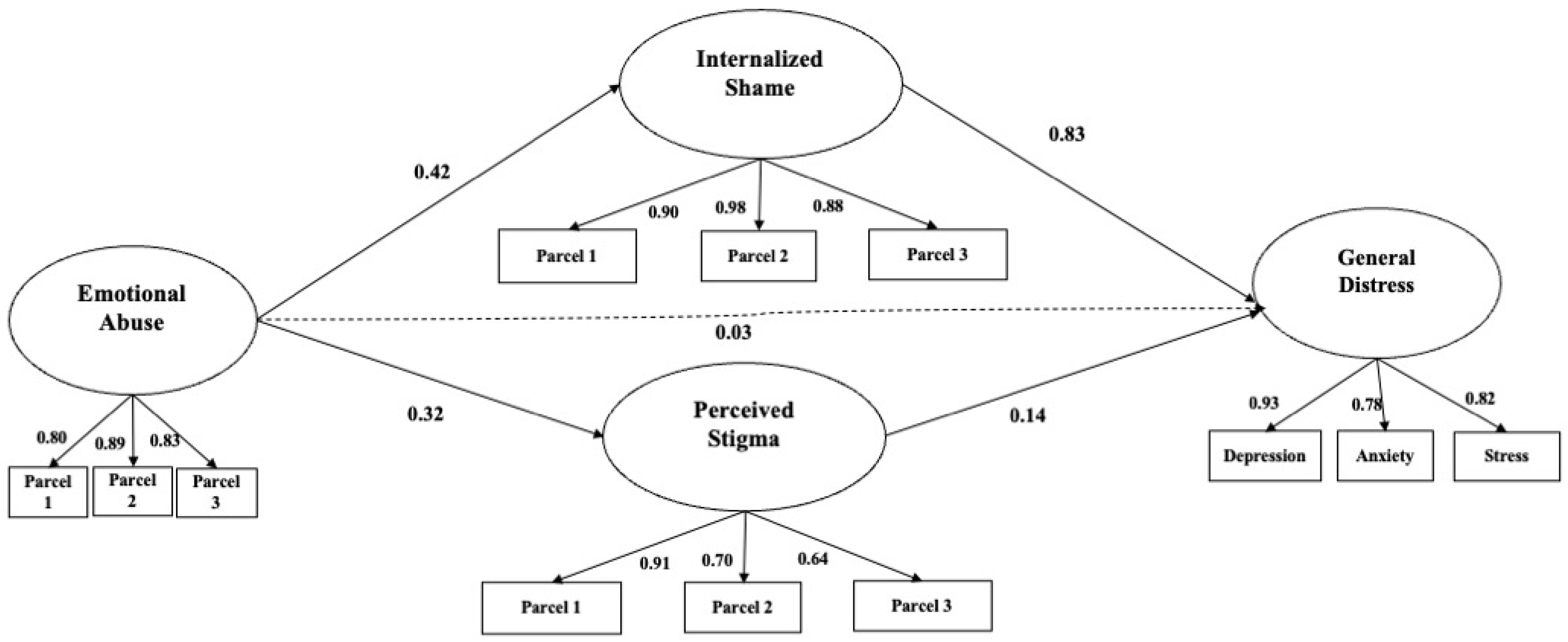
| Emotional Abuse→Internalized Shame | 0.42 | <0.001 | 0.61 | 0.38 | 0.84 |
| Emotional Abuse→Perceived Stigma | 0.32 | <0.001 | 0.39 | 0.18 | 0.60 |
| Emotional Abuse→Psychological Distress | 0.03 | 0.57 | 0.04 | −0.09 | 0.16 |
| Internalized Shame→Psychological Distress | 0.81 | <0.001 | 0.61 | 0.52 | 0.71 |
| Perceived Stigma→Psychological Distress | 0.14 | <0.05 | 0.13 | 0.22 | 0.14 |
| Indirect Effect via Internalized Shame | |||||
| Emotional Abuse→Psychological Distress | 0.34 | <0.001 | 0.37 | 0.22 | 0.52 |
| Indirect Effect via Perceived Stigma | |||||
| Emotional Abuse→Psychological Distress | 0.05 | <0.05 | 0.05 | 0.00 | 0.10 |
Disclaimer/Publisher’s Note: The statements, opinions and data contained in all publications are solely those of the individual author(s) and contributor(s) and not of MDPI and/or the editor(s). MDPI and/or the editor(s) disclaim responsibility for any injury to people or property resulting from any ideas, methods, instructions or products referred to in the content. |
© 2026 by the authors. Licensee MDPI, Basel, Switzerland. This article is an open access article distributed under the terms and conditions of the Creative Commons Attribution (CC BY) license.
Share and Cite
Barberis, N.; Falgares, G.; Costanzo, G.; Cannavò, M. Emotional Abuse and Psychological Distress in Individuals with Multiple Sclerosis: The Mediation Role of Internalized Shame and Chronic Illness Stigma. Behav. Sci. 2026, 16, 632. https://doi.org/10.3390/bs16050632
Barberis N, Falgares G, Costanzo G, Cannavò M. Emotional Abuse and Psychological Distress in Individuals with Multiple Sclerosis: The Mediation Role of Internalized Shame and Chronic Illness Stigma. Behavioral Sciences. 2026; 16(5):632. https://doi.org/10.3390/bs16050632
Chicago/Turabian StyleBarberis, Nadia, Giorgio Falgares, Giulia Costanzo, and Marco Cannavò. 2026. "Emotional Abuse and Psychological Distress in Individuals with Multiple Sclerosis: The Mediation Role of Internalized Shame and Chronic Illness Stigma" Behavioral Sciences 16, no. 5: 632. https://doi.org/10.3390/bs16050632
APA StyleBarberis, N., Falgares, G., Costanzo, G., & Cannavò, M. (2026). Emotional Abuse and Psychological Distress in Individuals with Multiple Sclerosis: The Mediation Role of Internalized Shame and Chronic Illness Stigma. Behavioral Sciences, 16(5), 632. https://doi.org/10.3390/bs16050632