


Abstract
The Automated Essay Scoring (AES) systems confront two fundamental challenges: opaque “black-box” decision-making that limits educator trust, and insufficient validation across linguistically diverse educational contexts. This study proposes IRT-AESF, an innovative framework that bridges educational measurement theory and artificial intelligence by integrating item response theory (IRT) with deep learning. The framework generates three theoretically grounded psychometric parameters: student ability, item difficulty, and item discrimination, which provide transparent and interpretable explanations for scoring decisions. We rigorously evaluated IRT-AESF through 5-fold cross-validation on three large-scale datasets comprising 41,328 authentic essays from English and Chinese educational settings, including both classroom assessments and high-stakes examinations. Results demonstrate statistically significant improvements over competitive baseline models, achieving an 8.4% relative increase in quadratic weighted kappa while maintaining robust cross-lingual performance. This research advances the development of transparent, trustworthy automated assessment systems that deliver not only scores but meaningful diagnostic insights for educational practice.
1. Introduction
Assessing writing proficiency is fundamental to students’ academic development and serves as a cornerstone of educational evaluation (Srikandi, 2019). In this domain, scoring by human experts remains the benchmark for validity. This approach is grounded in rigorous psychometric principles and relies on standardized protocols such as rater selection, training, and multi-rater blind scoring. Moreover, sophisticated measurement models, including generalizability theory (G-Theory) or item response theory (IRT), are employed to ensure its reliability and fairness (Engelhard, 1992; Reise & Waller, 2009).
Despite its high validity, this manual method presents significant logistical challenges. The process is both time-consuming and resource-intensive, creating a critical bottleneck for large-scale assessments. Consequently, the delivery of timely, formative feedback to students is often delayed. This situation reveals an inherent trade-off between maintaining assessment quality and achieving operational scalability.
To address this scalability challenge, automated essay scoring (AES) has emerged as a promising solution. AES has progressed significantly since its inception with Page’s (1966) Project Essay Grade (PEG). Contemporary systems based on large language models (LLMs) are now demonstrating impressive scoring accuracy, often rivaling that of human raters (Li & Liu, 2024; Mansour et al., 2024; Pack et al., 2024; Yavuz et al., 2024). This advancement, however, has introduced two pressing challenges for the field of educational technology.
First, despite significant advancements, most current AES research remains heavily English-centric, leaving a substantial gap in validation across linguistically diverse contexts. Non-English datasets, such as Chinese, which feature unique logographic structures and distinct syntactic patterns, are markedly underrepresented in existing literature. This lack of cross-linguistic evidence limits the global generalizability of AES systems and underscores the urgency of our study, which validates the IRT-AESF framework across both English and large-scale Chinese datasets.
Second, beyond its evaluative function, the role of AES as a cornerstone of the formative feedback ecosystem is increasingly recognized. Recent empirical evidence from a large-scale randomized controlled trial () demonstrates that generative AI-based feedback can yield statistically significant improvements in student writing quality while simultaneously fostering higher levels of task engagement and eliciting nuanced emotional experiences during the revision process (Chan et al., 2024). However, the pedagogical efficacy of such feedback remains tethered to the underlying reliability and transparency of the scoring logic. Without an “interpretable-by-design” mechanism to anchor these AI-generated insights, there is a risk of providing feedback that, while engaging, lacks the psychometric rigor needed for precise instructional calibration. This underscores the necessity of frameworks like IRT-AESF, which provide the latent ability estimates () and threshold structures () required to underwrite more trustworthy and pedagogically targeted feedback workflows.
The development of automated essay scoring has undergone a significant evolution. Foundational operational systems, such as ETS’s e-rater and Pearson’s Intelligent Essay Assessor, established the early paradigm by relying on handcrafted linguistic features. While these systems provided initial scalability, recent advancements have largely shifted from feature-engineered systems to deep learning frameworks to better capture complex semantic representations. Unlike previous attempts to integrate IRT into AES, which were often constrained by narrow model compatibility or limited to specific neural architectures, our proposed IRT-AESF framework introduces a model-agnostic “plug-in” design. By decoupling the psychometric GPCM layer from the primary encoder, our approach overcomes the limitations of prior research, ensuring seamless integration with diverse backbones ranging from state-of-the-art transformers to traditional recurrent networks.
The growing complexity of these models has led to an “interpretability problem”. The models often function as opaque “black boxes”, which makes it difficult for educators to understand or trust their scoring rationale (Wang & Hu, 2021; Y. Kumar et al., 2023). In addition, a significant “generalization problem” persists. Much of the existing AES research is validated on a limited set of English-language, high-stakes assessment corpora (e.g., ASAP-AES; Mathias & Bhattacharyya, 2018). This narrow focus fails to represent the linguistic and contextual diversity of authentic educational settings. As a result, the robustness of these models in real-world, multi-context scenarios remains largely unverified.
This imbalance raises critical concerns regarding cross-linguistic robustness and construct validity in high-stakes assessment environments. Therefore, validating interpretable AES frameworks in multilingual contexts is not merely a supplementary extension but a necessary step toward broader architectural applicability.
To address these dual challenges of interpretability and generalizability, this work proposes and evaluates the item response theory-enhanced AES framework (IRT-AESF). This framework is designed to bridge the gap between the predictive power of modern AI and the explanatory rigor of established educational measurement. By deeply integrating an IRT module into the AES pipeline, the IRT-AESF moves beyond simple score prediction. The framework enhances interpretability by providing interpretable designs of scoring decisions (Gilpin et al., 2018; Arrieta et al., 2019; Guidotti et al., 2019; Murdoch et al., 2019). It also enriches the assessment output with psychometrically meaningful diagnostic parameters, such as item (prompt1) difficulty and discrimination. This integration ensures the framework is not only accurate but also transparent and educationally informative, positioning it for robust performance across diverse linguistic and instructional contexts.
This study makes the following primary contributions to educational technology research and development:
- (1)
- The proposal of an interpretable and generalizable framework, IRT-AESF, that integrates educational measurement theory with diverse AES technologies to mitigate the “black-box” problem and enhance scoring transparency. The framework provides prompt-internal diagnostic parameters, such as relative student writing ability and prompt-specific threshold structures, ensuring internally coherent parameters that enhance within-prompt scoring consistency.
- (2)
- A demonstration of the framework’s versatility by implementing and evaluating it with two distinct classes of state-of-the-art models: a deep neural network and a pretrained language model.
- (3)
- Rigorous empirical validation of the framework’s effectiveness and generalizability using three large-scale, multilingual, and multi-context datasets from authentic educational assessments.
2. Literature Review
This literature review provides the rationale for the proposed framework. First, it delineates the foundational principles of rigorous, interpretable essay scoring from the field of educational measurement. Second, it traces the technological evolution of automated essay scoring (AES) and highlights the emergent challenges of interpretability and generalizability. Finally, the review examines prior work that integrates measurement theory with AES technology. This examination identifies the specific research gaps that the present study aims to address.
2.1. Foundational Principles of Rigorous Essay Scoring
Early operational AES systems, notably e-rater and the Intelligent Essay Assessor (IEA), primarily utilized natural language processing techniques to extract surface-level and syntactic features for scoring. The psychometric integrity of large-scale manual essay scoring relies on two key components: rigorous operational procedures and the statistical models that validate them.
2.1.1. Operational Procedures of Manual Essay Scoring
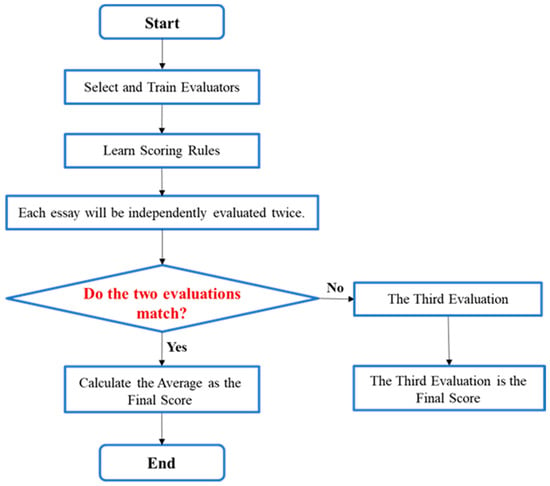
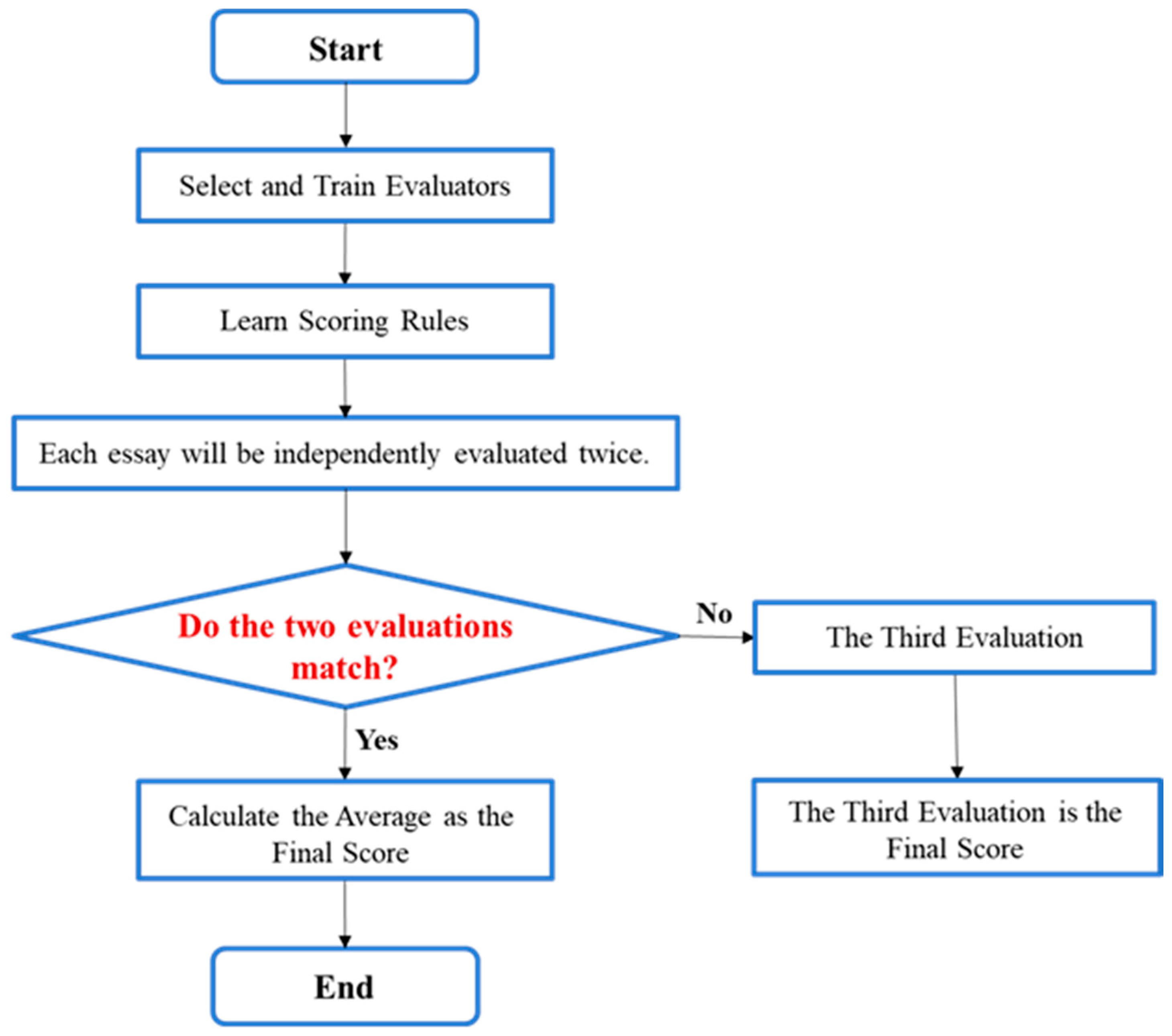
In educational assessment, a multi-stage process ensures the credibility of manual scoring. The process begins with the careful selection of qualified raters. These raters then undergo systematic training using specific scoring rubrics (Moskal & Leydens, 2000; Andrade et al., 2008; Rezaei & Lovorn, 2010; Panadero & Jonsson, 2013). To promote fairness, each essay is independently evaluated by at least two raters in a double-blind scoring system. A critical final step is the verification of rater consistency. When the initial scores are consistent, their average is taken as the final score. If a significant discrepancy occurs, a third, senior rater adjudicates to resolve the difference (Powers et al., 1998; Rezaei & Lovorn, 2010; Shermis, 2014; Campion et al., 2016). Collectively, these procedures ensure that scoring is a systematic, evidence-based practice rather than an arbitrary judgment. The standardized workflow for large-scale manual essay scoring is illustrated in Figure 1.
Figure 1.
Large-Scale Manual Essay Scoring Workflow.
2.1.2. Important Models in Educational Measurement
These operational procedures are grounded in the principles of educational measurement. Key measurement models, such as generalizability theory (Shavelson & Webb, 1981; Shavelson et al., 1992; Brennan, 1992, 2010; Briesch et al., 2014) and item response theory (Samejima, 1968; Baker, 2001; Embretson & Reise, 2013), are central to establishing the psychometric soundness of these scores. IRT offers a powerful statistical framework for connecting a student’s latent ability (e.g., writing proficiency) to their observed scores. A key advantage of IRT is its interpretability. The model yields meaningful parameters, including student ability , item discrimination , and item difficulty .
For polytomous (i.e., multi-category) scoring common in essay assessment, the generalized partial credit model (GPCM) is a widely used and robust IRT model (Muraki, 1992, 1993; Muraki & Muraki, 2016). The mathematical formulation of GPCM is as follows:
where denotes the student, the essay prompt, the score category (ranging from 1 to ), D a constant usually set to 1.7, the student’s latent ability, the discrimination parameter of the essay prompt , the difficulty of moving from step to step in the essay item , and the probability that the student selects score category for item .
From a data science perspective, the core mathematical form of the GPCM is analogous to a softmax function that incorporates a latent variable. However, this theory-guided approach requires intensive manual labor, which makes the scoring process slow and costly. These logistical constraints limit its scalability and highlight the need for automated solutions.
2.2. The Technological Response: Evolution and Challenges of AES
Automated essay scoring (AES) was developed by researchers across disciplines, including psychology and computer science, to address the efficiency limitations of manual scoring. This technology has evolved over time, leading to improved performance. However, this evolution has also introduced new and significant challenges.
2.2.1. The Evolution of AES Models
Since its inception with the PEG system (Page, 1966), AES has progressed through several paradigms. Early approaches, based on heuristics (Persing et al., 2010) and statistical machine learning (McNamara et al., 2015; Ramalingam et al., 2018), offered a degree of interpretability. However, they had a limited capacity to capture deep semantic meaning, which restricted their scoring accuracy.
The modern era of AES can be characterized by three successive technological waves. A summary of these development paradigms, including their key technologies and respective trade-offs, is provided in Table 1. The first wave, deep neural networks (DNNs), improved automated feature extraction. However, these models are inherently “black boxes” and often struggle to capture long-range contextual dependencies in essays (Hussein et al., 2020; V. Kumar & Boulanger, 2020; Yuan et al., 2020; Uto et al., 2020; Uto, 2021; Tashu et al., 2022). The second wave, leveraging pre-trained language models (PLMs) like BERT, substantially improved scoring consistency by enhancing contextual semantics recognition (Yang et al., 2020; Ormerod et al., 2021; Wang et al., 2022; Mizumoto & Eguchi, 2023). However, the increased parameter counts and complexity of PLMs exacerbated the “black-box” problem. Most recently, the third wave of generative large language models (LLMs), such as those in the GPT series, has introduced new possibilities for AES (Mansour et al., 2024; Pack et al., 2024). Yet, these large-scale models pose even greater challenges to interpretability. This evolutionary trend highlights a critical trade-off: as model performance increases, model transparency decreases. Consequently, the “black-box” issue has become a central challenge in the field (Yang et al., 2020; Wangkriangkri et al., 2020; Ormerod et al., 2021; Wang et al., 2022; Mizumoto & Eguchi, 2023).
Table 1.
Development Paradigms of AES.
While generative LLMs have significantly improved the quality of automated feedback, they often struggle with the “black-box” nature of score derivation and consistency across diverse prompts. The proposed IRT-AESF framework addresses these limitations by providing a theoretically grounded psychometric layer that can be integrated with various encoders, including LLMs. This integration allows for high-resolution scoring and latent trait estimation while maintaining computational efficiency compared to prompt-based LLM grading.
2.2.2. The Interpretability Challenge
The performance gains of modern AES have been achieved at the expense of transparency. This “black-box” nature contrasts sharply with the theory-driven approach of educational measurement outlined in Section 2.1. Within machine learning, interpretability can be categorized by its timing relative to model training and its scope of explanation (Arrieta et al., 2019; Murdoch et al., 2019). These dimensions and their application to our proposed framework are summarized in Table 2. Transparent models are interpretable by design due to their simple structure (e.g., linear regression). However, their simplicity often limits their performance on complex tasks like AES. Consequently, the predominant approach involves applying complex models first and subsequently providing post hoc explanations. Post hoc methods analyze a trained model from the outside to explain its predictions without altering it (Guidotti et al., 2019). These explanations can be global (explaining the model’s overall behavior) or local (explaining a single prediction). In AES, many existing post hoc techniques are designed for system developers and produce outputs that are not readily useful for educators and students. This work directly confronts this challenge. Rather than generating low-level technical outputs, our framework integrates IRT to provide a post hoc, global explanation that yields high-level, educationally meaningful, and immediately interpretable parameters such as student ability, prompt difficulty, and prompt discrimination.
Table 2.
Categorization of Interpretability Models in Machine Learning for Automated Essay Scoring.
2.2.3. The Generalization Challenge
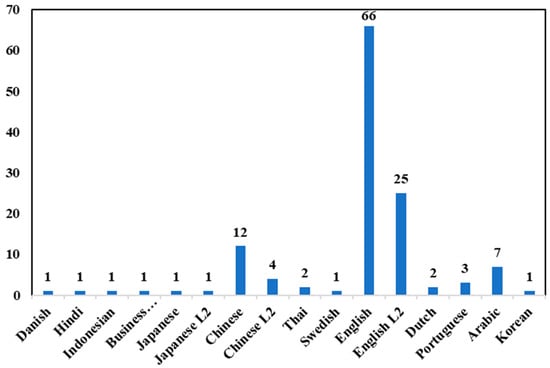
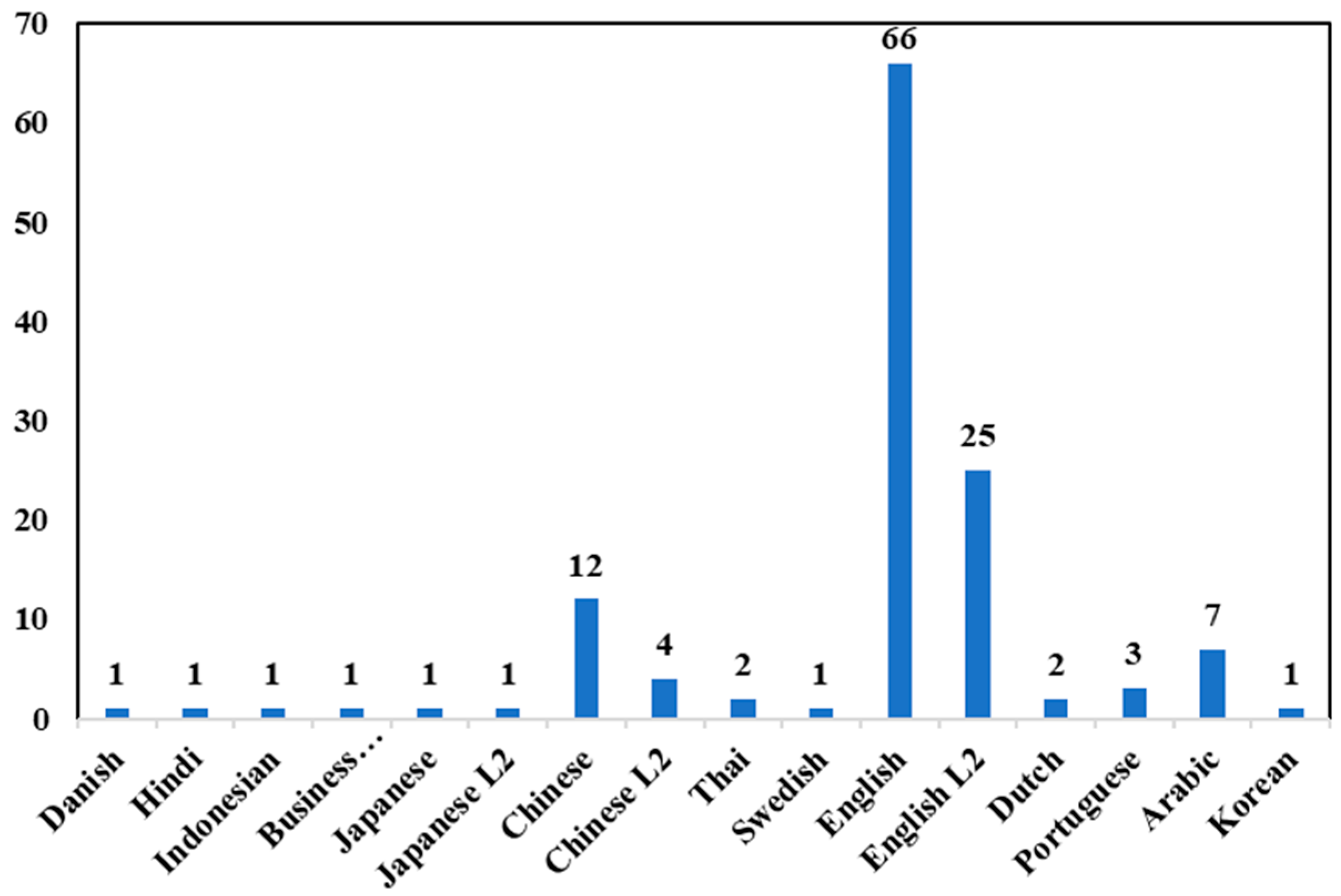
Beyond interpretability, AES faces a significant generalization challenge. To understand the empirical landscape, this work conducted a literature search in the Scopus database, identifying 125 papers on the AES task over the past 10 years, excluding related but distinct tasks like grammatical error correction or rhetoric identification. The analysis of these papers from three perspectives reveals a heavy reliance on limited and homogeneous data.
- (1)
- Linguistic Context: Research is overwhelmingly concentrated on English-language essays, with few studies in other languages like Chinese, where large-scale assessment is also prevalent. The distribution of research across different language contexts is illustrated in Figure 2.Figure 2. Usage of Different Language Datasets.
- (2)
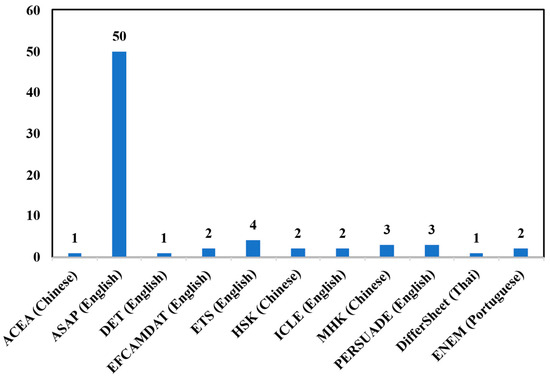
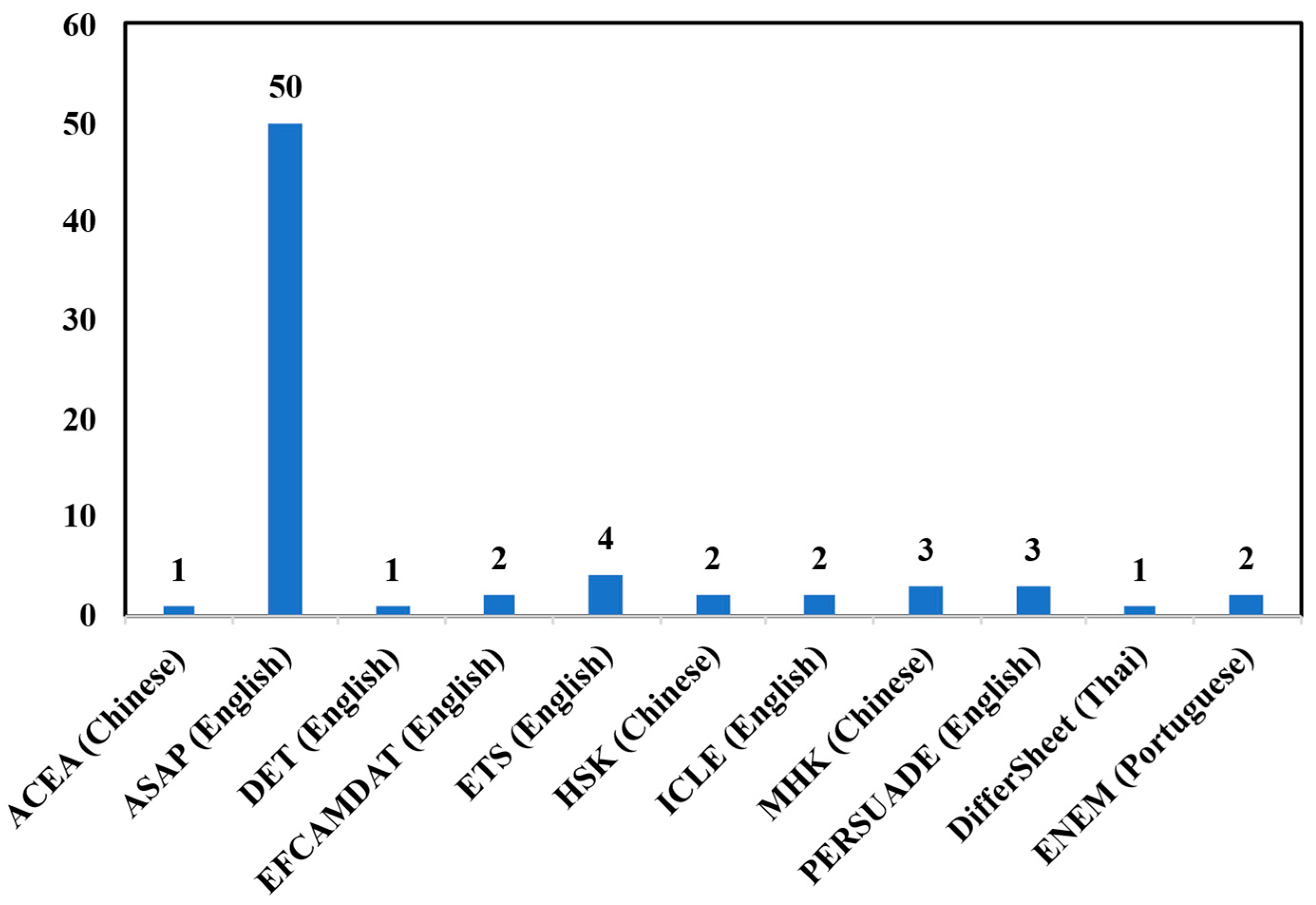
- Dataset Variety: A majority of studies (57%) use a single public dataset—primarily the ASAP-AES corpus (Mathias & Bhattacharyya, 2018). This limits the validation of model performance across different writing prompts, genres, and educational levels. Figure 3 provides a breakdown of how different languages are represented across these public datasets.Figure 3. Application of Different Languages in Public Datasets.
- (3)
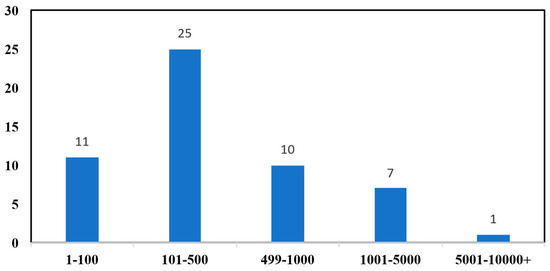
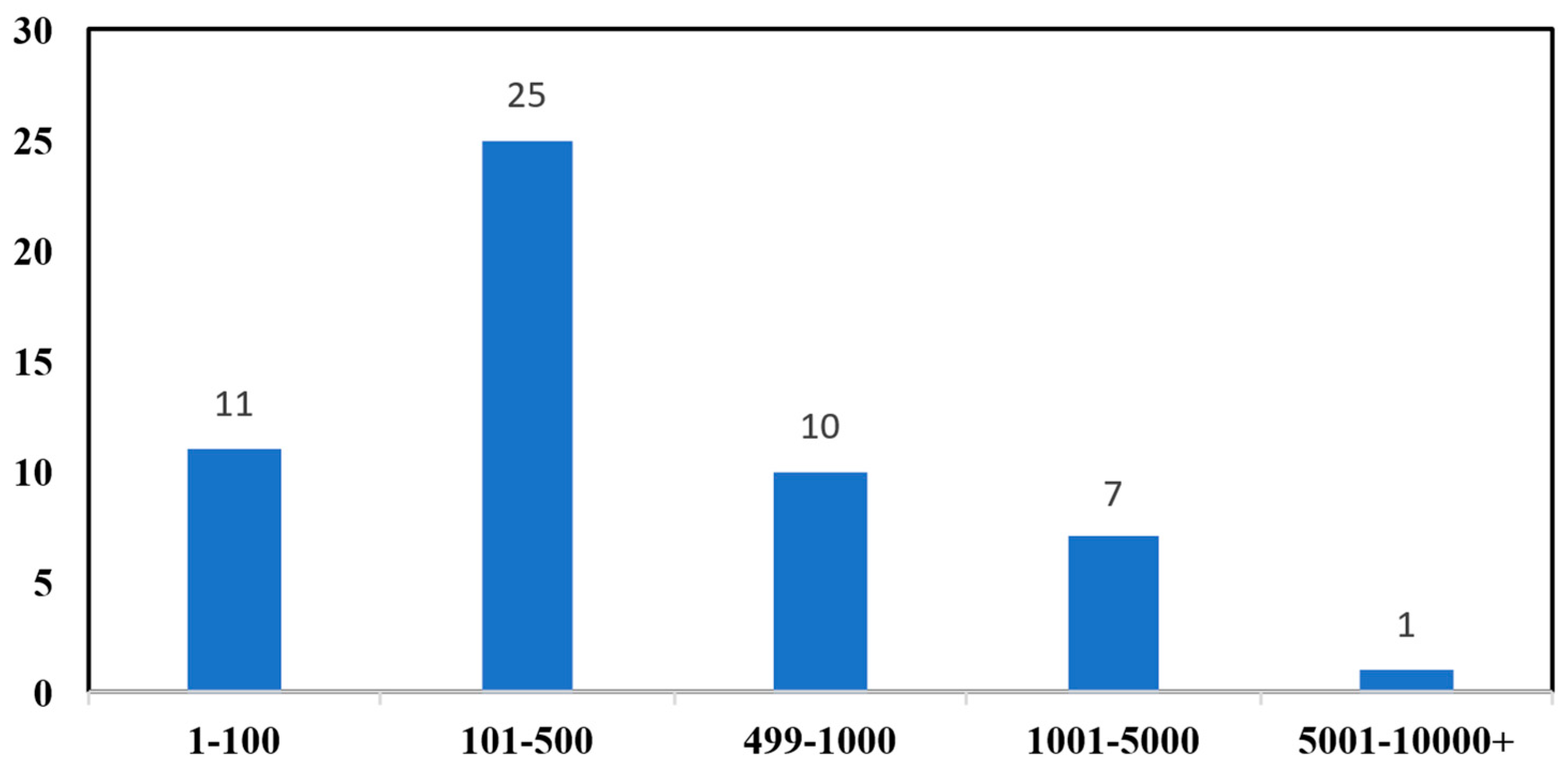
- Data Scale: Among studies using self-collected data, over two-thirds use fewer than 500 essays. Such small datasets are insufficient for validating models intended for large-scale deployment. The distribution of experimental data scales for studies using self-collected datasets is shown in Figure 4.Figure 4. Scale of Experimental Data in Self-Collected Datasets.
Collectively, these issues highlight a critical data bottleneck in the field. The scarcity of non-English corpora, the limited use of diverse public datasets, and the small scale of private datasets mean that the generalizability of most AES models in authentic educational settings remains largely unsubstantiated.
To address the inherent ordinal nature of essay scores, recent studies have introduced modern ordinal modeling baselines, such as Consistent Rank Logits (CORAL). While these generic ordinal regression methods successfully enforce rank consistency across score categories, they typically apply a universal ordinal assumption across all tasks. In contrast, our integration of the Generalized Partial Credit Model (GPCM) goes beyond simple ordinality by explicitly modeling item-specific difficulty and discrimination parameters, thereby capturing the unique psychometric properties of each individual prompt.
2.3. Bridging the Divide: Previous Works on IRT-AES Integrations and the Remaining Research Gaps
To address the challenges of interpretability and generalization, some studies have begun to integrate the psychometric principles from Section 2.1 with the machine learning models from Section 2.2. This integrative approach has shown promise in several related fields within educational AI. For instance, in cognitive diagnosis, the DIRT framework employs a deep neural network to extract student and item features. An IRT model then uses these features to provide interpretable diagnoses of knowledge mastery (Cheng et al., 2019). Similarly, in the field of knowledge tracing, the Deep-IRT model integrates a neural network with IRT to model student learning trajectories. The IRT component provides interpretable parameters for student ability and item difficulty (Yeung, 2019). Collectively, these studies demonstrate the viability of combining deep learning with IRT to enhance model interpretability.
Within the field of AES, researchers have also begun to explore such integrations. A significant line of research by Uto has applied IRT to address psychometric challenges in AES. Their work focuses on modeling and correcting for rater effects and linking scores across different essay datasets (Uto & Okano, 2022; Uto et al., 2023; Uto & Aramaki, 2024). While the present study shares a similar conceptual foundation, its research objectives differ. This work’s focus is on enhancing the post hoc interpretability of the core scoring model, rather than on addressing rater effects or data linking. The work by Shibata and Uto (2022) is most directly relevant to our research. They incorporated an IRT model into a DNN-based AES to facilitate multidimensional trait scoring, demonstrating the potential for integrating IRT directly into the AES process.
Prior research by Uto (2019) and Uto et al. (2020) demonstrated the utility of IRT in addressing rater effects and establishing score equivalence across different assessment forms. Our study diverges from this focus by prioritizing the post hoc interpretability and diagnostic value of the neural scoring architecture. By embedding the GPCM layer directly into the deep learning pipeline, we move beyond administrative score linking toward an ‘interpretable-by-design’ mechanism that clarifies why a specific score was assigned based on prompt-specific psychometric parameters.
Despite these promising developments, several research gaps remain. This study aims to address these gaps by making three key contributions. First, we move beyond previous integration approaches to propose a comprehensive, interpretable framework. This framework systematically combines principles from educational measurement with methods from machine learning. Second, we expand the technological scope of this integration. While previous studies focused primarily on deep neural network architectures, the proposed framework is designed for a broader range of contemporary “black-box” models, including pre-trained language models. Third, we address the challenge of generalization by validating the framework on diverse, large-scale datasets from real-world settings. Prior work in this area has often relied on the public ASAP dataset. This study extends the evaluation to include two additional large-scale Chinese essay datasets, one from a classroom context and another from a high-stakes assessment.
3. Methodology
This section details the methodology used to develop and validate the proposed framework. We first define the AES task from an educational measurement perspective. We then explain the rationale behind our choice of model components, describe the overall architecture, and specify the learning objective for model training.
3.1. The IRT-AESF Scoring Framework
In this work, we conceptualize the AES task as a multi-class classification problem, where the goal is to assign an essay to one of several predefined score categories. For any given essay prompt , the dataset consists of a collection of essays () and their corresponding scores () awarded by expert human raters. Each score , where is the total number of score categories. The framework is designed with a dual purpose. The primary objective is educational: to learn a function that links an essay to a predicted score () that is consistent with human judgment. The secondary, and equally important, goal is to enhance the model’s interpretability. It achieves this by estimating two key sets of psychometric parameters: (1) each student’s underlying writing ability ), and (2) the assessment characteristics of the prompt itself, namely its discrimination and its score-level difficulty thresholds .
To achieve this, the framework processes each essay through a sequence of steps designed to mirror aspects of human evaluation. First, the model develops a deep understanding of the essay’s content, creating a rich representation of its feature representation . Next, based on this understanding, it estimates the student’s underlying writing ability . Finally, this estimated ability is combined with the learned characteristics of the prompt ( and ) within an IRT model. This final step calculates the probability of the essay deserving each possible score. The score with the highest probability is then chosen as the final prediction , resulting in a holistic assessment that includes not just a score, but also meaningful diagnostic parameters.
3.2. Model Components and Justification
The proposed framework is built from three core components, each with a distinct educational function: a module for understanding essay meaning, a module for predicting student ability, and a module for estimating psychometric traits. This section explains our choices for each component.
For the component responsible for understanding the essay’s meaning, we chose the well-established BERT2 (Devlin et al., 2019) model over more recent generative LLMs. In the context of educational assessment, reliability and consistency are cornerstones of fairness and validity. While newer LLMs show great promise, their scoring can sometimes be inconsistent, which is a significant concern for high-stakes evaluations (Kundu & Barbosa, 2024; Tate et al., 2024; Wang et al., 2024). In contrast, BERT-based models have a proven track record of high-scoring reliability. Therefore, to build a trustworthy and stable assessment framework, BERT serves as a more suitable foundation for this stage of our research (Wang et al., 2024; Zheng et al., 2025).
At its core, BERT is a model designed to read and understand text in a way that is sensitive to context. Unlike older models that read text in one direction, BERT reads entire sentences at once, allowing it to grasp the nuances of language much like a human reader would. In our framework, we use BERT to generate a single numerical summary that represents the overall meaning and quality of an essay, which is then passed to the next component.
To provide the interpretable psychometric statistics, we selected the GPCM (Muraki, 1992). Since essay scoring involves multiple score levels, a polytomous IRT model like the GPCM is necessary. The GPCM is an excellent fit because its underlying mathematical structure aligns naturally with the way neural networks handle classification. This alignment allows for a smooth and stable integration of educational measurement theory into the deep learning architecture.
3.3. Model Architecture
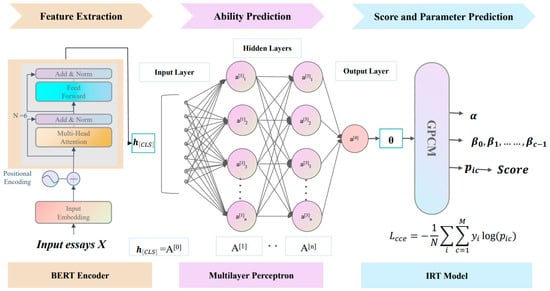
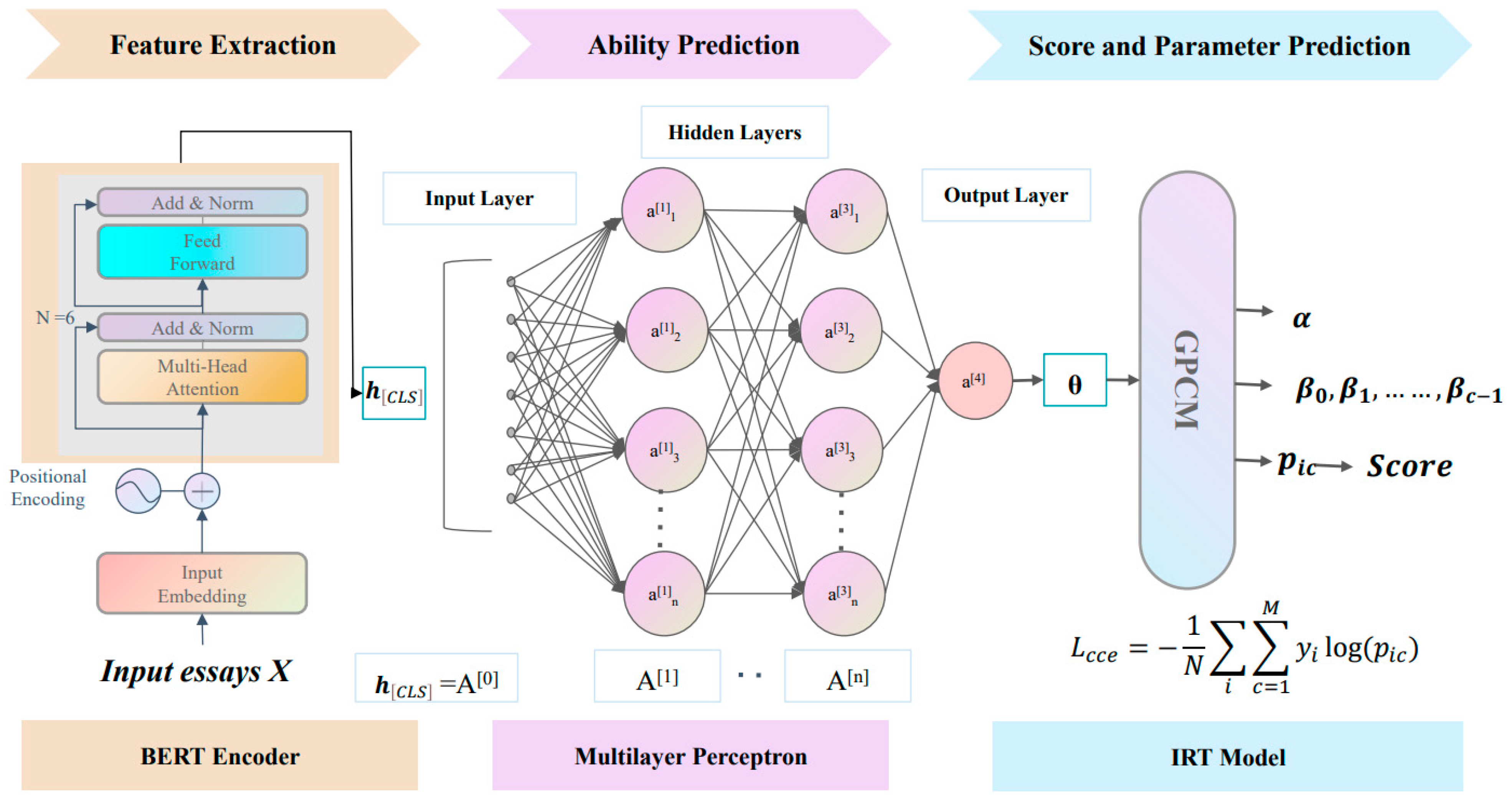
The complete architecture of our IRT-enhanced AES framework is illustrated in Figure 5. It consists of the three sequential components mentioned previously, which we implemented using well-established models: BERT, a Multi-Layer Perceptron (MLP), and the GPCM.
Figure 5.
The framework of IRT-AESF is illustrated with BERT, MLP, and GPCM as examples.
3.3.1. Essay Semantic Information Extraction Module
This module uses a pre-trained BERT model as the encoder. For an input essay sequence , the model generates contextualized token representations . Following standard practice, we use the final hidden state representation token , which is utilized as the semantic representation for the entire essay.
3.3.2. Ability Prediction Module
This module uses a multi-layer perceptron (MLP) to map the essay representation to a scalar value representing the student’s latent ability . Our implementation uses a three-layer MLP (768 × 256, 256 × 64, and 64 × 1), though this configuration is adjustable. The final layer’s output is passed through a modified Sigmoid function to scale the ability value to the conventional IRT range of [−3, 3].
Preliminary empirical experiments were conducted to determine the optimal depth of the feature projection network. Comparing two-, three-, and four-layer Multi-Layer Perceptron (MLP) configurations revealed that two-layer models exhibited reduced stability in latent ability () estimation. Conversely, four-layer architectures introduced higher variance during training and exacerbated overfitting, without yielding consistent performance gains. The selected three-layer configuration achieved the most stable convergence behavior, effectively balancing representational capacity and parameter efficiency.
3.3.3. Latent Trait Estimation Module Based on IRT
This module utilizes the GPCM, as formally introduced in Section 2.1.2. The psychometric parameters for the essay prompt j—item’s discrimination () and difficulty thresholds () are defined as trainable parameters. They are learned jointly with all other model parameters during end-to-end training. At inference, the module takes the estimated ability and the learned item parameters (, ) as input to the GPCM formula. This computes the probability vector over all score categories. The final predicted score is then determined by selecting the category with the highest probability.
3.3.4. Parameterization and Identifiability Constraints
To guarantee a valid psychometric interpretation under a single-item modeling design, explicit parameter constraints must be enforced. The GPCM defines the probability of a person receiving a score on a prompt as follows, where denotes the possible score categories for a given prompt :
To ensure the psychometric validity of the ordinal scoring, we enforce a monotonicity constraint on the threshold parameters . Specifically, we utilize a reparameterization technique where each threshold is defined as the cumulative sum of positive step values, (or Softplus), ensuring that the probability of transitioning to a higher score category increases strictly with the latent ability .
Similarly, the discrimination parameter is constrained to be strictly positive to prevent sign indeterminacy and ensure that higher ability directly correlates with higher score probabilities:
Furthermore, the latent ability trait is mapped from the final neural encoder output via a scaled sigmoid activation function to bound the variance and prevent infinite scaling during optimization:
Since each essay prompt is modeled independently as a single item in this framework, the parameters , , and are identifiable only up to a linear transformation within that specific prompt. By bounding to the interval [−3, 3] and constraining > 0 alongside monotonically ordered , we effectively fix an internally consistent measurement scale for each prompt, ensuring stable and interpretable psychometric diagnostics.
3.4. Loss Function
All components of the framework are trained together in a single, integrated process. The training is guided by a cross-entropy loss function. In educational terms, the goal of this function is to continually adjust the model’s internal parameters to minimize the difference between its predicted score probabilities and the actual scores awarded by human experts, as shown in Equation (6)
The optimization of the proposed neural framework is fundamentally aligned with IRT maximum likelihood estimation (MLE). The GPCM defines category probabilities through an exponential formulation that is structurally equivalent to a standard softmax function over specifically constrained logits.
Consequently, minimizing the cross-entropy loss between the predicted GPCM probabilities and the true ordinal score labels is mathematically equivalent to maximizing the negative log-likelihood under the GPCM probabilistic model. It is important to note that the ordinal structure of the essay scores is inherently preserved through the monotonic threshold parameterization () built into the GPCM layer itself, rather than relying on external loss reweighting techniques or custom ordinal loss functions. This structural alignment allows the model to leverage highly efficient deep learning optimizers while rigorously estimating valid psychometric parameters.
4. Experiment
This section details the experimental design used to evaluate the proposed framework. It first introduces the datasets and evaluation metrics. It then presents the results from three experiments, followed by an overall analysis.
4.1. Implementation Details and Hyperparameters
All models were trained end-to-end using 5-fold cross-validation to ensure robustness. We employed the Adam optimizer to minimize the cross-entropy loss function. To ensure reproducibility, experimental configurations were standardized across both the proposed IRT-AESF and the CNN-LSTM-Attention baseline. For the Transformer-based models, we utilized the bert-base-uncased for English essays and the bert-base-Chinese model for Chinese essays. The maximum sequence length was set to 512 tokens, with truncation and padding applied to maintain uniform tensor shapes. The BERT encoder was initialized with pre-trained weights, while the GPCM layer’s threshold parameters were initialized linearly across the [−3, 3] interval to facilitate stable convergence. The key hyperparameters included a learning rate of and a batch size of 16. While the maximum training duration was set to 30 epochs, we implemented an early stopping strategy based on validation performance to prevent overfitting. All experiments were conducted on a single NVIDIA RTX A6000 GPU using the PyTorch framework. The framework was implemented using PyTorch version 2.4.0.
The CNN-LSTM-Attention architecture, serving as a non-Transformer baseline to verify framework transferability, followed a hierarchical encoding approach. Text preprocessing was performed using the NLTK library for sentence and word-level tokenization, with words mapped to 50-dimensional pre-trained embeddings. The encoding backbone comprised a 1D-convolutional layer (Conv1d) with 100 channels and a kernel size of 5 to capture local n-gram features, followed by a Bi-LSTM layer to model long-range sequential dependencies. A hierarchical attention mechanism—incorporating both word-level and sentence-level attention—was employed to aggregate the final text representation. This baseline was optimized using RMSprop (lr = 0.001) with a batch size of 10 over 50 training epochs.
4.2. Data Processing and Fold Construction
The robustness of our findings was substantiated through a systematic 5-fold cross-validation procedure. For each essay prompt, the dataset was partitioned into five distinct folds using the KFold method. To ensure the reliability of cross-model comparisons and the exact reproducibility of the fold assignments, we utilized a fixed random seed of 42 during the shuffling and splitting process. In each iteration, three folds were used for training, one for validation/hyperparameter tuning, and the remaining fold for final performance evaluation. Furthermore, to address the categorical imbalance inherent in certain prompts, a sensitivity analysis was performed to evaluate the impact of downsampling on scoring stability, the results of which informed our final sampling strategy to ensure equitable model calibration across all proficiency levels.
4.3. Dataset and Evaluation Metric
4.3.1. Datasets
To evaluate the framework’s performance and generalizability, we used one public dataset and two large-scale, self-collected Chinese datasets.
- (1)
- ASAP-AES: A widely used public dataset for AES research (Mathias & Bhattacharyya, 2018). It contains 12,976 English essays from U.S. students (grades 7–9) across eight prompts. The dataset features varied score ranges and essay types, and each essay was rated by two human experts.
- (2)
- ELion Dataset: This dataset consists of 7628 Chinese essays written by third and fourth-grade students using the ELion intelligent tutoring system3 (Zheng et al., 2023). The prompts correspond to textbook exercises, with scores ranging from 0 to 8.
- (3)
- Standardized Test Dataset: A high-stakes dataset comprising 20,724 Chinese essays from a regional sixth-grade examination in China. All essays were written for a single prompt (“A special ____”) and scored on a 1-to-27 points scale.
The basic characteristics of each dataset are summarized in Table 3.
Table 3.
The Experimental Datasets.
4.3.2. Evaluation Metric
We evaluated model performance using two standard metrics: the Quadratic Weighted Kappa (QWK) and the Pearson Correlation Coefficient (PCC). In addition, we incorporated Mean Absolute Error (MAE) and Root Mean Square Error (RMSE) to provide a more granular assessment of prediction accuracy on the original score scales. While QWK and PCC focus on agreement and correlation, MAE and RMSE quantify the magnitude of deviation from ground-truth scores, which is crucial for assessing the fairness and reliability of automated scoring in educational contexts.
(1) QWK: QWK measures the agreement between two raters on an ordinal scale. It is particularly suitable for AES because it penalizes larger disagreements in scores more heavily than smaller ones. QWK scores range from 0 to 1, where higher values indicate stronger agreement. The calculation is shown in Equations (7) and (8):
In these equations, represents the observed frequency matrix, where the element at denotes the number of essays that received score from the human rater and score from the automated system. denotes the expected frequency matrix under the assumption of independence between the two raters. is the weight matrix that assigns penalties based on the squared distance between scores, and is the total number of possible score categories.
(2) : The Pearson correlation coefficient measures the linear relationship between the automated scores and the human-assigned gold standard. Its value ranges from −1 to 1, where a value closer to 1 indicates a stronger positive linear correlation. The calculation is presented in Equation (9):
In this equation, denotes the automated score predicted by the model for the -th essay, and represents the corresponding human-assigned score. and signify the mean values of the automated and human scores, respectively.
(3) MAE: MAE measures the average magnitude of errors in a set of predictions, without considering their direction. It provides a direct interpretation of how many score points the model’s predictions are off on average.
(4) RMSE: RMSE is the square root of the average of squared differences between the prediction and actual observation. Compared to MAE, RMSE assigns a higher penalty to large errors, making it a sensitive metric for detecting extreme mispredictions. These two pairs of metrics offer complementary perspectives on model performance. Therefore, we employ all four metrics to ensure a comprehensive evaluation.
4.4. Main Analysis and Results
In the following sections, our proposed framework integrating BERT and GPCM is referred to as IRT-AESF (BERT-GPCM). We compare its performance against a standard BERT baseline model.
4.4.1. Experiment 1: ASAP-AES
The first experiment, conducted on the ASAP-AES benchmark, aimed to: (1) evaluate the framework’s effectiveness compared to state-of-the-art ordinal modeling baselines, and (2) verify its model-agnostic transferability across diverse neural architectures.
- (1)
- Performance Comparison with Ordinal Baselines
To address the ordinal nature of essay scores, we compared our IRT-AESF (BERT-GPCM) against three baselines:
BERT (Base): A standard regression-based transformer.
BERT-CORAL: A modern ordinal regression baseline (Consistent Rank Logits).
BERT-LDL: A Label Distribution Learning approach.
The results across 8 prompts are summarized in Table 4.
Table 4.
ASAP-AES Essay Scoring Results (Mean ± SD).
The empirical results presented in Table 4 demonstrate that IRT-AESF (Ours) consistently outperforms all competitive baselines across the majority of evaluative metrics. A critical observation arises from the performance on prompts with expanded score ranges, specifically Prompt 7 (scale 2–24) and Prompt 8 (scale 27–48). In these scenarios, traditional ordinal modeling approaches like BERT-CORAL and BERT-LDL exhibited significant performance degradation or total failure to converge.
Specifically, on Prompt 7, BERT-CORAL yielded a QWK of near zero, indicating a complete collapse in its ability to map inputs to such a wide ordinal scale. This instability likely stems from the cumulative logit constraints in CORAL, which become mathematically precarious and difficult to optimize as the number of rank thresholds increases. Similarly, BERT-LDL’s performance plummeted on these granular scales, as the label distribution learning process becomes increasingly sparse when the potential score categories expand. In stark contrast, IRT-AESF achieved a robust QWK of 0.818 on Prompt 7, representing a substantial improvement over the standard BERT Base (0.721). This suggests that by conceptualizing the scoring process through the GPCM, our framework effectively handles high-granularity scales by modeling the probabilistic transitions between score levels rather than treating them as isolated categories or rigid thresholds.
Furthermore, an analysis of error-aware metrics, MAE and RMSE, reveals that IRT-AESF not only enhances correlation but also significantly minimizes absolute prediction bias. As shown in the results for Prompts 7 and 8, the IRT-enhanced model reduced RMSE more effectively than the BERT baseline. This improvement is particularly pronounced at the extreme ends of the score distribution. Standard regression models often suffer from “central tendency bias”, where predictions cluster around the mean; however, the psychometric constraints inherent in the GPCM layer enforce a more rigorous calibration. By accounting for prompt-specific difficulty () and discrimination (), the framework ensures that high-performing and low-performing essays are distinguished with higher resolution, thereby providing a more reliable and pedagogically sound automated assessment.
- (2)
- Demonstrating Framework Transferability (CNN-LSTM-Attention)
To test the framework’s transferability, the BERT encoder was replaced with a widely cited CNN-LSTM-Attention model (Ridley et al., 2021), a non-Transformer architecture, and the same experiment design was implemented. The results are presented in Table 5.
Table 5.
Transferability Results (CNN-LSTM-Attention vs. IRT-enhanced version).
As shown in Table 5, the addition of the IRT-AESF module yielded consistent improvements over the CNN-LSTM-Attention baseline. The average QWK increased from 0.714 to 0.741, and the PCC rose from 0.723 to 0.752. This confirms that the benefits of our framework are not architecture-dependent but stem from the integration of psychometric modeling, which can enhance various AES systems regardless of their underlying encoder.
- (3)
- Results Summary
These experimental findings lead to several pivotal conclusions regarding the framework’s performance. First, the most substantial gains observed on Prompts 7 and 8 underscore the framework’s superiority in handling complex scoring rubrics. By explicitly modeling prompt-specific difficulty and discrimination, IRT-AESF effectively mitigates the” regression toward the mean” effect—a common pitfall where regression and ordinal baselines fail to distinguish between high- and low-performing essays. Furthermore, the framework exhibits remarkable stability; unlike the high variance observed in CORAL across certain prompts, IRT-AESF maintains a lower standard deviation, indicating a more reliable probabilistic mapping. Ultimately, the consistent improvements across both BERT and CNN-LSTM architectures suggest that IRT-AESF offers a scalable and model-agnostic solution for advancing both scoring accuracy and psychometric interpretability in automated essay scoring.
4.4.2. Experiment 2: ELion_Grade 3 & Grade 4
The ELion dataset prompts are encoded for clarity (e.g., G3S1U1 for Grade 3, Semester 1, Unit 1). A detailed description of these codes and their corresponding Chinese essay topics is available in the Appendix A. The scoring results for Grade 3 and Grade 4 are presented in Table 6 and Table 7.
Table 6.
ELion-Grade3 Essay Scoring Results.
Table 7.
ELion-Grade4 Essay Scoring Results.
For the third-grade essays (Table 6), the IRT-AESF model achieved an average QWK of 0.704, a substantial improvement over the baseline’s 0.508. The average PCC value also increased from 0.568 to 0.737. For the fourth-grade essays (Table 7), the model again outperformed the baseline, with the average QWK increasing from 0.411 to 0.516 and the PCC improving from 0.482 to 0.583.
Across both grades, the framework showed significant advantages. Notably, the baseline model performed poorly on several prompts (e.g., a QWK of 0.151 for G3S2U4). The substantial performance gains on these particularly noisy prompts suggest that the IRT module may provide a stabilizing effect, enforcing a psychometrically sound structure on data with real-world scoring inconsistencies.
4.4.3. Experiment 3: Standardized Data Test
The results for the high-stakes standardized test data are presented in Table 8.
Table 8.
Standardized Test Essay Scoring Results.
On the high-stakes standardized test data, the IRT-AESF model also outperformed the baseline. The QWK score improved from 0.660 to 0.697, and the PCC score increased from 0.677 to 0.713 (Table 8). Although the margin of improvement is smaller than that observed on the ELion dataset, these results validate the framework’s effectiveness in a high-stakes assessment context.
5. Discussions and Future Work
5.1. Discussions
The results from the experiments demonstrate the effectiveness, versatility, and generalizability of the proposed IRT-AESF framework. This work represents a significant step toward developing more transparent, trustworthy, and diagnostically useful AES systems for real-world educational applications.
First, the framework demonstrably enhances the interpretability of AES systems while simultaneously improving scoring accuracy. Across all datasets, the IRT-AESF model consistently outperformed its “black-box” baseline. This was achieved through an innovative integration of the highly interpretable IRT model, which partially mitigates the inherent opacity in AES. While traditional deep learning models are often considered black boxes, the IRT-based AES in our framework disaggregates the scoring process into multi-level probability estimations. As a result, the AES model is transformed into a diagnostic tool. Educators can derive an intuitive understanding of students’ true writing proficiencies by examining the discrimination and difficulty parameters furnished by the GPCM, which in turn mitigates biases inherent in traditional scoring methodologies.
Second, the framework proves to be a versatile, model-agnostic solution. While the primary experiments were conducted on a transformer-based architecture (BERT), the framework’s transferability was substantiated through supplementary experiments. By substituting the BERT encoder with a widely cited non-transformer architecture (CNN-LSTM-Attention), the results showed that applying the IRT-AESF module still yielded significant and consistent performance gains. This outcome is crucial as it indicates that the framework’s benefits are not tied to a specific encoder but can be transferred across different deep learning architectures, functioning as a powerful “plug-in” to improve various AES systems. Furthermore, this study did not extend its evaluation to large language models (LLMs) such as GPT-4 (Khademi, 2023; Kim & Jo, 2024), primarily due to practical considerations of computational cost and performance trade-offs. Although applying such models to AES tasks is technically feasible, their operational expenses can be prohibitively high (Oketch et al., 2025). Moreover, studies have consistently shown that the scoring accuracy of LLMs, particularly in zero-shot or few-shot scenarios (Oketch et al., 2025; Shibata & Miyamura, 2025), does not necessarily surpass that of finely tuned, smaller models like BERT (Wang et al., 2024). In some cases, LLMs have even demonstrated lower agreement with human raters compared to traditional state-of-the-art methods. Given these factors, the focus remained on architectures that provide a more balanced and accessible solution for enhancing AES systems.
Third, the experimental design systematically establishes the framework’s robust generalizability and ecological validity. To mitigate the shortfalls of existing research, which has predominantly relied on English datasets from limited demographics like ASAP-AES, this study incorporated two additional large-scale, real-world Chinese datasets. This broadened the research’s purview to cover different languages, grade levels (3rd through 9th), and diverse educational contexts, from low-stakes classroom exercises to high-stakes standardized tests. The empirical findings affirm that the proposed framework manifests considerable effectiveness and robustness across these varied settings. The utilization of cross-lingual and large-scale datasets provides robust empirical backing for the practical implementation of AES, laying a formidable groundwork for their operationalization in authentic educational contexts.
Fourth, this study contributes to the ongoing dialogue on fairness and algorithmic bias in AES. While traditional deep learning models are criticized for their “black-box” nature, which can inadvertently perpetuate biases present in training data, the integration of IRT provides a psychometric foundation for monitoring model behavior. By estimating difficulty and discrimination parameters for each prompt, our framework allows for a more granular inspection of how the model treats different score levels. The error analysis across various score bands demonstrates that the IRT-AESF framework maintains stable calibration, mitigating the common “regression toward the mean” effect where high-scoring essays are undervalued and low-scoring ones are inflated. This stability is a critical prerequisite for ensuring that the system provides equitable outcomes for students across the entire proficiency spectrum. It is important to note that since the IRT-AESF is trained independently for each prompt, the resulting parameters (, , ) reside on prompt-specific scales. While these parameters provide high interpretability for a particular assignment—allowing educators to understand the difficulty thresholds of a specific rubric, they are not directly comparable across different prompts. The ability estimate should be interpreted as a student’s relative proficiency within the specific context of the assigned topic.
In conclusion, to address the pervasive “black-box” problem in AES, this study proposed and validated the IRT-AESF, a novel framework that deeply integrates IRT with modern neural networks. Through extensive experiments on three diverse, large-scale datasets, the results demonstrated that the framework significantly improves scoring consistency and accuracy over strong baselines. More importantly, it enhances interpretability by providing global interpretable designs in the form of learned psychometric prompt parameters, advancing the development of more transparent and effective educational technologies.
5.2. Limitations and Future Work
Despite its contributions, this study has several limitations, which in turn provide a clear foundation for future research.
First, while the framework greatly enhances interpretability, this is currently at a holistic, unidimensional level. The model provides valuable insights into the overall difficulty and discrimination of a prompt, but does not yet disaggregate the score into finer-grained, multidimensional traits (e.g., content, organization, language use), and therefore cannot explain why a student’s score is high or low in terms of specific writing competencies. A significant next step, therefore, is to extend the current model to a multidimensional IRT framework. Such an extension would align each dimension with a specific, concrete scoring trait and, thus, be able to provide more detailed diagnostic feedback.
Second, the framework was evaluated on a prompt-specific basis. A separate model was trained for each essay prompt, which does not address the significant challenge of cross-prompt generalization. This limits the framework’s applicability in scenarios requiring scoring for new, previously unseen prompts. Consequently, future work should explore techniques to create prompt-invariant essay representations within the IRT-AESF framework to tackle this major hurdle for practical AES.
Third, a notable limitation is the current inability to perform explicit subgroup fairness auditing. Due to the absence of demographic metadata (e.g., gender, ethnicity, or native language status) in the public datasets used, we were unable to conduct a formal Differential Item Functioning (DIF) analysis. DIF is essential to ensure that a prompt does not inherently disadvantage specific subgroups of students with the same underlying ability. Future research must prioritize “fairness-by-design” by incorporating demographic attributes to conduct subgroup parity audits, ensuring consistent calibration across diverse student populations before operational deployment.
To achieve cross-prompt comparability and longitudinal student tracking, future iterations of the framework could incorporate IRT linking designs or anchor-based multi-prompt modeling. By training on multiple prompts simultaneously with common anchor essays, the latent parameters could be mapped onto a universal scale, further extending the pedagogical utility of the system for long-term learner analytics.
Finally, while this study focuses on scoring consistency and psychometric interpretation, the IRT-AESF framework provides a robust backbone for the next generation of feedback systems. Recent evidence from Hong Kong underscores a critical hierarchy in feedback efficacy: while AI-generated feedback is efficient, it often results in lower essay score improvements and student motivation compared to teacher or hybrid (teacher-AI) models, largely due to a lack of perceived personalization and trust (Lo et al., 2025). Our framework directly addresses this “trust gap” by replacing opaque scores with “interpretable-by-design” parameters. Specifically, the prompt-internal diagnostics—such as the threshold structures () and student ability ()—can serve as teacher-cued overlays. These overlays could translate abstract latent traits into rubric-aligned actionables, allowing teachers to quickly identify exactly where a student sits on the latent proficiency scale and provide pedagogically calibrated guidance. By leveraging the consistency of IRT-AESF to handle the heavy lifting of diagnostic scoring while preserving the motivational benefits of teacher mediation, this research outlines a concrete pathway toward equitable, high-impact hybrid feedback models that move AES beyond mere scoring toward a structured human-AI collaboration (Lo et al., 2025).
Author Contributions
Conceptualization, W.X. and C.Z.; methodology, W.X.; software, J.W.; validation, J.W. and J.Y.; formal analysis, W.X.; investigation, W.X.; resources, C.Z.; data curation, W.X.; writing—original draft preparation, W.X.; writing—review and editing, C.Z. and W.X.; visualization, W.X.; supervision, C.Z.; project administration, C.Z.; funding acquisition, C.Z. All authors have read and agreed to the published version of the manuscript.
Funding
This research received no external funding.
Institutional Review Board Statement
The study was conducted in accordance with the Declaration of Helsinki, and approved by the Ethics Committee of East China Normal University (protocol code HR088-2023 and date of approval: 23 February 2023). The public ASAP-AES dataset used in this study is an open-source corpus available for research purposes. The two self-collected datasets were fully anonymized to ensure the privacy of the participants, and all data collection procedures followed the approved ethical guidelines.
Informed Consent Statement
Not applicable.
Data Availability Statement
The data presented in this study are available on request from the corresponding author. The data are not publicly available due to privacy and institutional restrictions.
Conflicts of Interest
The authors declare no conflicts of interest.
Appendix A
The ELion dataset is sourced from the ELion intelligence essay scoring system (Zheng et al., 2023). It contains authentic Chinese essay data from third and fourth-grade elementary school students, with all content aligned with the Chinese textbooks used in Chinese primary education. The specific data details are shown in the table below.
Table A1.
Essay Count in ELion Dataset.
Table A2.
Corresponding Chinese and English Titles for ELion Prompts.
This study additionally collected 20,724 essays from a sixth-grade standardized examination in a specific region, with the writing prompt “A Special _____”. The scoring range spanned 1–27 points. Detailed data distribution across score ranges can be found in Table A2.
Table A3.
Total Standardized Test data.
Table A4.
ASAP-AES Parameter Estimation Results.
Table A5.
ELion-Grade3 Parameter Estimation Results.
Table A6.
ELion-Grade4 Parameter Estimation Results.
Table A7.
Standardized Test Parameter Estimation Results.
To support the statistical significance of the improvements, this appendix provides the comprehensive results of the 5-fold cross-validation. Table A8 reports the mean and standard deviation for each metric across all prompts. Furthermore, we provide -values from paired t-tests (for QWK) and Fisher z-transformed tests (for PCC), alongside Cohen’s to quantify the effect sizes of the performance gains achieved by the IRT-AESF framework.
Table A8.
Detailed Performance Metrics and Statistical Significance Tests Across Folds for IRT-AESF and Baselines.
Notes
| 1 | In this work, “prompt” refers to the essay topic, a common term used in the field of automated essay scoring, and not a prompt as used in generative AI. |
| 2 | https://github.com/google-research/bert (accessed on 3 March 2025). |
| 3 | https://elion-student.aiecnu.cn/ (accessed on 3 March 2025). |
References
- Andrade, H. L., Du, Y., & Wang, X. (2008). Putting rubrics to the test: The effect of a model, criteria generation, and rubric-referenced self-assessment on elementary school students’ writing. Educational Measurement: Issues and Practice, 27(2), 3–13. [Google Scholar] [CrossRef] [Scilit]
- Arrieta, A. B., Díaz-Rodríguez, N., Ser, J. D., Bennetot, A., Tabik, S., Barbado, A., García, S., Gil-López, S., Molina, D., Benjamins, R., Chatila, R., & Herrera, F. (2019). Explainable artificial intelligence (XAI): Concepts, taxonomies, opportunities and challenges toward responsible AI. arXiv, arXiv:1910.10045. [Google Scholar] [CrossRef] [Scilit]
- Baker, F. B. (2001). The basics of item response theory. Available online: https://eric.ed.gov/?id=ED458219 (accessed on 3 March 2025).
- Brennan, R. L. (1992). Generalizability theory. Educational Measurement: Issues and Practice, 11(4), 27–34. [Google Scholar] [CrossRef] [Scilit]
- Brennan, R. L. (2010). Generalizability theory and classical test theory. Applied Measurement in Education, 24(1), 1–21. [Google Scholar] [CrossRef] [Scilit]
- Briesch, A. M., Swaminathan, H., Welsh, M., & Chafouleas, S. M. (2014). Generalizability theory: A practical guide to study design, implementation, and interpretation. Journal of School Psychology, 52(1), 13–35. [Google Scholar] [CrossRef] [Scilit] [PubMed]
- Campion, M. C., Campion, M. A., Campion, E. D., & Reider, M. H. (2016). Initial investigation into computer scoring of candidate essays for personnel selection. Journal of Applied Psychology, 101(7), 958–975. [Google Scholar] [CrossRef] [Scilit]
- Chan, S. T. S., Lo, N. P. K., & Wong, A. M. H. (2024). Enhancing university level English proficiency with generative AI: Empirical insights into automated feedback and learning outcomes. Contemporary Educational Technology, 16(4), ep541. [Google Scholar] [CrossRef] [Scilit] [PubMed]
- Cheng, S., Liu, Q., Chen, E., Huang, Z., Huang, Z., Chen, Y., Ma, H., & Hu, G. (2019). DIRT: Deep learning enhanced item response theory for cognitive diagnosis. In Proceedings of the 28th ACM international conference on information and knowledge management (pp. 2397–2400). Association for Computing Machinery. [Google Scholar] [CrossRef] [Scilit]
- Devlin, J., Chang, M.-W., Lee, K., & Toutanova, K. (2019). BERT: Pre-training of deep bidirectional transformers for language understanding. arXiv, arXiv:1810.04805. [Google Scholar] [CrossRef] [Scilit]
- Embretson, S. E., & Reise, S. P. (2013). Item response theory for psychologists. Psychology Press. [Google Scholar]
- Engelhard, G., Jr. (1992). The measurement of writing ability with a many-faceted Rasch model. Applied Measurement in Education, 5(3), 171–191. [Google Scholar] [CrossRef] [Scilit]
- Gilpin, L. H., Bau, D., Yuan, B. Z., Bajwa, A., Specter, M., & Kagal, L. (2018). Explaining explanations: An overview of interpretability of machine learning. In 2018 IEEE 5th international conference on data science and advanced analytics (DSAA) (pp. 80–89). IEEE. [Google Scholar] [CrossRef] [Scilit]
- Guidotti, R., Monreale, A., Ruggieri, S., Turini, F., Giannotti, F., & Pedreschi, D. (2019). A survey of methods for explaining black box models. ACM Computing Surveys, 51(5), 93. [Google Scholar] [CrossRef] [Scilit]
- Hussein, M. A., A., H., & Nassef, M. (2020). A trait-based deep learning automated essay scoring system with adaptive feedback. International Journal of Advanced Computer Science and Applications, 11(5), 287–293. [Google Scholar] [CrossRef] [Scilit]
- Khademi, A. (2023). Can ChatGPT and Bard generate aligned assessment items? A reliability analysis against human performance. Journal of Applied Learning & Teaching, 6(1), 75–80. [Google Scholar] [CrossRef] [Scilit]
- Kim, S., & Jo, M. (2024). Is GPT-4 alone sufficient for automated essay scoring?: A comparative judgment approach based on rater cognition. In Proceedings of the eleventh ACM conference on learning @ scale (pp. 315–319). Association for Computing Machinery. [Google Scholar] [CrossRef] [Scilit]
- Kumar, V., & Boulanger, D. (2020). Explainable automated essay scoring: Deep learning really has pedagogical value. Frontiers in Education, 5, 572367. [Google Scholar] [CrossRef] [Scilit]
- Kumar, Y., Parekh, S., Singh, S., Li, J. J., Shah, R. R., & Chen, C. (2023). Automatic essay scoring systems are both overstable and oversensitive: Explaining why and proposing defenses. Dialogue & Discourse, 14(1), 1–33. [Google Scholar] [CrossRef] [Scilit]
- Kundu, A., & Barbosa, D. (2024). Are large language models good essay graders? arXiv, arXiv:2409.13120. [Google Scholar] [CrossRef] [Scilit]
- Li, W., & Liu, H. (2024). Applying large language models for automated essay scoring for non-native Japanese. Humanities and Social Sciences Communications, 11(1), 723. [Google Scholar] [CrossRef] [Scilit]
- Lo, N. P. K., Chan, S. T. S., & Wong, A. M. H. (2025). Evaluating teacher, AI, and hybrid feedback in English language learning: Impact on student motivation, quality, and performance in Hong Kong. SAGE Open, 15(3), 21582440251352907. [Google Scholar] [CrossRef] [Scilit]
- Mansour, W., Albatarni, S., Eltanbouly, S., & Elsayed, T. (2024). Can large language models automatically score proficiency of written essays? arXiv, arXiv:2403.06149. [Google Scholar] [CrossRef] [Scilit]
- Mathias, S., & Bhattacharyya, P. (2018). ASAP++: Enriching the ASAP automated essay grading dataset with essay attribute scores. In Proceedings of the eleventh international conference on language resources and evaluation (LREC 2018). European Language Resources Association (ELRA). Available online: https://aclanthology.org/L18-1187/ (accessed on 25 March 2026).
- McNamara, D. S., Crossley, S. A., Roscoe, R. D., Allen, L. K., & Dai, J. (2015). A hierarchical classification approach to automated essay scoring. Assessing Writing, 23, 35–59. [Google Scholar] [CrossRef] [Scilit]
- Mizumoto, A., & Eguchi, M. (2023). Exploring the potential of using an AI language model for automated essay scoring. Research Methods in Applied Linguistics, 2(2), 100050. [Google Scholar] [CrossRef] [Scilit]
- Moskal, B. M., & Leydens, J. A. (2000). Scoring rubric development: Validity and reliability. Practical Assessment, Research and Evaluation, 7, 10. [Google Scholar]
- Muraki, E. (1992). A generalized partial credit model: Application of an EM algorithm. ETS Research Report Series, 1992(1), i–30. [Google Scholar] [CrossRef] [Scilit]
- Muraki, E. (1993). Information functions of the generalized partial credit model. ETS Research Report Series, 1993(1), i–12. [Google Scholar] [CrossRef] [Scilit]
- Muraki, E., & Muraki, M. (2016). Generalized partial credit model. In Handbook of item response theory (pp. 127–137). Chapman and Hall/CRC. [Google Scholar]
- Murdoch, W. J., Singh, C., Kumbier, K., Abbasi-Asl, R., & Yu, B. (2019). Definitions, methods, and applications in interpretable machine learning. Proceedings of the National Academy of Sciences of the United States of America, 116(44), 22071–22080. [Google Scholar] [CrossRef] [Scilit]
- Oketch, K., Lalor, J. P., Yang, Y., & Abbasi, A. (2025). Bridging the LLM accessibility divide? Performance, fairness, and cost of closed versus open LLMs for automated essay scoring. arXiv, arXiv:2503.11827. [Google Scholar] [CrossRef] [Scilit]
- Ormerod, C. M., Malhotra, A., & Jafari, A. (2021). Automated essay scoring using efficient transformer-based language models. arXiv, arXiv:2102.13136. [Google Scholar] [CrossRef] [Scilit]
- Pack, A., Barrett, A., & Escalante, J. (2024). Large language models and automated essay scoring of English language learner writing: Insights into validity and reliability. Computers and Education: Artificial Intelligence, 6, 100234. [Google Scholar] [CrossRef] [Scilit]
- Page, E. B. (1966). The imminence of... grading essays by computer. The Phi Delta Kappan, 47(5), 238–243. [Google Scholar]
- Panadero, E., & Jonsson, A. (2013). The use of scoring rubrics for formative assessment purposes revisited: A review. Educational Research Review, 9, 129–144. [Google Scholar] [CrossRef] [Scilit]
- Persing, I., Davis, A., & Ng, V. (2010). Modeling organization in student essays. In Proceedings of the 2010 conference on empirical methods in natural language processing (pp. 229–239). Association for Computational Linguistics. Available online: https://aclanthology.org/D10-1023/ (accessed on 3 April 2025).
- Powers, D. E., Kubota, M., Bentley, J., Farnum, M., Swartz, R., & Willard, A. (1998). Qualifying readers for the online scoring network: Scoring argument essays. ETS Research Report No. RR-98-21. Educational Testing Service. [Google Scholar] [CrossRef] [Scilit]
- Ramalingam, V. V., Pandian, A., Chetry, P., & Nigam, H. (2018). Automated essay grading using machine learning algorithm. Journal of Physics: Conference Series, 1000, 012030. [Google Scholar] [CrossRef] [Scilit]
- Reise, S. P., & Waller, N. G. (2009). Item response theory and clinical measurement. Annual Review of Clinical Psychology, 5, 27–48. [Google Scholar] [CrossRef] [Scilit]
- Rezaei, A. R., & Lovorn, M. (2010). Reliability and validity of rubrics for assessment through writing. Assessing Writing, 15(1), 18–39. [Google Scholar] [CrossRef] [Scilit]
- Ridley, R., He, L., Dai, X., Huang, S., & Chen, J. (2021). Automated cross-prompt scoring of essay traits. Proceedings of the AAAI Conference on Artificial Intelligence, 35(15), 13745–13753. [Google Scholar] [CrossRef] [Scilit]
- Samejima, F. (1968). Estimation of latent ability using a response pattern of graded scores. ETS Research Bulletin No. RB-68-29. Educational Testing Service. [Google Scholar] [CrossRef] [Scilit]
- Shavelson, R. J., & Webb, N. M. (1981). Generalizability theory: 1973–1980. British Journal of Mathematical and Statistical Psychology, 34(2), 133–166. [Google Scholar] [CrossRef] [Scilit]
- Shavelson, R. J., Webb, N. M., & Rowley, G. L. (1992). Generalizability theory. In A. E. Kazdin (Ed.), Methodological issues & strategies in clinical research (pp. 233–256). American Psychological Association. [Google Scholar] [CrossRef] [Scilit]
- Shermis, M. D. (2014). State-of-the-art automated essay scoring: Competition, results, and future directions from a United States demonstration. Assessing Writing, 20, 53–76. [Google Scholar] [CrossRef] [Scilit]
- Shibata, T., & Miyamura, Y. (2025). LCES: Zero-shot automated essay scoring via pairwise comparisons using large language models. arXiv, arXiv:2505.08498. [Google Scholar] [CrossRef] [Scilit]
- Shibata, T., & Uto, M. (2022). Analytic automated essay scoring based on deep neural networks integrating multidimensional item response theory. In Proceedings of the 29th international conference on computational linguistics (pp. 2917–2926). International Committee on Computational Linguistics. [Google Scholar]
- Srikandi. (2019). The teaching of writing in EFL classes. EDUCASIA: Jurnal Pendidikan, Pengajaran, Dan Pembelajaran, 4(1), 69–80. [Google Scholar] [CrossRef] [Scilit]
- Tashu, T. M., Maurya, C. K., & Horvath, T. (2022). Deep learning architecture for automatic essay scoring (Version 1). arXiv, arXiv:2206.08232. [Google Scholar] [CrossRef] [Scilit]
- Tate, T. P., Steiss, J., Bailey, D., Graham, S., Moon, Y., Ritchie, D., Tseng, W., & Warschauer, M. (2024). Can AI provide useful holistic essay scoring? Computers and Education: Artificial Intelligence, 7, 100255. [Google Scholar] [CrossRef] [Scilit]
- Uto, M. (2019). Rater-effect IRT model integrating supervised LDA for accurate measurement of essay writing ability. In International conference on artificial intelligence in education (pp. 494–506). Springer International Publishing. [Google Scholar]
- Uto, M. (2021). A review of deep-neural automated essay scoring models. Behaviormetrika, 48(2), 459–484. [Google Scholar] [CrossRef] [Scilit]
- Uto, M., Aomi, I., Tsutsumi, E., & Ueno, M. (2023). Integration of prediction scores from various automated essay scoring models using item response theory. IEEE Transactions on Learning Technologies, 16(6), 983–1000. [Google Scholar] [CrossRef] [Scilit]
- Uto, M., & Aramaki, K. (2024). Linking essay-writing tests using many-facet models and neural automated essay scoring. Behavior Research Methods, 56(8), 8450–8479. [Google Scholar] [CrossRef] [Scilit] [PubMed]
- Uto, M., & Okano, M. (2022). Learning automated essay scoring models using item-response-theory-based scores to decrease effects of rater biases. IEEE Transactions on Learning Technologies, 14(6), 763–776. [Google Scholar] [CrossRef] [Scilit]
- Uto, M., Xie, Y., & Ueno, M. (2020). Neural automated essay scoring incorporating handcrafted features. In Proceedings of the 28th international conference on computational linguistics (pp. 6077–6088). International Committee on Computational Linguistics. [Google Scholar] [CrossRef] [Scilit]
- Wang, Y., & Hu, R. (2021). A prompt-independent and interpretable automated essay scoring method for Chinese second language writing. In S. Li, M. Sun, Y. Liu, H. Wu, L. Kang, W. Che, S. He, & G. Rao (Eds.), Chinese computational linguistics (pp. 450–470). Springer International Publishing. [Google Scholar] [CrossRef] [Scilit]
- Wang, Y., Hu, R., & Zhao, Z. (2024). Beyond agreement: Diagnosing the rationale alignment of automated essay scoring methods based on linguistically-informed counterfactuals. In Findings of the association for computational linguistics: EMNLP 2024 (pp. 8906–8925). Association for Computational Linguistics. [Google Scholar] [CrossRef] [Scilit]
- Wang, Y., Wang, C., Li, R., & Lin, H. (2022). On the use of BERT for automated essay scoring: Joint learning of multi-scale essay representation. In Proceedings of the 2022 Conference of the north american chapter of the association for computational linguistics: Human language technologies (pp. 3416–3425). Association for Computational Linguistics. [Google Scholar] [CrossRef] [Scilit]
- Wangkriangkri, P., Viboonlarp, C., Rutherford, A. T., & Chuangsuwanich, E. (2020). A comparative study of pretrained language models for automated essay scoring with adversarial inputs. In 2020 IEEE region 10 conference (TENCON) (pp. 875–880). IEEE. [Google Scholar] [CrossRef] [Scilit]
- Yang, R., Cao, J., Wen, Z., Wu, Y., & He, X. (2020). Enhancing automated essay scoring performance via fine-tuning pre-trained language models with combination of regression and ranking. In Findings of the association for computational linguistics: EMNLP 2020 (pp. 1560–1569). Association for Computational Linguistics. [Google Scholar] [CrossRef] [Scilit]
- Yavuz, F., Çelik, Ö., & Yavaş Çelik, G. (2024). Utilizing large language models for EFL essay grading: An examination of reliability and validity in rubric-based assessments. British Journal of Educational Technology, 56, 150–166. [Google Scholar] [CrossRef] [Scilit]
- Yeung, C.-K. (2019). Deep-IRT: Make deep learning based knowledge tracing explainable using item response theory. arXiv, arXiv:1904.11738. [Google Scholar] [CrossRef] [Scilit]
- Yuan, S., He, T., Huang, H., Hou, R., & Wang, M. (2020). Automated Chinese essay scoring based on deep learning. Computers, Materials & Continua, 65(1), 817–833. [Google Scholar] [CrossRef]
- Zheng, C., Guo, S., Xia, W., & Mao, S. (2023). ELion: An intelligent Chinese composition tutoring system based on large language models. Chinese/English Journal of Educational Measurement and Evaluation, 4(3), 3. [Google Scholar] [CrossRef] [Scilit]
- Zheng, C., Xia, W., Mao, S., & Xia, Y. (2025). ChatGPT, BERT, or both? This is not a question: The evolution story of LLMs in ELion intelligent Chinese composition tutoring system. ECNU Review of Education, 8, 356–366. [Google Scholar] [CrossRef] [Scilit]

Disclaimer/Publisher’s Note: The statements, opinions and data contained in all publications are solely those of the individual author(s) and contributor(s) and not of MDPI and/or the editor(s). MDPI and/or the editor(s) disclaim responsibility for any injury to people or property resulting from any ideas, methods, instructions or products referred to in the content. |
© 2026 by the authors. Licensee MDPI, Basel, Switzerland. This article is an open access article distributed under the terms and conditions of the Creative Commons Attribution (CC BY) license.