


Abstract
Employees differ in whether they use generative artificial intelligence (AI) in new ways. Drawing on career construction theory, we ask whether occupational future time perspective (OFTP), usually treated as a resource, favors engagement with it regardless of psychological safety, and whether career adaptability relates to innovative work behavior through usefulness appraisals. We tested these questions with a two-wave survey of 525 employees in South Korea, adjusting each outcome for its baseline. OFTP was negatively associated with perceived usefulness under low psychological safety and nearly unrelated under high safety, so its indirect association with innovative work behavior was negative under low safety. Career adaptability was associated with innovative work behavior through perceived usefulness, although perceived ease of use shared this mediating role. The moderation depended on concurrent measurement of safety and was reproduced by job autonomy, so we treat it as tentative. An expansive occupational future does not uniformly favor AI engagement: where employees do not feel safe to experiment, it goes with less favorable appraisals. Building career adaptability alongside a climate that tolerates experimentation may support innovative work behavior.
1. Introduction
Organizations have moved past the question of whether to adopt generative artificial intelligence (AI). The open question is why some employees use it to rework how their jobs are done while others, with the same access and skills, do not (Budhwar et al., 2023; Roberts & Candi, 2024). Generative AI, like other AI applications, both augments and automates human tasks (Raisch & Krakowski, 2021), and it now reaches a widening range of intellectual activity (Feuerriegel et al., 2024). Because innovation is enacted by individuals, these differences determine how much of the technology’s value organizations realize (Felin et al., 2015; Mariani & Dwivedi, 2024), and explaining which employees innovate with generative AI, and under what conditions, is a central question for research on employee–AI collaboration, in which innovation is one of the main outcomes studied (Bouschery et al., 2023; Li et al., 2023). We treat employees’ use of generative AI in their own work as a form of employee–AI collaboration (Li et al., 2025) in which the employee decides which tasks to delegate, evaluates the outputs, and integrates them into new ways of working. This study concerns the judgment that comes before such collaboration (how useful employees find generative AI for their work) and relates that judgment to their innovative work behavior in general, which we measured without reference to AI.
We argue that this variance among employees is, at its core, a career phenomenon. Generative AI does not merely change discrete tasks; it changes which competencies retain value and how long current skills will stay relevant, so employees’ responses to it are bound up with how they construct and anticipate their occupational futures (Budhwar et al., 2023; Hirschi, 2018). Career construction theory treats career adaptability, the self-regulatory capacities of concern, control, curiosity, and confidence, as the resource for exactly this kind of change (Savickas, 2005; Savickas & Porfeli, 2012). Careers research has established what adaptability does for careers; it has rarely examined what adaptability does when a technology changes the career itself. The same framing raises a question about a second career perception. Careers research counts an open occupational future among employees’ motivational resources, at least for motivation and performance outcomes (Rudolph et al., 2018). We ask whether this holds in the face of a technology that can displace skills. Our expectation is that the same open future raises what is at stake, so that whether it goes with more or less favorable appraisals of generative AI depends on whether employees feel safe to experiment.
Building on this premise, we position employees’ engagement with generative AI as career-relevant adaptation and ask how career adaptability relates to it. We draw the mechanism from the technology acceptance model (TAM; Davis, 1989), which holds that people take up a tool when they judge it useful and easy to use: adaptable employees appraise generative AI as more useful for their work, and this appraisal links the career resource to innovative work behavior. The result is an individual-level account in which a domain-general career resource helps explain where technology-specific appraisals come from, and those appraisals help explain how the resource reaches behavior.
The construct through which we examine the second question is occupational future time perspective (OFTP), individuals’ perceptions of the time and opportunities remaining in their occupational future (Zacher & Frese, 2009). An expansive occupational future signals opportunity, but in the context of generative AI it also heightens sensitivity to displacement and skill obsolescence (Budhwar et al., 2023; Wach et al., 2023), so whether it goes with favorable technology appraisals should depend on the organizational context in which employees interpret these possibilities.
We identify psychological safety as a boundary condition. Psychological safety, employees’ belief that they can take interpersonal and experimentation-related risks without fear of negative consequences (A. Edmondson, 1999), shapes whether an expansive occupational future is read as exposure to a skill-displacing technology or left out of its appraisal altogether. We theorize and test a moderated mediation model in which OFTP relates negatively to perceived usefulness under low psychological safety, and through it to innovative work behavior, and is unrelated to usefulness under high psychological safety.
Four research streams bear on this model, and each leaves a gap that the model addresses. Research on career adaptability has linked the construct to career and performance outcomes (Rudolph et al., 2017a, 2017b), and recent work has begun to relate employees’ capabilities to use and evaluate generative AI to their innovative work behavior (Held & Heubeck, 2025), but it has not asked whether a general career resource shapes how a specific technology is appraised. Technology acceptance research has identified antecedents of perceived usefulness that are themselves technology-specific, such as computer self-efficacy and experience (Venkatesh & Bala, 2008), and has been criticized for stopping there (Bagozzi, 2007; Benbasat & Barki, 2007). Research on employee–AI collaboration has shown that working with AI is appraised as both opportunity and burden, with cognitive appraisals carrying its associations with employees’ work lives (Duan et al., 2026b), and that collaboration with robots relates to citizenship behavior through resource-gain and resource-loss pathways alike (Duan et al., 2026a); research on psychological safety has established the construct as a condition for learning, voice, and innovation (A. C. Edmondson & Lei, 2014; Newman et al., 2017); neither has examined whether safety changes how employees read their own occupational future when a new technology arrives. Our model joins these strands: a career resource (adaptability) and a career-temporal perception (OFTP) feed a technology-specific appraisal (usefulness), and the climate (psychological safety) is expected to determine the sign of the second link.
This study makes three contributions. First, it qualifies the view, established across the OFTP literature for motivation and performance outcomes, that an open occupational future is a uniformly positive motivational resource (Henry et al., 2017; Rudolph et al., 2018). In our data, the relationship between an open occupational future and employees’ appraisal of generative AI appeared conditional: negative where psychological safety was low and close to zero where it was high, a pattern we treat as tentative (Section 5.2). For OFTP theory, and for the socioemotional selectivity account on which it rests (Carstensen, 2006), this would identify, if replicated, a condition under which an open horizon raises what is at stake in a career-disruptive technology instead of orienting employees toward growth.
Second, it specifies a role for psychological safety that extends its established one. Psychological safety has been studied chiefly for what it enables employees to do (A. C. Edmondson & Lei, 2014; Newman et al., 2017); here it appears to operate one step earlier, as the frame under which a future-oriented career perception is read as exposure to an AI tool, where experimentation is unsafe, or left out of its appraisal, where it is safe. For research on employee–AI collaboration, this would locate the value of psychological safety in the appraisal of the tool, not only in the experimentation itself.
Third, it extends career construction theory (Savickas, 2005; Savickas & Porfeli, 2012) to technological change. Career adaptability, a domain-general self-regulatory resource, was associated with the usefulness appraisals that technology acceptance research takes as its starting point (Bagozzi, 2007; Benbasat & Barki, 2007) and, through them, with innovative work behavior; it was also associated with innovative work behavior beyond those appraisals. For careers research, this traces adaptability into a concrete adaptation result in the context of an emerging technology; for technology acceptance research, it identifies a dispositional and temporal correlate of perceived usefulness. We test these predictions with a two-wave survey of 525 employees in which each outcome is adjusted for its baseline.
The paper proceeds as follows. Section 2 develops the hypotheses from career construction theory, the technology acceptance model, and research on psychological safety. Section 3 describes the two-wave survey, the measures, and the analytic strategy, including the additional specifications used to probe the results. Section 4 reports the results. Section 5 discusses what the findings do and do not show, Section 6 draws out the theoretical and practical implications, Section 7 states the limitations and directions for future research, and Section 8 concludes.
2. Theoretical Background and Hypotheses
2.1. Career Adaptability, Perceived Usefulness of Generative AI, and Innovative Work Behavior
Career adaptability is a psychosocial, self-regulatory resource for managing current and anticipated vocational tasks, transitions, and uncertainties (Savickas & Porfeli, 2012). Its four dimensions (concern with one’s occupational future, control over one’s vocational development, curiosity about possible selves and scenarios, and confidence to pursue aspirations) jointly support proactive engagement with change, and meta-analyses link the construct to engagement, satisfaction, and performance (Rudolph et al., 2017a, 2017b). Career construction theory describes a sequence from adaptivity through adaptability resources and adapting responses to adaptation results, and the last of these includes performance in the job one holds rather than career decisions alone (Rudolph et al., 2017b; Savickas & Porfeli, 2012). As digitalization quickens vocational change, this resource becomes more central to how individuals author their careers (Hirschi, 2018).
Innovative work behavior, the generation, promotion, and realization of new ideas at work (Janssen, 2000; Scott & Bruce, 1994), is central to individual and organizational effectiveness in dynamic environments (Anderson et al., 2014) and belongs to the final category in this sequence: it is the form adaptation takes when the demand that changes is the way work itself is done. Generative AI is such a demand. It does not ask employees to change jobs but to change how they generate, promote, and realize ideas within the job they hold; the technology expands the problem and solution spaces employees can explore, and using it well requires experimentation, recombination of ideas, and new work practices (Bouschery et al., 2023; Roberts & Candi, 2024). Early evidence links employees’ capabilities to use and evaluate generative AI to their innovative work behavior (Held & Heubeck, 2025); we ask what lies upstream of such capabilities and appraisals. We accordingly treat innovative work behavior as an adaptation result and ask how this resource reaches it.
Although TAM robustly predicts use from appraisals (Marikyan et al., 2026), it has been criticized for treating those appraisals as analytic starting points while saying little about the upstream individual differences that shape them (Bagozzi, 2007; Benbasat & Barki, 2007). Career adaptability helps fill this gap. Unlike technology-specific individual differences such as computer self-efficacy (Venkatesh & Bala, 2008), career adaptability is a domain-general, temporally oriented resource for authoring one’s vocational future, so it explains not merely whether a tool is judged useful but why that judgment is embedded in employees’ evolving career concerns.
Why should a career resource shape a tool-specific appraisal? In TAM, usefulness judgments draw on job relevance, output quality, and result demonstrability (Venkatesh & Bala, 2008), and each presupposes that the employee has looked ahead, tried the tool, and connected its output to goals that matter. Career adaptability supplies these inputs. Concern directs attention to how generative AI will bear on one’s work, which makes job relevance salient; curiosity motivates the exploration through which output quality is experienced rather than assumed; confidence and control sustain the trials through which results become demonstrable. Career adaptability is therefore not another positive disposition that colors appraisals indiscriminately; it is the resource that generates the experiences on which usefulness judgments rest. We expect perceived usefulness to carry career adaptability into innovative work behavior, because the appraisal supplies the impetus for the experimentation and integration that constitute that behavior (Davis, 1989; Venkatesh et al., 2012). Perceived ease of use, the second TAM appraisal, reflects a more self-contained judgment of effort; we treat usefulness as the focal route and examine ease of use as a parallel one.
H1.
Perceived usefulness mediates the relationship between career adaptability and innovative work behavior.
2.2. Career Adaptability and Occupational Future Time Perspective
Career adaptability also shapes how employees perceive their occupational future. Occupational future time perspective captures how individuals perceive the time and opportunities remaining in their work life (Zacher & Frese, 2009). Grounded in socioemotional selectivity theory, which holds that perceived time horizons reorganize goals and motivation (Carstensen, 2006), OFTP has been linked meta-analytically to motivation, work attitudes, and performance (Rudolph et al., 2018).
Career construction theory holds that adaptability resources shape not only what people do about their careers but the account they construct of where those careers are going (Savickas, 2005). Perceptions of the future respond to such experience: among university students, for example, the perceived benefits of side hustles were positively related to future time perspective and, through it, to entrepreneurial curiosity (Alshebami et al., 2026). An employee who attends to the future, takes charge of vocational decisions, explores possibilities, and trusts their ability to realize them will construct an occupational future that appears longer and more open than will an employee who lacks these resources, even at the same age and tenure. Fasbender et al. (2019) reported this pattern: career adaptability predicted OFTP, which in turn carried part of adaptability’s relationship with late-career planning. The two constructs remain distinct. Concern is a readiness to look ahead; OFTP is the content of what one sees when one does. Because both were measured at the same time and one concern item (“thinking about what my future will be like”) resembles the OFTP items in content, we state H2 as an association and report the discriminant validity of the two measures in Section 4.5. Specifying this link matters for what follows. If the occupational future is in part a product of career adaptability, then the conditional path through it is a second channel through which a career resource reaches appraisals of generative AI, and one that can run against the first.
H2.
Career adaptability is positively associated with occupational future time perspective.
2.3. Psychological Safety as a Boundary Condition
OFTP has commonly been viewed as a motivational resource that fosters engagement and goal pursuit (Henry et al., 2017; Rudolph et al., 2018). In the context of career-disruptive technologies such as generative AI, however, an expansive occupational future may be ambivalent. A long, open horizon heightens the salience of what is at stake: employees who see much future ahead have more to gain from AI but also more to lose if AI devalues their skills or restructures their roles (Budhwar et al., 2023; Wach et al., 2023). Prior research documents the threat side: employees who believe that smart technology could take over their job report lower career satisfaction and organizational commitment and higher turnover intention and cynicism (Brougham & Haar, 2018), and hotel employees who experienced collaboration with robots as a novel, disruptive, and critical event reported higher job insecurity, which in turn went with more learning behavior (Wu et al., 2025). Threat, in other words, is a regular companion of technological change at work; what it does to appraisals of the technology is the question we take up next. Conservation of resources theory holds that people strive to protect valued resources and are especially sensitive to potential losses (Hobfoll, 1989). For employees with an expansive occupational future, generative AI can be a potential resource gain (a tool for building career-relevant capability) or a potential resource threat (a force that could devalue hard-won skills). The gain, we argue next, is realized largely through career adaptability; whether the threat registers depends on environmental cues signaling whether experimentation is safe or hazardous.
Career adaptability and the occupational future it opens up therefore play different roles in our model. Adaptability is a capacity, a set of resources an employee can bring to a changing situation; OFTP is a perception of how much of one’s working life remains to be affected by that change. The first reduces what a technology can threaten; the second raises what is at stake. An open horizon ordinarily orients employees toward growth (Carstensen, 2006). In our model that growth orientation is not independent of adaptability. Career adaptability is the resource that constructs an opportunity-rich occupational future (H2; Fasbender et al., 2019), so the opportunity an open horizon promises is, in large part, the opportunity adaptable employees have already made for themselves. Conservation of resources theory adds the corollary that resource-rich people are less vulnerable to loss and more likely to enter gain spirals (Hobfoll et al., 2018); adaptability is such a resource, which is why we expect it to relate to usefulness appraisals unconditionally. What the horizon adds in its own right is the length of time over which a skill-displacing technology could matter, so the relationship for OFTP should depend on context.
Psychological safety captures employees’ belief that their work environment is safe for interpersonal risk-taking and experimentation (A. Edmondson, 1999; A. C. Edmondson & Lei, 2014). It has deep roots in research on the conditions that free employees to invest themselves in their work (Kahn, 1990) and on team learning (A. Edmondson, 1999), and a substantial body of work establishes it as an enabler of learning, voice, and innovation (Newman et al., 2017). Here its role is more specific: it supplies the frame that decides whether an open occupational future registers as a threat at all when employees appraise the tool. Under high psychological safety, an open occupational future is unlikely to be read as a threat, leaving appraisals of generative AI’s usefulness unaffected. Under low psychological safety, the same future orientation is more likely to activate threat appraisals: where failure is punished and experimentation is risky, a vivid sense of occupational future amplifies the perceived threat that AI poses to one’s standing, depressing appraisals of its usefulness.
Why should the relationship turn negative rather than merely weaken? Perceived usefulness is a judgment about what the tool does for one’s present work. A longer occupational horizon does not by itself make generative AI more useful today. The opportunity it promises is, as argued above, largely the opportunity adaptable employees have constructed for themselves; what horizon length adds in its own right is how much of one’s working life a skill-displacing technology could affect. Horizon length is thus a measure of stakes, and stakes are inert until something signals that they are at risk. What psychological safety signals is whether the skills on which a long horizon rests can be tested and updated against the technology without penalty. Under high psychological safety they can: trying the tool is cheap, visible errors carry little cost, the technology is something an employee does rather than something that happens to one’s skills, and a long horizon adds nothing to the appraisal, so the relationship should be near zero. Under low psychological safety they cannot: experimentation can damage one’s standing, the technology reaches one’s skills only as a force that may devalue them, and the longer the horizon, the more of one’s occupational life that devaluation could affect, so each increment in horizon length adds perceived threat without adding perceived usefulness, and the relationship turns negative.
H3.
Psychological safety moderates the relationship between OFTP and perceived usefulness, such that the relationship is negative under low psychological safety and near zero under high psychological safety.
Because career adaptability is in the same equation, H3 concerns the part of OFTP that is not accounted for by adaptability; Section 4.3 shows how the OFTP coefficient changes sign once adaptability and the T1 baseline are included.
Integrating this moderation with the appraisal pathway implies a conditional indirect association, that is, first-stage moderated mediation (Edwards & Lambert, 2007; Preacher et al., 2007): the indirect path from OFTP through perceived usefulness to innovative work behavior should depend on psychological safety, becoming negative under low psychological safety. The expectation rests on the position that psychological safety operates on the appraisal that carries OFTP’s association with innovative work behavior rather than on the behavior directly, which is consistent with evidence that safety shapes how employees interpret risk before they act (A. C. Edmondson & Lei, 2014; Newman et al., 2017). Because the climate in place when an appraisal is formed is the one that shapes it, we specify psychological safety as operating at the time of the appraisal.
H4.
Psychological safety moderates the indirect association of OFTP with innovative work behavior via perceived usefulness, such that the conditional indirect association is negative under low psychological safety.
Figure 1 summarizes the hypothesized model.
Figure 1.
Hypothesized model. H1: career adaptability is associated with innovative work behavior through perceived usefulness of generative AI (paths a and b); H2: career adaptability is positively associated with OFTP; H3: psychological safety moderates the path from OFTP to perceived usefulness; H4: the indirect path from OFTP through perceived usefulness to innovative work behavior is conditional on psychological safety. The dashed arrow is the direct path c′, estimated but not hypothesized. Career adaptability and OFTP were measured at T1; perceived usefulness, innovative work behavior, and psychological safety at T2. T2 outcomes are adjusted for their T1 levels and for gender, age, education, and organizational tenure.
3. Materials and Methods
3.1. Sample and Procedure
Participants were regularly employed workers in South Korea recruited through PanelNow, the online panel of the survey company dataSpring. The panel’s screening questions admitted adults aged 18 or older who lived in South Korea, were currently employed, and held a regular (permanent) position; no quotas were set for age, gender, industry, or occupation, and panel members who had completed two earlier surveys by our research group were not invited. Respondents received the panel’s standard point rewards for each wave. The first wave was fielded from 18 to 20 August 2025 and the second from 13 to 16 October 2025, eight weeks later; all 700 respondents who completed the first wave were invited to the second. Career adaptability and OFTP were measured at Time 1 (T1); perceived usefulness, perceived ease of use, AI use intention, innovative work behavior, and psychological safety were measured at both waves, and the analyses relate Time 2 (T2) outcomes to T1 predictors while adjusting for the T1 level of each outcome. Response quality was managed in three ways. An instructed-response item was embedded in the OFTP block at T1 (“This item is to check your responses. For this item, please be sure to select ‘disagree’”), and the panel provider screened out respondents who failed it before delivering the data, so the 700 T1 completions are all respondents who passed the check; the shorter T2 survey contained no attention check. The survey software displayed a warning when a respondent answered very quickly or gave the same response to every item on a page, although no response-time exclusion rule was applied. The software also required a response to every item and saved only completed questionnaires, so the analytic data contain no missing values. Of the 700 respondents who completed T1, 525 completed T2 (75.0% retention) and form the analytic sample; attrition analyses and inverse probability weighting are reported in the Supplementary Materials (Section S5). The study was approved by the Institutional Review Board of Yonsei University, and all participants gave informed consent at each wave.
The sample was experienced and occupationally diverse. The mean age was 44.48 years (SD = 10.97; 10.7% were 29 or younger, 26.5% in their thirties, 26.3% in their forties, 25.3% in their fifties, and 11.2% 60 or older), 53.5% were men, and 67.0% held a bachelor’s degree (13.0% high school or below, 10.1% associate degree, 9.9% graduate school, enrolled or completed). By role level, 54.1% were staff members, 36.4% middle managers such as team leaders, 7.2% senior managers or executives, and 2.3% other; by job function, 65.3% worked in office jobs, 15.6% in service, 8.2% in production, 5.9% in research and development, 2.3% in sales, and 2.7% in other functions. Mean total career length was 16.9 years (SD = 9.95) and mean tenure in the current organization 8.7 years (SD = 7.62); 63.2% lived in the Seoul metropolitan area. At T1, 15.8% had never used generative AI at work and 52.0% used it at least weekly. Industry and whether the employer provided generative AI tools were not recorded, which Section 7 notes as a limitation.
3.2. Measures
Unless noted, items used Likert-type scales. Sample items are provided below; the full questionnaire, including all items in Korean and English, is reproduced in the Supplementary Materials (Section S8). No items were removed after data collection; every item administered for the constructs below was retained in the analyses. All scales were administered in Korean. For each scale we used the Korean wording of a prior Korean study (career adaptability, Tak et al., 2015; OFTP, Kang & Kim, 2021; perceived usefulness and ease of use, Lee & Hwangbo, 2024, later published as Hwangbo et al., 2026; use intention, Chung, 2020; innovative work behavior, Ko & Yoo, 2012; psychological safety, Shin, 2021), changing only the referent of the future time perspective items to the occupational future, the object of the technology acceptance items to generative AI tools, and the referent of the psychological safety items from the department to the organization.
Career adaptability was measured with the 16-item Korean form of the Career Adapt-Abilities Scale (CAAS; Savickas & Porfeli, 2012) validated for employees by Tak et al. (2015), four items for each facet (concern, control, curiosity, confidence; e.g., “Thinking about what my future will be like”), on a 5-point scale (α = 0.89; facet α = 0.74, 0.73, 0.74, 0.80). Tak et al. (2015) administered the 24 Korean items to 300 employees, dropped the two items per facet that loaded on more than one factor, and confirmed the four-factor, 16-item structure in a second sample of 184 employees; we administered this form as published. The item-to-facet assignment and facet-level statistics are reported in the Supplementary Materials (Section S3).
Occupational future time perspective was measured with the 10-item Future Time Perspective Scale (Carstensen & Lang, 1996) with items referred to the occupational future as in Zacher and Frese (2009); the Korean version of the general scale was validated by Kang and Kim (2021) (e.g., “Many opportunities await me in my occupational future”), on a 7-point scale (α = 0.91). The scale comprises open-ended and time-limited items (Cate & John, 2007), which a robustness check entered as two predictors.
Perceived usefulness and perceived ease of use of generative AI were measured with four items each, adapted from Venkatesh and Bala (2008) (e.g., usefulness: “Using generative AI tools improves my performance in my job”; ease: “I find generative AI tools to be easy to use”), on 7-point scales (usefulness α = 0.92 at T1, 0.91 at T2; ease α = 0.88 at both waves). Before these items, respondents read a definition of generative AI tools as artificial intelligence models, and services based on them, such as ChatGPT and Gemini, that generate text, images, or other media in response to prompts.
AI use intention was measured with three items adapted from Venkatesh et al. (2012) (e.g., “I intend to continue using generative AI tools in the future”), on a 7-point scale (α = 0.91 at T1, 0.89 at T2).
Innovative work behavior was measured with Janssen’s (2000) 9-item scale spanning idea generation, promotion, and realization (e.g., “Generating original solutions for problems”), on a 5-point scale (α = 0.92 at both waves). The scale refers to innovative behavior at work in general and does not mention generative AI; Section 6.1 and Section 7 return to this distinction.
Psychological safety was measured with A. Edmondson’s (1999) 7-item scale, referenced to the organization (e.g., “It is safe to take a risk in my organization”), on a 5-point scale (α = 0.80 at T1, 0.82 at T2). The T2 measure served as the moderator (see Section 3.3); the T1 measure was used in a robustness check.
Controls. We controlled for gender, age, education, and organizational tenure, which are associated with technology engagement and innovative work behavior.
3.3. Analytic Strategy
We tested a first-stage moderated mediation model (Edwards & Lambert, 2007) by path analysis with observed composite scores in lavaan (version 0.6-21; Rosseel, 2012) for R (versions 4.5.3 and 4.6.1). In the model, career adaptability is associated with OFTP and with perceived usefulness, OFTP with perceived usefulness, and perceived usefulness with innovative work behavior, and a direct path links career adaptability to innovative work behavior; psychological safety moderates the first-stage path from OFTP to perceived usefulness. Each T2 endogenous variable was regressed on its T1 level, so the coefficients compare employees who had the same T1 score on the outcome. Throughout, we describe the estimates as associations: the two-wave design orders the T1 predictors before the T2 outcomes but does not identify causal effects, and the coefficients concern differences between employees in levels rather than within-person change (Section 7). The hypotheses and the main specification were fixed in the first author’s dissertation proposal before data collection; the study was not preregistered, and the additional specifications reported in Section 4.5 and in the Supplementary Materials were run after the main analyses and are post hoc.
We assessed the measurement model with confirmatory factor analysis (CFA). Because career adaptability and innovative work behavior are multidimensional constructs used here as global predictor and outcome, we represented each by facet-representative parcels (four CAAS facet parcels; three innovative work behavior dimension parcels), a use of parceling appropriate for hierarchical constructs (Little et al., 2002). Common method bias was examined with Harman’s single-factor test, a marker-variable analysis (Lindell & Whitney, 2001; Williams et al., 2010), and unmeasured latent method factor models (Podsakoff et al., 2003), applied to a six-factor measurement model (career adaptability, OFTP, psychological safety, perceived usefulness, perceived ease of use, and AI use intention), to a seven-factor model that adds innovative work behavior, and to the structural model itself (Richardson et al., 2009). Indirect and conditional indirect associations were tested with percentile bootstrap confidence intervals (5000 resamples, fixed random seed), and the index of moderated mediation followed Hayes (2015); OFTP and psychological safety were mean-centered before the product term was formed (Aiken & West, 1991; Preacher et al., 2007). Psychological safety at T2 served as the moderator (Section 2.3); because concurrent measurement leaves open common causes and reverse influence, we also examined the lagged (T1) moderator and entered both products together. We report ΔR2 and f2 for the interaction and R2 for each equation. A sensitivity power analysis indicated that, with N = 525 and α = 0.05, the design had 80% power to detect an interaction of f2 ≥ 0.015 (Supplementary Materials, Table S7).
To probe the results we (a) re-estimated the focal model as a latent-variable structural equation model, with career adaptability and innovative work behavior represented by facet parcels, OFTP and psychological safety by three parcels each, perceived usefulness by its items, and the OFTP × psychological safety interaction by double-mean-centered matched product indicators (Lin et al., 2010), first with observed and then with latent T1 baselines (Westfall & Yarkoni, 2016); (b) added squared terms for OFTP and psychological safety, which are correlated (r = 0.39), to rule out a spurious interaction (Ganzach, 1997); and (c) added role level, job function, and T1 generative AI use frequency as covariates. We also (d) re-estimated the interaction controlling for concurrently measured job autonomy, technology readiness, and organizational technology usefulness, and with job autonomy as a competing moderator; (e) estimated an interaction for each of the open-ended and time-limited OFTP item sets, entered together (Cate & John, 2007; Kang & Kim, 2021), at the observed and the latent level; and (f) substituted AI use intention and single-item generative AI use as AI-specific outcomes and estimated a serial model through intention. Finally, we (g) estimated the model among T1 users and non-users of generative AI; (h) compared the two cross-lagged paths between usefulness and innovative work behavior (Maxwell & Cole, 2007); and (i) evaluated the discriminant validity of OFTP and career adaptability with the heterotrait–monotrait (HTMT) ratio (Henseler et al., 2015) and probed the interaction with the Johnson–Neyman technique. The anonymized data, the analysis code, and a codebook are available as described in the Data Availability Statement.
4. Results
4.1. Measurement Model and Common Method Bias
The five-factor measurement model (career adaptability and innovative work behavior parceled) fit the data acceptably, CFI = 0.911, TLI = 0.901, RMSEA = 0.065, SRMR = 0.059; CFI and TLI exceed the 0.90 convention (Bentler, 1990) but fall short of the stricter 0.95 criterion (Hu & Bentler, 1999). Longitudinal measurement invariance for the repeated focal constructs (perceived usefulness and psychological safety) was supported across configural, metric, and scalar levels (all ΔCFI ≤ 0.001; Supplementary Materials, Table S1).
Three checks addressed common method bias (Supplementary Materials, Section S2). Harman’s single factor accounted for 30.3% of the variance across the 32 indicators, namely four career adaptability facet parcels and the items of OFTP, psychological safety, perceived usefulness, perceived ease of use, and AI use intention (26.4% when the 16 career adaptability items were entered individually). A marker-variable analysis using present-hedonistic time perspective as the marker (smallest positive marker correlation r = 0.01) left every focal correlation essentially unchanged after adjustment.
A model that added an unmeasured latent method factor to the same 32 indicators fit better than the corresponding six-factor trait-only model (CFI = 0.957 vs. 0.913) and attributed about 15% of the indicator variance to the method factor. Part of this improvement overlaps with the shared wording of the three reverse-keyed OFTP items: allowing their residuals to correlate alone raised the CFI to 0.952. In a two-step structural model that retained the method factor (first-stage paths estimated with AI use intention as the distal outcome), the career adaptability path to usefulness remained significant, whereas the OFTP × psychological safety interaction was smaller and its interval included zero.
Further checks added innovative work behavior to the method-factor analysis. In a seven-factor model (35 indicators) a method factor with free loadings improved fit (robust CFI 0.923 to 0.962) and accounted for 14.4% of the indicator variance against 47.0% for the trait factors. We then re-estimated the structural model on standardized indicators with the method factor included (free loadings; robust maximum likelihood Wald intervals), because a two-step version with the loadings fixed at their first-step values did not yield admissible standard errors. Without a method factor this model gave an interaction of 0.117 [0.021, 0.213] and an index of moderated mediation of 0.023 [0.000, 0.046]. With the method factor on all 17 substantive indicators (four career adaptability parcels, three OFTP parcels, three psychological safety parcels, four usefulness items, and three innovative work behavior parcels), the career adaptability → usefulness path (0.341 [0.094, 0.587]), the indirect association with innovative work behavior (0.065 [0.023, 0.108]), and the interaction (0.116 [0.021, 0.211]) were intact, while the interval of the index widened to include zero (0.022 [−0.002, 0.047]). A second marker, chosen among the Big Five domains as the one least correlated with the focal variables (neuroticism, two items; mean |r| = 0.171), left all focal paths unchanged when entered as a covariate (interaction 0.141 [0.033, 0.251]; indirect association 0.062 [0.031, 0.098]), and in the CFA marker technique (Williams et al., 2010) the model with equal marker loadings fit better than the baseline (Δχ2(1) = 12.46, p < 0.001) whereas free loadings did not improve it further (p = 0.147); the largest change in any factor correlation after adjustment was 0.056. In the structural model with the method factor, the indirect association remained whereas the index of moderated mediation lost significance. Because this model relies on Wald intervals in standardized units and its solution included a negative residual variance estimate, we treat it as a sensitivity analysis rather than as a primary estimate (Richardson et al., 2009) and return to it in Section 5.2.
4.2. Descriptive Statistics
Table 1 reports means, standard deviations, and correlations; correlations among the model variables, including perceived ease of use, AI use intention, and generative AI use, at both waves and the four covariates are given in Supplementary Materials Table S6. Career adaptability correlated positively with innovative work behavior (r = 0.54), AI use intention (r = 0.46), perceived usefulness (r = 0.46), and perceived ease of use (r = 0.39). The appraisal constructs and intention were strongly intercorrelated, consistent with TAM.
Table 1.
Means, standard deviations, and correlations.
4.3. Tests of the Mediation Pathway (H1–H2)
Table 2 presents the structural estimates and Table 3 the indirect associations. Career adaptability was positively related to innovative work behavior (zero-order r = 0.54). Career adaptability was associated with perceived usefulness (B = 0.46, 95% CI [0.26, 0.66]), which was in turn associated with innovative work behavior (B = 0.13, 95% CI [0.08, 0.19]); the indirect association through perceived usefulness was significant (estimate = 0.063, 95% CI [0.031, 0.099]), supporting H1. Career adaptability was also positively associated with OFTP (B = 0.69, 95% CI [0.49, 0.90]), supporting H2. Table 2 also reports the stability coefficients of the two T2 outcomes and the R2 of each equation (0.18 for OFTP, 0.49 for perceived usefulness, and 0.57 for innovative work behavior); the covariate coefficients are given in the Supplementary Materials (Table S5).
Table 2.
Structural path estimates (moderated mediation, concurrent psychological safety).
Table 3.
Indirect and conditional indirect associations.
Although OFTP correlated positively with perceived usefulness at the zero-order level, that is, before any other variable is taken into account (r = 0.18; Table 1), its partial coefficient was negative once career adaptability, the T1 baseline, and psychological safety were included. The positive zero-order association is therefore accounted for by career adaptability, with which OFTP is correlated (r = 0.29), and by the baseline; the moderation reported next suggests that the remaining negative partial association is concentrated among employees who report lower psychological safety.
4.4. Conditional Associations of OFTP (H3–H4)
Consistent with a conditional view of OFTP, concurrent psychological safety moderated the OFTP–usefulness relationship. The interaction was significant (B = 0.14, 95% CI [0.03, 0.25]; ΔR2 = 0.0098, f2 = 0.019). Simple-slope analysis showed that OFTP was negatively related to perceived usefulness under low psychological safety (−1 SD; B = −0.177, 95% CI [−0.286, −0.060]) and near zero under high psychological safety (+1 SD; B = −0.004, 95% CI [−0.090, 0.093]). The high-safety interval rules out slopes larger than about half the low-safety slope in either direction; because this rests on the width of the interval rather than on a formal equivalence test, it is consistent with, but does not establish, a relationship near zero, rather than merely weaker, under high psychological safety. The data thus support the first part of H3, a negative relationship under low psychological safety, and are consistent with the second.
The conditional indirect association of OFTP with innovative work behavior via perceived usefulness was negative under low psychological safety (estimate = −0.024, 95% CI [−0.044, −0.008]), also negative at mean safety (−0.012, 95% CI [−0.024, −0.002]), and near zero under high psychological safety (−0.001, 95% CI [−0.012, 0.013]); the index of moderated mediation, which tests whether the indirect association changes with safety, was significant (estimate = 0.019, 95% CI [0.004, 0.038]). These results support H4: where psychological safety is low, a more expansive occupational future was associated with less favorable usefulness appraisals and, in turn, with less innovative work behavior. In practical terms the quantities are small: a one-point difference in OFTP on the 7-point scale was associated with a 0.024-point difference in innovative work behavior on the 5-point scale under low safety, and the interaction added about 1% to the explained variance of usefulness. Figure 2 displays the interaction in both directions. Panel A shows the OFTP slopes at low and high psychological safety; Panel B shows that psychological safety was positively associated with usefulness among employees with a long occupational horizon (slope 0.30 at +1 SD of OFTP) and unrelated to it among employees with a short horizon (0.00 at −1 SD), with the observed distribution of each predictor marked along the axis. At two standard deviations below the OFTP mean the slope of psychological safety was negative (−0.15), but its interval included zero (95% CI [−0.43, 0.12]). An exploratory secondary index for the pathway from career adaptability through OFTP, which was not hypothesized, is reported in the Supplementary Materials (Section S7) and is not interpreted further.
Figure 2.
Model-implied perceived usefulness of generative AI (T2) from Table 2’s equation, with career adaptability, the T1 baseline, and the covariates at their means. Panel (A): OFTP (T1) at low (−1 SD) and high (+1 SD) psychological safety (T2). Panel (B): psychological safety (T2) at short (−1 SD) and long (+1 SD) occupational horizons. Shaded areas are 95% confidence bands for the conditional mean; the tick marks along the horizontal axis show the observed values of the predictor on that axis. The vertical axis shows the central part of the 7-point scale.
4.5. Robustness and Boundary Analyses
We examined the two central results against a series of additional specifications, all run after the main analyses (Supplementary Materials, Sections S4–S7 and S9; Tables S2–S4). The mediation (H1) held in most specifications: the indirect association of career adaptability with innovative work behavior through perceived usefulness remained positive and excluded zero when squared terms were added (0.062 [0.031, 0.099]), when role level, job function, and T1 generative AI use frequency were added as covariates (0.048 [0.021, 0.079]), when a marker variable was added (0.062 [0.031, 0.098]), in the latent model with observed baselines (0.074 [0.032, 0.123]; Table S3), in the latent model with latent T1 baselines (0.069 [0.025, 0.123]), and in the latent model with two OFTP factors (0.084 [0.033, 0.140]). With usefulness as the single mediator, it did not exclude zero in the latent model with the T2 controls (job autonomy, technology readiness, and organizational technology usefulness; Table S3, row B3), in which the path from career adaptability to usefulness had a wide interval that included zero. Adding perceived ease of use as a correlated parallel mediator reduced the usefulness-specific indirect association to 0.031 (95% CI [−0.001, 0.065]), an interval that just included zero, whereas the ease-of-use route was significant (0.051, 95% CI [0.017, 0.092]); the two correlated appraisals thus share the mediating role. Replacing innovative work behavior with AI use intention and with a single-item measure of AI use reproduced the indirect association, and inverse probability weighting for attrition produced substantively identical results. A serial model that placed AI use intention between usefulness and innovative work behavior showed that the usefulness → innovative work behavior path ran partly through intention: the serial indirect association of career adaptability was 0.022 (95% CI [0.006, 0.043]) and the index of moderated mediation on innovative work behavior through intention 0.007 (95% CI [0.001, 0.015]; Supplementary Materials, Section S7).
The moderation (H3 and H4) was less stable. It held in the latent version of the focal model (interaction B = 0.15, 95% CI [0.03, 0.28]; index 0.021, 95% CI [0.004, 0.046]; CFI = 0.91), in the latent model with latent T1 baselines (interaction 0.151 [0.029, 0.285]; index 0.019 [0.003, 0.043]; robust CFI = 0.976, RMSEA = 0.035, SRMR = 0.046), with the additional covariates (interaction 0.147 [0.037, 0.258]; index 0.017 [0.004, 0.034]), with the marker variable (0.141 [0.033, 0.251]), and among the 442 respondents who had used generative AI at T1 (0.235 [0.137, 0.348]). It weakened in five respects. First, the interaction depended on psychological safety being measured at the same wave as the appraisal: with the lagged (T1) moderator the interaction was 0.061 (95% CI [−0.030, 0.154]) and the index 0.008 (95% CI [−0.004, 0.022]), and when the T1 and T2 products were entered together only the T2 product remained (0.194, 95% CI [0.036, 0.343] vs. −0.074, 95% CI [−0.198, 0.056]). Second, adding squared terms for OFTP and psychological safety left the point estimate unchanged but widened the interval to include zero (interaction 0.138 [−0.020, 0.314]; index 0.019 [−0.003, 0.047]; neither squared term was significant, −0.011 [−0.071, 0.044] and 0.039 [−0.154, 0.200]). Third, job autonomy measured at T2 moderated the OFTP–usefulness path to the same degree (0.136, 95% CI [0.043, 0.228]), and when both products were entered neither excluded zero (safety 0.059, 95% CI [−0.083, 0.209]; autonomy 0.099, 95% CI [−0.025, 0.221]; the two products correlated 0.74); controlling for job autonomy, technology readiness, and organizational technology usefulness likewise reduced the interaction to borderline significance (Table S3, row B3). Fourth, splitting OFTP into its open-ended (seven items) and time-limited (three reverse-keyed items) facets, which fit better as two factors than as one, and entering both in the same equation produced interactions of the same sign for both facets, but neither excluded zero, at the observed level (0.083 [−0.022, 0.197] and 0.067 [−0.037, 0.172]) or the latent level (0.116 [−0.018, 0.353] and 0.025 [−0.276, 0.209]; robust CFI = 0.952, RMSEA = 0.044, SRMR = 0.050). Fifth, the two method-factor analyses reported in Section 4.1, both estimated on standardized indicators, led to different conclusions about the interaction: in the two-step model its interval included zero (0.08 [−0.03, 0.19]; Supplementary Materials, Section S2), whereas in the model with free method loadings it remained significant (0.116 [0.021, 0.211]), although that solution included a negative residual variance estimate and the index of moderated mediation lost significance (0.022 [−0.002, 0.047]). The robustness of the interaction to method variance therefore remains unresolved. Among the 83 respondents who had not used generative AI at T1 the interaction was imprecise (−0.072 [−0.566, 0.351]).
Three further checks concern the structure of the model. Discriminant validity between OFTP and career adaptability was strong (HTMT = 0.33), which supports treating H2 as an association between distinct constructs. A Johnson–Neyman analysis placed the region in which OFTP was significantly negatively associated with perceived usefulness below a psychological safety value of 3.36 on the 5-point scale, that is, at moderate-to-low safety, a region that included about 58% of the sample. Finally, because usefulness and innovative work behavior were both measured at T2, we compared the two cross-lagged paths in a two-variable panel model with career adaptability and the covariates: the path from T1 usefulness to T2 innovative work behavior was 0.081 [0.021, 0.143] and the reverse path from T1 innovative work behavior to T2 usefulness was 0.109 [−0.028, 0.245], and their difference did not exclude zero (−0.028 [−0.165, 0.107]). The data therefore do not establish that usefulness precedes innovative work behavior rather than the reverse, which is why we describe the second-stage path as an association.
5. Discussion
5.1. Summary of Findings
This study asked two questions about employees’ appraisals of generative AI and their innovative work behavior. The first was whether career adaptability, a general capacity for managing career change, is associated with innovative work behavior through the usefulness employees see in generative AI. It was employees with more career adaptability gave more favorable usefulness ratings of generative AI at the second survey, and those ratings were associated with more innovative work behavior; career adaptability was also associated with innovative work behavior beyond the appraisals. The second was whether an expansive occupational future, which careers research treats as a motivational resource, favors appraisals of generative AI regardless of the climate in which employees work. In our data, it appeared not to. Among employees who perceived low psychological safety, a more expansive occupational future was associated with less favorable appraisals of the tool and, through them, with less innovative work behavior; among employees who perceived high safety, the association was close to zero. In plain terms, among employees who did not feel safe to experiment, those who saw many working years ahead rated generative AI as somewhat less useful than otherwise similar colleagues; the difference was small.
5.2. How Robust Are the Findings?
The two results differ in how much weight they can bear. The association between career adaptability and innovative work behavior through perceived usefulness held in most of the specifications we report (Section 4.5), including the latent models with observed and with latent baselines and the model that retained a method factor on all substantive indicators; when the ease-of-use route was added as a parallel mediator, the two appraisals shared the mediating role. The exception was the latent model with the T2 controls, in which the path from adaptability to usefulness had a wide interval that included zero. Readers can treat this mediation as the more stable of the two results.
The moderation by psychological safety is a tentative result. It appeared only when safety was measured at the same wave as the appraisal, it was reproduced to the same degree by job autonomy, and it lost significance under several of the further specifications listed in Section 4.5, although it held in the latent versions of the focal model, including the one with latent T1 baselines. Two readings are consistent with this pattern. If climate operates at the moment an appraisal is formed, as we argued, the concurrent measure is the appropriate one and the lagged measure should be weaker; if the concurrent measure shares method variance with the appraisal, the same attenuation would appear. The data do not separate these readings. What also remains uncertain is whether psychological safety specifically, or a broader climate that tolerates experimentation of which safety and autonomy are both markers, is the condition under which the moderation appears. We therefore describe the moderation as a tentative finding that merits replication with climate measured before the appraisal, and we present the implications that rest on it (Section 6) with the same caution.
One other feature of the design bears on interpretation. Because usefulness and innovative work behavior were measured at the same wave, and because the two cross-lagged paths between them did not differ, the second-stage path should be read as an association between concurrent reports, not as evidence that usefulness leads to innovative work behavior.
6. Implications
6.1. Theoretical Implications
First, the findings offer tentative evidence qualifying the prevailing view of OFTP as a positive resource, at least for appraisals of a skill-displacing technology. Once career adaptability and baseline usefulness were accounted for, an expansive occupational future was not associated with more favorable usefulness appraisals; under low psychological safety it was associated with less favorable ones, and under high safety the association was close to zero rather than positive. The near-zero association under high safety is itself informative: the uniform-benefit view was not supported under adverse conditions or under the conditions most favorable to it. On the threat account developed in Section 2.3, OFTP enters the appraisal as a stake rather than as a resource: it raises what a skill-displacing technology could cost (Hobfoll, 1989; Wach et al., 2023), and whether that cost registers depends on context. Prior work has examined contextual moderators as varying the strength of OFTP’s positive relationships with motivation and performance (Henry et al., 2017; Rudolph et al., 2018); the present results suggest that, for appraisals of a technology that can displace skills, the sign of the relationship can also differ by context. Whether the mechanism is threat, as we have argued, or disinvestment by employees who locate their future elsewhere, is a question the present data cannot settle (Section 7).
Second, the study suggests a role for psychological safety in an AI-augmented work environment. Psychological safety has been established as an enabler of learning, voice, and innovation (A. Edmondson, 1999; Newman et al., 2017), and in that role it acts on behavior. Here its role lay in an appraisal, a result we treat as tentative (Section 5.2): under low psychological safety a future-oriented career perception was associated with judging generative AI as less useful, and under high psychological safety the association was close to zero. If the moderation replicates, psychological safety would be the frame through which employees read what an open future means for experimenting with a tool that could devalue their skills: where failure is costly, the open future would read as exposure; where failure is cheap, as neutral. Given the robustness results, the condition the findings point to is better described as a work environment that tolerates experimentation, of which psychological safety was the most direct marker among those we measured, than as psychological safety specifically.
Third, the study extends career construction theory to technological change and, in doing so, locates technology appraisal within the theory’s sequence from adaptivity through adaptability and adapting responses to adaptation results (Rudolph et al., 2017b; Savickas & Porfeli, 2012). Perceived usefulness of generative AI can be read in this sequence as an adapting response of a cognitive kind: it is where adaptable employees’ concern, curiosity, and confidence first register on a specific technology. Because usefulness and innovative work behavior were reported at the same wave and their cross-lagged paths did not differ (Section 4.5), the data do not show that this appraisal precedes the behavior. The parallel-mediator results add a nuance: the two TAM appraisals, usefulness and ease of use, shared the mediating role, which suggests a joint appraisal mechanism rather than a usefulness-specific one. For technology acceptance research, the same results supply what the model has been criticized for lacking (Bagozzi, 2007; Benbasat & Barki, 2007): a correlate of perceived usefulness that lies in the employee’s career rather than in the tool. We note that innovative work behavior was measured with a general scale; the serial model indicates that its association with usefulness ran in part through the intention to use generative AI, but the behavior itself was not measured as AI-specific innovation.
Taken together, the three contributions bear on research on employee–AI collaboration. Employees’ collaboration with generative AI, as defined in the Introduction, begins with a judgment about whether the tool is worth delegating work to. The present results locate a career correlate of that judgment, indicate that a career-temporal perception can go with a less favorable judgment, and suggest the kind of climate under which it may not.
6.2. Practical Implications
The following implications are suggestions consistent with the associations we observed; the study did not test whether the practices change appraisals or behavior, and the moderation on which the second, for team leaders, rests is a tentative finding.
For human resource functions that design generative AI rollouts, the results tie AI engagement to a career resource: employees with more career adaptability appraised generative AI as more useful and reported more innovative work behavior, beyond what the appraisals alone accounted for. Rollouts that pair tool training with career development, through self-directed learning, cross-functional experience, and structured career reflection, may therefore reach a resource that tool training by itself does not.
For team leaders, the results suggest whose appraisals may be most sensitive to climate. The negative association between an expansive occupational future and perceived usefulness was confined to employees who perceived moderate-to-low psychological safety, a region that covered about 58% of this sample, and within that region usefulness appraisals were lowest among employees who saw the longest occupational horizon ahead. The size of the association was modest (under low safety, each additional point of OFTP on the 7-point scale went with a usefulness rating about 0.18 of a point lower, or about 0.4 of a point across two standard deviations of OFTP), but the direction is informative: where employees with much future to invest judge the tool unhelpful, the climate for early, imperfect attempts may deserve attention before the tool does. Legitimizing experimentation, expecting first attempts to be imperfect, and declining to penalize visible failures are the practices the moderation points to, with the caveat that job autonomy marked the same condition.
For employees, the results place generative AI within their careers: the same concern, control, curiosity, and confidence that help them author their careers were the resources associated with finding value in the tool.
7. Limitations and Future Research
The design is correlational and relies on self-reports. Temporal separation of predictors and outcomes reduces but does not remove common-method influences, and the two models that retained a latent method factor led to different conclusions about the interaction, so its robustness to method variance remains unresolved (Section 4.5). Other-source ratings of innovative work behavior, usage logs, and additional waves would strengthen inference. Career adaptability and OFTP were measured once, at T1; usefulness and innovative work behavior share a wave, and their cross-lagged paths did not differ, so the direction of the second-stage path is not established. Because each T2 outcome was adjusted for its T1 level, the coefficients describe differences among employees who started from the same rating rather than change over the eight weeks. This is the between-person question the hypotheses pose, but it leaves open whether gains in adaptability or in psychological safety within a person would be followed by gains in appraisal. The study was not preregistered; the hypotheses and main specification were fixed before data collection, and the additional specifications are labeled as post hoc.
Several measurement choices bound the conclusions. Actual generative AI use was measured with a single frequency item, which limits the reliability and content coverage of that supplementary outcome. Most respondents were existing users, for whom the continuance-worded intention items fit better than for the 16% who had not yet used generative AI. Industry and whether the employer provided generative AI tools were not recorded. The sample was experienced (mean age 44.5) and drawn from a single, relatively high-power-distance context (South Korea; Hofstede, 2001), where psychological safety may be scarcer and thus more consequential, which bounds generalization to younger, AI-native cohorts and to lower-power-distance settings and invites cross-national replication.
The moderation held only for psychological safety measured concurrently with the appraisal, and job autonomy reproduced it (Section 5.2). Designs that measure climate shortly before the appraisal, or that manipulate it, are needed to settle whether climate operates at the moment of appraisal or shares method variance with it, and designs that measure several climate facets with temporal separation are needed to tell psychological safety apart from a broader climate that tolerates experimentation. Two further features limit what the negative association can be taken to mean. First, we inferred threat construal from the sign and conditionality of the association rather than measuring it. Second, an employee with a long occupational future in an organization where risk-taking is unsafe may locate that future elsewhere, and a tool framed in terms of current job performance may then look less useful for reasons of disinvestment rather than displacement. A threat account implies that the association should be strongest for tasks the employee expects AI to absorb and should covary with AI-related anxiety and the perceived cost of a visible failure, whereas a disinvestment account implies that it should extend to job tools unrelated to AI and should covary with turnover intention. Measuring perceived AI threat and turnover intention alongside OFTP would separate them. Because age and organizational tenure were partialled in every model, the moderated association concerns the perceived horizon rather than chronological age; whether age itself interacts with climate is a question for future work.
Finally, we examined generative AI in general rather than specific tools or use cases, and innovative work behavior was measured with a general scale rather than as AI-specific innovation; measures of AI-augmented innovation remain to be developed. Whether career development or climate practices change employees’ appraisals of generative AI is a question for field experiments, and attention to leadership and human resource systems would extend the processes examined here.
8. Conclusions
Generative AI arrives in organizations as a career event as much as a technical one. In this two-wave study, employees’ innovative work behavior was associated with career adaptability through their appraisals of the tool, a pattern that held across most of the specifications we report. An expansive occupational future, usually counted among employees’ assets, was associated with lower usefulness appraisals where employees did not feel safe to experiment and with little difference where they did; this second pattern depended on how and when the climate was measured and is offered as a tentative finding. Explaining who innovates when generative AI arrives therefore calls for attention to employees’ career resources, to how they read their occupational future, and to the climate in which that reading takes place.
Supplementary Materials
The following supporting information can be downloaded at https://www.mdpi.com/article/10.3390/bs16122260/s1. Table S1: Longitudinal measurement invariance across the two waves; Table S2: Robustness analyses; Table S3: Latent moderated mediation across specifications; Table S4: Additional specifications of the focal model estimated for the revision; Table S5: All regression coefficients of the Table 2 model, including covariates; Table S6: Correlations among the model variables at both waves and the covariates; Table S7: Sensitivity power analysis for the OFTP × psychological safety interaction in the usefulness equation; Sections S1–S9: measurement model and invariance, common method bias analyses, full item content and facet statistics, robustness notes, attrition and inverse probability weighting, the latent structural equation model, additional robustness analyses (temporal ordering, OFTP dimensionality, the serial pathway through AI use intention, a competing moderator, discriminant validity, the exploratory secondary index), the full questionnaire in Korean and English, and the additional analyses conducted for the revision. Morgeson and Humphrey (2006), Parasuraman and Colby (2015), Rammstedt and John (2007), Siemsen et al. (2010), Steger et al. (2012), and Zimbardo and Boyd (1999) are cited in the Supplementary Materials.
Author Contributions
Conceptualization, S.Y. and K.K.; methodology, S.Y. and K.K.; formal analysis, S.Y. and K.K.; investigation, S.Y.; data curation, S.Y. and K.K.; writing—original draft preparation, S.Y. and K.K.; writing—review and editing, K.K.; visualization, K.K.; supervision, K.K.; project administration, K.K. All authors have read and agreed to the published version of the manuscript.
Funding
This research received no external funding.
Institutional Review Board Statement
The study was conducted in accordance with the Declaration of Helsinki and approved by the Institutional Review Board of Yonsei University (protocol code 7001988-202508-HR-2836-03; approved on 3 August 2025).
Informed Consent Statement
Informed consent was obtained from all subjects involved in the study.
Data Availability Statement
The data presented in this study are available on request from the corresponding author in the first three years after the completion of the study as per the restrictions implied by the Institutional Review Board. The analysis code and codebook are openly available at Zenodo (https://doi.org/10.5281/zenodo.24502546) (accessed on 21 November 2026).
Conflicts of Interest
The authors declare no conflicts of interest.
References
- Aiken, L. S., & West, S. G. (1991). Multiple regression: Testing and interpreting interactions. Sage. [Google Scholar]
- Alshebami, A. S., Aljarodi, A. M., Sobaih, A. E. E., Alrawad, M., & Afaneh, J. A. A. (2026). The curiosity–creativity pathway: How side hustling shapes future time perspective. Quality & Quantity, 60(6), 21303–21325. [Google Scholar] [CrossRef] [Scilit]
- Anderson, N., Potočnik, K., & Zhou, J. (2014). Innovation and creativity in organizations: A state-of-the-science review, prospective commentary, and guiding framework. Journal of Management, 40(5), 1297–1333. [Google Scholar] [CrossRef] [Scilit]
- Bagozzi, R. P. (2007). The legacy of the technology acceptance model and a proposal for a paradigm shift. Journal of the Association for Information Systems, 8(4), 244–254. [Google Scholar] [CrossRef] [Scilit]
- Benbasat, I., & Barki, H. (2007). Quo vadis TAM? Journal of the Association for Information Systems, 8(4), 211–218. [Google Scholar] [CrossRef] [Scilit]
- Bentler, P. M. (1990). Comparative fit indexes in structural models. Psychological Bulletin, 107(2), 238–246. [Google Scholar] [CrossRef] [Scilit] [PubMed]
- Bouschery, S. G., Blazevic, V., & Piller, F. T. (2023). Augmenting human innovation teams with artificial intelligence: Exploring transformer-based language models. Journal of Product Innovation Management, 40(2), 139–153. [Google Scholar] [CrossRef] [Scilit]
- Brougham, D., & Haar, J. (2018). Smart technology, artificial intelligence, robotics, and algorithms (STARA): Employees’ perceptions of our future workplace. Journal of Management & Organization, 24(2), 239–257. [Google Scholar] [CrossRef] [Scilit]
- Budhwar, P., Chowdhury, S., Wood, G., Aguinis, H., Bamber, G. J., Beltran, J. R., Boselie, P., Lee Cooke, F., Decker, S., DeNisi, A., Dey, P. K., Guest, D., Knoblich, A. J., Malik, A., Paauwe, J., Papagiannidis, S., Patel, C., Pereira, V., Ren, S., … Varma, A. (2023). Human resource management in the age of generative artificial intelligence: Perspectives and research directions on ChatGPT. Human Resource Management Journal, 33(3), 606–659. [Google Scholar] [CrossRef] [Scilit]
- Carstensen, L. L. (2006). The influence of a sense of time on human development. Science, 312(5782), 1913–1915. [Google Scholar] [CrossRef] [Scilit] [PubMed]
- Carstensen, L. L., & Lang, F. R. (1996). Future time perspective scale [Database record]. APA PsycTests. [Google Scholar] [CrossRef] [Scilit]
- Cate, R. A., & John, O. P. (2007). Testing models of the structure and development of future time perspective: Maintaining a focus on opportunities in middle age. Psychology and Aging, 22(1), 186–201. [Google Scholar] [CrossRef] [Scilit] [PubMed]
- Chung, I. G. (2020). A study on the effect of integrated technology acceptance theory (UTAUT) and technology readiness (TRI) on the customer’s intention to accept the innovative products: Focused on the mediating role of the value-based acceptance model (VAM) [Doctoral dissertation, Kyonggi University]. [Google Scholar]
- Davis, F. D. (1989). Perceived usefulness, perceived ease of use, and user acceptance of information technology. MIS Quarterly, 13(3), 319–340. [Google Scholar] [CrossRef] [Scilit] [PubMed]
- Duan, W.-Y., Cui, X.-X., & Wu, T.-J. (2026a). Human-robot collaboration and organizational citizenship behavior: The psychological and emotional mediating pathways. Psychological Reports. Advance online publication. [Google Scholar] [CrossRef] [Scilit] [PubMed]
- Duan, W.-Y., Wu, T.-J., & Yang, Z.-J. (2026b). AI collaboration and quality of work life: A dual perspective of hotel employees’ perceptions. International Journal of Contemporary Hospitality Management, 38(9), 2874–2892. [Google Scholar] [CrossRef] [Scilit]
- Edmondson, A. (1999). Psychological safety and learning behavior in work teams. Administrative Science Quarterly, 44(2), 350–383. [Google Scholar] [CrossRef] [Scilit]
- Edmondson, A. C., & Lei, Z. (2014). Psychological safety: The history, renaissance, and future of an interpersonal construct. Annual Review of Organizational Psychology and Organizational Behavior, 1(1), 23–43. [Google Scholar] [CrossRef] [Scilit]
- Edwards, J. R., & Lambert, L. S. (2007). Methods for integrating moderation and mediation: A general analytical framework using moderated path analysis. Psychological Methods, 12(1), 1–22. [Google Scholar] [CrossRef] [Scilit] [PubMed]
- Fasbender, U., Wöhrmann, A. M., Wang, M., & Klehe, U.-C. (2019). Is the future still open? The mediating role of occupational future time perspective in the effects of career adaptability and aging experience on late career planning. Journal of Vocational Behavior, 111, 24–38. [Google Scholar] [CrossRef] [Scilit]
- Felin, T., Foss, N. J., & Ployhart, R. E. (2015). The microfoundations movement in strategy and organization theory. Academy of Management Annals, 9(1), 575–632. [Google Scholar] [CrossRef]
- Feuerriegel, S., Hartmann, J., Janiesch, C., & Zschech, P. (2024). Generative AI. Business & Information Systems Engineering, 66(1), 111–126. [Google Scholar] [CrossRef] [Scilit]
- Ganzach, Y. (1997). Misleading interaction and curvilinear terms. Psychological Methods, 2(3), 235–247. [Google Scholar] [CrossRef]
- Hayes, A. F. (2015). An index and test of linear moderated mediation. Multivariate Behavioral Research, 50(1), 1–22. [Google Scholar] [CrossRef] [Scilit] [PubMed]
- Held, P., & Heubeck, T. (2025). GenAI and employee innovativeness: How employees’ sensing capabilities and the capabilities to use and evaluate GenAI shape their innovative work behavior. Digital Business, 5(2), 100149. [Google Scholar] [CrossRef] [Scilit]
- Henry, H., Zacher, H., & Desmette, D. (2017). Future time perspective in the work context: A systematic review of quantitative studies. Frontiers in Psychology, 8, 413. [Google Scholar] [CrossRef] [Scilit] [PubMed]
- Henseler, J., Ringle, C. M., & Sarstedt, M. (2015). A new criterion for assessing discriminant validity in variance-based structural equation modeling. Journal of the Academy of Marketing Science, 43(1), 115–135. [Google Scholar] [CrossRef] [Scilit]
- Hirschi, A. (2018). The fourth industrial revolution: Issues and implications for career research and practice. The Career Development Quarterly, 66(3), 192–204. [Google Scholar] [CrossRef] [Scilit]
- Hobfoll, S. E. (1989). Conservation of resources: A new attempt at conceptualizing stress. American Psychologist, 44(3), 513–524. [Google Scholar] [CrossRef] [PubMed]
- Hobfoll, S. E., Halbesleben, J., Neveu, J.-P., & Westman, M. (2018). Conservation of resources in the organizational context: The reality of resources and their consequences. Annual Review of Organizational Psychology and Organizational Behavior, 5(1), 103–128. [Google Scholar] [CrossRef] [Scilit]
- Hofstede, G. (2001). Culture’s consequences: Comparing values, behaviors, institutions, and organizations across nations (2nd ed.). Sage. [Google Scholar]
- Hu, L.-T., & Bentler, P. M. (1999). Cutoff criteria for fit indexes in covariance structure analysis: Conventional criteria versus new alternatives. Structural Equation Modeling: A Multidisciplinary Journal, 6(1), 1–55. [Google Scholar] [CrossRef] [Scilit]
- Hwangbo, Y., Choi, H., & Lee, G. (2026). The impact of perceived usefulness and ease of use of productivity tools on entrepreneurs’ burnout: Focusing on the mediating effect of passion. Asia-Pacific Journal of Business Venturing and Entrepreneurship, 21(3), 193–219. [Google Scholar]
- Janssen, O. (2000). Job demands, perceptions of effort–reward fairness and innovative work behaviour. Journal of Occupational and Organizational Psychology, 73(3), 287–302. [Google Scholar] [CrossRef] [Scilit]
- Kahn, W. A. (1990). Psychological conditions of personal engagement and disengagement at work. Academy of Management Journal, 33(4), 692–724. [Google Scholar] [CrossRef] [Scilit] [PubMed]
- Kang, H.-S., & Kim, B.-N. (2021). Exploratory factor analysis and confirmatory factor analysis of the future time perspective scale and age difference. The Korean Journal of Developmental Psychology, 34(1), 63–80. [Google Scholar] [CrossRef] [Scilit]
- Ko, D.-Y., & Yoo, T.-Y. (2012). The effect of job autonomy on innovation behavior: The mediating effect of job satisfaction and moderating effects of personality and climate for innovation. Korean Journal of Industrial and Organizational Psychology, 25(1), 215–238. [Google Scholar] [CrossRef]
- Lee, G., & Hwangbo, Y. (2024). The effect of productivity tool use experience on entrepreneurs’ burnout: Focusing on the mediating effect of passion. In Proceedings of conference on business venturing and entrepreneurship, fall 2024 (pp. 211–226). Korean Society of Business Venturing. [Google Scholar]
- Li, J.-M., Wu, H.-Y., Zhang, R.-X., & Wu, T.-J. (2025). How employee-generative AI collaboration affects employees work and family outcomes? The relationship instrumentality perspective. The International Journal of Human Resource Management, 36(8), 1431–1457. [Google Scholar] [CrossRef] [Scilit]
- Li, J.-M., Wu, T.-J., Wu, Y. J., & Goh, M. (2023). Systematic literature review of human–machine collaboration in organizations using bibliometric analysis. Management Decision, 61(10), 2920–2944. [Google Scholar] [CrossRef] [Scilit]
- Lin, G.-C., Wen, Z., Marsh, H. W., & Lin, H.-S. (2010). Structural equation models of latent interactions: Clarification of orthogonalizing and double-mean-centering strategies. Structural Equation Modeling: A Multidisciplinary Journal, 17(3), 374–391. [Google Scholar] [CrossRef] [Scilit]
- Lindell, M. K., & Whitney, D. J. (2001). Accounting for common method variance in cross-sectional research designs. Journal of Applied Psychology, 86(1), 114–121. [Google Scholar] [CrossRef] [Scilit] [PubMed]
- Little, T. D., Cunningham, W. A., Shahar, G., & Widaman, K. F. (2002). To parcel or not to parcel: Exploring the question, weighing the merits. Structural Equation Modeling: A Multidisciplinary Journal, 9(2), 151–173. [Google Scholar] [CrossRef] [Scilit] [PubMed]
- Mariani, M., & Dwivedi, Y. K. (2024). Generative artificial intelligence in innovation management: A preview of future research developments. Journal of Business Research, 175, 114542. [Google Scholar] [CrossRef] [Scilit]
- Marikyan, D., Papagiannidis, S., & Stewart, G. (2026). Technology acceptance research: Meta-analysis. Journal of Information Science, 52(2), 429–450. [Google Scholar] [CrossRef] [Scilit]
- Maxwell, S. E., & Cole, D. A. (2007). Bias in cross-sectional analyses of longitudinal mediation. Psychological Methods, 12(1), 23–44. [Google Scholar] [CrossRef] [Scilit] [PubMed]
- Morgeson, F. P., & Humphrey, S. E. (2006). The Work Design Questionnaire (WDQ): Developing and validating a comprehensive measure for assessing job design and the nature of work. Journal of Applied Psychology, 91(6), 1321–1339. [Google Scholar] [CrossRef] [Scilit] [PubMed]
- Newman, A., Donohue, R., & Eva, N. (2017). Psychological safety: A systematic review of the literature. Human Resource Management Review, 27(3), 521–535. [Google Scholar] [CrossRef] [Scilit]
- Parasuraman, A., & Colby, C. L. (2015). An updated and streamlined Technology Readiness Index: TRI 2.0. Journal of Service Research, 18(1), 59–74. [Google Scholar] [CrossRef] [Scilit]
- Podsakoff, P. M., MacKenzie, S. B., Lee, J.-Y., & Podsakoff, N. P. (2003). Common method biases in behavioral research: A critical review of the literature and recommended remedies. Journal of Applied Psychology, 88(5), 879–903. [Google Scholar] [CrossRef] [Scilit] [PubMed]
- Preacher, K. J., Rucker, D. D., & Hayes, A. F. (2007). Addressing moderated mediation hypotheses: Theory, methods, and prescriptions. Multivariate Behavioral Research, 42(1), 185–227. [Google Scholar] [CrossRef] [Scilit] [PubMed]
- Raisch, S., & Krakowski, S. (2021). Artificial intelligence and management: The automation–augmentation paradox. Academy of Management Review, 46(1), 192–210. [Google Scholar] [CrossRef] [Scilit]
- Rammstedt, B., & John, O. P. (2007). Measuring personality in one minute or less: A 10-item short version of the Big Five Inventory in English and German. Journal of Research in Personality, 41(1), 203–212. [Google Scholar] [CrossRef] [Scilit]
- Richardson, H. A., Simmering, M. J., & Sturman, M. C. (2009). A tale of three perspectives: Examining post hoc statistical techniques for detection and correction of common method variance. Organizational Research Methods, 12(4), 762–800. [Google Scholar] [CrossRef] [Scilit]
- Roberts, D., & Candi, M. (2024). Artificial intelligence and innovation management: Charting the evolving landscape. Technovation, 136, 103081. [Google Scholar] [CrossRef] [Scilit]
- Rosseel, Y. (2012). lavaan: An R package for structural equation modeling. Journal of Statistical Software, 48(2), 1–36. [Google Scholar] [CrossRef] [Scilit]
- Rudolph, C. W., Kooij, D. T. A. M., Rauvola, R. S., & Zacher, H. (2018). Occupational future time perspective: A meta-analysis of antecedents and outcomes. Journal of Organizational Behavior, 39(2), 229–248. [Google Scholar] [CrossRef] [Scilit]
- Rudolph, C. W., Lavigne, K. N., Katz, I. M., & Zacher, H. (2017a). Linking dimensions of career adaptability to adaptation results: A meta-analysis. Journal of Vocational Behavior, 102, 151–173. [Google Scholar] [CrossRef] [Scilit]
- Rudolph, C. W., Lavigne, K. N., & Zacher, H. (2017b). Career adaptability: A meta-analysis of relationships with measures of adaptivity, adapting responses, and adaptation results. Journal of Vocational Behavior, 98, 17–34. [Google Scholar] [CrossRef] [Scilit]
- Savickas, M. L. (2005). The theory and practice of career construction. In S. D. Brown, & R. W. Lent (Eds.), Career development and counseling: Putting theory and research to work (pp. 42–70). John Wiley & Sons. [Google Scholar]
- Savickas, M. L., & Porfeli, E. J. (2012). Career Adapt-Abilities Scale: Construction, reliability, and measurement equivalence across 13 countries. Journal of Vocational Behavior, 80(3), 661–673. [Google Scholar] [CrossRef] [Scilit]
- Scott, S. G., & Bruce, R. A. (1994). Determinants of innovative behavior: A path model of individual innovation in the workplace. Academy of Management Journal, 37(3), 580–607. [Google Scholar] [CrossRef] [Scilit]
- Shin, E.-J. (2021). The effect of leader’s performance coaching on employees’ innovative behavior: The mediating effect of perceived insider status and psychological safety, and moderated mediating effect of perceived feedback environment [Master’s thesis, Kwangwoon University]. [Google Scholar]
- Siemsen, E., Roth, A., & Oliveira, P. (2010). Common method bias in regression models with linear, quadratic, and interaction effects. Organizational Research Methods, 13(3), 456–476. [Google Scholar] [CrossRef] [Scilit]
- Steger, M. F., Dik, B. J., & Duffy, R. D. (2012). Measuring meaningful work: The Work and Meaning Inventory (WAMI). Journal of Career Assessment, 20(3), 322–337. [Google Scholar] [CrossRef] [Scilit]
- Tak, J., Lee, E., & Lim, G. (2015). Validation of the career adaptability scale. Korean Journal of Industrial and Organizational Psychology, 28(4), 591–608. [Google Scholar] [CrossRef]
- Venkatesh, V., & Bala, H. (2008). Technology Acceptance Model 3 and a research agenda on interventions. Decision Sciences, 39(2), 273–315. [Google Scholar] [CrossRef] [Scilit]
- Venkatesh, V., Thong, J. Y. L., & Xu, X. (2012). Consumer acceptance and use of information technology: Extending the unified theory of acceptance and use of technology. MIS Quarterly, 36(1), 157–178. [Google Scholar] [CrossRef] [Scilit]
- Wach, K., Duong, C. D., Ejdys, J., Kazlauskaitė, R., Korzynski, P., Mazurek, G., Paliszkiewicz, J., & Ziemba, E. (2023). The dark side of generative artificial intelligence: A critical analysis of controversies and risks of ChatGPT. Entrepreneurial Business and Economics Review, 11(2), 7–30. [Google Scholar] [CrossRef] [Scilit]
- Westfall, J., & Yarkoni, T. (2016). Statistically controlling for confounding constructs is harder than you think. PLoS ONE, 11(3), e0152719. [Google Scholar] [CrossRef] [Scilit] [PubMed]
- Williams, L. J., Hartman, N., & Cavazotte, F. (2010). Method variance and marker variables: A review and comprehensive CFA marker technique. Organizational Research Methods, 13(3), 477–514. [Google Scholar] [CrossRef] [Scilit]
- Wu, T.-J., Zhang, R.-X., Lin, W., & Li, J.-M. (2025). Hotel employee’s behavioral change in human–robot collaboration: Investigating the dual path toward event strength. International Journal of Hospitality Management, 130, 104248. [Google Scholar] [CrossRef] [Scilit]
- Zacher, H., & Frese, M. (2009). Remaining time and opportunities at work: Relationships between age, work characteristics, and occupational future time perspective. Psychology and Aging, 24(2), 487–493. [Google Scholar] [CrossRef] [Scilit] [PubMed]
- Zimbardo, P. G., & Boyd, J. N. (1999). Putting time in perspective: A valid, reliable individual-differences metric. Journal of Personality and Social Psychology, 77(6), 1271–1288. [Google Scholar] [CrossRef]
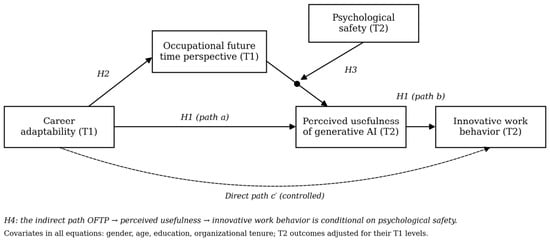
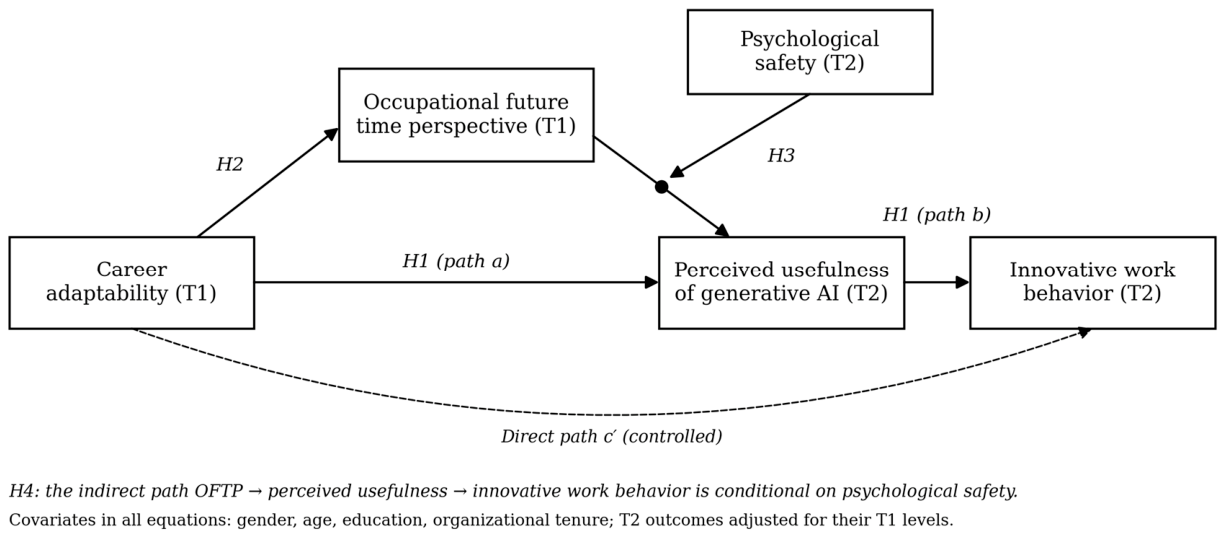
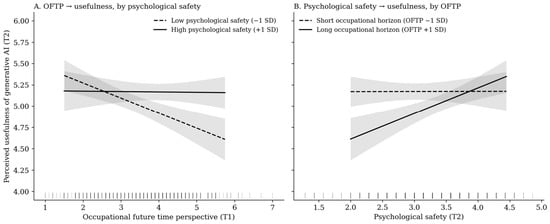
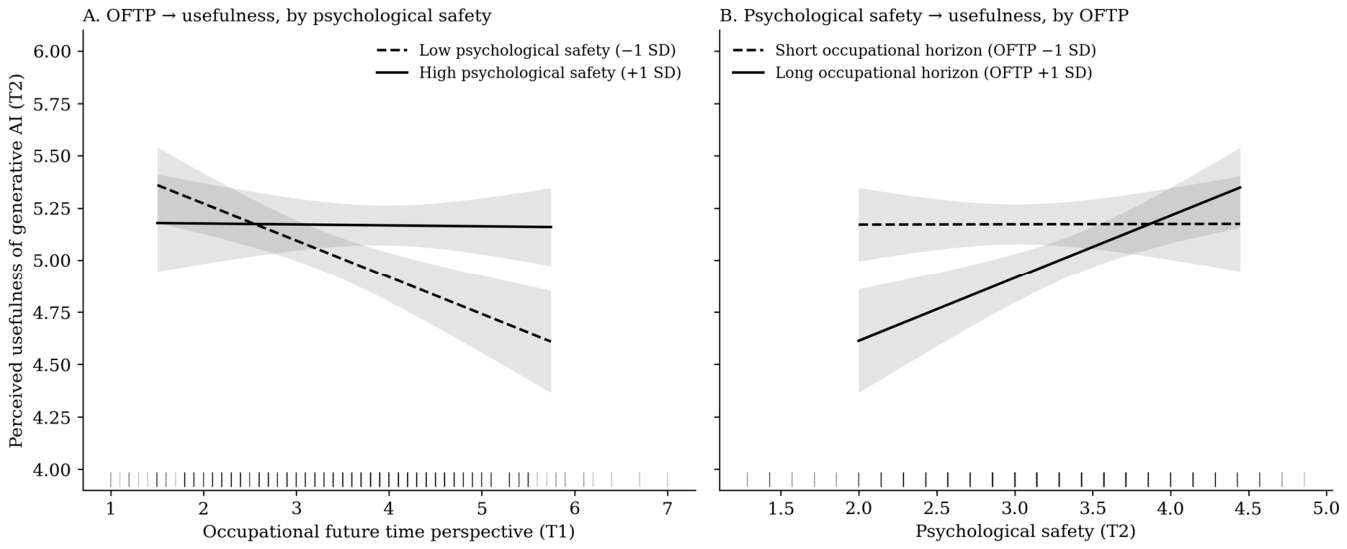

Disclaimer/Publisher’s Note: The statements, opinions and data contained in all publications are solely those of the individual author(s) and contributor(s) and not of MDPI and/or the editor(s). MDPI and/or the editor(s) disclaim responsibility for any injury to people or property resulting from any ideas, methods, instructions or products referred to in the content. |
© 2026 by the authors. Licensee MDPI, Basel, Switzerland. This article is an open access article distributed under the terms and conditions of the Creative Commons Attribution (CC BY) license.