


Abstract
Higher education introduces many challenges and stressors, particularly for young Black men who are underrepresented on university and college campuses, and societal expectations of manhood that emphasize traditional views of masculinity can restrict young Black men’s ability to effectively manage and resolve these stressors. This study examined how traditional masculinity values that promote emotional restriction and minimize vulnerability are associated with Black male college students’ stress and self-efficacy. Data came from a cross-sectional sample of Black male college students (N = 82; Mage = 22.68 years, SD = 4.57; 72.90% undergraduate; 27.10% graduate) in the United States. The results from a path analysis model examining the relations between traditional restrictive masculinity values, adaptive and maladaptive coping behaviors, and perceived stress and self-efficacy indicated that students who endorsed more traditional masculinity values were less likely to report using adaptive coping behaviors that center emotional connection and vulnerability and more likely to utilize maladaptive coping behaviors that center emotional isolation. The use of these more maladaptive coping behaviors was related to greater stress and lower self-efficacy. These results underscore how coping behaviors may be one process underlying the relations between restrictive masculinity attitudes, Black college men’s stress, and self-efficacy.
Keywords:
Black men; college students; coping behaviors; masculinity; stress; self-efficacy; young adult 1. Introduction
Higher education spaces introduce stressors that are uniquely difficult to navigate for many youth, particularly young Black men who are underrepresented in higher education (Palmer et al., 2014), and knowing how to properly navigate these spaces to achieve a college degree is critical for a person’s long-term well-being. Entering higher education and obtaining a postsecondary degree has been, for many, the expected path for a successful transition to adulthood, but the path to a successful transition into and through higher education is complicated by the societal expectations placed on young adults. Specifically, Black young men are left with fewer supports when transitioning into and through higher education spaces because of the societal expectations and structural barriers that hinder their agency and put them at risk of mental health complications (Wallace, 2026; Goodwill et al., 2018). This leaves young Black men at risk; suicide was the third leading cause of death for Black men in the United States (U.S.) ages 18–34 in 2023 (United States Department of Health & Human Services, 2023), and Black college men are less likely than women and white men to seek mental health counseling (Williams et al., 2023). Thus, there is a critical need to identify processes that can promote resilience to stress in Black male college students. Many scholars have highlighted the detrimental influences of patriarchy and traditional masculinity values, such as voluntary isolation, harmful posturing, and increased stoicism, on Black college men’s retention, graduation rates, and gender identity (Dancy, 2012; Harper, 2004; McGowan, 2017), but few have explored the underlying processes that explain how the internalization of these masculinity values shapes their ability to manage stress (e.g., Goodwill et al., 2018; Mincey et al., 2015). The current study is the first to examine one process, the associations of restrictive masculinity values with coping strategies, to explain the relations between restrictive masculinity values and Black male college students’ stress and self-efficacy.
1.1. Conceptualizing the Impacts of Traditional Masculinity Values
This study draws on two theoretical perspectives to help conceptualize the impact of traditional restrictive masculinity values on Black male college students’ stress and self-efficacy: Majors and Billson’s (1992) concept of cool pose, and Butler’s (2016) understanding of vulnerability. Majors and Billson’s (1992) “cool pose” names the self-representations Black men use to establish their male identity to counter and resist the dangers they face, such as over-policing (Shabazz, 2015) and gendered racism (Smith et al., 2016), which are as ever-present on college campuses as they are in broader society. In particular, cool pose is often utilized by Black men as a protective function within racialized social settings such as predominantly white institutions (PWIs). As a ritualized form of traditional masculinity, cool pose includes “physical posturing, impression management, and carefully crafted performances that deliver a single, critical message: pride, strength, and control.” (Majors & Billson, 1992, p. 5). Cool pose is utilized as a form of self-expression, dignity, and confidence, but it can also be framed by strict stoicism, individualism, and emotional isolation. Although it is meant to be protective, this internalization and utilization of traditional restrictive masculinity values highlighted by cool pose can be detrimental to young Black men’s ability to manage stress and develop effective self-efficacy in the face of adversities because it encourages emotional isolation and repression rather than self-expression and emotional connection.
As an alternative to cool pose, Butler’s (2016) conceptualization of vulnerability provides a framework for understanding how the rejection of these restrictive masculinity values can promote resilience to stress in young Black men. At times, vulnerability is conceptualized in ways that describe minoritized people as being more susceptible to hurt and harm (Shi & Stevens, 2021). In contrast, Butler (2016) theorizes vulnerability as a strategic act of resistance to social and political power. Vulnerability can, in part, be conceptualized as the critical social networks and emotionally close relationships that are foundational to human life. When individuals connect with others by being emotionally vulnerable and seeking emotional support, they assert agency against forces of dominance and power. When applied to understandings of young Black men’s experiences, harnessing vulnerability as a form of resistance means rejecting traditional masculinity values that emphasize emotional isolation and restriction and instead embracing connection to others and emotionally supportive relationships when coping with threatening events or stressful circumstances.
While these concepts are used together to construct our framework, some distinctions between them should be clarified. Namely, values of restrictive masculinities might include some of the posturing from cool pose, such as stoicism and emotional restriction; however, cool pose is distinct in that it is a mechanism of coping learned by Black men to counter stereotypes and social dangers they experience as racialized and gendered beings (Majors & Billson, 1992). That is, masculine performances of cool pose are not inherently restrictive masculinities but rather a protective response to social dangers that include restrictive masculine behaviors. In addition, Butler’s (2016) understanding of vulnerability runs in contrast to traditional masculinities in that it describes how marginalized individuals draw on vulnerability such as seeking help through social and emotional support (Brooms, 2020) to resist social powers present in traditional masculinities, such as opposition to femininity and alienation of non-conforming expressions of masculinity (Connell & Messerschmidt, 2005). Ultimately, both theoretical perspectives frame how Black college men’s masculinities relate to the stress management process by identifying the social and contextual factors that inform how young Black men view appropriate displays of manhood in response to stress or threatening circumstances.
Taken together, these theoretical framings both connect and contrast with one another, while illuminating the complexity of Black college men’s ability to cope with stress and develop adaptive self-efficacy. Cool pose (Majors & Billson, 1992) highlights the performative and often emotionally restrictive nature of patriarchal expectations of masculinities, while vulnerability (Butler, 2016) emphasizes one’s agency to resist that emotional restriction and instead embrace connection with others. When applying these frameworks to understanding the relations between restrictive masculinity values and Black male college students’ coping behaviors, differences in how these young adults embrace cool pose or vulnerability might emerge. Cool pose embodies the embracing of traditional masculinity values such as stoicism and isolation, which could drive young Black men to adapt coping behaviors that emphasize isolation and emotional repression, leading to poorer stress management and lower self-efficacy. Alternatively, vulnerability emphasizes the need for connection and emotional closeness, and utilizing emotional vulnerability could be indicated by less endorsement of isolationist views of traditional masculinity and a higher likelihood of young Black men’s use of emotional and social connection as preferred coping behaviors, leading to improved stress management and self-efficacy.
1.2. Empirical Support Linking Masculinity, Coping Behaviors, and Young Black Men’s Outcomes
To date, very little empirical research has examined the links between traditional masculinity values, coping behaviors, and stress and self-efficacy in college students, and far less has centered young Black men in these investigations. Overall, the literature linking traditional restrictive masculinity values and Black men’s well-being is mixed in its findings. Some findings indicate that Black men who endorse traditional masculinity norms that emphasize self-isolation and self-reliance are more likely to report problems such as greater depressive symptoms (Goodwill et al., 2020; Matthews et al., 2013) and less willingness to seek help for mental health problems (Johnson et al., 2024), but another study found no link between restrictive masculinity values and depression but did find that greater endorsement of these values was related to more frequent perceptions of barriers to help-seeking for health concerns (Powell et al., 2016).
More work has focused on understanding the link between coping behaviors and well-being outcomes for Black adults. Qualitative work has demonstrated that Black men of all ages prefer to emphasize their own self-reliance and social supports to cope with stress (Goodwill et al., 2018). Overall, quantitative studies have found that greater endorsement of maladaptive coping behaviors that emphasize avoidance of stress, social isolation, and physical violence is related to poorer stress management and adjustment outcomes in Black men, while endorsement of adaptive coping behaviors that emphasize social and emotional connection is related to better outcomes. Specifically, one study of a diverse group of young adults that included Black men found that avoidance coping was related to higher perceived stress, and Black participants reported the highest levels of avoidance coping (Mair et al., 2023). Additionally, in a study of Black adolescents, utilizing physical violence to cope with stress was related to greater distress when experiencing discriminatory situations (Scott, 2003). Further, studies of mixed-gender Black college students have found conflicting results. Some indicate that more avoidance coping is related to lower self-esteem and life satisfaction (Utsey et al., 2000), greater perceived stress (Barnes & Lightsey, 2005), and greater perceptions of emotional strain when under stress (Hoggard et al., 2012), while others have found that utilizing more adaptive coping behaviors was related to less perceived stress (Greer et al., 2015), and greater perceived social support was related to both less perceived stress and less use of substances as a coping strategy (Pittman et al., 2019). Conversely, other studies have found no link between coping behaviors and felt stress (Greer & Brown, 2011) regardless of the type of coping behaviors being endorsed.
These mixed findings with a lack of emphasis on Black male college students make it difficult to draw effective conclusions from the existing literature. Although some trends in the findings are present, like the relations of coping behaviors and traditional masculinity values with well-being outcomes, the majority of this work does not differentiate young Black men’s experiences and women’s experiences from each other. Men and women, especially in higher education spaces where women now make up the majority of college students (National Center for Education Statistics, n.d.), may have or perceive themselves to have different levels of access to support systems on campus, which can impact what coping behaviors they employ under stress. In studies that do focus on Black men’s experiences, they focus on community samples that also include middle-aged and older adults and do not differentiate based on age. Drawing conclusions based on a broader adult Black male sample may not capture the impact that developmentally specific challenges introduced in early adulthood may present or the unique expectations placed on young Black men as they transition into adulthood. Further, no literature to date has examined the processes associating traditional masculinity values, coping behaviors, and adjustment outcomes, leaving researchers with a substantial gap in the understanding of processes that link masculinity, coping behaviors, and stress and self-efficacy. Thus, although the scant literature does tenuously support the conceptual perspectives of Majors and Billson (1992) and Butler (2016), more work is needed to explicitly examine the relations between traditional masculinity values, coping behaviors, and stress and self-efficacy in Black male college students.
1.3. The Current Study
Based on the theoretical frameworks of cool pose (Majors & Billson, 1992) and Butler’s (2016) theory of vulnerability, this study is the first to date to examine how traditional masculinity values that promote emotional restriction relate to Black male college students’ stress and self-efficacy. Specifically, this study sought to evaluate how these restrictive masculinity values encourage more maladaptive strategies for coping with stress (e.g., disengagement or denial of emotional or stressful circumstances) and discourage more adaptive coping strategies (e.g., seeking emotional support or actively working to manage stress), which can then negatively impact Black men’s abilities to manage stress and feel as if they can be successful in their lives. The current study tested several hypotheses:
H1.
Greater endorsement of restrictive masculinity values will be directly related to less use of adaptive coping behaviors and greater use of maladaptive coping behaviors.
H2.
Greater endorsement of restrictive masculinity values will be directly related to lower self-efficacy and higher stress levels.
H3.
More adaptive coping behaviors will be directly related to lower stress and greater self-efficacy, and more maladaptive coping behaviors will be directly related to higher stress and lower self-efficacy.
H4.
Greater endorsement of restrictive masculinity values will be indirectly related to lower self-efficacy and higher stress through a decrease in adaptive coping behaviors and an increase in maladaptive coping behaviors.
2. Materials and Methods
2.1. Participants and Procedure
The sample consisted of 82 Black male students (ages 18–34, Mage = 22.68 years, SD = 4.57) enrolled at a college or university in the U.S. (72.90% undergraduate; 27.10% graduate) from September 2025 through May 2026. Half of the students (51.40%) came from families where at least one parent or caregiver had completed a four-year degree, and most participants (78.50%) identified as straight/heterosexual. Most students (75.47%) were enrolled at public, four-year institutions, and most (79.44%) attended primarily white institutions (PWIs). The sample represented students attending 42 different colleges and universities across the U.S.
Participants were recruited through snowball sampling in person on campuses across the U.S. and through online social media platforms and email listservs. Students were eligible for participation if they (1) identified as a black man, (2) were a U.S. citizen, and (3) were enrolled in a college or university and had been enrolled at a college or university for at least one year. U.S. citizenship was a requirement for participation because international students may have substantially different experiences in higher education spaces in relation to their race and ethnicity, warranting exploration that was beyond the scope of the current study. Eligible participants completed an online, mobile-compatible survey through the Qualtrics survey platform (Provo, UT, USA) that asked about their endorsement of traditional masculinity values, the coping behaviors they typically employ when encountering stressful situations, and their perceptions of their felt stress and self-efficacy. Once the participants completed the survey, they were asked to provide their university-issued email address to receive monetary compensation in the form of a US$15 virtual gift card for a popular online shopping site. The data were checked for duplicate and automated responses using the response quality functions (e.g., reCAPTCHA completion, IP address records) embedded in Qualtrics. Responses from 13 individuals were not included in the analyses due to concerns with duplication or automated responses, resulting in a final sample of 82 participants.
2.2. Measures
2.2.1. Restrictive Masculinity Values
Three scales were combined to represent overall restrictive masculinity values. Participants responded to the 10-item restrictive emotionality subscale from the Male Role Norms Inventory (MNRI; Levant et al., 1992) that asks individuals how much they agree with statements asserting the expectations for men to restrict or hide their emotional states (e.g., “nobody likes a man who cries in public”). Response options ranged from 1 (strongly disagree) to 7 (strongly agree). Participants also responded to 16 items from the Male Role Norms Scale (MRNS, Thompson & Pleck, 1986), representing a person’s attitudes regarding the social roles a man should play in society. These 16 items represent two subscales: the toughness subscale, examining a person’s agreement with statements that assert men should be tough and reliant (eight items, e.g., “when a man is feeling a little pain he should try not to let it show very much”), and the anti-femininity subscale, examining a person’s agreement that men should avoid stereotypical feminine activities (eight items, e.g., “it is a bit embarrassing for a man to have a job that is usually filled by a woman”). Response options ranged from 1 (very strongly disagree) to 7 (very strongly agree). The items were averaged to create overall restrictive emotionality (α = 0.77), toughness (α = 0.74), and anti-femininity (α = 0.86) scores. Because the intercorrelations between the three subscales could be classified as moderate to strong (r = 0.53–0.66; see Table 1) based on criteria established by J. Cohen (1988) and to accommodate the small sample size and reduce the number of observed variables utilized in the analyses, a composite score combining the three subscales was calculated using principal component analysis to represent overall restrictive masculinity values (see Supplementary Table S1), with higher scores indicating greater endorsement of traditional restrictive masculinity values.
Table 1.
Descriptive statistics and bivariate relations for all study variables.
2.2.2. Coping Behaviors
Participants responded to 12 items from the Brief Coping Orientation to Problems Experienced Inventory (Brief COPE; Carver, 1997), which is designed to assess the various coping behaviors and strategies a person engages in when experiencing stress. Six items represented a person’s use of adaptive coping behaviors like active coping (two items, e.g., “I’ve been taking action to try to make the situation better”), emotional support (two items, e.g., “I’ve been getting emotional support from others”), and positive reframing (two items, e.g., “I’ve been looking for something good in what is happening”), and the other six items represented a person’s use of maladaptive coping behaviors, such as denial (two items, e.g., “I have been refusing to believe that it has happened”), disengagement (two items, e.g., “I’ve been giving up trying to deal with it”), and venting emotions (two items, e.g., “I’ve been saying things to let my unpleasant feelings escape”). These items were chosen over others in the Brief COPE to represent adaptive and maladaptive coping for two reasons. First, prior theoretical conceptualizations of adaptive and maladaptive coping suggest this alignment based on the original scale design (Carver et al., 1989). Second, these particular subscales highlight emotional and behavioral coping orientations related to cool pose and emotional vulnerability. For example, the items representing emotional support indicate an endorsement of using support from others to manage stress, which might require a level of vulnerability regarding what is causing their stress and how they feel about the situation in order for that coping strategy to be effective. Response options ranged from 1 (I usually don’t do this at all) to 4 (I usually do this a lot). Individual items were averaged to create overall adaptive coping behavior (α = 0.71) and maladaptive coping behavior (α = 0.65) scores, with higher scores indicating greater use of the coping behaviors. Although the reliability analysis for the overall maladaptive coping score was lower than what is ideal, it is consistent with the scale loading reported when the Brief COPE subscales were developed (Carver, 1997; Cronbach’s alphas ranging from 0.50 to 0.65 for the individual subscales).
2.2.3. Perceived Stress
Participants responded to the 10-item Perceived Stress Scale (PSS; S. Cohen et al., 1983), designed to measure the level of stress a person has felt in the past month (e.g., “in the last month, how often have you felt nervous or stressed?”). Response options ranged from 0 (never) to 4 (very often). The items were averaged to create an overall perceived stress score (α = 0.82), with higher scores indicating more felt stress in the past month.
2.2.4. Self-Efficacy
Participants responded to the 10-item General Self-Efficacy Scale (GSES; Schwarzer & Jerusalem, 1995), which is designed to measure a person’s belief that they can accomplish tasks or goals (e.g., “if I am in trouble, I can usually think of a solution”). Response options range from 1 (not at all true) to 4 (exactly true). The items were averaged to create an overall self-efficacy score (α = 0.90), with higher scores indicating greater self-efficacy.
2.2.5. Demographic Information
Participants reported their age, sexual orientation, and the highest degree earned by their parent(s) or primary caregiver(s). Sexual orientation was coded to represent individuals who identified as either straight/heterosexual (0) or as a sexual minority (i.e., gay/homosexual, bisexual, queer, pansexual, asexual, or other; 1). Caregiver education was coded as individuals whose parent(s) or caregiver(s) had either earned a 4-year undergraduate degree (1) or had not (0). Age was included as a covariate to account for potential age differences in the sample of students that spans a 16-year age range. Sexual orientation was included because young Black men who identify as a sexual minority may have different experiences with how they conceptualize their masculinity ideals when compared to Black men who identify as straight or heterosexual, which may influence how their views about manhood are associated with their stress management processes. Caregiver education was also included because first-generation college students may experience more problems with the transition into and through higher education (Jenkins et al., 2013) and are less likely than their continuing-education classmates to seek mental health services (Lipson et al., 2023), and these differences may influence how they manage stress.
2.3. Analysis Plan
Data were analyzed using Mplus 8.11 (Muthén & Muthén, 2024; Los Angeles, CA, USA). A single path analysis was estimated using maximum likelihood to examine the hypothesized relations. The path model estimated the direct relations of (1) restrictive masculinity with both adaptive and maladaptive coping behaviors, (2) both adaptive and maladaptive coping behaviors with both perceived stress and self-efficacy, and (3) restrictive masculinity with both perceived stress and self-efficacy. A bootstrapping approach using 5000 resamples (Shrout & Bolger, 2002) was used to estimate the bias-corrected confidence intervals of each indirect effect of restrictive masculinity on both self-efficacy and perceived stress through both adaptive and maladaptive coping strategies, resulting in four indirect effects being estimated. Age, sexual orientation, and caregiver education were included in the model as covariates. The model was estimated using Full Information Maximum Likelihood (FIML) to account for any missing data (Enders, 2022). Although fit statistics would typically be evaluated to determine the adequacy of model fit, the just-identified model (df = 0) provided no meaningful fit statistics. Instead, evaluation of the model fit relies on the magnitude, direction, and significance of the estimated direct and indirect relations (Hayes, 2022). There is no consensus in the literature on what sample size is needed to examine path analysis and individual indirect effect detection (see Hayes, 2022, Chapter 14.3 for a summary of these limitations), but Fritz and MacKinnon (2007) offer guidance on the sample size required for bias-corrected bootstrapping resampling procedures. According to their estimates, the analyses would need a sample size of 71–115 to detect each meaningful indirect effect being tested in the model, providing evidence that our sample size of 82, while small, is adequate.
3. Results
Descriptive statistics and bivariate correlations are presented in Table 1. Greater endorsement of restrictive masculinity values was significantly related to more maladaptive coping behaviors and greater perceived stress. Restrictive masculinity values were not significantly related to either adaptive coping behaviors or self-efficacy. More maladaptive coping behaviors were significantly related to greater perceived stress and lower self-efficacy, while more adaptive coping behaviors were only related to more self-efficacy.
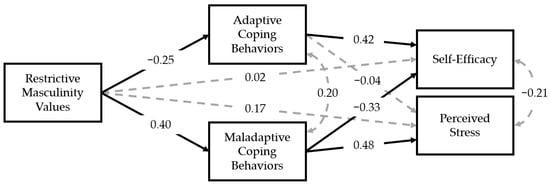
The path model examining the direct and indirect relations between restrictive masculinity, coping behaviors, and perceived stress and self-efficacy is presented in Figure 1 and Supplementary Table S2. The model accounted for 33.5% of the variance in perceived stress and 29.8% of the variance in self-efficacy. As hypothesized, restrictive masculinity was directly related to both adaptive and maladaptive coping behaviors (Hypothesis 1), such that greater endorsement of restrictive masculinity values was related to fewer adaptive coping behaviors and more maladaptive coping behaviors. Contrary to Hypothesis 2, restrictive masculinity was not directly related to either perceived stress or self-efficacy. Adaptive coping behaviors were only directly related to self-efficacy, such that more adaptive coping behaviors were related to greater self-efficacy. Moreover, maladaptive coping behaviors were directly related to both self-efficacy and perceived stress, such that more maladaptive coping behaviors were related to lower self-efficacy and more perceived stress, providing partial support for Hypothesis 3.
Figure 1.
Path analysis estimating the relations between restrictive masculinity values, coping behaviors, and perceived stress and self-efficacy in Black male college students. Standardized estimates (β) are reported. Age, sexual orientation, and caregiver education are included as covariates. Model fit indices are unavailable due to the model being just-identified (df = 0). Solid lines indicate an effect significant at p < 0.05; dashed lines indicate a non-significant effect.
An examination of the indirect effects from restrictive masculinity values to self-efficacy and perceived stress through coping behaviors revealed several significant relations that partially supported Hypothesis 4 (see Table 2). Restrictive masculinity was significantly associated with self-efficacy through both adaptive and maladaptive coping behaviors, such that more restrictive masculinity values were indirectly associated with lower self-efficacy through both fewer adaptive coping behaviors and more maladaptive coping behaviors. Restrictive masculinity values were also indirectly associated with perceived stress through maladaptive coping behaviors, such that greater endorsement of restrictive masculinity values was associated with more perceived stress through more maladaptive coping behaviors. Adaptive coping behaviors did not significantly account for the indirect association between restrictive masculinity values and perceived stress.
Table 2.
Estimated indirect relations of restrictive masculinity values with perceived stress and self-efficacy through coping behaviors.
4. Discussion
As young Black men in the U.S. enter higher education spaces as part of their transition to adulthood, there is a critical need to identify the processes that underlie their ability to manage stress and develop self-efficacy. Using a combination of Majors and Billson’s (1992) cool pose and Butler’s (2016) vulnerability as a framework, which describe the maladaptive effects that traditional restrictive masculinity has on Black young men’s well-being, this study was the first to examine how young Black male college students’ internalization of traditional masculinity values relates to the coping behaviors they employ and their stress and self-efficacy levels. The findings indicated that men who endorsed more restrictive masculinity values utilized more maladaptive coping strategies that emphasize denial and isolation and utilized fewer adaptive coping behaviors that center emotional support and problem-focused behaviors. Moreover, although traditional masculinity values were not directly related to young Black men’s perceptions of their stress and self-efficacy, greater endorsement of traditional masculinity values was indirectly associated with both stress and self-efficacy through their coping behaviors.
The findings from this study underscore how traditional views of masculinity that restrict men from social connectedness and emotional closeness are related to Black male college students’ well-being. Consistent with conceptualizations asserted by Majors and Billson’s (1992) cool pose and Butler’s (2016) theory of vulnerability, young Black men who endorsed more restrictive views of masculinity (i.e., endorsing the isolation, stoicism, and individualism embodied in cool pose) were less likely to employ adaptive coping behaviors that center emotional connection and vulnerability with others and were more likely to utilize maladaptive coping behaviors that center disengagement and isolation. These men who emphasized isolation and restriction in how they coped with stress also reported higher levels of perceived stress and fewer feelings of effectively succeeding in their lives (i.e., self-efficacy). Conversely, Black men who did not endorse restrictive perspectives of masculinity were more likely to seek emotional support and connection to others, which requires the utilization of social and emotional vulnerability when seeking that support. This emotional support for Black men was drawn on as a coping mechanism, which was then associated with greater feelings of self-efficacy in their lives.
These results are consistent with empirical findings that also highlight the detrimental relations of restrictive masculinity with Black men’s mental health (Goodwill et al., 2020; Johnson et al., 2024; Matthews et al., 2013), but the current study expands on past work by identifying coping behaviors as a potential underlying process in the association between young Black men’s ideas about manhood and their stress and self-efficacy. We found that, while restrictive masculinity values were related to young Black men’s perceived stress at the bivariate level, both maladaptive and adaptive coping behaviors were identified as a factor that links restrictive masculinity values to both young Black men’s stress and self-efficacy. Thus, these findings are the first to identify that these restrictive masculinity values may not directly relate to a Black male student’s stress or self-efficacy; instead, they relate to the critical coping processes young Black men need to effectively manage stress and develop self-efficacy as they move through higher education.
Interestingly, although adaptive coping behaviors were not initially correlated with restrictive masculinity values, a significant positive relation was present between adaptive coping behaviors and restrictive masculinity in the full path model. This could indicate that, once the shared variance between maladaptive and adaptive coping behaviors is accounted for, the association between adaptive coping behaviors and restrictive masculinity can be more precisely identified. This unexpected finding further emphasizes the need to more comprehensively examine the complex nature of these interrelations in young Black college students. Research may miss- or under-identify the nuanced relations between these constructs if the findings are not accounting for the complex processes and interrelated similar constructs when examining how Black male college students navigate and mitigate stressful circumstances in higher education spaces. Moreover, the social settings in which Black men engage are implicated in their coping processes. That is, Black men often draw on cool pose to counter experiences of racialized and gendered stress (Smith et al., 2016) they experience as part of the campus climate in PWI settings (Harris et al., 2011). Thus, Black men’s use of cool pose represents a complex gender posturing, where emotional vulnerability is potentially restricted for fear of social dangers.
Ultimately, this work signals the need for greater focus in higher education to support Black college men, and these preliminary findings may provide a more nuanced perspective of the underlying associations between restrictive masculinity values and stress and self-efficacy than what is present in the existing literature that may inform interventions. For example, the online YBMen Project (Watkins et al., 2020), which seeks to support young Black men and boys with the pressures they face surrounding manhood during the transition to adulthood, might find these results useful in determining how to best support young Black men seeking to enter higher education spaces. And, although more research is needed to pinpoint the clinical relevance and generalizability of the results of this study, these preliminary findings could also inform further development of similar interventions to help young Black men employ more effective coping behaviors when they experience stress. Higher education presents unique challenges that can be stressful for young Black men (e.g., networking, time management, semi-structured independence), and developing a more diverse set of coping tools to manage those challenges could also help mitigate any negative influences that restrictive masculinity expectations impose.
The findings need to be considered in the context of several limitations. The cross-sectional design of this study does not allow for causal inference. Specifically, we cannot rule out that the participants’ baseline levels of stress and self-efficacy or the origins of the stress they are experiencing (e.g., from coursework deadlines vs. racial discrimination) might impact either the masculinity values they endorse or the coping behaviors they choose to utilize, and we cannot determine how early these processes develop in young Black men. We also cannot determine how inter-relational and systemic race-related factors central to the experiences of Black male college students (e.g., discrimination and microaggressions, social support availability, overall university climate and belongingness) may impact the coping processes examined here. This study also cannot delineate how diverse restrictive masculinity values may each be differentially associated with coping behaviors and stress and self-efficacy. Further, because the study utilized only self-report measures of all variables of interest, participant responses may suffer from a social desirability bias, especially on concepts tied to strong societal views of manhood or the utilization of coping behaviors that these young men may consider wrong or inappropriate. Moreover, the small sample size collected through snowball sampling of self-selected students from predominantly public, 4-year, primarily white institutions may make it difficult to generalize these findings to students on Historically Black College and University (HBCU) campuses, private campuses, or at 2-year institutions and may overrepresent individuals with similar experiences. Additionally, although over 20% of the sample identified as a sexual minority (i.e., gay/homosexual, bisexual, queer, pansexual, asexual, or other), the study’s small sample size did not allow us to account for potential differences between these identities, and these young Black men may have different experiences regarding how they conceptualize and internalize their masculinity ideals when compared to young Black men who identify as straight or heterosexual, which may influence how their views about manhood are associated with their coping behaviors and stress and self-efficacy. The same may be true for young Black male international students, who were not included in this study; their internalization of U.S. expectations of traditional restrictive masculinity and the unique acculturative strains experienced by many international students may change how these young men cope with stress.
Future research can build on the results from this study in several ways. Using a large, diverse sample of Black male college students with proportional representation of students from PWIs, HBCUs, private, public, 4-year, and 2-year institutions would allow for better generalizability of the results and allow for comparisons to be made based on the type of higher education institutions these young men attend, their sexual identity, and their international student status. Integration of systemic race-related factors (e.g., experiences with discrimination on campus) that may influence the associations between masculinity values, coping behaviors, and Black men’s stress and self-efficacy would provide a more nuanced examination of the challenges Black male college students face in higher education spaces and the competencies these young men use to cope. Longitudinal studies aimed at determining when these relations first arise for young men and boys and how long into adulthood the relations persist would also provide more information for potential intervention timelines to help young Black men develop more effective coping behaviors and mitigate the negative effects of traditional restrictive masculinity values. Finally, this study only focused on two outcomes, perceived stress and self-efficacy, and future research can expand this work by examining a broader selection of both general and academic-specific outcomes to elucidate how generalizable the relations between traditional restrictive masculinity values and Black male college students’ adjustment may be.
5. Conclusions
This study, examining the relations between restrictive masculinity values, coping behaviors, and stress and self-efficacy in Black male college students, emphasizes the need for further research targeting the strengths and needs of young Black men as they transition into and through higher education. The findings identify coping behaviors as one potential process that underlies how internalized feelings of restrictive masculinity are associated with Black male college students’ stress and self-efficacy, providing a preliminary identification of an opportunity to focus on both coping behaviors and young men’s conceptualizations of manhood as intervention targets. The results suggest the need to further examine these effects in large, diverse sample of young Black men to fully capture the nuances of these relations and effectively apply the findings to better support young Black men on college campuses across the U.S.
Supplementary Materials
The following supporting information can be downloaded at https://www.mdpi.com/article/10.3390/bs16112044/s1. Table S1: Results from the principal component analysis used to combine the three restrictive masculinity scores into a single overall score; Table S2: Results from the path analysis estimating the relations between restrictive masculinity values, coping behaviors, and perceived stress and self-efficacy in Black male college students.
Author Contributions
Conceptualization, C.D.T. and J.W.; Methodology, C.D.T.; Formal Analysis, C.D.T.; Data Curation, C.D.T.; Writing—Original Draft Preparation, C.D.T. and J.W.; Writing—Review and Editing, C.D.T. and J.W.; Project Administration, C.D.T. and J.W.; Funding Acquisition, C.D.T. and J.W. All authors have read and agreed to the published version of the manuscript.
Funding
The research reported in this article was made possible by a grant from the Spencer Foundation (#202600157). The views expressed are those of the authors and do not necessarily reflect the views of the Spencer Foundation.
Institutional Review Board Statement
The study was conducted in accordance with the Declaration of Helsinki and approved by the Institutional Review Board of the University of Louisville (IRB number 25.0134, approved on 14 March 2025).
Informed Consent Statement
Informed consent was obtained from all subjects involved in the study.
Data Availability Statement
The raw, de-identified data supporting the conclusions of this article will be made available by the authors on request.
Conflicts of Interest
The authors declare no conflicts of interest.
Abbreviations
The following abbreviations are used in this manuscript:
| PWIs | Primarily White Institutions |
| HBCUs | Historically Black Colleges and Universities |
References
- Barnes, P. W., & Lightsey, O. R. (2005). Perceived racist discrimination, coping, stress, and life satisfaction. Journal of Multicultural Counseling and Development, 33(1), 48–61. [Google Scholar] [CrossRef] [Scilit]
- Brooms, D. R. (2020). Helping us think about ourselves: Black males’ sense of belonging through connections and relationships with faculty in college. International Journal of Qualitative Studies in Education, 33(9), 921–938. [Google Scholar] [CrossRef] [Scilit]
- Butler, J. (2016). Rethinking vulnerability and resistance. In J. Butler, Z. Gambetti, & L. Sabsay (Eds.), Vulnerability in resistance (pp. 12–27). Duke University Press. [Google Scholar] [CrossRef] [Scilit]
- Carver, C. S. (1997). You want to measure coping but your protocol is too long: Consider the brief cope. International Journal of Behavioral Medicine, 4(1), 92–100. [Google Scholar] [CrossRef] [Scilit] [PubMed]
- Carver, C. S., Scheier, M. F., & Weintraub, J. K. (1989). Assessing coping strategies: A theoretically based approach. Journal of Personality and Social Psychology, 56(2), 267–283. [Google Scholar] [CrossRef] [PubMed]
- Cohen, J. (1988). Statistical power analysis for the behavioral sciences (2nd ed.). Erlbaum. [Google Scholar]
- Cohen, S., Kamarck, T., & Mermelstein, R. (1983). A global measure of perceived stress. Journal of Health and Social Behavior, 24(4), 385–396. [Google Scholar] [CrossRef] [Scilit]
- Connell, R. W., & Messerschmidt, J. W. (2005). Hegemonic masculinity: Rethinking the concept. Gender and Society, 19(6), 829–859. [Google Scholar] [CrossRef] [Scilit]
- Dancy, T. E. (2012). The brother code: Manhood and masculinity among African American males in college. Information Age Publishing. [Google Scholar]
- Enders, C. K. (2022). Applied missing data analysis (2nd ed.). The Guilford Press. [Google Scholar]
- Fritz, M. S., & MacKinnon, D. P. (2007). Required sample size to detect the mediated effect. Psychological Science, 18(3), 233–239. [Google Scholar] [CrossRef] [Scilit] [PubMed]
- Goodwill, J. R., Johnson, N. C., & Watkins, D. C. (2020). Adherence to masculine norms and depressive symptoms in young Black men. Social Work, 65(3), 235–244. [Google Scholar] [CrossRef] [Scilit] [PubMed]
- Goodwill, J. R., Watkins, D. C., Johnson, N. C., & Allen, J. O. (2018). An exploratory study of stress and coping among Black college men. American Journal of Orthopsychiatry, 88(5), 538–549. [Google Scholar] [CrossRef] [Scilit] [PubMed]
- Greer, T. M., & Brown, P. (2011). Minority status stress and coping processes among African American college students. Journal of Diversity in Higher Education, 4(1), 26–38. [Google Scholar] [CrossRef] [Scilit]
- Greer, T. M., Ricks, J., & Baylor, A. A. (2015). The moderating role of coping strategies in understanding the effects of intragroup race-related stressors on academic performance and overall levels of perceived stress for African American students. Journal of Black Psychology, 41(6), 565–585. [Google Scholar] [CrossRef] [Scilit]
- Harper, S. R. (2004). The measure of a man: Conceptualizations of masculinity among high-achieving African American male college students. Berkeley Journal of Sociology, 48, 89–107. [Google Scholar]
- Harris, F., Palmer, R. T., & Struve, L. E. (2011). “Cool posing” on campus: A qualitative study of masculinities and gender expression among Black men at a private research institution. Journal of Negro Education, 80(1), 47–62. [Google Scholar]
- Hayes, A. F. (2022). Introduction to mediation, moderation, and conditional process analysis: A regression-based approach (3rd ed.). The Guilford Press. [Google Scholar]
- Hoggard, L. S., Byrd, C. M., & Sellers, R. M. (2012). Comparison of African American college students’ coping with racially and nonracially stressful events. Cultural Diversity & Ethnic Minority Psychology, 18(4), 329–339. [Google Scholar] [CrossRef] [Scilit] [PubMed]
- Jenkins, S. R., Belanger, A., Connally, M. L., Boals, A., & Durón, K. M. (2013). First-generation undergraduate students’ social support, depression, and life satisfaction. Journal of College Counseling, 16(2), 129–142. [Google Scholar] [CrossRef] [Scilit]
- Johnson, A., Amonoo, L., Lofton, S., & Powell-Roach, K. L. (2024). How masculinity impedes African American men from seeking mental health treatment. American Journal of Men’s Health, 18(5), 15579883241278846. [Google Scholar] [CrossRef] [Scilit] [PubMed]
- Levant, R. F., Hirsch, L. S., Celentano, E., & Cozza, T. M. (1992). The male role: An investigation of contemporary norms. Journal of Mental Health Counseling, 14(3), 325–337. [Google Scholar]
- Lipson, S. K., Diaz, Y., Davis, J., & Eisenberg, D. (2023). Mental health among first-generation college students: Findings from the national healthy minds study, 2018–2021. Cogent Mental Health, 2(1), 2220358. [Google Scholar] [CrossRef] [Scilit] [PubMed]
- Mair, C. A., Peek, M. K., Slatcher, R. B., & Cutchin, M. P. (2023). Examining racial/ethnic disparities in coping and stress within an environmental riskscape. Journal of Immigrant and Minority Health, 25(5), 1033–1042. [Google Scholar] [CrossRef] [Scilit] [PubMed]
- Majors, R., & Billson, J. M. (1992). Cool pose: The dilemmas of Black manhood in America. Touchstone. [Google Scholar]
- Matthews, D. D., Hammond, W. P., Nuru-Jeter, A., Cole-Lewis, Y., & Melvin, T. (2013). Racial discrimination and depressive symptoms among African-American men: The mediating and moderating roles of masculine self-reliance and John Henryism. Psychology of Men & Masculinity, 14(1), 35–46. [Google Scholar] [CrossRef] [Scilit] [PubMed]
- McGowan, B. L. (2017). Visualizing peer connections: The gendered realities of African American college men’s interpersonal relationships. Journal of College Student Development, 58(7), 983–1000. [Google Scholar] [CrossRef] [Scilit]
- Mincey, K., Alfonso, M., Hackney, A., & Luque, J. (2015). The influence of masculinity on coping in undergraduate Black men. The Journal of Men’s Studies, 23(3), 315–330. [Google Scholar] [CrossRef] [Scilit]
- Muthén, L., & Muthén, B. (2024). Mplus user’s guide (8th ed.). Muthén & Muthén. [Google Scholar]
- National Center for Education Statistics. (n.d.). Trend generator. U.S. Department of Education, Institute of Education Sciences. Available online: https://nces.ed.gov/ipeds/trendgenerator/app/answer/2/2?sideid=13--%7C1%7C2 (accessed on 2 September 2026).
- Palmer, R. T., Wood, J. L., Dancy, T. E., & Strayhorn, T. L. (2014). Black male collegians: Increasing access, retention, and persistence in higher education: ASHE higher education report 40: 3. John Wiley & Sons. [Google Scholar]
- Pittman, D. M., Quayson, A. A., Rush, C. R., & Minges, M. L. (2019). Revisiting resilience: Examining the relationships between stress, social support, and drinking behavior among black college students with parental substance use disorder histories. Journal of Ethnicity in Substance Abuse, 21(1), 90–111. [Google Scholar] [CrossRef] [Scilit] [PubMed]
- Powell, W., Adams, L. B., Cole-Lewis, Y., Agyemang, A., & Upton, R. D. (2016). Masculinity and race-related factors as barriers to health help-seeking among African American men. Behavioral Medicine, 42(3), 150–163. [Google Scholar] [CrossRef] [Scilit] [PubMed]
- Schwarzer, R., & Jerusalem, M. (1995). Generalized Self-Efficacy scale. In J. Weinman, S. Wright, & M. Johnston (Eds.), Measures in health psychology: A user’s portfolio. Causal and control beliefs (pp. 35–37). NFER-NELSON. [Google Scholar]
- Scott, L. D. (2003). Correlates of coping with perceived discriminatory experiences among African American adolescents. Journal of Adolescence, 27(2), 123–137. [Google Scholar] [CrossRef] [Scilit] [PubMed]
- Shabazz, R. (2015). Spatializing blackness: Architectures of confinement and black masculinity in Chicago. University of Illinois Press. [Google Scholar]
- Shi, L., & Stevens, G. D. (2021). Vulnerable populations in the United States. John Wiley & Sons. [Google Scholar]
- Shrout, P. E., & Bolger, N. (2002). Mediation in experimental and nonexperimental studies: New procedures and recommendations. Psychological Methods, 7, 422–445. [Google Scholar] [CrossRef]
- Smith, W. A., Mustaffa, J. B., Jones, C. M., Curry, T. J., & Allen, W. R. (2016). ‘You make me wanna holler and throw up both my hands!’: Campus culture, Black misandric microaggressions, and racial battle fatigue. International Journal of Qualitative Studies in Education, 29(9), 1189–1209. [Google Scholar] [CrossRef] [Scilit]
- Thompson, E. H., Jr., & Pleck, J. H. (1986). The structure of male role norms. American Behavioral Scientist, 29(5), 531–543. [Google Scholar] [CrossRef] [Scilit]
- United States Department of Health & Human Services. (2023). Leading causes of death. Centers for Disease Control and Prevention. Available online: https://wisqars.cdc.gov/lcd/?o=LCD&y1=2018&y2=2023&ct=10&cc=ALL&g=00&s=1&r=2&ry=2&e=0&ar=lcd1age&at=groups&ag=lcd2age&a1=0&a2=80 (accessed on 10 August 2026).
- Utsey, S. O., Ponterotto, J. G., Reynolds, A. L., & Cancelli, A. A. (2000). Racial discrimination, coping, life satisfaction, and self-esteem among African Americans. Journal of Counseling & Development, 78(1), 72–80. [Google Scholar] [CrossRef] [Scilit]
- Wallace, J. D. (2026). Origins of departure: Agency and typologies of Black graduate men’s subversive masculinities. American Educational Research Journal, 1–34. [Google Scholar] [CrossRef] [Scilit]
- Watkins, D. C., Goodwill, J. R., Johnson, N. C., Casanova, A., Wei, T., Allen, J. O., Williams, E.-D. G., Anyiwo, N., Jackson, Z. A., Talley, L. M., & Abelson, J. M. (2020). An online behavioral health intervention promoting mental health, manhood, and social support for young Black men: The YBMen Project. American Journal of Men’s Health, 14(4). [Google Scholar] [CrossRef] [Scilit] [PubMed]
- Williams, K. D. A., Adkins, A., Kuo, S. I., LaRose, J. G., Utsey, S. O., Guidry, J. P. D., Spit for Science Working Group, Dick, D., & Carlyle, K. E. (2023). Mental health disorder symptom prevalence and rates of help-seeking among university-enrolled emerging adults. Journal of American College Health, 71(1), 61–68. [Google Scholar] [CrossRef] [Scilit] [PubMed]

Disclaimer/Publisher’s Note: The statements, opinions and data contained in all publications are solely those of the individual author(s) and contributor(s) and not of MDPI and/or the editor(s). MDPI and/or the editor(s) disclaim responsibility for any injury to people or property resulting from any ideas, methods, instructions or products referred to in the content. |
© 2026 by the authors. Licensee MDPI, Basel, Switzerland. This article is an open access article distributed under the terms and conditions of the Creative Commons Attribution (CC BY) license.