


Abstract
Teachers’ well-being and occupational stress may coexist in complex ways. However, their configurations and associations with work engagement among university English teachers remain insufficiently understood. This study identified latent profiles of subjective well-being and perceived occupational stress and examined their demographic associations and engagement differences. Using convenience sampling, we collected cross-sectional survey data from 536 English teachers at six public universities in Northeast China. Nine profile indicators comprised two dimensions of teacher subjective well-being: school belonging and teaching self-efficacy, and seven perceived occupational stress domains: academic research, organizational functioning, professional development, career promotion, English language teaching, workload, and interpersonal relationships. Latent profile analysis was followed by R3STEP analysis of demographic associations and BCH comparisons of work engagement and its three dimensions: vigor, dedication, and absorption. Four profiles emerged: the High Well-Being and High Task-Related Stress Profile (P1), the Moderate Well-Being and Moderate Stress Profile (P2), the High Well-Being and Low Stress Profile (P3), and the Low Belonging and Multidimensionally High Stress Profile (P4). Their proportions based on most likely assignments were 19.0%, 27.2%, 6.3%, and 47.4%. Only academic rank showed a significant overall association with profile membership after adjustment. Across all four engagement outcomes, P1 scored significantly higher than P4 and P2, while P3 and P4 scored significantly higher than P2. These findings link configurations of organizational connectedness, perceived teaching competence, and domain-specific stress to differences in work engagement. They provide configurational evidence rather than a causal test of Job Demands–Resources theory.
1. Introduction
Teacher well-being has become an important concern in higher education (Hascher & Waber, 2021). Teachers’ occupational experiences influence individual professional development, students’ learning experiences and the long-term vitality of organizations (Wu & Liu, 2026). A systematic review indicates that these experiences are shaped by individual, work-related, and organizational factors (J. Li et al., 2025). Understanding these experiences therefore requires attention to both positive experiences and perceived occupational stress, which need not fall at opposite ends of a single continuum. Research has examined associations among teachers’ work characteristics, psychological experiences, and work engagement (W. Li & Kou, 2018; Xu & Jia, 2022). Person-centered studies add another perspective by showing that positive and negative experiences can occur together within distinct groups of teachers (Gao et al., 2025; Huang et al., 2024; Salmela-Aro et al., 2019). These findings demonstrate the value of examining configurations rather than relying on average associations. Teachers’ work contexts and professional responsibilities may shape which experiences occur together.
Teachers of English as a foreign language (EFL) at Chinese universities provide a specific context for examining these configurations. They deliver language instruction, adapt to curriculum reform, and undertake assessment tasks (Chen et al., 2023; Ni, 2024). They also face demands related to academic promotion, research output, and institutional service (W. Li & Kou, 2018; Meng & Wang, 2018; Wu & Liu, 2026). This combination of responsibilities across work domains makes university EFL teachers a relevant group for examining how perceived stress combines with positive occupational experiences. Separate indicators are therefore needed to examine whether positive experiences coexist with pressure in particular work domains. Their teaching and research roles also need to be understood in relation to their institutional settings (Y. Li & Xu, 2024; Xu & Jia, 2022; Liu & McVee, 2025). The present study therefore focuses on EFL teachers at public universities in Northeast China. The region has an established higher education system and is experiencing demographic and institutional change (Ma & Xiong, 2026; Yu et al., 2025). This regional focus provides a defined setting for examining their occupational experiences.
Three questions remain in the existing literature. First, latent profile studies have focused on primary and secondary school educators (Holmström et al., 2023). Whether their findings apply to university EFL teachers whose occupational stress arises from a unique domain composition requires direct examination. Second, previous studies have identified profiles based on engagement and burnout, satisfaction and stress, or configurations of job demands and resources (Chan et al., 2026; Huang et al., 2024; Murangi et al., 2022). Few studies integrate organizational connectedness and professional self-evaluation into a single framework. Consequently, how positive occupational experiences and domain-specific stress combine among university EFL teachers remains unclear. Third, work engagement differences across these configurations remain insufficiently examined.
To address these gaps, this study jointly examines subjective well-being and multidimensional occupational stress among EFL teachers at public universities in Northeast China. The positive indicators comprise school belonging and teaching self-efficacy. The stress indicators cover seven domains: academic research, organizational functioning, professional development, career promotion, English language teaching, workload, and interpersonal relationships. The study identifies latent profiles based on these indicators and examines demographic associations with profile membership. It also compares overall work engagement and its dimensions of vigor, dedication, and absorption across profiles. Given its cross-sectional design, this study examines statistical associations and between-profile differences without drawing causal inferences. Three research questions guide the analysis:
RQ1: What latent profiles of teacher subjective well-being and occupational stress can be identified? RQ2: Are demographic characteristics significantly associated with latent profile membership? RQ3: Do overall work engagement and its three dimensions differ significantly across latent profiles?
2. Literature Review and Theoretical Background
2.1. Core Concepts and Their Interrelations
Teacher subjective well-being reflects teachers’ positive psychological experiences and evaluations in occupational settings (J. Li et al., 2025). Research has examined teacher well-being in relation to professional competence, organizational connectedness, positive emotions, and psychological distress (Chan et al., 2026; Granziera et al., 2022). School belonging and teaching self-efficacy are two dimensions of teacher subjective well-being (Renshaw et al., 2015). The former captures teachers’ sense of connection to their institution, while the latter measures their confidence in their teaching abilities. Previous research has demonstrated heterogeneity in teacher well-being and teaching self-efficacy (Chan et al., 2026; Sun & Yin, 2025). Therefore, this study incorporates these two dimensions as separate indicators to capture distinct configurations.
Occupational stress represents teachers’ subjective perceptions of job demands and their potential psychological costs. Existing studies have identified multiple sources of stress among university teachers, including student instruction, academic research, and institutional service (Hang et al., 2025; Wang & Wang, 2024; Zhou et al., 2024). Research on Chinese EFL teachers has also examined difficulties related to workload, organizational environments, and relationships with colleagues (Ding, 2024). Within the context of university EFL teachers’ work, this study examines seven stress domains: academic research, organizational functioning, professional development, career promotion, English language teaching, workload, and interpersonal relationships. Person-centered research on university teachers suggests that teachers differ in both overall levels and specific stress sources (Tian et al., 2024). Accordingly, the seven domains are included as separate perceived stress indicators in the latent profile analysis to retain domain-specific distinctions and examine their configurations.
Beyond well-being and occupational stress, work engagement is another important aspect of teachers’ occupational functioning. Work engagement captures teachers’ energy, enthusiasm, and immersion in their work through three dimensions: vigor, dedication, and absorption (Schaufeli et al., 2009). Previous studies have examined work engagement in relation to teachers’ self-efficacy and occupational stress (Geraci et al., 2023; Xu & Jia, 2022). Person-centered studies have also identified groups of teachers experiencing both engagement and burnout. These findings indicate that positive work-related states can coexist with negative occupational experiences (Drouin-Rousseau et al., 2024; Salmela-Aro et al., 2019). They support examining engagement alongside configurations of well-being and stress rather than inferring it from either construct alone. In this study, work engagement is treated as a concurrent distal outcome rather than a profile indicator.
2.2. Person-Centered Research on Teachers’ Occupational Experiences
Latent profile analysis (LPA) identifies subgroups with similar response patterns across continuous indicators, allowing researchers to examine configurations of teachers’ occupational experiences. The following review compares this literature in terms of profile indicators, demographic associations, and external outcomes.
The indicators selected determine which aspects of occupational experience a profile captures. Some studies have identified groups of teachers reporting both high work engagement and burnout (Drouin-Rousseau et al., 2024; Gao et al., 2025). Other research has combined emotional experiences, teaching self-efficacy, and perceived stress to identify distinct psychological configurations (Gearhart et al., 2024). Huang extended this approach by combining professional satisfaction and school satisfaction with three stress domains among Chinese middle school teachers (Huang et al., 2024). By distinguishing positive evaluations and stress sources, this study provides a direct precedent for the present analysis. However, satisfaction differs conceptually from school belonging and teaching self-efficacy, which reflect organizational connectedness and perceived teaching competence. Its three stress domains did not encompass research, promotion, or professional development in the university context. The present study therefore examines how these two positive dimensions combine with seven domain-specific stress indicators among university EFL teachers.
Demographic and professional characteristics have also been examined in relation to profile membership. Research on Australian teachers found that background characteristics were differentially associated with stress profile membership (Collie & Mansfield, 2022). Among Chinese teachers, teaching experience and school level significantly predicted self-efficacy profile membership (Sun & Yin, 2025). A study of Saudi Arabian teachers also linked age and teaching experience to burnout class membership (Alghamdi & Sideridis, 2025). Using decision-tree analysis, Gao examined combinations of teaching experience, income, school type, and working hours in relation to engagement-burnout profiles (Gao et al., 2025). Among university teachers, demand–resource profile distributions differed by academic rank and highest educational qualification (Hang et al., 2025). These studies used different profile indicators and analytical approaches, limiting direct comparisons across teacher populations. Existing evidence does not provide a sufficient basis for directional predictions about university EFL teachers’ well-being and stress profile membership. Accordingly, this study takes an exploratory approach to these associations, examining gender, age, teaching experience, academic rank, and highest educational qualification.
External outcomes offer another way to examine the occupational relevance of profiles. Australian early childhood educators’ well-being profiles differed in job satisfaction and turnover intentions (Canobi et al., 2024). Among Chinese early childhood educators, demand–resource configurations were linked to multiple dimensions of well-being (J. B. Li et al., 2025). A study of Hong Kong teachers also connected multi-target commitment profiles with job satisfaction, well-being, and turnover intentions (Meyer et al., 2025). These comparisons highlight different aspects of occupational functioning, depending on the outcomes selected. Work engagement can serve two distinct analytical roles. When included alongside burnout in profile identification, engagement differences are part of the profiles’ defining characteristics (Gao et al., 2025; Salmela-Aro et al., 2019). Alternatively, demand–resource research has treated engagement and turnover intentions as external outcomes (Murangi et al., 2022). This design offers a precedent for examining engagement outside the profiles. However, it concerns working conditions rather than configurations of well-being and perceived stress. Whether such psychological configurations differ in engagement among EFL teachers remains insufficiently examined.
2.3. The Job Demands–Resources Framework
Job Demands–Resources (JD-R) theory provides a framework for understanding the relationships between job demands, job resources, and occupational outcomes such as burnout and work engagement (Bakker & Demerouti, 2017; Y. Li et al., 2025). In the health-impairment process, high and sustained job demands may deplete cognitive, emotional, and physical energy. In the motivational process, job resources and personal resources can support work engagement and positive occupational experiences (Hakanen et al., 2006; Uslukaya & Zincirli, 2025). Recent studies of teachers have drawn on these two processes to examine associations between job characteristics and teachers’ psychological states (X. Li et al., 2026; C. Zhang et al., 2026).
In this study, the seven occupational stress indicators reflect teachers’ subjective evaluations of pressure associated with different job demands, rather than directly measuring those demands as job characteristics. School belonging and teaching self-efficacy are used here solely as indicators of teacher subjective well-being for profile identification, rather than as measures of job or personal resources within the JD-R framework. However, job demands, job resources, and occupational burnout were not directly measured. The findings therefore do not constitute a test of the health-impairment and motivational processes proposed by the theory. The distinction between the health-impairment and motivational processes offers a theoretical rationale for examining positive occupational experiences alongside perceived stress. Together with existing research on occupational stress and work engagement, this perspective provides a basis for expecting engagement differences across configurations. The following hypotheses address RQ3:
H1: Overall work engagement differs significantly across the latent profiles of subjective well-being and occupational stress. H2: Vigor, dedication, and absorption differ significantly across the latent profiles of subjective well-being and occupational stress.
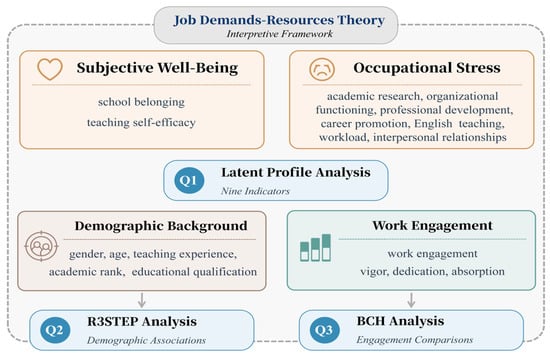
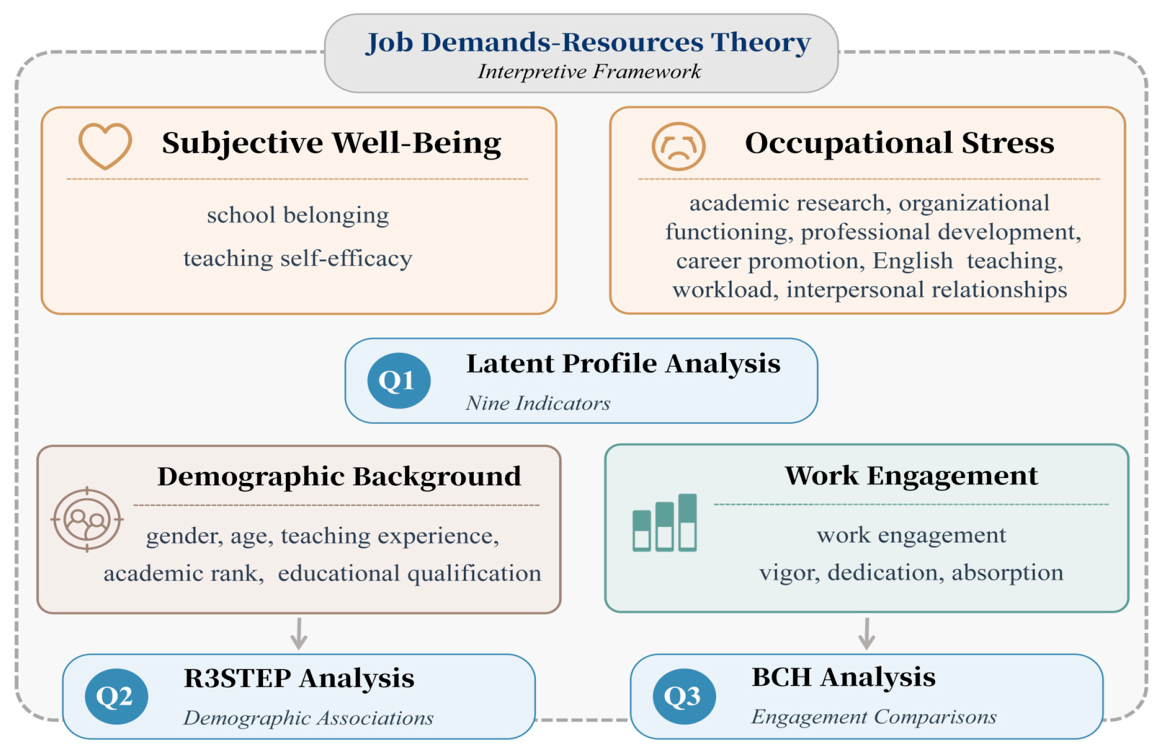
Building on the literature reviewed above, this study combines profile identification with analyses of demographic associations and work engagement differences. Figure 1 summarizes the research framework and the analytical procedure used to address the research questions and test H1 and H2.
Figure 1.
Research framework and analytical workflow.
3. Materials and Methods
3.1. Research Design
3.1.1. Participants
The participants were in-service English teachers employed at six public universities in Northeast China. Four of these institutions were specialized universities in agriculture, forestry, medicine, and transportation. The participating universities thus represented different disciplinary settings within the same regional public higher education context. Each university contributed 79–97 participants, accounting for 14.7–18.1% of the sample. No single university dominated the sample, allowing occupational experiences to be examined across several institutional settings. However, differences between institutions should be considered when interpreting the findings. Participant numbers and percentages are presented in Table 1.
Table 1.
Distribution of participants across the six universities.
The inclusion criteria were: (1) currently employed at a public university in Northeast China; (2) engaged in English language teaching; (3) had at least one year of university teaching experience. The survey resulted in 550 returned questionnaires from 600 distributed, representing a response rate of 91.7%. After screening, 14 questionnaires were excluded: nine had completion times of less than 180 s, and five were judged invalid following manual review of response patterns, involving identical answers across all scale items or across blocks of consecutive items. No response was counted in both exclusion categories. Because all survey items were mandatory on the online survey platform, no item-level missing responses were identified in the remaining dataset. This resulted in 536 valid questionnaires, representing 97.5% of the returned surveys.
3.1.2. Data Collection
This study used a cross-sectional survey design. Participants were recruited through convenience sampling in 2025. Eligible university English teachers were invited through contact networks to complete an online questionnaire on Wenjuanxing, a Chinese survey platform. The survey link was distributed through departmental contacts and university teacher communication groups. The first page explained the study purpose, completion instructions, confidentiality rules, and voluntary nature of participation. Participants were allowed to access the formal questionnaire only after reading the information and providing informed consent.
3.1.3. Ethical Considerations
This research followed relevant ethical guidelines for research involving human participants. It was reviewed by the Ethics Committee of the College of Foreign Languages, Jilin Agricultural University (Approval No. 20251012S2). Before beginning the questionnaire, all participants were informed of the study purpose, procedures, and measures to protect their anonymity. The raw data are not publicly available because they contain potentially sensitive information about teachers’ occupational experiences across multiple universities. Requests for access may be directed to the first author and will be considered subject to ethical and confidentiality requirements.
3.2. Measures and Measurement
3.2.1. Background Characteristics
The questionnaire collected information on participants’ gender, age, teaching experience, academic rank, and highest educational qualification. Gender was recorded as male or female. Age was coded as 30 years or younger, 31–40, 41–50, or 51–65 years. Teaching experience was classified as 5 years or less, 6–10, 11–15, 16–20, or more than 20 years. Academic rank was categorized as teaching assistant, lecturer, associate professor, or professor. The highest educational qualification was grouped into three categories: bachelor’s, master’s, or doctoral degree.
3.2.2. Subjective Well-Being
This study used the Teacher Subjective Wellbeing Questionnaire (TSWQ) to evaluate teachers’ positive psychological experiences in their school contexts and teaching activities (Renshaw et al., 2015). This questionnaire comprises two dimensions: school belonging (4 items) and teaching self-efficacy (4 items). School belonging reflects teachers’ experiences of identification, acceptance, and belonging within their school and departmental communities. Teaching self-efficacy reflects teachers’ confidence in their teaching competence and their capacity to facilitate student learning and development.
The original English items were translated into Chinese by the researchers. Experts subsequently reviewed the translations against the English originals for accuracy of meaning and clarity of expression. The final Chinese wording was agreed upon through discussion, and the questionnaire was administered in Chinese. All items were scored on a 5-point Likert scale, ranging from 1 (“strongly disagree”) to 5 (“strongly agree”). Higher scores indicated a stronger sense of subjective well-being.
The questionnaire showed satisfactory internal reliability, with Cronbach’s α of 0.912 and McDonald’s ω of 0.939. CFA was conducted using the weighted least squares mean- and variance-adjusted (WLSMV) estimator, with all eight items treated as ordered categorical variables. The results supported the two-factor structure: χ2(19) = 36.979, CFI = 0.998, TLI = 0.998, RMSEA = 0.042, 90% CI [0.021, 0.062], and SRMR = 0.015. Standardized factor loadings ranged from 0.863 to 0.909 for school belonging and from 0.818 to 0.922 for teaching self-efficacy (all p < 0.001).
3.2.3. Occupational Stress
Teachers’ occupational stress was measured through the University Teacher Stress Scale, originally developed in Chinese to assess perceived work-related stress among university teachers (Y. Zhang et al., 2020). The questionnaire comprises 34 items across seven dimensions: teaching stress (4 items), academic research stress (6 items), career promotion stress (6 items), workload stress (5 items), professional development stress (5 items), organizational functioning stress (5 items), and interpersonal relationship stress (3 items).
Thirty items from six dimensions were retained unchanged. The four items in the teaching stress dimension were reworded to refer specifically to university English teaching, and the dimension was renamed “English language teaching stress.” This contextual adaptation was intended to reflect the specific teaching responsibilities of university English teachers while preserving the meaning of the original items. For example, “The workload involved in lesson preparation is heavy” was revised to “The workload involved in preparing university English courses is heavy.” Experts reviewed the revised wording for consistency with the original meaning. Participants responded with reference to the current semester on a 5-point scale ranging from 1 (“strongly disagree”) to 5 (“strongly agree”). Higher scores indicated higher levels of perceived stress.
For the adapted questionnaire, Cronbach’s α values for the seven dimensions ranged from 0.777 to 0.942, while McDonald’s ω values ranged from 0.845 to 0.963. These results indicated acceptable internal consistency across all seven dimensions. Treating all 34 items as ordered categorical variables, the CFA was executed using the WLSMV estimator. The results demonstrated a good fit to the data, χ2(506) = 741.758, CFI = 0.991, TLI = 0.990, RMSEA = 0.029, 90% CI [0.025, 0.034], and SRMR = 0.033. Standardized factor loadings on 34 items varied between 0.573 and 0.942, all exceeding 0.50.
3.2.4. Work Engagement
Work engagement was assessed using the Chinese version of the 17-item Utrecht Work Engagement Scale (UWES-17) (Schaufeli et al., 2002). It contains three dimensions: vigor, dedication, and absorption. Vigor (6 items) reflects high levels of energy, resilience, and persistence when facing difficulties at work. Dedication (5 items) captures teachers’ sense of significance, enthusiasm, pride, inspiration, and challenge in their work. Absorption (6 items) measures concentration and full involvement in work-related tasks.
The Chinese items were reviewed and contextually adjusted to refer explicitly to participants’ work as university teachers. For example, the item corresponding to “I am immersed in my work” was reworded as “I am immersed in my work as a university English teacher.” Experts reviewed the revised wording against the source Chinese version for consistency of meaning and clarity. The questionnaire was administered in Chinese, with items rated on a 5-point scale. Higher scores indicated greater work engagement.
For the overall work engagement scale, Cronbach’s α was 0.960 and McDonald’s ω was 0.961, indicating good internal consistency. The three-factor structure was evaluated using CFA. All 17 items were specified as ordered categorical variables, using the WLSMV estimator with theta parameterization. The results were: χ2(116) = 256.176, CFI = 0.976, TLI = 0.972, RMSEA = 0.047, 90% CI [0.040, 0.055], and SRMR = 0.027. All items loaded significantly on their respective factors, with standardized loadings of 0.660–0.875 (all p < 0.001).
3.2.5. Measurement Quality Assessment
Before formal data collection, the complete questionnaire was pilot-tested with 60 public university English teachers who were not included in the final study sample. The pilot test assessed the preliminary psychometric properties of the questionnaire, the clarity of the instructions, and the contextual relevance of the items. Completion time was approximately 8–10 min. All subscales demonstrated satisfactory internal consistency, with Cronbach’s α coefficients exceeding 0.80. Based on participants’ qualitative feedback, minor adjustments were made to the questionnaire layout and font size to improve readability. The four contextually adapted teaching-stress items were considered clear and appropriate for the university English teaching context; therefore, no further substantive revisions were made before the formal survey.
Data collection relied entirely on self-reported questionnaires at a single time point. To evaluate potential common method variance, Harman’s single-factor test was performed based on the 536 participants. The first unrotated factor accounted for 31.14% of the variance, which was below the commonly used 40% reference criterion (Podsakoff et al., 2003). However, this result does not establish that common method variance was absent or negligible, and its potential influence on the findings cannot be ruled out.
Discriminant validity was assessed using the HTMT ratios across 12 constructs, comprising two dimensions of teacher subjective well-being, seven dimensions of occupational stress, and three dimensions of work engagement. HTMT values calculated from Pearson correlations between items ranged from 0.021 to 0.818, with the highest value observed between academic research stress and career promotion stress. All pairwise values were below the reference threshold of 0.85, supporting the discriminant validity of these constructs.
3.3. Data Analysis
IBM SPSS Statistics 27.0 and Mplus 8.3 were used for data processing and statistical analyses. Where applicable, tests were two-tailed. Statistical significance was set at p < 0.05, with adjustments for multiple testing as described below. The analyses did not evaluate or adjust for potential within-university dependence. Therefore, statistical significance should be interpreted cautiously.
First, the data were checked for missing values and response patterns. No item-level missing values were identified, so no missing-data treatment was required. Minimum and maximum dimension scores and their corresponding Z scores were examined descriptively. Z scores were used for inspection rather than as an automatic exclusion rule, and no additional cases were excluded after these checks. Means, standard deviations, and Pearson correlation coefficients for the main variables were calculated. Harman’s single-factor test was used as a limited diagnostic of potential common method variance (Podsakoff et al., 2003). The internal consistency was evaluated using Cronbach’s α and McDonald’s ω (Hayes & Coutts, 2020; McDonald, 1999). Confirmatory factor analysis was used to test model structure. Model fit was evaluated using the chi-square statistic (χ2), comparative fit index (CFI), Tucker–Lewis index (TLI), root mean square error of approximation (RMSEA), and standardized root mean square residual (SRMR). Standardized factor loadings and the heterotrait–monotrait ratio (HTMT) were also examined (Henseler et al., 2015; Hu & Bentler, 1999).
Second, latent profile analysis (LPA) was conducted to identify distinct configurations of teacher subjective well-being and occupational stress (Masyn, 2013). Nine indicators were included: two well-being dimensions and seven occupational stress dimensions. Each indicator was calculated as the mean of its corresponding items. Models with 1 to 6 profiles were estimated in Mplus. Indicator means were freely estimated across profiles, whereas each indicator’s variance was constrained to equality across profiles and within-profile covariances were fixed at zero. The two- to six-profile models used 5000 random starting values and 1000 final-stage optimizations, with a maximum of 20 initial-stage iterations. To assess numerical stability, the four-profile model was additionally estimated using 10,000 random starting values and 2000 final-stage optimizations. Convergence, replication of the best log-likelihood, and consistency of most likely profile assignments were examined. Model selection considered: Akaike information criterion (AIC), Bayesian information criterion (BIC), sample-size-adjusted BIC (aBIC), entropy, average posterior probabilities, Lo–Mendell–Rubin likelihood ratio test (LMR-LRT), bootstrap likelihood ratio test (BLRT), profile size, model stability, and theoretical interpretability (Nylund-Gibson & Choi, 2018; Spurk et al., 2020).
Third, after determining the optimal model, profiles were described and labeled according to their indicator means. Descriptive cross-tabulations summarized demographic characteristics across profiles. Participants were assigned to the profile with the highest posterior probability. Frequencies and within-profile percentages were reported. These summaries did not account for classification uncertainty. Demographic associations were examined using the classification-error-adjusted R3STEP procedure (Asparouhov & Muthén, 2014). Gender, age, teaching experience, academic rank, and highest educational qualification were entered simultaneously. Overall associations were assessed using Wald tests. Specific contrasts were reported as odds ratios (ORs) with 95% confidence intervals (CIs). Holm corrections were applied separately to the overall tests and the profile-specific coefficient tests.
Finally, overall work engagement and its three dimensions were specified as distal outcomes. They were calculated as the means of their respective items and were not included in profile identification. The BCH three-step method was used to compare mean differences across profiles while accounting for classification uncertainty (Bolck et al., 2004). Omnibus tests assessed between-profile differences in each outcome, and BCH-adjusted estimated means and standard errors were reported. Bonferroni correction was applied to pairwise comparisons within each outcome. Because of the cross-sectional design, these analyses assessed associations and differences rather than causal effects.
4. Results
4.1. Latent Profile Analysis
LPA was conducted using nine indicators including school belonging, teaching self-efficacy, and seven stress dimensions covering academic research, organizational functioning, professional development, career promotion, English language teaching, workload, and interpersonal relationships. Models with one to six profiles were estimated. The model fit indices are presented in Table 2.
Table 2.
Model Fit Indices for Latent Profile Analysis.
As the number of profiles increased, AIC, BIC, and aBIC values decreased continuously. However, the reductions in BIC became smaller beyond the four-profile model. BIC decreased by 1003.037 from the one-profile to the two-profile model, by 352.137 from the two-profile to the three-profile model, and by 182.758 from the three-profile to the four-profile model. The corresponding reductions from four to five and five to six profiles were 82.689 and 41.612. The likelihood ratio tests provided different indications regarding the number of profiles to retain. The BLRT was statistically significant for all models containing two or more profiles. The LMR-LRT was used to compare each model with a model having one fewer profile. The test showed significant fit improvements for the two-profile, three-profile, and four-profile models (p < 0.001, p = 0.002, and p = 0.048). However, the LMR-LRT was nonsignificant for the five-profile and six-profile models (p = 0.352 and p = 0.584). Thus, the adjusted LMR-LRT supported retaining four profiles, whereas the BLRT continued to favor additional profiles.
Regarding classification quality, the three-profile model had the highest entropy value (0.897), followed by the four-profile model (0.869); entropy was lower for the five- and six-profile models (0.818 and 0.814). Average posterior probabilities for participants assigned to P1-P4 were 0.873, 0.917, 0.964, and 0.959. Together with entropy, these probabilities indicated reasonably clear classification, although uncertainty remained. Model-estimated proportions for P1-P4 were 19.67%, 26.87%, 6.39%, and 47.07%, whereas the corresponding counts based on most likely profile assignments were 102 (19.0%), 146 (27.2%), 34 (6.3%), and 254 (47.4%) participants. Profile labels summarize the observed indicator configurations and do not imply fixed or naturally occurring types of teachers. “High,” “moderate,” and “low” refer to relative patterns in the profile indicator means within this sample, not validated scale cut-offs. These labels summarize the overall configurations, not uniform levels across all indicators.
All one-profile to six-profile models under the equal-variance specification with within-profile covariances fixed at zero terminated normally. The best log-likelihood was repeatedly obtained for the two- to six-profile models, although some final-stage solutions for the six-profile model converged to inferior local maxima. For the four-profile model, the best log-likelihood (−5044.701) was obtained in all 1000 final-stage solutions. An expanded search using 10,000 random starts and 2000 final-stage optimizations reproduced this value in all 2000 solutions. After aligning profile labels, all participants retained their most likely assignments, including all 34 participants in P3. These findings support numerical stability under the specified constraints. However, P3’s size warrants caution when interpreting its demographic characteristics and comparisons with other profiles.
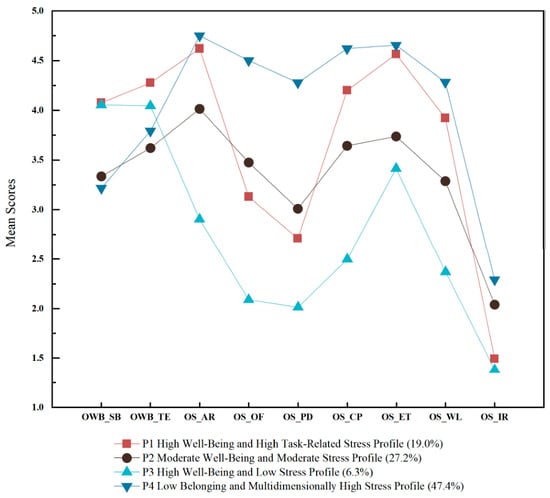
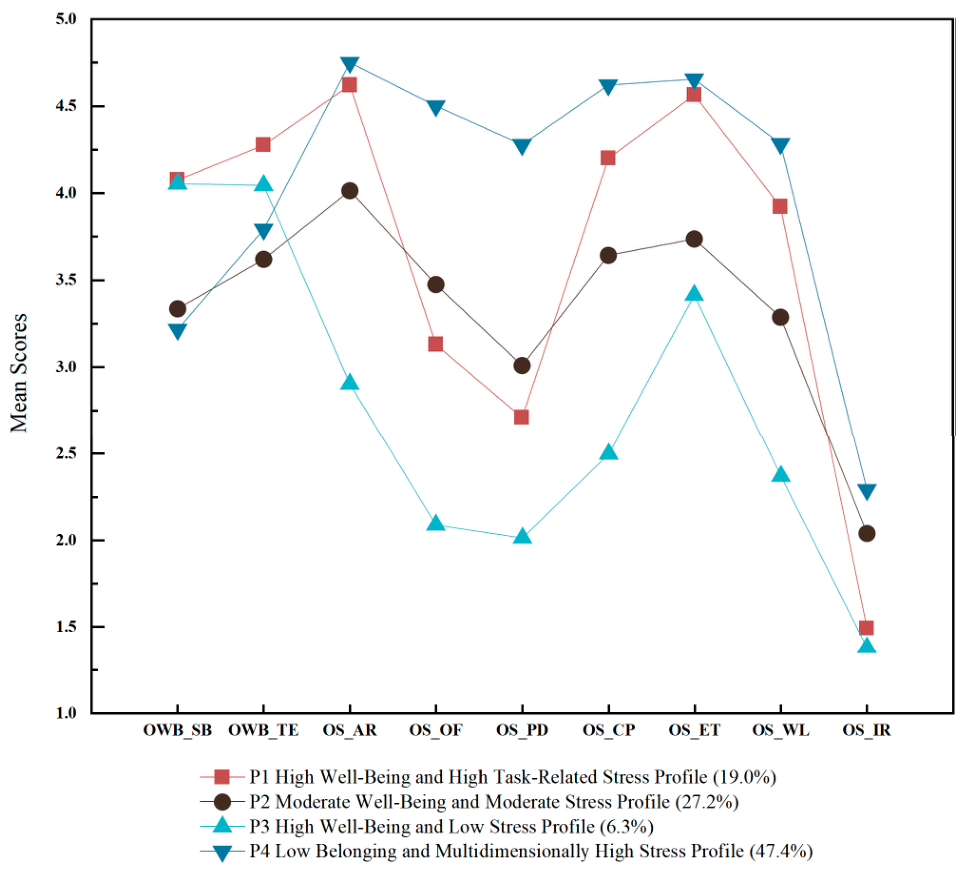
Considering the model criteria, classification quality, numerical stability, and interpretability, the four-profile solution was retained for subsequent analyses. Figure 2 presents its estimated indicator means.
Figure 2.
Estimated Mean Profiles of Teacher Subjective Well-Being and Occupational Stress. Note. OWB_SB = school belonging; OWB_TE = teaching self-efficacy; OS_AR = academic research stress; OS_OF = organizational functioning stress; OS_PD = professional development stress; OS_CP = career promotion stress; OS_ET = English language teaching stress; OS_WL = workload stress; OS_IR = stress related to interpersonal relationships.
The first profile comprised 102 teachers (19.0%). Teachers in this profile reported high levels of school belonging (M = 4.076) and teaching self-efficacy (M = 4.277). They also experienced relatively high levels of academic research stress (M = 4.621). Meanwhile, career promotion, English language teaching, and workload stress were also high. In contrast, the means for organizational functioning (M = 3.131), professional development (M = 2.711), and interpersonal relationship stress (M = 1.494) were relatively lower than the task-related stress means within this profile. Relatively high school belonging and teaching self-efficacy coexisted with elevated task-related stress in this profile. This profile was labeled the “High Well-Being and High Task-Related Stress (P1).”
Profile 2 contained 146 teachers, representing 27.2% of the sample. This class showed moderate levels of school belonging (M = 3.337) and teaching self-efficacy (M = 3.621). Academic research stress was relatively high (M = 4.015), while stress levels in other key areas remained moderate, including organizational functioning (M = 3.476), career promotion (M = 3.644), English language teaching (M = 3.738), workload (M = 3.289), and professional development (M = 3.011). Interpersonal relationship stress was relatively low (M = 2.040). Based on this descriptive pattern, this profile was labeled the “Moderate Well-Being and Moderate Stress (P2).”
The third profile comprised 34 teachers (6.3%). It reported high levels of school belonging (M = 4.055) and teaching self-efficacy (M = 4.046). Conversely, their scores across almost all stress dimensions were lower than those in the other profiles: academic research (M = 2.905), organizational functioning (M = 2.089), professional development (M = 2.014), career promotion (M = 2.499), workload stress (M = 2.369), and interpersonal relationship stress (M = 1.382). English language teaching stress had the highest mean among the seven stress dimensions within P3 (M = 3.415), but this mean was descriptively lower than those in the other three profiles. Profile 3 was labeled “High Well-Being and Low Stress (P3).”
Profile 4 comprised 254 teachers, representing 47.4% of the sample. It was the largest profile. Teachers in this profile reported relatively low school belonging (M = 3.218), whereas their teaching self-efficacy was moderately high (M = 3.794). Teachers in this profile reported relatively high stress in academic research (M = 4.751), organizational functioning (M = 4.502), professional development (M = 4.279), career promotion (M = 4.622), English language teaching (M = 4.656), and workload (M = 4.285). Interpersonal relationship stress (M = 2.292) was lower than the other stress-domain means within P4, but descriptively higher than in the other three profiles. This group showed elevated stress across multiple work domains alongside relatively low school belonging. It was therefore labeled the “Low Belonging and Multidimensionally High Stress (P4).”
4.2. Demographic Characteristics and Associations with Latent Profile Membership
Table 3 presents demographic counts and within-profile percentages based on participants’ most likely profile assignments. The demographic variables included gender, age, teaching experience, academic rank, and highest educational qualification. Women constituted the majority of all four profiles, ranging from 70.6% to 78.4%. Teachers aged 30 years or younger accounted for 26.5% of P3, higher than the proportions in the other three profiles. Teachers aged 41–50 years constituted the largest age category in P4 (65.4%). Teachers with 5 years or less of teaching experience accounted for 50.0% of P3. Those with more than 20 years of teaching experience accounted for 50.4% of P4 and 48.0% of P1. Regarding academic rank, P3 mainly consisted of teaching assistants (44.1%) and associate professors (38.2%). Lecturers constituted the largest category in P2 (45.9%), whereas associate professors represented the largest category in P4 (48.8%). Teachers holding a master’s degree constituted the majority across all four profiles, ranging from 76.7% to 86.6%.
Table 3.
Demographic Characteristics Across the Four Latent Profiles.
The exploratory joint R3STEP results are presented in Table 4. All five demographic variables were entered simultaneously. The initial model with five teaching experience categories produced an unstable estimate. The categories of 5 years or less and 6–10 years were therefore combined into a single category of 10 years or less. After mutual adjustment and Holm correction, academic rank was associated with profile membership, Wald χ2(9) = 46.875, Holm-adjusted p < 0.001. The overall tests for gender, age, teaching experience, and highest educational qualification did not reach statistical significance (Holm-adjusted p = 0.971, 0.971, 0.345, and 0.589).
Table 4.
R3STEP Analysis of Demographic Associations with Latent Profile Membership.
Using P4 as the reference profile, only the teaching-assistant versus associate-professor contrast for P3 relative to P4 remained significant after Holm correction. Compared with associate professors, teaching assistants had higher odds of membership in P3 rather than P4 (OR = 25.64, 95% CI [3.61, 182.29], Holm-adjusted p = 0.043). The remaining coefficient tests did not reach statistical significance after correction.
4.3. Differences in Work Engagement Across Latent Profiles
The BCH method was applied to compare overall work engagement and its three dimensions (vigor, dedication, and absorption) across the four profiles while accounting for classification uncertainty. Results are presented in Table 5. The omnibus test indicated a significant difference in overall work engagement, χ2(3) = 48.60, p < 0.001. The corresponding tests for vigor, dedication, and absorption were also significant (all p < 0.001).
Table 5.
BCH Comparisons of Work Engagement Across the Four Latent Profiles.
Based on BCH-adjusted estimated means, the High Well-Being and High Task-Related Stress Profile (P1) had the highest estimated overall work engagement (M = 4.084, SE = 0.077). It was followed by the High Well-Being and Low Stress Profile (P3; M = 3.861, SE = 0.141) and the Low Belonging and Multidimensionally High Stress Profile (P4; M = 3.705, SE = 0.052). The Moderate Well-Being and Moderate Stress Profile (P2) had the lowest score (M = 3.342, SE = 0.067). Estimated means for vigor, dedication, and absorption followed the same descriptive ordering.
For each outcome, the six pairwise comparisons were evaluated using a Bonferroni-adjusted significance threshold of α = 0.0083. Overall work engagement in P1 was significantly higher than in P2 and P4. Similarly, P3 and P4 showed significantly higher overall engagement than P2. Neither the P1–P3 nor the P3–P4 comparison reached statistical significance after adjustment. The three dimensions showed an identical pattern of pairwise differences to overall work engagement. P3 had the largest standard errors across all four outcomes, indicating less precise mean estimates than those for the larger profiles.
5. Discussion
5.1. Latent Profiles of Teacher Subjective Well-Being and Occupational Stress
This study identified four latent profiles of teacher subjective well-being and occupational stress, thereby answering RQ1. These were the High Well-Being and High Task-Related Stress Profile (P1), Moderate Well-Being and Moderate Stress Profile (P2), High Well-Being and Low Stress Profile (P3), and Low Belonging and Multidimensionally High Stress Profile (P4). Higher well-being did not necessarily coincide with lower stress. The profiles differed in both indicator levels and the distribution of stress across occupational domains. This pattern is consistent with recent studies (Gao et al., 2025; Huang et al., 2024; L. Li, 2025).
The High Well-Being and High Task-Related Stress Profile (P1) comprised 19.0% of the sample. Relatively high school belonging and teaching self-efficacy coexisted with elevated stress concerning academic research, career promotion, English language teaching, and workload. By contrast, stress related to organizational functioning, professional development, and interpersonal relationships was lower. This configuration suggests that perceived pressure associated with core work responsibilities does not necessarily coincide with unfavorable organizational experiences or low confidence in teaching competence (Murangi et al., 2022; Peng et al., 2023). However, the coexistence of high well-being and high task-related stress does not imply that the stress is harmless. Evidence from daily diary studies suggests that sustained demands may be accompanied by resource depletion and strain (Pindek et al., 2024). Whether such processes occur in P1 requires longitudinal examination.
The Moderate Well-Being and Moderate Stress Profile (P2) accounted for 27.2%. Similar profiles are commonly observed in person-centered research on teachers (Gao et al., 2025; Laitinen, 2022). Although its overall configuration was less extreme, academic research stress was comparatively elevated, while interpersonal relationship stress was lower. Organizational functioning and professional development stress were descriptively higher than in P1, despite lower task-related stress. The “moderate” label therefore does not imply uniformly moderate experiences or an absence of occupational concerns. P2 highlights the value of examining domain-specific stress indicators, as an overall profile label may obscure relatively elevated stress in particular areas.
The High Well-Being and Low Stress Profile (P3, 6.3%) showed a comparatively favorable pattern across the measured indicators in this study. Teachers in P3 reported strong school belonging and teaching self-efficacy, alongside lower stress means across all seven domains than those in the other profiles. English language teaching stress was nevertheless the highest stress dimension within P3. Thus, relatively low stress across domains did not imply an absence of teaching-related pressure. Research on teachers’ occupational experiences provides a context for understanding the continuing relevance of this pressure (Gao et al., 2025; X. Li et al., 2026; C. Zhang et al., 2026). In contrast to P1, P3 combined positive occupational experiences with lower task-related stress. Its small size (n = 34), however, warrants caution when interpreting its characteristics and comparisons with other profiles.
The Low Belonging and Multidimensionally High Stress Profile (P4, 47.4%) was the largest profile. It reported the lowest school belonging among the four profiles, although teaching self-efficacy remained moderately high. Elevated stress extended across academic research, organizational functioning, professional development, career promotion, English language teaching, and workload. Interpersonal relationship stress was also descriptively higher than in the other profiles. This pattern is consistent with previous research documenting multiple sources of occupational stress among Chinese university faculty (W. Li & Kou, 2018; Meng & Wang, 2018). Compared with P1, P4 combined broader stress, particularly in organizational functioning, professional development, and interpersonal relationships, with lower school belonging and teaching self-efficacy. In P4, elevated stress coexisted with low school belonging but moderately high teaching self-efficacy, rather than uniformly low scores on both well-being dimensions. The present analysis adds to this literature by showing how multidomain stress combines with distinct aspects of well-being.
These profiles show why both well-being dimensions and individual stress domains need to be distinguished. Their coexistence is compatible with the JD-R framework, but does not establish the operation of its motivational or health-impairment processes.
5.2. Demographic Characteristics and Latent Profile Membership
The demographic analysis addresses RQ2. Women and teachers holding master’s degrees constituted the majority in all profiles. This composition resembles that reported in previous university EFL teacher samples (Chen et al., 2023; Yan, 2024; L. Zhang et al., 2026). However, these within profile proportions should be interpreted against the overall sample distribution. Numerical predominance alone does not establish an association with profile membership. When all demographic variables were entered simultaneously, only academic rank showed a significant overall association.
Gender was not significantly associated with profile membership. Sun and Yin similarly found no significant gender association with teachers’ self-efficacy profile membership (Sun & Yin, 2025). However, the studies used different profile indicators, so their findings are not directly equivalent. The population of English teachers at Chinese universities is predominantly female in previous studies (Chen et al., 2023; L. Zhang et al., 2026). Thus, it should be considered when interpreting the gender analysis. The present nonsignificant result does not establish that occupational experiences are equivalent across genders.
Descriptive age distributions differed across profiles. P1 and P4 were both predominantly composed of teachers aged 41–50 years. In contrast, teachers aged 40 or younger accounted for 52.9% of P3. Nevertheless, 41.2% of teachers in P3 were aged 41–50 years, so it should not be characterized solely as a younger-teacher profile. Age showed no significant overall association with profile membership in the jointly adjusted model.
Teachers with 5 years or less of teaching experience accounted for 50.0% of P3 and those with over 20 years represented 48.0% of P1 and 50.4% of P4. This pattern was broadly consistent with the descriptive age distribution. However, teaching experience also showed no significant overall association after adjustment. Despite their similar age and teaching-experience distributions, P1 and P4 displayed different psychological configurations. P1 showed higher school belonging and teaching self-efficacy, with stress concentrated mainly in task-related domains. P4 showed lower school belonging and elevated stress across more domains. Together, these findings do not support interpreting the profiles as successive career stages.
The significant academic rank contrast involved P3 and P4. Compared with associate professors, teaching assistants had higher odds of belonging to P3 rather than P4. This comparison concerns the joint configuration of well-being and domain-specific stress. Promotion and appraisal requirements offer a possible context for interpreting the observed association. Ni found that these requirements shaped university EFL teachers’ research engagement, with differing experiences of evaluation-related pressure (Ni, 2024). Such expectations may be relevant to the rank association, but the present study did not directly measure rank specific responsibilities or appraisal conditions. This interpretation therefore remains tentative. The contrast remained significant after Holm correction (OR = 25.64, 95% CI [3.61, 182.29]). However, the wide confidence interval indicates uncertainty about the magnitude of the association. P3 included only 34 teachers, and the demographic analysis was exploratory. This finding should therefore be interpreted cautiously.
Highest educational qualification showed no significant association after adjustment. Although doctoral degree holders were relatively more common in P2 and P4, these descriptive proportions do not establish a qualification-specific association. Overall, the findings indicate a specific rank-related association rather than a consistent demographic pattern across profiles. The analysis remains exploratory, particularly given the recoding of teaching experience following an unstable estimate. Demographic characteristics help describe the groups but cannot substitute for direct assessment of teachers’ well-being and domain-specific stress.
5.3. Differences in Work Engagement Across the Latent Profiles
The BCH analysis revealed significant differences among the four profiles in overall work engagement and its three dimensions. These results support H1 and H2. The same pattern of significant pairwise differences was observed for vigor, dedication, and absorption. It indicated that the profile differences were not confined to a single engagement dimension.
The High Well-Being and High Task-Related Stress Profile (P1) reported the highest estimated overall work engagement (M = 4.084), significantly exceeding P2 and P4. Its relatively high teaching self-efficacy and school belonging coexisted with high engagement despite elevated task-related stress. This pattern is consistent with person-centered research showing that engagement and negative occupational experiences are not necessarily mutually exclusive (Drouin-Rousseau et al., 2024; Gao et al., 2025). Comparing P1 and P4 illustrates the importance of distinguishing their well-being and stress configurations. Although both profiles showed elevated academic research and English language teaching stress, P4 had descriptively higher stress means in organizational functioning, professional development, and interpersonal relationships, alongside lower school belonging and teaching self-efficacy. Its overall engagement was also significantly lower than P1’s. This contrast highlights differences in the breadth of perceived stress and positive occupational experiences. From a JD-R perspective, one plausible interpretation is that positive organizational experiences and professional self-evaluations remain relevant to engagement even under demanding conditions. Related research provides a theoretical context for this interpretation, although the present indicators were not direct measures of job or personal resources (Geraci et al., 2023; Hejazi & Sadoughi, 2025).
The Moderate Well-Being and Moderate Stress Profile (P2) showed the lowest overall work engagement, which was significantly lower than all other profiles. Thus, moderate well-being and stress levels did not correspond to the most favorable engagement pattern in this sample. This result highlights the potential for relatively low engagement to be overlooked when attention focuses only on teachers reporting extreme stress. It does not, however, establish that P2 lacked motivation or resources.
The High Well-Being and Low Stress Profile (P3) was relatively small, comprising 6.3% of the sample (n = 34). Its estimated overall engagement was significantly higher than P2’s. This contrast links the combination of stronger school belonging, higher teaching self-efficacy, and generally lower occupational stress to higher engagement. However, because these characteristics differed together, the comparison cannot distinguish their individual contributions to engagement. The comparisons of P3 with P1 and P4 did not reach statistical significance. P3 had the largest standard errors across all four engagement outcomes, and its small size may have limited statistical power. Its high average posterior probability (0.964) indicates relatively clear classification under the fitted model but does not ensure precise estimation of engagement differences. Accordingly, nonsignificant comparisons involving P3 should not be interpreted as evidence of equivalent engagement levels.
P4 reported an overall work engagement score of 3.705. It was significantly lower than P1’s, but remained higher than P2’s. Its combination of lower school belonging, multidimensional stress, and engagement above that of P2 suggests that occupational difficulties and positive work involvement need not align uniformly across profiles (Drouin-Rousseau et al., 2024; Salmela-Aro et al., 2019). Teaching self-efficacy was also higher in P4 than in P2, making professional confidence a theoretically plausible consideration within the JD-R framework (Geraci et al., 2023; Granziera et al., 2022; Murangi et al., 2022). Nevertheless, the profile comparison does not establish that self-efficacy sustained engagement or buffered stress.
5.4. Theoretical and Practical Implications
By combining two well-being dimensions and seven occupational stress domains into a unified latent profile model, this study adds detail to person-centered research on teachers’ occupational experiences. P1 and P4 shared elevated academic research and English language teaching stress but differed in positive experiences, the breadth of perceived stress, and engagement. This contrast highlights the value of retaining both distinct well-being dimensions and domain-specific stress indicators. Examining work engagement separately from profile identification further showed that these configurations differed in overall engagement and all three dimensions. The demographic analysis also distinguished descriptive group composition from mutually adjusted associations, with only academic rank showing a significant overall association after correction. Together, these findings extend the evidence to EFL teachers at public universities in Northeast China. The contribution lies in the specific configurations and their external associations.
Practically, the findings suggest that departmental support should respond to teachers’ reported needs rather than follow fixed interventions assigned to profile labels. Brief, voluntary consultations could help departments identify specific pressures and requests for assistance. These discussions should remain separate from performance appraisal. When teachers report task-related pressure, departments could review teaching assignments alongside research and promotion deadlines. Possible responses include redistributing duties or adjusting assessment schedules where conflicts are identified. For concerns about organizational procedures or professional development, clear guidance and a designated contact could help teachers access relevant support. P2’s lower engagement suggests that teachers reporting moderate stress should not be overlooked. The support offered should reflect individual requests, such as research mentoring or teaching consultation, without assuming a lack of motivation or resources. Demographic characteristics and profile labels alone should not determine access to support. These are possible directions for institutional support, but their effects on well-being, stress, and engagement remain to be tested.
5.5. Limitations and Future Directions
This study has several limitations. First, the cross-sectional design means that teachers’ subjective well-being, occupational stress, and work engagement were measured at a single point in time. Thus, temporal ordering and causal relationships cannot be established. Future studies could adopt longitudinal designs to examine profile transitions and subsequent changes in work engagement.
Second, this study employed convenience sampling, and all participants were English teachers from six public universities in Northeast China, most of whom worked at institutions with specialized disciplinary orientations. Accordingly, the sampling approach and limited institutional coverage may restrict the generalizability of the findings to other regions and institution types. Potential within-university dependence was not evaluated or adjusted for. Its effects on standard errors and significance tests therefore remain uncertain. The High Well-Being and Low Stress Profile comprised only 34 teachers. Its small size may have reduced the precision of demographic association estimates, and engagement means. It may also have limited the statistical power of the BCH comparisons. Future research using larger and more diverse samples should broaden institutional coverage, account for potential clustering, and examine whether P3 can be replicated.
Third, all three constructs were assessed through teacher self-reports on the same occasion. Social desirability, transient emotional states, and shared method effects may have influenced the observed associations. Harman’s single-factor test was used as a preliminary diagnostic. However, its results do not establish the absence of common method bias. Future research should incorporate multi-source data and measurements collected at different times to reduce reliance on a single survey source.
Fourth, this study did not directly assess job demands, job resources, recovery experiences, or occupational burnout. The findings therefore do not test the health-impairment or motivational processes proposed by JD-R theory. Future research should include these constructs to examine their relationships with profile transitions and subsequent occupational outcomes.
6. Conclusions
This study used LPA to examine the configurations of subjective well-being and perceived occupational stress among English teachers at public universities in Northeast China. Four profiles were identified. High well-being coexisted with elevated task-related stress, and stress varied in its distribution across occupational domains. After mutual adjustment and correction for multiple testing, only academic rank showed a significant overall association with profile membership. The BCH analysis revealed significant differences across the four profiles in overall work engagement and its three dimensions. P1 had the highest estimated overall engagement and scored significantly higher than P4. P2 scored significantly lower than all other profiles on each outcome. Taken together, these findings support considering school belonging, teaching self-efficacy, domain-specific occupational stress, and work engagement jointly when assessing teachers’ support needs. Universities could use confidential consultations to identify teachers’ main stress concerns and support requests.
Author Contributions
J.M. provided the primary conceptual framework and overall guidance. W.Z. was responsible for research design, data collection, data cleaning, statistical analysis, and drafting the initial manuscript. All authors have read and agreed to the published version of the manuscript.
Funding
This research was supported by the 2025 Key Project of the Jilin Provincial Education Science “14th Five-Year Plan”, “Coping Mechanisms for Occupational Stress among English Teachers at Industry-Specialized Universities in Jilin Province from the Perspective of Career Resilience” (Grant No. ZD25143).
Institutional Review Board Statement
The studies involving human participants were reviewed and approved by the Ethics Committee of the College of Foreign Languages, Jilin Agricultural University (approval code: No.20251012S2; date of approval: 12 October 2025).
Informed Consent Statement
Informed consent was obtained from all subjects involved in the study.
Data Availability Statement
The dataset is not publicly available because it contains potentially sensitive information concerning teachers from multiple universities. An anonymized version of the data may be obtained from the first author upon reasonable request, provided that the request complies with relevant ethical and data-protection requirements.
Conflicts of Interest
The authors declare no conflicts of interest.
References
- Alghamdi, M. H., & Sideridis, G. (2025). Identifying subgroups of teacher burnout in elementary and secondary schools: The effects of teacher experience, age and gender. Frontiers in Psychology, 15, 1406562. [Google Scholar] [CrossRef] [Scilit] [PubMed]
- Asparouhov, T., & Muthén, B. (2014). Auxiliary variables in mixture modeling: Three-step approaches using Mplus. Structural Equation Modeling: A Multidisciplinary Journal, 21(3), 329–341. [Google Scholar] [CrossRef] [Scilit]
- Bakker, A. B., & Demerouti, E. (2017). Job demands–resources theory: Taking stock and looking forward. Journal of Occupational Health Psychology, 22(3), 273–285. [Google Scholar] [CrossRef] [Scilit] [PubMed]
- Bolck, A., Croon, M., & Hagenaars, J. (2004). Estimating latent structure models with categorical variables: One-step versus three-step estimators. Political Analysis, 12(1), 3–27. [Google Scholar] [CrossRef] [Scilit]
- Canobi, K. H., Eadie, P., Murray, L., Levickis, P., Page, J., & McFarland, L. (2024). Profiles of professional wellbeing and turnover intentions among Australian early childhood educators. Early Education and Development, 35(5), 1063–1079. [Google Scholar] [CrossRef] [Scilit]
- Chan, M.-K., Nie, Q., Teng, Z., Srisarajivakul, E. N., & Wang, Y. (2026). Promoting sustainable teacher well-being through Job and personal resources: A one-year longitudinal study. School Psychology Review, 1–16. [Google Scholar] [CrossRef] [Scilit]
- Chen, S., Zhang, L. J., & McNaughton, S. (2023). The structure and characteristics of Chinese university English teachers’ identities: Toward a sustainable language pedagogy. Sustainability, 15(15), 12040. [Google Scholar] [CrossRef] [Scilit]
- Collie, R. J., & Mansfield, C. F. (2022). Teacher and school stress profiles: A multilevel examination and associations with work-related outcomes. Teaching and Teacher Education, 116, 103759. [Google Scholar] [CrossRef] [Scilit]
- Ding, L. (2024). Exploring the causes, consequences, and solutions of Chinese EFL teachers’ psychological ill-being: A qualitative investigation. European Journal of Education, 59(4), e12739. [Google Scholar] [CrossRef] [Scilit]
- Drouin-Rousseau, S., Morin, A. J. S., Fernet, C., Blechman, Y., & Gillet, N. (2024). Teachers’ profiles of work engagement and burnout over the course of a school year. Applied Psychology: An International Review, 73(1), 57–92. [Google Scholar] [CrossRef] [Scilit]
- Gao, X., Zhou, X., & Leong, F. T. L. (2025). Exploring occupational well-being profiles, outcomes, and predictors among Chinese teachers: A mixed-methods approach using latent profile and decision tree analysis. Applied Psychology: Health and Well-Being, 17(1), 12640. [Google Scholar] [CrossRef] [Scilit] [PubMed]
- Gearhart, C. A., McCarthy, C. J., & Lambert, R. G. (2024). Teachers’ psychological stress and wellbeing during a pandemic: Exploring latent profiles. School Psychology, 39(5), 475–487. [Google Scholar] [CrossRef] [Scilit] [PubMed]
- Geraci, A., Di Domenico, L., Inguglia, C., & D’Amico, A. (2023). Teachers’ emotional intelligence, burnout, work engagement, and self-efficacy during COVID-19 lockdown. Behavioral Sciences, 13(4), 296. [Google Scholar] [CrossRef] [Scilit] [PubMed]
- Granziera, H., Collie, R. J., & Martin, A. J. (2022). Teacher well-being: A complementary variable- and person-centered approach harnessing Job Demands-Resources theory. Contemporary Educational Psychology, 71, 102121. [Google Scholar] [CrossRef] [Scilit]
- Hakanen, J. J., Bakker, A. B., & Schaufeli, W. B. (2006). Burnout and work engagement among teachers. Journal of School Psychology, 43(6), 495–513. [Google Scholar] [CrossRef] [Scilit]
- Hang, Y., Zhang, X., & Guo, J. (2025). The demand-resource profiles of university teachers and their associations with well-being and performance. Social Psychology of Education, 28(1), 197. [Google Scholar] [CrossRef] [Scilit]
- Hascher, T., & Waber, J. (2021). Teacher well-being: A systematic review of the research literature from the year 2000–2019. Educational Research Review, 34, 100411. [Google Scholar] [CrossRef] [Scilit]
- Hayes, A. F., & Coutts, J. J. (2020). Use omega rather than Cronbach’s Alpha for estimating reliability. Communication Methods and Measures, 14(1), 1–24. [Google Scholar] [CrossRef] [Scilit]
- Hejazi, S. Y., & Sadoughi, M. (2025). Growth teaching mindset and work engagement: The chain mediating roles of professional development and teaching self-efficacy. Studies in Educational Evaluation, 87, 101506. [Google Scholar] [CrossRef] [Scilit]
- Henseler, J., Ringle, C. M., & Sarstedt, M. (2015). A new criterion for assessing discriminant validity in variance-based structural equation modeling. Journal of the Academy of Marketing Science, 43(1), 115–135. [Google Scholar] [CrossRef] [Scilit]
- Holmström, A., Tuominen, H., Laasanen, M., & Veermans, M. (2023). Teachers’ work engagement and burnout profiles: Associations with sense of efficacy and interprofessional collaboration in school. Teaching and Teacher Education, 132, 104251. [Google Scholar] [CrossRef] [Scilit]
- Hu, L.-t., & Bentler, P. M. (1999). Cutoff criteria for fit indexes in covariance structure analysis: Conventional criteria versus new alternatives. Structural Equation Modeling, 6(1), 1–55. [Google Scholar] [CrossRef] [Scilit]
- Huang, Y., Nalipay, M. J. N., & Wang, H. (2024). Profiles of occupational well-being among Chinese teachers: Associations with basic psychological needs satisfaction and teaching quality. Teaching and Teacher Education, 139, 104461. [Google Scholar] [CrossRef] [Scilit]
- Laitinen, S. (2022). Work-related well-being profiles among health education teachers. Education Sciences, 12(5), 343. [Google Scholar] [CrossRef] [Scilit]
- Li, J., He, Y., Wang, Y., & Xue, E. (2025). Investigating higher education teachers’ well-being and its influencing multiple factors: A systematic review approach. International Journal of Mental Health Promotion, 27, 901–928. [Google Scholar] [CrossRef] [Scilit]
- Li, J. B., Xu, Y., Sun, J., Qiu, S., Zhang, R., & Yang, A. (2025). A multilevel latent profile analysis to job demands, job resources, and personal resources in early childhood educators: Implications for multidimensional well-being. Journal of School Psychology, 109, 101405. [Google Scholar] [CrossRef] [Scilit] [PubMed]
- Li, L. (2025). Burnout among Chinese EFL university instructors: A mixed-methods exploration of school climate, job demands, and emotion regulation. Frontiers in Psychology, 16, 1549466. [Google Scholar] [CrossRef] [Scilit] [PubMed]
- Li, W., & Kou, C. (2018). Prevalence and correlates of psychological stress among teachers at a national key comprehensive university in China. International Journal of Occupational and Environmental Health, 24, 7–16. [Google Scholar] [CrossRef] [Scilit] [PubMed]
- Li, X., Zhang, M., Zhao, X., & Yang, C. (2026). Job demands, resources, and teachers’ work engagement: The multiple mediating roles of emotional exhaustion and self-efficacy. Teaching and Teacher Education, 182, 105780. [Google Scholar] [CrossRef] [Scilit]
- Li, Y., Chen, J., Lu, J., & Wang, X. (2025). A meta-analysis of teacher well-being: A job demands and resources perspective. Educational Research Review, 49, 100719. [Google Scholar] [CrossRef] [Scilit]
- Li, Y., & Xu, L. (2024). Exploring the influence of teachers’ motivation, self-efficacy, and institutional support on their research engagement: A study of Chinese university EFL teachers. System, 121, 103272. [Google Scholar] [CrossRef] [Scilit]
- Liu, Z., & McVee, M. B. (2025). Foregrounding language teacher agency and positioning of EFL teachers in the research-practice nexus. System, 131, 103682. [Google Scholar] [CrossRef] [Scilit]
- Ma, X.-z., & Xiong, W.-h. (2026). Governing higher education under demographic contraction: A dual-effect framework and international lessons. Studies in Higher Education, 1–18. [Google Scholar] [CrossRef] [Scilit]
- Masyn, K. E. (2013). Latent class analysis and finite mixture modeling. In The Oxford handbook of quantitative methods: Statistical analysis (Vol. 2, pp. 551–611). Oxford University Press. [Google Scholar]
- McDonald, R. P. (1999). Test theory: A unified treatment. Lawrence Erlbaum Associates Publishers. [Google Scholar]
- Meng, Q., & Wang, G. (2018). A research on sources of university faculty occupational stress: A Chinese case study. Psychology Research and Behavior Management, 11, 597–605. [Google Scholar] [CrossRef] [Scilit] [PubMed]
- Meyer, J. P., Morin, A. J. S., & McInerney, D. M. (2025). Multi-target commitment profiles and their links to motivational orientation, turnover intentions, and personal adjustment: An investigation with Hong Kong teachers. Current Psychology, 44(4), 2594–2611. [Google Scholar] [CrossRef] [Scilit]
- Murangi, A., Rothmann, S., & Nel, M. (2022). Special education teachers’ job demands-resources profiles and capabilities: Effects on work engagement and intention to leave. Frontiers in Psychology, 13, 942923. [Google Scholar] [CrossRef] [Scilit] [PubMed]
- Ni, H. (2024). “I am strong in will but weak in action”: College English teachers’ research engagement in a Chinese regional university. Frontiers in Education, 9, 1397786. [Google Scholar] [CrossRef] [Scilit]
- Nylund-Gibson, K., & Choi, A. (2018). Ten frequently asked questions about latent class analysis. Translational Issues in Psychological Science, 4, 440–461. [Google Scholar] [CrossRef] [Scilit]
- Peng, W., Liu, Y., & Peng, J.-E. (2023). Feeling and acting in classroom teaching: The relationships between teachers’ emotional labor, commitment, and well-being. System, 116, 103093. [Google Scholar] [CrossRef] [Scilit]
- Pindek, S., Meyer, K., Valvo, A., & Arvan, M. (2024). A dynamic view of the challenge-hindrance stressor framework: A meta-analysis of daily diary studies. Journal of Business and Psychology, 39(5), 1107–1125. [Google Scholar] [CrossRef] [Scilit]
- Podsakoff, P. M., MacKenzie, S. B., Lee, J.-Y., & Podsakoff, N. P. (2003). Common method biases in behavioral research: A critical review of the literature and recommended remedies. Journal of Applied Psychology, 88(5), 879–903. [Google Scholar] [CrossRef] [Scilit] [PubMed]
- Renshaw, T. L., Long, A. C. J., & Cook, C. R. (2015). Assessing teachers’ positive psychological functioning at work: Development and validation of the teacher subjective wellbeing questionnaire. School Psychology Quarterly, 30(2), 289–306. [Google Scholar] [CrossRef] [Scilit] [PubMed]
- Salmela-Aro, K., Hietajärvi, L., & Lonka, K. (2019). Work burnout and engagement profiles among teachers. Frontiers in Psychology, 10, 2254. [Google Scholar] [CrossRef] [Scilit] [PubMed]
- Schaufeli, W. B., Bakker, A. B., & Van Rhenen, W. (2009). How changes in job demands and resources predict burnout, work engagement and sickness absenteeism. Journal of Organizational Behavior, 30(7), 893–917. [Google Scholar] [CrossRef] [Scilit]
- Schaufeli, W. B., Salanova, M., González-Romá, V., & Bakker, A. B. (2002). The measurement of engagement and burnout: A two sample confirmatory factor analytic approach. Journal of Happiness Studies: An Interdisciplinary Forum on Subjective Well-Being, 3(1), 71–92. [Google Scholar] [CrossRef] [Scilit]
- Spurk, D., Hirschi, A., Wang, M., Valero, D., & Kauffeld, S. (2020). Latent profile analysis: A review and “how to” guide of its application within vocational behavior research. Journal of Vocational Behavior, 120, 103445. [Google Scholar] [CrossRef] [Scilit]
- Sun, Y., & Yin, H. (2025). Profiles of teacher self-efficacy and their relations to teacher demographics and affective well-being: A social cognitive perspective. Teaching and Teacher Education, 154, 104855. [Google Scholar] [CrossRef] [Scilit]
- Tian, M., Li, X., Ma, J., Zhang, T., Wang, P., Yuan, X., & Wang, X. (2024). Who merits more concern: University teachers under task-related or those under interpersonal-related stress? Humanities and Social Sciences Communications, 11(1), 1564. [Google Scholar] [CrossRef] [Scilit]
- Uslukaya, A., & Zincirli, M. (2025). Reciprocal relationships between job resources and work engagement in teachers: A longitudinal examination of cross-lagged and simultaneous effects. Social Psychology of Education, 28(1), 127. [Google Scholar] [CrossRef] [Scilit]
- Wang, X., & Wang, W. L. (2024). The tenure track employment system in colleges and universities in China: A scoping review of the Chinese literature. Frontiers in Psychology, 14, 1271110. [Google Scholar] [CrossRef] [Scilit]
- Wu, X., & Liu, J. (2026). Navigating the decades: A narrative inquiry into tertiary EFL teacher wellbeing amid Chinese educational reforms. System, 138, 103983. [Google Scholar] [CrossRef] [Scilit]
- Xu, R., & Jia, X. (2022). An investigation into Chinese EFL teachers’ self-efficacy and stress as predictors of engagement and emotional exhaustion. SAGE Open, 12, 215824402210933. [Google Scholar] [CrossRef] [Scilit]
- Yan, Y. (2024). Investigating Chinese university EFL teachers’ professional identity and socio-demographic factors. International Journal of Teacher Education and Professional Development, 6, 1–16. [Google Scholar] [CrossRef] [Scilit]
- Yu, T., Jiang, L., Liang, M., Lin, X., Zeng, Y., & Su, Y. (2025). Will higher education development influence the escape from the middle-income trap? Insights from northeast China. Global Journal of Emerging Market Economies, 17(2), 265–285. [Google Scholar] [CrossRef] [Scilit]
- Zhang, C., Ma, X., & Li, S. (2026). The interplay of job demands, job resources and personal resources among EFL teachers in challenging contexts. European Journal of Education, 61(4), e70852. [Google Scholar] [CrossRef] [Scilit]
- Zhang, L., Zheng, Y., & Yang, D. (2026). Exploring Chinese university English teachers’ language assessment literacy: A mixed-method study. Asia Pacific Journal of Education, 46(1), 322–340. [Google Scholar] [CrossRef] [Scilit]
- Zhang, Y., Ren, H. Y., Cai, L., & Yang, J. (2020). Development of a scale for measuring job stress sources among university teachers and research on the current situation. Journal of Mudanjiang Normal University (Social Sciences Edition), (2), 121–128. [Google Scholar] [CrossRef]
- Zhou, N., Liu, X., Jin, X., Li, T., Wang, C., & Admiraal, W. (2024). Motivation for and challenges in teacher research in underdeveloped areas of Northwest China: An exploratory study. Behavioural Sciences, 14(11), 1064. [Google Scholar] [CrossRef] [Scilit] [PubMed]

Disclaimer/Publisher’s Note: The statements, opinions and data contained in all publications are solely those of the individual author(s) and contributor(s) and not of MDPI and/or the editor(s). MDPI and/or the editor(s) disclaim responsibility for any injury to people or property resulting from any ideas, methods, instructions or products referred to in the content. |
© 2026 by the authors. Licensee MDPI, Basel, Switzerland. This article is an open access article distributed under the terms and conditions of the Creative Commons Attribution (CC BY) license.