


Abstract
Academic burnout is prevalent among university students and has been consistently linked to impostor feelings, yet the role of personality traits remains largely unexplored. Specifically, grandiose and vulnerable narcissism have not yet been examined in the impostor–burnout link. This study investigated whether vulnerable and grandiose narcissism moderate the relationship between impostor feelings and academic burnout, including its subscales (emotional exhaustion, cynicism, and reduced academic efficacy). Self-report data were obtained from 300 bachelor’s and master’s students in the Netherlands (Mage = 22.84 years, SD = 2.29). Moderation analyses were conducted to test the proposed relationships. The results showed that impostor feelings significantly predicted academic burnout. However, neither vulnerable nor grandiose narcissism moderated this relationship, either for overall burnout or across subscales. Notably, vulnerable narcissism was a significant direct predictor of overall burnout and its subscales, whereas grandiose narcissism significantly predicted cynicism only. Thus, vulnerable narcissism was associated with academic burnout, rather than moderating the impostor–burnout relationship. This highlights the importance of raising awareness of vulnerable narcissism and impostor feelings among student counselors for burnout prevention. Future research with larger, more adequately powered samples is needed to further investigate the moderating role of narcissism.
1. Introduction
1.1. Academic Burnout
Over the last few decades, academic burnout has received increasing attention. Although burnout is often conceptualized in an occupational setting, defined as a prolonged stress response resulting from enduring emotional and interpersonal demands (Maslach et al., 2001), it can also be translated into an academic setting. This is because students’ workload and performance expectations are similar to those in work contexts (Schaufeli et al., 2002). Academic burnout is typically characterized by three components: emotional exhaustion (i.e., feelings of being emotionally exhausted from studying), cynicism/depersonalization (i.e., persistent negative and detached attitude toward one’s studies), and reduced academic efficacy (i.e., feelings of inadequacy as a student; Schaufeli et al., 2002). Research indicates that academic burnout symptoms are highly prevalent among students worldwide (Rosales-Ricardo et al., 2021). Other researchers propose that academic burnout results from a mismatch between students’ internal resources, workload, personal performance expectations, and expectations imposed by teachers or parents (Kiuru et al., 2008).
Comparable to occupational burnout, academic burnout has several consequences in academic contexts. Academic burnout comes with significant costs for students’ mental health. These costs include an increased risk of depression (Salmela-Aro et al., 2009), suicidal ideation (Ang & Huan, 2006), and feelings of anxiety and low self-esteem (Slivar, 2001). Academic burnout was also found to be significantly associated with somatic symptoms (Murberg & Bru, 2007). Furthermore, school-related burnout has an influence on academic achievement by increasing the risk of school dropout (Slivar, 2001), lowering school engagement as well as achievement (Tuominen-Soini & Salmela-Aro, 2014). Given these consequences for mental health and performance, it is essential to examine psychological factors that may contribute to academic burnout. One such factor that may increase vulnerability to academic burnout is impostor feelings.
1.2. Impostor Feelings
The term “impostor phenomenon” was first introduced by Clance and Imes (1978), who described it as an “internal experience of intellectual phonies” (p. 1). In other words, high-achieving individuals believe they are not actually intelligent, despite objective evidence of success. Impostor feelings are also characterized by self-doubt, fear of being exposed as incompetent, and attributing success to luck rather than ability (Clance & Imes, 1978). Research has shown that impostor feelings are highly prevalent among university students, where many report experiencing them frequently (Fassl et al., 2020). Villwock et al. (2016) showed that women especially report internal feelings of inadequacy. Research indicates that impostor feelings are associated with negative psychological consequences, particularly emotional exhaustion (Villwock et al., 2016). Impostor feelings are also linked to higher levels of anxiety, perfectionism, and emotional instability (Rohrmann et al., 2016). Taken together, the negative psychological consequences associated with impostor feelings may be a risk factor for academic burnout (Alrayyes et al., 2020; Villwock et al., 2016).
1.3. Relationship Between Impostor Feelings and Academic Burnout
The relationship between impostor feelings and work burnout can be attributed to chronic self-doubt and fear of failure, as individuals who experience impostor feelings continuously question their competence, leading to persistent psychological pressure (Clance & Imes, 1978). According to Maslach’s burnout theory, this prolonged stress can result in emotional exhaustion, which is the main symptom of burnout (Maslach et al., 2001). Several studies extend this reasoning to academic contexts, demonstrating that there is a link between impostor feelings and academic burnout (Alrayyes et al., 2020; Villwock et al., 2016). A study conducted by Villwock et al. (2016) found that medical students with impostor feelings had significantly increased levels of exhaustion, cynicism, and depersonalization. Likewise, Alrayyes et al. (2020) revealed that, across recent graduates and students in medicine, health sciences and pharmacy, impostor feelings were significantly associated with all three domains of burnout (i.e., depersonalization, emotional exhaustion, and reduced personal accomplishments), even after controlling for depression, anxiety, and stress. While impostor feelings are clearly linked to academic burnout, research suggests that this relationship may also be influenced by personality traits, such as narcissism (Wirtz & Rigotti, 2020).
1.4. Narcissism as a Moderator
Raskin and Terry (1988) described narcissism as a “higher order construct” capturing a range of distinct psychological and behavioral characteristics (p. 892). In essence, it is conceptualized as a construct with multiple dimensions rather than a single trait. They identified seven components of narcissism: Authority, Exhibitionism, Superiority, Vanity, Exploitativeness, Entitlement, and Self-Sufficiency. Their results further suggested that individuals high on narcissism are dominant, extraverted, impulsive, self-centered, self-indulgent, and nonconforming (Raskin & Terry, 1988). Wink (1991) was one of the first researchers to empirically validate the dual nature of narcissism. He identified two factors of narcissistic personality, which he labeled Grandiosity–Exhibitionism (grandiose narcissism) and Vulnerability–Sensitivity (vulnerable narcissism). Although these two factors are known to share a common underlying core, such as self-centeredness and entitlement, they fundamentally differ in their manifestations: both types experience entitlement and a sense of deserving special treatment, but only grandiose narcissists believe they can obtain it, whereas vulnerable narcissists question their competence to achieve it, which appears as insecurity and defensiveness instead of confidence (Brown et al., 2016). Grandiose narcissism is characterized by extraversion, self-assuredness, dominance, and the need to be admired by others, and is often compared to the traits associated with Narcissistic Personality Disorder in the DSM-5 (Cain et al., 2008). Vulnerable narcissism, on the other hand, manifests as feelings of inferiority, defensiveness, vulnerability, and insecurity (Wink, 1991).
Recent research on narcissism suggests that grandiose and vulnerable characteristics can co-occur (Fossati et al., 2015; Ronningstam, 2009). Ronningstam (2009) noted that a narcissistic individual may “fluctuate between assertive grandiosity and vulnerability” (p. 113). A study by Fossati et al. (2015) revealed that narcissism entails both grandiose and vulnerable characteristics, which are distinct but highly correlated. Narcissistic individuals can show different levels of grandiosity and vulnerability and may alternate between the two.
Given that narcissistic individuals demonstrate increased sensitivity to achievement-related feedback, narcissism is not only relevant in organizational settings, but also in academic contexts. Specifically, grandiose narcissism has been associated with greater reactivity to achievement failures and setbacks (Besser & Priel, 2010). Moreover, factors such as academic entitlement (Chowning & Campbell, 2009) and academic dishonesty (Brunell et al., 2011) have been shown to be related to narcissism. Given that these traits actively influence students’ academic behaviors, university settings are particularly relevant for understanding narcissistic behaviors.
Although impostor feelings are common among students, they do not inevitably lead to academic burnout. Individual differences in personality traits, particularly grandiose and vulnerable narcissism, may determine how impostor feelings contribute to academic burnout, which suggests the two dimensions of narcissism as a potential moderator in this relationship. Among these two, grandiose and vulnerable narcissism are expected to play contrasting roles in this moderation effect.
Potential protective mechanisms of grandiose narcissism include self-enhancement strategies and externalizing failure in order to maintain an inflated self-image (Morf & Rhodewalt, 2001). Consistent with this idea, Sedikides et al. (2004) found that grandiose narcissism is negatively related to depression, daily sadness, loneliness, anxiety, and positively related to subjective well-being. This implies that traits of grandiose narcissism may be the reason why individuals maintain confidence despite experiencing impostor feelings and may thereby buffer the impact of impostor feelings on burnout. To date, the relationship between grandiose narcissism as a whole and academic burnout has not yet been studied. However, Rana et al. (2022) examined specific facets of narcissism and found that admiration, a facet of grandiose narcissism, was negatively related to burnout symptoms, particularly emotional exhaustion and depersonalization.
Vulnerable narcissism is also expected to moderate the relationship between impostor feelings and burnout. Vulnerable narcissism and impostor feelings overlap with fragile self-esteem, insecurity, anxiety, and hypersensitivity to negative evaluation (Clance & Imes, 1978; Rohrmann et al., 2016; Wink, 1991), but whereas impostor feelings reflect a particular way of judging one’s competence, vulnerable narcissism is about how individuals deal with threats to their self-image (Morf & Rhodewalt, 2001). Similar dynamics can be observed outside the academic context: in a study of competitive bodybuilders, self-esteem did not mediate the link between vulnerable narcissism and muscularity-oriented disordered eating. Instead, this link was mediated only by the functional impairment dimension of muscle dysmorphia, which involves feeling guilty when missing a workout or avoiding social situations because of body image concerns (Giancola et al., 2024). This suggests that it is how individuals react to threats to their self-image, rather than low self-esteem itself, that is linked to negative outcomes. Since impostor feelings represent such a threat, individuals high in vulnerable narcissism may react more strongly to them, which might result in a stronger relationship between impostor feelings and burnout compared to those low in vulnerable narcissism. While grandiose narcissism may buffer this relationship through self-enhancement and externalization of failure, vulnerable narcissism directly shapes how impostor feelings are experienced. Thus, the moderating effect of vulnerable narcissism is expected to be stronger than that of grandiose narcissism.
It is crucial to study the simultaneous roles of grandiose and vulnerable narcissism in the relationship between impostor feelings and burnout to better understand potential factors associated with academic burnout. As previously discussed, burnout is linked to a wide range of harmful consequences and is prevalent not only in the work environment but also in university settings (Rosales-Ricardo et al., 2021). The consequences of burnout often go beyond the academic context, as it is closely associated with physical health and social relationships (Vachon et al., 2019). Due to its impact on multiple life domains, it is essential to pay close attention to academic burnout.
1.5. Current Study
While prior studies have investigated the role of gender in the association between impostor feelings and burnout (Gisselbaek et al., 2025; Villwock et al., 2016), there is limited research on personality traits as moderators of this relationship, leaving it unclear why some students with high impostor feelings develop burnout while others do not. In particular, there is a lack of research examining both vulnerable and grandiose narcissism at the same time, since studies tend to investigate them in isolation rather than simultaneously. There is also limited research on the link between narcissism, especially grandiose or vulnerable narcissism, and academic burnout, since the focus has primarily been on outcomes such as achievement (Papageorgiou et al., 2018) and self-evaluation (Zajenkowski & Gignac, 2024). Consequently, clarifying how and why the two components of narcissism are associated with burnout is crucial not only for developing effective intervention programs but also for identifying students at risk.
To our knowledge, the present study is the first to investigate the relationship between impostor feelings and academic burnout, including its subscales, while looking at grandiose and vulnerable narcissism simultaneously. This approach is justified given that both dimensions of narcissism can co-occur within individuals (Fossati et al., 2015; Ronningstam, 2009). Moreover, due to their contrasting functions, it remains unclear how these traits operate when present together. The buffering tendencies of grandiose narcissism may reduce the amplifying effect of vulnerable narcissism, or one dimension may predominate when both are considered simultaneously.
1.6. Research Objectives
Previous research has consistently demonstrated a clear relationship between impostor feelings and academic burnout (Villwock et al., 2016). At the same time, narcissism has been shown to play a role in self-regulatory processes (Morf & Rhodewalt, 2001). However, it is unknown whether narcissism modifies the strength of the relationship between impostor feelings and burnout. Moreover, narcissism is often treated as a uniform construct, which is why the potentially opposing effects of grandiose and vulnerable narcissism are overlooked. Distinguishing between these two subtypes of narcissism is therefore fundamental for understanding burnout risk.
Hence, the aim of this study was to explore the association between impostor feelings and academic burnout, and whether vulnerable and grandiose narcissism moderate this relationship. In addition to examining academic burnout, these relationships were explored at the subscale (i.e., emotional exhaustion, cynicism, and reduced academic efficacy) level as well. In particular, reduced academic efficacy was expected to show the strongest moderating effects across the three subscales. This is because reduced academic efficacy specifically reflects negative self-evaluations of one’s own academic competence, which is closely linked to the self-image concerns of both types of narcissism (Morf & Rhodewalt, 2001; Wink, 1991). Emotional exhaustion and cynicism, on the other hand, reflect fatigue and detachment rather than self-evaluation, and are therefore less directly related to narcissistic traits.
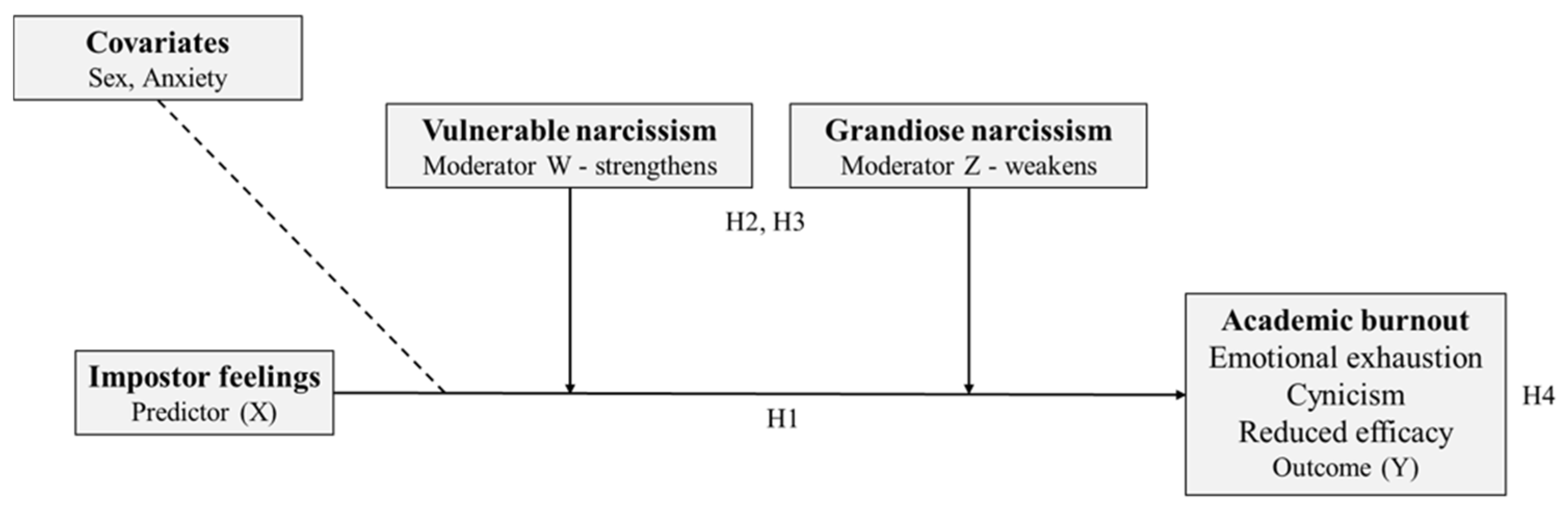
Based on the literature above, the present study addressed the following research question: Do vulnerable and grandiose narcissism moderate the relationship between impostor feelings and academic burnout, including its subscales, in university students? Given previous findings that impostor feelings are linked to anxiety and differ across males and females (Villwock et al., 2016; Rohrmann et al., 2016), all analyses included anxiety and sex as covariates. To address this question, four hypotheses were tested (Figure 1). First, impostor feelings will be positively associated with overall academic burnout (H1). Second, the relationship between impostor feelings and academic burnout will be simultaneously moderated by both vulnerable and grandiose narcissism, such that vulnerable narcissism strengthens, and grandiose narcissism weakens the relationship (H2). Third, the moderating effect of vulnerable narcissism on the relationship between impostor feelings and academic burnout will be stronger than that of grandiose narcissism (H3). Finally, the moderating effects of both factors of narcissism will be strongest for the reduced academic efficacy subscale compared to emotional exhaustion and cynicism (H4).
Figure 1.
Conceptual Moderation Model of Impostor Feelings and Academic Burnout.
2. Materials and Methods
2.1. Participants
In total, 476 students participated in the study. Of these, 44 participants were left out because they did not provide informed consent (36 discontinued before the consent question and 8 declined). Of the remaining 432 participants, 126 were excluded: 123 due to >25% missing data, 1 for having the same pattern of responses (e.g., value 2 for all questions), and 2 for both criteria. Taking a closer look at the response patterns of these 126 participants showed that 73 of them did not start the questionnaire at all. The others (n = 53) discontinued at various points during the survey. Since the burnout measure was the sixth of eight questionnaires and the anxiety measure the seventh, only two of the excluded participants provided any data on burnout or anxiety. Subsequently, five participants who reported “other” as their sex (n = 4) or did not disclose their sex (n = 1) were excluded due to insufficient sample size for reliable estimation. One participant who was identified as an outlier was excluded from all analyses (see Section 2.4). The final sample consisted of 300 university students. All exclusion criteria were specified in the preregistration, except for the exclusion of one participant who did not disclose their sex. Of these 300, 196 (65.3%) were female and 104 (34.7%) were male. The sample was predominantly White/Caucasian (82.3%), with approximately 82% of the sample of Dutch nationality. Additionally, a total of 176 participants (58.7%) were pursuing a bachelor’s degree, 122 (40.7%) a master’s degree, and two students (0.7%) did not report their study program. The mean age of the final sample was 22.84 years old (SD = 2.29), ranging from 18 to 27 years.
2.2. Procedure
University students enrolled in Bachelor’s, Master’s, or PhD programs across the Netherlands were recruited online through convenience sampling via social platforms such as LinkedIn to complete a Qualtrics questionnaire. Data were collected between May and June 2022. Prior to participation, each participant was asked to sign an informed consent form in which they were informed about the procedure and purpose of the study. It was clearly stated that participation was anonymous and voluntary, and that participants could withdraw at any time without providing a reason. Participants also signed informed consent regarding publishing their data. The study received ethical permission from the Ethics Review Board of Tilburg School of Social and Behavioral Sciences [TSB_RP529] and the data were managed following the General Data Protection Regulation (GDPR) guidelines. The study was preregistered on AsPredicted at https://aspredicted.org/9x3im7.pdf (accessed on 16 October 2026). The Qualtrics questionnaire contained demographics and eight self-reported measures, which took approximately 30–45 min to complete. For the purpose of the present research, only four of these measures were included in the analysis.
2.3. Measures
2.3.1. Impostor Feelings
Impostor feelings were assessed using the 16-item Clance Impostor Phenomenon Scale (CIPS; Clance, 1985), which describes a pattern of chronic self-doubt and personal incompetence in which individuals attribute their achievements to external factors. The original CIPS consisted of 20 items. However, a 16-item version was used following suggestions that four of the items had low discrimination values (Kertay et al., 1992). The CIPS uses a Likert scale format with a 5-point response range (1 = not at all true to 5 = very true). Examples of items are: “When people praise me for something I’ve accomplished, I’m afraid I won’t be able to live up to their expectations of me in the future” (Item 4) and “I’m afraid people important to me may find out that I’m not as capable as they think I am” (Item 6). Total scores range from 16 to 80 and are obtained by summing the numbers of the responses to each statement. Higher scores indicate more severe and frequent experiences of impostor feelings. The CIPS demonstrates excellent internal consistency for the total scale (α = 0.92), and item discrimination indices were moderate to high (range = 0.50–0.75; French et al., 2008). In the current study, Cronbach’s alpha was excellent (α = 0.95), and item discrimination indices were moderate to high (range = 0.51–0.81).
2.3.2. Academic Burnout
Academic burnout was assessed with the Maslach Burnout Inventory-Student Survey (MBI-SS; Schaufeli et al., 2002), which is used to measure academic burnout in higher education. The scale has a total of 15 items with three subscales: emotional exhaustion (5 items), cynicism (4 items), and academic efficacy (6 items). All items were rated on a 7-point Likert scale (1 = never to 7 = always). Examples of items are “I feel emotionally drained by my studies” (Item 1), “I have become less enthusiastic about my studies” (Item 7), and “In my opinion, I am a good student” (Item 13, reversed), reflecting exhaustion, cynicism, and academic efficacy, respectively. Academic efficacy items were reverse-scored so that higher scores reflect reduced academic efficacy. Each subscale score was computed by averaging its items, and the total burnout score was subsequently computed by averaging the three subscale scores, with higher scores indicating greater academic burnout. Combining the three subscale scores reflects the general conceptualization of burnout as an overarching syndrome, rather than three separate constructs (Maslach et al., 2001). To preserve the multidimensional nature of burnout, subscale scores were also examined separately. According to Shi et al. (2019), exploratory factor analyses confirmed the three-factor structure. The three subscales showed good to excellent reliability indices (person reliability = 0.79–0.88, real-item reliability = 0.97–1.0). In the current study, the total scale demonstrated excellent internal consistency (α = 0.90), and the subscales demonstrated good to excellent internal consistency (exhaustion α = 0.90, cynicism α = 0.89, academic efficacy α = 0.83).
2.3.3. Grandiose and Vulnerable Narcissism
Grandiose and vulnerable narcissism were assessed using the Brief-Pathological Narcissism Inventory (B-PNI; Schoenleber et al., 2015), which is the short version of the Pathological Narcissism Inventory (PNI; Pincus et al., 2009). The B-PNI consists of 28 items with 7 facets, which form two factors: grandiosity (i.e., entitlement rage, exploitativeness, grandiose fantasy, self-sacrificing self-enhancement) and vulnerability (i.e., contingent self-esteem, hiding the self, devaluing). Note that the B-PNI measures pathological narcissism, which means that its grandiosity factor reflects pathological grandiosity instead of broader forms of grandiose narcissism. Participants responded to the items using a 6-point Likert scale (1 = not at all like me to 6 = very much like me). Examples of items assessing grandiose narcissism are: “I can usually talk my way out of anything” (Item 1) and “I can read people like a book” (Item 11). Examples of vulnerable narcissism items are “Sometimes I avoid people because I’m concerned that they’ll disappoint me” (Item 7) and “It’s hard to feel good about myself unless I know other people admire me” (Item 16). The two factor scores were calculated by averaging the corresponding items, with higher scores indicating greater grandiose and vulnerable narcissism. Both B-PNI factors showed sufficient reliability (grandiosity α = 0.83; vulnerability α = 0.93) (Schoenleber et al., 2015). The two-factor structure was confirmed via confirmatory factor analysis (CFA) across two independent samples, demonstrating acceptable fit indices (CFI = 0.92/0.91, TLI = 0.91/0.90, RMSEA = 0.06/0.06). In the current study, the two factors demonstrated good to excellent reliability (grandiosity α = 0.88; vulnerability α = 0.94).
2.3.4. Anxiety
Anxiety was assessed using the Screen for Adult Anxiety Related Disorders (SCAARED; Angulo et al., 2017), a 44-item self-report measure of anxiety disorders in adults and included as a covariate in the analyses. In the present study, only the 13 items of the generalized anxiety subscale were used. This subscale assesses excessive worry that is not tied to specific situations and was therefore considered particularly relevant in relation to impostor feelings and academic burnout, given the persistent anxiety about competence and evaluation. The other SCAARED subtypes (i.e., social anxiety, separation anxiety, somatic/panic/agoraphobic symptoms) reflect more specific fear responses and were therefore not included. The score of the subscale is obtained by summing the specific items. Examples of items are: “I worry about people liking me” (Item 1) and “I worry about things that have already happened” (Item 12). Participants responded to the items using a 3-point Likert scale (1 = not true or hardly ever true, 2 = somewhat true or sometimes true, 3 = very true or often true). Angulo et al. (2017) demonstrated that the subscale showed excellent internal consistency (α = 0.94), good discriminant validity across anxiety and other disorders, and adequate diagnostic accuracy (AUC = 0.83). In the current study, the subscale showed excellent internal consistency (α = 0.95).
2.4. Data Analyses
A sensitivity power analysis was conducted in G*Power 3.1 (Faul et al., 2009) using the F test for linear multiple regression (fixed model, R2 increase for the interaction terms). With a sample of N = 300, an alpha level of 0.05, a power of 0.80, and seven predictors in total (three main predictors—impostor feelings, vulnerable narcissism, grandiose narcissism—two interaction terms, and two covariates: sex and anxiety), the minimum detectable effect size was f2 = 0.03, which is slightly above Cohen’s (1988) threshold for a small effect (f2 = 0.02). Data were analyzed using IBM SPSS Statistics version 31 (IBM Corp, 2025) and PROCESS (Hayes, 2018). A p-value threshold of 0.05 was applied. No Bonferroni correction for multiple comparisons was applied.
Following the exclusion of participants with more than 25% missing data, the number of remaining missing data was small: IP (2 missing values), B-PNI (6 missing values), MBI-SS (2 missing values), SCAARED (8 missing values). Little’s (1988) missing completely at random (MCAR) test was used to determine the pattern of missing data. The result was non-significant, χ2(1363) = 1193.99, p = 0.977, indicating that the data were MCAR. Missing values were handled using the expectation maximization algorithm (Schafer, 1997) in SPSS. Following inspection of missing data, outliers were assessed on the imputed dataset with Mahalanobis distance, Cook’s distance and leverage values (Kannan & Manoj, 2015). Participants flagged on two or more indicators were excluded, which resulted in the removal of one participant who was identified as an outlier on both Mahalanobis distance and leverage value. In all regression analyses, sex and anxiety were included as covariates to control for potential confounding effects.
Subsequently, assumptions for linear regression analyses were checked. Normality of residuals was inspected with Q-Q plots, which indicated no substantial deviations from normality. Linearity and homoscedasticity were assessed using scatterplots of standardized residuals versus predicted values. Both assumptions were sufficiently met. Multicollinearity was examined with variance inflation factors (VIF < 5) and tolerance values (>0.20) (O’Brien, 2007). All VIFs were below 5 (range = 1.16–3.87) and all tolerance values exceeded 0.20 (range = 0.26–0.86). Independence of observations was assumed to be met since the participants completed the questionnaire individually. Next, descriptive analyses, including means, standard deviations and ranges, were computed for all relevant variables, and Pearson correlations were calculated.
The main analysis included impostor feelings, vulnerable narcissism, and grandiose narcissism as independent variables and academic burnout, including its subscales, as the dependent variables. In addition, sex and anxiety were included as covariates. All variables were measured as continuous variables, except sex, which is dichotomous. First, to address H1, a linear regression analysis was conducted in SPSS to examine whether impostor feelings predict overall academic burnout. Second, to investigate H2, a dual-moderation regression analysis was performed using PROCESS (Model 2) to test whether vulnerable and grandiose narcissism simultaneously moderate the relationship between impostor feelings and academic burnout. The dual-moderation model included the main effects and the two interaction terms (impostor feelings × vulnerable narcissism; impostor feelings × grandiose narcissism). The main effects of vulnerable and grandiose narcissism were not hypothesized and therefore reported as secondary findings. To examine H3, the two interaction coefficients were formally compared using a linear contrast test within the regression model. Finally, to test H4, the moderated regression analyses described above were repeated separately for each of the three academic burnout subscales—emotional exhaustion, cynicism, and reduced academic efficacy—and the interaction coefficients were then compared across subscales using linear contrast tests that accounted for the correlation between subscales. Deviations from preregistration are summarized in Table 1.
Table 1.
Comparison of Preregistered and Implemented Analyses.
3. Results
3.1. Descriptive Analyses
Table 2 shows the descriptive statistics of all study variables for the full sample (N = 300). Table 3 demonstrates the Pearson correlations. Most variables were positively and significantly correlated, with the exception of the correlation between reduced efficacy and anxiety, which was non-significant (r = −0.03, p = 0.629). Grandiose and vulnerable narcissism were strongly correlated (r = 0.75, p < 0.001), which is consistent with the existing literature that the two factors share a common narcissistic structure and can co-occur simultaneously.
Table 2.
Descriptive Statistics.
Table 3.
Pearson Correlations.
3.2. Regression Analysis Predicting Total Academic Burnout
A hierarchical regression analysis was conducted to examine whether impostor feelings predict academic burnout, after controlling for sex and anxiety (H1; Table 4). In Block 1, sex and anxiety explained 16.6% of the variance in burnout (R2 = 0.17, F(2, 297) = 29.61, p < 0.001). Adding impostor feelings in Block 2 explained an additional 3.5% of variance (ΔR2 = 0.04, ΔF(1, 296) = 12.90, p < 0.001), which sums up to a total explained variance of 20.1% (R2 = 0.20, F(3, 296) = 24.83, p < 0.001). Impostor feelings significantly predicted academic burnout (B = 0.31, β = 0.28, p < 0.001), thus supporting H1.
Table 4.
Results Regression Analysis Predicting Total Academic Burnout.
3.3. Moderation Analysis Predicting Total Academic Burnout
Then, a dual-moderation regression analysis was performed using PROCESS (Model 2) to test whether vulnerable and grandiose narcissism simultaneously moderate the relationship between impostor feelings and academic burnout, controlling for sex and anxiety (H2; Table 5). The overall model was significant (R2 = 0.27, F(7, 292) = 15.12, p < 0.001). However, both the interaction between impostor feelings and vulnerable narcissism (B = 0.08, p = 0.386) and the interaction between impostor feelings and grandiose narcissism (B = 0.03, p = 0.745) were not significant. The interaction terms together explained 0.8% of additional variance in burnout (ΔR2 = 0.008). The 95% confidence intervals for the interactions included zero but were wide (IF × VN: B = 0.08, 95% CI [−0.11, 0.27]; IF × GN: B = 0.03, 95% CI [−0.15, 0.21]), which means that a real interaction cannot be ruled out. Thus, H2 was not supported. To test H3, the two interaction coefficients were compared formally using a linear contrast test. The moderating effect of vulnerable narcissism did not differ significantly from that of grandiose narcissism (ΔB = 0.05, t(292) = 0.30, p = 0.767). Thus, the results did not support H3.
Table 5.
Moderation Analyses Predicting Total Academic Burnout.
Examining the main effects showed that vulnerable narcissism was a significant positive predictor of overall academic burnout (B = 0.35, p = 0.001), which indicates that higher levels of vulnerable narcissism were associated with greater burnout. No significant main effects were found for grandiose narcissism (B = 0.08, p = 0.308) or impostor feelings (B = 0.11, p = 0.241).
3.4. Moderation Analyses Predicting Academic Burnout Subscales
Finally, the moderated regression analyses were repeated separately for each of the three academic burnout subscales: emotional exhaustion, cynicism, and reduced academic efficacy (H4; Table 6). For emotional exhaustion, the overall model was significant (R2 = 0.32, F(7, 292) = 19.69, p < 0.001); however, both the interaction between impostor feelings and vulnerable narcissism (B = 0.17, p = 0.159) and the interaction between impostor feelings and grandiose narcissism (B = −0.02, p = 0.875) were not significant. For cynicism, the overall model was also significant (R2 = 0.27, F(7, 292) = 15.17, p < 0.001), but both interaction terms were non-significant (impostor × vulnerable narcissism: B = 0.05, p = 0.726; impostor × grandiose narcissism: B = 0.11, p = 0.385). For reduced academic efficacy, the overall model was also significant (R2 = 0.07, F(7, 292) = 3.17, p = 0.003), but neither interaction was significant (impostor × vulnerable narcissism: B = 0.03, p = 0.761; impostor × grandiose narcissism: B = −0.01, p = 0.962). Across all three subscales, the interaction terms explained minimal additional variance (emotional exhaustion: ΔR2 = 0.010; cynicism: ΔR2 = 0.009; reduced academic efficacy: ΔR2 = 0.001). Since none of the interaction terms were significant across the three subscales, there was no evidence that narcissism moderates the relationship between impostor feelings and any burnout subscale. To formally test H4, the interaction coefficients were compared across subscales using linear contrast tests. Neither the moderating effect of vulnerable narcissism nor that of grandiose narcissism was significantly stronger for reduced academic efficacy than for emotional exhaustion (vulnerable: ΔB = −0.14, t(292) = −1.08, p = 0.281; grandiose: ΔB = 0.01, t(292) = 0.11, p = 0.913) or cynicism (vulnerable: ΔB = −0.02, t(292) = −0.12, p = 0.902; grandiose: ΔB = −0.12, t(292) = −0.94, p = 0.350). Thus, H4 was not supported.
Table 6.
Moderation Analysis Predicting Academic Burnout Subscales.
Although not hypothesized, the main effects within each subscale were also examined. For emotional exhaustion, anxiety was the strongest predictor (B = 0.59, p = 0.001), followed by vulnerable narcissism (B = 0.26, p = 0.041). Impostor feelings (p = 0.245) and grandiose narcissism (p = 0.243) were not significant predictors. For cynicism, both vulnerable (B = 0.41, p = 0.003) and grandiose narcissism (B = 0.23, p = 0.049) were significant predictors. It should be noted that effects of vulnerable narcissism on exhaustion (p = 0.041) and grandiose narcissism on cynicism (p = 0.049) were both close to the conventional significance threshold, which is why they should be interpreted with caution, especially given the number of analyses conducted. Additionally, there was a significant main effect for sex (B = 0.45, p = 0.006), with male students reporting higher levels of cynicism toward their studies than female students. However, impostor feelings were not a significant predictor (p = 0.357). For reduced academic efficacy, vulnerable narcissism was a significant positive predictor (B = 0.37, p = 0.001). Anxiety was a significant negative predictor, suggesting that higher anxiety was associated with lower levels of reduced efficacy (B = −0.41, p = 0.005).
3.5. Exploratory Moderation Analyses
As the dual-moderation analyses showed no significant interactions, exploratory analyses were conducted to assess whether this null result was robust to the choice of modeling approach. All of these analyses are exploratory and not preregistered. Given the high correlation between vulnerable and grandiose narcissism (r = 0.75), each moderator was examined separately using single-moderator models without covariates. When vulnerable narcissism was entered as the only moderator, the interaction term was not statistically significant (B = 0.10, p = 0.098, ΔR2 = 0.007). For grandiose narcissism, the interaction was similarly non-significant (B = 0.09, p = 0.153, ΔR2 = 0.01).
The single-moderator models were also estimated with sex and anxiety kept as covariates, as this allows for a direct comparison with the dual-moderation model in Table 5. When vulnerable narcissism was entered alone, the interaction term had a standard error of 0.06. In the dual-moderation model, the standard error increased to 0.10. Similarly, when grandiose narcissism was entered alone, the interaction term had a standard error of 0.06, which increased to 0.09 in the dual-moderation model. These increases suggest that including both moderators in the model may have increased the uncertainty surrounding the estimated moderation effects.
Because anxiety correlated strongly with both impostor feelings (r = 0.74) and vulnerable narcissism (r = 0.72), controlling for it may remove meaningful shared variance. To check this, the dual-moderation models were re-run without anxiety. Excluding anxiety did not change the moderation results. Interactions remained non-significant for total burnout (IF × VN: B = 0.08, p = 0.413; IF × GN: B = 0.03, p = 0.728) and for all three subscales (all p > 0.23). One exception was that impostor feelings significantly predicted emotional exhaustion when anxiety was left out (B = 0.31, p = 0.005). This suggests that the association between impostor feelings and exhaustion may be largely shared with anxiety. Finally, to examine whether excluding the five participants who reported “other” as their sex or did not disclose it affected the results, the models were repeated without sex as a covariate. A total of 305 participants were included. The interactions remained non-significant for overall burnout (IF × VN: B = 0.08, p = 0.429; IF × GN: B = 0.05, p = 0.572) and for all three subscales.
4. Discussion
The main goal of the present study was to investigate the role of vulnerable and grandiose narcissism in the relationship between impostor feelings and academic burnout. The study aimed to answer the following research question: Do grandiose and vulnerable narcissism moderate the relationship between impostor feelings and academic burnout, including its subscales, in university students? The results supported H1, thus confirming that impostor feelings were positively associated with overall academic burnout. H2 was not supported, as neither vulnerable nor grandiose narcissism significantly moderated the relationship between impostor feelings and overall academic burnout. The moderating effect of vulnerable narcissism was not significantly stronger than that of grandiose narcissism, so H3 was not supported. Additionally, reduced academic efficacy did not show stronger moderating effects than the other subscales, which is why H4 was not supported. Exploratory analyses, in which each narcissism factor was tested separately as a moderator, similarly showed no significant interaction effects.
4.1. Impostor Feelings and Academic Burnout
As hypothesized, impostor feelings were found to be a significant positive predictor of academic burnout. This is in line with prior studies linking impostor feelings and academic burnout (Alrayyes et al., 2020; Villwock et al., 2016). This finding aligns with the theory developed by Clance and Imes (1978), who proposed that impostor feelings are accompanied by chronic self-doubt and fear of failure, which may lead to persistent psychological pressure. In an academic context, this chronic self-doubt among students continuously questioning their competence can be particularly emotionally demanding. These students are more inclined to engage in perfectionistic and workaholic behavior in the form of excessive preparation and pressure they put on themselves to maintain a competent image (Parkman, 2016). According to the Job Demands-Resources (JD-R; Bakker & Demerouti, 2007) model, high demands combined with limited personal resources drain individuals and can ultimately lead to exhaustion and burnout (Demerouti et al., 2001). Thus, students who experience impostor feelings may face an additional demand that drains emotional resources over time and contributes to burnout. Additionally, the finding that impostor feelings explained an additional 3.5% of the variance in burnout beyond sex and anxiety suggests that the impostor–burnout link is not fully explained by these covariates, thus highlighting the unique contribution of impostor feelings to academic burnout.
4.2. The Null Moderation Effect of Narcissism
The findings that neither vulnerable nor grandiose narcissism significantly moderated the impostor–burnout link may be explained by several factors. First, the null moderation results may challenge the assumptions of the proposed model. Impostor feelings and vulnerable narcissism were strongly correlated (r = 0.73), and impostor feelings no longer predicted burnout once vulnerable narcissism was included. This suggests that these two constructs may simply share a common vulnerability, such as fragile self-esteem and self-doubt, instead of vulnerable narcissism strengthening the effect of impostor feelings. It is possible that this shared vulnerability, rather than the interaction between the constructs, is associated with burnout.
Second, methodological factors may have limited the ability to detect small moderation effects. The high correlation between vulnerable and grandiose narcissism in the current sample (r = 0.75) might have complicated the dual-moderation model. Although the pattern that narcissism shares a common underlying structure is consistent with other studies (Fossati et al., 2015; Ronningstam, 2009), the high correlation makes it difficult to identify the different contributions to interaction effects. This is reflected in the standard errors (SE). The SE for the vulnerable narcissism interaction increased from 0.06 to 0.10, while that for grandiose narcissism increased from 0.06 to 0.09 when both moderators were included simultaneously. This suggests that multicollinearity may have reduced the precision of the interaction estimates despite VIF values being below 5. However, as the interactions were also non-significant in the single-moderator models, multicollinearity alone does not explain the null findings. Although impostor feelings, vulnerable narcissism, and anxiety were strongly correlated, correlations corrected for measurement error (correction for attenuation using alpha; Spearman, 1904) ranged between 0.76 and 0.78. Since this is below the 0.80 cutoff for a discriminant validity problem, it indicates that these are related yet distinguishable constructs (Rönkkö & Cho, 2022). The disattenuated correlation between vulnerable and grandiose narcissism was higher (r = 0.82), so their unique effects should be interpreted with caution.
Also, the sample of the current study (N = 300), although reasonable for main effect analyses, might have been underpowered for detecting small interaction effects. The sensitivity analysis conducted earlier suggested that the current sample was sufficiently powered to detect interaction effects of f2 = 0.03 or larger. However, prior work has found that interactions are often quite small and require large samples to detect them (McClelland & Judd, 1993). Aguinis et al. (2005) showed that, in a review of 261 papers in psychology journals, the median effect was f2 = 0.002. Consequently, detecting a small effect of f2 = 0.002 with the current model would have required approximately N = 4821. This suggests that a study with adequate power might paint a different picture.
4.3. The Role of Vulnerable Narcissism
While no moderation effects were found, the secondary main effects revealed that vulnerable narcissism was a significant predictor of academic burnout across all analyses, namely overall burnout, cynicism, and reduced academic efficacy, as well as emotional exhaustion, although this last effect was close to the conventional significance threshold (p = 0.041) and should therefore be interpreted with caution. This implies that, regardless of impostor feelings, vulnerable narcissism is directly associated with higher burnout. The significant main effect may be explained by the core characteristics of vulnerable narcissism, which include insecurity, hypersensitivity to criticism, and fragile self-esteem (Wink, 1991). In an academic environment, where performance is constantly evaluated, students high in vulnerable narcissism may be particularly sensitive to critical evaluation. Their fragile self-esteem makes it harder to deal with negative feedback and may therefore lead to academic burnout symptoms. Although the link between vulnerable narcissism and academic burnout has not yet been explored, the study’s findings are consistent with Barnett and Flores (2016), who found pathological narcissism to be positively associated with academic burnout in a large sample of U.S. college students. The significant main effect could also be examined through the lens of the diathesis-stress model, as proposed by Monroe and Simons (1991), which holds that negative mental health conditions (here, burnout) develop from a combination of pre-existing vulnerabilities (vulnerable narcissism) and the impact of a stressor (academic stress). Students high in vulnerable narcissism may already be predisposed towards insecurity and sensitivity to evaluation, which makes it harder to cope with academic pressure and critical feedback. When exposed to these stressors, their vulnerability may be heightened, and the ongoing stress can add up over time and ultimately contribute to burnout. These findings suggest that vulnerable traits may be associated with academic burnout. Increasing awareness of vulnerable narcissism among student counselors and therapists could support burnout prevention and more individualized interventions. However, due to the cross-sectional nature of the design, the directionality from vulnerable narcissism to academic burnout cannot be confirmed. A reverse pathway may be equally plausible, in which chronic academic burnout contributes to diminished self-esteem and defensive narcissistic traits over time (e.g., as a protective response to persistent experiences of academic exhaustion and reduced feelings of competence).
4.4. Grandiose Narcissism and Cynicism
While vulnerable narcissism was associated with multiple aspects of burnout, grandiose narcissism showed a more specific effect. The present study revealed that grandiose narcissism was a significant predictor of cynicism, but not the other burnout subscales, although this effect was close to the conventional significance threshold (p = 0.049) and should thus be interpreted carefully. This pattern may be explained by the protective role of defense mechanisms associated with grandiose narcissism. Kampe et al. (2021) found that grandiose narcissism is positively associated with rationalization, the tendency to come up with logical explanations for unfavorable situations, and dissociation, the ability to mentally detach from stressful experiences. In an academic context, such defense mechanisms may become apparent as cynicism, potentially reflecting a detached and indifferent attitude toward their studies that protects their self-image from threat. Meanwhile, defense mechanisms may buffer against the more impairing aspects of burnout, which could explain why grandiose narcissism was not linked to the other two subscales, emotional exhaustion and reduced academic efficacy.
4.5. The Role of Sex and Anxiety
Beyond narcissism, anxiety also played a role in predicting burnout outcomes across subscales. In fact, anxiety was the strongest predictor of emotional exhaustion, which is consistent with the existing literature suggesting that anxiety is associated with heightened reactivity to stressors and increased vulnerability to emotional exhaustion (Richardsen et al., 1992). Students experiencing high anxiety may spend more energy dealing with constant worry and stress, which over time can lead to exhaustion. Interestingly, anxiety was a negative predictor of reduced academic efficacy. However, anxiety was unrelated to reduced efficacy in the zero-order correlations (r = −0.03), so this coefficient emerged only after controlling for impostor feelings and narcissism, with which anxiety overlaps strongly. It thus likely reflects a suppression pattern. Since all variables were self-reported measures at a single time point, common method bias may be a contributor to the negative association between anxiety and reduced academic efficacy. Reverse-scoring of the efficacy items, which were originally phrased to reflect competence (e.g., “In my opinion, I am a good student”), may further introduce method effects (Podsakoff et al., 2003). This coefficient should therefore be interpreted with caution.
Finally, in addition to the personality variables, sex was also shown to be a significant predictor of cynicism. Male students reported higher levels of cynicism toward their studies than females. This pattern is consistent with previous research (Rusandi et al., 2022) and can be understood through gender role theory (Eagly, 1987). According to this theory, while women are more likely to openly express feelings concerning emotional and physical fatigue, men tend to shut off and withdraw under stress because they have learned to mask their emotions. In an academic context, this tendency among male students to distance themselves from stressors may take the form of cynical attitudes toward academic work, since withdrawing emotionally and becoming indifferent toward it are closely related.
4.6. Practical Implications
The study’s findings have several meaningful implications for student mental health support. Given that impostor feelings have been consistently found to be a significant predictor of academic burnout, both in the present study and in prior research (Alrayyes et al., 2020; Villwock et al., 2016), mental health programs in universities could assist students by offering support programs that target impostor feelings. This is particularly important considering that impostor feelings are highly prevalent in university settings (Fassl et al., 2020). A review by Para et al. (2024) identified that group discussion sessions tend to be effective, since they give individuals the opportunity to connect with others and share similar experiences. Psychoeducation, where students learn to recognize and understand their impostor feelings, has been consistently shown to be an important component across effective interventions.
Additionally, the secondary finding that vulnerable narcissism predicted academic burnout across all subscales suggests that student counselors and therapists may benefit from being attentive to signs of fragile self-esteem, insecurity, avoidance, and hypersensitivity to evaluation in students with burnout symptoms. Essentially, burnout support should consider not only academic stress or performance factors but also vulnerable narcissistic characteristics. Greater awareness of these vulnerabilities may help counselors better understand the student’s profile. When these traits are identified, additional mental health support could be beneficial. Students with both high impostor feelings and vulnerable narcissistic traits may be a group for whom these associations are especially relevant, and it would be worth examining whether tailored interventions could support this group. As treatment options specifically targeting vulnerable narcissism are limited, further clinical investment in this area is needed.
4.7. Strengths, Limitations and Future Research
The present study is the first to simultaneously examine the role of both vulnerable and grandiose narcissism as moderators in the relationship between impostor feelings and academic burnout. This is particularly meaningful given that the two factors tend to co-occur within individuals. Examining them simultaneously therefore allows for a better representation of narcissism. Another strength of the study is the use of validated instruments, such as the B-PNI and CIPS. Finally, including sex and anxiety as covariates is a notable strength, since both variables have been shown to be associated with impostor feelings and burnout in prior research (Clance & Imes, 1978; W. Liu et al., 2024; Rohrmann et al., 2016).
However, there are also some limitations. First, the present study relied on self-report measures, which increases the risk of common method variance and social desirability effects (Podsakoff et al., 2003). Second, convenience sampling was used and therefore limits the generalizability of the findings. The results are specific to Dutch university students and may not generalize to students in other educational contexts and countries. Third, the present study has a cross-sectional design, which prevents conclusions about the directionality of effects. Fourth, depression was not assessed through questionnaires and thus could not be included as a covariate, although previous research has found an overlap with both impostor feelings and academic burnout (Alrayyes et al., 2020). Fifth, the original sample was N = 476, of whom 126 were excluded due to missing data or identical response patterns, representing a loss of 26% of the sample. Most of these excluded participants did not start the questionnaires at all or discontinued before reaching the burnout and anxiety measures, which made it impossible to test whether they differed systematically from the final sample. If students with higher burnout were more likely to discontinue the survey, burnout levels may have been underestimated. Sixth, as noted before, the sensitivity power analysis indicated adequate power to detect effects of f2 = 0.03, which was too optimistic considering that the median interaction effect size typically reported in psychology is f2 = 0.002. Hence, the null findings for H2 and H3 should be interpreted with caution since the study was likely underpowered.
Finally, it is worth noting that although multiple statistical tests were performed, no correction for multiple comparisons was applied, which increases the risk of Type I error (Shaffer, 1995). However, applying a Bonferroni correction across the moderation analyses (adjusted α = 0.006) would not have changed the conclusions, since none of the interaction effects were significant in the first place.
As the current sample might have been underpowered to detect small interaction effects, future research is needed to replicate the study with larger samples. Since the study was cross-sectional, meaning that causality could not be established, future studies should use longitudinal designs to analyze whether impostor feelings predict burnout over time, and what role both narcissism factors play in this relationship. Given the overlap between burnout and depression (Salmela-Aro et al., 2009), future studies should additionally include depression as a covariate to isolate the unique variance explained by burnout. Moreover, since the current sample consisted mainly of Dutch university students, replication across different countries and educational contexts is necessary for the generalizability of the findings. This can be especially relevant in regions characterized by achievement-oriented cultures, where the mechanisms underlying the impostor–burnout relationship may differ. Particularly in East Asian countries such as China, students face a vast amount of academic stress and high expectations from parents and teachers due to traditions that emphasize the value of hard work, achievement, and filial piety (H. Liu et al., 2020). More than half of secondary school students in China have reported experiencing academic burnout symptoms at some point in their academic career (Zhang et al., 2013). The fear of academic failure or underperformance may intensify feelings of self-doubt beyond what is seen in more individualistic cultures such as the Netherlands. Future research could delve deeper into whether these cultural expectations around achievement strengthen the relationship between impostor feelings and academic burnout and whether narcissistic features buffer that link. Further research could also extend beyond the student population to university staff. Academic staff similarly operate in a high-evaluation environment that is performance-driven, and impostor feelings have been linked to emotional exhaustion among faculty (Hutchins, 2015). Future studies could investigate the role of vulnerable narcissism in the relationship between impostor feelings and burnout among academic staff. A direct comparison between student and faculty samples could help determine whether these patterns are specific to students or reflect a broader picture across academic environments.
5. Conclusions
The present study investigated whether vulnerable and grandiose narcissism moderate the relationship between impostor feelings and academic burnout in university students. While neither narcissism factor significantly moderated this relationship, impostor feelings were shown to be a significant positive predictor of academic burnout, suggesting that persistent self-doubt and not feeling competent enough can take an emotional toll on students. Moreover, the present study revealed that vulnerable narcissism was consistently associated with academic burnout across all its dimensions, which hints that vulnerable traits may be relevant to understanding burnout. No evidence for moderation was found, although small moderation effects cannot be ruled out. These findings suggest that greater awareness of impostor feelings and vulnerable narcissism among therapists may support burnout prevention. Despite the null moderation findings, the present study contributes to the literature on the role of personality, specifically narcissism, in academic burnout. Future research with larger samples is needed to examine whether narcissism could moderate the impostor–burnout relationship.
Author Contributions
Conceptualization, L.F.; methodology, L.F. and E.D.C.; formal analysis, L.F.; investigation, E.D.C.; resources, E.D.C.; data curation, E.D.C.; writing—original draft preparation, L.F.; writing—review and editing, L.F. and E.D.C.; visualization, L.F.; supervision, E.D.C.; project administration, E.D.C. All authors have read and agreed to the published version of the manuscript.
Funding
This research received no external funding.
Institutional Review Board Statement
The study was conducted in accordance with the Declaration of Helsinki and approved by the Ethics Review Board of Tilburg School of Social and Behavioral Sciences (protocol code: TSB RP529; date of approval: 29 April 2022).
Informed Consent Statement
Informed consent was obtained from all subjects involved in the study.
Data Availability Statement
The dataset generated and analyzed during the current research is available on request from the corresponding author.
Acknowledgments
We would like to thank Roberta Dumitrescu and the students from the Clinical Forensic Psychology Master who helped with data collection in the context of their Master Thesis. MBI-General Survey for Students–MBI-GS (S): Copyright ©1996, 2016 Wilmar B. Schaufeli, Michael P. Leiter, Christina Maslach & Susan E. Jackson. All rights reserved in all media. Published by Mind Garden, Inc. www.mindgarden.com. Given the copyright of this instrument, a license was purchased.
Conflicts of Interest
The authors declare no conflicts of interest.
References
- Aguinis, H., Beaty, J. C., Boik, R. J., & Pierce, C. A. (2005). Effect size and power in assessing moderating effects of categorical variables using multiple regression: A 30-year review. Journal of Applied Psychology, 90(1), 94–107. [Google Scholar] [CrossRef] [Scilit] [PubMed]
- Alrayyes, S., Dar, U. F., Alrayes, M., Alghutayghit, A., & Alrayyes, N. (2020). Burnout and imposter syndrome among Saudi young adults. The strings in the puppet show of psychological morbidity. Saudi Medical Journal, 41(2), 189–194. [Google Scholar] [CrossRef] [Scilit] [PubMed]
- Ang, R. P., & Huan, V. S. (2006). Relationship between academic stress and suicidal ideation: Testing for depression as a mediator using multiple regression. Child Psychiatry and Human Development, 37(2), 133–143. [Google Scholar] [CrossRef] [Scilit] [PubMed]
- Angulo, M., Rooks, B. T., Gill, M. K., Goldstein, T., Sakolsky, D., Goldstein, B., Monk, K., Hickey, M. B., Diler, R. S., Hafeman, D., Merranko, J., Axelson, D., & Birmaher, B. (2017). Psychometrics of the screen for adult anxiety related disorders (SCAARED): A new scale for the assessment of DSM-5 anxiety disorders. Psychiatry Research, 253, 84–90. [Google Scholar] [CrossRef] [Scilit] [PubMed]
- Bakker, A. B., & Demerouti, E. (2007). The job demands-resources model: State of the art. Journal of Managerial Psychology, 22(3), 309–328. [Google Scholar] [CrossRef] [Scilit]
- Barnett, M. D., & Flores, J. (2016). Narcissus, exhausted: Self-compassion mediates the relationship between narcissism and school burnout. Personality and Individual Differences, 97, 102–108. [Google Scholar] [CrossRef] [Scilit]
- Besser, A., & Priel, B. (2010). Grandiose narcissism versus vulnerable narcissism in threatening situations: Emotional reactions to achievement failure and interpersonal rejection. Journal of Social and Clinical Psychology, 29(8), 874–902. [Google Scholar] [CrossRef] [Scilit]
- Brown, A. A., Freis, S. D., Carroll, P. J., & Arkin, R. M. (2016). Perceived agency mediates the link between the narcissistic subtypes and self-esteem. Personality and Individual Differences, 90, 124–129. [Google Scholar] [CrossRef] [Scilit]
- Brunell, A. B., Staats, S., Barden, J., & Hupp, J. M. (2011). Narcissism and academic dishonesty: The exhibitionism dimension and the lack of guilt. Personality and Individual Differences, 50(3), 323–328. [Google Scholar] [CrossRef] [Scilit]
- Cain, N. M., Pincus, A. L., & Ansell, E. B. (2008). Narcissism at the crossroads: Phenotypic description of pathological narcissism across clinical theory, social/personality psychology, and psychiatric diagnosis. Clinical Psychology Review, 28(4), 638–656. [Google Scholar] [CrossRef] [Scilit] [PubMed]
- Chowning, K., & Campbell, N. J. (2009). Development and validation of a measure of academic entitlement: Individual differences in students’ externalized responsibility and entitled expectations. Journal of Educational Psychology, 101(4), 982–997. [Google Scholar] [CrossRef] [Scilit]
- Clance, P. R. (1985). The impostor phenomenon: When success makes you feel like a fake. Bantam Books. [Google Scholar]
- Clance, P. R., & Imes, S. A. (1978). The imposter phenomenon in high achieving women: Dynamics and therapeutic intervention. Psychotherapy: Theory, Research & Practice, 15(3), 241–247. [Google Scholar] [CrossRef] [Scilit]
- Cohen, J. (1988). Statistical power analysis for the behavioral sciences (2nd ed.). Routledge. [Google Scholar]
- Demerouti, E., Bakker, A. B., de Jonge, J., Janssen, P. P., & Schaufeli, W. B. (2001). Burnout and engagement at work as a function of demands and control. Scandinavian Journal of Work, Environment & Health, 27(4), 279–286. [Google Scholar] [CrossRef] [Scilit] [PubMed]
- Eagly, A. H. (1987). Sex differences in social behavior: A social-role interpretation. Lawrence Erlbaum Associates. [Google Scholar]
- Fassl, F., Yanagida, T., & Kollmayer, M. (2020). Impostors dare to compare: Associations between the impostor phenomenon, gender typing, and social comparison orientation in university students. Frontiers in Psychology, 11, 1225. [Google Scholar] [CrossRef] [Scilit] [PubMed]
- Faul, F., Erdfelder, E., Buchner, A., & Lang, A.-G. (2009). Statistical power analyses using G*Power 3.1: Tests for correlation and regression analyses. Behavior Research Methods, 41(4), 1149–1160. [Google Scholar] [CrossRef] [Scilit] [PubMed]
- Fossati, A., Feeney, J., Pincus, A. L., Borroni, S., & Maffei, C. (2015). The structure of pathological narcissism and its relationships with adult attachment styles: A study of Italian nonclinical and clinical adult participants. Psychoanalytic Psychology, 32(3), 403–431. [Google Scholar] [CrossRef] [Scilit]
- French, B. F., Ullrich-French, S. C., & Follman, D. (2008). The psychometric properties of the Clance Impostor Scale. Personality and Individual Differences, 44(5), 1270–1278. [Google Scholar] [CrossRef] [Scilit]
- Giancola, M., Ferrandes, A., & D’Amico, S. (2024). Mirror, mirror on the wall: The role of narcissism, muscle dysmorphia, and self-esteem in bodybuilders’ muscularity-oriented disordered eating. Current Psychology, 43, 32697–32706. [Google Scholar] [CrossRef] [Scilit]
- Gisselbaek, M., Suppan, M., Saxena, S., Hudelson, P., & Savoldelli, G. L. (2025). Association of impostor phenomenon and burnout among Swiss residents and junior anaesthesiologists: Results of a cross-sectional survey. BMC Anesthesiology, 25, 98. [Google Scholar] [CrossRef] [Scilit] [PubMed]
- Hayes, A. F. (2018). Introduction to mediation, moderation, and conditional process analysis: A regression-based approach (2nd ed.). Guilford Press. [Google Scholar]
- Hutchins, H. M. (2015). Outing the imposter: A study exploring imposter phenomenon among higher education faculty. New Horizons in Adult Education and Human Resource Development, 27(2), 3–12. [Google Scholar] [CrossRef] [Scilit]
- IBM Corp. (2025). IBM SPSS statistics for windows (Version 31.0) [Computer software]. IBM Corp.
- Kampe, L., Bohn, J., Remmers, C., & Hörz-Sagstetter, S. (2021). It’s not that great anymore: The central role of defense mechanisms in grandiose and vulnerable narcissism. Frontiers in Psychiatry, 12, 661948. [Google Scholar] [CrossRef] [Scilit] [PubMed]
- Kannan, K. S., & Manoj, K. (2015). Outlier detection in multivariate data. Applied Mathematical Sciences, 9, 2317–2324. [Google Scholar] [CrossRef] [Scilit]
- Kertay, L., Clance, P. R., & Holland, C. L. (1992). A factor study of the Clance impostor phenomenon scale [Unpublished manuscript]. Georgia State University.
- Kiuru, N., Aunola, K., Nurmi, J.-E., Leskinen, E., & Salmela-Aro, K. (2008). Peer group influence and selection in adolescents’ school burnout: A longitudinal study. Merrill-Palmer Quarterly, 54(1), 23–55. [Google Scholar] [CrossRef] [Scilit]
- Little, R. J. A. (1988). A test of missing completely at random for multivariate data with missing values. Journal of the American Statistical Association, 83(404), 1198–1202. [Google Scholar] [CrossRef] [Scilit]
- Liu, H., Yao, M., & Li, J. (2020). Chinese adolescents’ achievement goal profiles and their relation to academic burnout, learning engagement, and test anxiety. Learning and Individual Differences, 83–84, 101945. [Google Scholar] [CrossRef] [Scilit]
- Liu, W., Zhang, R., Wang, H., Rule, A., Wang, M., Abbey, C., Singh, M. K., Rozelle, S., She, X., & Tong, L. (2024). Association between anxiety, depression symptoms, and academic burnout among Chinese students: The mediating role of resilience and self-efficacy. BMC Psychology, 12(1), 335. [Google Scholar] [CrossRef] [Scilit] [PubMed]
- Maslach, C., Schaufeli, W. B., & Leiter, M. P. (2001). Job burnout. Annual Review of Psychology, 52, 397–422. [Google Scholar] [CrossRef] [Scilit] [PubMed]
- McClelland, G. H., & Judd, C. M. (1993). Statistical difficulties of detecting interactions and moderator effects. Psychological Bulletin, 114(2), 376–390. [Google Scholar] [CrossRef] [Scilit] [PubMed]
- Monroe, S. M., & Simons, A. D. (1991). Diathesis-stress theories in the context of life stress research: Implications for the depressive disorders. Psychological Bulletin, 110(3), 406–425. [Google Scholar] [CrossRef] [PubMed]
- Morf, C. C., & Rhodewalt, F. (2001). Unraveling the paradoxes of narcissism: A dynamic self-regulatory processing model. Psychological Inquiry, 12(4), 177–196. [Google Scholar] [CrossRef] [Scilit] [PubMed]
- Murberg, T. A., & Bru, E. (2007). The role of neuroticism and perceived school-related stress in somatic symptoms among students in Norwegian junior high schools. Journal of Adolescence, 30(2), 203–212. [Google Scholar] [CrossRef] [Scilit] [PubMed]
- O’Brien, R. M. (2007). A caution regarding rules of thumb for variance inflation factors. Quality & Quantity, 41(5), 673–690. [Google Scholar] [CrossRef] [Scilit]
- Papageorgiou, K. A., Malanchini, M., Denovan, A., Clough, P. J., Shakeshaft, N., Schofield, K., & Kovas, Y. (2018). Longitudinal associations between narcissism, mental toughness and school achievement. Personality and Individual Differences, 131, 105–110. [Google Scholar] [CrossRef] [Scilit]
- Para, E., Dubreuil, P., Miquelon, P., & Martin-Krumm, C. (2024). Interventions addressing the impostor phenomenon: A scoping review. Frontiers in Psychology, 15, 1360540. [Google Scholar] [CrossRef] [Scilit] [PubMed]
- Parkman, A. (2016). The imposter phenomenon in higher education: Incidence and impact. Journal of Higher Education Theory and Practice, 16(1), 51–60. [Google Scholar]
- Pincus, A. L., Ansell, E. B., Pimentel, C. A., Cain, N. M., Wright, A. G. C., & Levy, K. N. (2009). Initial construction and validation of the pathological narcissism inventory. Psychological Assessment, 21(3), 365–379. [Google Scholar] [CrossRef] [Scilit] [PubMed]
- Podsakoff, P. M., MacKenzie, S. B., Lee, J. Y., & Podsakoff, N. P. (2003). Common method biases in behavioral research: A critical review of the literature and recommended remedies. The Journal of Applied Psychology, 88(5), 879–903. [Google Scholar] [CrossRef] [Scilit] [PubMed]
- Rana, M., Riedel, E., Czens, F., Petersohn, H., Moellmann, H. L., Schorn, L., & Rana, M. (2022). When do narcissists burn out? The bright and dark side of narcissism in surgeons. International Journal of Environmental Research and Public Health, 19(22), 15123. [Google Scholar] [CrossRef] [Scilit] [PubMed]
- Raskin, R., & Terry, H. (1988). A principal-components analysis of the narcissistic personality inventory and further evidence of its construct validity. Journal of Personality and Social Psychology, 54(5), 890–902. [Google Scholar] [CrossRef] [PubMed]
- Richardsen, A. M., Burke, R. J., & Leiter, M. P. (1992). Occupational demands, psychological burnout and anxiety among hospital personnel in Norway. Anxiety, Stress & Coping: An International Journal, 5(1), 55–68. [Google Scholar] [CrossRef] [Scilit]
- Rohrmann, S., Bechtoldt, M. N., & Leonhardt, M. (2016). Validation of the impostor phenomenon among managers. Frontiers in Psychology, 7, 821. [Google Scholar] [CrossRef] [Scilit] [PubMed]
- Ronningstam, E. F. (2009). Narcissistic personality disorder: Facing DSM-V. Psychiatric Annals, 39(2), 111–121. [Google Scholar] [CrossRef] [Scilit]
- Rosales-Ricardo, Y., Rizzo-Chunga, F., Mocha-Bonilla, J., & Ferreira, J. P. (2021). Prevalence of burnout syndrome in university students: A systematic review. Salud Mental, 44(2), 91–102. [Google Scholar] [CrossRef] [Scilit]
- Rönkkö, M., & Cho, E. (2022). An updated guideline for assessing discriminant validity. Organizational Research Methods, 25(1), 6–14. [Google Scholar] [CrossRef] [Scilit]
- Rusandi, M. A., Liza, L. O., & Biondi Situmorang, D. D. (2022). Burnout and resilience during the COVID-19 outbreak: Differences between male and female students. Heliyon, 8(8), e10019. [Google Scholar] [CrossRef] [Scilit] [PubMed]
- Salmela-Aro, K., Savolainen, H., & Holopainen, L. (2009). Depressive symptoms and school burnout during adolescence: Evidence from two cross-lagged longitudinal studies. Journal of Youth and Adolescence, 38(10), 1316–1327. [Google Scholar] [CrossRef] [Scilit] [PubMed]
- Schafer, J. L. (1997). Analysis of incomplete multivariate data. Chapman & Hall. [Google Scholar]
- Schaufeli, W. B., Martínez, I. M., Pinto, A. M., Salanova, M., & Bakker, A. B. (2002). Burnout and engagement in university students: A cross-national study. Journal of Cross-Cultural Psychology, 33(5), 464–481. [Google Scholar] [CrossRef] [Scilit]
- Schoenleber, M., Roche, M. J., Wetzel, E., Pincus, A. L., & Roberts, B. W. (2015). Development of a brief version of the Pathological Narcissism Inventory. Psychological Assessment, 27(4), 1520–1526. [Google Scholar] [CrossRef] [Scilit] [PubMed]
- Sedikides, C., Rudich, E. A., Gregg, A. P., Kumashiro, M., & Rusbult, C. (2004). Are normal narcissists psychologically healthy? Journal of Personality and Social Psychology, 87(3), 400–416. [Google Scholar] [CrossRef] [Scilit] [PubMed]
- Shaffer, J. P. (1995). Multiple hypothesis testing. Annual Review of Psychology, 46(1), 561–584. [Google Scholar] [CrossRef]
- Shi, Y., Gugiu, P. C., Crowe, R. P., & Way, D. P. (2019). A Rasch analysis validation of the Maslach Burnout Inventory–Student Survey with preclinical medical students. Teaching and Learning in Medicine, 31(2), 154–169. [Google Scholar] [CrossRef] [Scilit] [PubMed]
- Slivar, B. (2001). The syndrome of burnout, self-image, and anxiety with grammar school students. Horizons of Psychology, 10(2), 21–32. [Google Scholar] [CrossRef] [Scilit]
- Spearman, C. (1904). The proof and measurement of association between two things. The American Journal of Psychology, 15(1), 72–101. [Google Scholar] [CrossRef] [Scilit] [PubMed]
- Tuominen-Soini, H., & Salmela-Aro, K. (2014). Schoolwork engagement and burnout among Finnish high school students and young adults: Profiles, progressions, and educational outcomes. Developmental Psychology, 50(3), 649–662. [Google Scholar] [CrossRef] [Scilit] [PubMed]
- Vachon, M., Papineau, M., Dupuis, G., & Roberge, P. (2019). Associations between systemic quality of life and burnout among French Canadian workers. Social Indicators Research, 142(3), 1193–1210. [Google Scholar] [CrossRef] [Scilit]
- Villwock, J. A., Sobin, L. B., Koester, L. A., & Harris, T. M. (2016). Impostor syndrome and burnout among American medical students: A pilot study. International Journal of Medical Education, 7, 364–369. [Google Scholar] [CrossRef] [Scilit] [PubMed]
- Wink, P. (1991). Two faces of narcissism. Journal of Personality and Social Psychology, 61(4), 590–597. [Google Scholar] [CrossRef] [PubMed]
- Wirtz, N., & Rigotti, T. (2020). When grandiose meets vulnerable: Narcissism and well-being in the organizational context. European Journal of Work and Organizational Psychology, 29(4), 556–569. [Google Scholar] [CrossRef] [Scilit]
- Zajenkowski, M., & Gignac, G. E. (2024). Ego vs. reality: Narcissism and the discrepancy between academic expectations and achievement. Learning and Individual Differences, 112, 102466. [Google Scholar] [CrossRef] [Scilit]
- Zhang, X., Klassen, R. M., & Wang, Y. (2013). Academic burnout and motivation of Chinese secondary students. International Journal of Social Science and Humanity, 3, 134–138. [Google Scholar] [CrossRef] [Scilit]

Disclaimer/Publisher’s Note: The statements, opinions and data contained in all publications are solely those of the individual author(s) and contributor(s) and not of MDPI and/or the editor(s). MDPI and/or the editor(s) disclaim responsibility for any injury to people or property resulting from any ideas, methods, instructions or products referred to in the content. |
© 2026 by the authors. Licensee MDPI, Basel, Switzerland. This article is an open access article distributed under the terms and conditions of the Creative Commons Attribution (CC BY) license.