


Abstract
Background: Left atrial appendage occlusion (LAAO) is an alternative approach to stroke prevention in selected patients with non-valvular atrial fibrillation. This single-centre retrospective study describes device implantation, peri-procedural complications and clinical outcomes during the first year after Watchman FLX implantation. Methods: We analysed 100 consecutive patients who underwent LAAO with the Watchman FLX device at Helios Frankenwaldklinik-Hospital, Kronach, Germany, between 2021 and 2024. The primary endpoint was device implantation success, defined as correct device deployment and implantation. The secondary safety endpoint was a composite of major peri-procedural complications within 72 h. Additional clinical outcomes were strokes and mortality at 30 days and one year. Results: The mean age was 70.7 ± 6.5 years, and 47% of patients were female. The mean CHA2DS2-VASc score was 4.9 ± 1.4, and the mean HAS-BLED score was 4.1 ± 1.0. Device implantation was successful in 100% (95% CI 96.4–100%). The reported peri-procedural complication rate was 7% (95% CI 2.9–13.9%), including major bleeding in 6% (95% CI 2.2–12.6%) and pericardial tamponade in 1% (95% CI 0.0–5.4%). Thirty-day mortality was 2% (95% CI 0.2–7.0%), with no reported strokes (0%; 95% CI 0.0–3.6%). One-year mortality was 11% (95% CI 5.6–18.8%), with one reported stroke (1%; 95% CI 0.0–5.4%). Conclusions: Watchman FLX implantation was achieved in all patients in this cohort. Bleeding was the most frequently reported peri-procedural complication. The low observed stroke proportion should be interpreted alongside the 11% one-year mortality and incomplete imaging surveillance. This uncontrolled descriptive study cannot establish comparative efficacy or comprehensive device safety.
1. Introduction
Atrial fibrillation (AF) is a common cardiac arrhythmia whose prevalence increases with age. Epidemiological studies describe its substantial global burden [1,2,3]. AF is associated with an increased risk of ischaemic stroke, making stroke prevention a central component of care [4].
Oral anticoagulation (OAC) with vitamin K antagonists (VKAs) or direct oral anticoagulants (DOACs) is an established strategy for stroke prevention in AF [5,6]. In selected patients who cannot receive long-term OAC, percutaneous left atrial appendage occlusion (LAAO) may be considered [7]. The rationale is that the left atrial appendage (LAA) is an important source of thrombus in non-valvular AF [8,9,10]. Several percutaneous devices have been developed to exclude the LAA from the circulation [11,12,13].
The Watchman device (Boston Scientific Corporation, Marlborough, MA, USA) consists of a self-expanding nitinol frame with a fabric covering and is delivered through a transseptal sheath [12]. Post-implantation antithrombotic treatment varies across studies and clinical settings [14]. The pivotal Watchman trials used an initial course of warfarin and aspirin, followed by aspirin and clopidogrel and then aspirin alone [15,16]. This trial regimen differs from the three-month dual antiplatelet protocol used at our centre.
Randomised trials and observational registries, including PROTECT AF, PREVAIL, and EWOLUTION, have evaluated the Watchman device [15,16,17]. These studies provide context for interpreting local outcomes, but differences in device generation, patient selection and outcome assessment limit direct comparisons.
This single-centre retrospective study describes device implantation success, peri-procedural complications, and stroke and mortality outcomes through one year in patients treated with the Watchman FLX device.
2. Methods
2.1. Study Design and Patient Population
This single-centre, retrospective observational study included 100 consecutive patients who underwent percutaneous LAAO at Helios Frankenwaldklinik Hospital in Kronach, Germany, between 2021 and 2024. All 100 patients received the Watchman FLX device; no patients received Watchman 2.5. We based LAAO indications on guideline and consensus recommendations [7,18]. The study excluded patients younger than 18 years and patients for whom neither the patient nor a legal representative could provide written consent, or patients who would not be able to stop taking OAC for any medical condition. Study planning began before the first implantation so that all patients or their legal guardians had signed the implantation consent as well as a general research consent.
The study period ended in 2024 to allow assessment of clinical outcomes over the year following implantation. From late 2024, our centre adopted an LAAO device from another manufacturer. These procedures were outside the scope of this Watchman-only cohort.
Demographic characteristics, procedural data and clinical outcomes were analysed retrospectively. A clinical event committee of two independent physicians adjudicated adverse events, with a third physician consulted in cases of disagreement.
On 26 March 2026, the Ethics Committee of the Bavarian State Medical Association classified this project as a retrospective quality-control study and determined that it was not subject to mandatory consultation under Section 15 of the Professional Code for Physicians in Bavaria (reference 26008-BO). Written informed consent covering both device implantation and the scientific use of clinical data was obtained from all participants or their legal representatives. The study was conducted in accordance with the Declaration of Helsinki.
2.2. Data Collection
Demographic and clinical characteristics, procedural details, in-hospital treatment and adverse events were extracted from electronic medical records.
Clinical events up to one year after implantation were ascertained through institutional medical records, discharge reports from other hospitals and telephone contact with patients, relatives or treating physicians. Telephone follow-up covered the entire cohort; some patients also continued to receive outpatient or inpatient care at our institution. Clinical follow-up for vital status and stroke was complete for all 100 patients through one year after implantation or until death; no patients were lost to clinical follow-up. Available information on the date and cause of death was reviewed. Post-procedural imaging was not performed systematically in all patients; an imaging-based analysis of device-related thrombus, peri-device leak and late device position was therefore not performed.
2.3. LAAO Procedure
All procedures were performed under conscious sedation with fluoroscopic and transoesophageal echocardiography (TOE) guidance. Transseptal puncture used standard techniques. Watchman FLX size was selected using TOE measurements, with a device diameter 10–20% larger than the maximum LAA landing-zone diameter. Local anaesthesia consisted of 1% mepivacaine at the puncture site. Propofol was administered continuously at the lowest effective dose, and the standard protocol required four hours of post-procedural monitoring. Patients with active infection, pregnancy, an estimated life expectancy below one year, or an indication for OAC other than AF were not considered eligible for implantation.
The institutional post-implantation protocol was aspirin plus clopidogrel for three months, followed by lifelong aspirin monotherapy. Clopidogrel monotherapy was used in patients with aspirin intolerance. This strategy was selected to avoid long-term OAC exposure and reduce the associated bleeding risk in patients considered at high bleeding risk; patients with an indication for OAC other than AF were not offered LAAO. Antiplatelet-based treatment in this setting is discussed in the EHRA/EAPCI consensus recommendations [18]. Medication intake was queried during follow-up. The analysis did not quantify the number or timing of treatment deviations, interruptions or subsequent OAC prescriptions. The intended protocol should therefore be distinguished from uninterrupted treatment exposure in every patient, particularly in those who died during follow-up.
2.4. Study Endpoints
The primary endpoint was device implantation success, defined as correct deployment and implantation of the Watchman FLX device in the intended LAA position. This endpoint did not require freedom from peri-procedural complications. LAAO consensus definitions distinguish device deployment, technical success including adequate LAA occlusion, and procedural success including freedom from major complications [19]. The implantation endpoint reported here should not be interpreted as a complete consensus-defined technical or procedural success endpoint; these broader endpoints were not calculated.
The secondary safety endpoint was a composite of major peri-procedural complications occurring within 72 h of the index procedure: death, stroke, device embolisation, cardiac tamponade or pericardial effusion requiring intervention, major bleeding (BARC type > 3a), bailout surgery, cardiopulmonary resuscitation, and other major cardiac or vascular injuries. Additional clinical outcomes were stroke, all-cause mortality and cardiovascular mortality at 30 days and one year.
Bleeding terminology and cardiovascular event classification were informed by published consensus definitions [20,21,22]. The study-specific endpoint definition and 72-h observation window are stated explicitly because definitions and assessment periods differ across LAAO studies. The composite safety endpoint is defined at patient level; individual component categories need not be mutually exclusive.
2.5. Statistical Analysis
This study is descriptive. Continuous variables are summarised as mean ± standard deviation (SD), and categorical variables as counts and percentages. Exact (Clopper–Pearson) 95% confidence intervals (CIs) accompany principal outcome proportions. Follow-up outcomes are reported as observed events divided by the original cohort of 100 patients, rather than person-time incidence rates or competing-risk estimates. No patient-level comparisons of survivors and decedents or patients with and without complications, and no multivariable models, were performed. The small number of events, including 11 deaths, limits reliable adjustment for the several proposed predictors. Exploratory two-sided exact binomial tests compare the observed counts with selected published rates treated as fixed reference probabilities. These are one-sample benchmark tests, not formal between-cohort tests; they do not account for uncertainty in the reference estimate, differences in follow-up, baseline risk or multiple comparisons. They cannot establish superiority, non-inferiority or equivalence. Descriptive analyses used GraphPad Prism 10 (GraphPad Software, Boston, MA, USA); confidence intervals and the revised benchmark tests were independently verified using Python 3.12.14.
3. Results
3.1. Patient Characteristics
All 100 patients received the Watchman FLX device. Baseline characteristics are summarised in Table 1.
Table 1.
Baseline Characteristics (n = 100).
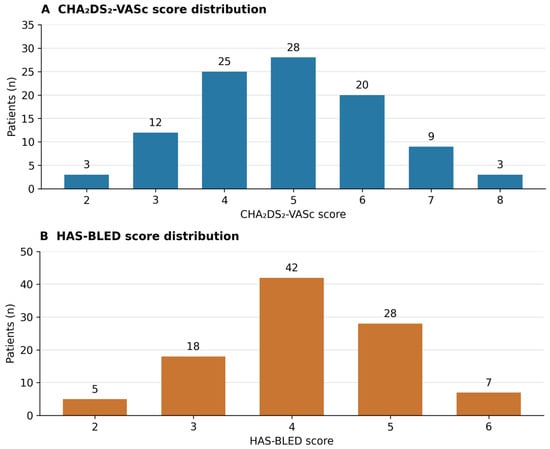
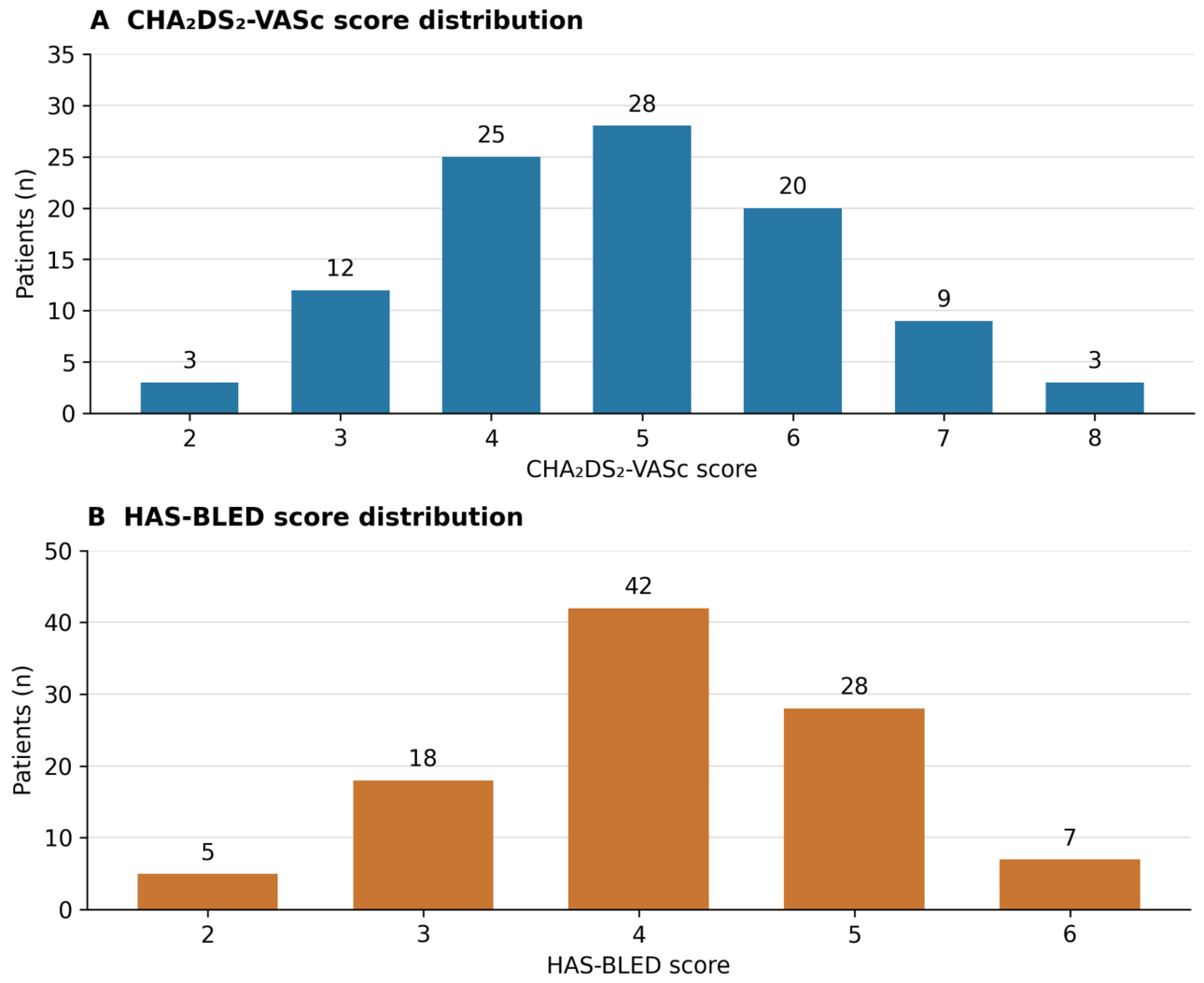
The cohort’s mean age was 70.7 ± 6.5 years and 47% were female. Most participants had arterial hypertension (88%), coronary artery disease (71%) and chronic kidney disease (40%) at various stages; 5% received regular haemodialysis. The cohort exhibited a high mean stroke risk (mean CHA2DS2-VASc score 4.9) and a high mean bleeding risk (mean HAS-BLED score 4.1). The score distributions are shown in Figure 1A,B.
Figure 1.
(A) Distribution of CHA2DS2-VASc scores in the study cohort (n = 100). Bars show the number of patients in each score category. (B) Distribution of HAS-BLED scores in the study cohort (n = 100). Bars show the number of patients in each score category.
3.2. Device Implantation Outcomes
Device implantation was successful in all 100 patients (100%; 95% CI 96.4–100%). No device embolisation or implantation failure occurred (0% each; 95% CI 0.0–3.6%).
3.3. Peri-Procedural Complications
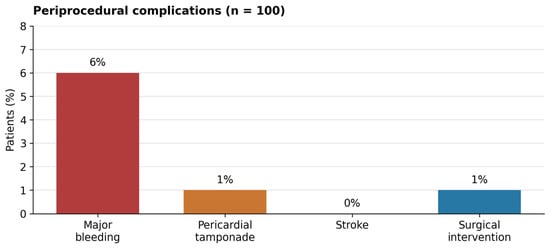
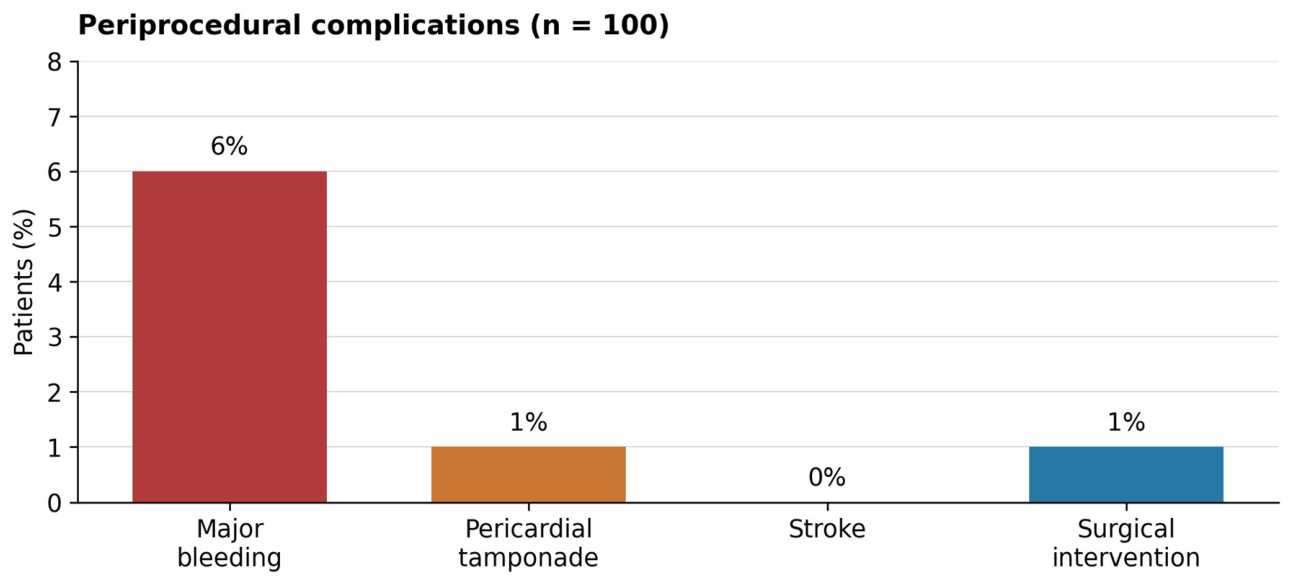
Seven patients experienced at least one major peri-procedural complication (7%; 95% CI 2.9–13.9%): six had major bleeding (6%; 95% CI 2.2–12.6%), and one additional patient had pericardial tamponade (1%; 95% CI 0.0–5.4%). The patient requiring surgical intervention (1%; 95% CI 0.0–5.4%) was included among the six patients with major bleeding. No peri-procedural stroke was reported (0%; 95% CI 0.0–3.6%). The individual complication categories are shown in Figure 2.
Figure 2.
Peri-procedural complication categories within 72 h of implantation in the 100-patient cohort. Bars show the percentage of patients in each category. The surgical intervention occurred in one of the six bleeding patients; tamponade affected a seventh patient. Thus, seven unique patients had at least one complication, and the component percentages should not be added.
One of the six patients with major bleeding experienced a post-procedural haematoma in the right groin that required surgical evacuation.
One patient developed intra-procedural cardiac tamponade and underwent successful pericardiocentesis. Surgical intervention was not required. The patient remained haemodynamically stable during subsequent monitoring and was discharged without further complications.
3.4. Clinical Outcomes
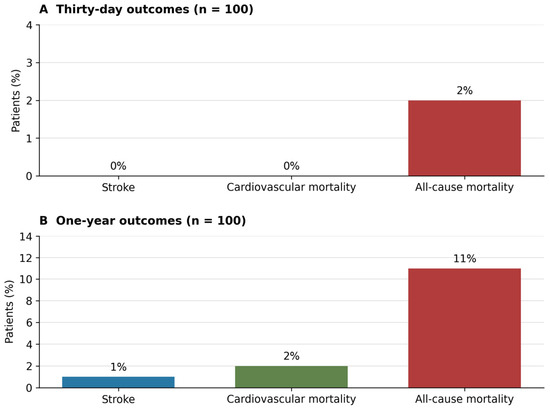
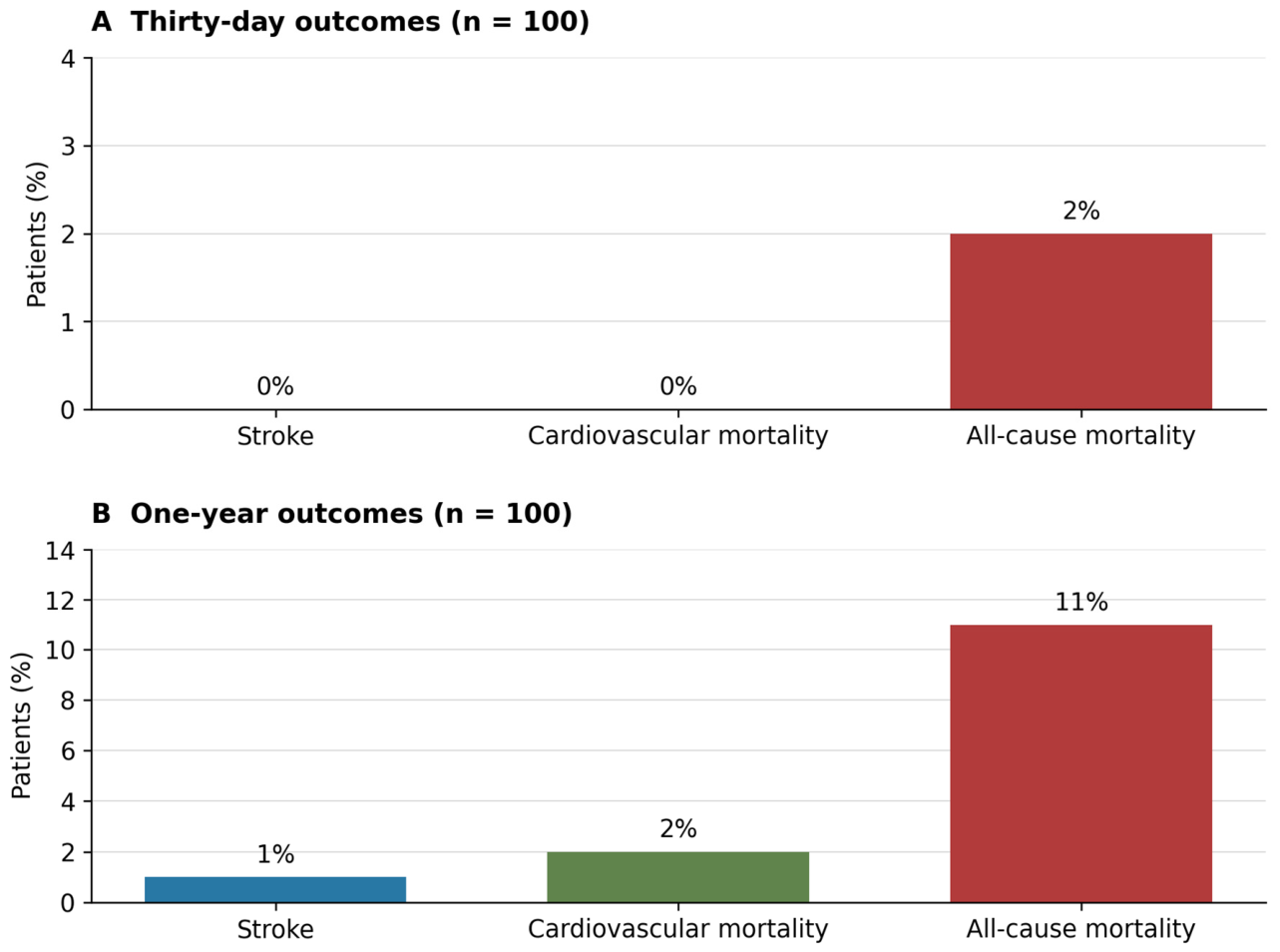
Clinical follow-up for vital status and stroke was complete for all 100 patients through one year or until death. Stroke and mortality at 30 days and one year are shown in Figure 3A,B.
Figure 3.
Clinical outcomes after Watchman implantation. Panel (A) shows 30-day outcomes; panel (B) shows one-year outcomes. Bars show the percentage of the original 100-patient cohort with stroke, cardiovascular death or death from any cause. Cardiovascular deaths are included in all-cause mortality.
Of the 100 patients included in this study, 11 died within one year following the procedure, resulting in an all-cause mortality rate of 11% (95% CI 5.6–18.8%). Two deaths occurred within the first 30 days, corresponding to a 30-day mortality rate of 2% (95% CI 0.2–7.0%). Cardiovascular mortality was 0% at 30 days (95% CI 0.0–3.6%) and 2% at one year (95% CI 0.2–7.0%).
Both 30-day deaths were attributed to non-cardiovascular causes. One patient died from advanced urinary bladder cancer while the other died from end-stage chronic renal failure.
Of the remaining nine deaths occurring between 30 days and one year, two patients died at home at the ages of 88 and 89 years, respectively; the exact causes of death are unknown. Two additional patients died at home due to end-stage renal failure. Other causes of death included decompensated heart failure in two patients, sepsis in one patient, acute renal failure in one patient and pneumonia in one patient.
No strokes were reported within 30 days (0%; 95% CI 0.0–3.6%). One non-disabling stroke was reported within one year (1% of the original cohort; 95% CI 0.0–5.4%).
4. Discussion
4.1. Principal Findings and Comparison with Previous Studies
In this descriptive cohort, Watchman FLX implantation was achieved in all 100 patients. Major bleeding was the most frequently reported peri-procedural complication. During the first year, one stroke and 11 deaths were reported. These findings describe local clinical experience; they do not demonstrate treatment efficacy or establish that implantation was free of complications.
Table 2 provides a focused comparison with contemporary studies using the same Watchman FLX generation. Published definitions, follow-up completeness and methods of estimating event rates still differ. The exploratory benchmark tests should therefore be read alongside the cohort CIs and should not be used to infer equivalence or a centre-specific advantage.
Table 2.
Selected outcomes in the present cohort and contemporary Watchman FLX studies.
PROTECT AF, PREVAIL, EWOLUTION and the earlier NCDR registry provide historical context but predominantly concern the earlier Watchman generation [15,16,17,25,26,27]. Their implantation and safety outcomes should not be treated as directly interchangeable with those of this FLX cohort. In particular, comparisons across dissimilar peri-procedural windows and composite endpoints may be misleading.
The 95% CI around our 100% implantation estimate extends down to 96.4%. Successful implantation alone does not demonstrate absence of complications or complete long-term LAA exclusion. Differences in patient selection, operator experience and antithrombotic treatment could influence outcomes across studies, but their contribution was not tested in this cohort.
4.2. Peri-Procedural Bleeding and Tamponade
Six patients had reported major bleeding, and one patient required surgical evacuation of an access-site groin haematoma. This makes bleeding an important safety concern despite successful device implantation. The high mean HAS-BLED score and frequent renal disease identify relevant clinical context, but they do not establish why these events occurred or which characteristics predicted them.
Bleeding after LAAO can occur before any longer-term benefit from avoiding anticoagulation is realised. A pooled analysis of the randomised Watchman trials found that bleeding outcomes varied over time and according to exposure to adjunctive antithrombotic therapy [28]. Our retrospective data cannot determine whether a different regimen or access-management strategy would have prevented bleeding. Anatomical site, timing, BARC grade, management and recovery should be documented consistently in future assessments.
The tamponade event resolved after pericardiocentesis. The available account does not establish that propofol exposure or patient movement caused the event. Prior observational work has examined conscious sedation and general anaesthesia for Watchman implantation [29], but this single event cannot guide a comparison of anaesthetic strategies.
4.3. Stroke Outcomes and Antithrombotic Treatment
One non-disabling stroke was reported within one year (1%; 95% CI 0.0–5.4%). The wide CI reflects the uncertainty of a single event in a small cohort. CHA2DS2-VASc describes baseline risk and cannot replace an untreated or anticoagulated control group. We therefore do not infer a treatment effect or a relative stroke-risk reduction from this observation. Death also limits the time during which a patient can experience stroke; no competing-risk analysis was performed.
Our three-month aspirin–clopidogrel protocol was intended to avoid long-term OAC exposure in patients at high bleeding risk. The EHRA/EAPCI consensus describes aspirin with clopidogrel for one to six months after Watchman implantation in this setting, with treatment decisions informed by adequate occlusion and the absence of device-related thrombus [18]. The 2024 international consensus specifically includes three months of aspirin plus clopidogrel after Watchman FLX implantation, followed by aspirin alone [30]. These recommendations provide context for the local strategy; they do not establish it as superior to alternative regimens.
The subsequent 2025 SCAI/HRS guideline conditionally supports either post-procedural OAC or dual antiplatelet therapy, with DAPT a reasonable choice when OAC is unsuitable because of bleeding risk; it makes no recommendation for single antiplatelet therapy because of an evidence gap [31]. Clopidogrel monotherapy for aspirin intolerance represented an individualised local alternative. Medication intake was queried at follow-up, but this does not establish uninterrupted adherence or permit comparison of regimens. Clinical follow-up was complete, whereas imaging surveillance was not systematic. Since device-related thrombus has been associated with embolic events [32], a low clinical stroke proportion cannot exclude subclinical device complications. Neither LAAO nor antiplatelet treatment eliminates bleeding risk.
4.4. Mortality and Competing Clinical Risks
Of the 11 deaths reported within one year, two were cardiovascular, seven were attributed to non-cardiovascular causes, and two had an unknown cause (Table 3). We retained the unknown deaths as a separate category. Without additional information, we cannot confidently classify all deaths as unrelated to the device or procedure. When interpreting clinical benefit, consider observed mortality alongside stroke outcomes.
Table 3.
Reported causes of death by follow-up period.
Both deaths within 30 days were attributed to severe pre-existing disease. Their occurrence raises questions about prognosis and patient selection, but does not establish what could reasonably have been predicted at implantation. No comparison of baseline characteristics between decedents and survivors was performed, so greater comorbidity remains a possible explanation rather than a demonstrated cause of mortality. Long-term trial results provide a different time horizon from this one-year cohort [33]. Assessment of expected survival, frailty, renal disease and oncological status is relevant when considering whether a patient may live long enough to benefit from stroke prevention.
4.5. Clinical Implications and Future Directions
This series identifies bleeding management, documentation of antithrombotic treatment, follow-up imaging and assessment of prognosis as priorities for local review. It does not determine an optimal medication regimen or anaesthetic approach. Evidence from randomised comparisons, including PRAGUE-17 [34], must be distinguished from the descriptive findings reported here. Larger prospective studies with consistent event definitions, complete follow-up and documented reasons for LAAO are needed to examine treatment effects and predictors of adverse outcomes.
4.6. Study Limitations
The retrospective, single-centre design, absence of a control group and small number of events limit generalisability and prevent causal or comparative efficacy conclusions. The reported CIs are wide, and no patient-level risk-factor analyses or multivariable adjustment were performed.
Clinical follow-up for vital status and stroke was complete through one year or until death, but retrospective event ascertainment relied on clinical records and telephone reports rather than uniform prospective assessments. Death was a competing event for stroke, and event-time data were not analysed using a competing-risk method.
Post-procedural imaging was not systematic. Imaging attendance, timing and findings were not quantified, so reliable frequencies of device-related thrombus, peri-device leak and late device malposition cannot be provided. The absence of a reported clinical event should not be interpreted as the absence of an imaging-detectable complication.
Patient-level indications for LAAO and detailed bleeding classifications were not systematically reported in this analysis. Aspirin intolerance led to use of clopidogrel monotherapy, introducing treatment heterogeneity. Medication intake was queried at follow-up, but the number and timing of regimen changes and interruptions were not quantified, and no comparative analysis by treatment regimen was performed. Self-reported intake does not establish uninterrupted adherence. These limitations prevent attribution of outcomes to a uniform antithrombotic regimen or a demonstrated reduction in bleeding risk.
Comparisons with published cohorts remain descriptive because device generations, baseline risk, outcome definitions, follow-up windows and denominators differ. The fixed-rate binomial tests do not address these differences or the uncertainty in the reference estimates. A non-significant result is not evidence of equivalence. Follow-up beyond one year is needed to assess later events.
5. Conclusions
In this single-centre cohort of 100 patients, Watchman FLX implantation was achieved in all patients. Major bleeding was the most frequently reported peri-procedural complication. One stroke and 11 deaths were reported during the first year. These observations support the feasibility of implantation in this setting but cannot establish comparative stroke-prevention efficacy, the safety of a specific antithrombotic regimen, or comprehensive device safety without systematic imaging and more complete outcome characterisation.
Author Contributions
W.A. made the major contribution to the conception and design of the study, acquisition and organization of the clinical data, data analysis, interpretation of the results, and preparation of the initial manuscript draft. M.H. provided substantial senior scientific and clinical supervision, contributed to the study design and interpretation of the findings, critically reviewed the manuscript, and contributed to its scientific refinement and finalization. M.S. (Mostafa Salem) contributed substantially to the study conception and design, interpretation of the results, and critical revision of the manuscript. M.S. (Mohamed Salem), M.E., A.B., M.A., A.F. and M.S. (Mohammed Saad) contributed to patient recruitment and clinical data collection, interpretation of clinical findings, and critical review of the manuscript. All authors have read and agreed to the published version of the manuscript.
Funding
This research received no external funding.
Institutional Review Board Statement
On 26 March 2026, the Ethics Committee of the Bavarian State Medical Association classified this project as a retrospective quality-control study and determined that it was not subject to mandatory consultation under Section 15 of the Professional Code for Physicians in Bavaria (reference 26008-BO). The study was conducted in accordance with the Declaration of Helsinki. Written informed consent was obtained from all participants or their legal representatives.
Informed Consent Statement
Informed consent was obtained from all subjects involved in the study.
Data Availability Statement
The data presented in this study are available from the corresponding author upon reasonable request. The data are not publicly available due to ethical restrictions and the protection of patient privacy in accordance with institutional policies and applicable data protection regulations.
Conflicts of Interest
The authors declare no conflicts of interest.
Abbreviations
| Abbreviation | Full Term |
| AF | Atrial Fibrillation |
| BARC | Bleeding Academic Research Consortium |
| BMI | Body Mass Index |
| CAD | Coronary Artery Disease |
| CKD | Chronic Kidney Disease |
| DOAC | Direct Oral Anticoagulant |
| EHRA | European Heart Rhythm Association |
| EAPCI | European Association of Percutaneous Cardiovascular Interventions |
| HAS-BLED | Hypertension, Abnormal Renal/Liver Function, Stroke, Bleeding, Labile INR, Elderly, Drugs or Alcohol |
| LAA | Left Atrial Appendage |
| LAAO | Left Atrial Appendage Occlusion |
| NCDR | National Cardiovascular Data Registry |
| OAC | Oral Anticoagulation |
| PREVAIL | Prospective Randomised Evaluation of the Watchman Left Atrial Appendage Closure Device In Patients With Atrial Fibrillation Versus Long-Term Warfarin Therapy |
| PROTECT AF | Watchman Left Atrial Appendage System for Embolic Protection in Patients With Atrial Fibrillation |
| SD | Standard Deviation |
| TOE | Transoesophageal Echocardiography |
| VKA | Vitamin K Antagonist |
References
- Chugh, S.S.; Havmoeller, R.; Narayanan, K.; Singh, D.; Rienstra, M.; Benjamin, E.J.; Gillum, R.F.; Kim, Y.H.; McAnulty, J.H., Jr.; Zheng, Z.J.; et al. Worldwide epidemiology of atrial fibrillation: A Global Burden of Disease 2010 Study. Circulation 2014, 129, 837–847. [Google Scholar] [PubMed]
- Ohlrogge, A.H.; Brederecke, J.; Schnabel, R.B. Global burden of atrial fibrillation and flutter by national income: Results from the Global Burden of Disease 2019 Database. J. Am. Heart Assoc. 2023, 12, e030438. [Google Scholar] [CrossRef] [Scilit] [PubMed]
- Linz, D.; Gawalko, M.; Betz, K.; Hendriks, J.M.; Lip, G.Y.H.; Vinter, N.; Guo, Y.; Johnsen, S. Atrial fibrillation: Epidemiology, screening and digital health. Lancet Reg. Health Eur. 2024, 37, 100786. [Google Scholar] [CrossRef] [Scilit] [PubMed]
- Wolf, P.A.; Abbott, R.D.; Kannel, W.B. Atrial fibrillation as an independent risk factor for stroke: The Framingham Study. Stroke 1991, 22, 983–988. [Google Scholar] [CrossRef] [Scilit] [PubMed]
- January, C.T.; Wann, L.S.; Calkins, H.; Chen, L.Y.; Cigarroa, J.E.; Cleveland, J.C., Jr.; Ellinor, P.T.; Ezekowitz, M.D.; Field, M.E.; Furie, K.L.; et al. 2019 AHA/ACC/HRS Focused Update of the 2014 AHA/ACC/HRS Guideline for the Management of Patients With Atrial Fibrillation. Circulation 2019, 140, e125–e151. [Google Scholar] [CrossRef] [Scilit] [PubMed]
- Ruff, C.T.; Giugliano, R.P.; Braunwald, E.; Hoffman, E.B.; Deenadayalu, N.; Ezekowitz, M.D.; Camm, A.J.; Weitz, J.I.; Lewis, B.S.; Parkhomenko, A.; et al. Comparison of the efficacy and safety of new oral anticoagulants with warfarin in patients with atrial fibrillation: A meta-analysis of randomised trials. Lancet 2014, 383, 955–962. [Google Scholar] [CrossRef] [Scilit] [PubMed]
- Hindricks, G.; Potpara, T.; Dagres, N.; Arbelo, E.; Bax, J.J.; Blomström-Lundqvist, C.; Boriani, G.; Castella, M.; Dan, G.-A.; Dilaveris, P.E.; et al. 2020 ESC Guidelines for the diagnosis and management of atrial fibrillation. Eur. Heart J. 2021, 42, 373–498. [Google Scholar] [CrossRef] [Scilit] [PubMed]
- Blackshear, J.L.; Odell, J.A. Appendage obliteration to reduce stroke in cardiac surgical patients with atrial fibrillation. Ann. Thorac. Surg. 1996, 61, 755–759. [Google Scholar] [CrossRef] [Scilit] [PubMed]
- Aberg, H. Atrial fibrillation. I. A study of atrial thrombosis and systemic embolism in a necropsy material. Acta Med. Scand. 1969, 185, 373–379. [Google Scholar] [PubMed]
- Stoddard, M.F.; Dawkins, P.R.; Prince, C.R.; Ammash, N.M. Left atrial appendage thrombus is not uncommon in patients with acute atrial fibrillation and a recent embolic event: A transesophageal echocardiographic study. J. Am. Coll. Cardiol. 1995, 25, 452–459. [Google Scholar] [CrossRef] [Scilit] [PubMed]
- Sievert, H.; Lesh, M.D.; Trepels, T.; Omran, H.; Bartorelli, A.; Della Bella, P.; Nakai, T.; Reisman, M.; DiMario, C.; Block, P.; et al. Percutaneous left atrial appendage transcatheter occlusion to prevent stroke in high-risk patients with atrial fibrillation: Early clinical experience. Circulation 2002, 105, 1887–1889. [Google Scholar] [CrossRef] [Scilit] [PubMed]
- Sick, P.B.; Schuler, G.; Hauptmann, K.E.; Grube, E.; Yakubov, S.; Turi, Z.G.; Mishkel, G.; Almany, S.; Holmes, D.R. Initial worldwide experience with the WATCHMAN left atrial appendage system for stroke prevention in atrial fibrillation. J. Am. Coll. Cardiol. 2007, 49, 1490–1495. [Google Scholar] [CrossRef] [Scilit] [PubMed]
- Park, J.-W.; Bethencourt, A.; Sievert, H.; Santoro, G.; Meier, B.; Walsh, K.; Lopez-Minguez, J.R.; Meerkin, D.; Valdés, M.; Ormerod, O.; et al. Left atrial appendage closure with Amplatzer Cardiac Plug in atrial fibrillation: Initial European experience. Catheter. Cardiovasc. Interv. 2011, 77, 700–706. [Google Scholar] [CrossRef] [Scilit] [PubMed]
- Raffo, C.; Greco, A.; Capodanno, D. Antithrombotic therapy after left atrial appendage occlusion. Expert Rev. Cardiovasc. Ther. 2025, 23, 141–152. [Google Scholar] [CrossRef] [Scilit] [PubMed]
- Holmes, D.R.; Reddy, V.Y.; Turi, Z.G.; Doshi, S.K.; Sievert, H.; Buchbinder, M.; Mullin, C.M.; Sick, P. Percutaneous closure of the left atrial appendage versus warfarin therapy for prevention of stroke in patients with atrial fibrillation: A randomised non-inferiority trial. Lancet 2009, 374, 534–542. [Google Scholar] [CrossRef] [Scilit] [PubMed]
- Holmes, D.R., Jr.; Kar, S.; Price, M.J.; Whisenant, B.; Sievert, H.; Doshi, S.K.; Huber, K.; Reddy, V.Y. Prospective randomized evaluation of the Watchman Left Atrial Appendage Closure device in patients with atrial fibrillation versus long-term warfarin therapy: The PREVAIL trial. J. Am. Coll. Cardiol. 2014, 64, 1–12. [Google Scholar] [CrossRef] [Scilit] [PubMed]
- Boersma, L.V.; Ince, H.; Kische, S.; Pokushalov, E.; Schmitz, T.; Schmidt, B.; Gori, T.; Meincke, F.; Protopopov, A.V.; Betts, T.; et al. Efficacy and safety of left atrial appendage closure with WATCHMAN in patients with or without contraindication to oral anticoagulation: 1-year follow-up outcome data of the EWOLUTION trial. Heart Rhythm 2017, 14, 1302–1308. [Google Scholar] [CrossRef] [Scilit] [PubMed]
- Glikson, M.; Wolff, R.; Hindricks, G.; Mandrola, J.; Camm, A.J.; Lip, G.Y.H.; Fauchier, L.; Betts, T.R.; Lewalter, T.; Saw, J.; et al. EHRA/EAPCI expert consensus statement on catheter-based left atrial appendage occlusion—An update. Europace 2020, 22, 184. [Google Scholar] [CrossRef] [Scilit] [PubMed]
- Tzikas, A.; Holmes, D.R., Jr.; Gafoor, S.; Ruiz, C.E.; Blomström-Lundqvist, C.; Diener, H.-C.; Cappato, R.; Kar, S.; Lee, R.J.; Byrne, R.A.; et al. Percutaneous left atrial appendage occlusion: The Munich consensus document on definitions, endpoints, and data collection requirements for clinical studies. EP Eur. 2017, 19, 4–15. [Google Scholar] [CrossRef] [Scilit] [PubMed]
- Mehran, R.; Rao, S.V.; Bhatt, D.L.; Gibson, C.M.; Caixeta, A.; Eikelboom, J.; Kaul, S.; Wiviott, S.D.; Menon, V.; Nikolsky, E.; et al. Standardized bleeding definitions for cardiovascular clinical trials: A consensus report from the Bleeding Academic Research Consortium. Circulation 2011, 123, 2736–2747. [Google Scholar] [PubMed]
- Hicks, K.A.; Mahaffey, K.W.; Mehran, R.; Nissen, S.E.; Wiviott, S.D.; Dunn, B.; Solomon, S.D.; Marler, J.R.; Teerlink, J.R.; Farb, A.; et al. 2017 Cardiovascular and Stroke Endpoint Definitions for Clinical Trials. J. Am. Coll. Cardiol. 2018, 71, 1021–1034. [Google Scholar] [CrossRef] [Scilit] [PubMed]
- Meier, B.; Blaauw, Y.; Khattab, A.A.; Lewalter, T.; Sievert, H.; Tondo, C.; Glikson, M. EHRA/EAPCI expert consensus statement on catheter-based left atrial appendage occlusion. Europace 2014, 16, 1397–1416. [Google Scholar] [CrossRef] [Scilit] [PubMed]
- Betts, T.R.; Grygier, M.; Nielsen Kudsk, J.E.; Schmitz, T.; Sandri, M.; Casu, G.; Bergmann, M.; Hildick-Smith, D.; Christen, T.; Allocco, D.J.; et al. Real-world clinical outcomes with a next-generation left atrial appendage closure device: The FLXibility Post-Approval Study. Europace 2023, 25, 914–921. [Google Scholar] [CrossRef] [Scilit] [PubMed]
- Kapadia, S.R.; Yeh, R.W.; Price, M.J.; Piccini, J.P.; Nair, D.G.; Bansal, A.; Hsu, J.C.; Freeman, J.V.; Christen, T.; Allocco, D.J.; et al. Outcomes with the WATCHMAN FLX in Everyday Clinical Practice from the NCDR Left Atrial Appendage Occlusion Registry. Circ. Cardiovasc. Interv. 2024, 17, e013750. [Google Scholar] [CrossRef] [Scilit] [PubMed]
- Freeman, J.V.; Varosy, P.; Price, M.J.; Slotwiner, D.; Kusumoto, F.M.; Rammohan, C.; Kavinsky, C.J.; Turi, Z.G.; Akar, J.; Koutras, C.; et al. The NCDR Left Atrial Appendage Occlusion Registry. J. Am. Coll. Cardiol. 2020, 75, 1503–1518. [Google Scholar] [CrossRef] [Scilit] [PubMed]
- Reddy, V.Y.; Holmes, D.; Doshi, S.K.; Neuzil, P.; Kar, S. Safety of percutaneous left atrial appendage closure: Results from the WATCHMAN Left Atrial Appendage System for Embolic Protection in Patients with AF (PROTECT AF) clinical trial and the Continued Access Registry. Circulation 2011, 123, 417–424. [Google Scholar] [PubMed]
- Boersma, L.V.A.; Schmidt, B.; Betts, T.R.; Sievert, H.; Tamburino, C.; Teiger, E.; Pokushalov, E.; Kische, S.; Schmitz, T.; Stein, K.M.; et al. Implant success and safety of left atrial appendage closure with the WATCHMAN device: Peri-procedural outcomes from the EWOLUTION registry. Eur. Heart J. 2016, 37, 2465–2474. [Google Scholar] [CrossRef] [Scilit] [PubMed]
- Price, M.J.; Reddy, V.Y.; Valderrábano, M.; Halperin, J.L.; Gibson, D.N.; Gordon, N.; Huber, K.C.; Holmes, D.R., Jr. Bleeding outcomes after left atrial appendage closure compared with long-term warfarin: A pooled, patient-level analysis of the WATCHMAN randomized trial experience. JACC Cardiovasc. Interv. 2015, 8, 1925–1932. [Google Scholar] [CrossRef] [Scilit]
- Kleinecke, C.; Allakkis, W.; Buffle, E.; Liu, X.-X.; Mohrez, Y.; Gloekler, S.; Brachmann, J.; Schnupp, S.; Achenbach, S.; Yu, J. Impact of conscious sedation and general anesthesia on periprocedural outcomes in Watchman left atrial appendage closure. Cardiol. J. 2021, 28, 519–527. [Google Scholar] [CrossRef] [Scilit] [PubMed]
- Potpara, T.; Grygier, M.; Haeusler, K.G.; Nielsen-Kudsk, J.E.; Berti, S.; Genovesi, S.; Marijon, E.; Boveda, S.; Tzikas, A.; Boriani, G.; et al. Practical guide on left atrial appendage closure for the non-implanting physician: An international consensus paper. EP Eur. 2024, 26, euae035. [Google Scholar] [CrossRef] [Scilit] [PubMed]
- Goldsweig, A.M.; Glikson, M.; Joza, J.; Kavinsky, C.J.; Khalique, O.; Lakkireddy, D.; Mackensen, G.B.; Naccarelli, G.V.; Nair, D.G.; Saw, J.; et al. 2025 SCAI/HRS Clinical Practice Guidelines on Transcatheter Left Atrial Appendage Occlusion. J. Soc. Cardiovasc. Angiogr. Interv. 2025, 4, 103783. [Google Scholar] [CrossRef] [Scilit] [PubMed]
- Dukkipati, S.R.; Kar, S.; Holmes, D.R.; Doshi, S.K.; Swarup, V.; Gibson, D.N.; Maini, B.; Gordon, N.T.; Main, M.L.; Reddy, V.Y. Device-related thrombus after left atrial appendage closure: Incidence, predictors, and outcomes. Circulation 2018, 138, 874–885. [Google Scholar] [CrossRef] [Scilit] [PubMed]
- Reddy, V.Y.; Doshi, S.K.; Kar, S.; Gibson, D.N.; Price, M.J.; Huber, K.; Horton, R.P.; Buchbinder, M.; Neuzil, P.; Gordon, N.T.; et al. 5-year outcomes after left atrial appendage closure: From the PREVAIL and PROTECT AF trials. J. Am. Coll. Cardiol. 2017, 70, 2964–2975. [Google Scholar] [PubMed]
- Osmancik, P.; Herman, D.; Neuzil, P.; Hala, P.; Taborsky, M.; Kala, P.; Poloczek, M.; Stasek, J.; Haman, L.; Branny, M.; et al. Left atrial appendage closure versus direct oral anticoagulants in high-risk patients with atrial fibrillation. J. Am. Coll. Cardiol. 2020, 75, 3122–3135. [Google Scholar] [CrossRef] [Scilit] [PubMed]

Disclaimer/Publisher’s Note: The statements, opinions and data contained in all publications are solely those of the individual author(s) and contributor(s) and not of MDPI and/or the editor(s). MDPI and/or the editor(s) disclaim responsibility for any injury to people or property resulting from any ideas, methods, instructions or products referred to in the content. |
© 2026 by the authors. Licensee MDPI, Basel, Switzerland. This article is an open access article distributed under the terms and conditions of the Creative Commons Attribution (CC BY) license.