


Abstract
Background: Acute kidney injury following cardiac surgery is frequent and is associated with increased risks of morbidity and mortality. However, the incidence, severity, and impact of acute kidney injury after cardiac surgery are still underestimated. Therefore, we analyzed our large electronic database for the procedure-specific incidence, characterization, and outcomes of cardiac surgery-associated acute kidney injury (CSA-AKI). Methods: A total of 8564 patients who underwent cardiac surgery at our center between 2017 and 2024 were included. We used an algorithm-based data fusion technique to aggregate data from different electronic health record sources. Data were analyzed regarding acute kidney injury according to the full kidney disease: Improving Global Outcomes (KDIGO) criteria. Results: The patients’ median age was 68 [60; 75] years, and 75.2% were male. The overall incidence of CSA-AKI was 70.5% during the hospital stay, and its development was significantly associated with increased in-hospital mortality rates (5.9% vs. 0.9%, p < 0.001). In regression analysis, all AKI stages were independent predictors of mortality (stage 1: OR 2.92 [1.66–5.59], p < 0.001; stage 2: OR 2.74 [1.35–5.8], p = 0.007; stage 3: OR 4.16 [1.19–14.1], p = 0.02). The incidence and severity of procedure-specific AKI showed significant differences between the groups (p < 0.001). Conclusions: The occurrence of CSA-AKI is associated with a significantly increased risk of in-hospital mortality, irrespective of stage. Procedure-specific AKI rates differ significantly between types of surgeries. Therefore, consideration of procedure-related risks, as well as early detection, is crucial to improve outcomes after cardiac surgery.
1. Introduction
Cardiac surgery-associated acute kidney injury (CSA-AKI) is well known to be associated with increased risks of morbidity, prolonged intensive care unit (ICU)- and hospital-related stays, secondary complications and mortality in the short and long term [1,2,3]. Moreover, it promotes the development of chronic kidney disease and long-term dialysis dependence, generating considerable healthcare costs and resource consumption [4,5,6]. However, despite its disastrous prognostic and economic consequences, awareness of CSA-AKI is still very low [7]. The reported incidence rates vary substantially between 4% and 40%, mostly related to a high degree of underrecognition and the application of different nonstandardized, incomplete definitions, which are mostly dependent on the availability of data [8,9,10]. When the full KDIGO criteria, including urine output, are applied, the incidence of CSA-AKI can reach 60–70% [11,12].
However, detailed knowledge regarding the incidence and impact of CSA-AKI, particularly with respect to different cardiac surgical procedures, is sparse, as obtaining sufficient and robust data remains challenging, especially with respect to the included urine output. With the broad establishment of electronic health records (EHRs), large amounts of digital data are generated. However, data from different clinical EHR systems are often difficult to combine because of interoperability issues [13]. To overcome these obstacles, programming interfaces, decoding and data fusion are crucial for retrieving and assessing these data [14].
This study sought to characterize the incidence and impact of acute kidney injury on mortality depending on different cardiac surgical procedures. Therefore, we applied a dedicated data fusion technique to assess and analyze our large electronic database. To the best of our knowledge, this is the first study in which such large-scale and differentiated AKI and outcome data on cardiac surgical patients have been made available.
2. Materials and Methods
2.1. Study Design
In this retrospective observational study, we sought to characterize the association between CSA-AKI and the risk of mortality. We hypothesized that 1. the development of CSA-AKI has an impact on mortality and 2. there would be differences regarding severity of disease, i.e., AKI stages, and between types of cardiac surgical procedures. The primary endpoint was CSA-AKI-associated mortality. Secondary endpoints included risk factor analysis for the development of CSA-AKI and procedure-specific AKI incidences and their impact on survival.
2.2. Patients
A total of 8564 patients who underwent cardiac surgery at our center between 2017 and 2024 were included in this analysis. Surgical procedures covered the whole spectrum of adult cardiac surgeries except transplantation and were grouped according to the most common and frequent operations: coronary artery bypass grafting with and without the use of cardiopulmonary bypass (OPCAB), aortic and mitral valvular repair and replacement surgeries, tricuspid valve surgeries, aortic surgeries, and combined (valve and/or bypass) procedures. There is a special focus on minimally invasive techniques in our center, i.e., off-pump coronary surgery and the mini-sternotomy or mini-thoracotomy approaches where applicable. Owing to their different natures and impacts on AKI, vascular and wound surgeries were excluded.
2.3. Data
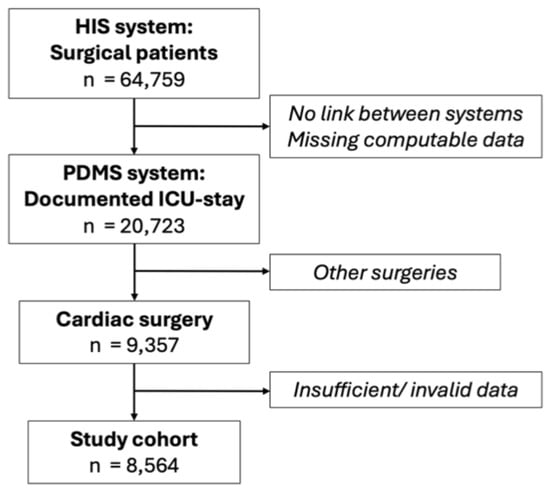
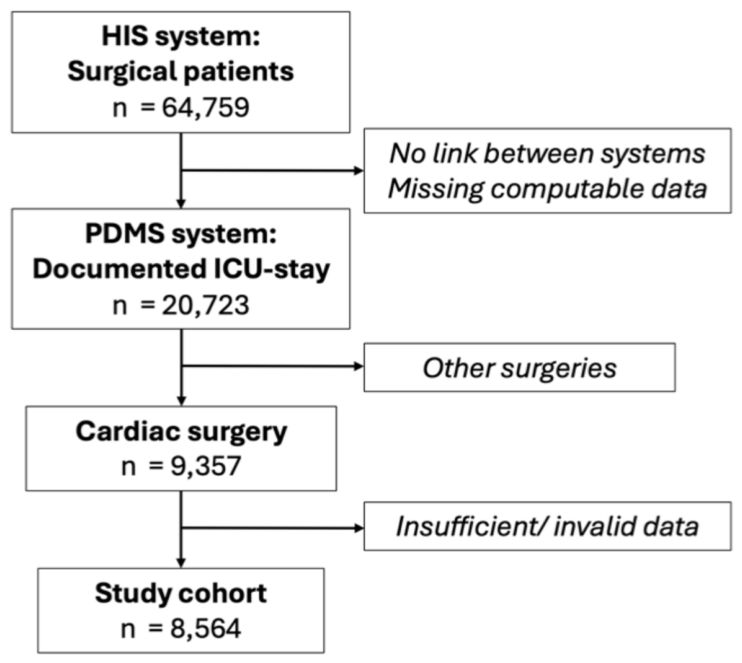
Data were retrospectively collected from the beginning of the electronic health records at our center in 2017. Algorithm-based techniques were used in two instances. First, for the data retrieval and the data fusion technique used to construct the present dataset, which is based on information originating from two different electronic health record sources. Owing to the lack of interoperability between the primary hospital information system (HIS; iMedOne®, Telekom Healthcare Solutions, Bonn, Germany), where surgical procedures outcomes, complications, and length of stay are documented, and the intensive and intermediate care patient data management system (PDMS; Metavision®, iMDSoft, Tel Aviv, Israel), where all monitoring and AKI-defining data, e.g., vital signs and urine output, are recorded, data fusion was required for this analysis. Integrating data from various clinical information systems poses significant challenges owing to disparities in data quality and operational protocols across systems, especially concerning the management of entities such as cases or clinical processes. To construct the cohort, we initially gathered patient and surgery data from the primary hospital information system. Subsequently, leveraging insights from physicians, we devised a mapping strategy to the ICU patient documentation management system to determine ICU admission and discharge specifically related to the appropriate surgery. The general mapping of patients between the incorporated systems was facilitated by the use of a unique patient identifier across these systems. As clinical parameters are often redundantly collected, we prioritize the collection from processes known for higher data quality before detecting AKI and performing further analysis. Patients with missing, insufficient, or invalid computable data, especially for the detection of AKI (minimum of two urine output data, one serum creatinine, or one documented dialysis), were excluded. In doing so, over 99% of patients had at least one creatinine observation as well as one urine value normalized by body weight. For other clinical parameters that were less frequently observed, we did not apply any data imputation approach to introduce as little potential bias as possible compared to real-world data. The creation of the study patient cohort is displayed in Figure 1. Second, data were analyzed regarding acute kidney injury according to the full KDIGO criteria, including urine output and KDIGO staging, via algorithm-based big data processing [15]. For identification, grouping, and characterization, ICD-10 and OPS codes were used (Supplementary Tables S1 and S2).
Figure 1.
Patient cohort. HIS hospital information system; PDMS patient data management system; ICU intensive care unit; n, number of patients; italics indicate excluded patients.
2.4. Statistical Analysis
Categorical variables are reported as absolute numbers with percentages and were compared via Pearson’s chi-square test at a significance level of α = 0.05. For continuous variables, median values with interquartile ranges (IQRs) are reported, and the Wilcoxon rank sum test was used for comparison. Confounding risk factor analysis was performed via univariate and multivariate logistic regression models each for the first and maximum AKI stages. Kaplan-Meier survival estimates were compared via the log-rank test. For the main regression analysis, a simulation-based post hoc power calculation was performed. Assuming a mortality rate of 4.4% and a clinically relevant effect size (OR = 1.30), the study achieved approximately 98.60% power at a significance level of 0.005. All statistical analyses were performed via R v4.2.1 (The R Foundation for Statistical Computing, Vienna, Austria).
2.5. Ethics Approval and Consent to Participate
The study was approved by the local Ethics Committee of the Medical Faculty of the University of Tuebingen (File-No. 963/2021BO2). The need for informed consent was waived. Approval was also obtained from the local data privacy protection officer. The manuscript was written according to the Strengthening the Reporting of Observational Studies in Epidemiology reporting checklist.
3. Results
3.1. Baseline and AKI Characteristics
The patients had a median age of 68 [IQR: 60; 75] years, 75.2% were male, and the median body mass index was 26.9 [24.3; 30.1] kg/m2. The overall incidence of CSA-AKI was 70.5% (n = 6034 patients). The median duration of AKI development was 18 [11; 27] hours post-operatively until the first AKI stage. The distribution of AKI stages upon first detection was as follows: 88.1% had stage 1 AKI, 10.6% had stage 2 AKI, and 1.4% had stage 3 AKI. The maximum AKI stage was reached after a median of 27 [18; 40] hours post-operatively. Among these patients, 28.1% peaked at AKI stage 1, 54.0% at stage 2, and 17.9% at stage 3. Urine output was the major criterion for AKI detection and accounted for 86.8% of the overall AKI detection. The creatinine- and dialysis-based detection rates were 12.1% and 1.1%, respectively.
Patients who developed CSA-AKI were significantly older (median 70 [61; 76] versus 65 [58; 72] years, p < 0.001), heavier (median BMI 27.5 [24.7; 30.9] versus 25.7 [23.4; 28.2] kg/m2, p < 0.001), and had more comorbidities (median 5 [4; 6] versus 4 [3; 5], p < 0.001), which was also reflected by a higher EuroSCORE II (median 3.1 [1.6; 7.3] versus 1.5 [0.9; 2.8], p < 0.001). Details about comorbidities can be found in Supplementary Table S3. Overall, these patients had a longer duration of surgery (3.33 [2.8; 4.1] versus 3.03 [2.6; 3.6] hours, p < 0.001). In addition, there were longer cardiopulmonary bypass times (122 [87; 164] versus 113 [80; 149] minutes, p < 0.001), longer aortic cross-clamp times (78 [56; 104] versus 72 [51; 96] minutes, p < 0.001), and longer circulatory arrest times (19 [0; 34] versus 10 [0; 20] minutes, p < 0.001). Postoperatively, CSA-AKI patients had significantly prolonged ICU stays (median 3.0 [1.9; 6.1] versus 1.0 [0.9; 1.9] days), hospital lengths of stay (median 9.1 [7.0; 14.1] versus 6.9 [6.0; 8.0]), and a sixfold greater risk of mortality (5.9% versus 0.9%), all p < 0.001 (Table 1).
Table 1.
Patient characteristics: AKI vs. no AKI.
A detailed analysis of risk factors associated with the occurrence of CSA-AKI is presented in the Supplementary Materials (Tables S4 and S5). In brief, several established perioperative variables, including age, comorbidity burden, operative time, and cross-clamp time, were significantly associated with the development of CSA-AKI in uni- and multivariate models.
3.2. AKI-Associated Mortality
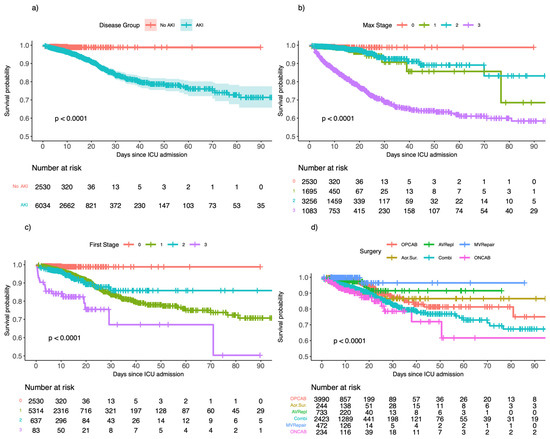
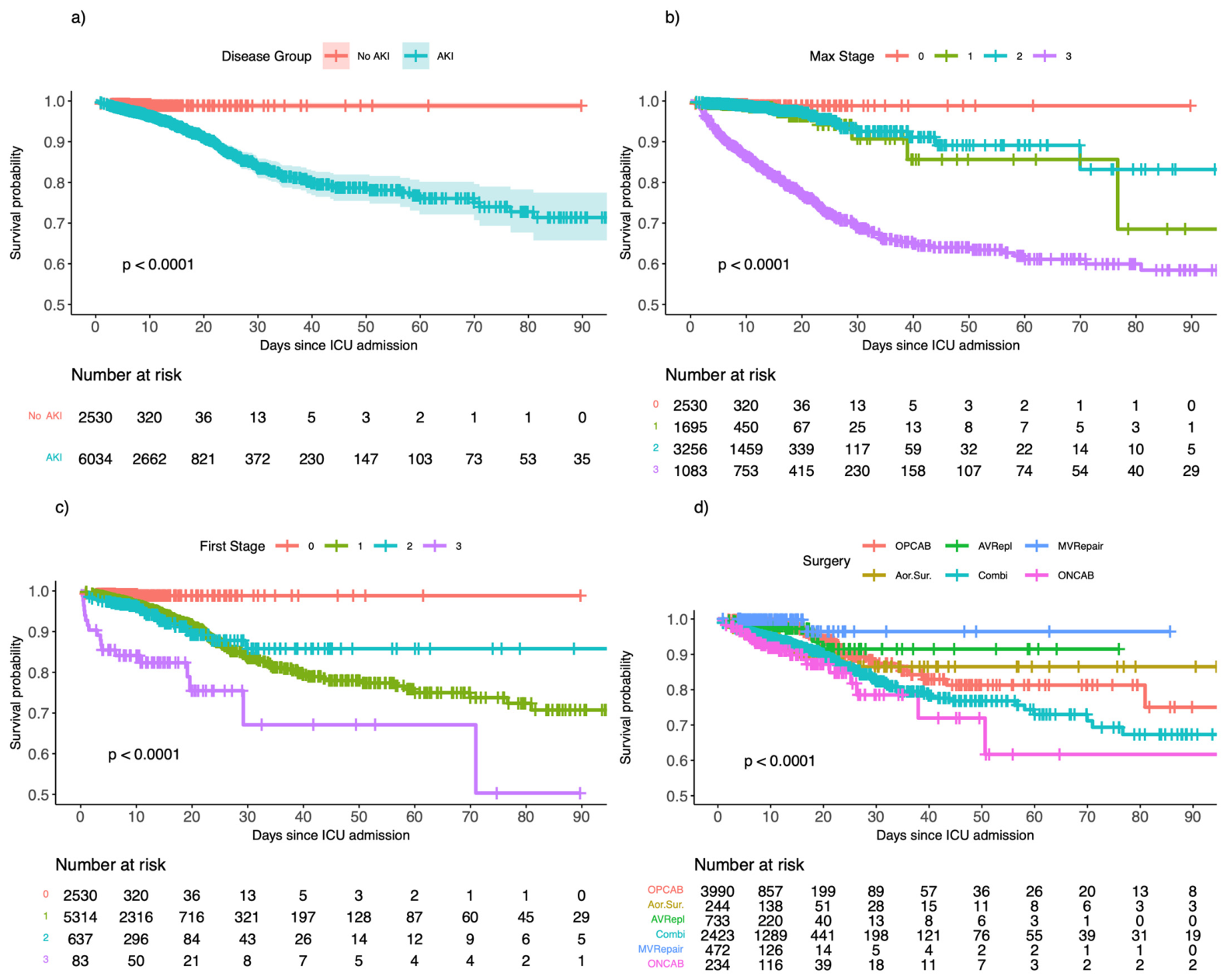
The development of AKI was associated with an increased risk of in-hospital mortality (5.9% versus 0.9%, p < 0.0001) (Figure 2a). The mortality rates were 4.4% (375/8564) overall, 0.9% (22/2530) without AKI, 1.5% (26/1695) with stage 1 AKI, 1.8% (59/3256) with stage 2 AKI, and 24.7% (268/1083) with stage 3 AKI. All stages of AKI were associated with an impaired probability of survival, regardless of whether the first or maximum AKI stage was considered (p < 0.0001) (Figure 2b,c). Moreover, there were highly significant procedure-specific differences in survival, with the highest survival rates after mitral valve repair and the lowest rates after on-pump coronary artery bypass grafting. Figure 2d shows plotted survival curves for the six most common cardiac surgeries in our cohort, which were, in detail, off- and on-pump coronary artery bypass grafting (OPCAB, ONCAB), combined valvular and bypass procedures (Combi), aortic valve replacements (AVRepl), mitral valve repairs (MVRepair), and aortic surgeries (Aor.Sur.).
Figure 2.
Kaplan-Meier survival estimates for (a) AKI patients versus non-AKI patients, (b) maximum AKI stages versus 0 non-AKI patients, (c) first AKI stages versus 0 non-AKI patients, and (d) the six most common cardiac surgeries. Abbreviations: AKI, acute kidney injury; ICU, intensive care unit; Max, maximum; OPCAB, off-pump coronary artery bypass grafting; Aor.Sur., aortic surgery; AVRepl, aortic valve replacement; Combi, combined procedure; MVRepair, mitral valve repair; ONCAB, on-pump coronary artery bypass surgery.
3.3. Risk Factor Analysis for AKI Mortality
According to the logistic regression risk factor analysis, even after adjustment for potential confounders, CSA-AKI was independently associated with elevated odds of mortality. Notably, when accounting for the first detection of AKI, all stages were predictive of mortality (stage 1: OR 2.92 [1.66; 5.59], p < 0.001; stage 2: OR 2.74 [1.34; 5.8], p = 0.01; stage 3: OR 4.16 [1.18; 14.01], p = 0.02), with first stage AKI 3 achieving the second-highest OR after endocarditis (OR 4.74 [3.17; 7.03]). However, in terms of the maximum AKI stage, only stage 3 remained predictive of mortality (OR 13.14 [7.28; 25.48], p < 0.001). The complete results of the risk factor analysis are summarized in Table 2 and in Supplementary Table S4 (first AKI) and Table S5 (max AKI).
Table 2.
Multivariate risk factor analysis.
3.4. Procedure-Specific Mortality
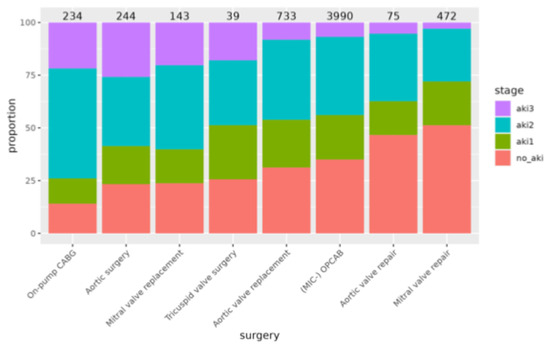
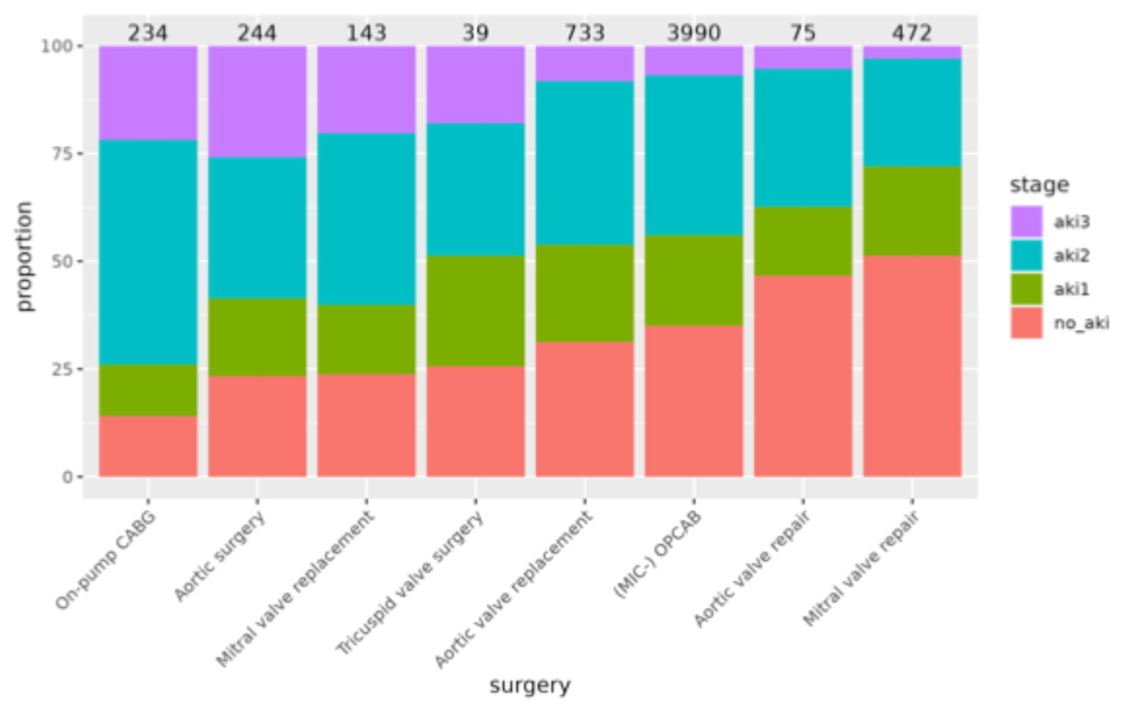
The differentiated analysis of specific, most common cardiac operative procedures revealed significant differences in overall AKI rates and AKI stage distributions between types of surgeries (see the bar plot in Figure 3). Combined procedures, on-pump CABG, mitral valve replacement and aortic surgeries had significantly higher-than-average AKI rates and significantly more patients with more severe AKI stages (p < 0.001); complete data are provided in Supplementary Table S6. AKI rates were highest after on-pump coronary artery bypass grafting (85.9%) and combined surgeries (81.9%). The lowest AKI rates were observed in isolated mitral (48.7%) and aortic (53.3%) valve repairs and in off-pump coronary artery bypass grafting (65.0%). Patients who developed AKI had significantly higher mortality rates, especially after combined surgery (17.9% vs. 3.4%, p < 0.0001), OPCAB (2.5% vs. 0.1%, p < 0.0001), and aortic surgery (9.6% vs. 0.0%, p = 0.01). The difference in mortality rates reached the borderline significance level for isolated aortic (2.6% vs. 0.4%, p = 0.05) and mitral valve replacement (10.1% vs. 0.0%, p = 0.05) and was not significantly different for on-pump coronary surgery (11.9% vs. 6.1%, p = 0.32) and isolated tricuspid valve surgery (10.3% vs. 0.0%, p = 0.29) or aortic (2.5% vs. 0.0%, p = 0.35) and mitral (0.9% vs. 0.0%, p = 0.15) valve repairs; for complete data, see Table 3.
Figure 3.
Bar plot displaying the incidence and distribution of AKI stages according to the most common cardiac surgical procedures. Abbreviations: CABG, coronary artery bypass grafting; (MIC) OPCAB, (minimally invasive cardiac surgery) off-pump coronary artery bypass surgery.
Table 3.
Rates of AKI and mortality for different cardiac surgical procedures.
4. Discussion
The risks and impact of cardiac surgery-associated acute kidney injury (CSA-AKI) are still highly underestimated. Our results underscore the increased risk of in-hospital mortality for patients who develop acute kidney injury after cardiac surgery in a large dataset. While AKI was independently associated with increased mortality in our analysis, causality cannot be inferred from this observational study. AKI likely reflects both overall disease severity and a potential contributor to adverse outcomes, given its early occurrence after surgery and its known systemic effects. Therefore, AKI should be interpreted as both a marker of illness severity and a clinically relevant target for early intervention. In our cohort, AKI-associated mortality was 6-fold higher than that in patients without AKI, and for patients with stage 3 AKI, the mortality rate was as high as 24.7%.
In addition, few data on AKI incidence and mortality exist for cardiac surgery-specific patient cohorts. Global AKI reports usually summarize intensive care patients, including major surgeries, and include many different patients [5]. Cardiac surgical publications often refer to small numbers and/or one specific type of surgery, e.g., acute aortic dissection surgery [16]. Nadim et al. reported a 50% mortality rate for cardiovascular patients receiving renal replacement therapy, which is double our data but also includes vascular surgical patients [3].
We based our analysis on a large homogeneous cardiosurgical patient cohort and big data processing, including data fusion from different electronic health records, overcoming the hurdles of missing interoperability between systems. In addition, the full KDIGO criteria, including urine output, were applied for the definition and detection of AKI. The widely differing AKI rates and, consequently, outcome data are also heavily attributed to the use of different criteria, e.g., serum creatinine-based AKI definitions without considering urine output. This severely complicates the comparability of published data and dilutes the enormous impact of AKI on outcomes [12].
Moreover, for the first time, we provide a differentiated analysis of the incidence and stage distributions of AKI according to different cardiac surgical procedures and their correlation with outcomes. Our data revealed the lowest rates of AKI after elective aortic and mitral valve repairs as well as OPCAB coronary bypass surgery and the highest rates for combined procedures and on-pump coronary bypass grafting. The type of surgery has been described as a risk factor for CSA-AKI [17,18]. The risk of CSA-AKI correlates with overall perioperative risk according to common cardiac surgical risk calculators such as the EuroSCORE II [19]. Perioperative risk factors for AKI are multifaceted, as are outcomes in general: preoperative fasting, dehydration, intraoperative blood loss, variable hemodynamics, cardiopulmonary bypass, drugs are all likely to influence the risk of CSA-AKI [20]. However, the significant difference in AKI and mortality rates between off- and on-pump CABGs in our cohort must be interpreted with caution. As a dedicated OPCAB center, we follow a consistent OPCAB-first approach; therefore, the differences in the coronary data are biased by selection and more likely reflect differences in risk profiles between elective low-risk and urgent, emergent, and high-risk coronary surgeries, which are more likely to be performed on-pump. To date, evidence of the role of off-pump versus on-pump coronary artery bypass grafting is conflicting [21,22].
Risk factor analysis revealed that all stages of CSA-AKI, even stage 1 AKI, were predictive of the risk of mortality upon first AKI stage detection. These findings emphasize the importance of early detection and the application of full KDIGO criteria, including urine output, as the majority of stage 1 AKI cases are detected by the urine output criterion. However, stage 1 AKI should not be interpreted as uniformly reflecting structural kidney injury, but rather as a heterogeneous entity ranging from transient functional impairment to early injury. In this context, stage 1 AKI may primarily identify patients at increased risk, particularly those prone to progression to more severe stages. Moreover, stage 1 CSA-AKI can no longer be considered benign and should be acknowledged as a serious complication that requires attention and action. However, when risk factor analysis was focused on the maximum AKI stage, only stage 3 AKI was predictive of the risk of mortality. At first glance, these findings might be conflicting; however, in our opinion, they indicate that lower AKI stages may primarily reflect an early risk state, whereas progression to more severe stages likely indicates both worsening systemic illness and a greater contribution of kidney injury to adverse outcomes. Should we, then, focus only on AKI stages 2 and 3? In contrast, our results emphasize the importance of early surveillance and attention to the so-called lower AKI stages, as kidney-protective measures need to be applied before renal damage is irreversible, with all the detrimental consequences. Recognition of stage 1 AKI patients and kidney-protective intervention could prevent deterioration to AKI stages 2 and 3, which accounted for half of all initially detected stage 1 AKI patients in our cohort. Early detection and implementation of a treatment bundle based on KDIGO recommendations have already been proven to reduce the rates of severe AKI stages [23,24]. Algorithm-based detection or the use of modern biomarkers could enable even earlier action [12]. Therefore, early diagnosis may potentially prevent further deterioration of AKI. Irrespective of causality, AKI identifies a high-risk population early after surgery and thus represents an important window for preventive and supportive interventions.
5. Conclusions
Acute kidney injury is one of the most common but still one of the most underestimated complications after cardiac surgery, as it significantly increases the risk of mortality as well as the length of intensive care unit (ICU) and hospital stays at all stages. There are significant differences between procedure-specific AKI rates and associated mortality rates. New developments in early detection methods such as algorithms and biomarkers can potentially help optimize the management of these patients.
Limitations
This study has several limitations. Although our dataset included a range of established perioperative risk factors for CSA-AKI, such as comorbidities, preoperative renal function, and operative parameters (e.g., cardiopulmonary bypass time and cross-clamp time), it did not capture all clinically relevant determinants in a sufficiently granular manner. In particular, detailed intraoperative hemodynamic data, vasopressor or inotrope use, transfusion requirements, fluid balance, and nephrotoxic medication exposure were not consistently available across data sources. Therefore, residual confounding by unmeasured perioperative severity factors cannot be excluded, and the present analysis should be interpreted as an association study rather than a comprehensive mechanistic model of CSA-AKI.
Supplementary Materials
The following supporting information can be downloaded at: https://www.mdpi.com/article/10.3390/medsci14020209/s1, Table S1: Comorbidities/ICD-10 Codes; Table S2: Operative procedures/OPS-Codes; List S1: List of confounders for risk factor analysis; Table S3: AKI rates for comorbidities; Table S4: Univariate and multivariate risk analysis considering first AKI stage; Table S5: Univariate and multivariate risk analysis considering max AKI stage; Table S6: AKI rate and stages distribution for common cardiac surgical procedures.
Author Contributions
Conceptualization, N.G., N.S. and M.S.; methodology, M.C., C.H. and N.S.; software, M.C., C.H. and N.S.; validation, N.G., M.C., N.S. and M.S.; formal analysis, N.G., M.C., N.S. and M.S.; investigation, N.G., M.C., N.S. and M.S.; resources, J.L., M.D.A. and B.R.; data curation, M.C., C.H. and N.S.; writing—original draft preparation, N.G., M.C. and M.S.; writing—review and editing, C.H., N.S., J.L., M.D.A. and B.R.; visualization, N.G. and M.C.; supervision, J.L., M.D.A. and B.R.; project administration, N.G., N.S., J.L., M.D.A., B.R. and M.S.; funding acquisition, N.G., N.S. and M.S. All authors have read and agreed to the published version of the manuscript.
Funding
This research was supported by the Robert Bosch Foundation (grant number 2023-09).
Institutional Review Board Statement
The study was conducted in accordance with the Declaration of Helsinki and approved by the local Ethics Committee of the Medical Faculty of the University of Tuebingen (File-No. 963/2021BO2 and approval date on 16 February 2022).
Informed Consent Statement
Patient consent was waived due to study design: retrospective analysis of pseudonymized big data.
Data Availability Statement
The data presented in this study are available from the corresponding author on reasonable request after internal board review due to ethical and legal constraints.
Conflicts of Interest
The authors declare no conflicts of interest. The funders had no role in the design of the study; in the collection, analyses, or interpretation of data; in the writing of the manuscript; or in the decision to publish the results.
Abbreviations
The following abbreviations are used in this manuscript:
| AKI | Acute Kidney Injury |
| CABG | Coronary artery bypass grafting |
| CSA-AKI | Cardiac surgery-associated acute kidney injury |
| EHR | Electronic health record |
| EuroSCORE | European system for cardiac operative risk evaluation |
| HIS | Hospital information system |
| ICU | Intensive care unit |
| IQR | Interquartile range |
| KDIGO | Kidney Disease: Improving Global Outcomes |
| OPCAB | Off-pump coronary artery bypass grafting |
| OR | Odds ratio |
| PDMS | Patient data management system |
References
- Rewa, O.; Bagshaw, S.M. Acute kidney injury-epidemiology, outcomes and economics. Nat. Rev. Nephrol. 2014, 10, 193–207. [Google Scholar] [CrossRef] [Scilit] [PubMed]
- Kellum, J.A.; Romagnani, P.; Ashuntantang, G.; Ronco, C.; Zarbock, A.; Anders, H.J. Acute kidney injury. Nat. Rev. Dis. Primers 2021, 7, 52. [Google Scholar] [CrossRef] [Scilit]
- Nadim, M.K.; Forni, L.G.; Bihorac, A.; Hobson, C.; Koyner, J.L.; Shaw, A.; Arnaoutakis, G.J.; Ding, X.; Engelman, D.T.; Gasparovic, H.; et al. Cardiac and Vascular Surgery-Associated Acute Kidney Injury: The 20th International Consensus Conference of the ADQI (Acute Disease Quality Initiative) Group. J. Am. Heart Assoc. 2018, 7, e008834. [Google Scholar] [CrossRef] [Scilit] [PubMed]
- Ostermann, M.; Bellomo, R.; Burdmann, E.A.; Doi, K.; Endre, Z.H.; Goldstein, S.L.; Kane-Gill, S.L.; Liu, K.D.; Prowle, J.R.; Shaw, A.D.; et al. Controversies in acute kidney injury: Conclusions from a Kidney Disease: Improving Global Outcomes (KDIGO) Conference. Kidney Int. 2020, 98, 294–309. [Google Scholar] [CrossRef] [Scilit]
- Chertow, G.M.; Burdick, E.; Honour, M.; Bonventre, J.V.; Bates, D.W. Acute kidney injury, mortality, length of stay, and costs in hospitalized patients. J. Am. Soc. Nephrol. 2005, 16, 3365–3370. [Google Scholar] [CrossRef] [Scilit]
- Lysak, N.; Bihorac, A.; Hobson, C. Mortality and cost of acute and chronic kidney disease after cardiac surgery. Curr. Opin. Anaesthesiol. 2017, 30, 113–117. [Google Scholar] [CrossRef] [Scilit]
- Schanz, M.; Schöffski, O.; Kimmel, M.; Oberacker, T.; Göbel, N.; Franke, U.F.W.; Alscher, M.D.; Ketteler, M.; Schricker, S. Under-recognition of Acute Kidney Injury after Cardiac Surgery in the ICU Impedes Early Detection and Prevention. Kidney Blood Press. Res. 2021, 47, 50–60. [Google Scholar] [CrossRef] [Scilit]
- Hu, J.; Chen, R.; Liu, S.; Yu, X.; Zou, J.; Ding, X. Global Incidence and Outcomes of Adult Patients With Acute Kidney Injury After Cardiac Surgery: A Systematic Review and Meta-Analysis. J. Cardiothorac. Vasc. Anesth. 2016, 30, 82–89. [Google Scholar] [CrossRef] [Scilit]
- Machado, M.N.; Nakazone, M.A.; Maia, L.N. Prognostic value of acute kidney injury after cardiac surgery according to kidney disease: Improving global outcomes definition and staging (KDIGO) criteria. PLoS ONE 2014, 9, e98028. [Google Scholar] [CrossRef] [Scilit]
- Grant, M.C.; Crisafi, C.; Alvarez, A.; Arora, R.C.; Brindle, M.E.; Chatterjee, S.; Ender, J.; Fletcher, N.; Gregory, A.J.; Gunaydin, S.; et al. Perioperative Care in Cardiac Surgery: A Joint Consensus Statement by the Enhanced Recovery After Surgery (ERAS) Cardiac Society, ERAS International Society, and The Society of Thoracic Surgeons (STS). Ann. Thorac. Surg. 2024, 117, 669–689. [Google Scholar] [CrossRef] [Scilit] [PubMed]
- Vanmassenhove, J.; Steen, J.; Vansteelandt, S.; Morzywolek, P.; Hoste, E.; Decruyenaere, J.; Benoit, D.; Van Biesen, W. The importance of the urinary output criterion for the detection and prognostic meaning of AKI. Sci. Rep. 2021, 11, 11089. [Google Scholar] [CrossRef] [Scilit]
- Schmid, N.; Ghinescu, M.; Schanz, M.; Christ, M.; Schricker, S.; Ketteler, M.; Alscher, M.D.; Franke, U.; Goebel, N. Algorithm-based detection of acute kidney injury according to full KDIGO criteria including urine output following cardiac surgery: A descriptive analysis. BioData Min. 2023, 16, 12. [Google Scholar] [CrossRef] [Scilit] [PubMed]
- Benson, T.; Grieve, G. Principles of Health Interoperability; Springer: Berlin/Heidelberg, Germany, 2021. [Google Scholar]
- Yang, J.; Li, Y.; Liu, Q.; Li, L.; Feng, A.; Wang, T.; Zheng, S.; Xu, A.; Lyu, J. Brief introduction of medical database and data mining technology in big data era. J. Evid. Based Med. 2020, 13, 57–69. [Google Scholar] [CrossRef] [Scilit] [PubMed]
- Kellum, J.A.; Lameire, N.; Aspelin, P.; Barsoum, R.S.; Burdmann, E.A.; Goldstein, S.L. Kidney Disease: Improving Global Outcomes (KDIGO) Acute Kidney Injury Work Group KDIGO Clinical Practice Guideline for Acute Kidney Injury. Kidney Int. 2012, 2, 1–138. [Google Scholar]
- Meng, W.; Li, R.; E, L.; Zha, N. Postoperative acute kidney injury and early and long-term mortality in acute aortic dissection patients: A meta-analysis. Medicine 2021, 100, e23426. [Google Scholar] [CrossRef] [Scilit] [PubMed]
- Jung, H.; Mohr, N.; Hulde, N.; Krannich, A.; Storm, C.; von Dossow, V. Intraoperative hypotension and its association with acute kidney injury in patients undergoing elective cardiac surgery: A large retrospective cohort study. Eur. J. Anaesthesiol. Intensive Care 2024, 3, e0048. [Google Scholar] [CrossRef] [Scilit]
- Qiao, C.; Zhou, J.; Wei, C.; Cao, J.; Zheng, K.; Lv, M. Cardiac surgery-associated acute kidney injury: A decade of research trends and developments. Front. Med. 2025, 12, 1572338. [Google Scholar] [CrossRef] [Scilit]
- Nashef, S.A.; Roques, F.; Sharples, L.D.; Nilsson, J.; Smith, C.; Goldstone, A.R.; Lockowandt, U. EuroSCORE II. Eur. J. Cardiothorac. Surg. 2012, 41, 734–744; discussion 44-5. [Google Scholar] [CrossRef] [Scilit]
- Milne, B.; Gilbey, T.; Kunst, G. Perioperative Management of the Patient at High-Risk for Cardiac Surgery-Associated Acute Kidney Injury. J. Cardiothorac. Vasc. Anesth. 2022, 36, 4460–4482. [Google Scholar] [CrossRef] [Scilit]
- Garg, A.X.; Devereaux, P.J.; Yusuf, S.; Cuerden, M.S.; Parikh, C.R.; Coca, S.G.; Walsh, M.; Novick, R.; Cook, R.J.; Jain, A.R.; et al. Kidney function after off-pump or on-pump coronary artery bypass graft surgery: A randomized clinical trial. JAMA 2014, 311, 2191–2198. [Google Scholar] [CrossRef] [Scilit]
- Wang, R.; Wang, X.; Zhu, Y.; Chen, W.; Li, L.; Chen, X. Acute kidney injury following on-pump or off-pump coronary artery bypass grafting in elderly patients: A retrospective propensity score matching analysis. J. Cardiothorac. Surg. 2020, 15, 186. [Google Scholar] [CrossRef] [Scilit]
- Zarbock, A.; Küllmar, M.; Ostermann, M.; Lucchese, G.; Baig, K.; Cennamo, A.; Rajani, R.; McCorkell, S.; Arndt, C.; Wulf, H.; et al. Prevention of Cardiac Surgery-Associated Acute Kidney Injury by Implementing the KDIGO Guidelines in High-Risk Patients Identified by Biomarkers: The PrevAKI-Multicenter Randomized Controlled Trial. Anesth. Analg. 2021, 133, 292–302. [Google Scholar] [CrossRef] [Scilit]
- von Groote, T.C.; Ostermann, M.; Forni, L.G.; Meersch-Dini, M.; Zarbock, A. The AKI care bundle: All bundle components are created equal-are they? Intensive Care Med. 2022, 48, 242–245. [Google Scholar] [CrossRef] [Scilit]

Disclaimer/Publisher’s Note: The statements, opinions and data contained in all publications are solely those of the individual author(s) and contributor(s) and not of MDPI and/or the editor(s). MDPI and/or the editor(s) disclaim responsibility for any injury to people or property resulting from any ideas, methods, instructions or products referred to in the content. |
© 2026 by the authors. Licensee MDPI, Basel, Switzerland. This article is an open access article distributed under the terms and conditions of the Creative Commons Attribution (CC BY) license.