Article

Chronic Obstructive Pulmonary Disease and Asthma Among Workers and Residents of Navanakorn Industrial Zone, Thailand


by
Narongkorn Saiphoklang
1,2,3,*,
Pitchayapa Ruchiwit
1,
Pasitpon Vatcharavongvan
4,
Kanyada Leelasittikul
2,
Apiwat Pugongchai
2 and
Orapan Poachanukoon
3,5
1
Department of Internal Medicine, Faculty of Medicine, Thammasat University, Pathum Thani 12120, Thailand
2
Medical Diagnostics Unit, Thammasat University Hospital, Pathum Thani 12120, Thailand
3
Center of Excellence for Allergy, Asthma and Pulmonary Diseases, Thammasat University Hospital, Pathum Thani 12120, Thailand
4
Department of Community Medicine and Family Medicine, Faculty of Medicine, Thammasat University, Pathum Thani 12120, Thailand
5
Department of Pediatrics, Faculty of Medicine, Thammasat University, Pathum Thani 12120, Thailand
*
Author to whom correspondence should be addressed.
Med. Sci. 2026, 14(2), 208; https://doi.org/10.3390/medsci14020208

Submission received: 8 February 2026 / Revised: 9 April 2026 / Accepted: 21 April 2026 / Published: 23 April 2026
(This article belongs to the Section Pneumology and Respiratory Diseases)

Abstract

Background: Industrial activities may contribute to airway diseases, particularly chronic obstructive pulmonary disease (COPD) and asthma, which are major respiratory health problems with geographically variable prevalence. The objective of this study was to assess the prevalence of COPD and asthma and to examine factors associated with impaired pulmonary function among workers and residents of the Navanakorn Industrial Zone, Thailand. Methods: A cross-sectional study was performed from September 2025 to January 2026 among adults aged ≥18 years who were employed in or residing within the Navanakorn Industrial Zone. Data collected included demographic characteristics, comorbidities, respiratory symptoms, chest radiographic findings, and spirometric parameters, including forced vital capacity (FVC), forced expiratory volume in one second (FEV1), and bronchodilator responsiveness (BDR). COPD was defined as the presence of respiratory symptoms in conjunction with at least one risk factor and a post-bronchodilator FEV1/FVC < 70%. Asthma was defined by the presence of respiratory symptoms with a positive BDR. Results: Among the 373 participants (65.4% female; mean age 55.0 ± 13.6 years), the prevalence of COPD and asthma was 4.3% and 5.4%, respectively. Abnormal chest radiographic findings were present in 8.6%, while abnormal pulmonary function was identified in 30.8%. Lung function abnormalities included airway obstruction (12.9%), restrictive patterns (9.7%), mixed defects (2.1%), and small airway disease (6.2%). A positive BDR was detected in 2.4% of participants. Multivariable logistic regression analysis demonstrated older age, male sex, a history of asthma, and the presence of chest tightness as independent predictors of abnormal lung function. Conclusions: COPD and asthma were prevalent among individuals working or living in the industrial zone, and abnormal pulmonary function—particularly obstructive defects—was common. Older age, male sex, a history of asthma, and respiratory symptoms were associated with a greater risk of lung function impairment, underscoring the importance of targeted surveillance and preventive strategies in industrial environments.

1. Introduction

Occupational lung diseases are common among industrial workers and result from prolonged exposure to harmful substances, including chemicals, dust, and airborne pollutants. The afflictions encompass chronic obstructive pulmonary disease (COPD), asthma, interstitial lung disease, silicosis, and pneumoconiosis, which can lead to progressive lung injury and impaired respiratory function [1,2,3].
The Navanakorn Industrial Zone is one of the major industrial estates in central Thailand, comprising a diverse range of industries, including electronics and electrical appliance manufacturing, automotive parts production, plastics and polymer processing, chemical and petrochemical industries, and food processing. These industrial activities are potential sources of various airborne pollutants, such as particulate matter, volatile organic compounds (VOCs), and chemical sensitizers, which may contribute to adverse respiratory health outcomes among workers and nearby residents.
Asthma prevalence may be particularly elevated among workers engaged in artificial stone manufacturing, especially those exposed to phthalic anhydride and epoxy resins [2]. In the general adult population of Thailand, asthma prevalence has been reported to range from 3% to 10% [4,5]. Globally, occupational asthma accounts for approximately 5–25% of adult-onset asthma cases [6,7,8], and occupational exposures are frequently underrecognized contributors to asthma development in adulthood [8].
COPD and asthma are highly prevalent respiratory conditions that pose major public health challenges worldwide, including Thailand. Increasing urbanization, traffic-related emissions, industrial pollution, biomass and agricultural waste burning, as well as forest fires, have contributed to deteriorating air quality, leading to an increased disease burden among individuals with COPD and asthma, particularly through elevated levels of fine particulate matter (PM2.5) [1,9]. Globally, COPD is a leading cause of mortality, predominantly affecting older adults and individuals with long-term exposure to tobacco smoke or environmental pollutants [9]. Epidemiological studies in Thailand have estimated COPD prevalence to be approximately 4–8% among adults [5,10].
Disease progression is often accelerated in untreated individuals and may be complicated by acute exacerbations requiring hospitalization, thereby contributing to increased healthcare utilization, reduced quality of life, and substantial economic burden for patients and their families [11,12]. While early detection through community-based screening may facilitate identification of individuals with undiagnosed respiratory disease and enable timely clinical evaluation and management, the role of population-based screening for COPD remains controversial. Current evidence suggests that routine screening of asymptomatic individuals has limited impact on disease outcomes, and the most effective intervention to slow lung function decline is the reduction or elimination of causative exposures, particularly smoking cessation [13,14,15,16]. Therefore, early detection strategies should be interpreted cautiously and are likely to be most beneficial when targeted toward high-risk populations, combined with interventions addressing modifiable risk factors and appropriate long-term management [13,14,16].
Given the limited epidemiological data on airway diseases in industrial zones of Thailand, this study was undertaken to estimate the prevalence of COPD and asthma and to identify factors associated with abnormal pulmonary function among workers and residents of the Navanakorn Industrial Zone.

2. Materials and Methods

2.1. Study Design and Participants

A cross-sectional study was performed from September 2025 to January 2026 among workers and residents of the Navanakorn Industrial Zone, Pathumthani Province, Thailand. The Navanakorn Industrial Zone is located in central Thailand, approximately 40 km north of Bangkok. Participants were recruited through community outreach and workplace-based invitations, including announcements at industrial facilities and nearby residential areas. Individuals who were interested in participating voluntarily presented for screening and enrollment; therefore, the study population consisted of a convenience sample rather than a randomly selected population. The sample included both industrial workers and residents living in proximity to the industrial zone, representing a mixed population with potential occupational and environmental exposures. The total population of the Navanakorn Industrial Zone, including both workers and residents, is estimated to be approximately 269,800. Based on this estimate, the proportion of individuals included in this study can be approximated to provide context regarding the representativeness of the study sample. However, proportion of the participants who were workers and residents was not precisely classified.
Eligible participants were adults aged ≥18 years. Exclusion criteria included active respiratory infection, recent myocardial infarction, uncontrolled hypertension (blood pressure >180/100 mmHg), resting heart rate >120 beats per minute, pregnancy, and inability to perform acceptable spirometry.
The study protocol was approved by the Human Research Ethics Committee of Thammasat University (Medicine) (IRB No. MTU-EC-IM-1-024/68; COA No. 106/2568; date of approval: 19 May 2025). Written informed consent was obtained from all participants prior to enrollment. The study was prospectively registered with ClinicalTrials.gov (NCT07383896) accessed on 18 January 2026.

2.2. Procedures and Outcomes

Data collected included demographic characteristics, underlying comorbidities, respiratory symptoms, chest radiographic findings, and pulmonary function parameters obtained via spirometry. These parameters comprised forced vital capacity (FVC), forced expiratory volume in one second (FEV1), peak expiratory flow (PEF), forced expiration flow rate at 25–75% of FVC (FEF25–75), and bronchodilator responsiveness (BDR).
Spirometry was conducted in accordance with established international guidelines from the United States and Europe [17,18,19] using a PC-based spirometer (Vyntus SPIRO, Vyaire Medical, Mettawa, IL, USA). Participants were instructed to perform a maximal inhalation followed by a forceful and rapid exhalation into the mouthpiece, sustaining the maneuver for at least 15 s. FVC, FEV1, FEV1/FVC, PEF and FEF25–75 were expressed in liters (L), percent predicted (%pred), percentages (%), or liters per second (L/s), as appropriate. Predicted values were established using the Global Lung Function Initiative (GLI) reference equations [20]. BDR testing was performed by administering 400 µg of salbutamol, with repeat spirometry conducted 15 min after inhalation [17,18,19].
Baseline lung function was categorized using standardized criteria. Airway obstruction was defined as an FEV1/FVC ratio below the lower limit of normal (LLN). A restrictive pattern was defined as an FEV1/FVC ≥ LLN in conjunction with an FVC < LLN [21]. A mixed ventilatory defect was defined as a reduced FEV1/FVC ratio with a concomitant reduction in FVC below the LLN. Small airway disease was defined as an FEF25–75 < 65% of the predicted value [22]. A positive BDR was defined as an increase in FEV1 or FVC of more than 10% of the predicted value following bronchodilator administration [21].
Airway diseases were classified as COPD or asthma. COPD was defined by the presence of respiratory symptoms (e.g., cough, sputum production, dyspnea, or wheezing), relevant exposure history—particularly smoking ≥10 pack-years or biomass fuel use—and a post-bronchodilator FEV1/FVC ratio <70% [16]. Asthma was defined as the presence of respiratory symptoms (e.g., wheezing, dyspnea, chest tightness, or cough) in combination with a positive BDR [23].
Chest radiographs were performed in all participants using the standard upright posteroanterior projection, and all images were independently reviewed by two board-certified radiologists.

2.3. Statistical Analysis

Prior research [24] reported the prevalence of abnormal pulmonary function among occupationally exposed individuals to be 22.6%. This prevalence was adopted as the expected rate for the present study. The required sample size for proportion estimation was determined with a statistical power of 80%, a two-sided type I error rate of 5%, and a margin of error of 5%, resulting in a minimum sample size of 269 participants.
Categorical variables were summarized as frequencies and percentages. Continuous variables were presented as mean values with corresponding standard deviations. Comparisons of categorical variables between participants with normal and abnormal pulmonary function were conducted using the chi-square test. Differences in continuous variables between the two groups were assessed using Student’s t-test. Multivariable logistic regression analysis was conducted to identify factors independently associated with abnormal pulmonary function. Variables such as age, sex, comorbidities, and respiratory symptoms were included in the model if they were statistically significant in univariate analyses (p < 0.05). Adjusted odds ratios (ORs) with corresponding 95% confidence intervals (CIs) were estimated. A two-tailed p-value < 0.05 was considered statistically significant. All analyses were performed using SPSS software, version 26.0 (IBM Corp., Armonk, NY, USA).

3. Results

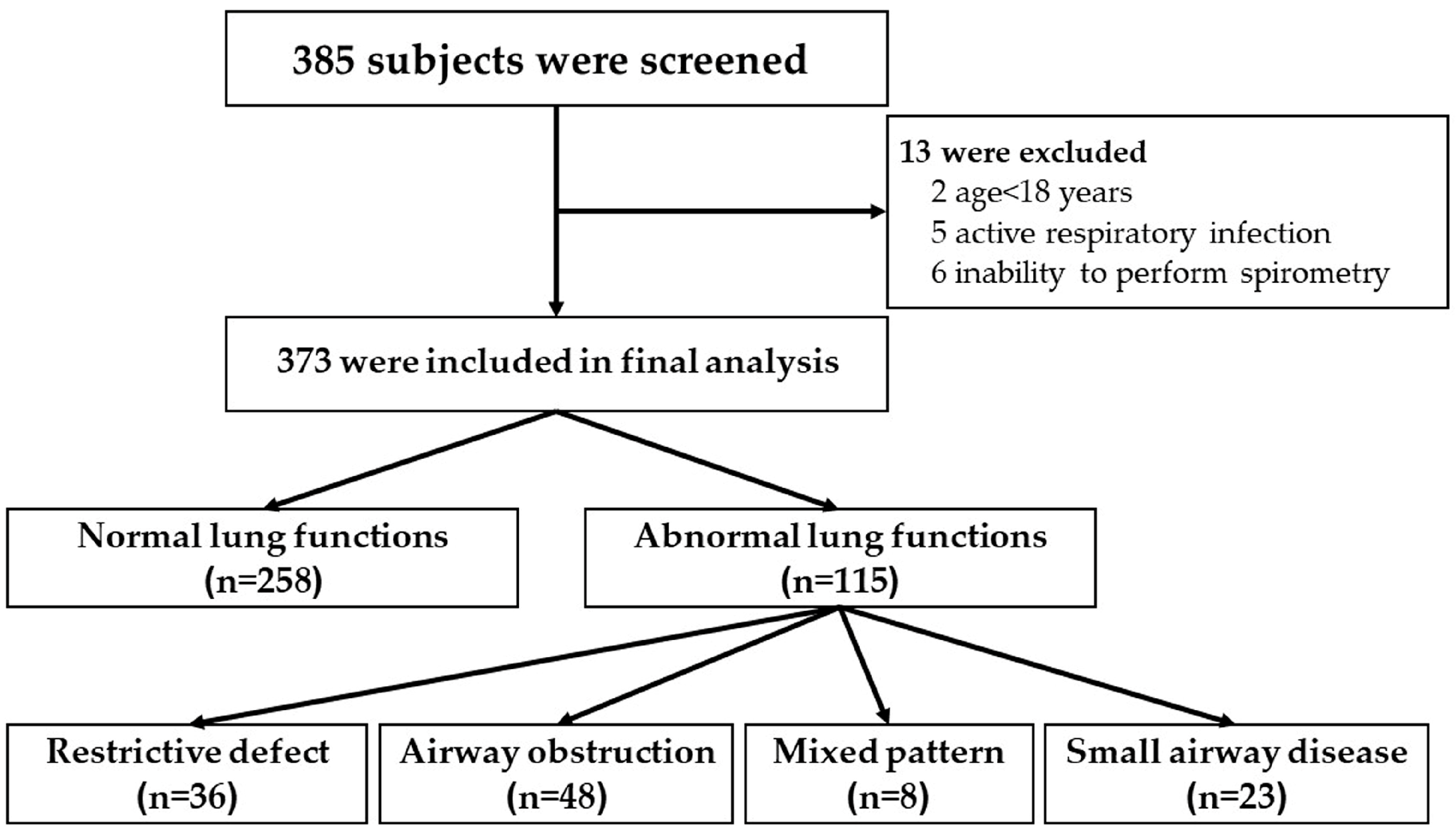
A total of 385 participants underwent initial screening, of whom 373 participants were ultimately enrolled in the analysis, with females comprising 65.4% of the study population; 13 individuals were excluded (Figure 1). The mean age was 55.0 ± 13.6 years. Current or former smokers represented 18.2%, with a mean cumulative smoking exposure of 14.6 ± 16.8 pack-years. Employment in the textile industry and chemical industry accounted for 8.8% and 5.9%, respectively. Hypertension (29.0%) and dyslipidemia (21.2%) were the most frequently reported pre-existing comorbid conditions. The most commonly reported respiratory symptoms were cough (18.0%) and sputum production (15.5%) (Table 1).
The mean FEV1 was 92.5 ± 14.1% of predicted value, while the mean FEV1/FVC ratio was 80.41 ± 6.93% (Table 2). Overall, 30.8% of participants demonstrated abnormal pulmonary function (Table 3), comprising restrictive defect (9.7%), airway obstruction (12.9%), mixed defect (2.1%), and small airway disease (6.2%). A positive BDR was identified in 2.4% (Table 3). The prevalence of COPD and asthma was 4.3% and 5.4%, respectively (Table 2). Abnormal findings on chest radiography were detected in 8.6% of participants, including lung fibrosis (3.4%), pleural fibrosis (2.1%), lung nodules (4.8%), and mixed patterns (4.0%) (Table 3).
Compared with participants who had normal pulmonary function, those with abnormal results were significantly older and included a higher proportion of males, smokers, individuals employed in the chemical industry, and participants with hypertension, a history of asthma, cough, chest tightness, prior treatment for dyspnea, and emergency department visits for dyspnea within the preceding year (Table 1). Multivariable logistic regression analysis revealed that older age, male sex, a history of asthma, and the presence of chest tightness were independently associated with an increased likelihood of abnormal pulmonary function (Table 4).

4. Discussion

This cross-sectional study provides contemporary epidemiological data on abnormal pulmonary function, COPD, and asthma among workers and residents of the Navanakorn Industrial Zone, Thailand. Using standardized spirometry and internationally accepted diagnostic criteria, we found that nearly one-third (30.8%) of participants exhibited abnormal pulmonary function, with airway obstruction (12.9%) and restrictive defects (9.7%) being the most common patterns. These findings underscore the substantial burden of subclinical and overt respiratory impairment in industrial and peri-industrial communities.
Air quality in the Navanakorn Industrial Zone is likely influenced by a combination of urban traffic emissions, industrial activities, and regional transboundary pollution, similar to patterns observed across the Bangkok metropolitan region and central Thailand. Particulate matter, particularly PM2.5, is the predominant pollutant and has been consistently reported to exceed national and international air quality guidelines in urban–industrial settings [25,26,27]. Importantly, air pollution levels in this region exhibit marked seasonal variation. PM2.5 concentrations typically peak during the dry and cool season (November to February), when meteorological conditions such as low wind speed, temperature inversion, and reduced atmospheric mixing height promote pollutant accumulation. In addition, regional biomass burning contributes to episodic haze events during this period [28,29]. In contrast, air quality generally improves during the rainy season (June to October) due to enhanced atmospheric dispersion and wet deposition of airborne particles [29,30]. These seasonal fluctuations may have influenced exposure levels during the study period and should be considered when interpreting the observed prevalence of respiratory abnormalities.
The prevalence of abnormal lung function observed in our study is comparable to that reported in other occupationally exposed populations, where rates range from approximately 4.3% to 56.6% [24,31,32,33,34,35], depending on exposure intensity and diagnostic definitions. The predominance of airway obstruction and restrictive defects reflects the heterogeneous respiratory effects of industrial exposures, including irritant gases, organic and inorganic dusts, and chemical aerosols.
Importantly, when considering pollutants, dust, and airborne contaminants, their chemical composition plays a critical role in determining respiratory toxicity and disease pathogenesis. Particulate matter (PM), particularly PM2.5, is a complex mixture that may contain transition metals (e.g., iron, nickel), polycyclic aromatic hydrocarbons (PAHs), sulfates, nitrates, and organic carbon fractions, all of which can induce oxidative stress and airway inflammation [36,37,38]. Inorganic dusts such as silica and asbestos are well known to promote fibrotic lung disease through persistent activation of alveolar macrophages and fibroblasts [3,39], while organic dusts (e.g., endotoxin-containing bioaerosols) can trigger airway inflammation and bronchial hyperresponsiveness [40]. Additionally, VOCs and chemical sensitizers commonly encountered in industrial environments—such as isocyanates, epoxy resins, and acid anhydrides—have been strongly associated with occupational asthma via immunologic and non-immunologic mechanisms [6,8,41]. Therefore, incorporating information on the chemical composition of airborne exposures is essential for understanding their differential contributions to airway obstruction, restriction, and asthma pathophysiology.
Our findings are consistent with large-scale epidemiological evidence demonstrating the adverse respiratory effects of occupational exposure to vapors, gases, dusts, and fumes (VGDF). A COPD surveillance study in southern China involving more than 7000 participants reported significant associations between VGDF exposure and chronic bronchitis, respiratory symptoms, and impaired lung function, particularly reductions in FEV1/FVC and FEF25–75, indicative of airflow limitation and small airway dysfunction [42]. These spirometric abnormalities parallel those observed in our study population.
Participants with abnormal pulmonary function in our cohort had higher rates of cough, wheezing, and chest tightness, closely mirroring symptom patterns reported in the Chinese study, where cough and sputum production were strongly linked to dust and combined VGDF exposure [42]. Consistently, 6.2% of our participants exhibited small airway disease, highlighting the vulnerability of peripheral airways to inhalational exposures. Importantly, dual VGDF exposure in the Chinese cohort conferred a greater risk of chronic bronchitis and lung function decline than single exposures, suggesting synergistic effects of mixed pollutants. This aligns with our findings that chemical industry employment and male sex were independently associated with abnormal pulmonary function. Together, these data reinforce the role of occupational and environmental exposures in the development of airflow limitation and support early spirometric screening and preventive strategies in industrial and peri-industrial populations.
Restrictive defects accounted for nearly 10% of participants, a finding consistent with prior studies linking long-term occupational exposure to fibrogenic dusts and chemical fumes with reduced lung volumes, even in the absence of overt interstitial lung disease on chest radiography (3,19). The presence of small airway disease in 6.2% of participants further highlights the potential for early peripheral airway involvement, which may precede clinically apparent COPD or asthma [43,44] and is often under-recognized in routine spirometric screening [45].
The prevalence of COPD (4.3%) in our cohort is consistent with population-based estimates from Thailand, which have reported COPD prevalence ranging from 3.7% to 8.3% among adults [5,10,46]. Notably, this burden was observed despite a relatively modest proportion of current or former smokers (18.2%), suggesting that non-smoking-related exposures—such as occupational and environmental pollutants—may play an important contributory role in this population [47,48,49,50].
Asthma prevalence in our study was 5.4%, which falls within the reported range for the Thai adult population (3–10%) [4,5]. However, the significantly higher prevalence of asthma history among participants with abnormal pulmonary function, together with its strong independent association in multivariable analyses, supports the growing recognition of adult-onset and occupational asthma as a major health concern in industrial settings [6,7,8]. Occupational asthma is estimated to account for 5–25% of adult-onset asthma cases globally, and exposure to chemical sensitizers such as epoxy resins and acid anhydrides—commonly encountered in industrial environments—has been well documented [2,6,8].
In our study, multivariable logistic regression analysis identified older age, male sex, a history of asthma, and chest tightness as independent predictors of abnormal pulmonary function. The association with age is consistent with physiological declines in lung function and cumulative exposure to environmental and occupational hazards over time [9,11]. Male sex remained a significant risk factor even after adjustment, likely reflecting sex-based differences in occupational roles, exposure intensity, and smoking patterns, as reported in previous occupational health studies [1].
A prior history of asthma conferred a more than sevenfold increase in the risk of abnormal lung function. This finding aligns with evidence that chronic airway inflammation and repeated exacerbations can lead to airway remodeling, fixed airflow limitation, and overlap phenotypes of asthma and COPD later in life [6,23]. Chest tightness, although reported by a small proportion of participants, emerged as a strong clinical predictor, highlighting the importance of symptom-based screening in identifying individuals at risk for underlying functional impairment [51,52].
Abnormal findings on chest radiography were observed in 8.6% of participants, most commonly lung fibrosis and pulmonary nodules. While radiographic abnormalities were less frequent than spirometric impairments, this discrepancy emphasizes that functional abnormalities may precede structural changes detectable by conventional imaging [3,21]. The combined use of spirometry and chest radiography therefore provides complementary information for early detection and risk stratification in occupational and community screening programs.
The findings of our study have important public health implications for industrial zones in Thailand and other low- and middle-income settings. The substantial prevalence of abnormal pulmonary function among both workers and residents suggests that respiratory risk extends beyond the workplace and may be influenced by ambient air pollution, traffic emissions, and regional biomass burning, all of which contribute to elevated PM2.5 levels in central Thailand [1,9]. Early detection through community-based screening programs, as demonstrated in this study, offers an opportunity for timely intervention, smoking cessation, exposure reduction, and appropriate long-term management to prevent disease progression and exacerbations [11,12,51,52].
Key strengths of our study include the use of standardized spirometry following international guidelines, application of GLI reference equations, and comprehensive assessment of symptoms, occupational exposure, and radiographic findings. However, several limitations should be acknowledged. The cross-sectional design precludes causal inference, and exposure assessment relied primarily on occupational categories rather than quantitative exposure measurements. The cross-sectional design limits assessment of disease progression over time, as respiratory conditions such as COPD and asthma develop gradually with cumulative exposures. Longitudinal studies are needed to better understand temporal changes, establish causal relationships, and characterize the natural history of these diseases. In addition, future studies should consider evaluating the occurrence of other comorbidities over time, such as malignancies and neurodegenerative disorders, which may be associated with long-term environmental and occupational exposures. Furthermore, future research should be complemented by approaches that investigate underlying mechanisms at the molecular level, such as multi-omics analyses using non-invasive samples (e.g., blood or urine) or semi-invasive samples (e.g., bronchoalveolar lavage), to better elucidate biological pathways linking environmental exposures to respiratory disease. Additionally, the relatively low prevalence of BDR may underestimate asthma prevalence, particularly in individuals with well-controlled disease or intermittent symptoms. The definitions of COPD and asthma used in this study warrant cautious interpretation. However, based on standard spirometric criteria, reliance primarily on spirometry and BDR may lead to misclassification. In an industrial setting, limiting exposure assessment to cigarette smoking and biomass fuel use may underestimate the contribution of industrial pollutants to COPD burden. Moreover, BDR alone has limited specificity for asthma, as it may be present in COPD and absent in some asthma phenotypes. Without additional objective measures, such as fractional exhaled nitric oxide (FeNO) or bronchial provocation testing, differentiation between COPD and asthma remains uncertain. Therefore, the observed findings may more appropriately reflect airflow obstruction rather than distinct diagnostic categories. Future studies incorporating comprehensive diagnostic tools and detailed assessment of industrial exposures are needed to improve disease classification and clarify exposure–response relationships. Spirometry, while suitable for epidemiological studies, has inherent limitations. A reduced FVC in the presence of a preserved FEV1/FVC ratio may reflect either true restriction or airflow limitation with air trapping, and cannot be reliably distinguished without lung volume measurements. Lastly, the lack of longitudinal follow-up limits assessment of disease evolution. Future longitudinal studies are needed to assess temporal changes in lung function, radiographic findings, and clinical outcomes over time in this population.

5. Conclusions

In conclusion, abnormal pulmonary function is common among workers and residents of the Navanakorn Industrial Zone, with COPD and asthma prevalence comparable to national estimates yet occurring in the context of significant occupational and environmental exposures. Older age, male sex, a history of asthma, and respiratory symptoms were key determinants of impaired lung function. These results highlight the need for integrated occupational and community respiratory health surveillance, early screening, and targeted preventive strategies in industrial regions of Thailand.

Author Contributions

Conceptualization, all authors; methodology, N.S., P.R., P.V., K.L. and A.P.; software, N.S., K.L. and A.P.; validation, N.S., P.R., P.V. and O.P.; formal analysis, N.S., K.L., A.P. and O.P.; investigation, N.S., P.V., K.L., A.P. and O.P.; resources, N.S., P.R., P.V., K.L. and A.P.; data curation, N.S., P.R., P.V., K.L., A.P. and O.P.; writing—original draft preparation, N.S., P.R., P.V., K.L. and A.P.; writing—review and editing, all authors; visualization, N.S., P.R., P.V., K.L., A.P. and O.P.; supervision, N.S., P.R., P.V. and O.P.; project administration, N.S., K.L. and A.P.; funding acquisition, N.S., P.V., K.L., A.P. and O.P. All authors have read and agreed to the published version of the manuscript.

Funding

This research was funded by the Thailand Science Research and Innovation Fundamental Fund, fiscal year 2025 (TUFF 62/2568).

Institutional Review Board Statement

The study was conducted in accordance with the Declaration of Helsinki, and approved by the Human Research Ethics Committee of Thammasat University (Medicine), Thailand (IRB No. MTU-EC-IM-1-024/68; COA No. 106/2568; date of approval: 19 May 2025). This study was prospectively registered with ClinicalTrials.gov with number NCT07383896.

Informed Consent Statement

All participants provided written informed consent.

Data Availability Statement

The original contributions presented in this study are included in the article. Further inquiries can be directed to the corresponding author.

Acknowledgments

The authors thank Michael Jan Everts, Faculty of Medicine, Thammasat University, for proofreading this manuscript. This study was supported by the Thammasat University Research Unit in Allergy and Respiratory Medicine, Thailand.

Conflicts of Interest

The authors declare no conflicts of interest. The funders had no role in the design of the study; in the collection, analyses, or interpretation of data; in the writing of the manuscript; or in the decision to publish the results.

Abbreviations

The following abbreviations are used in this manuscript:
BDRbronchodilator responsiveness
CIconfidence interval
COPDchronic obstructive pulmonary disease
FEF25–75forced expiration flow rate at 25–75% of FVC
FEV1forced expiratory volume in one second
FVCforced vital capacity
GLIGlobal Lung Function Initiative
Lliter
LLNlower limit of normal
L/sliter per second
ORodds ratio
PEFpeak expiratory flow
VGDFvapors, gases, dusts, and fumes

References

  1. Murgia, N.; Akgun, M.; Blanc, P.D.; Costa, J.T.; Moitra, S.; Munoz, X.; Toren, K.; Ferreira, A.J. Issue 3-The occupational burden of respiratory diseases, an update. Pulmonology 2025, 31, 2416808. [Google Scholar] [CrossRef]
  2. Tustin, A.W.; Kundu-Orwa, S.; Lodwick, J.; Cannon, D.L.; McCarthy, R.B. An outbreak of work-related asthma and silicosis at a US countertop manufacturing and fabrication facility. Am. J. Ind. Med. 2022, 65, 12–19. [Google Scholar] [CrossRef]
  3. Leung, C.C.; Yu, I.T.; Chen, W. Silicosis. Lancet 2012, 379, 2008–2018. [Google Scholar] [CrossRef] [PubMed]
  4. Dejsomritrutai, W.; Nana, A.; Chierakul, N.; Tscheikuna, J.; Sompradeekul, S.; Ruttanaumpawan, P.; Charoenratanakul, S. Prevalence of bronchial hyperresponsiveness and asthma in the adult population in Thailand. Chest 2006, 129, 602–609. [Google Scholar] [CrossRef] [PubMed]
  5. Saiphoklang, N.; Ruchiwit, P.; Kanitsap, A.; Tantiyavarong, P.; Vatcharavongvan, P.; Palungrit, S.; Leelasittikul, K.; Pugongchai, A.; Poachanukoon, O. Prevalence of chronic obstructive pulmonary disease and asthma in the community of Pathumthani, Thailand. Diseases 2025, 13, 130. [Google Scholar] [CrossRef] [PubMed]
  6. Baur, X.; Aasen, T.B.; Burge, P.S.; Heederik, D.; Henneberger, P.K.; Maestrelli, P.; Schlunssen, V.; Vandenplas, O.; Wilken, D. The management of work-related asthma guidelines: A broader perspective. Eur. Respir. Rev. 2012, 21, 125–139. [Google Scholar] [CrossRef]
  7. Toren, K.; Blanc, P.D. Asthma caused by occupational exposures is common—A systematic analysis of estimates of the population-attributable fraction. BMC Pulm. Med. 2009, 9, 7. [Google Scholar] [CrossRef]
  8. Liviero, F. Occupational asthma: Still an underestimated burden? Thorax 2025, 81, 22–32. [Google Scholar] [CrossRef]
  9. Wang, Y.; Jin, L.; Dong, Y.; Yang, E.; Niu, X.; Mao, J.; Yuan, C.; You, B.; Wang, Y.; Chai, Y. Global burden of disease study on COPD in the older adult: Comprehensive analysis of environmental factors and interaction effects. Front. Public Health 2025, 13, 1597793. [Google Scholar] [CrossRef]
  10. Pothirat, C.; Chaiwong, W.; Phetsuk, N.; Pisalthanapuna, S.; Chetsadaphan, N.; Inchai, J. A comparative study of COPD burden between urban vs rural communities in northern Thailand. Int. J. Chron. Obstr. Pulm. Dis. 2015, 10, 1035–1042. [Google Scholar] [CrossRef]
  11. Bollmeier, S.G.; Hartmann, A.P. Management of chronic obstructive pulmonary disease: A review focusing on exacerbations. Am. J. Health Syst. Pharm. 2020, 77, 259–268. [Google Scholar] [CrossRef] [PubMed]
  12. Pham, H.Q.; Pham, K.H.T.; Ha, G.H.; Pham, T.T.; Nguyen, H.T.; Nguyen, T.H.T.; Oh, J.K. Economic burden of chronic obstructive pulmonary disease: A systematic review. Tuberc. Respir. Dis. 2024, 87, 234–251. [Google Scholar] [CrossRef]
  13. Force, U.S.P.S.T.; Mangione, C.M.; Barry, M.J.; Nicholson, W.K.; Cabana, M.; Caughey, A.B.; Chelmow, D.; Coker, T.R.; Davis, E.M.; Donahue, K.E.; et al. Screening for chronic obstructive pulmonary disease: US preventive services task force reaffirmation recommendation statement. JAMA 2022, 327, 1806–1811. [Google Scholar]
  14. Force, U.S.P.S.T.; Siu, A.L.; Bibbins-Domingo, K.; Grossman, D.C.; Davidson, K.W.; Epling, J.W., Jr.; Garcia, F.A.; Gillman, M.; Kemper, A.R.; Krist, A.H.; et al. Screening for chronic obstructive pulmonary disease: US preventive services task force recommendation statement. JAMA 2016, 315, 1372–1377. [Google Scholar]
  15. Scanlon, P.D.; Connett, J.E.; Waller, L.A.; Altose, M.D.; Bailey, W.C.; Buist, A.S.; Tashkin, D.P.; Lung Health Study Research Group. Smoking cessation and lung function in mild-to-moderate chronic obstructive pulmonary disease. The Lung Health Study. Am. J. Respir. Crit. Care Med. 2000, 161, 381–390. [Google Scholar] [CrossRef]
  16. Global Initiative for Chronic Obstructive Lung Disease. Global Strategy for the Diagnosis, Management and Prevention of Chronic Obstructive Pulmonary Disease 2026 Report. Available online: http://goldcopd.org (accessed on 31 January 2026).
  17. Miller, M.R.; Crapo, R.; Hankinson, J.; Brusasco, V.; Burgos, F.; Casaburi, R.; Coates, A.; Enright, P.; van der Grinten, C.P.; Gustafsson, P.; et al. General considerations for lung function testing. Eur. Respir. J. 2005, 26, 153–161. [Google Scholar] [CrossRef]
  18. Miller, M.R.; Hankinson, J.; Brusasco, V.; Burgos, F.; Casaburi, R.; Coates, A.; Crapo, R.; Enright, P.; van der Grinten, C.P.; Gustafsson, P.; et al. Standardisation of spirometry. Eur. Respir. J. 2005, 26, 319–338. [Google Scholar] [CrossRef]
  19. Graham, B.L.; Steenbruggen, I.; Miller, M.R.; Barjaktarevic, I.Z.; Cooper, B.G.; Hall, G.L.; Hallstrand, T.S.; Kaminsky, D.A.; McCarthy, K.; McCormack, M.C.; et al. Standardization of spirometry 2019 update. An official American Thoracic Society and European Respiratory Society technical statement. Am. J. Respir. Crit. Care Med. 2019, 200, e70–e88. [Google Scholar] [CrossRef]
  20. Quanjer, P.H.; Stanojevic, S.; Cole, T.J.; Baur, X.; Hall, G.L.; Culver, B.H.; Enright, P.L.; Hankinson, J.L.; Ip, M.S.; Zheng, J.; et al. Multi-ethnic reference values for spirometry for the 3-95-yr age range: The global lung function 2012 equations. Eur. Respir. J. 2012, 40, 1324–1343. [Google Scholar] [CrossRef]
  21. Stanojevic, S.; Kaminsky, D.A.; Miller, M.R.; Thompson, B.; Aliverti, A.; Barjaktarevic, I.; Cooper, B.G.; Culver, B.; Derom, E.; Hall, G.L.; et al. ERS/ATS technical standard on interpretive strategies for routine lung function tests. Eur. Respir. J. 2022, 60, 2101499. [Google Scholar] [CrossRef] [PubMed]
  22. Ciprandi, G.; Capasso, M.; Tosca, M.; Salpietro, C.; Salpietro, A.; Marseglia, G.; La Rosa, M. A forced expiratory flow at 25-75% value <65% of predicted should be considered abnormal: A real-world, cross-sectional study. Allergy Asthma Proc. 2012, 33, e5–e8. [Google Scholar] [CrossRef]
  23. Global Initiative for Asthma. Global Strategy for Asthma Management and Prevention 2025 Update. Available online: https://ginasthma.org/ (accessed on 31 January 2026).
  24. Huang, C.; Liu, R.; Cai, C.; Huang, L.; Xia, T.; Luo, S.; Wang, S.; Gan, Y.; Cai, J.; Peng, X.; et al. Investigation of factors influencing abnormal pulmonary ventilation function in occupational exposed populations and the establishment of a risk prediction model. Sci. Rep. 2024, 14, 25215. [Google Scholar] [CrossRef]
  25. Hyunh, L.T.; Polset, S.; Truong, M.T.N.; Tangkan, S. High-resolution monthly PM2.5 and PM10 data and annual average Pb from multiple monitoring sites across Bangkok, Thailand with an integrated screening-level health risk assessment. Environ. Geochem. Health 2026, 48, 193. [Google Scholar] [CrossRef]
  26. Jinsart, W.; Tamura, K.; Loetkamonwit, S.; Thepanondh, S.; Karita, K.; Yano, E. Roadside particulate air pollution in Bangkok. J. Air Waste Manag. Assoc. 2002, 52, 1102–1110. [Google Scholar] [CrossRef][Green Version]
  27. World Health Organization. WHO Global Air Quality Guidelines. Particulate Matter (PM2.5 and PM10), Ozone, Nitrogen Dioxide, Sulfur Dioxide and Carbon Monoxide. Executive Summary. Available online: https://www.who.int/publications/i/item/9789240034228 (accessed on 8 April 2026).
  28. Aman, N.; Panyametheekul, S.; Pawarmart, I.; Xian, D.; Gao, L.; Tian, L.; Manomaiphiboon, K.; Wang, Y. Machine learning-based quantification and separation of emissions and meteorological effects on PM(2.5) in Greater Bangkok. Sci. Rep. 2025, 15, 14775. [Google Scholar] [CrossRef]
  29. Boongla, Y.; Chanonmuang, P.; Hata, M.; Furuuchi, M.; Phairuang, W. The characteristics of carbonaceous particles down to the nanoparticle range in Rangsit city in the Bangkok Metropolitan Region, Thailand. Environ. Pollut. 2021, 272, 115940. [Google Scholar] [CrossRef]
  30. Bhatta, J.; Laosee, O.; Janmaimool, P.; Strezov, V.; Rattanapan, C. Spatiotemporal analysis of particulate matter (PM10 and PM2.5) and health risks in Thailand’s urban core. Chemosphere 2025, 388, 144687. [Google Scholar] [CrossRef]
  31. Saiphoklang, N.; Ruchiwit, P.; Kanitsap, A.; Tantiyavarong, P.; Vatcharavongvan, P.; Palungrit, S.; Leelasittikul, K.; Pugongchai, A.; Poachanukoon, O. Silicosis and pulmonary functions among residents exposed to dust in Saraburi Thailand. Diseases 2025, 13, 372. [Google Scholar] [CrossRef]
  32. He, W.; Jin, N.; Deng, H.; Zhao, Q.; Yuan, F.; Chen, F.; Zhang, H.; Zhong, X. Workers’ occupational dust exposure and pulmonary function assessment: Cross-sectional study in China. Int. J. Environ. Res. Public Health 2022, 19, 11065. [Google Scholar] [CrossRef]
  33. Rahman, S.; Das, A.; Islam, A.N.; Hossain, E.; Mesbahul Islam, S.; Rony, K.; Rahul, A.K.; Hossain, G.; Romel Bhuia, M.; Asaduzzaman, M. Prevalence and risk factors for the development of COPD among workers in stone quarries: A cross-sectional study. BMC Pulm. Med. 2025, 25, 384. [Google Scholar] [CrossRef]
  34. Koskela, K.; Lehtimaki, L.; Uitti, J.; Oksa, P.; Tikkakoski, A.; Sauni, R. The prevalence of respiratory symptoms and diseases and declined lung function among foundry workers. J. Occup. Med. Toxicol. 2024, 19, 41. [Google Scholar] [CrossRef]
  35. Go, L.H.T.; Almberg, K.S.; Rose, C.S.; Zell-Baran, L.M.; Harris, D.A.; Tomann, M.; Friedman, L.S.; Weems, D.J.; Vonhof, W.; Mastel, K.M.; et al. Prevalence and severity of abnormal lung function among US former coal miners with and without radiographic coal workers’ pneumoconiosis. Occup. Environ. Med. 2022, 79, 527–532. [Google Scholar] [CrossRef]
  36. Kelly, F.J.; Fussell, J.C. Air pollution and airway disease. Clin. Exp. Allergy 2011, 41, 1059–1071. [Google Scholar] [CrossRef]
  37. Pope, C.A., 3rd; Dockery, D.W. Health effects of fine particulate air pollution: Lines that connect. J. Air Waste Manag. Assoc. 2006, 56, 709–742. [Google Scholar] [CrossRef]
  38. Brook, R.D.; Rajagopalan, S.; Pope, C.A., 3rd; Brook, J.R.; Bhatnagar, A.; Diez-Roux, A.V.; Holguin, F.; Hong, Y.; Luepker, R.V.; Mittleman, M.A.; et al. Particulate matter air pollution and cardiovascular disease: An update to the scientific statement from the American Heart Association. Circulation 2010, 121, 2331–2378. [Google Scholar] [CrossRef]
  39. Mossman, B.T.; Churg, A. Mechanisms in the pathogenesis of asbestosis and silicosis. Am. J. Respir. Crit. Care Med. 1998, 157, 1666–1680. [Google Scholar] [CrossRef]
  40. Eduard, W.; Pearce, N.; Douwes, J. Chronic bronchitis, COPD, and lung function in farmers: The role of biological agents. Chest 2009, 136, 716–725. [Google Scholar] [CrossRef]
  41. Tarlo, S.M.; Lemiere, C. Occupational asthma. N. Engl. J. Med. 2014, 370, 640–649. [Google Scholar] [CrossRef]
  42. Zheng, X.Y.; Zheng, Y.J.; Liao, T.T.; Xu, Y.J.; Liu, L.; Wang, Y.; Xiao, N.; Li, C.; He, Z.X.; Tan, X.M.; et al. Effects of occupational exposure to dust, gas, vapor and fumes on chronic bronchitis and lung function. J. Thorac. Dis. 2024, 16, 356–367. [Google Scholar] [CrossRef]
  43. Zhou, R.; Wang, H.; Zhang, Y.; Mai, J.; Yang, L. Small airway disease as a key factor in COPD: New perspectives and insights. Front. Med. 2025, 12, 1648612. [Google Scholar] [CrossRef] [PubMed]
  44. Braido, F.; Scichilone, N.; Lavorini, F.; Usmani, O.S.; Dubuske, L.; Boulet, L.P.; Mosges, R.; Nunes, C.; Sanchez-Borges, M.; Ansotegui, I.J.; et al. Manifesto on small airway involvement and management in asthma and chronic obstructive pulmonary disease: An Interasma (Global Asthma Association—GAA) and World Allergy Organization (WAO) document endorsed by Allergic Rhinitis and its Impact on Asthma (ARIA) and Global Allergy and Asthma European Network (GA(2)LEN). World Allergy Organ. J. 2016, 9, 37. [Google Scholar]
  45. Hoesterey, D.; Das, N.; Janssens, W.; Buhr, R.G.; Martinez, F.J.; Cooper, C.B.; Tashkin, D.P.; Barjaktarevic, I. Spirometric indices of early airflow impairment in individuals at risk of developing COPD: Spirometry beyond FEV(1)/FVC. Respir. Med. 2019, 156, 58–68. [Google Scholar] [CrossRef] [PubMed]
  46. Kitjakrancharoensin, P.; Yasan, K.; Hongyantarachai, K.; Ratanachokthorani, K.; Thammasarn, J.; Kuwuttiwai, D.; Ekanaprach, T.; Jittakarm, R.; Nuntapravechpun, R.; Hotarapavanon, S.; et al. Prevalence and risk factors of chronic obstructive pulmonary disease among agriculturists in a rural community, central Thailand. Int. J. Chron. Obstr. Pulm. Dis. 2020, 15, 2189–2198. [Google Scholar] [CrossRef] [PubMed]
  47. Kc, R.; Shukla, S.D.; Gautam, S.S.; Hansbro, P.M.; O’Toole, R.F. The role of environmental exposure to non-cigarette smoke in lung disease. Clin. Transl. Med. 2018, 7, 39. [Google Scholar] [CrossRef]
  48. Park, H.; Jo, S.M.; Jin, K.N.; Lee, H.J.; Lee, H.W.; Park, T.Y.; Heo, E.Y.; Kim, D.K.; Lee, J.K. Distinct risks of exacerbation and lung function decline between never-smokers and ever-smokers with COPD. BMC Pulm. Med. 2025, 25, 138. [Google Scholar] [CrossRef]
  49. Loeb, E.; Zock, J.P.; Miravitlles, M.; Rodriguez, E.; Soler-Cataluna, J.J.; Soriano, J.B.; Garcia-Rio, F.; de Lucas, P.; Alfageme, I.; Casanova, C.; et al. Association between occupational exposure and chronic obstructive pulmonary disease and respiratory symptoms in the Spanish population. Arch. Bronconeumol. 2024, 60, 16–22. [Google Scholar] [CrossRef]
  50. Wang, T.; Lyu, L.; Yuan, R.; Lei, L.; Meng, F.; Zhu, M.; Duan, W. Air pollution exposure modes, smoking and genetic risk with chronic respiratory diseases: A prospective study. NPJ Prim. Care Respir. Med. 2025, 36, 6. [Google Scholar] [CrossRef]
  51. De Matteis, S.; Heederik, D.; Burdorf, A.; Colosio, C.; Cullinan, P.; Henneberger, P.K.; Olsson, A.; Raynal, A.; Rooijackers, J.; Santonen, T.; et al. Current and new challenges in occupational lung diseases. Eur. Respir. Rev. 2017, 26, 170080. [Google Scholar] [CrossRef]
  52. Vogelmeier, C.F.; Roman-Rodriguez, M.; Singh, D.; Han, M.K.; Rodriguez-Roisin, R.; Ferguson, G.T. Goals of COPD treatment: Focus on symptoms and exacerbations. Respir. Med. 2020, 166, 105938. [Google Scholar] [CrossRef] [PubMed]
Figure 1. Flowchart of participant recruitment to the study.
Medsci 14 00208 g001
Table 1. Baseline characteristics of participants.
CharacteristicsTotal
(n = 373)
Normal Lung Function (n = 258)Abnormal Lung Function (n = 115)p-Value
Age, years55.0 ± 13.653.9 ± 13.857.5 ± 13.00.019
Sex 0.002
Female244 (65.4)182 (70.5)62 (53.9)
Male129 (34.6)76 (29.5)53 (46.1)
Body mass index, kg/m225.0 ± 4.424.7 ± 4.125.5 ± 5.10.123
Current or former smoker68 (18.2)38 (14.7)30 (26.1)0.003
Smoking exposure, pack-years14.6 ± 16.810.9 ± 18.319.0 ± 14.10.063
Type of factory work 0.037
Textile industry33 (8.8)26 (10.1)7 (6.1)
Chemical industry22 (5.9)10 (3.9)12 (10.4)
Other industries131 (35.1)87 (33.7)44 (38.3)
Non-factory occupations187 (50.1)135 (52.3)52 (45.2)
Pre-existing comorbidities
Hypertension108 (29.0)66 (25.6)42 (36.5)0.031
Dyslipidemia79 (21.2)49 (19.0)30 (26.1)0.121
Diabetes mellitus34 (9.1)21 (8.1)13 (11.3)0.327
Coronary heart disease11 (2.9)7 (2.7)4 (3.5)0.743
Cerebrovascular disease6 (1.6)4 (1.6)2 (1.7)1.000
Obesity5 (1.3)4 (1.6)1 (0.9)1.000
Allergic rhinitis40 (10.7)23 (8.9)17 (14.8)0.091
Asthma11 (2.9)2 (0.8)9 (7.8)<0.001
COPD2 (0.5)1 (0.4)1 (0.9)0.522
Respiratory symptoms
Presence of respiratory symptom135 (36.2)80 (31.0)55 (47.8)0.002
Cough67 (18.0)36 (14.0)31 (27.0)0.003
Dyspnea25 (6.7)14 (5.4)11 (9.6)0.106
Sputum production58 (15.5)34 (13.2)24 (20.9)0.051
Wheezing7 (1.9)1 (0.4)6 (5.2)0.002
Chest tightness9 (2.4)2 (0.8)7 (6.1)0.003
Nasal obstruction33 (8.8)23 (8.9)10 (8.7)0.324
Rhinorrhea29 (7.8)18 (7.0)11 (9.6)0.220
Sore throat13 (3.5)7 (2.7)6 (5.2)0.152
Previous treatment for dyspnea24 (6.4)15 (13.0)9 (3.5)<0.001
ED visit for dyspnea in the past year7 (1.9)2 (0.8)5 (4.3)0.009
Data presented as n (%) or mean ± SD. COPD = chronic obstructive pulmonary disease, ED = emergency department, kg = kilogram, m = meter.
Table 2. Pulmonary function data and diagnosis of airway disease.
VariableData (n = 373)
Spirometry data
FVC, L2.79 ± 0.79
FVC, %predicted94.8 ± 14.1
FVC change after BD test, %0.46 ± 4.98
FEV1, L2.24 ± 0.67
FEV1, % predicted92.5 ± 14.1
FEV1 change after BD test, % 3.04 ± 4.19
FEV1/FVC, % 80.41 ± 6.93
FEV1/FVC, % predicted97.56 ± 7.73
PEF, L/s6.52 ± 1.79
PEF, % predicted98.77 ± 18.45
FEF25–75, L/s2.20 ± 1.00
FEF25–75, %predicted87.81 ± 31.59
Diagnosis of airway disease
COPD16 (4.3)
Asthma 20 (5.4)
Data presented as n (%). BD = bronchodilator response, COPD = chronic obstructive pulmonary disease, FEV1 = forced expiratory volume in 1 s, FVC = forced vital capacity, FEF25–75 = forced expiratory flow at 25–75% of FVC, PEF = peak expiratory flow, L = liters, s = second.
Table 3. Abnormal pulmonary function and chest radiographic findings.
CharacteristicsData (n = 373)
Abnormal pulmonary function115 (30.8)
Restrictive defect36 (9.7)
Airway obstruction48 (12.9)
Mixed obstructive and restrictive defect8 (2.1)
Small airway disease23 (6.2)
Bronchodilator response9 (2.4)
Abnormal chest radiographic findings32 (8.6)
Lung fibrosis13 (3.5)
Pleural fibrosis8 (2.1)
Lung nodule18 (4.8)
Mixed pattern15 (4.0)
Data presented as n (%), Airway obstruction defined as FEV1/FVC ratio < LLN, Restrictive defect defined as FEV1/FVC ratio > LLN and FVC < LLN, Mixed obstructive and restrictive defect defined as FEV1/FVC ratio < LLN and FVC < LLN, Small airway disease defined as FEF25–75 < 65%, while normal FEV1, FVC and FEV1/FVC ratio, BDR defined as increase in FEV1 or FVC > 10% of the predicted value after bronchodilator responsiveness test, FEV1 = forced expiratory volume in one second, FVC = forced vital capacity, FEF25–75 = forced expiratory flow at 25–75% of FVC, LLN = lower limit of normal.
Table 4. Logistic regression analysis for factors associated with abnormal pulmonary functions.
VariablesAdjusted Odds Ratio (95%CI)p-Value
Age for every 1-year increase1.026 (1.008–1.045)0.005
Male sex2.139 (1.322–3.459)0.002
History of asthma 7.155 (1.314–38.959)0.023
Previous treatment for dyspnea2.440 (0.909–6.555)0.077
Wheezing8.326 (0.844–82.140)0.070
Chest tightness6.274 (1.188–33.142)0.031
Disclaimer/Publisher’s Note: The statements, opinions and data contained in all publications are solely those of the individual author(s) and contributor(s) and not of MDPI and/or the editor(s). MDPI and/or the editor(s) disclaim responsibility for any injury to people or property resulting from any ideas, methods, instructions or products referred to in the content.