
Kounis Syndrome in Cardiac Surgery: Pathophysiology, Antimicrobial Triggers, and Perioperative Recognition and Management

 ,
,  ,
,  , ,
, ,  ,
,  and
and 
Abstract
1. Introduction
2. Materials and Methods
2.1. Study Design
2.2. Literature Search Strategy
2.3. Eligibility Criteria
- Description of patients with a combination of anaphylaxis and myocardial ischemia, which represents a definite diagnosis of perioperative Kounis syndrome.
- Description of patients with perioperative anaphylaxis and life-threatening cardiovascular involvement, such as cardiovascular collapse (grade III) and cardiac arrest (grade IV). These cases are considered possible cases of perioperative Kounis syndrome despite the lack of clear evidence of coronary hypoperfusion.
- Relevant to cardiac surgery, including coronary artery bypass graft (CABG), valve replacement, and large vessel pathology.
- Various types of articles, including case reports, case series, and observational studies.
- Available full-text.
- English language.
2.4. Data Selection and Synthesis
2.5. Methodological Limitations
3. Results
4. Discussion
4.1. Pathophysiology of Perioperative Kounis Syndrome
4.2. Epidemiology of Perioperative Kounis Syndrome
4.3. Etiology of Perioperative Kounis Syndrome
4.4. Clinical Presentation and Diagnostic Investigation
4.5. Management: Dual-Pathway Approach
4.6. Outcomes and Prevention
4.7. Knowledge Gaps and Future Directions
5. Limitations
6. Key Messages for Cardiac Surgeons
- Kounis syndrome should be suspected when perioperative anaphylaxis and ischemia coexist, particularly after the administration of common allergens, such as antibiotics, NMBAs, chlorhexidine, and protamine.
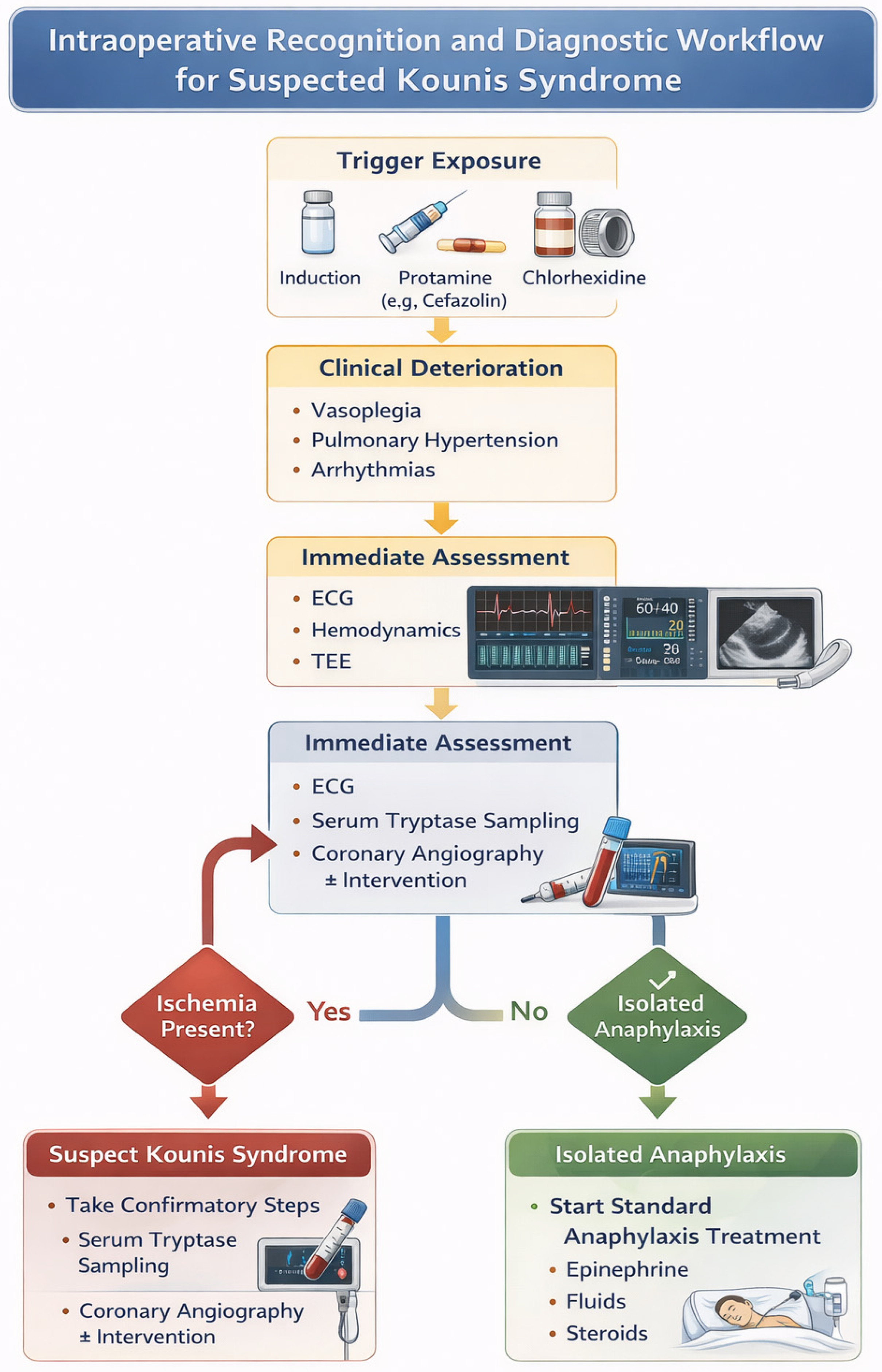
- CPB masks allergic signs; thus, electrocardiographic and echocardiographic monitoring is often the earliest diagnostic tool.
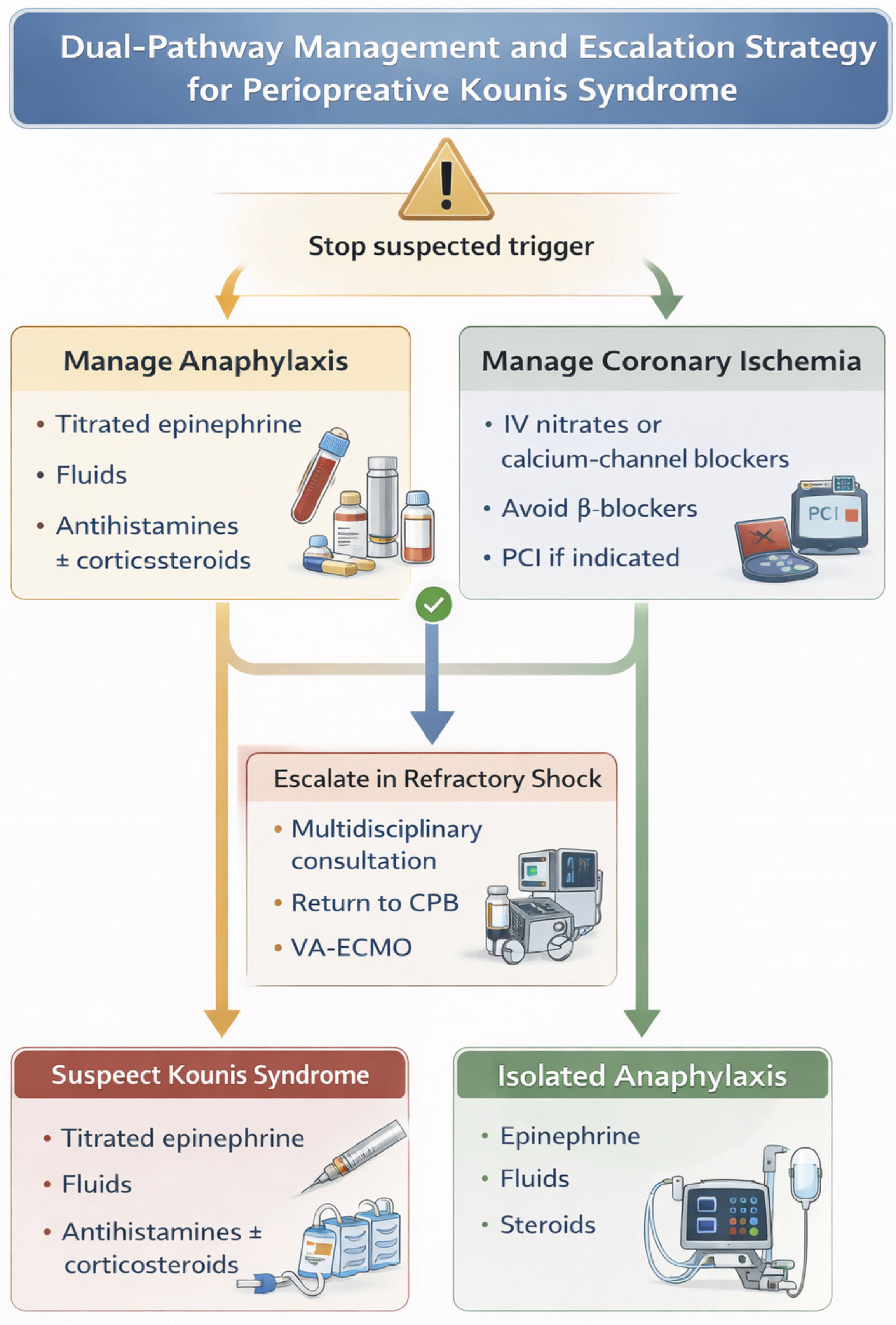
- Management requires a dual-pathway approach to anaphylaxis and ischemia.
- Early return to CPB or VA-ECMO is essential for refractory cases.
- Post-event allergy investigation is essential to prevent recurrence, especially
7. Conclusions
Author Contributions
Funding
Institutional Review Board Statement
Informed Consent Statement
Data Availability Statement
Conflicts of Interest
References
- Kounis, N.G.; Zavras, G.M. Histamine-induced coronary artery spasm: The concept of allergic angina. Br. J. Clin. Pract. 1991, 45, 121–128. [Google Scholar] [CrossRef]
- Mckinlay, C.A. Allergic carditis, pericarditis and pleurisy; report of a case of serum sickness with predominant cardiac manifestations and symptomatic recovery; preliminary report. J. Lancet 1948, 68, 61–65. [Google Scholar]
- Neild, G.H.; Ivory, K.; Williams, D.G. Severe systemic vascular necrosis in cyclosporin-treated rabbits with acute serum sickness. Br. J. Exp. Pathol. 1984, 65, 731–743. [Google Scholar]
- Neustadt, D.H. Transient electrocardiographic changes simulating an acute myocarditis in serum sickness. Ann. Intern. Med. 1953, 39, 126–131. [Google Scholar] [CrossRef] [PubMed]
- Chatzigrigoriadis, C.; Koufopoulos, E.; Avramidis, P.; Erginousakis, I.; Karakoida, V.; Papadopoulos, T.; Sperdouli, D.; Tachliabouri, M.-E.; Vilanakis, K.; Zampounidis, D.; et al. Serum Sickness-Like Reaction: A Narrative Review of Epidemiology, Immunopathogenesis, Diagnostic Challenges, and Therapeutic Approaches. Clin. Pract. 2025, 15, 178. [Google Scholar] [CrossRef] [PubMed]
- Kounis, N.G.; Stefanidis, A.; Hung, M.-Y.; Özkan, U.; de Gregorio, C.; Ceasovschih, A.; Mplani, V.; Gogos, C.; Assimakopoulos, S.F.; Chatzigrigoriadis, C.; et al. From Acute Carditis, Rheumatic Carditis, and Morphologic Cardiac Reactions to Allergic Angina, Allergic Myocardial Infarction, and Kounis Syndrome: A Multidisciplinary and Multisystem Disease. J. Cardiovasc. Dev. Dis. 2025, 12, 325. [Google Scholar] [CrossRef] [PubMed]
- Kounis, N.G.; Koniari, I.; Plotas, P.; Argyriou, A.; Soufras, G.D.; Tsigkas, G.; Davlouros, P.; Hahalis, G. Bee sting-induced acute ischemic stroke: A new manifestation of kounis syndrome? Ann. Indian Acad. Neurol. 2021, 24, 118–120. [Google Scholar] [CrossRef]
- Desai, R.; Parekh, T.; Patel, U.; Fong, H.K.; Samani, S.; Patel, C.; Savani, S.; Doshi, R.; Kumar, G.; Sachdeva, R. Epidemiology of acute coronary syndrome co-existent with allergic/hypersensitivity/anaphylactic reactions (Kounis syndrome) in the United States: A nationwide inpatient analysis. Int. J. Cardiol. 2019, 292, 35–38. [Google Scholar] [CrossRef]
- Mirijello, A.; Pepe, G.; Zampiello, P.; Manfrini, A. Ischemic Stroke After Wasp Sting: Another Manifestation of Kounis Syndrome? J. Emerg. Med. 2017, 52, e215. [Google Scholar] [CrossRef]
- Kounis, N.G.; Koniari, I.; Velissaris, D.; Tzanis, G.; Hahalis, G. Kounis syndrome-not a single-organ arterial disorder but a multisystem and multidisciplinary disease. Balk. Med. J. 2019, 36, 212–221. [Google Scholar] [CrossRef]
- Kouni, N.G.; Koniari, I.; Tsigkas, G.; Davlouros, P. Rectosigmoid ischemia and cerebral coma following gadolinium-induced anaphylaxis: A new manifestation of Kounis syndrome presented as devastating complication. Ann. Ital. Chir. 2020, 91, 442–444. [Google Scholar]
- Klug, G.; Zwick, R.H.; Mayr, A.; Schocke, M.F.; Steinboeck, P.; Jaschke, W.; Pachinger, O.; Metzler, B. Correlation of cardiovascular risk scores with myocardial high-energy phosphate metabolism. Int. J. Cardiol. 2011, 150, 208–210. [Google Scholar] [CrossRef]
- González-De-Olano, D.; Álvarez-Twose, I.; Matito, A.; Sánchez-Muñoz, L.; Kounis, N.; Escribano, L. Mast cell activation disorders presenting with cerebral vasospasm-related symptoms: A “Kounis-like” syndrome? Int. J. Cardiol. 2011, 150, 210–211. [Google Scholar] [CrossRef]
- Dazy, K.; Walters, D.; Holland, C.; Baldwin, J. Anaphylaxis mediated myocardial infarction in a coronary graft: A new variant of Kounis syndrome (a case report). Int. J. Cardiol. 2013, 168, e84–e85. [Google Scholar] [CrossRef]
- Kounis, N.G.; Cervellin, G.; Koniari, I.; Bonfanti, L.; Dousdampanis, P.; Charokopos, N.; Assimakopoulos, S.F.; Kakkos, S.K.; Ntouvas, I.G.; Soufras, G.D.; et al. Anaphylactic cardiovascular collapse and Kounis syndrome: Systemic vasodilation or coronary vasoconstriction? Ann. Transl. Med. 2018, 6, 332. [Google Scholar] [CrossRef]
- Brancaccio, R.; Bonzano, L.; Cocconcelli, A.; Boyko, R.; Ienopoli, G.; Motolese, A. Recurrent Kounis Syndrome: A Case Report and Literature Review. J. Clin. Med. 2024, 13, 1647. [Google Scholar] [CrossRef] [PubMed]
- Kounis, N.G. Kounis syndrome: An update on epidemiology, pathogenesis, diagnosis and therapeutic management. Clin. Chem. Lab. Med. (CCLM) 2016, 54, 1545–1559. [Google Scholar] [CrossRef] [PubMed]
- Constantinides, P. Infiltrates of Activated Mast Cells at the Site of Coronary Atheromatous Erosion or Rupture in Myocardial Infarction. Circulation 1995, 92, 1083. [Google Scholar] [CrossRef]
- Constantinides, P.; Harkey, M. Electron Microscopic Exploration of Human Endothelium in Step-Serial Sections of Early and Advanced Atherosclerotic Lesions. Ann. N. Y. Acad. Sci. 1990, 598, 113–124. [Google Scholar] [CrossRef]
- Braunwald, E. Unstable Angina. Circulation 1998, 98, 2219–2222. [Google Scholar] [CrossRef] [PubMed]
- Theoharides, T.C. Mast Cells and Stress—A Psychoneuroimmunological Perspective. J. Clin. Psychopharmacol. 2002, 22, 103–108. [Google Scholar] [CrossRef][Green Version]
- Kounis, N.G. Kounis syndrome (allergic angina and allergic myocardial infarction): A natural paradigm? Int. J. Cardiol. 2006, 110, 7–14. [Google Scholar] [CrossRef] [PubMed]
- Kounis, N.G.; Kounis, G.N.; Kouni, S.N.; Soufras, G.D.; Niarchos, C.; Mazarakis, A. Allergic Reactions Following Implantation of Drug-Eluting Stents: A Manifestation of Kounis Syndrome? J. Am. Coll. Cardiol. 2006, 48, 592–593. [Google Scholar] [CrossRef][Green Version]
- Cahuapaza-Gutierrez, N.L.; Calderon-Hernandez, C.C.; Chambergo-Michilot, D.; De Arruda-Chaves, E.; Zamora, A.; Runzer-Colmenares, F.M. Clinical characteristics, management, diagnostic findings, and various etiologies of patients with Kounis syndrome. A systematic review. Int. J. Cardiol. 2025, 418, 132606. [Google Scholar] [CrossRef]
- Ollo-Morales, P.; Gutierrez-Niso, M.; De-La-Viuda-Camino, E.; Ruiz-De-Galarreta-Beristain, M.; Osaba-Ruiz-De-Alegria, I.; Martel-Martin, C. Drug-Induced Kounis Syndrome: Latest Novelties. Curr. Treat. Options Allergy 2023, 10, 301–318. [Google Scholar] [CrossRef]
- Niccoli, G.; Montone, R.A.; Sabato, V.; Crea, F. Role of Allergic Inflammatory Cells in Coronary Artery Disease. Circulation 2018, 138, 1736–1748. [Google Scholar] [CrossRef]
- Tkaczyk, C.; Okayama, Y.; Woolhiser, M.R.; Hagaman, D.D.; Gilfillan, A.M.; Metcalfe, D.D. Activation of human mast cells through the high affinity IgG receptor. Mol. Immunol. 2002, 38, 1289–1293. [Google Scholar] [CrossRef] [PubMed]
- Benchea, L.-C.; Anghel, L.; Scripcariu, D.V.; Diaconu, A.; Zanfirescu, R.-L.; Lucaci, L.-V.; Bîrgoan, S.-G.; Sascău, R.A.; Stătescu, C.; Radu, R. Kounis Syndrome in Clinical Practice: Insights from Clinical Case Series and Mechanistic Pathways. J. Clin. Med. 2025, 14, 768. [Google Scholar] [CrossRef]
- Abdelghany, M.; Subedi, R.; Shah, S.; Kozman, H. Kounis syndrome: A review article on epidemiology, diagnostic findings, management and complications of allergic acute coronary syndrome. Int. J. Cardiol. 2017, 232, 1–4. [Google Scholar] [CrossRef] [PubMed]
- Li, J.; Zheng, J.; Zhou, Y.; Liu, X.; Peng, W. Acute coronary syndrome secondary to allergic coronary vasospasm (Kounis Syndrome): A case series, follow-up and literature review. BMC Cardiovasc. Disord. 2018, 18, 42. [Google Scholar] [CrossRef]
- Alevizos, M.; Karagkouni, A.; Panagiotidou, S.; Vasiadi, M.; Theoharides, T.C. Stress triggers coronary mast cells leading to cardiac events. Ann. Allergy Asthma Immunol. 2014, 112, 309–316. [Google Scholar] [CrossRef]
- Littlejohns, A.; Savic, L. Management and treatment of perioperative hypersensitivity. Curr. Opin. Allergy Clin. Immunol. 2024, 24, 210–217. [Google Scholar] [CrossRef]
- Laguna, J.; Archilla, J.; Doña, I.; Corominas, M.; Gastaminza, G.; Mayorga, C.; Berjes-Gimeno, P.; Tornero, P.; Martin, S.; Planas, A.; et al. Practical Guidelines for Perioperative Hypersensitivity Reactions. J. Investig. Allergol. Clin. Immunol. 2018, 28, 216–232. [Google Scholar] [CrossRef] [PubMed]
- Tran, R.; Pedersen, K.; Kolawole, H.; Roessler, P.; Scolaro, R. Australian and New Zealand Anaesthetic Allergy Group/Australian and New Zealand College of Anaesthetists perioperative anaphylaxis management guideline 2022. Anaesth. Intensive Care 2024, 52, 147–158. [Google Scholar] [CrossRef] [PubMed]
- Patil, S.S.; Sun, L.; Fox, C.J.; Anthony, K.E.; Anzalone, F.A.; Fisher, P.M.; Girma, B.; Huang, G.J.; Barsley, E.L.; Cornett, E.M.; et al. Multiple drug allergies: Recommendations for perioperative management. Best Pract. Res. Clin. Anaesthesiol. 2020, 34, 325–344. [Google Scholar] [CrossRef]
- Ramsey, A. Penicillin Allergy and Perioperative Anaphylaxis. Front. Allergy 2022, 3, 903161. [Google Scholar] [CrossRef]
- Ma, M.; Duncan, D.; Bartoszko, J. Perioperative anaphylaxis: An update on pathophysiology, diagnosis, and management. Can. J. Anesth./J. Can. D’anesthésie 2025, 72, 649–674. [Google Scholar] [CrossRef]
- Manian, D.V.; Volcheck, G.W. Perioperative Anaphylaxis: Evaluation and Management. Clin. Rev. Allergy Immunol. 2022, 62, 383–399. [Google Scholar] [CrossRef]
- Tacquard, C.; Serrier, J.; Viville, S.; Chiriac, A.-M.; Franchina, S.; Gouel-Cheron, A.; Giraudon, A.; Le Guen, M.; Le Quang, D.; Malinovsky, J.-M.; et al. Epidemiology of perioperative anaphylaxis in France in 2017–2018, the 11th GERAP survey. Br. J. Anaesth. 2024, 132, 1230–1237. [Google Scholar] [CrossRef] [PubMed]
- Dai, B.; Cavaye, J.; Judd, M.; Beuth, J.; Iswariah, H.; Gurunathan, U. Perioperative Presentations of Kounis Syndrome: A Systematic Literature Review. J. Cardiothorac. Vasc. Anesth. 2022, 36, 2070–2076. [Google Scholar] [CrossRef]
- Merino García, M.; Ruiz, M.C.; Marcos-Vidal, J.; de Castro, R.G.; Contreras, S.M.; García, D.F. Anaphylactic shock versus Kounis syndrome in cardiac surgery: Differential diagnosis. Rev. Española Anestesiol. Reanim. (Engl. Ed.) 2019, 66, 53–56. [Google Scholar] [CrossRef] [PubMed]
- Kumaran, T.; Damodaran, S.; Singh, A.P.; Kanchi, M. Intraoperative Cardiac Arrest due to Allergic Acute Coronary Syndrome (Kounis syndrome) Triggered by Cephalosporin. Ann. Card. Anaesth. 2023, 26, 219–222. [Google Scholar] [CrossRef] [PubMed]
- Parent, B.; Wearden, P.; Kounis, N.G.; Chrysostomou, C. Kounis syndrome or allergic coronary vasospasm in a two-year-old. Congenit. Heart Dis. 2011, 6, 499–503. [Google Scholar] [CrossRef]
- Cheung, M.; Seres, T.; Cleveland, J.; Kounis, N. Kounis syndrome, a coronary hypersensitivity disorder: A rare case of amiodarone-induced coronary vasospasm and simultaneous peripheral vasodilation intraoperatively. Int. J. Cardiol. 2016, 218, 267–268. [Google Scholar] [CrossRef]
- Zhou, E.; Parikh, P.S.; Kanchuger, M.S.; Balsam, L.B. Intraoperative Anaphylaxis to Chlorhexidine During LVAD and Transplant Surgery. J. Cardiothorac. Vasc. Anesth. 2019, 33, 169–172. [Google Scholar] [CrossRef]
- Stephens, R.; Mythen, M.; Kallis, P.; Davies, D.; Egner, W.; Rickards, A. Two episodes of life-threatening anaphylaxis in the same patient to a chlorhexidine±sulphadiazine-coated central venous catheter. Br. J. Anaesth. 2001, 87, 306–308. [Google Scholar] [CrossRef]
- Jaroenpuntaruk, V.; Volcheck, G.W. Perioperative anaphylaxis manifesting as cardiac arrest during cardiac surgery. Allergy Asthma Proc. 2025, 46, 70–75. [Google Scholar] [CrossRef]
- Macharadze, T.; Davies, A.; Fedor, I. A Well-Trained Team During Anaphylactic Shock After Rocuronium in a Patient with Aortic Stenosis: A Case Report. Front. Med. 2020, 6, 305. [Google Scholar] [CrossRef]
- Ripoll, J.G.; Ritter, M.J.; Comfere, T.B.; Smith, M.M.; Schaff, H.V.; Gilkey, G.D.; Warner, M.A. Undiagnosed Systemic Mastocytosis Presenting as Postoperative Distributive Shock: A Case Report. A A Pract. 2019, 13, 392–395. [Google Scholar] [CrossRef] [PubMed]
- Komericki, P.; Grims, R.H.; Aberer, W.; Kränke, B. Near-fatal anaphylaxis caused by human serum albumin in fibrinogen and erythrocyte concentrates. Anaesthesia 2014, 69, 176–178. [Google Scholar] [CrossRef]
- Molina-Molina, G.; González, C.; Viñas-Giménez, L.; Sanz-Martínez, M.; Galván-Blasco, P.; Luengo, O.; Guilarte, M.; Sala-Cunill, A.; Cardona, V.; Labrador-Horrillo, M. Fatal anaphylactic shock induced by intravenous gelatin colloid: A postmortem allergological work-up. J. Investig. Allergol. Clin. Immunol. 2020, 30, 143–145. [Google Scholar] [CrossRef]
- Baird, P.A.; Cokis, C.J. A case series of anaphylaxis to chlorhexidine-impregnated central venous catheters in cardiac surgical patients. Anaesth. Intensive Care 2019, 47, 85–89. [Google Scholar] [CrossRef]
- Giacinto, O.; Satriano, U.; Nenna, A.; Spadaccio, C.; Lusini, M.; Mastroianni, C.; Nappi, F.; Chello, M. Inflammatory Response and Endothelial Dysfunction Following Cardiopulmonary Bypass: Pathophysiology and Pharmacological Targets. Recent Pat. Inflamm. Allergy Drug Discov. 2019, 13, 158–173. [Google Scholar] [CrossRef]
- Utley, J.R. Pathophysiology of Cardiopulmonary Bypass: Current Issues. J. Card. Surg. 1990, 5, 177–189. [Google Scholar] [CrossRef] [PubMed]
- Obata, A.; Saito-Sasaki, N.; Sugino, H.; Itamura, M.; Okada, E.; Sawada, Y. Cardiac Arrest Due to Kounis Syndrome Following Cephazolin Administration During Surgery Under Local Anesthesia. Cureus 2023, 15, e46297. [Google Scholar] [CrossRef] [PubMed]
- Sato, M.; Arai, T. A case of Kounis syndrome presenting as coronary artery spasm associated with cefazolin-induced anaphylaxis during general anesthesia. JA Clin. Rep. 2019, 5, 49. [Google Scholar] [CrossRef] [PubMed]
- de Gregorio, C.; Granata, L.; Raspanti, D.; Giannino, F.; Cimino, C.; Koniari, I.; Andò, G.; Kounis, N.G. Cephalosporin triggered Kounis syndrome: Pathophysiological and clinical insights. Int. J. Cardiol. 2025, 431, 133249. [Google Scholar] [CrossRef]
- Levy, J.H.; Adkinson, N.F. Anaphylaxis During Cardiac Surgery: Implications for Clinicians. Anesth. Analg. 2008, 106, 392–403. [Google Scholar] [CrossRef]
- Gonzalez-Estrada, A.; Pien, L.C.; Zell, K.; Wang, X.-F.; Lang, D.M. Antibiotics Are an Important Identifiable Cause of Perioperative Anaphylaxis in the United States. J. Allergy Clin. Immunol. Pract. 2015, 3, 101–105.e1. [Google Scholar] [CrossRef]
- Kuhlen, J.L.; Camargo, C.A.; Balekian, D.S.; Blumenthal, K.G.; Guyer, A.; Morris, T.; Long, A.; Banerji, A. Antibiotics Are the Most Commonly Identified Cause of Perioperative Hypersensitivity Reactions. J. Allergy Clin. Immunol. Pract. 2016, 4, 697–704. [Google Scholar] [CrossRef]
- Harper, N.; Cook, T.; Garcez, T.; Farmer, L.; Floss, K.; Marinho, S.; Torevell, H.; Warner, A.; Ferguson, K.; Hitchman, J.; et al. Anaesthesia, surgery, and life-threatening allergic reactions: Epidemiology and clinical features of perioperative anaphylaxis in the 6th National Audit Project (NAP6). Br. J. Anaesth. 2018, 121, 159–171. [Google Scholar] [CrossRef] [PubMed]
- Sharp, G.; Green, S.; Rose, M. Chlorhexidine-induced anaphylaxis in surgical patients: A review of the literature. ANZ J. Surg. 2016, 86, 237–243. [Google Scholar] [CrossRef] [PubMed]
- Odedra, K.M.; Farooque, S. Chlorhexidine: An unrecognised cause of anaphylaxis. Postgrad. Med. J. 2014, 90, 709–714. [Google Scholar] [CrossRef] [PubMed]
- Srivastava, V.; Saravanan, P.; Abraham, J.; Au, J. Successful On-Pump Coronary Artery Bypass Without Using Protamine. Ann. Thorac. Surg. 2011, 91, 608–610. [Google Scholar] [CrossRef]
- Amano, Y.; Matsuura, A.; Tamura, T.; Kato, Y.; Kameyama, N.; Takazawa, T.; Nishiwaki, K. Life-threatening chlorhexidine anaphylaxis caused by skin preparation before chlorhexidine-free central venous catheter insertion: A case report and literature review. J. Anesth. 2023, 37, 474–481. [Google Scholar] [CrossRef]
- Amro, M.; Mansoor, K.; Amro, A.; Okoro, K.; Okhumale, P.I. Kounis Syndrome Induced by Protamine Sulfate. Cureus 2020, 12, e6972. [Google Scholar] [CrossRef]
- Freundlich, R.E.; Duggal, N.M.; Housey, M.; Tremper, T.T.; Engoren, M.C.; Kheterpal, S. Intraoperative medications associated with hemodynamically significant anaphylaxis. J. Clin. Anesth. 2016, 35, 415–423. [Google Scholar] [CrossRef] [PubMed]
- Roumeliotis, A.; Davlouros, P.; Anastasopoulou, M.; Tsigkas, G.; Koniari, I.; Mplani, V.; Hahalis, G.; Kounis, N.G. Allergy Associated Myocardial Infarction: A Comprehensive Report of Clinical Presentation, Diagnosis and Management of Kounis Syndrome. Vaccines 2021, 10, 38. [Google Scholar] [CrossRef]
- Kounis, N.G.; Giannopoulos, S.; Tsigkas, G.G.; Goudevenos, J. Eosinophilic responses to stent implantation and the risk of Kounis hypersensitivity associated coronary syndrome. Int. J. Cardiol. 2012, 156, 125–132. [Google Scholar] [CrossRef] [PubMed]
- Kounis, N.G.; Almpanis, G.; Mazarakis, A. Stent thrombosis and Kounis syndrome: Who is guilty? J. Cardiovasc. Med. 2011, 12, 71–72. [Google Scholar] [CrossRef]
- Kounis, N.G.; Hahalis, G.; Theoharides, T.C. Coronary Stents, Hypersensitivity Reactions, and the Kounis Syndrome. J. Interv. Cardiol. 2007, 20, 314–323. [Google Scholar] [CrossRef] [PubMed]
- Rajh, F.; Raja, R.; Rajah, F.; AlAli, A. Acute ST-Segment Elevation Myocardial Infarction Following Intramuscular Diclofenac: A Case of Kounis Syndrome. J. Emerg. Med. 2019, 57, e5–e8. [Google Scholar] [CrossRef]
- Kounis, N.G.; Koniari, I.; de Gregorio, C.; Velissaris, D.; Petalas, K.; Brinia, A.; Assimakopoulos, S.F.; Gogos, C.; Kouni, S.N.; Kounis, G.N.; et al. Allergic Reactions to Current Available COVID-19 Vaccinations: Pathophysiology, Causality, and Therapeutic Considerations. Vaccines 2021, 9, 221. [Google Scholar] [CrossRef] [PubMed]
- Fassio, F.; Almerigogna, F. Kounis syndrome (allergic acute coronary syndrome): Different views in allergologic and cardiologic literature. Intern. Emerg. Med. 2012, 7, 489–495. [Google Scholar] [CrossRef]
- Okur, A.; Kantarci, M.; Karaca, L.; Ogul, H.; Aköz, A.; Kızrak, Y.; Aslan, S.; Pirimoglu, B.; Aksakal, E.; Emet, M. The utility of cardiac magnetic resonance imaging in Kounis syndrome. Adv. Interv. Cardiol. 2015, 3, 218–223. [Google Scholar] [CrossRef]
- Paparella, D. Cardiopulmonary bypass induced inflammation: Pathophysiology and treatment. An update. Eur. J. Cardio-Thorac. Surg. 2002, 21, 232–244. [Google Scholar] [CrossRef]
- Kounis, N.G. Natural paradigm: Kounis hypersensitivity associated acute coronary syndrome. Achaiki Iatriki 2016, 35, 16–21. [Google Scholar]
- Kounis, N.G.; Koniari, I.; Mplani, V.A. Natural Paradigm to Prevent Heart Attacks and Thrombosis: The Kounis Syndrome. Achaiki Iatriki 2024, 44, 18–20. [Google Scholar]
- Peroni, D.; Sansotta, N.; Bernardini, R.; Cardinale, F.; Paravati, F.; Franceschini, F.; Boner, A. Perioperative Allergy: Clinical Manifestations. Int. J. Immunopathol. Pharmacol. 2011, 24, 69–74. [Google Scholar] [CrossRef] [PubMed]
- Savic, L.C.; Kaura, V.; Yusaf, M.; Hammond-Jones, A.-M.; Jackson, R.; Howell, S.; Savic, S.; Hopkins, P.M.; Anaesthetic Audit and Research Matrix of Yorkshire. Incidence of suspected perioperative anaphylaxis: A multicenter snapshot study. J. Allergy Clin. Immunol. Pract. 2015, 3, 454–455.e1. [Google Scholar] [CrossRef]
- Rico Cepeda, P.; Palencia Herrejón, E.; Rodríguez Aguirregabiria, M.M. Síndrome de Kounis. Med. Intensiv. 2012, 36, 358–364. [Google Scholar] [CrossRef]
- Zhang, P.; Liu, X.; Li, W.; Gong, R.; Zuo, J.; Sun, R.; Zhao, J.; Mandell, M.S. Epidemiology of suspected life-threatening perioperative anaphylaxis: A cross-sectional multicentre study in China. Br. J. Anaesth. 2022, 128, 45–54. [Google Scholar] [CrossRef]
- Zecic, F.; Smart, M.H.; Abbey, T.C.; Pazhempallil, A.; Korban, C. Sugammadex-induced anaphylactic reaction: A systematic review. J. Anaesthesiol. Clin. Pharmacol. 2022, 38, 360–370. [Google Scholar] [CrossRef] [PubMed]
- Reddy, J.I.; Cooke, P.J.; van Schalkwyk, J.M.; Hannam, J.A.; Fitzharris, P.; Mitchell, S.J. Anaphylaxis Is More Common with Rocuronium and Succinylcholine than with Atracurium. Anesthesiology 2015, 122, 39–45. [Google Scholar] [CrossRef] [PubMed]
- Youssef, M.R.; Martinez, E.; Pinnock, T.M.; Gonzalez-Estrada, A.; Smith, M.M.; Smith, B.B. Assessment of Perioperative Protamine Reactions in Patients With Fish Allergies: A Retrospective Observational Study. J. Cardiothorac. Vasc. Anesth. 2024, 38, 2925–2931. [Google Scholar] [CrossRef]
- Horiuchi, T.; Takazawa, T.; Orihara, M.; Sakamoto, S.; Nagumo, K.; Saito, S. Drug-induced anaphylaxis during general anesthesia in 14 tertiary hospitals in Japan: A retrospective, multicenter, observational study. J. Anesth. 2021, 35, 154–160. [Google Scholar] [CrossRef]
- Laxenaire, M.C. Épidémiologie des réactions anaphylactoïdes peranesthésiques. Quatrième enquête multicentrique (juillet 1994–décembre 1996). Ann. Fr. D’anesthesie Reanim. 1999, 18, 796–809. [Google Scholar] [CrossRef]
- Escolano, F.; Valero, A.; Huguet, J.; Baxarias, P.; De Molina, M.; Castro, A.; Granel, C.; Sanosa, J.; Bartolomé, B.; Grupo de estudio de anafilaxia perioperatoria en Cataluña. [Prospective epidemiologic study of perioperative anaphylactoid reactions occurring in Catalonia (1996-7)]. Rev. Esp. Anestesiol. Reanim. 2002, 49, 286–293. [Google Scholar] [PubMed]
- Crimmins, D.; Crilly, H.; van Nieuwenhuysen, C.; Ziser, K.; Zahir, S.; Todd, G.; Ryan, L.; Heyworth-Smith, D.; Balkin, L.; Harrocks, A.; et al. Sugammadex hypersensitivity: A multicentre retrospective analysis of a large Australian cohort. Br. J. Anaesth. 2025, 134, 72–79. [Google Scholar] [CrossRef]
- Rensing, A.; Whittam, B.; Chan, K.; Cain, M.; Carroll, A.; Bennett, W. Is surgical antibiotic prophylaxis necessary for pediatric orchiopexy? J. Pediatr. Urol. 2018, 14, 261.e1–261.e7. [Google Scholar] [CrossRef]
- Patel, T.K.; Patel, P.B.; Barvaliya, M.J.; Tripathi, C. Drug-induced anaphylactic reactions in Indian population: A systematic review. Indian J. Crit. Care Med. 2014, 18, 796–806. [Google Scholar] [CrossRef]
- Moreau, A.; Chérifa, M.; Roland, E.; Mc Gee, K.; Plaud, B.; Gouel-Cheron, A.; Blet, A. Exploring the Landscape of Perioperative Immediate Hypersensitivity: A Comprehensive 6-Year Monocentric Observational Analysis on Epidemiology and Risk Factors. Int. Arch. Allergy Immunol. 2024, 186, 551–555. [Google Scholar] [CrossRef]
- Morales, F.S.; Pelletier, F.; Aubin, F.; Castelain, F.; Aubin Sr, F. Chlorhexidine-Induced Contact Anaphylaxis. Cureus 2025, 17, e88598. [Google Scholar] [CrossRef]
- de Oliveira, L.R.R.; de Abreu, A.F.T.; de Oliveira, E.R.; Ireno, M.S.d.M.; Aarestrup, F.M.; Aarestrup, M.F.; Aarestrup, P.F. Perioperative Anaphylaxis to Chlorhexidine during Surgery and Septoplasty. Case Rep. Otolaryngol. 2017, 2017, 9605804. [Google Scholar] [CrossRef] [PubMed]
- Toomey, M. Preoperative chlorhexidine anaphylaxis in a patient scheduled for coronary artery bypass graft: A case report. AANA J. 2013, 81, 209–214. [Google Scholar] [PubMed]
- Kalangara, J.; Vanijcharoenkarn, K.; Lynde, G.C.; McIntosh, N.; Kuruvilla, M. Approach to Perioperative Anaphylaxis in 2020, Updates in Diagnosis and Management. Curr. Allergy Asthma Rep. 2021, 21, 4. [Google Scholar] [CrossRef] [PubMed]
- Regateiro, F.S.; Marques, M.L.; Gomes, E.R. Drug-Induced Anaphylaxis: An Update on Epidemiology and Risk Factors. Int. Arch. Allergy Immunol. 2020, 181, 481–487. [Google Scholar] [CrossRef]
- Khan, D.A.; Banerji, A.; Bernstein, J.A.; Bilgicer, B.; Blumenthal, K.; Castells, M.; Ein, D.; Lang, D.M.; Phillips, E. Cephalosporin Allergy: Current Understanding and Future Challenges. J. Allergy Clin. Immunol. Pract. 2019, 7, 2105–2114. [Google Scholar] [CrossRef]
- Misbah, S.A.; Krishna, M.T. Peri-Operative Anaphylaxis—An Investigational Challenge. Front. Immunol. 2019, 10, 1117. [Google Scholar] [CrossRef]
- Takazawa, T.; Horiuchi, T.; Nagumo, K.; Sugiyama, Y.; Akune, T.; Amano, Y.; Fukuda, M.; Haraguchi, T.; Ishibashi, C.; Kanemaru, E.; et al. The Japanese Epidemiologic Study for Perioperative Anaphylaxis, a prospective nationwide study: Allergen exposure, epidemiology, and diagnosis of anaphylaxis during general anaesthesia. Br. J. Anaesth. 2023, 131, 159–169. [Google Scholar] [CrossRef]
- Lobera, T.; Audicana, M.T.; Pozo, M.D.; Blasco, A.; Fernández, E.; Cañada, P.; Gastaminza, G.; Martinez-Albelda, I.; González-Mahave, I.; Muñoz, D. Study of hypersensitivity reactions and anaphylaxis during anesthesia in Spain. J. Investig. Allergol. Clin. Immunol. 2008, 18, 350–356. [Google Scholar]
- Mota, I.; Gaspar, Â.; Morais-Almeida, M. Perioperative Anaphylaxis Including Kounis Syndrome due to Selective Cefazolin Allergy. Int. Arch. Allergy Immunol. 2018, 177, 269–273. [Google Scholar] [CrossRef] [PubMed]
- Pollart, S.M.; Warniment, C.; Mori, T. Latex allergy. Am. Fam. Physician 2009, 80, 1413–1418. [Google Scholar] [PubMed]
- Gold, M.; Swartz, J.S.; Braude, B.M.; Dolovich, J.; Shandling, B.; Gilmour, R.F. Intraoperative anaphylaxis: An association with latex sensitivity. J. Allergy Clin. Immunol. 1991, 87, 662–666. [Google Scholar] [CrossRef]
- Mertes, P.; Lambert, M.; Guéant-Rodriguez, R.; Aimone-Gastin, I.; Mouton-Faivre, C.; Moneret-Vautrin, D.; Guéant, J.; Malinovsky, J.; Demoly, P. Perioperative Anaphylaxis. Immunol. Allergy Clin. N. Am. 2009, 29, 429–451. [Google Scholar] [CrossRef]
- Levy, J.H. Antibody formation after drug administration during cardiac surgery: Parameters for aprotinin use. J. Heart Lung Transplant. 1993, 12, S26–S33. [Google Scholar]
- Gupta, S.K.; Veith, F.J.; Ascer, E.; Wengerter, K.R.; Franco, C.; Amar, D.; El-Gaweet, E.S.; Gupta, A. Anaphylactoid reactions to protamine: An often lethal complication in insulin-dependent diabetic patients undergoing vascular surgery. J. Vasc. Surg. 1989, 9, 342–350. [Google Scholar] [CrossRef]
- Garvey, L.H.; Ebo, D.G.; Mertes, P.; Dewachter, P.; Garcez, T.; Kopac, P.; Laguna, J.J.; Chiriac, A.M.; Terreehorst, I.; Voltolini, S.; et al. An EAACI position paper on the investigation of perioperative immediate hypersensitivity reactions. Allergy 2019, 74, 1872–1884. [Google Scholar] [CrossRef]
- Huang, W.; Li, X.; Xiang, Y.; Li, J.; Zhou, X.; Zheng, X.; Cheng, B.; Zhu, S. Risk factors and prevention for perioperative anaphylaxis: A nested case-control study. Int. J. Clin. Pharm. 2019, 41, 1442–1450. [Google Scholar] [CrossRef]
- Shenoy, E.S.; Macy, E.; Rowe, T.; Blumenthal, K.G. Evaluation and Management of Penicillin Allergy. JAMA 2019, 321, 188. [Google Scholar] [CrossRef] [PubMed]
- Minaldi, E.; Phillips, E.J.; Norton, A. Immediate and Delayed Hypersensitivity Reactions to Beta-Lactam Antibiotics. Clin. Rev. Allergy Immunol. 2021, 62, 449–462. [Google Scholar] [CrossRef]
- Ali, Y.; Gonzalez, A.; Pallan, J.; Bergbower, E.A.S. A Rare Case of Intraoperative Anaphylaxis Secondary to Central Venous Catheter Placement: A Case Report. Case Rep. Anesthesiol. 2025, 2025, 1310392. [Google Scholar] [CrossRef]
- Rochel-Perez, E.; Santaularia-Tomas, M.; Martin-Dorantes, M.; Villareal-Jimenez, E.; Olivera-Mar, A.; Sanchez-Felix, E.; Perez-Navarrete, A.; Millet-Herrera, J.L.; Huchim-Mendez, O.; Alejos-Briceño, R.; et al. Triggers, Types, and Treatments for Kounis Syndrome: A Systematic Review. Clin. Pract. 2025, 15, 59. [Google Scholar] [CrossRef] [PubMed]
- Kounis, N.G.; Koniari, I.; Chourdakis, E.; Tsigkas, G.; Soufras, G.; Roumeliotis, A.; Davlouros, P.; Hahalis, G. Intraoperative Anaphylaxis to Chlorhexidine During LVAD and Transplant Surgery. J. Cardiothorac. Vasc. Anesth. 2019, 33, 582–584. [Google Scholar] [CrossRef]
- Norawat, R.; Vohra, A.; Parkes, A.; O’kEeffe, N.J.; Anipindi, S.; Maybauer, M.O. Incidence and Outcome of Anaphylaxis in Cardiac Surgical Patients. Ann. Card. Anaesth. 2022, 25, 323–329. [Google Scholar] [CrossRef] [PubMed]
- Shamsher, S.; Suhaimi, N.H.I.; Ali, R.N.; Zulkifli, K. Combating chlorhexidine allergy in perioperative setting. Med. J. Malays. 2023, 78, 126–127. [Google Scholar]
- Ebo, D.G.; Van Gasse, A.L.; Decuyper, I.I.; Uyttebroek, A.; Sermeus, L.A.; Elst, J.; Bridts, C.H.; Mertens, C.M.; Faber, M.A.; Hagendorens, M.M.; et al. Acute Management, Diagnosis, and Follow-Up of Suspected Perioperative Hypersensitivity Reactions in Flanders 2001–2018. J. Allergy Clin. Immunol. Pract. 2019, 7, 2194–2204.e7. [Google Scholar] [CrossRef] [PubMed]
- Li, S.; Koerner, M.M.; El-Banayosy, A.; Soleimani, B.; Pae, W.E.; Leuenberger, U.A. Takotsubo’s syndrome after mitral valve repair and rescue with extracorporeal membrane oxygenation. Ann. Thorac. Surg. 2014, 97, 1777–1778. [Google Scholar] [CrossRef]
- Levy, J.H.; Ghadimi, K.; Kizhakkedathu, J.N.; Iba, T. What’s fishy about protamine? Clinical use, adverse reactions, and potential alternatives. J. Thromb. Haemost. 2023, 21, 1714–1723. [Google Scholar] [CrossRef]
- Boer, C.; Meesters, M.I.; Veerhoek, D.; Vonk, A.B.A. Anticoagulant and side-effects of protamine in cardiac surgery: A narrative review. Br. J. Anaesth. 2018, 120, 914–927. [Google Scholar] [CrossRef]
- Kimmel, S.E.; Sekeres, M.A.; Berlin, J.A.; Ellison, N.; DiSesa, V.J.; Strom, B.L. Risk factors for clinically important adverse events after protamine administration following cardiopulmonary bypass. J. Am. Coll. Cardiol. 1998, 32, 1916–1922. [Google Scholar] [CrossRef]
- Ackah, J.K.; Neal, L.; Marshall, N.R.; Panahi, P.; Lloyd, C.; Rogers, L.J. Antimicrobial prophylaxis in adult cardiac surgery in the United Kingdom and Republic of Ireland. J. Infect. Prev. 2021, 22, 83–90. [Google Scholar] [CrossRef] [PubMed]
- Jeppsson, A.; Rocca, B.; Hansson, E.C.; Gudbjartsson, T.; James, S.; Kaski, J.K.; Landmesser, U.; Landoni, G.; Magro, P.; Pan, E.; et al. 2024 EACTS Guidelines on perioperative medication in adult cardiac surgery. Eur. J. Cardio-Thorac. Surg. 2024, 67, ezae355. [Google Scholar] [CrossRef]
- Bratzler, D.W.; Houck, P.M. Surgical Infection Prevention Guidelines Writers Workgroup. Antimicrobial prophylaxis for surgery: An advisory statement from the National Surgical Infection Prevention Project. Clin. Infect. Dis. 2004, 38, 1706–1715. [Google Scholar] [CrossRef]
- Kwok, F.-Y.; Hui, M.-T.; Joseph, C.T.; Mohamad, A.H.B.; Bakhtiar, M.-F. Perioperative anaphylaxis in Malaysia: A nine-year retrospective study. Anaesth. Intensive Care 2025, 53, 171–180. [Google Scholar] [CrossRef]
- Cunningham, B.W.; Shah, S.; Biswas, S. Vancomycin Anaphylaxis and Kounis Syndrome Case Report. Cureus 2024, 16, e64740. [Google Scholar] [CrossRef] [PubMed]
- Leibee, C.; Getachew, B.; Ehmann, M.R. Vancomycin-induced Kounis Syndrome. Am. J. Emerg. Med. 2019, 37, 1806.e3–1806.e5. [Google Scholar] [CrossRef] [PubMed]
- Gagnon, L.R.; Huang, Y.; Kay, R.; Cujec, B. Kounis Syndrome: A Case of Vancomycin-Associated Coronary Artery Vasospasm Resulting in Myocardial Infarction. CJC Open 2022, 4, 337–339. [Google Scholar] [CrossRef]
- Gao, J.; Gao, Y.; Ma, J. Cefuroxime-associated Kounis syndrome with unique peculiarity in perioperative prophylaxis. J. Infect. Public Health 2018, 11, 889–892. [Google Scholar] [CrossRef] [PubMed]
- Almeida, J.; Ferreira, S.; Malheiro, J.; Fonseca, P.; Caeiro, D.; Dias, A.; Ribeiro, J.; Gama, V. Causa rara de síndrome coronária aguda: Síndrome de Kounis. Rev. Port. Cardiol. 2016, 35, 699.e1–699.e4. [Google Scholar] [CrossRef]
- Pouessel, G.; Tacquard, C.; Tanno, L.K.; Mertes, P.M.; Lezmi, G. Anaphylaxis mortality in the perioperative setting: Epidemiology, elicitors, risk factors and knowledge gaps. Clin. Exp. Allergy 2024, 54, 11–20. [Google Scholar] [CrossRef] [PubMed]
- Pitlick, M.M.; Volcheck, G.W. Perioperative Anaphylaxis. Immunol. Allergy Clin. N. Am. 2022, 42, 145–159. [Google Scholar] [CrossRef] [PubMed]
- Li, J.; Best, O.G.; Rose, M.A.; Green, S.L.; Fulton, R.B.; Capon, M.J.; Krupowicz, B.A.; Fernando, S.L. Assessing cross-reactivity to neuromuscular blocking agents by skin and basophil activation tests in patients with neuromuscular blocking agent anaphylaxis. Br. J. Anaesth. 2019, 123, e144–e150. [Google Scholar] [CrossRef]
- Sadleir, P.H.M.; Clarke, R.C.; Bunning, D.L.; Platt, P.R. Anaphylaxis to neuromuscular blocking drugs: Incidence and cross-reactivity in Western Australia from 2002 to 2011. Br. J. Anaesth. 2013, 110, 981–987. [Google Scholar] [CrossRef]
- Takazawa, T.; Mitsuhata, H.; Mertes, P.M. Sugammadex and rocuronium-induced anaphylaxis. J. Anesth. 2016, 30, 290–297. [Google Scholar] [CrossRef] [PubMed]
- Arslan, B.; Sahin, T.; Ozdogan, H. Sugammadex and anaphylaxis. J. Anaesthesiol. Clin. Pharmacol. 2021, 37, 153–159. [Google Scholar] [CrossRef]
- Molero Díez, Y.B.; Sanchis Dux, R.; Sánchez Tabernero, Á.; Fernández, A.d.D. Anaphylaxis to neuromuscular blocking agents: Cross-reactivity between rocuronium and cisatracurium. Can. J. Anesth./J. Can. D’anesthésie 2023, 70, 286–287. [Google Scholar] [CrossRef]
- Muraro, A.; Worm, M.; Alviani, C.; Cardona, V.; DunnGalvin, A.; Garvey, L.H.; Riggioni, C.; de Silva, D.; Angier, E.; Arasi, S.; et al. EAACI guidelines: Anaphylaxis (2021 update). Allergy 2022, 77, 357–377. [Google Scholar] [CrossRef]
- Cohen, D.E.; Scheman, A.; Stewart, L.; Taylor, J.; Pratt, M.; Trotter, K.; Prawer, S.; Warshaw, E.; Rietschel, R.; Watsky, K.; et al. American Academy of Dermatology’s position paper on latex allergy. J. Am. Acad. Dermatol. 1998, 39, 98–106. [Google Scholar] [CrossRef]
- AORN Latex Guideline. AORN J. 2004, 79, 653–672. [CrossRef]
- Golden, D.B.; Wang, J.; Waserman, S.; Akin, C.; Campbell, R.L.; Ellis, A.K.; Greenhawt, M.; Lang, D.M.; Ledford, D.K.; Lieberman, J.; et al. Anaphylaxis: A 2023 practice parameter update. Ann. Allergy Asthma Immunol. 2024, 132, 124–176. [Google Scholar] [CrossRef]
- Leynadier, F.; Pecquet, C.; Dry, J. Anaphylaxis to latex during surgery. Anaesthesia 1989, 44, 547–550. [Google Scholar] [CrossRef]
- Tacquard, C.; Iba, T.; Levy, J.H. Perioperative Anaphylaxis. Anesthesiology 2023, 138, 100–110. [Google Scholar] [CrossRef]
- Hartmann, M.; Bode, C.; Zirlik, A. Anaphylactic shock-associated cardiomyopathy. Int. J. Cardiol. 2008, 127, e136–e137. [Google Scholar] [CrossRef]
- Kounis, N.G.; Mazarakis, A.; Bardousis, C. Myocardial injury through serum troponin I and echocardiography in anaphylaxis: Takotsubo cardiomyopathy and the Kounis hypersensitivity–associated acute coronary syndrome. Am. J. Emerg. Med. 2016, 34, 650–651. [Google Scholar] [CrossRef]
- Cha, Y.S.; Bang, M.H.; Kim, O.H.; Kim, H.I.; Cha, K.; Lee, K.H.; Hwang, S.O. Evaluation of myocardial injury through serum troponin I and echocardiography in anaphylaxis. Am. J. Emerg. Med. 2016, 34, 140–144. [Google Scholar] [CrossRef]
- Bastante, T.; Rivero, F.; Cuesta, J.; Benedicto, A.; Restrepo, J.; Alfonso, F. Nonatherosclerotic Causes of Acute Coronary Syndrome: Recognition and Management. Curr. Cardiol. Rep. 2014, 16, 543. [Google Scholar] [CrossRef] [PubMed]
- Baretto, R.L.; Beck, S.; Heslegrave, J.; Melchior, C.; Mohamed, O.; Ekbote, A.; Huissoon, A.P.; Krishna, M.T. Validation of international consensus equation for acute serum total tryptase in mast cell activation: A perioperative perspective. Allergy 2017, 72, 2031–2034. [Google Scholar] [CrossRef] [PubMed]
- Polewczyk, A.; Nowosielecka, D.; Jacheć, W.; Kutarski, A. Safety and efficacy of cardiovascular procedures monitored by transesophageal echocardiography. Echocardiography 2024, 41, e15884. [Google Scholar] [CrossRef] [PubMed]
- Daniel, W.G.; Mügge, A. Transesophageal Echocardiography. N. Engl. J. Med. 1995, 332, 1268–1280. [Google Scholar] [CrossRef]
- Hahn, R.T.; Abraham, T.; Adams, M.S.; Bruce, C.J.; Glas, K.E.; Lang, R.M.; Reeves, S.T.; Shanewise, J.S.; Siu, S.C.; Stewart, W.; et al. Guidelines for Performing a Comprehensive Transesophageal Echocardiographic Examination: Recommendations from the American Society of Echocardiography and the Society of Cardiovascular Anesthesiologists. J. Am. Soc. Echocardiogr. 2013, 26, 921–964. [Google Scholar] [CrossRef]
- Wang, C.; Zhou, Y.; Fang, W.; Li, Z.; Zhao, S. Clinical features, diagnosis and management of amoxicillin-induced Kounis syndrome. Front. Pharmacol. 2022, 13, 998239. [Google Scholar] [CrossRef] [PubMed]
- Karaca, O.; Cakal, B.; Cakal, S.D.; Turkmen, M. Acute myocarditis or the kounis syndrome: Role of cardiac mri and speckle-tracking echocardiography in diagnosis. Res. Cardiovasc. Med. 2014, 3, 8. [Google Scholar] [CrossRef] [PubMed]
- Poggiali, E.; Benedetti, I.; Vertemati, V.; Rossi, L.; Monello, A.; Giovini, M.; Magnacavallo, A.; Vercelli, A. Kounis syndrome: From an unexpected case in the Emergency Room to a review of the literature. Acta Biomed. 2022, 93, e2022002. [Google Scholar] [CrossRef]
- Baillie, T.J.; Scherer, D.J.; Wong, D.T.; Steele, P.M. Kounis syndrome and hypersensitivity myocarditis—One and the same? Insights from cardiac magnetic resonance imaging. J. Cardiol. Cases 2015, 12, 119–122. [Google Scholar] [CrossRef]
- Akoz, A.; Bayramoglu, A.; Uzkeser, M.; Kantarci, M.; Aksakal, E.; Emet, M. Two questions for Kounis syndrome: Can we use magnetic resonance imaging in the diagnosis and does ST elevation correlates with troponin levels? Am. J. Emerg. Med. 2012, 30, 2086.e5–2086.e7. [Google Scholar] [CrossRef]
- Goto, K.; Kasama, S.; Sato, M.; Kurabayashi, M. Myocardial scintigraphic evidence of Kounis syndrome: What is the aetiology of acute coronary syndrome? Eur. Heart J. 2016, 37, 1157. [Google Scholar] [CrossRef]
- Rose, M.A.; Garcez, T.; Savic, S.; Garvey, L.H. Chlorhexidine allergy in the perioperative setting: A narrative review. Br. J. Anaesth. 2019, 123, e95–e103. [Google Scholar] [CrossRef] [PubMed]
- Garvey, L.H.; Dewachter, P.; Hepner, D.L.; Mertes, P.M.; Voltolini, S.; Clarke, R.; Cooke, P.; Garcez, T.; Guttormsen, A.B.; Ebo, D.G.; et al. Management of suspected immediate perioperative allergic reactions: An international overview and consensus recommendations. Br. J. Anaesth. 2019, 123, e50–e64. [Google Scholar] [CrossRef]
- Thygesen, K.; Alpert, J.S.; Jaffe, A.S.; Chaitman, B.R.; Bax, J.J.; Morrow, D.A.; White, H.D.; Executive Group on behalf of the Joint European Society of Cardiology (ESC)/American College of Cardiology (ACC)/American Heart Association (AHA)/World Heart Federation (WHF) Task Force for the Universal Definition of Myocardial Infarction. Fourth Universal Definition of Myocardial Infarction (2018). Circulation 2018, 138, e618–e651. [Google Scholar] [CrossRef]
- Vu, V.H.; Nguyen, K.D.; Nguyen, C.D.; Truong, B.Q. A Case of Kounis Syndrome Presenting as Coronary Artery Spasm Associated with Acetaminophen Infusion. Am. J. Case Rep. 2021, 22, e934190. [Google Scholar] [CrossRef]
- Wang, J.; Jiang, Z. Emergency management of ceftriaxone-induced Type II Kounis syndrome: A case report. Medicine 2025, 104, e42917. [Google Scholar] [CrossRef]
- Cevik, C.; Nugent, K.; Shome, G.P.; Kounis, N.G. Treatment of Kounis syndrome. Int. J. Cardiol. 2010, 143, 223–226. [Google Scholar] [CrossRef] [PubMed]
- Ballesteros, R.V.; Polo, J.C.G.; Olmos, C.; Vilacosta, I. Kounis and Takotsubo, Two Syndromes Bound by Adrenaline: The “ATAK” Complex. Case Rep. Cardiol. 2023, 2023, 7706104. [Google Scholar] [CrossRef]
- Pouessel, G.; Dribin, T.E.; Tacquard, C.; Tanno, L.K.; Cardona, V.; Worm, M.; Deschildre, A.; Muraro, A.; Garvey, L.H.; Turner, P.J. Management of Refractory Anaphylaxis: An Overview of Current Guidelines. Clin. Exp. Allergy 2024, 54, 470–488. [Google Scholar] [CrossRef] [PubMed]
- Amino, M.; Fukushima, T.; Uehata, A.; Nishikawa, C.; Morita, S.; Nakagawa, Y.; Murakami, T.; Yoshioka, K.; Ikari, Y. Should beta-blockers be continued as a treatment for myocardial infarction in the case of Kounis syndrome? Ann. Noninvasive Electrocardiol. 2021, 26, e12837. [Google Scholar] [CrossRef]
- Doğan, V.; Mert, G.Ö.; Biteker, F.S.; Mert, K.U.; Biteker, M. Treatment of Kounis syndrome. Int. J. Cardiol. 2015, 181, 133–134. [Google Scholar] [CrossRef]
- Calogiuri, G.; Savage, M.P.; Congedo, M.; Nettis, E.; Mirizzi, A.M.; Foti, C.; Vacca, A.; Kounis, N.G. Is Adrenaline Always the First Choice Therapy of Anaphylaxis? An Allergist-cardiologist Interdisciplinary Point of View. Curr. Pharm. Des. 2023, 29, 2545–2551. [Google Scholar] [CrossRef]
- Berrío Valencia, M.I. Perioperative anaphylaxis. Braz. J. Anesthesiol. (Engl. Ed.) 2015, 65, 292–297. [Google Scholar] [CrossRef][Green Version]
- Sánchez, V.O.; Roca, L.C.; Moreno, A.d.P. Intraoperative “Kounis syndrome” that improved electrocardiography changes and hemodynamic situation after administering nitroglycerine. Braz. J. Anesthesiol. (Engl. Ed.) 2014, 64, 281–285. [Google Scholar] [CrossRef] [PubMed][Green Version]
- Soriano, M.; Sionis, A.; Rodríguez, E.; Bonet, A.; Soto, L.; Tauron, M.; Belmar, D.; Arakama, S.; Mayol, J.; Rodríguez, L. Amiodarone triggered Kounis syndrome complicated by refractory cardiac arrest rescued with VA-ECMO. Clin. Case Rep. 2024, 12, e8712. [Google Scholar] [CrossRef]
- Yu, H.K.; Park, M.; Lee, S.H.; Woo, J.-W.; Kang, D.-H.; Byun, J.H.; Ok, S.-H. Early Use of ECMO for Refractory Kounis Syndrome Concealed by General Anesthesia—A Case Report. Medicina 2022, 58, 759. [Google Scholar] [CrossRef]
- Sharma, V.; Parkes, A.; Diacono, J.; Khan, S. Cardiac stress in a child with perioperative anaphylaxis. BMJ Case Rep. 2025, 18, e262614. [Google Scholar] [CrossRef]
- Kawano, T.; Tamura, T.; Hamaguchi, M.; Yatabe, T.; Yamashita, K.; Yokoyama, M. Successful management of rocuronium-induced anaphylactic reactions with sugammadex: A case report. J. Clin. Anesth. 2012, 24, 62–64. [Google Scholar] [CrossRef] [PubMed]
- Ghimire, A.; Olbrecht, V.A.; Tobias, J.D. Role of sugammadex in the treatment of anaphylaxis due to rocuronium in children: Extrapolation from adult and animal reports. Paediatr. Anaesth. 2022, 32, 706–715. [Google Scholar] [CrossRef]
- Panagiotopoulos, I.; Mulita, F.; Verras, G.I.; Bekou, E.; Mulita, A.; Dahm, M.; Grapatsas, K.; Sawafta, A.; Katinioti, A.; Liolis, E.; et al. Left main coronary artery disease: Percutaneous coronary intervention or coronary artery bypass grafting? A critical review of current knowledge and contemporary debates. Kardiochir. Torakochirurgia Pol. 2024, 21, 108–112. [Google Scholar] [CrossRef] [PubMed]
- Harper, N.; Cook, T.; Garcez, T.; Lucas, D.; Thomas, M.; Kemp, H.; Kong, K.-L.; Marinho, S.; Karanam, S.; Ferguson, K.; et al. Anaesthesia, surgery, and life-threatening allergic reactions: Management and outcomes in the 6th National Audit Project (NAP6). Br. J. Anaesth. 2018, 121, 172–188. [Google Scholar] [CrossRef]
- Guleri, A.; Kumar, A.; Morgan, R.J.; Hartley, M.; Roberts, D.H. Anaphylaxis to chlorhexidine-coated central venous catheters: A case series and review of the literature. Surg. Infect. 2012, 13, 171–174. [Google Scholar] [CrossRef]
- Li, X.; Ma, Q.; Yin, J.; Zheng, Y.; Chen, R.; Chen, Y.; Li, T.; Wang, Y.; Yang, K.; Zhang, H.; et al. A Clinical Practice Guideline for the Emergency Management of Anaphylaxis (2020). Front. Pharmacol. 2022, 13, 845689. [Google Scholar] [CrossRef]
- Hocagil, H.; Karakilic, E.; Hocagil, C.; Senlikci, H.; Büyükcam, F. Underdiagnosis of anaphylaxis in the emergency department: Misdiagnosed or miscoded? Hong Kong Med. J. 2013, 19, 429–433. [Google Scholar] [CrossRef] [PubMed][Green Version]



| Category | Definite Kounis Syndrome (n = 5) | Possible Kounis Syndrome (n = 10) |
|---|---|---|
| Diagnostic criteria | Anaphylaxis + documented myocardial ischemia | Anaphylaxis + severe cardiovascular involvement |
| Cardiac arrest | 2/5 | 7/10 |
| Cardiovascular collapse | - | 3/10 |
| Common triggers | Chlorhexidine, protamine, antibiotics | Chlorhexidine, protamine, anesthetic agents, colloids |
| ECG changes | Frequent (ST elevation/depression) | Hyperdynamic ventricles, dysfunction |
| Echocardiographic findings | RWMA, ventricular dysfunction | Hyperdynamic ventricles, dysfunction |
| Biomarker elevation | 3/5 | Limited data |
| Recurrence | Present in selected cases | Frequent with re-exposure |
| Treatment | Adrenaline, vasopressors, CPB/ECMO | Similar approach |
| Outcome | Mostly survival | Mostly survival, 1 fatal case |
| Clinical note | Clear ischemic component | Diagnostic uncertainty |
| Author, Year | Age (Years)/Sex (M/F) | Type of Surgery | Trigger | Onset | Clinical Presentation and Diagnosis | Treatment | Outcome and Follow-Up |
|---|---|---|---|---|---|---|---|
| A. Cases described as perioperative KS in cardiac surgery | |||||||
| Kumaran, et al., 2023 [42] | 56/M | Elective CABG | Cefuroxime | Intraoperative | Tachycardia, hypotension, lack of rash, decreased EtCO2, increased PIP, increased tryptase/eosinophils, ST elevation (ECG), cardiac arrest (V-fib) | 100% oxygen, crystalloids, Trendelenburg position, diphenhydramine, hydrocortisone, inhaled β2 agonist, CPR, CPB, adrenaline, dobutamine, noradrenaline | Survival Successful completion of surgery with improved cardiac function n/a |
| García, et al., 2018 [41] | 69/M | Elective MVR | Amiodarone | Intraoperative | Hypoxemia, hypotension, lack of rash, decreased EtCO2, increased PIP, increased tryptase/CK-MB/troponin, ST elevation (EGC), biventricular dysfunction (TEE) Positive prick test for amiodarone | Crystalloids, phenylephrine, adrenaline, salbutamol, CPB, noradrenaline, hydrocortisone, methylprednisolone, FFP, pRBCs, dobutamine, furosemide | Survival Successful completion of surgery Normal echocardiogram (after 7 days) |
| Parent, et al., 2011 [43] | 2/M | Elective repair of ASD | n/a | Intraoperative and postoperative (POD 0) | Intermittent periods of diffuse ST elevation consistent with incipient ischemia (intraoperative) Hypoxemia, bradycardia, hypotension, lack of rash, cardiac arrest, anuria, compartment syndrome, watershed stroke, seizures, ARDS, increased troponin/tryptase/IgE, ST elevation (ECG), biventricular dysfunction (echo), narrowed coronary vessels (angiography), normal cardiac biopsy consistent with Kounis syndrome (POD 0) | Intubation, mechanical ventilation, inotropes, CPR, ECMO, nitroglycerin, BiVAD, hemodialysis, fasciotomy, famotidine, cromolyn | Survival Successful completion of surgery with improved cardiac function. Urgent implantation of BiVAD, which was later removed. Normal echocardiogram (after 12 months) |
| Li, et al., 2014 [118] | 37/F | Elective MVR | Protamine | Intraoperative | Hypotension, lack of rash, elevated CVP, decreased cardiac index, increased troponin, ST elevation (ECG), lack of complications in the surgical field, ballooning of the LV apex (TTE), normal angiography | Adrenaline, diphenhydramine, vasopressin, desmopressin, levothyroxine, hydrocortisone, methylene blue, noradrenaline, phenylephrine, ECMO | Survival Successful completion of surgery with improved cardiac function. Emergent sternal reopening for exclusion of cardiac tamponade. Normal ECG and TTE |
| Cheung, et al., 2016 [44] | 79/F | Elective MVR | Amiodarone | Intraoperative | Hypotension, lack of rash, inferolateral wall hypokinesis (TEE), vasoconstriction of the distal coronary branches (angiography) | Phenylephrine, vasopressin, calcium chloride, adrenaline | Survival Successful completion of surgery |
| Β. Additional possible cases of perioperative Kounis syndrome in cardiac surgery (anaphylaxis and cardiac arrest) | |||||||
| Zhou, et al., 2019 (commented by Kounis et al., 2019) [45,114] | 59/M | Elective orthotopic heart (2nd operation) transplantation 13 months following elective implantation of LVAD (1st operation) | Chlorhexidine | Intraoperative and postoperative | Pruritic irritation due to skin application, probably in the context of sensitization (preoperative night) Hypotension, tachycardia, wheezing, urticaria, angioedema, normal tryptase in the context of anaphylaxis (1st operation and postoperative) Shock, erythema, and cardiac arrest, probably in the context of Kounis syndrome (2nd operation) Positive prick testing for chlorhexidine and ceftriaxone (6 weeks after LVAD implantation) | Adrenaline, diphenhydramine, and hydrocortisone (1st operation). CPR, adrenaline, noradrenaline, vasopressin (2nd operation). | Survival Successful completion of LVAD implantation Unsuccessful completion of heart transplantation after 13 months, but it was completed successfully 5 months later |
| Stephens, et al., 2001 [46] | 50/M | Elective CABG 3 weeks after previous CABG | Chlorhexidine | Intraoperative | Possible history of dermatitis to chlorhexidine Hypotension, erythema, angioedema, increased tryptase/CRP, normal complement (1st operation) Rash, angioedema, hypotension, increased tryptase, ST depression/A-fib/V-fib (ECG), PEA, increased tryptase, normal CK/CK-MB (2nd operation) Positive skin testing for chlorhexidine 4% and 0.4% (after the first operation) Positive skin testing for chlorhexidine 4%, 0.4%, and 0.04% (after the second operation) | CPR, 100% O2, phenylephrine, adrenaline, crystalloids, calcium, chlorpheniramine, hydrocortisone, ranitidine (1st operation) Ineffective premedication with corticosteroids and antihistamines. CPR, phenylephrine, adrenaline, noradrenaline, crystalloids, calcium, lignocaine, aprotinin, chlorpheniramine, cardioversion (2nd operation) | Survival Unsuccessful completion of both CABG procedures, leading to medical management of angina |
| Jaroenpuntaruk, et al., 2025 [47] | 75/M | Elective CABG repeated 10 weeks later | Chlorhexidine | Intraoperative | Hypotension progressing to PEA, lack of rash, increased tryptase, normal troponin, normal TEE, normal chest CTA (1st operation) Tachycardia, hypotension, flushing (2nd operation) Positive skin testing for chlorhexidine (6 weeks after the first operation) | CPR, adrenaline, vasopressors (1st operation) Adrenaline (2nd operation) | Survival Unsuccessful completion of the first CABG, but successful completion of the second CABG |
| Macharadze, et al., 2020 [48] | 66/M | Elective CABG and AVR | Rocuronium | Intraoperative | Bronchospasm, hypoxemia, tachycardia, hypotension progressing to cardiac arrest, flushing Positive skin testing for rocuronium (prick), vecuronium (intradermal), and pancuronium (intradermal) (6 weeks after first operation) | CPR, intubation, crystalloids, pRBCs, albumin, metaraminol, adrenaline, sugammadex, ECMO, vasopressin, noradrenaline, emergent bronchoscopy for secretion clearance, ipratropium, salbutamol | Survival Unsuccessful completion of the first surgery, but successful completion of the second surgery |
| Ripoll, et al., 2019 [49] | 69/M | Elective repair of the left anterior descending artery bridging | Protamine | Intraoperative and postoperative (POD 2 and 4) | Intraoperative episode of hypotension consistent with anaphylaxis Postoperative episode of hypotension, coagulopathy, lack of rash, increased chest tube drainage, prominent soft tissue bleeding consistent with hemorrhagic shock (POD 0) Postoperative episode of hypoxemia, hypotension, cardiac arrest, soft tissue bleeding, coagulopathy, lack of rash, hyperdynamic ventricles (TTE) consistent with mixed shock (hemorrhage-Kounis syndrome) (POD 2) Postoperative episode of respiratory distress, hypotension, flushing, elevated tryptase, hyperdynamic ventricles (TTE), systemic mastocytosis (bone marrow biopsy) consistent with anaphylaxis (POD 4) | CPB, adrenaline, noradrenaline, dexamethasone, diphenhydramine (intraoperative) Mediastinal exploration with hemorrhage control, vasopressors (POD 0) Intubation, mechanical ventilation, adrenaline, phenylephrine, calcium, crystalloids, CPR, emergent sternotomy, transfusions, vasopressors, protamine after pretreatment with antihistamines/corticosteroids (POD 2) CPAP, vasopressor, corticosteroids, antihistamines (POD 4) | Survival Successful completion of surgery Two emergent surgeries for the investigation of postoperative hemorrhage (POD 0 and 2) |
| Komericki, et al., 2014 [50] | 40/M | Elective MVR | Human serum albumin | Intraoperative and postoperative | Intraoperative episode of hypotension progressing to cardiac arrest with a clear surgical field Postoperative episode of hypotension, dyspnoea, rash, normal tryptase, increased IgE (POD 2) Positive skin testing for Haemocomplettan P leading to positive skin testing (prick and intradermal) for “human albumin 20%, CSL Behring” and “human albumin 20%, Octapharma, Vienna, Austria” | CPR, crystalloids, colloids, emergent resternotomy with direct cardiac massage, adrenaline, prednisolone, dimetindene (intraoperative) Crystalloids, dimetindene, prednisolone (POD 2) | Survival Successful completion of surgery Emergent resternotomy for surgical field exploration and direct cardiac massage (POD 0) |
| Molina-Molina, et al., 2019 [51] | 65/Μ | Repair of type A aortic dissection followed by surgical debridement | Gelatin colloid (Gelaspan) | Postoperative (POD 57) | Oropharyngeal pruritus, lack of rash, altered mental status, cardiac arrest (POD 57) Positive testing for tryptase and IgE specific to Gelaspan (post-mortem allergological work-up) | CPR, intubation, adrenaline, noradrenaline, isoprenaline, methylene blue | Death Successful completion of surgery complicated by surgical wound infection necessitating urgent surgical debridement (POD 57) |
| Baird, et al., 2019 (Case 1) [52] | 71/M | Urgent MVR | Chlorhexidine | Intraoperative and postoperative (POD 0) | Intraoperative episode of hypotension progressing to cardiovascular collapse, increased airway pressure, abnormal end-tidal CO2, urticaria (intraoperative) Recurrent postoperative episodes of hypotension with increased tryptase (POD 0) Positive intradermal testing to 1:100 chlorhexidine | Adrenaline (intraoperative) Crystalloids (POD 0) | Survival Successful completion of surgery |
| Baird, et al., 2019 (Case 2) [52] | 76/M | Urgent CABG | Chlorhexidine | Intraoperative | Intraoperative episode of hypotension progressing to cardiovascular collapse with rash and increased tryptase Positive prick testing for chlorhexidine | Adrenaline, phenylephrine, ephedrine, crystalloids | Survival Successful completion of surgery |
| Baird, et al., 2019 (Case 3) [52] | 71/M | Urgent CABG | Chlorhexidine | Intraoperative and postoperative (POD 0) | Intraoperative episode of tachycardia, hypotension progressing to cardiovascular collapse with increased tryptase Postoperative episode of hypotension and angioedema Positive testing for specific IgE against chlorhexidine | Adrenaline, vasopressors, crystalloids Adrenaline, corticosteroids, antihistamines, vasopressors, inotropes | Survival Successful completion of surgery |
| Feature | Kounis Syndrome | Isolated Perioperative Anaphylaxis | CPB-Related Myocardial Stunning/Low Output | Acute Coronary Occlusion (Non-Allergic) |
|---|---|---|---|---|
| Temporal relationship to exposure | Immediate or early (minutes) after allergen exposure (e.g., protamine, antibiotics, chlorhexidine) | Immediate after allergen exposure | Variable; often after CPB separation or reperfusion | Variable; not necessarily linked to allergen |
| Cutaneous manifestations | Often absent during CPB; may be subtle or delayed | Common (urticaria, flushing, angioedema) | Absent | Absent |
| Bronchospasm | May occur, but not universal | Frequent | Rare | Rare |
| Hemodynamic profile | Vasoplegia ± acute pulmonary hypertension; possible RV failure | Vasoplegia with distributive shock | Low cardiac output without vasoplegia | Cardiogenic shock |
| TEE findings | New regional wall-motion abnormalities; possible RV dilation/dysfunction | Usually normal or hyperdynamic ventricles | Global ventricular dysfunction | Territory-specific RWMA |
| ECG changes | Dynamic ST-segment changes, transient ischemia | Usually normal or nonspecific | Nonspecific ST-T changes | Persistent ST elevation or new Q waves |
| Serum tryptase | Elevated (acute rise above baseline) | Elevated | Normal | Normal |
| Coronary angiography | Coronary spasm ± allergic thrombus (Type III KS) | Normal coronaries | Normal coronaries | Fixed coronary obstruction |
| Response to nitrates | Often rapid improvement | No effect | No effect | Limited or none |
| Key diagnostic clue | Temporal link between allergy and ischemia | Systemic allergic signs without ischemia | CPB-related myocardial depression | Persistent ischemia unrelated to allergy |
| Clinical Scenario | Immediate Actions | Targeted Therapy | Escalation Strategy |
|---|---|---|---|
| Suspected KS during induction or early intra-operative phase | Stop suspected trigger; secure airway; high-flow oxygen; invasive hemodynamic monitoring | Titrated epinephrine; IV crystalloids; H1/H2 antihistamines; corticosteroids | TEE assessment; serum tryptase sampling |
| Predominant coronary vasospasm | Hemodynamic stabilization; avoid β-blockers | IV nitrates ± calcium-channel blockers (if BP permits) | Urgent coronary angiography |
| Protamine-associated cardiovascular collapse | Immediately stop protamine; re-heparinize | RV support; pulmonary vasodilators; vasopressors as needed | Return to CPB |
| Persistent ischemia or STEMI pattern | Continuous ECG and TEE monitoring | Intracoronary nitrates; antiplatelet therapy as indicated | Urgent PCI |
| Refractory shock despite conventional therapy | Multidisciplinary escalation (surgery–anesthesia–cardiology) | Dual-pathway therapy (anaphylaxis + ischemia) | VA-ECMO |
| Post-event stabilization and prevention | Detailed documentation; avoid re-exposure | Allergy referral; targeted avoidance strategy | Protocol update for future procedures |
Disclaimer/Publisher’s Note: The statements, opinions and data contained in all publications are solely those of the individual author(s) and contributor(s) and not of MDPI and/or the editor(s). MDPI and/or the editor(s) disclaim responsibility for any injury to people or property resulting from any ideas, methods, instructions or products referred to in the content. |
© 2026 by the authors. Licensee MDPI, Basel, Switzerland. This article is an open access article distributed under the terms and conditions of the Creative Commons Attribution (CC BY) license.
Share and Cite
Leivaditis, V.; Chatzigrigoriadis, C.; Koletsis, E.; Mplani, V.; Dousdampanis, P.; Mulita, F.; Kounis, N.G.; Assimakopoulos, S.F. Kounis Syndrome in Cardiac Surgery: Pathophysiology, Antimicrobial Triggers, and Perioperative Recognition and Management. Med. Sci. 2026, 14, 207. https://doi.org/10.3390/medsci14020207
Leivaditis V, Chatzigrigoriadis C, Koletsis E, Mplani V, Dousdampanis P, Mulita F, Kounis NG, Assimakopoulos SF. Kounis Syndrome in Cardiac Surgery: Pathophysiology, Antimicrobial Triggers, and Perioperative Recognition and Management. Medical Sciences. 2026; 14(2):207. https://doi.org/10.3390/medsci14020207
Chicago/Turabian StyleLeivaditis, Vasileios, Christodoulos Chatzigrigoriadis, Efstratios Koletsis, Virginia Mplani, Periklis Dousdampanis, Francesk Mulita, Nicholas G. Kounis, and Stelios F. Assimakopoulos. 2026. "Kounis Syndrome in Cardiac Surgery: Pathophysiology, Antimicrobial Triggers, and Perioperative Recognition and Management" Medical Sciences 14, no. 2: 207. https://doi.org/10.3390/medsci14020207
APA StyleLeivaditis, V., Chatzigrigoriadis, C., Koletsis, E., Mplani, V., Dousdampanis, P., Mulita, F., Kounis, N. G., & Assimakopoulos, S. F. (2026). Kounis Syndrome in Cardiac Surgery: Pathophysiology, Antimicrobial Triggers, and Perioperative Recognition and Management. Medical Sciences, 14(2), 207. https://doi.org/10.3390/medsci14020207