


Abstract
In the northern Sichuan Basin, distant from the main body of the Emeishan Large Igneous Province (ELIP), marine deposits of the Wujiaping Formation from the Permian period contain widely distributed tuffs of varying thicknesses. To clarify the genesis of these tuffs and their relationship with the ELIP, this study conducted field measurements and sample collection at the Daliang Section, Wangcang County, and the Qiaoting Section, Nanjiang County, of the northern Sichuan Basin and compared them with basalts and tuffs from Well DY1 in a minor basaltic eruption zone in the northern Sichuan Basin. The results indicate that tuffs from the Daliang and Qiaoting Sections of the northern Sichuan Basin exhibit high Al2O3/TiO2 ratios (23.65–39.55) and significant depletion of Eu, Ba, and Sr elements. These characteristics suggest that their origin is linked to multiphase felsic volcanic activity within the ELIP and formation in an intraplate extensional setting. The basalts and tuffs developed at Well DY1 share the same low Al2O3/TiO2 ratios (4.02–4.97), similar to the Emeishan basalts. In the Zr-Ti, Zr/Sc-Th/Sc, Nb/Y-Zr/TiO2, and Zr/TiO2-SiO2 diagram plots, they fall within the basalt range, indicating that the tuffs at Well DY1 originated from the mid-ELIP eruption of basic basalt. In contrast to the felsic nature of the tuffs at Well DY1, the northern Sichuan Basin lacks records of such basic–alkaline igneous eruptions, suggesting that the influence of basalt eruptions in the northeastern Sichuan Basin is limited and does not affect the Wujiaping Formation in the northern Sichuan Basin. There is a positive correlation between volcanic activity and the total organic carbon (TOC) content of black siliceous rocks and siliceous shales in the Wujiaping Formation of northern Sichuan. The acid volcanic eruptions from Emeishan likely also played a key role in the formation of high-quality hydrocarbon source rocks in the deep-water continental shelf areas of the Wujiaping Formation in the northern Sichuan Basin.
1. Introduction
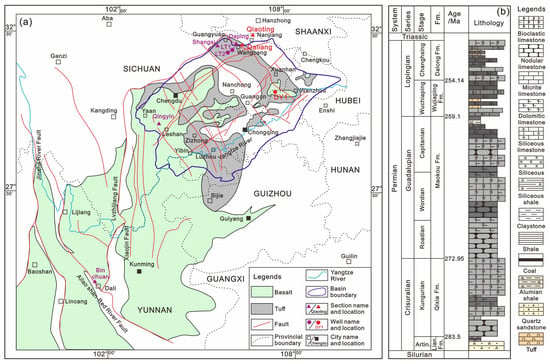
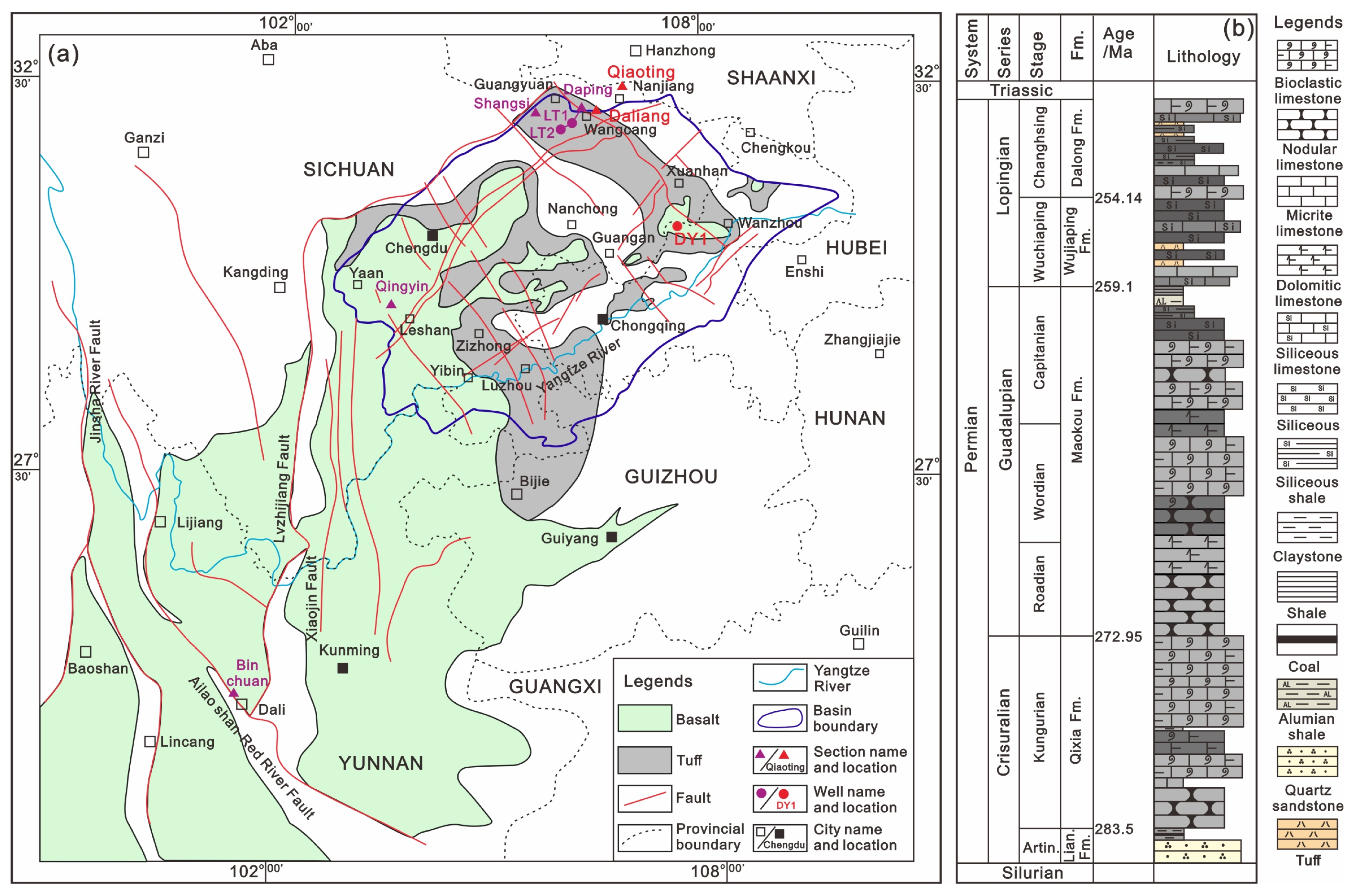
Tuff is a type of volcanic pyroclastic rock with particle sizes of less than 2 mm. Due to the fine grain size of volcanic pyroclastic material, volcanic ash ejected from the crater during eruptions drifted hundreds to thousands of kilometers in the air and then settled, condensed, and consolidated. Moreover, its atmospheric residence time is relatively short (1–3 years). This widely distributed rock layer, formed by rapid deposition over extensive areas, serves as an excellent marker bed for stratigraphic correlation [1]. Additionally, its lateral and vertical distribution also constrains the temporal and spatial scale of volcanic activity [2,3]. Volcanic ash beds are widely distributed within the Upper Permian sedimentary sequence of South China [4,5,6,7,8]. These volcanic ashes originated from the Emeishan volcanic activity, arc magmatism in the convergent plate margin, and Siberian Traps activity [6,9,10]. The huge basalt in the Emeishan Large Igneous Province (ELIP) is composed of a volcanic sequence of medium-lower iron-rich basalt and upper felsic acidic volcanic rocks [11]. The felsic volcanic rocks, located at the stratigraphic top position of the Emeishan lava sequence, are likely to have been preferentially removed by weathering and erosion. Consequently, the age constraints of the currently exposed felsic volcanic sequence may not represent the termination age of the ELIP [6]. Tuffs corresponding to the Emeishan felsic volcanic ash were deposited within the adjacent Late Permian carbonate sedimentary system and were well preserved. Such distal tuff layers are widely preserved in the Late Permian Wujiaping Formation of the northwestern and northern Sichuan Basin [12,13]. They serve as crucial carriers for studying the spatial extent of the Emeishan volcanic activity and precisely constraining stratigraphic ages [6,14]. High-precision CA-TIMS dating of felsic volcanic ash from the Shangsi Section in northwest Sichuan indicates that Emeishan volcanic activity persisted until approximately 257.8 Ma [6]. This is remarkably close to the Emeishan volcanic activity ages of 260.55 ± 0.07 Ma–257.22 ± 0.37 Ma from the Binchuan Section [7]. Moreover, the thickness of tuffs gradually decreases from the Shangsi Section northeastward to the LT1 well and Daping Section (Figure 1) in the northwest Sichuan Basin, indicating that the tuffs were derived from the Shangsi area to the southwestern Sichuan Basin [15]. Well DY1 lies in the Kaijiang–Liangping Trough, northeastern Sichuan Basin, where basaltic rocks are locally developed (Figure 1). The massive ash produced by volcanic activity falls into the ocean, providing a large amount of nutrients for marine organisms, promoting their vigorous development, and enhancing the ocean’s primary productivity. Meanwhile, the flourishing of organisms consumes dissolved oxygen in the water, strengthens reducing conditions, and triggers hypoxic events, thereby facilitating the preservation of organic matter. Therefore, tuff is an important driver of the rapid burial of organic carbon [16].
Figure 1.
(a) Schematic map showing the distribution of the Emeishan basalts and the studied section locations [6,13,15,17,18]. Sections at Binchuan and Shangsi [18], Daping [15], and Qingyin [6]. (b) Stratigraphic column of the Peimian in the northern Sichuan Basin.
The Late Permian Tuffs are widely distributed in South China and serve as an important site for studying the activity of the ELIP. Therefore, this paper aims to investigate the genesis of tuffs by analyzing the petrology and whole-rock geochemistry of the Wujiaoping Formation tuffs from the Daliang and Qioting sections in northern Sichuan. This is carried out in order to analyze the influence of the ELIP on the Upper Permian strata in northern Sichuan. Additionally, by combining the analysis of total organic carbon (TOC) content in the Wujiaoping Formation, the coupling relationship between organic carbon enrichment and volcanic activity will be explored, along with the controlling role of volcanic activity in organic carbon enrichment.
2. Geological Setting
The ELIP is primarily distributed across Yunnan, Guizhou, and Sichuan provinces (Figure 1), covering an area of approximately 250,000 km2 [11,17]. It is primarily composed of lower picrite-bearing basalt and upper basaltic andesite and felsic volcanic rocks [11]. Felsic volcanic rocks, including rhyolite and trachyte, are only found in the uppermost part of the well-preserved volcanic sequence [18,19]. Stratigraphically, the Emeishan volcanic rocks rest upon the limestone-dominated Middle Permian Maokou Formation. In the eastern part of the province, they are covered by clastic rocks of the Upper Permian Xuanwei or Longtan Formations, while in other areas, they are overlain by Upper Triassic sediments [2].
In the northern Sichuan Basin, the Permian succession is relatively complete and consists, from base to top, of the Liangshan, Qixia, Maokou, Wujiaping, and Dalong Formations. The Maokou Formation primarily consists of gray limestone with chert concretions, with a small amount of thin-bedded mudstone or chert intercalated in its upper part. Influenced by the Dongwu Movement, the Maokou Formation contains yellow aluminum volcanic ash beds, coal seams, and carbonaceous shale [20], which are widely distributed in the northwestern and northern parts of the Sichuan Basin.
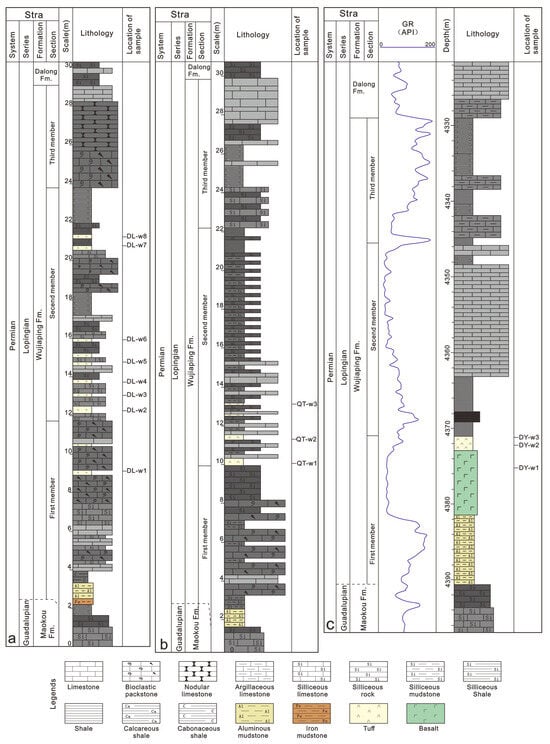
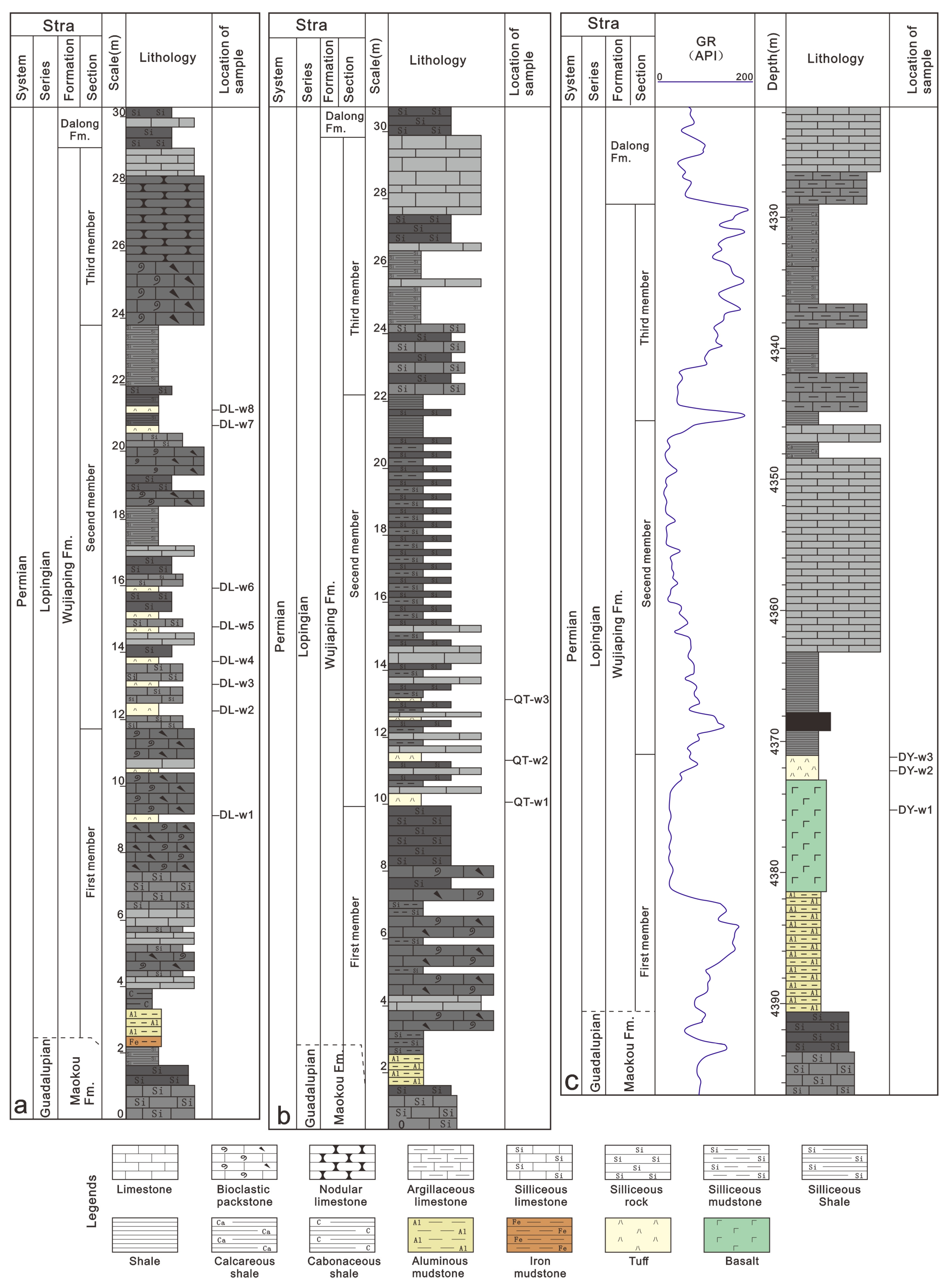
The Wujiaping Formation underlies the Middle Permian Maokou Formation and overlies the Upper Permian Dalong Formation. It primarily consists of dark gray bioclastic limestone with chert concretions, siliceous rock, siliceous shale, and shale. Lithologically, the Wujiaping Formation is subdivided upward into the first, second, and third members. In the northern Sichuan Basin, the strata contain interbedded layers of pale yellow to light yellow volcanic ash ranging from 1 to 30 cm in thickness (Figure 2a,b), whereas in Well DY1 in northeastern Sichuan, the lowermost Wujiaping Formation (Wu 1) is characterized by basalt and tuff (Figure 2c). The conformably overlying Dalong Formation primarily consists of siliceous limestone interbedded with shale, organic-rich limestone, and chert.
Figure 2.
Stratigraphic sections and sampling locations of Wujiaping Formation in the northern Sichuan Basin: (a) Daliang Section in Wangcang County; (b) Qiaoting Section in Nanjiang County; (c) Well DY1.
3. Samples and Methods
3.1. Samples
Geochemical analysis was conducted on 12 whole-rock samples, including 6 from the volcanic ash beds at the Daliang Section of the Upper Permian, 3 pyroclastic rock samples from the Qiaoting Section, and 3 basalt samples from Well DY1 (Figure 2). All samples originated from the Wujiaping Formation of the Upper Permian. Each sample underwent pulverization and homogenization prior to geochemical analysis.
3.2. Methods
Thin-section observations were conducted with a polarizing microscope at the National Key Laboratory of Oil and Gas Reservoir Geology and Engineering, Chengdu University of Technology, focusing on lithology, microtextures, and fossil components.
Whole-rock mineralogy analysis was performed using X-ray diffractometer Bruker D8 Advance A25, Germany, operating at 40 kV voltage, 40 mV current, and a scanning angle of 2θ ranging from 3° to 70°. The samples were ground into powder and placed on the sample stage for XRD analysis. Whole-rock mineral identification and content determination were conducted employing the characteristic diffraction peaks and K-value method, following the testing standard SY/T 5163-2018 [21].
Major elements were determined by an inductively coupled plasma optical emission spectrometer (ICP-OES, PerkinElmer PE Optima 5300DV, Waltham, MA, USA), whereas trace and rare-earth element concentrations were determined by ICP-MS using an Agilent Technologies 7700 Series, Santa Clara, CA, USA.
All analytical procedures followed the protocol outlined in Rock and Mineral Analysis DZG20-01 [22]. The specific sample preparation process for geochemical analysis is as follows: ① Ultrasonically clean the sample surfaces with deionized water to remove argillaceous materials and impurities, then dry at 60 °C for 48 h to a constant weight. ② Grind the samples in an agate mortar to a particle size below 200 mesh (<75 μm). ③ Place the 200-mesh (<75 μm) powder sample into a high-pressure sealed digestion vessel lined with polytetrafluoroethylene (PTFE). Add HF and HNO3, and then heat to 190 °C for 48 h to ensure complete decomposition of silicate minerals. ④ After digestion, remove and evaporate to dryness. Add HCl for a secondary sealed digestion for 2 h to convert insoluble fluorides into soluble chlorides. ⑤ Cool to room temperature, then transfer to a pre-cleaned fluorinated ethylene propylene (FEP) bottle, and store at 4 °C in the dark until analysis. All experiments were completed at the Provincial Key Laboratory of Nuclear Technology and Application, Chengdu University of Technology. All analytical data are presented in Tables S1–S3.
4. Results
4.1. Petrology
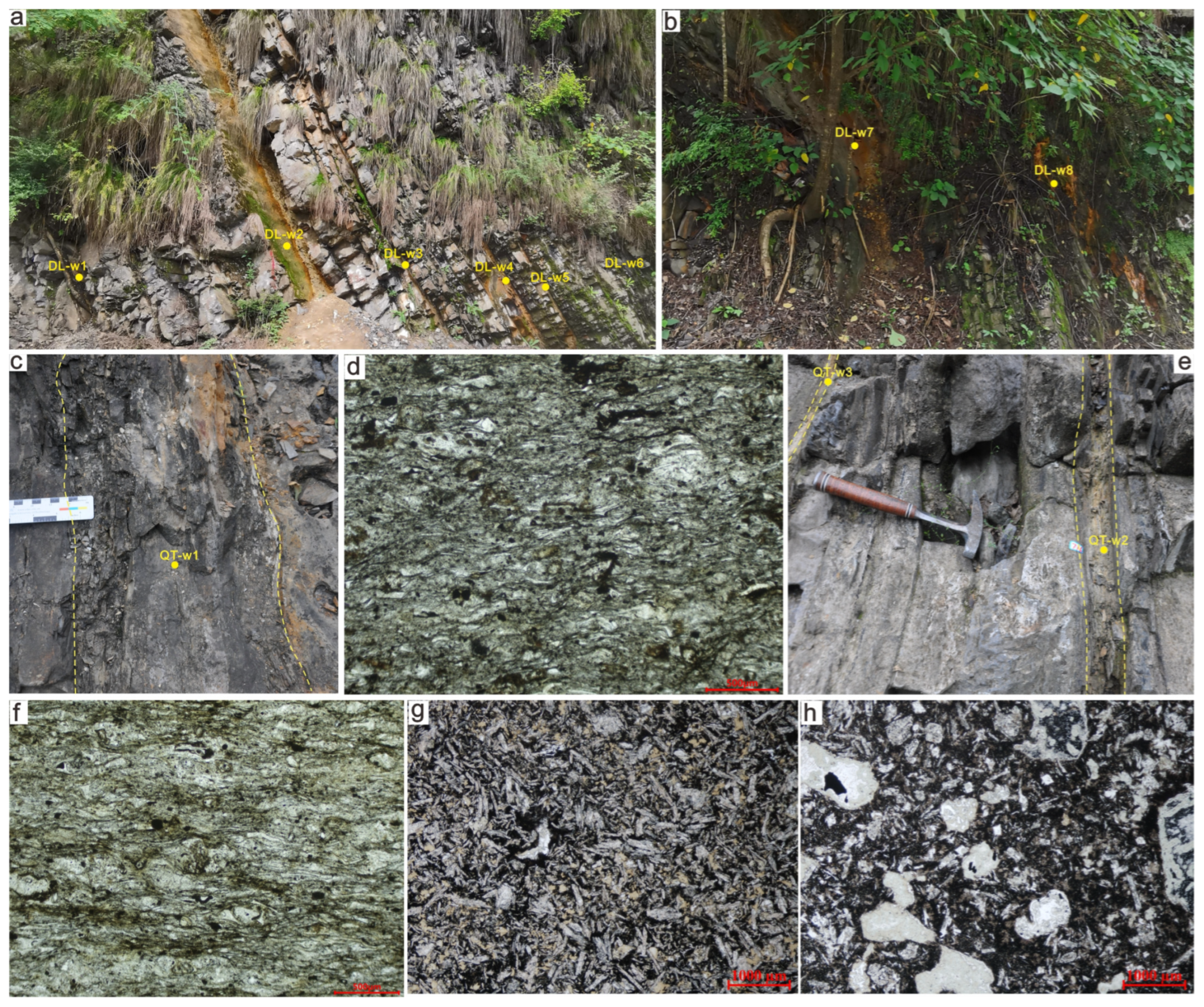
The primary lithologies of the Wujiaping Formation in northern Sichuan include limestone, siliceous rock, siliceous shale, and shale, with tuff intercalated. The tuff at the Daliang Section exhibits widespread alteration to ochre yellow (Figure 3a,b), making it easily identifiable in the field. At the Qiaoting Section, tuff shows weaker alteration (Figure 3c–f). Under microscopic examination, glass shards and crystal clasts are clearly distinguishable. The glass shards are arranged in an oriented manner, forming pseudorhyolitic structures (Figure 3d,f). The Wujiaping Formation at the base of Well DY1 in northeastern Sichuan developed basalts (Figure 2c) with well-developed plagioclase phenocrysts (Figure 3g), overlain by tuffs (Figure 2c) containing minor plagioclase phenocrysts (Figure 3h).
Figure 3.
Field section and microscopic characteristics of tuff in the Wujiaping Formation: (a) sample locations of limestone, siliceous rock interbedded with tuff, and tuff (DL-w1–6), Wujiaping Formation, Daliang Section; (b) sample locations of siliceous shale, shale interbedded with tuff, and tuff (DL-w7–8), Wujiaping Formation, Daliang Section; (c) tuff (QT-w1), Wujiaping Formation, Qiaoting Section; (d) vitric tuff, photomicrograph of QT-w1, plane-polarized light; (e) tuff (QT-w2 and QT-w3), Wujiaping Formation, Qiaoting Section; (f) vitric tuff, photomicrograph of QT-w3, plane-polarized light; (g) basalt, Well DY1, 4379.5 m, photomicrograph, plane-polarized light; (h) basaltic crystal tuff, Well DY1, 4371.76 m, photomicrograph, plane-polarized light.
4.2. Mineral Composition in Whole Rock
Whole-rock mineral composition and contents for XRD analysis of the tuffs from the Wangcang Daliang Section (Table S1) indicate that the material composition of tuff primarily consists of clay minerals (76.1–86.2%) and quartz (6.1–9.7%), followed by jarosite (1.8–10.7%), anhydrite (0.5–4.8%), rutile (0.7–2.2%), and pyrite (0–7.4%). The mineral composition of Nanjiang Qiaoting primarily consists of clay minerals (80.8–84.1%) and quartz (13.4–15.3%), followed by calcite (0.2–2.0%) and orthoclase (0.6–2.1%). The mineral composition of tuffs in Well DY1 primarily consists of clay minerals (75.2–80.2%) and quartz (16.2–23.1%), followed by pyrite (1.7–2.4%) and plagioclase (0–1.2%). The mineral composition of basalt in Well DY1 primarily consists of plagioclase (41.2%), calcite (26.7%), clay minerals (18.7%), and quartz (13.4%). The types of clay minerals are illite (47–73%) and illite/Smectite interstratified (I/S) (27–53%) in the tuffs of Daliang Section.
4.3. Major Elements in Whole Rock
Whole-rock major element contents of the tuffs from the Wangcang Daliang Section and Nanjiang Qiaoting Section, as well as the basalt from Well DY1, exhibit significant variation (Table S2). Specifically, the loss on ignition (LOI) of tuff samples from the Wujiaping Formation at the Wangcang Daliang section ranges from 7.56% to 11.54%; the SiO2 content ranges from 45.01% to 57.40%, with an average of 50.98%; the Al2O3 content ranges from 23.91% to 30.18%; the SiO2/Al2O3 ratio ranges from 1.58 to 2.41; the TiO2 content ranges from 0.670% to 1.05%, with Al2O3/TiO2 ratios ranging from 23.65 to 39.55; their total alkali contents (Na2O + K2O) range from 4.78% to 6.92%; and their Na2O/K2O ratios range from 0.01 to 0.094. At the Nanjiang Qiaoting Section, tuff samples from the Wujiaping Formation exhibit loss on ignition ranging from 4.17% to 7.13%; the SiO2 content ranges from 63.47% to 70.38%, with an average of 67.038%; the Al2O3 content ranges from 18.92% to 19.13%; the SiO2/Al2O3 ratio ranges from 3.318 to 3.719; the TiO2 content ranges from 0.55% to 0.62%; the Al2O3/TiO2 ratios range from 32.51 to 35.03; the total alkali (Na2O + K2O) content ranges from 4.21% to 5.47%; and the Na2O/K2O ratio ranges from 0.34 to 0.73. The SiO2 content of basalt and tuff from Well DY1 ranges from 36.95% to 49.26%; the Al2O3 content ranges from 11.39% to 24.17%; the SiO2/Al2O3 ratio ranges from 1.73 to 3.25; the TiO2 content ranges from 3.01% to 5.83%, with the Al2O3/TiO2 ratio ranging from 3.78 to 4.96; and the total alkali (Na2O + K2O) content ranges from 3.90% to 4.36%, with the Na2O/K2O ratio ranging between 0.19 and 42.36.
4.4. Trace Elements
The results of trace elements from the tuffs in Wujiaping Formation (Table S2) show significant differences between the Daliang Section, Qiaoting Section, and Well DY1. In the Daliang Section, the contents of Zr, Ta, and Hf are relatively high, with average values of 5177.98, 23.32, and 162.35 ppm, respectively, and the contents of Ba, Sr, Th and Nb are 56.13, 130.53, 60.08, and 302.86 ppm, respectively. The contents of Zr, Ta, and Hf are relatively low in the Qiaoting Section, with average values of 753.33, 8.05, and 13.52 ppm, respectively, and the contents of Ba, Sr, Th, and Nb are 98.67, 235.31, 22.17, and 27.07 ppm, respectively. The contents of Zr, Ta, and Hf are lower in Well DY1, with average values of 356.11, 3.55, and 9.32 ppm, respectively, and the contents of Ba, Sr, Th, and Nb are 132.41, 331.41, 7.41, and 69.61 ppm, respectively.
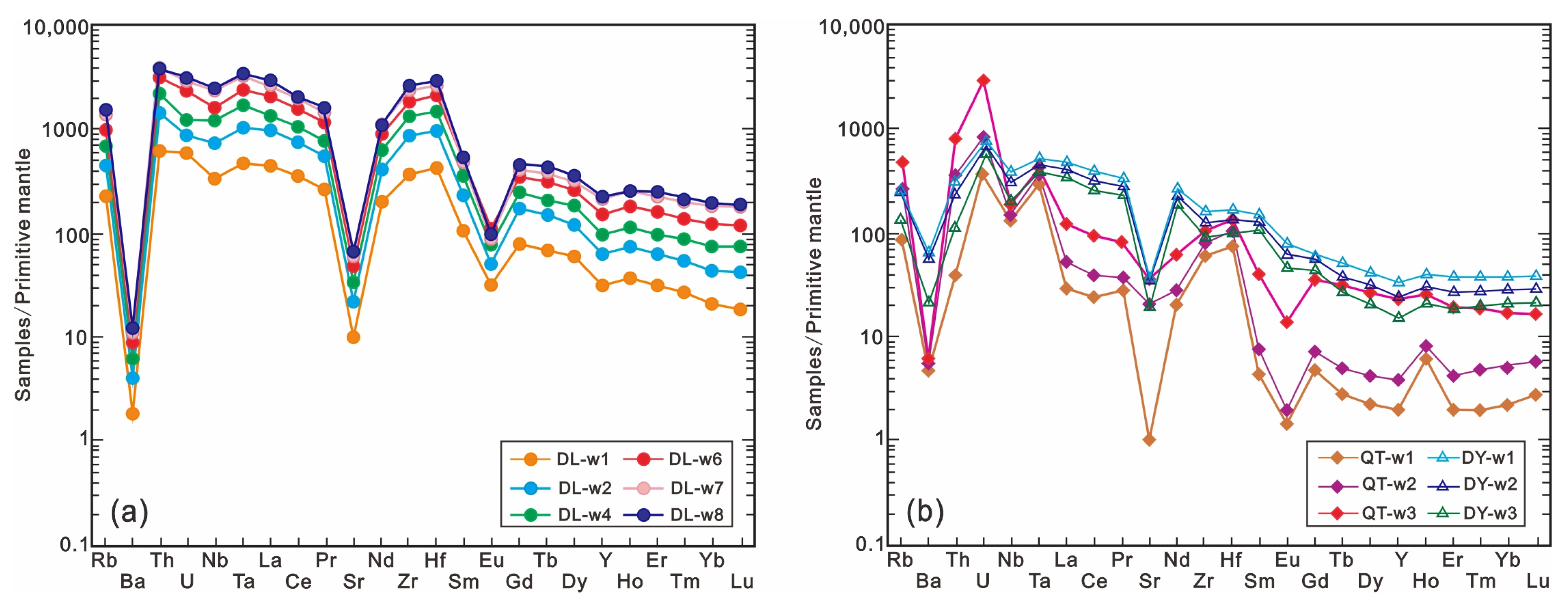
Trace element data normalized to the primitive mantle [23] were used to construct the trace element spider diagrams (Figure 4). As can be seen from the diagrams, most samples exhibit troughs in their large-ion-lithophile elements (LILEs), with pronounced negative anomalies in Ba, Sr, and Eu. The Ba–Sr depletion is generally consistent with strong plagioclase fractionation during magma evolution. The tuff samples from the Qiaoting Section exhibit relatively pronounced negative Nb anomalies, possibly indicating that their source region was subjected to crust–mantle mixing. The tuffs from the Daliang Section exhibit weak positive anomalies for Th and Ta, as well as stronger positive anomalies for Zr and Hf. In contrast, the tuff samples from the Qiaoting Section show pronounced positive anomalies of elements such as U, Ta, Hf, etc.
Figure 4.
Spidergram of primitive mantle-normalized trace elements (normalized primitive mantle from reference [23]): (a) Daliang Section in Wangcang County; (b) Qiaoting Section in Nanjiang County and Well DY1.
4.5. Rare-Earth Elements
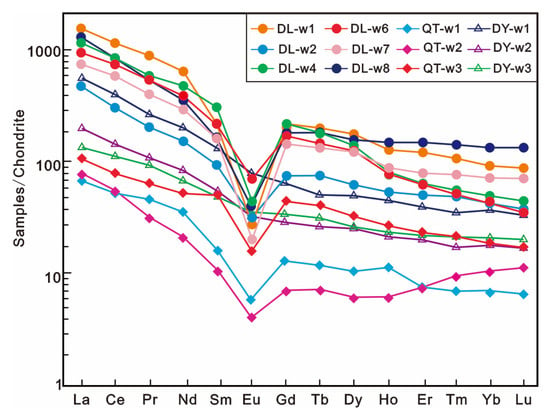
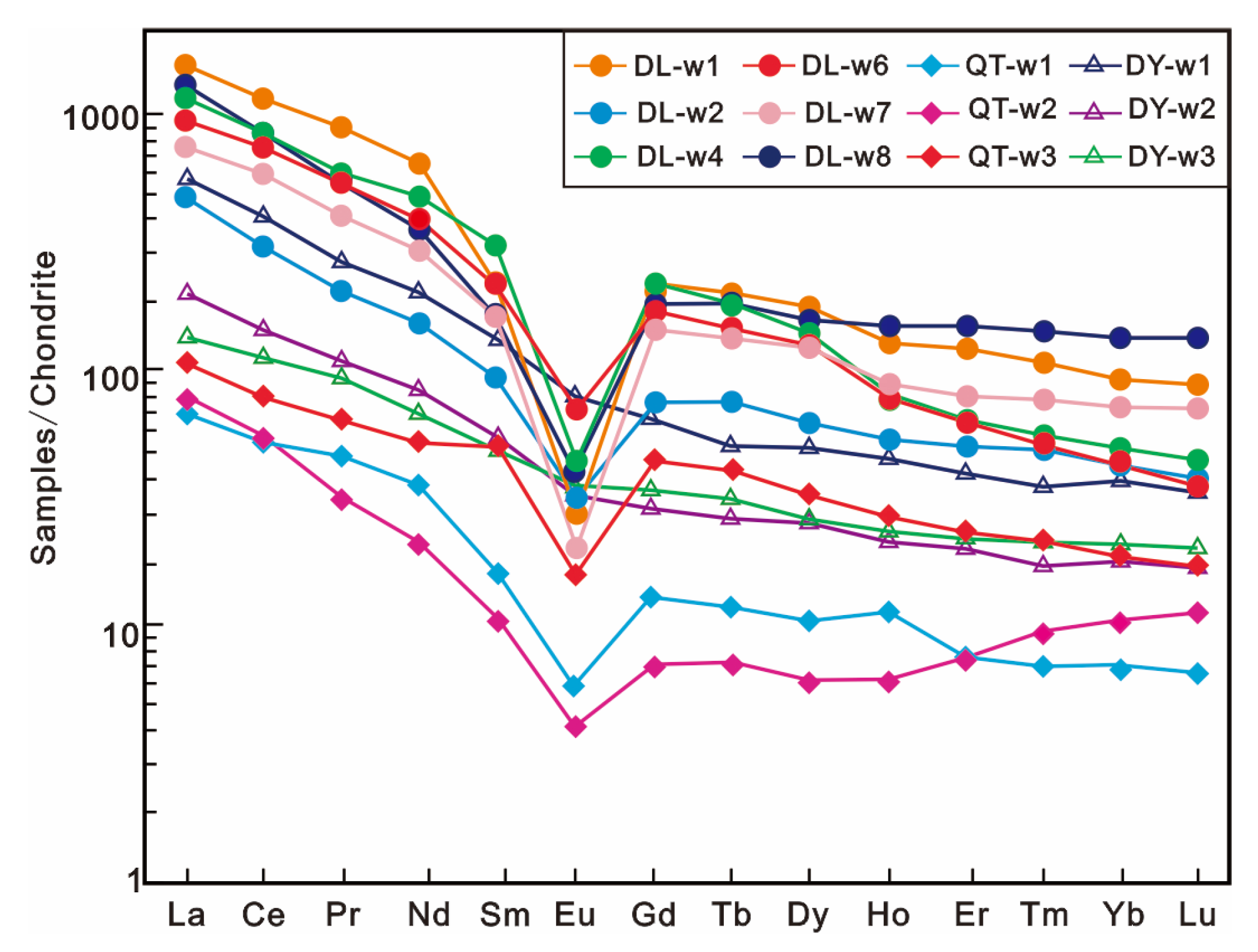
The rare-earth element patterns normalized to chondrite (Figure 5) indicate that the Daliang tuffs are characterized by pronounced negative Eu anomalies, with Eu/Eu* values ranging from 0.14 to 0.36, whereas Ce anomalies are not significant. The (La/Sm)N values range from 3.61 to 7.74, averaging 5.39; the (La/Yb)N values range from 9.56 to 22.64, averaging 15.11; and the (Gd/Lu)N values range from 1.37 to 4.39, averaging 2.74. All samples from the Daliang Section exhibited similar REE distribution patterns, characterized by a relative depletion of LREE and a relatively flat HREE. The Qiaoting tuffs also show pronounced negative Eu anomalies, with Eu/Eu* values ranging from 0.23 to 0.36, with no significant Ce anomalies. The (La/Sm)N values range from 2.08 to 7.19, averaging 5.31; the (La/Yb)N values range from 5.58 to 12.63, averaging 8.46; and the (Gd/Lu)N values range from 0.66 to 2.54, averaging 1.66. All samples from the Qiaoting Section similarly exhibited a comparable REE distribution pattern, characterized by the relative depletion of both LREE and HREE. The basalt and tuff samples from Well DY1 show relatively weak negative Eu anomalies, with Eu/Eu* values ranging from 0.801 to 0.851; the (La/Sm)N values range from 2.84 to 4.33, with an average of 3.63; the (La/Yb)N values range from 6.61 to 15.66, averaging 11.06; and the (Gd/Lu)N values range from 1.65 to 2.54, averaging 1.98. All samples from Well DY1 similarly exhibited a comparable REE distribution pattern, which is generally characterized by the relative depletion of both LREEs and HREEs.
Figure 5.
Chondrite-normalized REE patterns (normalized values for chondrite from reference [23]).
5. Discussion
5.1. Genesis of Tuff
5.1.1. Source of Tuff
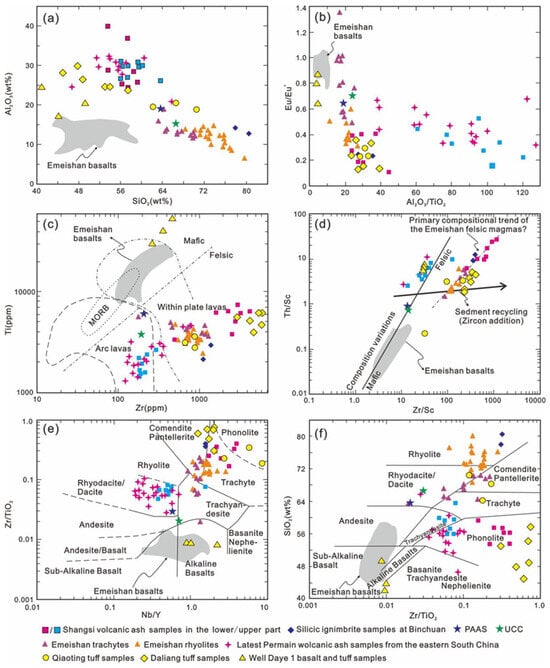
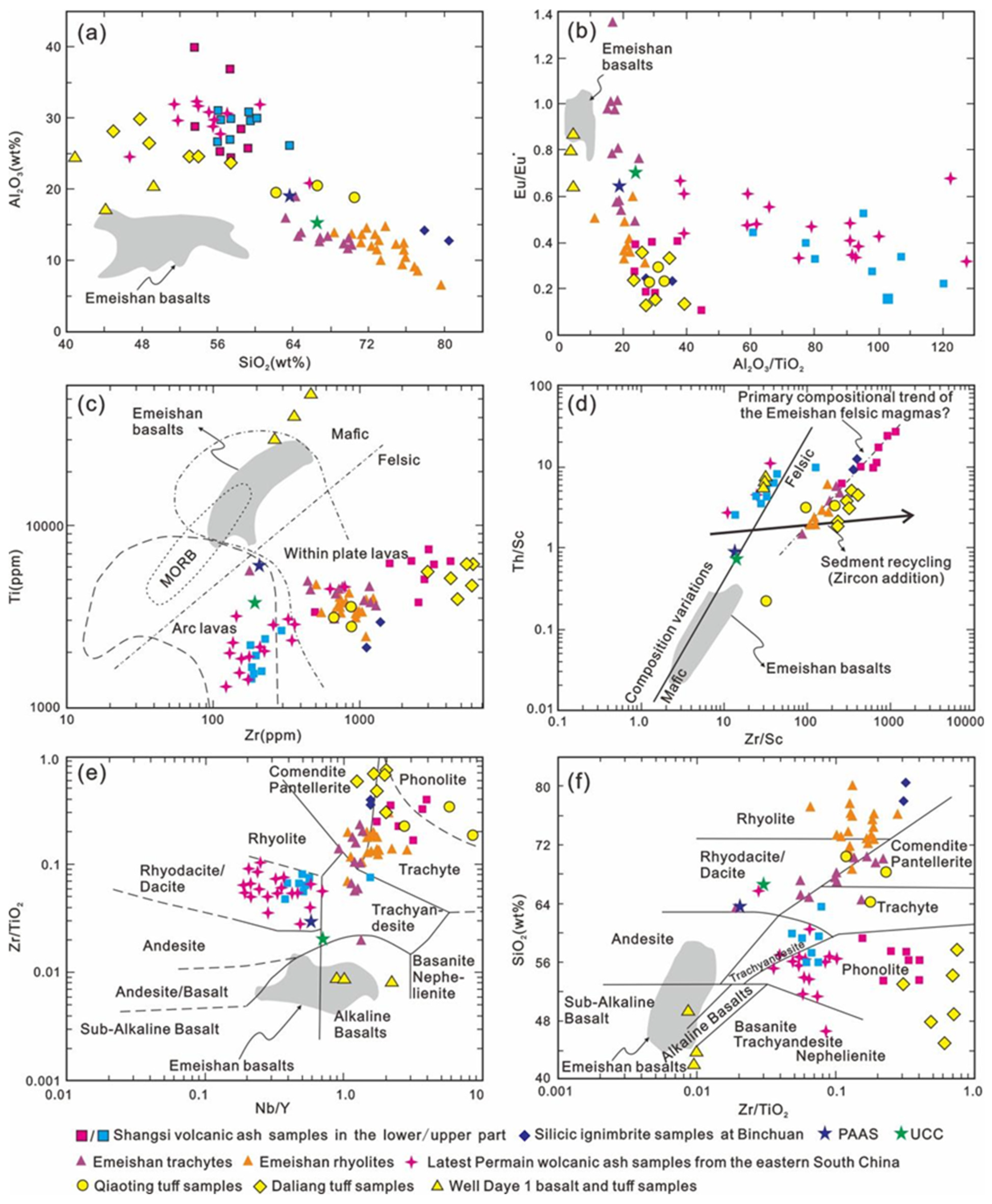
Studies indicate that rapidly cooled volcanic glass is thermodynamically unstable and highly reactive, making it prone to weathering and alteration into clay minerals [24,25]. During this process, mobile elements are extensively reactivation, which is mainly characterized by the release of Si and the accumulation of Al [18,26]. The SiO2/Al2O3 ratio can therefore be used to evaluate the extent of post-depositional weathering and alteration in tuffaceous deposits [24]. The SiO2/Al2O3 ratios of the tuffs of the Wujiaping Formation from the Daliang Section range from 1.58 to 2.40, significantly lower than the 5.47–6.31 ratios observed in the acid ignimbrite at Binchuan [18]. The SiO2/Al2O3 ratios of samples from the Qiaoting Section range from 3.318 to 3.719, slightly lower than those of the acid ignimbrite samples at Binchuan. This indicates that the tuffs of the Wujiaping Formation at the Daliang Section have undergone intense weathering and alteration, whereas those at the Qiaoting Section have experienced weaker alteration and weathering. Because Al2O3/TiO2 ratios and relatively immobile high-field-strength elements, including Nb, Zr, Ta, Hf, Sc, and Th, are only weakly affected by weathering, they provide robust constraints on magma provenance [27,28]. The Al2O3/TiO2 ratio ranges from 3 to 8 for mafic magmas, 8 to 21 for intermediate magmas, and 21 to 70 for felsic magmas [28]. The Al2O3/TiO2 ratios of the tuffs from the Wujiaping Formation at the Daliang Section range from 23.65 to 39.55, while those from the Qiaoting Section range from 33.19 to 60.33. Both values exceeded those of the Emeishan basalt (Figure 6a,b) and were comparable to those of the acid ignimbrite at Binchuan [18], the Emeishan rhyolite [19,29,30], and the lower tuff samples from the Shangsi Section [18].
Figure 6.
Geochemical diagrams of tuffs from the Wujiaping Formation in northern Sichuan. (a) SiO2 vs. Al2O3 diagram. (b) Al2O3/TiO2 vs. Eu/Eu* diagram. (c) Zr vs. Ti diagram [30]. (d) Zr/Sc vs. Th/Sc diagram [29]. (e) Nb/Y vs. Zr/TiO2 diagram [25]. (f) Zr/TiO2 vs. SiO2 [25].
This indicates that the Wujiaping Formation tuffs at the Daliang and Qiaoting Sections may be associated with felsic volcanic eruptions. Datings from the Shangsi volcanic ash samples in the lower/upper part, the acid ignimbrite samples at Binchuan [18], the latest Permian volcanic ash samples in South China, the Emeishan basalts, the volcanic ash samples from the Wangpo Bed and Upper Permian Xuanwei Formation at Qingyin, six Emeishan trachytes and rhyolites, the average upper continental crust (UCC) [31], and the post-Archean average Australian shale (PAAS) are shown for comparison [32].
On the Zr-Ti diagram, both tuff samples from the two sections fall within the intraplate magma field (Figure 6c). In the Zr/Sc-Th/Sc diagram, the tuff samples from the two sections follow the compositional variation line of the ELIP (Figure 6d), indicating that the tuffs from the Daliang and Qiaoting Sections in northern Sichuan share the same source with the acidic ignimbrite of Binchuan, the rhyolite of Emeishan, and the lower tuff from the Shangsi Section. In the Nb/Y-Zr/TiO2 diagram (Figure 6e) and the Zr/TiO2-SiO2 diagram (Figure 6f), most tephra sample points from the Daliang and Qiaoting Sections fall within the distribution ranges of trachyte and phonolite, indicating that both tuffs originate from acidic rocks.
The Al2O3/TiO2 ratios of basalt and tuff samples from Well DY1 range from 4.02 to 4.97, similar to those of Emeishan basalts (Figure 6b), indicating that the tuff of the Wu 1 Member at Well DY1 originated from the eruption of mafic basalts. Similarly, all samples are plotted within the field of intraplate basalts in the Zr-Ti diagram (Figure 6c) and distributed along the compositional variation trend of the ELIP in the Zr/Sc-Th/Sc diagram (Figure 6d). In the Nb/Y-Zr/TiO2 diagram (Figure 6e) and the Zr/TiO2-SiO2 diagram (Figure 6f), most sample points fall within the basalt range, indicating that the tuff from Well DY1 originated from mafic basalt eruption.
5.1.2. Tectonic Environment Interpretation of Tuff
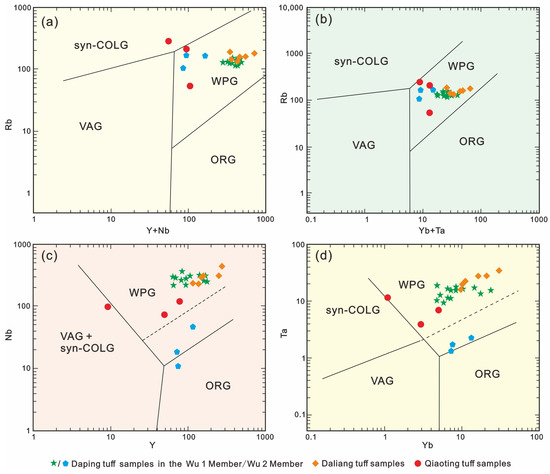
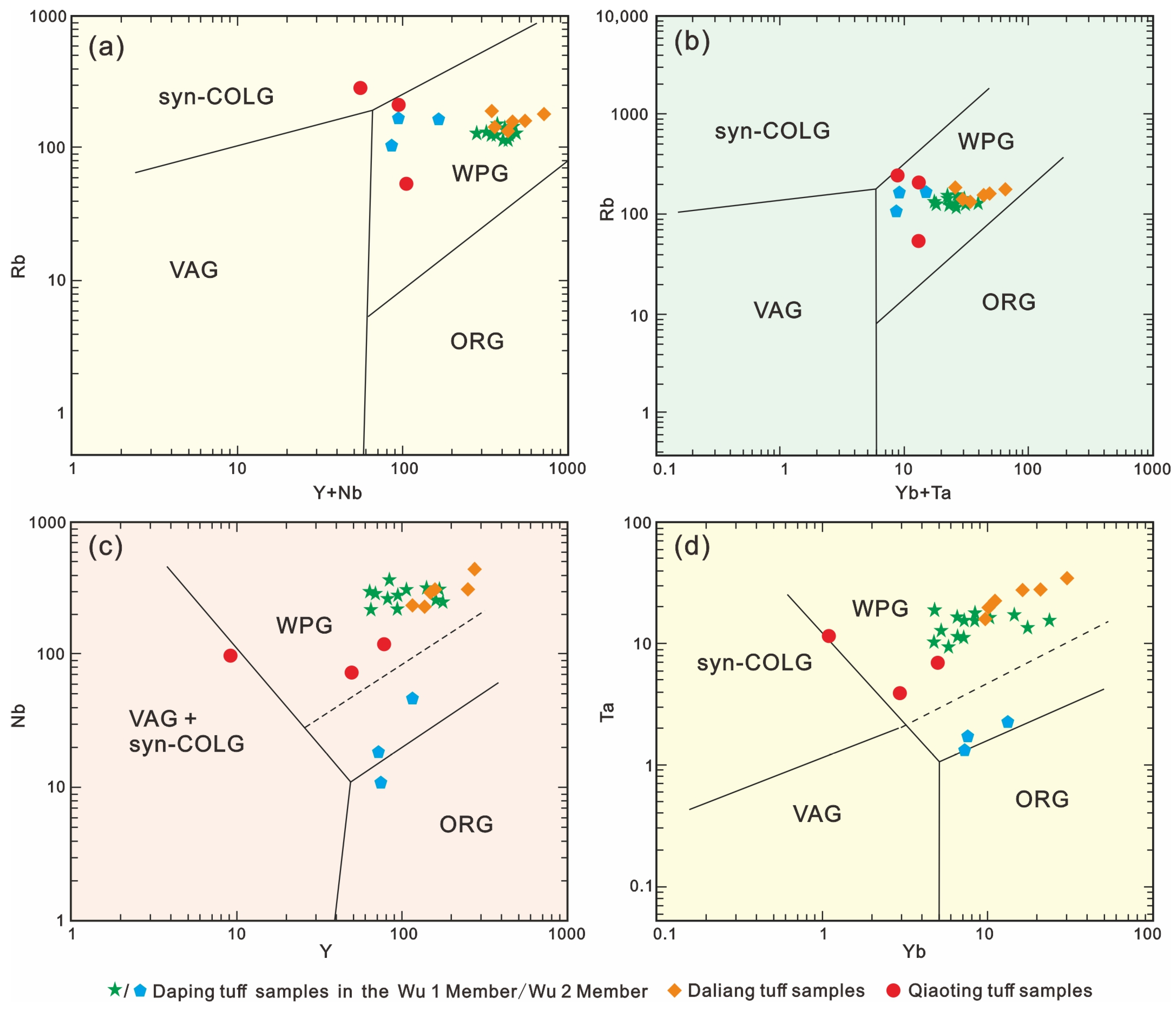
Immobile trace elements, particularly Y, Nb, Rb, Yb, and Ta, are commonly used to discriminate tectonic affinities of volcanic and granitoid rocks [33,34]. Based on four discrimination diagrams, namely, Y + Nb-Rb, Yb + Ta-Rb, Y-Nb, and Yb-Ta (Figure 7), this study determined the tectonic settings of Wujiaping Formation tuffs from the Daliang and Qiaoting Sections in the northern Sichuan Basin. In all four tectonic settings diagrams, the tuff samples of the Wujiaping Formation from the Daliang Section all fell within the intraplate granite zone and exhibited the same characteristics as the tuff samples of the Wu 1 Member from the Daping Section [15]. This indicates that the tuffs of the Wujiaping Formation from the Daliang Section share similar features with granitoid rocks formed in an intraplate extensional setting.
Figure 7.
Structural Environment Discrimination Diagram for Geochemical Analysis of the Wujiaping Formation Tuff Rocks in Northern Sichuan Basin (Base map after reference [28]). (a) Discriminant diagrams for (Y+Nb)-Rb of tuff; (b) Discriminant diagrams for (Yb+Ta)-Rb of tuff; (c) Discriminant diagrams for Y-Nb of tuff; (d) Discriminant diagrams for Yb-Ta of tuff. Data from Daping tuff samples in the Wu 1 Member/Wu 2 Member (After reference [15]). VAG: volcanic arc granites; WPG: with plate granites; syn-COLG: syn-collision granites; ORG: ocean ridge granites.
Most of the tuff samples of the Wujiaping Formation from the Qiaoting Section fell within the intraplate granite zone. Additionally, some samples fell at the boundary between the intraplate and syn-collisional fields (Figure 7b,d) or at the boundary between the syn-collisional and volcanic arc fields (Figure 7a,c). These characteristics indicate that samples from the Qiaoting Section similarly share features with granitoid rocks formed in an intraplate extensional environment and may also be influenced by syn-collision or volcanic arc processes.
In summary, the source rocks of the tuffs from the Daliang and Qiaoting Sections are intermediate-felsic volcanic rocks. Their characteristics regarding trace elements and rare-earth elements are similar to those of the Binchuan acid ignimbrite, Emeishan rhyolite, the lower tuffs from the Shangsi Section, and tuffs of the Wu 1 Member from the Daping Section, indicating that these are homologous products of the same period [15,18]. Furthermore, the tuffs were sourced from the felsic volcanic sequence of the upper felsic acidic volcanic rocks in the ELIP [18]. The tuff from Well DY1 shares identical geochemical characteristics with basalt, indicating that the tuffs from the well are associated with the basalt eruptions in the Wanzhou area of northeastern Sichuan. Similarly, the shales of the Wu 2 Member of the early Wuchianpingian stage in Well DY1 (Figure 2c) preserve records influenced by mafic–alkaline igneous rocks formed during the middle stage of the ELIP, while the provenance of some shales of the Wu 3 Member of the late Wuchianpingian stage is derived from the felsic rhyolites formed during the late stage of the ELIP [16]. A comparison of the provenance of volcanic ashes from the Shangsi, Daping, Daliang, and Qiaoting Sections in the northwestern and northern Sichuan Basin with those from Well DY1 in northeastern Sichuan during the Wuchiapingian stage reveals that the Wujiaping Formation in northwestern and northern Sichuan generally lacks records of the influence of mafic–alkaline igneous rocks from the middle ELIP stage. This indicates that the basalt eruptions in the Wanzhou area of northeastern Sichuan occurred relatively late and had a limited influence, being confined to northeastern Sichuan without affecting the Wujiaping Formation in northwestern and northern Sichuan.
5.2. Geological Significance of Tuff Development
5.2.1. Impact of Climate Cooling
The ELIP represents a significant geological event in the geological history [35]. It exhibits strong temporal correlation with the Last Glacial Period (P4 glaciation) among the four independent glacial events of the Permian period [36,37]. Weathering following the eruption of Emeishan basalts was one of the factors contributing to the climatic cooling at the Mid-Late Permian transition [38]. In contrast, volcanic ash formed by the felsic magma eruptions during the late stage of the ELIP not only covered vast areas but also released substantial quantities of ash and gases, including CO2 and SO2. Among these gases, SO2 can form sulfate aerosols that reflect solar radiation after entering the atmosphere, which may induce short-term climatic cooling known as a “volcanic winter” [38,39,40]. Furthermore, compared with basalt, the rhyolite erupted during the late stage of the ELIP is rich in silicate minerals. Its weathering can significantly reduce atmospheric CO2 levels, thereby triggering a cooling effect [41]. Atmospheric CO2 concentrations during the Wuchiapingian to Changhsingian stages (442–687 ppm) were lower than those in the late Capitanian stage (654 ppm) [42]. This cooling event was more pronounced than the cooling in the early Wuchiapingian stage, and the cessation of felsic volcanic activity preceded the end of the cooling phase [16]. This suggests that the climate change resulted from the combined effects of multiple factors.
5.2.2. Impact of Organic Matter Enrichment
A growing body of research has indicated that volcanic activity was not only a key driver of Late Paleozoic glaciations but also a major catalyst for the rapid burial of organic carbon [42,43,44,45,46]. Volcanic activity inputs substantial nutrients, enhancing primary productivity, consuming dissolved oxygen in water bodies, strengthening reducing environments, and promoting organic matter preservation.
Volcanic Activity and Content of Total Organic Carbon (TOC)
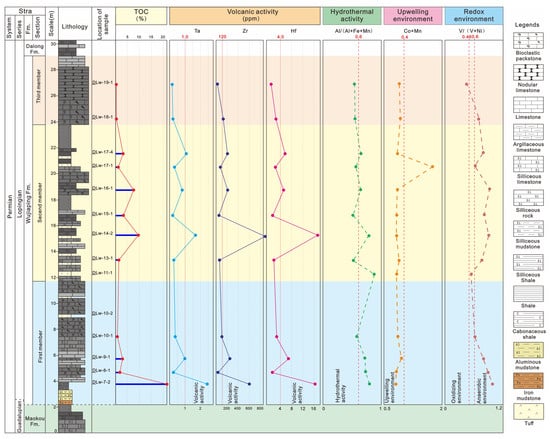
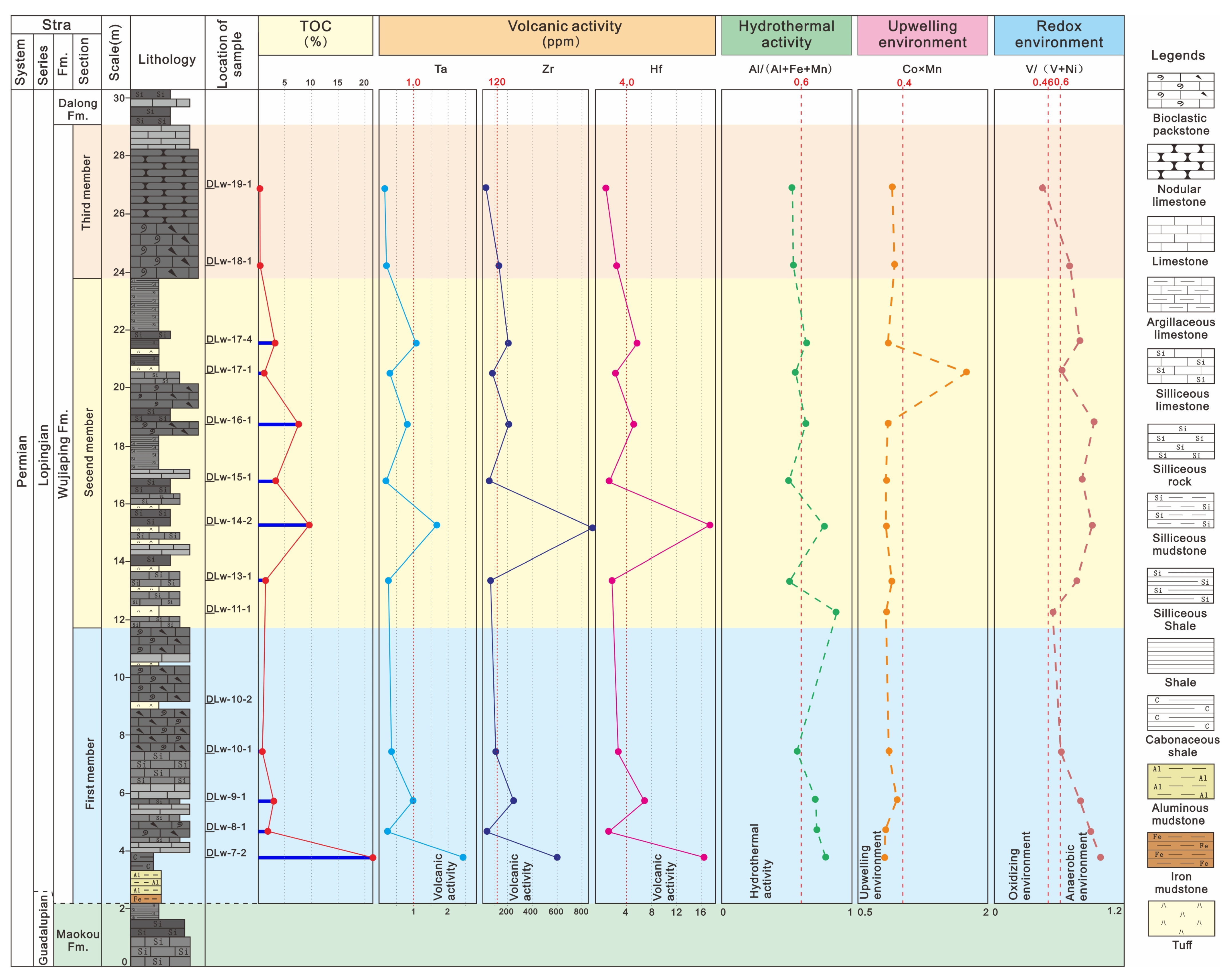
High-field-strength elements, Zr, Hf, and Ta, are effective indicators for identifying volcanic material input [47,48]. The presence of volcanic activity is considered when the contents of Zr, Ta, and Hf in rocks exceed 120 ppm, 1 ppm, and 4 ppm, respectively. On testing the trace element and TOC contents in 12 chert and siliceous shale samples from the Wujiaping Formation of the Daliang section in northern Sichuan, the results show that Zr, Hf, and Ta elements consistently vary in content to reflect the presence of volcanic activity, and they also indicate the existence of multiple volcanic eruption events (Figure 8). By comparing the relationship between volcanic activity and the corresponding TOC content, a significant positive correlation is observed: higher TOC content corresponds to Zr, Hf, and Ta contents exceeding the threshold for volcanic activity judgment [16]. This indicates that volcanic activity significantly promotes the enrichment of organic matter.
Figure 8.
Comprehensive evolution of TOC content, volcanic activity, hydrothermal activity indicators, and upwelling and redox conditions in the Wujiaping Formation of the Daliang section, northern Sichuan Basin.
To further validate the coupling relationship between volcanic ash input and organic matter enrichment, the study employed the Al/(Al + Fe + Mn) ratio as a parameter for assessing hydrothermal contribution [49]. For pure hydrothermal siliceous rocks, the Al/(Al + Fe + Mn) ratio ≦ 0.1, exhibiting spatial differentiation characteristics that increase with distance from the hydrothermal jet center; a ratio ≧ 0.6 indicates biogenic dominance; values between 0.1 and 0.6 reflect hydrothermal–biogenic coaction; while values greater than 0.6 confirm biogenic origin [50,51,52]. Among the 12 samples from the Wujiaping Formation at the Daliang section, the Al/(Al + Fe + Mn) ratios ranged from 0.51 to 0.94, with a mean of 0.72, demonstrating pronounced biogenic characteristics, although localized layers in the second and third sections of Wujiaping Formation exhibited weak hydrothermal activity (Figure 8). No correlation was observed between hydrothermal activity and either volcanic activity or TOC content.
Upwelling and Redox Environment
Due to the significant depletion of Mn and Co and anomalous enrichment of Mo and Cd in modern upwelling sediments, the Co × Mn and Cd/Mo ratios have been widely used as discriminators for upwelling environments and restricted basins. Sedimentary environments long controlled by upwelling typically exhibit high Cd/Mo ratios (>0.1) and low Co × Mn values (<0.4) [44,52]. The Co × Mn values of the Wujiaping Formation in the Datang section range from 0.0004 to 1.67, with an average of 0.17, which is significantly below the 0.4 threshold, clearly indicating sustained upwelling activity during the deposition period (Figure 8).
The V/(V + Ni) ratio is commonly used to distinguish redox conditions in depositional water bodies: a ratio <0.46 indicates an oxic environment; a ratio between 0.46 and 0.6 indicates a dysoxic environment; and a ratio between 0.6 and 1 indicates an anoxic environment [53]. The V/(V + Ni) ratios of samples from the Datang section range from 0.25 to 0.99, with an average of 0.76, indicating that the Wujiaping Formation was deposited under overall anoxic conditions.
During the early first member of Wuchiapingian, northeastern Sichuan was dominated by mafic volcanic rock eruption. The Wujiaping Formation was characterized by low productivity and an oxygen-rich environment. High sedimentation rates and enhanced input of terrestrial organic matter driven by volcanic activity became the primary factors for organic matter accumulation [16]. During the second member of Wuchiapingian, the late stage of the ELIP period saw widespread felsic volcanic eruptions across the northern Sichuan Basin. Sulfate aerosols formed by these eruptions, which cause solar radiation reflection, and the weathering of acidic rhyolites may have jointly driven climatic cooling. Studies indicate that felsic volcanic rocks weather 5–10 times faster than mafic volcanic rocks [54]. The alteration of the tuffs released substantial amounts of Si; consequently, coastal upwelling, which had been affected by temperature decline, gradually recovered [16]. This provided ample siliceous rocks and nutrients, promoting the proliferation of siliceous organisms. Subsequently, the death, settlement, and decomposition of these organisms consumed substantial oxygen, leading to the formation of an oxygen minimum zone (OMZ) with anoxic sulfide conditions that ultimately led to the deposition of organic-rich siliceous shales (Figure 8).
6. Conclusions
(1) The tuffs from the Daliang and Qiaoting Sections display high Al2O3/TiO2 ratios (23.65–39.55) and significant anomalies with respect to the Eu, Ba, and Sr elements in the northern Sichuan Basin. Their formation is associated with multiple episodes of felsic volcanic activity of the ELIP and took place in the intraplate extensional setting.
(2) Both the basalt and tuff developed at Well DY1 show low Al2O3/TiO2 ratios, indicating that the tuff originated from the mafic basalt eruptions during the middle stage of the ELIP, with the scope of influence limited to the northeastern Sichuan Basin.
(3) The felsic volcanic eruptions in the late ELIP had a wide-ranging impact. There is a positive correlation between volcanic activity and the TOC content of the black siliceous rocks and siliceous shales of the Wujiaping Formation in northern Sichuan. This may have played an important role in the formation of high-quality hydrocarbon source rocks in the deep-water shelf area of the Wujiaping Formation in northern Sichuan.
Supplementary Materials
The following supporting information can be downloaded at https://www.mdpi.com/article/10.3390/geosciences16060234/s1, Table S1: Analysis results of the whole-rock mineral composition of tuffs and basalt in the Wujiaping Formation; Table S2: Analysis results of the major elements from the tuff in the Wujiaping Formation; Table S3: Analysis results of trace elements and rare-earth elements from the tuff in the Wujiaping Formation.
Author Contributions
Conceptualization, F.L. and J.W.; methodology, J.W., X.L. and P.Z.; investigation, J.W., X.L., P.Z. and J.Y.; writing—original draft preparation, J.W., X.L. and F.L.; writing—review and editing, J.W., P.Z. and J.Y.; supervision, F.L.; project administration, F.L. and P.Z.; funding acquisition, F.L. and P.Z. All authors have read and agreed to the published version of the manuscript.
Funding
This research was funded by Open Fund Project “Study on the Paleogeographic Evolution of Upper Permian and Shale Facies in the Northern Sichuan-Western Hubei Region” from the Sinopec Shale Oil and Gas Exploration and Development Laboratory [grant number: 33550000-24-ZC0613-0023] and was supported by the Open Fund Project from the State Key Laboratory of Oil and Gas Reservoir Geology and Exploitation (CDUT) (No. CDUT-PLC2024015).
Data Availability Statement
Data is contained within the article or Supplementary Materials.
Acknowledgments
We are grateful to Wang Chaoqun, Liu Yaozu, and Liu Yanxin, for their participation in the field profile measurement.
Conflicts of Interest
Jia Wang is employed by the companies State Key Laboratory of Shale Oil and Gas Enrichment Mechanisms and Efficient Development and Sinopec Shale Oil and Gas Exploration and Development Laboratory. The remaining authors declare that the research was conducted in the absence of any commercial or financial relationships that could be construed as a potential conflict of interest.
References
- Königer, S.; Lorenz, V.; Stollhofen, H.; Armstrong, R.A. Origin, age and stratigraphic significance of distal fallout ash tuffs from the Carboniferous-Permian continental Saar-Nahe Basin (SW Germany). Int. J. Earth Sci. 2002, 91, 341–356. [Google Scholar] [CrossRef] [Scilit]
- He, B.; Xu, Y.G.; Chung, S.L.; Xiao, L.; Wang, Y.M. Sedimentary evidence for a rapid, kilometer-scale crustal doming prior to the eruption of the Emeishan flood basalts. Earth Planet. Sci. Lett. 2003, 213, 391–405. [Google Scholar] [CrossRef] [Scilit]
- Wang, M.; Zhong, Y.T.; Hou, Y.L.; Shen, S.Z.; He, B. Source and extent of the felsic volcanic ashes at the Permian-Triassic boundary in South China. Acta Petrol. Sin. 2018, 34, 36–48, (In Chinese with English abstract). [Google Scholar]
- Mundil, R.; Ludwig, K.R.; Metcalfe, I.; Renne, P.R. Age and timing of the Permian mass extinctions: U/Pb dating of closed-system zircons. Science 2004, 305, 1760–1763. [Google Scholar] [CrossRef] [Scilit] [PubMed]
- Dai, S.F.; Wang, X.B.; Zhou, Y.P.; Hower, J.C.; Li, D.H.; Chen, W.M.; Zhu, X.W.; Zou, J.H. Chemical and mineralogical compositions of silicic, mafic, and alkali tonsteins in the late Permian coals from the Songzao coalfield, Chongqing, Southwest China. Chem. Geol. 2011, 282, 29–44. [Google Scholar] [CrossRef] [Scilit]
- Huang, H.; Cawood, P.A.; Hou, M.C.; Yang, J.H.; Ni, S.J.; Du, Y.S.; Yan, Z.K.; Wang, J. Silicic ash beds bracket Emeishan large igneous province to <1 m. y. at ~260 Ma. Lithos 2016, 264, 17–27. [Google Scholar] [CrossRef] [Scilit]
- Huang, H.; Huyskens, M.H.; Yin, Q.Z.; Cawood, P.A.; Hou, M.C.; Yang, J.H.; Xiong, F.H.; Du, Y.S.; Yang, C.C. Eruptive tempo of Emeishan large igneous province, southwestern China and northern Vietnam: Relations to biotic crises and paleoclimate changes around the Guadalupian-Lopingian boundary. Geology 2022, 50, 1083–1087. [Google Scholar] [CrossRef] [Scilit]
- Bagherpour, B.; Bucher, H.; Schneebeli-Hermann, E.; Vennemann, T.; Chiaradia, M.; Shen, S.Z. Early late Permian coupled carbon and strontium isotope chemostratigraphy from South China: Extended Emeishan volcanism? Gondwana Res. 2018, 58, 58–70. [Google Scholar] [CrossRef] [Scilit]
- Xu, L.; Lin, Y.; Shen, W.; Qi, L.; Xie, L.; Ouyang, Z. Platinum-group elements of the Meishan Permian -Triassic boundary section: Evidence for flood basaltic volcanism. Chem. Geol. 2007, 246, 55–64. [Google Scholar] [CrossRef] [Scilit]
- Dai, S.F.; Nechaev, V.P.; Chekryzhov, I.Y.; Zhao, L.X.; Vysotskiy, S.V.; Graham, I.; Ward, C.R.; Ignatiev, A.V.; Velivetskaya, T.A.; Zhao, L.; et al. A model for Nb-Zr-REE-Ga enrichment in Lopingian altered alkaline volcanic ashes: Key evidence of H-O isotopes. Lithos 2018, 302–303, 359–369. [Google Scholar] [CrossRef] [Scilit]
- Xiao, L.; Xu, Y.G.; Mei, H.J.; Zheng, Y.F.; He, B.; Pirajno, F. Distinct mantle sources of low-Ti and high-Ti basalts from the western Emeishan large igneous province, SW China: Implications for plume-lithosphere interaction. Earth Planet. Sci. Lett. 2004, 228, 525–546. [Google Scholar] [CrossRef] [Scilit]
- Ma, X.H.; Xu, C.C.; Li, G.H.; Ying, D.L.; Zhang, B.J.; Li, Y.; Dai, X.; Fan, Y.; Zeng, Y.X. Distribution and gas-bearing properties of Permian igneous rocks in Sichuan Basin, SW China. Pet. Explor. Dev. 2019, 46, 216–225, (In Chinese with English abstract). [Google Scholar] [CrossRef] [Scilit]
- Xia, W.Q.; Zhu, X.; Jin, M.D.; Zhang, L.; Liu, Y.T.; Zhang, S.Y. Characteristics and controlling factors of volcanic clastic rock reservoirs in Wujiaping Formation of Upper Permian in northern Sichuan Basin. Exp. Pet. Geol. 2023, 45, 307–316. [Google Scholar]
- Zhang, H.; Huang, H.; Hou, M.C. Origin of tuffs from Upper Permian Wujiaping Formation in Chaotian section of Guang Shellnutt an area, Sichuan, China and its geological significance. J. Earth Sci. Environ. 2020, 42, 36–48, (In Chinese with English abstract). [Google Scholar]
- Yang, F.Y.; Zhang, Y.F.; Zeng, Q.; Pan, Q.C.; Fan, C.H.; Li, Y.W.; Yin, H.; Zhang, B.J. Formation and Types of Tuff Reservoirs: A case study of Permian Wujiaping Formation at Daping section, northwestern Sichuan Basin. Acta Sedimentol. Sin. 2025, 43, 182–197, (In Chinese with English abstract). [Google Scholar]
- Yu, M.X.; Zhao, J.H.; Liu, K.Y.; Hu, Q.H.; Wu, W.; Liu, Q.Y.; Luo, C.; Chen, Y.; Ma, H.Y.; Jin, Z.J. Paleoenvironment and organic matter enrichment in the Kaijiang–Liangping Trough across the Emeishan Large Igneous Province (ELIP). Mar. Pet. Geol. 2025, 181, 107517. [Google Scholar] [CrossRef] [Scilit]
- Ali, J.R.; Thompson, G.M.; Zhou, M.F.; Song, X.Y. Emeishan large igneous province, SW China. Lithos 2005, 79, 475–489. [Google Scholar] [CrossRef] [Scilit]
- Huang, H.; Cawood, P.A.; Hou, M.C.; Ni, S.J.; Yang, J.H.; Du, Y.S.; Wen, H.G. Provenance of Late Permian volcanic ash beds in South China: Implications for the age of Emeishan volcanism and its linkage to climate cooling. Lithos 2018, 314–315, 293–306. [Google Scholar] [CrossRef] [Scilit]
- Shellnutt, J.G.; Jahn, B.M. Formation of the Late Permian Panzhihua plutonic hypabyssal volcanic igneous complex: Implications for the genesis of Fe-Ti oxide deposits and A-type granites of SW China. Earth Planet. Sci. Lett. 2010, 289, 509–519. [Google Scholar] [CrossRef] [Scilit]
- Lai, X.L.; Wang, W.; Wignall, P.B.; Bond, D.P.G.; Jiang, H.S.; Ali, J.R.; John, E.H.; Sun, Y.D. Palaeoenvironmental change during the end-Guadalupian (Permian) mass extinction in Sichuan, China. Palaeogeogr. Palaeoclimatol. Palaeoecol. 2008, 269, 78–93. [Google Scholar] [CrossRef] [Scilit]
- SY/T 5163-2018; National Energy Administration. Analysis Method for Clay Minerals and Ordinary Non-Clay Minerals in Sedimentary Rocks by the X-ray Diffraction. National Energy Administration: Beijing, China, 2018.
- Yin, M.; Li, J.X. Rock and Mineral Analysis (Volume 3, 4th Edition); Geological Publishing House: Beijing, China, 2011. [Google Scholar]
- Sun, S.S.; McDonough, W.F. Chemical and isotopic systematics of oceanic basalts: Implications for mantle composition and processes. Geol. Soc. Lond. Spec. Publ. 1989, 42, 313–345. [Google Scholar] [CrossRef] [Scilit]
- Hong, H.L.; Fang, Q.; Wang, C.W.; Churchman, G.J.; Zhao, L.L.; Gong, N.N.; Yin, K. Clay mineralogy of altered tephra beds and facies correlation between the Permian-Triassic boundary stratigraphic sets, Guizhou, South China. Appl. Clay Sci. 2017, 143, 10–21. [Google Scholar] [CrossRef] [Scilit]
- Kiipli, T.; Hints, R.; Kallaste, T.; Verš, E.; Voolma, M. Immobile and mobile elements during the transition of volcanic ash to bentonite-an example from the early Palaeozoic sedimentary section of the Baltic Basin. Sediment. Geol. 2017, 347, 148–159. [Google Scholar] [CrossRef] [Scilit]
- Pellenard, P.; Deconinck, J.F.; Huff, W.D.; Thierry, J.; Marchand, D.; Fortwengler, D.; Trouiller, A. Characterization and correlation of Upper Jurassic (Oxfordian) bentonite deposits in the Paris Basin and the Subalpine Basin, France. Sedimentology 2003, 50, 1035–1060. [Google Scholar] [CrossRef] [Scilit]
- Winchester, J.A.; Floyd, P.A. Geochemical discrimination of different magma series and their differentiation products using immobile elements. Chem. Geol. 1977, 20, 325–343. [Google Scholar] [CrossRef] [Scilit]
- Hayashi, K.I.; Fujisawa, H.; Holland, H.D.; Ohmoto, H. Geochemistry of ~1.9 Ga sedimentary rocks from northeastern Labrador, Canada. Geochim. Cosmochim. Acta 1997, 61, 4115–4137. [Google Scholar] [CrossRef] [Scilit] [PubMed]
- Anh, T.V.; Pang, K.N.; Chung, S.L.; Lin, H.M.; Hoa, T.T.; Anh, T.T.; Yang, H.J. The Song Da magmatic suite revisited: A petrologic, geochemical and Sr-Nd isotopic study on picrites, flood basalts and silicic volcanic rocks. J. Asian Earth Sci. 2011, 42, 1341–1355. [Google Scholar] [CrossRef] [Scilit]
- Cheng, L.L.; Wang, Y.; Herrin, J.S.; Ren, Z.Y.; Yang, Z.F. Origin of K-feldspar megacrysts in rhyolites from the Emeishan large igneous province, southwest China. Lithos 2017, 294–295, 397–411. [Google Scholar] [CrossRef] [Scilit]
- McLennan, S.M.; Hemming, S.; McDaniel, D.K.; Hanson, G.N. Geochemical approaches to sedimentation, provenance, and tectonics. In Processes Controlling the Composition of Clastic Sediments; Johnsson, M.J., Basu, A., Eds.; GSA Special Paper; Geological Society of America: Boulder, CO, USA, 1993; Volume 285, pp. 21–40. [Google Scholar]
- Pearce, J.A.; Harris, N.B.W.; Tindle, A.G. Trace element discrimination diagrams for the tectonic interpretation of granitic rocks. J. Petrol. 1984, 25, 956–983. [Google Scholar] [CrossRef] [Scilit]
- Rudnick, R.L.; Gao, S. Composition of the continental crust. In Treatise on Geochemistry; Rudnick, R.L., Ed.; Elsevier Inc.: Gainesville, FL, USA, 2003; Volume 3, pp. 1–64. [Google Scholar]
- Taylor, S.R.; McLennan, S.M. The Continental Crust: Its Composition and Evolution; Blackwell Scientific Publications: Oxford, UK, 1985; p. 312. [Google Scholar]
- Shellnutt, J.G. The Emeishan large igneous province: A synthesis. Geosci. Front. 2014, 5, 369–394. [Google Scholar] [CrossRef] [Scilit]
- Fielding, C.R.; Frank, T.D.; Birgenheier, L.P.; Rygel, M.C.; Jones, A.T.; Roberts, J. Stratigraphic imprint of the Late Palaeozoic Ice Age in eastern Australia: A record of alternating glacial and nonglacial climate regime. J. Geol. Soc. 2008, 165, 29–140. [Google Scholar] [CrossRef] [Scilit]
- Metcalfe, I.; Crowley, J.L.; Nicoll, R.S.; Schmitz, M. High-precision U-Pb CA-TIMS calibration of Middle Permian to Lower Triassic sequences, mass extinction and extreme climate-change in eastern Australian Gondwana. Gondwana Res. 2015, 28, 61–81. [Google Scholar] [CrossRef] [Scilit]
- Yang, J.H.; Cawood, P.A.; Du, Y.S.; Condon, D.J.; Yan, J.X.; Liu, J.Z.; Huang, Y.; Yuan, D.X. Early Wuchiapingian cooling linked to Emeishan basaltic weathering? Earth Planet. Sci. Lett. 2018, 492, 102–111. [Google Scholar] [CrossRef] [Scilit]
- Thordarson, T.; Self, S.; Óskarsson, N.; Hulsebosch, T. Sulfur, chlorine, and fluorine degassing and atmospheric loading by the 1783-1784 AD Laki (Skaftár Fires) eruption in Iceland. Bull. Volcanol. 1996, 58, 205–225. [Google Scholar] [CrossRef] [Scilit]
- Ward, P.L. Sulfur dioxide initiates global climate change in four ways. Thin Solid Film. 2009, 517, 3188–3203. [Google Scholar] [CrossRef] [Scilit]
- Arnscheidt, C.W.; Rothman, D.H. Presence or absence of stabilizing Earth system feedback on different time scales. Sci. Adv. 2022, 8, eadc9241. [Google Scholar] [CrossRef] [Scilit] [PubMed]
- Retallack, G.J.; Conde, G.D. Deep time perspective on rising atmospheric CO2. Glob. Planet. Change 2020, 189, 103177. [Google Scholar] [CrossRef] [Scilit]
- Soreghan, G.S.; Soreghan, M.J.; Heavens, N.G. Explosive volcanism as a key driver of the late Paleozoic ice age. Geology 2019, 47, 600–604. [Google Scholar] [CrossRef] [Scilit]
- Deng, K.; Lu, Y.B.; Zhang, B.L. Controls of Major Middle and Late Permian Geological Events on the Development of the Organic-rich Shales in Northeast Sichuan Basin. Geol. Sci. Technol. Bull. 2025, 44, 16–36, (In Chinese with English abstract). [Google Scholar]
- Wang, C.; Li, F.; Wang, J. Geochemical characteristics and paleoenvironmental significance of Permian Wujiaping Formation in northeastern Sichuan Basin. Nat. Gas Geosci. 2025, 36, 183–195, (In Chinese with English abstract). [Google Scholar]
- Gao, J.H.; Jin, Z.J.; Liang, X.P. Lacustrine organic carbon sequestration driven by volcanism: A case study of the third submember of the Chang 7 Member of the Yanchang Formation in the Ordos Basin. Pet. Sci. 2025, 22, 3497–3511. [Google Scholar] [CrossRef] [Scilit]
- Yang, S.C.; Hu, W.X.; Fan, J.X.; Deng, Y. New geochemical identification fingerprints of volcanism during the Ordovician-Silurian transition and its implications for biological and environmental evolution. Earth Sci. Rev. 2022, 228, 104016. [Google Scholar] [CrossRef] [Scilit]
- Wang, Y.; Cao, J.; Zhang, B.L.; Hu, G.; Liu, J.C.; Zhang, B.; Liao, Z.W.; Xiao, D. Effects of Emeishan Large Igneous Province on organic matter accumulation, Sichuan Basin, China. Palaeogeogr. Palaeoclimatol. Palaeoecol. 2023, 632, 111862. [Google Scholar] [CrossRef] [Scilit]
- Boström, K. The origin and fate of ferromanganoan active ridge sediments. Stockh. Contrib. Geol. 1973, 27, 149–243. [Google Scholar]
- Adachi, M.; Yamamoto, K.; Sugisaki, R. Hydrothermal chert and associated siliceous rocks from the northern Pacific their geological significance as indication od ocean ridge activity. Sediment. Geol. 1986, 47, 125–148. [Google Scholar] [CrossRef] [Scilit]
- Yamamoto, K. Geochemical characteristics and depositional environments of cherts and associated rocks in the Franciscan and Shimanto Terranes. Sediment. Geol. 1987, 52, 65–108. [Google Scholar] [CrossRef] [Scilit]
- Sweere, T.; Van den Boorn, S.; Dickson, A.J.; Reichart, G.J. Definition of new trace-metal proxies for the controls on organic matter enrichment in marine sediments based on Mn, Co, Mo and Cd concentrations. Chem. Geol. 2016, 441, 235–245. [Google Scholar] [CrossRef] [Scilit]
- Wei, H.Y. Productivity and redox proxies of palaeo-oceans: An overview of elementary geochemistry. Sediment. Geol. Tethyan Geol. 2012, 32, 76–88. [Google Scholar]
- Liang, C.; Xie, H.R.; Wu, J.; Cao, Y.C.; Han, Y.; Liu, K.Y.; Hao, F. Volcanic activity driving rapid organic carbon burial during the Ordovician–Silurian transition. GSA Bull. 2025, 137, 1909–1926. [Google Scholar] [CrossRef] [Scilit]
Disclaimer/Publisher’s Note: The statements, opinions and data contained in all publications are solely those of the individual author(s) and contributor(s) and not of MDPI and/or the editor(s). MDPI and/or the editor(s) disclaim responsibility for any injury to people or property resulting from any ideas, methods, instructions or products referred to in the content. |
© 2026 by the authors. Licensee MDPI, Basel, Switzerland. This article is an open access article distributed under the terms and conditions of the Creative Commons Attribution (CC BY) license.