

Geochronology, Geochemistry, and Tectonic Implications of the Early Devonian Mafic Intrusions in the Southern Margin of the North China Craton


Abstract
1. Introduction
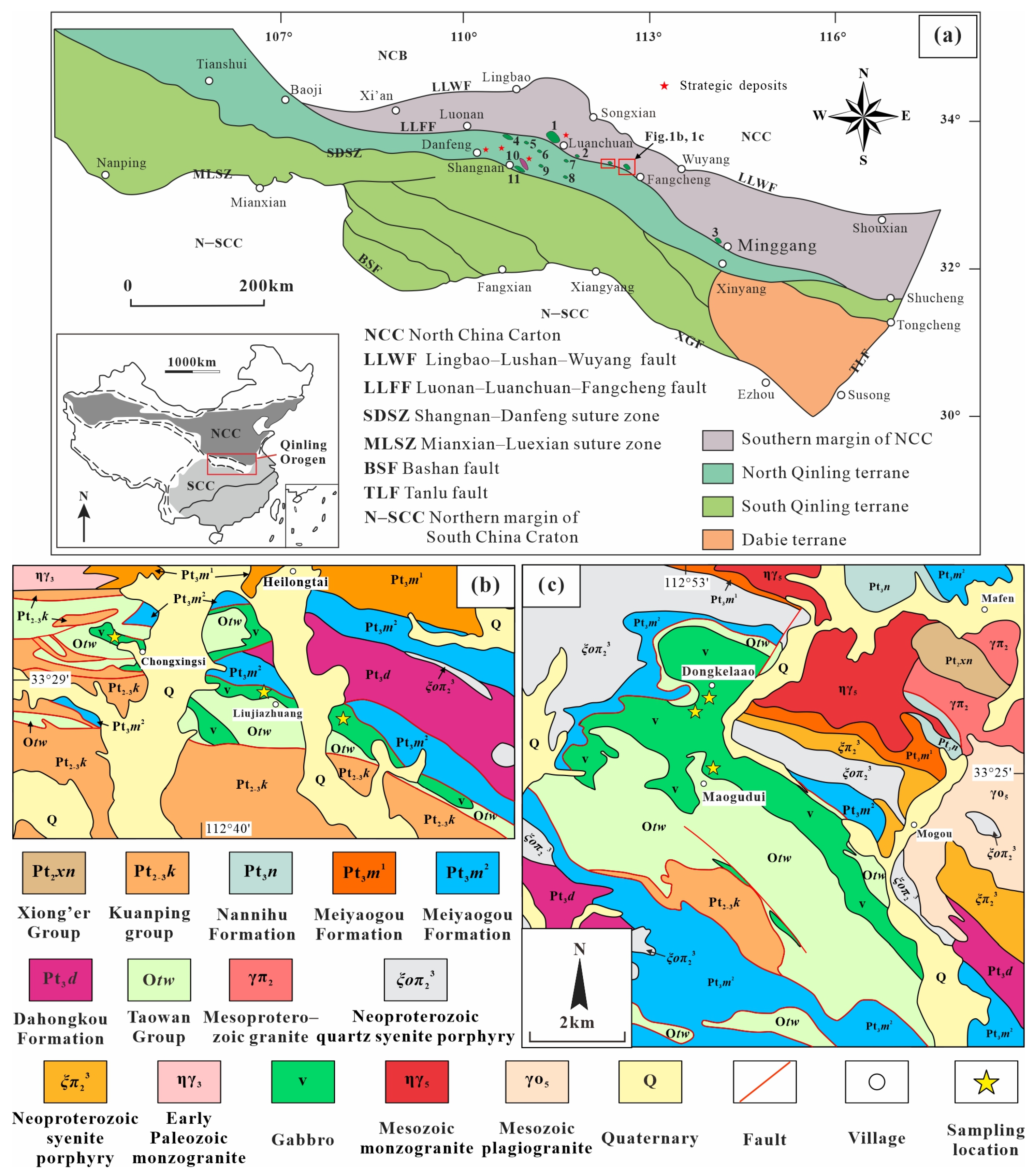
2. Geological Setting
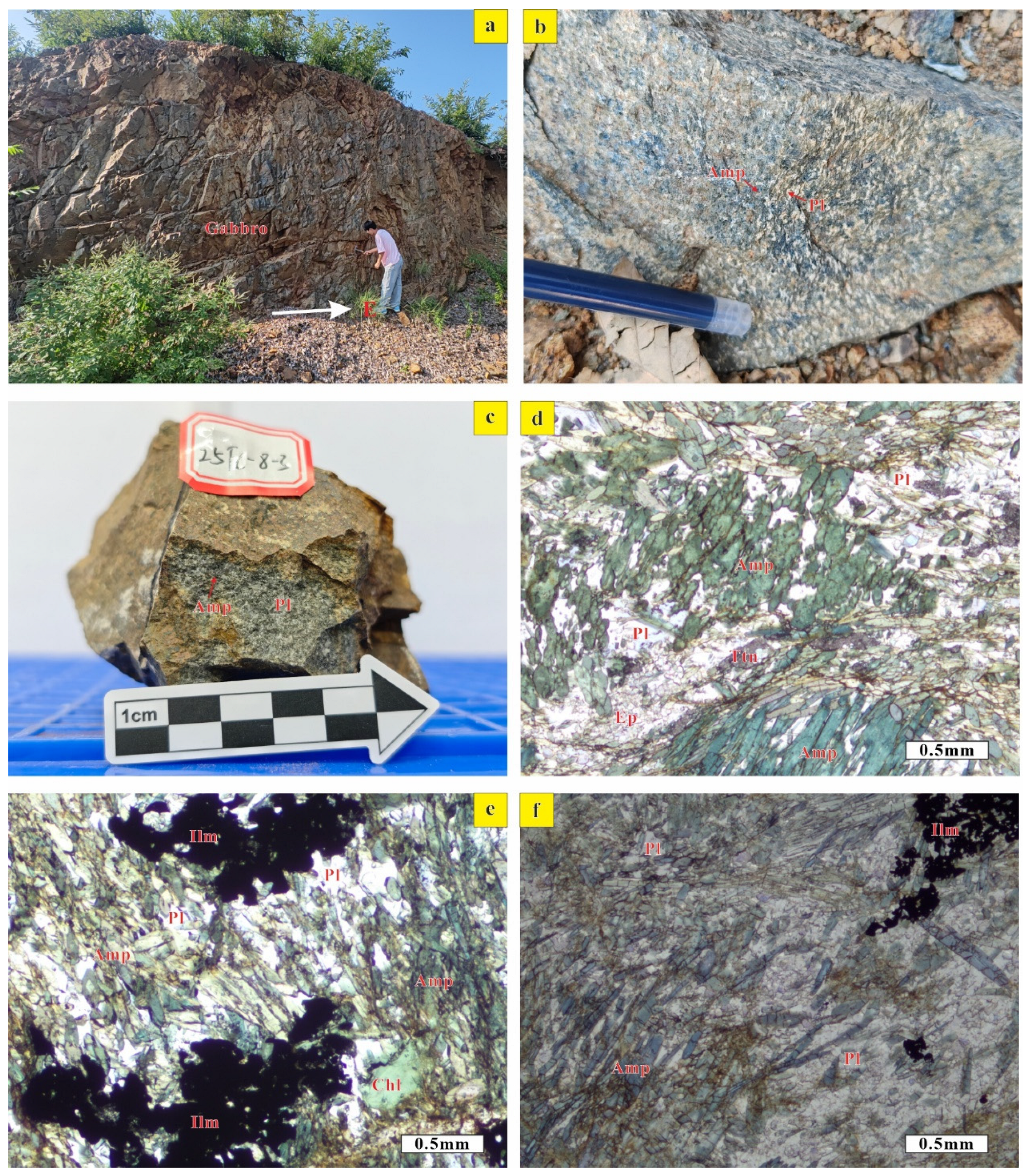
3. Petrological Characteristics
4. Analytical Methods
4.1. U–Pb Dating and REE Analyses of Zircons
4.2. Geochemistry Analyses of the HM Gabbros
5. Results
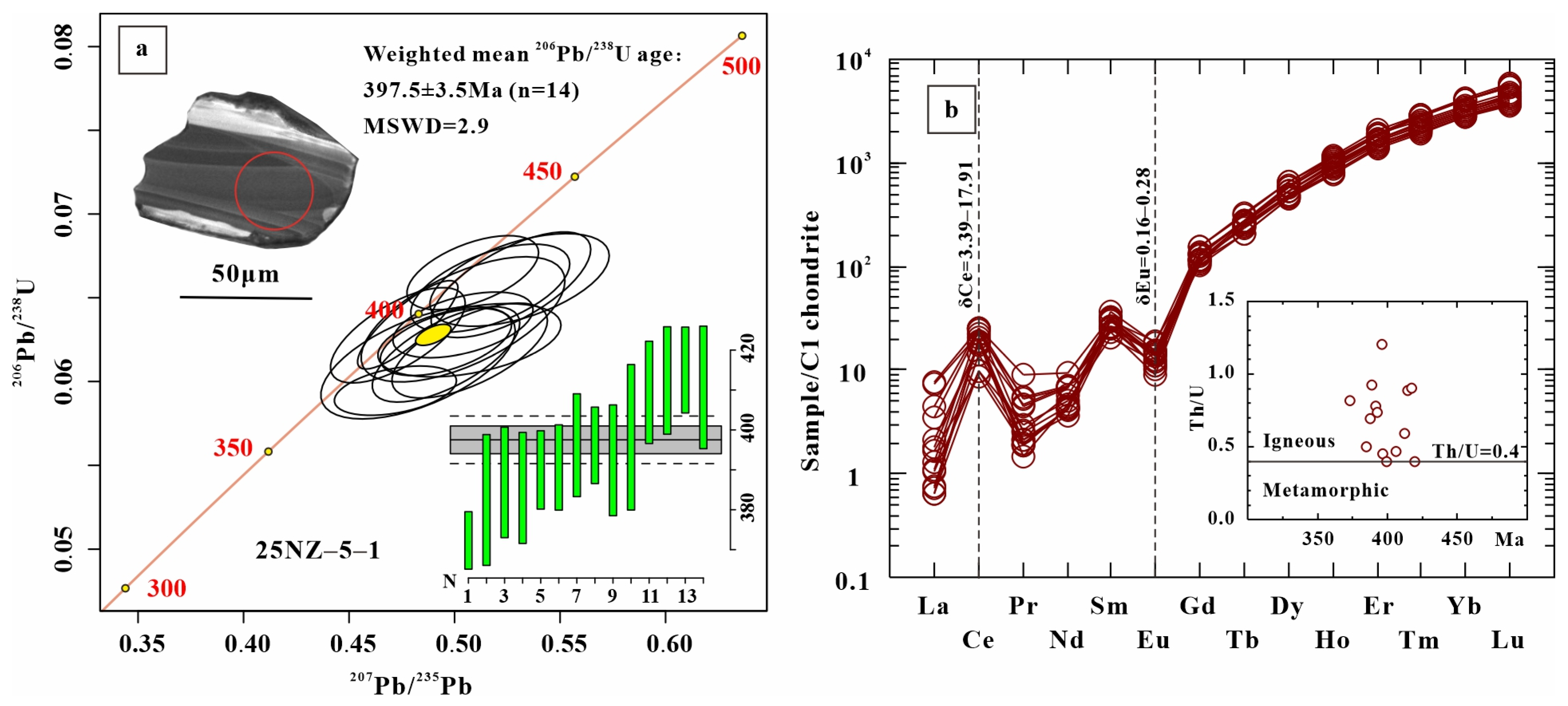
5.1. Zircon Texture, Trace Elements, and U–Pb Ages
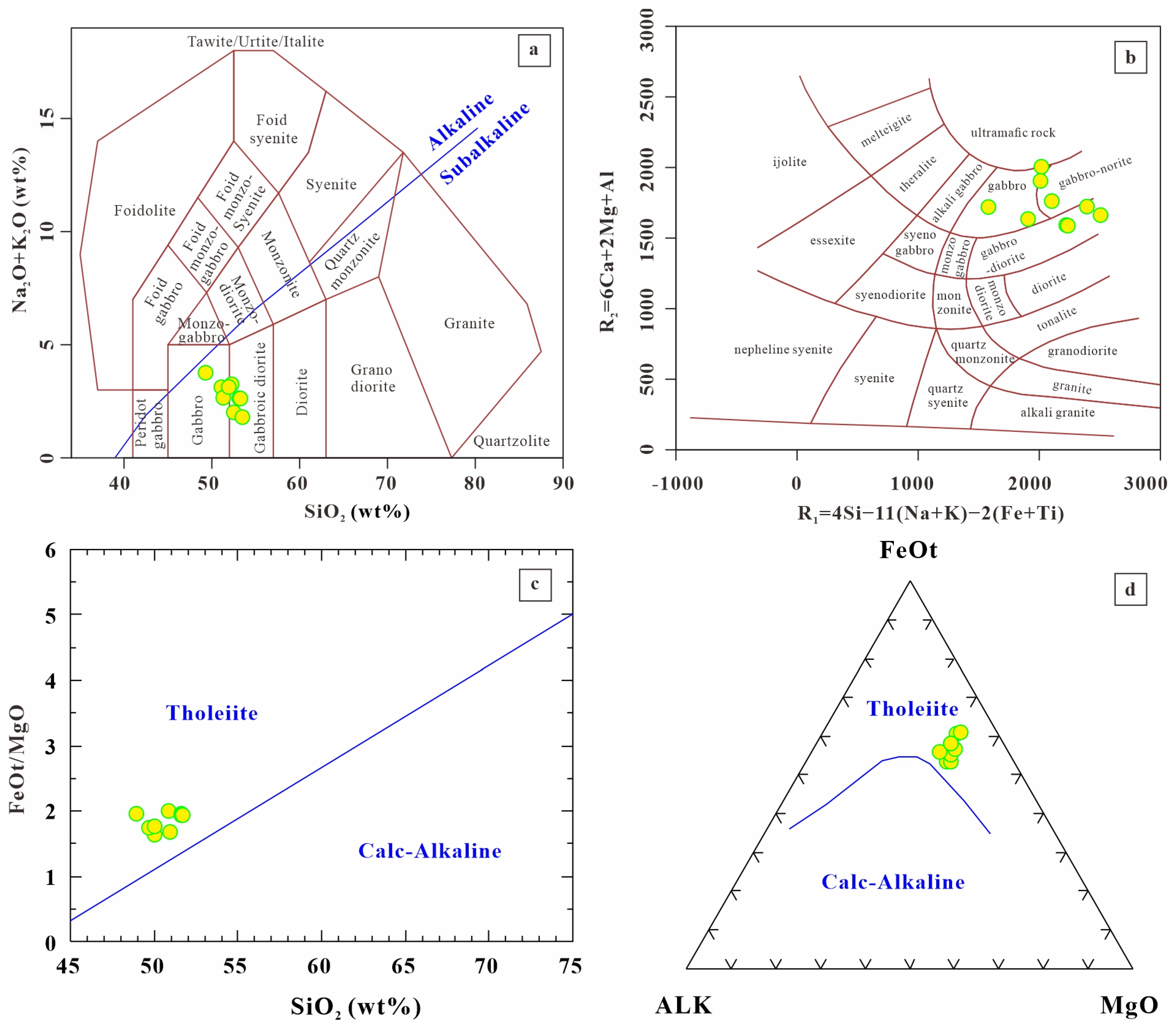
5.2. Whole-Rock Geochemistry
6. Discussion
6.1. Petrogenesis and Magma Source
6.1.1. Effect of Alteration
6.1.2. Crustal Contamination and Fractional Crystallization
6.1.3. Nature of the Mantle Source
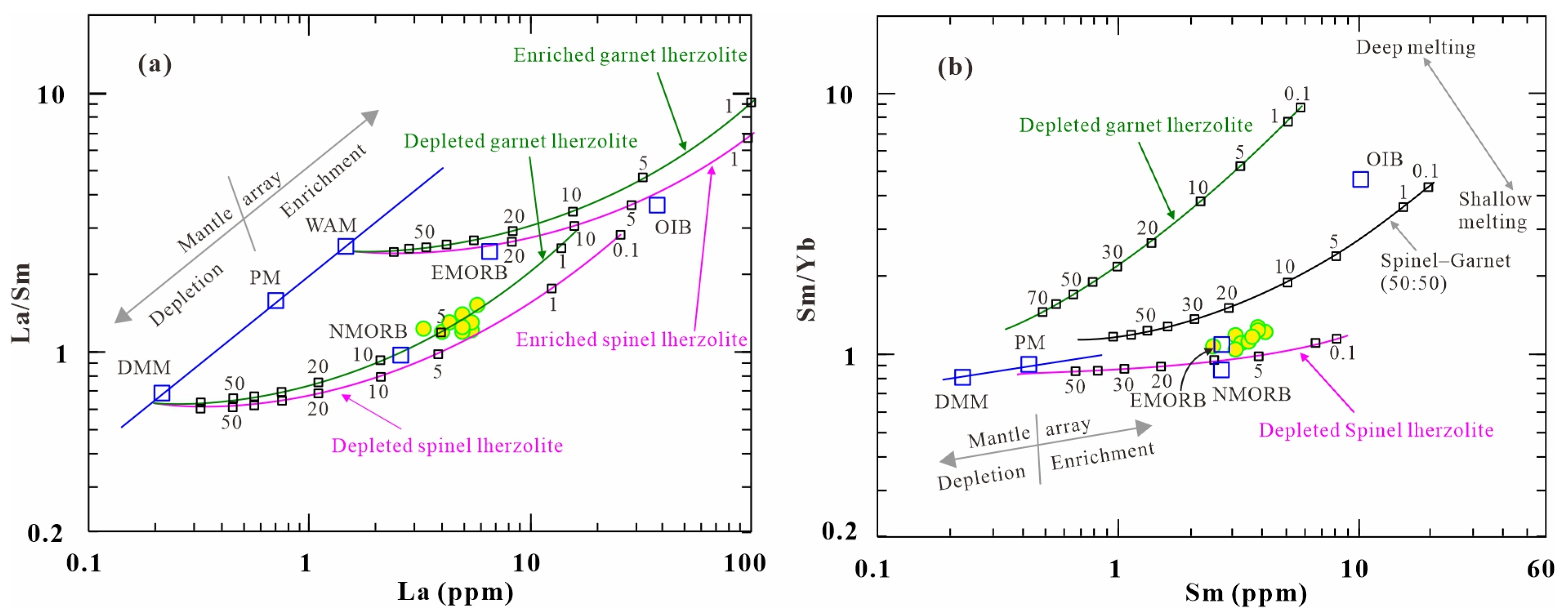
6.1.4. Partial Melting of the Mantle Source
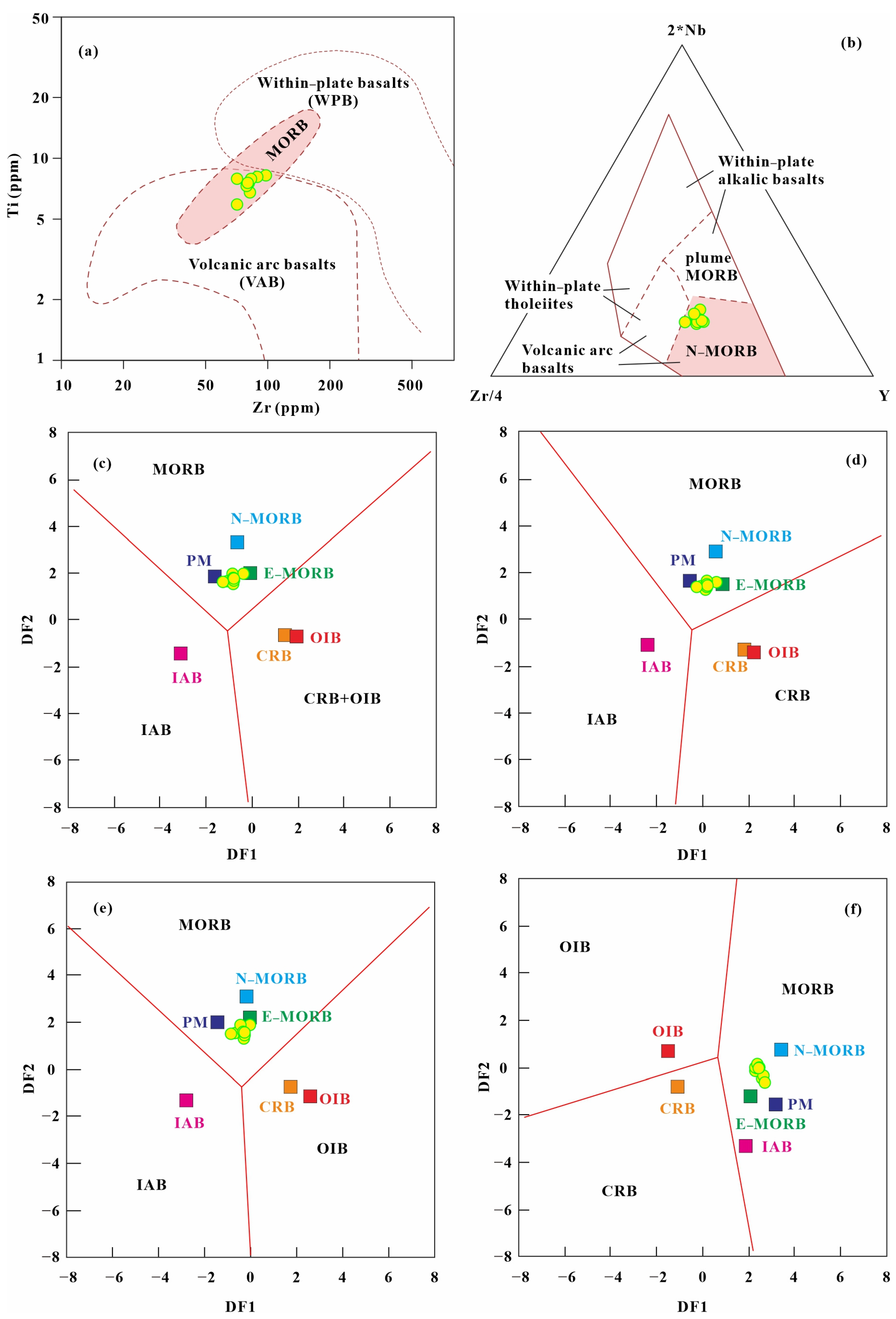
6.2. Tectonic Setting
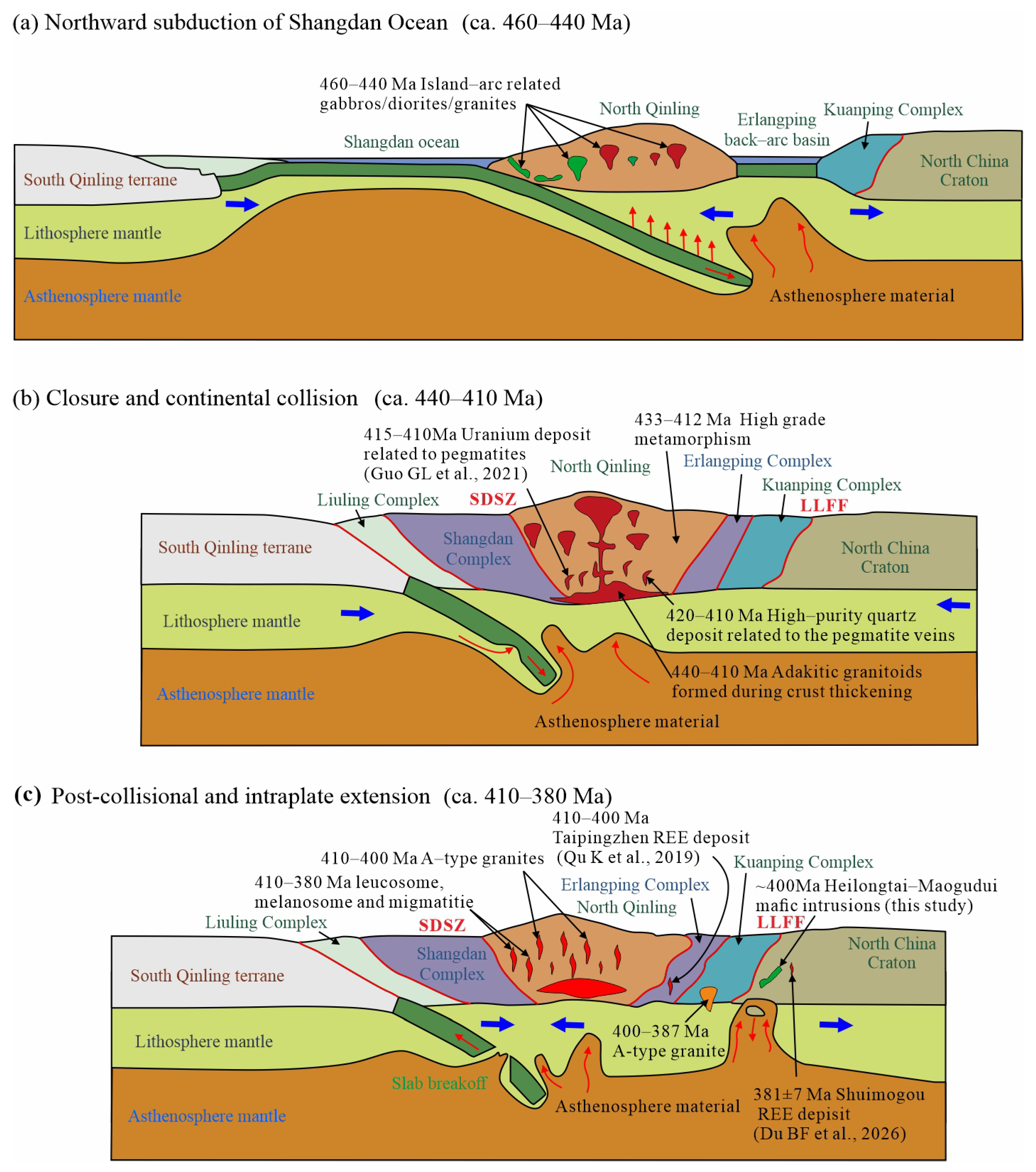
6.3. Implications for Tectonic Evolution and Regional Mineralization
7. Conclusions
- Zircon LA–ICPMS data form a concordant cluster, yielding a mean 206Pb/238U age of 397.5 ± 3.5 Ma (MSWD = 2.9), interpreted as the Early Devonian crystallization age. The HM mafic intrusions also indicate the end of the Paleozoic Proto–Tethyan orogenic cycle.
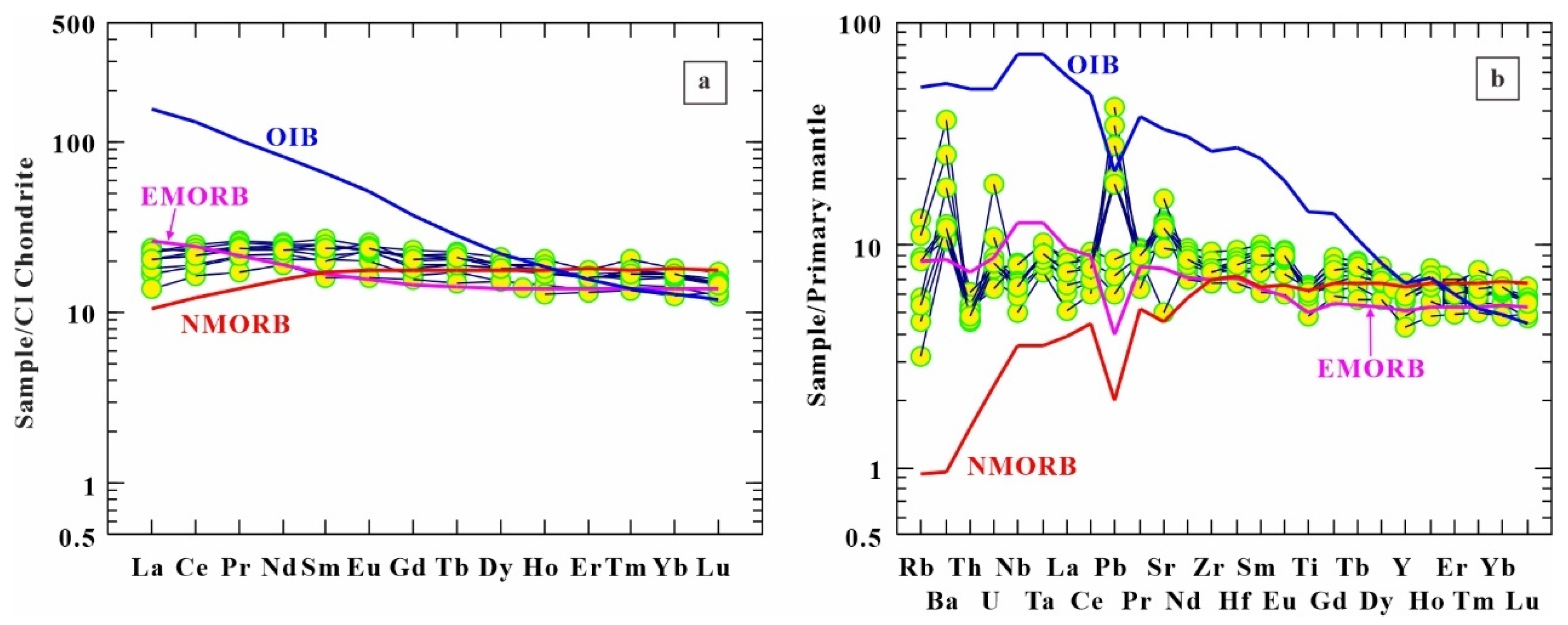
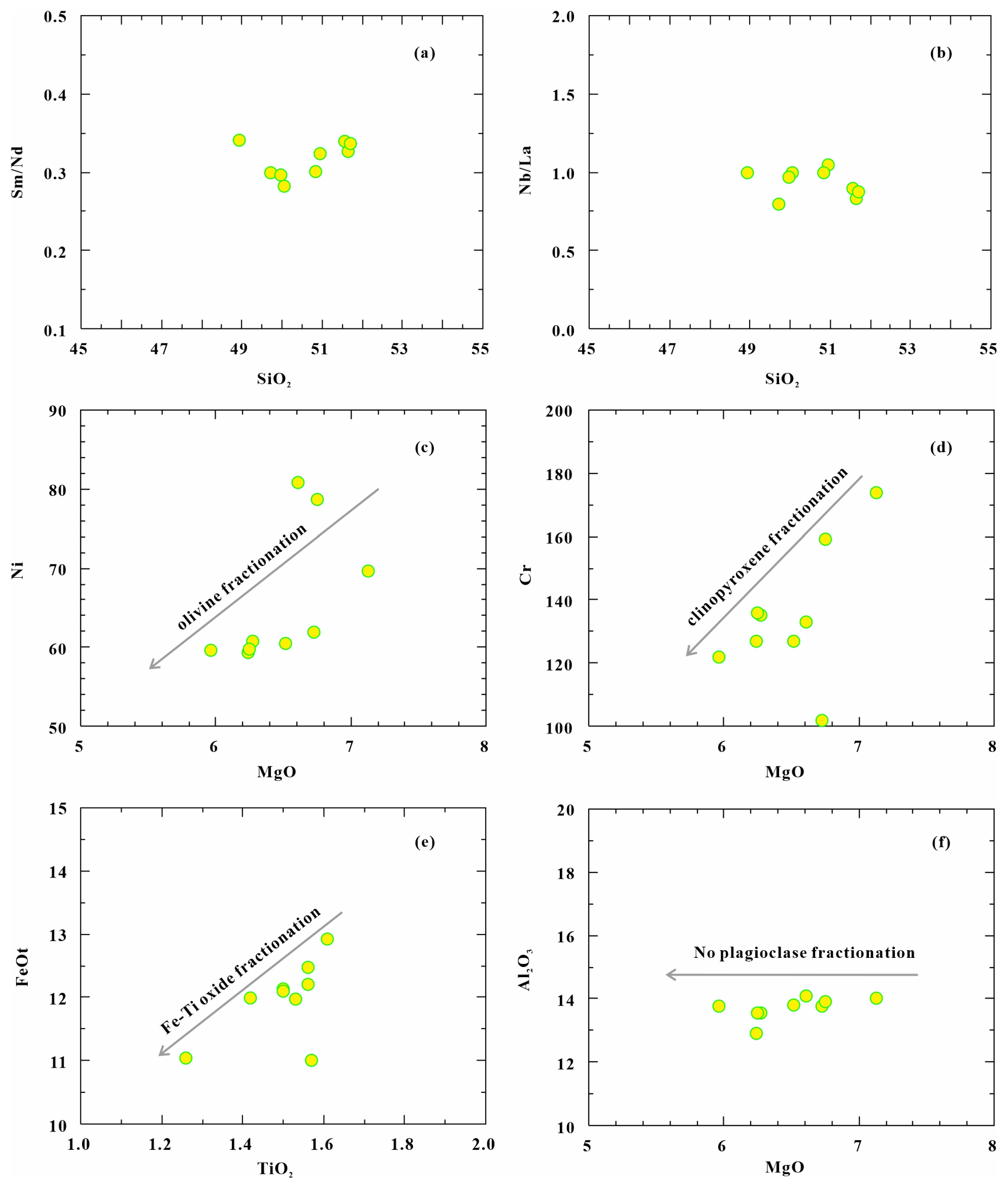
- The HM mafic intrusions have undergone fractionation of mainly olivine, clinopyroxene, and minor Fe–Ti oxides. The geochemical characteristics exhibit that the HM mafic intrusions belong to the tholeiitic series and display nearly flat REE and trace element patterns that are consistent with MORB.
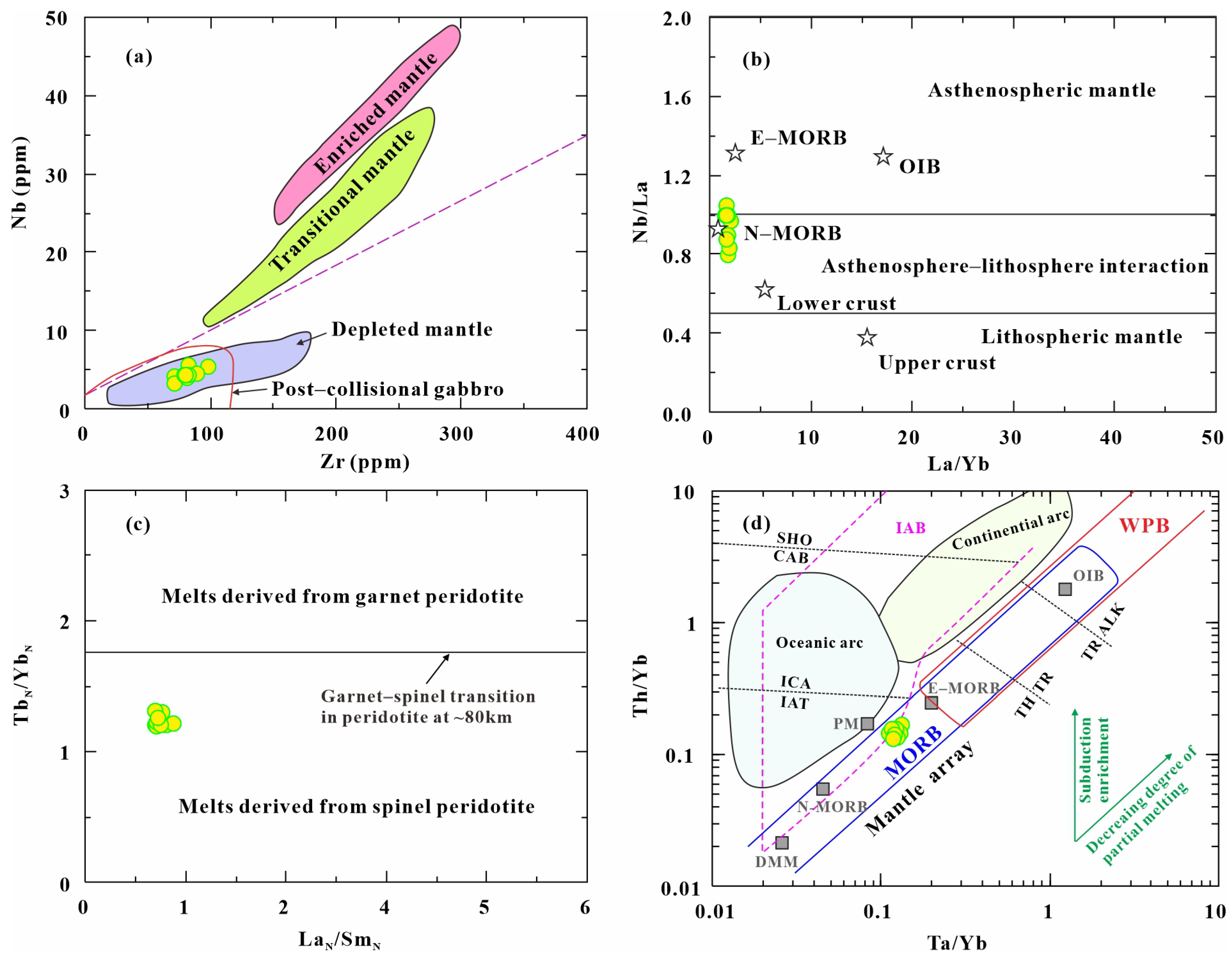
- The HM mafic intrusions typically originated in the continental extensional environment through 5–10% degrees of partial melting of the depleted spinel asthenosphere mantle source due to the gravitational delamination of the lithosphere mantle and the upwelling of the hot asthenosphere.
- Paleozoic strategic mineral deposits are proposed to have formed under a comparable specific tectonic regime to the HM mafic intrusions.
Author Contributions
Funding
Institutional Review Board Statement
Informed Consent Statement
Data Availability Statement
Acknowledgments
Conflicts of Interest
References
- Qu, K.; Sima, X.; Zhou, H.; Xiao, Z.; Tu, J.; Yin, Q.; Liu, X.; Li, J. In situ LA–MC–ICP–MS and ID–TIMS U–Pb ages of bastnäsite–(Ce) and zircon from the Taipingzhen hydrothermal REE deposit: New constraints on the later Paleozoic granite–related U–REE mineralization in the North Qinling Orogen, Central China. J. Asian Earth Sci. 2019, 173, 352–363. [Google Scholar] [CrossRef]
- Zhang, W.; Chen, W.T.; Gao, J.F.; Chen, H.K.; Li, J.H. Two episodes of REE mineralization in the Qinling Orogenic Belt, Central China: In–situ U–Th–Pb dating of bastnäsite and monazite. Miner. Depos. 2019, 54, 1265–1280. [Google Scholar] [CrossRef]
- Yu, D.; Ma, Y.; Wang, S.; Ma, C.; Wei, F. Mineralogy and Preparation of High-Purity Quartz: A Case Study from Pegmatite in the Eastern Sector of the North Qinling Orogenic Belt. Minerals 2025, 15, 788. [Google Scholar] [CrossRef]
- Guo, G.; Bonnetti, C.; Zhang, Z.; Li, G.; Yan, Z.; Wu, J.; Wu, Y.; Liu, X.; Wu, B. SIMS U–Pb Dating of Uraninite from the Guangshigou Uranium Deposit: Constraints on the Paleozoic Pegmatite–Type Uranium Mineralization in North Qinling Orogen, China. Minerals 2021, 11, 402. [Google Scholar] [CrossRef]
- Zhao, H.; Simonetti, A.; Simonetti, S.; Cao, X.; Du, Y. A Geochemical and Isotopic Investigation of Carbonatites from Huangshuian, Central China: Implications for Petrogenesis and Mantle Sources. Minerals 2024, 14, 953. [Google Scholar] [CrossRef]
- Qu, K.; Sima, X.; Li, G.; Fan, G.; Shen, G.; Liu, X.; Xiao, Z.; Guo, H.; Qiu, L.; Wang, Y. Fluorluanshiweiite, KLiAl1.5□0.5(Si3.5Al0.5)O10F2, a New Mineral of the Mica Group from the Nanyangshan LCT Pegmatite Deposit, North Qinling Orogen, China. Minerals 2020, 10, 93. [Google Scholar] [CrossRef]
- Yang, W.; Fang, T.; Wang, Y.; Sha, H. Late Paleozoic Tectonic Evolution of the Qinling Orogenic Belt: Constraints of Detrital Zircon U-Pb Ages from the Southern Margin of North China Block. Minerals 2022, 12, 864. [Google Scholar] [CrossRef]
- Wu, B.; Bonnetti, C.; Liu, Y.; Zhang, Z.-S.; Guo, G.-L.; Li, G.-L.; Hu, Y.-Q.; Yan, Z.-Y. Uraninite from the Guangshigou Pegmatite-Type Uranium Deposit in the North Qinling Orogen, Central China: Its Occurrence, Alteration and Implications for Post-Caledonian Uranium Circulation. Minerals 2021, 11, 729. [Google Scholar] [CrossRef]
- Wang, W.; Tan, S.; Wan, J.; Hu, X.; Peng, H.; Liu, C. Insights from Dikes for Multistage Granitic Magmatism in the Huayangchuan Uranium Polymetallic Deposit, Qinling Orogen. Minerals 2024, 14, 261. [Google Scholar] [CrossRef]
- Du, B.F.; Li, S.P.; Wu, M.Q.; Zhang, R.Z.; Chen, J.K.; Wang, L.; Li, S.S.; Qiu, K.F. Metallogenic age and process of the Shuimogo REE deposit in the south margin of the North China Craton. Earth Sci. Front. 2026, 33, 247–264, (In Chinese with English abstract). [Google Scholar]
- Lei, H.C.; Xia, F.; Ren, Q.; Dang, S.B.; Zhang, H.; Ye, Y.K.; Duan, J.B. Mineralogy, Geochemistry, and geochronology of the Paleoproterozoic pegmatite in the northern margin of the North China Craton, China: Implications for U–Th–Pb–Nb–Ta–REE polymetallic mineralization. Ore Geol. Rev. 2025, 187, 106948. [Google Scholar] [CrossRef]
- Shi, J.P.; Wu, G.; Yang, D.B.; Chen, Y.J.; Yang, H.T. Tectonic extension and pre–enrichment of REEs in the southern margin of the North China Craton during late Paleoproterozoic: Evidence from geochemistry and Lu–Hf–Nd isotopes of Longwangzhuang REE–bearing granite. Ore Geol. Rev. 2026, 191, 107186. [Google Scholar] [CrossRef]
- Li, Z.D.; Li, S.P.; Zeng, W.; Li, X.G.; Pan, X.N.; Zhang, S.B.; Guo, H.; Liu, W.G. Geological, geochemistry and Sr, Nd, Pb isotopic characteristics of the Dazhuang Nb–REE deposit in southern margin of the North China craton. Acta Geol. Sin. 2023, 97, 82–108, (In Chinese with English abstract). [Google Scholar]
- Teng, F.; Zhang, J.; Guo, W.; Bagas, L.; Yan, K.; Teng, Y.; Wei, Y.; Zhou, N.; Gao, Y.; Wei, L. Metamorphic Fluids with Magmatic Overprint in the Huayagou Gold Deposit, West Qinling Orogen, Central China: Evidence from Apatite and Tourmaline in Situ Geochemistry. Geosciences 2026, 16, 80. [Google Scholar] [CrossRef]
- Miao, G.; Dong, G.; Yan, G.; Qi, X.; Xiao, C.; Jiang, H.; Shi, Z. Geochemical Fingerprints of Magnetite in Yechangping Super-Large Mo-W Deposit, Western Henan, China: Constraints on Ore-Forming Evolution and Prospecting Implications. Minerals 2026, 16, 374. [Google Scholar] [CrossRef]
- HIGS (Henan Institute of Geological Survey). Regional Geology of China: Henan Volume; Geological Publishing House: Beijing, China, 2024; pp. 1–689, (In Chinese with English abstract). [Google Scholar]
- Gao, Q.L.; Zheng, J.P.; Zhang, Z.H.; Xiong, Q.; Chen, X. Complex evolution of the southern margin of the North China Craton: Evidence from LA–ICPMS U–Pb dating of zircons in Zhouzhuang meta–gabbro. Acta Petrol. Sin. 2009, 25, 3275–3286, (In Chinese with English abstract). [Google Scholar]
- Wang, X.L.; Jiang, S.Y.; Dai, B.Z.; Griffin, W.L.; Dai, M.N.; Yang, Y.H. Age, geochemistry and tectonic setting of the Neoproterozoic, ca 830Ma. gabbros on the southern margin of the North China Craton. Precambrian Res. 2011, 190, 35–47. [Google Scholar] [CrossRef]
- Wang, H.; Wu, Y.B.; Qin, Z.W.; Zhu, L.Q.; Liu, Q.; Liu, X.C.; Gao, S.; Wijbrans, J.R.; Zhou, L.; Gong, H.J.; et al. Age and geochemistry of Silurian gabbroic rocks in the Tongbai orogen, central China: Implications for the geodynamic evolution of the North Qinling arc–back–arc system. Lithos 2013, 179, 1–15. [Google Scholar] [CrossRef]
- Wang, H.; Wu, Y.B.; Li, C.R.; Zhao, T.Y.; Qin, Z.W.; Zhu, L.Q.; Gao, S.; Zheng, J.P.; Liu, X.M.; Zhou, L.; et al. Recycling of sediment into the mantle source of K–rich mafic rocks: Sr–Nd–Hf–O isotopic evidence from the Fushui complex in the Qinling orogen. Contrib. Mineral. Petrol. 2014, 168, 1062. [Google Scholar] [CrossRef]
- Li, Z.S.; Jia, C.; Zhao, Z.Y.; Huo, J.J.; Li, Q.Z.; Zhang, J.D. Depositional age and provenance analysis of the Luanchuan Group in the southern margin of North China Craton and its significance for regional tectonic evolution:constraints from zircon U–Pb geochronology and Hf isotopes. Acta Geol. Sin. 2020, 94, 1046–1066, (In Chinese with English abstract). [Google Scholar]
- Peng, P.; Mitchell, R.N.; Zhang, N.; Su, X.; Li, Y.; Sun, F.; Wang, C.; Guo, J.; Zhai, M. Basal mantle structure regenerated through supercontinents. Nat. Commun. 2025, 16, 9666. [Google Scholar] [CrossRef]
- Sun, S.; Dong, Y.; He, D.; Cheng, C.; Liu, X. Thickening and partial melting of the Northern Qinling Orogen, China: Insights from zircon U–Pb geochronology and Hf isotopic composition of migmatites. J. Geol. Soc. 2019, 176, 1218–1231. [Google Scholar] [CrossRef]
- Chang, H.; Hu, P.; Zhou, G.; Zhang, W.; He, Y.; Zhao, Y.; Bauer, A.M.; Hu, Z.; Wu, Y. Development of a back–arc basin from initial rifting to seafloor spreading: Constraints from Paleozoic basic rocks in the North Qinling accretionary orogen, central China. Geol. Soc. Am. Bull. 2023, 136, 1511–1525. [Google Scholar] [CrossRef]
- Zhao, L.; Li, Y.; Xiang, H.; Zheng, J.; Xiao, W.; Chen, X.; Jiang, H.; Xie, Y.; Brouwer, F.M. A Devonian Shoshonitic Appinite–Granite Suite in the North Qinling Orogenic Belt: Implications for Partial Melting of a Water–Fluxed Lithospheric Mantle in an Extensional Setting. J. Petrol. 2023, 64, egad040. [Google Scholar] [CrossRef]
- Liu, X.Y.; Han, X.; Liang, T.; Li, L.M.; Ren, S.L.; Li, J.H. Petrogenesis and tectonic implications of the Fanpu diorite in the northern Qinling orogenic belt. Chin. J. Geol. 2024, 59, 52–64, (In Chinese with English abstract). [Google Scholar]
- Meng, Q.R.; Wu, G.L.; Wan, B.; Zhu, R.X.; Duan, L.; Wang, B.; Hu, J.M. Proto–Tethyan tectonics in East China: A revisit. Natl. Sci. Rev. 2025, 12, 153. [Google Scholar] [CrossRef]
- Zeng, W.; Sun, F.Y.; Li, C.D.; Li, Z.D.; Cheng, Y.H.; Liu, W.G.; Tu, J.R.; Zhang, C.; Liu, X.; Sun, W.Z. Geological and geochemical characteristics of intermediate–basic intrusions in Funiushan area, southern margin of the North China Craton: Implications for tectonic environment and mantle properties in the Early Cretaceous. Lithos 2025, 514–515, 108193. [Google Scholar] [CrossRef]
- Zhang, F.; Li, M.; Dong, Y.; Gan, C.; Zhu, Z.; Han, W.; Wang, Y. Unveiling an Ordovician continental back-arc basin: Insights from the gabbros and adakitic granitoids of the Erlangping unit, Tongbai Orogen (Central China). Lithos 2026, 532–533, 108506. [Google Scholar] [CrossRef]
- Bao, Z.W.; Li, C.J.; Qi, J.P. SHRIMP zircon U–Pb age of the gabbro dyke in the Luanchuan Pb–Zn–Ag orefield, East Qinling orogen and its constraint on mineralization time. Acta Petrol. Sin. 2009, 25, 2951–2956, (In Chinese with English abstract). [Google Scholar]
- Zhao, G.; Wang, Y.; Huang, B.; Dong, Y.; Li, S.; Zhang, G.; Yu, S. Geological reconstructions of the East Asian blocks: From the breakup of Rodinia to the assembly of Pangea. Earth–Sci. Rev. 2018, 186, 262–286. [Google Scholar] [CrossRef]
- Dong, Y.; Santosh, M. Tectonic architecture and multiple orogeny of the Qinling Orogenic Belt, Central China. Gondwana Res. 2016, 29, 1–40. [Google Scholar] [CrossRef]
- Huang, J.H.; Huang, Z.Z.; Chen, D.L.; Li, K.K.; Huang, X.X.; Ren, M.H.; Fan, Y.Z. Tectonic Setting of the Neoproterozoic Gabbroic Intrusions in the Luanchuan Area, Southern Margin of the North China Craton: Constraints from Ilmenite and Biotite Mineralogy. Minerals 2025, 15, 602. [Google Scholar] [CrossRef]
- Zhao, L.G.; Li, C.D.; Xu, Y.W.; Wu, Z.Y.; Chang, Q.S.; Xu, T.; Teng, X.M. Geochemistry of Nb–Enriched Gabbros in Zhaigen Area in Northern Qinling and Their Tectonic Significance. Earth Sci. 2019, 44, 135–144, (In Chinese with English abstract). [Google Scholar]
- Chen, Y.; Zhou, Z.; Xu, C. Transition from orogenic plateau to thinning reveals mesozoic North China craton dynamics. Commun. Earth Environ. 2025, 6, 791. [Google Scholar] [CrossRef]
- Ren, L.; Liang, H.; Bao, Z.; Huang, W. Early Paleozoic magmatic “flare–ups” in western Qinling orogeny, China: New insights into the convergence history of the North and South China Blocks at the northern margin of Gondwana. Lithos 2021, 380–381, 105833. [Google Scholar] [CrossRef]
- Zhao, T.P.; Zhou, M.F.; Zhai, M.; Xia, B. Paleoproterozoic Rift–Related Volcanism of the Xiong’er Group, North China Craton: Implications for the Breakup of Columbia. Int. Geol. Rev. 2002, 44, 336–351. [Google Scholar] [CrossRef]
- Hu, G.H.; Zhang, S.H.; Zhang, Q.Q.; Wang, S.Y. New geochronological constraints on the Dahongkou Formation of the Luanchuan Group and its implications on the Neoproterozoic tectonic evolution of the southern margin of the North China Craton. Acta Petrol. Sin. 2019, 35, 2503–2517, (In Chinese with English abstract). [Google Scholar]
- Li, Y.; Yang, J.; Dilek, Y.; Zhang, J.; Pei, X.; Chen, S.; Xu, X.; Li, J. Crustal architecture of the Shangdan suture zone in the early Paleozoic Qinling orogenic belt, China: Record of subduction initiation and backarc basin development. Gondwana Res. 2015, 27, 733–744. [Google Scholar] [CrossRef]
- Pang, L.Y.; Zhu, X.Y.; Hu, G.H.; Qiu, Y.F.; Su, W.B.; Wang, S.Y.; Zhao, T.P. Advances in the study of Meso–Neoproterozoic stratigraphic chronology and sedimentary evolution in the southern margin of the North China Craton. J. Stratigr. 2021, 45, 180–195, (In Chinese with English abstract). [Google Scholar]
- Zeng, L.; Zheng, H.; Zhang, D.; Han, S.; Peng, H.; Kang, P.; Ma, S. Early Palaeozoic PTtD paths of the eastern Shangdan Shear Zone in Qinling Orogen, central China. Int. Geol. Rev. 2025, 23, 2495–2520. [Google Scholar] [CrossRef]
- Diwu, C.; Long, X.; Li, S. Tectonic evolution of the North Qinling Orogenic Belt, Central China: Insights from metamafic rocks of the Songshugou Complex. Geol. J. 2018, 54, 2382–2399. [Google Scholar] [CrossRef]
- Wiedenbeck, M.; AllÉ, P.; Corfu, F.; Griffin, W.L.; Meier, M.; Oberli, F.; Quadt, A.V.; Roddick, J.C.; Spiegel, W. Three Natural Zircon Standards for U–Th–Pb, Lu–Hf, Trace Element and Ree Analyses. Geostand. Newsl. 1995, 19, 1–23. [Google Scholar] [CrossRef]
- Sláma, J.; Košler, J.; Condon, D.J.; Crowley, J.L.; Gerdes, A.; Hanchar, J.M.; Horstwood, M.S.A.; Morris, G.A.; Nasdala, L.; Norberg, N.; et al. Plešovice zircon—A new natural reference material for U–Pb and Hf isotopic microanalysis. Chem. Geol. 2008, 249, 1–35. [Google Scholar] [CrossRef]
- Andersen, T. Correction of common lead in U–Pb analyses that do not report 204Pb. Chem. Geol. 2002, 192, 59–79. [Google Scholar] [CrossRef]
- Vermeesch, P. IsoplotR: A free and open toolbox for geochronology. Geosci. Front. 2018, 9, 1479–1493. [Google Scholar] [CrossRef]
- Sun, S.S.; McDonough, W.F. Chemical and isotopic systematics of oceanic basalts: Implications for mantle composition and processes. Geol. Soc. Lond. Spec. Publ. 1989, 42, 313–345. [Google Scholar] [CrossRef]
- Rubatto, D.; Gebauer, D. Use of cathodoluminescence for U–Pb zircon dating by IOM Microprobe: Some examples from the western Alps. In Cathodoluminescence in Geosciences; Pagel, M., Barbin, V., Blanc, P., Ohnenstetter, D., Eds.; Springer: Berlin/Heidelberg, Germany, 2000; pp. 373–400. [Google Scholar]
- Wu, Y.B.; Zheng, Y.F. Genesis of zircon and its constraints on interpretation of U–Pb age. Chin. Sci. Bull. 2004, 49, 1554–1569. [Google Scholar] [CrossRef]
- Siebel, W.; Schmitt, A.K.; Danišík, M.; Chen, F.; Meier, S.; Weiß, S.; Eroǧlu, S. Prolonged mantle residence of zircon xenocrysts from the western Eger rift. Nat. Geosci. 2009, 2, 886–890. [Google Scholar] [CrossRef]
- Hoskin, P.W.O.; Ireland, T.R. Rare earth element chemistry of zircon and its use as a provenance indicator. Geology 2000, 28, 627–630. [Google Scholar] [CrossRef]
- Hoskin, P.W.O.; Schaltegger, U. The Composition of Zircon and Igneous and Metamorphic Petrogenesis. Rev. Mineral. Geochem. 2003, 53, 27–62. [Google Scholar] [CrossRef]
- Middlemost, E.A. Naming materials in the magma/igneous rock system. Earth–Sci. Rev. 1994, 37, 215–224. [Google Scholar] [CrossRef]
- De la Roche, H.D.; Leterrier, J.T.; Grandclaude, P.; Marchal, M. A classification of volcanic and plutonic rocks using R1 R2–diagram and major–element analyses—Its relationships with current nomenclature. Chem. Geol. 1980, 29, 183–210. [Google Scholar] [CrossRef]
- Miyashiro, A. Classification, Characteristics, and Origin of Ophiolites. J. Geol. 1975, 83, 249–281. [Google Scholar] [CrossRef]
- Irvine, T.N.; Baragar, W.R.A. A Guide to the Chemical Classification of the Common Volcanic Rocks. Can. J. Earth Sci. 1971, 8, 523–548. [Google Scholar] [CrossRef]
- Pearce, J.A. Trace element characteristics of lavas from destructive plate boundaries. In Andesites: Orogenic Andesites and Related Rocks; Thorpe, R.S., Ed.; John Wiley and Sons: Hoboken, NJ, USA, 1982; pp. 528–548. [Google Scholar]
- Gillis, K.M.; Banerjee, N.R. Hydrothermal alteration patterns in supra–subduction zone ophiolites. In Ophiolites and Oceanic Crust: New Insights from Field Studies and the Ocean Drilling Program; Geological Society of America: Boulder, CO, USA, 2000; Volume 349, pp. 283–297. [Google Scholar]
- Winchester, J.A.; Floyd, P.A. Geochemical magma type discrimination: Application to altered and metamorphosed basic igneous rocks. Earth Planet. Sci. Lett. 1976, 28, 459–469. [Google Scholar] [CrossRef]
- Polat, A.; Hofmann, A.W.; Rosing, M.T. Boninite–like volcanic rocks in the 3.7–3.8 Ga Isua greenstone belt, West Greenland: Geochemical evidence for intra–oceanic subduction zone processes in the early Earth. Chem. Geol. 2002, 184, 231–254. [Google Scholar] [CrossRef]
- Polat, A.; Hofmann, A.W. Alteration and geochemical patterns in the 3.7–3.8 Ga Isua greenstone belt, West Greenland. Precambrian Res. 2003, 126, 197–218. [Google Scholar] [CrossRef]
- Castro, A. The Appinite–Migmatite Complex of Sanabria, NW Iberian Massif, Spain. J. Petrol. 2003, 44, 1309–1344. [Google Scholar] [CrossRef]
- Rudnick, R.L.; Gao, S. Composition of the Continental Crust. Treatise Geochem. 2003, 3, 1–64. [Google Scholar]
- Wilson, M.E. Igneous petrogenesis: A Global Tectonic Approach; Springer: Dordrecht, The Netherlands; London, UK, 1989; pp. 1–466. [Google Scholar]
- Workman, R.K.; Hart, S.R. Major and trace element composition of the depleted MORB mantle, DMM. Earth Planet. Sci. Lett. 2005, 231, 53–72. [Google Scholar] [CrossRef]
- Dai, L.Q.; Zhao, Z.F.; Zheng, Y.F. Tectonic development from oceanic subduction to continental collision: Geochemical evidence from postcollisional mafic rocks in the Hong’an–Dabie orogens. Gondwana Res. 2015, 27, 1236–1254. [Google Scholar] [CrossRef]
- Geng, H.; Sun, M.; Yuan, C.; Zhao, G.; Xiao, W. Geochemical and geochronological study of early Carboniferous volcanic rocks from the West Junggar: Petrogenesis and tectonic implications. J. Asian Earth Sci. 2011, 42, 854–866. [Google Scholar] [CrossRef]
- Scandolara, J.E.; Ribeiro, P.S.E.; Frasca, A.A.S.; Fuck, R.A.; Rodrigues, J.B. Geochemistry and geochronology of mafic rocks from the Vespor suite in the Juruena arc, Roosevelt–Juruena terrain, Brazil: Implications for Proterozoic crustal growth and geodynamic setting of the SW Amazonian craton. J. S. Am. Earth Sci. 2014, 53, 20–49. [Google Scholar] [CrossRef]
- Khalil, A.E.S.; Obeid, M.A.; Azer, M.K. Late Neoproterozoic post–collisional mafic magmatism in the Arabian–Nubian Shield: A case study from Wadi El–Mahash gabbroic intrusion in southeast Sinai, Egypt. J. Afr. Earth Sci. 2015, 105, 29–46. [Google Scholar] [CrossRef]
- Kara, J.; Leskelä, T.; Väisänen, M.; Skyttä, P.; Lahaye, Y.; Tiainen, M.; Leväniemi, H. Early Svecofennian rift–related magmatism: Geochemistry, U–Pb–Hf zircon isotope data and tectonic setting of the Au–hosting Uunimäki gabbro, SW Finland. Precambrian Res. 2021, 364, 106364. [Google Scholar] [CrossRef]
- Wang, K.; Plank, T.; Walker, J.D.; Smith, E.I. A mantle melting profile across the Basin and Range, SW USA. J. Geophys. Res. Solid Earth 2002, 107, 5–21. [Google Scholar] [CrossRef]
- Aldanmaz, E.; Pearce, J.A.; Thirlwall, M.F.; Mitchell, J.G. Petrogenetic evolution of late Cenozoic, post–collision volcanism in western Anatolia, Turkey. J. Volcanol. Geotherm. Res. 2000, 102, 67–95. [Google Scholar] [CrossRef]
- Sandeman, H.; Hanmer, S.; Tella, S.; Armitage, A.; Davis, W.; Ryan, J. Petrogenesis of Neoarchaean volcanic rocks of the MacQuoid supracrustal belt: A back–arc setting for the northwestern Hearne subdomain, western Churchill Province, Canada. Precambrian Res. 2006, 144, 140–165. [Google Scholar] [CrossRef]
- Salters, V.J.M.; Stracke, A. Composition of the depleted mantle. Geochem. Geophys. Geosystems 2004, 5, Q05B07. [Google Scholar] [CrossRef]
- McKenzie, D.A.N.; O’Nions, R.K. Partial melt distributions from inversion of rare earth element concentrations. J. Petrol. 1991, 32, 1021–1091. [Google Scholar] [CrossRef]
- Zheng, F.; Dai, L.Q.; Zhao, Z.F.; Zheng, Y.F.; Xu, Z. Recycling of Paleo–oceanic crust: Geochemical evidence from Early Paleozoic mafic igneous rocks in the Tongbai orogen, Central China. Lithos 2019, 329, 312–327. [Google Scholar] [CrossRef]
- Shaw, D.M. Trace element fractionation during anatexis. Geochim. Cosmochim. Acta 1970, 34, 237–243. [Google Scholar] [CrossRef]
- Kinzler, R.J. Melting of mantle peridotite at pressures approaching the spinel to garnet transition: Application to mid-ocean ridge basalt petrogenesis. J. Geophys. Res. Solid Earth 1997, 102, 853–874. [Google Scholar] [CrossRef]
- Walter, M.J. Melting of Garnet Peridotite and the Origin of Komatiite and Depleted Lithosphere. J. Petrol. 1998, 39, 29–60. [Google Scholar] [CrossRef]
- Pearce, J.A.; Cann, J.R. Tectonic setting of basic volcanic rocks determined using trace element analyses. Earth Planet. Sci. Lett. 1973, 19, 290–300. [Google Scholar] [CrossRef]
- Meschede, M. A method of discriminating between different types of mid–ocean ridge basalts and continental tholeiites with the Nb–Zr–Y diagram. Chem. Geol. 1986, 56, 207–218. [Google Scholar] [CrossRef]
- Agrawal, S.; Guevara, M.; Verma, S.P. Tectonic Discrimination of Basic and Ultrabasic Volcanic Rocks through Log–Transformed Ratios of Immobile Trace Elements. Int. Geol. Rev. 2010, 50, 1057–1079. [Google Scholar] [CrossRef]
- Boedo, F.L.; Vujovich, G.I.; Kay, S.M.; Ariza, J.P.; Pérez Luján, S.B. The E–MORB like geochemical features of the Early Paleozoic mafic–ultramafic belt of the Cuyania terrane, western Argentina. J. S. Am. Earth Sci. 2013, 48, 73–84. [Google Scholar] [CrossRef]
- Bonin, B. Do coeval mafic and felsic magmas in post–collisional to within–plate regimes necessarily imply two contrasting, mantle and crustal, sources? A review. Lithos 2004, 78, 1–24. [Google Scholar] [CrossRef]
- Wang, W.; Pandit, M.K.; Zhao, J.H.; Chen, W.T.; Zheng, J.P. Slab break–off triggered lithosphere–asthenosphere interaction at a convergent margin: The Neoproterozoic bimodal magmatism in NW India. Lithos 2018, 299, 281–296. [Google Scholar] [CrossRef]
- Yu, H.; Zhang, H.F.; Li, X.H.; Zhang, J.; Santosh, M.; Yang, Y.H.; Zhou, D.W. Tectonic evolution of the North Qinling Orogen from subduction to collision and exhumation: Evidence from zircons in metamorphic rocks of the Qinling Group. Gondwana Res. 2016, 30, 65–78. [Google Scholar] [CrossRef]
- Liang, L.; Li, W.; Dong, Y.; Zhang, L.; Sheir, F.; Jiang, L.; Feng, Z.; Wang, C.; Basil, A.; Ma, Z. Late Palaeozoic tectonic transformation of the North Qinling Orogenic Belt: Insight from the geochronology, geochemistry and Sr-Nd-Hf isotopes of Carboniferous magmatic rocks. Geol. J. 2024, 59, 1280–1297. [Google Scholar] [CrossRef]
- Torsvik, T.H.; Cocks, L.R.M. Gondwana from top to base in space and time. Gondwana Res. 2013, 24, 999–1030. [Google Scholar] [CrossRef]
- Bader, T.; Zhang, L.; Li, X. Is the Songshugou Complex, Qinling Belt, China, an Eclogite Facies Neoproterozoic Ophiolite? J. Earth Sci. 2019, 30, 460–475. [Google Scholar] [CrossRef]
- Li, H.; Yan, K.; Li, K.; Yang, K.; Fan, B.; Xue, Z.; Chen, L.; Guo, H. Detrital Zircon U–Pb Age Data and Geochemistry of Clastic Rocks in the Xiahe–Hezuo Area: Implications for the Late Paleozoic–Mesozoic Tectonic Evolution of the West Qinling Orogen. Geosciences 2025, 15, 384. [Google Scholar] [CrossRef]
- Yuan, F.; Jiang, S.Y.; Liu, J.; Zhang, S.; Xiao, Z.; Liu, G.; Hu, X. Geochronology and Geochemistry of Uraninite and Coffinite: Insights into Ore-Forming Process in the Pegmatite-Hosted Uraniferous Province, North Qinling, Central China. Minerals 2019, 9, 552. [Google Scholar] [CrossRef]
- Zhang, H.F.; Zhang, B.R.; Harris, N.; Zhang, L.; Chen, Y.L.; Chen, N.S.; Zhao, Z.D. U–Pb zircon SHRIMP ages, geochemical and Sr–Nd–Pb isotopic compositions of intrusive rocks from the Longshan–Tianshui area in the southeast corner of the Qilian orogenic belt, China: Constraints on petrogenesis and tectonic affinity. J. Asian Earth Sci. 2006, 27, 751–764. [Google Scholar] [CrossRef]
- Qin, J.F.; Lai, S.C.; Long, X.P.; Zhang, Z.Z.; Ju, Y.J.; Zhu, R.Z.; Wang, X.Y.; Li, Y.F.; Wang, J.B.; Li, T. Thermotectonic evolution of the Paleozoic granites along the Shangdan suture zone, central China): Crustal growth and differentiation by magma underplating in an orogenic belt. GSA Bull. 2021, 133, 523–538. [Google Scholar] [CrossRef]
- Mao, X.H.; Zhang, J.X.; Yu, S.Y.; Li, Y.S.; Yu, X.X.; Lu, Z.L. Early Paleozoic granulite–facies metamorphism and anatexis in the northern West Qinling orogen: Monazite and zircon U–Pb geochronological constraints. Sci. China Earth Sci. 2017, 60, 943–957. [Google Scholar] [CrossRef]
- Vanderhaeghe, O.; Teyssier, C. Crustal–scale rheological transitions during late–orogenic collapse. Tectonophysics 2001, 335, 211–228. [Google Scholar] [CrossRef]



| Spots | Th/U Ratio | Concentration (ppm) | Isotopic Ratios | Age (Ma) | Concordance | |||||||||||
|---|---|---|---|---|---|---|---|---|---|---|---|---|---|---|---|---|
| U | Th | 207Pb/206Pb | 2σ | 207Pb/235U | 2σ | 206Pb/238U | 2σ | 207Pb/206Pb | 2σ | 207Pb/235U | 2σ | 206Pb/238U | 2σ | |||
| 25NZ5-1@1 | 0.82 | 164.70 | 134.80 | 0.0576 | 0.0026 | 0.4804 | 0.0205 | 0.0596 | 0.0012 | 494.4 | 97.9 | 397.7 | 14.0 | 373.3 | 7.4 | −6.55% |
| 25NZ5-1@2 | 0.50 | 341.86 | 170.88 | 0.0573 | 0.0036 | 0.4910 | 0.0265 | 0.0615 | 0.0028 | 514.5 | 131.3 | 405.0 | 18.2 | 385.0 | 16.9 | −5.21% |
| 25NZ5-1@3 | 0.69 | 222.64 | 154.29 | 0.0595 | 0.0027 | 0.5088 | 0.0311 | 0.0620 | 0.0023 | 578.1 | 94.9 | 417.2 | 20.8 | 387.8 | 13.9 | −7.57% |
| 25NZ5-1@4 | 0.93 | 430.71 | 398.69 | 0.0584 | 0.0025 | 0.5052 | 0.0216 | 0.0622 | 0.0023 | 558.9 | 80.4 | 413.9 | 14.5 | 388.5 | 14.0 | −6.51% |
| 25NZ5-1@5 | 0.78 | 367.31 | 285.53 | 0.0577 | 0.0025 | 0.5053 | 0.0225 | 0.0626 | 0.0017 | 518.7 | 91.4 | 414.6 | 15.2 | 391.5 | 10.0 | −5.89% |
| 25NZ5-1@6 | 0.74 | 193.75 | 142.61 | 0.0589 | 0.0037 | 0.5014 | 0.0351 | 0.0628 | 0.0017 | 548.4 | 125.4 | 410.7 | 22.9 | 392.6 | 10.4 | −4.61% |
| 25NZ5-1@7 | 1.20 | 371.65 | 446.99 | 0.0547 | 0.0012 | 0.4757 | 0.0268 | 0.0634 | 0.0021 | 397.8 | 51.0 | 395.1 | 18.4 | 396.3 | 12.9 | 0.30% |
| 25NZ5-1@8 | 0.45 | 290.21 | 131.31 | 0.0577 | 0.0027 | 0.5122 | 0.0274 | 0.0635 | 0.0017 | 551.8 | 66.3 | 419.4 | 18.8 | 396.9 | 10.0 | −5.68% |
| 25NZ5-1@9 | 0.40 | 282.69 | 113.31 | 0.0547 | 0.0022 | 0.4779 | 0.0210 | 0.0639 | 0.0022 | 446.2 | 79.2 | 395.2 | 14.2 | 399.2 | 13.4 | 1.01% |
| 25NZ5-1@10 | 0.47 | 112.33 | 52.57 | 0.0574 | 0.0035 | 0.4929 | 0.0273 | 0.0651 | 0.0028 | 588.3 | 101.9 | 409.9 | 21.5 | 406.2 | 17.1 | −0.91% |
| 25NZ5-1@11 | 0.59 | 180.59 | 106.65 | 0.0572 | 0.0028 | 0.5178 | 0.0287 | 0.0660 | 0.0021 | 476.9 | 102.3 | 422.5 | 18.9 | 412.0 | 12.9 | −2.55% |
| 25NZ5-1@12 | 0.89 | 380.31 | 338.12 | 0.0583 | 0.0032 | 0.5448 | 0.0370 | 0.0664 | 0.0023 | 552.3 | 108.3 | 440.2 | 24.2 | 414.5 | 13.7 | −6.20% |
| 25NZ5-1@13 | 0.90 | 267.44 | 241.74 | 0.0555 | 0.0023 | 0.5108 | 0.0265 | 0.0669 | 0.0018 | 449.7 | 81.1 | 417.7 | 17.7 | 417.4 | 10.8 | −0.05% |
| 25NZ5-1@14 | 0.40 | 169.75 | 67.45 | 0.0581 | 0.0025 | 0.5355 | 0.0254 | 0.0673 | 0.0027 | 575.0 | 79.3 | 433.4 | 16.9 | 419.3 | 16.0 | −3.37% |
| Spots | La | Ce | Pr | Nd | Sm | Eu | Gd | Tb | Dy | Ho | Er | Tm | Yb | Lu | ∑REE | Ce* | Eu* |
|---|---|---|---|---|---|---|---|---|---|---|---|---|---|---|---|---|---|
| 25NZ5-1@1 | 0.15 | 5.94 | 0.20 | 1.73 | 3.89 | 0.81 | 26.74 | 10.39 | 155.79 | 62.14 | 320.53 | 74.16 | 716.99 | 146.43 | 1525.89 | 8.26 | 0.24 |
| 25NZ5-1@2 | 0.15 | 12.51 | 0.19 | 1.98 | 5.50 | 1.04 | 32.38 | 11.78 | 163.46 | 63.58 | 317.39 | 65.13 | 605.01 | 119.63 | 1399.73 | 17.90 | 0.24 |
| 25NZ5-1@3 | 0.17 | 11.65 | 0.14 | 2.22 | 3.96 | 0.88 | 23.88 | 8.82 | 121.97 | 49.15 | 250.22 | 54.53 | 516.54 | 100.32 | 1144.45 | 17.88 | 0.27 |
| 25NZ5-1@4 | 0.18 | 8.76 | 0.25 | 2.70 | 3.90 | 0.84 | 21.19 | 7.88 | 113.81 | 44.46 | 225.33 | 48.82 | 462.99 | 91.95 | 1033.06 | 10.11 | 0.28 |
| 25NZ5-1@5 | 0.25 | 6.07 | 0.28 | 2.36 | 3.19 | 0.69 | 23.53 | 9.02 | 121.79 | 45.85 | 234.74 | 53.40 | 496.36 | 93.04 | 1090.56 | 5.58 | 0.24 |
| 25NZ5-1@6 | 0.26 | 11.63 | 0.20 | 1.96 | 4.83 | 0.82 | 31.77 | 12.41 | 163.46 | 66.97 | 348.73 | 73.71 | 681.77 | 136.61 | 1535.15 | 12.17 | 0.20 |
| 25NZ5-1@7 | 0.31 | 15.75 | 0.24 | 2.09 | 4.58 | 1.10 | 22.28 | 9.45 | 123.54 | 50.83 | 253.41 | 52.27 | 493.88 | 98.01 | 1127.74 | 14.05 | 0.33 |
| 25NZ5-1@8 | 0.39 | 5.31 | 0.18 | 2.01 | 3.99 | 0.64 | 24.16 | 9.77 | 135.49 | 55.29 | 274.50 | 62.80 | 590.19 | 112.63 | 1277.36 | 4.85 | 0.20 |
| 25NZ5-1@9 | 0.43 | 11.02 | 0.18 | 2.01 | 4.82 | 0.58 | 26.89 | 9.98 | 148.27 | 59.23 | 305.53 | 73.02 | 687.06 | 140.87 | 1469.86 | 9.74 | 0.16 |
| 25NZ5-1@10 | 0.51 | 10.75 | 0.45 | 3.28 | 3.61 | 0.53 | 23.61 | 9.12 | 123.48 | 50.94 | 267.20 | 58.00 | 537.37 | 113.12 | 1201.98 | 5.46 | 0.18 |
| 25NZ5-1@11 | 0.84 | 14.63 | 0.43 | 3.19 | 5.03 | 0.73 | 27.09 | 10.42 | 146.29 | 59.68 | 310.09 | 72.15 | 680.74 | 135.38 | 1466.69 | 5.87 | 0.19 |
| 25NZ5-1@12 | 1.06 | 15.72 | 0.86 | 4.32 | 4.97 | 0.90 | 28.38 | 9.91 | 132.86 | 54.14 | 281.32 | 61.12 | 551.05 | 115.51 | 1262.11 | 3.99 | 0.23 |
| 25NZ5-1@13 | 1.73 | 13.44 | 0.53 | 3.31 | 3.82 | 0.64 | 22.48 | 7.87 | 116.07 | 45.73 | 238.11 | 51.42 | 472.75 | 92.67 | 1070.57 | 3.39 | 0.21 |
| 25NZ5-1@14 | 1.82 | 15.15 | 0.50 | 3.18 | 4.47 | 0.79 | 26.26 | 10.33 | 135.10 | 53.20 | 268.32 | 57.38 | 529.24 | 105.08 | 1210.82 | 3.85 | 0.22 |
| Sample No. | 25FC-5-1 | 25FC-5-2 | 25FC-5-3 | 25NZ-8-1 | 25NZ-8-2 | 25NZ-8-3 | 25NZ-8-4 | 25NZ-8-5 | 25NZ-8-6 |
|---|---|---|---|---|---|---|---|---|---|
| Locality | Maogudui | Dongkelaao | Chongxingsi | Liujiazhuang | |||||
| 112°53′51″ E | 112°53′42″ E | 112°39′27″ E | 112°41′09″ E | ||||||
| 33°25′18″ N | 33°25′36″ N | 33°29′13″ N | 33°28′46″ N | ||||||
| Petrology | Olivine gabbronorite | Gabbroniotite | Olivine gabbro | Gabbronorite | Gabbronorite | Gabbronorite | Gabbronorite | Gabbronorite | Gabbronorite |
| SiO2 | 49.71 | 49.98 | 48.94 | 50.83 | 51.64 | 51.57 | 51.70 | 50.95 | 50.05 |
| TiO2 | 1.56 | 1.42 | 1.61 | 1.53 | 1.56 | 1.50 | 1.50 | 1.57 | 1.26 |
| Al2O3 | 14.00 | 13.91 | 14.08 | 13.76 | 12.92 | 13.56 | 13.55 | 13.81 | 13.78 |
| Fe2O3t | 13.87 | 13.32 | 14.37 | 13.31 | 13.57 | 13.49 | 13.44 | 12.22 | 12.28 |
| FeOt | 12.48 | 11.99 | 12.93 | 11.98 | 12.21 | 12.14 | 12.09 | 11.00 | 11.05 |
| MnO | 0.19 | 0.19 | 0.20 | 0.20 | 0.18 | 0.20 | 0.20 | 0.20 | 0.18 |
| MgO | 7.13 | 6.75 | 6.61 | 5.96 | 6.24 | 6.27 | 6.25 | 6.52 | 6.73 |
| CaO | 9.21 | 10.59 | 10.23 | 10.62 | 10.08 | 9.29 | 9.26 | 10.31 | 10.35 |
| Na2O | 2.77 | 2.31 | 3.19 | 1.60 | 1.46 | 2.21 | 2.20 | 2.63 | 2.54 |
| K2O | 0.14 | 0.15 | 0.34 | 0.22 | 0.15 | 0.22 | 0.22 | 0.41 | 0.35 |
| P2O5 | 0.12 | 0.14 | 0.14 | 0.12 | 0.13 | 0.12 | 0.12 | 0.12 | 0.11 |
| LOI | 1.05 | 0.97 | 0.99 | 1.57 | 1.80 | 1.30 | 1.30 | 0.90 | 0.98 |
| Total | 99.76 | 99.72 | 99.71 | 99.72 | 99.72 | 99.73 | 99.74 | 99.65 | 99.62 |
| ALK | 2.91 | 2.46 | 3.53 | 1.83 | 1.61 | 2.43 | 2.42 | 3.05 | 2.88 |
| Mg# | 50.70 | 50.32 | 47.92 | 47.23 | 47.91 | 48.17 | 48.20 | 51.62 | 52.30 |
| σ | 1.26 | 0.87 | 2.10 | 0.43 | 0.30 | 0.69 | 0.67 | 1.17 | 1.18 |
| AR | 1.29 | 1.22 | 1.34 | 1.16 | 1.15 | 1.24 | 1.24 | 1.29 | 1.27 |
| CIPW weight norm | |||||||||
| Quartz | 5.30 | 7.61 | 3.98 | 4.23 | |||||
| Plagioclase | 50.17 | 47.94 | 51.01 | 44.69 | 42.03 | 46.46 | 46.40 | 48.12 | 48.40 |
| Orthoclase | 0.83 | 0.89 | 2.01 | 1.36 | 0.95 | 1.36 | 1.36 | 2.48 | 2.13 |
| Diopside | 16.65 | 20.86 | 22.72 | 19.12 | 18.10 | 16.17 | 16.05 | 21.94 | 21.87 |
| Hypersthene | 22.68 | 26.66 | 2.45 | 26.23 | 27.93 | 28.79 | 28.73 | 23.98 | 22.29 |
| Olivine | 6.34 | 0.54 | 18.37 | 0.13 | 2.56 | ||||
| Ilmenite | 3.04 | 2.77 | 3.11 | 3.00 | 3.08 | 2.94 | 2.92 | 3.06 | 2.49 |
| Apatite | 0.30 | 0.35 | 0.32 | 0.30 | 0.30 | 0.30 | 0.30 | 0.28 | 0.28 |
| Total | 100.01 | 100.01 | 100.01 | 100.00 | 100.00 | 100.00 | 99.99 | 99.99 | 100.01 |
| Sample No. | 25FC-5-1 | 25FC-5-2 | 25FC-5-3 | 25NZ-8-1 | 25NZ-8-2 | 25NZ-8-3 | 25NZ-8-4 | 25NZ-8-5 | 25NZ-8-6 |
|---|---|---|---|---|---|---|---|---|---|
| Locality | Maogudui | Dongkelaao | Chongxingsi | Liujiazhuang | |||||
| 112°53′51″ E | 112°53′42″ E | 112°39′27″ E | 112°41′09″ E | ||||||
| 33°25′18″ N | 33°25′36″ N | 33°29′13″ N | 33°28′46″ N | ||||||
| Petrology | Olivine gabbronorite | Gabbroniotite | Olivine gabbro | Gabbronorite | Gabbronorite | Gabbronorite | Gabbronorite | Gabbronorite | Gabbronorite |
| Li | 8.7 | 8.6 | 7.4 | 6.7 | 7.4 | 7.6 | 7.4 | 17.5 | 18.2 |
| P | 493 | 576 | 611 | 485 | 556 | 528 | 512 | 494 | 463 |
| Sc | 43.1 | 42.9 | 44.3 | 39.7 | 42.1 | 41.3 | 40.3 | 38.0 | 35.1 |
| Ti | 7339.5 | 6596.6 | 8008.1 | 7100.7 | 7873.2 | 7690.4 | 7352.2 | 7705.9 | 5747.2 |
| V | 305 | 320 | 317 | 318 | 302 | 306 | 303 | 274 | 243 |
| Cr | 174 | 159 | 133 | 122 | 127 | 135 | 136 | 127 | 102 |
| Mn | 1448 | 1431 | 1564 | 1455 | 1404 | 1568 | 1507 | 1530 | 1370 |
| Co | 42.5 | 41.8 | 49.5 | 35.1 | 41.5 | 41.8 | 40.7 | 47.4 | 27.2 |
| Ni | 69.7 | 78.7 | 80.8 | 59.6 | 59.3 | 60.7 | 59.7 | 60.5 | 61.9 |
| Rb | 1.9 | 2.7 | 3.5 | 5.2 | 3.2 | 5.3 | 5.1 | 7.9 | 6.6 |
| Sr | 98.8 | 193.4 | 251.8 | 318.9 | 242.6 | 244.2 | 238.3 | 256.3 | 234.7 |
| Y | 24.2 | 25.9 | 29.3 | 24.6 | 26.9 | 27.1 | 25.6 | 20.7 | 18.4 |
| Zr | 81 | 82 | 98 | 79 | 89 | 83 | 80 | 71 | 71 |
| Nb | 3.9 | 5.5 | 5.4 | 4.3 | 4.5 | 4.4 | 4.3 | 4.2 | 3.3 |
| Cs | 0.13 | 0.20 | 0.20 | 0.18 | 0.12 | 0.16 | 0.16 | 0.61 | 0.54 |
| Ba | 68.5 | 73.3 | 119.3 | 70.8 | 80.8 | 81.6 | 78.4 | 242.2 | 167.4 |
| Hf | 2.2 | 2.3 | 2.7 | 2.2 | 2.5 | 2.4 | 2.3 | 2.1 | 1.9 |
| Ta | 0.30 | 0.37 | 0.38 | 0.34 | 0.32 | 0.34 | 0.34 | 0.30 | 0.28 |
| Pb | 0.9 | 1.1 | 1.3 | 3.0 | 4.2 | 3.0 | 2.8 | 6.3 | 5.2 |
| Bi | 0.01 | 0.03 | 0.02 | 0.03 | 0.02 | 0.02 | 0.02 | 0.10 | 0.04 |
| Th | 0.40 | 0.41 | 0.49 | 0.37 | 0.43 | 0.40 | 0.38 | 0.37 | 0.36 |
| U | 0.14 | 0.13 | 0.16 | 0.16 | 0.18 | 0.17 | 0.17 | 0.38 | 0.22 |
| La | 4.9 | 5.7 | 5.4 | 4.3 | 5.4 | 4.9 | 4.9 | 4.0 | 3.3 |
| Ce | 13.2 | 14.0 | 15.5 | 11.8 | 14.6 | 13.8 | 13.2 | 11.5 | 10.0 |
| Pr | 2.22 | 2.28 | 2.48 | 2.04 | 2.41 | 2.32 | 2.27 | 1.98 | 1.63 |
| Nd | 10.9 | 11.7 | 12.1 | 10.2 | 11.7 | 11.2 | 10.8 | 9.6 | 8.8 |
| Sm | 3.27 | 3.47 | 4.12 | 3.07 | 3.82 | 3.80 | 3.63 | 3.11 | 2.48 |
| Eu | 1.32 | 1.47 | 1.43 | 1.35 | 1.32 | 1.36 | 1.38 | 1.15 | 0.93 |
| Gd | 3.95 | 4.15 | 4.83 | 3.69 | 4.41 | 4.46 | 4.22 | 3.41 | 3.19 |
| Tb | 0.72 | 0.76 | 0.84 | 0.72 | 0.79 | 0.82 | 0.79 | 0.64 | 0.56 |
| Dy | 4.65 | 5.01 | 5.40 | 4.57 | 4.86 | 4.86 | 4.66 | 3.83 | 3.83 |
| Ho | 0.96 | 0.98 | 1.16 | 0.96 | 1.06 | 1.08 | 1.02 | 0.83 | 0.72 |
| Er | 2.67 | 2.80 | 2.94 | 2.73 | 2.61 | 2.62 | 2.65 | 2.23 | 2.15 |
| Tm | 0.42 | 0.44 | 0.52 | 0.40 | 0.45 | 0.45 | 0.43 | 0.37 | 0.34 |
| Yb | 2.72 | 2.83 | 3.11 | 2.71 | 2.76 | 2.83 | 2.86 | 2.42 | 2.13 |
| Lu | 0.37 | 0.40 | 0.44 | 0.39 | 0.38 | 0.38 | 0.37 | 0.32 | 0.33 |
| ∑REE | 52.28 | 55.98 | 60.30 | 48.93 | 56.54 | 54.79 | 53.20 | 45.36 | 40.31 |
| (La/Yb)N | 1.22 | 1.36 | 1.18 | 1.08 | 1.32 | 1.17 | 1.16 | 1.11 | 1.05 |
| (La/Sm)N | 0.93 | 1.02 | 0.82 | 0.88 | 0.88 | 0.80 | 0.84 | 0.80 | 0.83 |
| (Gd/Yb)N | 1.18 | 1.19 | 1.26 | 1.10 | 1.29 | 1.28 | 1.20 | 1.14 | 1.21 |
| δEu | 1.12 | 1.18 | 0.97 | 1.22 | 0.98 | 1.01 | 1.07 | 1.08 | 1.00 |
Disclaimer/Publisher’s Note: The statements, opinions and data contained in all publications are solely those of the individual author(s) and contributor(s) and not of MDPI and/or the editor(s). MDPI and/or the editor(s) disclaim responsibility for any injury to people or property resulting from any ideas, methods, instructions or products referred to in the content. |
© 2026 by the authors. Licensee MDPI, Basel, Switzerland. This article is an open access article distributed under the terms and conditions of the Creative Commons Attribution (CC BY) license.
Share and Cite
Li, K.; Yang, R.; Fan, Y.; Huang, J.; Chen, P. Geochronology, Geochemistry, and Tectonic Implications of the Early Devonian Mafic Intrusions in the Southern Margin of the North China Craton. Geosciences 2026, 16, 233. https://doi.org/10.3390/geosciences16060233
Li K, Yang R, Fan Y, Huang J, Chen P. Geochronology, Geochemistry, and Tectonic Implications of the Early Devonian Mafic Intrusions in the Southern Margin of the North China Craton. Geosciences. 2026; 16(6):233. https://doi.org/10.3390/geosciences16060233
Chicago/Turabian StyleLi, Kekun, Ruidong Yang, Yazhou Fan, Jianhan Huang, and Pengyuan Chen. 2026. "Geochronology, Geochemistry, and Tectonic Implications of the Early Devonian Mafic Intrusions in the Southern Margin of the North China Craton" Geosciences 16, no. 6: 233. https://doi.org/10.3390/geosciences16060233
APA StyleLi, K., Yang, R., Fan, Y., Huang, J., & Chen, P. (2026). Geochronology, Geochemistry, and Tectonic Implications of the Early Devonian Mafic Intrusions in the Southern Margin of the North China Craton. Geosciences, 16(6), 233. https://doi.org/10.3390/geosciences16060233