


Abstract
Acid mine drainage (AMD) produces iron (Fe)-rich precipitates that retain arsenic (As), forming contaminant stores susceptible to disturbance during mine rehabilitation. We re-examined aqueous As partitioning and solid-phase geochemical evidence from a 1996–1998 investigation at the abandoned Pintor W–As mine, Portugal. During two 1996 sampling campaigns, adit drainage had pH 3.1–3.9 and operationally dissolved As concentrations of 1126–2208 µg L−1. These concentrations decreased by 99.5–99.8% over 1.8 km, but corresponding changes in As loads could not be determined without concurrent flow measurements. Streambed coatings contained 2.9–4.0 times more As than paired sediments, and an Fe-rich outlet crust had 3.85% aqua regia-extractable As. Dark-oxalate extraction accounted for 48–82% of recovered As across the analysed solids. The concentration gradient coincided with As enrichment in Fe-rich deposits, consistent with Fe-associated retention. Later investigations commissioned by Empresa de Desenvolvimento Mineiro, S.A. (EDM) confirmed that acidic, As-bearing drainage remained present in 2007 and 2022–2024. The historical evidence identifies priorities for pre-intervention characterisation of As-bearing deposits, monitoring particulate As export during excavation, evaluating dissolved and particulate As loads through the proposed treatment system, and assessing As accumulation in channel deposits and treatment residues.
1. Introduction
Oxidation of pyrite, arsenopyrite and other sulphides exposed in mine workings and waste deposits can sustain acidic, iron (Fe)- and arsenic (As)-bearing drainage long after extraction ceases [1,2,3]. This acid mine drainage (AMD) falls within the wider metal leaching/acid rock drainage (ML/ARD) framework [2]. Fe(II) oxidation and subsequent Fe(III) hydrolysis promote the formation of secondary Fe phases with varying degrees of structural order, depending on pH and solution chemistry [2,4,5].
Secondary Fe precipitates contribute to dissolved As attenuation by adsorption, coprecipitation and incorporation into Fe minerals, transferring As to suspended particles, channel coatings and sediments [4,5,6]. However, this attenuation does not ensure permanent immobilisation: changes in pH, redox conditions or Fe-phase stability may lead to As release into solution [4,5], while erosion and resuspension redistribute As-bearing particles [7,8]. The delayed geochemical hazard (DGH) framework [9,10] provides a basis for considering the potential future mobilisation of contaminants currently retained in solid phases.
Mine rehabilitation must address both persistent drainage and the management of contaminated solid deposits. In Portugal, Decree-Law No. 198-A/2001 introduced the legal framework for the environmental rehabilitation of degraded mining areas through an exclusive concession initially awarded to EXMIN–Companhia de Indústria e Serviços Mineiros e Ambientais, S.A. Following the incorporation of EXMIN into Empresa de Desenvolvimento Mineiro, S.A. (EDM) in 2005, EDM assumed the concession [11,12]. By September 2011, the programme had inventoried 175 degraded mining areas, comprising 61 associated with radioactive ores and 114 with polymetallic sulphides [12].
The Pintor W–As mine in north-western Portugal represents one such mining legacy: more than eight decades of mining and ore processing left sulphide-bearing underground workings, roasting residues and mine waste [13]. The authors’ earlier research [13,14] identified acidic, Fe–As-rich drainage from the former workings entering the Pintor stream, a tributary of the Antuã River, and Fe-rich precipitates along the affected reach. At the catchment scale, the sediment survey [13] identified the Pintor sub-basin as having the highest median As concentration among the drainage units investigated, suggesting that elevated sediment As concentrations were not confined to the immediate discharge area. Residential development underway near the historic ore-roasting installations by 2012 prompted an investigation that identified As and Pb enrichment in and around the residential area [15]. A 2023 survey also found concentrations of As and other elements of environmental concern exceeding regional geochemical background levels and those measured at off-site controls across the abandoned mine area [16].
Investigations commissioned by EDM reported contaminated drainage at the adit outlet in 2007 and during 2022–2024 [17,18]. The 2024 site characterisation and 2025 environmental assessment drew on these records as the rehabilitation project advanced towards procurement. Supported under NORTE 2030, the proposed works include on-site confinement of mine waste, removal of contaminated streambed deposits and passive mine-water treatment [18,19,20]. Public procurement procedures followed in 2025 and 2026 [21,22].
The present study revisits data collected during the authors’ 1996–1998 investigation, integrating aqueous partitioning, solid-phase concentrations, mineralogical observations and sequential extraction to examine the relationship between downstream decreases in dissolved As and its accumulation in Fe-rich deposits. This retrospective analysis presents a site-specific account of As distribution and storage, while the proposed interventions give that evidence renewed practical relevance. The objectives are to (i) describe spatial and campaign-specific differences in aqueous Fe and As concentrations and their operationally defined dissolved and particulate fractions; (ii) compare solid-phase concentrations, extraction patterns and qualitative mineralogical evidence among material types; (iii) identify potential pathways for chemical As release and particulate mobilisation; and (iv) highlight monitoring priorities concerning excavation-related transport, renewed Fe–As accumulation and the management of treatment solids.
2. Materials and Methods
2.1. Study Area and Mining History
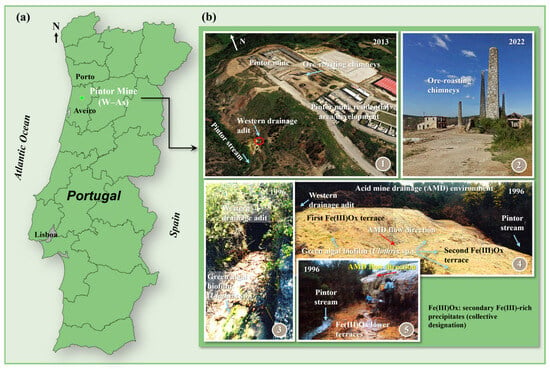
The Pintor mine is located in the civil parish of Nogueira do Cravo, municipality of Oliveira de Azeméis, Aveiro District (Figure 1a).
Figure 1.
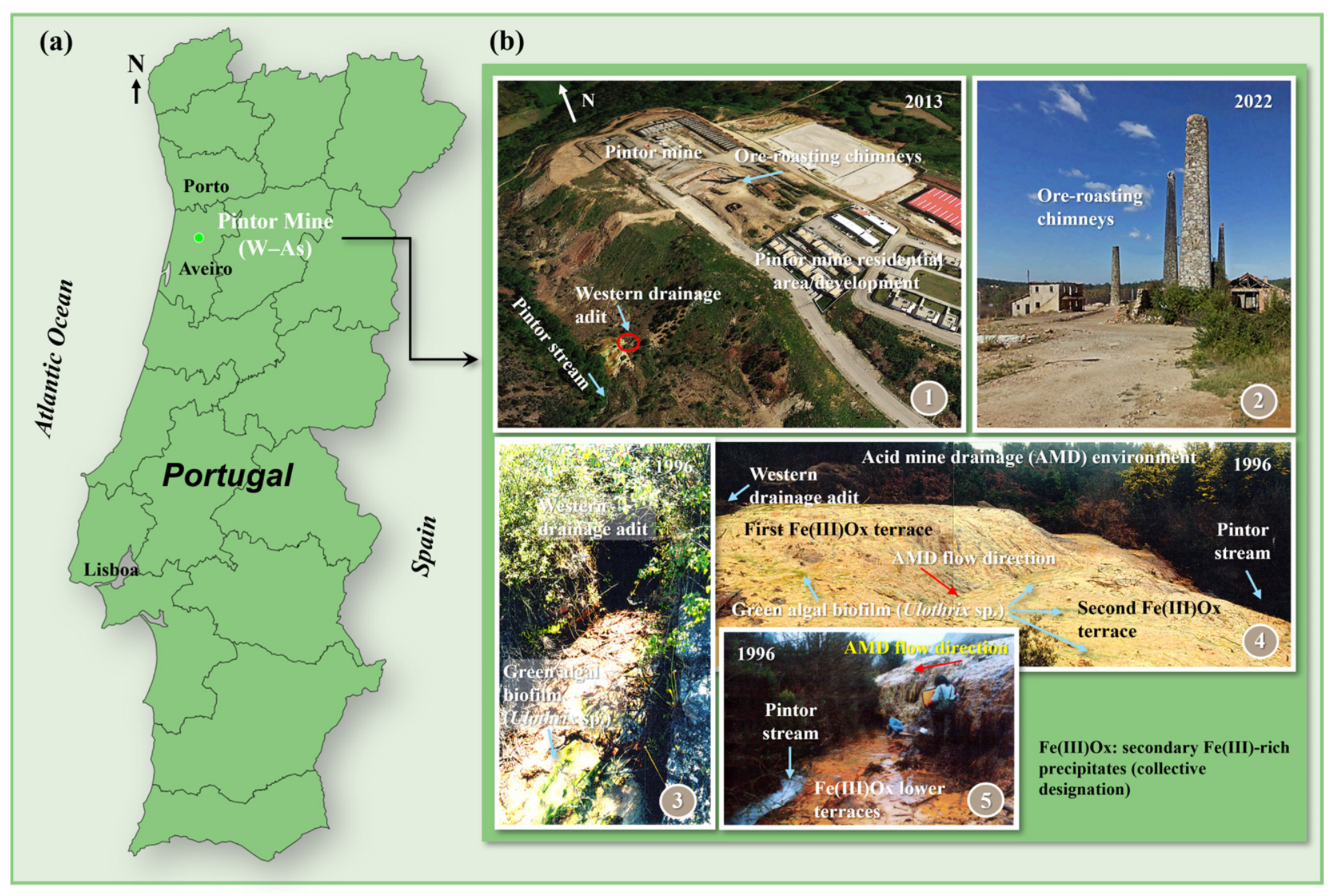
(a) Location of the Pintor mine in Aveiro District, north-western Portugal. (b) Main features of the mine site: (1) oblique aerial image showing the spatial relationship among the former mine area, ore-roasting chimneys, western drainage-adit outlet, adjacent residential development and Pintor stream; (2) ground-level view of the historical (arseno)pyrite-roasting chimney complex; (3) western drainage-adit outlet, conveying mine drainage during the 1996 survey; and (4–5) Fe-rich terraces extending from the adit towards the Pintor stream, consisting of ochre-cemented material. Fe(III)Ox is used as a collective designation for secondary Fe(III)-rich precipitates, including oxides, oxyhydroxides, and other Fe-bearing mineral phases. Green filamentous biofilms identified as Ulothrix sp. [14] are visible in (3,4). (1): historical Google Earth imagery dated 12 May 2013; data: Landsat/Copernicus. (2): image accessed via Google Maps, dated 2022. (3–5): photographs by J.M., 1996. Annotations by the authors.
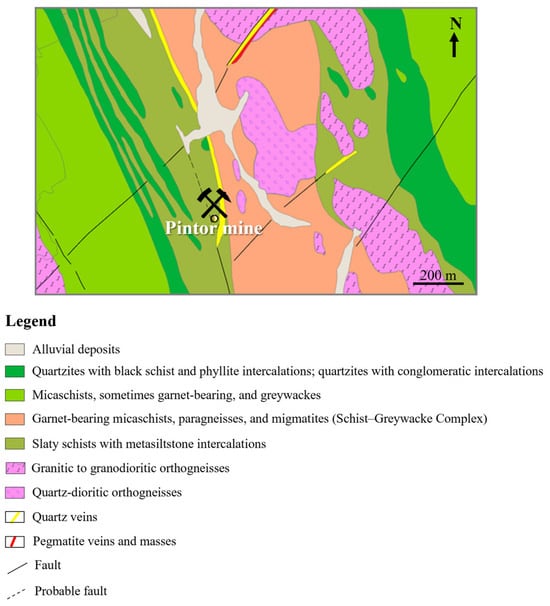
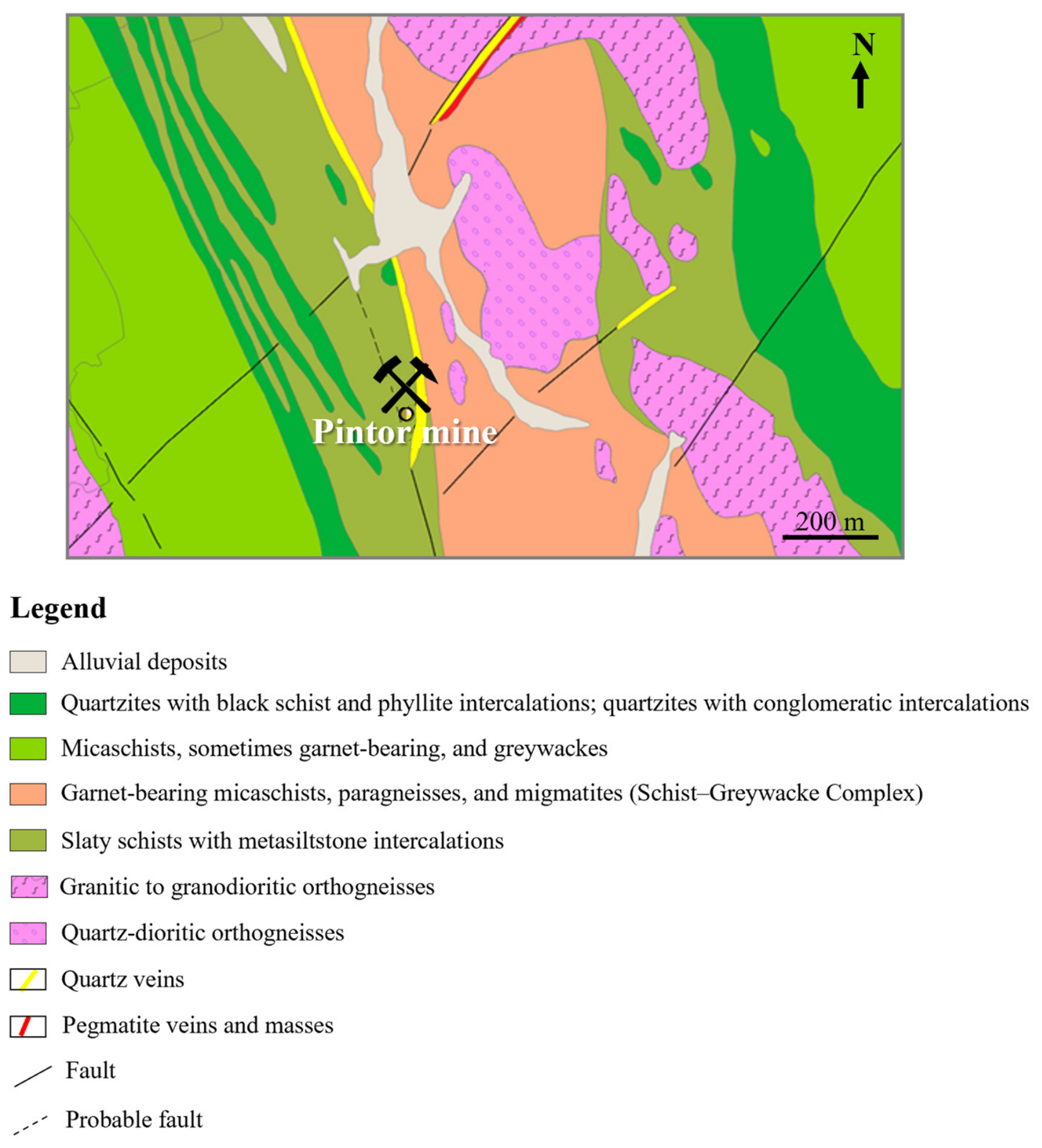
The mine lies within pre-Ordovician metasedimentary successions of the Central Iberian Zone, traditionally included in the Schist–Greywacke Complex [23,24] (Figure 2). The regional lithostratigraphic framework of these successions has subsequently been reassessed [23]. Mineralisation occurs in the so-called Large Vein of the Pintor mine, a silicified fault-zone infill striking approximately N15° W and dipping about 80° E. The vein has an average thickness of around 20 m and contains sulphide-bearing mineral assemblages. Mining primarily targeted As and W, with subordinate recovery of Sn, Cu, Pb, Au and Ag [24].
Figure 2.
Simplified geological setting of the Pintor mine. Geological information adapted from the Geological Map of Portugal, scale 1:200,000, accessed via the Laboratório Nacional de Energia e Geologia (LNEG) Geoportal [25] on 26 September 2025.
Historical records compiled in [13] trace mining activity at Pintor from 1875 to 1958, with peak production during the early years of the Second World War. The workings reportedly comprised a shaft approximately 204 m deep and eight galleries, with the first at 40 m and the fifth at 180 m depth [13]. Mota [26] restates the configuration. Extraction followed the room-and-pillar method, leaving substantial quantities of mineralised material underground [13,26].
A report published in 1908 describes mine-water management during active operation [27]. Part of the drainage was removed via the extraction shaft and the remainder through a level gallery opening on the hillside. Some was reused for mechanical ore treatment, while the excess was discharged to the Pintor stream after filtration. The treatment system had recently been installed following recurrent complaints of damage to livestock and crops in neighbouring areas. Engineering drawings accompanying the report show limestone within the filtration system [27].
The same source also records the production of powdered As2O3 by calcining arsenical pyrite, followed by condensation and refining of the volatilised product [27]. Calcined residues were discarded in mine-waste heaps [13,26]. After extraction at Pintor had ceased, ore from the Jales gold mine in the Vila Real District, north-eastern Portugal, was processed there, with documentary records placing the continuation of roasting as late as 1991 [15,26]. Other post-mining activities involved ornamental-stone cutting and polishing, as well as the disposal and burning of solid waste, introducing environmental pressures of undetermined magnitude [13].
Mine water issues from the western drainage adit (Figure 1(3)), which historically served as the emergency exit and ventilation opening of the 40 m level [13,27]. By 1996, Fe-rich material had accumulated along the downslope flow path towards the Pintor stream, forming a terraced deposit approximately 48 × 27 m in extent on the stream margin (Figure 1(4)). Its uppermost terrace lay at approximately the elevation of the adit outlet, where the accumulation partly obstructed drainage. A succession of lower terraces extended towards the stream (Figure 1(5)), and exposed sections displayed pale-yellow to reddish-brown banding. Sánchez-España et al. [28] described comparable AMD-derived terraces in the Tintillo River (Huelva, south-western Spain) and discussed the roles of Fe precipitation, hydrological variability and microbial activity in their formation, possible links between flow and internal lamination, and the contributions of dehydration and Fe-phase transformations to consolidation. Although vascular vegetation was sparse, green filamentous biofilms identified as Ulothrix sp. [14] occurred around the Pintor adit outlet and on adjacent terrace surfaces (Figure 1(3,4)). The same area is visible in the 2013 aerial image (Figure 1(1)), and photographs in later EDM-commissioned reports show orange-coloured deposits near the discharge point and farther downstream (Figure 5.3 in [17]; Photos 2.5 and 3.2 in [18]).
2.2. Surface Water Sampling and Chemical Analysis
Surface water was sampled during late spring (18 June) and late summer (16 September) 1996. Samples were collected in 1 L polyethylene bottles previously cleaned with alkaline detergent, 0.1 N HNO3 and deionised water. Six locations were sampled: (1) approximately 200 m upstream of the AMD–Pintor stream confluence; (2) the adit outlet; (3) the Pintor stream adjacent to the AMD inflow; (4) approximately 500 m downstream of the outlet; (5) approximately 750 m downstream; and (6) approximately 1800 m downstream. Field pH and temperature were measured with a Hanna HI 8424 portable meter (Hanna Instruments, Woonsocket, RI, USA), electrical conductivity (EC) with a Hanna HI 8633 conductivity meter (Hanna Instruments, Woonsocket, RI, USA), and redox potential (Eh) with a WTW pH 537 microprocessor meter (WTW, Weilheim, Germany) connected to an Ingold Pt 4805-S7 platinum electrode (Ingold, Urdorf, Switzerland).
The samples were transported to the laboratory at approximately 4 °C and filtered upon arrival on the day of collection, within 3–4 h after sampling. A 500 mL aliquot of each sample was passed sequentially through 0.45 and 0.1 µm Millipore membranes mounted in Sterifil filtration units (Millipore Corporation, Bedford, MA, USA). The resulting fractions were operationally defined as particulate (>0.45 µm), colloidal (0.1–0.45 µm) and dissolved (<0.1 µm). For dissolved Fe, a 200 mL aliquot of the <0.1 µm filtrate was lyophilised using a Christ Alpha 1–4 system (Martin Christ Gefriertrocknungsanlagen GmbH, Osterode am Harz, Germany) with an LDC-1M controller. The residue was redissolved in 65% HNO3 and the solution made up to 10 mL before determination by flame atomic absorption spectrometry (FAAS; GBC 906AA, GBC Scientific Equipment Pty Ltd., Melbourne, Australia). Dissolved As was measured in the <0.1 µm fraction by hydride-generation atomic absorption spectrometry (HG-AAS; Varian SpectrAA-10 Plus, Varian Australia Pty Ltd., Mulgrave, Victoria, Australia) after acidification with 37% HCl.
For the particulate and colloidal fractions, the loaded 0.45 and 0.1 µm membranes, respectively, were placed separately in polytetrafluoroethylene beakers, treated with 3 mL of 65% HNO3 and heated on a hotplate at 50 °C until membrane decomposition was complete. Each residue was redissolved in 10 mL of 7 M HCl, quantitatively transferred to a 25 mL volumetric flask and made up to volume with demineralised water. Membrane blanks were processed using the same digestion procedure. Arsenic concentrations in the final blank solutions were 0.09 µg L−1 for the 0.45 µm membrane and 0.36 µg L−1 for the 0.1 µm membrane. Fe was determined by FAAS and As by HG-AAS.
Calibration standards for Fe and As were prepared from separate 1000 mg L−1 Spectrosol (BDH) stock solutions. Working standards of 2.5, 5, 10, 30 and 50 mg L−1 Fe were prepared from a 500 mg L−1 intermediate solution, and standards of 6, 8, 10, 20 and 40 µg L−1 As from a 100 µg L−1 intermediate solution. Analytical solutions exceeding the calibration range were diluted before determination. The same calibration series were applied to all aqueous fractions and to the solid material and sequential extraction determinations described below.
2.3. Sampling and Chemical Analysis of Solid Materials
Solid materials were collected at or near water-sampling locations. At each sediment site, approximately 1.5 kg was taken from the upper 5–10 cm of the streambed using a plastic trowel and transported in polyethylene bags. Fe-rich AMD precipitates were sampled in two forms: consolidated material from the uppermost terrace at the adit discharge, designated the outlet crust (Figure 1(4)), and thin, generally millimetre-scale gel-like or flocculent coatings on stones and boulders within the active channel of the Pintor stream, designated streambed coatings. The term “Fe-rich precipitates” is used collectively for these two materials.
Sediments were dried at 40 °C, homogenised and sieved to <177 µm (80 mesh). Crusts were dried, crushed, homogenised and sieved to the same grain size. Coatings were recovered by drying the coated stones at 40 °C and gently scraping the surface material with a plastic spatula; the recovered material was then homogenised and sieved to <177 µm.
Iron was determined following mixed-acid digestion with HCl–HNO3–HF in polytetrafluoroethylene beakers, according to Lecomte and Sondag [29]. Aqua regia (AR)-extractable As was determined after digestion with HCl–HNO3 (3:1, v/v). The Fe digests were evaporated to dryness at approximately 120 °C and the As digests at 100 °C. The residues were redissolved in 10 mL of 4 N HNO3 for Fe or 7 M HCl for As and filtered through Whatman Grade 45 filter paper. The solutions were made up to 50 mL with demineralised water for Fe and 7 M HCl for As. Iron and As were measured by FAAS and HG-AAS, respectively. Analytical quality control included procedural blanks and duplicate determinations, with precision calculated according to Garrett [30,31] at 2% for Fe and 5% for As. Certified reference materials were not analysed, and calibration-verification and matrix-spike records were unavailable for evaluation.
An Ulothrix sp. biomass sample collected at the adit outlet was rinsed with deionised water, oven-dried at 40 °C and digested with 65% HNO3. Arsenic was determined by inductively coupled plasma atomic emission spectrometry (ICP-AES) at the Central Laboratory of the University of Aveiro. The quality-control procedures applied to the ICP-AES determinations could not be verified from the retained laboratory records.
2.4. Sequential Extraction Procedure
A six-step sequential extraction procedure (SEP) adapted from Cardoso Fonseca [32] was performed on 1.0 g aliquots of selected Pintor solid samples to characterise the operational distribution of As and Fe among fractions extracted under different chemical conditions (Table 1). The fractions are operationally defined according to the conventional extraction targets of the respective reagents [33,34]. Testing of a closely related SEP for As fractionation using artificially prepared mineral mixtures has also been reported [35].
Table 1.
Six-step sequential extraction procedure (SEP) and operationally defined target fractions.
The interpretation of the Fe fractions draws on the preferential extraction of poorly ordered and X-ray-amorphous Fe phases by ammonium oxalate in darkness and the enhanced dissolution of some more crystalline Fe phases under UV irradiation [36], as well as on selective-dissolution approaches developed for sulphide mine wastes [37]. Steps S1–S5 were conducted at room temperature, with S3 performed in darkness and S5 under UV irradiation using lamps rated at up to 300 W. Contact time for each sample and extraction step was determined from kinetic dissolution curves, with completion defined by an asymptotic concentration response [38].
After steps S1–S5, the suspensions were centrifuged at 4000 rpm and the supernatants filtered. Preparation of the extracts varied according to the extraction matrix and element determined. Iron extracts were either made up to volume in the corresponding extraction medium or subjected to step-specific evaporation and acid treatment before measurement by FAAS. For As determination, the S1, S2 and S4 extracts were evaporated and reconstituted in 7 M HCl, with additional acid treatment where necessary. The S3 and S5 extracts were treated with AR and H2O2 to decompose the oxalate matrix. In S6, the solid residue remaining after S5 was digested with concentrated HCl–HNO3–HF. All As solutions were ultimately made up to volume with 7 M HCl and analysed by HG-AAS. The reported detection limit for As in these determinations was 0.1 mg kg−1. Duplicate analytical determinations of the extracts differed by less than 10%. For each element, apparent extraction recovery was calculated from the sum of S1–S6 relative to the corresponding separate determination (mixed-acid-digested Fe or AR-extractable As). Since the separate As determination used AR while S6 included HF, the calculated As recoveries are method-dependent and do not represent a strict mass balance against independently determined total As. Values below 100% may reflect incomplete extraction or procedural losses. Matrix-dependent analytical effects and differences between the SEP and separate digestion procedures may also contribute to deviations in either direction [33]. The archived records provide no information on replication of the complete sequential extraction procedure. All extractions and associated As and Fe determinations were carried out at the Geochemistry Laboratory, Department of Geosciences, University of Aveiro.
A dark-oxalate Fe ratio (Rₒₓ) was defined for this study as:
where FeF3 and FeF5 denote Fe concentrations recovered in the respective extraction steps. Rₒₓ served to describe operational extraction behaviour, not to infer Fe-phase composition or crystallinity.
Rox = FeF3/(FeF3 + FeF5),
2.5. Mineralogical Characterisation
Mineralogical characterisation combined optical observations with X-ray diffraction (XRD) of selected grain-size and density fractions. The <2 µm fraction was analysed at the Department of Geosciences, University of Aveiro, using a Philips PW1130/90 diffractometer (Philips Analytical X-Ray B.V., Almelo, The Netherlands) with Cu Kα radiation and a monochromator, operated at 40 kV and 30 mA. Patterns were recorded from 3° to 80° 2θ in 0.028° steps, with a counting time of 2 s per step. Dense material (>2.89 g cm−3), separated using bromoform, was investigated using Debye–Scherrer powder diffraction at the Laboratório de Mineralogia e Petrologia do Instituto Superior Técnico (LAMPIST).
2.6. Data Synthesis and Retrospective Comparisons
For sites where both fractions were quantified, operationally dissolved (<0.1 µm) and particulate (>0.45 µm) concentrations were summed, and the proportion of each fraction was calculated relative to that sum. Non-detects were excluded from calculations. Downstream percentage decreases were calculated as 100 × (Coutlet − Csite)/Coutlet, separately for the June and September campaigns, using the adit outlet (Site 2) as the reference. Numerical results for the 0.1–0.45 µm colloidal fraction were unavailable, preventing quantitative reassessment of its As contribution, earlier described as negligible [13]. Consequently, the sum of the two measured fractions does not represent a complete whole-water As concentration. Solid-material comparisons were expressed as concentration ratios relative to the upstream sediment and, at Sites 4 and 6, as coating-to-sediment ratios.
Operationally dissolved As was compared with the 10 µg L−1 parametric or guideline value for water intended for human consumption [39,40]. AR-extractable As in solid materials was considered in relation to the Canadian freshwater interim sediment quality guideline of 5.9 mg kg−1 and probable effect level of 17 mg kg−1 [41], as well as the reported Antuã catchment-wide median of 30 mg kg−1 and Pintor sub-basin median of 96 mg kg−1 [13]. These values were used as screening benchmarks and regional geochemical reference points for interpreting the historical As concentrations.
The retrospective dataset consists of one surface-water sample per site per campaign and a single field sample of each solid material analysed. Analytical duplicates, where available, provided an indication of laboratory repeatability. The results were summarised descriptively, without formal statistical testing or inference of recurring seasonal patterns.
2.7. Use of Post-1996 Monitoring and Rehabilitation Documents
The 2024 site characterisation report [17] summarises a February 2007 monitoring campaign originally described in EGIambiente Report No. 07-0886, while the 2025 environmental incidence study [18] compiles monitoring results from 2022 to 2024. These sources were consulted for evidence of acidic, As-bearing drainage after 1996. The execution project memorandum [19] additionally presents monthly adit outlet flow observations from March to December 2024.
The environmental incidence study and execution project memorandum [18,19] were also examined to characterise the planned rehabilitation works, which involve excavation of contaminated soil and mine waste, slope regrading and construction of two on-site confinement cells. The cover system for these cells comprises a 2 mm high-density polyethylene (HDPE) geomembrane, geotextile layers and a geogrid, overlain by approximately 0.70 m of clean vegetated soil. Surface drainage and riprap protection are intended to control runoff and erosion along the stream-facing slope. The works also provide for removal of sediment along approximately 700 m of the Pintor streambed and its transfer to a confinement cell [18,19].
The mine-water treatment design extends beyond the three-lagoon concept outlined in the 2024 report [17]. It specifies the collection of mine drainage at the adit, followed by aeration, primary and secondary settling, and treatment in three lagoons equipped with anchored floating planted islands. A separate stabilisation lagoon precedes final discharge into the Pintor stream [19]. A sludge-drying bed is included to manage solids removed from the settling tanks. Sampling and flow measurement points are specified at the outlets of the treatment units [19].
3. Results
3.1. Spatial Physicochemical Gradients
A spatial survey conducted in July 1996 showed a pronounced pH contrast where drainage from the western adit entered the Pintor stream (Figure 3). The pH was 3.3 at the adit outlet (point 1) and approximately 3.6 at the stream inflow (point 2), compared with pH 6–7 in upstream stream water. Downstream measurements included pH 4.4 and 4.0 at the locations shown in Figure 3, and pH 4.7 at point 3, approximately 500 m below the confluence. These measurements indicate that acidic conditions persisted along the affected reach, without a steady downstream increase in pH.
Figure 3.
Schematic pH distribution at and downstream of the AMD–Pintor stream confluence in July 1996. Cross-channel scale is exaggerated eightfold, and ~450 m of channel is omitted. Points 1–3 denote the western drainage-adit outlet, AMD inflow and a location ~500 m downstream; points 1 and 2 correspond to Sites 2 and 3 in Table 2. Fe(III)Ox denotes secondary Fe(III)-rich precipitates, used here as a collective designation. Adapted from [13], with the original labels translated and annotations added to identify the Fe-rich terraces and western mine drainage adit.
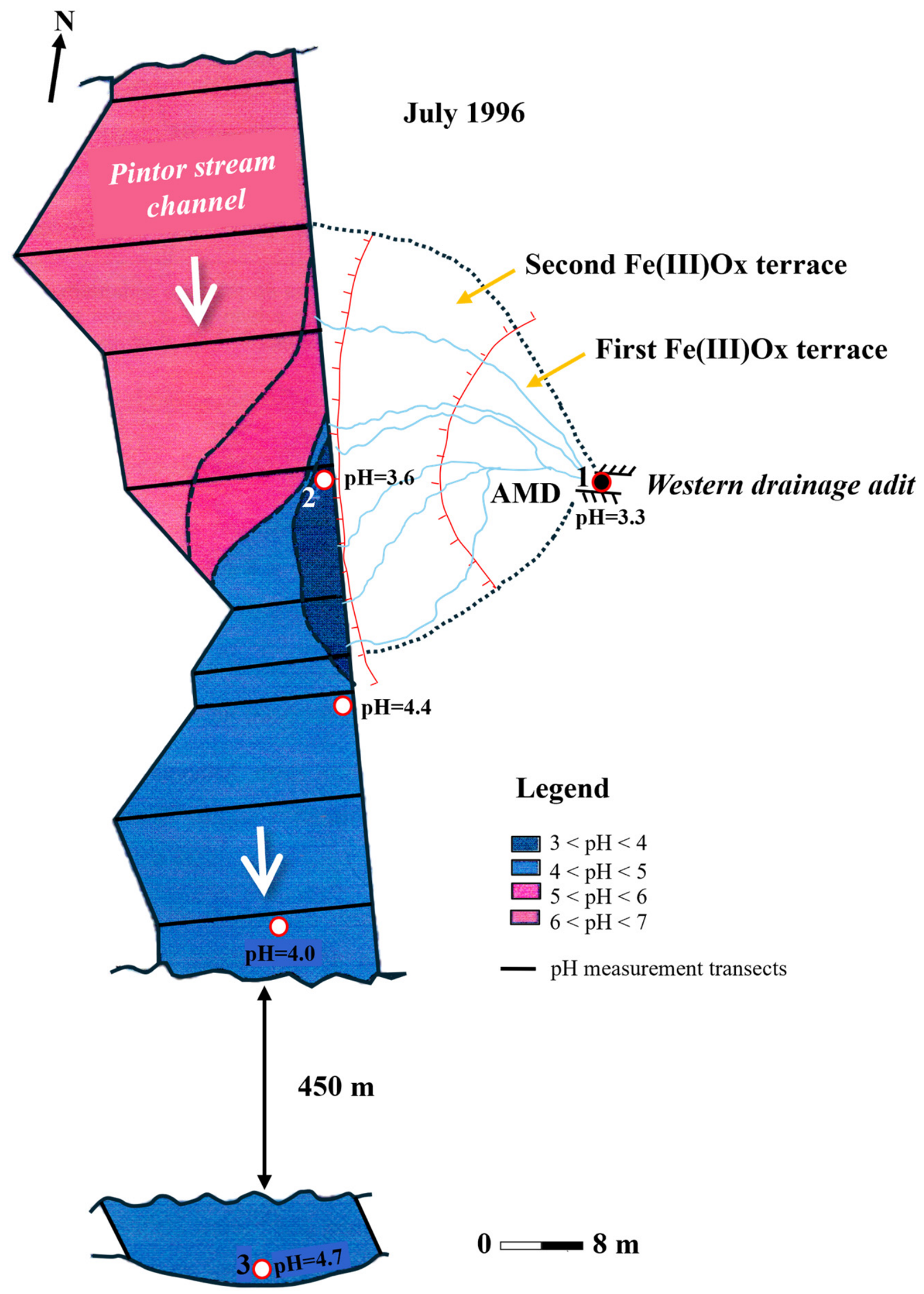
Table 2.
Physicochemical variables and operationally dissolved (<0.1 µm) and particulate (>0.45 µm) As and Fe concentrations in surface water on 18 June and 16 September 1996. Sites: 1, approximately 200 m upstream of the AMD–stream confluence; 2, adit outlet; 3, stream adjacent to the discharge; 4, approximately 500 m downstream; 5, approximately 750 m downstream; and 6, approximately 1800 m downstream. N.D., not detected. Method detection limits applicable to results reported as N.D. are unavailable in the archived documentation.
3.2. Aqueous Concentrations, Phase Proportions and Downstream Changes
The highest operationally dissolved As and Fe concentrations in both campaigns were measured at the adit outlet (Site 2) (Table 2). At this location, pH values were 3.9 and 3.1, As concentrations were 1126 and 2208 µg L−1, and Fe concentrations were 90,800 and 87,500 µg L−1 in June and September, respectively. At Sites 2 and 3, As partitioning differed between campaigns: particulate As accounted for 80.6% and 85.2% of the dissolved-plus-particulate sum in June, compared with 24.3% and 33.3% in September, when dissolved As predominated at both locations. At the upstream site (Site 1), pH ranged from 5.7 to 6.1, EC from 124 to 129 µS cm−1, and operationally dissolved As from 2 to 20 µg L−1; particulate As was reported as not detected in both campaigns.
Operationally dissolved As and Fe concentrations were lower downstream in both campaigns. Relative to the outlet, dissolved As was 51.3–98.5% lower at Sites 3–5 in June and 85.8–94.5% lower in September. At Site 6, dissolved As was 6 µg L−1 in June and 4 µg L−1 in September, 99.5% and 99.8% lower than at the outlet. At the same site, the dissolved-plus-particulate As sum was 99.9% and 99.6% lower, and dissolved Fe was 99.2% and 99.8% lower, in June and September, respectively.
In June, dissolved As predominated at Sites 4–6. In September, particulate As represented 66.7% of the dissolved-plus-particulate As sum at Site 6, while particulate Fe comprised 70.0–87.7% of the corresponding two-fraction Fe sums at Sites 4–6. The June particulate Fe proportions at these sites were 29.2%, 47.8% and 10.8%, respectively, with dissolved Fe accounting for the larger proportion at each site.
3.3. Arsenic and Fe Concentrations in Sediments and Fe-Rich Precipitates
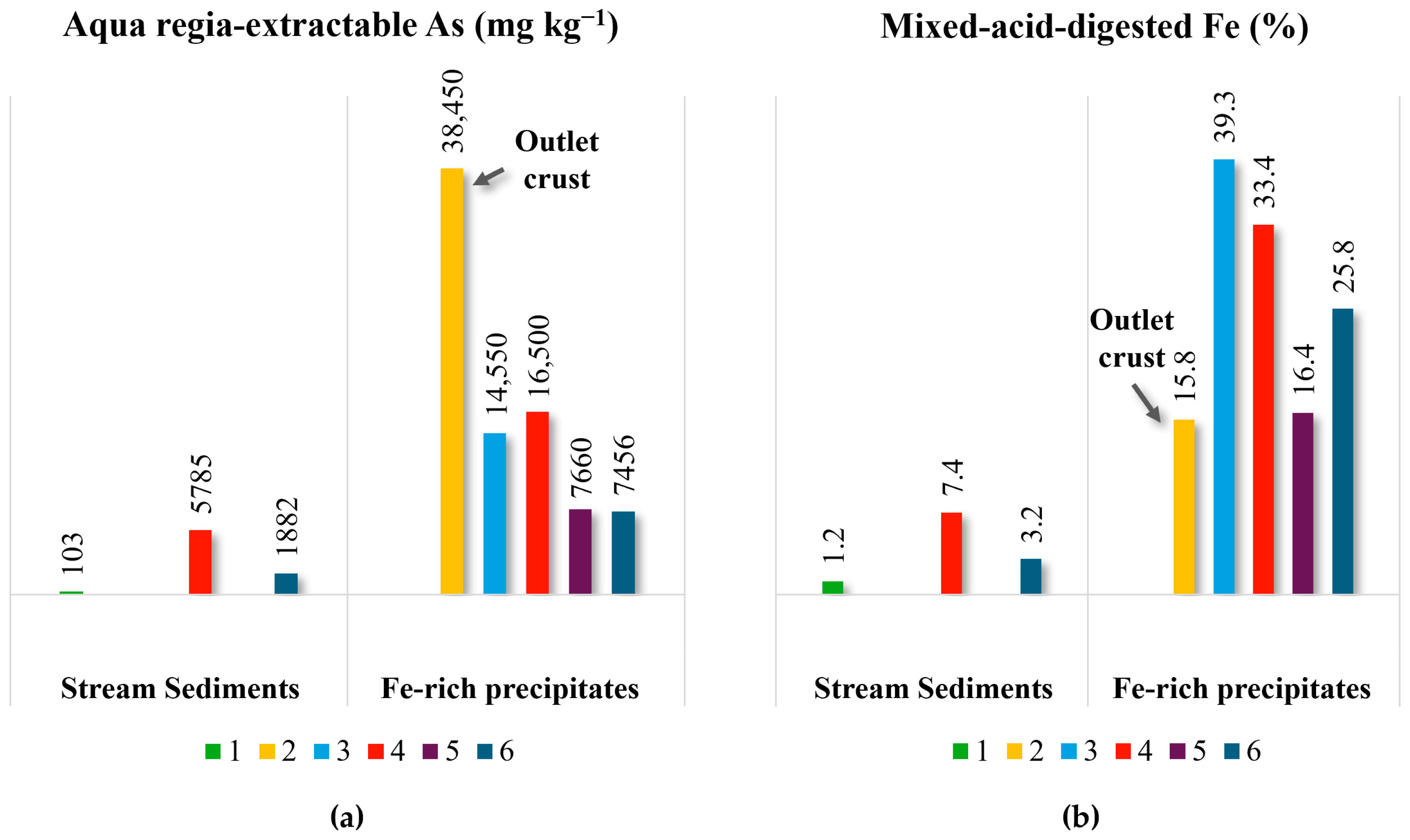
Solid materials collected at and downstream of the adit outlet were strongly enriched in As and Fe relative to the upstream sediment (Figure 4). The outlet crust had the highest As concentration (38,450 mg kg−1, 373 times the upstream sediment value) and contained 15.8% Fe. The highest Fe concentration (39.3%) occurred in the streambed coating at Site 3, where As reached 14,550 mg kg−1. Across the analysed coatings, As concentrations were 72–160 times that of the upstream sediment.
The coating-to-sediment concentration ratios at Site 4 were approximately 2.9 for As and 4.5 for Fe; at Site 6, the corresponding ratios were approximately 4.0 and 8.1. At Site 6, the coating reached 7456 mg kg−1 As and 25.8% Fe, compared with 1882 mg kg−1 As and 3.2% Fe in the paired sediment. The single Ulothrix sp. sample contained 1965 mg kg−1 As (dry weight).
Figure 4.
Aqua regia (AR)-extractable As (a) and mixed-acid-digested Fe (b) concentrations in stream sediments and Fe-rich precipitates collected in 1996. The Fe-rich precipitates comprise the outlet crust and streambed coatings. Colours indicate sampling locations: Site 1, approximately 200 m upstream of the confluence between the AMD discharge and the Pintor stream; Site 2, the western drainage-adit outlet; Site 3, the Pintor stream adjacent to the AMD inflow; and Sites 4–6, approximately 500, 750 and 1800 m downstream of Site 2, respectively. Values are shown above the bars. Each bar corresponds to a single analysed sample.
The XRD patterns of the outlet crust exhibited a high background and reflections attributable to jarosite, hematite and the As-bearing mineral scorodite (FeAsO4·2H2O). The streambed coatings displayed diffraction patterns lacking well-defined reflections, suggesting the presence of poorly ordered material.
3.4. Operational As and Fe Fractionation
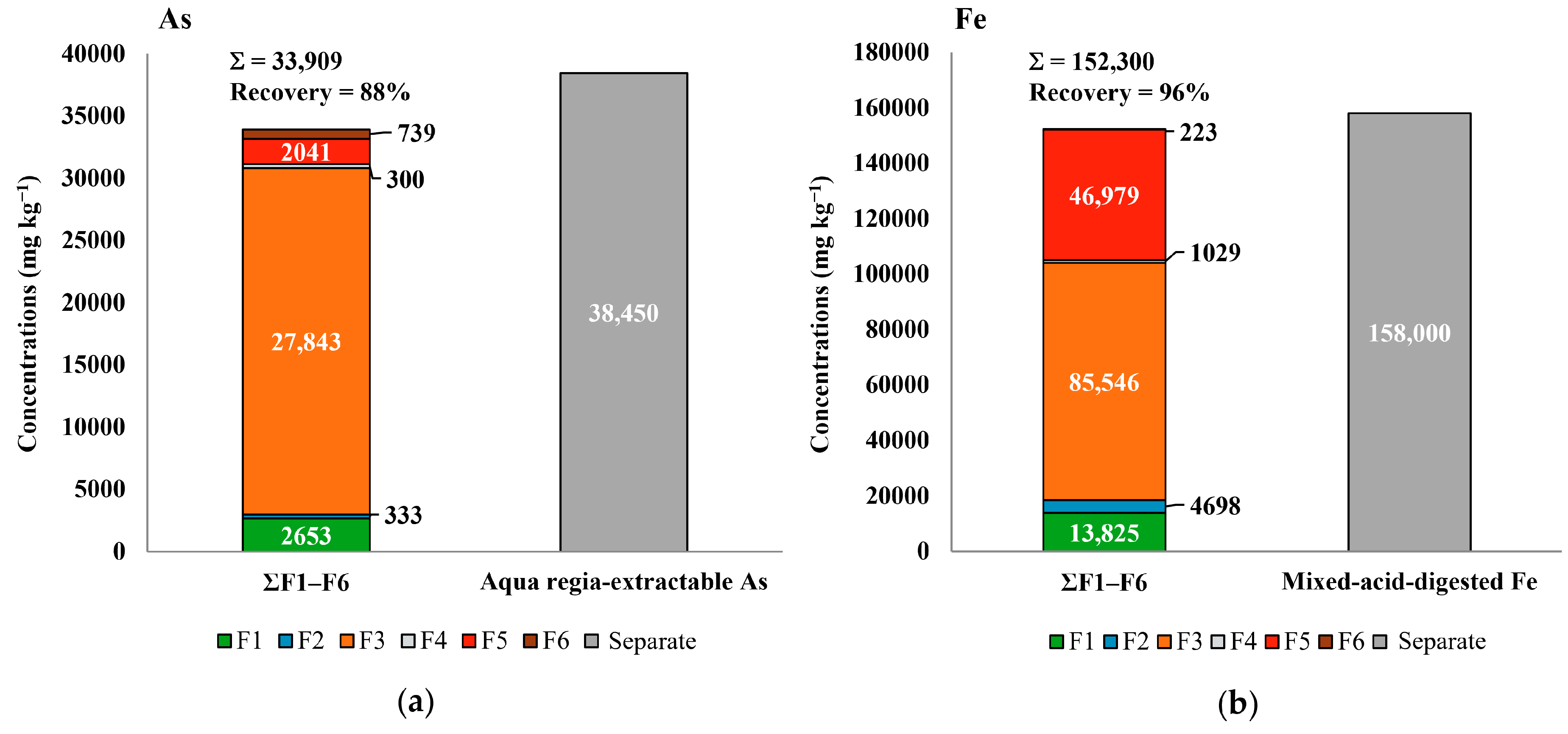
The operational fractionation pattern varied among the outlet crust, downstream coatings and stream sediments (Figure 5 and Figure 6). In the outlet crust, the dark-oxalate-extractable fraction (F3) accounted for 27,843 mg kg−1 As, equivalent to approximately 82% of recovered As. The ammonium acetate-extractable fraction (F1) yielded 2653 mg kg−1 and the UV–oxalate-extractable fraction (F5) 2041 mg kg−1, while F2, F4 and F6 each accounted for less than 800 mg kg−1. The extraction sum represented 88% of the corresponding AR-extractable As concentration.
F3 accounted for 48–60% of recovered As in sediments and 51–54% in streambed coatings, while F1 contributed 28–36% in the coatings. In the Site 6 coating, F3 contained 3753 mg kg−1 As, corresponding to approximately 50% of the AR-extractable As concentration and 54% of recovered As. In each of the five analysed solids, F3 was the largest individual operational As fraction, although F1 also contributed substantially to the streambed coatings. For Fe, the outlet crust had an Rₒₓ value of 0.65, while the coatings at Sites 4 and 6 had values of 0.97 and 0.93, respectively. The paired sediments had lower values of 0.57 and 0.39 (Table 3). Apparent extraction recoveries ranged from 68% to 105%, with the lowest values obtained for As in the Site 4 coating (72%) and Fe in the Site 6 coating (68%).
Figure 5.
Sequential extraction results for As (a) and Fe (b) in the Fe-rich outlet crust (Site 2). Stacked columns represent concentrations recovered in fractions F1–F6; grey columns show the corresponding separate determinations. Iron concentrations in panel (b) are expressed in mg kg−1 (15.8% Fe = 158,000 mg kg−1). F1, ammonium acetate-extractable; F2, hydroxylamine hydrochloride-extractable; F3, dark-oxalate-extractable; F4, hydrogen peroxide-extractable; F5, UV–oxalate-extractable; and F6, triacid-extractable. For As, the apparent recovery is method-dependent because the separate determination used aqua regia, whereas F6 included HF.
The cumulative extraction curves, normalised to the sum of F1–F6, showed distinct profiles for the outlet crust and the Site 4 streambed coating (Figures S1 and S2). In the outlet crust, extraction during S1 (NH4OAc) was limited, reaching 7.8% of recovered As and 9.1% of recovered Fe; the cumulative proportions increased to 8.8% and 12.2%, respectively, after S2 (NH2OH·HCl). During S3 (dark-oxalate), As showed a steep early increase followed by a slower approach to 90.9% of the extraction sum, whereas Fe increased more progressively to 68.3%. A modest proportion of As was extracted during S4 (H2O2) and S5 (UV–oxalate), while Fe extraction increased considerably during S5. In the Site 4 coating, the NH4OAc curves rose rapidly at first and then more gradually, reaching 35.6% of recovered As and 57.4% of recovered Fe. The cumulative proportions increased to 47.7% and 65.8% after S2. During S3, both curves rose sharply at the outset, approaching 99.3% for As and 98.0% for Fe by the end of the step. Little further extraction occurred during S4 and S5.
Figure 6.
Relative distributions of As and Fe among the six operational sequential extraction fractions in paired stream sediments and streambed coatings at Sites 4 (a) and 6 (b). Individual fraction concentrations were calculated from differences between successive cumulative extraction steps and expressed as percentages of the corresponding F1–F6 extraction sum. F1, ammonium acetate-extractable; F2, hydroxylamine hydrochloride-extractable; F3, dark-oxalate-extractable; F4, hydrogen peroxide-extractable; F5, UV–oxalate-extractable; and F6, triacid-extractable. Normalisation to 100% represents the cumulative proportion of each element recovered across F1–F6 and does not imply complete extraction of As or Fe. Apparent recoveries relative to separate determinations are reported in Table 3.
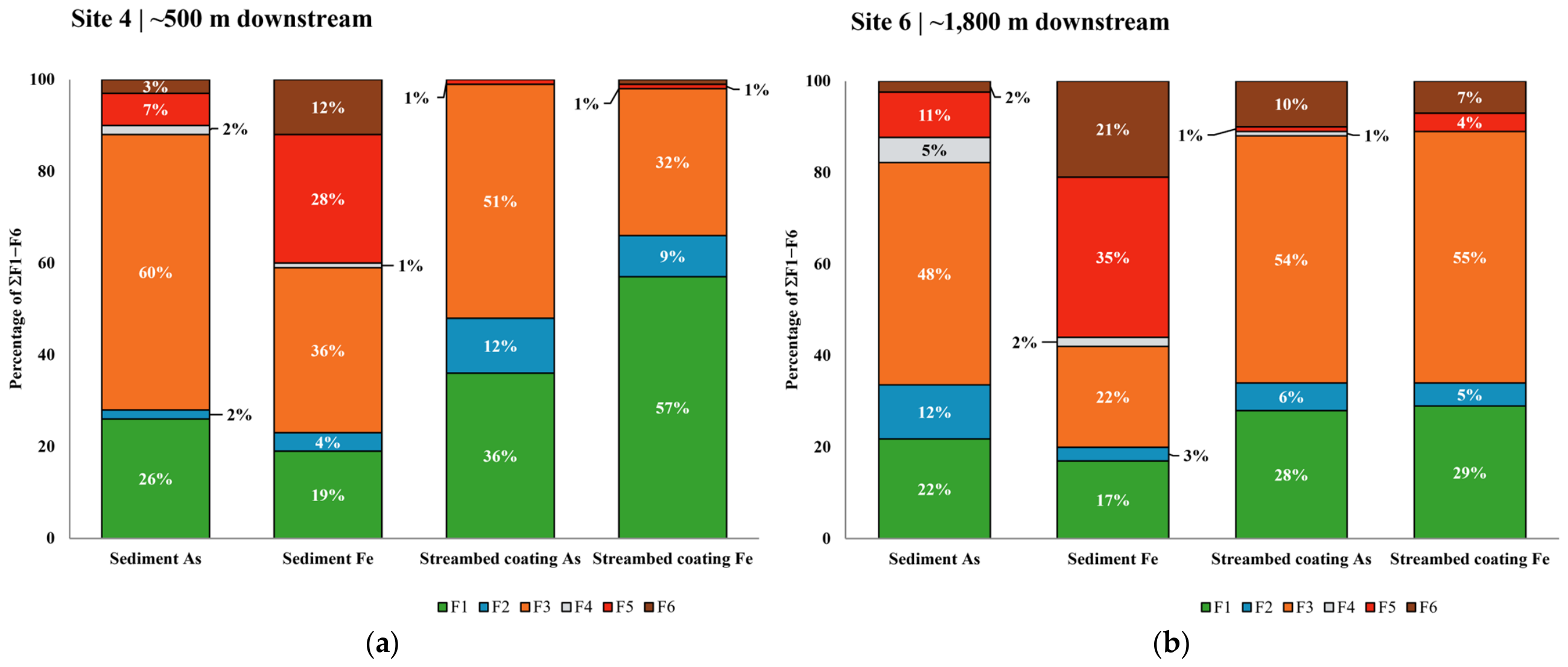
Table 3.
Comparison of sequential extraction sums with separate aqua regia (AR)-extractable As and mixed-acid-digested Fe determinations, apparent extraction recoveries and dark-oxalate Fe ratios (Rox).
3.5. Post-1996 Monitoring Evidence
The February 2007 monitoring campaign, as summarised in the 2024 site characterisation report [17], found that water at the adit outlet exceeded the maximum admissible values for irrigation water specified in Annex XVI of Decree-Law No. 236/98 [42] for As, sulphate, Al, Fe, Cd and Cu and was described as brackish. The downstream stream sample showed much lower concentrations of these parameters, with the analysed values within the irrigation-water limits. The reduction was provisionally ascribed to the high discharge of the receiving stream. Exact concentrations and concurrent flow measurements are not reproduced in the 2024 report.
The campaign of 3 November 2022 again distinguished the adit drainage from the receiving stream. Water at the adit outlet had pH 4.16, EC of 748 µS cm−1 and total dissolved solids of 486 mg L−1, compared with pH 7.24, EC of 34 µS cm−1 and total dissolved solids of 22 mg L−1 upstream. Dissolved oxygen was 2.24 mg L−1 in the water at the adit outlet, compared with 9.97 mg L−1 upstream and 9.78 mg L−1 downstream. The report further stated that Fe, As and Mn exceeded the legal limits used in that assessment and described an extensive accumulation of orange Fe-rich precipitates near the adit outlet [17].
At the adit outlet (PTGW1), reported As concentrations were 5300 µg L−1 on 3 November 2022, 2980 µg L−1 on 27 July 2023 and 1130 µg L−1 on 12 March 2024, with corresponding pH values of 4.16, 3.54 and 3.40 [18]. The March 2024 campaign also reported an outlet discharge of 0.0130 m3 s−1 (46.80 m3 h−1) [18]. The available documentation did not specify the filtration status of the 2022–2024 As measurements, limiting direct comparison with the operationally dissolved concentrations measured in 1996.
4. Discussion
4.1. Fe-Associated Arsenic Partitioning Along the Pintor Stream
The 1996 survey identified the western adit as a prominent input of Fe- and As-rich drainage to the Pintor stream. Mixing with receiving stream water was accompanied by a local increase in pH (Figure 3), favouring Fe(III) hydrolysis and precipitation [2,7]. High particulate As concentrations near the discharge and As enrichment in Fe-rich deposits point to Fe-associated accumulation, consistent with observations in other AMD environments [7,43] and the established affinity of As for Fe oxides and oxyhydroxides [44]. Aqueous speciation modelling by Moreno et al. [14] using WATEQ4F [45] predicted H2AsO4− as the dominant dissolved As species, compatible with arsenate retention by secondary Fe phases.
At Site 6, relatively low operationally dissolved As concentrations co-occurred with pronounced As enrichment in the sediment and streambed coating, emphasising the importance of considering solid-phase As when interpreting the aqueous concentration gradient. Dilution, incomplete mixing, Fe precipitation and particle settling are potential contributors to the observed spatial pattern [46,47,48]. Their relative contributions cannot be determined from the available data, and the absence of concurrent flow measurements prevents calculation of downstream changes in As loads.
The June and September campaigns also differed in aqueous As partitioning. At Site 6, similarly low operationally dissolved As concentrations coincided with markedly different particulate As proportions. Rainfall preceded the September campaign, but the two sampling occasions do not establish a flushing response; hydrochemical responses vary among AMD systems [46,49,50]. The delay before laboratory filtration also limits interpretation of the measured phase proportions, as Fe oxidation, precipitation, adsorption or particle aggregation could have altered the operational distribution.
At the adit outlet, As concentrations reported in 2022–2024 (1130–5300 µg L−1) [18] were of the same order of magnitude as the operationally dissolved concentrations measured in 1996 (1126–2208 µg L−1). These records document the presence of As-rich drainage decades after the original investigation.
4.2. Solid-Phase Retention and Fe-Phase Reactivity
The outlet crust and streambed coatings represent contrasting depositional environments within the Pintor drainage system, with differences in their operational extraction profiles and XRD characteristics.
Dark-oxalate extraction (F3) accounted for approximately 82% of recovered As in the outlet crust, compared with 51–54% in the streambed coatings. The coatings also contained appreciable ammonium acetate-extractable As (F1), representing 28–36% of their recovered As. Drahota et al. [51] found that dark ammonium oxalate preferentially extracted As associated with amorphous and poorly crystalline Fe arsenates, oxides and hydroxysulphates in mine wastes. This supports interpreting the Pintor F3 pool in relation to secondary Fe-bearing material, while recognising that the operational fractions neither identify unique mineral hosts nor directly quantify environmental mobility [33,34,51,52].
Associations between algae and Fe-rich precipitates in other AMD environments [53] may help explain As accumulation in algal-associated material at Pintor, although bulk analysis cannot distinguish biologically bound from mineral-associated As.
XRD reflections assigned to scorodite in the outlet crust are consistent with the presence of a crystalline secondary Fe arsenate commonly found in oxidised mine wastes [54]. Experimental studies indicate relatively low scorodite solubility around pH 3–4, with increased dissolution under more acidic or higher-pH conditions [55,56]. Jarosite and hematite represent additional components of the outlet crust’s Fe-bearing assemblage. Jarosite can accommodate limited arsenate by substitution for sulphate, while Fe oxyhydroxides serve as a major sink for arsenate in mine wastes [54]. Research on schwertmannite has also shown that Al incorporation can modify arsenate surface coordination [57].
Specific Fe phases in the streambed coatings could not be identified by XRD, including schwertmannite, whose poor crystallinity can hinder detection [43]. Their higher Rₒₓ values relative to the outlet crust (Table 3) reflect a greater contribution of F3 to the combined F3 and F5 Fe recovery. However, Rₒₓ does not account for Fe released in earlier extraction steps, particularly F1, which represented approximately 57% of recovered Fe in the Site 4 coating. The relatively low overall Fe recovery for the Site 6 coating warrants caution when relating its extraction profile to the bulk Fe inventory.
Fe-phase transformations and secondary mineral cementation are well established in AMD deposits [43,58,59,60,61]. Exposure-related dehydration and mineralogical maturation can further modify Fe-rich terraces [28]. At Tinto Santa Rosa (Iberian Pyrite Belt, south-western Spain), Asta et al. [6] identified As(V) associated mainly with schwertmannite upstream and with goethite and jarosite farther downstream, while the principal As-bearing Fe phases in consolidated terraces also varied with depth. Fe–As-rich hardpans at the abandoned Santo António gold mine near Penedono, Portugal, contain jarosite, scorodite, goethite and amorphous Fe–As precipitates [62,63]. The occurrence of jarosite and scorodite provides a mineralogical comparison with the Pintor outlet crust, despite differences between waste-pile cementation and adit-associated deposition. In the Carnon River (Cornwall, UK), Jennings et al. [64] used mineralogical and particle-size evidence to link As-enriched fine sediments to secondary Fe oxides and coarser sulphide-bearing fractions to inputs from historical mine waste.
Arsenic also influences the mineralogical evolution of Fe-rich precipitates. Under strongly acidic conditions, Burton et al. [4] found that elevated aqueous As(V) concentrations favoured amorphous ferric arsenate formation over schwertmannite, while increasing As(V) incorporation enhanced schwertmannite transformation to jarosite. Experiments involving Fe precipitates formed during carbonate neutralisation of AMD demonstrated pH-dependent As release accompanied by mineralogical changes [65]. These findings underscore the importance of Fe-phase transformations and changing geochemical conditions for As retention and release in mine-affected settings.
4.3. Comparison with Screening Values and Regional Geochemical Context
The resulting comparisons with screening values and regional sediment geochemistry are summarised in Table S1. At the adit outlet, operationally dissolved As concentrations were approximately 110 and 220 times the 10 µg L−1 value for water intended for human consumption [39,40] in June and September, respectively.
Even the upstream sediment exceeded the Canadian freshwater interim sediment quality guideline (5.9 mg kg−1 As) and probable effect level (17 mg kg−1 As) [41] by approximately 18-fold and six-fold, respectively. This upstream As concentration shows that exceedances of the screening values cannot be attributed solely to the western drainage-adit discharge at Pintor. All analysed stream sediments were above both thresholds. Such comparisons are complicated in mineralised and historically mined areas, where geochemical reference values can vary considerably with lithology and the statistical approach used to derive them, sometimes surpassing generic sediment-effect thresholds [66].
The Antuã survey offers a broader regional geochemical perspective [13]. Its basin-wide median was 30 mg kg−1 As, while the Pintor sub-basin had the highest median concentration (96 mg kg−1). Medians in the other drainage units ranged from 16 mg kg−1 in Vale da Agrela to 63 mg kg−1 in Cercal. The elevated Cercal value was linked to the possible continuation of W–As-mineralised structures from the Pintor deposit, while the As–Pb relationship in Arrifana pointed towards an anthropogenic contribution [13]. Urban and industrial wastewater pressures have also been reported in the Antuã basin [67]. Taken together, these spatial differences suggest that regional sediment As concentrations reflect a combination of geogenic and anthropogenic influences rather than a uniform geochemical background.
Within such a heterogeneous regional setting, As enrichment in the mine-affected reach was particularly pronounced. At Site 6, sediment As concentrations were approximately 63 times the basin-wide median and 20 times the Pintor sub-basin median, with further enrichment in the paired Fe-rich coating.
4.4. Stored Arsenic and Potential Reactivation
The longer-term stability of As stored in the Pintor outlet crust, streambed coatings and sediments depends on their response to environmental change. Both the earlier chemical time bomb (CTB) concept [68,69] and the DGH framework [9,10] address the potential reactivation of retained contaminants over time. Quantitative DGH assessments evaluate the total releasable content of the pollutant (TRCP) separately from the total concentration of active species (TCAS), recognising that environmental change may alter the active proportion of a contaminant reservoir [9,10,70,71]. At Pintor, substantial solid-phase As accumulation does not indicate how much As could become mobile under specific conditions, and the differing characteristics of these materials merit targeted investigation. Their operational extraction fractions cannot be equated with TRCP or TCAS, and summing F1–F3 would not quantify an environmentally releasable As pool [33,34]. Instead, the DGH framework guides investigation of the conditions under which stored As may become chemically mobile, rather than implying a quantified delayed hazard or an identified activation threshold.
Two mobilisation pathways are especially pertinent. Changes in pH or redox conditions may destabilise As-bearing Fe phases and promote dissolved As release. Low-oxygen porewaters with elevated dissolved Fe concentrations have been observed in AMD-affected streambed sediments [72], and Burton et al. [4] reported As remobilisation associated with reductive dissolution of As-bearing Fe(III) phases in an AMD sediment-retention pond. Physical disturbance provides a distinct pathway, whereby erosion, excavation or resuspension can transport As-bearing particles without mineral dissolution.
These pathways call for complementary experimental approaches. Controlled pH- and redox-dependent experiments on the outlet crust could determine As and Fe release kinetics and examine the reversibility of mobilisation following restoration of initial conditions. Chemical-release and particle-detachment tests on streambed coatings would characterise dissolved As mobilisation and the potential for particulate export. Parallel experiments on paired sediments would enable comparison among the solid materials and evaluation of how their operational extraction profiles relate to release under controlled conditions.
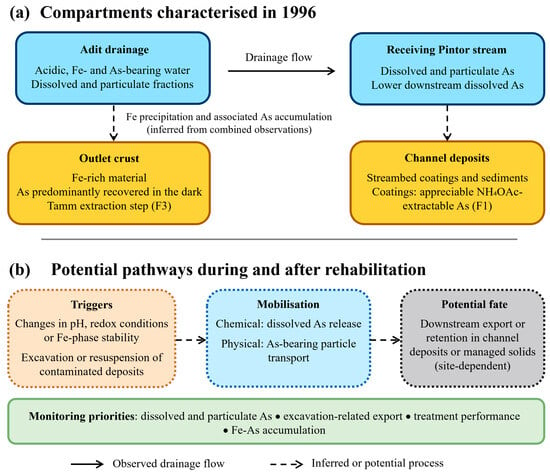
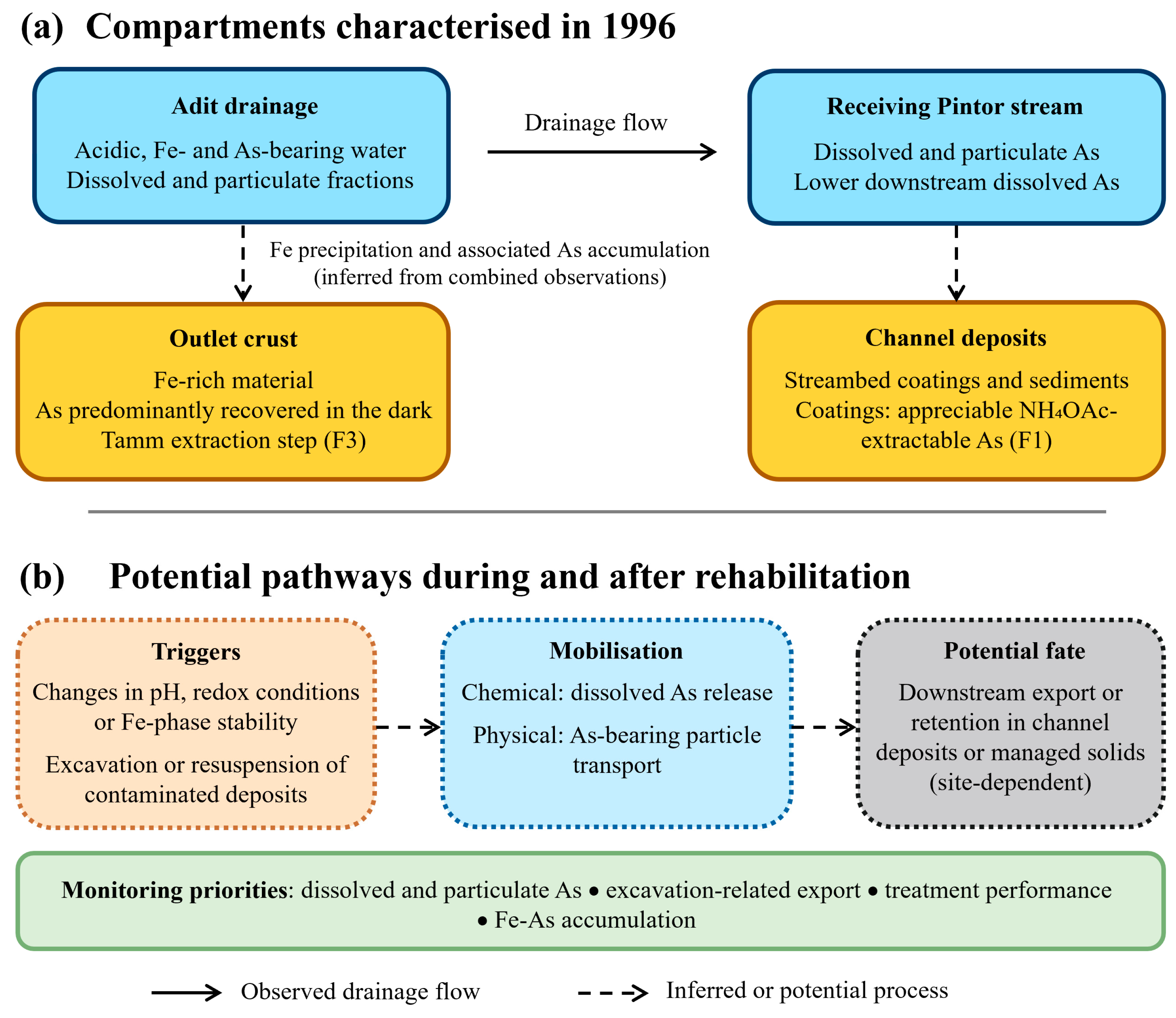
Figure 7 integrates the historical evidence of As accumulation at Pintor with potential remobilisation pathways, linking the experimental approaches proposed here to the rehabilitation and monitoring priorities discussed in Section 4.5.
Figure 7.
Arsenic transport, storage and potential mobilisation at the Pintor mine. (a) Aqueous and solid-phase compartments characterised in 1996, with Fe precipitation and associated As retention inferred from the combined observations. (b) Potential chemical-release and particulate transport pathways during and after rehabilitation, their implications for As redistribution and the corresponding monitoring priorities.
4.5. Implications of the Proposed Rehabilitation Measures
The proposed mine-waste confinement, streambed excavation and passive treatment target different contaminant sources and stores [18,19]. The historical investigation is most directly applicable to the latter two measures, since it examined drainage and channel deposits but not the mine-waste material intended for confinement.
The planned streambed excavation would remove part of the present sediment store [18,19], whose current mass and overall composition remain to be established. During remediation of historical mine tailings at Two Mile Creek, Canada, Runnells and Stewart [73] reported elevated total metal concentrations associated with increased suspended solids and temporary exceedances of freshwater aquatic life guidelines, including for As, during construction. Changes in oxygen exposure during excavation and sediment handling may also affect sediment geochemistry and contaminant mobility [74,75,76]. Pre-excavation characterisation, including grain-size distribution [77], would inform material-removal planning and assessment of potential particulate export.
The proposed treatment would seek to retain part of the incoming As in solids generated within managed treatment units [78,79,80,81]. Fe-rich ochre generated during passive mine-water treatment at Jales contained approximately 5.2% AR-extractable As and exhibited poorly ordered Fe-rich material; heating experiments provided evidence for an associated amorphous As-bearing component [82]. Evaluation of treatment performance should therefore consider both treated-water quality and the As content and leaching behaviour of accumulated residues.
The environmental incidence study proposes a pre-construction assessment, monthly stream monitoring during construction and quarterly monitoring during operation at one upstream and two downstream stations [18]. Experience at the rehabilitated Valdarcas mine (Covas, north-western Portugal) illustrates how hydrochemical variability and successive interventions can complicate the attribution of later changes to individual rehabilitation measures [83]. Building on the monitoring arrangements already envisaged for Pintor, the historical geochemical evidence suggests three interrelated lines of investigation:
- •
- Baseline and construction: Revisit historical sampling locations where practicable and characterise sediments and associated streambed coatings before disturbance. Surveys of deposit extent and thickness, supported by dry bulk density and representative As concentrations, would allow estimation of the As inventory targeted for removal. Paired field-filtered and unfiltered As and Fe measurements, together with discharge, pH, EC, dissolved oxygen, acidity, alkalinity and suspended-solids measurements under contrasting flow conditions, would establish a contemporary baseline. During excavation and dewatering, targeted sampling and, where practicable, upstream and downstream turbidity monitoring would help assess short-lived particulate export [84].
- •
- Treatment performance: Compare mine-water inflow and treated-water outflow using As and Fe concentrations, suspended solids and discharge measurements to assess both concentration changes and contaminant loads. Consistent analytical fraction definitions and consideration of hydraulic residence time and operating conditions would support interpretation of treatment performance. Additional observations during commissioning, high-flow events and operational changes, supplemented by sampling of intermediate treatment units as needed, would help distinguish changes in treatment efficiency from variations in incoming mine-water chemistry.
- •
- Longer-term solid-phase storage: Monitor sediment and coating accumulation following rehabilitation, including repeated surveys during the first year of operation, to assess reaccumulation. Record excavated volumes, dry bulk density and representative As concentrations to estimate the mass of As removed from the channel. Characterise accumulated treatment residues during removal campaigns, including their As content and leaching behaviour, to inform handling, storage and disposal [85,86].
5. Conclusions
The 1996–1998 investigation documented acidic Fe–As drainage from the western adit and a 99.5–99.8% downstream decrease in operationally dissolved As concentrations over 1.8 km. This pronounced concentration gradient coincided with substantial As enrichment in Fe-rich deposits, while dissolved–particulate As proportions varied between the two 1996 campaigns. These findings demonstrate that dissolved As concentrations do not fully capture the distribution of As across the affected reach.
The outlet crust, streambed coatings and sediments represent distinct As-bearing compartments whose longer-term stability cannot be inferred from their operational extraction profiles. A DGH-informed assessment should examine material-specific chemical As release under changing environmental conditions.
The proposed rehabilitation would alter the distribution and management of As-bearing materials by streambed excavation, mine-water treatment and confinement. Evaluating its performance involves monitoring dissolved and particulate As transport, sediment reaccumulation and the composition and leaching behaviour of treatment residues.
Supplementary Materials
The following supporting information can be downloaded at https://www.mdpi.com/article/10.3390/geosciences16110469/s1: Figure S1, cumulative extraction curves for As and Fe in the outlet Fe-rich crust collected at Site 2; Figure S2, cumulative extraction curves for As and Fe in the streambed coating collected at Site 4; Table S1, retrospective comparison of dissolved and solid-phase As concentrations measured in 1996 with selected screening and local reference values.
Author Contributions
Conceptualisation, F.M.; methodology, F.M.; formal analysis, F.M.; investigation, F.M. and J.M.; data curation, F.M.; writing—original draft preparation, F.M.; writing—review and editing, F.M. and J.M.; visualisation, J.M. All authors have read and agreed to the published version of the manuscript.
Funding
The original research was supported by a PRAXIS XXI doctoral scholarship awarded to F.M. by the Junta Nacional de Investigação Científica e Tecnológica (JNICT). No external funding was received for the preparation of this manuscript.
Data Availability Statement
The 1996 data analysed in this study are presented in the article and its Supplementary Materials. No new field or laboratory data were generated.
Acknowledgments
We thank the Department of Geosciences at the University of Aveiro for access to its facilities and Eduardo Ferreira da Silva, José Saraiva and Celeste Azevedo for their scientific and technical support during the original investigation. This article is dedicated to the memory of Edmundo Cardoso da Fonseca and Óscar Carvalho, both of whom mentored F.M. in their respective fields of expertise. We are also grateful to the three anonymous reviewers for their constructive comments and suggestions, which helped improve the manuscript.
Conflicts of Interest
The authors declare no conflicts of interest. The funder had no role in the design of the study; the collection, analysis or interpretation of the data; the writing of the manuscript; or the decision to publish the results.
References
- Younger, P.L. The longevity of minewater pollution: A basis for decision-making. Sci. Total Environ. 1997, 194–195, 457–466. [Google Scholar] [CrossRef] [Scilit] [PubMed]
- Nordstrom, D.K.; Blowes, D.W.; Ptacek, C.J. Hydrogeochemistry and microbiology of mine drainage: An update. Appl. Geochem. 2015, 57, 3–16. [Google Scholar] [CrossRef] [Scilit]
- Corkhill, C.L.; Vaughan, D.J. Arsenopyrite oxidation—A review. Appl. Geochem. 2009, 24, 2342–2361. [Google Scholar] [CrossRef] [Scilit]
- Burton, E.D.; Karimian, N.; Johnston, S.G.; Schoepfer, V.A.; Choppala, G.; Lamb, D. Arsenic-imposed effects on schwertmannite and jarosite formation in acid mine drainage and coupled impacts on arsenic mobility. ACS Earth Space Chem. 2021, 5, 1418–1435. [Google Scholar] [CrossRef] [Scilit]
- Paikaray, S. Arsenic geochemistry of acid mine drainage. Mine Water Environ. 2015, 34, 181–196. [Google Scholar] [CrossRef] [Scilit]
- Asta, M.P.; Ayora, C.; Román-Ross, G.; Cama, J.; Acero, P.; Gault, A.G.; Charnock, J.M.; Bardelli, F. Natural attenuation of arsenic in the Tinto Santa Rosa acid stream (Iberian Pyritic Belt, SW Spain): The role of iron precipitates. Chem. Geol. 2010, 271, 1–12. [Google Scholar] [CrossRef] [Scilit]
- Salomons, W. Environmental impact of metals derived from mining activities: Processes, predictions, prevention. J. Geochem. Explor. 1995, 52, 5–23. [Google Scholar] [CrossRef] [Scilit]
- Macklin, M.G.; Thomas, C.J.; Mudbhatkal, A.; Brewer, P.A.; Hudson-Edwards, K.A.; Lewin, J.; Scussolini, P.; Eilander, D.; Lechner, A.; Owen, J.; et al. Impacts of metal mining on river systems: A global assessment. Science 2023, 381, 1345–1350. [Google Scholar] [CrossRef] [Scilit] [PubMed]
- Zheng, M.; Feng, L.; He, J.; Chen, M.; Zhang, J.; Zhang, M.; Wang, J. Delayed geochemical hazard: A tool for risk assessment of heavy metal polluted sites and case study. J. Hazard. Mater. 2015, 287, 197–206. [Google Scholar] [CrossRef] [Scilit] [PubMed]
- Liu, H.; Kang, C.; Xie, J.; He, M.; Zeng, W.; Lin, C.; Ouyang, W.; Liu, X. Monte Carlo simulation and delayed geochemical hazard revealed the contamination and risk of arsenic in natural water sources. Environ. Int. 2023, 179, 108164. [Google Scholar] [CrossRef] [Scilit] [PubMed]
- Portugal. Decreto-Lei n.º 198-A/2001, de 6 de julho. Estabelece o regime jurídico de concessão do exercício da atividade de recuperação ambiental das áreas mineiras degradadas. Diário República 2001, 4084-(2)–4084-(7). [Google Scholar]
- EDM—Empresa de Desenvolvimento Mineiro, S.A. A Herança das Minas Abandonadas—O Enquadramento e a Actuação em Portugal/The Legacy of Abandoned Mines—The Context and the Action in Portugal; EDM: Lisboa, Portugal, 2011; 172p. [Google Scholar]
- Moreno, F. Estudo dos Mecanismos de Dispersão de Elementos Vestigiais em Sedimentos de Corrente e Águas Superficiais da Bacia Hidrográfica do Rio Antuã. Ph.D. Thesis, University of Aveiro, Aveiro, Portugal, 2000. [Google Scholar]
- Moreno, F.; Ferreira da Silva, E.; Gil, M.C.; Cardoso Fonseca, E. Évolution des teneurs en As dans un drainage à l’aval d’une ancienne exploitation minière (mine du Pintor, Portugal). Chron. Rech. Min. 1999, 534, 47–51. [Google Scholar]
- Santos, I.; Ferreira da Silva, E.; Patinha, C.; Dias, A.C.; Reis, A.P. Definition of areas of probable risk to human health posed by As and Pb in soils and ground-level dusts of the surrounding area of an abandoned As-sulfide mine in the north of Portugal: Part 1. Environ. Earth Sci. 2013, 69, 1649–1660. [Google Scholar] [CrossRef] [Scilit]
- Fonseca, B.; Candeias, C.; Rocha, F.; Góis, J.; Dias, A.G.; Pereira, H.G. Preliminary assessment of environmental contamination of the abandoned Pintor mine in the Portuguese Tin–Tungsten Metallogenic Province. In 11th International Conference on Medical Geology and 13th International Symposium on Environmental Geochemistry: Book of Abstracts; Ferreira da Silva, E., Zhang, C., Patinha, C., Durães, N., Candeias, C., Eds.; Universidade de Aveiro: Aveiro, Portugal, 2025; p. 65. [Google Scholar] [CrossRef]
- Ferreira Lemos Engenharia, Lda. Recuperação Ambiental da Área Mineira do Pintor: Fase 1—Relatório de Caraterização da Situação Existente e Propostas de Atuação; Memória Descritiva e Justificativa; Document P31C-2023.21-134-MD01V00; Prepared for EDM—Empresa de Desenvolvimento Mineiro, S.A.; Ferreira Lemos Engenharia, Lda: Porto, Portugal, 2024. [Google Scholar]
- AQUALOGUS, Engenharia e Ambiente, Lda. Projeto de Execução para a ‘Empreitada de Remediação Ambiental da Área Mineira do Pintor’: Estudo de Incidências Ambientais—Relatório de Avaliação Integral e Final; Ref. 93.02.01; Prepared for EDM—Empresa de Desenvolvimento Mineiro, S.A.; AQUALOGUS, Engenharia e Ambiente, Lda: Vila Nova de Gaia, Portugal, 2025. [Google Scholar]
- Ferreira Lemos Engenharia, Lda.; EPOCA—Gestão, Estudos e Projectos, Lda. Elaboração de Projeto de Execução de Recuperação Ambiental da Área Mineira do Pintor: Projeto de Execução—Memória Descritiva e Justificativa; Document 24129_PE_01_UNI_MEM_RV_02; Prepared for EDM—Empresa de Desenvolvimento Mineiro, S.A.; Ferreira Lemos Engenharia, Lda.: Porto, Portugal; EPOCA—Gestão, Estudos e Projectos, Lda: Porto, Portugal, 2025. [Google Scholar]
- NORTE 2030. Norte vai Recuperar Antigas Áreas Mineiras com 14,5 M€ de Fundos Europeus. 16 May 2025. Available online: https://portugal2030.pt/2025/05/16/norte-vai-recuperar-antigas-areas-mineiras-com-145-me-de-fundos-europeus/ (accessed on 25 July 2026).
- Portugal. Anúncio de Procedimento n.º 26553/2025, de 9 de outubro: Empreitada de Remediação Ambiental da Área Mineira do Pintor, Procedimento n.º 025/PORNT/2025. Diário República 2025, 195. [Google Scholar]
- Portugal. Anúncio de Procedimento n.º 17724/2026, de 10 de julho: Empreitada de Remediação Ambiental da Área Mineira do Pintor, Procedimento n.º 035/PORNT/2026. Diário República 2026, 132. [Google Scholar]
- Meireles, C.A.P.; Castro, P.F.; Vaz, N.; Ângelo, C.; Ferreira, N.; Sequeira, A.J.D.; Sá, A.A. Lithostratigraphy of the “Schist–Greywacke Domain” in Portugal: A reappraisal. Cad. Lab. Xeol. Laxe 2022, 44, 1–32. [Google Scholar] [CrossRef] [Scilit]
- Pereira, E.; Gonçalves, L.S.M.; Moreira, A. Carta Geológica de Portugal na Escala 1:50,000: Notícia Explicativa da Folha 13-D, Oliveira de Azeméis; Serviços Geológicos de Portugal: Lisboa, Portugal, 1980; 68p.
- Laboratório Nacional de Energia e Geologia (LNEG). Carta Geológica de Portugal, escala 1:200,000. GeoPortal da Energia e Geologia. Available online: https://geoportal.lneg.pt/pt/dados_abertos/cartografia_geologica/cgp200k (accessed on 26 September 2025).
- Mota, A. Mina do Pintor—As suas 5 chaminés são construídas em pedra, sendo uma a mais alta da Península Ibérica. Correio de Azeméis. 2023. Available online: https://correiodeazemeis.sapo.pt/noticias/mina-do-pintor-as-suas-5-chamines-sao-construidas-em-pedra-sendo-uma-a-mais-alta-da-peninsula-iberica (accessed on 15 July 2026).
- As minas do Pintor em Nogueira do Cravo: Relatorio de uma missão de alumnos do curso de engenheria da Escola do Exercito. Rev. Chim. Pura Appl. 1908, 4, 9–25, Série I/Anno 4/Número 1.
- Sánchez-España, J.; Santofimia Pastor, E.; López Pamo, E. Iron terraces in acid mine drainage systems: A discussion about the organic and inorganic factors involved in their formation through observations from the Tintillo acidic river (Riotinto mine, Huelva, Spain). Geosphere 2007, 3, 133–151. [Google Scholar] [CrossRef] [Scilit]
- Lecomte, P.; Sondag, F. Regional geochemical reconnaissance in the Belgian Ardennes: Secondary dispersion patterns in stream sediments. Miner. Depos. 1980, 15, 47–60. [Google Scholar] [CrossRef] [Scilit]
- Garrett, R.G. The determination of sampling and analytical errors in exploration geochemistry. Econ. Geol. 1969, 64, 568–569. [Google Scholar] [CrossRef] [Scilit]
- Garrett, R.G. The determination of sampling and analytical errors in exploration geochemistry—A reply. Econ. Geol. 1973, 68, 282–283. [Google Scholar] [CrossRef] [Scilit]
- Cardoso Fonseca, E. Emploi de l’extraction chimique sélective séquentielle et détermination des phases-support du Pb et du Zn en milieu silico-alumineux lors de l’altération supergène: Exemple du prospect de Sanguinheiro (SE-Aveiro, Portugal). Comun. Serv. Geol. Port. 1982, 68, 267–283. [Google Scholar]
- Filgueiras, A.V.; Lavilla, I.; Bendicho, C. Chemical sequential extraction for metal partitioning in environmental solid samples. J. Environ. Monit. 2002, 4, 823–857. [Google Scholar] [CrossRef] [Scilit] [PubMed]
- Wenzel, W.W.; Kirchbaumer, N.; Prohaska, T.; Stingeder, G.; Lombi, E.; Adriano, D.C. Arsenic fractionation in soils using an improved sequential extraction procedure. Anal. Chim. Acta 2001, 436, 309–323. [Google Scholar] [CrossRef] [Scilit]
- Patinha, C.; Ferreira da Silva, E.; Cardoso Fonseca, E. Mobilisation of arsenic at the Talhadas old mining area—Central Portugal. J. Geochem. Explor. 2004, 84, 167–180. [Google Scholar] [CrossRef] [Scilit]
- Schwertmann, U. Differenzierung der Eisenoxide des Bodens durch Extraktion mit Ammoniumoxalat-Lösung. Z. Pflanzenernähr. Düng. Bodenkd. 1964, 105, 194–202. [Google Scholar] [CrossRef] [Scilit]
- Dold, B. Speciation of the most soluble phases in a sequential extraction procedure adapted for geochemical studies of copper sulfide mine waste. J. Geochem. Explor. 2003, 80, 55–68. [Google Scholar] [CrossRef] [Scilit]
- Cardoso Fonseca, E.; Martin, H. The selective extraction of Pb and Zn in selected mineral and soil samples: Application in geochemical exploration (Portugal). J. Geochem. Explor. 1986, 26, 231–248. [Google Scholar] [CrossRef] [Scilit]
- European Parliament and Council. Directive (EU) 2020/2184 of the European Parliament and of the Council of 16 December 2020 on the quality of water intended for human consumption (recast). Off. J. Eur. Union 2020, L 435, 1–62. [Google Scholar]
- World Health Organization. Guidelines for Drinking-Water Quality: Fourth Edition Incorporating the First, Second and Third Addenda; World Health Organization: Geneva, Switzerland, 2026; 647p. [Google Scholar]
- Canadian Council of Ministers of the Environment (CCME). Canadian sediment quality guidelines for the protection of aquatic life: Arsenic. In Canadian Environmental Quality Guidelines, 1999; Canadian Council of Ministers of the Environment: Winnipeg, MB, Canada, 1999. [Google Scholar]
- Portugal. Decreto-Lei n.º 236/98, de 1 de agosto. Estabelece normas, critérios e objectivos de qualidade com a finalidade de proteger o meio aquático e melhorar a qualidade das águas em função dos seus principais usos. Diário República 1998, 176, 3676–3722. [Google Scholar]
- Cruz-Hernández, P.; Pérez-López, R.; Parviainen, A.; Lindsay, M.B.J.; Nieto, J.M. Trace element–mineral associations in modern and ancient iron terraces in acid drainage environments. Catena 2016, 147, 386–393. [Google Scholar] [CrossRef] [Scilit]
- Bowell, R.J. Sorption of arsenic by iron oxides and oxyhydroxides in soils. Appl. Geochem. 1994, 9, 279–286. [Google Scholar] [CrossRef] [Scilit]
- Ball, J.W.; Nordstrom, D.K. User’s Manual for WATEQ4F, with Revised Thermodynamic Data Base and Test Cases for Calculating Speciation of Major, Trace, and Redox Elements in Natural Waters, Version 2.0; U.S. Geological Survey Open-File Report 91-183; U.S. Geological Survey: Reston, VA, USA, 1991; 193p. [Google Scholar] [CrossRef] [Scilit]
- Olías, M.; Nieto, J.M.; Sarmiento, A.M.; Cerón, J.C.; Cánovas, C.R. Seasonal water quality variations in a river affected by acid mine drainage: The Odiel River (South West Spain). Sci. Total Environ. 2004, 333, 267–281. [Google Scholar] [CrossRef] [Scilit] [PubMed]
- Nieto, J.M.; Sarmiento, A.M.; Olías, M.; Cánovas, C.R.; Riba, I.; Kalman, J.; DelValls, T.A. Acid mine drainage pollution in the Tinto and Odiel rivers and bioavailability of the transported metals to the Huelva Estuary. Environ. Int. 2007, 33, 445–455. [Google Scholar] [CrossRef] [Scilit] [PubMed]
- Araújo, J.F.; Fonseca, R.; Albuquerque, T.; Silva, N.; da Silva, R. Influence of sulphide mine tailings on drainage water quality, 60 years after its abandonment: A case study in SW Portugal. Comun. Geol. 2025, 112, 247–251. [Google Scholar] [CrossRef]
- Gomes, P.; Valente, T. Seasonal impact of acid mine drainage on water quality and potential ecological risk in an old sulfide exploitation. Environ. Sci. Pollut. Res. 2024, 31, 21124–21135. [Google Scholar] [CrossRef] [Scilit] [PubMed]
- Gomes, P.; Valente, T.; Cordeiro, M.; Moreno, F. Hydrochemistry of pit lakes in the Portuguese sector of the Iberian Pyrite Belt. E3S Web Conf. 2019, 98, 09007. [Google Scholar] [CrossRef] [Scilit]
- Drahota, P.; Grösslová, Z.; Kindlová, H. Selectivity assessment of an arsenic sequential extraction procedure for evaluating mobility in mine wastes. Anal. Chim. Acta 2014, 839, 34–43. [Google Scholar] [CrossRef] [Scilit] [PubMed]
- Van Herreweghe, S.; Swennen, R.; Vandecasteele, C.; Cappuyns, V. Solid phase speciation of arsenic by sequential extraction in standard reference materials and industrially contaminated soil samples. Environ. Pollut. 2003, 122, 323–342. [Google Scholar] [CrossRef] [Scilit] [PubMed]
- Gomes, P.; Valente, T.; Albuquerque, T.; Henriques, R.; Flor-Arnau, N.; Pamplona, J.; Macías, F. Algae in acid mine drainage and relationships with pollutants in a degraded mining ecosystem. Minerals 2021, 11, 110. [Google Scholar] [CrossRef] [Scilit]
- Blowes, D.W.; Ptacek, C.J.; Jambor, J.L.; Weisener, C.G.; Paktunc, D.; Gould, W.D.; Johnson, D.B. The geochemistry of acid mine drainage. In Treatise on Geochemistry, 2nd ed.; Holland, H.D., Turekian, K.K., Eds.; Elsevier: Oxford, UK, 2014; Volume 11, pp. 131–190. [Google Scholar] [CrossRef] [Scilit]
- Harvey, M.C.; Schreiber, M.E.; Rimstidt, J.D.; Griffith, M.M. Scorodite dissolution kinetics: Implications for arsenic release. Environ. Sci. Technol. 2006, 40, 6709–6714. [Google Scholar] [CrossRef] [Scilit] [PubMed]
- Paktunc, D.; Bruggeman, K. Solubility of nanocrystalline scorodite and amorphous ferric arsenate: Implications for stabilization of arsenic in mine wastes. Appl. Geochem. 2010, 25, 674–683. [Google Scholar] [CrossRef] [Scilit]
- Carrero, S.; Fernández-Martínez, A.; Pérez-López, R.; Cama, J.; Dejoie, C.; Nieto, J.M. Effects of aluminum incorporation on the schwertmannite structure and surface properties. Environ. Sci. Process. Impacts 2022, 24, 1383–1391. [Google Scholar] [CrossRef] [Scilit] [PubMed]
- Valente, T.M.; Gomes, C.L. Occurrence, properties and pollution potential of environmental minerals in acid mine drainage. Sci. Total Environ. 2009, 407, 1135–1152. [Google Scholar] [CrossRef] [Scilit] [PubMed]
- Lottermoser, B.G.; Ashley, P.M. Mobility and retention of trace elements in hardpan-cemented cassiterite tailings, north Queensland, Australia. Environ. Geol. 2006, 50, 835–846. [Google Scholar] [CrossRef] [Scilit]
- Graupner, T.; Kassahun, A.; Rammlmair, D.; Meima, J.A.; Kock, D.; Furche, M.; Fiege, A.; Schippers, A.; Melcher, F. Formation of sequences of cemented layers and hardpans within sulfide-bearing mine tailings (mine district Freiberg, Germany). Appl. Geochem. 2007, 22, 2486–2508. [Google Scholar] [CrossRef] [Scilit]
- DeSisto, S.L.; Jamieson, H.E.; Parsons, M.B. Influence of hardpan layers on arsenic mobility in historical gold mine tailings. Appl. Geochem. 2011, 26, 2004–2018. [Google Scholar] [CrossRef] [Scilit]
- Valente, T.; Gomes, P.; Sequeira Braga, M.A.; Dionísio, A.; Pamplona, J.; Grande, J.A. Iron and arsenic-rich nanoprecipitates associated with clay minerals in sulfide-rich waste dumps. Catena 2015, 131, 1–13. [Google Scholar] [CrossRef] [Scilit]
- Valente, T.M.; Gomes, P.; Sequeira Braga, M.A.; Pamplona, J.; Antunes, I.M.; Ríos Reyes, C.A.; Moreno, F. Mineralogical attenuation processes associated with the evolution of acid mine drainage in sulfide-rich mine wastes. In Mine Water—Technological and Ecological Challenges; Khayrulina, E., Wolkersdorfer, C., Polyakova, S., Bogush, A., Eds.; Perm State University: Perm, Russia, 2019; pp. 146–154. [Google Scholar]
- Jennings, E.; Onnis, P.; Crane, R.; Mayes, W.M.; Jarvis, A.P.; Hudson-Edwards, K.A. Geochemical, mineralogical and particle-size controls on origin, transport and storage of sediment-associated metal(loid)s in an acid mine drainage-affected river. Appl. Geochem. 2026, 204, 106859. [Google Scholar] [CrossRef] [Scilit]
- Zhang, S.; Zhang, R.; Wu, P.; Zhang, Y.; Fu, Y.; An, L.; Zhang, Y. Study on the precipitation of iron and the synchronous removal mechanisms of antimony and arsenic in the AMD under the induction of carbonate rocks. Environ. Sci. Pollut. Res. 2022, 29, 55161–55173. [Google Scholar] [CrossRef] [Scilit] [PubMed]
- Leão, L.P.; Sanches Fernandes, L.F.; Salomão, G.N.; Amarante, R.T.; Ferreira da Costa, R.V.; Laureano, F.V.; Marques, E.D.; Dutra, L.F.; Lage, L.V.; Pacheco, F.A.L. From geology to environmental management: Defining geochemical baselines for stream sediments in a mining-impacted Brazilian watershed. J. Geochem. Explor. 2026, 286, 108044. [Google Scholar] [CrossRef] [Scilit]
- Cerqueira, M.A.; Silva, J.F.; Magalhães, F.P.; Soares, F.M.; Pato, J.J. Assessment of water pollution in the Antuã River basin (Northwestern Portugal). Environ. Monit. Assess. 2008, 142, 325–335. [Google Scholar] [CrossRef] [Scilit] [PubMed]
- Stigliani, W.M. Chemical Time Bombs: Definition, Concepts, and Examples; IIASA Executive Report ER-91-016; International Institute for Applied Systems Analysis: Laxenburg, Austria, 1991. [Google Scholar]
- ter Meulen, G.R.B. Delayed effects of chemicals in soils and sediments: “Chemical time bombs”. In Integrated Soil and Sediment Research: A Basis for Proper Protection; Eijsackers, H.J.P., Hamers, T., Eds.; Kluwer Academic Publishers: Dordrecht, The Netherlands, 1993; pp. 63–66. [Google Scholar] [CrossRef] [Scilit]
- Dinake, P.; Kelebemang, R.; Sehube, N.; Kereeditse, T.T.; Motswetla, O. Dynamic risk assessment of lead pollution of shooting range soil by applying the delayed geochemical hazard model—A case study in Botswana. Soil Sediment Contam. 2020, 29, 503–515. [Google Scholar] [CrossRef] [Scilit]
- Shu, L.; Ng, J.C.; Tang, W.; Zhao, Y.; Sun, L.; Zhang, H. Assessment methodology applied to arsenic pollution in lake sediments combining static and dynamic processes. Chemosphere 2021, 277, 130260. [Google Scholar] [CrossRef] [Scilit] [PubMed]
- Singer, D.M.; Jefferson, A.J.; Traub, E.L.; Perdrial, N. Mineralogical and geochemical variation in stream sediments impacted by acid mine drainage is related to hydro-geomorphic setting. Elem. Sci. Anth. 2018, 6, 31. [Google Scholar] [CrossRef] [Scilit]
- Runnells, J.; Stewart, G.G. BC Crown Contaminated Sites Program Remediation of the Historic Mine Tailings at Two Mile Creek, near Hazelton, BC. In Proceedings of the 34th Annual British Columbia Mine Reclamation Symposium and 35th Canadian Land Reclamation Association Conference, Courtenay, BC, Canada, 20–23 September 2010. [Google Scholar] [CrossRef] [Scilit]
- Eggleton, J.; Thomas, K.V. A review of factors affecting the release and bioavailability of contaminants during sediment disturbance events. Environ. Int. 2004, 30, 973–980. [Google Scholar] [CrossRef] [Scilit] [PubMed]
- Siegel, F.R. Environmental Geochemistry of Potentially Toxic Metals; Springer: Berlin/Heidelberg, Germany, 2002; 218p. [Google Scholar] [CrossRef] [Scilit]
- Cappuyns, V.; Swennen, R.; Devivier, A. Dredged River sediments: Potential chemical time bombs? A case study. Water Air Soil Pollut. 2006, 171, 49–66. [Google Scholar] [CrossRef] [Scilit]
- Mora-Sánchez, F.J.; Gómez-Álvarez, A.; Encinas-Romero, M.A.; Valenzuela-García, J.L.; Jara-Marini, M.E.; Encinas-Soto, K.K.; Villalba-Atondo, A.I.; Dórame-Carreño, G. Granulometric and geochemical distribution of arsenic in a mining environmental liability in a semi-arid area. Arch. Environ. Contam. Toxicol. 2024, 87, 409–426. [Google Scholar] [CrossRef] [Scilit] [PubMed]
- Fernandez-Rojo, L.; Héry, M.; Le Pape, P.; Braungardt, C.; Desoeuvre, A.; Torres, E.; Tardy, V.; Resongles, E.; Laroche, E.; Delpoux, S.; et al. Biological attenuation of arsenic and iron in a continuous flow bioreactor treating acid mine drainage (AMD). Water Res. 2017, 123, 594–606. [Google Scholar] [CrossRef] [Scilit] [PubMed]
- Skousen, J.; Zipper, C.E.; Rose, A.; Ziemkiewicz, P.F.; Nairn, R.; McDonald, L.M.; Kleinmann, R.L. Review of passive systems for acid mine drainage treatment. Mine Water Environ. 2017, 36, 133–153. [Google Scholar] [CrossRef] [Scilit]
- International Network for Acid Prevention (INAP). Global Acid Rock Drainage Guide: Chapter 7—Mine Water Treatment. Updated July 2021. Available online: https://gardguide.com/wp-content/uploads/GARD-Guide_Chapter-7.pdf (accessed on 21 July 2026).
- Tong, L.; Fan, R.; Yang, S.; Li, C. Development and status of the treatment technology for acid mine drainage. Min. Metall. Explor. 2021, 38, 315–327. [Google Scholar] [CrossRef] [Scilit]
- Valente, T.M.; Antunes, M.D.; Braga, M.A.S.; Pamplona, J.M. Geochemistry and mineralogy of ochre-precipitates formed as waste products of passive mine water treatment. Geochem. Explor. Environ. Anal. 2011, 11, 103–106. [Google Scholar] [CrossRef] [Scilit]
- Abreu, E.M. Avaliação da Eficiência de Projetos de Reabilitação Ambiental de Áreas Mineiras Abandonadas: O caso da área mineira de Covas. Master’s Thesis, Universidade do Minho, Braga, Portugal, 2015. [Google Scholar]
- Palermo, M.R.; Schroeder, P.R.; Estes, T.J.; Francingues, N.R. Technical Guidelines for Environmental Dredging of Contaminated Sediments; ERDC/EL TR-08-29; U.S. Army Engineer Research and Development Center: Vicksburg, MS, USA, 2008; 302p.
- Delgado, J.; Lozano, O.; Ayala, D.; Martín, D.; Barba-Brioso, C. Geochemistry and mineralogy of precipitates from passive treatment of acid mine drainage: Implications for future management strategies. Minerals 2025, 15, 15. [Google Scholar] [CrossRef] [Scilit]
- Zinck, J.; Griffith, W. Review of Mine Drainage Treatment and Sludge Management Operations; MEND Report 3.43.1; CANMET-MMSL Report 10-058(CR); CANMET Mining and Mineral Sciences Laboratories, Natural Resources Canada: Ottawa, ON, Canada, 2013. Available online: https://iaac-aeic.gc.ca/050/documents_staticpost/63928/90971/5A.pdf (accessed on 21 July 2026).

Disclaimer/Publisher’s Note: The statements, opinions and data contained in all publications are solely those of the individual author(s) and contributor(s) and not of MDPI and/or the editor(s). MDPI and/or the editor(s) disclaim responsibility for any injury to people or property resulting from any ideas, methods, instructions or products referred to in the content. |
© 2026 by the authors. Licensee MDPI, Basel, Switzerland. This article is an open access article distributed under the terms and conditions of the Creative Commons Attribution (CC BY) license.