


Abstract
Root systems, the hidden half of terrestrial plants, have been a fundamental geological agent since the late Early Paleozoic, with their evolution preserved in a rich but underutilized archive of soils and sediments. This review adopts a rhizolith-centric perspective to trace the co-evolution of root systems and the Earth’s surface environment from the Silurian to the present. Two profound, linked transitions are recognized. The first is the Devonian “Rooting Revolution,” during which true roots and their mycorrhizal partners scaled up silicate weathering, drawing down atmospheric CO2 and contributing to the initiation of the Late Paleozoic Ice Age. The second is the Mesozoic–Cenozoic “Rhizosphere Expansion,” led by angiosperms, which greatly amplified the existing weathering engine through higher transpiration, denser fibrous roots, and more diverse rhizosphere microbial and mycorrhizal communities. Reading rhizoliths through their morphology, mineralogy, and isotopic signatures makes it possible to reconstruct how roots became central regulators of long-term carbon and phosphorus cycling, builders of the pedosphere, and stabilizers of landscapes. Beyond these geochemical roles, this also integrates the dimension of roots as a persistent nutritional resource for terrestrial vertebrates—from Early Permian stem amniotes and early synapsids and reptiles to Pleistocene megafauna and early hominins. By synthesizing evidence from paleontology, sedimentology, geochemistry, and vertebrate paleoecology, this review offers a rhizolith-centric framework—anchored by the two linked transitions described above—for refining Earth system models and for understanding the feedbacks between root evolution and global environmental change.
1. Introduction
The habitable state of Earth’s surface is a dynamic emergent property of co-evolution between the biosphere and geosphere [1]. The terrestrialization of plants has traditionally been viewed through the lens of above-ground innovations—stems, leaves, and vascular transport [2]—yet an equally profound transformation unfolded below ground: the origin and diversification of root systems [3,4,5]. As the primary interface between the biosphere and the lithosphere, hydrosphere, and atmosphere, root systems progressed from simple anchoring structures to primary regulators of global biogeochemical cycles [6,7].
The conceptual foundation for this review has a long intellectual history that we wish to acknowledge explicitly. The idea that the origin of land plants was intimately tied to mycorrhizal fungi—that terrestrialization itself was, in essence, “a matter of mycotrophism”—was first articulated by Pirozynski and Malloch [3]. The proposition that land plants can amplify silicate weathering sufficiently to trigger global climate transitions was developed by Berner and colleagues through the GEOCARB family of models [6] and was given a strong empirical footing by Lenton et al. [8], who demonstrated that even non-vascular plants substantially enhance mineral weathering and could have cooled the Ordovician. This weathering-based “biosphere as regulator” perspective belongs to a broader lineage of thinking about organism–environment co-evolution that extends back to the Gaia framework [1]. The specific concept of a Devonian “Rooting Revolution”—the recognition that the evolution of true roots was a planetary-scale biogeochemical force—was crystallized by this same body of work [4,8,9]. The present review builds on these foundations rather than replacing them.
Our contribution is threefold. First, we adopt a rhizolith-centric perspective: rather than treating roots as inferred from plant macrofossils alone, we read the organosedimentary record of root activity—rhizoliths—as a primary archive of root–environment interaction through deep time [10]. Second, we introduce the term “Rhizosphere Expansion” as the conceptual counterpart of the Devonian Rooting Revolution. We use it not to claim a newly discovered phenomenon—that angiosperms amplify weathering is well established [11,12,13]—but to name the second of two linked transitions, thereby framing root evolution as a pair of transformations of comparable planetary consequence that operate through distinct mechanisms. Third, we integrate a dimension that has remained underexplored in deep-time syntheses: the role of roots as a persistent nutritional resource for terrestrial vertebrates, from Early Permian herbivores to Pleistocene megafauna and early hominins. We do not claim to be the first to recognize roots as geochemical engineers; rather, we aim to assemble the empirical record and the existing conceptual frameworks into a coherent, rhizolith-anchored synthesis and to indicate where the archive can be productively exploited further.
2. Key Stages of Root Evolution and Earth System Responses
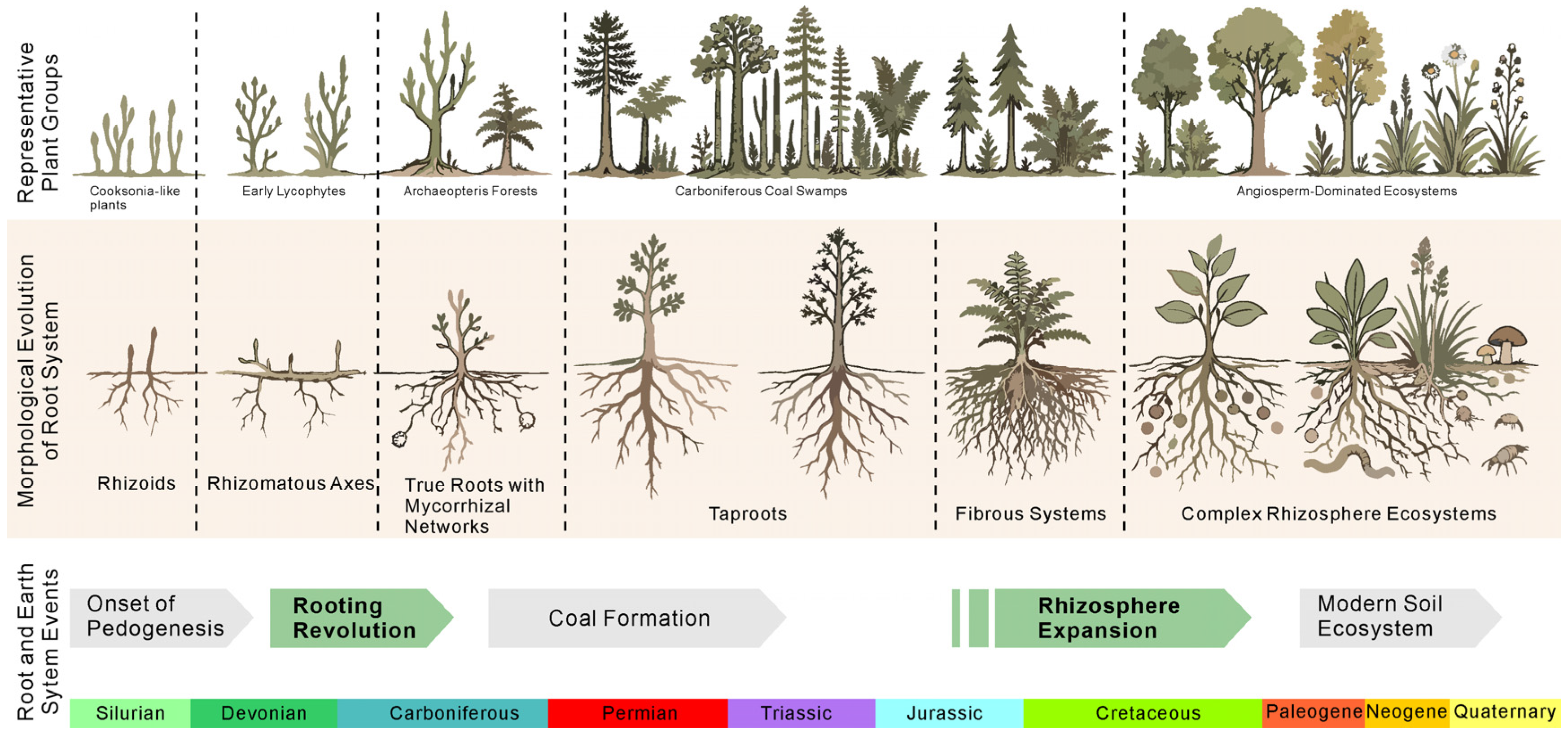
Key evolutionary stages of root development coincided with major global transitions (Figure 1). In the following, we describe four stages and their contrasting mechanisms, which are summarized in Table 1.
Figure 1.
Plant root system evolution and transitions through Earth history. Schematic timeline showing major evolutionary stages of root systems (up) and corresponding Earth system responses (down) from the Silurian to present. Key transitions—the Devonian “Rooting Revolution” and Cretaceous–Cenozoic “Rhizosphere Expansion”—are highlighted.
Table 1.
Four key stages of root evolution and their contrasting mechanisms.
2.1. Early Exploration (Late Ordovician–Silurian)
The earliest vascular plants (e.g., Cooksonia) lacked true roots, anchoring themselves by rhizoids and rhizomes in moist substrates [7]. These structures, termed rhizoid-based rooting systems (RBRSs), served primarily for anchorage and had limited geochemical impact, yet their developmental pathway is ancestral to true root hairs: tip-growing cells—rhizoids in early plants and root hairs in vascular plants—share a deeply conserved molecular pathway, confirming their common evolutionary ancestry [4,14]. Remarkably well-preserved fossils from the 407-million-year-old Rhynie Chert demonstrate that even these simple RBRSs already hosted diverse mycorrhizal symbionts, including both Glomeromycota (arbuscular) and Mucoromycotina fungi, indicating that fungal partnerships were established before true roots evolved [4,15]. The key geological innovation of this stage, however, was the initiation of in-situ weathering: by secreting simple organic acids and accumulating organic matter, these primitive systems set in motion the first biological weathering and soil-forming processes [5].
It is important to be precise about the timing and causation of early Paleozoic CO2 decline, a point that has been the subject of active debate. Pedogenic-carbonate isotopic records indicate that atmospheric CO2 began a major, long-term decline in the Ordovician—well before the Devonian appearance of true vascular-plant roots, coals, large logs, or diverse terrestrial biotas [16]. The Ordovician cooling that culminated in the Hirnantian glaciation (~445 Ma) therefore cannot be attributed to vascular plants. Two mutually compatible mechanisms have been proposed. First, Lenton et al. [8] demonstrated experimentally that even non-vascular (bryophyte-grade) plants substantially enhance mineral weathering, providing a mechanism by which the earliest terrestrial vegetation could have contributed to Ordovician CO2 drawdown without true roots. Second, Retallack (1997) [16] argued that the early Paleozoic greenhouse was curbed by an increased ratio of primary to secondary productivity on land: the evolution of herbivore-suppressant toxins (e.g., flavonoids) and refractory materials (e.g., lignin) in early land plants reduced the fraction of primary production consumed by animals and other secondary producers, thereby enhancing net carbon retention on land. Significantly, the CO2 decline does not correlate with temporal variation in volcanic or metamorphic activity—which in fact increased from the Ordovician to the Carboniferous—weakening purely tectonic explanations for the drawdown [16]. Carbon-isotope evidence for near-modern levels of soil respiration in Ordovician paleosols is consistent with an active early terrestrial carbon cycle, although much of that respiration is attributed to animals and other secondary producers rather than to the roots of non-vascular plants [16]. Silurian paleosols then record a progressive increase in root-trace density and rooting depth, together with a decline in animal burrow density, indicating that rhizospheres were already becoming dense and deep during the Silurian [16]. The earliest recognizable rhizoliths often provide the only evidence of plant colonization where above-ground organs were obliterated by taphonomic processes [17].
2.2. The “Rooting Revolution” (Devonian)
The Devonian (~419–359 Ma) appearance of true roots—here defined as multicellular organs characterized by gravitropic response, endogenous branching, root hairs, and a protective root cap [4]—represents the critical transition of root evolution. Roots evolved in a piecemeal fashion, independently in several major clades, rapidly acquiring functionality and complexity [4]. Some of the earliest rooting structures are found in 419–408-million-year-old clubmosses (e.g., Drepanophycus spinaeformis) and their close relatives among the extinct zosterophylls (e.g., Bathurstia denticulata), which bore distinctive downward-growing branches interpreted as the earliest gravitropic rooting response [4]. At the Rhynie Chert (407 Ma), however, the rooting axes of these early plants appear to be exogenous and lack root hairs—possessing only some of the attributes of true roots [4,5]. Rooting structures first appeared in the zosterophyll/lycopod lineage during the Early Devonian, with euphyllophyte roots evolving later, supporting the hypothesis of convergent origins for this key organ [4,5,18]. The two lineages show contrasting anatomies—lycopod roots typically have endarch xylem maturation and strictly dichotomous branching, whereas euphyllophyte roots are typically exarch and capable of endogenous branching—differences that reflect their independent evolutionary origins [18]. The roots of early arborescent lycopods were modified shoots bearing modified leaves as rootlets, a unique evolutionary solution to anchorage and resource acquisition distinct from that of any other plant group [19].
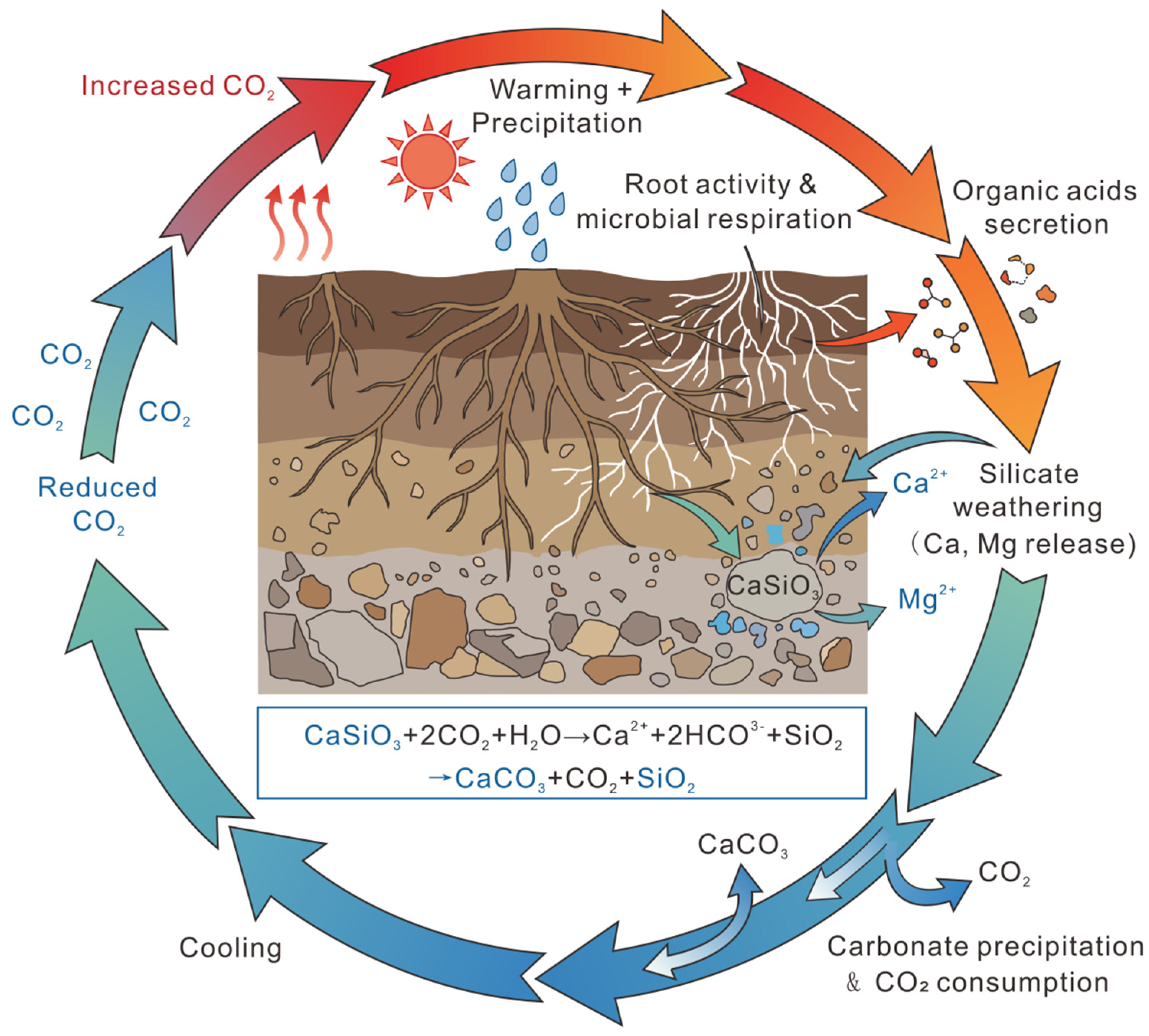
True roots, together with their fungal partners, formed an efficient “root–fungal weathering network” that physically disrupted minerals and secreted organic acids [9]. The evolution of deep-rooting trees like Archaeopteris created the first forests [20,21] and scaled this weathering engine globally. The earliest known fossil forest at Gilboa, New York (ca. 385 Ma), reveals that trees had already attained heights exceeding 8 m, with strikingly diverse rooting strategies: the dominant cladoxylaleans (thought to be intermediate between early vascular plants and living ferns) were anchored by many narrow (1–2 cm), unbranched, overlapping roots like modern palms; small clubmoss trees possessed large bifurcating root systems extending horizontally at shallow depth to form a stable platform for their pole-like trunks; and aneurophyte progymnosperms grew as lianas bearing adventitious roots [21]. Notably, there was no straightforward correlation between above-ground stature and root-system size in these early forests [21]. Cross-disciplinary work integrating palaeobotany, palaeosol geochemistry, and experimental geobiology has tested—and largely confirmed—that the evolution of deep-rooting trees intensified weathering and pedogenesis, leaving detectable geochemical signatures in Devonian palaeosols [9]. Devonian paleosols record a rapid increase (over the interval ca. 390–360 Ma) in weathering depth and intensity [16], which, along with geochemical models, indicates that biologically amplified silicate weathering drove a massive drawdown of atmospheric CO2, a key driver of the Late Paleozoic Ice Age [8,22] (Figure 2). Root systems thus transitioned from passive adapters to active regulators of global climate, with the rhizolith record shifting from simple traces to complex networks [18].
Figure 2.
The root−driven silicate weathering thermostat and carbon cycle feedback. Conceptual diagram of the negative feedback loop by which roots amplify silicate weathering, ultimately cooling climate. Key components include root–microbe–mineral interactions, pedogenic carbonate formation, and organic carbon burial. Conceptual framework based on [1,8,10,13]. The direction of the arrows in the image indicates the evolutionary trend of the Earth system’s climate temperature. Red tones indicate warmer temperatures, while blue tones indicate cooler or cold temperatures.
We note, however, that the deep-time record argues for a progressive—rather than abrupt—intensification of biological weathering. A substantial part of the Paleozoic CO2 decline was accomplished before the mid-Devonian, through the non-vascular and early vascular vegetation described above [8,16]; true roots provided a late but powerful amplification—the “Devonian engine” of the so-called Devonian plant hypothesis, which posits that the evolution of deep-rooting trees drove a ~90% decline in atmospheric CO2 through the Palaeozoic [9]. Within this framework, the late Paleozoic ice age is best understood as a multi-phase phenomenon rather than a single event: glaciation was initiated near the end of the Devonian [9] and recurred through the Carboniferous and Permian, with later phases modulated by additional factors—most notably the vast burial of organic carbon in Carboniferous coal swamps and the drift of Gondwana into polar latitudes—acting on top of the root-driven CO2 decline [22]. Attributing the entire Paleozoic CO2 decline to vascular-plant roots alone would overstate the case, just as attributing it entirely to tectonic or volcanic processes would. These distinctions are elaborated in Table 1.
2.3. System Deepening (Carboniferous–Permian)
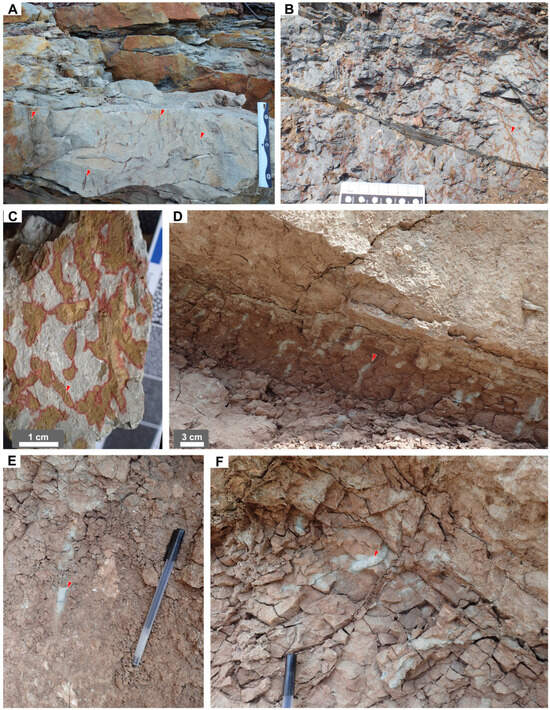
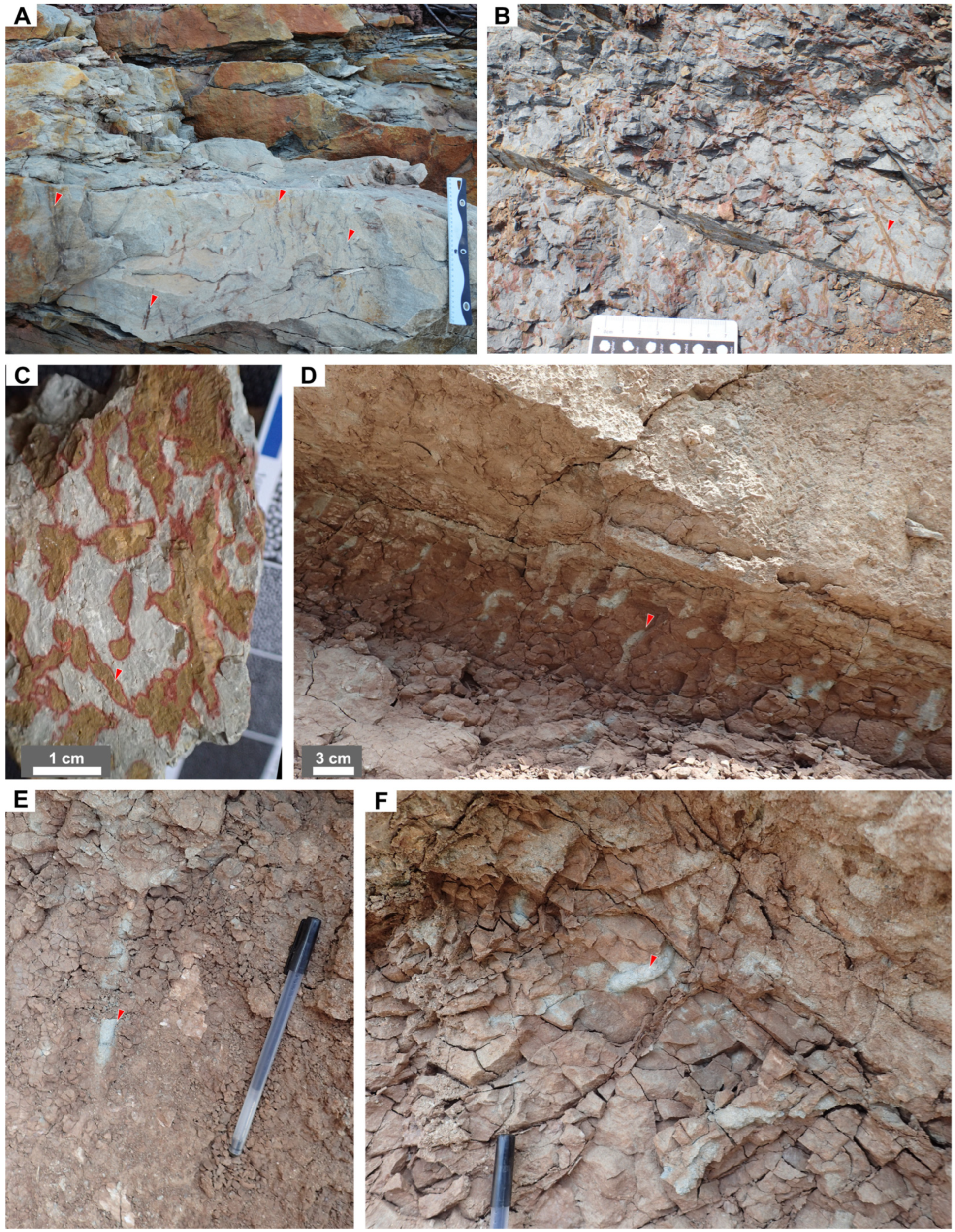
The Carboniferous and Permian witnessed the diversification of root architectures (Figure 3A–C) [4,18] and the full maturation of the Paleozoic weathering engine. The independent and nearly concurrent evolution of trees in several plant groups—lycopods, sphenophytes, progymnosperms, and cladoxylaleans—produced a spectrum of architectural solutions to anchorage, water supply, and nutrient acquisition [4]. Vast root networks greatly enhanced landscape erosion resistance, promoting a global shift in fluvial depositional patterns from braided to meandering rivers [23]. Intense acidic leaching by vast root networks led to the first significant bauxite deposits and deeply weathered kaolinitic paleosols [24], with root fossils preserved within them providing direct evidence of plant-led deep chemical weathering and elemental differentiation.
Figure 3.
Representative root fossils in strata. (A) Root fossils from the fluvial sandstone of Joggins Formation (Carboniferous), Nova Scotia, Canada; (B,C) rhizoliths from the Shihhotse Formation (late Permian), western Liaoning, China; (D–F) rhizoliths from the Cretaceous red beds in Shanyang Basin, Qinling, China. The red arrows indicate the area in the photograph where the plant root fossils are located or the area they influence.
Calcitic rhizoliths in Permo-Pennsylvanian eolianites of the western United States—ranging from <1 mm to 15 cm in diameter and ramifying through the uppermost 2–3 m of flat-topped sand bodies—attest to the root’s role in stabilizing landscapes under arid to semi-arid conditions [25]. Large compound rhizoliths display alveolar fabric, a feature resulting from rootlet calcification that is characteristic of modern and ancient calcretes [25]. Formed as low-Mg calcite precipitated around roots in permeable dune sands, these rhizoliths are confined to planar deflation surfaces, indicating that plants required geomorphically stable substrates and could not colonize active dune fields; their restriction to late Paleozoic coastal dune sequences further links rhizolith formation to glacio-eustatic sea-level fluctuations [25]. In the Permian red beds of the Erzgebirge Basin, Germany, calcrete paleosols containing diverse rhizolith types formed under semi-arid conditions on alluvial fans and floodplains and are associated with microvertebrate remains that provide a rare taphonomic window into early terrestrial vertebrate communities [17]. The succession on the North China Plate is exemplary: rhizolith-bearing paleosols in the middle–late Permian Shihhotse and Hamashan Formations track a basin-wide shift from swamp to alluvial settings driven by Variscan uplift and increasing aridity, with Stigmaria root fossils capping the alluvial conglomerates of the Hamashan Formation [26] (Figure 3B,C). The sequence records a Wuchiapingian arid phase, a brief humid interval, and a return to semiarid conditions across the Changhsingian–Induan, capturing the response of terrestrial ecosystems to high-frequency climate oscillations near the close of the Paleozoic [26].
2.4. The “Rhizosphere Expansion” (Mesozoic Onward)
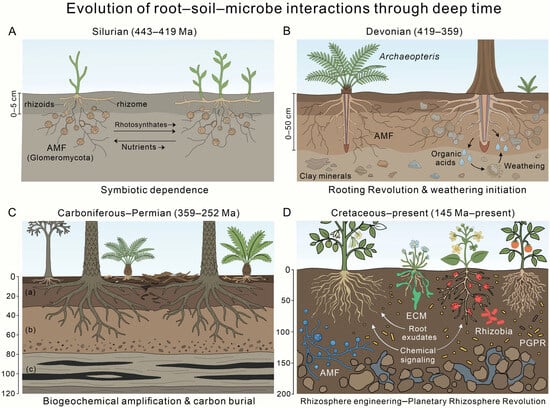
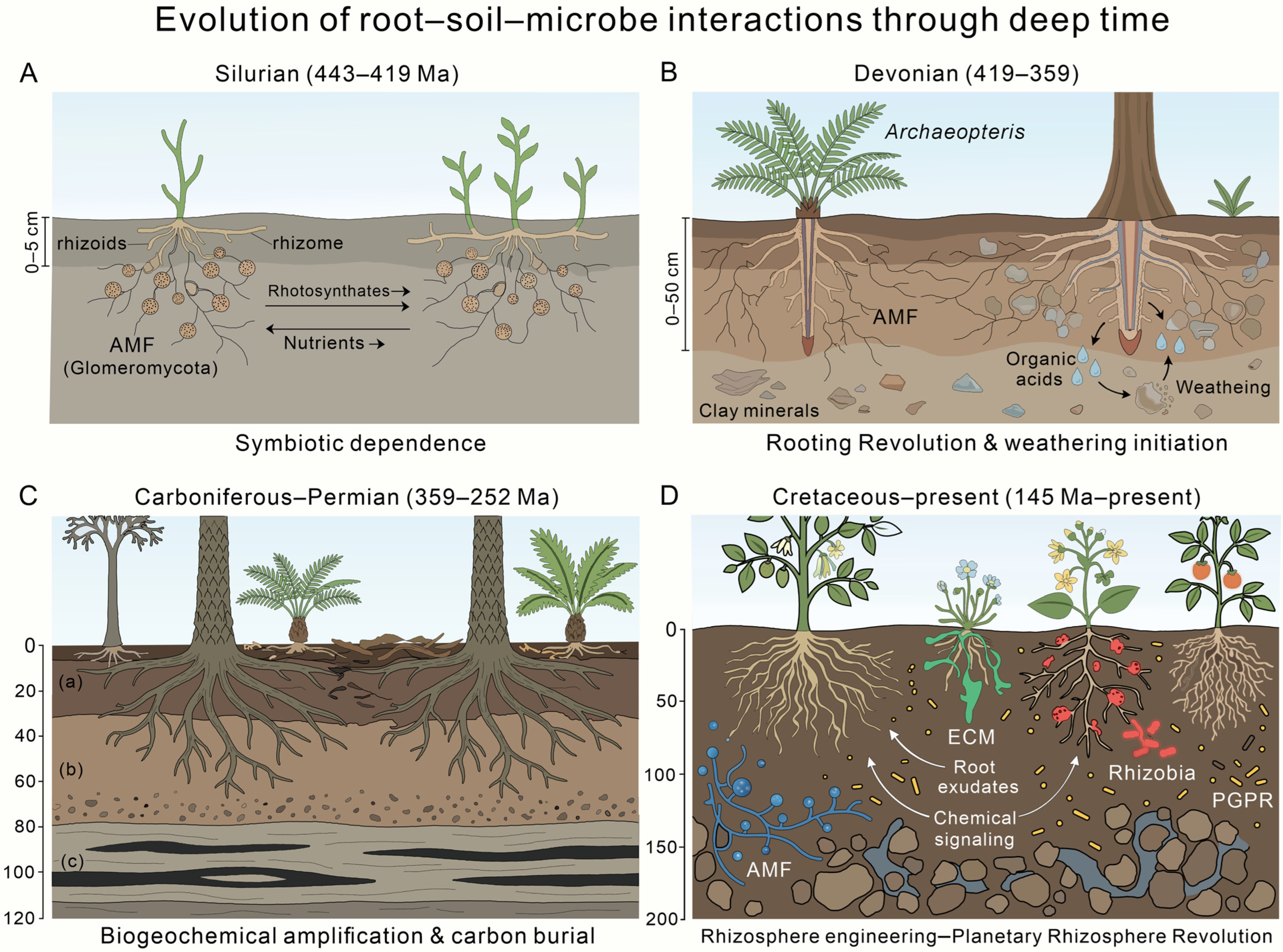
We propose the term “Rhizosphere Expansion” for the angiosperm-led amplification of the inherited weathering engine (Figure 4). We note that the phrase “rhizosphere revolution” has recently been used in an agricultural context [27]; here we apply it in a strictly geobiological sense. Angiosperms, which represent more than three-quarters of all living land-plant species despite existing for only about a quarter of land-plant history, possess root systems with uniquely high physiological capacities [11]. Their dense, fibrous roots have extremely high specific surface area and support diverse microbial consortia, enabling rapid nutrient cycling—especially of phosphorus—and elevating terrestrial primary productivity and nutrient recycling toward modern levels [12]. Recent molecular dating integrating over 25,000 fossil occurrences with genomic data pushes the inferred origin of crown angiosperms back to the Late Jurassic, incompatible with a strictly post-Jurassic emergence [28]. This intensification is registered in multiple independent lines of evidence.
Figure 4.
Schematic diagram illustrating the co-evolution of root systems, soils, and microorganisms through four key stages. (A) Silurian: Rhizoid-based anchoring with arbuscular mycorrhizal fungi; (B) Devonian: True roots with vascular tissues and fungal networks (Rooting Revolution); (C) Carboniferous–Permian: Deep, woody root systems with massive carbon burial (biogeochemical amplification). Massive root systems (e.g., Stigmaria) under arborescent lycopsids; the soil profile shows clear (a–c) horizon differentiation: (a) horizon (organic-rich topsoil, zone of eluviation), (b) horizon (clay/Fe–Al oxide accumulation, zone of illuviation), and (c) horizon (partially weathered parent material, weathering front), reflecting mature root-driven pedogenesis and long-term organic carbon burial; (D) Cretaceous–present: Angiosperm fibrous roots with diverse microbial consortia (Rhizosphere Expansion). Conceptual framework based on [3,4,13,16].
First, root-driven chemical weathering reached unprecedented intensities. Cretaceous bauxite deposits from Georgia (USA) exhibit Chemical Index of Alteration (CIA) values exceeding 99, with mineral assemblages dominated by kaolinite, gibbsite, and goethite in the complete absence of quartz and micas [29]—signatures that far surpass those of Paleozoic paleosols and fingerprint intense organic-acid secretion and elemental leaching. Second, angiosperms fundamentally altered the terrestrial water cycle: their greatly elevated transpiration capacities feed atmospheric moisture and enhance rainfall recycling at regional to continental scales [30]. Although the impact of any single angiosperm on weathering rate may not have greatly exceeded that of earlier plants [31], the aggregate effect—amplified by positive hydrological feedbacks—created a more powerful Earth system loop that was not operational before the Cretaceous. Third, angiosperm root systems transformed sedimentary environments and biological interaction networks. Mangrove ecosystems, which radiated during the Late Cretaceous, produced distinctive root architectures that trapped sediment and stabilized coastlines; the Cenomanian Bahariya Formation of Egypt preserves crabs (Necrocarcinidae) associated with dinosaurs in a mangrove setting dominated by the tree fern Weichselia reticulata [32]. By the Oligocene, the Jebel Qatrani Formation of Egypt records diverse rhizolith assemblages from wetland plants, mangroves, and large trees alongside the first fossil termite nests and riverine Ophiomorpha, illustrating that roots had become core architects of terrestrial food webs and sediment budgets [33]. Well-developed root architectures discovered in the Cretaceous red strata of the Qinling area, central China (Figure 3D–F), provide an illustrative example of the kind of rooting systems that characterized this expansion in mid-latitude terrestrial settings during the Late Cretaceous.
Fourth, and critically for the evolutionary history of root–microbe interactions, the angiosperm radiation triggered an explosive diversification of mycorrhizal strategies. The Cretaceous saw the evolution of ectomycorrhizas (ECM), ericoid mycorrhizas, orchid mycorrhizas, and independently evolved nonmycorrhizal roots—a profound shift from the largely uniform arbuscular mycorrhizal (AM) associations of the glomeromycetes that dominated earlier plants [13]. Ectomycorrhizas are thought to have emerged in the Early Cretaceous, with the first unequivocal fossil evidence at ~50 Ma and molecular-clock estimates extending their origin back to at least 200 Ma [9]. Brundrett (2002) framed this history as a progression from endophytic associations toward balanced mutualisms in which partners became interdependent through the exchange of limiting resources and documented a correlated morphological divergence: obligately mycorrhizal plants have the greatest root-cortex thickness and exodermal suberization, whereas nonmycorrhizal plants tend toward fine roots with more root hairs and stronger chemical defenses [13]. Field experiments at the UK National Arboretum demonstrate that AM fungi associated with gymnosperm trees (the closest extant analogues of Devonian forest trees) preferentially colonize and weather basalt grains over granite and quartz—exhibiting mineral-specific foraging behaviour that had previously been dismissed—whereas ectomycorrhizal Pinaceae weather basalt even more intensively, highlighting the functional divergence between ancestral AM and later, independently evolved ECM symbioses [9]. This diversification allowed angiosperms to colonize nutrient-poor soils and extreme habitats that remained inaccessible to earlier vascular plants, and it represents the key contrast between the two great transitions: the Devonian Rooting Revolution operated through a relatively conserved AM-dominated symbiosis, whereas the Rhizosphere Expansion was characterized by a proliferation of root–fungal and root–bacterial strategies [13]. Molecular studies further reveal that the regulatory modules controlling root development—including PLETHORA, WOX, SHORT-ROOT, and SCARECROW homologs—are expressed in similar spatial patterns in lycophyte and angiosperm roots, indicating that natural selection repeatedly recruited the same genetic toolkit during convergent root evolution [34,35].
Quantitatively, the Rhizosphere Expansion is registered in weathering and productivity proxies that are extreme by Phanerozoic standards—CIA values exceeding 99 in Cretaceous bauxites [29] and angiosperm-specific leaf-vein densities of 7–28 mm mm−2 [36]—together indicating a weathering regime without Paleozoic precedent.
3. Integrative Mechanisms for Planetary Habitability
3.1. Core Geochemical Engine
Roots are the biological amplifier of Earth’s silicate weathering thermostat [8] (Figure 2), establishing a crucial negative feedback: increased atmospheric CO2 → warmer climate and increased precipitation → enhanced plant and microbial activity → accelerated root weathering → consumption of CO2 → climate cooling. This negative feedback is the cornerstone of Earth’s long-term climate stability [8]. Studies of Devonian paleosols confirm that forested ecosystems substantially increased the quantity and depth of chemical weathering, with long-term sequestration of atmospheric CO2 through marine carbonate formation [9,16]. Concurrently, root-promoted burial of organic matter (e.g., Carboniferous coal seams) further regulated the balance of atmospheric O2 and CO2 over geological timescales.
Calcareous rhizoliths are direct archives of this process. Pedogenic carbonate formation—including rhizolith precipitation—is driven by a dynamic equilibrium between dissolution of primary carbonates and reprecipitation of secondary carbonates, controlled by soil CO2 concentration [37]. Recently, the first quantitative mechanistic model of rhizolith formation (RhizoCalc) has been developed, integrating water fluxes, root water uptake, and carbonate chemistry to simulate the conditions under which rhizoliths develop [38]. 14CO2 labeling experiments on saline and alkaline soils along the Tarim River—incubated at three CO2 concentrations (0.04%, 0.4%, and 4%)—demonstrate that carbonate recrystallization rates increase logarithmically with CO2 concentration (r2 > 0.97): the average recrystallization rate reached 8.45 × 10⁻⁶ day−1 in a saline soil at 4% CO2, roughly 280-fold higher than the 0.03 × 10⁻⁶ day−1 measured in an alkaline soil at 0.04% CO2, and the full recrystallization period of primary carbonates at 4% CO2 was 10- to 100-fold shorter than at lower concentrations [37]. Recrystallization rates also increased with soil salinity (electrical conductivity) and decreased with pH, identifying CO2 concentration—ultimately derived from root and microbial respiration—as the dominant control on pedogenic carbonate turnover, and thereby providing a mechanistic link between belowground respiratory activity and long-term carbon sequestration [37]. We caution, however, that these experiments were conducted in modern saline–alkaline soils colonized by highly evolved angiosperm–microbial consortia, whose physiological and microbial conditions differ markedly from Paleozoic systems; they are therefore best regarded as mechanistic analogues that illuminate process, rather than as direct quantitative calibrations transferable to deep time.
The isotopic composition of carbonate rhizoliths—δ13C recording the photosynthetic pathway (C3 vs. C4) of the rooting vegetation and δ18O tracking hydrological conditions—enables reconstruction of past vegetation and wet–dry cycles [39]. Evidence from leaf fossils further suggests that terrestrial productivity was relatively decoupled from atmospheric CO2 prior to angiosperm evolution. The high leaf-vein densities (7–28 mm mm−2) unique to angiosperms have been attributed to Cretaceous CO2 decline, but across the Phanerozoic low vein densities (<3 mm mm−2) remained equally common among non-angiosperms regardless of CO2 levels, and photosynthetic modeling indicates that maximum assimilation rates in non-flowering plants were capped well below those of flowering plants [36]. Thus, although earlier models predicted that productivity might have doubled or tripled with each Phanerozoic transition from low to high CO2, actual productivity changes were likely limited before the evolution of flowering plants—only then did terrestrial productivity become tightly coupled to the carbon cycle in the modern manner [36].
The phosphorus cycle is tightly coupled to this engine. Phosphorus—a key limiting nutrient in weathered soils—is ultimately derived from the weathering of calcium-phosphate minerals such as apatite, a process mediated by roots and, critically, by arbuscular mycorrhizal fungi, which release plant-available P through Ca-phosphate dissolution in exchange for host carbon [9]. This root–fungal P release supports higher-biomass forested ecosystems, which in turn intensify weathering—a positive feedback central to the Devonian plant hypothesis [9]. At the molecular level, rhizoliths preserve complementary archives: alkane and fatty-acid proxies show that rhizolith organic matter carries a woody-plant signature distinct from the grass-dominated signal of surrounding loess, and elevated microorganism-derived fatty acids in the former rhizosphere record the high microbial activity associated with rhizodeposition [40].
3.2. Genesis of the Pedosphere
Soil is not merely a geological substrate but a direct product and legacy of root exploration. By supplying organic matter, creating aggregate structures, and regulating water–air ratios, roots transform inert mineral debris into the life-sustaining pedosphere. Early Devonian forest soils represent the most ancient well-drained paleosols, showing clay enrichment and subsurface weathering that culminated a long-term trend of soil deepening initiated in the Silurian [16]. A positive feedback between soil development and plant size—larger plants require deeper, more stable soils, and plants themselves enhance soil formation—progressively deepened both rooting zones and soil profiles during the Devonian [4].
Rhizoliths are among the most informative pedogenic features in the rock record, and their value for paleoenvironmental reconstruction lies in several independent attributes. Klappa (1980) [10] provided the foundational classification, recognizing five basic types: (1) root moulds—tubular voids outlining former root positions; (2) root casts—sediment- and/or cement-filled root moulds; (3) root tubules—cemented cylinders around root moulds; (4) rhizocretions sensu stricto—pedodiagenetic mineral accumulations around living or dead roots; and (5) root petrifactions—mineral impregnations or replacements preserving anatomical features. Roots are also responsible for characteristic pedogenic features including alveolar textures, rhizobrecciation, and rhizomicritization within terrestrial carbonates [10].
Morphology and orientation. Vertical, downward-tapering rhizoliths indicate the taproots of phreatophytes in well-drained alluvial settings, whereas horizontal networks point to emergent macrophytes or coastal grasses in saturated, lake-margin settings [41]. Petrography refines these interpretations: vertical rhizoliths from well-drained vadose settings contain little organic debris and have poorly developed meniscus and microstalactitic cements, whereas horizontal rhizoliths from saturated, reduced environments contain abundant organic material and display elevated Mn concentrations (up to 4.5 cation percent in calcite cements), reflecting bacterial decay of plant debris under low-Eh conditions [41].
Mineralogy as a hydrochemical fingerprint. The mineral composition of rhizoliths records the fluid chemistry of the depositional environment: calcite dominates in seasonally dry, well-drained vadose settings [25]; opaline silica, zeolites (mainly analcime), and fluorite form under saline–alkaline conditions driven by evapotranspiration [42]. Around the margins of saline, alkaline Lake Bogoria, Kenya, rhizoliths composed of opaline silica, calcite, zeolites, and fluorite record a sequence of hot-spring, evaporative, and capillary-rise hydrochemical regimes [42]—non-calcareous archives that carbonate-dominated studies cannot capture. However, primary signals can be modified by diagenesis; carbonate phases may undergo multiple generations of dissolution and reprecipitation, potentially decoupling isotopic compositions from original root-respired CO2 [37,43]. Petrographic studies of Pleistocene rhizoliths from Cayman Brac illustrate the mechanism: rhizolith cores are surrounded by a diverse suite of cements—calcite rhomb chains, isolated rhombs, calcified filaments, and grain-coating needle mats—that are largely absent from the host sediment, demonstrating that roots act as conduits for waters of varying composition and as substrates for carbonate-promoting algae, fungi, and bacteria [44]. Careful petrographic examination is thus essential.
Isotopic archives of paleoclimate and paleohydrology. The δ13C of carbonate rhizoliths records the photosynthetic pathway of the root-bearing vegetation, while δ18O and δ13C together track wet–dry cycles. At Olduvai Gorge, Tanzania, high-resolution isotope analyses of lake-margin rhizoliths record Milankovitch-scale oscillations in groundwater discharge and evaporation [39]. Radiocarbon dating of Quaternary rhizoliths can distinguish synsedimentary roots from later root penetration—a distinction of first-order importance for reliable reconstruction. At Nussloch, Germany, carbonate rhizoliths up to 5 cm in diameter and more than 1 m long yielded δ13C values of −10.9 ± 0.1‰ (indicating a C3 plant origin) and 14C ages of 3788 ± 59 yr BP, demonstrating that the roots penetrated the loess long after deposition had ceased (~15 ka BP) rather than forming synsedimentarily [43]. Molecular proxies (n-alkanes, fatty acids) further confirm a woody-plant signature distinct from the grass-derived signal of synsedimentary loess [40], and root-derived material can alter the organic-matter composition of loess up to 5 cm from the rhizolith—a postsedimentary overprint that must be separated from original signals using compound-specific approaches [37].
3.3. Stabilizing Geomorphology
Root networks fundamentally altered sediment erosion and river morphology [23], shifting landscapes from pre-vegetation braided rivers to meandering systems—one of the most fundamental changes in Earth’s sedimentary record [23,45]. Quantitative estimates suggest that the evolution of deep-rooting systems during the Devonian reduced landscape erosion rates by an order of magnitude compared to unvegetated terrains [45]. Rhizoliths in Permo-Pennsylvanian eolianites, restricted to planar deflation surfaces, indicate that plants established only on stable, non-migrating substrates, after which their roots locked down the underlying sands [25]. The repeated disappearance and reappearance of rhizolith-bearing paleosols across boundaries like the Permian–Triassic transition track perturbations that decimated plant cover; in the Late Permian to Middle Triassic successions of Minorca (Spain), an unconformity characterized by ventifacts and an absence of pedogenic features marks extreme aridity, whereas the overlying Anisian succession preserves the earliest Mesozoic rhizoliths, signaling a return to conditions favorable for plant colonization [46]. These patterns underscore the role of roots in landscape resilience, a principle applicable to modern soil conservation [47,48].
3.4. Roots as a Trophic Resource for Terrestrial Vertebrates
Beyond their geochemical functions, roots have served as a persistent nutritional resource for terrestrial vertebrates throughout the Phanerozoic. Direct fossil evidence of root consumption is inherently scarce, because root tissues are easily degraded during digestion and burial, and the remaining fragments are difficult to distinguish from above-ground organs such as leaves and stems [49]. Despite these taphonomic limitations, a compelling—if fragmentary—record is emerging, spanning roughly 290 million years.
The earliest direct evidence appears in the Early Permian, with a probable diadectid coprolite from Texas (USA) containing internal structures resembling root casts and matching the geometry of modern herbivore dung [50]. This indicates that by ~290 Ma, terrestrial vertebrates had incorporated below-ground plant parts into their diet. Diadectids, generally considered stem amniotes, possessed bulbous-cusp teeth and enlarged guts consistent with high-fiber herbivory [51] and evolved the earliest thecodont tooth implantation, which better resisted lateral forces during chewing [52]. Circumstantial skeletal evidence suggests that other contemporaneous herbivorous vertebrates likewise exploited below-ground resources by digging: the morphology of the terminal phalanges indicates wide, keratinous claws ideally suited for scratching and digging in the high-fiber caseid synapsids and captorhinid reptiles, whose fossil records extend into the middle and late Permian, respectively [53,54,55].
For the Mesozoic, no unambiguous direct evidence of root consumption has yet been identified. Coprolites of herbivorous dinosaurs are rich in gymnosperm cuticles, woody stem fragments, fern spores, and grass phytoliths [56,57,58], but these remains are interpreted as derived from above-ground parts, and no root-specific anatomical structures have been recognized. This gap most likely reflects preservational and analytical limitations rather than the genuine absence of root-feeding behavior; the long evolutionary history of vertebrate herbivory during this interval set the stage for subsequent exploitation of below-ground resources in the Cenozoic.
Pleistocene ecosystems provide a vivid picture of root-based food webs. The “mammoth steppe” biome, which stretched from Spain across Eurasia to Canada during the Last Glacial Period, maintained high productivity and biodiversity despite cold, dry conditions [59]. Stable isotope evidence indicates that clear dietary niche partitioning was a key mechanism allowing the coexistence of several large herbivores—woolly mammoths, woolly rhinoceros, bison, and horses—on the mammoth steppe [60]. In this cold, snow-covered environment, herbaceous plants stored photosynthates as starch in underground rhizomes and tubers, providing a critical winter energy source. Coprolites of woolly mammoths preserved in Siberian permafrost contain abundant fragments of herbaceous roots and rhizomes [61,62], and a multidisciplinary analysis of mammoth coprolites from Yakutia and Chukotka revealed that the winter diet of mammoths consisted mainly of herbaceous plant roots and grasses, supplemented by sedges, other herbs, and dwarf-shrub foliage [62]. Mammoth dentition shows specialized adaptations for this diet, including extreme hypsodonty and dense enamel lamellae suited to grinding silica-rich, soil-coated fodder [63]. An unusual avian example reinforces the antiquity of root feeding: ancient DNA and pollen analysis of a Late Quaternary coprolite from New Zealand identified the kākāpō (Strigops habroptilus) as the producer, and the coprolite contained pollen of the cryptic root-parasitic plant wood rose (Dactylanthus taylorii) at 8.9% of total pollen and spores [64]. Combined with observations of modern parrots digging for below-ground plant parts [65], this suggests the flightless, toothless kākāpō—equipped with a powerful beak and foregut fermentation—also consumed underground root tissue [66].
The nutritional significance of underground storage organs (USOs) extends to the human lineage. Carbon isotope signatures of Australopithecus africanus and Paranthropus robustus indicate a diet containing significant C4 (plants using the C4 photosynthetic pathway) plant carbon, yet their flat, low-cusped molars are mechanically unsuited to chewing tough C4 grass leaves—the “C4 conundrum” [67]. Yeakel et al. [68] analyzed the isotopic ecology of African mole rats, which specialize in consuming C4 USOs, and found that their δ13C values overlap strongly with those of these early hominins. USOs are starch-rich, fiber-poor, and mechanically easier to process with flat teeth, matching hominin dental morphology. Laden and Wrangham [69] proposed that USOs acted as “fallback foods”, providing reliable energy when above-ground resources were seasonally scarce, thereby facilitating hominin expansion into more open environments. Modern behavioral observations of savanna chimpanzees using wooden sticks to dig up USOs [70] provide a compelling analogue, demonstrating that the cognitive and technological prerequisites for exploiting below-ground resources were already present in the earliest hominins.
Finally, we emphasize a distinction that is sometimes blurred in the literature: roots interact with vertebrate remains in ways other than consumption. Root traces preserved as bioerosion on fossil bones—for example, on mandibles of the notoungulate Paedotherium minor in the Huayquerian (Late Miocene) assemblage of Telén, Argentina—record the activity of roots growing over and into bones after death and serve as taphonomic and paleoenvironmental indicators of vegetation cover rather than as evidence of herbivory [71]. Similarly, in continental evaporite successions, trace-fossil assemblages—including networks of small rhizoliths, large rhizoliths, and burrows of chironomid, coleopteran, and annelid larvae—document how roots and burrowing invertebrate faunas structured biological communities across distinct saline-lake subenvironments, with invertebrate activity concentrated in lakes from which gypsum precipitated at salinities of ~100–150 g/L [72]. Taken together, this deep-time perspective demonstrates that root systems have been not only geochemical engineers but also a foundational nutritional base—and a persistent agent of taphonomic and ecological interaction—linking the subterranean world to the evolution of terrestrial vertebrates, including humans.
Beyond their role as consumers, root-feeding and root-seeking vertebrates acted as potential agents of pedogenesis through bioturbation. The digging behavior documented above—from the keratinous-clawed caseid synapsids and captorhinid reptiles of the Permian [53,54,55] to the wintering megafauna of the mammoth steppe [59,60,61,62,63]—would have physically mixed soils, redistributed organic matter, and locally modified erosion rates, thereby feeding back on the very pedosphere that roots helped to construct (Section 3.1, Section 3.2 and Section 3.3). This reciprocal coupling—roots structuring soils and soil-disturbing vertebrates redistributing them—remains underexplored in deep-time syntheses, and we suggest that it closes the loop between the trophic role of roots and their geochemical and pedogenic roles.
4. Discussion: Challenges and a Path Forward
The primary challenge is signal separation in paleosols. Attributing extreme weathering in a Cretaceous bauxite exclusively to angiosperm root acids, rather than climate amplified by root-driven feedbacks, requires a careful multi-proxy approach [29]. A case in point is carbonate rhizoliths in Quaternary loess: Gocke et al. [43] demonstrated that Nussloch rhizoliths often contain multiple calcite generations, with δ13C and 14C values reflecting a mixture of carbon sources; disentangling these required compound-specific radiocarbon dating and micromorphology. Similarly, Liutkus et al. [39] used paired δ13C and δ18O to reconstruct wet–dry cycles at Olduvai Gorge but acknowledged that recrystallization could blur seasonal signals.
Two further limitations of the current synthesis deserve emphasis. First, the attribution of deep-time CO2 decline to specific plant groups remains contested—as reviewed above, the Ordovician cooling predates vascular-plant roots, and the early Carboniferous glaciation likely reflects organic-carbon burial and tectonic configuration as much as root-driven weathering [8,22]. A genuinely rhizolith-centric test of these hypotheses will require integrating quantitative weathering proxies (clumped isotopes, lithium isotopes) with high-resolution rhizolith archives across the critical Silurian–Devonian and Carboniferous intervals. Second, the vertebrate-root interaction record is fragmentary and taphonomically biased [49]; future work combining coprolite micromorphology with plant-DNA and phytolith analyses may close the Mesozoic “evidence gap”. Historic microscope slide collections of permineralized plants remain an underutilized resource for documenting root anatomy and fungal endophytes [4], and reinvestigating them with modern techniques promises a new level of mechanistic understanding [34,35].
It is appropriate here to state explicitly what this review does and does not claim. We do not claim to have discovered that plants, roots, or angiosperms influence the Earth system; these are well-established results with a long intellectual history, from the mycotrophic origin of land plants [3] through the GEOCARB models [6] and the Devonian plant hypothesis [8,9,22]. Our contribution is organizational and integrative rather than empirical. Specifically, we (i) propose a rhizolith-centric reading of root evolution, in which the organosedimentary record—rather than plant macrofossils alone—serves as the primary archive; (ii) introduce the term “Rhizosphere Expansion” as the conceptual counterpart of the Devonian Rooting Revolution, thereby framing root evolution as two linked transitions rather than a single event; and (iii) integrate the role of roots as a nutritional resource for terrestrial vertebrates, a dimension largely absent from previous deep-time syntheses. The empirical record reviewed here—morphological, mineralogical, and isotopic—is drawn from the published literature, which we have attempted to synthesize rather than supersede. Where our own unpublished observations are mentioned (the Cretaceous root architectures of the Qinling area, Figure 3D–F), they serve as illustrative cases rather than as the evidentiary basis of the review.
5. Conclusions
The rhizolith record is the direct geological archive of a trajectory from a Paleozoic “Rooting Revolution” to a Mesozoic–Cenozoic “Rhizosphere Expansion”. By reading this archive through morphology, mineralogy, and geochemistry, we can reconstruct the role of roots as central regulators of the carbon cycle, builders of the pedosphere, stabilizers of landscapes, and foundational elements of terrestrial food webs.
Two conclusions deserve emphasis. First, the deep-time record argues for a progressive—not abrupt—intensification of biological weathering: non-vascular and early vascular plants initiated the process well before the Devonian, with true roots providing a late but decisive amplification. Second, the contrast between the two great transitions is as much ecological as physiological: the Devonian Rooting Revolution operated through a relatively conserved arbuscular mycorrhizal symbiosis, whereas the Rhizosphere Expansion was defined by a proliferation of root–fungal and root–bacterial strategies.
While elevated CO2 can stimulate root growth in many species, though with variable effects on root/shoot ratios, the deep-time record demonstrates that the root–soil system is a planetary-scale regulator. The rhizolith record thus offers a unique deep-time perspective for refining Earth system models and understanding how vegetation may modulate the trajectory of future global change.
Author Contributions
Conceptualization, X.L.; writing—original draft preparation, Y.H. and X.L.; writing—review and editing, X.L., Q.Y. and R.R.R.; visualization, Y.H.; supervision, X.L. and R.R.R.; project administration, X.L.; funding acquisition, X.L. and Q.Y. All authors have read and agreed to the published version of the manuscript.
Funding
This research was funded by the National Key Research and Development Program of China, grant number 2024YFF0807701; the National Science Foundation of China, grant number 42288201; and the Geological Field Teaching Program of Jilin University.
Data Availability Statement
No new data were created or analyzed in this study. Data sharing is not applicable to this article.
Acknowledgments
We sincerely thank Emmanouil Manoutsoglou for the kind invitation to contribute to this Special Issue. We thank Yang Yutao for assistance with figure drafting. Preliminary drafts of the schematic figures (Figure 1 and Figure 4) were generated with the assistance of Nano Banana Pro and subsequently redrawn and revised in full by the authors using vector graphics software CorelDraw 2019. The authors have reviewed the figures and take full responsibility for the scientific accuracy and originality of the final figures.
Conflicts of Interest
The authors declare no conflicts of interest. The funders had no role in the design of the study; in the collection, analyses, or interpretation of data; in the writing of the manuscript; or in the decision to publish the results.
Abbreviations
The following abbreviations are used in this manuscript:
| RBRSs | rhizoid-based rooting systems |
| USOs | Underground Storage Organs |
References
- Beerling, D.J.; Berner, R.A. Feedbacks and the coevolution of plants and atmospheric CO2. Proc. Natl. Acad. Sci. USA 2005, 102, 1302–1305. [Google Scholar] [CrossRef] [Scilit] [PubMed]
- Beerling, D.J. The Emerald Planet: How Plants Changed Earth’s History; Oxford University Press: Oxford, UK, 2007. [Google Scholar] [CrossRef] [Scilit]
- Pirozynski, K.A.; Malloch, D.W. The origin of land plants: A matter of mycotrophism. Biosystems 1975, 6, 153–164. [Google Scholar] [CrossRef] [Scilit] [PubMed]
- Kenrick, P.; Strullu-Derrien, C. The origin and early evolution of roots. Plant Physiol. 2014, 166, 570–580. [Google Scholar] [CrossRef] [Scilit] [PubMed]
- Raven, J.A.; Edwards, D. Roots: Evolutionary origins and biogeochemical significance. J. Exp. Bot. 2001, 52, 381–401. [Google Scholar] [CrossRef] [Scilit] [PubMed]
- Berner, R.A.; Kothavala, Z. GEOCARB III: A revised model of atmospheric CO2 over Phanerozoic time. Am. J. Sci. 2001, 301, 182–204. [Google Scholar] [CrossRef] [Scilit]
- Bardgett, R.D.; Mommer, L.; De Vries, F.T. Going underground: Root traits as drivers of ecosystem processes. Trends Ecol. Evol. 2014, 29, 692–699. [Google Scholar] [CrossRef] [Scilit] [PubMed]
- Lenton, T.M.; Crouch, M.; Johnson, M.; Pires, N.; Dolan, L. First plants cooled the Ordovician. Nat. Geosci. 2012, 5, 86–89. [Google Scholar] [CrossRef] [Scilit]
- Morris, J.L.; Leake, J.R.; Stein, W.E.; Berry, C.M.; Marshall, J.E.A.; Wellman, C.H.; Milton, J.A.; Hillier, S.; Mannolini, F.; Quirk, J.; et al. Investigating Devonian trees as geo-engineers of past climates: Linking palaeosols to palaeobotany and experimental geobiology. Palaeontology 2015, 58, 787–801. [Google Scholar] [CrossRef] [Scilit]
- Klappa, C.F. Rhizoliths in terrestrial carbonates: Classification, recognition, genesis and significance. Sedimentology 1980, 27, 613–629. [Google Scholar] [CrossRef] [Scilit]
- Boyce, C.K.; Leslie, A.B. The paleontological context of angiosperm vegetative evolution. Int. J. Plant Sci. 2012, 173, 561–568. [Google Scholar] [CrossRef] [Scilit] [PubMed]
- Ma, Z.; Guo, D.; Xu, X.; Lu, M.; Bardgett, R.D.; Eissenstat, D.M.; McCormack, M.L.; Hedin, L.O. Evolutionary history resolves global organization of root functional traits. Nature 2018, 555, 94–97. [Google Scholar] [CrossRef] [Scilit] [PubMed]
- Brundrett, M.C. Coevolution of roots and mycorrhizas of land plants. New Phytol. 2002, 154, 275–304. [Google Scholar] [CrossRef] [Scilit] [PubMed]
- Menand, B.; Yi, K.; Jouannic, S.; Hoffmann, L.; Ryan, E.; Linstead, P.; Schaefer, D.G.; Dolan, L. An ancient mechanism controls the development of cells with a rooting function in land plants. Science 2007, 316, 1477–1480. [Google Scholar] [CrossRef] [Scilit] [PubMed]
- Strullu-Derrien, C.; Kenrick, P.; Pressel, S.; Duckett, J.G.; Rioult, J.P.; Strullu, D.G. Fungal associations in Horneophyton ligneri from the Rhynie Chert (c. 407 million year old) closely resemble those in extant lower land plants. New Phytol. 2014, 203, 964–979. [Google Scholar] [CrossRef] [Scilit] [PubMed]
- Retallack, G.J. Early forest soils and their role in Devonian global change. Science 1997, 276, 583–585. [Google Scholar] [CrossRef] [Scilit] [PubMed]
- Schneider, J.W.; Rößler, R. A Permian calcic paleosol containing rhizoliths and microvertebrate remains from the Erzgebirge Basin, Germany—Environment and taphonomy. Neues Jahrb. Geol. Paläontol.-Abh. 1996, 202, 243–258. [Google Scholar] [CrossRef] [Scilit]
- Boyce, C.K. The evolutionary history of roots and leaves. In Vascular Transport in Plants; Holbrook, N.M., Zwieniecki, M.A., Eds.; Elsevier Academic Press: Burlington, MA, USA, 2005; pp. 479–499. [Google Scholar] [CrossRef] [Scilit]
- Rothwell, G.W. The fossil history of branching: Implications for the phylogeny of land plants. In Experimental and Molecular Approaches to Plant Biosystematics; Hoch, P.C., Stephenson, A.G., Eds.; Missouri Botanical Garden: St. Louis, MO, USA, 1995; pp. 71–86. [Google Scholar]
- Stein, W.E.; Berry, C.M.; Hernick, L.V.; Mannolini, F. Surprisingly complex community discovered in the mid-Devonian fossil forest at Gilboa. Nature 2012, 483, 78–81. [Google Scholar] [CrossRef] [Scilit] [PubMed]
- Meyer-Berthaud, B.; Decombeix, A.-L.; Ermacora, X. Archaeopterid root anatomy and architecture: New information from permineralized specimens of Famennian age from Anti-Atlas (Morocco). Int. J. Plant Sci. 2013, 174, 364–381. [Google Scholar] [CrossRef] [Scilit] [PubMed]
- Algeo, T.J.; Scheckler, S.E. Terrestrial-marine teleconnections in the Devonian: Links between the evolution of land plants, weathering processes, and marine anoxic events. Phil. Trans. R. Soc. Lond. B 1998, 353, 113–130. [Google Scholar] [CrossRef] [Scilit]
- Davies, N.S.; Gibling, M.R. Cambrian to Devonian evolution of alluvial systems: The sedimentological impact of the earliest land plants. Earth-Sci. Rev. 2010, 98, 171–200. [Google Scholar] [CrossRef] [Scilit]
- Harder, E.C. Stratigraphy and origin of bauxite deposits. Bull. Geol. Soc. Am. 1949, 60, 887–908. [Google Scholar] [CrossRef] [Scilit]
- Loope, D.B. Rhizoliths in ancient eolianites. Late Paleozoic and Mesozoic Eolian Deposits of the Western Interior of the United States. Sediment. Geol. 1988, 56, 301–314. [Google Scholar] [CrossRef] [Scilit]
- Li, X.; Zhong, W.; Wang, Y.; Reisz, R.R. Late Permian paleoenvironmental changes in the Xingcheng area, Liaoning Province, China: Sedimentary succession and root systems. Palaios 2020, 35, 122–134. [Google Scholar] [CrossRef] [Scilit]
- Kumar, D.; Gupta, S.; Hasan, W.; Hussain, B.; Ansari, M.J.; Singh, S. (Eds.) Rhizosphere Revolution: Unveiling the Secrets of Insect Pheromones in Soil Health and Vermicompost Production, 1st ed.; CRC Press: Boca Raton, FL, USA, 2025. [Google Scholar] [CrossRef] [Scilit]
- Wu, R.; Álvarez-Carretero, S.; Tong, Y.; Wan, S.; Schneider, H.; Clark, J.; Pisani, D.; Silvestro, D.; Donoghue, P.C. Integrated analysis of fossils and molecular divergence time estimates a latest Jurassic origin of angiosperms. Nat. Plants 2026, 12, 1242–1251. [Google Scholar] [CrossRef] [Scilit] [PubMed]
- Ayorinde, A.O. Mineralogy and Geochemistry of the Bauxite Deposits (Cretaceous), Wilkinson County, Georgia. Master’s Thesis, Georgia State University, Atlanta, GA, USA, 2011. [Google Scholar] [CrossRef]
- Buck, B.J.; Mack, G.H. Latest Cretaceous (Maastrichtian) aridity indicated by paleosols in the McRae Formation, south-central New Mexico. Cretac. Res. 1995, 16, 559–572. [Google Scholar] [CrossRef] [Scilit]
- Boyce, C.K.; Lee, J.E. Could land plant evolution have fed the marine revolution? Paleontol. Res. 2011, 15, 100–105. [Google Scholar] [CrossRef] [Scilit]
- Schweitzer, C.E.; Lacovara, K.J.; Smith, J.B.; Lamanna, M.C.; Lyon, M.A.; Attia, Y. Mangrove-dwelling crabs (Decapoda: Brachyura: Necrocarcinidae) associated with dinosaurs from the Upper Cretaceous (Cenomanian) of Egypt. J. Paleontol. 2003, 77, 888–894. [Google Scholar] [CrossRef]
- Bown, T.M. Ichnofossils and rhizoliths of the nearshore fluvial Jebel Qatrani Formation (Oligocene), Fayum Province, Egypt. Palaeogeogr. Palaeoclimatol. Palaeoecol. 1982, 40, 255–309. [Google Scholar] [CrossRef] [Scilit]
- Li, M.; Wu, S. Root evolution: Evidence for convergent evolution of root meristem. Curr. Biol. 2023, 33, R1009–R1010. [Google Scholar] [CrossRef] [Scilit] [PubMed]
- Yang, X.; Poelmans, W.; Grones, C.; Lakehal, A.; Pevernagie, J.; Van Bel, M.; Njo, M.; Xu, L.; Nelissen, H.; De Rybel, B.; et al. Spatial transcriptomics of a lycophyte root sheds light on root evolution. Curr. Biol. 2023, 33, 4069–4084.e8. [Google Scholar] [CrossRef] [Scilit] [PubMed]
- Boyce, C.K.; Zwieniecki, M.A. Leaf fossil record suggests limited influence of atmospheric CO2 on terrestrial productivity prior to angiosperm evolution. Proc. Natl. Acad. Sci. USA 2012, 109, 10403–10408. [Google Scholar] [CrossRef] [Scilit] [PubMed]
- Zhao, X.; Zhao, C.; Wang, J.; Stahr, K.; Kuzyakov, Y. CaCO3 recrystallization in saline and alkaline soils. Geoderma 2016, 282, 1–8. [Google Scholar] [CrossRef] [Scilit]
- Tetteh, K.; Sun, Q.; Guggenberger, G.; Kuzyakov, Y.; Cornelis, W.; Zamanian, K. Mechanistic models for rhizolith formation and their implications for paleoenvironmental reconstructions. Quat. Res. 2026, 130, 133–151. [Google Scholar] [CrossRef] [Scilit]
- Liutkus, C.M.; Wright, J.D.; Ashley, G.M.; Sikes, N.E. Paleoenvironmental interpretation of lake-margin deposits using δ13C and δ18O results from early Pleistocene carbonate rhizoliths, Olduvai Gorge, Tanzania. Geology 2005, 33, 377–380. [Google Scholar] [CrossRef] [Scilit]
- Gocke, M.; Kuzyakov, Y.; Wiesenberg, G.L.B. Rhizoliths in loess—Evidence for post-sedimentary incorporation of root-derived organic matter in terrestrial sediments as assessed from molecular proxies. Org. Geochem. 2010, 41, 1198–1206. [Google Scholar] [CrossRef] [Scilit]
- Mount, J.F.; Cohen, A.S. Petrology and geochemistry of rhizoliths from Plio-Pleistocene fluvial and marginal lacustrine deposits, East Lake Turkana, Kenya. J. Sediment. Petrol. 1984, 54, 263–275. [Google Scholar] [CrossRef] [Scilit]
- Owen, R.A.; Owen, R.B.; Renaut, R.W.; Scott, J.J.; Jones, B.; Ashley, G.M. Mineralogy and origin of rhizoliths on the margins of saline, alkaline Lake Bogoria, Kenya Rift Valley. Sediment. Geol. 2008, 203, 143–163. [Google Scholar] [CrossRef] [Scilit]
- Gocke, M.; Pustovoytov, K.; Kühn, P.; Wiesenberg, G.L.B.; Löscher, M.; Kuzyakov, Y. Carbonate rhizoliths in loess and their implications for paleoenvironmental reconstruction revealed by isotopic composition: δ13C, 14C. Chem. Geol. 2011, 283, 251–260. [Google Scholar] [CrossRef] [Scilit]
- Jones, B.; Ng, K.-C. The structure and diagenesis of rhizoliths from Cayman Brac, British West Indies. J. Sediment. Petrol. 1988, 58, 457–467. [Google Scholar] [CrossRef] [Scilit]
- Gibling, M.R.; Davies, N.S. Palaeozoic landscapes shaped by plant evolution. Nat. Geosci. 2012, 5, 99–105. [Google Scholar] [CrossRef] [Scilit]
- Linol, B.; Bercovici, A.; Bourquin, S.; Diez, J.B.; López-Gómez, J.; Broutin, J.; Durand, M.; Villanueva-Amadoz, U. Late Permian to Middle Triassic correlations and palaeogeographical reconstructions in south-western European basins. Sediment. Geol. 2009, 220, 77–94. [Google Scholar] [CrossRef] [Scilit]
- Day, S.D.; Wiseman, P.E.; Dickinson, S.B.; Harris, J.R. Contemporary concepts of root system architecture of urban trees. Arboric. Urban For. 2010, 36, 149–159. [Google Scholar] [CrossRef] [Scilit]
- Zhan, A.; Schneider, H.; Lynch, J.P. Reduced lateral root branching density improves drought tolerance in maize. Plant Physiol. 2015, 168, 1603–1615. [Google Scholar] [CrossRef] [Scilit] [PubMed]
- Cambronero, I.; Sevilla, P.; García, N. What can be gained from studying coprolite taphonomy: The case of Villanueva-1 (Palencia, Spain). Hist. Biol. 2024, 36, 1028–1044. [Google Scholar] [CrossRef] [Scilit]
- Bakker, R.T.; Temple, D.P. Veggie-Saur debut? Earliest coprolite from hi-fiber large tetrapod, Early Permian, Seymour, TX. Geol. Soc. Am. Abstr. Programs 2018, 50, 322320. [Google Scholar] [CrossRef] [Scilit]
- Beerbower, R.; Olson, E.C.; Hotton, N., III. The early development of tetrapod herbivory. Paleontol. Soc. Spec. Publ. 1992, 6, 21. [Google Scholar] [CrossRef] [Scilit]
- LeBlanc, A.R.H.; Reisz, R.R. Periodontal ligament, cementum, and alveolar bone in the oldest herbivorous tetrapods, and their evolutionary significance. PLoS ONE 2013, 8, e74697. [Google Scholar] [CrossRef] [Scilit] [PubMed]
- Reisz, R.R. Oromycter, a new caseid from the Lower Permian of Oklahoma. J. Vertebr. Paleontol. 2005, 25, 905–910. [Google Scholar] [CrossRef] [Scilit]
- O’Keefe, F.R.; Sidor, C.A.; Larsson, H.C.E.; Maga, A.; Ide, O. The vertebrate fauna of the Upper Permian of Niger—III, morphology and ontogeny of the hindlimb of Moradisaurus grandis (Reptilia, Captorhinidae). J. Vertebr. Paleontol. 2005, 25, 309–319. [Google Scholar] [CrossRef] [Scilit]
- Maddin, H.C.; Reisz, R.R. The morphology of terminal phalanges in Permo-Carboniferous synapsids: An evolutionary perspective. Can. J. Earth Sci. 2007, 44, 267–274. [Google Scholar] [CrossRef] [Scilit]
- Rodríguez-de la Rosa, R.A.; Cevallos-Ferriz, S.R.S.; Silva-Pineda, A. Paleobiological implications of Campanian coprolites. Palaeogeogr. Palaeoclimatol. Palaeoecol. 1998, 142, 231–254. [Google Scholar] [CrossRef] [Scilit]
- Prasad, V.; Strömberg, C.A.E.; Alimohammadian, H.; Sahni, A. Dinosaur coprolites and the early evolution of grasses and grazers. Science 2005, 310, 1177–1180. [Google Scholar] [CrossRef] [Scilit] [PubMed]
- Barbacka, M.; Górecki, A.; Pacyna, G.; Pieńkowski, G.; Philippe, M.; Bóka, K.; Ziaja, J.; Jarzynka, A.; Qvarnström, M.; Niedźwiedzki, G. Early Jurassic coprolites: Insights into palaeobotany and the feeding behaviour of dinosaurs. Pap. Palaeontol. 2022, 8, e1425. [Google Scholar] [CrossRef] [Scilit]
- Guthrie, R.D. Origin and causes of the mammoth steppe: A story of cloud cover, woolly mammal tooth pits, buckles, and inside-out Beringia. Quat. Sci. Rev. 2001, 20, 549–574. [Google Scholar] [CrossRef] [Scilit]
- Drucker, D.G. The isotopic ecology of the mammoth steppe. Annu. Rev. Earth Planet. Sci. 2022, 50, 395–418. [Google Scholar] [CrossRef] [Scilit]
- Zimov, S.A.; Zimov, N.S.; Tikhonov, A.N.; Chapin, F.S., III. Mammoth steppe: A high-productivity phenomenon. Quat. Sci. Rev. 2012, 57, 26–45. [Google Scholar] [CrossRef] [Scilit]
- Kirillova, I.V.; Argant, J.; Lapteva, E.G.; Korona, O.M.; van der Plicht, J.; Zinovyev, E.V.; Kotov, A.A.; Chernova, O.F.; Fadeeva, E.O.; Baturina, O.A.; et al. The diet and environment of mammoths in North-East Russia reconstructed from the contents of their feces. Quat. Int. 2016, 406, 147–161. [Google Scholar] [CrossRef] [Scilit]
- Damuth, J.; Janis, C.M. On the relationship between hypsodonty and feeding ecology in ungulate mammals, and its utility in palaeoecology. Biol. Rev. 2011, 86, 733–758. [Google Scholar] [CrossRef] [Scilit] [PubMed]
- Wood, J.R.; Wilmshurst, J.M.; Worthy, T.H.; Holzapfel, A.S.; Cooper, A. A lost link between a flightless parrot and a parasitic plant and the potential role of coprolites in conservation paleobiology. Conserv. Biol. 2012, 26, 1091–1099. [Google Scholar] [CrossRef] [Scilit] [PubMed]
- Trewick, S.A. The diet of kakapo (Strigops habroptilus), takahe (Porphyrio mantelli) and pukeko (P. porphyrio melanotus) studied by faecal analysis. Notornis 1996, 43, 79–84. [Google Scholar] [CrossRef] [Scilit]
- Grajal, A. Structure and function of the digestive tract of the hoatzin (Opisthocomus hoazin): A folivorous bird with foregut fermentation. Auk 1995, 112, 20–28. [Google Scholar] [CrossRef] [Scilit]
- Sponheimer, M.; Lee-Thorp, J.A. Isotopic evidence for the diet of an early hominid, Australopithecus africanus. Science 1999, 283, 368–370. [Google Scholar] [CrossRef] [Scilit] [PubMed]
- Yeakel, J.D.; Bennett, N.C.; Koch, P.L.; Dominy, N.J. The isotopic ecology of African mole rats informs hypotheses on the evolution of human diet. Proc. R. Soc. B 2007, 274, 1723–1730. [Google Scholar] [CrossRef] [Scilit] [PubMed]
- Laden, G.; Wrangham, R. The rise of the hominids as an adaptive shift in fallback foods: Plant underground storage organs (USOs) and australopith origins. J. Hum. Evol. 2005, 49, 482–498. [Google Scholar] [CrossRef] [Scilit] [PubMed]
- Hernandez-Aguilar, R.A.; Moore, J.; Pickering, T.R. Savanna chimpanzees use tools to harvest the underground storage organs of plants. Proc. Natl. Acad. Sci. USA 2007, 104, 19210–19213. [Google Scholar] [CrossRef] [Scilit] [PubMed]
- Montalvo, C.I. Root traces in fossil bones from the Huayquerian (Late Miocene) faunal assemblage of Telén, La Pampa, Argentina. Acta Geol. Hisp. 2002, 37, 37–42. [Google Scholar]
- Rodríguez-Aranda, J.P.; Calvo, J.P. Trace fossils and rhizoliths as a tool for sedimentological and palaeoenvironmental analysis of ancient continental evaporite successions. Palaeogeogr. Palaeoclimatol. Palaeoecol. 1998, 140, 383–399. [Google Scholar] [CrossRef] [Scilit]

Disclaimer/Publisher’s Note: The statements, opinions and data contained in all publications are solely those of the individual author(s) and contributor(s) and not of MDPI and/or the editor(s). MDPI and/or the editor(s) disclaim responsibility for any injury to people or property resulting from any ideas, methods, instructions or products referred to in the content. |
© 2026 by the authors. Licensee MDPI, Basel, Switzerland. This article is an open access article distributed under the terms and conditions of the Creative Commons Attribution (CC BY) license.