


Simple Summary
Necrotic enteritis (NE) remains a significant enteric disease impacting poultry production, particularly in systems with reduced use of in-feed antibiotics. This disease poses a major concern to the global poultry industry, as it can cause impaired performance and high flock mortality rates of up to 50% in severe cases, resulting in losses exceeding USD 6 billion annually. The enzyme glucose oxidase (GOD) represents a promising approach to support intestinal health. These additives are increasingly studied as alternatives to in-feed antibiotics for controlling enteric disorders in broiler production. The results showed that at selected inclusion levels, GOD enhanced growth performance prior to disease exposure, improved nutrient utilization during disease, and positively influenced certain welfare indicators such as litter quality. The enzyme also modulated selected gut health parameters, further promising its potential as a supportive strategy in antibiotic-restricted broiler production systems under NE challenge.
Abstract
This study evaluated dietary glucose oxidase (GOD) supplementation in broilers challenged with NE. A total of 720 one-day-old Cobb 500 chicks were assigned to six treatments: unchallenged control (UC); challenged control (CC); CC+ antibiotic (salinomycin + bacitracin; 500 g/t each) (ANT), and CC supplemented with GOD at 100, 200, and 300 g/t (GOD100, GOD200, GOD300). All groups except UC were challenged with Eimeria spp. and Clostridium perfringens. Before challenge (day 0–8), GOD supplementation improved weight gain (AWG) and feed conversion ratio (FCR) except GOD300 (both p < 0.001). During day 9–19, CC birds exhibited impaired AWG and FCR (p < 0.001) and increased intestinal lesions and serum fluorescein isothiocyanate dextran (FITC-d) concentrations. Under challenge, GOD100 increased gross energy (p < 0.001) and crude protein (p < 0.01) digestibility relative to CC groups, while GOD200 improved litter scores (p < 0.05). GOD300 showed lower foot pad dermatitis scores than UC and ANT, but did not differ from CC. All GOD doses showed intermediate values in lesion scores, oocyst counts, serum FITC-d, and Production Efficiency Factor (except GOD200), which did not differ from those of CC group or UC and ANT groups (p > 0.05). Despite no significant overall growth benefit over CC, GOD showed potential to improve selected digestive and welfare outcomes under NE challenge.
1. Introduction
Necrotic enteritis is a major bacterial disease in broiler production systems with substantial impact worldwide. It is primarily caused by Clostridium perfringens, a Gram-positive, rod-shaped bacterium [1,2]. The spore-forming NetB toxin plays a key role in NE pathogenesis by damaging the intestinal mucosa, impairing villi development, and triggering necrosis and inflammation in poultry [3,4,5]. Globally, NE results in production losses, increased mortality, and higher management costs, contributing to economic losses estimated at more than USD 6 billion annually [6,7].
Necrotic enteritis occurs in two forms: clinical (acute) and subclinical (chronic). The clinical form is characterized by a sudden increase in flock mortality, alongside signs such as depression, ruffled feathers, and huddling [8,9]. However, the sub-clinical form is more prevalent and can result in impaired performance, increased intestinal lesions, diarrhea, and wet litter, with substantial impacts on profitability [10,11]. For decades, antibiotic growth promoters (AGPs) have been used to control enteric diseases including NE. However, concerns regarding antibiotic resistance have led the European Union to ban in-feed antibiotics and similar restrictions are emerging globally [12,13]. Upon the AGPs withdrawal, broilers become more susceptible to enteric opportunistic bacteria, including C. perfringens, thereby increasing the incidence and severity of NE outbreaks [14]. Therefore, the development and evaluation of effective alternatives to AGPs remain a priority for sustainable broiler production.
Glucose oxidase is considered one such potential alternative which was first identified in Penicillium glaucum and Aspergillus niger has since been detected in a range of organisms, including fungi, insects, bacteria, red algae, citrus fruits, and other plants [15,16,17,18]. This enzyme has oxidoreductase properties that catalyzes the oxidation of β-D-glucose to gluconic acid (GA), generating hydrogen peroxide (H2O2) [19]. The oxidation of glucose by GOD induces local hypoxia and may lead to the dominance of obligate anaerobes among the intestinal microbiota, which is beneficial for the host [20]. In addition, GA is fermented by the bacteria in the gut and produce short chain fatty acids (SCFAs), especially butyrate [21]. Both GA and SCFAs can reduce intestinal pH, enhance digestive enzyme activity, and act as acidifiers in the gut [22,23], protect against oxidative stress, reduce pathogen invasion, and ultimately improve growth performance [24,25]. Butyrate is known for its anti-inflammatory properties and its role in supporting epithelial cell energy supply and intestinal mucosa structure [26,27]. Meanwhile, H2O2 produced by GOD has antimicrobial activity [28] and GOD has been used as an antimicrobial agent within the food industry. Previous studies have reported inhibitory effects of GOD on several pathogenic bacteria, including C. perfringens, Campylobacter jejuni, Salmonella infantis, Staphylococcus aureus, and Listeria monocytogenes [29]. Moreover, GOD supplementation has been observed to modulate cecal microbiota by promoting the proliferation of beneficial bacteria such as Lactobacillus and Bifidobacterium, and reductions in potentially harmful Clostridium species [30]. Zhao, et al. [31] investigated the effects of GOD supplementation (150 U/kg) in broilers challenged with C. perfringens and reported improvements in selected intestinal health indicators. Although previous studies have examined GOD supplementation in healthy broilers, research investigating its effects under enteric disease challenge, particularly in relation to different inclusion levels and bird welfare, remains limited.
Based on these findings, it was hypothesized that dietary GOD would improve early growth performance before challenge and enhance performance and intestinal health of broilers under NE infection, in a dose and response-dependent manner. Therefore, the current study was designed to evaluate the effects of GOD supplementation on performance, intestinal lesions, Eimeria oocyst counts, apparent ileal digestibility (AID), litter quality, hock burn, and foot pad dermatitis (FPD) in broilers subjected to NE challenge. Understanding how GOD influences these outcomes may provide insights into its role as a potential dietary strategy in antibiotic-restricted poultry production systems.
2. Materials and Methods
2.1. Animal Ethics
The experimental procedures applied in the current study were approved by the Animal Ethics Committee of the University of New England, Armidale, NSW 2351, Australia (ARA23-050). The experiment was conducted following the guidelines set for the care and use of laboratory animals for scientific purposes accredited by the Australian Bureau of Animal Health [32].
2.2. Birds and Husbandry
A total of 720 one-day-old mixed-sex Cobb 500 broiler chicks were obtained from Baiada Hatchery in Tamworth, NSW, Australia. Upon arrival, the chicks were weighed, with an average initial body weight of 35.5 g and randomly assigned to 48 floor pens. Care was taken to ensure no significant differences in initial pen weights across the experimental treatments. The birds were reared on a littered floor in an environmentally controlled house, with softwood shavings used as bedding material to a depth of 8 cm. Each pen was equipped with one circular feeder and three nipple drinkers to provide feed and water ad libitum. Temperature, humidity, and lighting schedules were maintained according to the Cobb 500 management guide [33].
2.3. Experimental Design and Dietary Treatments
The experiment was conducted using a completely randomized design, comprising six treatment groups. Each treatment had eight replicate pens with 15 birds per pen. Among the six treatment groups, one served as an unchallenged control, while the remaining five were challenged with NE to assess the effects of a GOD (VTR Bio-Tech Co., Ltd., Guangdong, China) under challenge conditions. The enzyme activity of GOD is 10,000 U/g, providing 1000, 2000 and 3000 U/kg feed at 100, 200 and 300 g/t, respectively. The ANT group, combination of salinomycin (Coxistac 120, Phibro Animal health corporation, Tineke, NJ, USA) and bacitracin (BMD 100, Zoetis Australia Pty LTD., Rhodes, NSW, Australia) supplemented at 500 g/t each in all phases was used as an antibiotic (anti-coccidial + anti-bacterial) control group to assess the protective effects of antibiotics towards NE. Treatments are presented in Table 1. All diets were based on wheat–soybean meal–sorghum formulations and incorporated phytase (Axtra Phy Gold, IFF, New York, NY, USA) matrix values (1000 FTU/kg), as shown in Table 2. Prior to diet formulation, the nutrient composition of feed ingredients was analyzed using near-infrared spectroscopy (NIRS, Evonik Amino Prox, Essen, Germany). Birds were fed pelleted diets during three feeding phases: starter (day 0–8), grower (day 8–19), and finisher (day 19–35) following the nutritional requirements and feeding standards for Cobb 500 broilers [34]. The starter diet was crumbled to facilitate easier intake for chicks. In addition, 0.5% titanium dioxide (TiO2) was added to the grower diet for feed digestibility analysis. Detailed diet compositions for each phase and their respective nutrient contents are provided in Table 2.
Table 1.
Treatments applied in this study.
Table 2.
Diet composition (as-fed basis, %) and calculated nutrients.
2.4. Necrotic Enteritis Challenge
The NE challenge model was applied in this study previously described by Wu, et al. [35] and Rodgers, et al. [36]. Briefly, Eimeria spp. was used as a predisposing factor, and C. perfringens served as the primary causal agent of NE. On day 9, birds in the challenged groups were orally gavaged with 1 mL of a mixed Eimeria spp. suspension, containing 5000 oocysts each of E. acervulina and E. maxima, and 2500 oocysts of E. brunetti (Eimeria Pty Ltd., Ringwood, VIC, Australia). On day 14, these birds were further gavaged with 1 mL of C. perfringens (EHE-NE18) culture containing approximately 1 × 10⁸ CFU (CSIRO Livestock, Geelong, VIC, Australia). In contrast, birds in the unchallenged control group received 1 mL of phosphate-buffered saline (PBS) on day 9 and 1 mL of sterile thioglycolate broth on day 14. Any mortality occurring after the NE challenge was subjected to necropsy to confirm the cause of any NE-related death after confirming gross intestinal lesions consistent with NE. Additionally, the sex and body weight of deceased birds were recorded.
2.5. Performance Measurement
Pen body weight (BW) and feed intake (FI) were recorded on days 0, 8, 19, 28, and 35. Average weight gain was calculated using total pen weight and the number of live birds. Feed in and feed out were used to calculate average feed intake (AFI), whereas total feed intake and pen weight gain were used for FCR. All these parameters were subsequently calculated for each feeding phase. The AFI and FCR were also calculated according to the dry matter content of the feed (feed in and feed out) and corrected for mortality. The birds were monitored three times daily up to day 8 and two times daily from day 9–35. Birds showing severe clinical deterioration, inability to access feed or water, marked weakness, or other signs of significant distress were assessed for intervention in accordance with the approved animal ethics protocol. Humane euthanasia was performed when birds met the predefined humane endpoints. The BW of dead and culled birds were recorded daily and included in the calculation of total pen weight gain to adjust AFI and FCR accordingly. Both the AFI and FCR were presented on an 88% dry matter basis [37,38]. Performance data were analyzed for the treatment effects, with the percentage of females included as a covariate when significant [39]. On day 35, the individual BW of birds was recorded, and the coefficient of variation (CV) of BW of birds in each treatment group was calculated using the following formula to determine flock uniformity. On day 35, all remaining birds were opened to identify sex by visual inspection of the testes, and data were recorded.
2.6. European Production Efficiency Factor (EPEF)
EPEF was determined using the following equation [40]:
2.7. Sampling, Serum FITC-d, Intestinal Lesion Scoring and Oocyst Count
Intestinal permeability was assessed using fluorescein isothiocyanate-dextran, following the method described by Vicuña, et al. [41]. On day 16, two birds were randomly selected from each pen and orally gavaged with 1 mL of FITC-d solution containing 4.17 mg/kg (molecular weight 4000; Sigma–Aldrich Co., Macquarie Park, NSW, Australia), approximately 2.5 h prior to euthanasia. Birds were euthanized after being electrically stunned with an Electric Poultry stunner (JF Poultry Equipment, Weltevreden Park, South Africa), and blood samples were collected from the jugular vein into clot activator vacutainer tubes. Euthanasia was completed via cervical dislocation, followed by dissection.
For serum FITC-d analysis, blood samples were left at room temperature for approximately 3 h, after which serum was separated by centrifugation at 3000× g for 15 min. The serum samples collected were stored at −20 °C for subsequent analysis. Fluorescence levels of the diluted serum samples (1:1 in phosphate-buffered saline) were measured using a multi-mode microplate reader (SpectraMax M2e, Molecular Devices, San Jose, CA, USA) at an excitation wavelength of 485 nm and an emission wavelength of 528 nm. Serum FITC-d concentrations were determined based on a standard curve constructed with known FITC-d concentrations.
To assess lesion scores, four birds per pen were dissected, and the small intestine (duodenum and jejunum) was examined for Eimeria and NE-related lesions. Lesions were scored by two experienced researchers blinded to the treatment groups, using a 0 to 6 scoring scale for NE as described by Keyburn, et al. [42] and Shojadoost, et al. [2], and a scale of 0 to 4 for coccidiosis lesions [43]. Two blinded lesion scorers independently assessed the samples, and their scores were averaged to obtain the final score for each bird.
Eimeria oocyst counts were conducted following the method described by Hodgson [44], with modifications as described by Kumar, et al. [45]. On day 16, cecal and ileal contents were separately collected from four birds per pen into 2-mL Eppendorf tubes, mixed and stored at 4 °C. Oocyst counts were performed within 7 days of collection. For analysis, 100 mg of excreta was weighed and diluted with 900 µL of saturated salt solution (relative density 1.3). The samples were vortexed thoroughly and then refrigerated at 4 °C for at least 1 h to allow oocysts to float and debris to settle. Subsequently, 600 µL of the saturated salt solution was added to a Whitlock chamber (Whitlock Universal Slides, JA Whitlock & Co., Sydney, NSW, Australia), and 150 µL of the sample was carefully pipetted from the top layer and transferred to the chamber. Oocysts were counted under a microscope with 10× objectives and the data were expressed as oocyst/gram, with the counts in the chamber multiplied by 100 as the dilution factor.
2.8. Apparent Ileal Digestibility (AID) of Nutrients
On day 16, pooled ileal contents were collected from four birds per pen into containers and stored at 4 °C. For digestibility analysis, the ileal digesta samples were freeze-dried. Both diet and digesta samples were then ground to pass through a 0.5 mm sieve. Nitrogen (N) content was analyzed using a combustion analyzer (LECO Corp., St. Joseph, MI, USA). Gross energy (GE) contents of the diet and ileal digesta samples were determined in duplicate using an adiabatic bomb calorimeter (IKA Werke C7000, GMBH & Co., Staufen, Germany), with benzoic acid used as the calibration standard. Titanium dioxide, used as an indigestible marker in the diet, was measured in both diet and digesta samples using a colorimetric method as described earlier [46], with analyses performed in duplicates. The AID of GE and crude protein (CP) (calculated as N × 6.25) was calculated using the following equation:
2.9. Litter Quality, Footpad Dermatitis (FPD) and Hock-Burn (HB) Scores
On day 34, approximately 1 kg of litter was collected from five locations within each pen (around the feeders, drinkers, and endpoints of the pen). The samples were placed into plastic bags, pooled, and weighed. For moisture content determination, the pooled litter samples were oven-dried at 105 °C for 24 h in pre-weighed foil trays. Moisture content was calculated according to the method described by Barker, et al. [47]. Litter quality was assessed using a 5-point scoring system described by Kheravii, et al. [48] with modifications, where 0 = dry, 1 = slightly moist/caked, 2 = moist/more caked, 3 = wet litter, 4 = wet and fully caked. On day 35, all remaining birds in each pen were examined for HB and FPD with scoring conducted following the method outlined previously [49,50]. A 5-point scale (0 to 4) based on the extent and severity of lesions was performed, where 0 = no lesions, 4 = severe macroscopic deep lesions. Total pen weight at day 35 was used as a covariate in the analysis of litter moisture, litter score, HB and FPD.
2.10. Data Analysis
The pen was considered the experimental unit for all statistical analyses, with eight replicate pens per treatment (48 pens in total). All data obtained in this study was checked for normal distribution using Minitab17 (Minitab, LLC, State College, PA, USA) to assess their suitability for parametric analysis. As birds were reared in mixed-sex pens, the percentage of females was considered as a covariate in the analysis of growth performance to account for potential variation associated with sex distribution [39]. The percentage of females was included in the analysis as a covariate when its effect was statistically significant and the data were analyzed using one-way analysis of covariance (ANCOVA). Litter moisture, litter scores, HB, and FPD scores were analyzed using ANCOVA, with total pen body weight on day 35, as described. Serum FITC-d, AID, and EPEF were analyzed using one-way analysis of variance (ANOVA). To estimate the linear and quadratic response in AID, four groups (CC, GOD100, GOD200, GOD300) were analyzed separately for dose response using orthogonal polynomial contrasts.
Livability %, intestinal lesion scores, and oocyst counts data were analyzed using the non-parametric Kruskal–Wallis (Wilcoxon) test, as the data were not normally distributed. Data were analyzed using JMP 16.0 (SAS Institute, Cary, NC, USA). The significant differences between means were separated by Tukey’s test.
The means were considered significantly different when the p-value was <0.05 and declared a tendency to be different with 0.05 < p < 0.10.
3. Results
3.1. Performance
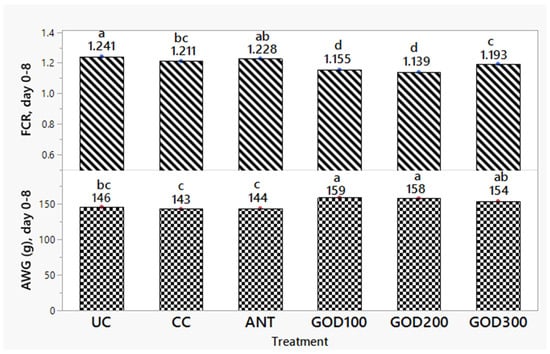
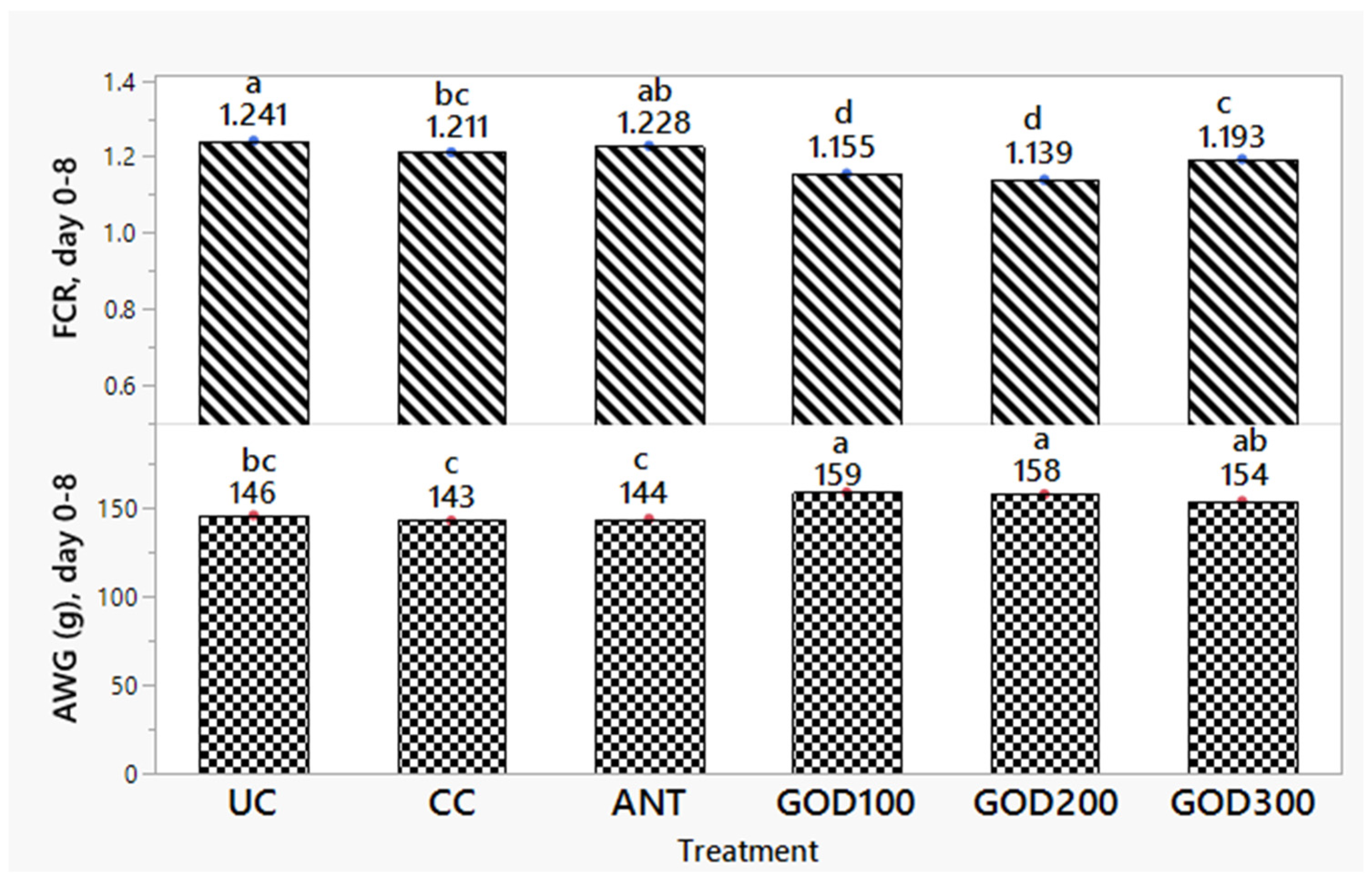
The pre-challenge period (day 0–8) performance results are shown in Figure 1. During this period, birds supplemented with GOD at 100 (159 g) and 200 (158 g) showed significantly higher AWG compared to UC (146 g), CC (143 g) and ANT (144 g) groups (p < 0.001). GOD300 also showed significantly higher AWG (154 g) than CC and ANT, but not UC. Additionally, FCR was significantly improved in the GOD100 and GOD200 groups (1.155, 1.139 respectively) compared with UC (1.241), CC (1.211), and ANT (1.228) (p < 0.001). GOD300 also showed significantly lower FCR (1.193) than UC and ANT, although the difference was not significant compared with CC. No significant differences were observed between GOD treatments in terms of AWG and FCR (p > 0.05) except GOD300, which had higher FCR compared to GOD100 and GOD200 (p < 0.001). Furthermore, although AWG did not differ significantly between UC and CC, UC birds had higher FCR than CC group (p < 0.001). As both groups had the same diets and were kept under the same experimental conditions before the challenge, the reason for this difference is unclear and may simply reflect normal variation between pens. The AFI did not differ among treatments (p = 0.076; Table S1).
Figure 1.
Effect of GOD on the performance of broilers before the challenge (day 0–8). UC—unchallenged control, no additives; CC-challenged control, no additives; ANT—antibiotics (salinomycin + bacitracin, 500 g/t, each in all phases); GOD100, 200, and 300—glucose oxidase 100, 200, and 300 g/t in all phases. AWG = average weight gain (p < 0.001); FCR = feed conversion ratio (p < 0.001). a–d values within a row with different letters differ significantly (p < 0.05).
The effects of GOD and NE challenge on the performance of broilers at grower to finisher phases are shown in Table 3. During day 8–19, all challenged group birds except ANT groups had significantly lower BWG and higher FCR compared to the UC group birds (p < 0.001). In addition, the CC group had significantly lower AFI (802 g) compared to the UC (866 g) and ANT (869 g) group (p = 0.013). From day 19–28, birds fed ANT showed significantly higher AWG (870 g) and lower FCR (1.539) (p < 0.001) compared to the CC and all GOD supplemented group birds, while the UC group performed intermediately with no significant difference from all groups (p > 0.05). There were no significant differences between GOD treatments in terms of AWG and FCR (p > 0.05) during day 8–19 and day 19–28. During day 28–35, CC group birds exhibited significantly higher AWG (774 g) (p = 0.004) and lower FCR (1.723) (p < 0.001) compared to the UC (670 g, 1.925) group. Supplementation of GOD did not affect FCR compared to the CC or ANT or among the individual GOD supplemented group birds (p > 0.05). Similarly, AWG did not differ between GOD supplemented groups and CC or ANT, except for GOD100, which had lower AWG compared to the CC and GOD200 groups (p = 0.004).
Table 3.
Effect of GOD on performance of broilers under NE challenge in grower to finisher phases (DM basis).
Across overall study period (day 0–35), among the challenged birds, the ANT group showed significantly higher AWG (2411 g) and lower FCR (1.482) (p < 0.001), except compared with the GOD200 group, which had an intermediate value in AWG (2240 g) approaching the level of ANT group birds, with no significant difference between them (p > 0.05). GOD supplementation did not affect AWG and FCR compared to the CC group (p > 0.05) and no significant differences were observed between individual GOD treatments in terms of AWG and FCR (p > 0.05). No significant differences in AFI were seen among groups after day 19 of the trial or over the whole period of the trial (p > 0.05). Furthermore, livability% was not affected by treatment during any part of the trial (p > 0.05).
3.2. Flock Uniformity, European Production Efficiency Factor and NE Related Mortality
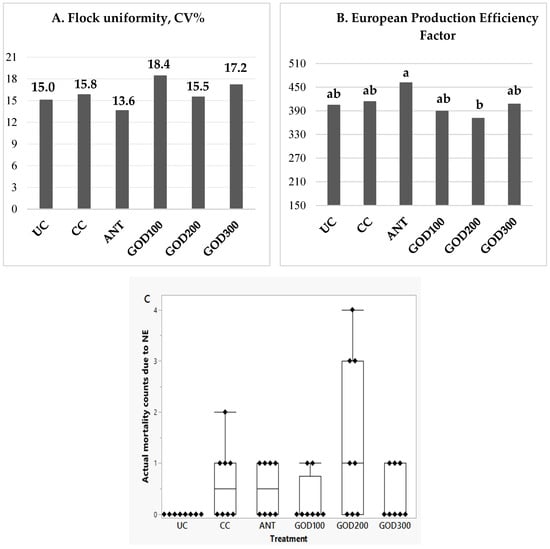
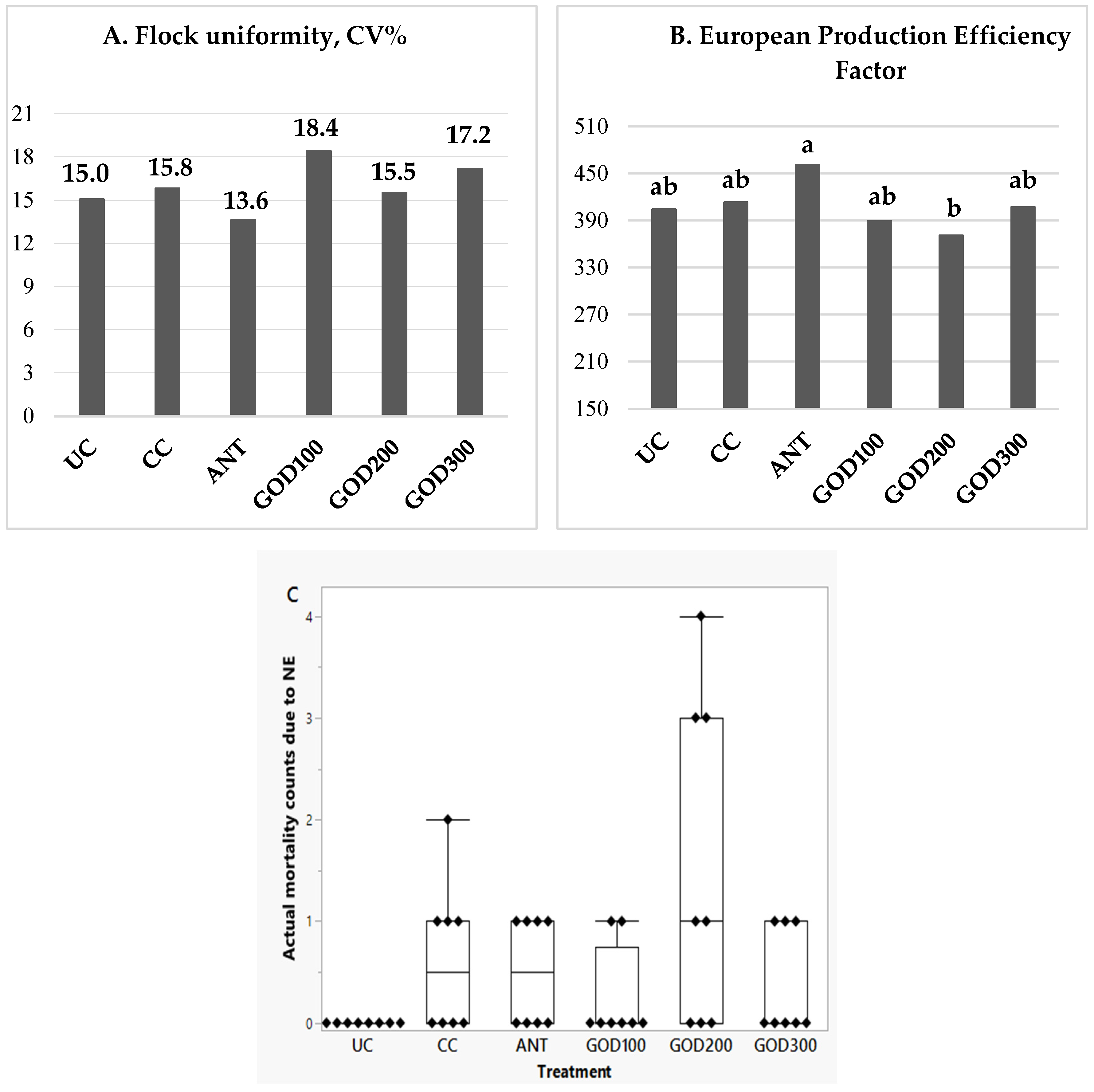
The effects of NE challenge and GOD supplementation on flock uniformity, EPEF on day 35, and death caused by NE (day 14–20) are shown in Figure 2A,B,C, respectively. The order of CV% of BW according to the treatment groups was ANT < UC < GOD200 < CC < GOD300 < GOD100. Birds in ANT group had the lowest CV (13.6%), while GOD100 group had the highest CV (18.4%). Furthermore, there was no significant difference between the groups in terms of EPEF, except GOD200, showing significantly lower EPEF (371) compared to the ANT (461) group birds (p = 0.043). The GOD200 group had the highest counts of mortality due to NE, followed by CC group, whereas no mortality was observed in the UC group.
Figure 2.
Effects of GOD and NE challenge on flock uniformity, European Production Efficiency Factor, and actual mortality counts due to NE in different treatment group. (A) Flock uniformity based on CV%; (B) EPEF—European Production Efficiency Factor (p = 0.043); (C) Actual mortality counts due to NE; UC—unchallenged control, no additives; CC—challenged control, no additives; ANT—antibiotics (salinomycin + bacitracin, 500 g/t, each in all phases); GOD100, 200, and 300—glucose oxidase @100, 200, and 300 g/t in all phases. a,b values within a column with different letters differ significantly (p < 0.05).
3.3. Lesion Scores
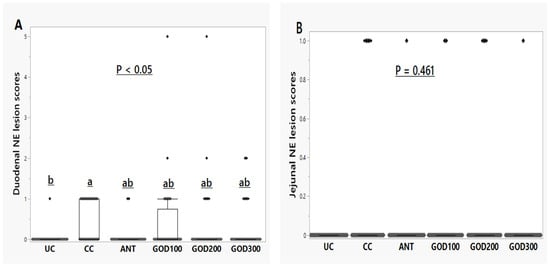
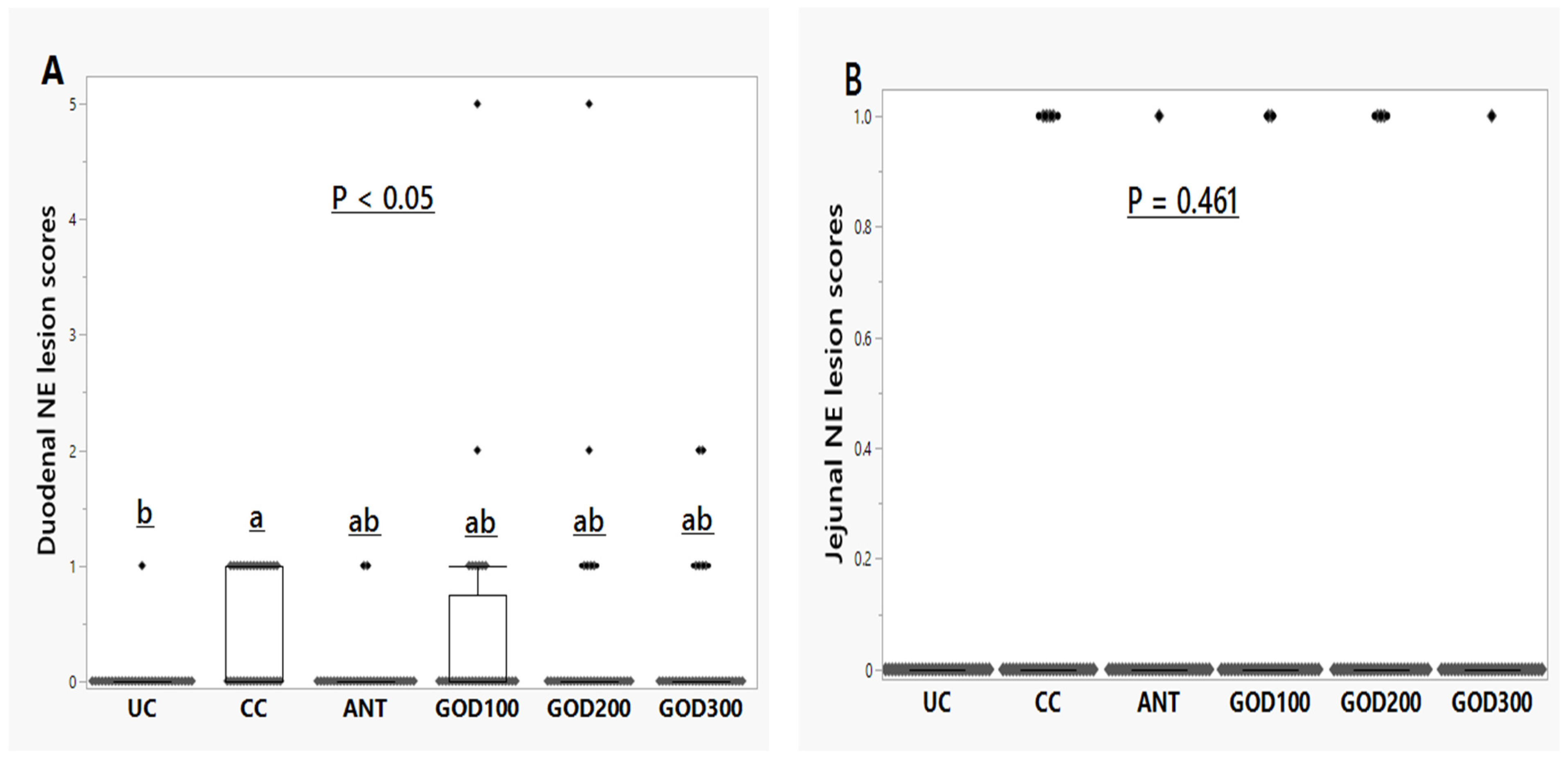
The effects of NE challenge and GOD supplementation on NE duodenal and jejunal lesion scores are shown in Figure 3A,B, respectively. The results showed that NE challenge significantly increased NE duodenal lesion scores in the CC group compared to the UC group (p = 0.006). In contrast, birds supplemented with GOD (all inclusion levels) and ANT did not differ significantly from either UC or CC (p > 0.05), exhibiting intermediate lesion scores. No differences in jejunal lesion scores were observed among the treatment groups (p = 0.46).
Figure 3.
Effects of GOD and NE challenge on intestinal lesions on broilers. (A) Duodenal NE lesion scores (p = 0.006); (B) Jejunal NE lesion scores (p = 0.461); UC—unchallenged control, no additives; CC—challenged control, no additives; ANT—antibiotics (salinomycin + bacitracin, 500 g/t, each in all phases); GOD100, 200, and 300—glucose oxidase @100, 200, and 300 g/t in all phases. NE—necrotic enteritis; a,b values within a column with different letters differ significantly (p < 0.05).
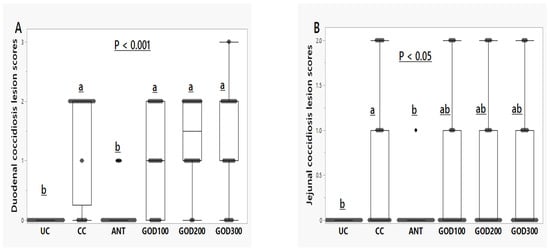
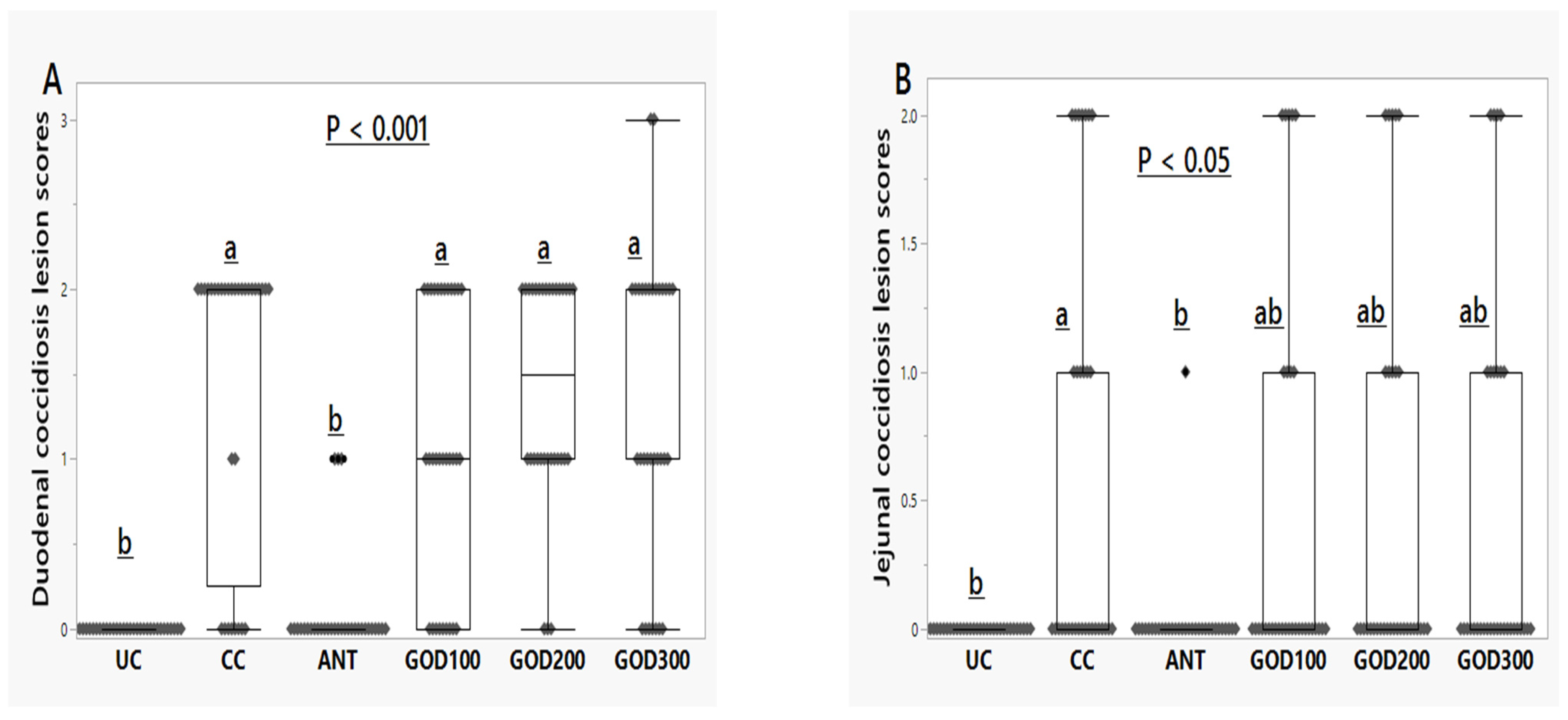
The effects of treatments on duodenal and jejunal coccidiosis lesion scores are presented in Figure 4A,B, respectively. The challenge significantly increased lesion scores in both the duodenum (p < 0.001) and jejunum (p = 0.006) of birds in the CC group compared to the UC and ANT birds. In terms of jejunal lesion scores, all GOD-supplemented birds showed numerically lower scores than CC groups and did not show any significant difference compared to the UC or ANT groups (p > 0.05).
Figure 4.
Effects of GOD and NE challenge on duodenal and jejunal coccidiosis lesion scores. (A) Duodenal coccidiosis lesion score (p < 0.001); (B) Jejunal coccidiosis lesion score (p = 0.006); UC—unchallenged control, no additives; CC—challenged control, no additives; ANT—antibiotics (salinomycin + bacitracin, 500 g/t, each in all phases); GOD100, 200, and 300—glucose oxidase @100, 200, and 300 g/t in all phases. NE—necrotic enteritis; a,b values within a column with different letters differ significantly (p < 0.05).
3.4. Oocyst Counts and Gut Permeability
The effects of GOD supplementation on oocyst counts and serum FITC-d on day 16 are presented in Table 4. Results showed that the NE challenge significantly increased Eimeria spp. oocyst counts in both the cecal and ileal contents of the CC group birds (101,187, 77,850, respectively) compared to the UC group (19, 0 respectively) (p < 0.001). Birds in the ANT group had significantly lower ileal oocyst counts (5088) compared to the CC group (p < 0.001). Serum FITC-d levels (µg/mL) were significantly increased in the CC birds (0.226) compared to the UC (0.149) and ANT (0.149) supplemented birds (p = 0.007). There was a similar trend in both the oocyst counts and the serum FITC-d concentrations in the GOD group. All GOD-supplemented groups (100, 200, and 300 g/t) had oocyst counts and FITC-d levels that were intermediate between UC and/or ANT but not significantly different from either the UC and/or ANT group (p > 0.05).
Table 4.
Effects of NE challenge and GOD in oocyst counts and serum FITC-d on day 16.
3.5. Apparent Ileal Digestibility of Gross Energy and Crude Protein
The effects of GOD supplementation and NE challenge on the AID of GE and CP are shown in Table 5. Results showed that the UC and ANT groups demonstrated significantly higher GE digestibility (72%, 73%, respectively) compared to the CC (62.5%) group (p < 0.001). There was no significant difference between the CC and GOD-supplemented birds (p > 0.05) except for GOD100, which exhibited significantly higher GE digestibility (69.7%) compared to the CC group (p < 0.001) and did not differ significantly from either UC or ANT birds (p > 0.05). Furthermore, NE challenge significantly reduced CP digestibility in the CC group (76.2%) compared to the ANT group (82%) birds (p = 0.004). Digestibility of CP was not different between CC, UC, and GOD-supplemented groups, except for GOD100, which showed higher CP digestibility (81%) compared to the CC group (p = 0.004). Dose response analysis of AID of GE and CP is shown in Table 6. Orthogonal polynomial contrasts analysis revealed significant quadratic (p = 0.020) responses to GOD inclusion levels in GE digestibility, and the pattern of change was not simply a straight-line increase or decrease. However, quadratic response tended to be significant for CP digestibility (p = 0.093).
Table 5.
Effect of GOD on apparent ileal digestibility of gross energy and crude protein on day 16.
Table 6.
Linear and quadratic response of GOD on apparent ileal digestibility of gross energy and crude protein on day 16.
3.6. Litter Quality, Foot Pad Dermatitis and Hock Burn Lesion
The effects of NE challenge and GOD supplementation on litter quality (day 34), FPD, and HB scores on day 35 are presented in Table 7. All challenged group birds had significantly lower litter moisture compared to the UC group (p < 0.001), while CC group birds had significantly higher litter scores (3.68) compared to the ANT (2.95) and GOD200 (2.95) group birds (p = 0.027). However, no significant differences were observed in HB scores among the treatment groups (p = 0.95). Furthermore, FPD scores were also similar between the UC and the challenged groups, except for GOD300, which had a lower FPD score (0.08) compared to UC (0.54) and ANT (0.52) birds (p = 0.011).
Table 7.
Effects of GOD on litter quality (day 34), FPD, and HB score on day 35.
4. Discussion
Necrotic enteritis remains one of the most economically significant enteric diseases in poultry production. In recent years, the ban or restriction on the use of AGPs in poultry production has reactivated the impact of NE in commercial broiler operations [51,52]. In this study, we evaluated the potential of different doses of dietary glucose oxidase to modulate growth performance, intestinal health, nutrient digestibility, and welfare in broiler chickens challenged with NE. It was shown that birds in the CC group exhibited reduced growth performance during the challenge period, showing lower AWG and AFI and higher FCR compared to the UC birds, indicating a successful induction of the challenge as reported in previous studies [4,53]. This was further demonstrated by suppressing intestinal health, such as increased intestinal lesions and oocyst counts, higher serum FITC-d concentrations, and lower AID in the NE challenged control broilers, as also demonstrated by Akerele, et al. [54], Gharib-Naseri, et al. [55].
Overall, GOD supplementation improved early growth performance prior to NE challenge, with more consistent responses observed at lower doses than at 300 g/t. Under NE conditions, the responses varied across outcomes and inclusion levels. The GOD200 group showed numerically higher AWG, greater flock uniformity, and improved litter scores, while GOD100 improved the AID of GE and CP, and GOD300 reduced FPD compared with the UC and ANT groups. Furthermore, several gut health indicators, including lesion scores, oocyst counts, and serum FITC-d, showed intermediate values approaching those of the unchallenged or antibiotic-treated groups following GOD treatment, although these differences were not statistically significant compared with the CC. These findings indicate that responses to GOD supplementation varied across outcomes and inclusion levels, with no consistent dose-dependent improvement observed. Therefore, our hypothesis is supported with respect to improved pre-challenge growth performance at selected inclusion levels and partially supported by improvements in selected nutrient digestibility and litter quality. However, significant improvements in overall growth performance and the measured intestinal health indicators under NE challenge were not demonstrated.
During the overall experimental period (day 0–35), GOD200 showed numerically higher AWG comparable to the CC group, showing no difference from either the ANT and/or UC groups. In addition, GOD supplementation at 100 and 200 improved performances during the pre-challenge period (day 0–8) as stated earlier, with higher AWG and improved FCR compared to the UC, CC, and ANT groups, indicating an early growth-enhancing effect. These findings are consistent with previous research demonstrating that GOD supplementation can enhance growth performance parameters in broilers [24,56,57] and other livestock species [58], thereby reinforcing its potential as an effective feed additive for growth and feed efficiency. The GOD200 group also exhibited a numerically lower CV% compared to the CC group, indicating a descriptive difference in flock uniformity, which positively associated with growth performance. Additionally, the response to GOD supplementation during the pre-challenge period was less consistent at the highest inclusion levels (GOD300). This may suggest that increasing GOD supplementation does not necessarily result in further improvements in growth performance during the early growth stage, as stated previously [59,60]. However, the limited impact on overall performance may be due to the inclusion levels, nature of the challenge, types of broiler strain, and/or production phases. Several physiological mechanisms have been proposed to explain the potential growth promoting effects of GOD. Previous studies have suggested that GOD may improve antioxidant enzymes and relieve birds from oxidative stress [61,62]. Studies reported that GOD maintains hypoxia within the intestinal lumen by consuming oxygen and expanding beneficial microbiota [20]. Furthermore, GOD catalyzes the oxidation of β-D-glucose to GA, producing H2O2 in the process [19,63]. Gluconic acid is rapidly fermented by beneficial microbiota to generate SCFAs in the intestines. Notably, the release of GA and SCFAs into the gut can lower the pH, creating an acidic gut environment. Simultaneously, H2O2 exerts bactericidal effects by inducing the formation of free hydroxyl radicals in bacterial cells, selectively reducing pathogens [64,65], all of which converge on nutrient extraction and reduced immune burden [20], ultimately contributing to enhanced performance. However, these potential mechanisms, including changes in intestinal oxygen availability, gut microbial composition, SCFA production, and antioxidant activity, were not directly investigated in the present study and therefore remain hypothetical explanations for the observed effects of GOD supplementation.
Improved nutrient digestibility correlates positively with nutrient utilization and performance under disease conditions. In the present study, it was demonstrated that nutrient digestibility of the birds was influenced by GOD supplementation. Specifically, the lower inclusion level GOD100 enhanced the AID of GE and CP compared to the CC group. However, these improvements were not observed at the higher GOD inclusion levels (200 and 300 g/t), indicating that the beneficial effects on nutrient digestibility were not consistent across supplementation levels. Studies reported that, by lowering intestinal pH, GOD enhanced the activity of intestinal digestive enzymes such as trypsin, chymotrypsin, pancreatic lipase, and amylase, thereby facilitating nutrient digestion and absorption while also increasing the abundance of microbiota involved in these processes [24,56,65]. In addition, Wang, et al. [66] demonstrated that GOD supplementation improved the AID of CP, likely due to improvements in intestinal morphology. In the current study, the increased nutrient digestibility in GOD100 birds may be explained by the partial effects of GOD by showing numerically lower intestinal lesions, oocyst counts, and serum FITC-d concentrations in supplemented birds, which modulated gut health recovery and improved nutrient absorption. Further, GE digestibility showed significant dose responses to GOD inclusion levels, indicating that the pattern of change was not simply a straight-line increase or decrease. Previous studies have also reported variable effects of GOD inclusion levels on nutrient digestibility in broilers, with responses differing according to the nutrient measured, supplementation level and experimental conditions [24,25].
Glucose oxidase has been linked to better gut health through its impact on intestinal barrier function and beneficial microbial development [58,66]. In this study, although GOD supplementation did not show statistically significant reductions in intestinal lesion scores and oocyst counts compared to the CC group, the treatments showed numerically lower scores for duodenal NE and jejunal coccidiosis lesions, along with oocyst counts, at intermediate levels between those in CC and UC birds, indicating a numerically intermediate response. Supplementation with GOD has been reported to be associated with lower concentrations of pro-inflammatory (IL-1β, IFN-γ) and anti-inflammatory cytokines (IL-10 and TGF-β) in the intestine in challenge conditions, and with mitigating inflammation [30,58,67]. Studies have also reported that the combined effects of H2O2 and GA may suppress pathogenic bacteria such as C. perfringens and create an unfavorable environment for clostridial proliferation, potentially mitigating lesion severity during challenge [68,69]. Similar tendencies have been reported in broilers exposed to fungal endotoxins where GOD was associated with reduced intestinal lesion severity [25]. However, Zhao, et al. [31] reported no significant effect of GOD on intestinal lesion scores under NE challenge. One possible explanation for this variation in lowering lesion severity may be attributed to experimental conditions, such as the challenge model and thus the severity of disease, broiler strain, and/or duration of the study. Although the known effects of H2O2 against a wide range of pathogens, including Gram-positive and Gram-negative bacteria as well as fungi, are well established [70,71], their specific role in controlling Eimeria infections remains unclear and anticoccidial mechanisms require further investigation. In addition, the intestinal mucosa serves a vital function as a barrier against detrimental bacterial infections and is crucial for efficient nutritional digestion and absorption [30,72,73]. The compromise of this barrier, especially by disruption to tight junctions during intestinal inflammation, leads to heightened permeability [41,74]. In this study, NE challenge increased serum FITC-d concentrations, confirming compromised intestinal barrier function. Glucose oxidase has been reported to increase the abundance of butyrate-producing bacteria in the gut, and butyrate serves as a primary energy source for colonocytes and directly maintains mucosal barrier integrity [59]. In this study, although GOD did not significantly reduce serum FITC-d concentrations compared with the CC group, the numerical values were intermediate between the CC and UC groups, suggesting a possible beneficial response that requires further investigation. Previous studies have reported that GOD may improve the epithelial barrier function and reduce the intestinal permeability [56,58]. The moderate effect of GOD on intestinal permeability in this study may be attributed to bird health status, challenged conditions, bird genetics, and management.
Litter quality and footpad health are important welfare indicators in broiler production [75,76]. In the present study, GOD200 significantly improved litter scores compared to the CC birds. Although GOD300 showed significantly lower FPD scores than UC and ANT, no significant difference was observed compared to the CC group, indicating that these findings do not provide sufficient evidence of improved footpad health under NE challenge. Previous studies have shown that dietary GOD supplementation can support skin integrity through systemic antioxidant effects that protect all epithelial tissues including the foot pad [59,60]. Previous studies have reported associations between litter conditions and FPD; however, no direct correlation analysis was performed in the present study [48,77]. Furthermore, the reasons for the relatively higher FPD scores in the UC and ANT groups remain unclear and warrant further investigation.
5. Conclusions
This study demonstrated that GOD supplementation improved early growth performance prior to NE challenge, with more consistent responses at 100 and 200 g/t than at 300 g/t. Under NE challenge conditions, it enhanced nutrient utilization at lower inclusion levels, suggesting a potential role in supporting digestion during enteric stress. Furthermore, GOD supplementation did not significantly improve overall growth performance, intestinal lesion scores, oocyst counts, or intestinal permeability compared with the challenged control. These findings suggest that GOD may provide benefits for selected performance, digestive and welfare outcomes, although its effects under NE challenge were limited. Further research investigating intestinal morphology, gut microbiota, SCFAs, and gene expression across different inclusion levels is warranted to better understand the mechanisms underlying these responses and to further evaluate the potential of GOD as a dietary strategy in antibiotic-restricted broiler production systems.
Supplementary Materials
The following supporting information can be downloaded at https://www.mdpi.com/article/10.3390/ani16223685/s1, Table S1: Effect of GOD on AFI of broilers under NE challenge in day 0–8 (DM basis).
Author Contributions
Conceptualization, K.G.N.; methodology, K.G.N.; software, S.A. and A.K.; validation, K.G.N. and S.-B.W.; formal analysis, S.A.; investigation, K.G.N.; resources, A.K. and K.G.N.; data curation, S.A., A.K. and K.G.N.; writing—original draft preparation, S.A.; writing—review and editing, A.K., K.G.N., S.-B.W. and Y.L.; visualization, S.A.; supervision, A.K., K.G.N. and S.-B.W.; project administration, K.G.N.; funding acquisition, K.G.N. and Y.L. All authors have read and agreed to the published version of the manuscript.
Funding
This research was funded by VTR Bio-Tech Co., Ltd., Guangdong, China (Contract numbers: Trim A23/1893 and Contract ID: C23/496; University of New England PURE system).
Institutional Review Board Statement
The experimental procedures applied in the current study were approved by the Animal Ethics Committee of the University of New England, Armidale, NSW, Australia (ARA23-050).
Informed Consent Statement
Not applicable.
Data Availability Statement
The data presented in this study are available on request from the corresponding author.
Acknowledgments
VTR Bio-Tech Co., Ltd., Guangdong, China, funded this project. Petrina Young of Eimeria Pty Ltd. provided Eimeria spp. and Robert Moore gifted C. perfringens.
Conflicts of Interest
Yangyuan Li is an employee of VTR Bio-Tech Co., Ltd., which provided funding for this study and manufactures the glucose oxidase product evaluated in the experiments. Yangyuan Li contributed to the design of the experiment and the review of the manuscript as a co-author. VTR had no role in data collection or analysis and did not influence the decision to publish the results. All authors declare no conflicts of interest.
References
- Rood, J.I.; Adams, V.; Lacey, J.; Lyras, D.; McClane, B.A.; Melville, S.B.; Moore, R.J.; Popoff, M.R.; Sarker, M.R.; Songer, J.G. Expansion of the Clostridium perfringens toxin-based typing scheme. Anaerobe 2018, 53, 5–10. [Google Scholar] [CrossRef] [Scilit] [PubMed]
- Shojadoost, B.; Vince, A.R.; Prescott, J.F. The successful experimental induction of necrotic enteritis in chickens by Clostridium perfringens: A critical review. Vet. Res. 2012, 43, 1–12. [Google Scholar] [CrossRef] [Scilit] [PubMed]
- Van Immerseel, F.; Rood, J.I.; Moore, R.J.; Titball, R.W. Rethinking our understanding of the pathogenesis of necrotic enteritis in chickens. Trends Microbiol. 2009, 17, 32–36. [Google Scholar] [CrossRef] [Scilit] [PubMed]
- Gharib-Naseri, K.; Kheravii, S.; Keerqin, C.; Morgan, N.; Swick, R.; Choct, M.; Wu, S.-B. Two different Clostridium perfringens strains produce different levels of necrotic enteritis in broiler chickens. Poult. Sci. 2019, 98, 6422–6432. [Google Scholar] [CrossRef] [Scilit] [PubMed]
- Moore, R. Necrotic enteritis predisposing factors in broiler chickens. Avian Pathol. 2016, 45, 275–281. [Google Scholar] [CrossRef] [Scilit] [PubMed]
- Emami, N.K.; Dalloul, R.A. Centennial Review: Recent developments in host-pathogen interactions during necrotic enteritis in poultry. Poult. Sci. 2021, 100, 101330. [Google Scholar] [CrossRef] [Scilit] [PubMed]
- Wade, B.; Keyburn, A. The true cost of necrotic enteritis. Poult. World. 2015, 31, 16–17. [Google Scholar]
- Wu, S.-B.; Rodgers, N.; Choct, M. Optimized necrotic enteritis model producing clinical and subclinical infection of Clostridium perfringens in broiler chickens. Avian Dis. 2010, 54, 1058–1065. [Google Scholar] [CrossRef] [Scilit] [PubMed]
- To, H.; Suzuki, T.; Kawahara, F.; Uetsuka, K.; Nagai, S.; Nunoya, T. Experimental induction of necrotic enteritis in chickens by a netB-positive Japanese isolate of Clostridium perfringens. J. Vet. Med. Sci. 2017, 79, 350–358. [Google Scholar] [CrossRef] [Scilit] [PubMed]
- Kaldhusdal, M.; Schneitz, C.; Hofshagen, M.; Skjerve, E. Reduced incidence of Clostridium perfringens-associated lesions and improved performance in broiler chickens treated with normal intestinal bacteria from adult fowl. Avian Dis. 2001, 45, 149–156. [Google Scholar] [CrossRef] [Scilit]
- Immerseel, F.V.; Buck, J.D.; Pasmans, F.; Huyghebaert, G.; Haesebrouck, F.; Ducatelle, R. Clostridium perfringens in poultry: An emerging threat for animal and public health. Avian Pathol. 2004, 33, 537–549. [Google Scholar] [CrossRef] [Scilit] [PubMed]
- Seal, B.S.; Lillehoj, H.S.; Donovan, D.M.; Gay, C.G. Alternatives to antibiotics: A symposium on the challenges and solutions for animal production. Anim. Health Res. Rev. 2013, 14, 78–87. [Google Scholar] [CrossRef] [Scilit] [PubMed]
- Bacanlı, M.; Başaran, N. Importance of antibiotic residues in animal food. Food Chem. Toxicol. 2019, 125, 462–466. [Google Scholar] [CrossRef] [Scilit] [PubMed]
- Kaldhusdal, M.; Skjerve, E.; Hansen, M.K.; Hamnes, I.S.; David, B.; Hanssen, S.A.; Lovland, A. The incidence of necrotic enteritis in turkeys is associated with farm, season and faecal Eimeria oocyst counts. BMC Vet. Res. 2021, 17, 1–12. [Google Scholar] [CrossRef] [Scilit] [PubMed]
- Müller, D. Oxidation von Glukose mit Extrakten aus Aspegillus niger. Biochem. Z. 1928, 199, 136–170. [Google Scholar]
- Bean, R.; Hassid, W. Carbohydrate oxidase from a red alga, Iridophycus flaccidum. J. Biol. Chem. 1956, 218, 425–436. [Google Scholar] [CrossRef] [Scilit]
- Bean, R.; Porter, G.; Steinberg, B.M. Carbohydrate metabolism of citrus fruits: II. Oxidation of sugars by an aerodehydrogenase from young orange fruits. J. Biol. Chem. 1961, 236, 1235–1240. [Google Scholar] [PubMed]
- Hauge, J.G. Glucose dehydrogenation in bacteria: A comparative study. J. Bacteriol. 1961, 82, 609–614. [Google Scholar] [CrossRef] [Scilit] [PubMed]
- Bankar, S.B.; Bule, M.V.; Singhal, R.S.; Ananthanarayan, L. Glucose oxidase—an overview. Biotechnol. Adv. 2009, 27, 489–501. [Google Scholar] [CrossRef] [Scilit] [PubMed]
- Liang, Z.; Yan, Y.; Zhang, W.; Luo, H.; Yao, B.; Huang, H.; Tu, T. Review of glucose oxidase as a feed additive: Production, engineering, applications, growth-promoting mechanisms, and outlook. Crit. Rev. Biotechnol. 2023, 43, 698–715. [Google Scholar] [CrossRef] [Scilit] [PubMed]
- Kameue, C.; Tsukahara, T.; Yamada, K.; Koyama, H.; Iwasaki, Y.; Nakayama, K.; Ushida, K. Dietary sodium gluconate protects rats from large bowel cancer by stimulating butyrate production. J. Nutr. 2004, 134, 940–944. [Google Scholar] [CrossRef] [Scilit] [PubMed]
- Rafacz-Livingston, K.; Parsons, C.; Jungk, R. The effects of various organic acids on phytate phosphorus utilization in chicks. Poult. Sci. 2005, 84, 1356–1362. [Google Scholar] [CrossRef] [Scilit] [PubMed]
- Tsukahara, T.; Koyama, H.; Okada, M.; Ushida, K. Stimulation of butyrate production by gluconic acid in batch culture of pig cecal digesta and identification of butyrate-producing bacteria. J. Nutr. 2002, 132, 2229–2234. [Google Scholar] [CrossRef] [Scilit] [PubMed]
- Wu, S.; Li, T.; Niu, H.; Zhu, Y.; Liu, Y.; Duan, Y.; Sun, Q.; Yang, X. Effects of glucose oxidase on growth performance, gut function, and cecal microbiota of broiler chickens. Poult. Sci. 2019, 98, 828–841. [Google Scholar] [CrossRef] [Scilit] [PubMed]
- Gao, S.; Zhang, L.; Zhu, D.; Huang, J.; Yang, J.; Jiang, J.; Wu, H.; Lv, G. Effects of glucose oxidase and Bacillus subtilis on growth performance and serum biochemical indices of broilers exposed to aflatoxin B1 and endotoxin. Anim. Feed Sci. Technol. 2022, 286, 115186. [Google Scholar] [CrossRef] [Scilit]
- Peng, L.; Li, Z.-R.; Green, R.S.; Holzmanr, I.R.; Lin, J. Butyrate enhances the intestinal barrier by facilitating tight junction assembly via activation of AMP-activated protein kinase in Caco-2 cell monolayers. J. Nutr. 2009, 139, 1619–1625. [Google Scholar] [CrossRef] [Scilit] [PubMed]
- Eshak, M.; Elmenawey, M.; Atta, A.; Gharib, H.; Shalaby, B.; Awaad, M. The efficacy of Na-butyrate encapsulated in palm fat on performance of broilers infected with necrotic enteritis with gene expression analysis. Vet. World 2016, 9, 450. [Google Scholar] [CrossRef] [Scilit] [PubMed]
- Bauer, J.A.; Zámocká, M.; Majtán, J.; Bauerová-Hlinková, V. Glucose oxidase, an enzyme “Ferrari”: Its structure, function, production and properties in the light of various industrial and biotechnological applications. Biomolecules 2022, 12, 472. [Google Scholar] [CrossRef] [Scilit] [PubMed]
- Cichello, S.A. Oxygen absorbers in food preservation: A review. J. Food Sci. Technol. 2015, 52, 1889–1895. [Google Scholar] [CrossRef] [Scilit] [PubMed]
- Qu, W.; Liu, J. Effects of glucose oxidase supplementation on the growth performance, antioxidative and inflammatory status, gut function, and microbiota composition of broilers fed moldy corn. Front. Physiol. 2021, 12, 646393. [Google Scholar] [CrossRef] [Scilit] [PubMed]
- Zhao, Y.; Fu, J.; Li, P.; Chen, N.; Liu, Y.; Liu, D.; Guo, Y. Effects of dietary glucose oxidase on growth performance and intestinal health of AA broilers challenged by Clostridium perfringens. Poult. Sci. 2022, 101, 101553. [Google Scholar] [CrossRef] [Scilit] [PubMed]
- NHMRC. Australian Code of Practice for the Care and Use of Animals for Scientific Purposes; National Health and Medical Research Council: Canberra, Australia, 2004. [Google Scholar]
- Cobb-Vantress. Cobb Broiler Management Guide. Available online: https://www.cobbgenetics.com/assets/Cobb-Files/Broiler-Guide_English-2021-min.pdf (accessed on 29 April 2024).
- Cobb-Vantress. Cobb500 Broiler Performance Nutrition Supplement. Available online: https://www.cobbgenetics.com/assets/Cobb-Files/2022-Cobb500-Broiler-Performance-Nutrition-Supplement.pdf (accessed on 20 April 2024).
- Wu, S.-B.; Stanley, D.; Rodgers, N.; Swick, R.A.; Moore, R.J. Two necrotic enteritis predisposing factors, dietary fishmeal and Eimeria infection, induce large changes in the caecal microbiota of broiler chickens. Vet. Microbiol. 2014, 169, 188–197. [Google Scholar] [CrossRef] [Scilit] [PubMed]
- Rodgers, N.J.; Swick, R.A.; Geier, M.S.; Moore, R.J.; Choct, M.; Wu, S.-B. A multifactorial analysis of the extent to which Eimeria and fishmeal predispose broiler chickens to necrotic enteritis. Avian Dis. 2015, 59, 38–45. [Google Scholar] [CrossRef] [Scilit] [PubMed]
- Noblet, J.; Dubois, S.; Lasnier, J.; Warpechowski, M.; Dimon, P.; Carré, B.; van Milgen, J.; Labussière, E. Fasting heat production and metabolic BW in group-housed broilers. Animal 2015, 9, 1138–1144. [Google Scholar] [CrossRef] [Scilit] [PubMed]
- Kumar, A.; Gharib-Naseri, K.; Khairunnesa, M.; Musigwa, S.; Barekatain, R.; Li, L.; Chen, P.; Wu, S.-B. Potentials of Bacillus subtilis derived surfactin to improve performance, intestinal health and welfare of broilers under necrotic enteritis challenge. Poult. Sci. 2025, 105, 106091. [Google Scholar] [CrossRef] [Scilit] [PubMed]
- England, A.D.; Musigwa, S.; Kumar, A.; Daneshmand, A.; Gharib-Naseri, K.; Kheravii, S.K.; Pesti, G.; Wu, S.-B. Sex proportion as a covariate increases the statistical test power in growth performance based experiments using as-hatched broilers. PLoS ONE 2023, 18, e0280040. [Google Scholar] [CrossRef] [Scilit] [PubMed]
- Huff, G.; Huff, W.; Jalukar, S.; Oppy, J.; Rath, N.; Packialakshmi, B. The effects of yeast feed supplementation on turkey performance and pathogen colonization in a transport stress/Escherichia coli challenge. Poult. Sci. 2013, 92, 655–662. [Google Scholar] [CrossRef] [Scilit] [PubMed]
- Vicuña, E.A.; Kuttappan, V.A.; Tellez, G.; Hernandez-Velasco, X.; Seeber-Galarza, R.; Latorre, J.D.; Faulkner, O.B.; Wolfenden, A.D.; Hargis, B.M.; Bielke, L.R. Dose titration of FITC-D for optimal measurement of enteric inflammation in broiler chicks. Poult. Sci. 2015, 94, 1353–1359. [Google Scholar] [CrossRef] [Scilit] [PubMed]
- Keyburn, A.L.; Sheedy, S.A.; Ford, M.E.; Williamson, M.M.; Awad, M.M.; Rood, J.I.; Moore, R.J. Alpha-toxin of Clostridium perfringens is not an essential virulence factor in necrotic enteritis in chickens. Infect. Immun. 2006, 74, 6496–6500. [Google Scholar] [CrossRef] [Scilit] [PubMed]
- Johnson, J.; Reid, W.M. Anticoccidial drugs: Lesion scoring techniques in battery and floor-pen experiments with chickens. Exp. Parasitol. 1970, 28, 30–36. [Google Scholar] [CrossRef] [Scilit] [PubMed]
- Hodgson, J. Coccidiosis: Oocyst counting technique for coccidiostat evaluation. Exp. Parasitol. 1970, 28, 99–102. [Google Scholar] [CrossRef] [Scilit] [PubMed]
- Kumar, A.; Toghyani, M.; Kheravii, S.K.; Pineda, L.; Han, Y.; Swick, R.A.; Wu, S.-B. Organic acid blends improve intestinal integrity, modulate short-chain fatty acids profiles and alter microbiota of broilers under necrotic enteritis challenge. Anim. Nutr. 2022, 8, 82–90. [Google Scholar] [CrossRef] [Scilit] [PubMed]
- Short, F.; Gorton, P.; Wiseman, J.; Boorman, K. Determination of titanium dioxide added as an inert marker in chicken digestibility studies. Anim. Feed Sci. Technol. 1996, 59, 215–221. [Google Scholar] [CrossRef] [Scilit]
- Barker, K.; Coufal, C.; Purswell, J.; Davis, J.; Parker, H.; Kidd, M.; McDaniel, C.; Kiess, A. In-house windrowing of a commercial broiler farm during early spring and its effect on litter composition. J. Appl. Poult. Res. 2013, 22, 551–558. [Google Scholar] [CrossRef] [Scilit]
- Kheravii, S.K.; Swick, R.A.; Choct, M.; Wu, S.-B. Coarse particle inclusion and lignocellulose-rich fiber addition in feed benefit performance and health of broiler chickens. Poult. Sci. 2017, 96, 3272–3281. [Google Scholar] [CrossRef] [Scilit] [PubMed]
- Butterworth, A.; Arnould, C.; van Niekerk, T.G.C.M.; Veissier, I.; Keeling, L.; Overbeke, G.; Bedaux, V. Welfare Quality®, Assessment Protocol for Poultry (Broilers, Laying Hens); Welfare Quality® Consortium: Lelystad, The Netherlands, 2009. [Google Scholar]
- Allain, V.; Mirabito, L.; Arnould, C.; Colas, M.; Le Bouquin, S.; Lupo, C.; Michel, V. Skin lesions in broiler chickens measured at the slaughterhouse: Relationships between lesions and between their prevalence and rearing factors. Br. Poult. Sci. 2009, 50, 407–417. [Google Scholar] [CrossRef] [Scilit] [PubMed]
- Allen, H.K.; Stanton, T.B. Altered egos: Antibiotic effects on food animal microbiomes. Annu. Rev. Microbiol. 2014, 68, 297–315. [Google Scholar] [CrossRef] [Scilit] [PubMed]
- Gadde, U.; Kim, W.; Oh, S.; Lillehoj, H.S. Alternatives to antibiotics for maximizing growth performance and feed efficiency in poultry: A review. Anim. Health Res. Rev. 2017, 18, 26–45. [Google Scholar] [CrossRef] [Scilit] [PubMed]
- Kumar, A.; Kheravii, S.K.; Li, L.; Wu, S.-B. Monoglyceride blend reduces mortality, improves nutrient digestibility, and intestinal health in broilers subjected to clinical necrotic enteritis challenge. Animals 2021, 11, 1432. [Google Scholar] [CrossRef] [Scilit] [PubMed]
- Akerele, G.; Al Hakeem, W.G.; Lourenco, J.; Selvaraj, R.K. The effect of necrotic enteritis challenge on production performance, cecal microbiome, and cecal tonsil transcriptome in broilers. Pathogens 2022, 11, 839. [Google Scholar] [CrossRef] [Scilit] [PubMed]
- Gharib-Naseri, K.; Kheravii, S.; Keerqin, C.; Swick, R.A.; Choct, M.; Wu, S.-B. Differential expression of intestinal genes in necrotic enteritis challenged broiler chickens with 2 different Clostridium perfringens strains. Poult. Sci. 2021, 100, 100886. [Google Scholar] [CrossRef] [Scilit] [PubMed]
- Meng, Y.; Huo, H.; Zhang, Y.; Bai, S.; Wang, R.; Zhang, K.; Ding, X.; Wang, J.; Zeng, Q.; Peng, H. Effects of dietary glucose oxidase supplementation on the performance, apparent ileal amino acids digestibility, and ileal microbiota of broiler chickens. Animals 2021, 11, 2909. [Google Scholar] [CrossRef] [Scilit] [PubMed]
- Zhao, Y.; Li, P.; Chen, N.; Liu, Y.; Liu, D.; Guo, Y. Effects of housing systems and glucose oxidase on growth performance and intestinal health of Beijing You Chickens. Poult. Sci. 2021, 100, 100943. [Google Scholar] [CrossRef] [Scilit] [PubMed]
- Liu, J.; Liu, G.; Chen, Z.; Zheng, A.; Cai, H.; Chang, W.; Li, C.; Chen, J.; Wu, Z. Effects of glucose oxidase on growth performance, immune function, and intestinal barrier of ducks infected with Escherichia coli O88. Poult. Sci. 2020, 99, 6549–6558. [Google Scholar] [CrossRef] [Scilit] [PubMed]
- Zhao, W.; Huang, Y.; Cui, N.; Wang, R.; Xiao, Z.; Su, X. Glucose oxidase as an alternative to antibiotic growth promoters improves the immunity function, antioxidative status, and cecal microbiota environment in white-feathered broilers. Front. Microbiol. 2023, 14, 1100465. [Google Scholar] [CrossRef] [Scilit] [PubMed]
- Hoque, M.R.; Chen, N.; Liu, Y.; Kim, I.H. Possibility of using glucose oxidase in the diet to improve selected indicators of blood antioxidant defense, digestibility and growth performance of broiler chicken. Ital. J. Anim. Sci. 2022, 21, 455–462. [Google Scholar] [CrossRef] [Scilit]
- Zhang, J.; Liu, Y.; Yang, Z.; Yang, W.; Huang, L.; Xu, C.; Liu, M.; Ge, J.; Wang, Y.; Jiang, S. Illicium verum extracts and probiotics with added glucose oxidase promote antioxidant capacity through upregulating hepatic and jejunal Nrf2/Keap1 of weaned piglets. J. Anim. Sci. 2020, 98, skaa077. [Google Scholar] [CrossRef] [Scilit] [PubMed]
- Dang, D.X.; Liu, Y.; Chen, N.; Kim, I.H. Dietary supplementation of Aspergillus niger-expressed glucose oxidase ameliorates weaning stress and improves growth performance in weaning pigs. J. Anim. Physiol. Anim. Nutr. 2022, 106, 258–265. [Google Scholar] [CrossRef] [Scilit] [PubMed]
- Witt, S.; Wohlfahrt, G.; Schomburg, D.; Hecht, H.-J.; Kalisz, H.M. Conserved arginine-516 of Penicillium amagasakiense glucose oxidase is essential for the efficient binding of β-D-glucose. Biochem. J. 2000, 347, 553–559. [Google Scholar] [CrossRef] [Scilit] [PubMed]
- Guilloteau, P.; Martin, L.; Eeckhaut, V.; Ducatelle, R.; Zabielski, R.; Van Immerseel, F. From the gut to the peripheral tissues: The multiple effects of butyrate. Nutr. Res. Rev. 2010, 23, 366–384. [Google Scholar] [CrossRef] [Scilit] [PubMed]
- Chen, C.Q.; Chen, F.M.; Xiao, J.; Li, H.B. Effects of glucose oxidase on growth performance, nutrient digestibility, and intestinal microflora and morphology of weaned piglets. Chin. J. Anim. Nutr. 2015, 27, 2361–2367. [Google Scholar]
- Wang, Y.; Wang, B.; Zhan, X.; Wang, Y.; Li, W. Effects of glucose oxidase and its combination with B. amyloliquefaciens SC06 on intestinal microbiota, immune response and antioxidative capacity in broilers. Animal 2022, 16, 100473. [Google Scholar] [CrossRef] [Scilit] [PubMed]
- Wang, Z.; Zhang, D.-W.; Xiao, Z.-Z.; Qi, C.-H.; Yuan, J.; Feng, H.-X. Preliminary study on alleviation of heat-induced intestinal inflammation through compensatory effects of glucose oxidase. Br. Poult. Sci. 2022, 63, 235–243. [Google Scholar] [CrossRef] [Scilit] [PubMed]
- Zhang, Z.; Xu, P.; Liu, C.; Chen, J.; Ren, B.; Du, E.; Guo, S.; Li, P.; Li, L.; Ding, B. Effect of tannic acid on antioxidant function, immunity, and intestinal barrier of broilers co-infected with coccidia and Clostridium perfringens. Animals 2024, 14, 955. [Google Scholar] [CrossRef] [Scilit] [PubMed]
- Jiang, Z.; Yang, M.; Su, W.; Mei, L.; Li, Y.; Guo, Y.; Li, Y.; Liang, W.; Yang, B.; Huang, Z. Probiotics in piglet: From gut health to pathogen defense mechanisms. Front. Immunol. 2024, 15, 1468873. [Google Scholar] [CrossRef] [Scilit] [PubMed]
- Malherbe, D.; Du Toit, M.; Cordero Otero, R.; Van Rensburg, P.; Pretorius, I. Expression of the Aspergillus niger glucose oxidase gene in Saccharomyces cerevisiae and its potential applications in wine production. Appl. Microbiol. Biotechnol. 2003, 61, 502–511. [Google Scholar] [CrossRef] [Scilit] [PubMed]
- Kriaa, M.; Hammami, I.; Sahnoun, M.; Azebou, M.C.; Triki, M.A.; Kammoun, R. Biocontrol of tomato plant diseases caused by Fusarium solani using a new isolated Aspergillus tubingensis CTM 507 glucose oxidase. C. R. Biol. 2015, 338, 666–677. [Google Scholar] [CrossRef] [Scilit] [PubMed]
- Balda, M.S.; Matter, K. Tight junctions at a glance. J. Cell. Sci. 2008, 121, 3677–3682. [Google Scholar] [CrossRef] [Scilit] [PubMed]
- Sanchez de Medina, F.; Romero-Calvo, I.; Mascaraque, C.; Martínez-Augustin, O. Intestinal inflammation and mucosal barrier function. Inflamm. Bowel Dis. 2014, 20, 2394–2404. [Google Scholar] [CrossRef] [Scilit] [PubMed]
- Barekatain, R.; Nattrass, G.; Tilbrook, A.; Chousalkar, K.; Gilani, S. Reduced protein diet and amino acid concentration alter intestinal barrier function and performance of broiler chickens with or without synthetic glucocorticoid. Poult. Sci. 2019, 98, 3662–3675. [Google Scholar] [CrossRef] [Scilit] [PubMed]
- Greene, J.A.; McCracken, R.; Evans, R. A contact dermatitis of broilers-clinical and pathological findings. Avian Pathol. 1985, 14, 23–38. [Google Scholar] [CrossRef] [Scilit] [PubMed]
- Haslam, S.; Knowles, T.G.; Brown, S.N.; Wilkins, L.; Kestin, S.C.; Warriss, P.D.; Nicol, C.J. Factors affecting the prevalence of foot pad dermatitis, hock burn and breast burn in broiler chicken. Br. Poult. Sci. 2007, 48, 264–275. [Google Scholar] [CrossRef] [Scilit] [PubMed]
- Michel, V.; Prampart, E.; Mirabito, L.; Allain, V.; Arnould, C.; Huonnic, D.; Le Bouquin, S.; Albaric, O. Histologically-validated footpad dermatitis scoring system for use in chicken processing plants. Br. Poult. Sci. 2012, 53, 275–281. [Google Scholar] [CrossRef] [Scilit] [PubMed]

Disclaimer/Publisher’s Note: The statements, opinions and data contained in all publications are solely those of the individual author(s) and contributor(s) and not of MDPI and/or the editor(s). MDPI and/or the editor(s) disclaim responsibility for any injury to people or property resulting from any ideas, methods, instructions or products referred to in the content. |
© 2026 by the authors. Licensee MDPI, Basel, Switzerland. This article is an open access article distributed under the terms and conditions of the Creative Commons Attribution (CC BY) license.