


Simple Summary
Endometritis, an inflammation of the uterine lining, can reduce fertility in mares. We examined 985 mares from five farms in Zhangye, China, a major center for biological products derived from horse blood. Endometritis was diagnosed in 35 mares (3.6%). Bacteria were recovered from 30 affected mares, with substantial differences in antibiotic resistance among bacterial groups. These findings highlight the importance of early examination of mares with reproductive problems and laboratory testing to guide antibiotic selection. Although limited to one region, this study provides information to support reproductive management and responsible antibiotic use.
Abstract
Equine endometritis impairs fertility, but regional data remain scarce in Zhangye, Gansu Province, China, a major production base for equine serum-derived biological products. This cross-sectional study investigated endometritis and associated bacterial isolates in 985 mares from five intensive horse farms. Mares with reproductive abnormalities underwent clinical, ultrasonographic, and cytological evaluation. Laboratory investigations included culture of low-volume uterine flush samples, biochemical testing, 16S rRNA gene sequencing, phylogenetic analysis, and antimicrobial susceptibility testing. Among the 156 mares selected for further evaluation, 35 were diagnosed with endometritis. This corresponded to an apparent prevalence of 3.6% in the full surveyed population (35/985; 95% confidence interval, 2.5–4.9%) and a detection rate of 22.4% in the selected subgroup (35/156; 95% confidence interval, 16.2–29.8%). Clinical manifestations were generally subtle. Thirty culture-positive samples yielded 38 isolates across six genera. Escherichia coli, Streptococcus equi subsp. zooepidemicus, and Staphylococcus aureus predominated. A single bacterial taxon was recovered from 22 (73.3%) culture-positive mares, whereas multiple bacterial taxa were recovered from eight (26.7%). Escherichia and Streptococcus isolates showed relatively high resistance, whereas Staphylococcus and Bacillus isolates exhibited lower overall resistance. Limited geographical coverage, small isolate numbers, incomplete antimicrobial-use records, and unexamined resistance genes constrained interpretation. These findings support early screening of mares with reproductive disorders and antimicrobial selection guided by culture and susceptibility testing.
1. Introduction
Gansu Province has long served as a major region for horse breeding and husbandry in northwestern China. Since the establishment of the Shandan Horse Farm during the Han Dynasty, the region has accumulated a long history of equine breeding, selection, and production. At present, supported by local equine genetic resources such as the Shandan horse and Hequ horse, Gansu has developed a relatively complete industrial chain for horse serum-derived biological products and has become a key supplier of equine-derived biological raw materials in China. Therefore, Gansu Province is of considerable strategic importance to the development of China’s equine industry.
Equine endometritis is a major cause of infertility in mares [1,2,3,4]. Its etiology is multifactorial and may involve microbial infection, mechanical injury, endocrine disorders, impaired uterine clearance, aging, malnutrition, and genetic factors [5]. Bacterial infection is an important contributing factor. Antimicrobial use is subject to product-specific restrictions in equine serum production; for example, the Chinese Pharmacopeia (2020 edition) prohibits penicillin, other β-lactam antibiotics, and streptomycin in horses used to produce immunoserum products for human use [6]. However, information on bacterial isolates associated with equine endometritis and their antimicrobial susceptibility remains limited in this region. This study therefore estimated the apparent prevalence of endometritis on five intensive horse farms in Zhangye, characterized aerobic bacterial isolates recovered from affected mares, and evaluated antimicrobial susceptibility in the predominant genera to inform local disease management and antimicrobial selection.
2. Materials and Methods
2.1. Animals
The survey was conducted during the local breeding season (April–October) in 2021 and 2022. Five intensive horse farms in Zhangye, Gansu Province, were selected to provide broad geographical coverage. Five intensive horse farms in Zhangye, Gansu Province, were selected to provide broad geographical coverage. Five intensive horse farms in Zhangye, Gansu Province, were selected to provide broad geographical coverage within the study area. The surveyed farms were of comparable scale, with 140–259 mares examined per farm (Supplementary Table S1). Each farm underwent a single cross-sectional screening, during which all eligible mares present were examined. The study population comprised 985 mares: Hequ horses (n = 577), Shandan horses (n = 186), Datong horses (n = 73), and crossbred mares or mares without recorded breed information (n = 149). Individual height at the withers and body weight were not available in the farm records used for this study and were not measured during the survey. Mares of any age and reproductive status were eligible. The farms practiced natural mating, with one or two stallions housed with groups of mares in each pen. Individual mating events were not systematically recorded, and the available reproductive histories did not permit reliable classification of mares as maiden, barren, or foaling. Farm-level breed and age distributions for the surveyed population, together with individual age and parity data for mares diagnosed with endometritis, are provided in Supplementary Table S1. Mares treated with an antimicrobial during the preceding 3 months were excluded. No mares with severe systemic disease or major reproductive-tract injury were identified. Ethical approval was granted by GSC-Eth-VMC2021-093.
2.2. Screening and Case Definition
All mares underwent physical and vaginal examination, review of reproductive history and transrectal ultrasonography. The definition of equine endometritis used in this study was based on previous reports [7]. A composite case definition was used to integrate complementary clinical, ultrasonographic, and cytological findings. For this study, endometritis was diagnosed when at least two of the following three criteria were present: (1) compatible clinical or reproductive-history findings; (2) intrauterine fluid detected by ultrasonography; and (3) cytological inflammation. The assessment methods and diagnostic criteria are summarized in Table 1.
Table 1.
Assessment methods and diagnostic criteria for endometritis in mares.
2.3. Endometrial Cytology and LVF Sampling
Sampling was conducted during the local breeding season but was not scheduled according to individual estrous-cycle stage. The estrous-cycle stage at cytobrush sampling and subsequent LVF sampling was not specifically recorded. Isolation measures were implemented for mares with suspected reproductive problems during the sampling period to prevent natural mating. Endometrial cytology samples were obtained using a cytobrush passed through the cervix and applied at multiple sites in the uterine body and horns. The brush was rolled directly onto glass slides, which were stained with Diff-Quik. Three fields at 400× magnification were examined per slide, and the mean neutrophil count was calculated. A mean of ≥2 neutrophils per field was classified as cytological inflammation [8,9,10]. For mares diagnosed with endometritis, a low-volume uterine flush (LVF) sample was collected within 3 days of cytological sampling. No uterine lavage, hormonal treatment, or antimicrobial administration occurred during this interval. The tail was wrapped, and the vulva and perineal region were cleaned with benzalkonium bromide and rinsed with sterile saline. A sterile uterine catheter was introduced into the uterine body, 50–100 mL sterile physiological saline was infused, and approximately 30 mL was recovered. Samples were immediately refrigerated at 4 °C, transported to the laboratory on the day of collection and processed on arrival.
2.4. Aerobic Bacterial Culture and Identification
Each LVF sample was centrifuged at 500× g for 10 min. Most supernatant was discarded, and the pellet was resuspended in the remaining fluid to a final volume of approximately 2 mL. Three replicate 10% sheep blood agar plates were each inoculated with 20 µL and incubated aerobically at 37 °C for 36–48 h. Culture positivity was determined by experienced laboratory personnel based on the amount and consistency of colony growth across replicate plates; a prespecified quantitative colony-count threshold was not used. Distinct colony morphotypes were subcultured on 10% sheep blood agar for two to three passages until pure cultures were obtained. All isolates underwent Gram staining and biochemical testing, including methyl red-Voges-Proskauer, carbohydrate fermentation, indole, urease, coagulase, catalase, nitrate reduction and haemolysis tests as appropriate.
For molecular identification, each purified isolate was grown overnight in 4 mL nutrient broth at 37 °C with shaking at 180 rpm. Genomic DNA was extracted using a bacterial genomic DNA extraction kit (Tiangen Biochemical Technology Co., Ltd., Beijing, China). The 16S rRNA gene was amplified with primers 27F (5′-AGAGTTTGATCCTGGCTCAG-3′) and 1492R (5′-GGTTACCTTGTTACGACTT-3′). The 20 µL reaction contained 10 µL 2× Taq PCR Mix, 0.5 µL of each primer (10 µM), 1.5 µL DNA template and nuclease-free water. Cycling conditions were 94 °C for 5 min; 34 cycles of 94 °C for 30 s, 56 °C for 30 s and 72 °C for 1 min; and 72 °C for 5 min. Products of approximately 1500 bp were purified and sequenced commercially. Species assignments were based on the best BLAST match (generally >99% identity) together with phenotypic and biochemical findings. Maximum-likelihood phylogenetic trees were constructed separately for Escherichia, Staphylococcus, Streptococcus, and Bacillus using MEGA version 11.0. Within the genus Streptococcus, only the 6 Streptococcus equi subsp. zooepidemicus isolates were included in the phylogenetic analysis; the single Streptococcus agalactiae isolate was not included because only one isolate of this species was recovered.
2.5. Antimicrobial Susceptibility Testing
Antimicrobial susceptibility testing by the disk-diffusion method was performed on isolates from the four predominant genera, which collectively accounted for the majority of the recovered isolates: Escherichia spp. (n = 8), Staphylococcus spp. (n = 11), Streptococcus spp. (n = 7), and Bacillus spp. (n = 6). Genus-specific antimicrobial panels were selected according to local antimicrobial-use practices and their anticipated clinical relevance. Collectively, 20 antimicrobial agents were evaluated: the β-lactams penicillin G (PG, 10 U/disk), amoxicillin (AMX, 10 μg/disk), ceftazidime (CAZ, 30 μg/disk), and cefalotin (CF, 30 μg/disk); the aminoglycosides gentamicin (GEN, 10 μg/disk), streptomycin (SM, 10 μg/disk), and kanamycin (KAN, 30 μg/disk); the fluoroquinolones norfloxacin (NOR, 10 μg/disk), ofloxacin (OFL, 5 μg/disk), and ciprofloxacin (CIP, 5 μg/disk); the macrolides clarithromycin (CLR, 15 μg/disk) and erythromycin (ERY, 15 μg/disk); the glycopeptide vancomycin (VAN, 30 μg/disk); polymyxin B (PB, 300 U/disk); the tetracyclines tetracycline (TET, 30 μg/disk) and doxycycline (DOX, 30 μg/disk); the folate-pathway inhibitors trimethoprim (TMP, 5 μg/disk), sulfisoxazole (SIZ, 300 μg/disk), and trimethoprim–sulfamethoxazole (TMP–SMX, 1.25/23.75 μg/disk); and the rifamycin rifampicin (RIF, 5 μg/disk).
Bacterial suspensions were adjusted to a turbidity equivalent to a 0.5 McFarland standard and uniformly inoculated onto Mueller–Hinton agar. Antimicrobial disks purchased from Hangzhou Binhe Microbial Reagent Co., Ltd. (Hangzhou, China) were placed on the inoculated agar surface, and the plates were incubated at 35–37 °C for 18–24 h. Inhibition-zone diameters were measured along two perpendicular axes using a ruler or caliper, and the mean diameter was recorded in millimeters. Each isolate was individually classified as susceptible, intermediate, or resistant according to the organism- and antimicrobial-specific interpretive criteria provided by the manufacturer. Tests yielding equivocal or anomalous results were repeated. The genus-specific antimicrobial panels, disk potencies, and corresponding interpretive criteria are presented in Supplementary Table S2.
2.6. Statistical Analysis
Data were collected and processed using IBM SPSS Statistics version 27.0 and Microsoft Excel 2010. Apparent prevalence and detection rates were calculated as proportions with exact binomial 95% confidence intervals (CIs). Differences in prevalence among farms and age groups were analyzed using the chi-square test, and pairwise comparisons were adjusted using the Bonferroni correction. The response of each bacterial isolate to each antimicrobial agent was classified as resistant, intermediate, or susceptible. Antimicrobial susceptibility results were summarized descriptively as the numbers and proportions of resistant, intermediate, and susceptible isolates for each genus–antimicrobial combination. Pairwise comparisons were adjusted using the Bonferroni correction. A value of p < 0.05 was considered statistically significant.
3. Results
3.1. Distribution of Mares with Endometritis
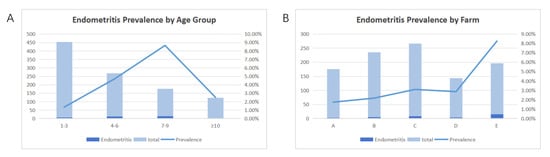
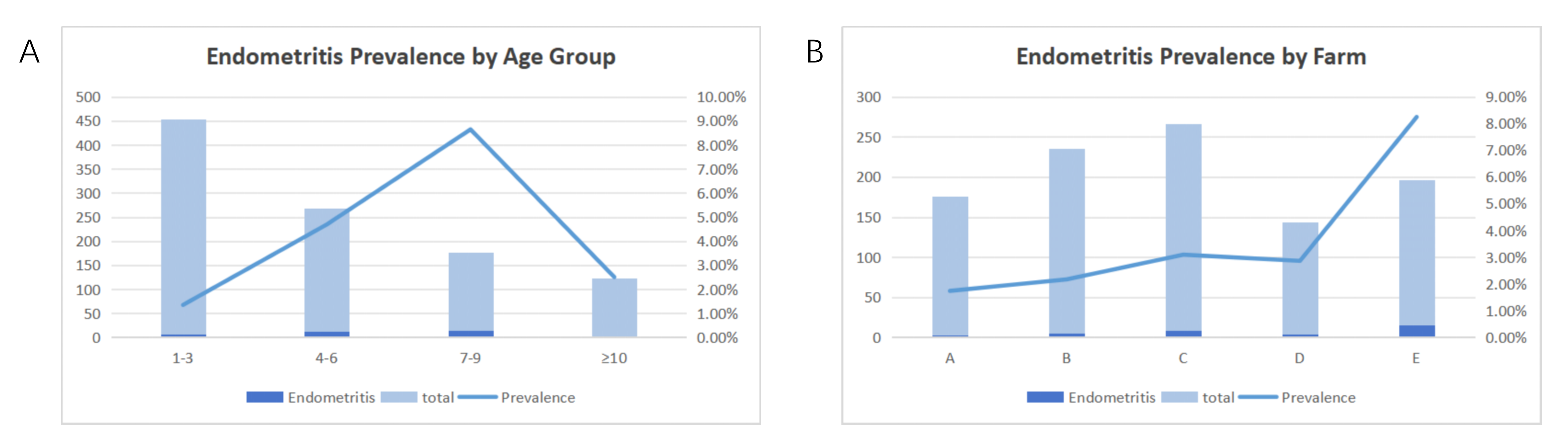
Among the 985 mares examined across five intensive horse farms (A–E) in Zhangye, Gansu Province, 35 were diagnosed with endometritis, yielding an apparent prevalence of 3.6% (95% CI, 2.5–4.9%). Among the 35 mares diagnosed with endometritis, age ranged from 3 to 11 years and parity ranged from 1 to 9. Supplementary Table S1 presents farm-level information on the surveyed population, including breed and age distributions, together with individual age, parity, and bacterial isolation results for the affected mares. The prevalence differed significantly among farms (χ2 = 15.2, df = 4, p = 0.004), ranging from 1.7% (3/173) on Farm A to 8.2% (15/182) on Farm E. A significant age-related pattern was also observed (χ2 = 20.0, df = 3, p < 0.001), with prevalence increasing from 1.3% (6/447) in mares aged 1–3 years to 4.7% (12/256) in those aged 4–6 years and peaking at 8.6% (14/162) in mares aged 7–9 years. Although the prevalence declined to 2.5% (3/120) in mares aged ≥10 years, mares aged 7–9 years had a significantly higher prevalence than those aged 1–3 years after Bonferroni adjustment (adjusted p < 0.001) (Figure 1).
Figure 1.
Apparent prevalence of endometritis in mares by age group (A) and farm (B). In each panel, the bars represent the numbers of mares examined and mares diagnosed with endometritis (left y-axis), while the line indicates the apparent prevalence of endometritis within each group (right y-axis, %). (A), age-group analysis; (B), farm-level analysis.
3.2. Bacterial Identification
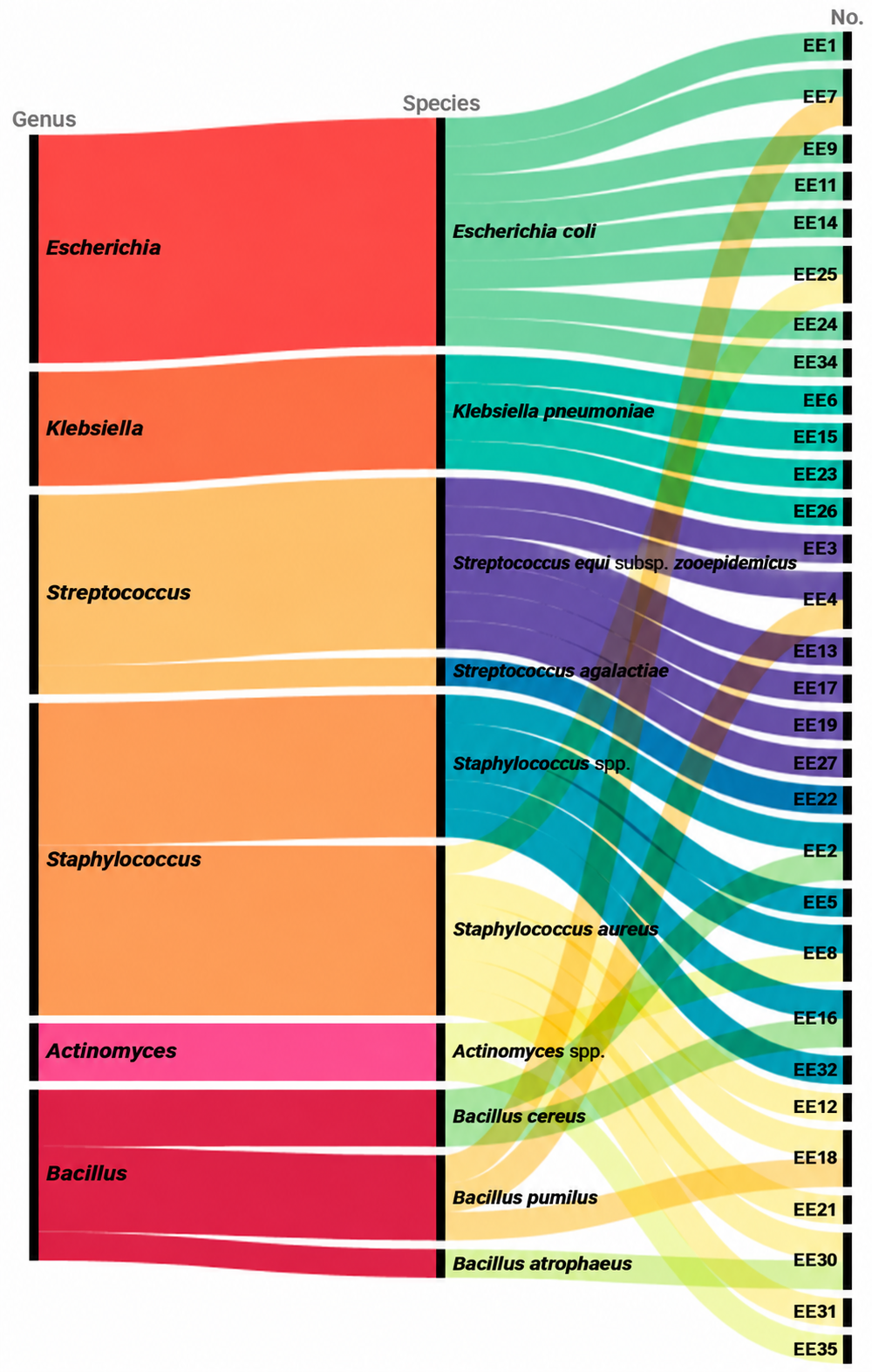
Among the 35 LVF samples included in this study, bacteria were successfully isolated from 30 samples. A total of 38 bacterial isolates were purified. These isolates belonged to six genera, including Staphylococcus spp. (11/38, 28.9%), Escherichia spp. (8/38, 21.1%), Streptococcus spp. (7/38, 18.4%), Bacillus spp. (6/38, 15.8%), Klebsiella spp. (4/38, 10.5%), and Actinomyces spp. (2/38, 5.3%). Specifically, the isolates included eight Escherichia coli isolates, six Streptococcus equi subsp. zooepidemicus isolates, six Staphylococcus aureus isolates, five other Staphylococcus spp. isolates, two Bacillus cereus isolates, three Bacillus pumilus isolates, one Bacillus atrophaeus isolate, four Klebsiella pneumoniae isolates, two Actinomyces spp. isolates, and one Streptococcus agalactiae isolate.
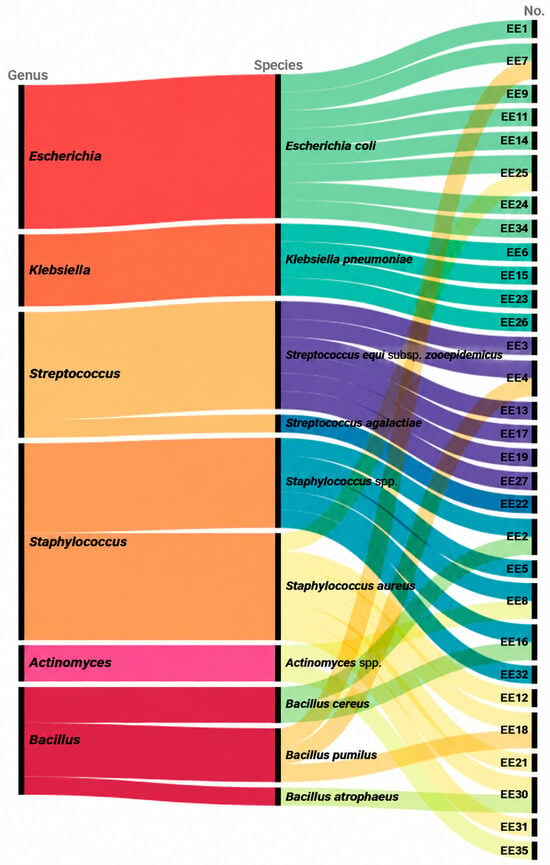
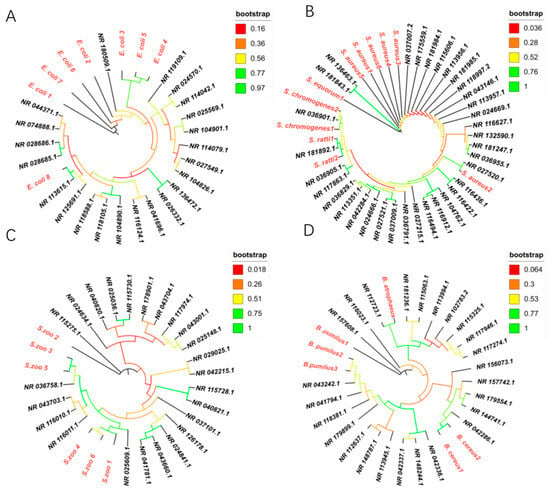
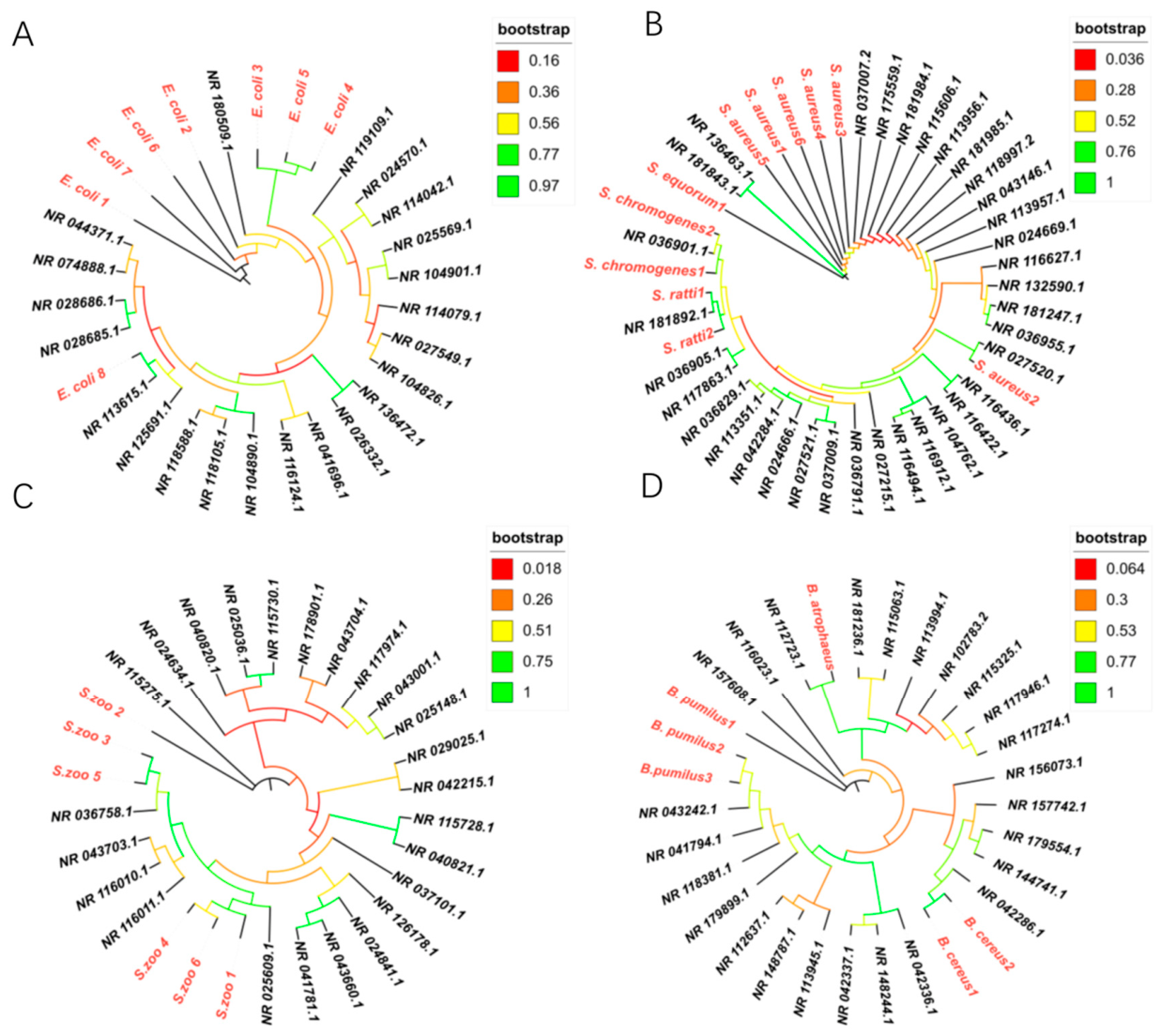
Among the 30 culture-positive mares, a single bacterial taxon was recovered from 22 samples (73.3%), whereas multiple bacterial taxa were recovered from eight samples (26.7%) (Figure 2). Phylogenetic trees were constructed for the predominant bacterial genera, including Escherichia, Staphylococcus, Streptococcus, and Bacillus, using MEGA software version 11.0 (Figure 3). Within the genus Streptococcus, only the six Streptococcus equi subsp. zooepidemicus isolates were included in the phylogenetic analysis, because only one Streptococcus agalactiae isolate was recovered. The results showed that the isolated strains were closely related within their respective genera.
Figure 2.
Sankey diagram showing the distribution of bacterial isolates by genus, species, and sample identifier.
Figure 3.
Maximum-likelihood phylogenetic trees of Escherichia, Staphylococcus, Streptococcus, and Bacillus isolates. (A): E. coli; (B): Staphylococcus spp.; (C): S. equi subsp. zooepidemicus; (D): Bacillus spp. Red labels indicate isolates obtained in this study, whereas black labels indicate reference sequences.
3.3. Antimicrobial Susceptibility
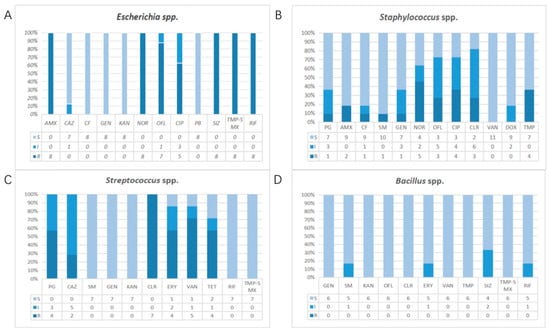
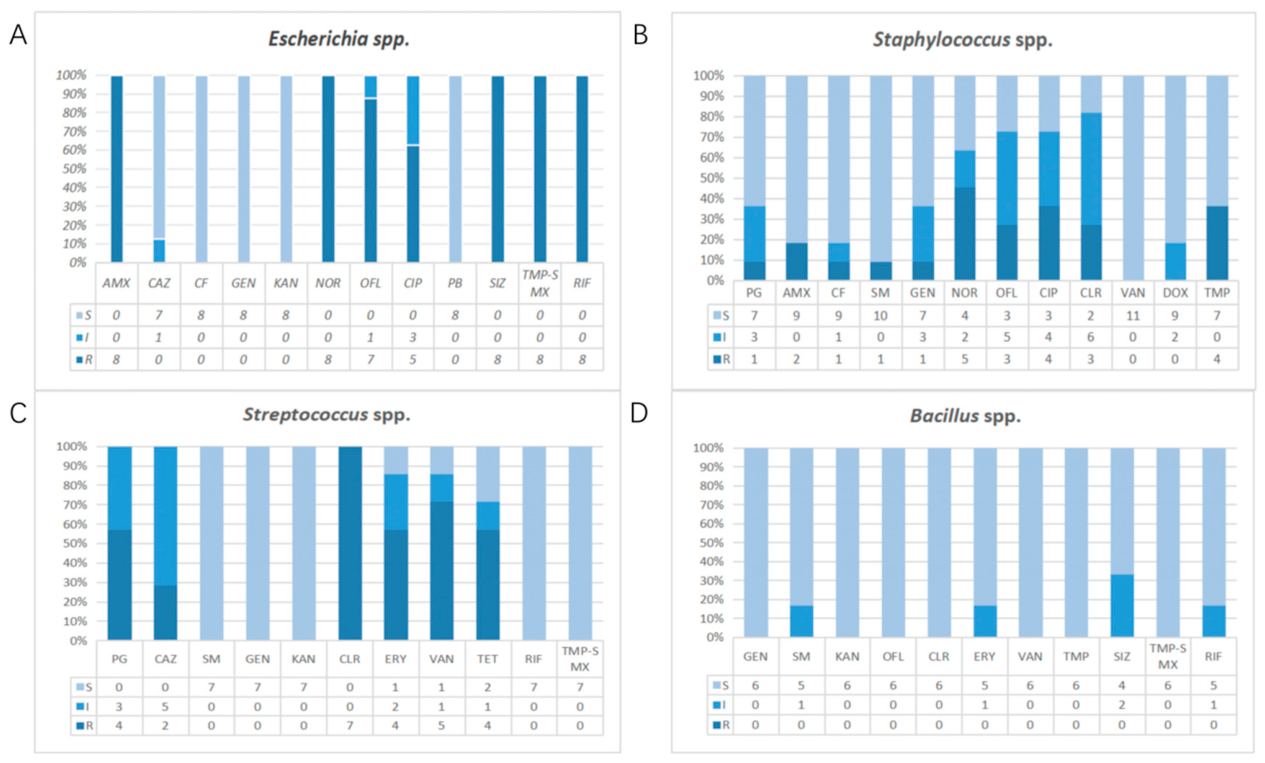
The antimicrobial susceptibility profiles differed markedly among the four bacterial genera. All Escherichia spp. isolates (n = 8) were susceptible to CF, GEN, KAN, and PB (8/8), whereas all isolates were resistant to AMX, NOR, SIZ, TMP–SMX, and RIF (8/8). High resistance was also observed for OFL (7/8) and CIP (5/8), indicating a broad resistance profile (Figure 4A). Among Staphylococcus spp. isolates (n = 11), all isolates were susceptible to VAN (11/11), while high susceptibility was observed for SM, AMX, CF, and DOX (9/11–10/11). Resistance was most frequently detected against NOR (5/11), followed by CIP and TMP (4/11 each). Relatively high proportions of isolates were categorized as intermediate to CLR, OFL, and CIP (Figure 4B). All Streptococcus spp. isolates (n = 7) were susceptible to SM, GEN, KAN, RIF, and TMP–SMX (7/7) but resistant to CLR (7/7). Resistance to VAN was detected in 5/7 isolates, whereas PG, ERY, and TET each showed resistance in 4/7 isolates. In addition, most isolates showed intermediate susceptibility to CAZ (5/7) (Figure 4C). No resistance to the tested antimicrobial agents was detected among the six Bacillus spp. isolates (0/6). All six isolates were susceptible to most tested antimicrobial agents (6/6), whereas four or five isolates were susceptible to SIZ, SM, ERY, and RIF (4/6–5/6; Figure 4D). The susceptibility patterns of Staphylococcus spp. and Streptococcus spp. were more dependent on the antimicrobial agent tested.
Figure 4.
Antimicrobial susceptibility profiles of Escherichia (A), Staphylococcus (B), Streptococcus (C), and Bacillus (D) isolates. The bars indicate the percentages of isolates classified as susceptible (S), intermediate (I), or resistant (R) to each antimicrobial agent. The corresponding numbers of isolates in each category are provided in the table beneath each panel. S, susceptible; I, intermediate; R, resistant.
4. Discussion
In Zhangye, Gansu Province, mare breeding activities are mainly concentrated from April to October each year. In the present study, five intensive horse farms of comparable scale were investigated during this period. A total of 985 mares were examined, among which 35 were diagnosed with endometritis, corresponding to an apparent prevalence of 3.6%. Among the 156 mares with reproductive problems recorded within the previous year, including failure to conceive, repeated estrus, or abnormal vulvar discharge, the detection rate of endometritis was 22.4%. These findings indicate that although the overall apparent prevalence of endometritis was relatively low among all mares on the farms, the disease remained common in mares with reproductive disorders. The number of cases varied markedly among farms, with Farm E having the highest number of cases. The number of cases varied markedly among farms, with Farm E having the highest number of cases. However, the reasons for these differences remain unclear, as farm-level management practices and other potential contributing factors were not systematically assessed. However, these factors were not formally assessed. These observations suggest that farm management may influence both the opportunity for bacteria to enter the reproductive tract and the timely detection of cases with subtle clinical manifestations. However, endometrial cytology was performed only in mares that met the initial screening criteria. Consequently, subclinical cases among mares not selected for further evaluation may have been missed, potentially affecting the apparent prevalence estimates and comparisons among farms and age groups. These comparisons should therefore be interpreted cautiously and not as evidence of independent risk factors.
Some intensive horse farms in Gansu Province are mainly used for the production of equine-derived serum products. Under this production system, production mares are replaced relatively frequently, and older mares with reduced reproductive performance are more likely to be removed from production or culled. In the present study, the prevalence of endometritis increased across the three age groups below 10 years but declined in the oldest age group. This apparent decrease should be interpreted cautiously, as it may partly reflect the reduced number of older mares retained on the farms rather than a true decrease in disease risk. Increases in age and parity may be accompanied by gradual changes in endocrine status, metabolic profiles [11], perineal conformation, vulvar closure function, uterine position, and myometrial contractility, which may weaken uterine clearance of inflammatory exudates and pathogenic microorganisms [12]. Notably, most affected mares in this study lacked obvious fever or large amounts of abnormal vulvar discharge. Instead, they mainly presented with failure to conceive, repeated estrus, intrauterine fluid accumulation, and cytological evidence of inflammation. This suggests that many cases in local horse farms had relatively subtle or nonspecific clinical manifestations. Therefore, screening based solely on obvious clinical signs may lead to missed diagnoses.
In the present study, 30 of the 35 low-volume uterine flush samples were positive for bacterial culture, and a total of 38 bacterial isolates were obtained. The five culture-negative cases may reflect fungal or anaerobic infections, although these were not specifically investigated in this study. At the species level, Escherichia coli was the most frequently detected bacterium, followed by Streptococcus equi subsp. zooepidemicus and Staphylococcus aureus. These bacteria were the predominant aerobic bacterial isolates recovered from mares diagnosed with endometritis in the surveyed population. The major bacterial species identified in this study were generally consistent with those reported in previous studies from China and other countries [8,13,14,15,16,17]. However, the relative proportions of different bacterial species varied among studies. Such variation may be related to regional climate, breeding environment, mare breed, reproductive management practices, antimicrobial use patterns, and differences in sampling and bacterial identification methods. Although isolation measures were implemented during the sampling period, the preceding cytobrush procedure could have introduced bacteria and influenced subsequent LVF culture results. The absence of recorded estrous-cycle stages prevented assessment of this potential influence in relation to cycle stage. Therefore, the recovered isolates should not all be assumed to have caused the pre-existing inflammation.
Among the common pathogenic bacteria identified in this region, Escherichia coli is mainly derived from the intestinal tract and fecally contaminated environments. It may ascend into the uterus through the perineal and vulvar regions. Some E. coli strains possess strong adhesion capacity [18] and biofilm-forming ability [19,20], which may facilitate persistent infection when uterine clearance is impaired. Streptococcus equi subsp. zooepidemicus is a common opportunistic pathogen associated with equine endometritis [21,22]. When the protective barriers of the vulva, vagina, and cervix are compromised, or when uterine clearance is reduced, this organism may colonize the uterus and induce persistent inflammation [23,24]. Staphylococcus aureus and other Staphylococcus spp. are widely present on animal skin, mucosal surfaces [25,26], and in farm environments [27]. Staphylococcus spp. are common pathogens associated with equine endometritis [28]; their detection may be related to breeding, artificial insemination, postpartum examination, and vulvar hygiene conditions [29]. Although Klebsiella pneumoniae was isolated less frequently in this study, it is also an important pathogen associated with equine endometritis [28,30]. Its capsule and biofilm-forming ability [31] may contribute to prolonged infection and increased difficulty in treatment. Bacillus spp. are commonly found in soil, dust, and farm environments [32]. Their detection in the uterus may reflect opportunistic infection, but sampling contamination cannot be completely excluded. Therefore, interpretation should consider bacterial growth abundance, whether the isolate was predominant in culture, the degree of cytological inflammation, and repeat culture results.
Among the culture-positive mares, 73.3% had single-pathogen infections, whereas 26.7% had mixed infection. This suggests that single-pathogen infection was predominant in local cases, although mixed infections may increase treatment difficulty by altering the local uterine microenvironment and promoting biofilm formation [33,34]. Phylogenetic analysis showed that the selected isolates clustered with closely related reference sequences within their respective genera, supporting their taxonomic placement at the genus level. The isolates included in each tree showed relatively limited sequence divergence at the 16S rRNA gene level.
Antimicrobial susceptibility profiles differed among bacterial genera. Escherichia spp. showed complete resistance to AMX, NOR, SIZ, TMP–SMX, and RIF (8/8 for each agent), with high resistance to OFL (7/8) and CIP (5/8), whereas most isolates remained susceptible to CAZ, and all isolates were susceptible to CF, GEN, KAN, and PB (8/8 for each agent). Streptococcus spp. showed complete resistance to CLR (7/7) and relatively high resistance to VAN (5/7), PG (4/7), ERY (4/7), and TET (4/7), but remained susceptible to the aminoglycosides SM, GEN, and KAN, as well as RIF and TMP–SMX (7/7 for each agent). Staphylococcus spp. exhibited lower overall resistance, whereas no resistant Bacillus spp. isolates were detected (0/6). Repeated or empirical use of the same antimicrobial classes, together with inappropriate dosages or treatment durations, may impose selective pressure and promote the persistence of resistant strains [35]. However, because historical antimicrobial-use records and resistance determinants were not systematically investigated, the mechanisms underlying the observed resistance patterns remain uncertain. Therefore, antimicrobial treatment should, whenever possible, be guided by bacterial culture and susceptibility testing rather than prolonged empirical use of broad-spectrum agents.
Overall, this study preliminarily revealed the regional characteristics of equine bacterial endometritis in Zhangye, Gansu Province, in terms of epidemiological features, bacterial pathogen composition, and antimicrobial resistance profiles. These findings provide a basis for local horse farms to identify chronic and subclinical cases, perform etiological diagnosis, and select antimicrobial agents rationally. In particular, for intensive horse farms mainly engaged in the production of equine-derived serum products, strengthening reproductive management and standardizing antimicrobial use are important for maintaining mare reproductive performance, reducing the risk of antimicrobial resistance, and ensuring the quality of serum-derived raw materials. Owing to the limited survey area and number of bacterial isolates, the applicability of these findings to broader regions and different farming systems requires further validation. The lack of reliable reproductive-status classification prevented separate analysis of maiden, barren, and foaling mares. Whether breed characteristics contributed to the relatively low apparent prevalence also remains uncertain, as breed-specific effects were not evaluated.
5. Conclusions
This study investigated 985 mares from five intensive horse farms in Zhangye, Gansu Province, and identified 35 mares with endometritis, corresponding to an apparent prevalence of 3.6% (95% CI, 2.5–4.9%). Most affected mares presented with chronic or subclinical reproductive abnormalities, including failure to conceive, repeated estrus, intrauterine fluid accumulation, and cytological evidence of inflammation. Among the 35 low-volume uterine flush samples, 30 were positive for bacterial culture, and a total of 38 bacterial isolates were obtained. Escherichia coli, Streptococcus equi subsp. zooepidemicus, and Staphylococcus aureus were the predominant bacterial species detected. Recovery of a single bacterial taxon was the predominant culture pattern, although multiple taxa were recovered from some samples. Antimicrobial susceptibility testing revealed marked differences in resistance profiles among bacterial genera. Escherichia spp. and Streptococcus spp. showed relatively high levels of antimicrobial resistance, whereas Staphylococcus spp. exhibited a lower overall resistance level, and no resistant isolates were detected among Bacillus spp. In summary, among the mares examined on the five surveyed intensive horse farms in Zhangye, Gansu Province, endometritis was characterized by relatively subtle clinical manifestations, diverse associated bacterial isolates, and varying antimicrobial resistance profiles among the major bacterial genera. Therefore, early screening of mares with reproductive disorders should be emphasized in clinical practice, and antimicrobial agents should be selected rationally based on bacterial culture and antimicrobial susceptibility testing.
Supplementary Materials
The following supporting information can be downloaded at: https://www.mdpi.com/article/10.3390/ani16213531/s1, Table S1: Farm and mare characteristics and bacterial isolation results; Table S2: Antimicrobial susceptibility results and interpretive criteria.
Author Contributions
Validation, W.D.; resources, R.M.; data curation, X.Z. and R.M.; writing—original draft preparation, X.Z.; writing—review and editing, Q.W.; visualization, Q.W.; supervision, W.D.; project administration, Y.Z. and J.Y.; funding acquisition, Y.Z. and J.Y. All authors have read and agreed to the published version of the manuscript.
Funding
This research was funded by Northwest Minzu University Talent Introduction Project, grant number Z2607115.
Institutional Review Board Statement
The animal study protocol was approved by the Animal Experiment Ethics Review Committee of Gansu Agricultural University (protocol code GSC-Eth-VMC2021-093).
Informed Consent Statement
Written informed consent was obtained from the owner of the animals involved in this study.
Data Availability Statement
The original contributions presented in this study are included in the article/Supplementary Material. Further inquiries can be directed to the corresponding authors.
Conflicts of Interest
The authors declare no conflicts of interest.
References
- LeBlanc, M. Advances in the Diagnosis and Treatment of Chronic Infectious and Post–Mating-Induced Endometritis in the Mare. Reprod. Domest. Anim. 2010, 45, 21–27. [Google Scholar] [CrossRef] [Scilit] [PubMed]
- Troedsson, M.H.; Woodward, E.M. Our current understanding of the pathophysiology of equine endometritis with an emphasis on breeding-induced endometritis. Reprod. Biol. 2016, 16, 8–12. [Google Scholar] [CrossRef] [Scilit] [PubMed]
- Canisso, I.F.; Segabinazzi, L.G.; Fedorka, C.E. Persistent breeding-induced endometritis in mares—A multifaceted challenge: From clinical aspects to immunopathogenesis and pathobiology. Int. J. Mol. Sci. 2020, 21, 1432. [Google Scholar] [CrossRef] [Scilit] [PubMed]
- Liu, I.K.M.; Troedsson, M.H.T. The diagnosis and treatment of endometritis in the mare: Yesterday and today. Theriogenology 2008, 70, 415–420. [Google Scholar] [CrossRef] [Scilit] [PubMed]
- Katila, T.; Ferreira-Dias, G. Evolution of the concepts of endometrosis, post breeding endometritis, and susceptibility of mares. Animals 2022, 12, 779. [Google Scholar] [CrossRef] [Scilit] [PubMed]
- Chinese Pharmacopoeia Commission. Pharmacopoeia of the People’s Republic of China; China Medical Science Press: Beijing, China, 2020; Volume III, pp. 60–61. (In Chinese) [Google Scholar]
- Zhang, X.; Mai, Z.; Gao, Y.; Zhao, X.; Zhang, Y. Selecting potential biomarkers of plasma proteins in mares with endometritis. Equine Vet. J. 2024, 56, 660–669. [Google Scholar] [CrossRef] [Scilit] [PubMed]
- Walter, J.; Neuberg, K.P.; Failing, K.; Wehrend, A. Cytological diagnosis of endometritis in the mare: Investigations of sampling techniques and relation to bacteriological results. Anim. Reprod. Sci. 2012, 132, 178–186. [Google Scholar] [CrossRef] [Scilit] [PubMed]
- Riddle, W.T.; LeBlanc, M.M.; Stromberg, A.J. Relationships between uterine culture, cytology and pregnancy rates in a Thoroughbred practice. Theriogenology 2007, 68, 395–402. [Google Scholar] [CrossRef] [Scilit] [PubMed]
- Morel, M.D.; Lawlor, O.; Nash, D.M. Equine endometrial cytology and bacteriology: Effectiveness for predicting live foaling rates. Vet. J. 2013, 198, 206–211. [Google Scholar] [CrossRef] [Scilit] [PubMed]
- Siemieniuch, M.J.; Gajos, K.; Kozdrowski, R.; Nowak, M. Advanced age in mares affects endometrial secretion of arachidonic acid metabolites during equine subclinical endometritis. Theriogenology 2017, 103, 191–196. [Google Scholar] [CrossRef] [Scilit] [PubMed]
- Woodward, E.M.; Troedsson, M.H. Endometritis in old mares. Pferdeheiikunde 2014, 30, 53–56. [Google Scholar] [CrossRef] [Scilit]
- LeBlanc, M.M.; Magsig, J.; Stromberg, A.J. Use of a low-volume uterine flush for diagnosing endometritis in chronically infertile mares. Theriogenology 2007, 68, 403–412. [Google Scholar] [CrossRef] [Scilit] [PubMed]
- Canisso, I.F.; Stewart, J.; da Silva, M.A.C. Endometritis: Managing persistent post-breeding endometritis. Vet. Clin. Equine Pract. 2016, 32, 465–480. [Google Scholar]
- LeBlanc, M.; Causey, R. Clinical and Subclinical Endometritis in the Mare: Both Threats to Fertility. Reprod. Domest. Anim. 2009, 44, 10–22. [Google Scholar] [CrossRef] [Scilit] [PubMed]
- Beltaire, K.A.; Cheong, S.H.; Coutinho Da Silva, M.A. Retrospective study on equine uterine fungal isolates and antifungal susceptibility patterns (1999–2011). Equine Vet. J. 2012, 44, 84–87. [Google Scholar] [CrossRef] [Scilit] [PubMed]
- Davis, H.A.; Stanton, M.B.; Thungrat, K.; Boothe, D.M. Uterine bacterial isolates from mares and their resistance to antimicrobials: 8,296 cases (2003–2008). J. Am. Vet. Med. Assoc. 2013, 242, 977–983. [Google Scholar] [CrossRef] [Scilit] [PubMed]
- Antão, E.M.; Wieler, L.H.; Ewers, C. Adhesive threads of extraintestinal pathogenic Escherichia coli. Gut Pathog. 2009, 1, 22. [Google Scholar] [CrossRef] [Scilit] [PubMed]
- Thakur, D.; Kumar, L. Biofilm-associated Escherichia coli infections: Pathogenesis, clinical implications, and treatment strategies. Crit. Rev. Microbiol. 2026, 52, 198–242. [Google Scholar] [CrossRef] [Scilit] [PubMed]
- Ageorges, V.; Monteiro, R.; Leroy, S.; Burgess, C.M.; Pizza, M.; Chaucheyras-durand, F.; Desvaux, M. Molecular determinants of surface colonisation in diarrhoeagenic Escherichia coli (DEC): From bacterial adhesion to biofilm formation. FEMS Microbiol. Rev. 2020, 44, 314–350. [Google Scholar] [CrossRef] [Scilit] [PubMed]
- Li, J.; Zhao, Y.; Gao, Y.; Zhu, Y.; Holyoak, G.R.; Zeng, S. Treatments for endometritis in mares caused by Streptococcus equi subspecies zooepidemicus: A structured literature review. J. Equine Vet. Sci. 2021, 102, 103430. [Google Scholar] [CrossRef] [Scilit] [PubMed]
- Rasmussen, C.D.; Haugaard, M.M.; Petersen, M.R.; Nielsen, J.M.; Pedersen, H.G.; Bojesen, A.M. Streptococcus equi subsp. zooepidemicus isolates from equine infectious endometritis belong to a distinct genetic group. Vet. Res. 2013, 44, 26. [Google Scholar] [CrossRef] [Scilit] [PubMed]
- Ma, S.; Luo, T.; Zheng, Y.; Wang, Y.; Yu, J.; Qu, H.; Liu, B.; Wang, T.; Wu, C.; Zhu, Y.; et al. Molecular typing, biofilm characteristics and biofilm-targeted inhibition strategies of Streptococcus equi subsp. zooepidemicus isolated from donkey endometritis. J. Equine Vet. Sci. 2026, 105891. [Google Scholar] [CrossRef] [Scilit] [PubMed]
- Nocera, F.P.; D’Eletto, E.; Ambrosio, M.; Fiorito, F.; Pagnini, U.; De Martino, L. Occurrence and antimicrobial susceptibility profiles of Streptococcus equi subsp. zooepidemicus strains isolated from mares with fertility problems. Antibiotics 2021, 11, 25. [Google Scholar] [CrossRef] [Scilit] [PubMed]
- Fayisa, W.O.; Tuli, N.F. Review on Staphylococcus aureus. Int. J. Nurs. Care Res. 2023, 1, 1–8. [Google Scholar]
- Del Giudice, P. Skin infections caused by Staphylococcus aureus. Acta Derm.-Venereol. 2020, 100, 5725. [Google Scholar] [CrossRef] [Scilit] [PubMed]
- Park, S.; Ronholm, J. Staphylococcus aureus in Agriculture: Lessons in Evolution from a Multispecies Pathogen. Clin. Microbiol. Rev. 2021, 34, e00182-20. [Google Scholar] [CrossRef] [Scilit] [PubMed]
- Pisello, L.; Rampacci, E.; Stefanetti, V.; Beccati, F.; Hyatt, D.R.; Coletti, M.; Passamonti, F. Temporal efficacy of antimicrobials against aerobic bacteria isolated from equine endometritis: An Italian retrospective analysis (2010–2017). Vet. Rec. 2019, 185, 598. [Google Scholar] [CrossRef] [Scilit] [PubMed]
- El-Shalofy, A.S.; Derbala, M.K.; Asfour, H.A.; Eissa, H.M.; Aly, A.B. Infectious endometritis in Arabian mares: An updated clinical investigation of uterine microbial isolates, antimicrobial sensitivities and fertility in Egypt. Thai J. Vet. Med. 2021, 51, 177–184. [Google Scholar] [CrossRef] [Scilit]
- Gravey, F.; Sévin, C.; Castagnet, S.; Foucher, N.; Maillard, K.; Tapprest, J.; Léon, A.; Langlois, B.; Le Hello, S.; Petry, S. Antimicrobial resistance and genetic diversity of Klebsiella pneumoniae from different clinical sources in horses. In Proceedings of the 12th International Equine Infectious Diseases Conference, Deauville, France, 30 September–4 October 2024; Volume 56, pp. 34–35. [Google Scholar]
- Díaz-Bertrana, M.L.; Deleuze, S.; Pitti Rios, L.; Yeste, M.; Morales Fariña, I.; Rivera del Alamo, M.M. Microbial prevalence and antimicrobial sensitivity in equine endometritis in field conditions. Animals 2021, 11, 1476. [Google Scholar] [CrossRef] [Scilit] [PubMed]
- Mahapatra, S.; Yadav, R.; Ramakrishna, W. Bacillus subtilis impact on plant growth, soil health and environment: Dr. Jekyll and Mr. Hyde. J. Appl. Microbiol. 2022, 132, 3543–3562. [Google Scholar] [CrossRef] [Scilit] [PubMed]
- Watnick, P.; Kolter, R. Biofilm, City of Microbes. J. Bacteriol. 2000, 182, 2675–2679. [Google Scholar] [CrossRef] [Scilit] [PubMed]
- Flemming, H.C.; Wingender, J.; Szewzyk, U.; Steinberg, P.; Rice, S.A.; Kjelleberg, S. Biofilms: An emergent form of bacterial life. Nat. Rev. Microbiol. 2016, 14, 563–575. [Google Scholar] [CrossRef] [Scilit] [PubMed]
- Kolář, M.; Urbánek, K.; Látal, T. Antibiotic selective pressure and development of bacterial resistance. Int. J. Antimicrob. Agents 2001, 17, 357–363. [Google Scholar] [CrossRef] [Scilit] [PubMed]

Disclaimer/Publisher’s Note: The statements, opinions and data contained in all publications are solely those of the individual author(s) and contributor(s) and not of MDPI and/or the editor(s). MDPI and/or the editor(s) disclaim responsibility for any injury to people or property resulting from any ideas, methods, instructions or products referred to in the content. |
© 2026 by the authors. Licensee MDPI, Basel, Switzerland. This article is an open access article distributed under the terms and conditions of the Creative Commons Attribution (CC BY) license.